Just International

Trump menaces the world over Iran sanctions

By Peter Symonds

As US sanctions on Iran “snapped back” into force, US President Donald Trump yesterday issued a blunt warning to countries and corporations around the world: “Anyone doing business with Iran will NOT be doing business with the United States.”

The punitive measures follow the Trump administration’s decision in May to abrogate the 2015 nuclear deal with Iran, known as the Joint Comprehensive Plan of Action, or JCPOA. The unilateral US sanctions will ban trade with Iran of commercial aircraft, cars, precious metals, coal, aluminium and steel, as well as Iranian exports of carpets and pistachios.

Washington is threatening to sanction any corporation internationally breaching the bans by blocking it from the US financial system. A second round of US sanctions is due to come into effect in November that will hit all foreign transactions of Iran’s central bank and its oil exports, which comprise the bulk of the country’s export earnings and underpin government finances.

In his tweet yesterday, Trump declared, “these are the most biting sanctions ever imposed,” justifying his stance by absurdly declaring, “I am asking for WORLD PEACE, nothing less!” Under the banner of “peace,” the Trump administration is preparing for trade war and war—not only against Iran, but against all potential rivals to the US, including its European and Asian allies.

Yesterday, the European Union’s (EU) “blocking statute” also came into effect, under which European companies have been instructed not to comply with US demands to cease business with Iran. Those that decide to pull out because of US sanctions will require EU authorization, and without it could face legal action from member states.

Britain’s Foreign Office Minister Alistair Burt told the BBC that the “Americans have really not got this right.” While it was up to companies to decide whether to remain in Iran, he said Britain believed that the 2015 nuclear deal was important “not only to the region’s security but the world’s security.”

Nathalie Tocci, an aide to the EU foreign policy chief Federica Mogherini, warned on BBC radio on Monday night: “If EU companies abide by U.S. secondary sanctions they will, in turn, be sanctioned by the EU.” She said that the measures were “necessary in order to signal, diplomatically, to the Iranians that Europeans are serious” about trying to maintain the Iran nuclear deal.

European companies have already voted with their feet, however. The German auto company Daimler, the maker of Mercedes-Benz cars, confirmed on Tuesday that it had suspended its activities in Iran. Other corporations including Boeing, Airbus, Total and Siemens have already signalled their intention to do the same.

By tearing up the 2015 nuclear deal, the US is also dealing a blow against its European rivals, particularly Germany. German firms, which have close ties with Iran, moved quickly to take advantage of investment opportunities. Last year German exports to Iran increased by 16 percent to nearly €3 billion, but have slumped by 4 percent in the first five months of 2018 as Trump moved to reimpose sanctions.

An unnamed US official declared on Monday that the EU blocking statute was “not something that we’re particularly concerned by.” Another official claimed that “nearly 100 international firms have announced their intent to leave the Iranian market.” It remains to be seen whether the EU and its member states will attempt to enforce the statute by legal action against European companies.

While US sanctions on Iranian oil do not come into force until November, China has already rejected US calls for an end to its oil imports from Iran. US officials visiting Beijing last week told the media that China had only agreed not to increase its purchases. China is the number one buyer of Iranian crude oil.

The Russian foreign ministry yesterday issued a statement branding the sanctions as “a glaring example” of Washington’s violation of UN resolutions and “its trampling on international law.” It urged other countries not to allow the Iran deal to be “sacrificed to American attempts to settle scores with Iran on issues unrelated to the JCPOA.”

The Trump administration abrogated the 2015 agreement despite the fact that the International Atomic Energy Agency repeatedly verified Iran’s compliance with its terms. Under the deal, Iran agreed to severely limit its nuclear programs in return for a step-by-step ending of international sanctions.

The Trump administration, however, has repeatedly denounced the agreement, insisting that Iran completely shut its nuclear and missile programs, submit to ever more intrusive inspections and end its so-called “support for terrorism.” The last demand signifies Iran’s complete subservience to US domination in the Middle East, including the removal of Iranian forces from Syria and the ending of support to groups such as Hezbollah in Lebanon and Houthi forces in Yemen.

US national security adviser John Bolton claimed on Monday that Washington’s policy was not regime-change in Tehran but “to put unprecedented pressure on the government of Iran to change its behaviour.” Such statements are simply not credible. Bolton, himself, is notorious for militarist statements that underscore the decades-long US ambition to install a pliable regime in Tehran.

The Trump administration’s sanctions are clearly aimed at provoking a severe economic and social crisis in Iran. The US decision in May to withdraw from the nuclear accord has already impacted heavily on the Iranian economy. Its currency has halved in value against the US dollar this year on the unofficial market, forcing up the price of food and other basic goods.

The Trump administration is clearly hoping to exploit anti-government protests that have erupted over recent months. The demonstrations, however, have included widely disparate layers, including unemployed workers, teachers calling for better pay, as well as well-off layers angered by the government’s currency controls.

Amid growing strikes and unrest by the working class internationally, the potential exists for a movement not only directed against the repressive Iranian regime, but also against the predatory actions of US imperialism.

8 August 2018

Source: https://countercurrents.org/2018/08/08/trump-menaces-the-world-over-iran-sanctions/

Trump’s sanctions against Iran are a clear breach of international law

By Gholamali Khoshroo

For the first time in the history of the UN, the United States – a permanent member of the security council with veto power – is engaging in penalising nations across the entire world; not for violating a security council resolution, rather, for abiding by it. The resolution in question, UN security council resolution 2231, was authored (including by the US itself) and passed unanimously by the council.

After more than a year of holding the joint comprehensive plan of action (JCPOA – known also as the Iran deal) to ransom and demanding Iran make a spade of unilateral nuclear and non-nuclear concessions, ultimately, on 8 May 2018, the Trump administration withdrew from the JCPOA. Simultaneously, Trump signed a presidential memorandum to reimpose all US sanctions lifted or waived in connection with the Iran deal. As a result, the agreement that was the culmination of more than a decade of negotiations and was endorsed by security council resolution 2231 now faces an existential moment, especially as the first set of US sanctions come into effect this week.

Security council resolution 2231 underlines “promoting and facilitating the development of normal economic and trade contacts and cooperation with Iran” as an essential part of the JCPOA and calls upon all member states to support its implementation, including to ensure Iran’s access in areas of trade, technology, finance and energy, and refrain from actions that undermine it. As part of the JCPOA itself, the US alongside other JCPOA participants, undertook to refrain from any policy intended to directly and adversely affect the normalisation of trade and economic relations with Iran. The Trump administration is nonetheless now targeting countries across the world for actually re-engaging Iran economically in accordance with their obligations under security council resolution 2231.

The US withdrawal from JCPOA and reimposition of its sanctions is a serious breach of its legal obligations under the UN charter, which entails its international responsibility. The international community must act in the face of this international intimidation and affront towards the international legal order.

What the Trump administration has done, through threatening economic revenge against the countries that continue their economic ties with Iran, is to weaponise its economy. It is a clear rejection of diplomacy and multilateralism; a clear call for confrontation rather than cooperation; an open invitation to resorting to logic of force instead of force of logic. Such reckless and menacing behaviour by the Trump administration renders it responsible for the ensuing adverse consequences, and it must be held accountable for such blatant material breach of its obligations under the JCPOA; for the consequences of its wrongful acts that fly in the face of the UN charter and international law; and for the damages and irreparable harm it has caused to Iran and its international business relations.

While the International Atomic Energy Agency (IAEA) has confirmed Iranian compliance in now close to a dozen periodic reports, the US’s performance has been abysmal from before the withdrawal and persistently in blatant violation of the letter, spirit and intent of the JCPOA almost from its inception. The US government’s agencies and instrumentalities actively and consistently were deterring and discouraging businesses from engagement with Iran.

The Trump administration’s abdication of the deal is a tragedy for multilateral diplomacy and will leave a deep scar on the credibility of such needed diplomatic ventures for some time to come. The spectre of extreme unilateralism, terminal intransigence and the unwinding of vital global institutions is a threat not just to my country, but to every nation. It may be tempting to hope for the proverbial passing of the storm, but at this point in time that is clearly no longer a sustainable approach. It is our true belief that each and every member of the community of nations has a duty to stand up to lawlessness and contempt for the rule of law in international relations; in particular, by refusing to give effect to irresponsible acts and by holding any law-breaking party accountable for the consequences of its acts.

Gholamali Khoshroo is Iran’s ambassador to the UN

8 August 2018

Source: https://www.theguardian.com/commentisfree/2018/aug/08/donald-trump-sanctions-iran-international-law

Assad: Israel Has Exhausted Our Patience and Iran Will Stay. But Has Putin Cured Netanyahu of His ‘Unsuitable Ideas’?

By Elijah J Magnier

The Syrian president Bashar al-Assad has communicated to the Russian leadership that “Israel has exhausted our patience” … “Israeli jets will be a legitimate target for our defence systems if Tel Aviv doesn’t cease its provocation and stop targeting our military positions and jets”. According to decision makers, “Assad has no intention of asking Iran and its allies to leave the Levant as long as any Syrian territory is occupied”. Assad has included the Golan Heights in ‘all occupied Syrian territories’, as well as the north of Syria where the Turkish and the US forces, unlike the those of Iran, are present without the consent of the Syrian government.

Moreover, according to the source, “Assad believes that the Syrian government will not be tamed by offers presented by Russia for a plan which would propose the return of all refugees, so as to be able to run the forthcoming elections over the entre Syrian territory, and the reconstruction of Syria by the international community in exchange for an Iranian withdrawal. However, the implementation of UN resolution 242 (1967)  (withdrawal of Israeli armed forces from territories occupied in the recent conflict) and the respect of Syrian sovereignty (cessation of Israeli violations of Syrian air space) is the right path for the withdrawal of all forces from Syria, including those of Iran”, said the source.

Russia is trying to create stability in the Levant, considered a permanent base for its forces and an essential platform for a much larger economic future and link to the world. Tass news agency said Russian Foreign Minister Sergey Lavrov and Chief of the General Staff Army Valery Gerasimov “visited the Israeli prime Minister Benjamin Netanyahu to discuss issues concerning the Syrian conflict”. The two hour meeting is part of the pre-organised exchange of visits established during Netanyahu’s last visit to Moscow where he met the Russian President Vladimir Putin.

Russia is caught between two tough countries, Syria and Israel, where their respective leaders do not give anything away without a hard bargain. However, seeking an Israeli withdrawal from the occupied Golan heights is an impossible task for Putin, particularly with Netanyahu in office. Therefore, it is most likely that Israel will continue violating the Syrian air space and bomb targets randomly. In exchange, it is also expected that Russia will watch happily the Syrian army responding to those expected Israeli attacks- with the (slim) hope to bring both parties to make concessions over their respective demands.

It is expected that Russia will communicate to the Israeli premier the possibility that Syria will fire against Israeli jets and respond to any future aggression.

Even as the Syrian army and its allies were liberating the south of Syria (the provinces of Daraa and Quneitra), and during the attack against the “Islamic State” (ISIS) designed to liberate the villages and the territory under its occupation (along the 1974 disengagement line), four Israeli jets violated the Lebanese airspace and fired from above the Bekaa valley. 10 missiles were fired against a Syrian military target between the cities of Zawi and Deir Mama in rural Homs. Six of these missiles reached their target.

A Syrian fighter jet is seen in flames after it was hit by the Israeli military over the Golan Heights on September 23, 2014

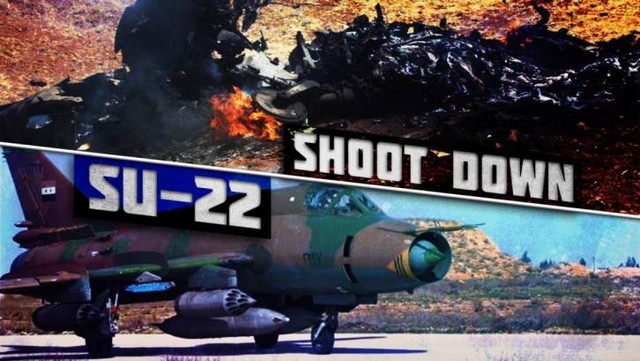
The following day, on the 24thof July, Israel launched a patriot missile against a Syrian Su-22M4 jet while bombing ISIS in south Quneitra. This is considered a clear violation of the 1974 agreement that “permitted Air Forces of the two sides (Syria and Israel) operate up to their respective lines without interference from the other side”. Israel – feeling strong with the US support and believing Russia is on its side – is provoking, and challenging, the Syrian army. Damascus is expected to wait for the appropriate moment to fire against Israeli settlements or cities- once the south of Syria is cleared from ISIS, or perhaps when the opportunity arises.

Moreover, the Syrian military development centres spread over the territory aim to manufacture middle and long-range missiles, benefitting from the long experience gathered in seven years of war and from the development by Syria’s allies of new warfare technology.

Sources within the Syrian leadership said “Damascus has defence and cooperation agreements with several countries. Therefore, developing its arsenal is part of the military plan to defend its territory against any outside aggression”.

Sources internal to Syria’s allies said the following: “Iran managed to deliver to Hezbollah tens of thousands of missiles of all calibres. The most precise and accurate missiles have been delivered already and will be used if ever Israel decides to attack Lebanon. Therefore, preventing Syria from developing its arsenal is an unrealistic and idiotic idea”.

The Israeli officials have raised the question of the long-range weapons Syria has developed for over a decade- it continues to do so. “This demand is obviously impossible to meet regardless what Israel can offer in exchange, even if the occupied Golan Heights is on the negotiation table. Hezbollah has these missiles in its arsenal and has managed to create a balance of power with Israel- it stopped the Israelis during the second war in 2006. Syria’s sovereignty is at stake and without precision missiles, Syria becomes weak. Israel doesn’t negotiate with weak countries”, said the source.

Assad’s message is very clear and he is determined to stop future Israeli aggressions, indicating his continuing readiness to respond in spite of the Russian request to “bring down the level of tension with Israel”. According to Assad, “the security and the protection of Syria comes before the relationship with our strategic Russian ally. The Syrian government will not abide by self-control policy unless Israel stops bombing military targets in Syria”. Assad will reject any Russian request for self-restraint if Israel continues provoking the Syrian army.

During the seven years of war imposed on Syria, Israel carried out over 100 attacks against the Syrian army positions in various parts of the country. It has also supported militants and jihadists by providing military and intelligence support, logistic and medical services. The Syrian army limited itself to intercepting as many missiles as possible and has shot down two jets on one occasion (Israel recognised only one) over the occupied Golan heights, during their raid.

During Netanyahu’s last visit to Moscow – according to top decision makers in Syria – the Israeli prime minister said his army “has the intention of attacking ISIS, al-Qaeda and other jihadists and militants in the south of Syria all along the 1974 disengagement line and advance into Syrian territory to create a buffer zone”. The Israeli prime minister wanted Putin’s approval of the plan, and in consequence, the acknowledgement of the Israeli permanent occupation of the Golan Heights. Any future negotiation between Syria and Israel would then concentrate on the newly occupied territory and no longer the one occupied during the six-day war in 1967 and annexed in 1981.

President Putin – said the source – responded that “Russia can guarantee that Iran and its allies will not fire one single shot beyond the 1974 disengagement line during the liberation of southern Syria. This line is approved by the UN, therefore will be respected. However, if Israel decides to push its army beyond this line, it would be the biggest gift you are offering to Iran and its allies and a valid reason to attack you. I’ll pull my forces out of the south and leave you with your unsuitable ideas”.

Netanyahu considered President Putin as a great friend of Israel because he engaged himself in preventing any attack beyond the 1974 disengagement line, while President Assad considers Putin has won over both Netanyahu and President Donald Trump by recognising the 1974 disengagement line. This means Russia didn’t give Israel and the US anything at all. It limited itself to recognising the established line, thus, any future negotiation to reach the recovery of the occupied Golan Heights will begin from this line.

Assad has won over all the countries who “did their best” – offering tens of billions of dollars, investing in intelligence, sending proper troops, opening the road to jihadists from all over the world – just to bring him down! But the regime held together, compact and strong, and came out stronger than ever, with unrivalled military experience. Assad therefore will have no qualms when he decides to respond against Israel, in due course.

By liberating the south, Syria will be faced with two occupation countries, the USA and Turkey. There will no longer be dozens or even hundreds of groups and organisations paid by different foreign countries for their confrontation. Therefore, when Assad says “my patience is coming to an end” he means firing against Israeli jets will not be difficult and that his allies, Iran and Hezbollah, will be more than happy to support him.

And lastly, Assad is part of the “Axis of the Resistance” and the year 2018 no longer resembles the 2000’s, before Assad joined the axis. Then, the international community and the Arab countries offered the Syrian president many concessions and financial support to stop the flow of weapons from Iran to Lebanon via Damascus and the harbour of Latakia. At a certain point, Assad told Hezbollah that he wouldn’t deliver to the Americans but wouldn’t stand in the way.

Today, following seven years of war, Syria has selected its friends and its allies. Iran and Hezbollah are part of Syria and their destiny is linked to the Levant. They have offered finance, logistics, oil, men, and thousands of killed and wounded to keep Syria united. That Assad can never forget.

Russia is, on the other hand, Syria’s ally and they have a mutual interest in the stability of the Levant. It also has interests with Israel, with the US and with the Arab Gulf countries who played an important role in the seven years of war in Syria. However, Putin managed to swallow the Turkish provocation in 2015 when the Turkish defence system shot down a Russian Sukhoi while in operation against jihadists in rural Latakia. Will he now accept Netanyahu’s continuing challenge to the stability of Syria, accepting and believing he can negotiate under fire?

When Putin throws a football to Donald Trump during the Helsinki meeting this month, and here throws the ball to Netanyahu to decide, is he stopping his incursions into Syria or is he encouraging escalation?

Elijah J. Magnier is a Senior Political Risk Analyst with over 32 years’ experience covering Europe & the Middle East. Acquiring in-depth experience, robust contacts and political knowledge in Iran, Iraq, Lebanon, Libya, Sudan and Syria. Specialized in political assessments, strategic planning and thorough insight in political networks.

30 July 2018

Source: https://russia-insider.com/en/assad-israel-has-exhausted-our-patience-and-iran-will-stay-has-putin-cured-netanyahu-his-unsuitable#.W2lBOrjHWgs.whatsapp

Kushner Reportedly Worked to Strip Jordan’s Two Million Palestinians of Refugee Status

By haaretz.com

Jared Kushner, U.S. President Donald Trump’s senior adviser and son-in-law, has reportedly pressured Jordan to strip the refugee status of more than two million registered Palestinians living in the country.

According to a report in the U.S. magazine Foreign Policy, Kushner raised the issue with Jordanian officials in the region during his visit there in June.

Hasan Ashrawi, a member of the Palestine Liberation Organization’s Executive Committee, claimed that the senior aide’s move was part of a broader effort by him and the U.S. administration to render UNRWA, the UN aid agency providing relief to Palestinian, irrelevant and halt its work in Jordan and in other countries in the Middle East.

“[Kushner said] the resettlement has to take place in the host countries and these governments can do the job that UNRWA was doing,” Ashrawi said.

The Palestinians’ chief negotiator, Saeb Erekat, told reporters after Kushner’s visit to Jordan in June that the latter’s delegation said it was ready to stop UNRWA funding and redirect the sum allocated to the agency to Jordan and other countries that host refugees.

Emails written by Kushner and obtained by Foreign Policy point to Kushner’s evident dismay with the UN agency as well as to discreet attempts to put a stop to UNRWA’s work — a move that would essentially render millions of Palestinian refugees status-less.

“It is important to have an honest and sincere effort to disrupt UNRWA,” the senior aide reportedly wrote Trump’s Middle East envoy Jason Greenblatt in an email dating back to January 11, 2018. “This [agency] perpetuates a status quo, is corrupt, inefficient and doesn’t help peace,” Kushner said of UNRWA.

Other such expressions were reportedly repeated in different exchanges the president’s son-in-law had with other U.S. officials.

Kushner, who has been toiling on a peace plan that Washington is slated to present to Israel and the Palestinians in the near future, was trying to disrupt the UN agency’s work as part of a bigger move, which American and Palestinian officials say is an attempt to completely remove the Palestinian refugee issue from the negotiations table.

There are at least two different bills currently being reviewed in Congress regarding this issue.

“Our goal can’t be to keep things stable and as they are [S]ometimes you have to strategically risk breaking things in order to get there,” Kushner was quoted as writing to Greenblatt in the same email.

The U.S. administration has helped fund UNRWA since it was formed in 1949 to provide aid to Palestinians displaced from their homes following the establishment of the State of Israel. The agency is considered to be a significant actor in the region, mainly due to the fact that it has been providing food and other essential services to Palestinian refugees for decades.

But while previous administrations have considered the agency to be an important contributor to the region, the newly disclosed emails reveal the current team in the White House may be willing to tip the balance in Israel’s favor by changing the terms of the Palestinian refugee issue and downgrading UNRWA’s significance as well as the scope of its activity.

6 August 2018

Source: https://www.haaretz.com/us-news/kushner-worked-to-strip-status-of-palestinian-refugees-1.6341143

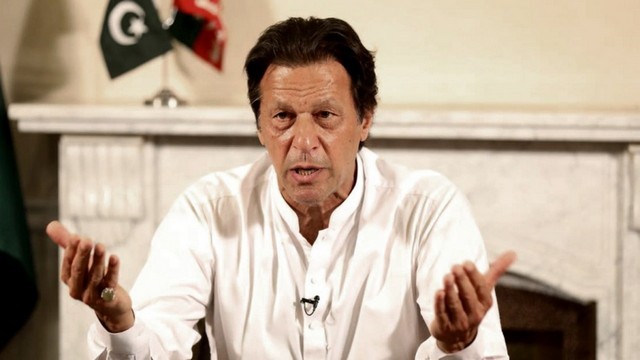
Pakistan’s Elections and the Rise of Imran Khan: More than Meets the Eye

By Junaid S. Ahmad

The fever-pitched aura around this year’s elections in Pakistan was for good reason: a palpable feeling of transition from the old to the new was in the air. Meanwhile, the Western mainstream (and alternative) media, as well as much of the native elite English media, advanced an atmosphere of hysteria and moral panic at what they called “Pakistan’s dirtiest elections” ever.  We were told to believe that the Pakistani military, which undoubtedly has been involved in the political life throughout the country’s history, indeed directly ruling the country for half of its history, was the sole factor for which the corrupt and ruthless politicians of the two parties, who believe it is their birthright to play a game of musical chairs with each other, looting and plundering as much as possible before they are removed and get their next turn – were rejected in these elections.

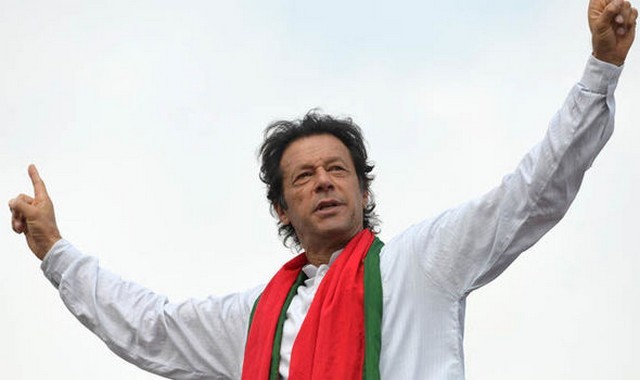
Pakistan-Tehreek-e-Insaaf (PTI), or the “Movement for Justice,” the political party of the iconic cricketer-turned politician Imran Khan, has swept this year’s national elections. They are the single largest political party in the country’s National Assembly, the unquestioned victor as the party that will continue to govern the province of KPK in the Northwest of the country (PTI governed the province for the past five years), and has even made inroads in Pakistan’s major city of Karachi, where they have displaced the once all-powerful Muttahida Quami Movement (MQM), which operated in a semi-fascist, mafioso-style, with rampant intimidation, ransoms, and murders. The MQM ran the streets and political life of Kararchi since their inception in the 1980s. MQM’s declining fortunes were of course facilitated by a relatively popular demand that the Pakistani military come to the city and deploy rangers to ‘clean up’ the vigilantes of the MQM. The bulging urban youth of Pakistan’s financial heartland seemed to have voted for PTI en masse.

Imran Khan, who founded his PTI political party in 1996, had developed an impeccable reputation in both his leadership of Pakistan’s cricket victory in the World Cup of 1992, as well as his widely-respected social welfare activities in the country, including a cancer hospital for the poor in the name of his late mother. But Khan made a sharp turn in his life, and decided that to truly transform Pakistan, structurally and systemically so that the same rut does not keep reappearing with different (dynastic, feudal, or clan) names, political engagement was essential. Though there are other smaller political parties, including provincial ones as well as a few national religious parties, the national civilian political life of the country has been dominated by two political parties: the Pakistan People’s Party (PPP) of the Bhutto family, formed amidst the anti-military dictatorship mass popular movement in the late 1960s, on the one hand, and the Sharif family – who effectively were created out of thin air by the rightwing Zia-ul-Huq military dictatorship. The Sharifs and their Pakistani Muslim League (PML) was established by the military high command to counter and undermine the renewed anti-dictatorship opposition emerging from the PPP.

After the death of Zia, Pakistani political life was effectively a duopoly of political rule, with the PPP and the PML(N) taking turns in governing the country – with an interlude of another stint of military rule between 1999-2007 under Gen. Pervez Musharraf. The ostensible ‘governance’ of the country was more akin to a modus vivendi between the two parties that each will get their turn to engage in gross corruption, plunder, and patronage to their sycophants and followers. The health, education, and welfare of ordinary Pakistanis was not on the agenda of either of these parties. Though PPP was considered the ‘progressive/left’ party, and the PML(N) the ‘conservative/right,’ they effectively joined the international trend under this period of neoliberalism, of converging as an ‘extreme center,’ as Tariq Ali puts it – fundamentally no different in their social and economic policies, their only extremism being that of ‘extreme’ servility to Washington, the IMF, the World Bank, and so on.

Pakistan’s transition to civilian democracy has always had major bumps here and there, and though the military shares its blame in its maneuvering and machinations in the country’s politics, the real curse has been that, since the 1970s and the period of Pakistan’s most gifted and formidable civilian political leader, Zulfiqar Ali Bhutto, Pakistani civilian ‘democrats’ have not really given Pakistanis a reason to bother whether they are ruled by the civilian plutocrats or the military. This is why there was absolute indifference to the military coup of General Pervez Musharraf in 1999. Would we expect people to march to defend the gross corruption and the growing authoritarianism of Nawaz Sharif? But the past two decades, roughly paralleling the disastrous ‘Af-Pak’ theatre of the US ‘war on terror,’ political consciousness among Pakistanis, especially the youth, began to rise rapidly. This was also because, ironically, General Musharraf’s military regime actually permitted the explosion of media channels and widened ideological-theological diversity, under his semi-serious “enlightened moderation” project. Imran Khan began really getting into the trenches of political activity in the movement against Musharraf’s dictatorship. That period, leading up till 2007, galvanized young people, lawyers, and ordinary Pakistanis in a profound way, creating a political consciousness that was neutralized and defanged during the entire neoliberal period. To bring about change, join (or even better, create your own) NGO – this was the rule of thumb for any Pakistani exhausted and shamefully exploited by her/his comprador class of incompetent and corrupt political ‘leaders.’

Before 2007, neoliberal ideology taught the world that politics is a messy business. The democratic civilian merry-go-round of the PPP/PML(N) of the 1990s achieved the goal of neoliberal ideology: de-politicization, atomization, and alienation of the population. And since the shelf life of every military ruler of Pakistan never exceeding a decade, Musharraf was ousted in 2007, under a deal manufactured by Washington whereby the PPP’s longstanding leader, Benazir Bhutto, would be brought back in a power-sharing arrangement. The tragic assassination of Benazir in Dec. 2007, of the ‘Daughter of the East’ (but to many, the ‘daughter of the West’), paved the way for her notoriously corrupt husband, Asif Ali Zardari, to be the undisputed leader of the party.

The ‘progressive’ PPP has functioned as a family dynasty, with the daughter (Benazir) taking over and then, in her will, ‘bequeathing’ the party to her husband and son! Throughout Zardari’s reign from 2008-13, the country was again propelled in an ocean of corruption combined with the most slavish servility to dictation from Washington. It was not difficult to understand why Zardari’s PPP got routed in the following national elections of 2013, bringing to power, once again, the same old face of Nawaz Sharif of the PML(N) as Prime Minister, and his brother Shahbaz Sharif as the Chief Minister of the Punjab, the largest and the most politically influential province in the country. The Sharif brothers and their PML(N) political party have treated Punjab as their playground, from where they dominated not just the province, but the entire country through neo-colonial relationships with the other provinces. They could never fathom that any political force could arise to even remotely challenge their monopoly of political power in the province.

But as Khan did with Musharraf, and then with Zardari (as well as with the clownish head of the semi-fascist MQM political party in Karachi – now decimated by the military’s intervention), he did with Nawaz Sharif as well: he went after them and their corruption like a bulldog, fearless in the face of the wealthiest and most powerful sections of Pakistani society. After the Panama Papers scandal that demonstrated that Nawaz Sharif had clearly been involved in massive corruption and money laundering, Khan would not leave the streets of Islamabad until the Supreme Court took notice of this. And when the Court did, it found Nawaz Sharif to be ‘unfit’ to be prime minister and called for the establishment of an anti-corruption court to fully investigate all charges of corruption. That court handed down its verdict weeks ago, a damning indictment of Nawaz Sharif and his daughter, Mariam Sharif, for not disclosing massive amounts of ill-gotten hidden assets, including prime property in London.

It is at this point, roughly around the 15th of July, that things begin to feel like the…US elections of 2016. PML(N) is the natural heir of power of the Punjab, and of Pakistan, and was a creation of the much-hated ‘establishment,’ hated by liberals, Western think tanks, and security studies hacks, the media – basically everybody.It was at this point that full-blown historical amnesia was being propagated endlessly, and the old political charlatans getting a complete makeover. After all, the Sharif brothers had no problem in permitting the most violent and repugnant forces on the loose during the 1990s when it served them and their business empire’s purposes to do so. But, as we all know, Washington has been in search of ‘moderate Islam’ now for a while, and you know that the world has gone upside down when Nawaz Sharif is presented as the ‘liberal reformer’ advancing fairness and justice in society. It’s a bit like his friend-backer in Riyadh, MBS as he is called.

The PML(N)’s rule was equally marked by corruption, unnecessary – but conspicuously visible – initiatives all at the expense of investing in the education, health and well-being of ordinary Pakistanis. But the PML(N) and Nawaz Sharif, even sitting in jail during these elections, felt entitled to once again win big time and Sharif essentially portraying himself as a martyr for ‘democracy.’ Things didn’t exactly work out that way.

Love him or hate him, Imran Khan has been a persistent pit bull in attacking the political class of all of the major political parties, for their utter indifference to the plight of the poor and the bulk of the population. As he said in his initial victory speech, “I believe a society should be judged not by the lifestyle of its rich, but of its poor.” The first component of Khan’s ‘manifesto’ (if we can call it that) is to make Pakistan a “welfare state” that delivers social justice to its people, and not simply be a country to serve the elite. This of course is anathema to neoliberalism and international finance capital, where countries of the Global South are merely supposed to prostrate themselves and their resources for Western elites and their native ‘friends’ in these formerly colonized countries.

But the problem Pakistan had begun to face even before Khan’s victory, was something eerily similar to Pakistan’s own version of “Russiagate/Russia-phobia” fixation. Just replace Putin with the military establishment, and all the chips fall into place. Trump won because of Putin, and Khan because of either direct or indirect military support. Just like the Democrats ignore the sheer political bankruptcy of a candidate like Hillary Clinton, the PML(N) could not fathom how it being the ‘sons of the soil’ of the powerful Punjab could be trounced so badly. The ‘sons of the soil’ just forgot how ruthless they have been in inflicting the myriad cruelties, injustices, and disparities among the broad populace. But the mantra became the same: just blame the establishment, or Putin, or both! The maddeningly hysterical reaction to Khan from the liberals (who overnight ALL became PML(N) supporters) demonstrated quite clearly, for a while now, how the purse strings of the civilian ‘democrats’ have been tied to their subservience to Washington, Riyadh, and even New Delhi.

It’s not emphasized enough, but Pakistan’s decision to refuse to participate in the criminal Saudi war on Yemen in 2015 was a historic turning point. It was the beginning of the process of deepening decolonization, since the Saudis and Americans have always expected Pakistan to dance to their tune. It is Imran Khan’s consistent and principled position against the Af-Pak theatre of the ‘war on terror,’ his constant emphasis on a political solution rather than a military one, that had the liberals incessantly mocking him as ‘Taliban Khan,’ unable and unwilling to engage in any rational discussion on these issues. It was a cheap shot by the liberals, but didn’t matter much since the bulk of the population agreed with Khan that American drone strikes are illegal and immoral, that the occupation of Afghanistan will definitely generate a Pashtun resistance. And in addition, if Pakistan gets involved, militarily, in this imperial enterprise, it will face disastrous consequences.

He was proven correct, with the enormous increase in militancy and terrorism throughout the country. His legitimate critique of American imperial policy – that always expected the Pakistanis to act as its satraps from early on in the Cold War – made the unthinking liberal believe that he is ‘anti-American’ or ‘anti-Western,’ whatever that means. There is a deep psycho-cultural schizophrenia amongst the secular moderns of Pakistan that believe the West can do no wrong, and that we in the Global South must self-orientalize ourselves as lazy, corrupt, backward, unchanging and static. The livelihoods of the country’s comprador liberal elite class depends on regurgitating this imbecilic narrative, so they can position themselves as the ‘enlightened few’ among an ‘herd’ of backward fundamentalists.

From the native elite who despised Khan both for his emphasis on decades of elite ravaging and plundering of the country at the expense of suffering majority, as well as from arch-rival India which saw Nawaz Sharif as merely a cog in their expanding role as a sub-imperialist power, someone who would toe their line reflexively on whatever issue it may be – the shock and hysteria to Khan’s astounding victory was understandable. Throughout this period, Khan has been absurdly compared to Narendra Modi and Donald Trump, two men whose campaigns were based almost entirely on the ugliest forms of racism, bigotry, and fear of ‘others,’ both internal and external. This fictional fantasy of the liberal elite could only hold water because they bought the cool aid that Khan was some irrational hater of the West, of India, and had a bit too much of an affinity with religion for them to swallow.

Much of the liberals’ commentary in elite English media demonstrated was that their contempt for Khan was really a contempt for ordinary Pakistanis, whom they thought were too ignorant and ‘backward’ – subjected to ‘false consciousness,’ of course. These elites could not see right under their noses, not see that Khan’s agenda, what he stood for, was completely being distorted by a Westoxificated Pakistani elite – and their patrons abroad – that takes more pride in their American/British accents than whether the nation is tackling issues such as widespread malnutrition and fatally unsafe drinking water that is affecting tens of millions of Pakistanis, especially children.

The first insidious insult, as mentioned above, was to ridicule the cricketer-turned-politician as ‘Taliban Khan’ merely because he took an anti-war position. Islamophobia runs so deep in the ‘enlightened’ liberals and progressives of Pakistan that they are more than willing to endorse indiscriminate bombardment (by the US or Pakistani military, doesn’t matter) against peoples and areas that just seem to look ‘too Muslim.’ Long beards and the rest of it, especially in the tribal and ‘backward areas’ – not exactly fitting the profile of the secular modern that they want to showcase to the world as the ‘other Pakistan.’ The Pakistani Westoxificated native elite’s profiling of their countrywomen and men seems to be taken straight from a Western government’s ‘Countering Violent Extremism’ (CVE) playbook – with its ridiculously racist presumptions around Muslims and ‘radicalization.’

In the same light, Khan is constantly accused of pandering to the religious right and not doing enough to distance himself from some of these groups and parties. First, it must be emphasized how hypocritical this is coming especially from the PML(N), the Sharif brothers the protégés of the most reactionary Islamist military dictator in the country’s history, and who continued – long after Zia – to patronize these assortment of fanatical, sectarian fundamentalists, especially in the Punjab. Indeed, both the PML(N) and the ‘progressive’ PPP have courted religious parties as coalition partners in virtually every term of theirs in office. But Khan is now being singled out for not speaking loudly enough on one issue that was given prominence last year, i.e. the Blasphemy Law and the status of the finality of the Prophet Muhammad – a clear reference to the claim of the Ahmadiyya Muslims that one other prophet, Ghulam Ahmad, was the final one.

None of these are the issues that Khan ever raised. The religious bigotry in national discourse was handed down to him for at least the past four decades – he is not responsible for it but it is easy for the liberal not to discredit him if he does not have the pristine progressive position on all religious matters. Khan was concerned with holding the high and mighty accountable, trying to reduce the cancerous corruption in the country, offer some form of a ‘welfare’ state, and resist being a quisling state that is expected to follow orders from Washington, or Riyadh. But the liberals panic when such issues are raised, so other non-issues were thrust upon him.

The liberal critics who say that he has not spoken strongly enough on these very sensitive religious issues in the country suffer from criminal historical amnesia that forgets that the most progressive national leader in the country’s history, Zufiqar Ali Bhutto, initiated this intertwining of (reactionary) religion and politics, with things getting far worse in the following decades. This is what has been bequeathed to Imran Khan (not by his own choice) by the PML(N) and the PPP, who were complicit even when there were military regimes in power, in facilitating the free reign given to these violent and sectarian outfits. From the word go, Khan has emphasized Islam as a religion that demands social justice, and offers what the liberation theologians call ‘a preferential option for the poor.’ Time and time again he emphasizes how Islam can only be made relevant if it is able to empower and uplift the marginalized and downtrodden, and to speak truth to power. But of course, the liberal mantra’s cunning implication that ‘Taliban Khan’s’ pandering to the religious right is because he wants a restoration of draconian forms of Islamic punishments like stoning and all sorts of medieval impositions – pandering precisely to the hegemonic, Islamophobic discourse in the West. Simply claiming that Islam as a faith tradition inspires your social action is anathema to Pakistan’s own Islamophobes – who of course apply blatant double standards (again, rooted in Islamophobia) when they recognize and appreciate how Gandhi’s or Martin Luther King’s invocation of religious inspiration for their politics was kosher. As of now, as Khan is trying to form a coalition to get a majority in Parliament, he is seeking out independent candidates and other smaller parties, and not the religious parties. And most hypocritically, the main political parties are so dead set against a PTI government that they themselves are more than willing to be in a coalition with, or boycott the election results, alongside the religious right wing parties.

But perhaps the most compelling reason for ‘Khan hysteria’ is not because of the ‘usual suspects’ of Khan-haters in Pakistan and in India (the latter’s media reaction has been as if Pakistan has launched a nuclear bomb to hit Delhi), but also, and more importantly, the entire barrage of animus from Western media and the political establishment they echo. Part of it is that Khan has been so deeply critical of US-NATO policies with regard to the ‘Af-Pak’ theatre of the ‘war on terror.’ Despite the fact that he is been at pains to give interview after interview to all of the major Western news channels in explaining a rational position on the topic, the obsequiously imperial Washington Post had the temerity to call him a ‘Taliban sympathizer’ in their recent headline, and the ‘newspaper of record,’ the New York Times, had a similarly obnoxious, racist headline stating that a, “Nuclear-armed Islamic Republic Gets Unpredictable New Leader.”

The depth of the hypocrisy and outright lies (you would think the NYT would’ve learned its lesson by now) that these headlines reveal are staggering. Khan, barely just winning in the elections and not having formed any government yet, is automatically ‘unpredictable’ and to be feared merely because of the fact he is Muslim and has offered a rational, principled critique of some of the policies of the United States, including drone attacks. He has explained his position clearly, generously in interview after interview, in more coherent English than Trump could do in a million years. None of it mattered. The recycled script from post 9/11 doesn’t seem to go away: you’re either with us (and we mean COMPLETELY with us) or you’re against us. In that regard, Khan’s independence and assertion of Pakistani sovereignty becomes intolerable for the Western political and financial elite.

But there is also a larger story here that is perhaps the most important point to emphasize. Western hegemony is in severe crisis. Even more bluntly, ‘Whiteness’ is suffering an incurable malaise. We see this in wars, refugee crises, and elections of semi-fascists within the West itself. The old liberal international order defined and shaped by the West is collapsing. Khan’s victory is yet another clear symptom of this crisis, of a world re-orienting in myriad ways and a de-centering of the West. And though Pakistan’s native elite may deem their population as backward and stupid, the consciousness of the ordinary Pakistani has shifted dramatically over the past two decades. They have obtained a political consciousness that recognizes that justice, fairness, accountability, and transparency were not on the agenda of the civilian ‘democratic’ politicians for which they were required to fight and die against the ‘rogue,’ ‘evil’ military establishment. It is in that transformation the subjectivity of the ordinary Pakistani that Imran Khan and PTI could miraculously do so and do so well in these elections, and break through a deeply entrenched, retrograde political system with its dynasties, clans, kinship networks and all.

But there is a second point that is often missed in these developments in Pakistan. From the 1970s onwards, large numbers of Pakistani migrant workers went to the Gulf, especially Saudi Arabia and the UAE, to get their meager wages to send home as remittances. Exploited and treated like animals, they worked out of necessity. It was this period and the ensuing decades of Saudi oil money that was hell-bent on convincing all of the world’s Muslims, including the migrant workers within the Gulf countries (who often comprised the majority of the populations), that Saudi Wahhabi Islam is the only ‘correct’ Islam. After, all the Saudi royal family considers itself as the ‘Guardian of the Two Holy Mosques’ – a position that normally would obtain a great deal of respect from the world’s Muslims.

This has shifted dramatically. The naked collaboration of the House of Saud with Zionism and Western hegemony in the region to annihilate any form of resistance in the region is now visible for all to see. The Saudis thought for the longest time that they could simply rely on the religious/sectarian ‘sunni vs. shia’ card to persuade the bulk of Muslims to give Saudi Arabia a free pass, since they housed the two holy mosques and claimed the purity of the original faith, its original followers, its regional language, customs, and so on. All else was ‘bidah’, or innovation to be condemned and disowned from the faith. According to such theology, the substantial number of Shias (as well as Sufis, etc.) were to be targeted as heretics. But the theological impetus to wage war against others with different beliefs only went so far in motivating entire societies to engage in reckless bigotry.

It was the Iranian revolution of 1979 that sent shockwaves throughout the conservative Arab monarchies, led by Saudi Arabia. Since that time, the Saudis have attempted to camouflage political issues (their own retrograde version of Islam, treatment of foreign workers, and subservience to and collaboration with Zionism and Western hegemony) by falsely asserting that it’s a ‘Sunni vs. Shia’ problem, and the Iranians and Shias just want to gobble up the entire region. The House of Saud believes that only monarchs, dictators, and autocrats are permitted to rule the region, which is why they’ve even now declared mass Sunni political movements, ones they at one time supported to undermine Arab nationalist sentiments, such as the Muslim Brotherhood and Hamas, as ‘terrorist organizations’ – since individual totalitarian autocrats and regimes are much easier for Riyadh, Tel Aviv, and Washington to control.

One has to be living under a rock not to notice these geopolitical catastrophes and transformations – certainly accelerated during this period of the ‘global war on terror.’ The US is undergoing, as Noam Chomsky puts it, a ‘wounded tiger’ syndrome – which can potentially be far more dangerous than the healthy, ‘rational’ tiger. The American empire specifically, and Western hegemony more generally, is coming to an end. In light of the anxieties generated within a declining empire, there are factions of imperial elites that still believe the decline can be reversed by the gargantuan military muscle the US maintains, on which it outspends the next 9 countries combined. That has not seemed to have worked either, which is also why the House of Saud, under the reckless and criminal leadership of the new crown prince (Thomas Friedman’s buddy), Mohammad bin Salman (MBS), as well as Israel, have effectively also become ‘wounded tigers’ that cannot digest the setbacks they have suffered since the US invasion of Iraq in 2003, the Israeli invasion of Lebanon in 2006, and the patently clear limits to American and Western military power when another ‘regime change’ operation has been under way in Syria.

Westoxificated Pakistani liberals, like their counterparts in the West who think Putin is responsible for everything from climate change to racist police brutality on the streets of America, also insist that simply the ‘establishment’ is the problem and source of all evil in the country. This is the peak of what Prof. Robert Jensen would call the period of the ‘delusional revolution,’ and liberals become just as myopic, and frankly politically illiterate, when they mimic the simplistic scapegoating explanations that we always thought only came from the rightwing. What has united the Westernized elites of Pakistan with their counterparts in the West is the absolute refusal, the vehement, childish denial, of a world order that is rapidly changing.

Whatever criticisms are made internally within Pakistan of Imran Khan and PTI, from its critical supporters and opponents alike, it is difficult to keep the population so utterly ignorant as to not see how their nation’s rulers have plundered the country and been quislings for whatever Western whim they were supposed to please, whether ‘jihadi Islam’ before, to ‘moderate Islam’ today, one that pacifies, polices and disciplines Pakistanis and Muslims as docile, obedient subjects of Empire. Indeed, this policing of Muslim-ness is often outsourced to the local native elites themselves, who enthusiastically comply.

So undoubtedly, Khan and the PTI may have a long arduous struggle ahead, with much learning to do in the process, if they are serious in tackling vital issues of gender justice, socio-economic and redistributive justice, pluralism and inclusivity, as well as de-linking from Western-Zionist-Gulf policies that do the country no good, but incredible harm. And that is why, when Khan mentioned both China and Iran as countries to deepen and improve relations with, whatever vitriol from Western media existed before, just got a shot of steroids afterwards. Pakistani liberals have failed to notice that not only are Pakistanis, especially the youth, more politically active and aware now about domestic issues, but also about regional and global geopolitics. They are not blind to the series of Western invasions, occupations, ‘regime change’ operations, drones, and threats if ‘Pakistan does not do more’ in basically assisting the US to conquer Afghanistan. And Pakistanis are also not blind to the fact that the US can no longer call the shots, at least so easily, in Pakistan, and in many parts of the world (with obvious exceptions like Micronesia, Guam, etc.) the way that it could since World War II.

The negative Western reaction to where Pakistan has been ‘heading’ has of course been there for the past several years. The Western narrative is that Pakistan is not helping quell the anti-occupation resistance in Afghanistan, and much more importantly (though not said too openly), it is growing and deepening its relationship with China – which one analyst has described as possibly the strongest bilateral relationship in the world.

Also, whatever happened with America’s obsession with terrorism and fighting a ‘war on terror?’ Well, the US position was made very clear where terrorism was not even mentioned in this year’s US National Defense Strategy document. All emphasis is on the emergence of potential and rising rivals, such as China and Russia. Perhaps this helps to explain why the US had no problem with jihadi fanatics fighting as its proxy forces in both Libya and most conspicuously in Syria – since apparently fighting some ‘war on terror’ is now considered antiquated and pales in front of the challenges posed by powers and movements which are most certainly reorienting the world order.

All of this background information is important to understand the context of the phenomenal political rise of a character like Imran Khan in Pakistan. What Khan’s victory effectively represents is the breakdown of the myths that Pakistanis have been fed for decades: the US-Pakistan relationship is a mutually beneficial one, and equally importantly, that Saudi Arabia is the epitome of ‘true Islam’ and a genuine protector of Muslim interests. It is quite a delight now to see Pakistani migrant workers of the 1970s and 1980s, who initially were just indoctrinated into Wahhabi theology as the only religious orientation one can have, now saying quite openly how hypocritical, fraudulent, and politically reactionary the Saudi monarchy is, and that its claim to represent Islam is bogus and preposterous. This is relatively new, since the previous decades imposed a frightening silence on these Pakistanis who went to the Gulf to build their big buildings and shopping malls, meanwhile living in conditions described by human rights groups as ‘slave camps,’ even ‘concentration camps.’

And even though Pakistan’s native elite relentlessly try to bury an affinity with causes of the oppressed elsewhere, the population has never submitted to such chicanery. Pakistan may be the most pro-Palestinian country on the planet, and Imran Khan has forcefully articulated his anti-Zionist position on the issue since his political career began two decades ago. He has openly described in interviews, platforms in the West and the East, that Palestinians suffer under an Israeli occupation that routinely engages in state terrorism, as he asserted during the most recent Israeli butchery against the people of Gaza.

So when the NYT says that Khan is ‘unpredictable,’ with all of the negative connotations that evokes, perhaps we should try to understand where this unease is coming from. It is, on the surface, preposterous – since there are few politicians on the planet who have articulated their political positions so lucidly and consistently.

But the unease comes from somewhere else. The unease comes from socio-historical processes that the West has no control over: the ‘provincializing’ and ‘de-centering’ of the West, and the coming end of Western hegemony and unipolarity. China is obviously the big, ‘threatening’ elephant in the room right now for planners in Washington, and Pakistan just happens to be its most strategic and formidable ally. Any future American military plans to use its encirclement of China to blockade the bulk of global trade, gas, and oil that runs through the Strait of Malacca and the South China Sea more generally, can eventually be circumvented, Beijing believes, by its China-Pakistan Economic Corridor (CPEC) that gives its stupendous access to the warm waters of the Arabian Sea via the Pakistan port city of Gwadar. In addition, it is precisely because of the fact of these ubiquitous American ‘fleets’ and naval ships all around China that the country has opted to invest so heavily in its Belt and Road Initiative (BRI), to increase trade and interconnectivity across the Eurasian landmass all the way to Berlin – as a lucrative backup plan in case its maritime activity is disrupted.

Nevertheless, the most perplexing part of the story of the rise of Imran Khan is that most of these developments are staring ordinary Pakistanis in the face, but a Westernized native elite remain oblivious to them. And this is why they didn’t know what hit them when Khan’s PTI won the largest number of seats in Parliament, since they are both cocooned from reality and so invested in a hegemonic Western project on which they and their goodies depend.

Hence, the victory of Imran Khan is a victory of the political – and relatedly – astute geopolitical consciousness of the Pakistani people. The frenzied reaction by Khan’s haters in Pakistan and India was expected, but virtually all of Western media’s virulence emanates from what Freud may have related to the ‘unconscious’ – the inability to decolonize oneself sufficiently so that you understand how the peoples of the Global South, of the non-Western world, have been trampled upon. It is an ‘unconscious’ that cannot fathom an Oxford English-speaking graduate that affirms his people and their culture, and desires improvements therein – and is maliciously portrayed as rather ‘ungrateful’ to the British who ‘educated’ him. “Education,” as Chomsky points out, “is a form of imposed obedience.” Khan must have missed class the day this truism was underscored – hence, he’s played it right.

Thanks to Edward Said, we know the entire enterprise of classical orientalism and its representations of the ‘East’ served more the function of a fictitious glorified version of itself and its past, of its Plato-to-NATO superior, rational historical sequence that produced good universals (since they emanate from the ‘West’) and the period of the enlightenment. Similarly, I would argue that what we are witnessing with the victory of this single individual and his party, with their warts and all, is both a conscious and unconscious recognition that things are shaking up in the world order the West was used to. All of the bitterness and acrimony at Khan, just as the old Orientalists displayed toward their ‘backward’ subjects, is both the projection of their (unstated) increasing impotence in world affairs, as well the concomitant displacement of blame unto the unworthy native who cannot understand what should be axiomatic: The West can do no wrong, so just be grateful, and don’t be stupid enough to work with other non-Western ‘backward’ or ‘rogue’ states like China, Iran, Turkey, or Russia. And don’t forget neoliberalism, ‘our way,’ that tolerates none of this nonsense of welfare-ism that may actually help the impoverished and lower classes of your country. Learn from ‘us’: Do a Trump tax cut to make more millionaires into billionaires, and show utter disdain towards poor families and children.

Khan is not following that script. In a nutshell, from whatever angle you want to look at it, his victory represents the intensification of imperial decline, since Pakistan was always expected to be a loyal client state of the US. So was Turkey. The problems with these countries now, like Iran, is not that human rights abuses are indeed often inflicted by the state. This the pretext used to discipline countries which fall out of the orbit of US control. What is happening is that the non-Arab peripheral regional pillars of the Cold War American-Zionist architecture of control of the Arabs are seemingly slipping away. Iran did so in 1979, and has suffered the consequences for its disobedience – though ironically it is probably now as formidable a regional actor as it has ever been, largely due to the arrogance, incompetence, and slaughter of American-Zionist-Saudi maneuvering in the region since 2003.

Therefore, there really was no logical or rational reason for the New York Times to label Imran Khan as “unpredictable,” as if he’s some Kim Jong-un (or the Westernized caricatured version of him), or going one notch higher on the level of unpredictability, Trump the con-man himself. But in fact that headline aptly captured the fundamental anxieties of an empire in decline, that knows precisely how predictable leaders, movements, and countries are – but despise them and what they represent.

In the US, liberals and Democrats have been obsessed with the Russiagate fixation at the expense of far more serious issues, the cascading crises afflicting humanity, as Prof. Robert Jensen puts it. They will be happy to know their Westoxificated counterparts in places like Pakistan also do their best to deflect attention away from the fact that the country may be formally independent, but still needs to undergo an ongoing process of deepening decolonizing, of the minds, and of the hearts.

The story ends like this: Muslims are not supposed to really have a place in this Plato-to-NATO historical sequence other than perhaps just being postmen handing over what the great philosophical notes and ideas of white men to the more learned contemporary Europeans who could carry that task forward. This is the Eurocentric world history that is taught in virtually every part of the world, including in Pakistan.

Whatever else Khan and PTI deliver, and it will require massive support and activism to actually live up to any broad notion of social justice and sovereignty, their victory represents a continuation of a process that was negated by colonialism: the writing of Muslims into a history, into a present, and into a future. Vulgar orientalism denied that, and decried Muslims’ stagnation – so that Muslims become a people without a history, and hence, irrelevant. But as Prof. Salman Sayyid argues aptly about the current global predicament, “Muslims are too many to be ignored, but too weak to be ignored.” Things may change quickly on that front, not just in the world of Islamdom, but in the non-Western world more generally.

American exceptionalism and Eurocentrism more broadly is the prism by which all of these developments in the Global South are analyzed. This is particularly so in the Muslim world because there are so many of them (around 1.8 billion) and they are totally globalized and transnational. To understand, but not to forgive, the pathetically malicious treatment Imran Khan is receiving before he has even formed a government, is the fact that one of our ‘Oxford boys’ is actually Asian and is putting a mirror to our faces that make us look quite ugly in our policies toward the non-white world.

The Western mainstream media’s bitterness at Khan’s victory, hence, should not be taken personally, It should in fact give us a clue to how panicky Western elites have become at developments all across Eurasia, from China, Russia, Iran, Turkey, and now…Pakistan.

Junaid S. Ahmad is a PhD Candidate in Decolonial Thought, School of Sociology, University of Leeds, a Fellow at the Center for Islam and Global Affairs (CIGA), and theDirector of Center for Global Studies, School of Advanced Studies, University of Management and Technology (UMT), Lahore, Pakistan. He is a member of the International Movement for a Just World (JUST).

6 August 2018

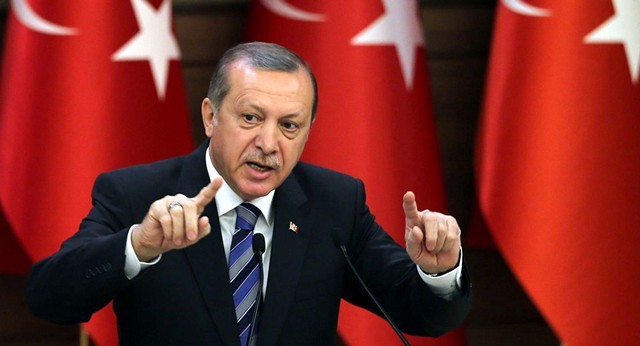
The Mythology of Erdogan and the Kurds. The Reorientation of the World Order

By Junaid S. Ahmad

Note to readers: please click the share buttons above

“Turkey’s Erdogan Wants to Crush the Kurds and Recreate the Ottoman World”

It’s true, with Western propagandistic headlines like this, who needs NATO, who really needs them as even friends. Perhaps the barrage of such vitriol has caused two vital allies of Washington, Ankara and Islamabad, to be fare more cautious from here on out.

It was bad before in previous decades, but headlines like this – NOT in right wing cheerleaders of empire like Fox News – but in virtually all of the “Liberal media” (who consider themselves more sophisticated and nuanced), we see one ridiculous (and dangerous) headline after the next.

It’s not Erdogan or Imran Khan per se who bother Western elites.

It is what they represent: the de-centering of the West, the re-orienting of the world order, and the profound crisis and rapidly collapsing  world system of the 500 year project of coloniality.

The Erdogans, Khans, etc., In a nutshell, represent the irresolvable crises of ‘whiteness’ (in a world that is finally beginning to mentally decolonize from prostrating before the Western “White Man” – used here as a political category rather than merely a racial one).

It is a crisis of that white supremacist world order, and a crisis of the post-WWII liberal international order that Western hegemony thought it could dominate endlessly – all culminating now in the relative structural decline of the Western plutocracies.

Of course, the leading American politicos and financiers fully grasp this situation but keep getting convinced by the warmongering neocons and Zionists in Washington DC that the Empire can reverse its decline by reckless threats and flexing its military muscle. Or, if that doesn’t work, learn from the German and Italian leaders of the 1930s about how to deal with the ‘Muslim Question’.

Indeed, headlines like this infantile one reflect that. They have become indistinguishable from any utter nonsense one may expect from many one-man, one-party, and one-media kind of states (many of which are close allies of Washington), something to be reflexively dismissed because everyone knows it’s pure state propaganda.

And in the headline referred to here, the mythology we are expected to swallow is just too insulting to our intelligence. Erdogan and the AKP were the first forces ever to make overtures to the Kurds, to both integrate them and grant them autonomy. In fact, Turkey’s worst crimes against the Kurds peaked in the 1990s with complete military and political support from Washington. A decade ago, Erdogan and the AKP were ‘NATO’s Islamists’ and promoted as a model for the Muslim world, repeated ad nauseum by every Western think tank.

So yes, the Kurds have been treated horribly by the state of Turkey, but that is a long history of secular military repression long preceding Erdogan and the AKP party that initially tried to ameliorate the conflict.

The fact of the matter is that the Gulf petro autocrats, their best friend the Zionist Israeli regime, and Washington never can tolerate any leader – from the global South and especially if s/he happens to be Muslim – getting too big for their boots…

The Saudis in particular are aching to punish Erdogan since he made sure that the Saudis would not just run roughshod and take over Qatar, since Turkey sent its troops immediately to defend Qatar from the Saudi invasion.

After all, the House of Saud believes that the GCC (Gulf Cooperation Council) and indeed all Muslim nations exist to serve them and their interests alone. They are – or at least claim to be –  the custodians of the two holy mosques and Islam more generally, so the House of Saud expects a default genuflection to its tyranny by all Muslims of the world.

Fortunately, that is the fictitious  fantasy land of the ‘reformer’ Crown Prince Mohammad Bin Salman (MBS), whose wet dreams undoubtedly are instigated by the smile on his face knowing Yemenis, Gazans, etc. are being butchered.

MBS should know not let his feelings get hurt by the fact that overwhelming majority of the Muslims throughout the world only care to visit or even think of Saudi Arabia when it comes to performing their mandatory religious ritual of Hajj (pilgrimage). Other than that, they see the House of Saud as the curse upon the Muslim world that it is, always on the side of oppression and subjugation, and ingratiating itself with its protectors in Washington at whatever price demanded. The Emiratis play the exact same game.

It is incredulous that in light of the criminal wars  and humanitarian catastrophes in Yemen, Gaza, and at the US-Mexico border where entire families are being ripped apart, the Western plutocracies and their media are involved in the most vulgar hypocrisy imaginable – when it comes the ‘non-West,’ the ‘non-White,’ and especially, the Muslim.

Nevertheless, we must never forget the courage of the many in the West resisting the creeping fascism that their elites are trying to impose on them and the world.

Junaid S. Ahmad is a PhD Candidate in Decolonial Thought, School of Sociology, University of Leeds, a Research Fellow at the Center for Islam and Global Affairs (CIGA) – Istanbul, and Director of the Center for Global Studies, School of Advanced Studies, UMT, Lahore, Pakistan.

4 August 2018

Source: https://www.globalresearch.ca/the-mythology-of-erdogan-and-the-kurds-the-reorientation-of-the-world-order/5649567

Warm welcome greets Ahed and Nariman Tamimi upon their release from Israeli prison

By http://samidoun.net

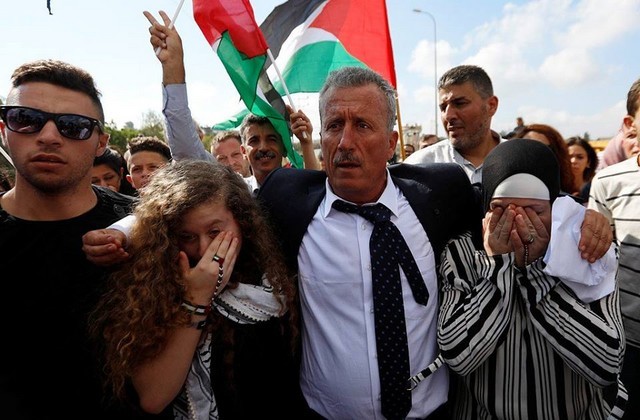
Palestinian teen Ahed Tamimi, 17, and her mother, Nariman Tamimi, were released from Israeli occupation prisons in the morning of Sunday, 29 July 2018 after serving eight-month prison sentences. Ahed and her mother were arrested on 19 December 2017 after a video of Ahed confronting occupation soldiers on the family’s land in the village of Nabi Saleh, including slapping one soldier, went viral on social media. Ahed and her family are leaders in the anti-colonial indigenous land defense movement in Nabi Saleh, where the village’s land and even springs are targeted for confiscation and theft by the neighboring illegal, Jewish-only settlement of Halamish.

A crowd of friends and family awaited the Tamimis’ release as the Israeli occupation repeatedly changed the designated location, from the Jabara checkpoint to Rantees to Jabara again, leaving them to travel the one-hour distance between the locations repeatedly. Ahed and Nariman were greeted with joy upon their actual release; they will hold a press conference at 4:00 pm in their village of Nabi Saleh.

One day before Ahed’s release, Israeli occupation forces arrested three artists involved in the painting of a massive mural on the Apartheid Wall saluting the teen’s struggle and celebrating her liberation.

Two of the detained artists are Italian and one Palestinian, including the lead artist, Jorit Agoch (Agostina Chirwin) a street artist from Naples known around the world for his massive, realistic murals.

An occupation spokesperson accused them of having “damaged and defaced the defense barrier in the Bethlehem area.” The Wall is well-known as a location for a number of famous graffiti murals saluting the Palestinian struggle.  The mayor of Naples, Luigi de Magistris, called for the artists’ immediate release, saying that this was a matter of freedom that concerned everyone.

As the Tamimi family and Palestinians celebrate Ahed’s release, their joy is, of course, not complete – among the over 6,000 Palestinians held in Israeli jails is Ahed’s 21-year-old brother, Wa’ed, seized in May by the Israeli occupation and accused of “participation in popular terror activities” such as organizing demonstrations.  A number of Ahed’s cousins, including Mohammed and Osama Tamimi, are also behind bars, targeted for their involvement in the defense of Palestinian land from confiscation, theft and colonization. The village of Nabi Saleh itself was closed by occupation forces last Thursday, preventing inhabitants from entering or leaving.

Samidoun Palestinian Prisoner Solidarity Network salutes, congratulates and welcomes Ahed and Nariman Tamimi upon their release. They are not only symbols of protest, but leaders in an anti-colonial, indigenous movement to defend their land from occupation, colonization and confiscation. Ahed’s case drew the attention and support of thousands – indeed millions – of people around the world, with protests in global cities and over 1.5 million people signing a petition demanding her freedom. That support had an important role to play in the freedom of Ahed and Nariman today. It also reminds us how critical it is to escalate our organizing for the freedom of all Palestinian political prisoners.

There are over 6,000 Palestinian prisoners in Israeli jails, including over 450 jailed without charge or trial under administrative detention. There are over 350 Palestinian children in Israeli jails and 60 Palestinian women and girls. They are leaders, teachers, organizers, workers, farmers, students and beloved family members, and they represent the true leadership of the Palestinian people targeted by the Israeli occupation for isolation. Of course, there are also prisoners of the Palestinian struggle in imperialist jails around the world – from the Holy Land Five in the United States to Georges Ibrahim Abdallah, jailed for 34 years in French prisons. Their freedom is critical to achieving the goal for which they struggle and sacrifice – freedom for the land and people of Palestine.

Free all Palestinian prisoners! Free Palestine!

29 July 2018

Source: http://samidoun.net/2018/07/warm-welcome-greets-ahed-and-nariman-tamimi-upon-their-release-from-israeli-prison/

An American in Ajmer: Khwaja Gharib Nawaz Calls Everyone, Regardless Of Their Religious Affiliation, To Penance and Purity of Heart, With Love towards All and Malice towards None

By Fr. Michael D. Calabria, New Age Islam

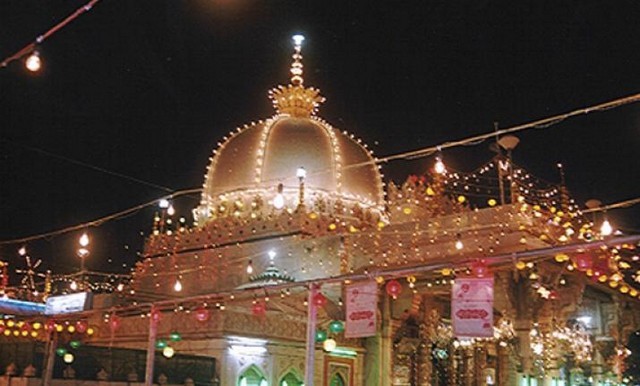
Dargah (shrine) of Khwaja Gharib Nawaz, “the Master, the Patron of the Poor,” the Sufi saint Mu’inuddin Chishti (1141-1230)

In July 2009, I made my first visit – or rather, pilgrimage – to the Dargah (shrine) of Khwaja Gharib Nawaz, “the Master, the Patron of the Poor,” the Sufi saint Mu’inuddin Chishti (1141-1230). Nine years later, in July 2018, I felt drawn back to the shrine.

Why would an American Franciscan friar travel not once, but twice to Ajmer, a six-hour journey by train from Delhi? There is certainly much of historical interest to me as a scholar of the Mughal period. Although devotion to Mu’inuddin’s shrine dates back to the fourteenth century, it was the Mughal emperors Akbar, Jahangir, and Shah Jahan who expressed particular interest in Ajmer and the Chishti Sufism espoused by Mu’inuddin, as did Shah Jahan’s daughter Jahanara. Akbar made the pilgrimage to Ajmer fourteen times during his reign. Jahangir installed two enormous cauldrons at the shrine from which five thousand needy people were fed and which remain in use. Shah Jahan ordered a mosque to be built on the site, a simple but elegant structure entirely of white marble at the same time the ethereal Taj Mahal was rising in Agra; and his daughter Jahanara added a white marble porch (Begami dalaan) to the eastern entrance of the mausoleum. Royal visits to the dargah were always accompanied by the distribution of alms and food to the needy, thus heeding the words of Mu’inuddin:

Never seek any help, charity or favors from anybody but God. Never go to the courts of kings, and never refuse to bless and help the needy and the poor, the widow, and the orphan, if they come to your door. This is your mission, to serve the people.

Although the history of the dargah continues to draw me to Ajmer, there is something else that brought me there the first time and called me back a second time. You may call it faith or devotion, or perhaps a sacred longing, a desire to be close to the Khwaja himself, a beautiful reflection of holiness revered by Muslims, Hindus, Sikhs, Jains as well as by Christians. It is a place where sanctity is sought and celebrated over sectarianism, where religious distinctions and differences vanish. It is a place where the words of Jallaluddin Rumi (1207-1273) resonate:

What can I do my friends, if I do not know? I am neither Christian nor Jew, not Muslim nor Hindu. What can I do? What can I do? … One I seek, One I know, One I see, One I call…

The Chishti Sufism, brought to South Asia by Mu’inuddin in the thirteenth century, embraced the concept of wahdat al-wujud, derived from the teachings of Ibn ‘Arabi (1165-1240). Succinctly put, the term signifies that there is only one existence, one wujud that is God. Thus, although humans perceive multiplicity in the phenomenal world – in terms of people, races, classes, castes, religions, etc. – true existence belongs to God alone. Thus, every person and thing only reflects the existence of the One, so that everyone and everything is one in the One.

At the dargah, it is this oneness I seek, oneness in a world where politicians in both the East and the West are intent on dividing rather than uniting, where human life is expendable and the natural world exploitable. Here, there are familiar echoes of my own Franciscan charism, a spiritual tradition born in the thirteenth century at the same time Chishti Sufism came to India. Both Francis of Assisi (1181-1226) and Mu’inuddin were ascetics who renounced wealth and status, who wore rough, patched garments, and were particularly concerned with the plight of the poor. Moreover, both holy men transcended religious differences in their day: Francis demonstrated this in his peaceful encounter with the Egyptian Sultan al-Malik al-Kamil in 1219; and Mu’inuddin in his referring to a local Hindu as a “saintly man of God.” Yet, their respective communities – Western Christian and Eastern Muslim – seemed reluctant to embrace the tolerance that Francis and Mu’inuddin exemplified, and recast them in hagiographies as zealous evangelists of religious orthodoxy.

But it was neither as a Mughal historian nor as a Franciscan that I returned to Ajmer this year, but as a simple penitent, a creature of God aware of his own brokenness, his own sin that stands in such contrast to the holiness of Mu’inuddin. Before setting out for the dargah, I clothed myself in a white kurta payjama, and covered my head with a white taqiyah. Like the ihram of a hajji to Mecca, I wear externally the purity that I seek internally at the dargah. First, I must make my way through the maze of muddy alleys that surround the dargah, a visual reminder of my own messy meanderings in life. Suddenly I stand on the threshold of a white marble gateway, richly decorated with inlaid stone (pietra dura) such as is seen at the Taj Mahal. I’m happy to shed my sandals, to wash my bare feet in the pools of rain water that have collected on the marble pavement of the sacred precinct. I leave the grey mud of Ajmer’s alleyways behind and enter a world of vibrant color: piles of pink rose petals for scattering over Mu’inuddin’s grave, cords of red and orange worn by visitors to the shrine, and chadars – cloths to be draped over the tomb – of green, red and gold. These are the colors I bore and wore in my devotions that morning against the whiteness of my kurta and the marble of the dargah.

Led by my Chishti murshid (“guide”), I carry a round wicker tray piled with rose petals and covered with a chadar into the shrine. I cannot see anything but a mass of bodies surging forward. Covering my head with the chadar, my murshid prays over me in Urdu. I am plunged into darkness like the waters of baptism. I am enshrouded in a spiritual burial like the prostration at my solemn vows as a friar. Out of the whir of words, I hear my murshid say: baraka – “blessing.” Uncovering me, leading me back into light and life, my murshid and I together throw fistfuls of rose petals onto the grave. Tying a red and orange cord around my neck, he pushes me down into the crowd of devotees so that I might reverence the Khwaja’s tomb. I kiss the marble threshold and then touch it with my forehead repeatedly, praying tearfully over and over a phrase from Muslim prayer rising from my heart: Rabb, ighfir-li: “Lord, forgive me.”

A pilgrimage of penance. That is what a visit to the dargah signifies for me. While others may seek God’s mercy and forgiveness in Mecca, Karbala, Jerusalem, Rome, Varanasi, or in the Sacrament of Reconciliation, it is to his dargah in Ajmer that Hazrat Khwaja Mu’inuddin Chishti calls me as he has called so many over the centuries regardless of their religious affiliation, both the powerful and the powerless. He calls me to penance and purity of heart, with “love towards all and malice towards none.”

Before leaving the sacred precinct, I go to Shah Jahan’s mosque to pray and complete my pilgrimage. There, above the arches, between al-asma al-husna – the Beautiful Names of God – I find verses in Persian assuring me of God’s forgiveness, and that my journey to Ajmer has not been in vain:

When you rub your fortunate face on the floor of the mosque (in prayer), your book of deeds becomes as white as marble…To the throng of people who come to offer prayers, its gate is always open as is the gate of penitence.

Al-Hamdu li-llah. Thanks be to God.

Fr. Michael D. Calabria, OFM is Director, Center for Arab and Islamic Studies, St. Bonaventure University, USA

24 July 2018

Source: http://newageislam.com/islam-and-the-west/fr-michael-d-calabria,-new-age-islam/an-american-in-ajmer–khwaja-gharib-nawaz-call-everyone,-regardless-of-their-religious-affiliation,-to-penance-and-purity-of-heart,-with-love-towards-all-and-malice-towards-none/d/115922

Pakistan: Poised for Challenging Political Innings with Imran’s ‘Naya’ Spin

By K M Seethi

The state of Pakistan is now poised for a change, as predicted by many in the context of the General Elections held on 25 July. Though Pakistan Tehreek-e-Insaf (PTI)’s victory is not decisive, there is a general feeling that given the lead in the race, PTI under the leadership of Imran Khan will form a government. The provinces will also witness changes in political dispensation. The results show a clear verdict against the PML-N led by Nawaz Sharif and the PPP led by Bilawal Bhutto. With Nawaz Sharif and his daughter Maryam in prison, in the wake of the Panama episode and court verdicts, the election campaign witnessed intense debate on corruption and, predictably, the popular verdict had to swing in favour of Imran Khan’s PTI, which has already been running a provincial (coalition) government in the Northwestern Khyber Pakhtunkhwa.  Though there are widespread allegations of corruption and rigging, Imran Khan threw down the gauntlet to his opponents and assured in public that it could be investigated.

During the campaign for a much hyped “Naya (new) Pakistan” Imran Khan had promised that his party would create 10 million new jobs and build 5 million homes for the poor if they win. He also made a claim that the rich Pakistani   diaspora had assured him that they would step in with substantive investment and expertise to reconstruct the country.  In his first press conference (even as the entire election results were still to be announced), Imran Khan announced that he wanted Pakistan to become the country that his leader “Quaid-i-Azam Muhammad Ali Jinnah had dreamed of” (Dawn 2018b). He said that he wanted to “share the kind of Pakistan” he envisioned—“the type of state that was established in Madina, where widows and the poor were taken care of “(Ibid).

If it i was Nizam-i Mustafa (the system of the Prophet Muhammad) that Imran referred to, there was already an experiment undertaken by a nine-party popular movement begun by the Jamaat-i Islami in 1977 to overthrow the secular government of Zulfikar Ali Bhutto and establish an ‘Islamic system’ of government in Pakistan. The movement broke done after the military coup of Zia-ul-Haq and, then, Pakistan witnessed another decade of authoritarian military rule under the facade of ‘Islamisation’ drive.

One does not know if Imran was still aware of the ‘dream’ of Jinnah which the latter had categorically made clear on 11 August 1947 in the Constituent Assembly of Pakistan:

“You are free; you are free to go to your temples, you are free to go to your Mosques or to any other places of worship in this state of Pakistan, You may belong to any religion or caste or creed – that has nothing to do with the business of the state… we are starting in the days when there is no discrimination, no distinction between one community and another, no discrimination between one caste or creed or another. We are starting with this fundamental principle that we are all citizens and equal citizens of one state… you should keep that in front of us as our ideal, and you will find, in course of time, Hindus would cease to be Hindus, and Muslims would cease to be Muslims, not in the religious sense, because that is the personal faith of each individual but in the political sense as citizens of the state (Jinnah 1947).

Does PTI’s “Islamic Republic” allow room for such an egalitarian society? What is the status of minorities in Pakistan even after 70 years? The Ahmadi community, for instance, announced their boycott of the July 25 elections to protest the ‘discriminatory’ move to have a separate voter list for them. Imran did not hide his bias on their status. He had openly rejected any idea of repealing the Second Amendment to the Pakistani Constitution which declares the Ahmadis as non-Muslims.

In his first press conference, Imran brought to light the plight of the poor, women and children. He says: “Farmers are not paid for their hard work, 25 million children are out of school, our women continue to die in childbirth because we can’t give them basic healthcare, we can’t give the people clean drinking water. A country is not recognised by the lifestyle of the rich, but by the lifestyle of the poor. No country that has an island of rich people and a sea of poor people can prosper” (Dawn 2018b). It may be recalled that in a pre-election interview Imran said that “The political class here doesn’t change that much. You can introduce new actors but you can’t change the political class wholesale. This is why I give the example of Mahathir Mohamad, who changed Malaysia with the same political class by giving them clean leadership” (Dawn 2018a). This was obviously an indication that Imran’s PTI does not envisage any fundamental change in the political economy of the State of Pakistan.  The ruling political class has always been characterised by a combination of military-bureaucratic-political forces.

There is already a feeling everywhere that Imran and his PTI could be the natural ‘selection’ of the military. Given such a spate of criticisms across a wider political spectrum, within and across the world, it remains to be seen how he would negotiate between these state apparatuses.  In an interview Imran was asked to speak on the military’s influence in setting Pakistan’s foreign policy. He said: “The army will get involved where there are security situations. If you look at the US policy in Afghanistan, a lot of the US-Afghan policy was influenced by Pentagon. Even when Barack Obama didn’t want to continue the war in Afghanistan, he did it because he was convinced by Pentagon” (Dawn 2018a).  Imran also said: “When you have democratic governments that perform and deliver, that is their strength. We have had military influence on politics in Pakistan because we have had the worst political governments. I am not saying it is justified but where there is a vacuum something will fill it.” He also said: “Under crooked and corrupt governments, people welcome the military with open arms. In 1999 when Musharraf’s martial law was declared, people were celebrating in Lahore – Nawaz’s political centre! – because governance had failed” (Dawn 2018a).

Imran has also been criticised for his ambiguous position on Islamic forces in Pakistan. Many even suspected if he was ‘soft’ on such issues. During the election campaign, he declared that there should be “a dual policy: one is dialogue and the other is military action. I have been labelled ‘Taliban Khan’ just because I did not agree with this one-dimensional policy that Pakistan implemented under American pressure.” Imran said: “the war in Afghanistan was a classic example of how military solutions alone did not work. “The US has been there for 15 years with a military option but has failed. If there is consensus among the American and Afghan governments and allies that they want unconditional peace talks with Taliban, it means the military option has failed” (Dawn 2018a).

The most challenging test of Imran’s policy regime could be Pakistan’s relations with India which witnessed a setback during the last few years. His anti-India rhetoric had already raised suspicions that a political dispensation under Imran would be more ‘aggressive’ in dealing with India. In the interview with Dawn, he said that his rival “Nawaz Sharif tried everything, even personal [gestures] calling him [Modi] over to his house. No one got in his way. But I think it is the policy of the Narendra Modi government to try and isolate Pakistan. They have a very aggressive anti-Pakistan posture because Modi wants to blame Pakistan for all the barbarism they are doing in Kashmir. What can one do in the face of this attitude?” (Dawn 2018a).

In his post-election speech, Imran, however, appeared to be more soft-spoken though he still harped on sensitive issues like Kashmir. He said that it would be “very good for all of us if we have good relations with India. We need to have trade ties, and the more we will trade, both countries will benefit”(Dawn 2018b). Everyone knows that it was Pakistan that was still hesitant on the issue of strengthening trade ties with India. It is yet to accord the most favoured nation (MFN) status to India even as it maintains a negative list of more than a thousand items which are not permitted to be imported from India.  New Delhi keeps reminding that its granting of MFN status to Pakistan should not be treated as a mere gesture and hence reciprocity is called for. Referring to Kashmir, Imran said that “Kashmir is a core issue, and the situation in Kashmir, and what the people of Kashmir have seen in the last 30 years. They have really suffered…Pakistan and India’s leadership should sit at a table and try to fix this problem. It’s not going anywhere.” In a more conciliatory tone Imran said:  “We are at square one right now [with India]. If India’s leadership is ready, we are ready to improve ties with India. If you step forward one step, we will take two steps forward. I say this with conviction, this will be the most important thing for the subcontinent, for both countries to have friendship” (Daily Pakistan 2018). A major question is if Pakistan will allow the democratic process to take the lead on both sides of Kashmir. Azad Kashmir is still a democratic-deficit zone which Imran does not want to concede when he talks about issues in the Indian administered Jammu and Kashmir. One major cause of the perennial crisis in Kashmir is the continued support the militants get from Pakistan which India considers as a critical factor stalling the peace process.

The most crucial tests of Imran Khan would be his handling of Pakistan economy and the burgeoning threats from Islamic forces. The economy has already been facing several problems—from resource crunch to worsening balance of payment situation. The International Monetary Fund (IMF) has already warned that “the current account and budget deficits are gloomy.”  According to the IMF, the country’s current account deficit stood at 4.8% of total national income ($16.6 billion), which was 83% higher than the government’s official estimates. The IMF has also warned that Pakistan’s official gross foreign currency reserves could fall to $12.1 billion–barely enough financing 10 weeks of imports.  The IMF also asked Pakistan to improve its anti-money laundering and counter-terrorism financing regimes. They also sought to devalue the currency to minimise damages to the external sector, and levy more taxes to control the growing budget deficit. It said that surging imports have led to a widening current account deficit and a significant decline in international reserves despite higher external financing. FY 2017/18’s current account deficit could reach 4.8% of GDP, with gross international reserves further declining in the context of limited exchange rate flexibility.  This is equal to $16.6 billion – and far higher than $12.1 billion deficit that Pakistan has experienced in the previous fiscal year (IMF 2018).

The World Bank’s latest estimates also paint a dismal picture for Pakistan. It says that “Pakistan remains one of the lowest performers in the South Asia Region on human development indicators, especially in education (etc)…  Infant and under five mortality rates represent a similar story. Gender disparities persist in education, health and all economic sectors. Pakistan has one of the lowest female labour force participation rates in the region. Nutrition also remains a significant cross-cutting challenge, as 44% of children under five are stunted. The spending on health, nutrition, and education, now totalling 3 per cent of GDP, significantly lower than most other countries. Increased allocation will only be possible after increasing government revenues. The tax-to-GDP ratio, at 12.4 percent, is one of the lowest in the world and it is still half of what it could be for Pakistan.”

The Fund-Bank estimates have a particular importance for Pakistan given its long-term dependence on the external sources and its high spending on defence and arms build-up, besides its financing of various forces. Remittances constitute a major share of Pakistan’s foreign exchange.  According to latest reports, remittances have declined by 19.82% compared to the situation the previous year (it was $1.609 billion in September 2016 but in 2017, it has been reduced to $1.29 billion) (Times of Islamabad 10 March 2017; Dawn 10 June 2017). Like other countries in South and Southeast Asia, Pakistan too will have to bear the burden of declining remittances due to the localisation drive underway in the GCC countries.

Most importantly, Imran has to address the situation arising out of the rise of terrorism and fundamentalism in Pakistan. He must be aware that it has much to do with the emergence of an oligarchic power structure (civil-military-religious nexus), which had its beginnings in the 1960s, but got accentuated in the 1970s after  General Zia-ul-Haq  came to power((Seethi 2015).  It was during the rule of Benazir Bhutto and Nawaz Sharif in the 1990s that the Islamic forces like Taliban branched out, within and across the boundary in Afghanistan. An major  factor that has significantly assisted their growth is the making of a vast number of jobless families, people without any means of existence and without expectations, as a consequence of lopsided policies in agriculture and industry. As  Hamza Alvi wrote, every tractor displaced at least a dozen families of sharecroppers. Hundreds of thousands of them were without a source of livelihood. Under these circumstances, the advent of the well-financed madrasas, who took over their children, gave them free tuition, accommodation and food, appeared to be a great miracle (Alvi 2010). Over years, the armed groups, many of them with battle-hardened Taliban, are in the forefront of a sectarian carnage in Pakistan, which have been on the increase — killings of members of rival sects, Sunnis vs Shias, Deobandi Sunnis vs Barelvi Sunnis, etc. (Seethi 2014). Over the years, these militant bands assumed new forms and carried new nomenclatures. Islamic militant outfits such as the Tehreek-e-Taliban Pakistan, Lashkar-e-Toiba, Lashkar-e-Jhangvi, Jaish-e-Mohammed are various forms of Jihadism in the making, seeking to take over the State by military means, mainly relying on the discontent of the middle class. Instead of conceptualising a workable policy with a view to dealing with such militant groups, successive governments have pandered to them. The high cost of this great lapse is that Pakistan has become the killing fields of South Asia.

In Pakistan, the State’s monopoly of force is dented by a variety of armed Islamist groups that have schemes of their own. The ruling dispensations have not so far recognised that the more they try to acquiesce to these religious extremists, the harder and more uncompromising they tend to become. It remains to be seen how Imran Khan’s ‘Naya’ Pakistan is going to address this crucial question.

References

Alvi, Hamza (2010): “The Rise of Religious Fundamentalism in Pakistan,” LUBP, https://lubpak.com/archives/5589

Dawn (2018a): “You can’t win without electables and money: Imran,” 5 July, https://www.dawn.com/news/1418060/you-cant-win-without-electables-and-money-imran

Dawn (2018b): “Imran promises wide-ranging reforms: All policies for the people” Dawn.com  26 July 26,  https://www.dawn.com/news/1423029/imran-promises-wide-ranging-reforms-all-policies-for-the-people

Daily Pakistan (2018): “‘Will run Pakistan like never before,’ Imran Khan vows to eradicate corruption and live a simple life in victory speech,”  https://en.dailypakistan.com.pk/lifestyle/well-spoken-indias-rishi-kapoor-praises-imran-khan-on-his-election-victory-speech/

IMF (2018):Pakistan: IMF Country Report No. 18/78, FIRST POST-PROGRAM MONITORING  DISCUSSIONS,  https://www.google.co.in/url?sa=t&rct=j&q=&esrc=s&source=web&cd=1&ved=2ahUKEwjrz9ngk73cAhXEQo8KHSD_CiUQFjAAegQIBRAC&url=https%3A%2F%2Fwww.imf.org%2F~%2Fmedia%2FFiles%2FPublications%2FCR%2F2018%2Fcr1878.ashx&usg=AOvVaw2lXQHNabxWLsLYV6XASIcX

Jinnah, Mohammed Ail (1947): “Presidential Address to the Constituent Assembly of Pakistan on 11 August 1947, Government of Pakistan, available at http:// quaid.gov.pk/speeches03.htm.

Seethi, K.M. (2014): “Pakistan School Killing: South Asia’s Killing Fields,” Tehelka, , 19 December.

Seethi, K.M. (2015): “Political Islam, Violence and Civil Society in Pakistan,” Indian Journal of Politics and International Relations, Vol.8. No.1.

The World Bank (2018): The World bank in Pakistan:  Overview 17 April, http://www.worldbank.org/en/country/pakistan/overview

The author is Professor, School of International Relations and Politics, Mahatma Gandhi University, Kerala. He can be reached at kmseethimgu@gmail.com

27 July 2018

Source: https://countercurrents.org/2018/07/27/pakistan-poised-for-challenging-political-innings-with-imrans-naya-spin/

Strategy and Conscience: Subverting Elite Power So We End Human Violence

By Robert J. Burrowes

Given the overwhelming evidence that activist efforts are failing to halt the accelerating rush to extinction precipitated and maintained by dysfunctional human behavior, it is worth reflecting on why this is happening.

Of course, you might say that the rush to extinction is being slowed. But is it? Even according to BP’s chief economist: ‘despite the extraordinary growth in renewables in recent years, and the huge policy efforts to encourage a shift away from coal into cleaner, lower carbon fuels, there has been almost no improvement in the power sector fuel mix over the past 20 years. The share of coal in the power sector in 1998 was 38% – exactly the same as in 2017…. this is one area where at the global level we haven’t even taken one step forward, we have stood still: perfectly still for the past 20 years.’ See ‘Analysis – Spencer Dale, group chief economist’.

And, to choose another measure that highlights our lack of ‘progress’: species extinctions proceed at a rate of 200 each day, which is vastly greater than the long-term background rate, with another 26,000 species already identified as ‘under threat’. See ‘Red list research finds 26,000 global species under extinction threat’.

But it wouldn’t matter what measure you analyzed – efforts to prevent cataclysmic nuclear war, to halt the many ongoing wars, to contain and reverse the prevalent and grotesque economic exploitation, to end slavery or the sex trafficking of women and children, to halt or even slow the rampant destruction of the biosphere, including the rainforests and oceans – we are rapidly losing ground (and often despite some apparent gains such as adoption of the ‘Treaty on the Prohibition of Nuclear Weapons’ by many non-nuclear states on 7 July 2017).

Not only are we destroying the rainforests – currently at the rate of 80,000 acres each day: see ‘Measuring the Daily Destruction of the World’s Rainforests’ – and oceans – see ‘The state of our oceans in 2018 (It’s not looking good!)’ – as a fellow long-standing nonviolent activist, Kelvin Davies, recently observed to me: the oceans and remaining rainforests are ‘being emptied of life’ as impoverished people, forced to the economic margin, hunt remaining wildlife, including tropical fish, for food and/or trafficking.

Before we blame impoverished people for their destruction however, it is the consumption by those of us in industrialized countries that is generating the adverse circumstances in which they are forced to survive. For one simple example of this, related to our diet alone, see ‘Emissions impossible: How big meat and dairy are heating up the planet’.

Of course, you might object that it is not activist efforts that are responsible for the failure to halt elite violence and our complicity in it. It is the failure of corporatized society to seriously consider and respond intelligently to the scientific and other evidence in relation to all of the violence in its many manifestations. However, any explanation of this nature fails to understand and appreciate why progressive change has always occurred in the past.

Social progress is the result of people of conscience strategically challenging elite power in such a way that new norms become so widely accepted that elites are compelled to work within them. This has always been essential for the simple reason that elites are insane and have never acted sensibly, whatever the issue. Elites have only ever orchestrated events to maximize their own power, profit and privilege whatever the cost to the rest of us and the Earth itself. Hence, violence, war, grotesque economic exploitation and ecological destruction are rampant across the planet; that is the way elites want it; that is what maximizes elite power, profit and privilege. See ‘The Global Elite is Insane Revisited’.

As an aside: if you aren’t convinced that the global elite is insane, then perhaps you might ponder the possible implications of the recent call by US President Donald Trump, for the creation of a new Space Force as a sixth branch of the U.S. military – ‘We must have American dominance in space’ – in violation of the Outer Space Treaty of 1967. See ‘Trump Orders Establishment of Space Force as Sixth Military Branch’.

While this enterprise, if it gets Congressional approval, would be staggeringly profitable to the global elite while further gutting social and environmental programs to pay for it, the proposal also raises the possibility, as Professor Karl Grossman graphically expressed it (given that there is no way to have the envisaged weapons in space without nuclear power) that ‘the heavens are going to be littered with radioactive debris’ for millennia (but in substantially greater amounts than is already there). See ‘Trump’s Space Force: Military Profiteering’s Final Frontier’ and ‘Star Wars Redux: Trump’s Space Force’.

Of course, if you want even more evidence of elite insanity, then look no further than the current hysteria generated by Donald Trump’s supposed ‘treason’ for having a meeting with Russian president Vladimir Putin in Helsinki with the intention of improving mutual understanding and the prospects of peace between the two countries. For a sample of the literature that discusses this summit intelligently, which you won’t find in the corporate media, see ‘US Media is Losing Its Mind Over Trump-Putin Press Conference’, ‘Is President Trump A Traitor Because He Wants Peace With Russia?’, ‘Helsinki Talks – How Trump Tries To Rebalance The Global Triangle’ and ‘Trump, The Manchurian Candidate: “Conspiracy” to Destabilize the Trump Presidency’.

Some informed and thoughtful analysts believe this could lead to an elite coup to remove Trump from the US presidency. See ‘Coming Coup Against Trump’ and ‘The Coming Coup to Overthrow President Trump: Sedition at the Highest Levels’.

So, to consolidate the information presented above, let me encapsulate the nature of geopolitics in one paragraph:

The military forces of the United States are not intended to defend the United States against military attack. The military forces of the countries in NATO are not intended to defend the respective member countries against military attack. The military forces of the United States and NATO are controlled by the global elite and used by the global elite to aggressively attack, in violation of all relevant national and international laws, any country that seeks independent control and development of its resources, particularly fossil fuels, strategic minerals and water. The global elite, which is in total control of the global economy and world affairs generally, does this in order to expand its own power, profit and privilege. It does this no matter what the cost to any individual (outside the elite), people, country and the biosphere. Why does the global elite do all of this? The global elite does this because it is completely insane.

Hence, to return to my point about the driver of social progress historically: Did the trans-Atlantic slave trade end because elites decided to halt the practice? Did gains for some women during the 21st century occur because elites committed themselves to ending patriarchal privilege? Did the British walk out of their colony in India because the British elite suddenly perceived the injustice of their violence and exploitation?

Despite the successes of activists of earlier generations, however, those of us who identify as activists of this generation are failing, quite comprehensively, to respond intelligently, powerfully and strategically to the vast challenges posed by an elite that has expanded its capacity to intimidate, outflank and overwhelm us (which is why, incidentally, slavery is now far more widespread than during any earlier period in human history, violence against women still manifests in a grotesque variety of forms all over the planet and even India has strayed monstrously from Gandhi’s vision).

In essence, strategic lessons learned by earlier generations of activists are forgotten or ignored as we stumble powerlessly to the extinction that is shortly to claim us all.

While I could write at some length about our shortcomings as activists in the era of perpetual violence and war, grotesque economic exploitation and pervasive climate and environmental destruction, I would like to focus on what I regard as the two key issues: strategy and conscience.

The global elite is deeply entrenched and manages world affairs, particularly through its capitalist economy. The global elite has developed over hundreds of years during which time it has fully and deeply penetrated all of the major power structures in world society, most of which it created (or moulded during their creation), so that the primary levers of power in the modern world – key financial institutions such as central banks, the major asset management corporations and the giant corporations in key industries (such as, but not limited to, the banking and weapons industries) – as well as the instruments through which its policies are implemented – including governments, military forces (both national and as ‘military contractors’ or mercenaries), key ‘intelligence’ agencies, legal systems and police forces, key nongovernment organizations such as the Vatican, and the academic, educational, media, medical, psychiatric and pharmaceutical industries – are all fully responsive to elite control.

More precisely than this, as explained in his forthcoming book ‘Giants: The Global Power Elite’, Professor Peter Phillips identifies the world’s top seventeen asset management firms, each with more than one trillion dollars of investment capital under management, as the giants of world capitalism. The total capital under management on behalf of all seventeen corporations is in excess of $US41.1 trillion; it represents the wealth invested for profit by thousands of millionaires, billionaires and corporations. These seventeen giants operate in nearly every country in the world and are ‘the central institutions of the financial capital that powers the global economic system’. They invest in anything considered profitable, ranging from ‘agricultural lands on which indigenous farmers are replaced by power elite investors’ to public assets to war.

Phillips goes on to note that the global elite develops and coordinates its policies through a variety of private planning fora such as the Group of Thirty, the Trilateral Commission and the Atlantic Council which determine the policies and issue the instructions for their implementation by transnational governmental institutions like the G7, G20, International Monetary Fund, World Trade Organization and the World Bank. Elite policies are also implemented following instruction of the relevant agent, including governments, in the context. These agents then do as they are instructed.

Or, if they do not, they are overthrown. Just ask any independently-minded government over the past century. For a list of governments overthrown by the global elite using its military and ‘intelligence’ agencies since World War II, see William Blum’s book ‘Killing Hope: U.S. Military and CIA Interventions Since World War II’ or, for just the list, see ‘Overthrowing other people’s governments: The Master List’.

As a result of coordination through the above elite fora, for example, gigantic media, public relations and entertainment corporations are used to reinforce elite dogma promulgated through national educational institutions so that most western humans become powerless consumers of elite product, informational and material, as the elite pursues ever-increasing profit, power and privilege. Oblivious to the way in which they are caught up in the elite drive to make us consume, even most western activists are major consumers, failing to limit their consumption in line with some appreciation of the per capita ecological carrying capacity of the Earth.

Hence, as should be obvious by now, with a deeply entrenched global elite in total control of major economic/financial, political, military, legal and social (including educational and media) power structures, only a comprehensive and sophisticated strategy has any prospect of succeeding, whatever the issue, and certainly the fundamental one: elite power.

In other words, if we want to end war (or even just one war), halt exacerbation of the climate catastrophe (in a region, country or the world), end environmental destruction on a vast range of fronts, terminate economic exploitation including (modern) slavery, end the sex trafficking of women and children, end the military occupation of Palestine, Tibet, West Papua… then we are going to have to think, plan and act strategically, which includes engaging and mobilizing, in a focused way, a significant proportion of the human population. Simply ‘campaigning’ on the basis of a few ideas and tactics that we think worked in the past, is not enough. Campaigning without strategy – and all that strategic thinking, including a penetrating analysis of the very nature of society and its power structure, entails – is a waste of time.

This is why most work of virtually all ‘activist’ NGOs is useless. They work within the elite-designed and managed global power structure, fearfully self-limiting their actions in accordance with elite-approved processes, such as those ‘within the law’ and lobbying elite-controlled governments and institutions, as well as international organizations such as the UN. By participating in elite-controlled processes, our dissent is absorbed and dissipated, as the elite intend.

This is the great achievement, from an elite perspective, of ‘democracy’: to the extent that people can be persuaded to participate in the delusion that democracy exists (anywhere on Earth) and that voting and lobbying changes anything important, they are unwitting victims of elite-manipulated processes and propaganda.

This also explains why virtually all NGOs invariably end up promoting elite-sponsored delusions such as, for example, those in relation to the climate catastrophe which talk of an ‘end of century’ timeframe (about 70 years more than we actually have), staying within 2 (or 3 or 1.5) degrees Celsius above the pre-industrial level (rather than the .5 degrees that is actually necessary) and, the most fundamental delusion of all, that we must substitute renewable energy for fossil fuels (which is certainly necessary), rather than (in addition) profoundly reduce – by at least 80% – consumption generally, involving both energy and resources of every kind – water, household energy, transport fuels, metals, meat, paper and plastic – while dramatically expanding our individual and community self-reliance if all environmental concerns are to be effectively addressed.

But elite-sponsored delusions are widely promulgated by its corporate media on a vast range of issues with only the rarest ‘activist’ NGO, concerned to focus on what it defines as its primary mission, taking a stand on these apparently ‘separate’ issues. So, for example, elite-sponsored delusions that are widely promulgated by its corporate media convince huge numbers of people that US-NATO wars against impoverished and militarily-primitive countries are in ‘self defense’ and that terrorists are a genuine threat to ‘national security’. At a more mundane level, elite-sponsored delusions propagated through its corporate media promote everything from genetically-mutilated, poisoned and junk food to psychiatric drugs. See ‘Defeating the Violence of Psychiatry’. These products are also highly profitable but because their insanity includes lacking any sense of morality, elites are unconcerned about the damage they inflict on us in these regards just as in all others.

Some grassroots activist groups are more politically savvy than NGOs but usually still lack comprehensive and sophisticated strategies. On rare occasions, it should be noted, one of these campaigns or national liberation struggles succeeds, because of such factors as the raw power of nonviolent action (even without strategy) or because they could rely on the NIMBY (Not In My Back Yard) effect to facilitate mobilization of significant numbers of people in a local area.

However, the global elite is unconcerned about the occasional local ‘setback’ which does not adversely impact its global agenda and where minor gains by grassroots activists can, if necessary, be subsequently reversed (including by simply violating the law, as the elite routinely does with impunity). Consider again, the above example of Trump’s call to violate the 1967 Outer Space Treaty or routine violation of legally-declared (and sometimes World Heritage-listed) national parks in Africa, Asia and Central/South America as major corporations seek to exploit oil and mineral wealth. The law is designed to intimidate and impede us; it is rarely used in an attempt to hold elites accountable and has little, if any, impact when it does: a corporation may, occasionally, be fined (an expense against generating monstrous profit). Fundamentally, elites are above the law: they draft it to defend their interests against the rest of us.

But to reiterate the main point: given the sheer number of (sometimes even large-scale) mobilizations on one issue after another around the world that achieve nothing of substance in relation to the issue itself (consider the demonstrations against the imminent war on Iraq, held in over 600 cities around the world and involving as many as 30 million people, on 15 February 2003), it is painfully clear that most grassroots activists have no conception of strategy either, including the appropriate strategic focus for their tactics.

And this applies equally to those national liberation activists in occupied countries such as Palestine, Tibet and West Papua, as well as those activists living in the many countries, such as Cambodia and the Democratic Republic of the Congo, run by dictatorships or where the elected government, such as that of Brazil, has been removed in a coup.

As touched on above, however, lack of sound strategy (including the structural analysis on which it must be based) is not the only shortcoming in our efforts to halt elite (or even our own) violence.

In the past, a primary motivator of activists, and particularly the great ones such as Mohandas K. Gandhi, was their conscience: The ‘inner voice’ that called them to action on both the personal and political levels.

But there is more to conscience than being called to action. So what is so important about conscience? Conscience is the mind function that asks the deeper questions such as ‘What is the right way to go about this?’, ‘How must I behave if I am to model what I ask of others?’ and ‘How will we design this campaign so that its conduct helps to create the world we envision?’ (rather than the simpler question ‘How will we win this campaign?’).

Moreover, living by one’s conscience requires courage: This includes making strategic choices to take significant or, occasionally, even great risks when elite violence threatens to intimidate a struggle into submission and silence.

It was his unyielding conscience, deeply guiding his personal and political behaviour (including his commitment to nonviolence and his extraordinarily austere lifestyle), and his superlative understanding of strategy that made Gandhi the great activist that he was. Why?

Because Gandhi’s nonviolence was based on certain premises derived from his conscience – including the importance of the truth, the sanctity and unity of all life, and the unity of means and end – his strategy was always conducted within the framework of his desired political, social, economic and ecological vision for society as a whole and not limited to the purpose of any immediate campaign.

It is for this reason that Gandhi’s approach to strategy is so important. He is always taking into account the ultimate end of all nonviolent struggle – a just, peaceful and ecologically sustainable society of self-realized human beings – not just the outcome of this campaign. He wants each campaign to contribute to the ultimate aim, not undermine vital elements of the long-term and overarching struggle to create a world without violence.

So what do we do?

If you would like to better understand why so many human beings, including those within the elite, are devoid of anything resembling a conscience, you can do so by reading what happened to them as a child in ‘Why Violence?’ and ‘Fearless Psychology and Fearful Psychology: Principles and Practice’.

If you are interested in acting in ways that maximize the chance that elite opponents and their agents will reflect, deeply, on what they are doing, while fundamentally changing the power relationship between you and your opponents, then you are welcome to consider acting strategically in the way that Gandhi did. Whether you are engaged in a peace, climate, environment or social justice campaign or a national liberation struggle, the 12-point strategic framework and principles are the same. See Nonviolent Campaign Strategy and Nonviolent Defense/Liberation Strategy.

The strategic aims and a core list of strategic goals to end war and to end the climate catastrophe, for example, are identified in ‘Campaign Strategic Aims’ and the strategic aims and a core list of strategic goals to defeat a political or military coup, remove a military occupation, remove a dictatorship or defeat a genocidal assault are identified here: ‘Liberation Strategic Aims’.

If you would like a straightforward explanation of ‘Nonviolent Action: Why and How it Works’ and an introduction to what it means to think strategically, try reading about the difference between ‘The Political Objective and Strategic Goal of Nonviolent Actions’.

If you anticipate violent repression by a ruthless opponent, make sure that you plan and implement any nonviolent action as history has taught us: ‘Nonviolent Action: Minimizing the Risk of Violent Repression’.

If you are interested in nurturing children to live by their conscience and to gain the courage necessary to resist elite violence fearlessly, while living sustainably despite the entreaties of capitalism to over-consume, then you are welcome to make ‘My Promise to Children’. After all, capitalism and other dysfunctional political, economic and social structures only thrive because of our dysfunctional parenting which robs children of their conscience and courage, among many other qualities, while actively teaching them to over-consume as compensation for having vital emotional needs denied. See ‘Love Denied: The Psychology of Materialism, Violence and War’.

Why this emphasis on children you might ask? For good reason. It is dysfunctional human behavior that got us into this civilizational mess and allowed the emergence of exploitative social, political and economic structures. So if we do not emphasize the importance of profoundly changing the way in which we nurture children so that they behave functionally in context, everything else we do to preserve humanity and the biosphere must ultimately fail. The onslaught of our dysfunctional species will simply overwhelm the biosphere, sooner or later, whether it is this generation or the next.

But we don’t have to settle for improving our parenting. We can improve our own functionality and access our conscience and courage too. How? See ‘Putting Feelings First’.

If you are already guided by your conscience to act powerfully in response to elite violence, you might also consider joining those participating in ‘The Flame Tree Project to Save Life on Earth’, which outlines a simple plan for people to systematically reduce their consumption while progressively increasing their self-reliance, and consider signing the online pledge of ‘The People’s Charter to Create a Nonviolent World’.

You may believe that you can halt elite violence without engaging your conscience (and the deep internal search that this requires) and without using Gandhian nonviolent strategy. Even if you are right, the key question is then this: Is the world you will get any better than this one?

And don’t forget the timeframe. Major historical struggles, including those noted above, took decades (whatever the merits and shortcomings of their strategies) or, as in most cases, are ongoing. How long do you want to wait before you invest time in learning how to think, plan and act strategically when the future of humanity and the biosphere is now at stake?

So, to conclude: The global elite controls all significant human affairs and even exercises almost total control over the individual lives of human beings. Because the global elite is insane and its psychological (and hence behavioral) dysfunctionality is of a particular kind, it cannot pull back from its existing regime of violence and exploitation, even in response to imperatives from the biosphere.

In this circumstance our choice is simple: near-term human extinction based on our unwitting complicity in elite violence or a conscientious, courageous and strategic response that fundamentally undermines elite power.

This will require a significant number of interrelated nonviolent strategies that each tackle elite violence in one context or another.

You are welcome to consider the options presented just above for your own involvement.

Robert J. Burrowes has a lifetime commitment to understanding and ending human violence.

25 July 2018