Just International

The Tide is Turning: Israel Is Losing on Two War Fronts

By Dr Ramzy Baroud

The November 12 botched Israeli military operation in the Gaza Strip is delineating Tel Aviv’s failure to utilize its army as a tool to achieve Palestinian political concessions.

Now that the Palestinian popular resistance has gone global through the exponential rise and growing success of the Boycott Movement, the Israeli government is fighting two desperate wars.

Following the Gaza attack, Palestinians responded by showering the Israeli southern border with rockets and carried out a precise operation targeting an Israeli army bus.

As Palestinians marched in celebration of pushing the Israeli army out of their besieged region, the fragile political order in Israel, long-managed by right-wing Israeli Prime Minister, Benjamin Netanyahu, was quickly unraveling.

Two days after the Israeli attack on Gaza, Defense Minister, Avigdor Lieberman, quit in protest of Netanyahu’s ‘surrender’ to the Palestinian Resistance.

Israeli leaders are in a precarious situation. Untamed violence comes at a price of international condemnation and a Palestinian response that is bolder and more strategic each time.

However, failing to teach Gaza its proverbial ‘lesson’ is viewed as an act of surrender by opportunistic Israeli politicians.

While Israel is experiencing such limitations on the traditional battlefield, which it once completely dominated, its war against the global Palestinian Boycott, Divestment and Sanctions movement (BDS) is surely a lost battle.

Israel has a poor track record in confronting civil society-based mobilization. Despite the vulnerability of Palestinians living under Israeli Occupation, it took the Israeli government and military seven long years to pacify the popular Intifada, the uprising of 1987. Even then, the jury is still out on what truly ended the popular revolt.

It should be accepted that a global Intifada is much more difficult to suppress, or even contain.

Yet, when Israel began sensing the growing danger of BDS – which was officially launched by Palestinian civil society in 2005 – it responded with the same superfluous and predictable pattern: arrests, violence and a torrent of laws that criminalize dissent at home, while unleashing an international campaign of intimidation and smearing of boycott activists and organizations.

That achieved little, aside from garnering BDS more attention and international solidarity.

The war on the Movement took a serious turn last year when Netanyahu’s government dedicated a largesse of about $72 million to defeat the civil society-led campaign.

Utilizing the ever-willing US government to boost its anti-BDS tactics, Tel Aviv feels assured that its counter-BDS efforts in the US is off to a promising start. However, it is only recently that Israel has begun to formulate the wider European component of its global strategy.

In a two-day conference in Brussels earlier this month, Israeli officials and their European supporters unleashed their broader European anti-BDS campaign.

Organized by the European Jewish Association (EJA) and the Europe Israel Public Affairs group (EIPA), the November 6-7 conference was fully supported by the Israeli government, featuring right-wing Israeli Minister of Jerusalem Affairs, Ze’ev Elkin.

Under the usual pretext of addressing the danger of anti-Semitism in Europe, attendees deliberately conflated racism and any criticism of Israel, of its military Occupation and colonization of Palestinian land.

The EJA Annual Conference has raised Israel’s manipulation of the term ‘anti-Semitism’ to a whole new level, as it drafted a text that will purportedly be presented to prospective members of the European Parliament (MEPs), demanding their signature before running in next May’s elections.

Those who decline to sign – or worse, repudiate the Israeli initiative – are likely to find themselves fending off accusations of racism and anti-Semitism.

This was certainly not the first conference of its kind.

The anti-BDS euphoria that has swept Israel in recent years, yielded several crowded and passionate conferences in luxurious hotels, where Israeli officials openly threatened BDS activists, such as Omar Barghouti. Barghouti was warned by a top Israeli official in a 2016 conference in Jerusalem of “civil assassination” for his role in the organization of the Movement.

In March 2017, the Israeli Knesset passed the Anti-BDS Travel Ban, which requires the Interior Minister to deny entry to the country to any foreign national who “knowingly issued a public call to boycott the state of Israel.”

Since the ban went into effect, many BDS supporters have been detained, deported and barred from entering the country.

While Israel has demonstrated its ability to galvanize self-serving US and other European politicians to support its cause, there is no evidence that the BDS Movement is being quelled or is, in any way, weakening.

On the contrary, the Israeli strategy has raised the ire of many activists, civil society and civil rights groups, angered by Israel’s attempt at subverting freedom of speech in western countries.

Only recently, Leeds University in the UK has joined many other campuses around the world in divesting from Israel.

The tide is, indeed, turning.

Decades of Zionist indoctrination also failed, not only in reversing the vastly changing public opinion on the Palestinian struggle for freedom and rights, but even in preserving the once solid pro-Israel sentiment among young Jews, most notably in the US.

For BDS supporters, however, every Israeli strategy presents an opportunity to raise awareness of Palestinian rights and to mobilize civil society around the world against Israeli occupation and racism.

BDS’ success is attributed to the very reason why Israel is failing to counter its efforts: it is a disciplined model of a popular, civil resistance that is based on engagement, open debate and democratic choices, while grounded in international and humanitarian law.

Israel’s ‘war-chest’ will run dry in the end, for no amount of money could have saved the racist, Apartheid regime in South Africa when it came tumbling down decades ago.

Needless to say, $72 million will not turn the tide in favor of Apartheid Israel, nor will it change the course of history that can only belong to the people who are unrelenting on achieving their long-coveted freedom.

Ramzy Baroud is a journalist, author and editor of Palestine Chronicle.

21 November 2018

Source: https://countercurrents.org/2018/11/21/the-tide-is-turning-israel-is-losing-on-two-war-fronts/

The World Order that’s Now Emerging

By Eric Zuesse

The Post-World-War-II world order was dominated by the one WW II major combatant that had only 0.32% of its population (the lowest percentage) killed by the war: the United States. The Soviet Union’s comparable number killed by the war was the highest — it was 13.7% — 42 .8.times higher than America’s. The U.S. was the main force that defeated Japan and so won WW II in Asia. The U.S.S.R., however, was the main force that defeated Germany and so won WW II in Europe. The U.S.S.R. suffered vastly more than did the U.S. to achieve its victory. In addition to suffering 42.8 times the number of war-deaths than did U.S., the U.S.S.R.’s financial expenditures invested in the conflict, as calculated by Jan Ludvik, were 4.8 times higher than were America’s financial expenditures on the war.

Thus, at the war’s end, the Soviet Union was exhausted and in a much weaker condition than it had been before the war. By contrast, the U.S., having had none of the war’s battles occurring on its territory, was (by comparison) barely even scratched by the war, and it was thus clearly and overwhelmingly the new and dominant world-power emerging from the war.

That was the actual situation in 1945.

The U.S. Government did not sit on its haunches with its enormous post-war advantage, but invested wisely in order to expand it. One of the first investments the U.S. made after the war was the Marshall Plan to rebuild the European countries that had now become the U.S. aristocracy’s vassal-states. The heavily damaged U.S.S.R. possessed no such extra cash to invest in (rebuilding) its vassals. Furthermore, the U.S.S.R.’s communist regime was additionally hobbled by Karl Marx’s labor theory of value, which produced prices that contained no useful information about demand and thus no constructive information for planners. (Planning is essential regardless whether an enterprise is private or public.) Thus, the U.S.S.R. was doomed to lose in its economic competition with The West, so that the Cold War was actually a losing proposition for them, from the very start of the post-war era. America’s post-WW-II dominance, combined with Marx’s crippling economic theory, and produced the exodus of East Europeans to The West.

America’s aristocracy thus increasingly rose on top internationally. Like any aristocracy, the American aristocracy’s main concerns were foreign trade, and so U.S. international corporations increasingly expanded even at the expense of the corporations owned by its competing, now-vassal, aristocracies, and the U.S. aristocracy’s corporations and brands thus came to dominate the entire capitalist sphere. The growth-bug, if it becomes an addiction, is itself a disease. Out of control, it is a cancer, which can destroy the organism. This is what happened in America. Conquering also the communist sphere was the U.S. aristocracy’s long-term goal, so that they would ultimately dominate every nation, the entire world. By the time of 1980, the U.S. aristocracy’s top goal (world domination) became also the U.S. Government’s top goal. The cancer had spread to the culture’s brain. Growth, backed by “Greed is good” economics, became practically the American religion, viewed as patriotic, and not merely as the nation’s economic model (which was bad enough, with its increasingly imperialistic thrust — such as 2003 Iraq, 2011 Libya, 2012- Syria, 2014 Ukraine, 2016- Yemen, and maybe now Iran).

America’s unchallengeable dominance lasted from then till now, but clearly has now reached near its end. The United States is trying to restore its post-Soviet (post-1991) global supremacy, by intensifying the U.S. regime’s secret war against Russia and its allies, which started on the night of 24 February 1990 and which could reach a crescendo soon in WW III unless something will be done by America’s allies to force the by-now wildly flailing U.S. aristocracy to accept peacefully the end of the American aristocracy’s hegemony — the termination of their, until recently, unchallengeable control over the world. By now, with the Soviet Union and its communism and its Warsaw Pact mirror of America’s NATO military alliance gone since 1991 and yet no peace-dividend but only ever-increasing wealth-concentration into the tiny number of billionaires who benefit from war weaponry-sales and conquests, America needs to abandon its addiction to growth, or else it will proceed forward on its current path, to WW III. That’s its current path.

According to Josh Rogin in the Washington Post on November 14th, U.S. Vice President Mike Pence had just said, as Rogin phrased it, that “the United States has no intention of ceding influence or control over the [Pacific] region to Beijing” and that if China won’t do everything that the U.S. demands, then the U.S. is fully prepared to force China to obey. The same newspaper had earlier presented Robert D. Kaplan, on October 9th, saying, “The United States must face up to an important fact: the western Pacific is no longer a unipolar American naval lake, as it was for decades after World War II. The return of China to the status of great power ensures a more complicated multipolar situation. The United States must make at least some room for Chinese air and naval power in the Indo-Pacific region.” But the U.S. regime is now making clear that it won’t do that.

The U.S. regime appears to be determined to coerce both Russia and China to comply with all American demands. With both of those countries, as with Iran, the U.S. regime is now threatening hot war. Trump, as the “deal-maker,” is offering no concessions, but only demands, which must be complied with, or else. The United States is threatening WW III. But what nations will be America’s allies, this time around? If many European nations abandon the U.S., then what?

Key for the U.S. regime is keeping the U.S. dollar as the world’s reserve currency.

Rockefeller Capital Management, Global Foresight, Third Quarter 2018 presents Jimmy Chang, Chief Investment Strategist, headlining “Nothing Trumps the Dollar, Yet”. He writes: “The reserve currency status gives the U.S. a significant advantage in handling its finances. American economist Barry Eichengreen observed that it cost only a few cents for the U.S. to print a $100 bill, but other countries would need to produce $100 of actual goods or services to obtain that $100 bill. The world’s need for the greenback allows the U.S. to issue debt in its own currency at very low interest rates. French Finance Minister Valéry Giscard d’Estaing, who later became the president, coined [in 1965] the term ‘exorbitant privilege’ to describe America’s advantage” of the U.S. dollar over any other nation’s currency. That “exorbitant advantage” never went away. Chang concludes: “As for the King Dollar, its short-term outlook appears robust.” However, few other observers now share that view. Increasing numbers of countries are pricing goods in other currencies, and China’s yuan and the EU’s euro are especially significant contenders to end dollar-dominance and to end the advantages that U.S.-based international corporations enjoy from dollar-dominance.

Other than dollar-dominance, the key barrier to world peace is NATO, the military alliance of the northern aggressor-nations. Proposals have been put forth for the EU to have its own army, which initially would be allied with NATO (i.e., with the U.S. regime). On November 17th, Russian Television bannered “EU army: Will it be easy for Europe to get rid of American political diktat?” and pointed to the U.S. vassal-nations that would be especially likely to stay in NATO: UK, Poland, Netherlands, Latvia, Lithuania, and Estonia. Perhaps the other EU nations and Russia could form their own military alliance, which will formally be committed to the independence of those U.S. vassal-nations, and which will welcome individual peace-treaties with each of them, so as to indicate that aggression is only the U.S. regime’s way, and thus to lay the groundwork for peace instead of war, going forward. Clearly, the people who control the U.S. are addicted to invasions and coups (“regime-change”s), instead of to respecting the sovereignty of each nation and the right of self-determination of people everywhere. America’s conquest-addiction threatens, actually, every other nation.

Perhaps a reformed and truly independent EU can provide the new reserve currency, and also in other ways the foundation for global peace between nations. NATO will be irrevocably opposed to this, but it could happen. And if and when it does, it might tame the aristocratic beast that rides the American warfare state, but this isn’t likely to happen anytime soon. A step forward toward it is the courageous statement by “The Saker” at the American news-commentary site, Unz dot com, on November 15th, “Thanking Vets for Their ‘Service’ – Why?” He boldly notes that after World War II, all U.S. invasions have been criminal, and that it’s a remarkably long string of evil — and this doesn’t even include the many coups, which have likewise destroyed some nations.

Nationalism is just as evil in today’s America as it was in Hitler’s Germany. It is hostile to people in any other nation. It demands conquest. And wherever nationalism rules, patriotism dies and is replaced by nationalism.

Only by restoring patriotism and eliminating nationalism can WW III be avoided. Ending dollar-dominance is part of the path toward an internationally peaceful world that focuses more on serving the public’s needs and less on serving the aristocrats’ cravings. But ending NATO is also necessary.

Either these things will be done, or there will be WW III.

—————

Investigative historian Eric Zuesse is the author, most recently, of They’re Not Even Close: The Democratic vs. Republican Economic Records, 1910-2010, and of CHRIST’S VENTRILOQUISTS: The Event that Created Christianity.

21 November 2018

Source: https://countercurrents.org/2018/11/21/the-world-order-thats-now-emerging/

More American Troops to Afghanistan, to Keep the Chinese Out? Lithium and the Battle for Afghanistan’s Mineral Riches

By Prof Michel Chossudovsky

18 Nov 2018 – Trump calls for escalation of the war in Afghanistan. Why? Is it part of the “Global War on Terrorism”, going after the bad guys, or is it something else?

Unknown to the broader public, Afghanistan has significant oil, natural gas and strategic raw material resources, not to mention opium, a multibillion dollar industry which feeds America’s illegal heroin market.

These mineral reserves include huge veins of iron, copper, cobalt, gold and lithium, which is a strategic raw material used in the production of high tech batteries for laptops, cell phones and electric cars.

The implication of Trump’s resolve is to plunder and steal Afghanistan’s mineral riches to finance the “reconstruction” of a country destroyed by the US and its allies after 16 years of war, i.e “War reparations” paid to the aggressor nation?

An internal 2007 Pentagon memo, quoted by the New York Times suggests that Afghanistan could become the “Saudi Arabia of lithium.” (New York Times, U.S. Identifies Vast Mineral Riches in Afghanistan – NYTimes.com, June 14, 2010, See also BBC, 14 June 2010, see also Michel Chossudovsky, Global Research, 2010).

While it could take many years to develop a mining industry, the potential is so great that officials and executives in the industry believe it could attract heavy investment…

“There is stunning potential here,” Gen. David H. Petraeus, commander of the United States Central Command, said… “There are a lot of ifs, of course, but I think potentially it is hugely significant.”

“This will become the backbone of the Afghan economy,” said Jalil Jumriany, an adviser to the Afghan minister of mines. (New York Times, op. cit.)

What this 2007 report does not mention is that this resource base has been known to both Russia (Soviet Union) and China going back to the 1970s.

While the Afghan government of President Ashraf Ghani has called upon President Donald Trump to promote US. investments in mining, including lithium, China is in the forefront in developing projects in mining and energy as well as pipeline projects and transport corridors.

China is a major trading and investment partner with Afghanistan (alongside Russia and Iran), which potentially encroaches upon US economic and strategic interests in Central Asia

China’s intent is to eventually integrate land transportation through the historical Wakhan Corridor which links Afghanistan to China’s Xinjiang Uyghur autonomous region (see map below).

Afghanistan’s estimated $3 trillion worth of unexploited minerals, Chinese companies have acquired rights to extract vast quantities of copper and coal and snapped up the first oil exploration concessions granted to foreigners in decades. China is also eyeing extensive deposits of lithium, uses of which range from batteries to nuclear components.

The Chinese are also investing in hydropower, agriculture and construction. A direct road link to China across the remote 76-kilometer border between the two countries is in progress. (New Delhi Times, July 18, 2015)

Afghanistan has extensive oil reserves which are being explored by China’s National Petroleum Corporation (CNPC).

“War Is Good for Business”

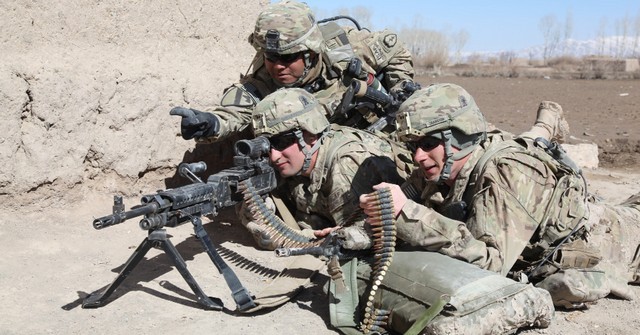
The US military bases are there to assert US control over Afghanistan’s mineral wealth. According to Foreign Affairs, “there are more U.S. military forces deployed there [Afghanistan] than to any other active combat zone”, the official mandate of which is “to go after” the Taliban, Al Qaeda and ISIS as part of the “Global war on Terrorism”.

Why so many military bases? Why the additional forces sent in by Trump?

The unspoken objective of US military presence in Afghanistan is to keep the Chinese out, i.e hinder China from establishing trade and investments relations with Afghanistan.

More generally, the establishment of military bases in Afghanistan on China’s Western border is part of a broader process of military encirclement of the People’s Republic of China.–i.e naval deployments in the South China sea, military facilities in Guam, South Korea, Okinawa, Jeju Island, etc. (see 2011 map below)

Pivot to Asia

Under the Afghan-US security pact, established under Obama’s Asian pivot, Washington and its NATO partners have established a permanent military presence in Afghanistan, with military facilities located close to China’s Western frontier. The pact was intended to allow the US to maintain their nine permanent military bases, strategically located on the borders of China, Pakistan and Iran as well as Turkmenistan, Uzbekistan and Tajikistan.

US military presence, however, has not prevented the expansion of trade and investment relations between China and Afghanistan. A strategic partnership agreement was signed between Kabul and Beijing in 2012. Afghanistan has observer status in the Shanghai Cooperation Organization (SCO).

Moreover, neighboring Pakistan –which is now a full member of the SCO–, has established close bilateral relations with China. And now Donald Trump is threatening Pakistan, which for many years has been the target of America’s “undeclared drone war”.

In other words, a shift in geopolitical alignments has taken place which favors the integration of Afghanistan alongside Pakistan into the Eurasian trade, investment and energy axis.

Pakistan, Afghanistan, Iran and China are cooperating in oil and gas pipeline projects. The SCO of which Turkmenistan, Uzbekistan and Tajikistan are full members is providing a geopolitical platform for the integration of Afghanistan into the Eurasian energy and transport corridors.

China is eventually intent upon integrating Afghanistan into the transport network of Western China as part of the Belt and Road initiative.

Moreover, China’s state owned mining giant, Metallurgical Corporation of China Limited (MCC) “has already managed to take control of the huge copper deposit Mes Aynak, which lies in an area controlled by the Taliban. Already in 2010, Washington feared “that resource-hungry China will try to dominate the development of Afghanistan’s mineral wealth which would upset the United States”… After winning the bid for its Aynak copper mine in Logar Province, China clearly wants more” (Mining.com)

China and the Battle for Lithium

Chinese mining conglomerates are now competing for strategic control of the global Lithium market, which until recently was controlled by the “Big Three” conglomerates including Albemarle’s Rockwood Lithium (North Carolina), The Sociedad Quimica y Minera de Chile and FMC Corporation, (Philadelphia) which operates in Argentina. While the Big Three dominate the market, China now accounts for a large share of global lithium production, categorized as the fourth-largest lithium-producing country behind Australia, Chile and Argentina. Meanwhile China’s Tianqi Group has taken control of Australia’s largest lithium mine, called Greenbushes. Tianqi now owns a 51-percent stake in Talison Lithium, in partnership with North Carolina’s Albemarle.

This thrust in lithium production is related to China’s rapid development of the electric car industry:

China is now “The Center Of Lithium Universe”. China is already the largest market for electric cars. BYD, Chinese company backed by Warren Buffett, is the largest EV manufacturer in the world and Chinese companies are producing the largest amount of lithium chemicals for the batteries. There are 25 companies, which are making 51 models of electric cars in China now. This year we will see over 500,000 EVs sold in China. It took GM 7 years to sell 100,000 Chevy Volts from 2009. BYD will sell 100,000 EVs this year alone! (Mining.com, November 2016 report)

The size of the reserves of Lithium in Afghanistan have not been firmly established.

Analysts believe that these reserves which are yet to be exploited will not have a significant impact on the global lithium market.

Michel Chossudovsky is an award-winning author, Professor of Economics (emeritus) at the University of Ottawa, Founder and Director of the Centre for Research on Globalization (CRG), Montreal and Editor of the globalresearch.ca website.

19 November 2018

Source: https://www.transcend.org/tms/2018/11/more-american-troops-to-afghanistan-to-keep-the-chinese-out-lithium-and-the-battle-for-afghanistans-mineral-riches/

Costs of Post-9/11 U.S. Wars to 2019: $5.9 Trillion

By Neta C. Crawford

14 Nov 2018 –The United States has appropriated and is obligated to spend an estimated $5.9 trillion on the war on terror through Fiscal Year 2019, including direct war and war-related spending and obligations for future spending on post-9/11 war veterans.

This number differs substantially from the Pentagon’s estimates of the costs of the post-9/11 wars because it includes not only war appropriations made to the Department of Defense – spending in the war zones of Iraq, Syria, Afghanistan, Pakistan, and in other places the government designates as sites of “overseas contingency operations,” – but also includes spending across the federal government that is a consequence of these wars. Specifically, this is war-related spending by the Department of State, past and obligated spending for war veterans’ care, interest on the debt incurred to pay for the wars, and the prevention of and response to terrorism by the Department of Homeland Security.

If the US continues on its current path, war spending will continue to grow. The Pentagon currently projects $80 billion in Overseas Contingency Operations (OCO) spending through FY2023. Even if the wars are ended by 2023, the US would still be on track to spend an additional $808 billion (see Table 2) to total at least $6.7 trillion, not including future interest costs. Moreover, the costs of war will likely be greater than this because, unless the US immediately ends its deployments, the number of veterans associated with the post-9/11 wars will also grow. Veterans benefits and disability spending, and the cost of interest on borrowing to pay for the wars, will comprise an increasingly large share of the costs of the US post-9/11 wars.

Table 1 summarizes the direct war costs – the OCO budget – and war-related costs through FY2019. These include war-related increases in overall military spending, care for veterans, Homeland Security spending, and interest payments on borrowing for the wars. Including the other areas of war-related spending, the estimate for total US war-related spending allocated through FY2019 is $4.9 trillion. But because the US is contractually and morally obligated to pay for the care of the post-9/11 veterans through their lifetimes, it is prudent to include the costs of care for existing post-9/11 veterans through the next several decades. This means that the US has spent or is obligated to spend $5.9 trillion in current dollars through FY2019. Table 1 represents this bottom-line breakdown for spent and obligated costs.

Table 1. Summary of War Related Spending, in Billions of Current Dollars, Rounded to the Nearest Billion, FY2001- FY2019

Figure 1. US Costs of War: $5.9 Billion of Current Dollars Spent and Obligated, through FY2019

Further, the US military has no plans to end the post-9/11 wars in this fiscal year or the next. Rather, as the inclusion of future years spending estimates in the Pentagon’s budget indicates, the DOD anticipates military operations in Afghanistan, Pakistan, Iraq and Syria necessitating funding through at least FY2023. Thus, including anticipated OCO and other war-related spending, and the fact that the post-9/11 veterans will require care for the next several decades, I estimate that through FY2023, the US will spend and take on obligations to spend more than $6.7 trillion.

Neta C. Crawford is Professor and Chair of the Department of Political Science at Boston University and Co-Director of the Costs of War Project at Brown University.

19 November 2018

Source: https://www.transcend.org/tms/2018/11/costs-of-post-9-11-u-s-wars-to-2019-5-9-trillion/

On My 88th Birthday: A Reflection

By Richard Falk

13 Nov 2018 – I took part in a stirring program here in Berlin earlier this evening in support of three activists from Palestine and Israel who face criminal charges for disrupting a meeting featuring Zionist denials of Israeli crimes against humanity. Two of the three who face these charges are Jews born in Israel, and one a Palestinian born in Gaza, whose family was in audience, including his father who was in an Israeli prison for 18 years.

It was an inspirational event that discussed with depth and insight the obstacles to support for Palestinian rights encountered in Germany because of the persistence of German guilt about the Nazi past. In my remarks I tried to convey the understanding that the only true way to erase that sense of the past is to oppose the ongoing Israeli crimes of states rather than be complicit by choosing to be silent in the face of evil.

I post a poem that I wrote earlier today, and read at the end of my talk, perhaps a self-indulgent conceit on my part, but I share it here as a way of thanking so many friends near and far who sent me the most moving birthday greetings throughout the day, which made me feel that we who are supporting the Palestinian struggle are part of a growing community that will prevail at some point, and the two peoples now inhabiting Palestine can finally live in peace, and with dignity and equality. All of us agreed that peace can only happen once the apartheid structure of the present Israeli state is fully dismantled and a spirit of true equality for Palestinians and Jews is affirmed and implemented, not only for those living under occupation, but for Palestinians confined to more than 60 refugee camps, to those millions long victimized by involuntary exile, and by the Palestinian minority in Israel.

**************************************

To be almost 90
And happy
With good health

Feels criminal
Amid Satanic happenings
Raising Images too dark
To be real

Children in Gaza
Are shot to death
Friday after Friday
By armed vampires

Khashoggi’s murder
An unspeakable crime
Yet no more than a problem
For hard men of power

Events so dark
And so numerous
Casting shadows

Will despair be our fate?
Is this truly our world?
Are we even meant to survive?

My hope– to live
Long enough to shout
An everlasting ‘No’

And may so affirming
Become my last word
Become my testament
Of hope for all beings
_______________________________________

Richard Falk is a member of the TRANSCEND Network, an international relations scholar, professor emeritus of international law at Princeton University, author, co-author or editor of 40 books, and a speaker and activist on world affairs.

19 November 2018

Source: https://www.transcend.org/tms/2018/11/on-my-88th-birthday-a-reflection/

Abolish Militarism and War

By Mairead Maguire

Dear Friends,

It is good to be here with you all. I would like to thank the organizers for inviting me to address the conference. Firstly I thank you all for your work for peace. It is good that we will have an opportunity in the next few days to get to know each other and together discuss what kind of a world we want to live in? There will be many different perspectives on this and the way forward, but let us agree to respect each other and to engage in deep listening and conversation no matter how hard and where the dialogue might take us!

Let us be encouraged by the fact that we have made an important first step when we agree to enter into dialogue, and when we agree that peace is both the means and the great achievable gift. It would be wonderful too no matter what area of social/political change we work in, if we can unite on a shared vision of a demilitarized world and find strength in agreeing we will not limit ourselves to civilizing and slowing down militarism, but demanding its total abolition.

Some people might argue that peace is not possible in such a highly militarized world. However, I believe that peace is both possible and urgent. It is achievable when we each become impassioned about peace and filled with an ethic that makes peace our objective and we each put into practice our moral sense of political/social responsibility to build peace and justice.

To build peace we are challenged to reject the bomb, the bullet, and all the techniques of violence. Unfortunately, we are constantly bombarded with the glorification of militarism and war; therefore building a culture of peace and nonviolence will not be an easy task. We are hearing about the building of a European army and we are asked to accept austerity and budget cuts to our health, education, etc. whilst increasing money to our own armies and also European military expansion.

The North Atlantic Treaty Organization-NATO, which should have been disbanded when the Warsaw Pact was dissolved, continue to carry out wars and proxy wars in many countries pushing towards the borders of Russia and resurrecting a cold war between the East and West. I believe that NATO should be disbanded and should be made accountable and make restitutions to the millions of people in countries such as Afghanistan, Iraq, Libya, and many others it has illegally attacked, invaded, destroyed. We will never be allowed by our governments, or our mainstream media, to hear many of the stories of the lives of so many civilians killed by US/NATO forces. NATO forces have targeted and assassinated individuals and entire families.

It is to all our shame in the International community, that their illegal criminal acts of horror and bloodletting which embodies the comeback of barbarism, is allowed to continue. NATO should be brought before the International Criminal Court for war crimes.

It would be all too easy to point fingers and play the blame game but unless we all take responsibility for the highly dangerous militarised situation with which we are faced in the world today, things will not get better.

Ireland with the militarization of its Foreign and Defence Policy has been unfaithful to the Irish peoples’ wish for a Neutral State and worse by being complicit in accommodating illegal wars. Ireland’s peace activists have been peacefully protesting US military use of Irish airports whereby over two and a half million armed US troops have passed through Shannon Airport on their way to and from the US-led Afghan and Iraq wars. I believe ireland should refuse permission to any further stopover and refueling facilities being granted to aeroplanes ferrying troops or munitions to the wars and also withdraw Irish participation from all NATO and EU military operations overseas.

Ireland is deeply admired in many countries and has a proud record in helping developing countries. Their role as mediators and peace negotiators is well known. I would like to propose that Ireland disband their army and focus their finance and people on developing their great expertise in the science of peacemaking through a Government Dept. of Peace. Recommitting to its tradition of neutrality and multilateralism, placing ethics, morality and justice as core values at the heart of its foreign policy would send out a clear message of Irish Government rejecting the road of militarism and war and choosing the road of peace and reconciliation, both locally and internationally.

For our survival through the UN we need to move to General and Complete Disarmament – including nuclear weapons. This is not an impossible dream. I commend the Irish Government in their work at UN to work for Nuclear Disarmament. I believe we can take hope from Pope Francis statement after pointing out the dangers of nuclear weapons when he says‚

‘The threat of their use, as well as their very possession, is to be firmly condemned.’

And the Pope quotes as an example the

‘historic vote at the UN the majority of the members of the international community determined that nuclear weapons are not only immoral, but also must be considered an illegal means of warfare.’

It is to be hoped that UK, Israel, USA and other nuclear armed states will begin to dismantle their nuclear weapons and help turn back the hands of the doomsday clock. Up to the end of 1961 at the United Nations general and complete disarmament was the aim of all governments. In a joint Soviet-United states statement of 20 Sep l961 they stated,

‘The goal of negotiations is to achieve agreement on a program which will ensure that disarmament is general and complete and war is no longer an instrument for settling international problems’.

Let us unite our voices to call for an end to enmity and war, and for President Trump and President Putin to join together with all world leaders in a World Peace Conference to work for an agreed Programme of General and Complete Disarmament. Such courageous leadership towards dialogue and disarmament would give hope to humanity.

Mairead Corrigan Maguire, co-founder of Peace People, is a member of the TRANSCEND Network for Peace Development Environment.

19 November 2018

Source: https://www.transcend.org/tms/2018/11/abolish-militarism-and-war/

Vandana Shiva on the Smallholder Farmers Who Feed the World

By Prof. Vandana Shiva

Opening of the We Feed the World exhibition in London, 11 Oct 2018. A photographic exhibition celebrating the smallholder farmers and fisherfolk who feed the world. www.wefeedtheworld.org

TRANSCEND Member Prof. Vandana Shiva is a physicist, ecofeminist, philosopher, activist, and author of more than 20 books and 500 papers.

12 November 2018

Source: https://www.transcend.org/tms/2018/11/vandana-shiva-on-the-smallholder-farmers-who-feed-the-world/

America’s ‘Indo-Pacific’ lacks currency and resonance

By Nile Bowie

When regional leaders gathered in Singapore and Papua New Guinea for the Association of Southeast Asian Nations (Asean) and Asia-Pacific Economic Cooperation (Apec) summits, many expected the United States to elaborate upon its new “Indo-Pacific” development strategy for the region.

But what began as an opportunity for the US and China to advance their competing visions for the region’s future development and economic integration ended in acrimony, with officials of the 21-member Apec grouping unable to agree for the first time on a joint communiqué as Washington and Beijing clashed over the statement’s language.

While fissures over trade, investment and maritime security between the world’s two largest economies appear no closer to resolution after the summits, speeches by US Vice President Mike Pence provided more clarity into the US’ Indo-Pacific gambit, which was unveiled in August but has so far failed to gain traction with regional leaders.

US Secretary of State Mike Pompeo initially announced the strategy to include a US$113 million investment package for technology, energy and infrastructure that he called a “down-payment on a new era of US economic commitment to the region.” That new commitment was unveiled alongside US$300 million in new funding for security cooperation.

Doubts about the strategy, seen by many as a vague move to counterbalance China’s economic heft, were rife among observers who compared the paltry amount pledged by Washington to Beijing’s US$1 trillion Belt and Road Initiative (BRI) infrastructure-spending drive.

While US officials have been at pains to impress the plan is not competing directly with Beijing’s initiatives, Pence’s remarks at regional summits and the US’ recent mobilization of large-scale public-private investments suggest the opposite: a coordinated American response to China’s signature economic initiative, backed by allies such as Australia, Japan and others.

“We do not offer a constricting belt or a one-way road,” Pence told Apec summit attendees during a blunt speech in Port Moresby that, while not directly naming China, warned of opaque infrastructure financing practices that could burden nations with unsustainable debt loads.

The idea that Beijing is mobilizing development financing in a bid to ensnare strategically important regional countries into sovereignty-eroding “debt traps” has gained currency among those with hawkish views on China, though it has arguably done little to blunt the region’s general receptiveness to the initiative.

Chinese President Xi Jinping defended the BRI during his Apec summit address, denying any “hidden political agendas” to weigh down countries with debt. Pence, meanwhile, used his sharply-worded address to persuade countries to choose “the better option” of American development financing.

Washington’s emphasis on infrastructure financing – which was not a component of the Barack Obama administration’s free trade-oriented Asia ‘pivot’ strategy – follows last month’s passage of the Better Utilization of Investment Leading to Development (Build) Act, which received rare bipartisan support from the US Congress.

The Build Act mandates the creation of a new agency, the US International Development Finance Corp (IDFC), which will make development financing loans and guarantees available around the world, giving – according to the White House – developing countries a viable alternative to “state-directed initiatives that come with hidden strings attached.”

The new legislation provides the soon-to-be-formed IDFC an exposure cap of US$60 billion, double what its predecessor agency, the Overseas Private Investment Corporation (OPIC), utilized for foreign aid expenditure. Unlike OPIC, the IDFC will be permitted to undertake investments in equity – just as BRI-linked lenders have done – in the global projects it finances.

That would mark a sea change from how America’s hitherto modest foreign assistance programs have operated in recent decades, generally focusing on technical assistance programs, civil society funding, disaster relief and small-scale infrastructure, rather than the big-ticket infrastructure and global development financing associated with China’s BRI.

In an op-ed published in the Washington Post, Pence wrote that the US would help build “world-class ports and airports, roads and railways, and pipelines and data lines.” Businesses, not bureaucrats, he wrote, would spearhead American efforts, “because governments and state-owned enterprises are incapable of building lasting prosperity.”

The narrative of business-led capitalism versus state-directed enterprises features prominently in the Indo-Pacific strategy’s offerings, which from the start emphasized how American private sector investment would yield more “transparent” and “sustainable” outcomes for developing countries.

Allied nations are also tipped to play a significant role, with Australia and Japan recently unveiling plans to collaborate with Washington on the funding of regional infrastructure programs.

All three countries, along with India, are part of the so-called Quadrilateral (Quad) security alliance that Beijing views as part of an ill-intentioned containment strategy.

Although the IDFC’s US$60 exposure cap pales in comparison to China’s development financing expenditure, some observers argue Washington could have an edge as a lender by offering mixed financing options that tap into strategic banking and private sector partners, as well as foreign lenders such as Japan, that offer concessionary interest rates.

IDFC won’t be formally established until 2019, and in the meantime, there is an ongoing discussion within the Trump administration regarding the implementation of new funding for American private sector companies, according to Michael Michalak, senior vice president and regional managing director of the US-ASEAN Business Council.

Michalak, a former US ambassador to Vietnam, told Asia Times that while the private sector will “try and get as much capital as they can” for use in projects across the region, members of the business community are “much more obviously pro-trade than the current administration” and not in favor of the White House’s policies toward China.

“I would say, everybody, without exception, thinks a trade war is a bad idea and that eventually it is going to hurt everybody involved,” he said. “The focus should be on rebuilding relationships with our trading partners, to try and use those relationships to get at the China issue, rather than going at it alone with heavy-handed tariff tactics.”

Michalak says the Trump administration’s trade policies and retreat from multilateralism have brought about “uncertainty” that has undermined American influence in the region. “Every time I talk with administration representatives at embassies or elsewhere, they are not talking about multilateral initiatives. It’s all bilateral.

“By doing bilateral, you’re not going to affect the entire rules-based system in a way that doing a multilateral agreement would,” says Michalak. “I don’t see them doing any multilateral initiatives, and, going forward, I don’t see the US as having the same kind of influence that it had in past administrations.”

Despite the Trump administration casting its global development financing aspirations as an alternative to China’s infrastructure spending, Michalak believes the American initiative is not intended to “go head-to-head” with BRI. The Build Act “is simply trying to improve the competitiveness of American companies in the infrastructure space,” he says.

By pulling back from multilateral trade deals, however, “the US just risks being left behind as the rest of the world is moving forward with integration and trying to decide rules on the digital economy,” said Michalak.

Despite bipartisan consensus among US lawmakers for countering Chinese initiatives, countries in the region appear more preoccupied with maneuvering around Washington’s zero-sum approach to trade and worsening ties with Beijing. And with multilateralism in tatters, witnessed in the Apec debacle, it remains to be seen whether Trump’s Indo-Pacific vision will have many takers.

Nile Bowie is a writer and journalist with Asia Times covering current affairs in Singapore and Malaysia.

19 November 2018

Source: http://www.atimes.com/article/americas-indo-pacific-lacks-currency-and-resonance/

Singapore’s ASEAN tenure marked by crises and disputes

By Nile Bowie

When Singapore took the reins last year of the Association of Southeast Asian Nations’ (Asean) rotating leadership, the regional grouping’s credibility and relevance was at stake.

Amid rising geopolitical tensions, maritime disputes in the South China Sea and abuses in Myanmar against the Rohingya Muslim minority that the United Nations has said constitute crimes against humanity, consensus has been elusive on issues that are dividing the region.

One year on, despite progress in enhancing certain areas of cooperation, the question of how the 10-member grouping intends to foster greater unity, coherence and relevance is no less pertinent now than when the city-state formally took over the revolving chair from the Philippines last November.

The grouping’s member states – along with top officials from China, Russia, South Korea, Japan and the United States – convened in Singapore this week for the 33rd Asean Summit, where Singapore’s Prime Minister Lee Hsien Loong gave perhaps his most frank assessment to date of US policy and the fractured state of multilateral cooperation.

“Countries, including major powers, are resorting to unilateral actions and bilateral deals, and even explicitly repudiating multilateral approaches and institutions,” the Singaporean premier said. “It is unclear if the world will settle into new rules and norms of international engagement, or whether the international order will break up into rival blocs.”

Asean’s chair is tasked with setting the agenda for the year’s multilateral engagements, facilitating official meetings, tabling new initiatives and serving as group spokesperson. The closing ceremony of the summit saw Singapore hand over Asean’s chairmanship to Thailand’s Prime Minister Prayut Chan-ocha, whose country will lead the grouping in 2019.

As Asean’s leader, Singapore presided over a period marked by a US-led pushback against multilateralism and trade tensions between America and China that saw the world’s two largest economies impose tit-for-tat tariffs, a move that has rattled supply chains with expectations of cooling growth across Southeast Asia.

Trade integration, rather than conflict resolution, was prioritized during the city-state’s stewardship of the grouping, bringing Asean in sync with a Chinese leadership that has taken the lead in extolling the virtues of free trade and openness at the expense of an American president who favors protectionism as a means to extract trade concessions.

As such, Washington has been left without a seat at the table as regional governments push to finalize the 16-member Regional Comprehensive Economic Partnership (RCEP), a trade pact between Asean, China, Japan, South Korea, India, Australia and New Zealand that will encompass more than half of the world’s population if and when it is concluded.

Hopes were high that RCEP, negotiated since 2013, would be concluded within this year. Asean economic ministers, however, failed to reach an agreement regarding issues such as lowering tariffs during this week’s summit in Singapore. Some believe the deal could be bogged down by politics with Australia, Indonesia, India and Thailand scheduled to hold polls in 2019.

Elsewhere, the 11-country Comprehensive and Progressive Agreement for Trans-Pacific Partnership (CPTPP) is expected to enter into force on December 30, with Vietnam being the latest nation to ratify the pact. An earlier version of the agreement was thrown into limbo when US President Donald Trump pulled out of the agreement during his first week in office.

Singapore focused its Asean chairmanship on themes of resilience and innovation, encompassing the promotion of free trade agreements (FTAs) as well as pacts related to e-commerce and new digital technologies, including a flagship “smart cities” urban planning concept aimed at improving access to public services across 26 Asean pilot cities.

Determining where the public relations end and the substantive outcomes begin, however, is an altogether different matter. Asean, which has traditionally worked by achieving consensus, has come no closer to reaching a purposeful outcome regarding the persecution of Rohingya Muslims in Myanmar, whose military stands accused of heinous rights abuses.

Singapore had previously called for the repatriation of displaced persons to Myanmar and reconciliation among communities, but earlier this year the city-state’s stance hardened somewhat. Minister for Foreign Affairs Vivian Balakrishnan urged Naypyidaw to give a full mandate to a commission of inquiry and hold those found responsible to account.

Signs of progress were seen in other areas. China and Asean announced in June that both sides had agreed upon a draft document to serve as a basis for further negotiations for a code of conduct that would outline the norms, rules and responsibilities that parties to territorial disputes in the South China Sea would be obligated to uphold.

The draft document came 16 years after a code of conduct was originally mandated in 2002 and since has seen the contested region’s dynamics dramatically shift in Beijing’s favor after years of reclamation and military fortification of islands it claims. Chinese Premier Li Keqiang recently said Beijing aims to complete negotiations on a code of conduct within three years.

“Under Singapore’s watch, Asean has strengthened and continued to juggle the different interests of all parties within the grouping while continuing to encourage international businesses to invest in the region,” says Felix Tan, an associate Lecturer with SIM Global Education in Singapore, who emphasized the organization’s defense of multilateralism.

“Disputes in the South China Sea and the Myanmar refugee crisis might have dented Asean’s cohesiveness and impacted the stability of the region, but Singapore handled it by encouraging Asean to cooperate and work in tandem within areas where other Asean countries can contribute significantly, such as diplomatic exchanges and dialogues.”

“During Singapore’s chairmanship, Asean has managed to temper the demands of the great powers such as China and the US,” said Tan, adding that Asean leaders are mindful of how great powers from outside the region would be able to manipulate the grouping if allowed to take center stage and exert “an overwhelming influence.”

Mark Valencia, an adjunct senior scholar at the National Institute for South China Sea Studies in Haikou, China, takes a dimmer view: “On Singapore’s watch, the South China Sea became an increasing focus of rivalry for dominance between China and the US,” he told Asia Times, adding that the grouping has become less central to regional security as a result.

“Asean was and is unable to mitigate this struggle and its deleterious effect on Asean unity and centrality in regional security,” he said. “This is not the fault or lack of effort on the part of [Foreign Minister] Balakrishnan and Singapore. Asean is caught up in a seminal great power contest and there is little that it can do to extricate itself or mitigate its effects.”

Valencia spoke favorably of a recent Asean agreement to introduce guidelines for managing unexpected encounters between military aircraft in the maritime region, but lamented that the guidelines would do little to prevent “intentional unfriendly encounters as we have seen in the continuing incidents between China and the US.”

Consensus between China and Asean on a draft document setting of terms of reference for future talks “reflects how little progress has been made” on the issue said Valencia, who highlighted outstanding issues such as the absence of a dispute settlement procedure.

“The situation is likely to get worse before it gets better,” he said.

Nile Bowie is a writer and journalist with Asia Times covering current affairs in Singapore and Malaysia.

15 November 2018

Source: http://www.atimes.com/article/singapores-asean-tenure-marked-by-crises-and-disputes/

Crucifying Julian Assange

By Chris Hedges

What is happening to Assange should terrify the press. And yet his plight is met with indifference and sneering contempt.

Julian Assange’s sanctuary in the Ecuadorian Embassy in London has been transformed into a little shop of horrors. He has been largely cut off from communicating with the outside world for the last seven months. His Ecuadorian citizenship, granted to him as an asylum seeker, is in the process of being revoked. His health is failing. He is being denied medical care. His efforts for legal redress have been crippled by the gag rules, including Ecuadorian orders that he cannot make public his conditions inside the embassy in fighting revocation of his Ecuadorian citizenship.

Australian Prime Minister Scott Morrison has refused to intercede on behalf of Assange, an Australian citizen, even though the new government in Ecuador, led by Lenín Moreno—who calls Assange an “inherited problem” and an impediment to better relations with Washington—is making the WikiLeaks founder’s life in the embassy unbearable. Almost daily, the embassy is imposing harsher conditions for Assange, including making him pay his medical bills, imposing arcane rules about how he must care for his cat and demanding that he perform a variety of demeaning housekeeping chores.

The Ecuadorians, reluctant to expel Assange after granting him political asylum and granting him citizenship, intend to make his existence so unpleasant he will agree to leave the embassy to be arrested by the British and extradited to the United States. The former president of Ecuador, Rafael Correa, whose government granted the publisher political asylum, describes Assange’s current living conditions as “torture.”

His mother, Christine Assange, said in a recent video appeal, “Despite Julian being a multi-award-winning journalist, much loved and respected for courageously exposing serious, high-level crimes and corruption in the public interest, he is right now alone, sick, in pain—silenced in solitary confinement, cut off from all contact and being tortured in the heart of London. The modern-day cage of political prisoners is no longer the Tower of London. It’s the Ecuadorian Embassy.”
“Here are the facts,” she went on. “Julian has been detained nearly eight years without charge. That’s right. Without charge. For the past six years, the U.K. government has refused his request for access to basic health needs, fresh air, exercise, sunshine for vitamin D and access to proper dental and medical care. As a result, his health has seriously deteriorated. His examining doctors warned his detention conditions are life-threatening. A slow and cruel assassination is taking place before our very eyes in the embassy in London.”

“In 2016, after an in-depth investigation, the United Nations ruled that Julian’s legal and human rights have been violated on multiple occasions,” she said. “He’d been illegally detained since 2010. And they ordered his immediate release, safe passage and compensation. The U.K. government refused to abide by the U.N.’s decision. The U.S. government has made Julian’s arrest a priority. They want to get around a U.S. journalist’s protection under the First Amendment by charging him with espionage. They will stop at nothing to do it.”

“As a result of the U.S. bearing down on Ecuador, his asylum is now under immediate threat,” she said. “The U.S. pressure on Ecuador’s new president resulted in Julian being placed in a strict and severe solitary confinement for the last seven months, deprived of any contact with his family and friends. Only his lawyers could see him. Two weeks ago, things became substantially worse. The former president of Ecuador, Rafael Correa, who rightfully gave Julian political asylum from U.S. threats against his life and liberty, publicly warned when U.S. Vice President Mike Pence recently visited Ecuador a deal was done to hand Julian over to the U.S. He stated that because of the political costs of expelling Julian from their embassy was too high, the plan was to break him down mentally. A new, impossible, inhumane protocol was implemented at the embassy to torture him to such a point that he would break and be forced to leave.”

Assange was once feted and courted by some of the largest media organizations in the world, including The New York Times and The Guardian, for the information he possessed. But once his trove of material documenting U.S. war crimes, much of it provided by Chelsea Manning, was published by these media outlets he was pushed aside and demonized. A leaked Pentagon document prepared by the Cyber Counterintelligence Assessments Branch dated March 8, 2008, exposed a black propaganda campaign to discredit WikiLeaks and Assange. The document said the smear campaign should seek to destroy the “feeling of trust” that is WikiLeaks’ “center of gravity” and blacken Assange’s reputation. It largely has worked. Assange is especially vilified for publishing 70,000 hacked emails belonging to the Democratic National Committee (DNC) and senior Democratic officials. The Democrats and former FBI Director James Comey say the emails were copied from the accounts of John Podesta, Democratic candidate Hillary Clinton’s campaign chairman, by Russian government hackers. Comey has said the messages were probably delivered to WikiLeaks by an intermediary. Assange has said the emails were not provided by “state actors.”

The Democratic Party—seeking to blame its election defeat on Russian “interference” rather than the grotesque income inequality, the betrayal of the working class, the loss of civil liberties, the deindustrialization and the corporate coup d’état that the party helped orchestrate—attacks Assange as a traitor, although he is not a U.S. citizen. Nor is he a spy. He is not bound by any law I am aware of to keep U.S. government secrets. He has not committed a crime. Now, stories in newspapers that once published material from WikiLeaks focus on his allegedly slovenly behavior—not evident during my visits with him—and how he is, in the words of The Guardian, “an unwelcome guest” in the embassy. The vital issue of the rights of a publisher and a free press is ignored in favor of snarky character assassination.

Assange was granted asylum in the embassy in 2012 to avoid extradition to Sweden to answer questions about sexual offense allegations that were eventually dropped. Assange feared that once he was in Swedish custody he would be extradited to the United States. The British government has said that, although he is no longer wanted for questioning in Sweden, Assange will be arrested and jailed for breaching his bail conditions if he leaves the embassy.

WikiLeaks and Assange have done more to expose the dark machinations and crimes of the American Empire than any other news organization. Assange, in addition to exposing atrocities and crimes committed by the United States military in our endless wars and revealing the inner workings of the Clinton campaign, made public the hacking tools used by the CIA and the National Security Agency, their surveillance programs and their interference in foreign elections, including in the French elections. He disclosed the conspiracy against British Labour Party leader Jeremy Corbyn by Labour members of Parliament. And WikiLeaks worked swiftly to save Edward Snowden, who exposed the wholesale surveillance of the American public by the government, from extradition to the United States by helping him flee from Hong Kong to Moscow. The Snowden leaks also revealed, ominously, that Assange was on a U.S. “manhunt target list.”

What is happening to Assange should terrify the press. And yet his plight is met with indifference and sneering contempt. Once he is pushed out of the embassy, he will be put on trial in the United States for what he published. This will set a new and dangerous legal precedent that the Trump administration and future administrations will employ against other publishers, including those who are part of the mob trying to lynch Assange. The silence about the treatment of Assange is not only a betrayal of him but a betrayal of the freedom of the press itself. We will pay dearly for this complicity.

Even if the Russians provided the Podesta emails to Assange, he should have published them. I would have. They exposed practices of the Clinton political machine that she and the Democratic leadership sought to hide. In the two decades I worked overseas as a foreign correspondent I was routinely leaked stolen documents by organizations and governments. My only concern was whether the documents were forged or genuine. If they were genuine, I published them. Those who leaked material to me included the rebels of the Farabundo Marti National Liberation Front (FMLN); the Salvadoran army, which once gave me blood-smeared FMLN documents found after an ambush; the Sandinista government of Nicaragua; the Israeli intelligence service, the Mossad; the Federal Bureau of Investigation; the Central Intelligence Agency; the Kurdistan Workers’ Party (PKK) rebel group; the Palestine Liberation Organization (PLO); the French intelligence service, Direction Générale de la Sécurité Extérieure, or DGSE; and the Serbian government of Slobodan Milosovic, who was later tried as a war criminal.

We learned from the emails published by WikiLeaks that the Clinton Foundation received millions of dollars from Saudi Arabia and Qatar, two of the major funders of Islamic State. As secretary of state, Hillary Clinton paid her donors back by approving $80 billion in weapons sales to Saudi Arabia, enabling the kingdom to carry out a devastating war in Yemen that has triggered a humanitarian crisis, including widespread food shortages and a cholera epidemic, and left close to 60,000 dead. We learned Clinton was paid $675,000 for speaking at Goldman Sachs, a sum so massive it can only be described as a bribe. We learned Clinton told the financial elites in her lucrative talks that she wanted “open trade and open borders” and believed Wall Street executives were best-positioned to manage the economy, a statement that directly contradicted her campaign promises. We learned the Clinton campaign worked to influence the Republican primaries to ensure that Donald Trump was the Republican nominee. We learned Clinton obtained advance information on primary-debate questions. We learned, because 1,700 of the 33,000 emails came from Hillary Clinton, she was the primary architect of the war in Libya. We learned she believed that the overthrow of Moammar Gadhafi would burnish her credentials as a presidential candidate. The war she sought has left Libya in chaos, seen the rise to power of radical jihadists in what is now a failed state, triggered a massive exodus of migrants to Europe, seen Libyan weapon stockpiles seized by rogue militias and Islamic radicals throughout the region, and resulted in 40,000 dead. Should this information have remained hidden from the American public? You can argue yes, but you can’t then call yourself a journalist.

“They are setting my son up to give them an excuse to hand him over to the U.S., where he would face a show trial,” Christine Assange warned. “Over the past eight years, he has had no proper legal process. It has been unfair at every single turn with much perversion of justice. There is no reason to consider that this would change in the future. The U.S. WikiLeaks grand jury, producing the extradition warrant, was held in secret by four prosecutors but no defense and no judge. The U.K.-U.S. extradition treaty allows for the U.K. to extradite Julian to the U.S. without a proper basic case. Once in the U.S., the National Defense Authorization Act allows for indefinite detention without trial. Julian could very well be held in Guantanamo Bay and tortured, sentenced to 45 years in a maximum-security prison, or face the death penalty. My son is in critical danger because of a brutal, political persecution by the bullies in power whose crimes and corruption he had courageously exposed when he was editor in chief of WikiLeaks.”

Assange is on his own. Each day is more difficult for him. This is by design. It is up to us to protest. We are his last hope, and the last hope, I fear, for a free press.

“We need to make our protest against this brutality deafening,” his mother said. “I call on all you journalists to stand up now because he’s your colleague and you are next. I call on all you politicians who say you entered politics to serve the people to stand up now. I call on all you activists who support human rights, refugees, the environment, and are against war, to stand up now because WikiLeaks has served the causes that you spoke for and Julian is now suffering for it alongside of you. I call on all citizens who value freedom, democracy and a fair legal process to put aside your political differences and unite, stand up now. Most of us don’t have the courage of our whistleblowers or journalists like Julian Assange who publish them, so that we may be informed and warned about the abuses of power.”

Chris Hedges writes a regular column for Truthdig.com.

14 November 2018

Source: https://countercurrents.org/2018/11/14/crucifying-julian-assange/