Just International

By razing Khan al-Ahmar, Israel will bulldoze illusions of peace process

By Jonathan Cook

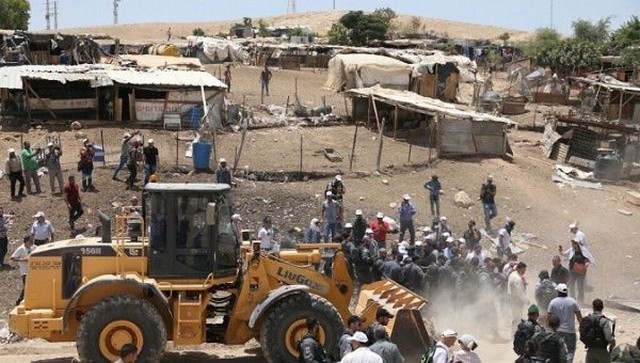
Nazareth: Israel finally built an access road to the West Bank village of Khan al-Ahmar last week, after half a century of delays. But the only vehicles allowed along it are the bulldozers scheduled to sweep away its 200 inhabitants’ homes.

If one community has come to symbolise the demise of the two-state solution, it is Khan al-Ahmar.

It was for that reason that a posse of European diplomats left their air-conditioned offices late last week to trudge through the hot, dusty hills outside Jerusalem and witness for themselves the preparations for the village’s destruction. That included the Israeli police viciously beating residents and supporters as they tried to block the advance of heavy machinery.

Britain, France, Germany, Italy and Spain have submitted a formal protest. Their denunciations echoed those of more than 70 Democratic lawmakers in Washington in May – a rare example of US politicians showing solidarity with Palestinians.

It would be gratifying to believe that Western governments care about the inhabitants of Khan al-Ahmar – or the thousands of other Palestinians who are being incrementally cleansed by Israel from nearby lands but whose plight has drawn far less attention.

After all, the razing of Khan al-Ahmar and the forcible transfer of its population are war crimes.

But in truth Western politicians are more concerned about propping up the illusion of a peace process that expired many years ago than the long-running abuse of Palestinians under Israeli occupation.

Western capitals understand what is at stake. Israel wants Khan al-Ahmar gone so that Jewish settlements can be built in its place, on land it has designated as “E1”.

That would put the final piece in place for Israel to build a substantial bloc of new settler homes to sever the West Bank in two. Those same settlements would also seal off West Bank Palestinians from East Jerusalem, the expected capital of a future Palestinian state, making a mockery of any peace agreement.

The erasure of Khan al-Ahmar has not arrived out of nowhere. Israel has trampled on international law for decades, conducting a form of creeping annexation that has provoked little more than uncomfortable shifting in chairs from Western politicians.

Khan al-Ahmar’s Bedouin inhabitants, from the Jahalin tribe, have been ethnically cleansed twice before by Israel, but these war crimes went unnoticed.

The first time was in the 1950s, a few years after Israel’s creation, when 80 per cent of Palestinians had been driven from their homes to clear the path for the creation of a Jewish state.

Although they should have enjoyed the protection of Israeli citizenship, the Jahalin were forced out of the Negev and into the West Bank, then controlled by Jordan, to make way for new Jewish immigrants.

A generation later in 1967, when they had barely re-established themselves, the Jahalin were again under attack from Israeli soldiers occupying the West Bank. The grazing lands the Jahalin had relocated to with their goats and sheep were seized to build a settlement for Jews only, Kfar Adumim, in violation of the laws of war.

Ever since, the Jahalin have dwelt in a twilight zone of Israeli-defined “illegality”. Like other Palestinians in the 60 per cent of the West Bank declared under Israeli control by the Oslo peace process, they have been denied building permits, forcing three generations to live in tin shacks and tents.

Israel has also refused to connect the village to the water, electricity and sewage grids, in an attempt to make life so unbearable the Jahalin would opt to leave.

When an Italian charity helped in 2009 to establish Khan al-Ahmar’s first school – made from mud and tyres – Israel stepped up its legal battle to demolish the village.

Now, the Jahalin are about to be driven from their lands again, as though they are nothing more than wayward cattle. This time they are to be forcibly re-settled next to a waste dump by the Palestinian town of Abu Dis, hemmed in on all sides by Israeli walls and settlements.

In the new location they will be forced to abandon their pastoral way of life. As resident Ibrahim Abu Dawoud observed: “For us, leaving the desert is death.”

In another indication of the Palestinians’ dire predicament, the Trump administration is expected to propose in its long-awaited peace plan that the slum-like Abu Dis, rather than East Jerusalem, serve as the capital of a future pseudo-Palestinian state – if Israel ever chooses to recognise one.

Khan al-Ahmar’s destruction would be the first demolition of a complete Palestinian community since the 1990s, when Israel ostensibly committed to the Oslo process.

Now emboldened by Washington’s unstinting support, Benjamin Netanyahu’s government is racing ahead to realise its vision of a Greater Israel. It wants to annex the lands on which villages like Khan al-Ahmar stand and remove their Palestinian populations.

There is a minor hurdle. Last Thursday, the Israeli supreme court tried to calm the storm clouds gathering in Europe by issuing a temporary injunction on the demolition works.

The reprieve is likely to be short-lived. A few weeks ago the same court – in a panel dominated by judges identified with the settler movement – backed Khan al-Ahmar’s destruction.

The Supreme Court has also been moving towards accepting the Israeli government’s argument that decades of land grabs by settlers should be retroactively sanctioned – even though they violate Israeli and international law – if carried out in “good faith”.

Whatever the judges believe, there is nothing “good faith” about the behaviour of either the settlers or Israel’s government towards communities like Khan al-Ahmar.

Saeb Erekat, the Palestinians’ veteran peace negotiator, recently warned that Israel and the US were close to “liquidating” the project of Palestinian statehood.

Sounding more desperate than usual, the Europe Union reaffirmed this month its commitment to a two-state solution, while urging that the “obstacles” to its realisation be more clearly identifed.

The elephant in the room is Israel itself – and its enduring bad faith. As Khan al-Ahmar demonstrates all too clearly, there will be no end to the slow-motion erasure of Palestinian communities until western governments find the nerve to impose biting sanctions on Israel.

A version of this article first appeared in the National, Abu Dhabi.

Jonathan Cook won the Martha Gellhorn Special Prize for Journalism.

9 July 2018

Source: https://countercurrents.org/2018/07/09/by-razing-khan-al-ahmar-israel-will-bulldoze-illusions-of-peace-process/
How to Judge the Success of the BRICS Summit? Three Questions Will Do the Trick

By Danny Bradlow

8 Jul 2018 – The 10th BRICS summit [25-27 Jul] to be hosted by South Africa is going to be closely watched. It comes at a time when extraordinary global political and economic challenges are facing the world.

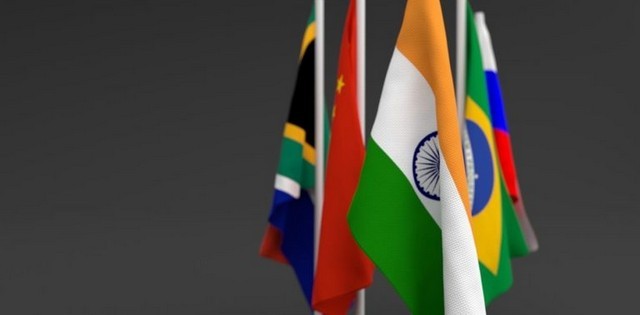
The BRICS bloc is made up of 5 of the leading countries in the global South — Brazil, Russia, India, China and South Africa.

The challenges facing the world range from country specific problems relating to domestic poverty, inequality and unemployment to climate change and a global economic system that is biased in favour of corporate interests, particularly in finance and technology.

One of the most immediate political challenges relate to the changing dynamics in global economic governance. The current global powerhouse, the US, appears intent on starting trade wars with both China and the European Union. Africa can’t avoid being adversely affected by a trade war between these three economic powers, which are its three largest trading partners.

The US is also pulling back from multilateral governance arrangements that it created. For example, it withdrew from the upcoming United Nations (UN) conference on migration and from the UN Human Rights Council. And Washington is effectively paralysing the World Trade Organisation (WTO) by refusing to agree to the appointment of new judges at the WTO Appellate Body.

These developments are creating a volatile and unpredictable situation for all countries. Small players on the global stage, like South Africa and other countries on the continent, face the prospect of becoming collateral damage in the destruction of the current global governance arrangements.

Given all these complex challenges, how should we judge the success of the BRICS Summit?

We can use three tests: is BRICS being strengthened? What benefits will accrue to Africa? And how is the bloc planning to influence global economic governance reform?

BRICS strengthening

One goal of the upcoming summit should be to strengthen the relationship between the BRICS partners.

A concrete way of measuring this will be to look at the number and quality of agreements to emerge out of the summit. A successful summit will result in a range of substantial agreements being reached. The world will be able to scrutinise the outcome in the communique released at the end of the meeting.

It is important to note that the summit is the apex event in a year-long process. During the year various groups of BRICS government officials, civil society groups and technical experts meet to discuss issues of common interest. They have included technical groups such as the BRICS water forum and a committee looking at customs cooperation. Others have involved political matters, such as meetings of foreign affairs ministers and government officials who help guide their leaders to the summit (known as Sherpas).

The participants in these meetings try to reach agreements on issues of mutual interest – such as establishing a BRICS vaccine research centre – or finding ways to collaborate in sectors like tourism. Their job is also to try and resolve differences.

These efforts feed into the work of the summit as the Sherpas prepare the statement of what has been agreed. Details of the agreements that have been struck will be released in a statement at the end of the summit.

BRICS in Africa

Given that the theme for this year’s summit is: “BRICS in Africa: Collaboration for Inclusive Growth and Shared Prosperity in the 4th Industrial Revolution”, it’s reasonable to expect the BRICS summit to produce benefits for Africa.

One area that would be beneficial for the continent would be a signal from the leaders that the BRICS members are willing to commit to funding infrastructure projects on the continent. This is important because Africa is in the process of putting in place an ambitious new Continental Free Trade Agreement. Successful implementation will require constructing infrastructure that can link the continent both internally and with other parts of the world.

BRICS could position itself for a critical role in the funding of these infrastructure projects.

Two obvious vehicles for such funds are the BRICS’s New Development Bank and the funds that China has created to support its One Belt One Road Initiative.

Thus a test for summit success will be whether it generates new financing for sustainable infrastructure in Africa, and the nature of the financing.

Global governance reform

One goal shared by all the BRICS states is reforming global economic governance structures like the World Bank and International Monetary Fund (IMF). The bloc hasn’t been particularly successful in this mission. But this year may be an opportune time to promote reform.

Actions by the US have undermined its leadership position in the world and may have made other countries more open to governance reforms in key international economic organisations. This is particularly relevant for the IMF which is reviewing its quota allocations. A shift would lead to the world body being more responsive to the concerns of its poorer member countries.

There is a longstanding call for the inclusion of a third African chair on the IMF board. It is unconscionable that the 46 sub-Saharan African countries have the lowest level of representation of any region on the IMF board. South Africa should push BRICS to stand behind this call.

The BRICS should also support making the IMF more accountable to countries affected by its operations. This could be done by demanding that the IMF create an independent accountability mechanism. It is currently the only multilateral financial institution without one.

A key benefit of the BRICS is its potential to lead efforts to meaningfully reform the global economic system. It therefore behoves the citizens of BRICS countries to hold their governments accountable for fulfilling this potential.

Danny Bradlow – SARCHI Professor of International Development Law and African Economic Relations, University of Pretoria

9 July 2018

Source: https://www.transcend.org/tms/2018/07/how-to-judge-the-success-of-the-brics-summit-three-questions-will-do-the-trick/

As Hudaida falls to Saudi-Emirati coalition, peace for Yemen seems remote

By Afro-Middle East Centre (AMEC)

As the Saudi-UAE offensive on the Yemeni port city of Hudaida continues and intensifies, there seems to be no solution that will serve the people of the city. Despite his efforts, the UN special envoy to Yemen, Martin Griffiths seems unable to get the warring parties to agree, especially since some parties have more long-term ambitions that cannot be achieved through his proposals.

The recent and ongoing Saudi-Emirati offensive on the Yemeni port city of Hudaida will render UN special envoy Martin Griffiths’s ‘new’ solution to the five-year-long Yemeni crisis difficult to implement. The partial success of the Hudaida offensive has already emboldened the UAE to demand the return of the city to troops aligned to Yemen’s president Abd Rabbuh Mansour Hadi. As Griffiths engages the different players, it is likely that the Houthi, who currently control the port city, will be willing eventually to hand Hudaida over to a third party. Griffiths alluded to this when he referred to his meetings with Houthi officials as ‘fruitful’. This despite the group’s initial rejection of the envoy’s proposal. Clearly, the devastating military hardware supplied by Saudi Arabia and the UAE confronted the group wicth insurmountable odds, and it has reevaluated its position.

Griffiths will, however, likely face pressure from Saudi Arabia and the UAE, which insist that Hudaida be transferred to their direct control, and that UNSC resolution 2216, which calls for Houthi disarmament, be the basis for negotiations. Their belligerence is fuelled by the lack of consequences for their offensive, which has been condemned by the United Nations and most global powers.
Before the Hudaida offensive commenced on 12 June, Griffiths had been meeting roleplayers in an attempt to formulate an enduring solution to the current impasse. His solution closely resembled the 2016 Kuwait and Kerry initiatives, and called for a ceasefire that would end with the disarmament of the Houthi.

The major difference between his proposal and the other two was that he proposed a unity government be formed before disarmament. Other issues, including reconciliation, the status of southern Yemen, and the holding of elections were to be decided in a second phase. Disagreements over the ceasefire and the handover of Hudaida to a third party aborted his initiative. Saudi Arabia and the UAE had previously insisted that the port be handed over to a third party without commensurately agreeing to lift the blockade on Sana’a airport. Significantly, UNSC resolution 2216, adopted in April 2015, ratified Hadi as Yemen’s president and advocated Houthi disarmament and withdrawal. This resolution remains skewed and unrepresentative of the balance of forces, but Saudi Arabia and the UAE insist on it as a basis for negotiations, thus ensuring that no initiative can succeed.

Hudaida is a strategic port through which northern Yemen receives over seventy per cent of its aid; the Saudi coalition has been plotting its capture for two years. The plan to take the city is consistent with the UAE’s recent attempts to secure control of ports along both the Asian and African sides of the Red Sea. In Yemen alone, Abu Dhabi controls the port of Mukallah, Mocha and Aden, and has significant influence in Socotra; in the Horn of Africa it controls the ports of Assab (Eritrea), Berbera (Somaliland/Somalia) and Bosaso (Somalia), and had previously attempted to control Djibouti’s main port.

Fearing that Saudi-Emirati control of Hudaida would halt aid to northern Yemen, the international community had previously scuppered an attack on the city.  Significantly, even the USA, in Donald Trump’s first year as president, refused to endorse the operation, and refused to supply Saudi Arabia with military hardware required to detect and remove sea mines and land-sea missiles that have prevented Saudi-backed forces from being able to amphibiously dock in the port.

However, on 12 June, Saudi- and Emirati-supported troops commenced their operation to capture Hudaida, despite warnings from the UNSC, which condemned the offensive and unsuccessfully attempted mediation talks the day before. Worryingly, Saudi Arabia and the UAE forced Yemen’s exiled president, Hadi, to endorse the offensive when it seemed that the international community would not. Under duress, he supported it, believing that his failure to do so would not halt UAE actions, but would, instead, allow the Emiratis to control Hudaida in the same way that they control Aden. Hadi’s lesson from Aden goes back to January when UAE-supported forces routed troops aligned to him. In February 2017, the UAE even forcefully prevented Hadi, a southerner and the internationally-recognised president of Yemen who the UAE supposedly supports, from returning to the region.  He was allowed to enter Aden only four months later, on 14 June, after his acquiescence with the Hudaida offensive.

Griffiths has travelled to Sana’a twice in the past two months – between16 and 20 June and from 2 to 4 July in an unsuccessful attempt to secure a ceasefire. His proposal to broker a solution, including the handover of Hudaida to a third party, was accepted by the Houthi in June, even though they publicly rejected it. Although the group’s support is largely intact, its lacks the military hardware, especially airpower, to contain Emirati- and Saudi-backed forces, allowing them to rapidly capture Hudaida’s airport. Houthi fighters are attempting to stall the offensive through guerrilla tactics. Their leaders realise the asymmetry of forces, and will likely accept a solution which allows them a stake in governance and allows them to keep their weapons. They unsuccessfully proposed a second ceasefire offer following Griffiths’s June visit, offering to surrender the whole of Hudaida to the UN in return for Houthi fighters being allowed to remain. This was rejected by Hadi. The UAE and Saudi Arabia are unwilling to accept any solution that will allow the Houthi to maintain their arms. Further, they have demanded that Hudaida be transferred to Hadi, rather than accepting third party control. The ‘pause’ in operations during Griffith’s recent visit was thus an attempt by the Saudi-UAE coalition to allow him the space to convince the Houthi to capitulate, and has little to do with the flow of aid. Significantly, it was the UAE, not Hadi, that announced the ‘pause’, clearly indicating its oversized influence in the conflict.

The Houthi still control most of northern Yemen, including the capital Sana’a, where the majority of the country’s population resides. Moreover, the group’s ability to use guerrilla tactics will ensure that recapturing territory will be a protracted process for the Hadi-Saudi-Emirati coalition, especially since northern Yemen is mostly mountainous. Even in Hudaida, UAE-backed forces are seeking to avert street battles, which would result in a large number of deaths. The UAE ‘pause’ is thus both tactical and strategic.

Despite global criticism of the Saudi-Emirati offensive, there have been no concrete consequences for their actions, which will likely embolden them further. Even the USA, which previously had cautioned against the offensive, now tentatively supports it. With the capture of Mukallah and Mocha, Saudi- and UAE-backed troops no longer required equipment to detect and remove sea mines and to counter land-to-sea missiles since they are able to travel on land along the coast. Additionally, the defection of troops aligned to former president Ali Abdullah Saleh from the Houthi to the Hadi camp, opened another front against the former. Abu Dhabi also countered concerns that a siege of Hudaida will prevent aid from reaching northern Yemen by sending aid, instead, overland through the UAE. The blockade on Hudaida thus also has economic benefits for the UAE.

Griffiths’s initiative, based on a leaked draft, fails to adequately address Yemen’s complexities. His travels in the past few weeks indicate that he has been forced to adopt a piecemeal approach to find common ground. This too has largely failed owing to Saudi and UAE intransigence, which will likely intensify if Hudaida is handed to Hadi. A solution for Yemen needs to be holistic, allowing for the parties to agree on sets of measures simultaneously in an attempt to catalyse compromise.
In his 18 June report to the UNSC, Griffiths promised that a new peace plan would be presented in July. However, the new situation will render it difficult for him to formulate a solution acceptable to both the Hadi and Houthi coalitions. Further, the leaked plan does not account for the many smaller conflicts within Yemen’s larger milieu.

In addition, the Saudi-UAE rejection of the UN process illustrates how little influence Hadi has in the conflict. Indeed, while he is touted as the recognised president, he is increasingly marginalised. The UAE’s increasing support for Tariq Saleh, nephew of former president Ali Abdullah Saleh, could result in Abu Dhabi having him play a role similar to that of Khalifa Haftar in Libya, to ensure that the conflict endures, especially since Saleh’s rise will further pressure the already-fragmented Hadi coalition. Southern Transitional Council (STC) officials, based in Aden, have acknowledged that a battle for southern independence will likely commence after the Houthi are defeated. It is probable that Abu Dhabi will continue supporting the STC to secure control of the country’s Red Sea ports, most of which are located in southern provinces.

8 July 2018

Source: http://www.amec.org.za/yemen/item/1568-as-hudaida-falls-to-saudi-emirati-coalition-peace-for-yemen-seems-remote.html

Turkish – Syrian Border: Confusion, Destruction And Grief

By Andre Vltchek

When we first met in 2017, the Turkish poet, Mustafa Goren, stood proudly and defiantly next to a monstrous concrete wall built on orders from Ankara. The partition has just recently separated two towns with the same culture: Turkish Karkamis and Syrian Jarabulus.

The poet then read some of his verses, and my friend, a translator of my books, originally from the city of Adana, tried to keep pace, interpreting.

The poem began with quite an unusual opening, and it warned Europe and its people:

“One day, true leaders of the world will come, and they’ll cut off all the gas and petrol supplies to you, and you’ll find yourself in even deeper shit thanthe one into which you are throwing this part of the world! You’ll have to burn your designer clothes and shoes, just to stay warm. You forgot, but you will soon be reminded, Europe: we are all human beings!”

He was raising his right hand accusingly, shouting towards the sky. Somehow, he looked like the Soviet revolutionary poet Vladimir Mayakovski.

The poet was obviously indignant. It was 2017 then. Everything at the border was still raw, new, and terribly painful. Everything, good and bad, seemed to be possible: full-scale Turkish – Syria war, even a war between Turkey and Russia, or perhaps a Turkish exit from NATO and much closer alliance with Russia and Iran against the West.

Like so many patriots and thinkers in his country, Mustafa Goren strongly disliked the West. He was expressing his full-hearted support for his friends – the people and the state of Syria.

Stopping the Syrian war was all that mattered to him; it was his mission. He was sustaining himself by selling cigarettes on the street of Carsi Mahallesi; a street that hugs the borderline and now the wall.

He did not care how he was making a living, as long as he had time to create, to write, to recite. He was full of determination, zeal and optimism.

*

Now, when I met him one year later, things definitely looked different. It was 2018, a different era, and totally different Karkamis.

The wall was still there, as well as the Turkish military operations behind it. The poet was still living and struggling in Karkamis, too, but his face looked defeated and tired. Now he was working in a small café. He was broke. His eyes had lost all their previous shine:

“Turkey is now fighting against the European Union…in ,” he said. But somehow it did not sound convincing.

My comrades and I then drove one kilometer towards the Euphrates River; to the ancient cemetery with a commanding view of the border and the Syrian town of Jarabulus.

This has been the best place in the area to take a leak, to film the border and to observe Turkish military operations inside Syria.

This time, shrapnel was flying too close, and the explosions were loud.

Two veiled ladies who were visiting the cemetery, spotted us.

“What are you looking for in this godforsaken ,” one of them asked. She gave us a hostile, or perhaps desperate look:

“What do you think you will find here? We are tired of this fight. We are bored of this conflict. All we want to do is to leave this place; to go far, very far away…”

We heard more shells flying nearby, and more explosions.

The lady couldn’t stop:

“Go away! Don’t you understand: we don’t want any foreigners here. Foreigners are the cause of this conflict!”

We tried to find our old contacts, including Mr. Bulent Polat, a Kemalist from the opposition Republican People’s Party. But his shop on the main street was gone, hermetically sealed. Nearby, an armored vehicle was parked, unceremoniously.

Like almost everyone we spoke to in Karkamis, Mr. Polat was a strong opponent of the war. And he was especially against the Turkish involvement in it:

“I know what we are doing there, across the border! To mobilize people against Assad, the anti-government militants supported by Turkey and the West, have been dressing in official Syrian military uniforms, then shoot at the civilians, killing many. Then they say: ‘Assad did it!’ It has been happening all over Syria.”

Now Mr. Polatwas gone.

Mustafa Goren, the poet, ordered tea for all of us. Then he sat down at a simple table, holding his head between two palms, before beginning to speak:

“Nobody wants to stay here, at the border, anymore. In Karkamis, there is more Syrians than Turks, now. If Syrians leave, the whole place will turn to a ghost town.”

Then he begins mixing everything together:

“Turkey is not fighting against the PKK and the Kurdish terrorist groups here and in Syria – it is fighting against the European Union. This is our own, internal issue, and if we have to die in this fight, we will!”

Such discourse can be heard all over Turkey. It is difficult and for many foreigners, hard to follow, but it is how it is. Turkey is in a complex transition: from where is obvious, but to where, almost no one knows.

“Mustafa,” I asked him softly. Despite all this pain, desperation and confusion, he is my comrade, a fellow poet. “What about Russia?”

His eyes softened up, as well as his entire facial expression:

“Russians never stabbed Turks in the back. During WWI, they helped us against the West, at Galipoli. They are honest people. We have to coordinate with the Russians…”

He nods towards the explosions.

For a while, we sit quietly, listening. Then we embrace. It is time to go.

Karkamis is getting de-populated. It is alarming but understandable. It is becoming truly dangerous to live here. Plus, there is almost no work left in this area.

The entire frontier region used to rely heavily on trade with Syria. There were strong friendships forged between the individuals and families on both sides of the border. People were visiting each other, and they were intermarrying. Goods and services were flowing between Turkey and Syria almost freely.

Now, there is a full stop. The border can only be crossed by armored vehicles, tanks, and ambulances.They are going back and forth, bringing soldiers, carrying the wounded and even corpses. No civilian can pass.

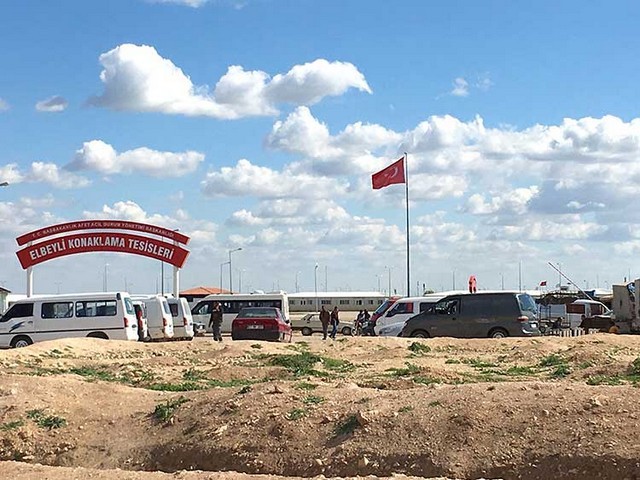
Further west, Elbeyli town is a bizarre hive of spies, a fortification. Everything here is monitored. It is because from here, the Turkish military forces are constantly invading Syrian territory. Here, no one dares to speak. To ask questions leads to immediate phone calls, arrests and interrogations.

Now, many villages around Elbeyli are half-empty. It is an eerie sight. The war has ruined entire communities.

What is thriving is the construction business. Not of the infrastructure, but of the military bases, spy antennas and above all, of the walls. An enormous, monstrous wall, which separates two countries – Turkey and Syria, in the past two inseparable sisters – is now scarring this ancient land. It is around 900 kilometers long, they say. How much money, how much concrete is being poured into it, and why?

Then the City of Killis.

We are shown destroyed walls of a house; a place “where rockets fell recently from the Syrian territory”. This is what the Turkish government uses as its justification for the invasion.

The local people have it all very clear. Several of them declare openly, but without revealing their names:

“If only the Turkish government and military would coordinate their operations with the legitimate government in Damascus!”

Things are tough in Killis. Like elsewhere along the border, businesses are closing down. An owner of a kebab stall couldn’t find any job for more than a year and had to try his luck in far-away Jakarta; in Indonesia which is much poorer than Turkey. He came back, had some luck and has now turned into an ultra-nationalist:

“Now the world can see the power of Turks!” He declared, passionately, voicing his full support for the invasion.

But here, at the border, he is clearly in the minority.

At a barbershop, “Salon Hassan”, several people are gathered, just in order to discuss politics. The most common assessment of the situation is:

“The biggest mistake is that the Turkish military is not coordinating its operations with President Assad.”

We are told that “some 8.000 of the refugees living in the camps all over the region are now returning back to Syria.”

But Turkey is hosting more than 3.5 million Syrian migrants. The situation is extremely complex, as intercommunal violence between Turks and Syrians tripled in the second half of 2017.

Turkish president Erdogan often declares that it is mainly because of his military forces operating across the border, that so many Syrian refugees now feel safe to return home. “Nonsense”, most Syrian people reply to such claims. “It is because of the Syrian army, President Assad, and his Russian and Iranian allies! Legitimate Syrian government is now winning the war. Only because of that, things are much safer for the Syrian people.”

“We love Russians here,” a local man professed, loudly. Some citizens of Killis also love Erdogan, as well as President Assad of Syria. ‘Too much love?’ Too many contradictory feelings? It is Turkey, after all. Here, nothing is ever simple.

But what is Russia here, to these people? In many parts of Turkey and all over the Middle East, more than a country, Russia became a symbol of defiance, proof that the West and its deadly designs can be confronted and stopped.

*

Things appear confusing, but in Turkey, they always are.

As we drive through this ancient, beautiful but wounded land, my Turkish friend and translator utters, in desperation:

“The ‘Elder dog’ (increasingly common derogatory nickname for the present leader) is going to lose during the next elections. I bet he is going to…”

“But is the Turkish policy towards NATO and towards Syria going to change, dramatically?” I wonder.

For a while, there is silence in the car.

“I wish hope,” friend, my comrade says, finally.

He doesn’t know. Of course, he doesn’t. In Turkey, anything is possible.

“I hope Turkey comes to its senses. I love this country,” I say honestly. “I am really tired of hating it.”

“So am I,” he nods.

We are literally licking a huge concrete wall. Behind it is Syria, clearly visible, beautiful.

Actually, it is all very simple. People there are fighting againstterror and against the Western imperialism.

People here, in Turkey, are still at the wrong side of the barricade. But they are waking up; many of them already understand. They may soon join those who are fighting for the survival of humanity. They may. Hopefully they will.

*

[First published by NEO – New Eastern Outlook]

Text and Photos: Andre Vltchek

Andre Vltchek is a philosopher, novelist, filmmaker and investigative journalist.

4 July 2018

Source: https://countercurrents.org/2018/07/04/turkish-syrian-border-confusion-destruction-and-grief/

‘Deal of the Century’ is Not New and the PA Leadership is Not a Victim

By Dr Ramzy Baroud

Donald Trump’s ‘deal of the century’ will fail. Palestinians will not exchange their 70-year long struggle for freedom for Jared Kushner’s cash; nor will Israel accept even if there is a demilitarized Palestinian state in the West Bank.

The order of that anticipated failure is likely to go something like this: the Palestinian Authority (PA) in Ramallah is likely to reject the deal once the full details of the US administration’s plan are revealed; Israel is likely to withhold its decision till Palestinians rejection is exploited thoroughly by pro-Israel US media.

The reality is that, considering the massive surge of the Right and ultra-nationalist forces in Israel, an independent Palestinian state even on one percent of historic Palestine will not be acceptable by Israel’s current political standards.

There is more to consider: Israeli Prime Minister Benjamin Netanyahu’s troubled career as a long-serving leader is being dogged by accusations of corruption and several police investigations. His position is too weak to even guarantee his own survival until the next general elections, let alone champion a ‘deal of the century.’

However, the embattled Israeli leader is expected to play along to win more favor with his American allies, distract the Israeli public from his own corruption, and hold Palestinians accountable for the political fiasco that this is sure to unleash.

It is Bill Clinton’s Camp David II and George W. Bush’s ‘Road Map for Peace’ all over again. Both initiatives, as unfair as they were to Palestinians, were never accepted by Israel in the first place, yet in many history books, it is written that the ungrateful Palestinian leadership had torpedoed US-Israeli peace efforts. Netanyahu is keen on maintaining this misconception.

The Israel leader, who has received the ultimate American gift of the relocation of US embassy to Jerusalem, knows how important this ‘deal’ is to the Trump Administration.

Before assuming his role as President, Trump spoke early on of his ‘ultimate deal’ in an interview with the Wall Street Journal on November 1, 2016. He offered no details, aside from the claim that he is able “to do … the deal that cannot be made … for humanity’s sake’.

Since then, we have relied on occasional leaks, starting in November 2017, up to recently. We learned that a demilitarized Palestinian state would be established on a small part of the West Bank, without Occupied East Jerusalem as its capital; that Israel will keep all of Jerusalem and will annex illegal Jewish settlements and even keep control of the Jordan Valley, and so on.

Palestinians will still have a ‘Jerusalem’, albeit an invented one, where the neighborhood of Abu Dis will simply be called Jerusalem.

Despite the hype, nothing is truly new here. The ‘deal of the century’ promises to be a rehash of previous American proposals that catered to Israel’s needs and interests.

Remarks by Trump’s son-in-law, Jared Kushner, in an interview with the Palestinian newspaper ‘Al-Quds’, corroborate this view. He claimed that the Palestinian people are “less invested in the politician’s talking points than they are in seeking how a deal will give them and their future generations new opportunities, more and better paying jobs.”

Where did we hear this before? Oh, yes, Netanyahu’s so-called ‘economic peace’ which he has been peddling for over a decade. Certainly, the Palestinian Authority (PA) has proven that its political will is a commodity to be bought and sold, but to expect the Palestinian people to follow suit is an illusion without historical precedent.

Indeed, the PA has grown to be an obstacle to Palestinian freedom. A recent survey conducted by the Palestinian Center for Policy and Survey indicated that the majority of Palestinians put the blame mostly on Israel and the PA for the Gaza siege, and that they mostly believe that the PA has “become a burden on the Palestinian people.”

It is hardly surprising that as of March 2018, 68% of all Palestinians want PA President Mahmoud Abbas to resign.

While Israel deserves most of the blame for its decades-long military Occupation, successive wars and lethal sieges, the US too stands accountable for backing and financing Israel’s colonial endeavors. However, the PA cannot play the role of the hapless victim.

What makes the ‘deal of the century’ particularity dangerous is the truth that the PA cannot be trusted. It has played its role, assigned by Israel and the US, so well and for so long. PA policy served as the local arm in the subjugation of Palestinians, thwarting their protests and ensuring the demise of any political initiative that does not revolve around the glorifying of Abbas and his goons.

It is hardly an achievement when much of PA foreign policy in recent years was invested to ensure the complete economic and political isolation of impoverished Gaza, as opposed to unifying the Palestinian people around a collective fight to end the horrific Israeli Occupation.

For PA officials to decry the ‘deal of the century’ as an infringement on Palestinian rights, while they have done little to respect these rights in the first place, is the very definition of hypocrisy. No wonder Kushner thinks the US can simply buy Palestinians with money in a “cash-in-your-chips, go-for-broke, take-it-or-leave-it (type of) deal’,” in the words of Robert Fisk.

What can the PA do now? It is trapped in its own imprudence. On the one hand, the PA’s financial sponsor in DC is turning off the money source, while on the other, the Palestinian people have lost the last iota of respect for its so-called ‘leadership’.

Trump’s ‘deal of the century’ may inadvertently mix up the cards leading to a “much-needed reckoning for all other parties involved”, argued Anders Persson. One option available for the Palestinian people is the expansion of the popular mobilization model which has been manifesting itself at the Gaza-Israel fence for many weeks.

The US-PA fallout and the looming destruction of the status quo might be the chance the Palestinian people need to unleash their power through mass mobilization and popular resistance at home, coupled with an active role for Palestinian communities in the diaspora.

– Ramzy Baroud is a journalist, author and editor of Palestine Chronicle.

4 July 2018

Source: https://countercurrents.org/2018/07/04/deal-of-the-century-is-not-new-and-the-pa-leadership-is-not-a-victim/

Trump’s Iran Gambit Won’t Pay Off

By Soraya Sepahpour-Ulrich

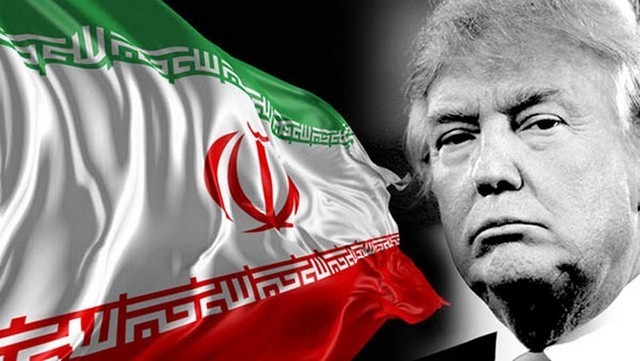
It is as clear as day that President Trump is obsessed with regime change in Iran.  What is not made clear is how much his gambit is damaging to Americans and American interests.

Without cause or justification, Mr. Trump  pulled out of the Joint Comprehensive Plan Of Action (JCPOA), striking a hard blow to America’s European allies – and its own credibility.  Moreover, he threatened European countries with secondary sanctions should they continue to trade with Iran.

To top it all, in his latest move, he has called for all Iranian oil exports to be cut off by November. Or in practical terms, he is imposing an economic blockade on Iran.  This is a similar scenario that was played out by the British in 1951 against Iran and Dr. Mossadegh – who was later overthrown in the 1953 British-US coup. But today, the IR of Iran is not the Iran of 1953, and the brunt of American demands and actions will not be borne by Iran alone.

Demanding that no country purchase oil from Iran is in fact an economic blockade.  It is an illegitimate use of power to force a sovereign nation to surrender.  It must be made clear however, that it is not just Iran that is the target here. The Trump administration’s demands are an offensive exercise of extraterritorial authority with no regard for sovereign equality between states. All states involved in trade with Iran will either have to cower to his demands or be punished.

But there is more than state sovereignty and indignation that is involved. These actions will have a dire effect on the economy of allies, and they will hit Americans in the wallet – hard.   If Mr. Trump is giving a November deadline, he hopes to postpone the impact this will have on the November elections.  He wants total rule over America before totally bankrupting it.

To fully appreciate how Mr. Trump intends to make ‘America great again’ where his policy regarding Iranian oil is concerned, one must take a look at some numbers and empirical evidence.

The oil strikes leading up to the toppling of Iran’s Shah were felt around the world.  During the 1978-79 revolution, Iranian oil production dropped 3.8 million barrels per day for 3 months.  Although outside production increased by 1.8 million barrels to make up for the loss, the net loss to the world was 150 million barrels of oil.  However, the compounding results of the production loss were significant around the globe.

Many Americans may recall the lines at the fuel pumps, but that was just what met the eyes.  The increase in oil prices impacted farming, production, transportation of goods and services, and so on.  At that time, China, currently the second biggest oil consumer behind America, was a net exporter of oil.  The loss to U.S. economy was estimated at many billions of dollars in 1979 and 1980 (Deese and Nye 308-309)[i].

More recent studies show that Iranian oil has a major impact on the U.S. economy even though America does not import a single barrel of oil from Iran.  In 2008, economists Dean DeRosa and Gary Hufbauer presented a paper in which they claimed that if the United States lifted sanctions on Iran, the world price of oil could fall by 10 percent which would translate into an annual savings of $38-76 billion for the United States[ii].

But sanctions alone were not responsible for oil price hikes in 2008 and beyond.  In July 2008, oil had reached a peak of $142.05/bbl (see chart HERE).   This price hike came on the heels of some important events.  In May, President Bush sent a ‘warning message’to Iran on the same day that additional aircraft carriers with guided-missile destroyers were sent to the Persian Gulf.

In June of the same year, the New York Times reported that: “Israel carried out a major military exercise earlier this month that American officials say appeared to be a rehearsal for a potential bombing attack on Iran’s nuclear facilities.”

In July, then presidential candidate Barak Obama asked for tougher sanctions to be imposed on Iran.

It was not until September 2008 when President Bush declined to help Israel attack Iran that oil prices started to relax.  They hit a low of just over $53 /bbl in December 2008.

Oil prices continued to rise again under Obama’s sanctions and reached well past the $100 mark.   The prices climbed down once again during the JCPOA negotiations reaching an all time low of $30.24/bbl in January 2016 – after the signing of the JCPOA.

Today, oil prices stands at $74.30/bbl.  A fact not lost on any American who has filled up his/her gas tank lately– and paid for groceries.   The deadline for Iran oil cut off is yet months away, but the impact has started.

Given that other countries may step in to compensate for some of the Iranian oil loss, other factors which effect prices must be considered – the most important of which is the security of the Strait of Hormuz.  As mentioned previously, the British oil blockade scenario of 1951 will have far different consequences in 2018 should America impose an economic blockade or oil embargo.

In the 1950’s, Iran did not have the military might to retaliate to the oil embargo and the naval blockade was aimed at crushing the economy in order to bring about regime change.   This economic blockade, should it be allowed to happen, would crush the economy of much of the world.

As it stands, 35% of seaborne oil goes through the Strait of Hormuz 85% of which goes to Asian markets. As the US Energy Information Administration  (EIA) has stated: “The blockage of the Strait of Hormuz, even temporarily, could lead to substantial increases in total energy costs.”Today, Iran not only has the military might to block the Strait of Hormuz in retaliation, but it also has the legal right.

The 1982 United Nations Convention on the Law of the Sea (UNCLOS) stipulates that vessels can exercise the right of innocent passage, and coastal states should not impede their passage. Under UNCLOS framework of international law, a coastal state can block ships from entering its territorial waters if the passage of the ships harms “peace, good order or security” of said state, as the passage of such ships would no longer be deemed “innocent”[iii].   Saudi Arabia and the UAE export oil through Iran’s territorial waters.   Should they help America choke Iran’s economy, their passage is not deemed ‘innocent’.

Even if Iran simply chooses to merely delay the passage of tankers by exercising its right to inspect every hostile oil tanker that passes through the Strait of Hormuz, such inspections and subsequent delays would contribute to higher oil prices.

No doubt, the Iranian navy is no match for the formidable US navy.  However, the shallow, narrow waters of Hormuz do not allow for the maneuvering of US battleships.  The very presence of warships can lead to incidents.  At its narrowest point, the Strait of Hormuz is 21 miles wide – hardly wide enough for a naval battle to take place and allow the passage of oil tankers at the same time. In recent years (2012), the USS Porter, a US navy destroyer, collided with an oil tanker in the Strait of Hormuz.   The collision left a big whole in the navy destroyer.

American officials and oil companies have attempted to assuage the concern of over oil shortages by stating that America is one of the top oil producers.  Some fact checking is in order.

According to EIA’s latest available data, America’s total exports in 2018 (thousands of barrels/month) was 7,730 bbl in April.  The same governmental body stated that total imports for the same month was 310,295.    According to the EIA: “In 2017, the United States produced about 15.4 million barrels of petroleum per day (MMb/d), and it consumed about 19.9 MMb/d. Imports from other countries help to supply demand for petroleum.” (Click HERE for explanation of imports and exports).

These facts do not stop the spread of such news.  As recently as June 4, 2018, Offshore Technology announced America is marching toward being the biggest oil producer.    Important factors to bear in mind are that 1.  America is the largest oil consumer and continues to have a deficit, and 2. Shale oil production is up thanks to higher oil prices.

While environmentalists objected to shale oil production, oil companies halted the extraction of oil when prices dropped. Anything above $50/bbl makes shale oil production feasible – which also makes it more expensive of the consumer.  Although Mr. Trump and his administration have no regard for the environment, many states and countries have banned shale oil production (see LINK for list as of December 2017).

So the American people (and much of the rest of the world) is left with a stark choice.  Either cave in to Mr. Trump’s demands, accept loss of business, pay much higher oil prices at the pump and for consumer goods, prepare for a potential war, and sacrifice the environment – especially water, and mortgage the future of the earth more than we already have, or, don’t heed Trump’s demands – even if means a short term loss.

Either way, messing with Iran’s oil exports is not an alternative that the world can afford.  It may well be that Mr. Trumpis beholden to Mr. Netanyahu.   He may well feel comfortable enough to subject the American people – and their allies to financial hardship; but the question is will Americans and the rest of the world sacrifice themselves at the Trump-Netanyahu altar?

Soraya Sepahpour-Ulrich is an independent researcher and writer with a focus on U.S. foreign policy and the role of lobby groups in influencing US foreign policy.

30 June 2018

Source: https://countercurrents.org/2018/06/30/trumps-iran-gambit-wont-pay-off/

Can the West’s democracy survive China’s rise to dominance?

By Martin Jacques

This is a guest contribution to the debate: Should the West worry about the threat to liberal values posed by China’s rise?

For long the West has thought that history is on its side, that the global future would and should be in its own image. With the end of the cold war and the implosion of the Soviet Union, this conviction became stronger than ever. The future was Western; nothing else was imaginable. Of course, already, well before the end of the cold war, in 1978 to be exact, China had started its epic modernisation such that, in the annals of history, 1978 will surely prove to be a far more significant year than 1989. During China’s rise, hubris continued to shape the West’s perception and understanding of China. As the latter modernised it would become increasingly Western, it was supposed: Deng’s reforms marked the beginning of the privatisation and marketisation of the Chinese economy—its political system would in time become Western, otherwise China would inevitably fail.

China’s political system did not turn Western. The state continues to be a very powerful force in the country’s economy. China remains very distinctive from the West—and has gone from strength to strength in the process. China never had the long-predicted economic crisis that so many Westerners forecast, nor the great political revolt that was destined to deliver Western-style democracy. Instead economic crisis and political crisis befell the West. The Western financial crisis in 2007-08 was the worst since the early 1930s. By 2015-16 its political consequences were upending Western politics, sounding the death-knell of neo-liberalism, undermining the governing elites and weakening governing institutions.

The West—both the United States and the European Union—is, in historical terms, in precipitous decline. The developing world, led by China and India, now accounts for just under 60% of global GDP, compared with around 33% in the mid-1970s. The great story of the post-war era has been the rise of the developing world, representing around 85% of humanity, and the decline of the old developed world, accounting for around 15% of humanity. The developing world has learnt much from the West but it is not, and will not be, Western. China is the classic case in point. It is not even mainly a nation-state. It is, first and foremost, a civilisation-state, a concept that the West has not begun to try and understand. The relationship between state and society is profoundly different from that in the West, and so is its tradition of governance. It was never expansionist in the manner of western Europe and America. China has a very different culture and history to that of the West. We should not expect it or require it to be Western.

The rise of Europe transformed the world. The rise of America did the same, though enjoying strong lines of continuity with Europe. China will likewise transform the world, but probably on a much greater scale than either Europe or America, mainly because it is that much larger. To think otherwise is both unrealistic and ahistorical. Western hegemony has left a huge imprint on the world, but it was never destined to last for ever. Hegemons are never eternal. To expect China to become a Western-style country in an American-shaped world was always an illusion. But nor should we expect China to delete that world and replace it with something entirely different.

That would be the antithesis of the Chinese tradition. China has an essentially hybrid view of the world, yin and yang. Unlike the Western tradition, which majors on singularity, Chinese thinking values plurality. In this, it also differs profoundly from the Soviet tradition, which had a Manichean and monolithic view of the world. The Chinese are highly pragmatic. There are many things that they greatly admire, and draw from, in the Western tradition, and will continue to do so. Unlike the West, they do not consider themselves to be a model for anyone else and have therefore not sought to impose themselves on others in the manner of the West. It is noteworthy, for example, how few wars China has fought. That is one reason why, for many centuries, East Asia was far more peaceful than Europe. Do not expect the Chinese to behave in the same aggressive military fashion that Europe did in its days of imperial pomp, or as America still does.

But equally we should not expect “Western values”, masquerading in this debate as “liberal values”, to survive pristine and unaltered. There are many traditions and many civilisations that inform the world. The West comprises a very small minority of humanity. The future will not be singular in the manner that the West has long believed it should be, but plural and hybrid, no doubt with a strong Chinese flavour. The East Asian tradition, China included, for example, is far more communal, collective and familial than the individualism of the West. Do not fear the future: it will be different, in some respects it may be worse, in many others it may be much better. Bear in mind too, that there is not much liberal, and nothing that is democratic, about the American world order, or the European one before, which was in fact much worse. In both cases a small minority of humanity in effect ruled the world. Internationally, the age of the West has been highly authoritarian.

The greatest danger is not the rise of China but how the United States will react to China’s rise and its own consequent loss of primacy. The rise of illiberalism in America is not an accident. It coincides with the dawning recognition of American decline and a desperate desire to prevent it. It should be remembered that the heyday of Western democracy corresponded with the zenith of Western hegemony. But can the West’s democracy survive the decline of Western global dominance? If the West is able to retain and renew its best values, in a world in which it enjoys a much diminished role and China is predominant, such a world will be the better for it.

Martin Jacques, the journalist and academic, is now seen by many as the man of the moment in China.

14 June 2018

Source: https://www.economist.com/open-future/2018/06/14/can-the-wests-democracy-survive-chinas-rise-to-dominance

Thousands of refugees forced onto death march into Sahara desert

By Bill Van Auken

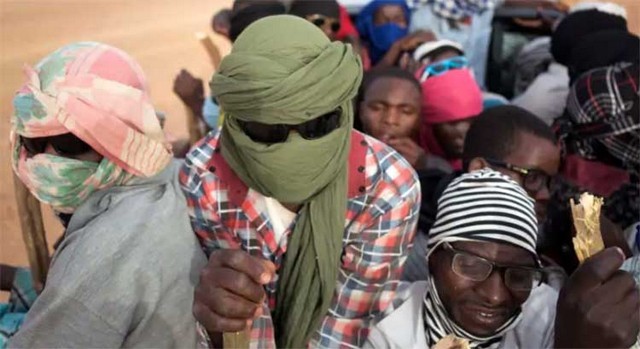
More than 13,000 refugees and migrants, including pregnant women and children, have been force-marched into the Sahara desert by Algerian security forces over the past 14 months, where many of them have died from hunger and exposure.

The shocking revelation by the Associated Press was substantiated by videos showing hundreds of migrants stumbling through a sand storm and others being driven in massive convoys of overcrowded trucks to be dumped at Algeria’s southern border with Niger and forced into the desert at gunpoint.

As the AP itself makes clear, the murderous policy of the Algerian government is being carried out at the behest of the countries of the European Union, which have increasingly sought to induce North African regimes to act as their border guards, impeding the flow of migrants by means of intimidation, violence and death.

The refugees are being forced by Algerian security forces into the Sahara without food or water and, in many cases, after being robbed of their money and cellphones. They are pointed in the direction of the nearest settlement in Niger, over nine miles away, across empty sands where the temperature rises as high as 120 degrees Fahrenheit.

The migrants told AP of “being rounded up hundreds at a time, crammed into open trucks headed southward for six to eight hours to what is known as Point Zero, then dropped in the desert and pointed in the direction of Niger. They are told to walk, sometimes at gunpoint.”

Two dozen different migrants who survived the crossing told the news agency that in their groups a number were unable to go on and died in the desert. “Women were lying dead, men … Other people got missing in the desert because they didn’t know the way,” said Janet Kamara of Liberia, who was pregnant when she was forced across the border. “Everybody was just on their own.”

Kamara’s baby died at birth and she was forced to bury him in a shallow grave in the desert. “I lost my son, my child,” she said.

While the world’s media has focused on the dangerous crossing from northern Africa to southern Europe having turned the Mediterranean into a watery graveyard for countless thousands, according to the International Organization for Migration (IOM), for every refugee who drowns in the sea, two more succumb to the relentless heat and harsh conditions of the Sahara. It estimates that the death toll in the desert exceeds 30,000 just since 2014.

The migrants expelled by Algeria come from countries throughout sub-Saharan Africa, including Niger, Mali, Gambia, Guinea, Ivory Coast, Senegal, Liberia and others.

“They come by the thousands … I’ve never seen anything like it,” Alhoussan Adouwal, an IOM official in Assamaka, Niger told AP. “It’s a catastrophe.”

A spokesperson for the European Union told AP that the EU is aware of what Algeria is doing with refugees and migrants, but that its view is that “sovereign countries” can carry out such expulsions so long as they comply with international law.

The revelations about the horrors inflicted upon refugees in the Sahara desert come on the eve of a summit meeting of EU member states on Thursday to discuss the issue of immigration.

On the eve of the summit, EU foreign policy chief Federica Mogherini has been urging EU member states to put more money into an Africa trust fund with an eye toward financing the construction of “migrant screening” camps in North Africa. At the top of the EU summit agenda is expected to be a proposal for holding asylum seekers at such camps in countries that include Algeria, Egypt, Libya, Morocco, Niger and Tunisia.

In the run-up to the summit, Matteo Salvini, the leader of the right-wing, anti-immigrant Lega party and Italy’s new interior minister, flew to Tripoli on Monday to praise the regime for its “excellent work” in “rescuing” nearly 1,000 people on Sunday after the Libyan Coast Guard intercepted them. The purpose of the coast guard, which is financed, trained and to some degree directed by Italy and other European powers, is not to rescue refugees trying to reach Europe, but rather to drag them back to Libya. There they face imprisonment in camps where torture and executions are commonplace and even being sold into slavery.

Salvini said that Italy would work with the UN-recognized regime, which controls little outside of Tripoli, to stop a “full-on invasion” of Libyan waters by aid groups seeking to rescue refugees at sea. He also called for migrant detention centers to be placed at Libya’s southern border in the Sahara desert.

Salvini has become infamous for refusing to allow rescue ships carrying refugees to dock at Italian ports. He ordered the Aquarius carrying over 600 refugees, including pregnant women and children, turned back earlier this month, forcing it to make a dangerous voyage to Spain. Presently, there are two ships in limbo in the Mediterranean carrying hundreds of refugees, a boat operated by German aid group Mission Lifeline with 234 aboard, and the Danish-flagged Alexander Maersk cargo ship with 100. In a statement laying bare the depth of the racism and reaction of the new Italian government, Salvini referred to the refugees as “human meat.”

Meanwhile the new PSOE government in Spain, which allowed the Aquarius to dock and condemned the Italian response, dispatched its own interior minister, Fernando Grande-Marlaska, to Morocco with much the same mission as Salvini’s in Libya, securing cooperation for immigrant detention camps.

Spain’s new development minister, Jose Luis Abalos, told Cadena Ser radio that, while Spain is taking “a respectful humanitarian approach” toward the refugees’ plight, it had no intention of becoming “Europe’s maritime rescue organization.”

Human rights groups have warned that refugees will be subject to abuse and denied asylum rights if kept in camps in Libya, Egypt and other North African countries with records of massive human rights abuses. EU Migration Commissioner Dimitris Avramopoulos, who is playing a central role in plans for setting up these centers, responded to these concerns last week, declaring, “I want to be very clear on that. I’m against a Guantanamo Bay for migrants.” He was referring to the Guantanamo Bay Naval base prison camp where those rounded up in the US “war on terror” were subjected to systematic torture.

In Europe, as in the US—where President Donald Trump has expressed his own desire to throw Central American refugees back into the desert without any asylum proceedings—the number of refugees and migrants has actually fallen steadily, even as the political hysteria whipped up by right-wing governments and politicians has sharply escalated.

According to the UN refugee agency, the number of migrants arriving in Europe is on track to reach just half the number for last year, and less than a quarter the number in 2016.

The “immigration crisis,” both in Europe and America, is a noxious political invention, aimed at dividing the working class and scapegoating the most oppressed layers of the population and the victims of imperialist war and oppression for the continuously worsening conditions created by capitalism.

26 June 2018

Source: https://countercurrents.org/2018/06/26/thousands-of-refugees-forced-onto-death-march-into-sahara-desert/

Malaysian-Saudi relations: A lesson in the pitfalls of authoritarianism and autocracy

By Dr James M Dorsey

Embattled former Malaysian prime minister Najib Razak was the main loser in last month’s election upset that returned Mahathir Mohamad to power as his country’s anti-corruption crusader. Yet, Mr. Razak is not the only one who may be paying the price for allegedly non-transparent and unaccountable governance.

So is Saudi Arabia with a Saudi company having played a key role in the 1Malaysia Development Berhad (1MDB) scandal in which Mr. Razak is suspected to have overseen the siphoning off of at least US$4.5 billion and the Saudi government seemingly having gone out of its way to provide him political cover.

While attention has focussed largely on the re-opening of the investigation of Mr. Razak and his wife, Rosmah Mansor, both of whom have been banned from travel abroad and have seen their homes raided by law enforcement, Saudi Arabia has not escaped policymakers’ consideration. Mr. Razak has denied all allegations of wrongdoing.

The geopolitical fallout of the scandal is becoming increasingly evident. Defence Minister Mohamad Sabu suggested this week that Malaysia was re-evaluating the presence of Malaysian troops in Saudi Arabia, dispatched to the kingdom as part of the 41-nation, Saudi-sponsored Islamic Military Counter Terrorism Coalition (IMCTC).

“The ATM (Malaysian Armed Forces) presence in Saudi Arabia has indirectly mired Malaysia in the Middle East conflict… The government will make a decision on the matter in the near future after a re-evaluation has been completed,” said Mr. Sabu, who is known for his critical view of Saudi Arabia.

In a commentary published late last year that suggests a potential Malaysian re-alignment of its Middle Eastern relationships, Mr. Sabu noted that Saudi wrath has been directed “oddly, (at) Turkey, Qatar, and Iran…three countries that have undertaken some modicum of political and economic reforms. Instead of encouraging all sides to work together, Saudi Arabia has gone on an offensive in Yemen, too. Therein the danger posed to Malaysia: if Malaysia is too close to Saudi Arabia, Putrajaya would be asked to choose a side.”

Putrajaya, a city south of Kuala Lumpur, is home to the prime minister’s residence.

Mr. Sabu went on to say that “Malaysia should not be too close to a country whose internal politics are getting toxic… For the lack of a better word, Saudi Arabia is a cesspool of constant rivalry among the princes. By this token, it is also a vortex that could suck any country into its black hole if one is not careful. Indeed, Saudi Arabia is governed by hyper-orthodox Salafi or Wahhabi ideology, where Islam is taken in a literal form. Yet true Islam requires understanding Islam, not merely in its Quranic form, but Quranic spirit.”

Since coming to office, Mr. Sabu has said that he was also reviewing plans for a Saudi-funded anti-terrorism centre, the King Salman Centre for International Peace (KSCIP), which was allocated 16 hectares of land in Putrajaya by the Razak government. Mr. Sabu was echoing statements by Mr. Mahathir before the election.

Compounding potential strains in relations with Saudi Arabia, Seri Mohd Shukri Abdull, Mr. Mahathir’s newly appointed anti-corruption czar, who resigned from the Malaysian Anti-Corruption Commission (MACC) in 2016 as a result of pressure to drop plans to indict Mr. Razak, noted that “we have had difficulties dealing with Arab countries (such as)…Saudi Arabia…”

The investigation is likely to revisit 1MDB relationship’s with Saudi energy company PetroSaudi International Ltd, owned by Saudi businessman Tarek Essam Ahmad Obaid as well as prominent members of the kingdom’s ruling family who allegedly funded Mr. Razak.

It will not have been lost on Saudi Arabia that Mr. Mahathir met with former PetroSaudi executive and whistle blower Xavier Andre Justo less than two weeks after his election victory.

A three-part BBC documentary, The House of Saud: A Family at War, suggested that Mr. Razak had worked with Prince Turki bin Abdullah, the son of former Saudi King Abdullah, to syphon off funds from 1MDB.

Saudi foreign minister Adel al-Jubeir came to Mr. Razak’s rescue in 2016 by declaring that US$681 million transferred into the prime minister’s personal bank account was a “genuine donation with nothing expected in return.”

The Malaysian election as well as seeming Saudi complicity in the corruption scandal that toppled Mr. Razak has global implications, particularly for the United States and China, global powers who see support of autocratic and/or corrupt regimes as the best guarantee to maintain stability.

It is a lesson that initially was apparent in the 2011 popular Arab revolts that toppled the leaders of Tunisia, Egypt, Libya and Yemen.

The rollback of the achievements of most of those revolts backed by autocratic leaders in Saudi Arabia and the United Arab Emirates bent on reshaping the Middle East and North Africa in their mould has contributed to the mayhem, violence and brutal repression engulfing the region.

In addition, autocratic rule has failed to squash widespread economic and social discontent. Middle Eastern states, including Algeria, Morocco, Egypt, Lebanon Iran, and most recently Jordan have witnessed protests against rising prices, cuts in public spending and corruption.

“The public dissatisfaction, bubbling up in several countries, is a reminder that even more urgent action is needed,” warned Christine Lagarde, the managing director of the International Monetary Fund (IMF).

Elections, if held at all, more often than not fail to serve as a corrective in the Middle East and North Africa because they are engineered rather than a free and fair reflection of popular will. Elections in countries like Iraq and Lebanon serve as exceptions that confirm the rule while Iran represents a hybrid.

As a result, street protests, militancy and violence are often the only options available to those seeking change.

Against that backdrop, Malaysia stands out as an example of change that does not jeopardize stability. It is but the latest example of Southeast Asian nations having led the way in producing relatively peaceful political transitions starting with the 1986 popular revolt in the Philippines, the 1998 toppling of Suharto in Indonesia, and Myanmar’s 2010 transition away from military dictatorship.

This is true even if Southeast Asia also demonstrates that political transition is a decades-long process that marches to the tune of Vladimir Lenin’s principle of two steps forward, one step backwards as it witnesses a backslide with the rise in the Philippines of President Rodrigo Duterte’s authoritarianism, stepped up jihadist activity, the 2014 military coup in Thailand, increasingly autocratic rule in Cambodia, the rise of conservatism and intolerance in Indonesia, and the plight of the Rohingya in Myanmar.

If anything, Malaysia constitutes an anti-dote.

“Malaysia’s institutions proved more resilient…and descent into authoritarianism has been averted – offering a lesson not only to aspiring dictators, but to those in the United States who argue that propping up corrupt leaders is in U.S. interests,” said Alex Helan, a security and anti-corruption consultant.

Dr. James M. Dorsey is a senior fellow at the S. Rajaratnam School of International Studies, co-director of the University of Würzburg’s Institute for Fan Culture.

24 June 2018

Source: https://countercurrents.org/2018/06/24/malaysian-saudi-relations-a-lesson-in-the-pitfalls-of-authoritarianism-and-autocracy/

The need for Algerian-Moroccan dialogue

By Hassan Aourid

An astute observer of Algeria and Morocco will notice that relations between the two countries have taken a dangerous turn and tensions have visibly increased. Bilateral relations over the last forty-odd years have been marked by a situation of ‘no-war-no-peace’, with tensions kept in check on both sides. However, tensions have sometimes peaked dangerously; examples include the clashes that culminated in the first Battle of Amgala in January 1976, and, again, in a second battle a month later. There were, however, periods of de-escalation, starting from 1988 with the re-establishment of diplomatic relations between the two countries. Unfortunately, tensions escalated again in 1992 following a few destabilising events. These included the assassination of Algerian political leader and a founder of the National Liberation Front, Mohamed Boudiaf; Morocco’s imposition of visa requirements for Algerian citizens (in violation of the Marrakech Agreement that created the Maghreb Union), and the Algerian authorities’ closing of land borders in August 1994, which persists.

The longstanding tensions between the two north African neighbours have not been elevated to open confrontation since then, and the military doctrines of both countries disapprove of armed engagement. Despite the deep historical, social and humanitarian bonds that link the two countries, however, their military doctrine has not been able to contain their arms’ race, diplomatic clashes, media and security provocations, and the abandoning of diplomatic courtesy and good neighbourliness. Furthermore, there seems to be no getting rid of the ‘no-war-no-peace’ paradigm that mostly suppresses tensions but sometimes sharply escalates.

Hostile rhetoric in a dangerous international context that is characterised by alliances and the return of the Cold War makes the impossible potentially possible. However, neither the possible nor the impossible are inevitable. The worst case scenario should not be accepted as a fait accompli. Nations write their own histories and determine their own fates, with historical inevitability playing no part. In his book Dimensions de la conscience historique, the French intellectual Raymond Aron reflects on the Peloponnesian War, an almost-three-decade episode in the fifth century BC that played out between the Athenians and the Spartans. Aron draws on the account of the authority on this episode, the historian Thucydides, and concludes that the war did not conform to the logic of the times, and that it happened even though nobody wanted it. He compares it to the First World War – which was also largely unwanted, and which broke out as a consequence of a passing incident that became the proverbial spark that lit the flame in an extremely volatile context. Aron argues that the first case resulted in the end of the city state, the decline of Greek civilisation and the emergence of Alexander, who was drawn towards the East. The second case, on the other hand, heralded the end of the nation state, the shifting of the centre of civilisation from Europe to the United States of America, and the emergence of the Soviet Union. In other words, both episodes resulted in collapse or, rather, self-destruction.

In spite of the tensions and disruptions manifested across the Maghreb, or North Africa, the region remains promising. It is the only unitary framework capable of drawing together a bloc that can match the regional poles of Turkey and Iran, and create some form of balance. In fact, this unitary framework is a strategic necessity that works to the advantage of the entire Arab world; it is its strategic depth and protective shield against the tempestuous storms descending upon the region and ripping it apart. The Economistrecently posited that had the Maghreb Union succeeded, it would have become the strongest economy in the region, matching Turkey, which has in twenty years transitioned from a backwater to an emerging economy.

While the clock cannot be turned back, one can at least benefit from the lessons of history. The current tensions – in spite of their intensity – will not overshadow the awareness of a common destiny, or the depth of the historical, cultural, social and humanitarian roots binding Morocco and Algeria, and the countries of the Maghreb in general. This awareness is shaped by a collective memory, common symbols and cognisance of shared interests. It obviously does not negate points of difference, opposing visions, or the animosity that has entrenched the hostility prevalent in the current generation. Nonetheless, transcending the status quo is not impossible.

Logic has repeatedly dictated that dialogue between Moroccan and Algerian officials be undertaken, but this dialogue, when it did happen, did not lead to any breakthroughs, and there are no indications that new attempts will produce results. Why then should there be any objection to the establishment of unofficial dialogue between parties that possess an acute historical awareness, sense of responsibility, boldness and independence? Dialogue does not, after all, occur between interlocutors that share the same vision, but rather between those who have opposing views and approaches, while being conscious of imminent dangers and being bound by mutual respect and a willingness to listen attentively. Dialogue is a process; it cannot be constructive through a single engagement; it is not a pronouncement of intentions or a media event.

For dialogue to be successful – for it to be able to take place at all – there must be what former Tunisian president Moncef al-Marzouqi called a changing of the paradigm. Longstanding problems cannot be resolved within entrenched paradigms. Success can only be achieved gradually and a lack of confidence built up over years cannot be unravelled in a single instant. The awareness of a common destiny among the Algerians I have encountered in various forums and my perusal of their pronouncements and writings make the prospect of successful dialogue between them and Moroccans a real possibility.

The history books tell us the story of an Ummayad Caliph who dispatched his court jester, Abu Dullamah, to fight the Azariqah, an extremist Kharijite sect prone to warfare. Abu Dullamah was not a man of war, and he knew that confrontation would spell his demise. He therefore thought long and hard about his dilemma before meeting his rival. When the two parties met, Abu Dullamah was sent to face one of the fiercest Azariqah warriors. When they faced off he asked his opponent: ‘You over there, do you know me?’ The warrior responded: ‘No.’ He then asked: ‘Can you bear witness to any malice I have inflicted upon you or your family?’ The warrior responded: ‘No.’ Abu Dullamah then asked: ‘Do you harbour bad intentions toward someone who only wishes you well?’ The warrior responded: ‘No.’ Abu Dullamah then said: “I am sure that you must be quite hungry,” and the warrior said: ‘Indeed! I haven’t eaten anything since yesterday!’ Abu Dullamah responded: ‘I have some food that we can share,’ and retrieved a chicken from his satchel. The two then dismounted from their respective steeds and partook of the meal. What had been intended to be a violent clash was transformed into an amicable engagement because the enemies were given the opportunity to talk and get to know each other. The moral of the story is that familiarity is the source of fraternity and dialogue is a nothing more than a means to gain familiarity.

* Hassan Aourid is a Moroccan intellectual. He served in the Moroccan administration in several positions, including official spokesperson of the Palace.

25 June 2018

Source: http://www.amec.org.za/algeria/item/1567-the-need-for-algerian-moroccan-dialogue.html