Just International

With help from their Jewish Israeli friends: A Palestinian political initiative (in the making)

By Rima Najjar

A Trump political initiative for peace is looming on the horizon, but no one expects that “Ultimate Deal” to be, in any sense, a “Palestinian political initiative”.

It is difficult to formulate a Palestinian “political initiative”, period. Palestinians are not free political agents.

A Palestinian citizen of Israel (example, Haneen Zoabi) is not a free agent politically, even as a member of the Israeli parliament (Knesset). And neither, of course, are Palestinian leaders jailed by Israel (example, Marwan Barghouti or Ahmad Sa’adat or KhalidaJarrar) or Palestinian leaders in exile (example, Ali Abunimah, author of ‘One Country’ or RamzyBaroud or Salman Abu Sitta) or, for that matter, Mahmoud Abbas himself, whose own people are now no longer willing to listen to him, and who is certainly not a free agent politically speaking.

But if such a Palestinian political initiative were to be put forward (with a little help from friends of Palestine such as the Israeli Jews of One Democratic State Campaign), the receptivity to such an initiative by the Jewish Israeli public is going to be minimal, at least initially, whether those advancing such an initiative are Palestinians or Israeli Jews or both.

The Israeli Jewish public is thoroughly brainwashed, not least through Israel’s education system. An honest discussion of Zionism and Jewish identity in the context of the Nakba is being slowly and painfully conducted in Israel by Zochrot.

As Ilan Binyamin (Pappe) notes on Facebook (in the comments section of this post link):

It is not easy to bring a Palestinian initiative to the Jewish society… But this is new — never done before- and is the only way forward (together with the resistance on the ground and B D S) [Boycott, Divestment and Sanctions Movement]

But that’s exactly what Pappe and co-founders of the ‘One Democratic State Campaign’ are doing, as Jeff Halpern explains:

Our initiative to create a movement for one democratic state in Palestine/Israel, the only political settlement that is substantially just and workable, continues. After a number of meetings with Palestinians, we held our first meeting with Israeli Jews, about 20 in number, in Jaffa.

…Activism on the issue of Palestine/Israel, as over any issue, cannot succeed in resolving the situation without a political program. As the PA continues its decline towards complete collapse and Trump’s “Ultimate Deal” of permanent apartheid looms, articulating a just political program and getting activists and their organizations world-wide behind it become the most urgent task.

How difficult can formulating and advancing a Palestinian political initiative by this Campaign in a Jaffa headquarters be?

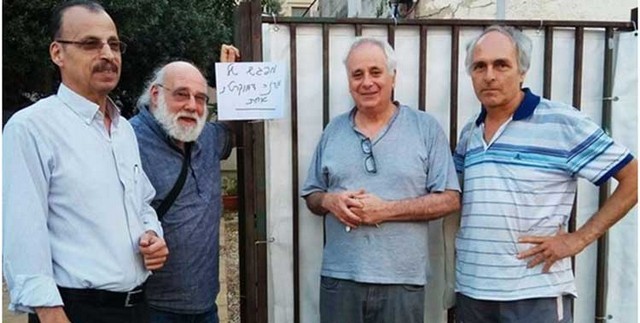
Well, the initiative is barely off the ground and the reaction, as gleaned on Facebook in the comments to Jeff Halper’s post are heartfelt and also lighthearted, referring to what the participants at the meeting (in the photo below) are wearing:

Rafael Balulu:

בגישההזוזהבחייםלאיצליח. רובהמוחלטשלהישראליםוהפלסטיניםשחייםפהקוניםבגדיםבביגפאשןוהגישהשלכםנעהביןמחסןהקיבוץלידשנייהשלויצ”ו. זולאצורהרציניתלגשתככהלשלום. This attitude will never work. The absolute majority of the Israelis and Israelis who live here buy clothes in big fashion and your attitude moves between the kibbutz warehouse next to a second of Wichita. It’s not a serious way to come in peace.

And pointing out the difficulty of the endeavor:

Mark Klein:Finding 20 Israeli Jews (of any gender) who agree with this was probably hard enough.

Formulating a political plan on how to reunite the three territories of partitioned Palestine — The Jewish state of Israel on the one hand and the Palestinian territories it has been “occupying” militarily for the past fifty-one years — is no easy undertaking, no matter who initiates it.

It is easier for Israeli Jews than for Palestinians to reach the Jewish Israeli public, logistically, in terms of access to documents and media, as well as psychologically and linguistically.

Nevertheless, reaching the Jewish Israeli public with a pro-Palestinian initiative, and especially that embraces one democratic state, is far from an easy task, because it means an end to the Apartheid Jewish state.

Another Israeli Jew who takes a pro-Palestine position is Miko Peled, author of ‘The General’s Son’ (himself — he is the son of a prominent major general in the Israeli army), who, unlike his father, does not believe that a two-state political solution is either “viable or just”.

He speaks about his “journey” of understanding (or rather of “conversion” away from Zionism) in the following terms:

The longer the journey continues — and it still continues — the more I discover, the more I learn, the more I…gain understanding and appreciation for the Palestinian experience, for the Palestinian reality, for Palestine itself as a country, as a nation, as a culture.

Needless to say, Peled’s political position resonates with Palestinians much more than it does with his fellow Jews in Israel, who are largely among those who see it as “quixotic”:

Now he [Peled] is fighting for what he calls “Jewish values.” His aim: an Israel that embraces Palestinians as full, equal political partners. Nothing less than a Republic of Palestine-Israel. It is ambitious. Some would say quixotic.

Judaism as a religion and Jewish identity or “Jewishness” are not the same, but they are linked, hence the too-frequent conflation of anti-Zionism with anti-Semitism.

Activists, whether Jewish or not, who want to discuss or point out that link as the core problem of Zionist ideology and the Jewish state of Israel often find themselves in trouble. They are often viewed as having obsessions and identity issues (if they are Jews) or outright bigots and racists or as “skirting” bigotry.

Zionism is and has been a Jewish enterprise, so much so that Judeo-centrism still frames Western political approach to the problem of Israel, rendering Palestinians powerless and invisible politically.

Pervading this mindset is an understandable sensitivity to Jewish suffering in history.

What’s not understandable is when that sensitivity turns into a blind spot that makes even Israeli Zionist Jews (like Ari Shavitz, for example) who admit the Nakba, only to draw the line at one democratic state — i.e., balk at Palestinian return to their homeland, thus dehumanizing Palestinian suffering in the process, and elevating Jewish suffering as unique.

Rima Najjar is a Palestinian whose father’s side of the family comes from the forcibly depopulated village of Lifta on the western outskirts of Jerusalem.

21 June 2018

Source: https://countercurrents.org/2018/06/21/with-help-from-their-jewish-israeli-friends-a-palestinian-political-initiative-in-the-making/

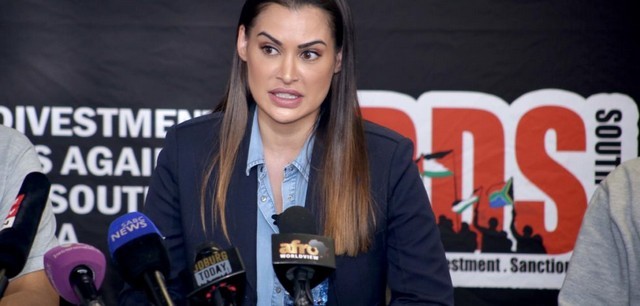
Statement from Press Conference with TV Personality Shashi Naidoo

By BDS SOUTH AFRICA

[Below is the press statement delivered by BDS South Africa at today’s press conference with TV personality and model Shashi Naidoo, Dudu Masango (South African Churches) and Professor Farid Esack (BDS South Africa). Click here to watch the entire press conference video.]

The human rights and Palestine solidarity organization, BDS South Africa, would like to commend, what we view as a positive outcry and warranted criticism by members of the public on social media following the statement that was copied, pasted and posted on Instagram by South African model, TV personality and presenter Shashi Naidoo.

Politicians, celebrities, and all others who wield social influence are correctly held accountable to public scrutiny. Because of the wide reach that they command, celebrities should be even more informed of pertinent social and human rights issues. Thus we celebrate the engagement and discussions that have taken place in the last two or three days on this issue. This is a reflection of our democracy, of our hard fought freedoms including the freedom of expression.

That said, BDS South Africa condemns all forms of racism including anti-Semitism and condemns all forms of violence, intimidation and bullying. These should be exposed and reported to relevant authorities. We, however, caution against those construing engagement and holding someone accountable as bullying or intimidation.

The engagements and expressions by various sectors of South Africa on this issue have contributed to, what we consider, as a positive space that we have now entered.

The statement on Palestine that was copied, pasted and posted by Shashi Naidoo was hurtful, inaccurate, offensive and derogatory. We join fellow South Africans in rejecting the sentiments shared in that initial statement.

Subsequently Shashi Naidoo issued an apology. In addition, she also freely took the initiative to reach out to us and met with representatives of BDS South Africa for over two hours.

There are some malicious accusations that today’s press conference is driven by business interest or is simply a face-saving exercise. This is baseless.

We found the information and insights that Shashi Naidoo shared with us to be an honest reflection of her experience and what occurred in the last 3 days. This was further supported by text messages that she showed us and we have full trust in her beyond any doubt.

Furthermore, in our discussions with Shashi Naidoo we experienced sincerity, honesty and genuineness. We found a person who is honest in her regret and willing to engage.

We are basing our reflections on our face to face engagement with Shashi Naidoo. Ms Naidoo accepts that she erred, and all humans err. All people make mistakes. There is a certain humility and courage in accepting our mistakes and wanting to make good.

Shashi Naidoo has taken a decision to accept the proposal of going on a humanitarian and fact-finding trip to Palestine. The itinerary will be guided by the South African Council of Churches and the South African Jews for a Free Palestine.

We view this as a positive, practical and concrete step. Many of us will be keen to hear her reports following her visit but we are not, as an organisation or movement, interested in policing Shashi Naidoo’s visit and her political commitments or lack thereof.

While we acknowledge that her apology does not transform her into activist for the Palestinian cause we do view this recent issue within a larger context of the growing number of celebrities, artists, musicians, actors and others who are speaking out on the issue of Palestine-Israel. Others are also joining the Palestine solidarity movement and backing the BDS boycott of Israel movement. This year alone celebrities, including Jesse Williams of Greys Anatomy, Hollywood actress Rosario Dawson, over 25 UK musicians, the director of the Portugal’s national theatre Tiago Rodrigues, artist Shakira, actress Natalie Portman, Brazil’s Gilberto Gil and various others from the creative, cultural and entertainment sector have cancelled Israeli gigs, have spoken in support of the Palestinian struggle or have lent their backing to the BDS boycott of Israel movement.

Locally in South Africa we also have an increasing number of artists who have participated in Palestine solidarity events or backed the BDS movement – from Simphiwe Dana to Tumi Molekane, Kagiso Lediga, Lebohang Mashile, Nina Hastie, DeepFriedMan, Mashabela Galane, and various others. We also recall the bold decision last year by acclaimed director, John Trengrove, of the award winning film Inxeba/The Wound, who cancelled his participation in a flagship Israeli film festival. This extends to other sectors, for example, within sports, Argentina’s national football team recently cancelled their World Cup warm up match with Israel following appeals from Palestinians and the international BDS movement.

We fully support our governing’s party proposal to have workshops and regular engagements with artists on important issues including that of the Palestinian struggle against Israeli Apartheid and the cultural boycott of Israel. This was proposed earlier in the year by Minister Lindiwe Zulu, the Head of the ANC’s International Relations Sub-Committee. We have been in touch with Minister Zulu and look forward to its speedy realization.

We see today’s press conference, and engagements that we have had since yesterday with Shashi Naidoo, as a turning point on this issue, opening a new chapter and way forward. Shashi Naidoo, in her own words, has described this as a journey that she is embarking on of learning, listening and, where possible, to humbly lend her voice towards important humanitarian causes. We welcome the apology by Shashi Naidoo and fully back her decision to go beyond words and embark on her humanitarian and fact finding trip to Palestine.

Some people who have crossed the picket line and when called out for their pro-Israel bias have responded arrogantly. With Shashi Naidoo we have found someone willing to engage. Similarly, others too, who have been held accountable subsequent to their performance in Israel, like Roger Waters of Pink Floyd and Macy Gray, after introspection, have expressed regret and many became advocates for the Palestinian cause and BDS campaign. We must never give up on each other and we hope that only but good will come of this issue.

BDS South Africa sees this as an important sign that South Africans are increasingly clear in their solidarity with the Palestinian struggle against Israeli Apartheid.

ISSUED BY KWARA KEKANA ON BEHALF OF BDS SOUTH AFRICA

20 June 2018

Source: http://www.bdssouthafrica.com/post/statement-press-conference-tv-personality-shashi-naidoo/

The Great March of Return: The Gaza Sniper Massacre

By Richard Falk

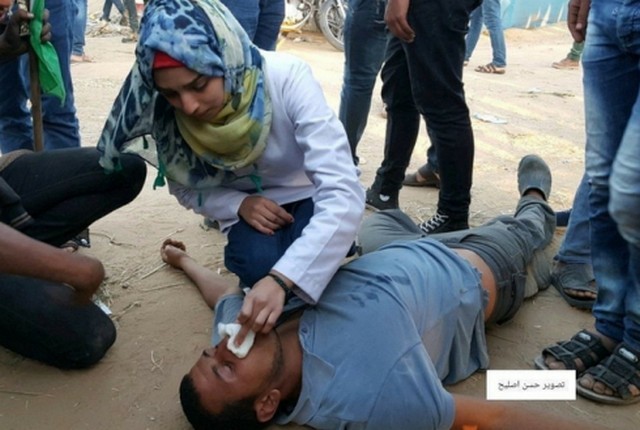
10 Jun 2018 – The Gaza Sniper Massacre in response to the Great Return March is one more milestone in Palestinian resistance and yet another frightening episode in the Israeli apartheid narrative of cruel and excessive violence, a shameful sequel of crimes for which there exists no adjudicative tribunal available to the victimized party to pursue justice. The post that follows consists of juxtaposing news items, a searing opinion piece by the courageously uncompromising Israeli journalist Gideon Levy and a wide-ranging brilliant commentary by my friend, Jim Kavanaugh. The post and is dedicated to the memory of Razan al-Najjar, the brave 21year old paramedic mortally shot while tending Palestinian demonstrators wounded at or near the Gaza fence. This young woman epitomized the purity of nonviolent yet heroic resistance, an identity given historical depth by her joy for life and her supreme sacrifice imposed by sniper brutality.

The Israeli political leadership and military commanders must be presumed to have chosen such a display of excessive and vindictive violence for a clear political objective, which will remain undisclosed. It would seem to be taking advantage of having unlimited support from the Trump presidency and the most favorable regional political situation of their history, but we may still ask ‘to what end?’ My best guess is that the effort was designed to convince the people of Gaza, more than Hamas, that resistance, and especially unarmed resistance was futile. Without a diplomatic path and with the annexationist path wide open, Israel would benefit from a Palestinian acknowledgement that the struggle is over, and they have lost. The Great March of Return was a defiant refusal to concede defeat, no doubt angering Israel, and inflicting a major defeat in the other war—the Legitimacy War being fought for hearts and minds on the basis of seizing the high moral and political ground.

Finally, we need to understand that the problem of winning the Legitimacy War is mostly a struggle to have the truth heard, to have it understood on all the major issues in dispute, law and morality are aligned with the Palestinian demands, but this has so far proved politically irrelevant as geopolitics and military capabilities strongly lean in an Israeli direction. Can Palestinian resistance as reinforced by a growing global solidarity movement overcome these Israeli advantages? Time will tell. So far the corporatized media has sided with Israel, which is a battlefield in the Legitimacy War where the Palestinians have mainly fared badly.

******************************
(1) The Free Gaza Movement

Please share this news with everyone you can think of. The only way we have a hope that these brave sailors will be safe is if the news gets out. There has been very little coverage so far. This is what we have found in the past day.

Quds News Network·

For the first time, #Gaza will attempt to break the 12-year-long siege by sea

On Tuesday morning, ships will set sail with a number of injured Gazans and patients abroad, carrying the hopes and dreams of the Palestinian people for freedom.

Tuesday’s Gaza flotilla will coincide with the 8th anniversary of an Israeli attack on the Turkish “Mavi Marmara” flotilla, in which nine Turkish activists were killed when the Israeli navy attacked the vessel in international waters. A tenth activist died nearly four years later, succumbing to injuries sustained during the raid.

https://www.middleeastmonitor.com/20180527-gaza-boats-will-attempt-to-break-israel-navy-siege-on-tuesday/

https://www.reuters.com/article/us-israel-palestinians-violence/israeli-air-strikes-target-boat-moored-in-gaza-residents-idUSKCN1IO06T

https://www.aljazeera.com/news/2018/05/boats-carrying-gaza-patients-set-bid-break-israel-blockade-180527150238689.html

Greta Berlin, Co-Founder, the Free Gaza movement

*****************************
(2) Jonathan COOK ‘LETTER FROM NAZARETH”

The flames that killed Fathi Harb should make us all burn with guilt and shame

The National – 27 May 2018

Fathi Harb should have had something to live for, not least the imminent arrival of a new baby. But last week the 21-year-old extinguished his life in an inferno of flames in central Gaza.

It is believed to be the first example of a public act of self-immolation in the enclave. Harb doused himself in petrol and set himself alight on a street in Gaza City shortly before dawn prayers during the holy month of Ramadan.

In part, Harb was driven to this terrible act of self-destruction out of despair.

After a savage, decade-long Israeli blockade by land, sea and air, Gaza is like a car running on fumes. The United Nations has repeatedly warned that the enclave will be uninhabitable within a few years.

Over that same decade, Israel has intermittently pounded Gaza into ruins, in line with the Israeli army’s Dahiya doctrine. The goal is to decimate the targeted area, turning life back to the Stone Age so that the population is too preoccupied with making ends meet to care about the struggle for freedom.

Both of these kinds of assault have had a devastating impact on inhabitants’ psychological health.

Harb would have barely remembered a time before Gaza was an open-air prison and one where a 1,000kg Israeli bomb might land near his home.

In an enclave where two-thirds of young men are unemployed, he had no hope of finding work. He could not afford a home for his young family and he was about to have another mouth to feed.

Doubtless, all of this contributed to his decision to burn himself to death.

But self-immolation is more than suicide. That can be done quietly, out of sight, less gruesomely. In fact, figures suggest that suicide rates in Gaza have rocketed in recent years.

But public self-immolation is associated with protest.

A Buddhist monk famously turned himself into a human fireball in Vietnam in 1963 in protest at the persecution of his co-religionists. Tibetans have used self-immolation to highlight Chinese oppression, Indians to decry the caste system, and Poles, Ukrainians and Czechs once used it to protest Soviet rule.

But more likely for Harb, the model was Mohamed Bouazizi, the Tunisian street vendor who set himself on fire in late 2010 after officials humiliated him once too often. His public death triggered a wave of protests across the Middle East that became the Arab Spring.

Bouazizi’s self-immolation suggests its power to set our consciences on fire. It is the ultimate act of individual self-sacrifice, one that is entirely non-violent except to the victim himself, performed altruistically in a greater, collective cause.

Who did Harb hope to speak to with his shocking act?

In part, according to his family, he was angry with the Palestinian leadership. His family was trapped in the unresolved feud between Gaza’s rulers, Hamas, and the Palestinian Authority (PA) in the West Bank. That dispute has led the PA to cut the salaries of its workers in Gaza, including Harb’s father.

But Harb undoubtedly had a larger audience in mind too.

Until a few years ago, Hamas regularly fired rockets out of the enclave in a struggle both to end Israel’s continuing colonisation of Palestinian land and to liberate the people of Gaza from their Israeli-made prison.

But the world rejected the Palestinians’ right to resist violently and condemned Hamas as “terrorists”. Israel’s series of military rampages in Gaza to silence Hamas were meekly criticised in the West as “disproportionate”.

The Palestinians of the West Bank and East Jerusalem, where there is still direct contact with Israeli Jews, usually as settlers or soldiers, watched as Gaza’s armed resistance failed to prick the world’s conscience.

So some took up the struggle as individuals, targeting Israelis or soldiers at checkpoints. They grabbed a kitchen knife to attack Israelis or soldiers at checkpoints, or rammed them with a car, bus or bulldozer.

Again, the world sided with Israel. Resistance was not only futile, it was denounced as illegitimate.

Since late March, the struggle for liberation has shifted back to Gaza. Tens of thousands of unarmed Palestinians have massed weekly close to Israel’s fence encaging them.

The protests are intended as confrontational civil disobedience, a cry to the world for help and a reminder that Palestinians are being slowly choked to death.

Israel has responded repeatedly by spraying the demonstrators with live ammunition, seriously wounding many thousands and killing more than 100. Yet again, the world has remained largely impassive.

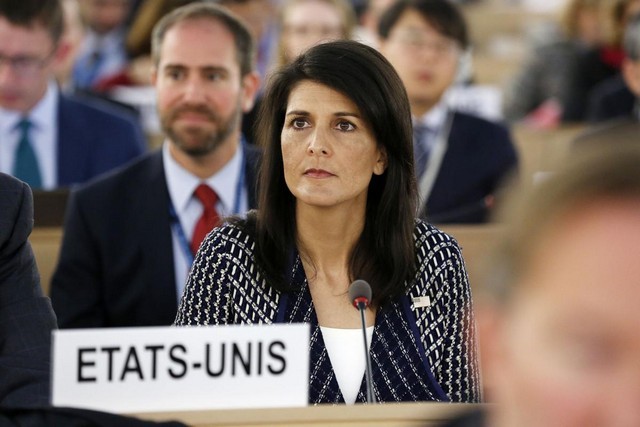
In fact, worse still, the demonstrators have been cast as Hamas stooges. The United States ambassador to the UN, Nikki Haley, blamed the victims under occupation, saying Israel had a right to “defend its border”, while the British government claimed the protests were “hijacked by terrorists”.

None of this can have passed Harb by.

When Palestinians are told they can “protest peacefully”, western governments mean quietly, in ways that Israel can ignore, in ways that will not trouble consciences or require any action.

In Gaza, the Israeli army is renewing the Dahiya doctrine, this time by shattering thousands of Palestinian bodies rather than infrastructure.

Harb understood only too well the West’s hypocrisy in denying Palestinians any right to meaningfully resist Israel’s campaign of destruction.

The flames that engulfed him were intended also to consume us with guilt and shame. And doubtless more in Gaza will follow his example.

Will Harb be proved right? Can the West be shamed into action?

Or will we continue blaming the victims to excuse our complicity in seven decades of outrages committed against the Palestinian people?

(3) The Israel Massacre Forces

The shooting on the Gaza border shows once again that the killing of Palestinians is accepted in Israel more lightly than the killing of mosquitoes

Gideon Levy

https://www.haaretz.com/opinion/.premium-the-israel-massacre-forces-1.5962852

The death counter ticked away wildly. One death every 30 minutes. Again. Another one. One more. Israel was busy preparing for the seder night. TV stations continued broadcasting their nonsense.

It’s not hard to imagine what would have happened if a settler had been stabbed – on-site broadcasts, throw open the studios. But in Gaza the Israel Defense Forces continued to massacre mercilessly, with a horrific rhythm, as Israel celebrated Passover.

If there was any concern, it was because soldiers couldn’t celebrate the seder. By nightfall the, all of them by live fire, with more than 750 wounded. Tanks and sharpshooters against unarmed civilians. That’s called a massacre. There’s no other word for it.

Comic relief was provided by the army spokesman, who announced in the evening: “A shooting attack was foiled. Two terrorists approached the fence and fired at our soldiers.” This came after the 12th Palestinian fatality and who knows how many wounded.

Sharpshooters fired at hundreds of civilians but two Palestinians who dared return fire at the soldiers who were massacring them are “terrorists,” their actions labeled “terror attacks” and their sentence – death. The lack of self-awareness has never sunk to such depths in the IDF.

As usual, the media lent its appalling support. After 15 deaths Or Heller on Channel 10 News declared that the most serious incident of the day had been the firing by the two Palestinians. Dan Margalit “saluted” the army. Israel was brainwashed again and sat down to a festive meal in a spirit of self-satisfaction. And then people recited “Pour out Thy wrath upon the nations that know Thee not,” impressed by the spread of plagues and enthusing at the mass murder of babies (the killing of the first-born Egyptians, the 10th plague).

Christian Good Friday and the Jewish seder night became a day of blood for the Palestinians in Gaza. You can’t even call it a war crime because there was no war there.

The test by which the IDF and the pathological indifference of public opinion should be judged is the following: What would happen if Jewish Israeli demonstrators, ultra-Orthodox or others, threatened to invade the Knesset? Would such insane live fire by tanks or sharpshooters be understood by the public? Would the murder of 15 Jewish demonstrators pass with silence? And if several dozen Palestinians managed to enter Israel, would that justify a massacre? The killing of Palestinians is accepted in Israel more lightly than the killing of mosquitoes. There’s nothing cheaper in Israel than Palestinian blood. If there were a hundred or even a thousand deaths Israel would still “salute” the IDF. This is the army whose commander, the good and moderate Gadi Eisenkot, is received with such pride by Israelis. Of course, in the holiday media interviews, no one asked him about the anticipated massacre and no one will ask him now either.

But an army that prides itself on shooting a farmer on his land, showing the video on its website in order to intimidate Gazans; an army that pits tanks against civilians and boasts of one hundred snipers waiting for the demonstrators is an army that has lost all restraint. As if there weren’t other measures. As if the IDF had the authority or right to prevent demonstrations in Gaza, threatening bus drivers not to transport protesters in territory where the occupation has long ended, as everyone knows.

Despairing young men sneak in from Gaza, armed with ridiculous weapons, marching dozens of kilometers without hurting anyone, only waiting to be caught so as to escape Gaza’s poverty in an Israeli jail. This doesn’t touch anyone’s conscience either. The main thing is that the IDF proudly presents its catch. Palestinian President Mahmous Abbas is responsible for the situation in Gaza. And Hamas, of course. And Egypt. And the Arab world and the whole world. Just not Israel. It left Gaza and Israeli soldiers never commit massacres. The names were published in the evening. One man was rising from his prayers, another was shot while fleeing. The names won’t move anyone. Mohammed al-Najar, Omar Abu Samur, Ahmed Odeh, Sari Odeh, Bader al-Sabag. This space is too small, to our horror, to list all their names.

(4) Sacrificing Gaza: The Great March of Zionist Hypocrisy

By Jim Kavanagh June 4, 2018

The Great March of Return is a startling, powerful expression of Palestinian identity and resistance. Thousands of Palestinians have come out, bravely and unapologetically, to say: “We refuse to remain invisible. We reject any attempt to assign us to the discard pile of history. We will exercise our fundamental right to go home.” They have done this unarmed, in the face of Israel’s use of deadly armed force against targets (children, press, medics) deliberately chosen to demonstrate the Jewish state’s unapologetic determination to force them back into submissive exile by any means necessary. By doing this repeatedly over the last few weeks, these incredibly brave men, women, and children have done more than decades of essays and books to strip the aura of virtue from Zionism that’s befogged Western liberals’ eyes for 70 years.

What the Israelis have done over the past few weeks—killing at least 112and wounding over 13,000people (332 with life-threatening injuries and 27 requiring amputation)—is a historical crime that stands alongside the Sharpeville Massacre (69 killed), Bloody Sunday(14 killed), and the Repression as a defining moment in an ongoing struggle for justice and freedom. Like those events, this month’s slaughter may become a turning point for what John Pilger correctly calls “the longest occupation and resistance in modern times”—the continuing, unfinished subjugation of the Palestinian people, which, like apartheid and Jim Crow, requires constant armed repression and at least occasional episodes of extermination.

The American government, political parties, and media, which support and make possible this crime are disgraceful, criminal accomplices. American politicians, media, and people, who feel all aglow about professing their back-in-the-day support (actual, for some; retrospectively-imagined, for most) of the Civil-Rights movement in the American South and the anti-apartheid struggle in South Africa but continue to ignore the Palestinian struggle for justice against Zionism, because saying peep one about it might cost them some discomfort, are disgraceful, cowardly hypocrites.

You know, the millions of ant-racist #Resistors who are waiting for a quorum of Natalie Portmans and cool elite, preferably Jewish, personalities to make criticism of Israel acceptable before finding the courage to express the solidarity with the Palestinian people they’ve always had in their hearts. Back in the day, they’d be waiting for Elvis to denounce Jim Crow before deciding that it’s the right time to side with MLK, Malcolm, and Fred Hampton against Bull Connor, George Wallace, and William F. Buckley.

Dis/Ingenuity

The bankruptcy of purportedly anti-racist and humanitarian liberal-Zionist ideology and ideological institutions reached an apogee with the eruption of various apologia for Israel in the wake of this crime, not-so-subtly embedded in mealy-mouthed “regret the tragic loss of life” bleats across the mediascape. All the usual rhetorical subjects were rounded up and thrown into ideological battle: “Israel has every right to defend its borders” (NYT Editorial Board);  the “misogynists and homophobes of Hamas” orchestrated the whole thing (Bret Stephens); the protestors are either Hamas “terrorists” or Hamas-manipulated robots, to be considered “nominal civilians” (WaPo). And, of course, the recurring pièce de résistance: Human Shields!

Somewhere in his or her discourse, virtually every American pundit is dutifully echoing the Israeli point laid down by Benjamin Netanyahu during the Israeli attack on Gaza in 2014: that Hamas uses the “telegenically dead” to further “their cause.” The whole March of Return action is “reckless endangerment, bottomlessly cynical” (Stephens). Women and children were “dispatched” to “lead the charges” although they had been “amply forewarned…of the mortal risk.” It’s a “politics of human sacrifice” (Tobin and Tom Friedman), staged by Hamas, “the terrorist group that controls [Gazans’] lives,” to “get people killed on camera.” (Matt Friedman, NYT Op-Ed). The White House, via spokesman, Raj Shah, adopts this line as its official response“The responsibility for these tragic deaths rests squarely with Hamas,” which “intentionally and cynically provoke[ed] this response” in “a gruesome… propaganda attempt.”

Shmuel Rosner takes this “human shields” trope to its ultimate “no apologies” conclusion in his notorious op-ed in the NYT, “Israel Needs to Protect Its Borders. By Whatever Means Necessary.” Feeling “no need to engage in ingénue mourning,” Rosner forthrightly asserts that “Guarding the border [or whatever it is] was more important than avoiding killing.” They want human sacrifice; we’ll give ‘em human sacrifice!

He acknowledges that Gazans “marched because they are desperate and frustrated. Because living in Gaza is not much better than living in hell,” and that “the people of Gaza … deserve sympathy and pity.” But the Palestinians were seeking “to violate [Israel’s] territorial integrity,” so “Israel had no choice” but to “draw a line that cannot be crossed,” and kill people trying to leave that hell. It was “the only way to ultimately persuade the Palestinians to abandon the futile battle for things they cannot get (“return,” control of Jerusalem, the elimination of Israel).”The alternative is “more demonstrations — and therefore more bloodshed, mostly Palestinian.”

Though he acknowledges that “the interests of Palestinians are [not] at the top of the list of my priorities,” Shmuel nonetheless feels comfortable speaking on their behalf. He sincerely “believe[s] Israel’s current policy toward Gaza ultimately benefits not only Israel but also the Palestinians.”Following the wisdom of “the Jewish sages” (featuring Nick Lowe?) he opines: “Those who are kind to the cruel end up being cruel to the kind.”

Fear not, Shmuel, for the pitiable people of Gaza: Knesset member Avi Dichter reassures us that the Israeli army

“has enough bullets for everyone. If every man, woman and child in Gaza gathers at the gate, in other words, there is a bullet for every one of them. They can all be killed, no problem.”For their ultimate benefit.”

Zionist tough love.

There is nothing new here. Israel has always understood the ghetto it created in Gaza. In 2004, Arnon Soffer, a Haifa University demographer and advisor to Ariel Sharon, said: “when 2.5 million people live in a closed-off Gaza, it’s going to be a human catastrophe. … The pressure at the border will be awful. … So, if we want to remain alive, we will have to kill and kill and kill. All day, every day….If we don’t kill, we will cease to exist.” And when challenged again in 2007about “Israel’s willingness to do what he prescribes… – i.e., put a bullet in the head of anyone who tries to climb over the security fence,” Soffer replied with a shrug:. “If we don’t, we’ll cease to exist.”

Soffer’s only plaint: “The only thing that concerns me is how to ensure that the boys and men who are going to have to do the killing will be able to return home to their families and be normal human beings.” A reprise of Golda Meir’s “shooting and crying” lament; “We can never forgive [the Arabs] for forcing us to kill their children.” Ingénue mourning, anyone?

We can point out the factual errors and concrete cruelties that all these apologias rely on.

We can point out that Hamas did not “orchestrate” these demonstrations, and that the thousands of Gazans who are risking their lives are not instruments. “You people always looked down at us,” one Gazan told Amira Hass, “so it’s hard for you to understand that no one demonstrates in anyone else’s name.”

We can point out that the fence the Israelis are defending is not a “border” (What country are the Gazans in?), but the boundary of a ghetto, what Conservative British PM David Cameron calleda giant “prison camp” and Israeli scholar Baruch Kimmerling called“the largest concentration camp ever to exist.” It’s a camp that tens of thousands of Palestinians were forced into by the Zionist army. The right of those families (80% of Gaza’s population) to leave that confinement and go home is a basic human right and black-letter international law.

We can point out that Gazans aren’t just trying to cross a line in the sand, they are trying to break a siege, and that: “The blockade is by definition an act of war, imposed and enforced through armed violence. Never in history have blockade and peace existed side by side. …There is no difference in civil law between murdering a man by slow strangulation or killing him by a shot in the head.” Those were, after all, the words of Israeli Foreign Minister Abba Eban, when he was justifying Israel’s attack on Egypt in 1967. And they are confirmed today by New York judge Mary McGowan Davis, who says: “The blockade of Gaza has to be lifted immediately and unconditionally.”

We can point out that there can be no excuse in terms of modern international law or human rights principles for Israel’s weeks-long “calculated, unlawful” (HRW) mass killing and crippling or unarmed protestors who were standing quietly, kneeling and praying, walking away, and tending to the wounded hundreds of meters from any “fence”—shootings carried out not in any “fog of war” confusion, but with precise, targeted sniper fire (which, per standard military practice, would be from two-man teams).

As the IDF bragged, in a quickly deleted tweet:  “Nothing was carried out uncontrolled; everything was accurate and measured, and we know where every bullet landed.” Indeed, as Human Rights Watch reports, senior Israeli officials ordered snipers to shoot demonstrators who posed no imminent threat to life, and many demonstrators were shot hundreds of meters, and walking away, from the fence.

We can point out that the IDF’s quick deletion of that tweet indicates its consciousness of guilt awareness, in the face of proliferating images of gruesome, unsupportable casualties, of how bad a Rosner-like “no apology, no regrets” discourse sounds. After all, it’s hard, since they “know where every bullet landed,” not to conclude the Israelis deliberately targeted journalists and medical personnel, who were never threatening to “violate [Israel’s] territorial integrity.” There have been at least 66 journalists wounded and 2 killedwearing clearly marked blue “PRESS” flak jackets. And everyone should see the powerful interview with Canadian doctor, Tarek Loubani, who was shot in the leg, describing how, after six weeks with no paramedic casualties, suddenly:

“in one day, 19 paramedics—18 wounded plus one killed—and myself were all injured, so—or were all shot with live ammunition. We were all… away during a lull, without smoke, without any chaos at all, and we were targeted…So, it’s very, very hard to believe that the Israelis who shot me and the Israelis who shot my other colleagues… It’s very hard to believe that they didn’t know who we were, they didn’t know what we were doing, and that they were aiming at anything else.”

It was on another day that this 21-year-old “nominal civilian” nurse, Razan al-Najjar, was killed by an Israeli sniper while tending to the wounded.

Of course, pointing all this out won’t mean anything to these apologists or to those who give them a platform. Everybody knows the ethico-political double standard at work here. No other country in the world would get away with such blatant crimes against humanity without suffering a torrent of criticism from Western politicians and media pundits, including every liberal and conservative Zionist apologist cited above. Razan’s face would be shining from every page and screen of every Western media outlet, day after day, for weeks. Even an “allied” nation would get at least a public statement or diplomatic protest; any disfavored countries would face calls for punishment ranging from economic sanctions to “humanitarian intervention.” Israel gets praise from America’s UN Ambassador.

Indeed, if the American government “defended” its own actual international border in this way, liberal Zionists would be on the highest of moral saddles excoriating the Trump administration for its crime against humanity. And—forgetting, as is obligatory, the thousands of heavily-armed Jewish Zionists who regularly force their way across actual international borders with impunity—if  some Arab country’s snipers killed hundreds and wounded tens of thousands of similarly unarmed Jewish Zionist men, women, children, and paraplegics who were demonstrating at an actual international border for the right to return to their biblical homeland, we all know the howling and gnashing of morally outraged teeth that would ensue from every corner of the Western political and media universe. No “Guarding the border was more important than avoiding killing” would be published in the NYT,or tolerated in polite company, for that scenario.

Nathan J. Robinson got to the bottom line in his wonderful shredding of Rosner’s argument, it comes down to: “Any amount of Palestinian death, however large, was justified to prevent any amount of risk to Israelis, however small.” Western governments and media have fashioned, and are doing their utmost to sustain, an ethico-political universe where Israel can “lay siege to a million people, ‘bomb them occasionally,’ and then kill them when they show up at the wall to throw rocks.”

Is there a way anymore of not seeing the racism of Zionism? Can we just say, once and for all, that the interests of Palestinians—not as pitiable creatures but as active, fully, enfranchised human beings—are not anywhere on the list of Soffer’s or Dichter’s or Rosner’s (or the Western media’s or governments’) priorities, and refuse any of their pitifully disingenuous expressions of concern for the Palestinians’ benefit? Nobody gets to put “For your own benefit,” in front of “Surrender or I’ll put a bullet in your head.” The only concern any of these commentators have for the people of Gaza is that they submissively accept their forced displacement and imprisonment in “the largest concentration camp ever to exist.”

Does the vulgarity of it shock you?

The “human shields, human sacrifice” trope, which all these apologias hang on, is particularly mendacious and hypocritical as used by Zionists. It’s also a classic example of projection.

This is a “human shield”:

It is Israel which has repeatedly used the specific, prohibited tactic of using children as “human shields” to protect its military forces. According tothe U.N. Committee on the Rights of the Child, Israel is guilty of the “continuous use of Palestinian children as human shields and informants.” Besides this namby-pamby UN Committee that no red-blooded American/Zionist would pay any attention to, the High Court of Justice in Israel identified and denounced the “human shield” procedures the IDF acknowledged and defended using 1,200 times. These include “the ‘neighbor procedure,’ whereby neighbors of wanted Palestinians are forced to go into the wanted man’s house ahead of troops, in case it is booby-trapped,” and Israeli “soldiers forcibly position[ing] members of [a] family, including the children, at the windows of [a] home and proceed[ing] to fire from behind them.”

So, when Zionists use a “human shields” argument as a moral cudgel against unarmed civilian protestors, and a moral justification for a powerful army, which brazenly uses children to shield its own soldiers, killing scores of those protestors by the day—well, it’s not a stretch to see this charge is a projection of Zionists’ own pattern of thought and behavior.

Besides being an ongoing tactic of today’s Israeli army, “human shields” and the “human sacrifice” they imply were an integral element of the Zionist narrative—expressly articulated and embraced, with no apology, as a necessity for the establishment of a Jewish State.

Take a look at what Edward Said in 2001 called: “the main narrative model that [still] dominates American thinking” about Israel, and David Ben-Gurion called “as a piece of propaganda, the best thing ever written about Israel.” It’s the “’Zionist epic’…identified by many commentators as having been enormously influential in stimulating Zionism and support for Israel in the United States.” In this piece of iconic American culture, an American cultural icon—more sympathetically liberal than whom there is not—explains why he, as a Zionist, is not bluffing in his threat to blow up his ship and its 600 Jewish refugees if they are not allowed to enter the territory they want:

–You mean you’d still set it [200 lbs. of dynamite] off, knowing you’ve lost?… Without any regard for the lives you’d be destroying?…

Every person on this ship is a soldier. The only weapon we have to fight with is our willingness to die.

–But for what purpose?”

Call it publicity.

—Publicity?

Yes, publicity. A stunt to attract attention….Does the vulgarity of it shock you?

More Zionist tough love.

In the face of the scurrilous “human shield” accusation against Palestinians now being used to denigrate the killed, maimed, and still-fighting protestors in Gaza, we would do well to recall Paul Newman’s Zionist-warrior, “no apology,” argument for 600 dead Jewish men, women, and children as a publicity stunt to gain the sympathy of the world.

Lest we dismiss this as a fiction, remember that Paul Newman’s fictional boat, Exodus, is based on a real ship, the SS Patria. In 1940, the Patriawas carrying 1800 Jewish refugees from Nazi-occupied Europe whom the British authorities refused entry into Palestine. While the Patria was in the port of Haifa, it was blown up and sunk by Munya Mardor on the orders of the Haganah, which did not want Jewish refugees going anywhere but Palestine. At least 267 people were killed. The Haganah put out the story that the passengers had blown up the ship themselves – a story that lasted 17 years, nourishing the imagination of Leon Uris, author of the Exodus fiction. This wasn’t a commander or leading organization urging people to knowingly take a deadly risk in confronting a powerful enemy; it was “their” self-proclaimed army blowing its people up with no warning—and then falsely claiming they did it to themselves! Nobody who wouldn’t use “bottomlessly cynical” to denigrate the Haganah should be using it to denigrate Gazans.

At a crucial moment in history, it was Zionists who practiced a foundational “human shield” strategy, holding the victims of Nazism “hostage” to the Zionist “statehood” project – as none other than the publisher of the New York Times, Arthur Hays Sulzberger, recognized and criticized:

I cannot rid myself of the feeling that the unfortunate Jews of Europe’s D. P. [Displaced Persons] camps are helpless hostages for whom statehood has been made the only ransom. … [W]hy in God’s name should the fate of all these unhappy people be subordinated to the single cry of Statehood?

The Exodus/Patria/Paul Newman/Haganah willingness to blow up hundreds of Jewish refugees in order to force their way into a desired territory was an attitude endemic to the Zionist movement, and enunciated quite clearly by its leader, David Ben-Gurion, as early as 1938: “If I knew it was possible to save all [Jewish] children of Germany by their transfer to England and only half of them by transferring them to Eretz-Yisrael, I would choose the latter.” You want human sacrifice?…

(Sulzberger, by the way, “opposed political Zionism not solely because of the fate of Jewish refugees because he disliked the ‘coercive methods’ of Zionists in this country who use economic means to silence those with differing views.” Yes, the NYT!  So change is possible.)

What’s Right Is Wrong

And here’s the thing: You want to call what the Gazans did—coming out unarmed by the thousands, knowing many of them would be killed by a heavily-armed adversary determined to put them down by whatever means necessary—a “politics of human sacrifice”? You are right.

Just as you’d be right to say that of the Zionist movement, when it was weak and faced with much stronger adversaries. And just as you’d be right to say it of the unarmed, non-violent Civil Rights Movement, when it faced the rageful determination of the immensely more powerful American South, to preserve the century-old Jim Crow apartheid that wasits identity, by whatever means necessary.

Princeon Professor Eddie Glaude, Jr. nailed it when, to the visible discomfort of his MSNBC co-panelists, he responded to the invocation of the White House line that it’s “all Hamas’ fault and that they’re using them as tools for propaganda,” with: “That’s like saying to the children in the Children’s March of Birmingham it was their fault that Bull Connor attacked them.”

Civil-rights activists did put children on the front lines, and put their own and those children’s lives in danger to fight and defeat Jim Crow. They knew there were a lot of people armed and willing to kill them. And children, as well as activists, were killed. And those actions weresupported (but by no means “orchestrated”) by “extremist” organizations—i.e., the Communist Party. At the time, conservatives attacked Freedom Riders with the same arguments that Zionists are now using to attack Gaza Return Marchers.

All unarmed, non-violent but disruptive, Gandhian strategies to eliminate entrenched systems of colonial-apartheid rule will knowingly sacrifice many lives to attain their victory. Call it a politics of human sacrifice if you want. I won’t make any ingénue objections. But it’s not a sign of the subjugated people’s cynicism; it’s a result of their predicament.

“Human sacrifice” defines the kind of choices a desperate and subjugated people are forced to make in the face of armed power they cannot yet overcome. A militarily-weak insurgent/liberation movement must use an effectively self-sacrificing strategy of moral suasion. That is now a standard and powerful weapon in political struggle. (Though moral suasion alone will not win their rights. Never has. Never will.)

For Gazans, it’s the choice between living in a hell of frustration, misery, insult, confinement, and slow death, or resisting and taking the high risk of instant death. It’s the choice faced by people whose “dreams are killed” by Israel’s siege and forced expulsion, and who are willing to risk their lives  “for the world’s attention.” Young men like Saber al-Gerim, for whom, “It doesn’t matter to me if they shoot me or not. Death or life — it’s the same thing.” Or the one who told Amira Hass: “We die anyway, so let it be in front of the cameras.” Or 21-year-old Fathi Harb, who burned himself to death last Sunday. Or Jihadi al-Najjar, who had to make the choice between continuing to care for his blind father (“He was my sight. He helped me in everything, from going to the bathroom to taking a shower to providing for me…I saw life through Jihadi’s eyes.”) or being killed by an Israeli sniper while, as his mother Tahani says “defending the rights of his family and his people.”

Tough choices, to get the world’s attention. This is the kind of choice imposed on the untermenschen of colonial-apartheid regimes. The only weapon they have is their willingness to die. But Gazans won’t get the sympathetically-anguished Paul Newman treatment. Just “bottomlessly cynical.”

Paul’s choice, Sophie’s choice, is now Saber’s and Jihad’s and Fathi’s, and it’s all bad. Maybe some people—comrades and allies in their struggle—have a right to say something about how to deal with that choice. But the one who doesn’t, the one who has no place to say or judge anything about that choice, is the one who is forcing it. Those who are trying to fight their way out of a living hell are not to be lectured to by the devil and his minions.

So, yes, in a very real sense, for the Palestinians, it is a politics of human sacrifice—to American liberals, the gods who control their fate.

By choosing unarmed, death-defying resistance, Palestinians are sacrificing their lives to assuage the faux-pacifist conscience of Americans and Europeans (particularly, I think, liberals), who have decreed from their Olympian moral heights that any other kind of resistance by these people will be struck down with devastating lightning and thunder.

Funny, that these are the same gods the Zionists appealed to seize their desired homeland, and the same gods the civil-rights activists appealed to wrest their freedom from local demons of lesser strength. Because, in their need to feel “sympathy and pity,” the sacrifice of human lives seems the only offering to which these gods might respond.

The Nakba Is Now

The Israelis and their defenders are right about something else: They cannot allow a single Gazan to cross the boundary. They know it would be a fatal blow to their colonial-supremacist hubris, and the beginning of the end of Zionism—just as Southern segregationists knew that allowing a single black child into the school was going to be the beginning of the end of Jim Crow. Palestinians gaining their basic human rights means Israeli Jews losing their special colonial privileges.

As Ali Abunimah points out, Arnon Soffer was right, when he said: “If we don’t kill, we will cease to exist,” and Rosner, when he said the Gazans threatened the “elimination of Israel.” To continue to exist as the colonial-apartheid polity it is, Israel must maintain strict exclusionist, “no right of return,” policies. Per Abunimah: “the price of a ‘Jewish state’ is the permanent and irrevocable violation of Palestinians’ rights…If you support Israel’s “right to exist as a Jewish state” in a country whose indigenous Palestinian people today form half the population, then you… must come to terms with the inevitability of massacres.”

What’s happening in Gaza is not only, as Abunimah says, a “reminder… of the original sin of the ethnic cleansing of Palestine and the creation of a so-called Jewish state,” it is a continuation of that unfinished work of the devil. The Nakba is now.

I’m all for everybody on both sides of the issue to be aware of the stakes and risks in this struggle, without any disingenuous denials.

Whether you sympathize with, or denigrate, the choices of people who put their own, their comrades’, and even their children’s, lives at risk is not determined by whether some tactical choices can be characterized as “human shields, human sacrifice”; it’s determined by what they’re fighting for, and what and whom they are fighting against, anywhere your solidarity lies.

Stage Left

Here’s the core of the disagreement about Gaza (and Palestine in general): There are those—they call themselves Zionists—who think the Palestinians deserve to have been put in that concentration camp, and who stand in solidarity with the soldiers who, by whatever means necessary, are forcing them to stay there. And there are those—the growing numbers who reject Zionism—who stand in solidarity with every human being trying to get out of that camp by whatever means necessary.

There’s a fight—between those breaking out of the prison and those keeping them in; between those seeking equality and those enforcing ethno-religious supremacism; between the colonized and the colonizer. Pick a side. Bret Stephens, Shmuel Rosner, and Tom Friedman have. The New York Times, The Washington Post, and Breitbart have. ABC, CBS, (MS)NBC, and Fox have. The Democrats and Republicans and the Congress and the White House have. And they are not shy about it.

It’s past time for American progressives to clearly and unequivocally decide and declare which side they are on. It’s time for professedly humanitarian, egalitarian, pro-human rights, anti-racist, and free-speech progressives to express their support of the Palestinian struggle—on social media, in real-life conversation, and on the street.

It’s time to firmly reject the hypocritical discourse of those who would have been belittling any expression of sorrow and outrage over Emmet Till, Chaney, Schwerner and Goodman, and the four black schoolgirls killed in Birmingham, while “ingénue mourning” the terrible moral quandary in which those disrupters had put Bull Connor’s boys. Don’t shrink from it, talk back to it—every time.Make them ashamed to be defending colonialism and apartheid with such patently phony arguments.

Politically? At a minimum, demand of any politician who seeks your vote:

End the blockade of Gaza, immediately and unconditionally. Support BDS. Refuse any attempt to criminalize BDS and anti-Zionism. Stop blocking UN and ICC actions against Israeli crimes. Restrict arms sales to Israel. Reject the hypocritical Zionist apologetics. Refuse any attempt to censor or restrict the internet.

(This last is very important. Nothing has threatened Zionist impunity more than the information available on the internet, and nothing is driving the demand to censor the internet more than the Zionists’ need to shut that off.)

This is a real, concrete, important resistance. What’ll it cost? Some social discomfort? It’s not sniper fire. Not human sacrifice. Not Saber’s choice.

Are we at a turning point? Some people think this year’s massacre in Gaza will finally attract a sympathetic gaze from the gods and goddesses of the Imperial City. Deliberately and methodically killing, maiming, and wounding thousands of unarmed people over weeks—well, the cruelty, the injustice, the colonialism is just too obvious to ignore any longer. And I hope that turns out to be so. And I know, Natalie Portman and Roger Waters and Shakira, and—the most serious and hopeful—the young American Jews in groups like Students for Justice in Palestine and IfNotNow. There are harbingers of change, and we must try.

I also know there is nothing new here. Thirty years ago, a doctor in Gaza said: “We will sacrifice one or two kids to the struggle — every family. What can we do? This is a generation of struggle.” It was obvious thirty years ago, and forty years before that. The Nakba was then. The Nakba is now. Was it ever not too obvious to ignore?

My mother was an actress on Broadway, who once came to Princeton University to share the stage, and her professional skills, with Jimmy Stewart and other amateur thespians. She played the ingénue. Me, I’m not so good at that.

By all means, regarding Palestine-Israel and the sacrifices and solidarity demanded: No more ingénue politics.

Article printed from http://www.counterpunch.org: ‪https://www.counterpunch.org

URL to article: ‪https://www.counterpunch.org/2018/06/04/sacrificing-gaza-the-great-march-of-zionist-hypocrisy/

****************************
(5) Israeli army frames slain medic Razan al-Najjar as ‘Hamas human shield’

Mondoweiss 7 June 2018 by Jonathan Ofir

Just when you thought Israel couldn’t get any lower… The Israeli army has just released an incitement video, titled “Hamas’ use of human shields must stop”, in which it frames the slain medic Razan al-Najjar as a “Hamas human shield”– a day after it claimed she was killed by accident. This is more than adding insult to injury. This is adding malice to crime. The propaganda effort is based on twisting al-Najjar’s own words. I have consulted with three Arabic experts, who have looked at the original Arabic interview from which the IDF took the “human shield” text, and it is clear to them beyond a doubt that the IDF was knowingly and cynically manipulating Razan’s words to mean something other than what she said. Bear with me, this requires close analysis: First the video features Razan throwing away a gas grenade in the field.  Obviously, this is one of the tear gas grenades fired by the Israeli army, which she is taking up and throwing to a safe distance. By this visual, the IDF is trying to create the impression that Razan is a kind of ‘combatant’. Then comes the short clip from an interview. The original interview has been found to be from Al Mayadeen News, a channel based in Beirut. The IDF video runs subtitles, saying: “I am Razan al-Najjar, I am here on the frontlines and I act as a human shield…” That’s all the IDF needs. Now, with the ominous music in the background, the IDF text states: “Hamas uses paramedics as human shields”. But the IDF cut out a very significant part of the sentence. Razan actually says: “I the Paramedic Razan al-Najjar, I am here on the Front Line acting as a human shield of safety to protect the injured at the Front Line. No one encouraged me on being a Paramedic, I encouraged myself. I wanted to take chances and help people…” (my emphasis)…. http://mondoweiss.net/2018/06/israeli-frames-najjar/

Richard Falk is a member of the TRANSCEND Network, an international relations scholar, professor emeritus of international law at Princeton University, author, co-author or editor of 40 books, and a speaker and activist on world affairs.

20 June 2018

Source: https://www.transcend.org/tms/2018/06/the-great-march-of-return-the-gaza-sniper-massacre/

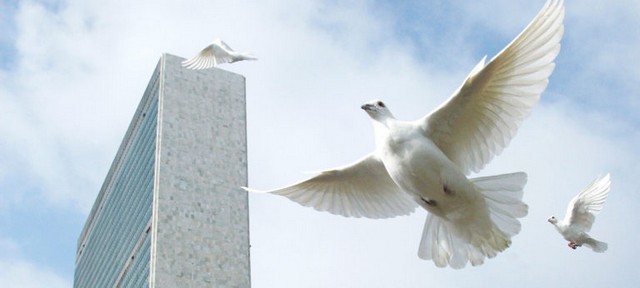
‘True’ Peace Requires Standing Up for Human Rights, Says UN Chief Guterres

By UN News

13 June 2018 – Achieving peace involves more than “laying down weapons”, United Nations Secretary-General António Guterres said today, calling for intensified efforts to address the root causes of conflict.

In a message marking the 100-day countdown to the International Day of Peace, observed annually on 21 September, Mr. Guterres reiterated the importance of human rights for lasting peace.

“There is more to achieving peace than laying down weapons. True peace requires standing up for the human rights of all the world’s people,” he said.

“Let us stand up for human rights for all, in the name of peace for all.”

The theme of the commemorations this year is ‘The Right to Peace – The Universal Declaration of Human Rights at 70.’

He said that the International Day “embodies our shared aspiration to end conflict in all its forms and to safeguard the human rights of all people,” adding that the UN has called for a 24-hour global ceasefire, “with the hope that one day in our lifetime, we will witness an end to violence.”

There is more to achieving peace than laying down weapons. True peace requires standing up for the human rights of all the world’s people – Secretary-General António Guterres

In his message, the UN chief also called on everyone to work to advance the Sustainable Development Goals, including through the promotion of inclusive societies, access to justice and building accountable institutions.

Adopted by all 193 UN Member States in 2015, the Sustainable Development Goals (SDGs) recognize the importance of achieving economic and social development, together with equality for all, to build a more peaceful world.

Part of the Agenda for Sustainable Development, which commits countries to a deadline of 2030, the 17 Goals cover a broad range of issues, including poverty, hunger, health, education, climate change, gender equality, water, sanitation, energy, environment and social justice.

One of the Goals (SDG16) focuses primarily on promoting peaceful and inclusive societies through achievable but sustainable development. It also includes providing access to justice for all and building effective, accountable and inclusive institutions at all levels.

António Manuel de Oliveira Guterres, Portuguese politician and diplomat who is serving as the ninth Secretary-General of the United Nations.

20 Jun 2018

Source: https://www.transcend.org/tms/2018/06/true-peace-requires-standing-up-for-human-rights-says-un-chief-guterres/

Scapegoating Iran

By Chris Hedges

10 Jun 2018 – Seventeen years of war in the Middle East and what do we have to show for it? Iraq after our 2003 invasion and occupation is no longer a unified country. Its once modern infrastructure is largely destroyed, and the nation has fractured into warring enclaves. We have lost the war in Afghanistan. The Taliban is resurgent and has a presence in over 70 percent of the country. Libya is a failed state. Yemen after three years of relentless airstrikes and a blockade is enduring one of the world’s worst humanitarian disasters. The 500 “moderate” rebels we funded and armed in Syria at a cost of $500 million are in retreat after instigating a lawless reign of terror. The military adventurism has cost a staggering $5.6 trillion as our infrastructure crumbles, austerity guts basic services and half the population of the United States lives at or near poverty levels. The endless wars in the Middle East are the biggest strategic blunder in American history and herald the death of the empire.

Someone has to be blamed for debacles that have resulted in hundreds of thousands of dead, including at least 200,000 civilians, and millions driven from their homes. Someone has to be blamed for the proliferation of radical jihadist groups throughout the Middle East, the continued worldwide terrorist attacks, the wholesale destruction of cities and towns under relentless airstrikes and the abject failure of U.S. and U.S.-backed forces to stanch the insurgencies. You can be sure it won’t be the generals, the politicians such as George W. Bush, Barack Obama and Hillary Clinton, the rabid neocons such as Dick Cheney, Paul Wolfowitz and John Bolton who sold us the wars, the Central Intelligence Agency, the arms contractors who profit from perpetual war or the celebrity pundits on the airwaves and in newspapers who serve as cheerleaders for the mayhem.

“The failed policies, or lack of policies, of the United States, which violate international law, have left the Middle East in total chaos,” the Iranian ambassador to the United Nations, Gholamali Khoshroo, told me when we met in New York City. “The United States, to cover up these aggressive, reckless and costly policies, blames Iran. Iran is blamed for their failures in Yemen, Iraq, Afghanistan, Syria and Lebanon.”

The Trump administration “is very naive about the Middle East and Iran,” the ambassador said. “It can only speak in the language of threats—pressure, sanctions, intervention. These policies have failed in the region. They are very risky and costly. Let the Americans deal with the problems of the countries they have already invaded and attacked. America lacks constructive power in the Middle East. It is unable to govern even a village in Iraq, Afghanistan, Yemen or Syria. All it can do is use force and destructive power. This U.S. administration wants the Middle East and the whole world to bow to it. This is not a policy conducive to sound relationships with sovereign states, especially those countries that have resisted American influence.”

“The plan to arm ‘moderate’ rebels in Syria was a cover to topple [Syrian President] Bashar al-Assad,” the ambassador went on. “The Americans knew there were no ‘moderate’ rebels. They knew these weapons would get into the hands of terrorist groups like Daesh [Islamic State], Al-Nusra and their affiliates. Once again, the American policy failed. The Americans succeeded in destroying a country. They succeeded in creating bloodbaths. They succeeded in displacing millions of people. But they gained nothing. The sovereignty of Syria is expanding by the day. It is hard to imagine what President Trump is offering as a strategy in Syria. One day, he says, ‘I will move out of Syria very soon, very quickly.’ The next day he says, ‘If Iran is there, we should stay.’ I wonder if the American taxpayers know how much of their money has been wasted in Iraq, Syria and Yemen?”

Trump’s unilateral decision to withdraw from the Iran nuclear deal, although Iran was in compliance with the agreement, was the first salvo in this effort to divert attention from these failures to Iran. Bolton, the new national security adviser, and Secretary of State Mike Pompeo, along with Trump lawyer Rudy Giuliani, advocate the overthrow of the Iranian government, with Giuliani saying last month that Trump is “as committed to regime change as we [an inner circle of presidential advisers] are.”

“The Iran nuclear deal was possible following several letters by Ppresident Barack Obama assuring the Iranian leadership that America had no intention of violating Iranian sovereignty,” Ambassador Khoshroo said. “America said it wanted to engage in a serious dialogue on equal footing and mutual interests and concerns. These assurances led to the negotiations that concluded with the JCPOA [Joint Comprehensive Plan of Action]. From the beginning, however, America was not forthcoming in its dealings with us on the JCPOA. President Obama wanted the agreement to be implemented, but he did not want it implemented in its full capacity. Congress, on the day JCPOA was implemented, passed a law warning Europeans that were doing business with Iran. The staffs of companies had to apply for a visa to the United States if they had traveled to Iran for business purposes. This began on the first day. The Americans were not always very forthcoming. OFAC [Office of Foreign Funds Control] gave ambiguous answers to many of the questions that companies had about sanctions, but at least in words the Obama administration supported the JCPOA and saw the agreement as the basis for our interactions.”

“President Trump, however, even as a candidate, called the agreement ‘the worst deal America ever made,’ ” the ambassador said. “He called this deal a source of embarrassment for America. Indeed, it was not the deal but America’s unilateral decision to walk away from an agreement that was supported by the United Nations Security Council, and in fact co-sponsored and drafted by the United States, that is the source of embarrassment for America. To walk away from an international agreement and then threaten a sovereign country is the real source of embarrassment since Iran was in full compliance while the U.S. never was.”

“In 2008, the Israelis told the world that Iran was only some days away from acquiring an atomic bomb,” he said. “The Israelis said there had to be a military strike to prevent Iran from acquiring a nuclear weapon. What has happened since? During the last two years, there have been 11 reports by the IAEA [International Atomic Energy Agency] clearly confirming and demonstrating Iran’s full compliance with the JCPOA. All of the accusations [about] Iran using nuclear facilities for military purposes were refuted by the IAEA as well as by Europe, Russia, China, along with many other countries in Asia, Latin America, Africa. America is concerned about Iranian influence in the region and seeks to contain Iran because the U.S. administration realizes that America’s policies in the Middle East have failed. Their own statements about Iran repeatedly contradict each other. One day they say, ‘Iran is so weak it will collapse,’ and the next day they say, ‘Iran is governing several Arab capitals in the Middle East.’ ”

Iran announced recently that it has tentative plans to produce the feedstock for centrifuges, the machines that enrich uranium, if the nuclear deal is not salvaged by European members of the JCPOA. European countries, dismayed by Trump’s decision to withdraw from the agreement, are attempting to renegotiate the deal, which imposes restrictions on Iran’s nuclear development in exchange for the lifting of international sanctions.

Why go to war with a country that abides by an agreement it has signed with the United States? Why attack a government that is the mortal enemy of the Taliban, along with other jihadist groups, including al-Qaida and Islamic State, that now threaten us after we created and armed them? Why shatter the de facto alliance we have with Iran in Iraq and Afghanistan? Why further destabilize a region already dangerously volatile?

The architects of these wars are in trouble. They have watched helplessly as the instability and political vacuum they caused, especially in Iraq, left Iran as the dominant power in the region. Washington, in essence, elevated its nemesis. It has no idea how to reverse its mistake, beyond attacking Iran. Those both in the U.S. and abroad who began or promoted these wars see a conflict with Iran as a solution to their foreign and increasingly domestic dilemmas.

For example, Israeli Prime Minister Benjamin Netanyahu, mired in corruption scandals, hopes that by fostering a conflict with Iran he can divert attention away from investigations into his abuse of power and the massacres Israel carries out against Palestinians, along with Israel’s accelerated seizure of Palestinian land.

“The most brutal regime is now in power in Israel,” the Iranian ambassador said. “It has no regard for international law or humanitarian law. It violates Security Council resolutions regarding settlements, its capital and occupation. Look at what Israel has done in Gaza in the last 30 days. On the same day America was unlawfully transferring its embassy to Jerusalem, 60 unarmed Palestinian protesters were killed by Israeli snipers. [Israelis] were dancing in Jerusalem while the blood of unarmed Palestinians was running in Gaza. The Trump administration gives total support and impunity to Israel. This angers many people in the Middle East, including many in Saudi Arabia. It is a Zionist project to portray Iran as the main threat to peace in the Middle East. Israel introducing Iran as a threat is an attempt to divert attention from the crimes this regime is committing, but these too are failed policies that will backfire. They are policies designed to cover weakness.”

Saudi Crown Prince Mohammed bin Salman, facing internal unrest, launched the war in Yemen as a vanity project to bolster his credentials as a military leader. Now he desperately needs to deflect attention from the quagmire and humanitarian disaster he created.

“Saudi Arabia, as part of [the civil war in Yemen], has a tactical and strategic cooperation with Israel against Iran,” the ambassador said. “But the Saudi regime is defying the sentiments of its own people. How long will this be possible? For three years now, Saudi Arabia, assisted by the United States, has bombed the Yemeni people and imposed a total blockade that includes food and medicine. Nothing has been resolved. Once again, Iran is blamed for this failure by Saudi Arabia and the United States in Yemen. Even if Iran wanted to help the Yemenis, it is not possible due to the total blockade. The Yemeni people asked for peace negotiations from the first day of the war. But Saudi military adventurism and its desire to test its military resolve made any peaceful solution impossible. The U.S. and the U.K. provide military and logistical support, including cluster bombs to be used by the Saudis in Yemen. The Emiratis are bombing Yemen. All such actions are doomed to failure since there is no military solution in Yemen. There is only a political solution. Look at the targets of Saudi airstrikes in Yemen: funerals. Wedding ceremonies. Agricultural fields. Houses. Civilians. How do the Saudis expect the Yemeni people to greet those who bomb them? With hugs? The war has cost a lot of money, and Trump responds by saying [to Saudi Arabia], ‘Oh you have money. [Paraphrasing here.] Please buy our ‘beautiful weapons.’ They are killing beautiful children with these ‘beautiful’ weapons. It is a disaster. It is tragic.”

And then there is President Donald Trump, desperate for a global crusade he can use to mask his ineptitude, the rampant corruption of his administration and his status as an international pariah when he runs for re-election in 2020.

“Of course, blaming and threatening Iran is not new,” the ambassador said. “This has been going on for 40 years. The Iranian people and the Iranian government are accustomed to this nonsense. United States intervention in the internal affairs of Iran goes back a long time, including the [Iranian] war with Iraq, when the United States supported Saddam Hussein. Then America invaded Iraq in 2003 in their so-called ‘intervention for democracy and elimination of WMDs.’ Iran has always resisted and will always resist U.S. threats.”

“America was in Iran 40 years ago,” the ambassador said. “About 100,000 U.S. advisers were in Iran during the rule of the shah, who was among the closest allies of America. America was unable to keep this regime in power because the Iranian people revolted against such dependency and suppression. Since the fall of the shah in 1979, for 40 years, America continued to violate international law, especially the Algeria agreements it signed with Iran in 1981.”

The Algeria Declaration was a set of agreements between the United States and Iran that resolved the Iranian hostage crisis. It was brokered by the Algerian government. The U.S. committed itself in the Algeria Declaration to refrain from interference in Iranian internal affairs and to lift trade sanctions on Iran and a freeze on Iranian assets.

The warmongers have no more of a plan for “regime change” in Iran than they had in Afghanistan, Iraq, Libya or Syria. European allies, whom Trump alienated when he walked away from the Iranian nuclear agreement, are in no mood to cooperate with Washington. The Pentagon, even if it wanted to, does not have the hundreds of thousands of troops it would need to attack and occupy Iran. And the idea—pushed by lunatic fringe figures like Bolton and Giuliani—that the marginal and discredited Iranian resistance group Mujahedeen-e-Khalq (MEK), which fought alongside Saddam Hussein in the war against Iran and is viewed by most Iranians as composed of traitors, is a viable counterforce to the Iranian government is ludicrous. In all these equations the 80 million people in Iran are ignored just as the people of Afghanistan, Iraq, Libya and Syria were ignored. Perhaps they would not welcome a war with the United States. Perhaps if attacked they would resist. Perhaps they don’t want to be occupied. Perhaps a war with Iran would be interpreted throughout the region as a war against Shiism. But these are calculations that the ideologues, who know little about the instrument of war and even less about the cultures or peoples they seek to dominate, are unable to fathom.

“The Middle East has many problems: insecurity, instability, problems with natural resources such as water, etc.,” Khoshroo said. “All of these problems have been made worse by foreign intervention as well as Israel’s lawlessness. The issue of Palestine is at the heart of turmoil in the Middle East for Muslims. Any delay in finding solutions to these wounds in the Middle East exposes this region to more dangerous threats. Americans say they want the Middle East to be free from violent extremism, but this will only happen when the Middle East is free from occupation and foreign intervention. The Americans are selling their weapons throughout the Middle East. They calculate how much money they can earn from destruction. They don’t care about human beings. They don’t care about security or democratic process or political process. This is worrisome.”

“What are the results of American policies in the Middle East?” he asked. “All of the American allies in the region are in turmoil. Only Iran is secure and stable. Why is this the case? Why, during the last 40 years, has Iran been stable? Is it because Iran has no relationship with America? Why is there hostility between Iran and America? Can’t the Americans see that Iran’s stability is important for the region? We are surrounded by Pakistan, Afghanistan, Iraq, Syria, Yemen. What good would come from destabilizing Iran? What would America get out of that?”

Chris Hedges spent nearly two decades as a foreign correspondent in Central America, the Middle East, Africa and the Balkans.

20 June 2018

Source: https://www.transcend.org/tms/2018/06/scapegoating-iran/

Trump Administration Pulls US out of UN Human Rights Council

By Associated Press

19 Jun 2018 – The United States announced today it was leaving the United Nations’ Human Rights Council, with Ambassador Nikki Haley calling it “an organization that is not worthy of its name.” It was the latest withdrawal by the Trump administration from an international institution.

Haley, Trump’s envoy to the U.N., said the U.S. had given the human rights body “opportunity after opportunity” to make changes. She lambasted the council for “its chronic bias against Israel” and lamented the fact that its membership includes accused human rights abusers such as China, Cuba, Venezuela and the Democratic Republic of Congo.

“We take this step because our commitment does not allow us to remain a part of a hypocritical and self-serving organization that makes a mockery of human rights,” Haley said.

Secretary of State Mike Pompeo, appearing alongside Haley at the State Department, said there was no doubt that the council once had a “noble vision.”

But today we need to be honest,” Pompeo said. “The Human Rights Council is a poor defender of human rights.”

The announcement came just a day after the U.N. human rights chief, Zeid Ra’ad al-Hussein, denounced the Trump administration for separating migrant children from their parents. But Haley cited longstanding U.S. complaints that the 47-member council is biased against Israel. She had been threatening the pull-out since last year unless the council made changes advocated by the U.S.

“Regrettably, it is now clear that our call for reform was not heeded,” Haley said.

Still, she suggested the decision need not be permanent, adding that if the council did adopt reforms, “we would be happy to rejoin it.” She said the withdrawal notwithstanding, the U.S. would continue to defend human rights at the United Nations.

Israeli Prime Minister Benjamin Netanyahu’s office called the U.S. decision “courageous,” calling it “an unequivocal statement that enough is enough.”

The move extends a broader Trump administration pattern of stepping back from international agreements and forums under the president’s “America First” policy. Although numerous officials have said repeatedly that “America First does not mean America Alone,” the administration has retreated from multiple multilateral accords and consensuses since it took office.

Since January 2017, it has announced its withdrawal from the Paris climate accord, left the U.N. educational and cultural organization and pulled out of the Iran nuclear deal. Other contentious moves have included slapping tariffs on steel and aluminum against key trading partners, recognizing Jerusalem as Israel’s capital and moving the U.S. Embassy there from Tel Aviv.

Opposition to the decision from human rights advocates was swift. A group of 12 organizations including Save the Children, Freedom House and the United Nations Association-USA said there were “legitimate concerns” about the council’s shortcomings but that none of them warranted a U.S. exit.

“This decision is counterproductive to American national security and foreign policy interests and will make it more difficult to advance human rights priorities and aid victims of abuse around the world,” the organizations said in a joint statement.

Added Kenneth Roth, the executive director of Human Rights Watch: “All Trump seems to care about is defending Israel.”

On Twitter, al-Hussein, the U.N. human rights chief, said it was “Disappointing, if not really surprising, news. Given the state of #HumanRights in today’s world, the US should be stepping up, not stepping back.”

And the Heritage Foundation, a conservative think tank close to the Trump administration, defended the move, calling the council “notably incurious about the human rights situations in some of the world’s most oppressive countries.” Brett Schaefer, a senior fellow, pointed out that Trump could have withdrawn immediately after taking office but instead gave the council 18 months to make changes.

Haley has been the driving force behind withdrawing from the human rights body, unprecedented in the 12-year history of the council. No country has ever dropped out voluntarily. Libya was kicked out seven years ago.

The move could reinforce the perception that the Trump administration is seeking to advance Israel’s agenda on the world stage, just as it prepares to unveil its long-awaited Israeli-Palestinian peace plan despite Palestinian outrage over the embassy relocation. Trump’s son-in-law and senior adviser, Jared Kushner, is visiting the Middle East this week as the White House works to lay the groundwork for unveiling the plan.

Israel is the only country in the world whose rights record comes up for discussion at every council session, under “Item 7” on the agenda. Item 7 on “Israel and the Occupied Palestinian Territories” has been part of the council’s regular business almost as long as it has existed.

The United States’ current term on the council ends next year. Although the U.S. could have remained a non-voting observer on the council, a U.S. official said it was a “complete withdrawal” and that the United States was resigning its seat “effective immediately.” The official wasn’t authorized to comment publicly and insisted on anonymity.

That means the council will be left without one of its traditional defenders of human rights. In recent months, the United States has participated in attempts to pinpoint rights violations in places like South Sudan, Congo and Cambodia.

The U.S. pullout was bound to have ripple effects for at least two countries at the council: China and Israel. The U.S., as at other U.N. organizations, is Israel’s biggest defender. At the rights council, the United States has recently been the most unabashed critic of rights abuses in China — whose growing economic and diplomatic clout has chastened some other would-be critics, rights advocates say.

There are 47 countries in the Human Rights Council, elected by the U.N.’s General Assembly with a specific number of seats allocated for each region of the globe. Members serve for three-year terms and can serve only two terms in a row.

The United States has opted to stay out of the Human Rights Council before: The George W. Bush administration opted against seeking membership when the council was created in 2006. The U.S. joined the body only in 2009 under President Barack Obama.

Associated Press writers Jamey Keaten in Geneva and Edith M. Lederer at the United Nations contributed.

20 June 2018

Source: https://www.transcend.org/tms/2018/06/trump-administration-pulls-us-out-of-un-human-rights-council/

Humanity’s ‘Dirty Little Secret’: Starving, Enslaving, Raping, Torturing and Killing our Children

By Robert J. Burrowes

18 Jun 2018 – In the 9 Apr 2018 TMS Editorial, ‘Challenges for Resolving Complex Conflicts’, I pointed out four conflict configurations that are paid little attention by conflict theorists. In this one I would like to discuss a fifth conflict configuration that is effectively ignored by conflict theorists (and virtually everyone else). This conflict is undoubtedly the most fundamental conflict in human society, because it generates all of the violence humans perpetrate and experience, and yet it is utterly invisible to almost everyone.

I have previously described this conflict as ‘the adult war on children’. It is indeed humanity’s ‘dirty little secret’.

Let me illustrate and explain the nature and extent of this secret war. And what we can do about it.

Every day, according to some estimates, human adults kill 50,000 of our children. The true figure is probably significantly higher. We kill children in wars. See, for example, ‘Scourging Yemen’. We kill them with drones. We kill them in our homes and on the street. We shoot them at school.

We also kill children in vast numbers by starving them to death, depriving them of clean drinking water, denying them medicines – see, for example, ‘Malaria is alive and well and killing more than 3000 African children every day’ – or forcing them to live in a polluted environment, particularly in parts of Africa, Asia and Central/South America. Why? Because we use military violence to maintain an ‘economic’ system that allocates resources for military weapons, as well as corporate profits for the wealthy, instead of resources for living.

We also execute children in sacrificial killings after kidnapping them. We even breed children to sell as a ‘cash crop’ for sexual violation, child pornography (‘kiddie porn’) and the filming of ‘snuff’ movies (in which children are killed during the filming), torture and satanic sacrifice. And these are just some of the manifestations of the violence against children that have been happening for centuries or, in some cases, millennia. On these points, see the video evidence presented at the recent Judicial Commission of Inquiry into Human Trafficking and Child Sex Abuse organized by the International Tribunal for Natural Justice.

The opening statement by Chief Counsel Robert David Steele refers to an estimated eight million children trafficked annually – with 600,000-800,000 of these children (excluding both those bred within the USA without birth certificates and those imported without documentation) in the United States alone – and mentions such practices as ritual torture and ritual murder as well as training dogs to rape children and toddlers. He mentions the range of organizations involved from Oxfam and the Boy Scouts of America to ‘child-service’ agencies and police forces as well as various United Nations organizations, where pedophiles (those who prey on children) rise through the ranks to exercise enormous control. He also points out that many of the children bred or kidnapped into this system usually last about two years before dying (often after being raped several times each hour for some of that time) or being killed outright. He also mentions (with evidence provided in other video presentations) the forced removal of body organs from children of Falun Gong practitioners in China.

Steele, who is a former CIA operations officer, also points out that the 1,000 US military bases around the world are ‘not there for national defense; they are there to serve as lilypads for the smuggling of guns, gold, cash, drugs and small children’. The obvious and clear inference to be drawn from his statement is that the US military is heavily involved in child trafficking (as well as its well-known involvement in drug and weapons trafficking, for example), which means that vast numbers of US military personnel know about it too. And do nothing.

The compelling testimony at the Commission of Inquiry of survivor/perpetrator Ronald Bernard will give you a clear sense of the deep elite engagement (that is, the 8,000-8,500 ‘elite’ individuals running central banks, governments, secret service agencies, multinational corporations, terrorist organizations and churches) in the extraordinary violence inflicted on children, with children illegally trafficked internationally along with women, weapons, drugs, currencies, gold and wildlife.

In a particularly poignant series of moments during the interview, after he has revealed some of the staggering violence he suffered as a child at the hands of his father and the Church, Bernard specifically refers to the fact that the people engaged in these practices are terrified (and ‘serving the monster of greed’) and that, during his time as a financial entrepreneur, he was working with people who understood him as he understood them: individuals who were suffering enormously from the violence they had suffered as children themselves and who are now so full of hatred that they want to destroy life, human and otherwise. In short: they enjoy and celebrate killing people and destroying the Earth as a direct response to the violence they each suffered as a child.

There are more video testimonies by survivors, expert witnesses, research scholars in the field and others on the International Tribunal for Natural Justice website and if you want to read scholarly books documenting aspects of this staggering violence against children then see, for example, ‘Childhunters: Requiem of a Child-killer’ and ‘Epidemic: America’s Trade in Child Rape’.

For further accounts of the systematic exploitation, rape, torture and murder of children over a lengthy period, which focuses on Canada’s indigenous peoples, Rev. Kevin Annett’s evocative report ‘Hidden from History: The Canadian Holocaust – The Untold Story of the Genocide of Aboriginal Peoples by Church and State in Canada’, and his books ‘Unrelenting’ and ‘Murder by Decree: The Crime of Genocide in Canada’ use eyewitness testimonies and archival documentation to provide ‘an uncensored record of the planned extermination of indigenous children in Canada’s murderous “Indian residential schools”’ from 1889 to 1996.

Apart from what happened in the Indian Residential Schools during this period, however, the books also offer extensive evidence documenting the ongoing perpetration of genocide, including child rape, torture and killing, against Canada’s indigenous peoples by its government, the Royal Canadian Mounted Police and the Catholic, Anglican and United Churches since the 19th century. Sadly, there is plenty more in Kevin’s various books and on the website of the International Tribunal into Crimes of Church and State which also explain the long-standing involvement of the Vatican in these genocidal crimes against children.

Of course, Canada is not alone in its unrelenting violence against indigenous children (and indigenous peoples generally). The United States and Australia, among many others, also have long records of savagery in destroying the lives of indigenous children, fundamentally by taking their land and destroying their culture, traditional livelihoods and spirituality. And when indigenous people do not simply abandon their traditional way of being and adopt the dominant model, they are blamed and persecuted even more savagely, as the record clearly demonstrates.

Moreover, institutional violence against children is not limited to the contexts and settings mentioned above. In the recently conducted Royal Commission into Institutional Responses to Child Sexual Abuse undertaken in Australia, childcare services, schools, health and allied services, youth detention, residential care and contemporary out-of-home services, religious activities, family and youth support services, supported accommodation, sporting, recreational and club activities, youth employment, and the military forces were all identified as providing contexts for perpetrating violence against children.

Over half of the survivors suffered sexual violation in an institution managed by a religious organization such as places of worship and for religious instruction, missions, religious schools, orphanages, residential homes, recreational clubs, youth groups, and welfare services. Another one-third of survivors suffered the violence in an institution under government management such as a school, an out-of-home care service, a youth detention centre or at a health service centre. The remaining 10%  suffered violence in a private organization such as a child care centre, a medical practice or clinic, a music or dance school, an independent school, a yoga ashram or a sports club, a non-government or not-for-profit organization.

Needless to say, the failure to respond to any of this violence for the past century by any of the institutions ‘responsible’ for monitoring, oversight and criminal justice, such as the police, law enforcement and agencies responsible for public prosecution, clearly demonstrates that mechanisms theoretically designed to protect children (and adults) do not function when those same institutions are complicit in the violence and are, in any case, designed to defend elite interests (not ‘ordinary’ people and children). Hence, of course, this issue was not even investigated by the Commission because it was excluded from the terms of reference!

Separately from those children we kill or violate every day in the ways briefly described above, we traffic many others into sexual slavery – such as those trafficked (sometimes by their parents) into prostitution to service the sex tourism industry in countries such as Thailand, Cambodia, the Dominican Republic, the Philippines and India – we kidnap others to terrorize them into becoming child soldiers with 46 countries using them according to Child Soldiers International, we force others to work as slave laborers, in horrific conditions, in fields, factories and mines (and buy the cheap products of their exploited labor as our latest ‘bargain’) with Human Rights Watch reporting over 70,000,000 children, including many who aren’t even, technically-speaking, slaves, working in ‘hazardous conditions’ – see ‘Child Labor’ – and we condemn millions to live in poverty, homelessness and misery because national governments, despite rhetoric to the contrary, place either negligible or no value on children apart from, in some cases, as future wage slaves in the workforce.

We also condemn millions of children, such as those in Palestine, Tibet, Western Sahara and West Papua, to live under military occupation, where many are routinely imprisoned, shot or killed.

In addition, while fighting wars we cause many children to be born with grotesque genetic deformities because we use horrific weapons, like those with depleted uranium, on their parents. See ‘“Falluja Babies” and Depleted Uranium: America’s Toxic Legacy in Iraq’ and ‘Depleted uranium used by US forces blamed for birth defects and cancer in Iraq’.

In other cases, we cause children shockingly debilitating injuries, if they are not killed outright, by using conventional, biological and chemical weapons on them directly. See ‘Summary of historical attacks using chemical or biological weapons’.

But war also destroys housing and other infrastructure forcing millions of children to become internally displaced or refugees in another country (often without a living parent), causing ongoing trauma. Worldwide, one child out of every 200 is a refugee, whether through war or poverty, environmental or climate disruption. See ‘50mn children displaced by war & poverty worldwide’.

We also inflict violence on children in many other forms, ranging from ‘ordinary’ domestic violence to genital mutilation, with UNICEF calculating that 200 million girls and young women in 30 countries on three continents have been mutilated. See ‘Female genital mutilation/cutting’.

And we deny children a free choice (even those who supposedly live in a ‘democracy’) and imprison vast numbers of them in school in the delusional belief that this is good for them. See ‘Do We Want School or Education?’ Whatever other damage that school does, it certainly helps to create the next generation of child-destroyers. And, in many countries, we just imprison children in our jails. After all, the legal system is no more than an elite tool to control ‘ordinary’ people while shielding the elite from accountability for their grotesque violence against us all. See ‘The Rule of Law: Unjust and Violent’.

While almost trivial by comparison with the violence identified above, the perversity of many multinational corporations in destroying our children’s health is graphically illustrated in the film ‘Global Junk Food’.

In Europe, food manufacturers have signed up to ‘responsibility pledges’, promising not to add sugar, preservatives, artificial colours or flavours to their products and to not target children.

However, the developing world is not in Europe so these ‘responsibility pledges’ obviously do not apply and corporations such as Coca-Cola, McDonald’s, Kentucky Fried Chicken and Domino’s Pizza sell their junk food in developing countries (with the video above showcasing Brazil and India) loaded with excess oil, salt and sugar and even using fake cheese.

The well-documented report reveals corporations like these to be nothing more than drug dealers, selling toxic food to ill-informed victims that deliver a lifetime of diabetes and obesity to huge numbers of children. So, just as weapons corporations derive their profits from killing children (and adults), junk food corporations derive their profits from destroying the health of children (and adults). Of course, the medical industry, rather than campaigning vigorously against this outrage, prefers to profit from it too by offering ‘treatments’, including the surgical removal of fat, which offer nothing more than temporary but very profitable ‘relief’.

But this is far from representing the only active involvement of the medical industry in the extraordinary violence we inflict on children. For example, western children and many others are rarely spared a plethora of vaccinations which systematically destroy a child’s immune system, thus making their health ongoingly vulnerable to later assaults on their well-being. For a taste of the vast literature on this subject, see ‘Clinical features in patients with long-lasting macrophagic myofasciitis’, ‘Vaccines: Who’s Allergic To Thimerosal (Mercury), Raise Your Hand’ and ‘Vaccine Free Health’.

And before we leave the subject of food too far behind, it should be noted that just because the junk food sold in Europe and some other western countries has less fat, salt, sugar, preservatives and artificial colors and flavours in it, this does not mean that it is healthy. It still has various combinations of added fat, salt, sugar, preservatives and artificial colors and flavours in it.

Separately from this: don’t forget that virtually all parents are systematically poisoning their children by feeding them food grown by the corporate agribusiness giants which is heavily depleted of nutrients and laced with poisons such as glyphosate. For a taste of the vast literature, see ‘The hidden truth about glyphosate EXPOSED, according to undeniable scientific evidence’. Of course, in many countries we are also forcing our children to drink fluoridated water to the detriment of their health too. See ‘Research Exposes How our Water is Making us Depressed, Sick: Fluoridated water is much to blame’.

Obviously, organically/biodynamically grown food, healthily prepared, and unfluoridated water are not health priorities for their children, according to most parents.

As our ultimate act of violence against all children, we are destroying their future. See ‘Killing the Biosphere to Fast-track Human Extinction’.

So how do we do all of this?

Very easily, actually. It works like this.

Perpetrators of violence learn their craft in childhood. If you inflict violence on a child, they learn to inflict violence on others. The child rapist and ritual child killer suffered violence as a child. The terrorist suffered violence as a child. The political leader who wages war suffered violence as a child. The man who inflicts violence on women suffered violence as a child. The corporate executive who exploits working class people and/or those who live in Africa, Asia or Central/South America suffered violence as a child. The racist and religious bigot suffered violence as a child. The soldier who kills in war suffered violence as a child. The individual who perpetrates violence in the home, in the schoolyard or on the street suffered violence as a child. The parent who inflicts violence on their own children suffered violence as a child.

So if we want to end violence, exploitation, ecological destruction and war, then we must finally admit our ‘dirty little secret’ and end our longest and greatest war: the adult war on children. And here is an incentive: if we do not tackle the fundamental cause of violence, then our combined and unrelenting efforts to tackle all of its other symptoms must ultimately fail. And extinction at our own hand is inevitable.

How can I claim that violence against children is the fundamental cause of all other violence? Consider this. There is universal acceptance that behavior is shaped by childhood experience. If it was not, we would not put such effort into education and other efforts to ‘socialize’ children to fit into society. And this is why many psychologists have argued that exposure to war toys and violent video games shapes attitudes and behaviors in relation to violence.

But it is far more complex than these trivialities suggest and, strange though it may seem, it is not just the ‘visible’ violence (such as hitting, screaming at and sexually abusing) that we normally label ‘violence’ that causes the main damage, although this is extremely damaging. The largest component of damage arises from the ‘invisible’ and ‘utterly invisible’ violence that we adults unconsciously inflict on children during the ordinary course of the day. Tragically, the bulk of this violence occurs in the family home and at school. See ‘Why Violence?’ and ‘Fearless Psychology and Fearful Psychology: Principles and Practice’.

So what is ‘invisible’ violence? It is the ‘little things’ we do every day, partly because we are just ‘too busy’. For example, when we do not allow time to listen to, and value, a child’s thoughts and feelings, the child learns to not listen to themSelf thus destroying their internal communication system. When we do not let a child say what they want (or ignore them when they do), the child develops communication and behavioral dysfunctionalities as they keep trying to meet their own needs (which, as a basic survival strategy, they are genetically programmed to do).

When we blame, condemn, insult, mock, embarrass, shame, humiliate, taunt, goad, guilt-trip, deceive, lie to, bribe, blackmail, moralize with and/or judge a child, we both undermine their sense of Self-worth and teach them to blame, condemn, insult, mock, embarrass, shame, humiliate, taunt, goad, guilt-trip, deceive, lie, bribe, blackmail, moralize and/or judge.

The fundamental outcome of being bombarded throughout their childhood by this ‘invisible’ violence is that the child is utterly overwhelmed by feelings of fear, pain, anger and sadness (among many others). However, mothers, fathers, teachers, religious figures and other adults also actively interfere with the expression of these feelings and the behavioral responses that are naturally generated by them and it is this ‘utterly invisible’ violence that explains why the dysfunctional behavioral outcomes actually occur.

For example, by ignoring a child when they express their feelings, by comforting, reassuring or distracting a child when they express their feelings, by laughing at or ridiculing their feelings, by terrorizing a child into not expressing their feelings (e.g. by screaming at them when they cry or get angry), and/or by violently controlling a behavior that is generated by their feelings (e.g. by hitting them, restraining them or locking them into a room), the child has no choice but to unconsciously suppress their awareness of these feelings.

However, once a child has been terrorized into suppressing their awareness of their feelings (rather than being allowed to have their feelings and to act on them) the child has also unconsciously suppressed their awareness of the reality that caused these feelings. This has many outcomes that are disastrous for the individual, for society and for nature because the individual will now easily suppress their awareness of the feelings that would tell them how to act most functionally in any given circumstance and they will progressively acquire a phenomenal variety of dysfunctional behaviors, including some that are violent towards themself, others and/or the Earth.

From the above, it should also now be apparent that punishment should never be used. ‘Punishment’, of course, is one of the words we use to obscure our awareness of the fact that we are using violence. Violence, even when we label it ‘punishment’, scares children and adults alike and cannot elicit a functional behavioural response. See ‘Punishment is Violent and Counterproductive’.

If someone behaves dysfunctionally, they need to be listened to, deeply, so that they can start to become consciously aware of the feelings (which will always include fear and, often, terror) that drove the dysfunctional behavior in the first place. They then need to feel and express these feelings (including any anger) in a safe way. Only then will behavioral change in the direction of functionality be possible. See ‘Nisteling: The Art of Deep Listening’.

‘But these adult behaviors you have described don’t seem that bad. Can the outcome be as disastrous as you claim?’ you might ask. The problem is that there are hundreds of these ‘ordinary’, everyday behaviors that destroy the Selfhood of the child. It is ‘death by a thousand cuts’ and most children simply do not survive as Self-aware individuals. And why do we do this? We do it so that each child will fit into our model of ‘the perfect citizen’: that is, obedient and hardworking student, reliable and pliant employee/soldier, and submissive law-abiding citizen. In other words: a slave.

Of course, once we destroy the Selfhood of a child, it has many flow-on effects. For example, once you terrorize a child into accepting certain information about themself, other people or the state of the world, the child becomes unconsciously fearful of dealing with new information, especially if this information is contradictory to what they have been terrorized into believing. As a result, the child will unconsciously dismiss new information out of hand.

In short, the child has been terrorized in such a way that they are no longer capable of thinking critically or even learning (or their learning capacity is seriously diminished by excluding any information that is not a simple extension of what they already ‘know’). If you imagine any of the bigots you know, you are imagining someone who is utterly terrified. But it’s not just the bigots; virtually all people are affected in this manner making them incapable of responding adequately to new (or even important) information. This is one explanation why many people are ‘climate deniers’ and most others do nothing in response to the climate catastrophe.

Of course, each person’s experience of violence during childhood is unique and this is why each perpetrator becomes violent in their own particular combination of ways.

But if you want to understand the core psychology of all perpetrators of violence, it is important to understand that, as a result of the extraordinary violence they each suffered during childhood, they are now (unconsciously) utterly terrified, full of self-hatred and personally powerless, among another 20 psychological characteristics.

You can read a brief outline of these characteristics and how they are acquired on pages 12-16 of ‘Why Violence?’

As should now be clear, the central point in understanding violence is that it is psychological in origin and hence any effective response must enable both the perpetrator’s and the victim’s suppressed feelings (which will include enormous fear about, and rage at, the violence they have suffered) to be safely expressed. As mentioned above, for an explanation of what is required, see ‘Nisteling: The Art of Deep Listening’.

Unfortunately, this nisteling cannot be provided by a psychiatrist or psychologist whose training is based on a delusionary understanding of how the human mind functions. See ‘Defeating the Violence of Psychiatry’ and ‘Psychiatry: Science or Fraud? The professor’s trick that exposed the ongoing Psychiatry racket…’ Nisteling will enable those who have suffered from psychological trauma to heal fully and completely, but it will take time.

So if we want to end violence (including the starvation, trafficking, rape, torture and killing of children), exploitation, ecological destruction and war, then we must tackle the fundamental cause. Primarily, this means giving everyone, child and adult alike, all of the space they need to feel, deeply, what they want to do, and to then let them do it (or to have the feelings they naturally have if they are prevented from doing so). See ‘Putting Feelings First’. In the short term, this will have some dysfunctional outcomes. But it will lead to an infinitely better overall outcome than the system of emotional suppression, control and punishment which has generated the incredibly violent world in which we now find ourselves.

This all sounds pretty unpalatable doesn’t it? So each of us has a choice. We can suppress  awareness of what is unpalatable, as we have been terrorized into doing as a child, or we can feel the various feelings that we have in response to this information and then ponder (personal and collective) ways forward.

If feelings are felt and expressed then our responses can be shaped by the conscious and integrated functioning of thoughts and feelings, as evolution intended, and we can plan intelligently. The alternative is to have our unconscious fear controlling our thinking and deluding us that we are acting rationally.

It is time to end the most fundamental conflict that is destroying human society from within – the adult war on children – so that we can more effectively tackle all of the other violence that emerges from this cause too.

What Do We Do?

Let me briefly reiterate.

If you are willing, you can make the commitment outlined in ‘My Promise to Children’. If you need to do some healing of your own to be able to nurture children in this way, then consider the information provided in the article ‘Putting Feelings First’.

In addition, you are also welcome to consider participating in ‘The Flame Tree Project to Save Life on Earth’ which maps out a fifteen-year strategy for creating a peaceful, just and sustainable world community so that all children (and everyone else) has an ecologically viable planet on which to live.

You might also consider supporting or even working with organizations like Destiny Rescue, which works to rescue children trafficked into prostitution, or any of the many advocacy organizations associated with the network of End Child Prostitution and Trafficking.

But for the plethora of other manifestations of violence against children identified above, you might consider using Gandhian nonviolent strategy in any context of particular concern to you. See Nonviolent Campaign Strategy or Nonviolent Defense/Liberation Strategy. And, if you like, you can join the worldwide movement to end all violence by signing online ‘The People’s Charter to Create a Nonviolent World’.

In summary: Each one of us has an important choice. We can acknowledge the painful truth that we inflict enormous violence on our children (which then manifests in a myriad complex ways) and respond powerfully to that truth. Or we can keep deluding ourselves and continue to observe, powerlessly, as the violence in our world proliferates until human beings are extinct.

If you want a child who is nonviolent, truthful, compassionate, considerate, patient, thoughtful, respectful, generous, loving of themself and others, trustworthy, honest, dignified, determined, courageous, powerful and who lives out their own unique destiny, then the child must be treated with – and experience – nonviolence, truth, compassion, consideration, patience, thoughtfulness, respect, generosity, love, trust, honesty, dignity, determination, courage, power and, ideally, live in a world that prioritizes nurturing the unique destiny of each child.

Alternatively, if you want a child to turn out like the perpetrators of violence described above, to be powerless to respond effectively to the crises in our world, or to even just turn out to be an appalling parent, then inflict violence – visible, ‘invisible’ and ‘utterly invisible’ – on them during their childhood.

Tragically, with only the rarest of exceptions, human adults are too terrified to truly love, nurture and defend our children from the avalanche of violence that is unleashed on them at the moment of birth.

Robert Burrowes, Ph.D. is a member of the TRANSCEND Network for Peace Development Environment and has a lifetime commitment to understanding and ending human violence.

20 Jun 2018

Source: https://www.transcend.org/tms/2018/06/humanitys-dirty-little-secret-starving-enslaving-raping-torturing-and-killing-our-children/

NORTH KOREA: WHAT PRICE PEACE?

By Askiah Adam

First it was the Panmunjom Declaration and now, after some two months, on 12 June the Singapore Declaration was signed, the former between the leaders of the two Koreas, Chairman Kim Jong-un of the Democratic People’s Republic of Korea (DPRK) or North Korea and President Moon Jae-in of the Republic of Korea (ROK) or South Korea. The latter, meanwhile, was inked by Donald Trump, the President of the United States, and Kim. The central theme for both is peace for the Korean Peninsula premised on its denuclearization.

Item 3 of the Singapore Declaration was unequivocal: “Reaffirming the April 27, 2018 Panmunjom Declaration, the DPRK commits towards complete denuclearization of the Korean Peninsula.” The continuity between the two declarations then is unmistakeable.

Unfortunately, reasons exist to cast a shadow over this ray of hope. Indeed the Singapore Declaration was much anticipated and is well received. But there is, too, much pessimism. The recent unilateral abandonment of the Iran nuclear agreement, formally known as the Joint Comprehensive Plan of Action (JCPOA) by the United States is one. Iran, naturally, advised Kim to be wary. Simply put, Washington’s words are not worth the paper they’re printed on because there have been many previous instances where it reneged on its commitments. For example, one of Trump’s earliest moves was to withdraw from the Trans Pacific Partnership Agreement (TPPA), a trade agreement signed and awaiting ratification by the 12 participating Pacific rim countries. NATO’s eastwards expansion towards the Russian border is another case of words betrayed. This was by the administration of Bush senior.

Not unnaturally, when the Singapore Declaration speaks of establishing US-DPRK friendly relations and for both parties to work at building peace for the Korean Peninsula hopes were kept realistic despite Trump’s announcement that US military exercises in South Korea will be suspended for the time being. This surprised even the ROK President. The US therefore, appeared to make good its intentions for peace. North Korea on its part had destroyed its missile test site even while the status of the summit was still uncertain.

However, the devil is in the details, which the Singapore Declaration left vague. Extensive negotiations then are inevitable. If the JCPOA took nine years to achieve could peace for Korea be arrived at faster? And, if the JCPOA is anything to go by could America’s cavalier attitude to peace be a a major spoiler?

The United States foreign policy is one of perpetual war. Where its soldiers are not on the ground, proxy armies are used to destabilise countries, as in Libya and Syria. To then be wholeheartedly optimistic about Korea is difficult, if not impossible especially when NATO military forces are building up along the Russia-Europe border, replete with military exercises which grow in intensity with every passing year.

America’s perpetual war policy is part of its imperial design to establish the so-called New World Order (NWO). Economic and military hostilities towards even superpowers Russia and China is indication of this malevolent inclination. And so, before a peace agreement can be signed and the Korean War well and truly ended the imperative is for a paradigm shift to occur in American foreign policy; one where there is acceptance that American hegemony is resented and a multipolar world is emerging. But no such thing is happening.

Does this mean that a Korean peace can be dismissed off hand as nothing but a pipe dream and the Singapore Declaration more an entrapment strategy than a liberating one? After all, Trump has said that sanctions on the DPRK stays.

But something odd occurred at the Summit. Trump played a 4-minute documentary on the options open to North Korea: a state of perpetual insecurity and war or prosperity through economic cooperation with America. Pyongyang is being placed squarely between a rock and a hard place.

Over the years North Korea has shown its resilience, circumventing American and international sanctions even as the noose tightens with every alleged breach. Rebuilding its cities from the ground up after having been razed to the ground by American bombing during the Korean War testifies to the people’s ingenuity. Reports of a backward, isolated country have proven false with recent visitors extolling its modern cityscapes. With the memories of a devastated country and a population decimated by at least 20 per cent still fresh in the Korean consciousness it is hard, therefore, to factor in an unforced capitulation by Pyongyang.

The Korean Peninsula is a flashpoint. For as long as tens of thousands of American soldiers are stationed in South Korea, North Korea cannot feel safe. But the Panmunjom Declaration demonstrated the two Koreas desire for peace. Yet Seoul does not decide its own security preferences.

Furthermore, even if Trump had the will can he successfully undermine the deep state which has placed obstacles in his path throughout the 18 months he has been in office? Indeed, the dithering over the Summit could be an indication of him trying to override the neoconservatives in his administration, namely, John Bolton his National Security Advisor and Mike Pompeo, his Secretary of State. But this does not mean that neoconservatives want only war.

North Korea is reputedly rich in untapped natural resources. Must Pyongyang then surrender its economic sovereignty to Washington before peace is possible for the peninsula?
END

Askiah Adam
Executive Director
International Movement for a JUST World (JUST)

The world’s most dire humanitarian crisis may get even worse

By Ishaan Tharoor

This week, Yemen’s already-brutal civil war may be entering an even deadlier and more worrying phase. An Emirati-led offensive is underway against the port city of Hodeida, which is controlled by the Iran-backed Houthi rebels. Security analysts and aid agencies fear that a protracted siege of Hodeida may only deepen Yemen’s misery. Hodeida is a crucial hub for humanitarian aid; two-thirds of the Yemeni population depends on food and goods flowing through the port. And urban fighting could put countless civilian lives at risk, displace hundreds of thousands of people and disrupt efforts to alleviate Yemeni suffering.

“It is the lifeline of the country,” said Lise Grande, the top U.N. humanitarian official in Yemen, to my colleagues. “If you cut that port off, we have a catastrophe on our hands.” She predicted that as many as a quarter million Yemenis could die of violence, hunger and illness.

Readers of Today’s WorldView will be all too familiar with the grim statistics. Thousands of civilians have died since March 2015. A Saudi-led blockade and the collapse of infrastructure have led to shortages of virtually everything, especially food and medicine. Some 8 million people are on the brink of famine, and more than 1 million have been infected with cholera. By one estimate, around 50,000 Yemeni children died of starvation, malnutrition or disease last year alone.

The Saudis and the Emiratis, the principal foreign powers that intervened on behalf of Yemen’s routed government in 2015, argue that aid will move much faster once they have freed the city from the Houthis. Buoyed by key defections in the Houthi ranks, the coalition sees the city’s potential capture as the victory that will tilt the war definitively in their favor.

“What most observers fail to understand, after just tuning in to Hodeidah, is that the UAE and its Yemeni partners have been preparing to liberate the port since 2016 to weaken the Houthis, create leverage for negotiators, limit the rebels’ ability to import Iranian-provided arms, and bring the port back up to full capacity as a humanitarian import hub,” wrote Middle East expert Michael Knights for the National, an Abu Dhabi-based newspaper.

But others in the international community are more skeptical. The Houthis appear primed for a bitter defense of Hodeida that will likely turn into a publicity nightmare for the Saudis and Emiratis as civilian deaths mount. U.N. officials, who administer a weapons-inspection program at the port, are not convinced by arguments that the port has been used to smuggle Iranian weaponry to the Houthis. Even the United States, which is refueling coalition aircraft and supplying it with intelligence and munitions, long cautioned against an outright assault.

“It’s a city with a large number of residents who are not to blame for this war and now find themselves at the front line,” said Frank McManus, the Yemen country director at the International Rescue Committee, to the Wall Street Journal. “Both sides of the conflict have a responsibility to ensure these people are protected.”

The warring parties don’t seem committed to that responsibility. “For uprooted villagers, reaching safety has meant crossing front lines, dodging airstrikes and mortar rounds, and traversing roads and fields seeded with land mines,” reported my colleague Sudarsan Raghavan. “Villagers have often slipped out of their homes under the cover of darkness to avoid rebels who have been preventing people from fleeing and pressing children to take up arms.”

And the intensification of the battle makes the prospect of a negotiated peace less likely. Martin Griffiths, the U.N.’s beleaguered special envoy, has been working fitfully to bring the various factions to the table. “Further military escalation will have serious consequences on the dire humanitarian situation in the country and will have an impact on my efforts to resume political negotiations to reach an inclusive political settlement to the conflict in Yemen,” Griffiths said in a statement earlier this week. “I cannot overemphasize that there is no military solution to the conflict.”

The Emirati-led ground offensive on Hodeida began in earnest only after the coalition appeared to get the tacit backing of Secretary of State Mike Pompeo. While U.S. officials are at pains to stress they are not party to the conflict, the Trump administration’s top diplomat made a Monday statement on Hodeida that, despite notes of caution, did not warn against attacking the city.

Gregory Johnsen, a resident fellow at the Arabia Foundation in Washington and a former member of a Yemen panel of experts at the U.N. Security Council, suggests that the Trump administration sees eye-to-eye with Riyadh and Abu Dhabi about the need to confront Iran in the Arabian peninsula. Yemen’s civil strife did not begin as a regional proxy war. But broader geopolitics now suffuse the country’s various fiefdoms and turf wars in a conflict that involves Sudanese mercenaries, UAE commandos and Lebanese Shiite militia Hezbollah.

“The Yemen war is very complicated. There are a lot of different sides and there are alliances that disintegrate overnight and reform seemingly the next day,” said Johnsen. He added that the White House may see the current push on Hodeida as a way out of the mess: “The argument that has won the day in the Trump administration is that in order for something to change, [the offensive] seems the best chance to do that now.”

But if the worst fears of aid workers are realized and a bloody siege grips Hodeida, it’s likely that lawmakers in Congress, as well as foreign governments elsewhere, may force the White House to account for its role in the war.

“Nikki Haley, America’s ambassador to the United Nations, has condemned, rightly, the Syrian government for starving its own people,” wrote Alex de Waal of the World Peace Foundation. “But it’s easy to call out villains like President Bashar al-Assad. It’s harder to call out one’s allies — though that may be more effective, and therefore more important.”

15 June 2018

Source: https://www.washingtonpost.com/news/worldviews/wp/2018/06/15/the-worlds-most-dire-humanitarian-crisis-may-get-even-worse/

First-ever UN human rights report on Kashmir calls for international inquiry into multiple violations

By Press Release

GENEVA (14 June 2018) – There is an urgent need to address past and ongoing human rights violations and abuses and deliver justice for all people in Kashmir, who for seven decades have suffered a conflict that has claimed or ruined numerous lives, a report by the UN Human Rights Office published on Thursday says.

The 49-page report – the first ever issued by the UN on the human rights situation in Indian-Administered and Pakistan-Administered Kashmir – details human rights violations and abuses on both sides of the Line of Control, and highlights a situation of chronic impunity for violations committed by security forces.

“The political dimensions of the dispute between India and Pakistan have long been centre-stage, but this is not a conflict frozen in time. It is a conflict that has robbed millions of their basic human rights, and continues to this day to inflict untold suffering,” said UN High Commissioner for Human Rights Zeid Ra’ad Al Hussein.

“This is why any resolution of the political situation in Kashmir must entail a commitment to end the cycles of violence and ensure accountability for past and current violations and abuses by all parties, and provide redress for victims,” he said.

“It is also why I will be urging the UN Human Rights Council to consider establishing a commission of inquiry to conduct a comprehensive independent international investigation into allegations of human rights violations in Kashmir,” said Zeid.

Noting the continuing serious tensions in recent weeks, including those stemming from a series of incidents in Srinagar, he called on Indian security forces to exercise maximum restraint, and strictly abide by international standards governing the use of force when dealing with future protests, including ones that could well occur this coming weekend.

“It is essential the Indian authorities take immediate and effective steps to avoid a repetition of the numerous examples of excessive use of force by security forces in Kashmir,” Zeid said.

The UN Human Rights Office – which, despite repeated requests to both India and Pakistan over the past two years, has not been given unconditional access to either side of the Line of Control – undertook remote monitoring to produce the report, which covers both Indian-Administered Kashmir and Pakistan-Administered Kashmir.

The main focus of the report is the human rights situation in the Indian state of Jammu and Kashmir from July 2016 – when large and unprecedented demonstrations erupted after Indian security forces killed the leader of an armed group – to April 2018.

Indian security forces used excessive force that led to unlawful killings and a very high number of injuries, the report says, citing civil society estimates that up to 145 civilians were killed by the security forces between mid-July 2016 and the end of March 2018, with up to 20 other civilians killed by armed groups in the same period.

One of the most dangerous weapons used against protesters in 2016 – and which is still being employed by security forces – was the pellet-firing shotgun. According to official figures, 17 people were killed by shotgun pellets between July 2016 and August 2017, and 6,221 people were injured by the metal pellets between 2016 and March 2017. Civil society organizations believe that many of them have been partially or completely blinded.

“Impunity for human rights violations and lack of access to justice are key human rights challenges in the state of Jammu and Kashmir,” the report says, noting that the Armed Forces (Jammu and Kashmir) Special Powers Act 1990 (AFSPA) and the Jammu and Kashmir Public Safety Act 1978 (PSA) have “created structures that obstruct the normal course of law, impede accountability and jeopardize the right to remedy for victims of human rights violations.”

The AFSPA prohibits prosecution of security forces personnel unless the Indian Government grants prior permission to prosecute. “This gives security forces virtual immunity against prosecution for any human rights violation. In the nearly 28 years that the law has been in force in Jammu and Kashmir there has not been a single prosecution of armed forces personnel granted by the central government,” the report says.

There is also almost total impunity for enforced or involuntary disappearances, with little movement towards credibly investigating complaints, including into alleged sites of mass graves in the Kashmir Valley and Jammu region.

Chronic impunity for sexual violence also remains a key concern in Kashmir.  An emblematic case is the Kunan-Poshpora mass rape 27 years ago when, according to survivors, soldiers gang-raped 23 women. “Attempts to seek justice have been denied and blocked over the years at different levels,” the report says.

The report also points to evidence that the armed groups that have operated in Jammu and Kashmir since the late 1980s have committed a wide range of human rights abuses, including kidnappings and killings of civilians and sexual violence. Despite the Government of Pakistan’s denial of any support for these groups, the report notes that a number of experts have concluded that Pakistan’s military continues to support their operations across the Line of Control.

The report also examines a range of human rights violations in Pakistan-Administered Kashmir which, according to the report, are of a different calibre or magnitude and of a more structural nature. In addition, the report says, restrictions on freedoms of expression, peaceful assembly and association in Azad Jammu and Kashmir (AJK) and in Gilgit-Baltistan have limited the ability to obtain information about the situation.

Among the issues highlighted in the report is the constitutional relationship of these two “distinct territories” with Pakistan. AJK has effectively been controlled by Pakistan throughout its entire history. Pakistan’s federal authorities also have full control over all government operations in Gilgit-Baltistan, and federal intelligence agencies are reportedly deployed across both regions.

The impact of Pakistani counter-terrorism operations on human rights is detailed in the report, which notes the concerns of the UN Human Rights Committee at the “very broad definition of terrorism laid down in the Anti-Terrorism Act.” The report quotes a respected national NGO that found hundreds of people had been imprisoned under the Act in Gilgit-Baltistan, and that it was being used to target locals who were raising issues related to people’s human rights.

Among its recommendations, the report calls on India and Pakistan to fully respect their international human rights law obligations in Indian-Administered and Pakistan-Administered Kashmir respectively.

India should urgently repeal the AFSPA; establish independent, impartial and credible investigations to probe all civilian killings since July 2016 and all abuses committed by armed groups; and provide reparations and rehabilitation to all injured individuals and to the families of those killed in the context of security operations. Similarly, the PSA should be amended to ensure its compliance with international human rights law, and all those held under administrative detention should either be charged or immediately released.

The report urges Pakistan to end the misuse of anti-terror legislation to persecute those engaging in peaceful political and civil activities and those who express dissent. The sections of the AJK interim constitution that limit the rights to freedoms of expression and opinion, and peaceful assembly and association should be amended. Any political activists, journalists and others convicted for peacefully expressing their opinions should be immediately released. The constitutions of AJK and Gilgit-Baltistan should also be amended to end the criminalization of Ahmadiyya Muslims.

ENDS

The full report is available on the India and Pakistan pages on the OHCHR website.

B-roll video of the High Commissioner speaking about the report here.

Audio of the High Commissioner here.

For more information and media requests, please contact Rupert Colville – + 41 22 917 9767 / rcolville@ohchr.org or Liz Throssell – + 41 22 917 9466 / ethrossell@ohchr.org.

2018 is the 70th anniversary of the Universal Declaration of Human Rights, adopted by the UN on 10 December 1948. The Universal Declaration – translated into a world record 500 languages – is rooted in the principle that “all human beings are born free and equal in dignity and rights.” It remains relevant to everyone, every day. In honour of the 70thanniversary of this extraordinarily influential document, and to prevent its vital principles from being eroded, we are urging people everywhere to Stand Up for Human Rights: www.standup4humanrights.org.

14 June 2018

Source: https://countercurrents.org/2018/06/14/first-ever-un-human-rights-report-on-kashmir-calls-for-international-inquiry-into-multiple-violations/