Just International

Judges rule ICC has jurisdiction over Rohingya deportations

By Mike Corder | AP

THE HAGUE, Netherlands — Judges at the International Criminal Court ruled Thursday that the court has jurisdiction to investigate widespread allegations that Myanmar forces have driven hundreds of thousands of Rohingya Muslims from their homes.

The decision opens up the possibility of crimes against Rohingya people being prosecuted at the Hague-based court, even though Myanmar is not a member of the court.

The court said in a statement that Prosecutor Fatou Bensouda must take the jurisdiction ruling into account “as she continues with her preliminary examination concerning the crimes allegedly committed against the Rohingya people.”

It said the probe, which aims to establish whether there is sufficient evidence to launch a full-blown investigation, “must be concluded within a reasonable time.”

Bensouda has not formally announced a preliminary examination, but the judges in their ruling said that prosecutors’ work so far studying the Rohingya issue serves that purpose.

Richard Dicker, international justice director for Human Rights Watch, told the AP: “This is a crucial step for accountability for crimes against the Rohingya and will rock a lot of boats.”

Bensouda asked earlier this year for a ruling on jurisdiction, arguing that while the Rohingya were forced from their homes in Myanmar, part of the crime involved them being driven across the border into neighboring Bangladesh, which is a member of the court.

There have been widespread reports of atrocities committed against the Rohingya minority in Myanmar.

Last week, investigators working for the U.N.’s top human rights body said that Myanmar military leaders should be prosecuted for genocide against Rohingya Muslims, taking the unusual step of identifying by name six of those it says were behind systematic crimes targeting the ethnic minority.

The call amounted to some of the strongest language yet from U.N. officials who have denounced alleged human rights violations in Myanmar since a bloody crackdown began last August.

The three-member “fact-finding mission” and their team, working under a mandate from the U.N.-backed Human Rights Council, meticulously assembled hundreds of accounts from expatriate Rohingya, as well as satellite footage and other information for the report.

Such reports will likely be closely studied now by prosecutors at the ICC.

Thursday’s ruling said that the court also can exercise jurisdiction over other crimes, “such as the crimes against humanity of persecution and/or other inhumane acts.”

Myanmar declined to file a formal response to the court as it considered the jurisdiction issue.

The Rohingya have long been treated as outsiders in Buddhist-majority Myanmar, even though their families have lived in the country for generations. Nearly all have been denied citizenship since 1982, effectively rendering them stateless, and they are also denied freedom of movement and other basic rights.

The latest crisis began with attacks by an underground Rohingya insurgent group on Myanmar security personnel last August in northern Rakhine State.

Myanmar’s military responded with counterinsurgency sweeps and has been accused of widespread rights violations, including rape, murder, torture and the burning of Rohingya homes and villages — leading about 700,000 Rohingya to flee to neighboring Bangladesh.

Copyright 2018 The Associated Press. All rights reserved. This material may not be published, broadcast, rewritten or redistributed.

World news email alerts

6 September 2018

Source: https://www.washingtonpost.com/world/asia_pacific/judges-rule-icc-has-jurisdiction-over-rohingya-deportations/2018/09/06/0b3698e2-b1e3-11e8-8b53-50116768e499_story.html?noredirect=on&utm_term=.37a574db1681

Joint Statement condemning arrest of activists and public intellectuals

By Press Release

We, the undersigned, are shocked by the serial raids across the country on the homes of activists and public intellectuals who are critical of the government and the ruling party at the Centre. The arrests of prominent activists and intellectuals Sudha Bharadwaj, Vernon Gonsalves, Gautam Navlakha, Varavara Rao, Arun Ferreira, Kranthi Tekula and others, are nothing but an attempt by the government to strike terror among those who are fighting for justice for the marginalised. This is also an attempt by the BJP to invent a false enemy and engage in scaremongering in order to polarise the 2019 elections in its favour. Already, the government and the media houses close to the BJP have been trying to spin a false narrative of a Maoist conspiracy since June, 2018. Terms like “urban naxals” are invented in order to stifle any criticism of the government. We have learnt that the Delhi Police, after having arrested Sudha Bharadwaj, waited for Republic TV to arrive before taking her to the court. This simply shows that the arrests are incomplete without the accompanying sensationalist media propaganda to demonise activists, human rights defenders and intellectuals.

The so-called raids carried out on the houses of these activists are aimed at creating a spectacle, as the writings and views of these intellectuals are already publicly known and are well documented. This seems like a conspiracy to divert attention from the gravity of the Sanatan Sanstha conspiracy to carry out serial bomb attacks on Eid and Ganesh Chaturthi! The same Sanatan Sanstha was also involved in the murder of Gauri Lankesh, as per the ongoing investigations by Karnataka police. Today’s arrests have been carried out in order to give cover to the murderers of Gauri Lankesh. People like Sudha Bharadwaj, Gautam Navlakha and others who have been arrested are friends of the people who have dedicated their entire lives to the betterment of the Indian public. By arresting them, the BJP is only exposing its insecurities and its intolerance to any dissent or criticism of its policies.

The arrests should be seen in continuation with the recent attacks on pro-justice voices such as Swami Agnivesh, Umar Khalid and many other student activists from Delhi to Lucknow. A BJP lawmaker from Karnataka even advocated the murder of “intellectuals.” Both the arrests and the physical attacks on justice loving people must be seen in a series of attempts to stifle dissent and deny social justice.

We demand immediate release of the arrested individuals, dropping of all false and malicious charges, as these arrests are politically motivated and unjustified.

Shehla Rashid Shora, former Vice-President, JNU Students’ Union.

Mohit Pandey, former President, JNU Students’ Union.

Paranjoy Guha Thakurta, Author, Journalist, Publisher.

Neha Dixit, Journalist.

Jignesh Mevani, MLA Vadgam, Gujarat.

Sanam Sutirath Wazir, Human Rights Activist.

Nakul Singh Sawhney, Documentary Filmmaker.

Teesta Setalvad, Journalist and Social Activist.

Harish Iyer, Equal Rights Activist.

Swami Agnivesh, Arya Samaj, Social Activist.

Admiral L Ramdas

Lalita Ramdas

Shabnam Hashmi

Mirza Saaib Bég, lawyer, former President, NALSAR Student Bar Council

Kamal shukla, Chattisgarh

Hussain Indorewala, Mumbai

Shinzani Jain, Student, Ambedkar University Delhi

Geeta Seshu, Independent Journalist, Mumbai

Shraddha Pandya, Researcher, People’s Science Institute, Dehradun

Jagadish G Chandra, New Socialist Alternative (CWI-India)

30 August 2018

Source: https://countercurrents.org/2018/08/30/joint-statement-condemning-arrest-of-activists-and-public-intellectuals/

Europe’s prisons breed terrorism. Can anything be done?

By Amanda Erickson

When Benjamin Herman went to prison for assault and robbery in 2003, he was a Catholic teen from the Dutch suburbs. By the time he was given a two-day home leave this May, he was an avowed Islamist. Within hours of his temporary release, he murdered two female police officers and used their stolen weapons to kill a passing motorist.

Herman’s transformation is not an anomaly. Europe’s prisons have become a hotbed of Islamic radicalization, particularly as 1,500 Islamic State fighters have returned from the Middle East and faced prosecution. “Never have so many people been arrested on charges related to terrorism, and never have we seen so many of these guys in prison together,” Thomas Renard, a Belgian terrorism expert and researcher at the Egmont Royal Institute for International Relations in Brussels, told my colleagues. “In bringing them together, we are facilitating their ability to recruit. And that is something that will stay with us for a long time.”

Two of my colleagues, Souad Mekhennet and Joby Warrick, spent months visiting prisons across Europe to understand how people become radicalized — and what countries on the continent are trying to do to stop this from happening. Their article includes looks inside prison cells in Belgium and Germany, two countries that have adopted sharply divergent strategies. Today’s WorldView spoke with Warrick about his and Mekhennet’s reporting.

Today’s WorldView: You write that prisons have become the latest battleground in the evolving fight against Islamist-inspired terrorism. Why are jails particularly conducive to radicalization?

Joby Warrick: Throughout the history of the modern Islamist movement, prisons have served as incubators for terrorist groups. Radicalized individuals, when cut off from family and other moderating influences and subjected to what they see as unjust punishment, often become more angry and more radical. Inside prisons, they find themselves surrounded by troubled young men who are looking for an identity and a cause. For extremists, prison becomes an opportunity to deepen their own ideological commitment while also helping to train and recruit the next generation.

Radicalization is nothing new, and rehabilitation efforts have been going on for years. What’s new or important about either subject in 2018?

JW: It’s partly a matter of scale. The current population of inmates in Europe includes hundreds who traveled to Syria to fight for the Islamic State or al-Qaeda, or to be part of the caliphate. Many who returned home were immediately imprisoned, and there’s a high risk that some of those will seek to recruit others, or try to carry out attacks after their release. In addition, the strain of Islamist ideology embraced by some of these returnees is more extreme and more violent, compared with what we’ve seen in the past.

In your story, you focus on prisons in Belgium and Germany. What does the problem look like in other parts of Europe?

JW: We focused on Belgium and Germany because both countries saw large numbers of their citizens travel to Syria and Iraq. Belgium, for example, had the highest number of Islamic State emigres per capita in Europe. But numerous other countries are grappling with the same problem and experimenting with different solutions. France, for example, has developed an intelligence service that works inside its prisons to try to penetrate and disrupt terrorist cells. Other countries are seeking to block would-be returnees from coming home at all. Each country is acutely aware of the potential political fallout if a former Islamic State member leaves prison and then commits a terrorist act.

How have European officials tried to fight radicalization?

JW: What we discovered is that countries don’t have ready solutions, so they are inventing new approaches and methods for dealing with the problem in real time. Often, the solutions differ dramatically from one country or region to another.

For example, Belgium has developed a program known as DeRadex, which isolates the most radicalized inmates from the rest of the prison population and allows them only limited contact with one another. Belgium’s approach doesn’t seek “deradicalization” per se — they argue that prisons aren’t really equipped to change an individual’s ideology and can only hope to discourage violence.

Germany, by contrast, rejects the idea of isolating inmates who embrace radical ideologies, opting instead for a program of intense monitoring and intervention to prevent radicalization from occurring. Officials in both countries say they don’t yet have enough data to know which approaches truly work.

Over the course of your reporting, you found that European officials had become much more aggressive about imprisoning people with links to terrorism. In the near future though, almost all of those men and women will be getting out of prison. If deradicalization tactics don’t work, what are the biggest risks as those people are freed?

JW: That’s what keeps European counterterrorism officials awake at night. Across Europe, there are about 1,500 returnees — women and children as well as men. Some are already back in their neighborhoods, and those who are in prison are serving sentences averaging between three and five years in cases where there is no hard evidence of violent behavior. Experts say there’s a high likelihood that at least a few of those inmates will remain just as committed to the Islamic State and its ideals at the time of their release.

What stance have European politicians taken?

JW: European countries were profoundly shaken by the terrorist attacks of 2015 and 2016, and also by the refugee crisis. The political imperative to stop terrorism at all costs was behind many of the tough new laws passed by European parliaments over the last three years. They essentially ensure that anyone who joined the jihad in Iraq or Syria will be charged with a crime and placed in jail. Those laws are highly popular but do little to address the long-term challenge of radicalization that many of these countries face. The solution will involve years of investment in areas such as economic development and education — and so far no political consensus has emerged for those kinds of reforms.

26 July 2018

Source: https://www.washingtonpost.com/news/worldviews/wp/2018/07/26/europes-prisons-breed-terrorism-can-anything-be-done/?utm_term=.63d9996ce55e

Statementof the Libyan National Popular Movement on the Sentences Issued against the Highway – Case – Libyan – Prisoners

On August 15, 2018 the Tripoli Court of Appeal issued unmerited sentences against 124 citizens accused of killing anti-Gaddafi demonstrators on August  21, 2011. 45 defendants were sentenced to death by firing squad, 54 to five years in prison and 22 to acquittal, while three had died during imprisonment.

The Libyan National Popular Movement (The Movement) has been following the development of the so-called Highway Case against prisoners of war who were defending their local community in Tripoli in the face of invaders assisted by NATO Apaches in 2011. As such, it is the belief of the Movement’s legal experts that the case lies within the provisions of Prisoners of War, covered by the third Geneva Convention of 1949. The harsh sentences given in this case is further proof that certain elements in the Libyan judicial system have become hostage to the de facto power of militias and their bloody cycle of violence and terrorism.
As a result, the Movement declares its categorical rejection of the policy of settling political accounts by tampering with laws and regulations and by exploiting some judicial platforms that are hostage to the interests of the militias and subject to the dictates of some countries involved in the Libyan bloodshed. On the other hand, it bemoans the dangerous stage reached by the usurpers of power in Libya, and their immoral rivalry and disregard for laws and societal civil peace, which represents the last bastion we can rely on to save Libya from destruction and the imminent threats endangering our homeland on all levels from all directions.

In this regard, the Movement would like to inform the Libyan and world-wide public opinion of its stance vis a vis this dreadful negative manipulation of the law and the need to put an end to it. Thus, the Movement believes that:

1. This type of trial is a political trial that has nothing to do with the domain of law.It  lacks legitimacy because it functions under a sham government, that has no authority over the land and is being looked at by many Libyans as a power usurper. Everyone knows its true nature as an externally imposed government that neither the Libyans nor parliament has the power to change or hold accountable.

2. The trial and its prior procedures, including arrest, investigation and interrogation are absolutely null and void. The procedures of arrest were not taken in the legal form because the suspects were kidnapped by militias and criminal gangs, not through specialized law enforcement agencies and judicial institutions that assume the status of judicial control. Some of these militias have been classified, locally and internationally, as terrorist groups known for adopting the most horrendous methods of torture to extract information and using it in a manner contrary to morality and incompatible with the law.

3. In addition to the false procedures of arrest and interrogation, this mock trial suffers from weakness of sustenance, and lack of substantiation and evidence regarding an incident that took place during a global war, launched by major countries on Tripoli, Libya’s capital, from the air and land, to enable Libyan terrorist groups to take control of the capital and convert it from a safe complacent city to one of the most dangerous, unlivable cities in the world, under their control.

4. Many international and national human rights organizations such as Human Rights Watch and the Libyan Human Rights Committee have confirmed with regard to more than one incident, and on more than one occasion, their denunciation of the human rights’ situation in the current February period, their condemnation of the various incidents of violation committed in prisons and, the legal imbalance that necessarily results from these violations. Such legal imbalance has been confirmed by correspondence, statements and procedures taken by the parallel judicial authority of the Ministry of Justice of the Libyan Interim Government, which has repeatedly declared that the judiciary in the capital is under the control of terrorist militias, leading it to inform Interpol to suspend its warrants of Wanted Persons relating to Libya until the stabilization of the situation in the capital, activation of the judicial system on sound legal and legislative foundations and, putting an end to the political conflict and the presence of more than one government claiming legitimacy in the country.

5. The seriousness of this type of judgment transcends the issue of legal flaw and its multiple manifestations, as clearly displayed in this incident. Rather it constitutes a direct threat to civil peace and undermines confidence in, and impartiality of, the Libyan judiciary, which has been recognized for neutrality and impartiality throughout the years. This, in turn, will be negatively reflected on the projects of national reconciliation, which the Libyans see as the last hope to stop the shedding of Libyan blood and to restore Libya from the risks of being turned into a quagmire of terrorism, a place for the resettlement of illegal immigrants and, a failed state threatened by disintegration and extinction.

Based on these facts, and to effect justice and preserve the human rights of these young Libyans, the Movement:

1. Urges all the great Libyan people to work to widen the circle of rejection of these violations that place the Libyan judiciary in the kiln of political mercenaries who perished during the attacks on our Tripoli and who are falsely described by the court as Libyan demonstrators. The question here arises: who will be able on that given day to go on a demonstration under NATO’s heavy shelling? The answer is unequivocally clear. Nobody. There were no demonstrators on the highway. What happened in that place were the most intense combat operations between fighters defending their communities and foreign and local aggressors.

2. Appeals to the Libyan lofty Judicial Institution to renounce this clique of hell-fire judges and to act with a courage that we know they do not lack to invalidate these corrupt rulings and to disown them, so that the Libyan judiciary will continue to be a safe haven and the fortified fortress at the hands of which collapse all attempts of weak souls or criminals and terrorists to deflect or control it.

3. Calls upon local and international legal entities and human rights organizations to support the sons of Libyan people who had been abducted by the militias and subjected to such unmerited judiciary rulings under the power of these militias by calling for and working to stop and abolish these false verdicts against these prisoners of war, whose rights and the safety of their lives are guaranteed by international laws and regulations.

Glory to Libya. Glory to the Martyrs of the Homeland. May Allah free our heroes in captivity sooner rather than later.
Freedom to the Homeland and Sovereignty to the People

The Libyan National Popular Movement
Issued in Benghazi 19/08/2018

Suu Kyi is most polished mouthpiece of Myanmar military

By Maung Zarni

Watching YouTube Myanmar State Counsellor’s 43rd Singapore lecture — 1-hour lecture including the questions and answers – entitled, “Democratic Transition in Myanmar: Challenges and the Way Forward,” left me deeply disturbed, pained and outraged.

The degree of her delusions, distortions and concoctions made me realize that my fellow Burmese dissident has become nothing more than the most polished mouth piece for her former captors, namely the murderous military regime.

Aung San Suu Kyi wasn’t simply one dissident leader among several potential leaders of significance that I, like millions of other Burmese Buddhists, supported in those long years of vibrant anti-dictatorship opposition after the nationwide uprisings of 1988.

My sentimental ties to Aung San family is more personal and goes far deeper.

One late great uncle of mine was her father’s next-door neighbor, class mate and a friend at Pegu Hall (dormitory) when both were young undergraduates who hailed together from the Buddhist heartland of the then Upper Burma to study Pali, literature, law, etc. at the colonial Rangoon University in the early 1930’s.

Through my relative’s first-hand accounts of Aung San, the anti-colonial revolutionary and founder of Burma Independence Army under WWII Japan’s fascist patronage, as well as my own study of the slain national hero’s voluminous speeches and writings, I have developed a lifelong admiration for the man’s strength of character, integrity, Marxist-influenced non-racialism and unwavering sense of service to the oppressed of colonial Burma, not just Buddhists nor the majority Burmans or Bama, but all people who considered Burma their home.

In fact, in my high school days in Mandalay of 1970’s I learned the worthy English phrase “love of truth” from one of his writings wherein he pointedly said as a father he wanted to instill the love of truth in his three children.

So, when I watched Suu Kyi’s speech act performed at the Grand Hyatt in Singapore, available on YouTube, I noted with deep pains and rage that my hero’s world famous, or infamous, daughter packed lie after lie – all verifiable – in her prepared lecture, which she proceeded to deliver with a straight face.

Suu Kyi’s Singapore lecture August 22 was a speech her own martyred father would most definitely feel so ashamed about.

Two years since Suu Kyi’s assumption of her self-declared ‘Above-the-President’ office as State Counsellor with her reportedly autocratic control over all ministries save the security-related ministries such as Home Affairs, Defense and Border Affairs, her leadership is noted only for serial failures.

The commissions she has formed to address the country’s defining problem — crimes against Rohingyas — have become a butt of international jokes. As the country’s most revered politician since her father’s murder in 1947, Suu Kyi has been unable to deliver on every one of the party’s official major priorities: “rule of law, peace, development, amendments to the Constitution”.

And yet in the lecture, the NLD leader served up the typically democracy-indifferent and docile Singaporean audience a rose-tinted view of her leadership and governmental performance, which the official hosts on the panel dutifully clapped and heaped praise on.

For someone who grew up under General Ne Win’s “Burmese Way to Socialism” (1962-1988), Suu Kyi’s speech sounded more like a typical party General Secretary’s report to the Socialist Polit Bureau presided over by Chairman (despot) Ne Win in the 1960’s and 1970’s.

The State Counsellor in her own words: “In each of the three panglong (peace) meetings held over the last two years, we made valuable progress. in the First Union Peace Conference, a seven-step roadmap for peace and national reconciliation was achieved. In the Second Conference, 37 principles were adopted. Before the Third Conference, two more ethnic armed groups signed the ceasefire agreement and during the Conference itself, 1“4 more principles were adopted.”

Not only her words are unpersuasive and uncorroborated by the harsh realities of Myanmar ethnic minorities, particularly more than 100,000 Kachin war refugees in the country’s eastern and northern border regions but the world of Myanmar watchers who actually set their foot in these conflict zones offer an assessment radically different from Ms. Suu Kyi’s. Virtually all news reports and field studies about the Burmese military’s internal colonial war of pacification note not only the regression of the country’s peace process under Suu Kyi’s incompetent and failing leadership, typically rich in rhetoric and empty of substance, but also the disappearance of the so-called democratic space even for the ethnically dominant Burman Buddhist public.

That “democratic space” was deliberately allowed by the quasi-democratic regime former General Thein Sein in 2010 designed to tango with the Barack Obama-Hillary Clinton administration as the generals sought to rebalance the military’s overreliance on the increasingly aggressive and invasive China in the Burmese affairs.

The emerging, if belated wisdom in Washington is that the Obama’s Myanmar embracement policy, once held up as one of his signature achievements emboldened, sped up and facilitated the genocidal destruction of Rohingya people.

Under Suu Kyi’s leadership, Myanmar now faces a growing chorus of international calls for the Security Council for the International Criminal Court referral for international crimes in Western Myanmar state of Rakhine, irrespective of whether such calls will bear fruit. Suu Kyi stands accused, with good reasons, of culpability and complicity in the military’s crimes against humanity and even genocide against Rohingya people.

It is matters pertaining to Rohingya persecution — which my researcher colleague Natalie Brinham and I call “the slow burning genocide,” because of its decades-long nature — on which Suu Kyi’s speech act morphed from detectable delusions into deliberate distortions.

With no basis in reality, Suu Kyi boasted of having implemented most of the Kofi Annan Commission recommendations, thus: “(t)he recommendations of Dr. Kofi Annan’s Commission, 88 in all, of which we have to date implemented 81, aim at the establishment of lasting peace and stability in Rakhine.”

Kofi Annan is no more to do the fact-checking. But former ambassador Laetitia van den Assum, one of his fellow Rakhine Commission members, is still alive to know the untruths, nah, outright lies of Ms. Suu Kyi. Van den Assum tweeted “The underlying reasons for their (Rohingyas’) flight remain unaddressed”. The tweet, which can be seen at https://twitter.com/lvandenassum/status/1032527791303139328, came on the eve of the one year anniversary of Myanmar’s large scale military attacks on the unarmed and peaceful Rohingyas in more than 300 villages across northern Rakhine region.

As a researcher who has spent the last six years concentrating on my own country’s decades-long, state-directed persecution of Rohingyas, I find it morally repugnant and empirically false Suu Kyi’s disingenuous framing of the largest refugee crisis her military partners in power have created as initially “terror”-related.

She in effect added insult to the collective injury of the nearly 2 million Rohingya survivors, internally displaced inside Myanmar, internationally deported across the border to Bangladesh, or the diaspora, when she said, “the danger of terrorist activities, which was the initial cause of events leading to the humanitarian crisis in Rakhine, remains real and present today. Unless this security challenge is addressed, the risk of inter-communal violence will remain.”

Suu Kyi words echo how Myanmar military has long framed the Rohingyas — a threat to security — and justified their institutionalized killings of the latter.

For the first 15 years since the country’s popular uprisings in 1988, I had been one of the most hard-working and effective foot soldiers for Suu Kyi in her international campaigns to ostracize and punish Myanmar military leaders.

I have studied closely Suu Kyi’s leadership and poured over every speech of hers, over the last 30 years since she first parachuted onto the Burmese political stage as “the daughter of General Aung San,” as she put it.

Painfully, I have concluded that the daughter of my nationalist hero is no longer part of Myanmar’s solution. For she has for all intents and purposes morphed into the most polished mouthpiece of the military perpetrators.

Suu Kyi even had the audacity to call three generals in her Cabinet “rather sweet” amidst international calls to haul Myanmar generals to the International Criminal Court.

On Aug. 25, 700,000-plus Rohingya survivors of Myanmar genocide in 35 camps in Kutupalong meet to mourn, memorialize and honor loved ones who were senselessly maimed, mass-raped, slaughtered and burned alive a year ago. The least the world, both grassroots communities and governments, could do is to drop the decades-old policy delusions, globally, that Suu Kyi represents hope, liberty and liberalism.

As a Burmese, a dominant Bama, Buddhist from an extended military family at that, I will say for the record Myanmar’s State Counsellor no longer speaks for me.

Nor does she represent the humanistic values which I learned to embrace through her father’s writings. I know for a fact that there are fellow dissidents inside Myanmar, however small their numbers, who share my categorical rejection of Suu Kyi and her military partners in crimes.

Let’s remember Rohingya victims today. And let’s reject false messiahs of Myanmar, starting with Aung San Suu Kyi.

*Opinions expressed in this article are the author’s own and do not necessarily reflect the views of Anadolu Agency.

25 August 2018

The U.S. Is Building a Drone Base in Niger That Will Cost More Than $280 Million by 2024

By Nick Turse

21 Aug 2018 – A U.S. drone base in a remote part of West Africa has garnered attention for its $100 million construction price tag. But according to new projections from the Air Force, its initial cost will soon be dwarfed by the price of operating the facility — about $30 million a year. By 2024, when the 10-year agreement for use of the base in Agadez, Niger, ends, its construction and operating costs will top a quarter-billion dollars — or around $280 million, to be more precise.

And that’s actually an undercount. The new projections from the Air Force do not include significant additional costs, such as salaries of the personnel stationed at the base or fuel for the aircraft flying out of Agadez. The facility, which is part of the expanded U.S. military footprint in Africa, is now the largest base-building effort ever undertaken by troops in the history of the U.S. Air Force, according to Richard Komurek, a spokesperson for U.S. Air Forces in Europe and Air Forces Africa.

The outpost — officially a new airfield and associated facilities at Nigerien Air Base 201, or AB 201 — was once billed as a $50 million base dedicated to surveillance drones, and it was to be completed in 2016.  Now, it’s slated to be a $100 million base for armed MQ-9 Reaper drones which will finally take flight in 2019, though the construction cost is hardly the end of the tab for the facility.

“It’s probably one of the most remote U.S. military airbases ever built,” said Dan Gettinger, co-founder and co-director of the Center for the Study of the Drone at Bard College and the author of a guide to identifying drone bases from satellite imagery. “Most drone bases on the African continent are appendages to larger airports and airfields, but not Agadez. The existing infrastructure is not there. So, the scale of the project is huge.”

Air Force documents submitted to Congress in 2015 note that the U.S. “negotiated an agreement with the government of Niger to allow for the construction of a new runway and all associated pavements, facilities, and infrastructure adjacent to the Niger Armed Force’s Base Aerienne 201 (Airbase 201) south of the city of Agadez.” When the National Defense Authorization Act for fiscal year 2016 was introduced, embedded in it was a $50 million request for the construction of an “airfield and base camp at Agadez, Niger … to support operations in western Africa.”

Reporting by The Intercept found that the true cost of the airfield is double the reported sum — all of it laid out in a September 2016 article on the “$100 Million Drone Base in Africa.” Despite more recent news reports that the price tag of the base has risen to $110 million, Komurek told The Intercept that the total cost of the project has remained roughly the same, topping out at $98.5 million next year.

While the total budget hasn’t changed, the way its costs are divided has. The price of construction jumped from $50 million to $60 million due to “unanticipated effects of the austere conditions and remote location of Agadez,” including the effects of severe weather, according to Komurek. In fact, in a June 2017 letter to Rep. Charlie Dent, then a senior member of the House Appropriations Committee and chair of the Subcommittee on Military Construction, Veterans Affairs, and Related Agencies, the Defense Department justified the $10 million increase by explaining that “poor initial planning and design” led to unforeseen projects, increased costs in acquiring and delivering three aircraft shelters, and a need for new perimeter security measures.

The Agadez base is now the largest “airman-built” project in Air Force history, according to Mark Kinkade of the Air Force Installation and Mission Support Center, eclipsing construction at Al-Dhafra Air Base in the United Arab Emirates, a longtime clandestine outpost from which the U.S. flies drones and fighter aircraft. Prior to that, the record-holder was Phan Rang Air Base in South Vietnam, which had nearly 150 aircraft assigned to it in 1969.

The U.S. outpost at Agadez might be remote, but it’s far from spartan. Photographs and videos released by the military show a base with all the typical American bells and whistles. Walk through the entryway where the overhead sign reads “Welcome to Agadez: Niger’s Best Kept Secret,” look around the base, and you’ll notice the three massive hangars that each cost $1.58 million. You’ll see large satellite dishes; rows of air-conditioned Quonset hut-shaped tan tents; and an Airmen Resiliency Center that serves as both a chapel and recreation center, with Wi-Fi and bookcases filled with few books but many movies and board games. Walk out of the triple-digit heat into the climate-controlled (and cleverly named) Dezert Café, and you can watch ice hockey on a big-screen TV while chowing down on chicken or pizza or fish or cookies or potato chips, and then wash it all down with bottled water, Snapple, Sprite, Gatorade, Coke, or Dr Pepper. Each cafeteria table even comes equipped with a bottle of yellow hand sanitizer and any condiment — ketchup, mustard, steak sauce, hot sauce, Sriracha, soy sauce, Tabasco — that you could hope for.

Earlier this year, the Air Force also put out a call for contractors to provide weight room equipment for the base. The solicitation laid out how the gym will be outfitted: weight plates ranging from 2 1/2 pounds to 45 pounds, dumbbells in five-pound increments up to 100 pounds, and two “Rogue Abram GHD 2.0” or equivalent pieces of equipment. For the uninitiated, the former is what its manufacturer calls “the perfect Glute Ham Developer for any garage gym or training facility where space is at a premium.”

To keep the gym lit, the Wi-Fi on, the big screen bright, and the air conditioning running, not to mention the water potable and the troops fed, requires a significant amount of money. In 2016, the Pentagon told The Intercept that the annual cost to keep the base running would be slightly less than $13 million per year. Komurek explained, however, that those numbers were “limited” and did “not cover the same categories of sustainment costs” as the new $30 million estimate. “In addition to the initial stand-up costs of a site, there are annual operations and maintenance sustainment costs for logistical support, maintenance and security which change based on the footprint and mission set supported,” he explained by email. “The sustainment cost for AB201 is estimated to be approximately $30M per year.”

Formerly secret U.S. Africa Command planning documents, first disclosed by The Intercept in 2016, attest to the importance of Agadez for future missions by drones, also known as remotely piloted aircraft or RPAs. “The top MILCON [military construction] project for USAFRICOM is located in Agadez, Niger to construct a C-17 and MQ-9 capable airfield,” reads a 2015 planning document. “RPA presence in NW Africa supports operations against seven [Department of State]-designated foreign terrorist organizations. Moving operations to Agadez aligns persistent ISR [intelligence, surveillance, and reconnaissance] to current and emerging threats over Niger and Chad, supports French regionalization and extends range to cover Libya and Nigeria.”

Construction of the base began during the summer of 2016, and the U.S. military hoped that drones would be flying from Agadez by the end of that year. According to Komurek, construction won’t be completed until the end of this year, and aircraft will not fly from the base until 2019. “The challenge of building this enormous airfield in the middle of the dessert has resulted in the delays that we’ve seen in getting this base operational,” Gettinger told The Intercept.

In the time since construction at Agadez began, U.S. military operations in North and West Africa have dramatically increased. Since 2016, the U.S. has carried out hundreds of drone strikes targeting Al Qaeda and Islamic State militants, including two in June, in neighboring Libya. U.S. forces have also been operating alongside Nigerien forces, a fact laid bare by an October 4, 2017, ambush by ISIS in the Greater Sahara militants near the Mali border, about 600 miles from Agadez, that killed four U.S. soldiers and wounded two others.

It took just over 1 1/2 hours for the first aircraft, an unarmed “U.S. ISR platform,” to arrive at the scene of the attacks, according to Army Maj. Gen. Roger Cloutier. If the outpost at Agadez had been completed on schedule, in late 2016, could armed MQ-9 Reapers have come to the rescue of the ambushed Americans? The Intercept put that question to Gen. Tod D. Wolters, the commander of U.S. Air Forces in Europe and Air Forces Africa. The USAFE-AFAFRICA press office responded that “it would be inappropriate for us or Gen. Wolters to speculate or comment on that hypothetical scenario.”

Nick Turse is a contributing writer for The Intercept, reporting on national security and foreign policy.

27 August 2018

Source: https://www.transcend.org/tms/2018/08/the-u-s-is-building-a-drone-base-in-niger-that-will-cost-more-than-280-million-by-2024/

Israel an Enemy of Freedom-Loving People Everywhere

By Eric Zuesse

Israel is fighting constantly not only against Gazans, and against Palestinians generally; it is fighting constantly against freedom-loving people everywhere, who oppose dictatorship of any type, and in any country, on principle, irrespective of nationality.

Here’s an example showing how much of a dictatorship and enemy of democrats it is:

Anna Dressler was a ship-hand on a flotilla of two small boats launched from Palermo Italy that were manned by 34 people from 12 countries in international waters and that were seized — stolen — by Israel’s military, on 29 July 2018. They became seized because these boats were carrying medical supplies in violation of Israel’s internationally illegal blockade against food and medicine reaching the residents of Gaza. She was on the boat “Al-Awda,” which was 42 miles from Gaza at the time of seizure-theft. Israel’s troops seizing it were masked, and were armed with machine-guns.

The first video of this incident was released on August 20th.

A “Legal and Welfare Update and Appeal” dated August 14th by the Freedom Flotilla, stated that,

The two boats ‘Al Awda’ (The Return) and ‘Freedom’ were hijacked by the Israeli Occupation Forces in international waters 42 and 49 nautical miles respectively off the coast of Gaza. During their unlawful detention, crew, participants and journalists were subjected to a range of physical and emotional violence.

The captain of Al Awda was threatened with execution, 4 people were tasered, 3 people had ribs broken by the Israeli military and one person had his foot broken.

They were all taken against their will to Israel, unlawfully imprisoned and ultimately deported. The Israeli authorities have stolen the boats and the 13,000 Euros worth of medical supplies that we were carrying as gifts, as well as many of the participants’ personal belongings (including clothes, a Bible, credit cards, IDs and mobile phones). Incredibly, they have begun to take legal action to attempt to confiscate the boats.

These people had been in constant communication with their colleagues on land; so, if they’d been killed by the Israelis, it would immediately have become an international incident, enraging 12 countries. They had to be released, and thus they were. These people weren’t Palestinians; they had rights that were cared-about in other countries. Though a gangster-state, Israel recognized that these people couldn’t be simply discarded, like trash — as Palestinians are treated by Israel.

So, here’s how the journey got to that stage:

On June 27th, Ms. Dressler, writing in the third person as “she,” had posted, as “Deckhand on Freedom”, her personal background, and presented an explanation, written as impersonally as she could, as to why she was participating in this flotilla (which, though she didn’t note the fact, was manned entirely by volunteers who knew that they were placing themselves in severe jeopardy for doing this):

Anna was born in Germany and is now living in Sweden, but mostly she is out on travels and ‘projects’ around the globe. She is an activist and problem solver – a person with a diversity of professions. In 2012, she was the Project Leader for an anti-money laundering campaign. In 2015-2016, she participated in a private project working with refugees near the Macedonian border and along the Balkan route. She enjoys her freedom wholeheartedly and wants others to have the same opportunity.

On July 18th was posted, by the Freedom Flotilla, the following “Leaving For Gaza – Media Release”:

Four boats from the ‘Right to a Just Future for Palestine’ Freedom Flotilla Coalition are scheduled to leave Palermo, Sicily, to break the illegal Israeli blockade of Gaza, and to assert the Palestinian people’s right to freedom of movement and their right to a just future. …

As always, our boats carry representatives from across the world and messages of love and solidarity for those living under the inhumane, decade-old blockade – the collective punishment on the civilian Palestinian population of Gaza. Given the dire situation in Palestinian hospitals, we are also transporting some urgently needed medical supplies (#Gauze4Gaza).

This need is even more critical given the thousands of people severely wounded by Israeli snipers and tear gas in the past few months during the Great March of Return protests (see 10 July UN report on serious injuries). …

It is also encouraging to see the local welcomes we are being given, including by the Mayor of Palermo who rightly connects our campaign with the Caravana Abriendo Fronteras, who have just arrived from Spain, and similar demands for the opening of borders and freedom of movement from the City Council of Cádiz (Spain) and Naples (Italy).

Spokesperson for the International Committee for Breaking the Siege of Gaza, James Godfrey said: “This Flotilla is necessary to highlight the international community’s failure and its ongoing complicity in the illegal blockade of over two million Palestinians in Gaza, more than half of them children.”

On July 23rd, was posted “Freedom Flotilla Coalition sets sail for a just future for Palestine”, and it reported:

Freedom Flotilla leaves Palermo to break the illegal Israeli blockade of Gaza.

Three boats are sailing with boxes of medical supplies: Al Awda (The Return), a large converted fishing vessel; Freedom to Gaza, a large sailing vessel; and Falestine, a smaller sailing vessel. A fourth boat, Mairead, will not sail at this time. Another Sicilian port Messina, opened its open arms as usual with a series of wonderful community events, and we are grateful for their solidarity.

All three boats making their way to Gaza will be donated to the Union of Agricultural Work Committees, that includes a fisherman’s union that will use the boats to fish in order to feed their families.

Spokesperson for the Swedish Ship to Gaza campaign, Jeannette Escanilla, said the boats would provide important economic and training opportunities for Palestinians trapped in Gaza.

“The illegal Israeli naval blockade has devastated the Palestinian economy, and in particular has hurt the fishing industry in Gaza so these boats will provide important economic opportunities for Palestinians in Gaza, and also training opportunities in sailing, to enable them to gain better qualifications. Currently, the Israeli Occupying Force prevent Palestinians in Gaza from sailing more than a few nautical miles from shore, and routinely attack fishing and other boats from Gaza.”

On July 26th, Dressler posted “ON THE WAY TO GAZA WITH FREEDOM – ANNA DRESSLER (UNITED KINGDOM/GERMANY)”. She said:

Gaza is a zone in the world where human rights seem to be forgotten. I believe that every person can change the world, on their own way, wherever they are and in which way they can. Let’s start here, with a blockade that should never have existed, and continues, along with everyone else, man-made, disasters.

On August 4th was posted to youtube “ANNA DRESSLER – SOS”, in which, six days after the seizure, theft, and assault, by Israel, against these people and their vessels, Anna, speaking in Swedish, publicly demanded that her Government in Stockholm enforce her rights as a Swede, against the Government of Israel, and that the ships and their supplies be at least returned to their owners.

On that same date, August 4th, the Freedom Flotilla itself headlined “SOS – Just Future for Palestine”, and officially notified the foreign ministers of the 12 involved countries whose nationals’ rights had been violated by Israel in this incident. These 12 countries were: Australia, Canada, Denmark, France, Malaysia, New Zealand, Norway, Singapore, Spain, Sweden, UK, and U.S.

The following day, August 5th, Jeannette Escanilla wrote, for the Steering Committee, Ship to Gaza Sweden (her official title being “Spokesperson for the Swedish Ship to Gaza campaign”), addressed as follows:

To the Foreign Minister of Sweden; Margot Wallström

To the Prime Minister of Sweden; Stefan Löfven

Ship to Gaza’s sailing ketch “Freedom for Gaza” was approaching the coast of Gaza when it was boarded by Israeli militants on Friday 3 August on international waters, a gross violation of international law. The last reported position of the vessel before boarding was about 40 nautical miles from coast of Gaza at 20:06 (CET).

The Swedish flagged ship and its cargo of medical supplies were seized by Israel and the 12 persons onboard were abducted and led to Israel, a country they did not intend to visit.

Ship to Gaza demands that the captured crew, the ship and its and cargo will be returned to the position where they were boarded and allowed to continue their voyage on international and Palestinian waters without being interupted, in accordance with international law. In this way we can complete the purpose of the journey, which is to hand over “Freedom” as a gift to Union of Agricultural Work Committees (UAWC)*, as well as 18 boxes of medical supplies, gauzes and sutures, to the organization My Care in Gaza. The lack of healthcare in the Gaza strip is appalling.

Our long term demands are also that the eleven-year illegal and destructive blockade of the Gaza Strip is finally lifted. The Swedish government has repeatedly backed the requirement of a lifting of the blockade. We now expect that the same government, whose flag is worn by the attacked ship, will also support our specific requirements regarding crew, cargo and ships. Ship to Gaza calls on Israel and Egypt to now meet the demands of large parts of the world community, that the illegitimate and destructive blockade of the Gaza Strip will be lifted after eleven years of isolation and aggression.

There is an obvious discrepancy between that “Friday 3 August” date, which she wrote on 5 August, versus the subsequent claim in the August 20th released video, of “29 July 2018,” as being the date on which their boats were stolen. An explanation is thus needed from them, regarding that discrepancy. However, in any case, the Swedish Ship to Gaza has made public that,

Ship to Gaza has now received an answer to the open letter that we, through our chairman Jeanette Escanilla, have sent to the Swedish Minister for Foreign Affairs, Margot Wallström on August 5th.

The Minister writes:

**

Thank you for your letter dated 5th of August 2018.

The situation in Gaza is very critical. UN Secretary General Antonio Guterres has described the situation as a humanitarian crisis. Furthermore, as you wrote, the lack of medical supplies is disastrous, not least since so many people have been injured as Israeli military has been deployed in connection with demonstrations along Gaza’s border in recent months.

Sweden upholds the principle of freedom of the seas and freedom of navigation. The government has been in contact with the Israeli authorities regarding Ship to Gaza, and has expressed that the actions of the Israeli authorities in relation to the Swedish-flagged vessel Freedom and the persons onboard constitutes a breach of international law. The government has also demanded that the ship, its cargo and the persons who were aboard be released. The Swedish Embassy in Tel Aviv is monitoring the imprisoned Swedish citizens’ consular rights and visited all of them on Sunday, August the 5th.

The Swedish government will continue to work towards an end to the Israeli-Palestinian conflict and towards a fair and sustainable two-state solution in which the two states can co-exist, peacefully, side by side. Ending the isolation of Gaza and providing humanitarian aid to its people are two critical, urgent steps towards that end.

(Translated by Ship to Gaza)

The Swedish Ship to Gaza commented on that statement:

Ship to Gaza wishes to emphasize that the wording … in principle corresponds with our own demands that the crew, cargo and boat should be returned to the place where they were boarded and be allowed to continue their journey to Gaza. We are now being notified that the activists and crew is being deported from Israel. This is not in agreement with our demands or with the requests of the Swedish government.

We also want to know what the Swedish government is doing now to enforce the demands regarding our ships, cargo and crew, but even more importantly, also with regards to the blockade of the Gaza Strip.

On August 8th, Ms. Dressler posted:

Anna arrived last night at Berlin airport. Read her preliminary report of the cruel and inhumane treatment that the Israeli authorities meted out to her despite having a German passport. “…Can you then imagine how few rights Palestinians have…”

Anna’s resolve is strengthened and she declared that “We will continue to fight for freedom…”.

Please continue to demand the release of all of the Political Prisoners.

On August 13th, the Freedom Flotilla posted “SECOND MEDIA RELEASE ON MEDICAL SUPPLIES NOT REACHING GAZA” and listed, and linked, to the international laws that Israel had violated in this incident.

On August 17th, UK’s Stuart Littlewood headlined at American Herald Tribune “The UK’s Prime Minister-in-Waiting Must Zap the Circling Sharks”, and he reported on the extreme pressure that the progressive UK politician Jeremy Corbyn was facing for his not clearly taking a stand favoring Israel against the Palestinians, and he reported Corbyn’s being accused by Israel of “anti-Semitism” for that (as if it were wrong to recognize that Israel is an enemy nation; as if to recognize this is somehow against Jews or Judaism, instead of being against racist fascism in any nation, and against apartheid in any nation, and against theocracy in any nation, and against the imposition by any nation, of dictatorship — all of which presumptions are clearly lies). Littlewood noted that,

While the mainstream, including the BBC, have been sticking the knife into Corbyn, none of them (as far as I’m aware) reported a much more serious outrage – the hijacking by Israeli Occupation Forces of two vessels heading for Gaza and the violent assault, abduction and imprisonment of the 34 people from 12 countries who were on board – one of them a British consultant from the famous ‘Barts’ Hospital in London.

That is basically where things currently stand on this matter. The other governments involved (among the 12, besides Sweden), have been silent. Only Dressler’s nation has not. But no indication exists that even Sweden is following up with any demand against Israel. The underlying assumption seems to be that governments in The West (including the Sauds and their friends — all also “Western”) will continue simply to side with Israel against the Palestinians, even when their own citizens’ rights have been violated by Israel’s illegal imposition and enforcement of this illegal blockade.

Among the Governments that refused to enforce its citizens’ rights in this matter is the United States. Refusing to enforce its citizens rights that have been illegally violated by Israel, is routine for the U.S. Government to do. Ever since 1967, Israel has been supported by America, though America’s enemy, at war against Americans, and Israel has stayed that way, but the U.S. Government itself (and its news-media) has been keeping that fact, of Israel’s war against Americans — Israel’s being an enemy — a bipartisan secret from the American people (who are required, furthermore, by their Government, to pay to Israel’s Government, $3.8 billion per year, so that it can buy U.S.-made weapons from Lockheed Martin and other politically top-connected American companies — Eisenhower’s “military-industrial complex” — which are the intended beneficiaries of this coercion, by America’s Government, against America’s citizens). It’s the proven and incontrovertible reality, of the U.S. Government’s tyranny, against its own people.

Without such lies as that Israel is America’s friend instead of America’s enemy, and without such hiding of crucial facts from the public (for ‘national-security’ purposes, of course — not for billionaires’ profits), none of this could happen, and could be even credibly called ‘democracy’. This is actually a ‘democracy’ based on lies. But is that really possible, or is it instead just another lie, one to cover-up all the others? If that’s the case, then the problem is, obviously, much deeper than merely Israel versus the Palestinians, and nothing that the mainstream press publishes in The West regarding international relations can be trusted, at all, for its keeping this secret throughout the decades.

Certainly, what you are now reading, on this site, isn’t mainstream in The West. So, you are here reading Western samizdat, forbidden truths — truths that are forbidden to be published in The West. Nonetheless, all of this article is documented to be true. Just click onto a link anywhere that you doubt it. You will find that it’s all true — not just “maybe true” (like mainstream ‘news’ often is) — it is all unequivocally true. And, yet, what politician can say it? What would they be implying if they did say it? Can they say it? Apparently not.

What you’ve read here is, therefore, exposing just the visible tip, of an iceberg, of lies.

—————

Investigative historian Eric Zuesse is the author, most recently, of  They’re Not Even Close: The Democratic vs. Republican Economic Records, 1910-2010, and of  CHRIST’S VENTRILOQUISTS: The Event that Created Christianity.

24 August 2018

Source: https://countercurrents.org/2018/08/24/israel-an-enemy-of-freedom-loving-people-everywhere/

UN Report Finds ISIS Given “Breathing Space” in US-Occupied Areas of Syria

By Whitney Webb

By maintaining an ISIS pocket in the territory it occupies, the U.S. can continue to justify its illegal presence in the country for the long-term, ultimately substituting Iran for ISIS as its new regional boogeyman.

16 Aug 2018 –— A recent report from the UN Security Council’s Sanctions Monitoring Team has found that many of the places in Syria where the terror group Daesh (ISIS) continues to operate, recuperate and extract oil for profit are in areas of the country occupied by the United States.

According to the report’s executive summary:

“Islamic State in Iraq and the Levant (ISIL), having been defeated militarily in Iraq and most of the Syrian Arab Republic during 2017, rallied in early 2018 [owing to] a loss of momentum by forces fighting it in the east of the Syrian Arab Republic, which prolonged access by ISIL to resources and gave it breathing space to prepare for the next phase of its evolution into a global covert network.”

While the text itself doesn’t explicitly state who controls these areas of Syrian territory, maps of eastern Syria make it clear that the pockets of Daesh within U.S.-controlled territory have remained unchanged in size since November 2017 while the Daesh pockets in the Syrian government-controlled portion of eastern Syria have shrunk considerably since last November.

Furthermore, the UN report states that the areas where Daesh has rallied since the year began are located in “pockets of territory in the Syrian Arab Republic on the Iraqi border” where the group has mounted “attacks, including across the border into Iraq.” Again, area maps clearly show that the Daesh-controlled areas in only the U.S.-occupied portion of eastern Syria are along the Syria-Iraq border.

Notably, in the sliver of Daesh-controlled land between U.S. and Syrian government-controlled areas in the border city of Abu Kamal, when the Syrian Arab Army (SAA) has tried to attack Daesh positions in the area this year, they have been targeted by U.S. coalition airstrikes. U.S. coalition airstrikes have also attacked Syrian civilian villages in the government-controlled portion of Abu Kamal. Survivors of that attack claimed that their villages had been targeted for refusing the entry of the U.S.-backed opposition militias — such as the Qasad militia, which is largely composed of former Daesh fighters.

U.S. coalition airstrikes targeting the SAA in Abu Kamal and elsewhere in eastern Syria have also been the key cause of the “loss of momentum” of forces fighting Daesh that was cited in the UN report, as Syrian forces have declined to advance deep into U.S.-held territory in order to pursue Daesh after being bombed numerous times. In addition, the U.S.’ own bombing campaign against Daesh can hardly be called effective given that the U.S., along with their military proxy the Syrian Democratic Forces (SDF), frequently announce on social media when and where they will be bombing Daesh in eastern Syria days in advance.

Beyond eastern Syria, the report also notes that another Daesh-infested area of concern is also located farther south in the area around the al-Tanf military base, which has been occupied by the United States since 2016. The UN report raises concerns about the Rukban refugee camp, which lies within the so-called “deconfliction” zone that the U.S. has imposed on a 55-kilometer radius around al-Tanf.

The report states:

“The densely populated Rukban camp in southern Syrian Arab Republic contains some 80,000 internally displaced persons, including families of ISIL fighters, a situation which Member States fear might generate new ISIL cells.”

As with other Daesh-held areas under U.S. “protection,” the U.S. has attacked the SAA for attempting to enter the U.S.’ unilaterally-imposed “deconfliction” zone in an effort to attack Daesh militants.

Washington’s Daesh-dependent long-game

The evidence that the U.S. presence in Syria is actually helping to strengthen Daesh flies in the face of the Pentagon’s justification for the U.S.’ occupation of northeastern Syria as being necessary because the Syrian government is not strong enough to defeat Daesh on its own. However, as the recent UN report reveals, the Pentagon’s portrayal does not appear to be the reality of the situation.

As MintPress has noted in the past, this finding is hardly surprising given that the Defense Intelligence Agency report from 2012 revealed that the U.S. willingly allowed Daesh to be formed in order to destabilize the Syrian government and partition Syria through foreign military intervention. Since then, the U.S. has adapted its justifications for its presence in Syria, particularly after the failure of Daesh and foreign-funded opposition groups to depose the current government of Syria.

By maintaining a Daesh pocket in the territory it occupies, the U.S. can continue to justify its illegal presence in the country for the long-term. Indeed, just last month, the Trump administration made it clear that the U.S. military plans to stay in Syria for the long haul, substituting Iran for Daesh as its new regional boogeyman.

Whitney Webb is a MintPress contributor who has written for several news organizations in both English and Spanish; her stories have been featured on ZeroHedge, the Anti-Media, 21st Century Wire, and True Activist among others – she currently resides in Southern Chile.

20 August 2018

Source: https://www.transcend.org/tms/2018/08/un-report-finds-isis-given-breathing-space-in-us-occupied-areas-of-syria/

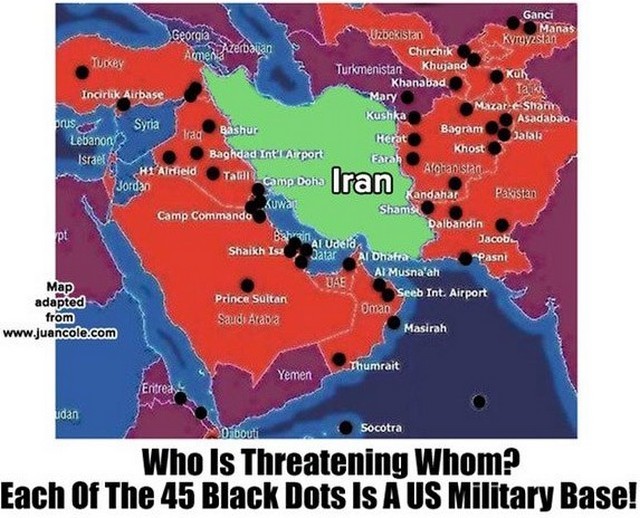
Hello, They Lied To You About Iran!

By Andre Vltchek

Text and Photos: Andre Vltchek

Have you ever considered the possibility that almost everything that you have been told about the world by the Western mass media is a lie and fabrication?

I am sure you have, at least lately, when the insanity of Western propaganda is becoming very clear and obvious. But what about the extent of indoctrination you were subjected to?

If you live in Europe or North America, how poisoned are you by the lies about Cuba and Venezuela, Russia and China, North Korea and yes – about Iran? Are you beyond recovery? If you see the truth, if you were confronted by reality, would you still be able to recognize it, or would you perceive it as propaganda and lies?

I have just left Tehran, a city with a tremendous history and culture, overflowing with museums, theatres, wonderfully kept parks dotted with modern art sculptures. It is a city with modern and fully subsidized public transportation, consisting of high-tech metro, ecological bus ways, as well as suburban trains. A city of tall trees, and quiet squares, of elegant cafes, and extremely educated and kind people.

A city that could easily be part of the ‘top ten’ cities on Earth, were it not be the capital of a country that the West is trying to ruin, first with unjust and draconian sanctions, and then, who knows, even by a militarily invasion.

What do most Westerners know about Iran; what were they told? I think the image the mass media outlets want to project is of “Iran – a radical Muslim country, some sort of Shia Saudi Arabia”, or perhaps worse. Much worse, as Saudi Arabia, the closest Arab ally of London and Washington,cannot be touched in the West, no matter what barbarity and terror it spreads all around the world.

Those who know both Jeddah and Teheran would laugh at such a comparison. Saudi Arabia, and its semi-colony Bahrain, despite their wealth from oil, are some of the most compassionless societies on the planet, misery rubbing shoulders with repulsively vulgar and extreme showing off of wealth.

Iran is in its essence a socialist country. It is internationalist, in full solidarity with many oppressed and struggling nations on our planet. No, I am not talking about Syria, Yemen or Palestine only; I am talking about Cuba and Venezuela, among many others. You did not know? It is not surprising: you are not supposed to know!

You are also expected to remain ignorant about Iran’s social system, clearly socialist. Free education and medical care, greatly subsidized public transportation and culture, huge public spaces and to some extent, strong government and at least partially, central planning.

Despite those absolutely unjust, terrible sanctions imposed, with some interruptions, from Washington and its allies, Iran is standing tall, trying as much as it can to take care of its people. And despite the terrible ordeal Iranian people are being put through, they do not cheat and do not steal. The exchange rate collapsed after Washington imposed another round of bizarre sanctions, triggering frustration, even protests. But the majority of Iranians understands who the real culprit is. And it is no secret that the so-called opposition is often financed from the West.

Most visitors do not understand anything about the local currency or exchange rates. I am no exception. I simply give taxi drivers or waiters my wallet, and they only take what is due. I checked with my Iranian colleagues: and the amount that is being taken is always fair.

Iranians do not display ‘arrogant pride’; they only show the determined, decent and patriotic pride of a nation with thousands of years of great culture which knows perfectly well that it is on the right side of history.

You were told ‘how religious Iran is’; I am sure you were. But unlike in Saudi Arabia or Indonesia, religion is not ‘being thrown into your face’ here; it is not waved as a flag. In Iran, religion is something internal, deep, which is expressed humbly and without noise. While the mosques of Jakarta broadcast, for hours a day and usingpowerful loudspeakers, entire sermons, while people are now being thrown into jail for even criticizing this brutal imposition of religion on the general public, in Tehran I could hardlyeven detect Adhan(call for prayer). Most of the local female Teheran city-dwellers only cover their hair symbolically – one third or even just a quarter, keeping most of their hair exposed.

But the West would never inflict sanctions on Indonesia or antagonize it in any other way, no matter how brutal it is to its own people: Washington, London and Canberra already ruined its socialist direction after the US-orchestrated coup of 1965. Jakarta is now an obedient, turbo capitalist, anti-Communist, West-junk-food-and-crap-entertainment-loving society. It has nothing public left. The elites have fully robbed the country on behalf of the West. Religions in Indonesia are used to uphold the pro-Western fascist regime.

Iran is totally the opposite: its interpretation of religion is ‘traditional’, as it used to be before the West managed to derail its essence in so many parts of the world. It is socialist, compassionate, spiritual and yes – internationalist.

Unlike in places like Jeddah or Jakarta, where going out to eat is now the height of cultural life (and often the only option of how to ‘enjoy the city’), Tehran offers high quality art cinemas (Iranian films are some of the greatest and most intellectual in the world), world-class museums and galleries, vast public spaces, as well as a great number of sport and amusement public facilities, including beautifully maintained parks.

You want to hang from a rope and fly over a valley, near one of the tallest TV towers on Earth – you can do it easily in Teheran. You want to see a series of the latest Chinese art films –you can, at the magnificent palace called the Cinema Museum. Or maybe Chekhov or a Tennessee Williams theatre play, if you understand some Farsi? Why not?

Of course you can sit in a horrendous traffic jam, if you are in love with your car, as you would in Riyadh or Jakarta, but you can also zip through the city in comfort and cheaply, on board the super modern metro system. You can walk on beautiful sidewalks, under tall trees, some of which grow from the clean creaks that separate driveways from pedestrian areas.

What else were you told; that you cannot look into a woman’s eyes or you will be stoned to death? Couples are holding hands everywhere in Tehran, and annoyed girls are slapping the faces of their men, teasingly and sometimes even seriously.

But would you believe it, if you saw it? Or is it too late; have you reached the point of no return?

One day, a driver who was taking me from my hotel to the Press TV television studio, exclaimed in desperation:

“Europeans who come here, even for the first time: they don’t want to learn. Even if they come to Iran for the first time, they land at the airport, get into my car, and begin preaching; teaching me about my own country! They all come with the same story, with the same criticism of Iran. There is no diversity! How can they call themselves democratic countries, if they are all thinking the same way?”

In Teheran, the diversity of thought is absolutely striking. With my colleagues and comrades, we discuss everything from the war in Yugoslavia, to Latin America and of course, Iran itself. They want to know about Russia and China. I love what I see and what I hear – when people are curious and respectful of other cultures, it is always a great start!

Iran is bleeding, suffering, but it is strong. Not everyone agrees with government policies here (although most of them do support their government), but everybody is determined to fight and defend his or her country, if it is attacked militarily or by other means.

Whenever I come here, I have this impolite urge – I want to shout at my readers: Come here and learn something! Iran is not perfect, but this is real – here, life is real and so are the people. Thanks to their culture and history, they somehow know how to separate precious stones from junk, pure thoughts from propaganda, cheap and deadly capitalism from the great strive for a much better world. If you don’t believe me, just watch their films; one masterpiece after another.

Perhaps that is why the West wants to first ruin, and then to totally destroy this country. For the West, Iran is ‘dangerous’. Iran is dangerous, even deadly,for the imperialist arrangement of the world, as China is dangerous, as Russia is, as Cuba, Venezuela, Syria and Bolivia are.

To ruin Iran will not be easy, I would even say:it could prove impossible. Its people are too smart and determined and strong. Iran is not alone; it has many friends and comrades. And even Iran’s neighbors – Turkey and Pakistan – are now quickly changing direction, away from the West.

Don’t take my word for all this. Just come and see. But do no preach: ask questions, and then, please sit, listen and learn! This country has more than 7,000 years of tremendous history. Instead of bombing it, read its poets, watch its films, and learn from its internationalist stand! And then, only then, decide, whether Iran is really your enemy, or a dear comrade and friend.

*

[First published by NEO – New Eastern Outlook]

Andre Vltchek is a philosopher, novelist, filmmaker and investigative journalist.

19 August 2018

Source: https://countercurrents.org/2018/08/19/hello-they-lied-to-you-about-iran/

Why the Calamity in Kerala is a ‘National Disaster’?

By K M Seethi

The south Indian State of Kerala has been going through a calamity of unimaginable proportions following the unexpected turn in monsoon rains which played havoc with the state’s life and livelihood. Floods and landslides were unprecedented. Displacement too witnessed massive rescue operations and relocation. Nearly a million people are directly affected. It may take several months and years to restore roads, bridges and cultivable lands. Thousands of houses were perished in the disaster. Shops and local markets were completely gutted in many districts.  Rail, road and air transport routes were paralyzed for several days.

The situation being serious, there are persistent calls for declaring it a ‘national disaster.’ Except BJP, all major political parties have made repeated pleas to the Union Government to do so. But the Modi Government is reticent on the issue so far and some of the officials even make technical arguments for not declaring it as ‘national disaster.’

Everyone knows that a mere declaration of such a calamity as ‘National’ won’t serve any purpose. It should be effectively followed up with coordinated action at different levels – from the local, national, regional to international levels.

Regarding the technicality of a declaration, it is true that the National Disaster Management regime does not call for such a conceptualisation of calamities for effective intervention and action. The only conceptualization is in regard to its nature and type. The Disaster Management Act defines a ‘disaster’ in terms of ”a catastrophe, mishap, calamity or grave occurrence in any area, arising from natural or man-made causes, or by accident or negligence which results in substantial loss of life or human suffering or damage to, and destruction of, property, or damage to, or degradation of, environment, and is of such a nature or magnitude as to be beyond the coping capacity of the community of the affected area.” It does not specifically mention the intensity in terms of its locale. However, many officials in Delhi believe that a call for a disaster as ‘national’ is an attempt to shift the onus on the Union Government in terms of burden sharing.  Hence, it is ‘political.’ This is a one-sided view, undeniably.

More than the technicalities, we need to have a collective ‘national’ mind-set in a diverse system like that of India to deal with such eventualities in states located far and wide. When we make such a declaration, it shows a collective social commitment to rescue a state from an impending collapse. It is true that even without an official declaration, other States in India have come up with generous support. However, a declaration will also help the State government seek international support from diverse sources. The reason why some GCC countries have come up with support is that the Keralites constitute a significant proportion in the GCC demographic base.

Admittedly, the central forces such as army, navy, air force, NDRF, CRPF etc have already been put in place at the disposal of the State government and they are effectively working under the State mechanism. That means, we don’t need to hand over the entire thing to the army. These are all for emergency rescue operations. And that is surely the top priority.

More than this, the second stage of ‘recovery operations’ is even vital and it needs well coordinated measures to bring the state back to normalcy. This is important for a state like Kerala which had, long back, earned international acclaim for its human development index, including life expectancy, literacy and education. Recently, even national agencies acknowledged Kerala as the top state in India in governance. Yet, even as the State’s performance in social and governance index remains high, the economy has been on a downturn path due to multiple reasons, including the reverse trends in global commodity trade. Since the demonetization and the introduction of GST regime, the economy has been struggling hard to meet even the basic requirements. This has been accelerated by the reverse trends in Kerala’s migration pay-off. Thousands and thousands of migrants are coming back to Kerala from the GCC countries every month, following the localization drive and austerity measures put in place in these countries. This would have a telling impact on the remittance scenario. The return migrants are already in distress conditions in many places.

Added to the complexity of these problems is the dwindling price of cash crops which constitute a significant percentage of the State’s agriculture sector and economy. What actually happened to the thousands and thousands of hectares of cultivable land in the wake of the disaster is known to everyone. It may take perhaps years for the people to recover their livelihood terrains. Poor and medium level farmers are the hard-hit people here. They lost their houses, farming land and local markets.

Kerala is the most dependent of all states in India for essential commodities such as rice and vegetables, medicines and other items, besides cloths, household articles, electronic and computer items, automobiles etc which sustain its social living standards. All South Indian States supply many of these essential items on a daily basis. These economies also depend on Kerala’s markets and hence they are also likely to lose ground if the state is not recovered immediately. The tragedy is that many of them have laboured for several months to make a reasonable income for the whole year through sales during the Onam season. They are literally shattered. More than 6 lakh people are already shifted to emergency camps. Nearly a million people are directly affected. Another three to four million people will have to bear the consequences at the secondary level. The number of people indirectly affected will be several millions. It’s not an exaggeration of numbers given the dependent nature of the social and economic exchange relations in Kerala.

The situation really calls for a coordinated action on the part of the State and Union Governments. The Union Government should also make an appeal to international agencies, including the UN to provide humanitarian assistance for the thousands of displaced people to restore their habitat.

The author is Professor, School of International Relations and Politics, Mahatma Gandhi University, Kerala.  The details of his profile are available @ http://kmseethi.com/ Prof Seethi can be reached at kmseethimgu@gmail.com

19 August 2018

Source: https://countercurrents.org/2018/08/19/why-the-calamity-in-kerala-is-a-national-disaster/