Just International

Trump Administration Pulls US out of UN Human Rights Council

By Associated Press

19 Jun 2018 – The United States announced today it was leaving the United Nations’ Human Rights Council, with Ambassador Nikki Haley calling it “an organization that is not worthy of its name.” It was the latest withdrawal by the Trump administration from an international institution.

Haley, Trump’s envoy to the U.N., said the U.S. had given the human rights body “opportunity after opportunity” to make changes. She lambasted the council for “its chronic bias against Israel” and lamented the fact that its membership includes accused human rights abusers such as China, Cuba, Venezuela and the Democratic Republic of Congo.

“We take this step because our commitment does not allow us to remain a part of a hypocritical and self-serving organization that makes a mockery of human rights,” Haley said.

Secretary of State Mike Pompeo, appearing alongside Haley at the State Department, said there was no doubt that the council once had a “noble vision.”

But today we need to be honest,” Pompeo said. “The Human Rights Council is a poor defender of human rights.”

The announcement came just a day after the U.N. human rights chief, Zeid Ra’ad al-Hussein, denounced the Trump administration for separating migrant children from their parents. But Haley cited longstanding U.S. complaints that the 47-member council is biased against Israel. She had been threatening the pull-out since last year unless the council made changes advocated by the U.S.

“Regrettably, it is now clear that our call for reform was not heeded,” Haley said.

Still, she suggested the decision need not be permanent, adding that if the council did adopt reforms, “we would be happy to rejoin it.” She said the withdrawal notwithstanding, the U.S. would continue to defend human rights at the United Nations.

Israeli Prime Minister Benjamin Netanyahu’s office called the U.S. decision “courageous,” calling it “an unequivocal statement that enough is enough.”

The move extends a broader Trump administration pattern of stepping back from international agreements and forums under the president’s “America First” policy. Although numerous officials have said repeatedly that “America First does not mean America Alone,” the administration has retreated from multiple multilateral accords and consensuses since it took office.

Since January 2017, it has announced its withdrawal from the Paris climate accord, left the U.N. educational and cultural organization and pulled out of the Iran nuclear deal. Other contentious moves have included slapping tariffs on steel and aluminum against key trading partners, recognizing Jerusalem as Israel’s capital and moving the U.S. Embassy there from Tel Aviv.

Opposition to the decision from human rights advocates was swift. A group of 12 organizations including Save the Children, Freedom House and the United Nations Association-USA said there were “legitimate concerns” about the council’s shortcomings but that none of them warranted a U.S. exit.

“This decision is counterproductive to American national security and foreign policy interests and will make it more difficult to advance human rights priorities and aid victims of abuse around the world,” the organizations said in a joint statement.

Added Kenneth Roth, the executive director of Human Rights Watch: “All Trump seems to care about is defending Israel.”

On Twitter, al-Hussein, the U.N. human rights chief, said it was “Disappointing, if not really surprising, news. Given the state of #HumanRights in today’s world, the US should be stepping up, not stepping back.”

And the Heritage Foundation, a conservative think tank close to the Trump administration, defended the move, calling the council “notably incurious about the human rights situations in some of the world’s most oppressive countries.” Brett Schaefer, a senior fellow, pointed out that Trump could have withdrawn immediately after taking office but instead gave the council 18 months to make changes.

Haley has been the driving force behind withdrawing from the human rights body, unprecedented in the 12-year history of the council. No country has ever dropped out voluntarily. Libya was kicked out seven years ago.

The move could reinforce the perception that the Trump administration is seeking to advance Israel’s agenda on the world stage, just as it prepares to unveil its long-awaited Israeli-Palestinian peace plan despite Palestinian outrage over the embassy relocation. Trump’s son-in-law and senior adviser, Jared Kushner, is visiting the Middle East this week as the White House works to lay the groundwork for unveiling the plan.

Israel is the only country in the world whose rights record comes up for discussion at every council session, under “Item 7” on the agenda. Item 7 on “Israel and the Occupied Palestinian Territories” has been part of the council’s regular business almost as long as it has existed.

The United States’ current term on the council ends next year. Although the U.S. could have remained a non-voting observer on the council, a U.S. official said it was a “complete withdrawal” and that the United States was resigning its seat “effective immediately.” The official wasn’t authorized to comment publicly and insisted on anonymity.

That means the council will be left without one of its traditional defenders of human rights. In recent months, the United States has participated in attempts to pinpoint rights violations in places like South Sudan, Congo and Cambodia.

The U.S. pullout was bound to have ripple effects for at least two countries at the council: China and Israel. The U.S., as at other U.N. organizations, is Israel’s biggest defender. At the rights council, the United States has recently been the most unabashed critic of rights abuses in China — whose growing economic and diplomatic clout has chastened some other would-be critics, rights advocates say.

There are 47 countries in the Human Rights Council, elected by the U.N.’s General Assembly with a specific number of seats allocated for each region of the globe. Members serve for three-year terms and can serve only two terms in a row.

The United States has opted to stay out of the Human Rights Council before: The George W. Bush administration opted against seeking membership when the council was created in 2006. The U.S. joined the body only in 2009 under President Barack Obama.

Associated Press writers Jamey Keaten in Geneva and Edith M. Lederer at the United Nations contributed.

20 June 2018

Source: https://www.transcend.org/tms/2018/06/trump-administration-pulls-us-out-of-un-human-rights-council/

Humanity’s ‘Dirty Little Secret’: Starving, Enslaving, Raping, Torturing and Killing our Children

By Robert J. Burrowes

18 Jun 2018 – In the 9 Apr 2018 TMS Editorial, ‘Challenges for Resolving Complex Conflicts’, I pointed out four conflict configurations that are paid little attention by conflict theorists. In this one I would like to discuss a fifth conflict configuration that is effectively ignored by conflict theorists (and virtually everyone else). This conflict is undoubtedly the most fundamental conflict in human society, because it generates all of the violence humans perpetrate and experience, and yet it is utterly invisible to almost everyone.

I have previously described this conflict as ‘the adult war on children’. It is indeed humanity’s ‘dirty little secret’.

Let me illustrate and explain the nature and extent of this secret war. And what we can do about it.

Every day, according to some estimates, human adults kill 50,000 of our children. The true figure is probably significantly higher. We kill children in wars. See, for example, ‘Scourging Yemen’. We kill them with drones. We kill them in our homes and on the street. We shoot them at school.

We also kill children in vast numbers by starving them to death, depriving them of clean drinking water, denying them medicines – see, for example, ‘Malaria is alive and well and killing more than 3000 African children every day’ – or forcing them to live in a polluted environment, particularly in parts of Africa, Asia and Central/South America. Why? Because we use military violence to maintain an ‘economic’ system that allocates resources for military weapons, as well as corporate profits for the wealthy, instead of resources for living.

We also execute children in sacrificial killings after kidnapping them. We even breed children to sell as a ‘cash crop’ for sexual violation, child pornography (‘kiddie porn’) and the filming of ‘snuff’ movies (in which children are killed during the filming), torture and satanic sacrifice. And these are just some of the manifestations of the violence against children that have been happening for centuries or, in some cases, millennia. On these points, see the video evidence presented at the recent Judicial Commission of Inquiry into Human Trafficking and Child Sex Abuse organized by the International Tribunal for Natural Justice.

The opening statement by Chief Counsel Robert David Steele refers to an estimated eight million children trafficked annually – with 600,000-800,000 of these children (excluding both those bred within the USA without birth certificates and those imported without documentation) in the United States alone – and mentions such practices as ritual torture and ritual murder as well as training dogs to rape children and toddlers. He mentions the range of organizations involved from Oxfam and the Boy Scouts of America to ‘child-service’ agencies and police forces as well as various United Nations organizations, where pedophiles (those who prey on children) rise through the ranks to exercise enormous control. He also points out that many of the children bred or kidnapped into this system usually last about two years before dying (often after being raped several times each hour for some of that time) or being killed outright. He also mentions (with evidence provided in other video presentations) the forced removal of body organs from children of Falun Gong practitioners in China.

Steele, who is a former CIA operations officer, also points out that the 1,000 US military bases around the world are ‘not there for national defense; they are there to serve as lilypads for the smuggling of guns, gold, cash, drugs and small children’. The obvious and clear inference to be drawn from his statement is that the US military is heavily involved in child trafficking (as well as its well-known involvement in drug and weapons trafficking, for example), which means that vast numbers of US military personnel know about it too. And do nothing.

The compelling testimony at the Commission of Inquiry of survivor/perpetrator Ronald Bernard will give you a clear sense of the deep elite engagement (that is, the 8,000-8,500 ‘elite’ individuals running central banks, governments, secret service agencies, multinational corporations, terrorist organizations and churches) in the extraordinary violence inflicted on children, with children illegally trafficked internationally along with women, weapons, drugs, currencies, gold and wildlife.

In a particularly poignant series of moments during the interview, after he has revealed some of the staggering violence he suffered as a child at the hands of his father and the Church, Bernard specifically refers to the fact that the people engaged in these practices are terrified (and ‘serving the monster of greed’) and that, during his time as a financial entrepreneur, he was working with people who understood him as he understood them: individuals who were suffering enormously from the violence they had suffered as children themselves and who are now so full of hatred that they want to destroy life, human and otherwise. In short: they enjoy and celebrate killing people and destroying the Earth as a direct response to the violence they each suffered as a child.

There are more video testimonies by survivors, expert witnesses, research scholars in the field and others on the International Tribunal for Natural Justice website and if you want to read scholarly books documenting aspects of this staggering violence against children then see, for example, ‘Childhunters: Requiem of a Child-killer’ and ‘Epidemic: America’s Trade in Child Rape’.

For further accounts of the systematic exploitation, rape, torture and murder of children over a lengthy period, which focuses on Canada’s indigenous peoples, Rev. Kevin Annett’s evocative report ‘Hidden from History: The Canadian Holocaust – The Untold Story of the Genocide of Aboriginal Peoples by Church and State in Canada’, and his books ‘Unrelenting’ and ‘Murder by Decree: The Crime of Genocide in Canada’ use eyewitness testimonies and archival documentation to provide ‘an uncensored record of the planned extermination of indigenous children in Canada’s murderous “Indian residential schools”’ from 1889 to 1996.

Apart from what happened in the Indian Residential Schools during this period, however, the books also offer extensive evidence documenting the ongoing perpetration of genocide, including child rape, torture and killing, against Canada’s indigenous peoples by its government, the Royal Canadian Mounted Police and the Catholic, Anglican and United Churches since the 19th century. Sadly, there is plenty more in Kevin’s various books and on the website of the International Tribunal into Crimes of Church and State which also explain the long-standing involvement of the Vatican in these genocidal crimes against children.

Of course, Canada is not alone in its unrelenting violence against indigenous children (and indigenous peoples generally). The United States and Australia, among many others, also have long records of savagery in destroying the lives of indigenous children, fundamentally by taking their land and destroying their culture, traditional livelihoods and spirituality. And when indigenous people do not simply abandon their traditional way of being and adopt the dominant model, they are blamed and persecuted even more savagely, as the record clearly demonstrates.

Moreover, institutional violence against children is not limited to the contexts and settings mentioned above. In the recently conducted Royal Commission into Institutional Responses to Child Sexual Abuse undertaken in Australia, childcare services, schools, health and allied services, youth detention, residential care and contemporary out-of-home services, religious activities, family and youth support services, supported accommodation, sporting, recreational and club activities, youth employment, and the military forces were all identified as providing contexts for perpetrating violence against children.

Over half of the survivors suffered sexual violation in an institution managed by a religious organization such as places of worship and for religious instruction, missions, religious schools, orphanages, residential homes, recreational clubs, youth groups, and welfare services. Another one-third of survivors suffered the violence in an institution under government management such as a school, an out-of-home care service, a youth detention centre or at a health service centre. The remaining 10%  suffered violence in a private organization such as a child care centre, a medical practice or clinic, a music or dance school, an independent school, a yoga ashram or a sports club, a non-government or not-for-profit organization.

Needless to say, the failure to respond to any of this violence for the past century by any of the institutions ‘responsible’ for monitoring, oversight and criminal justice, such as the police, law enforcement and agencies responsible for public prosecution, clearly demonstrates that mechanisms theoretically designed to protect children (and adults) do not function when those same institutions are complicit in the violence and are, in any case, designed to defend elite interests (not ‘ordinary’ people and children). Hence, of course, this issue was not even investigated by the Commission because it was excluded from the terms of reference!

Separately from those children we kill or violate every day in the ways briefly described above, we traffic many others into sexual slavery – such as those trafficked (sometimes by their parents) into prostitution to service the sex tourism industry in countries such as Thailand, Cambodia, the Dominican Republic, the Philippines and India – we kidnap others to terrorize them into becoming child soldiers with 46 countries using them according to Child Soldiers International, we force others to work as slave laborers, in horrific conditions, in fields, factories and mines (and buy the cheap products of their exploited labor as our latest ‘bargain’) with Human Rights Watch reporting over 70,000,000 children, including many who aren’t even, technically-speaking, slaves, working in ‘hazardous conditions’ – see ‘Child Labor’ – and we condemn millions to live in poverty, homelessness and misery because national governments, despite rhetoric to the contrary, place either negligible or no value on children apart from, in some cases, as future wage slaves in the workforce.

We also condemn millions of children, such as those in Palestine, Tibet, Western Sahara and West Papua, to live under military occupation, where many are routinely imprisoned, shot or killed.

In addition, while fighting wars we cause many children to be born with grotesque genetic deformities because we use horrific weapons, like those with depleted uranium, on their parents. See ‘“Falluja Babies” and Depleted Uranium: America’s Toxic Legacy in Iraq’ and ‘Depleted uranium used by US forces blamed for birth defects and cancer in Iraq’.

In other cases, we cause children shockingly debilitating injuries, if they are not killed outright, by using conventional, biological and chemical weapons on them directly. See ‘Summary of historical attacks using chemical or biological weapons’.

But war also destroys housing and other infrastructure forcing millions of children to become internally displaced or refugees in another country (often without a living parent), causing ongoing trauma. Worldwide, one child out of every 200 is a refugee, whether through war or poverty, environmental or climate disruption. See ‘50mn children displaced by war & poverty worldwide’.

We also inflict violence on children in many other forms, ranging from ‘ordinary’ domestic violence to genital mutilation, with UNICEF calculating that 200 million girls and young women in 30 countries on three continents have been mutilated. See ‘Female genital mutilation/cutting’.

And we deny children a free choice (even those who supposedly live in a ‘democracy’) and imprison vast numbers of them in school in the delusional belief that this is good for them. See ‘Do We Want School or Education?’ Whatever other damage that school does, it certainly helps to create the next generation of child-destroyers. And, in many countries, we just imprison children in our jails. After all, the legal system is no more than an elite tool to control ‘ordinary’ people while shielding the elite from accountability for their grotesque violence against us all. See ‘The Rule of Law: Unjust and Violent’.

While almost trivial by comparison with the violence identified above, the perversity of many multinational corporations in destroying our children’s health is graphically illustrated in the film ‘Global Junk Food’.

In Europe, food manufacturers have signed up to ‘responsibility pledges’, promising not to add sugar, preservatives, artificial colours or flavours to their products and to not target children.

However, the developing world is not in Europe so these ‘responsibility pledges’ obviously do not apply and corporations such as Coca-Cola, McDonald’s, Kentucky Fried Chicken and Domino’s Pizza sell their junk food in developing countries (with the video above showcasing Brazil and India) loaded with excess oil, salt and sugar and even using fake cheese.

The well-documented report reveals corporations like these to be nothing more than drug dealers, selling toxic food to ill-informed victims that deliver a lifetime of diabetes and obesity to huge numbers of children. So, just as weapons corporations derive their profits from killing children (and adults), junk food corporations derive their profits from destroying the health of children (and adults). Of course, the medical industry, rather than campaigning vigorously against this outrage, prefers to profit from it too by offering ‘treatments’, including the surgical removal of fat, which offer nothing more than temporary but very profitable ‘relief’.

But this is far from representing the only active involvement of the medical industry in the extraordinary violence we inflict on children. For example, western children and many others are rarely spared a plethora of vaccinations which systematically destroy a child’s immune system, thus making their health ongoingly vulnerable to later assaults on their well-being. For a taste of the vast literature on this subject, see ‘Clinical features in patients with long-lasting macrophagic myofasciitis’, ‘Vaccines: Who’s Allergic To Thimerosal (Mercury), Raise Your Hand’ and ‘Vaccine Free Health’.

And before we leave the subject of food too far behind, it should be noted that just because the junk food sold in Europe and some other western countries has less fat, salt, sugar, preservatives and artificial colors and flavours in it, this does not mean that it is healthy. It still has various combinations of added fat, salt, sugar, preservatives and artificial colors and flavours in it.

Separately from this: don’t forget that virtually all parents are systematically poisoning their children by feeding them food grown by the corporate agribusiness giants which is heavily depleted of nutrients and laced with poisons such as glyphosate. For a taste of the vast literature, see ‘The hidden truth about glyphosate EXPOSED, according to undeniable scientific evidence’. Of course, in many countries we are also forcing our children to drink fluoridated water to the detriment of their health too. See ‘Research Exposes How our Water is Making us Depressed, Sick: Fluoridated water is much to blame’.

Obviously, organically/biodynamically grown food, healthily prepared, and unfluoridated water are not health priorities for their children, according to most parents.

As our ultimate act of violence against all children, we are destroying their future. See ‘Killing the Biosphere to Fast-track Human Extinction’.

So how do we do all of this?

Very easily, actually. It works like this.

Perpetrators of violence learn their craft in childhood. If you inflict violence on a child, they learn to inflict violence on others. The child rapist and ritual child killer suffered violence as a child. The terrorist suffered violence as a child. The political leader who wages war suffered violence as a child. The man who inflicts violence on women suffered violence as a child. The corporate executive who exploits working class people and/or those who live in Africa, Asia or Central/South America suffered violence as a child. The racist and religious bigot suffered violence as a child. The soldier who kills in war suffered violence as a child. The individual who perpetrates violence in the home, in the schoolyard or on the street suffered violence as a child. The parent who inflicts violence on their own children suffered violence as a child.

So if we want to end violence, exploitation, ecological destruction and war, then we must finally admit our ‘dirty little secret’ and end our longest and greatest war: the adult war on children. And here is an incentive: if we do not tackle the fundamental cause of violence, then our combined and unrelenting efforts to tackle all of its other symptoms must ultimately fail. And extinction at our own hand is inevitable.

How can I claim that violence against children is the fundamental cause of all other violence? Consider this. There is universal acceptance that behavior is shaped by childhood experience. If it was not, we would not put such effort into education and other efforts to ‘socialize’ children to fit into society. And this is why many psychologists have argued that exposure to war toys and violent video games shapes attitudes and behaviors in relation to violence.

But it is far more complex than these trivialities suggest and, strange though it may seem, it is not just the ‘visible’ violence (such as hitting, screaming at and sexually abusing) that we normally label ‘violence’ that causes the main damage, although this is extremely damaging. The largest component of damage arises from the ‘invisible’ and ‘utterly invisible’ violence that we adults unconsciously inflict on children during the ordinary course of the day. Tragically, the bulk of this violence occurs in the family home and at school. See ‘Why Violence?’ and ‘Fearless Psychology and Fearful Psychology: Principles and Practice’.

So what is ‘invisible’ violence? It is the ‘little things’ we do every day, partly because we are just ‘too busy’. For example, when we do not allow time to listen to, and value, a child’s thoughts and feelings, the child learns to not listen to themSelf thus destroying their internal communication system. When we do not let a child say what they want (or ignore them when they do), the child develops communication and behavioral dysfunctionalities as they keep trying to meet their own needs (which, as a basic survival strategy, they are genetically programmed to do).

When we blame, condemn, insult, mock, embarrass, shame, humiliate, taunt, goad, guilt-trip, deceive, lie to, bribe, blackmail, moralize with and/or judge a child, we both undermine their sense of Self-worth and teach them to blame, condemn, insult, mock, embarrass, shame, humiliate, taunt, goad, guilt-trip, deceive, lie, bribe, blackmail, moralize and/or judge.

The fundamental outcome of being bombarded throughout their childhood by this ‘invisible’ violence is that the child is utterly overwhelmed by feelings of fear, pain, anger and sadness (among many others). However, mothers, fathers, teachers, religious figures and other adults also actively interfere with the expression of these feelings and the behavioral responses that are naturally generated by them and it is this ‘utterly invisible’ violence that explains why the dysfunctional behavioral outcomes actually occur.

For example, by ignoring a child when they express their feelings, by comforting, reassuring or distracting a child when they express their feelings, by laughing at or ridiculing their feelings, by terrorizing a child into not expressing their feelings (e.g. by screaming at them when they cry or get angry), and/or by violently controlling a behavior that is generated by their feelings (e.g. by hitting them, restraining them or locking them into a room), the child has no choice but to unconsciously suppress their awareness of these feelings.

However, once a child has been terrorized into suppressing their awareness of their feelings (rather than being allowed to have their feelings and to act on them) the child has also unconsciously suppressed their awareness of the reality that caused these feelings. This has many outcomes that are disastrous for the individual, for society and for nature because the individual will now easily suppress their awareness of the feelings that would tell them how to act most functionally in any given circumstance and they will progressively acquire a phenomenal variety of dysfunctional behaviors, including some that are violent towards themself, others and/or the Earth.

From the above, it should also now be apparent that punishment should never be used. ‘Punishment’, of course, is one of the words we use to obscure our awareness of the fact that we are using violence. Violence, even when we label it ‘punishment’, scares children and adults alike and cannot elicit a functional behavioural response. See ‘Punishment is Violent and Counterproductive’.

If someone behaves dysfunctionally, they need to be listened to, deeply, so that they can start to become consciously aware of the feelings (which will always include fear and, often, terror) that drove the dysfunctional behavior in the first place. They then need to feel and express these feelings (including any anger) in a safe way. Only then will behavioral change in the direction of functionality be possible. See ‘Nisteling: The Art of Deep Listening’.

‘But these adult behaviors you have described don’t seem that bad. Can the outcome be as disastrous as you claim?’ you might ask. The problem is that there are hundreds of these ‘ordinary’, everyday behaviors that destroy the Selfhood of the child. It is ‘death by a thousand cuts’ and most children simply do not survive as Self-aware individuals. And why do we do this? We do it so that each child will fit into our model of ‘the perfect citizen’: that is, obedient and hardworking student, reliable and pliant employee/soldier, and submissive law-abiding citizen. In other words: a slave.

Of course, once we destroy the Selfhood of a child, it has many flow-on effects. For example, once you terrorize a child into accepting certain information about themself, other people or the state of the world, the child becomes unconsciously fearful of dealing with new information, especially if this information is contradictory to what they have been terrorized into believing. As a result, the child will unconsciously dismiss new information out of hand.

In short, the child has been terrorized in such a way that they are no longer capable of thinking critically or even learning (or their learning capacity is seriously diminished by excluding any information that is not a simple extension of what they already ‘know’). If you imagine any of the bigots you know, you are imagining someone who is utterly terrified. But it’s not just the bigots; virtually all people are affected in this manner making them incapable of responding adequately to new (or even important) information. This is one explanation why many people are ‘climate deniers’ and most others do nothing in response to the climate catastrophe.

Of course, each person’s experience of violence during childhood is unique and this is why each perpetrator becomes violent in their own particular combination of ways.

But if you want to understand the core psychology of all perpetrators of violence, it is important to understand that, as a result of the extraordinary violence they each suffered during childhood, they are now (unconsciously) utterly terrified, full of self-hatred and personally powerless, among another 20 psychological characteristics.

You can read a brief outline of these characteristics and how they are acquired on pages 12-16 of ‘Why Violence?’

As should now be clear, the central point in understanding violence is that it is psychological in origin and hence any effective response must enable both the perpetrator’s and the victim’s suppressed feelings (which will include enormous fear about, and rage at, the violence they have suffered) to be safely expressed. As mentioned above, for an explanation of what is required, see ‘Nisteling: The Art of Deep Listening’.

Unfortunately, this nisteling cannot be provided by a psychiatrist or psychologist whose training is based on a delusionary understanding of how the human mind functions. See ‘Defeating the Violence of Psychiatry’ and ‘Psychiatry: Science or Fraud? The professor’s trick that exposed the ongoing Psychiatry racket…’ Nisteling will enable those who have suffered from psychological trauma to heal fully and completely, but it will take time.

So if we want to end violence (including the starvation, trafficking, rape, torture and killing of children), exploitation, ecological destruction and war, then we must tackle the fundamental cause. Primarily, this means giving everyone, child and adult alike, all of the space they need to feel, deeply, what they want to do, and to then let them do it (or to have the feelings they naturally have if they are prevented from doing so). See ‘Putting Feelings First’. In the short term, this will have some dysfunctional outcomes. But it will lead to an infinitely better overall outcome than the system of emotional suppression, control and punishment which has generated the incredibly violent world in which we now find ourselves.

This all sounds pretty unpalatable doesn’t it? So each of us has a choice. We can suppress  awareness of what is unpalatable, as we have been terrorized into doing as a child, or we can feel the various feelings that we have in response to this information and then ponder (personal and collective) ways forward.

If feelings are felt and expressed then our responses can be shaped by the conscious and integrated functioning of thoughts and feelings, as evolution intended, and we can plan intelligently. The alternative is to have our unconscious fear controlling our thinking and deluding us that we are acting rationally.

It is time to end the most fundamental conflict that is destroying human society from within – the adult war on children – so that we can more effectively tackle all of the other violence that emerges from this cause too.

What Do We Do?

Let me briefly reiterate.

If you are willing, you can make the commitment outlined in ‘My Promise to Children’. If you need to do some healing of your own to be able to nurture children in this way, then consider the information provided in the article ‘Putting Feelings First’.

In addition, you are also welcome to consider participating in ‘The Flame Tree Project to Save Life on Earth’ which maps out a fifteen-year strategy for creating a peaceful, just and sustainable world community so that all children (and everyone else) has an ecologically viable planet on which to live.

You might also consider supporting or even working with organizations like Destiny Rescue, which works to rescue children trafficked into prostitution, or any of the many advocacy organizations associated with the network of End Child Prostitution and Trafficking.

But for the plethora of other manifestations of violence against children identified above, you might consider using Gandhian nonviolent strategy in any context of particular concern to you. See Nonviolent Campaign Strategy or Nonviolent Defense/Liberation Strategy. And, if you like, you can join the worldwide movement to end all violence by signing online ‘The People’s Charter to Create a Nonviolent World’.

In summary: Each one of us has an important choice. We can acknowledge the painful truth that we inflict enormous violence on our children (which then manifests in a myriad complex ways) and respond powerfully to that truth. Or we can keep deluding ourselves and continue to observe, powerlessly, as the violence in our world proliferates until human beings are extinct.

If you want a child who is nonviolent, truthful, compassionate, considerate, patient, thoughtful, respectful, generous, loving of themself and others, trustworthy, honest, dignified, determined, courageous, powerful and who lives out their own unique destiny, then the child must be treated with – and experience – nonviolence, truth, compassion, consideration, patience, thoughtfulness, respect, generosity, love, trust, honesty, dignity, determination, courage, power and, ideally, live in a world that prioritizes nurturing the unique destiny of each child.

Alternatively, if you want a child to turn out like the perpetrators of violence described above, to be powerless to respond effectively to the crises in our world, or to even just turn out to be an appalling parent, then inflict violence – visible, ‘invisible’ and ‘utterly invisible’ – on them during their childhood.

Tragically, with only the rarest of exceptions, human adults are too terrified to truly love, nurture and defend our children from the avalanche of violence that is unleashed on them at the moment of birth.

Robert Burrowes, Ph.D. is a member of the TRANSCEND Network for Peace Development Environment and has a lifetime commitment to understanding and ending human violence.

20 Jun 2018

Source: https://www.transcend.org/tms/2018/06/humanitys-dirty-little-secret-starving-enslaving-raping-torturing-and-killing-our-children/

NORTH KOREA: WHAT PRICE PEACE?

By Askiah Adam

First it was the Panmunjom Declaration and now, after some two months, on 12 June the Singapore Declaration was signed, the former between the leaders of the two Koreas, Chairman Kim Jong-un of the Democratic People’s Republic of Korea (DPRK) or North Korea and President Moon Jae-in of the Republic of Korea (ROK) or South Korea. The latter, meanwhile, was inked by Donald Trump, the President of the United States, and Kim. The central theme for both is peace for the Korean Peninsula premised on its denuclearization.

Item 3 of the Singapore Declaration was unequivocal: “Reaffirming the April 27, 2018 Panmunjom Declaration, the DPRK commits towards complete denuclearization of the Korean Peninsula.” The continuity between the two declarations then is unmistakeable.

Unfortunately, reasons exist to cast a shadow over this ray of hope. Indeed the Singapore Declaration was much anticipated and is well received. But there is, too, much pessimism. The recent unilateral abandonment of the Iran nuclear agreement, formally known as the Joint Comprehensive Plan of Action (JCPOA) by the United States is one. Iran, naturally, advised Kim to be wary. Simply put, Washington’s words are not worth the paper they’re printed on because there have been many previous instances where it reneged on its commitments. For example, one of Trump’s earliest moves was to withdraw from the Trans Pacific Partnership Agreement (TPPA), a trade agreement signed and awaiting ratification by the 12 participating Pacific rim countries. NATO’s eastwards expansion towards the Russian border is another case of words betrayed. This was by the administration of Bush senior.

Not unnaturally, when the Singapore Declaration speaks of establishing US-DPRK friendly relations and for both parties to work at building peace for the Korean Peninsula hopes were kept realistic despite Trump’s announcement that US military exercises in South Korea will be suspended for the time being. This surprised even the ROK President. The US therefore, appeared to make good its intentions for peace. North Korea on its part had destroyed its missile test site even while the status of the summit was still uncertain.

However, the devil is in the details, which the Singapore Declaration left vague. Extensive negotiations then are inevitable. If the JCPOA took nine years to achieve could peace for Korea be arrived at faster? And, if the JCPOA is anything to go by could America’s cavalier attitude to peace be a a major spoiler?

The United States foreign policy is one of perpetual war. Where its soldiers are not on the ground, proxy armies are used to destabilise countries, as in Libya and Syria. To then be wholeheartedly optimistic about Korea is difficult, if not impossible especially when NATO military forces are building up along the Russia-Europe border, replete with military exercises which grow in intensity with every passing year.

America’s perpetual war policy is part of its imperial design to establish the so-called New World Order (NWO). Economic and military hostilities towards even superpowers Russia and China is indication of this malevolent inclination. And so, before a peace agreement can be signed and the Korean War well and truly ended the imperative is for a paradigm shift to occur in American foreign policy; one where there is acceptance that American hegemony is resented and a multipolar world is emerging. But no such thing is happening.

Does this mean that a Korean peace can be dismissed off hand as nothing but a pipe dream and the Singapore Declaration more an entrapment strategy than a liberating one? After all, Trump has said that sanctions on the DPRK stays.

But something odd occurred at the Summit. Trump played a 4-minute documentary on the options open to North Korea: a state of perpetual insecurity and war or prosperity through economic cooperation with America. Pyongyang is being placed squarely between a rock and a hard place.

Over the years North Korea has shown its resilience, circumventing American and international sanctions even as the noose tightens with every alleged breach. Rebuilding its cities from the ground up after having been razed to the ground by American bombing during the Korean War testifies to the people’s ingenuity. Reports of a backward, isolated country have proven false with recent visitors extolling its modern cityscapes. With the memories of a devastated country and a population decimated by at least 20 per cent still fresh in the Korean consciousness it is hard, therefore, to factor in an unforced capitulation by Pyongyang.

The Korean Peninsula is a flashpoint. For as long as tens of thousands of American soldiers are stationed in South Korea, North Korea cannot feel safe. But the Panmunjom Declaration demonstrated the two Koreas desire for peace. Yet Seoul does not decide its own security preferences.

Furthermore, even if Trump had the will can he successfully undermine the deep state which has placed obstacles in his path throughout the 18 months he has been in office? Indeed, the dithering over the Summit could be an indication of him trying to override the neoconservatives in his administration, namely, John Bolton his National Security Advisor and Mike Pompeo, his Secretary of State. But this does not mean that neoconservatives want only war.

North Korea is reputedly rich in untapped natural resources. Must Pyongyang then surrender its economic sovereignty to Washington before peace is possible for the peninsula?
END

Askiah Adam
Executive Director
International Movement for a JUST World (JUST)

The world’s most dire humanitarian crisis may get even worse

By Ishaan Tharoor

This week, Yemen’s already-brutal civil war may be entering an even deadlier and more worrying phase. An Emirati-led offensive is underway against the port city of Hodeida, which is controlled by the Iran-backed Houthi rebels. Security analysts and aid agencies fear that a protracted siege of Hodeida may only deepen Yemen’s misery. Hodeida is a crucial hub for humanitarian aid; two-thirds of the Yemeni population depends on food and goods flowing through the port. And urban fighting could put countless civilian lives at risk, displace hundreds of thousands of people and disrupt efforts to alleviate Yemeni suffering.

“It is the lifeline of the country,” said Lise Grande, the top U.N. humanitarian official in Yemen, to my colleagues. “If you cut that port off, we have a catastrophe on our hands.” She predicted that as many as a quarter million Yemenis could die of violence, hunger and illness.

Readers of Today’s WorldView will be all too familiar with the grim statistics. Thousands of civilians have died since March 2015. A Saudi-led blockade and the collapse of infrastructure have led to shortages of virtually everything, especially food and medicine. Some 8 million people are on the brink of famine, and more than 1 million have been infected with cholera. By one estimate, around 50,000 Yemeni children died of starvation, malnutrition or disease last year alone.

The Saudis and the Emiratis, the principal foreign powers that intervened on behalf of Yemen’s routed government in 2015, argue that aid will move much faster once they have freed the city from the Houthis. Buoyed by key defections in the Houthi ranks, the coalition sees the city’s potential capture as the victory that will tilt the war definitively in their favor.

“What most observers fail to understand, after just tuning in to Hodeidah, is that the UAE and its Yemeni partners have been preparing to liberate the port since 2016 to weaken the Houthis, create leverage for negotiators, limit the rebels’ ability to import Iranian-provided arms, and bring the port back up to full capacity as a humanitarian import hub,” wrote Middle East expert Michael Knights for the National, an Abu Dhabi-based newspaper.

But others in the international community are more skeptical. The Houthis appear primed for a bitter defense of Hodeida that will likely turn into a publicity nightmare for the Saudis and Emiratis as civilian deaths mount. U.N. officials, who administer a weapons-inspection program at the port, are not convinced by arguments that the port has been used to smuggle Iranian weaponry to the Houthis. Even the United States, which is refueling coalition aircraft and supplying it with intelligence and munitions, long cautioned against an outright assault.

“It’s a city with a large number of residents who are not to blame for this war and now find themselves at the front line,” said Frank McManus, the Yemen country director at the International Rescue Committee, to the Wall Street Journal. “Both sides of the conflict have a responsibility to ensure these people are protected.”

The warring parties don’t seem committed to that responsibility. “For uprooted villagers, reaching safety has meant crossing front lines, dodging airstrikes and mortar rounds, and traversing roads and fields seeded with land mines,” reported my colleague Sudarsan Raghavan. “Villagers have often slipped out of their homes under the cover of darkness to avoid rebels who have been preventing people from fleeing and pressing children to take up arms.”

And the intensification of the battle makes the prospect of a negotiated peace less likely. Martin Griffiths, the U.N.’s beleaguered special envoy, has been working fitfully to bring the various factions to the table. “Further military escalation will have serious consequences on the dire humanitarian situation in the country and will have an impact on my efforts to resume political negotiations to reach an inclusive political settlement to the conflict in Yemen,” Griffiths said in a statement earlier this week. “I cannot overemphasize that there is no military solution to the conflict.”

The Emirati-led ground offensive on Hodeida began in earnest only after the coalition appeared to get the tacit backing of Secretary of State Mike Pompeo. While U.S. officials are at pains to stress they are not party to the conflict, the Trump administration’s top diplomat made a Monday statement on Hodeida that, despite notes of caution, did not warn against attacking the city.

Gregory Johnsen, a resident fellow at the Arabia Foundation in Washington and a former member of a Yemen panel of experts at the U.N. Security Council, suggests that the Trump administration sees eye-to-eye with Riyadh and Abu Dhabi about the need to confront Iran in the Arabian peninsula. Yemen’s civil strife did not begin as a regional proxy war. But broader geopolitics now suffuse the country’s various fiefdoms and turf wars in a conflict that involves Sudanese mercenaries, UAE commandos and Lebanese Shiite militia Hezbollah.

“The Yemen war is very complicated. There are a lot of different sides and there are alliances that disintegrate overnight and reform seemingly the next day,” said Johnsen. He added that the White House may see the current push on Hodeida as a way out of the mess: “The argument that has won the day in the Trump administration is that in order for something to change, [the offensive] seems the best chance to do that now.”

But if the worst fears of aid workers are realized and a bloody siege grips Hodeida, it’s likely that lawmakers in Congress, as well as foreign governments elsewhere, may force the White House to account for its role in the war.

“Nikki Haley, America’s ambassador to the United Nations, has condemned, rightly, the Syrian government for starving its own people,” wrote Alex de Waal of the World Peace Foundation. “But it’s easy to call out villains like President Bashar al-Assad. It’s harder to call out one’s allies — though that may be more effective, and therefore more important.”

15 June 2018

Source: https://www.washingtonpost.com/news/worldviews/wp/2018/06/15/the-worlds-most-dire-humanitarian-crisis-may-get-even-worse/

First-ever UN human rights report on Kashmir calls for international inquiry into multiple violations

By Press Release

GENEVA (14 June 2018) – There is an urgent need to address past and ongoing human rights violations and abuses and deliver justice for all people in Kashmir, who for seven decades have suffered a conflict that has claimed or ruined numerous lives, a report by the UN Human Rights Office published on Thursday says.

The 49-page report – the first ever issued by the UN on the human rights situation in Indian-Administered and Pakistan-Administered Kashmir – details human rights violations and abuses on both sides of the Line of Control, and highlights a situation of chronic impunity for violations committed by security forces.

“The political dimensions of the dispute between India and Pakistan have long been centre-stage, but this is not a conflict frozen in time. It is a conflict that has robbed millions of their basic human rights, and continues to this day to inflict untold suffering,” said UN High Commissioner for Human Rights Zeid Ra’ad Al Hussein.

“This is why any resolution of the political situation in Kashmir must entail a commitment to end the cycles of violence and ensure accountability for past and current violations and abuses by all parties, and provide redress for victims,” he said.

“It is also why I will be urging the UN Human Rights Council to consider establishing a commission of inquiry to conduct a comprehensive independent international investigation into allegations of human rights violations in Kashmir,” said Zeid.

Noting the continuing serious tensions in recent weeks, including those stemming from a series of incidents in Srinagar, he called on Indian security forces to exercise maximum restraint, and strictly abide by international standards governing the use of force when dealing with future protests, including ones that could well occur this coming weekend.

“It is essential the Indian authorities take immediate and effective steps to avoid a repetition of the numerous examples of excessive use of force by security forces in Kashmir,” Zeid said.

The UN Human Rights Office – which, despite repeated requests to both India and Pakistan over the past two years, has not been given unconditional access to either side of the Line of Control – undertook remote monitoring to produce the report, which covers both Indian-Administered Kashmir and Pakistan-Administered Kashmir.

The main focus of the report is the human rights situation in the Indian state of Jammu and Kashmir from July 2016 – when large and unprecedented demonstrations erupted after Indian security forces killed the leader of an armed group – to April 2018.

Indian security forces used excessive force that led to unlawful killings and a very high number of injuries, the report says, citing civil society estimates that up to 145 civilians were killed by the security forces between mid-July 2016 and the end of March 2018, with up to 20 other civilians killed by armed groups in the same period.

One of the most dangerous weapons used against protesters in 2016 – and which is still being employed by security forces – was the pellet-firing shotgun. According to official figures, 17 people were killed by shotgun pellets between July 2016 and August 2017, and 6,221 people were injured by the metal pellets between 2016 and March 2017. Civil society organizations believe that many of them have been partially or completely blinded.

“Impunity for human rights violations and lack of access to justice are key human rights challenges in the state of Jammu and Kashmir,” the report says, noting that the Armed Forces (Jammu and Kashmir) Special Powers Act 1990 (AFSPA) and the Jammu and Kashmir Public Safety Act 1978 (PSA) have “created structures that obstruct the normal course of law, impede accountability and jeopardize the right to remedy for victims of human rights violations.”

The AFSPA prohibits prosecution of security forces personnel unless the Indian Government grants prior permission to prosecute. “This gives security forces virtual immunity against prosecution for any human rights violation. In the nearly 28 years that the law has been in force in Jammu and Kashmir there has not been a single prosecution of armed forces personnel granted by the central government,” the report says.

There is also almost total impunity for enforced or involuntary disappearances, with little movement towards credibly investigating complaints, including into alleged sites of mass graves in the Kashmir Valley and Jammu region.

Chronic impunity for sexual violence also remains a key concern in Kashmir.  An emblematic case is the Kunan-Poshpora mass rape 27 years ago when, according to survivors, soldiers gang-raped 23 women. “Attempts to seek justice have been denied and blocked over the years at different levels,” the report says.

The report also points to evidence that the armed groups that have operated in Jammu and Kashmir since the late 1980s have committed a wide range of human rights abuses, including kidnappings and killings of civilians and sexual violence. Despite the Government of Pakistan’s denial of any support for these groups, the report notes that a number of experts have concluded that Pakistan’s military continues to support their operations across the Line of Control.

The report also examines a range of human rights violations in Pakistan-Administered Kashmir which, according to the report, are of a different calibre or magnitude and of a more structural nature. In addition, the report says, restrictions on freedoms of expression, peaceful assembly and association in Azad Jammu and Kashmir (AJK) and in Gilgit-Baltistan have limited the ability to obtain information about the situation.

Among the issues highlighted in the report is the constitutional relationship of these two “distinct territories” with Pakistan. AJK has effectively been controlled by Pakistan throughout its entire history. Pakistan’s federal authorities also have full control over all government operations in Gilgit-Baltistan, and federal intelligence agencies are reportedly deployed across both regions.

The impact of Pakistani counter-terrorism operations on human rights is detailed in the report, which notes the concerns of the UN Human Rights Committee at the “very broad definition of terrorism laid down in the Anti-Terrorism Act.” The report quotes a respected national NGO that found hundreds of people had been imprisoned under the Act in Gilgit-Baltistan, and that it was being used to target locals who were raising issues related to people’s human rights.

Among its recommendations, the report calls on India and Pakistan to fully respect their international human rights law obligations in Indian-Administered and Pakistan-Administered Kashmir respectively.

India should urgently repeal the AFSPA; establish independent, impartial and credible investigations to probe all civilian killings since July 2016 and all abuses committed by armed groups; and provide reparations and rehabilitation to all injured individuals and to the families of those killed in the context of security operations. Similarly, the PSA should be amended to ensure its compliance with international human rights law, and all those held under administrative detention should either be charged or immediately released.

The report urges Pakistan to end the misuse of anti-terror legislation to persecute those engaging in peaceful political and civil activities and those who express dissent. The sections of the AJK interim constitution that limit the rights to freedoms of expression and opinion, and peaceful assembly and association should be amended. Any political activists, journalists and others convicted for peacefully expressing their opinions should be immediately released. The constitutions of AJK and Gilgit-Baltistan should also be amended to end the criminalization of Ahmadiyya Muslims.

ENDS

The full report is available on the India and Pakistan pages on the OHCHR website.

B-roll video of the High Commissioner speaking about the report here.

Audio of the High Commissioner here.

For more information and media requests, please contact Rupert Colville – + 41 22 917 9767 / rcolville@ohchr.org or Liz Throssell – + 41 22 917 9466 / ethrossell@ohchr.org.

2018 is the 70th anniversary of the Universal Declaration of Human Rights, adopted by the UN on 10 December 1948. The Universal Declaration – translated into a world record 500 languages – is rooted in the principle that “all human beings are born free and equal in dignity and rights.” It remains relevant to everyone, every day. In honour of the 70thanniversary of this extraordinarily influential document, and to prevent its vital principles from being eroded, we are urging people everywhere to Stand Up for Human Rights: www.standup4humanrights.org.

14 June 2018

Source: https://countercurrents.org/2018/06/14/first-ever-un-human-rights-report-on-kashmir-calls-for-international-inquiry-into-multiple-violations/

Shujaat Bukhari: Another Voice Of Reason Silenced

By Vidya Bhushan Rawat

Shujaat Bukhari, Editor of Rising Kashmir and a man of deep conviction, known through his fearless writings fell to the bullets of assassins today at the time when festive season of Eid is approaching after the culmination of the holy month of Ramadhan. Bukhari’s killing also shows us how difficult it is for the journalists of the Kashmiri origin particularly Muslims, to work in such a difficult circumstances as the militants would not like any Kashmiri to influence public opinion against them.

Shujaat Bukhari was among very few who welcomed open heartedly the announcement made by home minister Rajnath Singh even when a majority of those who matters in the valley did not support it. He wrote in his article two days back that though New Delhi can’t be trusted but we have to utilise these occasions. He called the halting of operations by the armed forces as a sane decision.

That the assassination took place in the holy period of Ramadhan shows the total contempt by those who are fighting the battle of kashmir in the name of Islam. It is very difficult for a Kashmiri journalist to work in such a situation where the entire atmosphere is against the Indian state for its monumental blunders that it has done in Kashmir and without showing any remorse for them. Rather, the government, it look, want to suggest that it can crush any movement on its military might. One does not know who are the advisors suggesting such silly approach to a very complex issue where people’s opinion is essential to come to a conclusion. Unfortunately, people dont matter for the government at the moment which has resulted in deep resentment against the government and all its agencies.

The Indian media has played havoc with Kashmir. Rather than providing a constructive criticism to government’s failed policies, it became RSS’s mouth piece and put every Kashmiri as suspect. The media which should have been putting healing touch to Kashmiris became the hatemongers of the VHP and Bajrang Dal variety. The saner voices lost. Most of the Kashmiri journalists whether editors or other journalists are also working for this ‘national’ media and it is a fact that they have to toe the line of these nationalists editors. We all know how the ruling party wanted to use Kashmir’s political issue to bolster its domestic political purposes. This made these journalist vulnerable to charges like puppets of Indian government and media. Their condition became worst as they were trying to report from the very difficult situation where a balance has to be made between people’s aspirations as well as the stated policy of India’s ‘official’ media which today has become Hindutva media. So, there was little option left for them.

In such a situation, Shujaat Bukhari continued to work unafraid and undeterred. He reported and wrote extensively. He was critical of Kashmiri leadership but also critical of New Delhi who cant be trusted for what it has done to Kashmir. The irony is that those who talked of peace and wanted the cease fire to happen became victim of the terror violence.

Shujaat Bukhari welcomed home minister’s announcement even when rest in the government were not keen or happy. The terrorist have actually silenced a voice who wanted peace to return to Kashmir. It is people like Shujaat Bukhari who were determined to work in such difficult circumstances when on the one side they have to face the wrath of the people and other side get suspected by the intelligence agencies for their reporting.

Shujaat Bukhari’s brutal killings have indicated that there are forces on both the side who dont want peace and negotiations but it is equally important for the government to continue with the peace process and political discussions in the valley. If the peace process is discontinued by this violence then those who oppose peace will win. Shujaat dedicated his life for the cause of peace and democracy but those who killed him have no faith in democratic values and peaceful solution. In the coming days, many other Kashmiri friends might face such threats if they speak up against the violence and talk of peace. Perhaps, the militants in the valley now feel that peace process would halt their ‘dream’ but it is here that the government of India should show maturity and extend the ceasefire and call for an inclusive democratic solutions to Kashmir problem. So far people dont believe the government as they feel it is just passing the time but if the government show sincerity, it will go a long long way.

We condemn the dastardly killing of Shujaat Bukhari and we hope the friends and colleagues who are working in Kashmir despite all the adverse circumstances will inspire from his sacrifices and will work for peace and stability in the region. Shujaat’s death is a huge loss for media fraternity as well as all those who stand for humanity and human rights.

We stand in solidarity with Kashmiri people in their effort to bring peace and justice in their society. Violence has no place in political negotiations. In fact, it endanger the whole peace process and create a artificial situation for all. Kashmir issue need to be addressed in all seriousness and government must be prepared for unconditional talks with all the stakeholders in the state. One hope that the people in Jammau and Kashmir would heed the sincere advise of Shujaat Bukhari. His death is an irreparable loss for all but we hope journalists will get inspired by his dedication despite all the grave threats to his life.

Vidya Bhushan Rawat is a social and human rights activist.

15 June 2018

Source: https://countercurrents.org/2018/06/15/shujaat-bukhari-another-voice-of-reason-silenced/

JOURNALISTS, POLITICIANS AND ACADEMICS EXPRESS OUTRAGE AT TARIQ RAMADAN’S UNJUST TREATMENT BY FRENCH JUDICIARY

(June 16, 2018) – Respected Oxford University Professor and public intellectual Tariq Ramadan has been held in preventative detention in a French prison and denied bail following allegations of rape to which he vehemently denies.

Incarcerated for over four months, Tariq Ramadan has been denied appropriate treatment for a serious pre-existing medical condition and denied access to his full legal file.

French magistrates appeared to ignore the diagnoses of nine physicians that Professor Ramadan suffers from Multiple Sclerosis, including the chief prison medical authority, who confirmed that his state of health is not compatible with continued incarceration.

In response, a worldwide appeal of journalists, politicians, scholars and academics are speaking out in an open letter. Signatories include English author Karen Armstrong, Canadian philosopher Charles Taylor, UK filmmaker Ken Loach, Dr Amina Wadud from Berkeley, UK journalist Peter Oborne, Professor John Esposito from Georgetown University, scholar Hamza Yusuf, among many others.

“We wish to remind the country that affirmed the inalienability of human rights and equality, the importance of respecting principles that ensure the integrity of French justice.”

The letter also expresses deep concern with the inhuman treatment that Tariq Ramadan has been subject to at the hands of French justice.

The signatories conclude by asking, “We ask our French friends: should it truly come to this?

-End-

For media interviews: freetariqramadan@gmail.com

Defenders of Due Process for Tariq Ramadan (DDPTR) is an international coalition, calling for full respect of judicial norms and established procedures in the Tariq Ramadan case.

See the full letter and signatories below: 


OPEN LETTER: A WORLDWIDE APPEAL FOR DUE PROCESS FOR TARIQ RAMADAN

 A Worldwide Appeal for Due Process for Tariq Ramadan. After four months of pre-trial detention, Tariq Ramadan’s last appeal for bail has again been denied.

As scholars and politicians from around the world, we write to demand due process for Professor Tariq Ramadan, incarcerated since February 2nd in a French prison.

It is not for us to judge Tariq Ramadan’s guilt or innocence. We fully recognize the rights of the plaintiffs to have their case heard without prejudice and without injury to their honour. But we wish to remind the country that has affirmed the inalienability of human rights and equality of the importance of respect for the principles that ensure the integrity of French justice.

We ask: Why has Mr. Ramadan been denied bail at the preliminary investigative stage although he willingly came for questioning and has given all required guarantees?

Has Mr. Ramadan been granted the equal treatment so prized by France when high-ranking political figures accused of similar offenses continue to enjoy full freedom of movement?

Is there one form of justice for Muslims in France and another for everyone else?

What justifies solitary confinement, limited family visitation rights, the denial of access to his case file and thus to the necessary means of preparing his defense?

Can prosecutors selectively leak information with impunity? Is it standard procedure in France for high-ranking political figures to publicly denigrate someone awaiting a trial?

In short, we respectfully ask, has Mr. Ramadan benefitted from a fair and equitable legal process, one in which he is presumed innocent until proven guilty?

These are straightforward questions of equal justice. To them we add deep concern for the dignity and humane treatment of all prisoners.

French magistrates have appeared to ignore the diagnoses of nine physicians that Mr. Ramadan suffers from multiple sclerosis, including the chief prison medical authority, who confirmed that his state of health is not compatible with continued incarceration.

Even though Mr. Ramadan suffers from multiple sclerosis and further neurological complications, proper medical treatment has not been provided.

We understand that the defense has appealed to the European Court of Human Rights against undue suffering he has undergone at the hands of the French justice.

We ask our French friends: should it truly come to this?

We, the signatories of this letter, endorse France’s commitment to uphold the values of liberté, égalité et fraternité threatened today around the world.

We trust that your response to our appeal will prove these sentiments to be well placed.


SIGNATORIES

Prof Farid Hafez , Salzburg, Austria

Dr Malika Hamidi, Brussels, Belgium

Dr Yacob Mahi, Brussels, Belgium

Dr Ahmet Alibasic, Sarajevo, Bosnia and Herzegovina

Dr Francirosy Campos Barbosa, Sao Paulo, Brazil

Dr Nadia Abu-Zahra, Ottawa, Canada

Charles Taylor, Montreal, Canada

Thomas Woodley, Montreal Canada

Houria Bouteldja, Paris, France

Ismahane Chouder, Paris, France

Dr Sonya Dayan- Herzbrun, Paris, France

Catherine Samary, Paris, France

Dr Hans-Christian Günther, Freiburg, Germany

Professor Dr Anwar Alam, New Delhi, India

Dr Javad Kashani, Tehran, Iran

Professor Mohammad Marandi, Tehran, Iran

Professor Abdulkarim Soroush, Iran

Dr Mohammed Hashas, Rome, Italy

Hamza Piccardo, Italy

Dr Mohammad Abdur Rahman Siddiqi, Tokyo, Japan

Dr Ahmad Sukkar, Beirut, Lebanon

Tengku Ahmad Hazri, Kuala Lumpur, Malaysia

Anwar Ibrahim, Malaysia

Wan Azizah binti Wan Ismail, Malaysia

Professor Dr Mohammad Hashim Kamali, Kuala Lumpur, Malaysia

Dr Ahmad Farouk Musa, Kuala Lumpur, Malaysia

Dr Chandra Muzaffar, Kuala Lumpur, Malaysia

Dr Paul Aarts, Amsterdam, The Netherlands

Alexander Fluegel, The Hague, The Netherlands

Dr Ellen van de Bovenkamp, Leiden, The Netherlands

Dr Hamid Aminoddin Barra, Marawi City, The Philippines

Dr Mutaz Al Khatib, Doha, Qatar

Dr Mawahib Bakr, Doha, Qatar

Dr Mohammed Ghaly, Doha, Qatar

Professor Ray Jureidini, Doha, Qatar

Professor Emad El-Din Shahin, Doha, Qatar

Professor Farid Esack, Johannesburg, South Africa

Dr Quraysha Ismail Sooliman, Pretoria, South Africa

Jacques Neirynck, Switzerland

Dr Sami Al- Arian, Istanbul, Turkey

Professor Dr Arshin Adib-Moghaddam, London, UK

Dr Shabbir Akhtar, Oxford, UK

Dr Nadje Al-Ali, London, UK

Dr Arif Anis, London, UK

Dr Walter Armbrust, Oxford, UK

Karen Armstrong, London, UK

Professor Masooda Bano, Oxford, UK

Dr Fanny Bauer-Motti, London, UK

Professor Stephen Chan, London, UK

Dr Stephanie Cronin, Oxford, UK

Professor Robert Gombrich, Oxford, UK

Dr Bilal Hassam, Leeds, UK

Ken Loach, UK

Professor Kalypso Nicolaidis, Oxford, UK

Professor Jørgen S. Nielsen, Birmingham, UK

Dr Homa Katouzian, Oxford, UK

Tanya Cariina Newbury-Smith, Exeter, UK

Dr Ziba Mir-Hosseini, Cambridge, UK

Professor Tariq Modood, Bristol, UK

Professor Ian Neary, Oxford, UK

Peter Oborne, London, UK

Professor Eugene Rogan, Oxford, UK

Dr Behar Sadriu, London, UK

Omar Salha, London, UK

Professor Salman Sayyid, Leeds, UK

Dr Mustapha Sheikh, Leeds, UK

Professor Avi Shlaim, Oxford, UK

Professor Jan Zielonka, Oxford, UK

Dr Khaled Abu-El Fadl, Los Angeles, California, USA

Professor Asma Afsaruddin, Bloomington, Indiana, USA

Dr Ilham AlMahamid, Albany, New York, USA

Ijaz Arif, Roseville, California, USA

Abbas Barzegar, Atlanta, Georgia, USA

Dr Hatem Bazian, Berkeley, California, USA

Dr Jonathan Brown, Washington DC, USA

Dr Zahid Bukhari, Frederick, Maryland, USA

Dr Charles Butterworth, Maryland, USA

Salah Eddin Elbakri, Oakland, USA

Professor John Esposito, Washington DC, USA

Dr James H. Faghmous, Stanford, USA

Professor Marianne Farina, Berkeley, California, USA

Dr Alain Gabon, Virginia, USA

Professor Todd Green, Iowa, USA

Dr Ramon Grosfoguel, Berkeley, California, USA

Dr Abdullah bin Hamid Ali, California, USA

Dr Nader Hashemi, Denver, USA

Dr Altaf Husain, Washington, USA

Hussein Khatib, Minnesota, USA

Dalia Mogahed, Washington, USA

Dr Aasim Padela, Chicago, USA

Muslema Purmul, California, USA

Dr Yasir Qadhi, Memphis, TN, USA

Professor Robert Shedinger, Iowa, USA

Dr Ahmad Sheikh, Cape Girardeau, Missouri, USA

Dr Amina Wadud, Berkeley, California, USA

Hamza Yusuf, Berkeley, California, USA

Why Venezuela And Syria Can Not Fall

By Andre Vltchek

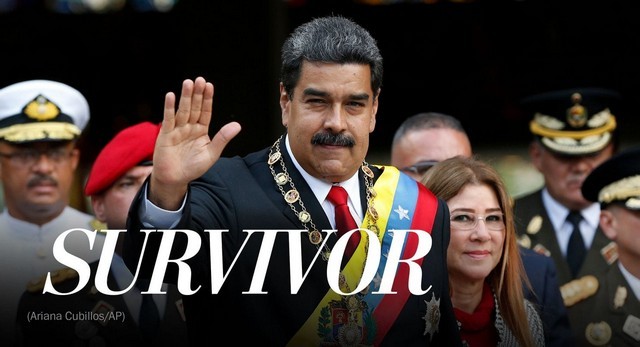
Despite tremendous hardship which the Venezuelan people are having to face, despite the sanctions and intimidation from abroad, President Nicolás Maduro has won a second six-year term.

Two weeks ago, at the Venezuelan embassy in Nairobi, Kenya, where I addressed several leaders of East African left-wing opposition, an acting Charge d’ Affaires, Jose Avila Torres, declared: “People of Venezuela are now facing similar situation as the Syrian people.”

True. Both nations, Venezuela and Syria, are separated by a tremendous geographical distance, but they are united by the same fate, same determination and courage.

During the Spanish Civil War, Czech anti-fascist fighters, volunteers in the International Brigades, used to say: “In Madrid we are fighting for Prague”. Madrid fell to Franco’s fascists in October 1939. Prague had been occupied by German troops several months earlier, in March 1939.It was the blindness and cowardice of the European leaders, as well as the support which the murderous fascist hordes received from populationsof all corners of the continent, which led to one of the greatest tragedies in modern history – a tragedy which only ended on May 9, 1945, when the Soviet troops liberated Prague, defeating Nazi Germany and de facto saving the world.

More than 70 years later, the world is facing another calamity. The West, mentally unfit to peacefully end its several centuries long murderous reign over the planet – a reign that has already taken several hundreds of millions of human lives – is flexing its muscle and madly snapping in all directions, provoking, antagonizing and even directly attacking countries as far apart as North Korea (DPRK), China, Iran, Russia, Syria and Venezuela.

What is happening now is not called fascism or Nazism, but it clearly is precisely that, as the barbaric rule is based on a profound spite for non-Western human lives, on fanatical right-wing dogmas which are stinking of exceptionalism, and on the unbridled desire to control the world.

Many countries that refused to yield to brutal Western force were recently literally leveled with the ground, including Afghanistan, Libya and Iraq. In many other ones, the governments were overthrown by direct and indirect interventions, as well as deceit, as was the case in the mightiest country in Latin America – Brazil. Countless “color”, “umbrella” and other “revolutions” as well as “springs” have been sponsored by Washington, London and other Western capitals.

But the world is waking up, slowly but irreversibly, and the fight for survival of our human race has already begun.

Venezuela and Syria are, unquestionably, at the frontline of the struggle.

Against all odds, bleeding but heroically erect, they stand against the overwhelmingly mightier force, and refuse to give up.

“Here no one surrenders!” shouted Hugo Chavez, already balding from chemotherapy, dying of cancer which many in Latin America believe, was administered to him from the United States. His fist was clenched and heavy rain was falling on his face. Like this, died one of the greatest revolutionaries of our time. But his revolution survived, and is marching on!

*
I am well aware of the fact that many of my readers are from the West. Somehow, particularly in Europe, I cannot explain, anymore, what it really is to be a revolutionary. Recently I spoke at a big gathering of ‘progressive’ teachers, which took place in Scandinavia. I tried to fire them up, to explain to them what monstrous crimes the West has been committing all over the world, for centuries.

I tried and I failed. When the lights went on, I was drilled by hundreds of eyes. Yes, there was an applause, and many stood up in that fake cliché – a standing ovation. But I knew that our worlds were far apart.

What followed were pre-fabricated and shallow questions about human rights in China, about “Assad’s regime”, but nothing about the collective responsibility of people of the West.

To understand what goes on in Syria and in Venezuela, requires stepping out of the Western mindset. It cannot be understood by selfish minds that are only obsessed with sexuality and sexual orientation, and with self-interest.

There is something essential, something very basic and human that is taking place in both Syria and Venezuela. It is about human pride, about motherland, about love for justice and dreams, about a much better arrangement for the world. It is not petty, in fact it is huge, and even worth fighting and dying for.

In both places, the West miscalculated, as it clearly miscalculated in such ‘cases’ as Cuba, Russia, China, Iran, DPRK.

“Patria no se vende!”, they have been saying in Cuba, for decades – “Fatherland is not for sale!”

Profit is not everything. Personal gain is not everything. Selfishness and tiny but inflated egosare not everything. Justice and dignity are much more. Human ideals are much more. To some people they are. Really, they are, trust me – no matter how unreal it may appear in the West.

Syria is bleeding, but it refused to surrender to the terrorism injected by the West and its allies. Aleppo was turned into a modern-day Stalingrad. At a tremendous cost, the city withstood all vicious assaults, it managed to reverse the course of the war, and as a result, it saved the country.

Venezuela, like Cuba in the early 90’s, found itself alone, abandoned, spat at and demonized. But it did not fall on its knees.

In Europe and North America, analyses of what is happening there have been made “logically” and “rationally”. Or have they, really?

Do people in the West really know what is like to be colonized? Do they know what the “Venezuelan oppositionis”?

Do they know about the consistency of the terror being spread by the West, for centuries and all over Latin America, from such places like the Dominican Republic and Honduras, all the way down to Chile and Argentina?

No, they know nothing, or they know very little, like those Germans who were living right next to the extermination camps and after the war they claimed that they had no idea what that smoke coming up from the chimneys was all about.

There is hardly any country in Central or South America, whose government has not at least been overthrown once by the North, whenever it decided to work on behalf of its people.

And Brazil, last year, became the ‘latest edition’ of the nightmares, disinformation campaigns, ‘fake news’ and coups – being spread with ‘compliments’ from the North, through local ‘elites’.

*
You see, there is really no point of discussing too many issues with the ‘opposition’ in countries such as Venezuela, Cuba or Bolivia. What has to be said was already pronounced.

What goes on is not some academic discussion club, but a war; a real and brutal civil war.

I know the ‘opposition’ in South American countries, and I know the ‘elites’ there. Yes, of course I know many of my comrades, the revolutionaries, but I am also familiar with the ‘elites’.

Just to illustrate, let me recall a conversation I once had in Bolivia, with the son of a powerful right-wing senator, who doubled as a media magnate. In a slightly drunken state he kept repeating to me:

“We will soon kick the ass of that Indian shit [president of Bolivia, Evo Morales] … You think we care about money? We have plenty of money! We don’t care if we lose millions of dollars, even tens of millions! We will spread insecurity, uncertainty, fear, deficits and if we have to, even hunger… We’ll bleed those Indians to death!”

All this may sound ‘irrational’, even directly against their own capitalist gospel. But they don’t care about rationality, only about power. And their handlers from the North will compensate their losses, anyway.

There is no way to negotiate, to debate with these kinds of people. They are traitors, thieves and murderers.

For years and decades, they used the same strategy, betting onthe soft-heartedness and humanism of their socialist opponents. They dragged progressive governments into endless and futile debates, then used their own as well as Western media to smear them. If it did not work, they choked their own economies, creating deficits, like in Chile before the 1973 Pinochet’s coup. If that did not work, they’d used terror – naked and merciless. And finally, as the last resort – direct Western interventions.

They are not in it for ‘democracy’ or even for some ‘free market’. They are serving their Western masters and their own feudalist interests.

To negotiate with them is to lose. It is identical with playing the game by their own rules. Because behind them is the entire Western propaganda, as well as financial and military machinery.

The only way to survive is to toughen up, to clench teeth, and to fight. As Cuba has been doing for decades, and yes, as Venezuela is doing now.

This approach does not look ‘lovely’; it is not always ‘neat’, but it is the only way forward, the only way for progress and revolution to survive.

Before Dilma got ‘impeached’ by the pro-Western bunch of corrupt freaks, I suggested in my essay that was censored by Counterpunch but published by dozens of other outlets world-wide, in many languages, that she should send tanks into the streets of Brasilia. I suggested that it was her duty, in the name of the people of Brazil, who voted for her, and who benefited greatly from the rule of her PT.

She did not do it, and I am almost certain that now she is regretting so. Her people are once again getting robbed; they are suffering. And the entire South America is, as a result, in disarray!

*
Corruption? Mismanagement? For decades and centuries, the people of Latin America were ruled and robbed by the corrupt bandits, who were using their continent as a milking cow, while living in the repulsive opulence of the Western aristocracy. All that was done, naturally, in the name of ‘democracy’, a total charade.

Venezuela is still there – people are rallying behind the government – in terrible pain and half-starving but rallying nevertheless. It is because for many people there, personal interests are secondary. What matters is their country, socialist ideology and the great South American fatherland.Patria grande.

It is impossible to explain. It is not rational, it is intuitive, deep, essential and human.

Those who have no ideology and ability to commit, will not understand. And, frankly, who cares if they will or not

Hopefully, soon, both Brazil and Mexico – the two most populous nations in Latin America – will vote in new left-wing governments. Things will then change, will become much better, for Venezuela.

Until then, Caracas has to rely on its far-away but close comrades and friends, China, Iran and Russia, but also on its beautifuland brave sister – Cuba.

Evo Morales recently warned that the West is plotting a coup in Venezuela.

Maduro’s government has to survive another few months. Before Brazil is back, before Mexico joins.

It will be a tough, perhaps even bloody fight. But history is not made by weak compromises and capitulations. One cannot negotiate with Fascism. France tried, before WWII, and we all know the results.

The West and its fascism can only be fought, never appeased

When one defends his country, things can never be tidy and neat. There are no saints. Sainthood leads to defeat. Saints are born later, when victory is won and the nation can afford it.

Venezuela and Syria have to be supported and defended, by all means.

These wonderful people, Venezuelans and Syrians, are now bleeding, fighting for the entire non-Western and oppressed world. In Caracas and Damascus, people are struggling, battling and dying for Honduras and Iran, for Afghanistan and West Africa.

Their enemies canonly be stopped by force.

*
In Scandinavia, a Syrian gusano, who lives in the West, who smears president Assad and gets fully compensated for it, challenged me, as well as the Syrian ‘regime’ and Iran, during the Q/A session. I said I refuse to discuss this with him, as even if we were to spend two hours shouting at each other, in public, we would never find any common ground. People like him began the war, and war they should get. I told him that he is definitely paid for his efforts and that the only way for us to settle this is ‘outside’, on the street.

Venezuela and Syria cannot fall. Too much is now at stake. Both countries are presently fighting something enormous and sinister – they are fighting against the entire Western imperialism. It is not just about some ‘opposition’, or even the treasonous elements in their societies.

This is much bigger. This is about the future, about the survival of humanity.

Billions of people in all parts of the world have been closely following the elections in the Bolivarian Republic. There, the people have voted. President Maduro won. He won again. Scarred, bruised, but he won. Once again, socialism defeated fascism. And long live Venezuela, damn it!

*
[Originally published by New Eastern Outlook – NEO]

Andre Vltchek is a philosopher, novelist, filmmaker and investigative journalist.

13 June 2018

Source: https://countercurrents.org/2018/06/13/why-venezuela-and-syria-can-not-fall/

The Singapore Summit: A Good Beginning

By K P Fabian

Confounding his critics and an army of pundits who were confidently predicting an unsuccessful summit, President Trump has demonstrated that his deal-making approach can deliver results in an area where patient, plodding, conventional, hesitant diplomacy has signally failed.

Trump deserves all credit for the historic success of his summit with DPRK’s Chairman Kim Jung Un. Equally, Kim also deserves full credit. The Western media that had for long demonized him had wrongly speculated that the young Kim, 34, would not be able to hold his own while meeting Trump who can be intimidating.  Kim held his head high and Trump was at his charming best. It looked as though Trump had left his bad temper in Canada and he was so relieved to apply his mind to resolving the Korean conundrum which successive US presidents have signally failed to address or even understand holistically.

We shall first try to figure out, cutting through  the diplomatic jargon, what was agreed upon in Singapore, based on the signed joint statement and Trump’s subsequent press conference.

First, Washington and Pyongyang have agreed to put an end to the long chapter of hostility going back to the Korean War of 1950-53. That war marked the beginning of the Cold War. Though the Cold War collapsed definitively by demise of the USSR in 1990-91, the 76 million Koreans in the divided Korea have not stopped suffering from that war. The Trump-Kim decision is to embark on a path of normalization of their relations.

Second, the two sides will jointly work to build a ‘lasting and stable peace’ in the Korean peninsula. In short, there will be a peace treaty formally ending the Korean War replacing the armistice of 1953.

Third, Pyongyang reiterated its commitment contained in the April 27 Panmunjom declaration with Seoul to “work towards complete denuclearization” of the Korean peninsula.

Fourth, Pyongyang agreed to permit Washington to recover and take to US the mortal remains of US soldiers who died in the Korean War. About 6,000 families in US have been wanting to see the mortal remains of their loved ones.

Fifth, Pyongyang will destroy an important missile testing centre as a gesture of good will though this is not mentioned in the joint statement.

Sixth, US will stop military exercises that have in the past raised the level of tension.

Last but not the least is that both sides will start implementing what was agreed upon with a sense of dispatch and the two leaders will meet again.

Trump has been unfairly criticized by some media pundits who were looking for the words “complete, verifiable, and irreversible disarmament “a formula used by Secretary of State Mike Pompeo before the summit as one of the key demands of Washington. Any one conversant with the ground realities of international diplomacy would have known that any such demand put upfront would have been a non-starter. There is a fundamental misunderstanding that need to be cleared up here. The Western pundits who believe that Kim sought the summit mainly because he wanted to get rid of the asphyxiating sanctions have got it wrong. Of course, the sanctions do hurt in a big way. But, the primary reason for Kim’s move is that having concluded the missile and nuclear tests he has demonstrated his nuclear-weapon capability and he does not need to conduct more tests. Senator Diane Feinstein , a member of the Senate Intelligence Committee, has said that Pyongyang probably has 50 to 60 nuclear weapons and the missile capability to deliver a  war head in the US, perhaps not with much accuracy.

President Trump who tweeted for months abusing Kim by calling him ‘the little rocket man” did consider for a while military action against DPRK. Eventually, Defence Secretary Mattis and others convinced him of the danger of initiating hostilities risking the lives of 29,000 of US military personnel and of hundreds of thousands of the South Koreans living in Seoul so close to the DMZ (Demilitarized Zone) within the range of DPRK’s artillery shells. Trump also has his eyes on a Nobel Peace Prize.

Trump’s critics who hark back to the 1994 agreement with DPRK that was aborted and argue on that basis that Kim cannot be trusted are woefully imprisoned in the past and are  unable to appreciate the realities of 2018.   The 1994 agreement was to stop DPRK’s use of reactors capable of producing plutonium and in exchange US was to supply fuel oil and to lift long standing sanctions though this was not specifically spelt out.  After the agreement was signed, President Clinton’s Democratic party lost control of the Senate and the Republicans stood in the way of Washington’s fulfilling its obligations.

There is another deplorable confusion of thought among some Western commentators. They always go into the past behavior of DPRK and try to extrapolate into its future behavior forgetting two crucial factors: DPRK is now a nuclear weapon state and Kim really wants to develop his country economically for which he badly needs good relations with US.

The behavior of Moscow and Beijing calls for a comment. For months, they obliged Trump   by agreeing to impose tighter and tighter sanctions. It was only when Kim smartly turned the tables on them by sending out a signal to Trump through President Moon of South Korea and Trump responded to that signal though with some delay that China and Russia realized that they had to get into the game. Kim responded cleverly by going to China twice to meet with President Xi Jinping  and accepting an invitation to go to Moscow from Foreign Minister Lavrov who came to Pyongyang. There is no doubt at all that Kim has played his hand skillfully.

Let us try to find out how South Korea, China, Russia, and Japan might look at the summit.   Obviously, President Moon of South Korea will be overjoyed as he, above all others, has worked the hardest to make the summit happen. His ‘sun-shine policy’ of seeking peace and cooperation with DPRK has  marked a milestone. At one time, Moon was supposed to be present in Singapore to have a meeting with Trump and Kim after they had met first. Secretary Pompeo is on his way to Seoul to brief President Moon.

China has an ambivalent approach to the whole problem. It does not want a crisis in DPRK that might cause a huge exodus of refugees to China. China is not too comfortable with a nuclear armed DPRK, but it also realizes that once the issue is resolved, US will cease to need China’s help in tackling DPRK. China, of course, does not want a unified Korea, but can be sure that Korean unification is far away. But, reinforced cooperation between Seoul and Pyongyang will reduce China’s hold on DPRK. If DPRK has normal trade with South Korea, obviously it will be less dependent on China economically. All told, China would like to see the issue remain unresolved provided it does not lead to a war between US and DPRK.

Russia shares some of China’s concerns, but on balance it would like to see peace and stability in the Korean peninsula.

Japan might be unhappy. Prime Minister Abe has till recently taken a hard line against DPRK, He has derived considerable political advantage by taking such a hard line that also in a way was used to justify his plan for amending the Constitution to permit Japan to have a normal military. But, as the momentum developed towards a Kim-Trump summit, Abe through Moon asked for a meeting with Kim before the Singapore summit, but for understandable reasons Kim did not oblige. Abe has highlighted the issue of 17 Japanese abducted, five of whom have been returned. Trump has declared that US would work with Japan.

Let us try to figure out what is in store. Of course, there is a non-zero probability that this Singapore agreement also can come a cropper. But, there is a higher probability that the Singapore summit will deliver as both sides want it to succeed. Trump does lack certain presidential qualities, but he is a successful chief executive officer who can apply his mind to problem with singular determination. He is no Hamlet like Obama to be paralyzed between ‘to be or not to be’.

The Nobel Committee should not rush to award any prize to Trump. It should watch the implementation for at least a year and then award the prize to Trump, Kim, and Moon.

Ambassador K. P. Fabian is an Indian Diplomat who served in the Indian Foreign Service between 1964 and 2000, during which time he was posted to Madagascar, Austria, Iran, Sri Lanka, Canada, Finland, Qatar and Italy.

13 June 2018

Source: https://countercurrents.org/2018/06/13/the-singapore-summit-a-good-beginning/

Upending the Palestinian leadership: The role of youth

By Fadi Quran

Instead of bringing an end to the occupation, the current Palestinian leadership and its institutions have become a key component of it. Yet a new generation of leaders is slowly emerging. Their goal is to build a new framework for the Palestinian struggle that avoids the mistakes of the past and ensures that freedom is achieved in their lifetime. Their successful entrance into leadership will require both a reckoning with and breaking of a cycle that blocks change.

Looking at former and current Palestinian leadership, one can observe a cyclical trajectory in which members of the elite first acquire the legitimacy to lead through a combination of traditional structures and foreign support. The legitimacy of the Grand Mufti of Jerusalem Amin Al-Husseini, for example, was grounded in religious and familial authority and enhanced and institutionalised by the Ottoman Empire and then the British Mandate. Ahmed Shuqeiri’s legitimacy derived from the Arab League as well as his educational status and familial ties, while President Mahmoud Abbas’s legitimacy was founded on factional loyalties within Fatah and then significantly consolidated by the US and Israel.

These leaders and the institutions they administer fail to deliver on popular aspirations, leading to stagnation and public dissent. This precipitates an inter-Palestinian power struggle that is often intergenerational and highly destructive. The struggle ends when a national tragedy occurs that either destroys or unites the competing factions. During these historical moments of national chaos, a new generation of leaders rises, mesmerising the public and accruing revolutionary legitimacy that propels them to the top.

In each turn of this cycle, sitting leaders either adopt the new discourse and co-opt members of the new generation or maintain status via intervention by foreign sponsors who kill or arrest insurgents. An example of this dynamic is the death of Izz Al-Din Al-Qassam, and later the leaders of the 1936 Revolt, who were crushed with great brutality by the British. Yasser Arafat’s conquest of the PLO from Shuqeiri in the 1960s, in which Arafat incorporated members of the new generation, is another. Such transitions also occurred on the local level during the First Intifada, and with Hamas’s gradual takeover in Gaza during and after the Second Intifada.

The third phase of this cycle sees the rise of a technocratic class, a generation of leaders that attempts to rebuild or replace the institutions that were destroyed in the internal conflict. These leaders are or perceive themselves to be institution builders, and although they rarely reach the pinnacles of power, they are able to acquire significant authority. These builders can take many forms in their approach to reinvigorate society, from the revolutionary to the neoliberal. Examples include Khalil Al-Wazir, a key founder of Fatah who was pivotal in slowly rebuilding the national movement in Palestine after the PLO’s failures in Lebanon. He was assassinated by Israel in Tunisia for his role in laying the groundwork that launched the First Intifada. Another example is Salam Fayyad, who pursued a Western-backed neoliberal institution-building process in Palestine after the Second Intifada. Regardless of the political leanings of these builders, their efforts are often short-lived as they tend to clash with more deeply-rooted power structures. This phase of the cycle often closes with a return to the first phase, wherein a small set of elites, supported by outside forces, hold control.

Today, this cycle seems blocked. An ossified Palestinian leadership has managed to cling to power for more than two decades. The institutional framework established by the Oslo Accords – a Palestinian Authority (PA) without authority providing inadequate administrative services, low-level employment, and security for Israel – still governs a subset of Palestinians in the Occupied Palestinian Territory. The PA has become a buffer zone between the Palestinians and the Israeli occupation, one that largely favours the occupation. Meanwhile, through heavy foreign assistance, the PA has transformed the socioeconomic landscape of Palestinian society by increasing inequality, widening political divisions, and even attempting to alter the media and educational landscape to weaken all forms of effective struggle against the occupation.

The results of these developments, combined with the deteriorating regional politics of the Middle East, has led the most astute observers of the Israeli-Palestinian conflict to conclude that the Palestinian struggle for freedom is comatose.

But one need only look a bit deeper to see that something is stirring. A new generation of Palestinians is organising and growing in strength. They are waiting for the right moment to transform the status quo and create the momentum that will end the occupation. The Israeli security establishment, although it may not fully understand these dynamics, sees this coming. Why else would defence minister Avigdor Lieberman ban the Palestinian “Youth Movement” and put it on the terrorist list? In fact, there is no organisation or organised body called the “Youth Movement” on the ground in Palestine. Rather, the term Al-Hirak Al-Shababi is most commonly used to refer to any social or political action led by youth. What scares Lieberman so? Why does the Palestinian General Intelligence maintain a file on “youth-led activities?”

Over the past five years I have met and spoken with thousands of young Palestinians across the West Bank and Gaza Strip and in the diaspora. In every town, city, and refugee camp, youth groups are blossoming. Most focus on very local needs and lead volunteer work. They appear non-political and are not affiliated with any faction. These groups often fail, fall apart, and use what they have learned to try something new. Their growth is anything but linear, but their learning is exponential.

These groups’ driving questions are: What do we need to do to have a better life? What is our purpose? How do we achieve it? Having asked these questions, it is not long before they discover that the occupation and the PA as its governing body are obstacles in their path. This generation’s focus on grassroots action and its ability to conceptualise the PA as an impediment to a genuine liberation movement are fundamental to its potential to transform the stagnant Palestinian leadership model.

Further, many young people in Palestine are despondent about the status quo. This is clearest in Palestinian universities, which have been transformed from beacons of liberation to factories of disenchantment. Once hotbeds of Palestinian political struggle, the universities today produce young men and women focused on two things: a paying job or an opportunity to emigrate. One university dean I spoke with defined his job as simply training a workforce for the PA economy. Although youth groups are active on campuses, offering glimpses of hope, the Palestinian security forces in the West Bank and Hamas’s forces in Gaza have turned student politics and electioneering into a shadow of what they once were, ensuring that superficial slogans and fear override genuine student organising and hope.

However, despite these repressive policies, the new generation has not given up on its Palestinian identity or its dreams of freedom. Many are preparing to enter the struggle for freedom under the right leadership: one they can be part of and trust. This new generation of leaders, learning from the experiences of the past, have wisely chosen to work quietly, away from the spotlight, and patiently prepare for when the moment is ripe.

Identifying that moment, however, will be difficult because three stars need to align: a) Reigniting hope: The Palestinian street needs to go from being risk averse to being hopeful that a better future is possible; b) Overcoming the power threshold: The youth must feel they have the human resources and endurance to slog through the obstacles the PA and Israel can put in their way; c) Consolidating to confront the occupation: Given that the PA and its security apparatus are pivotal in maintaining the status quo, and that any more internal Palestinian strife is to be avoided, the youth will have to find a moment when the occupation has committed an act so severe that they can mobilise many of the ranks of the apparatus into the struggle against the occupation and away from internal repression. Of course, Israel and its backers will do their best to make sure these stars do not align, from killing hope to arresting dozens of youth activists. The only way for this moment to arise is for Palestinian civil society and youth activists to build their strength and expand societal self-awareness.

How will these young people avoid the mistakes of the past and break the cycle outlined above? For a new Palestinian leadership to be successful, a culture of transparency, accountability, and feedback must first be created at the local level. No matter how powerful, resilient, and disciplined a leader is, and no matter how much they love their country and people, they are human. It is only through developing a culture of accountability that a community can produce leaders that can move the struggle forward. While Palestine has had many leaders, none have maintained a culture around them that helped birth new leaders and ensured that they remain accountable. Creating this culture is not something done through legislation or rules alone, but is a daily practice.

Although there is not enough space here to flesh out the necessary practices in detail, some are fairly straightforward. For example, leaders at all levels of society, from volunteer groups to ministries, can work with their teams to put forward a clear vision for what they want to achieve, define each person’s responsibilities and specific outcomes, and ensure that leaders take ownership of their and their teams’ results. They should allow team members to provide feedback on the process in an open setting, such as in a weekly meeting when tasks are tallied and learning is discussed in a convivial manner.

In such a process, the group’s leader helps ensure that the team achieves its vision in a united, collaborative spirit. Eventually, this ensures that everyone in the group is a leader because leadership is not couched as a zero-sum process.

The process may not always work perfectly, but the lessons learned are valuable, including lessons about how one’s ego can get in the way of achieving team goals. Most importantly, the youth participants become aware of a method of teamwork and leadership that transcends what they see in local politics. Though it may sound cliché, it is nonetheless true that nothing is more impactful than leading by example and learning through experimentation.

These self-aware leaders and their culture of transformative leadership will clash with the socioeconomic environment and political elite established and strengthened by international players and Israel. Such a people’s-based leadership, whether directly or indirectly, will be the target of massive co-optation and, if that fails, assassination. One can argue that Israel’s “mowing the grass” in Gaza and the PA’s assault on student and youth politics are pre-emptively attempting to destroy rising leaders.

While some argue that a top-down approach to reform will fix the leadership problems – by restructuring the PLO, gaining representation, and holding elections, among other strategies – the current socioeconomic dynamics, reality of occupation, and international intervention in Palestinian politics make these efforts at internal reform easy targets for political manipulation. It is authentic change at the local level that can fix the problem from its roots and bring about a lasting leadership transformation for Palestinian society. If this generation succeeds, it will not only liberate the nation, but will ensure that the future beyond liberation is more beautiful than many of us today can imagine.

* Fadi Quran is a Senior Campaigner at Avaaz and a Popular Struggle community organiser.

8 June 2018

Source: http://www.amec.org.za/palestine/item/1565-upending-the-palestinian-leadership-the-role-of-youth.html