Just International

The Palestinian Struggle: In Memory of Razan al-Najjar

By Orly Noy

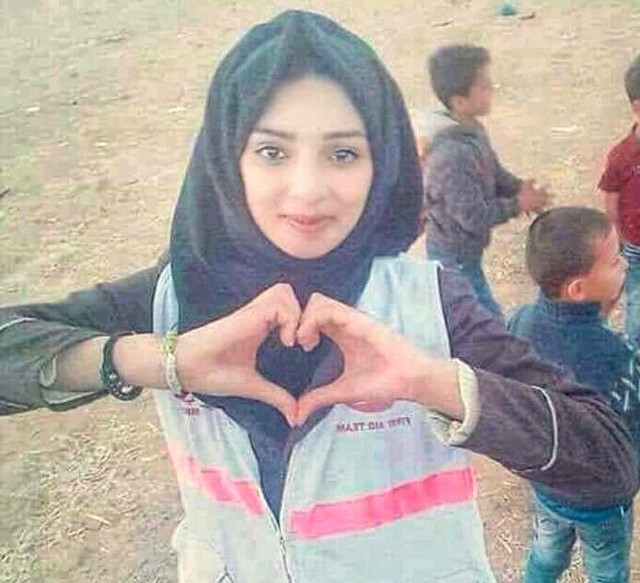
The 21-year-old paramedic was shot and killed by Israeli soldiers while trying to aid wounded protesters near the Gaza-Israel separation fence. Many Israelis either refuse to believe she was actually killed or claim that her killing was somehow justified.

Around two weeks ago, a Facebook friend of mine proposed an experiment to a small group of us. Social media has become a boxing ring, she said. The two sides, left and right, dig into their positions and slug it out in the comments — and that’s if they don’t just “block” each other. My friend suggested that for a month, we try to engage in a productive dialogue with right-wingers on Facebook, even with the most combative of commenters. After all, our aim is to change what and how people think, and to do that, we need to speak to other side. Let’s try it, I said, if only for a month — to see what happens.

For the past two days, I’ve been thinking about Razan al-Najjar, the 21-year-old paramedic shot and killed by Israeli soldiers Friday near the Gaza-Israel separation fence. According to witnesses, she was wearing her white paramedic’s uniform, attempting to treat protesters near the fence when she was shot. Immediately following Razan’s death, her picture appeared everywhere on my Facebook newsfeed. I, too, shared a post with her picture.

The angry responses came quickly.

Here was an opportunity to try out the dialogue experiment my friend had suggested, I thought. Maybe because Razan in her white uniform was so different from the image of the terrorist that the Israeli collective imagination assigned the protesters in Gaza, I hoped there would be an opening for compassion, for second thoughts, for a discourse free from blind hatred.

I was wrong.

Instead, the following responses came pouring in:

“What was she doing there in the first place? “Why didn’t she wait for the wounded in the hospital?” “You really think our soldiers kill protesters on purpose?” “That’s how it is in war.” “Hamas makes them to go to these protests.”

I tried to respond with calm, level-headed answers.

She didn’t wait for the wounded at the hospital because the Israeli army’s massive use of live fire made it necessary for first responders to be in the field — just like Israeli medics would at a mass casualty event.

And no, this is not “how it is in war.” Firstly, this is not a war. This is heavily armed soldiers facing down unarmed protesters. Secondly, even in war there are rules, and sniper fire against medics, journalists and children is a war crime. Hamas did not force her to be there, either; numerous interviews with Razan were published in recent weeks in which she explains why she volunteered as a medic during the protests.

Then the more violent responses came, in public and in private messages — bizarre death threats, a lot of toxic invective. What kind of a dialogue is possible when faced with that?

Someone asked,

“How do you know this is true, were you there?”

He added a picture from 2001 suicide bombing of the Dolphinarium, a beach-front nightclub in Tel Aviv, to prove some inexplicable point. Another commenter responded,

“How do you know there was an attack on the Dolphinarium, were you there?”

Another yet claimed that the entire story of Razan was fabricated, that they put a paramedic’s uniform on her body only after she died. No amount of photos showing Najjar treating wounded protesters over the past month could convince him. Palestinians, to him, are liars by definition.

Taken together, the responses reflected the depressing fact that for most of the Israeli public, Palestinians killed by Israeli soldiers are guilty by default. The identity of the deceased or the circumstances of the killing are irrelevant. Many of the commenters who responded to my post made the effort to stress that they were were not right-wingers. One even identified as a supporter of Meretz, the dovish left-wing party.

I gave up on the conversation because it was too frustrating and instead continued to look for interviews conducted with Razan. There are quite a few online. The young medic, it seems, was of significant interest to numerous international media outlets. In one of the interviews, Razan says:

People ask my father what I’m doing here, and getting a salary. He tells them, ‘I’m proud of my daughter, she provides care to the children of our country.’ And because in our society, women are often judged, but society has to accept us . If people don’t want to accept us by choice, they will be forced to accept us. Because we have more strength than any man. The strength that I showed as a first-responder on the first day of the protests — I dare you to find it in anyone else.

After that, I watched a short video of young men and women, perhaps Razan’s friends, perhaps her family members, in tears, their piercing cries announcing her death. One of them held his head and shouted her name over and over again.

I then returned to the comments that had accumulated under the picture of the young woman who went to care for wounded protesters and came back in a shroud. My heart struggled to contain the sadness.

I apologize to my well-intentioned friend. The bitter truth is that the Israeli collective consciousness is light-years away from a place where it can even begin speak about the basic concepts of justice, human rights, and human equality before God. I doubt that years of occupation and moral corruption can be corrected.

I also apologize to Razan, the young Gazan woman who lived her whole life under occupation, more than half under the brutal siege. She did not taste a single day of freedom in her short life. She went out into the Valley of Death by the separation barrier to care for her wounded countrymen and never came back. With shame beyond words, I apologize. Rest in peace Razan, may your memory bring freedom and justice to your people.

Orly Noy is a political activist who has worked in the past through frameworks like the Women’s Coalition for Peace and the Mizrahi Democratic Rainbow.

3 June 2018

US fingerprints all over Nicaragua’s bloody unrest

By William Whiteman

The student-led anti-government movement in Nicaragua is unlike other recent attacks on the Latin American socialist bloc; it emanates mainly from the left of the political spectrum. But that doesn’t mean the US isn’t behind it.

The so-called marea rosa, or ‘pink tide’, of allied leftist governments which held sway across Latin America in previous years is being rolled back. Brazil’s Dilma Rousseff was removed from power in a right-wing coup, co-conspirators of which have now managed to imprison the current presidential frontrunner, Luiz Inacio Lula da Silva. Ecuador’s Lenin Moreno has stabbed his former leader Rafael Correa in the back by barring him from seeking re-election, while seemingly purging his cabinet of remaining Correa loyalists and beginning the process of allowing the US military back into the country. Alongside other democratic and not-so-democratic removals of leftist governments from power, NATO has nabbed itself a foothold in the region, now that Colombia has joined the obsolete yet aggressively expanding Cold War alliance, in a thinly veiled threat to neighboring Venezuela.

And now it’s Nicaragua’s turn under the boot. Again. The student-led anti-government movement in Nicaragua is unlike other recent attacks on the Latin American socialist bloc; it emanates mainly from the left of the political spectrum. But that doesn’t mean the US isn’t behind it.

The so-called marea rosa, or ‘pink tide’, of allied leftist governments which held sway across Latin America in previous years is being rolled back. Brazil’s Dilma Rousseff was removed from power in a right-wing coup, co-conspirators of which have now managed to imprison the current presidential frontrunner, Luiz Inacio Lula da Silva. Ecuador’s Lenin Moreno has stabbed his former leader Rafael Correa in the back by barring him from seeking re-election, while seemingly purging his cabinet of remaining Correa loyalists and beginning the process of allowing the US military back into the country. Alongside other democratic and not-so-democratic removals of leftist governments from power, NATO has nabbed itself a foothold in the region, now that Colombia has joined the obsolete yet aggressively expanding Cold War alliance, in a thinly veiled threat to neighboring Venezuela.

And now it’s Nicaragua’s turn under the boot. Again.

Over 100 people have been killed since unrest broke out in mid April. Student demonstrations began in the capital Managua as a reaction to the country’s failure to handle forest fires in one of the most protected areas of the Indio Maiz Biological Reserve. The situation was then exacerbated when, two days later, the ruling Sandinista National Liberation Front announced it was slashing pensions and social security payments, sparking further anti-government protests. Targeted opposition violence along with police repressions have led to a mounting body count on both sides. Violence persists in the country, despite the fact that President Ortega has now ditched the proposed welfare reforms and has been engaging in talks with the opposition.

The government has adamantly denied it was responsible for snipers killing at least 15 people at a recent demonstration. And, while we may never know what really happened, it’s fair to say an embattled national leadership in the midst of peace talks has little to gain from people being gunned down in front of the world’s media at an opposition march on Mother’s Day. All I’ll say on the matter is it’s not like we didn’t have mysterious sharpshooters picking off protesters during US-supported coups in Venezuela and Ukraine.

With his approval ratings recently reaching as high as 80 percent during the 2017 presidential campaign, Nicaragua’s President Daniel Ortega is far from a dictator. As a Guerrilla leader, Ortega’s leftist Frente Sandinista de Liberación Nacional (FSLN) overthrew Anastasio Somoza Debayle’s brutal regime in 1979, thereby ending the Somoza family dynasty which had ruled Nicaragua since the mid-1930s. The US responded by arming, funding and training right-wing death squads, in an insurgency that would ultimately cost the lives of more than 60,000 people over the course of a decade. While all this was going on, Ortega called a free and open presidential election in 1984 and won with 67 percent of the vote. Under Ortega’s Sandinistas, Nicaragua went through a hugely successful literacy campaign and land reform process.

Ortega was then defeated in the 1990 presidential elections and remained an opposition figure until 2007, when he was reelected. He has been back at the helm of the country now for over 10 years. Despite his Marxist past, Ortega’s embracing of populist politics has seen him pander to conservative religious attitudes. In a country whose national identity has been so shaped in recent history by iconic revolutionary movements, Ortega’s moves to appease the right have alienated some on the left, most noticeably among the nation’s younger cadres.

It is unsurprising then that the US is apparently capitalizing on growing discontent, stoking dissent among the youth in a deliberate attempt to destabilize the Sandinista government. Infamously nefarious US soft power organizations such as the National Endowment for Democracy, also known as the CIA’s ‘legal window’, have set up extensive networks in Nicaragua.

Among the leading Nicaraguan student activists currently touring Europe to garner support for the anti-government movement is Jessica Cisneros. Cisneros is a member of the Movimiento Civico de Juventudes, which is funded by Madeline Albright’s National Democratic Institute (NDI). You remember Albright, right? She’s the former US Secretary of State that said that 500,000 Iraqi Children dying as a result of US sanctions against Saddam Hussein was “worth it”.

According to the NDI’s website, the organization “has partnered with Nicaraguan universities and civic organizations to conduct a youth leadership program, which has helped to prepare over 2,000 current and future young leaders from across the country” in order to improve the “country’s democratic development”.

Joining Cisneros on tour in Europe is Yerling Aguilera. At the time of writing this article Aguilera’s LinkedIn profile has her listed as a former employee and consultant for Instituto de Estudios Estratégicos y Políticas Públicas (IEEPP) in Nicaragua. IEEPP has received extensive funding from the National Endowment for Democracy.

If the idea of Washington supporting progressive anti-government forces in Latin America confuses you, then you’re failing to grasp the nature of US interference. During the Cold War, for example, the US supported both the Mujahideen in Afghanistan as well as eastern European trade unionists against the Soviet Union. Indeed, throughout the Syrian conflict, Washington has been arming leftist groups alongside jihadist organizations. It goes without saying that, despite US politicians getting all dewy-eyed over “freedom fighters,” the likes of Jihadists or even trade unionists are not welcome in US society. Certainly not if they receive foreign funding to carry out anti-government activities.

It’s all well and good saying things like ‘let Nicaraguans decide their future for themselves without foreign interference’, but criticism of Nicaragua’s young activists, based purely on the grounds of their acceptance of foreign backing, misses the point. Doing so ignores the historic fact that the Sandinistas also received extensive foreign support from the Cuban intelligence service (DGI) during the revolution. The difference between the two, however, are the stringent financial and economic conditions that go hand-in-hand with US support. When it comes to Washington backing your fight, there’s no such thing as a free ride.

Ortega’s government is far from perfect, but Nicaragua’s progressive opposition must be made to recognize the dangerous path down which they are leading their country. Yes, on the surface the organizations funding them may well have liberal-sounding mission statements that stress the need to “increase women’s political participation and initiatives to decrease discrimination against LGBTI people”, but they should know the destructive role that Washington non-profit foundations such as the NED or NDI have played around the world. They literally share the same agenda as the CIA.

Nicaraguans struggled against Washington’s subjugation of the country for most of the 20th century. Revolutionary Augusto C. Sandino, whose name Ortega’s Sandinistas incorporated, led an iconic guerilla war against US military occupation of the country between 1927-1933. He was eventually assassinated by the forces of General Anastasio Somoza Garcia (Anastasio Somoza Debayle’s grandfather), who went on to seize power two years later in a military coup. It was through Somoza that Washington first perfected its soft power form of imperialism, breaking with the European military occupation model. Somoza, armed and funded by Washington, crushed all opposition while making himself and his cohorts fantastically rich on the condition that he kept the country open to any and all US financial interests. Washington began to replicate this model all over Latin America, modernizing its tactics from the 80s onwards, all towards fostering corrupt neoliberal governments.

With the David and Goliath-style struggle for freedom and dignity their nation has waged over the years, the tens of thousands of Nicaraguans turning out into the streets for pro-government rallies undoubtedly want to preserve the security and relative prosperity they have known in recent years. Handing the keys of their country back over to Washington negates both of those things.

William Whiteman is an award-winning British war correspondent and political commentator, currently working for teleSUR English in South America.

4 June 2018

Source: https://www.rt.com/op-ed/428718-nicaragua-unrest-us-fingerprint/

Google says it will not renew Project Maven—but collaboration with Pentagon will continue

By Will Morrow

On Friday, Google Cloud CEO Diane Greene announced at a meeting with employees that the company will not renew its contract with the Pentagon for Project Maven following its expiry in 2019. Under the program, which Google entered in September last year, the company has provided the military with artificial intelligence software to perform real-time analysis of drone surveillance footage. The technology allows the Pentagon to develop its illegal drone assassination program that has killed thousands across the Middle East and North Africa.

Yesterday’s announcement is a response to widespread and mounting opposition from Google employees and the public to its collaboration with the military. The program only came to light as a result of opposition by employees, of whom approximately 4,000 have signed an internal petition demanding that Google cancel the project contract and institute a formal policy against taking on future military work.

Around a dozen employees have also resigned in protest. A report published on Tuesday by the New York Times, based on interviews with current and former employees, claimed the program has “fractured Google’s workforce, fueled heated staff meetings and internal exchanges,” and “touched off an existential crisis.” Among the employees who have resigned, one engineer “petitioned to rename a conference room after Clara Immerwahr, a German chemist who killed herself in 1915 after protesting the use of science in warfare.”

The Huffington Post reported yesterday that there were discussions among employees this week for a physical demonstration. An engineer who was due to leave the company on Friday posted on its internal online forum—in a thread titled “Maven conscientious objectors” that includes hundreds of employees—describing Maven as “the greatest ethical crisis in technology of our generation,” and suggesting that employees go to an upcoming Google conference in July with the aim of “making some noise.”

In comments to the World Socialist Web Site, academics Lucy Suchman and Peter Asaro, two of the authors of a recent open letter signed by more than 1,000 academics demanding that Google end its participation in the illegal drone murder program, said they were “gratified to see Google take the decision not to renew its contract for Project Maven, and to make the decision public.” They demanded that Google take “a clear and consistent stand against the weaponization of its technologies.”

“I do think it’s significant, in other words, that there was sufficient resistance inside the company that Google has had to respond, and it’s posed a tangible obstacle to growing relations with the DoD,” said Dr. Suchman. “The fact that those who entered into this contract attempted to do so quietly, if not actually in secret, shows that they anticipated how contested it would be (and then of course went ahead with it anyway).”

While Google claims it will not renew the contract, it will be involved with the project for the rest of the year, and will continue to deepen its intimate collaboration with the Pentagon. The company will also keep bidding for other contracts with the military not directly involving the use of artificial intelligence. Dr. Suchman added, “I suspect they’ll continue to look for ways of sustaining their Pentagon relations and spinning them as benign.”

It should be noted that Google’s previous statements in response to the revelations about Project Maven have been exposed as lies.

Internal emails between Google staff, portions of which were published by the New York Times, Gizmodo and the Intercept over the past three days, show that Google conspired to conceal its role in Project Maven from the beginning.

An email chain including Scott Frohman and Aileen Black—both defense and intelligence sales leads—as well as Dr Fei-Fei Li, the chief scientist for artificial intelligence at Google Cloud, discussed how the company should present the project publicly. Writing under the subject line “Communications/PR Request—Urgent,” Frohman asked for direction on the “burning question” of how the collaboration should be reported.

Li replied on September 24 that Google was “already battling privacy issues when it comes to AI [artificial intelligence] and data; I don’t know what would happen if the media starts picking up a theme that Google is secretly building AI weapons or AI technologies to enable weapons for the Defense industry”—i.e., precisely what Google is doing. Li said the issues would be “red meat” to the media.

Google eventually decided to silence reporting on the collaboration altogether. It also reached a non-disclosure agreement with the Pentagon, requiring that public communications first be approved by Google. Black also noted that the contract was “not direct with Google but through a partner,” ECS Federal, in order to conceal Google’s role.

Greene, who pledged yesterday not to renew the project, has also absurdly claimed that the program cannot be used for “lethal purposes.” This is directly contradicted by an email published yesterday by Gizmodo from Frohman, in which he calls Maven a “large government program that will result in improved safety for citizens and nations through faster identification of evils such as violent extreme activities and human rights abuses”—code words used by the Pentagon for activities justifying drone strikes.

Greene also previously claimed that the project was “small” and only worth $9 million. Another internal email from Aileen Black and published by the Intercept, however, shows the project was expected to grow rapidly, and “as the program grows expect spend is budgeted at 250 M per year.”

The real significance of Project Maven for Google is to secure a foothold into the tens of billions of dollars available in the arms race between the world’s major powers to incorporate Silicon Valley’s technology to develop next-generation weaponry, and to gain a competitive advantage against the other technology giants. The other bidders for the contract included Amazon and IBM.

All three companies, along with Microsoft, are competing to secure a $10 billion contract to build and administer Pentagon Cloud’s computing network. The network has been described by military officials as a “global fabric” for its warfighters. Every submarine, jetfighter, missile launch station and special operations soldier will be connected via computer systems that will be directly administered by one of the giant technology corporations.

The website Defense One reported that unlike Amazon and Microsoft, Google has “kept its own interest” in the contract “out of the press,” and the company has “even hidden the pursuit from its own workers.” Participating in Project Maven allowed Google to receive government clearance to host secure government data on its servers, and to compete for further cloud military projects in the future. Another internal email from Aileen Black called the clearance “priceless” for the company.

Google, along with the other technology giants, is intimately integrated into the US military and intelligence apparatus. Google representatives such as vice president Mike Medin and former Alphabet CEO Eric Schmidt sit on US military advisory boards and discuss the use of their technology for major wars and suppression of domestic political opposition. Google changed its search ranking algorithms in April last year to reduce traffic to and censor left-wing and anti-war websites, including the World Socialist Web Site.

3 June 2018

Source: https://countercurrents.org/2018/06/03/google-says-it-will-not-renew-project-maven-but-collaboration-with-pentagon-will-continue/

Fathi Harb burnt himself to death in Gaza. Will the world notice?

By Jonathan Cook

Fathi Harb should have had something to live for, not least the imminent arrival of a new baby. But last week the 21-year-old extinguished his life in an inferno of flames in central Gaza.

It is believed to be the first example of a public act of self-immolation in the enclave. Harb doused himself in petrol and set himself alight on a street in Gaza City shortly before dawn prayers during the holy month of Ramadan.

In part, Harb was driven to this terrible act of self-destruction out of despair.

After a savage, decade-long Israeli blockade by land, sea and air, Gaza is like a car running on fumes. The United Nations has repeatedly warned that the enclave will be uninhabitable within a few years.

Over that same decade, Israel has intermittently pounded Gaza into ruins, in line with the Israeli army’s Dahiya doctrine. The goal is to decimate the targeted area, turning life back to the Stone Age so that the population is too preoccupied with making ends meet to care about the struggle for freedom.

Both of these kinds of assault have had a devastating impact on inhabitants’ psychological health.

Harb would have barely remembered a time before Gaza was an open-air prison and one where a 1,000kg Israeli bomb might land near his home.

In an enclave where two-thirds of young men are unemployed, he had no hope of finding work. He could not afford a home for his young family and he was about to have another mouth to feed.

Doubtless, all of this contributed to his decision to burn himself to death.

But self-immolation is more than suicide. That can be done quietly, out of sight, less gruesomely. In fact, figures suggest that suicide rates in Gaza have rocketed in recent years.

But public self-immolation is associated with protest.

A Buddhist monk famously turned himself into a human fireball in Vietnam in 1963 in protest at the persecution of his co-religionists. Tibetans have used self-immolation to highlight Chinese oppression, Indians to decry the caste system, and Poles, Ukrainians and Czechs once used it to protest Soviet rule.

But more likely for Harb, the model was Mohamed Bouazizi, the Tunisian street vendor who set himself on fire in late 2010 after officials humiliated him once too often. His public death triggered a wave of protests across the Middle East that became the Arab Spring.

Bouazizi’s self-immolation suggests its power to set our consciences on fire. It is the ultimate act of individual self-sacrifice, one that is entirely non-violent except to the victim himself, performed altruistically in a greater, collective cause.

Who did Harb hope to speak to with his shocking act?

In part, according to his family, he was angry with the Palestinian leadership. His family was trapped in the unresolved feud between Gaza’s rulers, Hamas, and the Palestinian Authority (PA) in the West Bank. That dispute has led the PA to cut the salaries of its workers in Gaza, including Harb’s father.

But Harb undoubtedly had a larger audience in mind too.

Until a few years ago, Hamas regularly fired rockets out of the enclave in a struggle both to end Israel’s continuing colonisation of Palestinian land and to liberate the people of Gaza from their Israeli-made prison.

But the world rejected the Palestinians’ right to resist violently and condemned Hamas as “terrorists”. Israel’s series of military rampages in Gaza to silence Hamas were meekly criticised in the West as “disproportionate”.

The Palestinians of the West Bank and East Jerusalem, where there is still direct contact with Israeli Jews, usually as settlers or soldiers, watched as Gaza’s armed resistance failed to prick the world’s conscience.

So some took up the struggle as individuals, targeting Israelis or soldiers at checkpoints. They grabbed a kitchen knife to attack Israelis or soldiers at checkpoints, or rammed them with a car, bus or bulldozer.

Again, the world sided with Israel. Resistance was not only futile, it was denounced as illegitimate.

Since late March, the struggle for liberation has shifted back to Gaza. Tens of thousands of unarmed Palestinians have massed weekly close to Israel’s fence encaging them.

The protests are intended as confrontational civil disobedience, a cry to the world for help and a reminder that Palestinians are being slowly choked to death.

Israel has responded repeatedly by spraying the demonstrators with live ammunition, seriously wounding many thousands and killing more than 100. Yet again, the world has remained largely impassive.

In fact, worse still, the demonstrators have been cast as Hamas stooges. The United States ambassador to the UN, Nikki Haley, blamed the victims under occupation, saying Israel had a right to “defend its border”, while the British government claimed the protests were “hijacked by terrorists”.

None of this can have passed Harb by.

When Palestinians are told they can “protest peacefully”, western governments mean quietly, in ways that Israel can ignore, in ways that will not trouble consciences or require any action.

In Gaza, the Israeli army is renewing the Dahiya doctrine, this time by shattering thousands of Palestinian bodies rather than infrastructure.

Harb understood only too well the West’s hypocrisy in denying Palestinians any right to meaningfully resist Israel’s campaign of destruction.

The flames that engulfed him were intended also to consume us with guilt and shame. And doubtless more in Gaza will follow his example.

Will Harb be proved right? Can the West be shamed into action?

Or will we continue blaming the victims to excuse our complicity in seven decades of outrages committed against the Palestinian people?

A version of this article first appeared in the National, Abu Dhabi.

Jonathan Cook won the Martha Gellhorn Special Prize for Journalism.

30 May 2018

Source: https://countercurrents.org/2018/05/30/fathi-harb-burnt-himself-to-death-in-gaza-will-the-world-notice/

500 years is long enough! Human Depravity in the Congo

By Robert J. Burrowes

I would like to tell you something about human depravity and illustrate just how widespread it is among those we often regard as ‘responsible’. I am going to use the Democratic Republic of the Congo as my example.

As I illustrate and explain what has happened to the Congo and its people during the past 500 years, I invite you to consider my essential point: Human depravity has no limit unless people like you (hopefully) and me take some responsibility for ending it. Depravity, barbarity and violent exploitation will not end otherwise because major international organizations (such as the UN), national governments and corporations all benefit from it and are almost invariably led by individuals too cowardly to act on the truth.

The Congo

Prior to 1482, the area of central Africa now known as the Democratic Republic of the Congo was part of the Kingdom of the Kongo. It was populated by some of the greatest civilizations in human history.

Slavery

However, in that fateful year of 1482, the mouth of the Congo river, which flows into the Atlantic Ocean, became known to Europeans when the Portuguese explorer Diogo Cao claimed he ‘discovered’ it. By the 1530s, more than five thousand slaves a year (many from inland regions of the Kongo) were being transported to distant lands, mostly in the Americas. Hence, as documented by Adam Hothschild, the Congo was first exploited by Europeans during the Atlantic slave trade. See King Leopold’s Ghost: A Story of Greed, Terror, and Heroism in Colonial Africa.

Despite the horrific depredations of the militarized slave trade and all of its ancillary activities, including Christian priests spreading ‘Christianity’ while raping their captive slave girls, the Kingdoms of the Kongo were able to defend and maintain themselves to a large degree for another 400 years by virtue of their long-standing systems of effective governance. As noted by Chancellor Williams’ in his epic study The Destruction of Black Civilization: Great Issues of a Race from 4500 B.C. to 2000 A.D. the Kingdoms of the Congo prior to 1885 – including Kuba under Shyaam the Great and the Matamba Kingdom under Ngola Kambolo – were a cradle of culture, democracy and exceptional achievement with none more effective than the remarkable Queen (of Ndongo and Matamba), warrior and diplomat Nzinga in the 17th century.

But the ruthless military onslaught of the Europeans never abated. In fact, it continually expanded with ever-greater military firepower applied to the task of conquering Africa. In 1884 European powers met in Germany to finally divide ‘this magnificent African cake’, precipitating what is sometimes called ‘the scramble for Africa’ but is more accurately described as ‘the scramble to finally control and exploit Africa and Africans completely’.

Colonization

One outcome of the Berlin Conference was that the great perpetrator of genocide – King Leopold II of Belgium – with the active and critical support of the United States, seized violent control of a vast swathe of central Africa in the Congo Basin and turned it into a Belgian colony. In Leopold’s rapacious pursuit of rubber, gold, diamonds, mahogany and ivory, 10 million African men, women and children had been slaughtered and many Africans mutilated (by limb amputation, for example) by the time he died in 1909. His brutality and savagery have been documented by Adam Hochschild in the book King Leopold’s Ghost: A Story of Greed, Terror, and Heroism in Colonial Africa which reveals the magnitude of human suffering that this one man, unopposed in any significant way by his fellow Belgians or anyone else, was responsible for inflicting on Africa.

If you want to spend a few moments in touch with the horror of what some human beings do to other human beings, then I invite you to look at the sample photos of what Leopold did in ‘his’ colony in the Congo. See ‘“A Nightmare In Heaven” – Why Nobody Is Talking About The Holocaust in Congo’.

Now if you were hoping that the situation in the Congo improved with the death of the monster Leopold, your hope is in vain.

The shocking reality is that the unmitigated horror inflicted on the Congolese people has barely improved since Leopold’s time. The Congo remained under Belgian control during World War I during which more than 300,000 Congolese were forced to fight against other Africans from the neighboring German colony of Ruanda-Urundi. During World War II when Nazi Germany captured Belgium, the Congo financed the Belgian government in exile.

Throughout these decades, the Belgian government forced millions of Congolese into mines and fields using a system of ‘mandatory cultivation’ that forced people to grow cash crops for export, even as they starved on their own land.

It was also during the colonial period that the United States acquired a strategic stake in the enormous natural wealth of the Congo without, of course, any benefit to the Congolese people. This included its use of uranium from a Congolese mine (subsequently closed in 1960) to manufacture the first nuclear weapons: those used to destroy Hiroshima and Nagasaki. See ‘Patrice Lumumba: the most important assassination of the 20th century’.

Independence then Dictatorship

By 1960, the Congolese people had risen up to overthrow nearly a century of slavery and Belgian rule. Patrice Lumumba became the first Prime Minister of the new nation and he quickly set about breaking the yoke of Belgian influence and allied the Congo with Russia at the height of the Cold War.

But the victory of the Congolese people over their European and US overlords was shortlived: Patrice Lumumba was assassinated in a United States-sponsored coup in 1961 with the US and other western imperial powers (and a compliant United Nations) repeating a long-standing and ongoing historical pattern of preventing an incredibly wealthy country from determining its own future and using its resources for the benefit of its own people. See ‘Patrice Lumumba: the most important assassination of the 20th century’.

So, following a well-worn modus operandi, an agent in the form of (Army Chief of Staff, Colonel) Mobutu Sese Seko was used to overthrow Lumumba’s government. Lumumba himself was captured and tortured for three weeks before being assassinated by firing squad. The new dictator Mobutu, compliant to western interests, then waged all-out war in the country, publicly executing members of the pro-Lumumba revolution in spectacles witnessed by tens of thousands of people. By 1970, nearly all potential threats to his authority had been smashed. See ‘“A Nightmare In Heaven” – Why Nobody Is Talking About The Holocaust in Congo’.

Mobutu would rape the Congo (renamed Zaire for some time) with the blessing of the west  – robbing the nation of around $2billion – from 1965 to 1997. During this period, the Congo got more than $1.5 billion in US economic and military aid in return for which US multinational corporations increased their share of the Congo’s abundant minerals. ‘Washington justified its hold on the Congo with the pretext of anti-Communism but its real interests were strategic and economic.’ See ‘Congo: The Western Heart of Darkness’.

Invasion

Eventually, however, Mobutu’s increasingly hostile rhetoric toward his white overlords caused the west to seek another proxy. So, ostensibly in retaliation against Hutu rebels from the Rwandan genocide of 1994 – who fled into eastern Congo after Paul Kagame’s (Tutsi) Rwanda Patriotic Army invaded Rwanda from Uganda to end the genocide – in October 1996 Rwanda’s now-dictator Kagame, ‘who was trained in intelligence at Fort Leavenworth in the United States, invaded the Congo with the help of the Clinton Administration’ and Uganda. By May 1997 the invading forces had removed Mobutu and installed the new (more compliant) choice for dictator, Laurent Kabila.

Relations between Kabila and Kagame quickly soured, however, and Kabila expelled the Rwandans and Ugandans from the Congo in July 1998. However, the Rwandans and Ugandans reinvaded in August establishing an occupation force in eastern Congo. Angola, Zimbabwe and Namibia sent their armies to support Kabila and Burundi joined the Rwandans and Ugandans. Thus began ‘Africa’s First World War’ involving seven armies and lasting until 2003. It eventually killed six million people –  most of them civilians – and further devastated a country crushed by more than a century of Western domination, with Rwanda and Uganda establishing themselves as conduits for illegally taking strategic minerals out of the Congo. See ‘Congo: The Western Heart of Darkness’.

During the periods under Mobutu and Kabila, the Congo became the concentration camp capital of the world and the rape capital as well. ‘No woman in the path of the violence was spared. 7 year olds were raped by government troops in public. Pregnant women were disemboweled. Genital mutilation was commonplace, as was forced incest and cannibalism. The crimes were never punished, and never will be.’

Laurent Kabila maintained the status quo until he was killed by his bodyguard in 2001. Since then, his son and the current President Joseph Kabila has held power in violation of the Constitution. ‘He has murdered protesters and opposition party members, and has continued to obey the will of the west while his people endure unspeakable hells.’

Corporate and State Exploitation

While countries such as Belgium, Canada, France, Germany, the Netherlands, South Korea, Switzerland and the UK are heavily involved one way or another (with other countries, such as Australia, somewhat less so), US corporations make a vast range of hitech products including microchips, cell phones and semiconductors using conflict minerals taken from the Congo . This makes ‘companies like Intel, Apple, HP, and IBM culpable for funding the militias that control the mines’. See ‘“A Nightmare In Heaven” – Why Nobody Is Talking About The Holocaust in Congo’.

But many companies are benefitting. For example, a 2002 report by the United Nations listed a ‘sample’ of 34 companies based in Europe and Asia that are importing minerals from the Congo via, in this case, Rwanda. The UN Report commented: ‘Illegal exploitation of the mineral and forest resources of the Democratic Republic of the Congo is taking place at an alarming rate. Two phases can be distinguished: mass-scale looting and the systematic and systemic exploitation of resources’. The mass-scale looting occurred during the initial phase of the invasion of the Congo by Rwanda, Uganda and Burundi when stockpiles of minerals, coffee, wood, livestock and money in the conquered territory were either taken to the invading countries or exported to international markets by their military forces or nationals. The subsequent systematic and systemic exploitation required planning and organization involving key military commanders, businessmen and government structures; it was clearly illegal. See ‘Report of the Panel of Experts on the Illegal Exploitation of Natural Resources and other Forms of Wealth of the Democratic Republic of the Congo’.

For some insight into other issues making exploitation of the Congo possible but which are usually paid less attention – such as the roles of mercenaries, weapons dealers, US military training of particular rebel groups and the secret airline flights among key locations in the smuggling operations of conflict minerals – see the research of Keith Harmon Snow and David Barouski: ‘Behind the numbers: Untold Suffering in the Congo’ and ‘Merchants of Death: Exposing Corporate-Financed Holocaust in Africa; White Collar War Crimes, Black African Fall Guys’.

Has there been any official attempt to rein in this corporate exploitation?

A little. For example, the Obama-era US Dodd-Frank Financial Reform Act of 2010 shone a spotlight on supply chains, pressuring companies to determine the origin of minerals used in their products and invest in removing conflict minerals from their supply chain. This resulted in some US corporations, conscious of the public relations implications of being linked to murderous warlords and child labor, complying with the Act. So, a small step in the right direction it seemed. See ‘The Impact of Dodd-Frank and Conflict Minerals Reforms on Eastern Congo’s Conflict’ and ‘Congo mines no longer in grip of warlords and militias, says report’.

In 2011, given that legally-binding human rights provisions, if applied, should have offered adequate protections already, the United Nations rather powerlessly formulated the non-binding ‘Guiding Principles on Business and Human Rights’.

And in 2015, the European Union also made a half-hearted attempt when it decided that smelters and refiners based in the 28-nation bloc be asked to certify that their imports were conflict-free on a voluntary basis! See ‘EU lawmakers to limit import of conflict minerals’.

However, following the election of Donald Trump as US President, in April 2017 ‘the U.S. Securities and Exchange Commission suspended key provisions of its “conflict minerals” rule’. Trump is also seeking to undo the Obama-era financial regulations, once again opening the door to the unimpeded trade in blood minerals by US corporations. See ‘“A Nightmare In Heaven” – Why Nobody Is Talking About The Holocaust in Congo’ and ‘Trump Moves to Roll Back Obama-Era Financial Regulations’.

Today

Despite its corrupt exploitation for more than 500 years, the Congo still has vast natural resources (including rainforests) and mineral wealth. Its untapped deposits of minerals are estimated to be worth in excess of $US24 trillion. Yes, that’s right: $US24trillion. With a host of rare strategic minerals – including cobalt, coltan, gold and diamonds – as well as copper, zinc, tin and tungsten critical to the manufacture of hitech electronic products ranging from aircraft and vehicles to computers and mobile phones, violent and morally destitute western governments and corporations are not about to let the Congo decide its own future and devote its resources to the people of this African country. This, of course, despite the international community paying lip service to a plethora of ‘human rights’ treaties.

Hence, violent conflict, including ongoing war, over the exploitation of these resources, including the smuggling of ‘conflict minerals’ – such as gold, coltan and cassiterite (the latter two ores of tantalum and tin, respectively), and diamonds – will ensure that the people of the Congo continue to be denied what many of those in western countries take for granted: the right to life benefiting from the exploitation of ‘their’ natural resources.

In essence then, since 1885 European and US governments, together with their corporations and African collaborators, have inflicted phenomenal ongoing atrocities on the peoples of the Congo as they exploit the vast resources of the country for the benefit of non-Congolese people.

But, you might wonder, European colonizers inflicted phenomenal violence on the indigenous peoples in all of their colonies – whether in Africa, Asia, Central and South America, the Caribbean or Oceania – so is their legacy in the Congo any worse?

Well,  according to the The Pan-African Alliance, just since colonization in 1885, at least 25 million Congolese men, women and children have been slaughtered by white slave traders, missionaries, colonists, corporations and governments (both the governments of foreign-installed Congolese dictators and imperial powers). ‘Yet barely a mention is made of the holocaust that rages in the heart of Africa.’ Why? Because ‘the economy of the entire world rests on the back of the Congo.’ See ‘“A Nightmare In Heaven” – Why Nobody Is Talking About The Holocaust in Congo’.

So what is happening now?

In a sentence: The latest manifestation of the violence and exploitation that has been happening since 1482 when that Portuguese explorer ‘discovered’ the mouth of the Congo River. The latest generation of European and American genocidal exploiters, and their latter-day cronies, is busy stealing what they can from the Congo. Of course, as illustrated above, having installed the ruthless dictator of their choosing to ensure that foreign interests are protected, the weapon of choice is the corporation and non-existent legal or other effective controls in the era of ‘free trade’.

The provinces of North and South Kivu in the eastern Congo are filled with mines of cassiterite, wolframite, coltan and gold. Much mining is done by locals eking out a living using Artisanal and Small-Scale Mining (ASM); that is, mining by hand, sometimes with rudimentary tools. Some of these miners sell their product via local agents to Congolese military commanders who smuggle it out of the country, usually via Rwanda, Uganda or Burundi, and use the proceeds to enrich themselves.

Another report on South Kivu by Global Witness in 2016 – see ‘River of Gold’ and ‘Illegal gold trade in Congo still benefiting armed groups, foreign companies’ – documented evidence of the corrupt links between government authorities, foreign corporations (in this case, Kun Hou Mining of China) and the military, which results in the gold dredged from the Ulindi River in South Kivu being illegally smuggled out of the country, with much of it ending up with Alfa Gold Corp in Dubai. The unconcealed nature of this corruption and the obvious lack of enforcement of weak Congolese law is a powerful disincentive for corporations to engage in ‘due diligence’ when conducting their own mining operations in the Congo.

In contrast, in the south of the Congo in the former province of Katanga, Amnesty International and Afrewatch researchers tracked sacks of cobalt ore that had been mined by artisanal miners in Kolwezi to the local market where the mineral ore is sold. From this point, the material was smelted by one of the large companies in Kolwezi, such as Congo Dongfang Mining International SARL (CDM), which is a smelter and fully-owned subsidiary of Zhejiang Huayou Cobalt Company Ltd (Huayou Cobalt) in China, one of the world’s largest manufacturers of cobalt products. Once smelted, the material is typically exported from the Congo to China via a port in South Africa. See ‘“This is what We Die for”: Human Rights Abuses in the Democratic Republic of the Congo Power the Global Trade in Cobalt’.

In its 2009 report ‘“Faced with a gun, what can you do?” War and the Militarisation of Mining in Eastern Congo’ examining the link between foreign corporate activity in the Congo and the military violence, Global Witness raised questions about the involvement of nearly 240 companies spanning the mineral, metal and technology industries. It specifically identified four main European companies as open buyers in this illegal trade: Thailand Smelting and Refining Corp. (owned by British Amalgamated Metal Corp.), British Afrimex, Belgian Trademet and Traxys. It also questioned the role of other companies further down the manufacturing chain, including prominent electronics companies Hewlett-Packard, Nokia, Dell and Motorola (a list to which Microsoft and Samsung should have been added as well). Even though they may be acting ‘legally’, Global Witness criticized their lack of due diligence and transparency standards at every level of their supply chain. See ‘First Blood Diamonds, Now Blood Computers?’

Of course, as you no doubt expect, some of the world’s largest corporate miners are in the Congo. These include Glencore (Switzerland) and Freeport-McMoRan (USA). But there are another 20 or more mining corporations in the Congo too, including Mawson West Limited (Australia), Forrest Group International (Belgium),  Anvil Mining (Canada), Randgold Resources (UK) and AngloGold Ashanti (South Africa).

Needless to say, despite beautifully worded ‘corporate responsibility statements’ by whatever name, the record rarely goes even remotely close to resembling the rhetoric. Take Glencore’s lovely statement on ‘safety’ in the Congo: ‘Ask Glencore: Democratic Republic of the Congo’. Unfortunately, this didn’t prevent the 2016 accident at a Congolese mine that one newspaper reported in the following terms: ‘Glencore’s efforts to reduce fatalities among its staff have suffered a setback with the announcement that the death toll from an accident at a Congolese mine has risen to seven.’ See ‘Glencore reports seven dead in mining accident’.

Or consider the Belgian Forrest Group International’s wonderful ‘Community Services’ program, supposedly developing projects ‘in the areas of education, health, early childhood care, culture, sport, infrastructure and the environment. The FORREST GROUP has been investing on the African continent since 1922. Its longevity is the fruit of a vision of the role a company should have, namely the duty to be a positive player in the society in which it operates. The investments of the Group share a common core of values which include, as a priority, objectives of stability and long-term prospects.’

Regrettably, the Forrest Group website and public relations documents make no mention of the company’s illegal demolition, without notice, of hundreds of homes of people who lived in the long-standing village of Kawama, inconveniently close to the Forrest Group’s Luiswishi Mine, on 24 and 25 November 2009. People were left homeless and many lost their livelihoods as a direct consequence. Of course, the demolitions constitute forced evictions, which are illegal under international human rights law.

Fortunately, given the obvious oversight of the Forrest Group in failing to mention it, the demolitions have been thoroughly documented by Amnesty International in its report ‘Bulldozed – How a Mining Company Buried the Truth about Forced Evictions in the Democratic Republic of the Congo’ and the satellite photographs acquired by the American Academy for the Advancement of Science have been published as well. See ‘Satellite imagery assessment of forced relocations near the Luiswishi Mine’.

Needless to say, it is difficult for Congolese villagers to feel they have any ‘stability and long-term prospects’, as the Forrest Group’s ‘Community Services’ statement puts it, when their homes and livelihoods have been destroyed. Are company chairman George A. Forrest and its CEO Malta David Forrest and their family delusional? Or just so familiar with being violently ruthless in their exploitation of the Congo and its people, that it doesn’t even occur to them that there might be less violent ways of resolving any local conflicts?

Tragically, of course, fatal industrial accidents and housing demolition are only two of the many abuses inflicted on mining labourers, including (illegal) child labourers, and families in the Congo where workers are not even provided with the most basic ‘safety equipment’ – work clothes, helmets, gloves, boots and facemasks – let alone a safe working environment (including guidance on the safe handling of toxic substances) or a fair wage, reasonable working hours, holidays, sick leave or superannuation.

Even where laws exist, such as the Congo’s Child Protection Code (2009) which provides for ‘free and compulsory primary education for all children’, laws are often simply ignored (without legal consequence). Although, it should also be noted, in the Congo there is no such thing as ‘free education’ despite the law. Consequently, plenty of children do not attend school and work full time, others attend school but work out of school hours. There is no effective system to remove children from child labour (which is well documented). Even for adults, there is no effective labour inspection system. Most artisanal mining takes places in unauthorized mining areas ‘where the government is doing next to nothing to regulate the safety and labour conditions in which the miners work’. See ‘“This is what We Die for”: Human Rights Abuses in the Democratic Republic of the Congo Power the Global Trade in Cobalt’.

In addition, as noted above, given its need for minerals to manufacture the hitech products it makes, including those for western corporations, China is deeply engaged in mining strategic minerals in the Congo too. See ‘China plays long game on cobalt and electric batteries’.

Based on the Chinese notion of ‘respect’ – which includes the ‘principle’ of noninterference in each other’s internal affairs – the Chinese dictatorship is content to ignore the dictatorship of the Congo and its many corrupt and violent practices, even if its investment often has more beneficial outcomes for ordinary Congolese than does western ‘investment’. Moreover, China is not going to disrupt and destabilize the Congo in the way that the United States and European countries have done for so long. See ‘China’s Congo Plan’ and ‘China vs. the US: The Struggle for Central Africa and the Congo’.

Having noted the above, however, there is plenty of evidence of corrupt Chinese business practice in the extraction and sale of strategic minerals in the Congo, including that documented in the above-mentioned Global Witness report. See ‘River of Gold’.

Moreover, Chinese involvement is not limited to its direct engagement in mining such as gold dredging of the Ulindi River. A vital source of the mineral cobalt is that which is mined by artisanal miners. As part of a recent detailed investigation, Amnesty International had researchers follow cobalt mined by artisanal miners from where it was mined to a market at Musompo, where minerals are traded. The report summarised what happens:

‘Independent traders at Musompo – most of them Chinese – buy the ore, regardless of where it has come from or how it has been mined. In turn, these traders sell the ore on to larger companies in the DRC which process and export it. One of the largest companies at the centre of this trade is Congo Dongfang Mining International (CDM). CDM is a 100% owned subsidiary of China-based Zhejiang Huayou Cobalt Company Ltd (Huayou Cobalt), one of the world’s largest manufacturers of cobalt products. Operating in the DRC since 2006, CDM buys cobalt from traders, who buy directly from the miners. CDM then smelts the ore at its plant in the DRC before exporting it to China. There, Huayou Cobalt further smelts and sells the processed cobalt to battery component manufacturers in China and South Korea. In turn, these companies sell to battery manufacturers, which then sell on to well-known consumer brands.

‘Using public records, including investor documents and statements published on company websites, researchers identified battery component manufacturers who were listed as sourcing processed ore from Huayou Cobalt. They then went on to trace companies who were listed as customers of the battery component manufacturers, in order to establish how the cobalt ends up in consumer products. In seeking to understand how this international supply chain works, as well as to ask questions about each company’s due diligence policy, Amnesty International wrote to Huayou Cobalt and 25 other companies in China, Germany, Japan, South Korea, Taiwan, UK, and the USA. These companies include some of the world’s largest and best known consumer electronics companies, including Apple Inc., Dell, HP Inc. (formerly Hewlett-Packard Company), Huawei, Lenovo (Motorola), LG, Microsoft Corporation, Samsung, Sony and Vodafone, as well as vehicle manufacturers like Daimler AG, Volkswagen and Chinese firm BYD. Their replies are detailed in the report’s Annex.’ See ‘“This is what We Die for”: Human Rights Abuses in the Democratic Republic of the Congo Power the Global Trade in Cobalt’.

As backdrop to the problems mentioned above, it is worth pointing out that keeping the country under military siege is useful to many parties, internal and foreign. Over the past 20 years of violent conflict, control of these valuable mineral resources has been a lucrative way for warring parties to finance their violence – that is, buying the products of western weapons corporations – and to promote the chaotic circumstances that make minimal accountability and maximum profit easiest. The Global Witness report ‘Faced with a gun, what can you do?’ cited above followed the supply chain of these minerals from warring parties to middlemen to international buyers: people happy to profit from the sale of ‘blood minerals’ to corporations which, in turn, are happy to buy them cheaply to manufacture their highly profitable hitech products.

Moreover, according to the Global Witness report, although the Congolese army and rebel groups – such as the Democratic Forces for the Liberation of Rwanda (FDLR), a rebel force opposed to the Rwandan government that has taken refuge in the Congo since the 1994 Rwanda genocide – have been warring on opposite sides for years, they are collaborators in the mining effort, at times providing each other with road and airport access and even sharing their spoils. Researchers say they found evidence that the mineral trade is much more extensive and profitable than previously suspected: one Congolese government official reported that at least 90% of all gold exports from the country were undeclared. And the report charges that the failure of foreign governments to crack down on illicit mining and trade has undercut development endeavors supposedly undertaken by the international community in the war-torn region.

Social and Environmental Costs

Of course, against this background of preoccupation with the militarized exploitation of mineral resources for vast profit, ordinary Congolese people suffer extraordinary ongoing violence. Apart from the abuses mentioned above, four women are raped every five minutes in the Congo, according to a study done in May 2011. ‘These nationwide estimates of the incidence of rape are 26 times higher than the 15,000 conflict-related cases confirmed by the United Nations for the DRC in 2010’. Despite the country having the highest number of UN peacekeeping forces in the world – where the United Nations Organization Stabilization Mission in the Democratic Republic of the Congo (MONUSCO) has operated since the turn of the century – the level of sexual violence soldiers have perpetrated against women is staggering. ‘Currently, there is still much violence in the region, as well as an overwhelming amount of highly strategic mass rape.’ See ‘Conflict Profile: Democratic Republic of Congo’.

Unsurprisingly, given the international community’s complete indifference, despite rhetoric to the contrary, to the plight of Congolese people, it is not just Congolese soldiers who are responsible for the rapes. UN ‘peacekeepers’ are perpetrators too. See ‘Peacekeepers gone wild: How much more abuse will the UN ignore in Congo?’

And the Congo is a violently dangerous place for children as well with, for example, Child Soldiers International reporting that with a variety of national and foreign armed groups and forces operating in the country for over 20 years, the majority of fighting forces have recruited and used children, and most still exploit boys and girls today with girls forced to become girl soldiers but to perform a variety of other sexual and ‘domestic’ roles too. See Child Soldiers International. Of course, child labour is completely out of control with many impoverished families utterly dependent on it for survival.

In addition, many Congolese also end up as refugees in neighbouring countries or as internally displaced people in their own country.

As you would expect, it is not just human beings who suffer. With rebel soldiers (such as the Rwanda-backed M23), miners and poachers endlessly plundering inadequately protected national parks and other wild places for their resources, illegal mining is rampant, over-fishing a chronic problem, illegal logging (and other destruction such as charcoal burning for cooking) of rainforests is completely out of control in some places, poaching of hippopotamuses, elephants, chimpanzees and okapi for ivory and bushmeat is unrelenting (often despite laws against hunting with guns), and wildlife trafficking of iconic species (including the increasingly rare mountain gorilla) simply beyond the concern of most people.

The Congolese natural environment – including the UNESCO World Heritage sites at Virunga National Park and the Okapi Wildlife Reserve, together with their park rangers – and the indigenous peoples such as the Mbuti (‘pygmies’) who live in them, are under siege. In addition to the ongoing mining, smaller corporations that can’t compete with the majors, such as Soco, want to explore and drill for oil. For a taste of the reading on all this, see ‘Virunga National Park Ranger Killed in DRC Ambush’, ‘The struggle to save the “Congolese unicorn”’, ‘Meet the First Female Rangers to Guard One of World’s Deadliest Parks’

and ‘The Battle for Africa’s Oldest National Park’.

If you would like to watch a video about some of what is happening in the Congo, either of these videos will give you an unpleasant taste: ‘Crisis In The Congo: Uncovering The Truth’ and ‘Conflict Minerals, Rebels and Child Soldiers in Congo’.

Resisting the Violence

So what is happening to resist this violence and exploitation? Despite the horror, as always, some incredible people are working to end it.

Some Congolese activists resist the military dictatorship of Joseph Kabila, despite the enormous risks of doing so. See, for example, ‘Release the Congolese activists still in jail for planning peaceful demonstrations’.

Some visionary Congolese continue devoting their efforts, in phenomenally difficult circumstances including lack of funding, to building a society where ordinary Congolese people have the chance to create a meaningful life for themselves. Two individuals and organizations who particularly inspire me are based in Goma in eastern Congo where the fighting is worst.

The Association de Jeunes Visionnaires pour le Développement du Congo, headed by Leon Simweragi, is a youth peace group that works to rehabilitate child soldiers as well as offer meaningful opportunities for the sustainable involvement of young people in matters that affect their lives and those of their community.

And Christophe Nyambatsi Mutaka is the key figure at the Groupe Martin Luther King that promotes active nonviolence, human rights and peace. Christophe’s group particularly works on reducing sexual and other violence against women.

There are also solidarity groups, based in the West, that work to draw attention to the nightmare happening in the Congo. These include Friends of the Congo that works to inform people and agitate for change and groups like Child Soldiers International mentioned above.

If you would like to better understand the depravity of those individuals in the Congo (starting with the dictator Joseph Kabila but including all those officials, bureaucrats and soldiers) who enable, participate in or ignore the violence and exploitation; the presidents and prime ministers of western governments who ignore exploitation, by their locally-based corporations, of the Congo; the heads of multinational corporations that exploit the Congo – such as Anthony Hayward (Chair of Glencore), Richard Adkerson (CEO of Freeport-McMoRan), George A. Forrest and Malta David Forrest (Chair and CEO respectively of Forrest Group International), Christopher L Coleman (Chair of Randgold Resources) and Srinivasan Venkatakrishnan (CEO of AngloGold Ashanti) – as well as those individuals in international organizations such as the UN  (starting with Secretary-General António Guterres) and the EU (headed by Jean-Claude Juncker, President of the European Commission), who ignore, provoke, support and/or profit from this violence and exploitation, you will find the document ‘Why Violence?’ and the website ‘Feelings First’ instructive.

Whether passively or actively complicit, each of these depraved individuals (along with other individuals within the global elite) does little or nothing to draw attention to, let alone work to profoundly change, the situation in the Congo which denies most Congolese the right to a meaningful life in any enlightened sense of these words.

If you would like to help, you can do so by supporting the efforts of the individual activists and solidarity organizations indicated above or those like them.

You might also like to sign the online pledge of ‘The People’s Charter to Create a Nonviolent World’ which references the Congo among many other examples of violence around the world.

And if you would like to support efforts to remove the dictatorship of Joseph Kabila and/or get corrupt foreign governments, corporations and organizations out of the Congo, you can do so by planning and implementing or supporting a nonviolent strategy that is designed to achieve one or more of these objectives. See Nonviolent Defense/Liberation Strategy.

If you are still reading this article and you feel the way I do about this ongoing atrocity, then I invite you to participate, one way or another, in ending it.

For more than 500 years, the Congo has been brutalized by the extraordinary violence inflicted by those who have treated the country as a resource – for slaves, rubber, timber, wildlife and minerals – to be exploited.

This will only end when enough of us commit ourselves to acting on the basis that 500 years is long enough. Liberate the Congo!

Robert J. Burrowes has a lifetime commitment to understanding and ending human violence. He has done extensive research since 1966 in an effort to understand why human beings are violent and has been a nonviolent activist since 1981.

25 May 2018

Conflict Theory and Biosphere Annihilation

By Robert J. Burrowes

In a recent article titled ‘Challenges for Resolving Complex Conflicts’, I pointed out that existing conflict theory pays little attention to the extinction-causing conflict being ongoingly generated by human over-consumption in the finite planetary biosphere (and, among other outcomes, currently resulting in 200 species extinctions daily). I also mentioned that this conflict is sometimes inadequately identified as a conflict caused by capitalism’s drive for unending economic growth in a finite environment.

I would like to explain the psychological origin of this biosphere-annihilating conflict and how this origin has nurtured the incredibly destructive aspects of capitalism (and socialism, for that matter) from the beginning. I would also like to explain what we can do about it.

Before I do, however, let me briefly illustrate why this particular conflict configuration is so important by offering you a taste of the most recent research evidence in relation to the climate catastrophe and biosphere annihilation and why the time to resolve this conflict is rapidly running out (assuming, problematically, that we can avert nuclear war in the meantime).

In an article reporting a recent speech by Professor James G. Anderson of Harvard University, whose research led to the Montreal Protocol in 1987 to mitigate CFC damage to the Ozone Layer, environmental journalist Robert Hunizker summarizes Anderson’s position as follows: ‘the chance of permanent ice remaining in the Arctic after 2022 is zero. Already, 80% is gone. The problem: Without an ice shield to protect frozen methane hydrates in place for millennia, the Arctic turns into a methane nightmare.’ See ‘There Is No Time Left’.

But if you think that sounds drastic, other recent research has drawn attention to the fact that the ‘alarming loss of insects will likely take down humanity before global warming hits maximum velocity…. The worldwide loss of insects is simply staggering with some reports of 75% up to 90%, happening much faster than the paleoclimate record rate of the past five major extinction events’. Without insects ‘burrowing, forming new soil, aerating soil, pollinating food crops…’ and providing food for many bird species, the biosphere simply collapses. See ‘Insect Decimation Upstages Global Warming’.

So, if we are in the process of annihilating Earth’s biosphere, which will precipitate human extinction in the near term, why aren’t we paying much more attention to the origin of this fundamental conflict? And then developing a precisely focused strategy for transcending it?

The answer to these two questions is simply this: the origin of this conflict is particularly unpalatable and, from my careful observation, most people, including conflict theorists, aren’t anxious to focus on it.

So why are human beings over-consuming in the finite planetary biosphere? Or more accurately, why are human beings who have the opportunity to do so (which doesn’t include those impoverished people living in Africa, Asia, Central/South America or anywhere else) over-consuming in the finite planetary biosphere?

They are doing so because they were terrorized into unconsciously equating consumption with a meaningful life by parents and other adults who had already internalized this same ‘learning’.

Let me explain how this happens.

At the moment of birth, a baby is genetically programmed to feel and express their feelings in response to the stimuli, both internal and external, that the baby registers. For example, as soon after birth as a baby feels hungry, they will signal that need, usually by crying or screaming. An attentive parent (or other suitable adult) will usually respond to this need by feeding the baby and the baby will express their satisfaction with this outcome, perhaps with a facial expression, in a way that most aware parents and adults will have no difficulty identifying. Similarly, if the baby is cold, in pain or experiencing any other stimulus, the baby will express their need, probably by making a loud noise. Given that babies cannot immediately use a cultural language, they use the language that was given to them by evolution: particularly audibly expressed noise of various types that an aware adult will quickly learn to interpret.

Of course, from the initial moments after birth and throughout the next few months, a baby will experience an increasing range of stimuli – including internal stimuli such as the needs for listening, understanding and love, as well as external stimuli ranging from a wet nappy to a diverse set of parental, social, climate and environmental stimuli – and will develop a diverse and expanding range of ways, now including a wider range of emotional expression but eventually starting to include spoken language, of expressing their responses, including satisfaction and enjoyment if appropriate, to these stimuli.

At some vital point, however, and certainly within the child’s first eighteen months, the child’s parents and the other significant adults in the child’s life, will start to routinely and actively interfere with the child’s emotional expression (and thus deny them satisfaction of the unique needs being expressed in each case) in order to compel the child to do as the parent/adult wishes. Of course, this is essential if you want the child to be obedient – a socially compliant slave – rather than to follow their own Self-will.

One of the critically important ways in which this denial of emotional expression occurs seems benign enough: Children who are crying, angry or frightened are scared into not expressing their feelings and offered material items – such as food or a toy – to distract them instead. Unfortunately, the distractive items become addictive drugs. Unable to have their emotional needs met, the child learns to seek relief by acquiring the material substitutes offered by the parent. But as this emotional deprivation endlessly expands because the child has been denied the listening, understanding and love to develop the capacity to listen to, love and understand themself, so too does the ‘need’ for material acquisition endlessly expand.

As an aside, this explains why most violence is overtly directed at gaining control of material, rather than emotional, resources. The material resource becomes a dysfunctional and quite inadequate replacement for satisfaction of the emotional need. And, because the material resource cannot ‘work’ to meet an emotional need, the individual is most likely to keep using direct and/or structural violence to gain control of more material resources in an unconscious and utterly futile attempt to meet unidentified emotional needs. In essence, no amount of money and other assets can replace the love denied a child that would allow them to feel and act on their feelings.

Of course, the individual who consumes more than they need and uses direct violence, or simply takes advantage of structural violence, to do so is never aware of their deeply suppressed emotional needs and of the functional ways of having these needs met. Although, I admit, this is not easy to do given that listening, understanding and love are not readily available from others who have themselves been denied these needs. Consequently, with their emotional needs now unconsciously ‘hidden’ from the individual, they will endlessly project that the needs they want met are, in fact, material.

This is the reason why members of the Rothschild family, Jeff Bezos, Bill Gates, Warren Buffett, Amancio Ortega, Mark Zuckerberg, Carlos Slim, the Walton family and the Koch brothers, as well as the world’s other billionaires and millionaires, seek material wealth and are willing to do so by taking advantage of structures of exploitation held in place by the US military. They are certainly wealthy in the material sense; unfortunately, they are emotional voids who were never loved and do not know how to love themself or others now.

Tragically, however, this fate is not exclusive to the world’s wealthy even if they illustrate the point most graphically. As indicated above, virtually all people who live in material cultures have suffered this fate and this is readily illustrated by their ongoing excessive consumption – especially their meat-eating, fossil-fueled travel and acquisition of an endless stream of assets – in a planetary biosphere that has long been signaling ‘Enough!’

As an aside, governments that use military violence to gain control of material resources are simply governments composed of many individuals with this dysfunctionality, which is very common in industrialized countries that promote materialism. Thus, cultures that unconsciously allow and encourage this dysfunctional projection (that an emotional need is met by material acquisition) are the most violent both domestically and internationally. This also explains why industrialized (material) countries use military violence to maintain political and economic structures that allow ongoing exploitation of non-industrialized countries in Africa, Asia and Central/South America.

In summary, the individual who has all of their emotional needs met requires only the intellectual and few material resources necessary to maintain this fulfilling life: anything beyond this is not only useless, it is a burden.

If you want to read (a great deal) more detail of the explanation presented above, you will find it in ‘Why Violence?’ and ‘Fearless Psychology and Fearful Psychology: Principles and Practice’.

So what can we do?

Well, I would start by profoundly changing our conception of sound parenting by emphasizing the importance of nisteling to children – see ‘Nisteling: The Art of Deep Listening’ – and making ‘My Promise to Children’.

For those adults who feel incapable of nisteling or living out such a promise, I encourage you to consider doing the emotional healing necessary by ‘Putting Feelings First’.

If you already feel capable of responding powerfully to this extinction-threatening conflict between human consumption and the Earth’s biosphere, you are welcome to consider joining those who are participating in the fifteen-year strategy to reduce consumption and achieve self-reliance explained in ‘The Flame Tree Project to Save Life on Earth’ and/or to consider using sound nonviolent strategy to conduct your climate or environment campaign. See Nonviolent Campaign Strategy.

You are also welcome to consider signing the online pledge of ‘The People’s Charter to Create a Nonviolent World’.

As the material simplicity of Mohandas K. Gandhi demonstrated: Consumption is not life.

If you are not able to emulate Gandhi (at least ‘in spirit’) by living modestly, it is your own emotional dysfunctionality – particularly unconscious fear – that is the problem that needs to be addressed.

Robert J. Burrowes has a lifetime commitment to understanding and ending human violence. He has done extensive research since 1966 in an effort to understand why human beings are violent and has been a nonviolent activist since 1981.

30 May 2018

Transfer of the US Embassy to Jerusalem: Legal implications

By Hans Koechler

The decision of President Donald Trump to implement the US Congress Jerusalem Embassy Act of 1995, which transfers the United States Embassy to Jerusalem from Tel Aviv, is in contradiction with the principles and policies of the United Nations. It also undermines the US Administration’s self-declared aim to broker lasting peace between Israelis and Palestinians.

The facts are obvious. After the Arab-Israeli war of 1948/1949, Jerusalem was divided along armistice lines drawn between Israel and Jordan. West Jerusalem became part of Israel and East Jerusalem ruled by the Hashemite Kingdom of Jordan. A small portion of the territory – in the area between the western and southern parts of the Walls of Jerusalem and Musrara – was left as no man’s land. After the war of 1967, this territory and Arab Jerusalem east of the armistice line became occupied territory where the provisions of the Fourth Geneva Convention of 1949 apply, prohibiting any alteration of the status of the territory seized by force.

Since the establishment of the State of Israel a number of embassies from Latin American countries, plus the Netherlands, were located in Israeli West Jerusalem. This changed after 30 July 1980 when the Israeli Knesset passed the Basic Law entitled ‘Jerusalem, Capital of Israel’. The law declares “Jerusalem, complete and united,” i.e. it includes Arab East Jerusalem with the site of Haram al-Sharif, as the capital of Israel. This legislative step was tantamount to annexation, a point made abundantly clear by subsequent Israeli governments. Accordingly, the Guidelines of the Government of Israel, 1996, headed by Benjamin Netanyahu, stipulated that “Jerusalem, the capital of Israel, is one city, whole and united, and will remain forever under Israel’s sovereignty.”

In view of these facts, President Trump’s decision may well be seen as creating a precedent in terms of recognising Israeli claims of sovereignty over Arab East Jerusalem. His formulation, “I have determined that it is time to officially recognize Jerusalem as the capital of Israel,” points in that direction. He did not say ‘West Jerusalem’ (referring to the status quo ante before the 1967 seizure of the Arab part of the city), nor did he mention ‘East Jerusalem’ as capital of a future Arab State. Apart from this likely deliberate ambiguity, the caveat in the Trump’s solemn Proclamation of 6 December 2017 – “We are not taking a position on any final status issues, including the specific boundaries of the Israeli sovereignty in Jerusalem, in the resolution of contested borders” – is not consistent with the logic of the actual move from Tel Aviv to Jerusalem. Under the Israeli Basic Law, the city, West and East, is one undivided territorial entity where Israeli law exclusively applies. As always in international realpolitik, what counts are the facts on the ground, not the words.

Exactly the above-mentioned fact – that West and East Jerusalem no longer be conceptually separated under effective Israeli control and legislation – was the reason why the UN Security Council insisted right after the Knesset decision of 1980 that all “States that have established diplomatic missions at Jerusalem” should withdraw their missions from the city, a formulation that also means West Jerusalem. (Resolution 478 [1980] of 15 November 1980, adopted by 14 votes to none, with the abstention of the United States.) As a result, the concerned countries relocated their embassies back to Tel Aviv.

In strictly legal terms, Israel has made any future negotiations about final status issues and delimitation of borders (mentioned in the US President’s Proclamation) almost impossible. This follows two Amendments of the Basic Law of 1980, providing that “no authority that is stipulated in the law of the State of Israel or of the Jerusalem Municipality may be transferred either permanently or for an allotted period of time to a foreign body” (Amendment 1), and that any future amendment to the Law requires a supermajority of 80 out of 120 votes in the Knesset in order to decide over rescinding sovereignty over any area of unified Jerusalem (Amendment 2). This means that any final status negotiations between Israelis and Palestinians over Jerusalem, hinted at by President Trump and the US State Department, have become a distant dream.

The UN Security Council has made the legal issues crystal clear. In resolution 476 (1980) of 30 June 1980, the Council reaffirmed the basic principle of international law that “acquisition of territory by force is inadmissible” and reiterated that all measures that alter the “geographic, demographic and historical character and the status of the Holy City if Jerusalem are null and void and must be rescinded” in compliance with relevant resolutions of the Council. In resolution 478 (1980) of 20 August 1980 the Council reiterated this position and further decided “not to recognize the ‘basic law’ and such other actions by Israel that, as a result of this law, seek to alter the character and status of Jerusalem”.

There is one basic problem, however. The above, and all other resolutions in matters of Israeli occupation or annexation, though mostly adopted by an overwhelming majority of member states (14 votes out of 15), lack any enforcement mechanisms. This is because – due to the threat of a US veto – they are not based on Chapter VII of the UN Charter. This has also been the case with the most comprehensive resolution so far, 2334 (2016) of 23 December 2016. Regarding the general legal framework of the Jerusalem dispute it must also be stated that the UN General Assembly’s ‘Partition Plan’ of 1947 – which provided for a special international status of Jerusalem as corpus separatum – is, in strictly legal terms, essentially a recommendation. This has further added to the ambiguity of debates over the status of the city.[1]

Concerning the actual relocation of the US Embassy to Jerusalem – on 14 May 2018, a date with huge symbolic importance, coinciding with the day when Israel declared independence 70 years ago, the basic issues in terms of international law can be summed up as follows:

  • In view of the Knesset Basic Law of 1980, effectively annexing Arab East Jerusalem and stipulating the municipality boundaries as one indivisible entity of West and East Jerusalem, by implication the US decision ignores one of the foundational principles of modern international law, namely the inadmissibility of the acquisition of territory by force.
  • Consequently, the decision is at variance with relevant Security Council resolutions on Jerusalem, in particular 476 (1980) and 478 (1980), especially the latter resolution’s Paragraph 5(b). These resolutions are not based on Chapter VII, and thus without enforcement mechanisms, do not make the Israeli annexation legal. Nor does it make the move of a foreign embassy to a municipal area that Israel considers as undivided and under its permanent sovereignty (with occupied, now annexed, East Jerusalem as an integral part) a non-prejudicial administrative measure, as President Trump appears to suggest.
  • Furthermore, as regards the actual new location, the US Embassy – in the Arnona neighborhood of Jerusalem – is partly situated in the above-mentioned ‘No Man’s Land’ between the armistice lines of 1949, i.e. in technically occupied territory (which was not part of West Jerusalem under the pre-1967 borders).
  • In more general terms it must further be stated that, under modern international law as established after the two World Wars, claims of territorial sovereignty cannot be derived from religious sources or revelation, whether Jewish, Muslim or Christian. The issue of Jerusalem is undoubtedly also one of the protection of equal rights of the three monotheistic religions, but on the basis of the secular norms of human rights, in particular freedom of religion. This means that territorial issues can only be negotiated between the parties on the basis of generally recognised norms of international law, not by reference to religious claims of sovereignty – from whichever side.

The questions of international legality cannot be separated from those of politics and peace in a wider sense. By his unilateral decision (though in implementation of a Law of the US Congress), the President of the United States has not cut the Gordian knot of the Jerusalem conundrum, finally opening up new chances for a – so far elusive – ‘peace process’, as was suggested by some commentators. If anything, he has taken the US out of the Middle Eastern equation and has effectively relinquished the role of honest broker – or mediator – between Israelis and Palestinians. Should a hope of ‘peace by diktat’ have guided President Trump’s decision, it may ultimately be one of the numerous miscalculations of realpolitik in the long history of international relations.

Dr. Hans Koechler is professor of the University of Innsbruck (Austria) and holds the Chair of Political Philosophy and Philosophical Anthropology. He is the founder and President of the International Progress Organization (I.P.O.), an NGO in consultative status with the United Nations, and a member of the International Coordinating Committee of the World Public Forum «Dialogue of Civilizations». He is also the JUST International Advisory Panel(IAP).

29 May 2018

China, Japan, and the New Silk Road—Overcoming Geopolitics

By Mike Billington

May 20—A world-changing event took place last week in Japan, but anyone in the Western world who depends on the establishment press would have no way of knowing it even happened. Chinese Premier Li Keqiang visited Japan, first for a trilateral summit with Prime Minister Shinzo Abe and South Korean President Moon Jae-in (the first such trilateral summit in nearly three years), then for a series of bilateral events with Prime Minister Abe.

Historic agreements were reached between the two economic powers (Japan and China are the second and third largest economies in the world), to initiate joint investments in infrastructure projects in nations along the Belt and Road, to cooperate in joint research and development of new technologies, and to establish a cross-departmental committee to enter into an “era of coordination rather than competition,” as Prime Minister Abe put it. Those in the West who are desperate to maintain the British imperial division of the world into hostile blocs, East vs. West, are chewing the rug over this historic development, and making sure it goes generally unreported in the West.

Throughout the Cold War, Japan was treated by the Anglo-American “free world” as a bulwark against “Godless Communism” in Asia, both in regard to China and to Russia, while serving as a military base for the U.S. colonial wars in Indochina. Efforts by Japanese leaders, including the efforts of the grandfather and the father of the current Prime Minister Shinzo Abe (Nobusuke Kishi, Prime Minister from 1957-1960, and Shintaro Abe, Foreign Minister from 1982-1986) to establish better relations with Russia were quashed by Anglophile American leaders such as John Foster Dulles, in defense of the Cold War division of the world into enemy blocs.

Under Prime Minister Kakuei Fukuda in 1972 (as Nixon was making his famous trip to China), China and Japan established trade relations, and soon thereafter diplomatic relations. In 1978, the two nations signed a Treaty of Peace and Friendship, with China giving up demands for war reparations from Japan, and Japan recognizing One China with Beijing as its capital, and with Taiwan an integral part of China. The Taiwan issue was particularly crucial in this relationship because Japan had occupied Taiwan from 1895, following the First Sino-Japanese War, until Japan’s 1945 defeat in World War II.

Following these agreements, trade and investment between the two nations skyrocketed in the 1970s, but political tensions continued to fester, because of Japan’s conduct during its brutal invasion and occupation of much of China during World War II, and also because of conflicting territorial claims to islands in the East China Sea. Recurring crises involving these issues restricted political ties, and prevented a softening of the popular anger in both populations against each other. The fact that this historic distrust and animosity is finally being resolved is demonstrated by the massive increase in Chinese tourists traveling to Japan—in 2011, only 1.04 million Chinese visited Japan, but by 2017 it was 7.35 million.

Abe was elected Prime Minister for the first time in 2006, and, although he was in office for only one year due to health problems, he and his successor Yasuo Fukuda (the Son of Kakuei Fukuda) took measures to improve relations with China, such that by 2008, China and Japan were the world’s largest trading partners, while Japan became the largest foreign investor in China, and still is today.

But it has been under Abe’s second term as Prime Minister, which began in 2012, that major changes have taken place in respect to political relations with China, and Russia, as well. In both cases, it has required that Japan stand up to British imperial interests demanding that Japan follow their dictates. Abe has not shied away from this challenge, as he has long recognized that Japan’s future depends on its participation in the emerging Chinese economic dynamo and in cooperation with Russia in the development of the vast frontier of Russia’s Far East.

Abe and Putin

Following the U.S./British coup in Ukraine in 2014, deposing the elected government through a violent “color revolution,” with neo-nazi organizations on the front lines, President Obama called Abe, demanding that he join in the condemnation of Russia for supporting those who resisted the coup, and to go along with the other G-7 nations in imposing sanctions on Russia. Abe deflected the pressure by imposing minor and meaningless sanctions, while continuing to build positive relations with Russia.

In May, 2016, Abe visited Russian President Putin in Sochi, despite a personal call from Obama instructing him not to go. Abe presented Putin with an eight-point plan for Japanese cooperation with Russia in infrastructure, health, energy, and more, both in the Russian Far East and across Russia. They also agreed to begin joint development of two of the four contested islands north of Hokkaido, including investments and visits from Japanese citizens, aiming at an eventual peace treaty to officially end World War II, through an equitable solution to the territorial issues.

Abe then attended the Eastern Economic Forum in Vladivostok in September 2016, proposing 18 development projects in the Russia’s Far East. That was followed by Putin’s visit to Japan in December, where 60 joint development projects were signed, totaling $2.5 billion.

Abe will be attending the St. Petersburg International Economic Forum on May 25—the first time a sitting Prime Minister of Japan has attended this annual event. He will speak on a panel at the plenary session with President Putin, French President Macron, and IMF Managing Director Christine Lagarde. Abe and Putin will also hold a bilateral summit on May 26, and then celebrate the “Year of Japanese-Russian Cultural Relations” with a visit to the Bolshoi Ballet.

Western “fake news” coverage of these developments has usually described them as an effort by Japan to build relations with Russia as a hedge against the “threat” of a rising China. Abe and Li Keqiang have now proven that to be a neocon pipe dream.

The New Silk Road in East Asia

All of the historic developments taking place across East Asia today, including the amazing process taking place on the Korean Peninsula, must be seen from above, as an expression of the “new paradigm” globally set in motion by Xi Jinping’s Belt and Road Initiative. At the trilateral Summit between Moon, Li, and Abe on May 9 in Tokyo, they agreed to foster joint development projects in Asia in infrastructure, industrial capacity, poverty reduction, and innovation cooperation, within the framework of “China-Japan-South Korea + X.” At the Summit Li Keqiang said that the Belt and Road Initiative is creating new opportunities for cooperation among the three countries, and that considering the advanced level of development of the three nations, and the development deficit in other parts of Asia, they should cooperate to bring technology, capital, and engineering capacities to open up fourth countries and foster rapid development across Asia.

Of course, North Korea is an obvious “+X” in this process, if the current diplomatic breakthrough in North Korean relations with President Moon and with President Trump, with major help from China, succeeds in ending the sanctions. Also, such cooperation need not be limited to Asia, but could rapidly expand to Southwest Asia and Africa, where all three Asian powers have considerable experience in building infrastructure, as well as industrial and agricultural capacities.

Following the trilateral summit, Premier Li and Prime Minister Abe attended a ceremony marking the 40th anniversary of the signing of the 1978 Treaty of Peace and Friendship between China and Japan. Li called for “new steps” to bolster the confidence of the Chinese and Japanese people, as well as that of the international community, adding that the two nations should “cherish the hard-won momentum of improvement in relations.”

In attendance at the ceremony was former Prime Minister Yasuo Fukuda, whose father Kakuei Fukuda had established diplomatic relations between China and Japan in the 1970s. Also in attendance was Sadayuki Sakakibara, the head of the Japanese Business Federation (Keidanren), who called for the business sectors of the two countries to collaborate “within the context of the Belt and Road.”

Will President Trump succeed in bringing the United States into friendly and collaborative relations with both China and Russia, as he intends to do, even though his intention is under attack by the underlings of the British Empire? He will find full support from a united Asia if he does—an Asia which has become the core driver for the world economy, while it is forging a new kind of relationship between world powers, based on the common aims of Mankind.

23 May 2018

Source: http://www.larouchepub.com/other/2018/4521_billington_china_japan_nsr.html

Election observer: ‘The majority have chosen the path they want for Venezuela’

By Eulalia Reyes de Whitney & Federico Fuentes

More than 300 international representatives from organisations such as the African Union, the Caribbean Community and the Electoral Experts Council of Latin America, as well as former heads of states, parliamentarians, trade unionists and solidarity activists, were present for Venezuela’s May 20 presidential vote. Among them was Eulalia Reyes de Whitney, a Venezuelan-born activist with the Australia Venezuela Solidarity Network (AVSN). She spoke to Federico Fuentes about her experience.

You were present in Venezuela for the entire election campaign and as an accredited international observer for the vote on May 20. What were your impressions of the elections?

I had a great experience during the campaign and on polling day. Not only did I get a chance to feel, see and live through the many challenges that Venezuelans live through, I also had the opportunity to participate as an official observer representing AVSN.

What I saw was Venezuelans doing what they have been doing since the beginning of the Bolivarian Revolution [kick-started by the election of former president Hugo Chavez in 1998]. Every time an election is called, they go out to vote even though it is not compulsory. This time was no different.

I visited six different voting centres on May 20 in the state of Anzoátegui: one was an Indigenous voting centre; another was a voting centre in a rural town; and the other four were in urban areas of varying characteristics. At every centre I visited, I saw the people’s enthusiasm and determination to vote and be part of deciding the fate of the country.

During the whole campaign there was a great atmosphere. It seems to me that Venezuelans love elections and that they are keen to share their process with the world. They were very appreciative of the visitors who came to witness the evolution of this process.

In the rural areas, there seemed to be even more engagement with the process. Given that transportation was difficult, I noticed how many people refused to be held back by these obstacles and instead sought innovative ways to resolve this difficulty. For instance, many people were happy to travel standing up and in great numbers on the back of big trucks to be able to get to the voting centre.

Inside the voting centre, they were very appreciative and thankful to the international observers. They wanted to make sure the observers understood the meaning of the revolution to the country.

During the campaign, there was a call from the opposition to boycott the vote to delegitimise the results. In the end, Nicolas Maduro was re-elected for the presidential term of 2019-25 with more than 6.2 million votes (67.8%).

The election process was a journey of participation, and a clear signal that the majority have chosen the path they want their country to go down — and that is socialism.

From what you observed, how credible is the Venezuelan voting system? What do you say to claims outside Venezuela that the elections were fraudulent? Has any evidence of fraud been presented?

Venezuela’s voting system has been classified as one of, if not the most, secure and transparent in the world, including by former United States president Jimmy Carter, who is the founder of the Carter Center, an institution that monitors electoral processes in many regions of the world.

It is also important to remember that this was the 25th election held during the 19 years of the Bolivarian Revolution and the fourth election in the past 9 months. The process was open to numerous observers that came from every latitude of the globe.

It was very interesting to see the whole process of how the voting centres and machines were installed and put into action on the day. As an international observer, we were provided with an induction course on all the procedures that are followed through the whole process and the contingency plans in case of any problems arising.

There are no doubts about the transparency of the system. I witnessed the voting process in all the centres I visited and can give faith to the credibility, transparency and security of the system.

In terms of those people who have cried fraud: for Venezuela this nothing new. The same thing has happened after almost every election — except when the opposition has won. In these cases, there has never been any doubt cast about the results, and they have been accepted by all parties, including the government.

On the night of the elections, opposition candidate Henri Falcon surprised many when he appeared on TV half an hour before the results were announced and produced a list of complaints and accusations regarding the way the vote had been conducted.

He accused the National Electoral Council (CNE) of not fulfilling accords that had been agreed to by all parties during the election campaign, in particular focusing on the location of “Red Points” that should have been more than 200 metres away from the perimeter of voting centres. He also accused the CNE of favouring the re-election of Maduro and called for another election to be held before the end of the year.

However, Falcon did not produce any proof for these allegations, nor did he talk of any fraud in terms of the actual vote or result.

The other main candidate from the Hope for Change Party, Javier Bertucci, who won 10.8% of the votes, has recognised the results.

In the end, no one has come forward with evidence of fraud or even called for an audit of the vote.

Despite this, the vote is being audited, as this is a normal part of the electoral system. Every election in Venezuela obligatorily involves a series of audits during and after the election, always in the presence of witnesses from all parties contesting the elections and international observers.

On top of this, Maduro, in his speech after the results were announced, requested a complete audit of every single vote, not just the random sample of 53% of voting machines that is normally required in the auditing process.

The auditing process is open for all to view and can be followed on the CNE website.

What was the sentiment like the day after the elections, in light of the results and the international response? What impact has the result had on the mood of the people and their hopes for the future in light of the extremely difficult situation in Venezuela today?

People in the country are mostly happy, relieved and empowered by the results. The sense of accomplishment and of being on the right path exists across the whole of the country.

The Venezuelan people are today more conscious of their historic role, of the need to defend the legacy of Hugo Chavez and to work together to defy the criminal attacks the country has suffered from the enemies of their revolution.

Venezuelans from all corners of the country have spoken and given their president a mandate. Venezuelans want peace for everyone. The hopes and desires for a better future exist. The country and its people are looking forward to better times. They are also clear on who are the country’s enemies.

The international response has made its presence felt. Plenty of governments, allies and friends of Venezuela have recognised the results of the elections.

There was an international contingent of about 300 political leaders, journalists, academics, analysts, activists and representatives from different institutions and organisations, along with 2000 national and international observers, who were present in the country to express their support for the electoral process.

Organisations such as the Non-Aligned Movement, the Bolivarian Alliance for the Peoples of Our Americas (ALBA), the African Union, and countries such as Palestine, Russia, China, India, Bolivia, Nicaragua, El Salvador, etc. have recognised the vote.Others, however, such as the United States, the European Union, and the Lima Group [which included 13 right-wing Latin American countries and Canada] have refused to accept it and threaten more sanctions.

The day after Maduro was re-elected, the US administration implemented new, more severe sanctions. In response, Maduro expelled two leading diplomats from the US Embassy, Chargé d’Affaires Todd Robinson and head of political affairs Brian Naranjo, on May 22.

The president is calling on everyone to contribute their ideas and to come together for change. Maduro has also called on those Venezuelan youth that have left the country and that today are suffering from xenophobia in many places around the region to return and help move the country forward.

Venezuelans expect the government to move quickly to start changing the situation in the country. The hope for a genuine economic revolution exists.

Federico Fuentes is a national co-convenor of the Australia-Venezuela Solidarity Network.

27 May 2018

Source: https://countercurrents.org/2018/05/27/election-observer-the-majority-have-chosen-the-path-they-want-for-venezuela/

Saudi Wahabbism Serves Western Imperialism

By Andre Vltchek

When the Saudi Crown Prince gave an interview to the Washington Post, declaring that it was actually the West that encouraged his country to spread Wahhabism to all corners of the world, there was a long silence in almost all the mass media outlets in the West, but also in countries such as Egypt and Indonesia.

Those who read the statement, expected a determined rebuke from Riyadh. It did not come. The sky did not fall. Lightning did not strike the Prince or the Post.

Clearly, not all that the Crown Prince declared appeared on the pages of the Washington Post, but what actually did, would be enough to bring down entire regimes in such places like Indonesia, Malaysia or Brunei.Or at least it would be enough under ‘normal circumstances’. That is, if the population there was not already hopelessly and thoroughly indoctrinated and programed, and if the rulers in those countries did not subscribe to, or tolerate, the most aggressive, chauvinistic and ritualistic (as opposed to the intellectual or spiritual) form of the religion.

Reading between the lines, the Saudi Prince suggested that it was actually the West which, while fighting an ‘ideological war’ against the Soviet Union and other socialist countries, handpicked Islam and its ultra-orthodox and radical wing – Wahhabism – as an ally in destroying almost all the progressive, anti-imperialist and egalitarian aspirations in the countries with a Muslim majority.

As reported by RT on 28 March 2018:

“The Saudi-funded spread of Wahhabism began as a result of Western countries asking Riyadh to help counter the Soviet Union during the Cold War, Crown Prince Mohammed bin Salman told the Washington Post.

Speaking to the paper, bin Salman said that Saudi Arabia’s Western allies urged the country to invest in mosques and madrassas overseas during the Cold War, in an effort to prevent encroachment in Muslim countries by the Soviet Union…

The interview with the crown prince was initially held ‘off the record’. However, the Saudi embassy later agreed to let the Washington Post publish specific portions of the meeting.”

Since the beginning of the spread of Wahhabism, one country after another had been falling; ruined by ignorance, fanatical zeal and fear, which have been preventing the people of countries such as post-1965 Indonesia or the post-Western-invasion Iraq, to move back (to the era before Western intervention) and at the same time forward,towards something that used to be so natural to their culture in not such a distant past – towards socialism or at least tolerant secularism.

*

In reality, Wahhabism does not have much to do with Islam. Or more precisely, it intercepts and derails the natural development of Islam, of its strife for an egalitarian arrangement of the world, and for socialism.

The Brits were behind the birth of the movement; the Brits and one of the most radical, fundamentalist and regressive preachers of all times – Muhammad ibn Abd al-Wahhab.

The essence of the Wahabi/British alliance and dogma was and still is, extremely simple: “Religious leaders would force the people into terrible, irrational fear and consequent submission. No criticism of the religion is allowed;no questioning of its essence and particularly of the conservative and archaic interpretation of the Book. Once conditioned this way, people stopped questioning and criticizing first the feudalist, and later capitalist oppression; they also accepted without blinking the plunder of their natural resources by local and foreign masters. All attempts to build a socialist and egalitarian society got deterred, brutally, ‘in the name of Islam’ and ‘in the name of God’”.

Of course,as a result, the Western imperialists and the local servile ‘elites’ are laughing all the way to the bank, at the expense of those impoverished and duped millions in the countries that are controlled by the Wahhabi and Western dogmas.

Only a few in the devastated, colonized countries actually realize that Wahhabism does not serve God or the people; it is helping Western interests and greed.

Precisely this is what is right now happening in Indonesia, but also in several other countries that have been conquered by the West, including Iraq and Afghanistan.

Were Syria to fall, this historically secular and socially-oriented nation would be forced into the same horrid direction. People there are well aware of this, as they are educated. They also see what has happened to Libya and Iraq and they definitely do not want to end up like them. It is the Wahhabi terrorist fighters that both the West and its lackeys like Saudi Arabia unleashed against the Syrian state and its people.

*

Despite its hypocritical secular rhetoric, manufactured mainly for local consumption but not for the colonies, the West is glorifying or at least refusing to openly criticize its own brutal and ‘anti-people’ offspring – a concept which has already consumed and ruined both the Kingdom of Saudi Arabia and Indonesia. In fact, it is trying to convince the world that these two countries are ‘normal’, and in the case of Indonesia, both ‘democratic’ and ‘tolerant’. At the same time,it has consistently been antagonizing almost all the secular or relatively secular nations with substantial Muslim majorities, such as Syria (until now), but also Afghanistan, Iran (prior to the coup of 1953), Iraq and Libya before they were thoroughly and brutally smashed.

It is because the state, in which the KSA, Indonesia and the present-day Afghanistan can be found, is the direct result of both Western interventions and indoctrination. The injected Wahhabi dogma is giving this Western ‘project’ a Muslim flavor, while justifying trillions of dollars on ‘defense spending’ for the so-called ‘War on Terror’ (a concept resembling an Asian fishing pond where fish are brought in and then fished out for a fee).

Obedience, even submissiveness – is where, for many reasons, the West wants its ‘client’ states and neo-colonies to be. The KSA is an important trophy because of its oil, and strategic position in the region. Saudi rulers are often going out of their way to please their masters in London and Washington, implementing the most aggressive pro-Western foreign policy. Afghanistan is ‘valued’ for its geographical location, which could potentially allow the West to intimidate and even eventually invade both Iran and Pakistan, while inserting extremist Muslim movements into China, Russia and the former Soviet Central Asian republics. Between 1 and 3 million Indonesian people ‘had to be’ massacred in 1965-66, in order to bring to power a corrupt turbo-capitalist clique which could guarantee that the initially bottomless (although now rapidly thinning) natural resources could flow, uninterrupted and often untaxed, into places such as North America, Europe, Japan and Australia.

Frankly, there is absolutely nothing ‘normal’ about countries such as Indonesia and the KSA. In fact, it would take decades, but most likely entire generations, in order to return them to at least some sort of nominal ‘normalcy’. Even if the process were to begin soon, the West hopes that by the time it ends, almost all of the natural resources of these countries would be gone.

But the process is not yet even beginning. The main reason for the intellectual stagnation and lack or resistance is obvious: people in countries such as Indonesia and KSA are conditioned so they are not able to see the brutal reality that surrounds them. They are indoctrinated and ‘pacified’. They have been told that socialism equals atheism and that atheism is evil, illegal and ‘sinful’.

Hence, Islam was modified by the Western and Saudi demagogues, and has been ‘sent to a battle’, against progress and a just, egalitarian arrangement of the world.

This version of religion is unapologetically defending Western imperialism, savage capitalism as well as the intellectual and creative collapse of the countries into which it was injected, including Indonesia. There, in turn, the West tolerates the thorough corruption, grotesque lack of social services, and even genocides and holocausts committed first against the Indonesians themselves, then against the people of East Timor, and to this day against the defenseless Papuan men, women and children. And it is not only a ‘tolerance’ – the West participates directly in these massacres and extermination campaigns, as it also takes part in spreading the vilest forms of Wahabi terrorism and dogmas to all corners of the world. . All this, while tens of millions of the followers of Wahhabism are filling the mosques daily, performing mechanical rituals without any deeper thought or soul searching.

Wahhabism works – it works for the mining companies and banks with their headquarters in London and New York. It also works extremely well for the rulers and the local ‘elites’ inside the ‘client’ states.

*

Ziauddin Sardar, a leading Muslim scholar from Pakistan, who is based in London, has no doubts that ‘Muslim fundamentalism’ is, to a great extent, the result of the Western imperialism and colonialism.

In a conversation which we had several years ago, he explained:

“Trust between Islam and the West has indeed been broken… We need to realize that colonialism did much more than simply damage Muslim nations and cultures. It played a major part in the suppression and eventual disappearance of knowledge and learning, thought and creativity, from Muslim cultures. The colonial encounter began by appropriating the knowledge and learning of Islam, which became the basis of the ‘European Renaissance’ and ‘the Enlightenment’ and ended by eradicating this knowledge and learning from both from Muslim societies and from history itself. It did that both by physical elimination – destroying and closing down institutions of learning, banning certain types of indigenous knowledge, killing off local thinkers and scholars – and by rewriting history as the history of western civilization into which all minor histories of other civilization are subsumed.”

“As a consequence, Muslim cultures were de-linked from their own history with many serious consequences. For example, the colonial suppression of Islamic science led to the displacement of scientific culture from Muslim society. It did this by introducing new systems of administration, law, education and economy all of which were designed to impart dependence, compliance and subservience to the colonial powers. The decline of Islamic science and learning is one aspect of the general economic and political decay and deterioration of Muslim societies. Islam has thus been transformed from a dynamic culture and a holistic way of life to mere rhetoric. Islamic education has become a cul-de-sac, a one-way ticket to marginality. It also led to the conceptual reduction of Muslim civilization. By which I mean concepts that shaped and gave direction to Muslim societies became divorced from the actual daily lives of Muslims – leading to the kind of intellectual impasse that we find in Muslim societies today.  Western neo-colonialism perpetuates that system.”

*

In Indonesia, after the Western-sponsored military coup of 1965, which destroyed the Communist Party of Indonesia (PKI) and brought to power an extreme pro-market and pro-Western regime, things are deteriorating with a frightening predictability, consistency and speed.

While the fascist dictator Suharto, a Western implant after 1965, was said to be ‘suspicious of Islam’, he actually used all major religions on his archipelago with great precision and fatal impact. During his pro-market despotism, all left-wing movements and ‘-isms’ were banned, and so were most of the progressive forms of arts and thought.The Chinese language was made illegal. Atheism was also banned. Indonesia rapidly became one of the most religious countries on Earth.

At least one million people, including members of the PKI, were brutally massacred in one of the most monstrous genocides of the 20th century.

The fascist dictatorship of General Suharto often played the Islamic card for its political ends. As described by John Pilger in his book,“The New Rulers of The World”:

“In the pogroms of 1965-66, Suharto’s generals often used Islamicist groups to attack communists and anybody who got in the way. A pattern emerged; whenever the army wanted to assert its political authority, it would use Islamicists in acts of violence and sabotage, so that sectarianism could be blamed and justify the inevitable ‘crackdown’ – by the army…”

‘A fine example’ of cooperation between the murderous right-wing dictatorship and radical Islam.

After Suharto stepped down, the trend towards a grotesque and fundamentalist interpretation of the monotheist religions continued. Saudi Arabia and the Western-favored and sponsored Wahhabism has been playing an increasingly significant role. And so has Christianity, often preached by radical right-wing former exiles from Communist China and their offspring; mainly in the city of Surabaya but also elsewhere.

From a secular and progressive nation under the leadership of President Sukarno, Indonesia has gradually descended into an increasingly radically backward-looking and bigoted Wahhabi-style/Christian Pentecostal state.

After being forced to resign as the President of Indonesia during what many considered a constitutional coup, a progressive Muslim cleric and undoubtedly a closet socialist, Abdurrahman Wahid (known in Indonesia by his nickname Gus Dur), shared with me his thoughts, on the record:

“These days, most of Indonesian people do not care or think about God. They only follow rituals. If God would descend and tell them that their interpretation of Islam is wrong, they’d continue following this form of Islam and ignore the God.”

‘Gus Dur’ also clearly saw through all the tricks of the military and pro-Western elites. He told me, among other things, that the 2003 Marriott Hotel bombing in Jakarta was organized by the Indonesian security forces, and later blamed on the Islamists, who were actually only executing the orders given to them by their political bosses from the pro-Western military regime, which until nowis being disguised as a, ‘multi-party democracy’.

In Indonesia, an extreme and unquestioning obedience to the religions has led to a blind acceptance of a fascist capitalist system, and of Western imperialism and its propaganda. Creativity and intellectual pluralism have been thoroughly liquidated.

The 4th most populous nation on the planet, Indonesia, has presently no scientists, architects, philosophers or artists of any international standing. Its economy is fueled exclusively by the unbridled plunder of the natural resources of the vast, and in the past, pristine parts of the country, such as Sumatra and Indonesian Borneo (Kalimantan), as well as on the brutally-occupied Western part of Papua. The scale of the environmental destruction is monumental; something that I am presently trying to capture in two documentary films and a book.

Awareness of the state of things, even among the victims, is minimal or out rightly nonexistent.

In a country that has been robbed of its riches; identity, culture and future, religions now playthe most important role. There is simply nothing else left for the majority. Nihilism, cynicism, corruption and thuggery are ruling unopposed. In the cities with no theatres, galleries, art cinemas, but also no public transportation or even sidewalks, in the monstrous urban centers abandoned to the ‘markets’ with hardly any greenery or public parks, religions are readily filling the emptiness. Being themselves regressive, pro-market oriented and greedy, the results are easily predictable.

In the city of Surabaya, during the capturing of footage for my documentary film produced for a South American television network TeleSur (Surabaya – Eaten Alive by Capitalism), I stumbled over an enormous Protestant Christian gathering at a mall, where thousands of people were in an absolute trance, yelling and lifting their eyes towards the ceiling. A female preacher was shouting into a microphone:

“God loves the rich, and that is why they are rich! God hates the poor, and that’s why they are poor!”

Von Hayek, Friedmann, Rockefeller, Wahab and Lloyd George combined could hardly define their ‘ideals’in more precise way.

*

What exactly did the Saudi Prince say, during his memorable and ground-breaking interview with The Washington Post? And why is it so relevant to places like Indonesia?

In essence, he said that the West asked the Saudis to make the ‘client’ states more and more religious, by building madrassahs and mosques. He also added:

“I believe Islam is sensible, Islam is simple, and people are trying to hijack it.”

People? The Saudi themselves? Clerics in such places like Indonesia? The Western rulers?

In Teheran, Iran, while discussing the problem with numerous religious leaders, I was told, repeatedly:

“The West managed to create a totally new and strange religion, and then it injected it into various countries. It calls it Islam, but we can’t recognize it… It is not Islam, not Islam at all.”

*

In May 2018, in Indonesia, members of outlawed terrorist groups rioted in jail, took hostages, then brutally murdered prison guards. After the rebellion was crushed, several explosions shook East Java. Churches and police stations went up in flames. People died.

The killers used their family members, even children, to perpetrate the attacks. The men in charge were actually inspired by the Indonesian fighters who were implanted into in Syria –the terrorists and murderers who were apprehended and deported by Damascus back to their large and confused country.

Many Indonesian terrorists who fought in Syria are now on their home turf, igniting and ‘inspiring’ their fellow citizens. The same situation as in the past – the Indonesian jihadi cadres who fought against the pro-Soviet government in Afghanistan later returned and killed hundreds and thousands in Poso, Ambon and other parts of Indonesia.

Indonesian extremists are becoming world-famous, fighting the battles of the West as legionnaires, in Afghanistan, Syria, Philippines and elsewhere.

Their influence at home is also growing. It is now impossible to even mention any social or god forbid, socialist reforms in public. Meetings are broken up, participants beaten, and even people’s representatives (MP’s)intimidated, accused of being “communists”, in a country where Communism is still banned by the regime.

The progressive and extremely popular Jakarta governor, Ahok, first lost elections and was then put on trial and thrown into jail for “insulting Islam”, clearly fabricated charges. His main sin – cleaning Jakarta’s polluted rivers, constructing a public transportation network, and improving the lives of ordinary people. That was clearly ‘un-Islamic’, at least from the point of view of Wahhabism and the Western global regime.

Radical Indonesian Islam is now feared. It goes unchallenged. It is gaining ground, as almost no one would dare to openly criticize it. It will soon overwhelm and suppress the entire society.

And in the West ‘political correctness’ is used. It is lately simply ‘impolite’ to criticize Indonesian or even the Saudi form of ‘Islam’, out of ‘respect’ for the people and their ‘culture’. In reality, it is not the Saudi or Indonesian people who get ‘protected’ – it is the West and its imperialist policies; policies and manipulations that are used against both the people and the essence of Muslim religion.

*

While the Wahhabi/Western dogma is getting stronger and stronger, what is left of the Indonesian forests is burning. The country is literally being plundered by the Western multi-national companies and by its local corrupt elites.

Religions, the Indonesian fascist regime and Western imperialism are marching forward, hand in hand. But forward – where? Most likely towards the total collapse of the Indonesian state. Towards the misery that will come soon, when everything is logged out and mined out.

It is the same, as when Wahhabism used to march hand in hand with the British imperialists and plunderers. Except that the Saudis found their huge oil fields, plenty of oil to sustain themselves (or at least their elites and the middle class, as the poor still live in misery there) and their bizarre, British-inspired and sponsored interpretation of Islam.

Indonesia and other countries that have fallen victims to this dogma are not and will not be so ‘lucky’.

It is lovely that the Saudi Crown Prince Mohammed bin Salman spoke publicly and clarified the situation. But who will listen?

For the Indonesian people, his statements came too late. They did not open many eyes, caused no uprising, no revolution. To understand what he said would require at least some basic knowledge of both the local, and world history, and at least some ability to think logically. All this is lacking, desperately, in the countries that have found themselves squashed by the destructive imperialist embrace.

The former President of Indonesia, Abdurrahman Wahid, was correct: “If God would come and say… people would not follow God…”

Indonesia will continue following Mr. Wahab, and the capitalist dogma and the Western imperialists who ‘arranged it all’. They will do it for years to come, feeling righteous, blasting old North American tunes in order to fill the silence, in order not to think and not to question what is happening around them. There will be no doubts. There will be no change, no awakening and no revolution.

Until the last tree falls,until the last river and stream gets poisoned, until there is nothing left for the people. Until there is total, absolute submission:until everything is burned down, black and grey. Maybe then, few tiny, humble roots of awakening and resistance would begin to grow.

*

[First published by New Eastern Outlook – NEO]

Andre Vltchek is a philosopher, novelist, filmmaker and investigative journalist.

27 May 2018

Source: https://countercurrents.org/2018/05/27/saudi-wahabbism-serves-western-imperialism/