Just International

Campaign targets Facebook over attacks on Palestinian content

By Middle East Monitor

Activists will launch a social media campaign against Facebook for its deliberate targeting of pages which support Palestinian rights.

Social media users will use the hashtag #FBfightsPalestine to draw attention to their campaign.

Coordinator of Sada Social Centre, Iyad Rifai, said the campaign is scheduled to begin tomorrow evening will be the first step against Facebook’s latest actions.

He explained that the campaign aims to educate people about Facebook’s recent treatment of Palestinian content and the extent of its violations.

“We are planning to take further steps, if Facebook does not clearly clarify its policies with regards to dealing with the Palestinian content,” Rifai added.

He stressed that the group is mulling taking legal action against Facebook through international institutions concerned with freedom of opinion and expression, as well as institutions concerned with freedoms on social media.

Last year, 200 violations were monitored by Facebook against Palestinians including the closure and blocking of Palestinian pages and accounts and the deletion of photographs and postings.

This work by Middle East Monitor is licensed under a Creative Commons Attribution-NonCommercial-ShareAlike 4.0 International License. If the image(s) bear our credit, this license also applies to them.

20 February 2018

Source: https://www.middleeastmonitor.com/20180220-campaign-targets-facebook-over-attacks-on-palestinian-content/

Lebanon: Should It Be Devil, Deep Blue Sea… Or Russia?

By Andre Vltchek

Lebanon, as so often in the past, is facing mortal danger.

Saudi Arabia is putting great pressure on the Lebanese Prime Minister Saad al-Hariri, a powerful but controversial figure who holds dual nationality – Saudi and Lebanese. Riyadh expects Lebanon to play by its own rules, sidelining Hezbollah, ending Iranian influence in the country, and promoting Saudi business and political interests… or else. It is a clear that foreign aid from the Gulf is increasingly conditional.

Tension with Israel is also mounting. A military conflict could erupt at any moment, with devastating consequences. Between 1978 and 2006, Israel attacked its northern neighbor on five occasions. The last time Israel invaded Lebanon, during the so-called Lebanon War in 2006, at least 1,300 Lebanese people were killed and 1 million displaced.

The Israeli air force is lately, unceremoniously, violating Lebanese air space, flying over its territory on the way to Syria, where it is bombing selected targets, grossly violating various international laws.

To make things worse, Israel has begun building an ugly concrete wall right at the border line, an act which Lebanon views almost as a declaration of war. The Lebanese military received orders to confront Israeli bulldozers and construction crews, if the building of the frontier barrier continues. Both sides are now using intermediaries to communicate, but a confrontation may take place at any moment.

There is also a maritime dispute between the two countries, over an oil and gas rich area, which both countries are claiming as their own. This quarrel is also threatening the fragile ‘peace’ between Israel and Lebanon. Although some would say, what peace, really, if both nations are still technically at war?

Reported by AP, on February 8, 2018:

“Israel has in recent days escalated its threats against Lebanon over Lebanon’s invitation for offshore gas exploration bids on the countries’ maritime border.

Israeli Defense Minister Avigdor Lieberman described Lebanon’s exploration tender as “very provocative” and suggested that Lebanon had put out invitations for bids from international groups for a gas field ,”which is by all accounts ours.”

His comments drew sharp condemnation from the militant Hezbollah group and Lebanese officials, including Hariri, a Western ally, who described Lieberman’s comments as a “blatant provocation that Lebanon rejects.”

Abi Assi quoted Hariri as saying Thursday that area in the water that Israel is claiming, “is owned by Lebanon.”

A day after the above report appeared, Lebanon’s energy minister said, “the dispute with Israel would not stop Lebanon benefiting from potential undersea reserves in the contentious Block 9.”

An international consortium consisting of three giant oil companies – Italy’s Eni, France’s Total and Russia’s Novatek – is standing by, ready to begin drilling, although Total is increasingly reluctant to participate in the project amidst the Israeli threats.

*
Many in Lebanon feel that their country is literally caught between the devil and the deep blue sea.

For years, war in neighboring Syria has been sending hundreds of thousands of refugees across the border into tiny Lebanon, greatly straining its fragile and inadequate infrastructure. Refugee slums have mushroomed, in the Bekaa Valley, as well as in all the major cities.

Terrorist groups supported by the West and its allies, have spilled over the border, and are operating in the frontier region, while also infiltrating the capital.

In 2017, the Lebanese military, together with Syrian forces and Hezbollah, managed to confront and greatly weaken both al Nusra and ISIS cells.

Hezbollah is the only truly powerful social force in Lebanon, providing assistance to all needy citizens and refugees, regardless of their religion or ethnicity. It is also fighting, determinedly, all terrorist implants operating in the Lebanese territory.

Thanks to the help from both Russia and Hezbollah, the Syrian armed forces managed to regain most of the territory of their country and to come very close to winning the war. The country is now rebuilding and hundreds of thousands of refugees are returning home, including those who have temporarily been seeking refuge in Lebanon.

Sidelining Hezbollah would definitely have a devastating impact on both Lebanon and Syria.

And sidelining, intimidating and antagonizing Hezbollah is precisely what the United States is doing again.

US Secretary of State Rex Tillerson traveled to Beirut, and on February 15th, addressed reporters at a press conference:

“It is impossible to talk about stability, sovereignty and security in Lebanon without addressing Hezbollah. The US has considered Hezbollah a terrorist organization for more than two decades now …It is unacceptable for a militia like Hezbollah to operate outside the authority of the Lebanese government. The only legitimate defender of the Lebanese state is the Lebanese armed forces.”

Mr. Tillerson made some reconciliatory noises regarding Hezbollah, just a few days earlier, but was loudly criticized by both his regime apparatchiks and by the mainstream media. Promptly, he ‘regained his senses’ and stopped rocking the boat.

Israel, Saudi Arabia and the United States, indeed, treat pro-Iranian Hezbollah as a terrorist organization. Israel continuously intimidates Lebanon, claiming that it will not tolerate any Iranian influence in its vicinity. The fact that Lebanon is an independent country, is somehow overlooked. It is expected to ‘behave’, to accept foreign dictates, even if it means going against its own interests.

After all, Lebanon is in the Middle East, which in turn is just the playground of the West and its allies.

*
Most of the Lebanese citizens are indignant. The Israeli air force flying over their country’s territory, attacking Syria, is to them, naturally, something absolutely unacceptable. Being bullied over disputed resources-rich sea territory, as well as the construction of border barriers, is causing great outrage. However, until now, the Lebanese people felt that there was very little they could do, faced with the overwhelming military might of Israel, a country which is determinedly backed by the United States and most of the Western countries.

All this has suddenly changed.

Unexpectedly, although logically, the ‘Russian alternative’ has emerged.

As reported by the Middle East Monitor on the February 8, 2018:

“Russian media sources revealed that on Tuesday Russian Prime Minister, Dmitry Medvedev, instructed the Russian Defense Ministry to begin talks with its Lebanese counterpart to sign a military cooperation agreement between Russia and Lebanon.

The draft agreement to be signed between the parties included the opening of Lebanese ports in front of Russian military vessels and fleets, in addition to making Lebanese airports a transit station for Russian aircrafts and fighters, and the dispatch of Russian military experts to train and strengthen the capabilities of members of the Lebanese army, according to the Russian agency Sputnik.”

This is just a logical continuation of Russian approach towards the Middle East in general, and Lebanon in particular. According to a Russian Foreign Ministry statement, made public in November 2017, Russian Foreign Minister Sergey Lavrov declared:

“Russia invariably supports the sovereignty, unity and territorial integrity of Lebanon. We are interested in ensuring that Lebanon is safe, effectively functioning with the participation of all branches of government and with all state structures.”

Lavrov’s remarks came during a meeting with his Lebanese counterpart Gebran Bassil in Moscow.”

Russia is becoming increasingly active in those countries that have been destroyed or at least crippled by the Western interventions, such as Syria, Libya, now Lebanon and soon, hopefully, Afghanistan. Russian involvement is ranging from diplomatic and economic, to, as has been the case in Syria, military.

A Lebanese intellectual, anonymously, declared for this essay:

“If Russian military comes to Lebanon, then Israeli air force would certainly stop flying over our territory. We would also be able to retain our organizations and movements: particularly those that helped our country to stay united and to survive. Most of the Lebanese people have no bad experience with Russia. We tried many things, many alliances and they failed: we are still vulnerable, exposed. There is no harm in attempting to work with the Russians.”

The West, particularly the United States, is well aware of the mood on the streets of Lebanon. That is why Mr. Tillerson came on an official visit. But he offered nothing new, and what he offered, was rejected. It is clear that his mission was to simply preserve the status quo.

While it is increasingly obvious that the Lebanese people are hoping for something much more dramatic and ‘radical’ – they want their country to be respected, taken seriously. They want their borders to be protected. They want to have their independent foreign policy. They want to decide who is their ally and who is their foe.

Lebanon is tired of being stuck between the devil and the deep blue sea. And now it is discovering that it actually has other options!

*
[First published by New Eastern Outlook]

Andre Vltchek is a philosopher, novelist, filmmaker and investigative journalist.

22 February 2018

Source: https://countercurrents.org/2018/02/22/lebanon-devil-deep-blue-sea-russia/

More Than a Fight over Couscous: Why the Palestinian Narrative Must Be Embraced

By Dr Ramzy Baroud

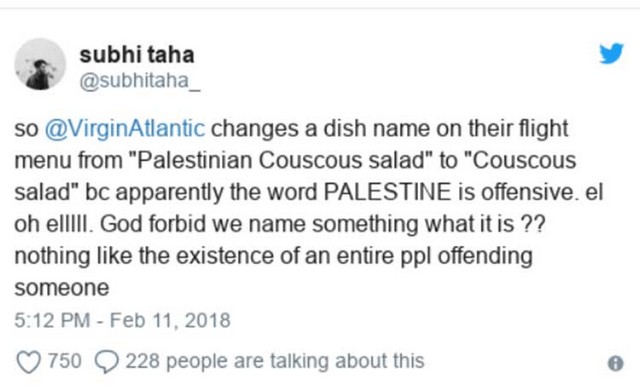
As soon as Virgin Atlantic Airlines introduced a couscous-style salad “inspired by the flavours of Palestine”, a controversy ensued. Israel’s supporters ignited a social media storm and sent many complaints to the company, obliging the airline to remove the reference to Palestine.

In the Zionist narrative, Palestine does not exist – nor is it allowed to exist – even if merely as a cultural conception.

The sad irony is that, while Israel appropriated Palestinian-Arabic couscous (the Palestinian dish, in particular, is known as ‘maftoul‘), branding and marketing it in western countries as ‘Israeli couscous’, its supporters go to every extent possible to erase any reference that may validate Palestinian Arab culture, whether Muslim or Christian.

This is an old habit, an endemic practice that dates back to the destruction of nearly 600 Palestinian villages and localities in 1947-48. Palestinians refer to these earth-shattering events as the ‘Nakba’, or catastrophe. Tellingly, Israel outlaws the use of the term or the commemoration of the tragic event in any way.

From claiming Palestinian Arab culinary culture as their own, to ‘Judaized’Arabic street names to rewriting history, Israel and its supporters are relentless.

Israel fears a Palestinian narrative because the Israeli government understands, and rightly so, that it is the collective Palestinian narrative that has compelled resistance, in all of its forms for over 70 years.

All attempts have failed, until recently.

The 1993 Oslo Accord is a critical juncture that shattered the cohesiveness of Palestinian discourse and weakened and divided the Palestinian people. However, it is not too late to remedy this through decisive and concentrated efforts that overcome the challenge of a Palestinian political viewpoint beholden to self-seeking political aspirations and competing factions.

In the absence of a Palestinian leadership populated by the Palestinian people themselves, intellectuals must safeguard and present the Palestinian story to the world with authenticity and balance. The clarity and integrity of the Palestinian story has been damaged and divided by Palestinian Authority (PA) tactics which remove Palestinian refugees’ right of return from their political platform.

Essentially, the story of Palestine is the story of the Palestinian people, for they are the victims of oppression and the main channel of Resistance, starting with the creation of Israel on the ruins of Palestinian villages. If Palestinians had not resisted, their story would have concluded right there and then and they, too, would have disappeared.

Those who admonish Palestinian Resistance, armed or otherwise, have little understanding of the psychological ramifications of resistance, such as a sense of collective empowerment and hope amongst the people. In his introduction to Frantz Fanon’s “Wretched of the Earth”, Jean-Paul Sartre describes violent resistance as a process through which “a man is re-creating himself”.

And for seven decades, Palestinians have embarked on this journey of the recreation of the “self”. They have resisted, and their resistance in all forms has moulded a sense of collective unity, despite the numerous divisions that have been erected amongst them.

Relentless resistance, a notion now embodied in the very fabric of Palestinian society, denied the oppressor the opportunity to emasculate Palestinians, or to reduce them to helpless victims and hapless refugees. The collective memory of the Palestinian people must focus on what it means to be Palestinian, defining the Palestinian people, what they stand for as a nation, and why they have resisted for years.

A new articulation of the Palestinian narrative is necessary, now more than ever before. The elitist interpretation of Palestine has failed, and is as worthless as the Oslo Accords. It is no more than a tired exercise in empty clichés, aimed at sustaining American political dominance in Palestine as well as in the rest of the Middle East.

The peace process is dead, but the Palestinian people are still resisting; unsurprisingly, the people are mightier than a group of self-centred individuals. Grassroots resistance is not constrained by the frivolous politicking of PA leader, Mahmoud Abbas, or any other actors.

Abbas and his men have not only muzzled the political will of the Palestinian people and falsely claimed to represent all Palestinians, they have also robbed Palestinians of their narrative, one that actually unites the ‘fellahin’ (peasants) and the refugees, the occupied and the ‘shattat’ (diaspora), into one distinct nation.

It is only when the Palestinian intellectual is able to repossess that collective narrative that the confines placed on the Palestinian voice can be finally broken. Only then can Palestinians truly confront the Israeli Hasbara and US-Western corporate media propaganda and, at long last, speak unhindered.

But there are obstacles, leading amongst them is the ruthless attempt by Zionist historians and institutions to replace the Palestinian historical narrative with their own. The story of the Palestinian cuisine on an airline menu may appear trivial in the greater scheme of things but it is significant, nonetheless.

In the Zionist Israeli narrative, Palestinians, if relevant at all, are depicted as drifting nomads, without a culture or tradition of their own, an inconvenience that hinders the path of progress – a duplicate narrative to the one that defined the relationship between every western colonial power and the resisting natives, always.

From the Zionist point of view, Palestinian existence is an inconvenience that was meant to be only temporary. “We must expel Arabs and take their places,” wrote Israel’s founding father, David Ben Gurion.

Assigning the Palestinian people the role of dislocated, disinherited and nomadic people without caring about the ethical and political implications of such false representations has erroneously presented Palestinians as a docile and submissive collective, to be wiped out by those more powerful.

Nothing could be further from the truth, and Palestinian resistance is the unremitting example of the strength and resilience of the Palestinian people. Palestinian culture is rooted, like the olive trees and mountains of Galilee.

Yes, the fight has been an arduous one. Between the rock of Israeli occupation and Hasbara and the hard place of Palestinian leadership acquiescence and failure, Palestine, Palestinians and their story have been trapped and misconstrued.

It is time for us to step up. We, as Palestinian writers, historians and journalists, assume the responsibility of reinterpreting Palestinian history and internalizing and communicating Palestinian voices, so that the rest of the world can, for once, appreciate the story as told by wounded, but tenacious, victors.

Ramzy Baroud is a journalist, author and editor of Palestine Chronicle.

22 February 2018

Source: https://countercurrents.org/2018/02/22/fight-couscous-palestinian-narrative-must-embraced/

As Israel tried to woo African states, it expels African refugees

By Afro-Middle East Centre

Israel’s controversial immigration policy will likely result in the forced deportation of thousands of African migrants to uncertainty. Israel has come under fire from the UN and some western countries. In Africa, the news has been met with silence, suggesting tacit African acceptance. This article examines the Israeli policy, discusses the risks faced by 38 000 African migrants (mostly refugees), and the complicity of certain African countries, and highlights Israel’s dual approach to Africa: strengthening ties with states, while expelling African asylum seekers

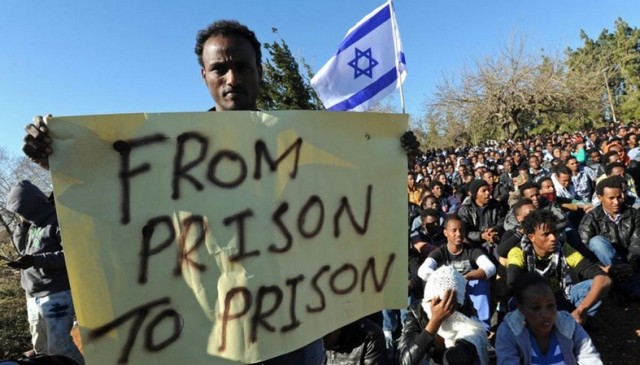
Israel began this year by announcing that African refugees (who are mostly from Sudan and Eritrea) faced imprisonment if they did not choose the controversial ‘voluntary departure package’ that the government was offering them before April. The package was part of an ultimatum to African migrants in Israel, allowing them two options: accept the $3 500 USD and leave to a ‘third country’ (said to be Rwanda or Uganda) or permanent incarceration in an Israeli jail. Rwanda and Uganda have denied agreeing to host African migrants deported from Israel, but evidence collected by the UN High Commissioner for Refugees (UNHCR) suggests otherwise. The decision to kick out around 20 000 African migrants comes as Israel embarked on a new strategy to rally African diplomatic support in international bodies. The UN and certain states – such as Canada – have condemned the Israeli migrant plan, but the African Union (AU) and most African countries remain silent on it, creating the perception that there is no substantial opposition to it.

African migration to Israel

Since 1950, Israel’s Law of Return has allowed the immigration of Jews from around the world, including from Ethiopia. African refugee migration to Israel began in the mid-2000s, and the numbers increased rapidly in the late 2000s. By late 2010, Israel received its highest number of African migrants, with between 30 000 and 45 000 entering through the Israeli-Egyptian border. Currently, around 38 000 African migrants – mainly asylum seekers from Eritrea and Sudan – live in Israel. The first wave of Sudanese migrants (mostly from the conflict-ravaged Darfur region) started arriving in Israel in December 2005 through Egypt. Due to the circumstances that forced them to flee Sudan, asylum seekers in Israel have a right to have a sur place refugee claim, and should automatically be recognised as such under the 1951 Convention relating to the status of Refugees.

The sur place refugees claim is also applicable to Eritreans, who fled widespread human rights violations, including forced conscription, forced labour and torture. Eritreans who evaded being drafted into the military face persecution if they return. Additionally, according to the UNHCR, many Eritrean migrants seeking asylum in Israel since 2004 have been Christians who faced abuses in Eritrea since 2002, qualifying them for refugee status and asylum in Israel under the 1951 Refugee Convention. Despite this, Israeli officials and Israel’s prime minister have continuously labelled African migrants ‘infiltrators’ who arrived in Israel for economic reasons. Moreover, many of the migrants in Israel do not enjoy asylum status as the application process is notoriously slow and hardly produces favourable outcomes for the migrants.

Asylum application in Israel is so slow that by the end of 2017 only 10 persons had been granted refugee status in response to 15 000 asylum applications since 2010. The slow and unresponsive process seemed to be changing in 2007 when the then-prime minister, Ehud Olmert, granted 500 temporary residence permits to migrants from Sudan under pressure from the UNHCR. This changed when Benyamin Netanyahu became prime minister. The current 38 000 African migrant number is after years of sporadic deportations of Africans to unnamed countries. They are concentrated in south Tel Aviv neighbourhoods, and are from among the refugees who arrived between 2006 and 2013. After Israel built a fence on its border with Egypt in 2013, the number of African migrants arriving through Egypt decreased drastically. Holot, a migrant detention centre in the Negev desert, currently houses 3 000 African migrants.

Holot was built in 2012, and has the capacity to house around 1 400 people at a time. It has been at the centre of Israel’s immigration policy towards African migrants. In November 2017, Israel announced plans to close the Holot centre and to deport the residents of the centre. It is over capacity with 3 000 African male migrants who do not possess residency or work permits. The Holot detainees are unable to work as they are required to report to the centre at specified times during the day. Migrants in other parts of Israel face similar challenges to those at Holot, and work illegally, facing exploitation and below minimum wage salaries. Israeli citizens who hire African migrants without permits face fines, and are required to deduct twenty per cent of their wages to put into a controversial ‘deposit fund’, thus making it near impossible for African migrants to survive.

Migrants regularly face abuse and ill-treatment from Israeli citizens, with many calling for their deportations. In August 2017, tensions came to a boil when south Tel Aviv residents protested the presence of African migrants. This was followed by a visit by Netanyahu, who promised to remove the ‘infiltrators’. The closure of Holot centre and the prior construction of a steel barrier fence at the Egypt-Israeli border form part of the various measures that Israel has taken to dramatically reduce the number of African migrants.

Africa’s (and South Africa’s) complicity

At the Egypt-Israel border stands a steel barrier that stretches for 242 kilometres, boasting five to seven metre high fences constructed of 35 000 tons of metal and steel. This gigantic barrier was to curb the influx of African migrants into Israel. The steel barrier intends to prevent African migrants from entering Israel through Egypt’s Sinai. The construction of the fence also saw contracts awarded to the Yehuda Fences Company, which is part of the Yehuda Group owned by the South African company Cape Gate. This is not Cape Gate’s first foray into illegal Israeli activities. In 2009 a report by the Palestinian Grassroots Anti-Apartheid wall campaign revealed that the company was complicit in maintaining and assisting with the construction of what Israel calls a ‘separation barrier’ and the organisation calls an ‘Apartheid Wall’.
The Israeli African migrants’ policy is being abetted by certain African countries that are said to be receiving deported migrants from Israel in exchange for financial compensation. The UNHCR reported that between December 2013 and June 2017, Israel deported 4 000 Sudanese and Eritrean asylum seekers under the ‘voluntary departure programme’ to Rwanda and Uganda. Both countries have denied claims that they had been complicit in Israel’s controversial plan. Although they deny having made deals with Israel to accept the migrants, the two countries have embraced Israel’s attempts to strengthen links with African states. In the wake of the recognition of Jerusalem as Israel’s capital by US president, Donald Trump, the UN passed a resolution rejecting the move; nine African states abstained, including Rwanda and Uganda, suggesting a solidification of links with Israel.

The silence of many African countries about the ill treatment of African migrants in Israel demonstrates complicity. The AU, in which Israel seeks to gain observer status, has not condemned the Israeli deportation plan, nor pronounced on reports that two of its member states, Rwanda and Uganda, have assisted Israel in its deportation and ill-treatment of African migrants.

Voluntary departure package

Israel’s being a signatory to the 1951 United Nations Convention on Refugees obligates it not to return refugees to a country where they face serious threats to their lives or freedom. Israel’s policy towards African migrants came into the spotlight around 2013 after the UN’s High Commissioner for Refugees (UNHCR) reported that Israel was offering a ‘voluntary departure’ ultimatum. Israel attempted  to redeem itself by stating that the plan did not include women and children, and targeted only males of working age. The UNHCR responded that the plan could not be considered ‘voluntary’ as both options given to the migrants threatened the life and freedom of the asylum seeker, and was thus in contravention of the 1951 Refugee Convention. By deporting the migrants back to their home countries, Israel placed their lives in more danger than they had previously faced.  This is especially significant  in the case of Sudanese migrants who, according to the UNHCR, faced jail sentences under Sudan’s Criminal Act, which prohibits citizens from visiting an enemy state, which Sudan considers Israel to be.

Having faced increased pressure from local and international groups to halt the deportations of migrants to their home countries, Israel revised the policy and included a component to allow refugees to choose to be deported to a ‘third’ country, which the UNHCR said was either Rwanda or Uganda. If migrants choose this option, they are given $3 500 USD to help them settle in the new country, an Israeli travel document, and a letter from the ‘third country’ guaranteeing a tourist visa upon arrival. Various Eritrean and Sudanese migrants who took this option and were deported to Rwanda have reported to the UNHCR that although they received the promised $3 500 USD, their documents were confiscated upon arrival and they could not apply for asylum. Further, they claim, immigration officials in Rwanda extorted money from them and ultimately trafficked them to Uganda where they face imprisonment for entering the country illegally.

In a recent twist, in its efforts to accelerate these deportations, the Israeli Population and Immigration Authority has offered an incentive to Israeli civilians to serve as ‘inspectors’ and implementers by forcibly removing African migrants from Israeli neighbourhoods. Under this offer, civilians are recruited as ‘inspectors’ who will rout out migrants who do not take up the ‘voluntary departure’ deal. The main targets under this new plan are African migrants residing in the greater Tel Aviv area. Once the ‘inspectors’ have identified those willing to take the departure package, they will facilitate the paperwork for their departure as well as monitor their entry to the third country. These inspectors will receive an incentive of $8 700 USD per deported person for a two-month period – higher than the total sum of $3 500 offered to the Africans who accept the deal and the $5 000 USD reported to be given to Rwanda and Uganda for each migrant they receive.

Conclusion

Israel insists the majority of African migrants in Israel are not asylum seekers but economic migrants. The UNHCR claims most of them are from Eritrea and Sudan and fled war and persecution, which qualifies them as asylum seekers and refugees. The controversial ‘voluntary departure’ package, the barrier fence on the Egypt-Israeli border, and the plan to close the Holot refugee detention centre signals Israel’s commitment to rid the country of ‘infiltrator’ African migrants seeking refuge. The African migrants have been given until April this year to take up the ‘voluntary departure’ package or face permanent jail detention, prompting widespread protests from the migrants and local human rights groups. Israel has also been condemned by the UN and some western countries, but the silence and the complicity of African countries in this controversial African migrants’ policy leaves little hope for the migrants. With this plan to rid itself off African refugees, Israel adds to its list of human rights and international law violations.

AMEC insights is a series of publicly-accessible publications, providing trenchant analyses of topical issues related to the Middle East and North Africa. If you want to be added to our mailing list, please email info@amec.org.za

23 February 2018

Source: http://www.amec.org.za/israel/item/1559-as-israel-tried-to-woo-african-states-it-expels-african-refugees.html

Statement of the Libyan National Popular Movement on the Seventh Anniversary of the February Conspiracy.

By Libyan National Popular Movement

Today comes the seventh year of the international conspiracy, in which obscurantist forces and Libyan agents participated in the war against Libya and its safe people, where innocent people were hurled to take part through the launching of false slogans by a media campaign carried out by excessive regional and international mass media machines.

It is a conspiracy that was finally accomplished by eight months of a prolonged heavy military action that the NATO had carried out since the Second World War, resulting in the destruction of the total civilian and military infrastructure of the country. The Libyan people had steadfastly withstood with unbridled courage and limited capabilities giving tens of thousands of martyrs.

The enemies of the Libyan people were able to take control of Libya, with the help of the NATO military forces, the international propaganda capabilities and the money of the reactionary Arab countries. They carried out large-scale repression operations of which no Libyan city, village or family was safe. They set up thousands of camps under the supervision of hateful criminals, where honest Libyans have suffered the most terrible categories of torment; hundreds of thousands of Libyan families have been displaced, and their homes, towns  and villages destroyed and; tens of thousands of Libyans have been killed in  cold blood. Moreover, the Libyan territory has been violated by all international intelligence agencies and international terrorist organizations and criminal gangs. Terrorists and criminals managed to take hold of the reins of the state and turned Libya into a base for international terrorism and a hotbed of organized crime.

Thieves and international mafia seized control of the economic institutions, plundering the money saved by Al-Fateh revolution for future generations. All kinds of crimes that Libyans had never thought of spread all over the country.

The central state disintegrated in favor of regional militias’ control, whereby Libya tuned into warring areas, security has become completely non-existent, and fear and terror spread on a large scale. Furthermore, all service sectors collapsed, and the lives of the Libyans returned to what they had been in the 1950s and 1960s, with no electricity, no medicine, no nutrition, and no money.

The February conspiracy has been a black era in Libya’s history. Our people realized its danger early and continued to resist it by all means, until in May 2015, they succeeded in rebuilding part of the armed forces that launched the Dignity Operation to restore the country from chaos, terrorism and foreign tampering, succeeding in liberating large parts of Libya from the grip of terrorism and criminality.

The Libyan National Popular Movement, as it peacefully fights against the February conspiracy, would like to highlight to the Libyan Arab People the following:

Firstly:

The suffering of our people in all walks of life is a result of this conspiracy, which had as one of its aims the humiliation of the Libyan Arab people, uprooting their lands and plundering their wealth. This catastrophe can only be overcome by the unity of the Libyan Arab people in the face of conspiracy and by collective struggle until it is overthrown.

Secondly:

The responsibility of the situation must be borne by the terrorist organizations, which are disguised in religious attire, and the foreigners of Libyan origin who have acted as spies against Libya. Thus, the country can only be salvaged by the elimination of their power and keeping their hands off from harming the Libyans.

Thirdly:

All attempts by the aggressor states and their agents to put forward political projects to turn the conspiracy and its consequences into a political and social reality in Libya have failed. The National Popular Movement calls on all national forces to work together to put forward a national salvation project away from the futility of foreign hands. Such project shall be based on the notion that Libya is an independent unified country, full equality between the Libyans, and the removal of the effects of the conspiracy, through central national institutions away from ideological, regional and tribal polarizations.

Fourthly:

The Libyan National Popular Movement renews its full support to the armed forces and the security services to establish security and impose stability, which is a condition for any viable political solution. It renews the call to all officers and soldiers to the need to rejoin their ranks and fulfill their duty to defend Libya and the Libyans against the aggression of the covetous and the terror of criminals and terrorists.

Fifthly:

The Movement emphasizes that no national dialogue and no political solution will succeed without the immediate release of all prisoners held in the prisons of the militias; return of the dislodged and the displaced to their homes, cities and villages, reparation and retrieval of grievances; abolition of all prosecutions of national leaders; and abolition of all exclusionary laws. In this context, the Movement renews its rejection of any dialogue with terrorists and organizations disguised in religion and rejects all desperate attempts to recycle and integrate them into the political process.

Sixthly:

The Libyan National Popular Movement rejects the policy of revenge and the fulfillment of rights by force, calls for the return of the just judicial system to deal with its effects by law, and believes in the importance of achieving national reconciliation based on restorative justice.

Seventhly:

The Movement appeals to all Libyan elites from all parties to highlight the importance of emerging from the cycle of conflict over the past and the search for serious remedies for the crisis of the homeland. It declares its readiness to work with all national forces to implement effective solutions to get out of the current crisis.

Eighthly:

The Libyan National Popular Movement reminds of the primary responsibility  of the foreign intervention for the negative conditions the country has arrived to and renews the call to the international community to shoulder its responsibilities regarding the humanitarian and security suffering of the Libyan people. It appeals to Mr. Ghassan Salameh, the head of the United Nations Support Mission to make serious efforts to resolve the political crisis and expresses its distress to the frustration caused by the failure to carry out any of the steps announced by Mr. Ghassan Salameh in what was known as the Resolution Salameh Plan. It shows that a feeling of bitterness began to infiltrate the Libyan people that the Plan is nothing but a time-gain in a desperate attempt to pass the failed Skheirat Plan.

Ninthly:

The Libyan National Popular Movement considers all the successive governments and institutions that have been produced by the February Conspiracy and controlled the fate of the Libyan people responsible for all the political, economic and social crimes and the damage done to the Libyan people. Furthermore, it considers such transgressions crimes against humanity the perpetrators of which must be tried in their legal and personal capacities before a just legal system and pursuing the escapees and not dropping their crimes by prescription.

The Movement also calls upon the African Union, all freedom and peace loving peoples, as well as all regional and international organizations, to shoulder their political, moral and legal responsibilities to support the Libyan people and help them overcome the crisis imposed on them.

Tenthly:

The Libyan National Popular Movement holds the international community and all its legal and political institutions responsible for looting the frozen Libyan funds and investments abroad and for tampering with its resources and wealth.

Eleventh:

The National Popular Movement condemns the local, regional and international silence on the suffering of the inhabitants of Tawergha who had been unjustly and aggressively kicked out of their city and calls upon the national forces in Misrata to urgently end the violations of the rights of these people, which are committed by the criminal militias in Misrata for. It also calls for the intensification of popular struggle to assure the return of dislodged and displaced people, individually and collectively, to their homes and cities and to compensate them for the damage.

In conclusion, the Movement renews its firm belief in the ability of the Libyan people, who defeated the Italian colonialism, overthrew the reactionary regime, expelled foreign bases, and carved for Libya a leading position above the ground and their ability to achieve the resounding victory.

Greetings to the righteous martyrs who gave their lives to the homeland, led by the martyr Muammar Gaddafi and the hero Abu Bakr Younis Jaber.

Peace be upon the heroic prisoners, the steadfast dislodged, and the persevering displaced.

Freedom the the Homeland and Sovereignty for the People

The Libyan National Popular

17 February 2018

Where’s the evidence Assad used sarin gas on his people?

By Ian Wilkie

The best way to analyze chemical weapons events in Syria is to try to discern who is providing evidence, why they are presenting evidence and what that evidence comprises.

Since the United States’ false Weapons of Mass Destruction (WMD) presentation in the U.N. Security Council led to an illegal, unjustified war in Iraq, it is only prudent to question the motivations of people accusing others of WMD war crimes and demanding regime change based on these allegations.

Secretary of Defense James Mattis made it very clear recently that “aid groups and others” had provided the U.S. with evidence that was insufficient to conclude that President Bashar Assad had recently used the chemical weapon Sarin against Syrian civilians. In other words, the Pentagon does not believe what has been presented to it as evidence, chiefly because of the dubious provenance of the providers.

The importance of the evidence source is critical in Syria because the jihadis arrayed against Assad ascribe to a doctrine of deception called taqiyya. Taqiyya fully supports and condones behavior such as chemical weapons “false flags” to gain advantage against infidel enemies on the ground.

My experience with chemical weapons goes back decades to when I was trained to fight in Mission Oriented Protective Posture (MOPP) chemical gear under the threat of Tabun and VX, deadly organophosphate poisons that kill unprotected personnel within minutes. These substances are even more lethal than Sarin and the infantry took very seriously their presence in the enemy’s quiver.

Since then, as a counter-terrorism practitioner and cleared contractor, I have become even more well versed in their technical characteristics to the point that the former Central Intelligence Agency Counter-WMD chief has interviewed me on the record about chemical and other WMD.

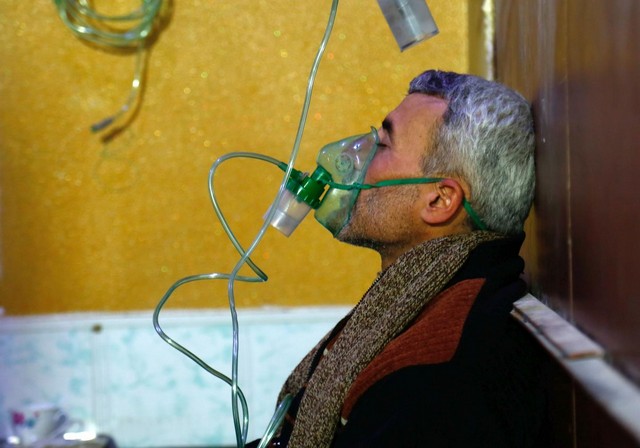
MilSpec Sarin is clear, odorless and invisible. The “Sarin events” in Ghouta and Khan Sheikhoun did not employ military-grade Sarin munitions. They produced dirty yellow, chlorine-smelling clouds, which suggest either: (a) manufacture by other than scientists of the Syrian Scientific Research Council or (b) an “accidental” bomb drop that hit stored chemicals on the ground, but not (c) delivery of military grade munitions against rebel military targets.

Note that I am not trying to make a case for any given scenario; I am merely suggesting that the Assad regime’s culpability is vastly under-proven by the public evidence.

Many videos of the White Helmets show them engaged in dubious staging of events, including one from Khan Sheikhoun which shows Uzbek (White Helmet) jihadis engaged in questionable evidence collection. To rely on anything that the White Helmets provide is to share, as we lawyers would call it, the fruit of the poisoned tree, or precisely what Secretary Mattis is alluding to.

Chemical weapons (CW) are ghastly, immoral and a red line since even before that term was made popular. The impetus to use chemical weapons is not a strong one since the world will not sit idly by when people anywhere are killed like poisoned rats. President Assad knows this.

He is under the gun, as it were, and under the glare of thousands of cameras. His motivation not to use CW is immense.

If America did, for example as it alleges in an official White House report, have evidence it calls “our information” regarding the Shayrat airbase “Sarin attack” being prepared, then why not show this?

The intelligence community was more than willing to show Khrushchev’s missiles, but they have no ability to share evidence with the public about Assad today? This defies credulity and calls the “evidence” provided in the White House memorandum into question.

Russia and Syria offered the U.S. and U.N. investigators access to the Shayrat airbase, but inspectors refused to go and take samples. Likewise, Khan Sheikhoun was deemed too dangerous to inspect, even though American and English “experts” were in regular contact with the White Helmets on the ground, one of whom, Dr. Shajul Islam, is an accused kidnapper of Westerners.

Such evidence as has been provided to the world is not National Security Agency intercepts, satellite photos or the testimony of named intelligence community officials, but the quasi-paid promotional material of regime change boosters such as the White Helmets (a UK government-backed, soldier-founded “medical charity”), the Syrian Observatory for Human Rights (a one-man propaganda shop whose founder is in contact with multiple Islamic State commanders) and tiny bellingcat who made an obvious call on MH17 and used that investigative “coup” to push for yet more interference in the affairs of nations deemed overly pro-Russian or pro-Iran.

Never once have these propagandists analyzed evidence objectively, preferring to shoot the messengers such as myself by making ridiculous comparisons to tragedies like the Sandy Hook school shooting in America and misguided theories surrounding them.

The best analysis is apolitical analysis, and these groups have shown they have a policy outcome to push, i.e. regime change, not the truth. One need not admire Putin or Assad to exculpate them, if that is where the evidence leads. The war in Syria is a meat grinder. People are dying of disease and starvation as well as high explosives, missiles and, occasionally, chemicals.

The use of a banned weapon, even if proven, should not obscure the fact that a majority of deaths and injuries in Syria do not come from unconventional weapons, but more traditional means of killing, bombs and bullets, many provided by America via the “good offices” of the CIA.

America wrote the book on WMD and chemicals. We used nuclear weapons against Japan twice and cancer-causing chemical defoliants against Vietnam. There are even credible allegations that U.S. assistance was given to Saddam Hussein in connection with Sarin attacks on Iranian forces.

To focus on the Ghouta and Khan Sheikhoun tragedies to paint Assad as an even more diabolical war criminal than he already is rings facile and hollow. Nobody puts down a rebellion, especially a terrorist-enabled one, by following the laws of war.

Even Abraham Lincoln couldn’t do it and look at where that got him.

Ian Wilkie is an international lawyer and terrorism expert and a veteran of the U.S. Army (Infantry). He is working on a book about the potential uses of WMD by terrorists entitled “Checkmate: Jihad’s Endgame.”

17 February 2018

Source: http://www.newsweek.com/wheres-evidence-assad-used-sarin-gas-his-people-810123

Regime Change Fails: Is A Military Coup or Invasion Of Venezuela Next?

Co-Written By Kevin Zeese and Margaret Flowers

Speaking at his alma mater, the University of Texas, on February 1, Secretary of State Tillerson suggested a potential military coup in Venezuela.  Tillerson then visited allied Latin American countries urging regime change and more economic sanctions on Venezuela. Tillerson is considering banning the processing or sale of Venezuelan oil in the United States and is discouraging other countries from buying Venezuelan oil. Further, the US is laying the groundwork for war against Venezuela.

In a series of tweets, Senator Marco Rubio, the Republican from Florida, where many Venezuelan oligarchs live, called for a military coup in Venezueala.

How absurd — remove an elected president with a military coup to restore democracy? Does that pass the straight face test? This refrain of Rubio and Tillerson seems to be the nonsensical public position of US policy.

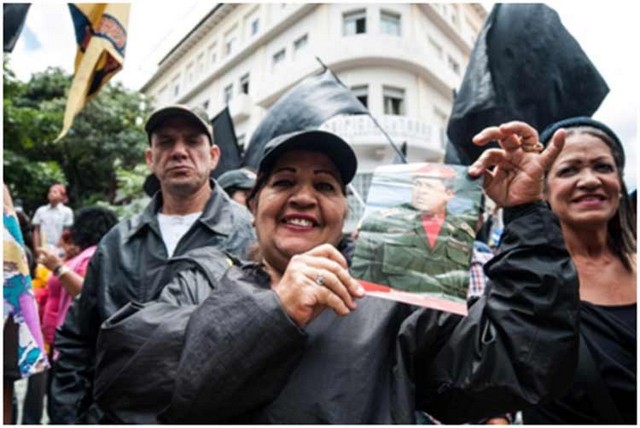
The US has been seeking regime change in Venezuela since Hugo Chavez was elected in 1998. Trump joined Presidents Obama and Bush before him in continuing efforts to change the government and put in place a US-friendly oligarch government.

They came closest in 2002 when a military coup removed Chavez. The Commander-in-Chief of the Venezuelan military announced Chavez had resigned and Pedro Carmona, of the Venezuelan Chamber of Commerce, became interim president. Carmona dissolved the National Assembly and Supreme Court and declared the Constitution void. The people surrounded the presidential palace and seized television stations, Carmona resigned and fled to Colombia. Within 47 hours, civilians and the military restored Chavez to the presidency. The coup was a turning point that strengthened the Bolivarian Revolution, showed people could defeat a coup and exposed the US and oligarchs.

US Regime Change Tactics Have Failed In Venezuela

The US and oligarchs continue their efforts to reverse the Bolivarian Revolution. The US has a long history of regime change around the world and has tried all of its regime change tools in Venezuela. So far they have failed.

Economic War
Destroying the Venezuelan economy has been an ongoing campaign by the US and oligarchs. It is reminiscent of the US coup in Chile which ended the presidency of Salvador Allende. To create the environment for the Chilean coup, President Nixon ordered the CIA to “make the economy scream.”

Henry Kissinger devised the coup noting a billion dollars of investment were at stake. He also feared the “the insidious model effect” of the example of Chile leading to other countries breaking from the United States and capitalism. Kissinger’s top deputy at the National Security Council, Viron Vaky, opposed the coup saying, “What we propose is patently a violation of our own principles and policy tenets .… If these principles have any meaning, we normally depart from them only to meet the gravest threat . . . our survival.”

These objections hold true regarding recent US coups, including in Venezuela and Honduras, Ukraine and Brazil, among others. Allende died in the coup and wrote his last words to the people of Chile, especially the workers, “Long live the people! Long live the workers!” He was replaced by Augusto Pinochet, a brutal and violent dictator.

For decades the US has been fighting an economic war, “making the economy scream,” in Venezuela. Wealthy Venezuelans have been conducting economic sabotage aided by the US with sanctions and other tactics. This includes hoarding food, supplies and other necessities in warehouses or in Colombia while Venezuelan markets are bare. The scarcity is used to fuel protests, e.g. “The March of the Empty Pots,” a carbon copy of marches in Chile before the September 11, 1973 coup. Economic warfare has escalated through Obama and under Trump, with Tillerson now urging economic sanctions on oil.

President Maduro recognized the economic hardship but also said sanctions open up the opportunity for a new era of independence and “begins the stage of post-domination by the United States, with Venezuela again at the center of this struggle for dignity and liberation.” The second-in-command of the Socialist Party, Diosdado Cabello, said, “[if they] apply sanctions, we will apply elections.”

Opposition Protests
Another common US regime change tool is supporting opposition protests. The Trump administration renewed regime change operations in Venezuela and the anti-Maduro protests, which began under Obama, grew more violent. The opposition protests included barricades, snipers and murders as well as widespread injuries. When police arrested those using violence, the US claimed Venezuela opposed free speech and protests.

The opposition tried to use the crack down against violence to achieve the US tactic of  dividing the military. The US and western media ignored opposition violence and blamed the Venezuelan government instead. Violence became so extreme it looked like the opposition was pushing Venezuela into a Syrian-type civil war. Instead, opposition violence backfired on them.

Violent protests are part of US regime change repertoire. This was demonstrated in the US coup in Ukraine, where the US spent $5 billion to organize government opposition including US and EU funding violent protesters. This tactic was used in early US coups like the 1953 Iran coup of Prime Minister Mossadegh. The US has admitted organizing this coup that ended Iran’s brief experience with democracy. Like Venezuela, a key reason for the Iran coup was control of the nation’s oil.

Funding Opposition
There has been massive US investment in creating opposition to the Venezuelan government. Tens of millions of dollars have been openly spent through USAID, the National Endowment for Democracy and other related US regime change agencies. It is unknown how much the CIA has spent from its secret budget, but the CIA has also been involved in Venezuela. Current CIA director, Mike Pompeo, said he is “hopeful there can be a transition in Venezuela.”

The United States has also educated leaders of opposition movements, e.g. Leopoldo López was educated at private schools in the US, including the CIA-associated Kenyon College. He was groomed at the Harvard Kennedy School of Government and made repeated visits to the regime change agency, the National Republican Institute.

Elections
While the US calls Venezuela a dictatorship, it is in fact a strong democracy with an excellent voting system. Election observers monitor every election.

In 2016, the economic crisis led to the opposition winning a majority in the National Assembly. One of their first acts was to pass an amnesty law. The law described 17 years of crimes including violent felonies and terrorism committed by the opposition. It was an admission of crimes back to the 2002 coup and through 2016. The law demonstrated violent treason against Venezuela. One month later, the Supreme Court of Venezuela ruled the amnesty law was unconstitutional. US media, regime change advocates and anti-Venezuela human rights groups attacked the Supreme Court decision, showing their alliance with the admitted criminals.

Years of violent protests and regime change attempts, and then admitting their crimes in an amnesty bill, have caused those opposed to the Bolivarian Revolution to lose power and become unpopular.  In three recent elections Maduro’s party won regional,  local and the Constituent Assembly elections.

The electoral commission announced the presidential election will be held on April 22. Maduro will run for re-election with the United Socialist Party. Opposition leaders such as Henry Ramos and Henri Falcon have expressed interest in running, but the opposition has not decided whether to participate. Henrique Capriles, who narrowly lost to Maduro in the last election, was banned from running for office because of irregularities in his campaign, including taking foreign donations. Capriles has been a leader of the violent protests. When his ban was announced he called for protests to remove Maduro from office. Also banned was Leopoldo Lopez, another leader of the violent protests who is under house arrest serving a thirteen year sentence for inciting violence.

Now, the United States says it will not recognize the presidential election and urges a military coup. For two years, the opposition demanded presidential elections, but now it is unclear whether they will participate. They know they are unpopular and Maduro is likely to be re-elected.

Is War Against Venezuela Coming?

A military coup faces challenges in Venezuela as the people, including the military, are well educated about US imperialism. Tillerson openly urging a military coup makes it more difficult.

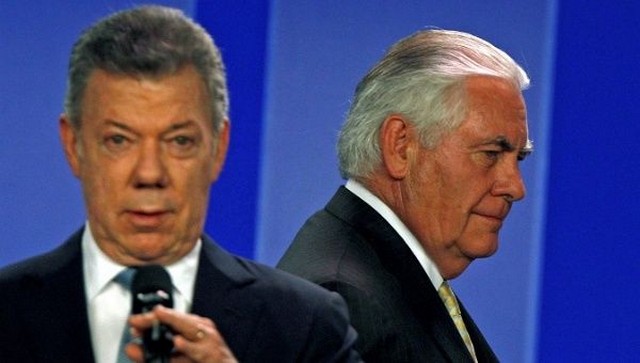
The government and opposition recently negotiated a peace settlement entitled “Democratic Coexistence Agreement for Venezuela.” They agreed on all of the issues including ending economic sanctions, scheduling elections and more. They agreed on the date of the next presidential election. It was originally planned for March, but in a concession to the opposition, it was  rescheduled for the end of April. Maduro signed the agreement even though the opposition did not attend the signing ceremony. They backed out after Colombian President Santos, who was meeting with Secretary Tillerson, called and told them not to sign. Maduro will now make the agreement a public issue by allowing the people of Venezuela to sign it.

Not recognizing elections and urging a military coup are bad enough, but more disconcerting is that Admiral Kurt Tidd, head of Southcom, held a closed door meeting in Colombia after Tillerson’s visit. The topic was “regional destabilization” and Venezuela was a focus.

A military attack on Venezuela from its Colombian and Brazilian borders is not far fetched. In January, the NY Times asked, “Should the US military invade Venezuela?” President Trump said the US is considering US military forceagainst Venezuela. His chief of staff, John Kelly, was formerly the general in charge of Southcom. Tidd has claimed the crisis, created in large part by the economic war against Venezuela, requires military action for humanitarian reasons.

War preparations are already underway in Colombia, which plays the role of Israel for the US in Latin America. The coup government in Brazil, increased its military budget 36 percent, and participated in Operation: America United, the largest joint military exercise in Latin American history. It was one of four military exercises by the US with Brazil, Colombia and Peru in Latin America in 2017. The US Congress ordered the Pentagon to develop military contingencies for Venezuela in the 2017 National Defense Authorization Act.

While there is opposition to US military bases, James Patrick Jordan explains, on our radio show, the US has military bases in Colombia and the Caribbean and military agreements with countries in the region; and therefore, Venezuela is already surrounded.

The United States is targeting Venezuela because the Bolivarian Revolution provides an example against US imperialism. An invasion of Venezuela will become another war-quagmire that kills innocent Venezuelans, US soldiers and others over control of oil. People in the United States who support the self-determination of countries should show solidarity with Venezuelans, expose the US agenda and publicly denounce regime change. We need to educate people about what is really happening in Venezuela to overcome the false media coverage.

Share this article and the interview we did on Clearing The FOG about Venezuela and the US’ role in Latin America.  The fate of Venezuela is critical for millions of Latin Americans struggling under the domination of US Empire.

Kevin Zeese and Margaret Flowers are directors of Popular Resistance

14 February 2018

Source: https://countercurrents.org/2018/02/14/regime-change-fails-military-coup-invasion-venezuela-next/

The Combat Order Was Given to Colombia on War Against Venezuela

By Sergio Rodriguez Gelfenstein

War preparations already began.
International media loudly spread the idea that Secretary of State Rex Tillerson’s trip to Latin America and the Caribbean was designed to align the region against Venezuela and pressure Caracas by increasing economic sanctions, but Tillerson was also trying to push the regional leaders to support the United States and Colombia’s intentions of a military aggression against Venezuela. That’s the reason he visited some of his closest allies, including those that have been particularly aggressive against Venezuela. The visit to Jamaica, a close Caribbean ally to the United States, had the aim to attract the smaller countries of the region who have so far firmly resisted all kinds of threats from the United States, pushing them to stop their support for Venezuela. In the political realm, Jamaica was the least important in Tillerson’s trip, but it was the most precious stop in diplomatic terms.
However, the tour main objective, as Tillerson made clear before starting traveling, was to counter Rusia and China increasing influence in Latin America and the Caribbean, expressed in a strong and progressive cooperation agenda. It’s not a coincidence that Tillerson’s trip had taken place almost immediately after the Second Ministerial China-CELAC (Community of Latin American and Caribbean States) forum in Santiago de Chile, with the presence of China’s Minister of Foreign Affairs Wang Yi.

Just as Jamaica was Tillerson’s most important stop in diplomatic terms, Colombia was the most transcendental stop in operative terms for refining the details of the aggression. I point to the evidence.In this context, the main strategic objective was Venezuela. In that logic, showing its disdain for the Caribbean countries, Mexico represented the possibility of knowing how much oil could they provide to “buy off” the leaders of those island nations, in order to “free them from the obligation” of receiving Venezuelan oil and to keep trying the diplomatic way towards the Seventh Summit of the Americans, to take place in Lima next April. He traveled with the same goal to Peru, a country where the current president is allied with the former dictator Fujimori’s party. Peru will host the international meeting, which intents to expel Venezuela from the Panamerican system. Argentina was inspected by Tillerson to reaffirm it would take the responsibility of politically conducting the aggression, before the imminent exit of Bachelet and Heraldo, who played that role until now, as the United States are certain that Piñera, his Chancellor Ampuero and the pro-Pinochet cabinet that will take over Chile’s government, are not capable of leading the aggression against Venezuela.

If we accept Von Clausewitz’ core idea, which says that “war is the extension of politics by other means,” to which Lenin adds “by violent means,” we would have to affirm that the “order was given,” as is said in military terms. From Colombia (could’ve been from Santos or from Tillerson), the opposition received the order to not sign the agreement previously reached with the government in Santo Domingo, having the Dominican President Danilo

Medina and Spanish former Prime Minister Jose Luis Rodriguez Zapatero as witnesses. If we see things that way, we would have to recognize that when Santos, Macri and others say they will not recognize the Venezuelan elections’ outcomes, they are telling the opposition they wouldn’t be recognized even if they won, because war is the only way they know. That’s why the agreement wasn’t signed.

War preparations already began. In Catatumbo, a North of Santander Department region bordering Venezuela, specifically in the Tibu and Tarra communities, illegal armed groups have taken over control of security, without the army, police or state institutions doing anything to avoid it. These terrorist groups seized the opportunity, as the FARC 33 front disappeared from the zone, to operate with complete impunity. In the same department’s Villa del Rosario, the “Los Pelusos” armed group and the self-referred Gaitanist Self-defense of Colombia (AGC) are taking over six neighborhoods (Galan, La Palmita, Pueblito Español, Montevideo, Primero de Mayo and San Jose) of this 90 thousand people city, in which they have been deploying to prepare Venezuela’s invasion, in front of the eyes of the army and Colombia’s authorities.

Drills have been seen in the US Military bases in Colombia. Also, 415 US Air Force members arrived illegally to Panama, before the government had authorized their presence in the country, as the Panamanian political analyst from Panama Marco A. Gandasegui H. has pointed out before. Also, in June of last year, the military did the Tradewinds 2017 drills in Barbados, less than 1,100 kilometers away from the Venezuelan coast, and the AmazonLog17 drills in the Brazilian Amazon, with troops from Brazil, Colombia and Peru, November last year, only 700 kilometers from the border with Venezuela.There is a presence of armed groups in eight of the ten communes that compose the city of Cucuta. Paramilitary has control over areas in Los Patios, Villa del Rosario, San Cayetano, La Parada, Juan Frio, La Uchema, Palo Gordo, Ragonvalia and Puerto Santander under the command of Luis Jesus “Cochas” Escamilla Melo, chief of the Paramilitary Army of the North of Santander (EPN). The Los Rastrojos group also operate in the border city. In Venezuela, the group has a presence in Llano Jorge and San Antonio del Tachira. Despite the people’s call for the national, regional and local government, the authorities suspiciously ignore this obvious violence against the citizens and threat to Venezuela.

The most elemental theory shows that, independently from the characteristics of a foreign military aggression, the success depends on the existence of an internal front. That’s how it was in Afghanistan, Iraq and Lybia. In Yemen, they didn’t have it and they had to hire war mercenaries. By coincidence, the biggest recruitment came from Chile (from former members of Pinochet’s repressive forces) and Colombia (from members of the several paramilitary groups that operate in Colombia). The problem is that the United States wasn’t able to build that required internal front. Nobody imagines Henry Ramos Allup, Julio Borges or Henrique Capriles commanding troops secretly or from some mountain in the national territory. That’s why they gave Oscar Perez the role the opposition leaders couldn’t assume. Those who were not capable of leading the movement against the government, nor managing a democratic parliament, nor taking a street insurrection to victory, and not even attract a sector of the armed forces for their obscure plans, they would hardly be able to conduct an armed group.

That’s the responsibility the Imperial Chancellor has given to Santos, the Colombian oligarchy and its government. Before, in Obama’s times, he was ordered to make peace with the FARC in order to dismantle one of the only military forces, along with the ELN, that could’ve countered the actions of the paramilitary army protected by Uribe and Santos.

However, the show began before Tillerson’s arrival to Bogota: already in November last year, Lorenzo Mendoza was in that city. A month after, the former prosecutor Luisa Ortega, her husband, someone called Ferrer, the “union leader” Marcela Maspero and the “magistrates” sent by Ramos Allup and Borges, that wander around the world looking for something to do and how to survive, reunited also in Bogota before New Year’s Eve to try to find legal foundations for the invasion. A month later, well-known people from Venezuelan opposition traveled to Bogota and reunited with radical Venezuelan groups in Usaquen, with support from Colombian authorities.

Colombia’s Internal Revenue Service Minister Mauricio Cardenas said again in Davos, Suiza, that the fall of Maduro was inevitable and spoke about the necessity of an economic plan to deal with the situation. This is the same minister that has done nothing to solve his country’s problem of 8 million displaced and relocated people. He also hasn’t provided an answer for the Mocoa city’s reconstruction, the capital of Putumayo department, almost a year after the tragedy that destroyed it.

In that same order, Monsignor Hector Fabio Henao, national secretary of the Social Pastoral of Colombia and member of the same political party that makes up the Venezuelan Episcopal Conference, who under the command of Cardinal Parolin opposes Pope Francis, is setting his “human aid” for Venezuela plot, without saying anything of the thousand of wayuu children that die from malnutrition on a daily basis, or the hundreds of social and human rights activists that have been murdered in the last weeks in Colombia, the last of which was Temistocles Machado, who moved the country for his leadership and loyalty towards his community. Also, Henao and his mentor Santos don’t speak about the abuses to Colombians that want to come back to their country from Venezuela, and who are segregated and harmed for confessing also having Venezuelan citizenship.

While Colombia falls apart, with a 10 percent unemployment rate; a virtual education strike in the next days ;and the fall of the Chirajara bridge (even though it was awarded with the national engineering prize) that no one will speak about, in spite of the 9 innocent Colombian citizens that died on the accident, because it was built by Coviandes, a company belonging to the richest person in the Colombia Carlos Sarmiento Angulo; and while a high, high ranking officer (so high people say that if he falls, the whole country will shake) protects himself cowardly in his armor after a rape accusation against him by a renowned journalist, Santos is worried about Venezuela.

The truth is his party is gone, he has no candidate and doesn’t know what he’s going to do to guarantee impunity at the brink of disaster… or he knows: he hopes to clean his sins directing the attack to Venezuela and seeking redemption from the north. He has until August 10. We must stop it, the Venezuelan people will stop it!

13 February 2018

Source: https://cuba-networkdefenseofhumanity.blogspot.my/2018/02/the-combat-order-was-given-to-colombia.html

Millions of Americans Are Among the Poorest People in the World

By Paul Buchheit

In 2015 it was reported that up to 50 million American adults had negative wealth and thus numbered among the poorest 10% of the world’s adults. This was disputed by Vox writer Matthew Yglesias, who said, “..that’s absurd. The poorest people in the world are the people with rock-bottom material living standards.”

It’s difficult for many Americans to admit the truth about extreme poverty in our country. Our poorest citizens may not be living in a farming village where they eat millet soup and walk a mile for water. But they have to deal with homelessness, alcoholism, mental health disease, opioid addiction, stress-inducing indebtedness and inequality, and pollution levels that are the highest in the developed world. All of that makes for rock-bottom living standards. According to Credit Suisse data over the past three years, anywhere from 4 to 10 percent of the world’s poorest decile are Americans. That’s 20 to 50 million adults. It’s likely that many of them are only temporarily in debt, and that they have a much better chance than a third-world villager to climb out of poverty. But it’s just as likely that they’ll be replaced by other impoverished Americans, especially with an aging population woefully unprepared for retirement, and with the great majority of new job prospects temporary or contract-based, without security or benefits.

A Second Denial

“There are millions of Americans whose suffering, through material poverty and poor health, is as bad or worse than that of the people in Africa or in Asia.” That’s the conclusion of Princeton researcher Angus Deaton, who along with his wife Anne Case documented the “marked deterioration in the morbidity and mortality of middle-aged white non-Hispanics in the United States after 1998.” In a recent opinion he cites the rising mortality rates from drugs, alcohol and suicide. Based on World Bank and Oxford numbers, he estimates that over 5 million Americans are absolutely poor by global standards.

Again a Vox writer takes exception, this time Ryan Briggs, who argues that “poor people in rich countries often receive many non-cash benefits that boost consumption without boosting income.” But it goes both ways. As Deaton points out: “An Indian villager spends little or nothing on housing, heat or child care, and a poor agricultural laborer in the tropics can get by with little clothing or transportation.” Overall, the cost of living is much lower in such places. More importantly, among a deeply troubled class of Americans there are aspects of life that too often outweigh the cash or non-cash benefits. For that we need to look more closely at the meaning of poverty.

Poverty Is Not Just an Income Number

Using a “dollar a day” estimate to compare poverty levels is impossible. A Brookings report notes: “There is a sad irony in the fact that the analytical tools used to assess welfare in the U.S. are poorly equipped to capture those whose lives are most precarious.” Furthermore, it’s an insult to desperate Americans to suggest that their state in life is better than they might think.

Poverty is not just the few dollars a day coming into the household, cash or non-cash. There is poverty in the diminishing quality of life for the bottom half of America. Poverty is the stress of overwhelming debt; the inability to pay for medical treatment during years of declining health; the lack of community support as part of a true safety net; the near-absence of retirement savings for over half the population; the steady decline of jobs that pay enough to support a family; the well-documented impact of America’s inequality on its citizens’ physical and mental well-being. Part of the definition of poverty is “the state of being inferior in quality.” The extreme level of inequality in the U.S. is battering the poor with a sense of inferiority. It’s ripping apart once-interdependent communities, and it’s triggering a surge in drug and alcohol and suicide “deaths of despair.”

This is not to understate the miserable conditions in many third-world communities. The point is that there are different forms of impoverishment. And, of course, some similar forms. While many villagers in the developing world don’t have sufficient food and water, it’s equally fair to say that millions of Americans have been exposed to contaminated drinking water and live in food deserts, often in frigid climates with substandard housing and insufficient heating. Also, while third-world villagers may not have the opportunities available in the U.S., those very opportunities are becoming less and less available to the neediest Americans.

It’s hard for people with wealth and power to admit all this. Because then they might feel obligated to do something about it.

Paul Buchheit is a college teacher, an active member of US Uncut Chicago.

13 Februaray 2018

Source: https://cuba-networkdefenseofhumanity.blogspot.my/2018/02/millions-of-americans-are-among-poorest.html

Operation Pacific Eagle in the Philippines: Washington’s New Colonial War

By Elliott Gabriel

Critics contend that Operation Pacific Eagle Philippines is aimed at strengthening Washington’s grip on the long-subjugated people of the Philippines, defeating a half-century leftist insurgency, and securing the country for the interests of U.S. multinational corporations

In the first part of this MPN exclusive, we speak to Ka Oris of the New People’s Army and Professors William I. Robinson and Roland Simbulan about the new U.S. intervention in Asia, which raises the Philippines to the same level as Syria and Iraq for the Pentagon’s war plans.

In the second part, we will look at the 1999-2015 counterinsurgency initiative “Plan Colombia” as a template for Operation Pacific Eagle, as well as the use of the operation to continue the encirclement of China by U.S. bases.Last month, the U.S. Armed Forces finally admitted that a new mission was underway in the Philippines. Dubbed “Operation Pacific Eagle – Philippines,” the operation allows for an unlimited budget to be set aside for the purpose of armed U.S. operations in the Southeast Asian region.

Designated on Sept. 1, 2017 by U.S. Defense Secretary James Mattis amid total secrecy in the U.S. and the Philippines, the overseas contingency operation – an official designation for the military theaters of the former “War on Terror” – is presented as a continuation of Operation Inherent Resolve, the U.S. military’s crusade against the Islamic State group (ISIS) in Iraq and Syria.

Pacific Eagle, an open-ended mission aimed at “countering radicalization and violent extremism” in the Southeast Asian region, could see the U.S. military re-establish itself as a virtually permanent fixture in a former U.S. colony described by President Donald Trump as a “prime piece of real estate.”

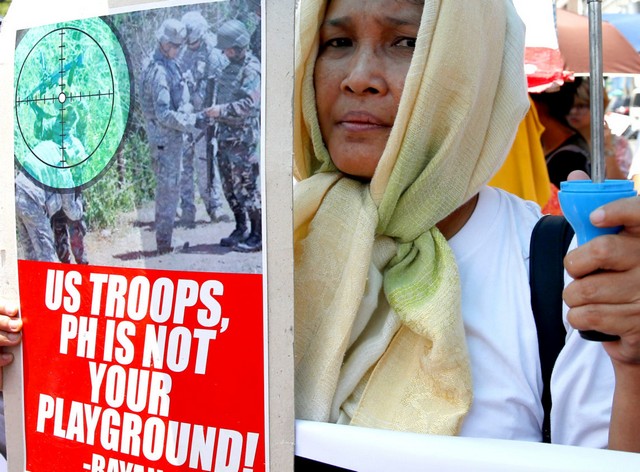
Critics contend that the operation is aimed at strengthening Washington’s grip on the long-subjugated people of the Philippines, defeating a half-century leftist insurgency, and securing the country for the interests of U.S. multinational corporations.

The ‘ISIS’ specter
The operation comes to light months after the conclusion of the bloody siege of Marawi, a now-pulverized city in the southernmost island of Mindanao that became the scene of a ruinous counterinsurgency campaign by the Armed Forces of the Philippines (AFP) against hundreds of alleged “Islamic State affiliates” of the Maute and Abu Sayyaf groups.

The campaign entailed the declaration of martial law in Mindanao until the end of 2018, the displacement of thousands of families, and the deployment of U.S. Special Forces to the city as advisors and drone operators assisting the Philippine military.

A recent video released by Philippine Army Special Operations Command, highlighted by Interaksyon, noted the clear evidence of U.S. logistical support to the AFP campaign, including M4s rifle optics, PEQ-2 laser designators, machine guns, grenade launchers and Harris tactical radio systems.

The U.S. participation was seen by the country’s leftists as proof of President Rodrigo Duterte’s hypocrisy, exposing his angry anti-U.S. statements and pledges to align with regional powerhouses such as Russia and China as the empty bluster of a U.S. puppet.

A report published for the U.S. Congress last Friday by Lead Inspector General Glenn Fine repeatedly invokes “ISIS-Philippines” as justification for the report while subtly mentioning “other terrorist organizations” that remain unnamed:

OPE-P is described as the comprehensive counterterrorism campaign by the DoD, in coordination with other U.S. Government agencies and international partners, to support the Philippine government and military in their efforts to isolate, degrade, and defeat Islamic State of Iraq and Syria (ISIS) affiliates and other terrorist organizations in the Philippines.”

Critics see the use of the term “other terrorist organizations” as a red flag signaling that the Pentagon’s focus is far from limited to those who are seeking to help establish a global “caliphate” from the Southeast Asian archipelago.

For, Roland Simbulan, a professor at the University of the Philippines and scholar of U.S. military activities in the region, Operation Pacific Eagle represents a new stage in the counterinsurgency against the Maoist guerrillas of the New People’s Army (NPA).

“The Operation Pacific Eagle marks a new era of U.S. military intervention in the Philippines,” Simbulan told MintPress News:

Internally, it is directed against the Philippine left and externally, to use the Philippines as a springboard to reassert U.S. military power in the Pacific. It is Trump’s way of supporting the creeping authoritarianism in the country while using U.S. military forces and assets to make sure that Duterte does not change the U.S. military presence [in relation to] China.”

The Philippine Revolution
For nearly 50 years, the NPA – affiliated with the Communist Party of the Philippines (CPP) – has waged a prolonged insurgency against successive governments in Manila, which it accuses of serving U.S. imperialist interests rather than the interests of poor people and Indigenous communities in resource-rich rural areas desired by multinational mining firms and local exporters.

Duterte once called himself a “socialist” and “anti-imperialist,” and even expressed sympathies for the red fighters in a manner considered taboo in a country that, for decades under former dictator Ferdinand Marcos, once nursed a single-minded hatred of the left.

Since 1986, however, Manila has taken part in intermittent peace talks with the banned Communist Party of the Philippines (CPP) through the National Democratic Front, an alliance of social movements affiliated with the clandestine party.

While Duterte initially championed the peace process, which hinged on the implementation of an ambitious socio-economic reform agenda, the negotiations were derailed last May after his declaration of martial law in Mindanao.

Accordingly, the end of last year’s peace talks eventually led to Duterte designating the Philippine communists, both armed and unarmed, as “terrorists.”

“I will follow America, since they say that I am an American boy,” Duterte noted. “OK, granted, I will admit that I am a fascist. I will categorize you already as a terrorist.”

The clandestine party and its military wing have both been included in the official U.S. government list of foreign terrorist organizations since 2002.

Duterte’s accusations came shortly after U.S. President Trump’s visit to Manila for the ASEAN leaders’ summit last November, drawing criticisms that the Philippine president was acting under the direction of his “idol and puppet-master” from Washington.

“Duterte’s martial law against the so-called ‘ISIS’ in Mindanao set a perfect backdrop for the reentry of U.S. troops and their permanent basing in the country without a signed treaty,” the CPP Information Bureau said in a statement released last month:

His termination of the peace negotiations with the National Democratic Front of the Philippines and subsequent declaration of the Communist Party of the Philippines and the New People’s Army as ‘terrorist organizations’ further set the stage. The declaration, which was made specifically in line with the U.S. State Department’s foreign terrorist organizations (FTO) listing, bolstered Duterte access to the U.S.’ budget for overseas contingency operations (OCO), the Pentagon’s bloated ‘anti-terror’ slush fund.”

Mindanao’s riches The material incentives of the United States government are key to understanding why the U.S. declared Operation Pacific Eagle, according to Jorge “Ka Oris” Madlos, the spokesman for the New People’s Army (NPA) National Operations Command.

“ISIS in the Philippines is more imagined than real,” Ka Oris told MintPress News:

By using the general catchphrase ‘radicalization and violent extremism,’ the U.S. is encompassing all armed groups resistant to its puppet state’s rule, both existing and those bound to emerge due to its interference. In Mindanao, this includes legitimate Moro groups/clans fighting for their ancestral lands and right to self-determination.”
The lush island has long been known for its lucrative natural gas and mineral deposits and its wide tracts of land ideal for large-scale commercial plantations operated by multinational corporations based in the U.S., Ka Oris explains.

Multinationals have also looked covetously at the Liguasan Marsh, a huge and biodiverse complex of rivers, channels, lakes, freshwater marshes and ponds.

Viewed as sacred patrimony for the Maguindanaoan Muslim tribe, the 220,000-hectare marsh was described in U.S. diplomatic cables from 2006, obtained by WikiLeaks, as containing untapped mineral wealth totaling anywhere from $840 billion to $1 trillion.

Manila government officials at the time described the region as a “treasure trove” of mineral resources — including gold, copper, chromites, nickel, manganese, silver, iron ore, lead and zinc. According to subsequent surveys carried out by U.S. oil engineers, the natural gas reserves of Liguasan alone amount to $580 billion.

“At the same time, the island is also home to robust people’s movements and has a strong presence of armed groups, including the NPA,” Ka Oris notes.

In hopes to advance their demands for self-determination from the distant Manila government, Maguindanaoans have long taken part in armed insurgencies led by groups such as the Moro National Liberation Front (MNLF) and Moro Islamic Liberation Front (MILF) — both groups that faced accusations of terrorism” from Manila and the U.S. Both groups have since signed peace deals and now hope to finalize a law granting autonomy to local elites.

Controversially, Duterte has tied the granting of autonomy to a new push to drastically raise the constitutional ceiling limiting the right of foreign investors to own Philippine land, among other measures that have raised the ire of watchdogs and opposition figures. Filipinos who oppose Duterte see the reform of foreign land ownership laws as key ingredients of a recipe for a return to colonialism in the country.

Manila also hopes a new law on autonomy can smooth over the lingering rage provoked by Marawi’s destruction. According to Moro advocates, the city’s Islamist insurgency was itself rooted more in a neglect of Moro people’s legitimate interests than in locals’ interest in the ISIS program.

“The U.S. even acknowledges that the Marawi siege may have further complicated the Moro situation in this part of the country,” Ka Oris explained.

Local Moro advocates see recent developments, such as plans to build a second major military camp in the city, as proof that Manila intends to transform Marawi City into a de facto “military reservation” directly owned and operated by the U.S. armed forces. The developments cast new light on the overuse of force against the city’s civilian infrastructure and neighborhoods for the purpose of quelling a relatively small number of Islamist insurgents.

Ka Oris notes:

The U.S. is sure to consider the city as one of its potential bases, as it hosted the main U.S. base in Mindanao in the 1900s (then known as Camp Keithley). Duterte has already displaced almost all its civilian population and is in the process of building a military base there. Resistance, both armed and unarmed, to this latest injustice is bound to intensify.”

Making the Philippines safe for global capitalismWhen former dictator Ferdinand Marcos declared martial law in 1972 — ostensibly to contain the communist insurgency of the CPP-NPA and growing unrest in the cities and schools — the neocolonial status of the Philippines was drastically deepened. The country was transformed into a laboratory for neoliberal experiments, free-market policies, special economic zones, and a lifting of protectionist laws under World Bank structural adjustment loan requirements.

U.S. multinational corporations, operating through loyal elites and oligarch clans, gained unprecedented access to the country’s riches — including its banking, petrochemical, construction, telecoms, and mineral extraction industries, among other strategic sectors.

For William I. Robinson, an author and professor at the University of California Santa Barbara, a new period of martial law and militarization would come as little surprise:

Both Trumpism and Duterteism are far-right authoritarian responses to crises of state legitimacy and internecine feuding among the elite. Militarization and authoritarianism in the United States and the Philippines will become more closely linked through Operation Pacific Eagle.”
Even in the past, when Manila abstained from the iron-fisted policies of Duterte, the country’s governance entailed the violent displacement of millions throughout the country and the resultant export of several millions of displaced Filipinos to all corners of the globe as “guest workers” lacking rights in Asia, the Middle East, Europe, North Africa. While women find work as domestic laborers, servers, caregivers, nurses, or hospitality industry workers — where they are often vulnerable to rape, physical assault, and murder — men find hazardous jobs as construction workers and agricultural laborers. Some reports claim that around 6,000 are forced to leave the country to seek work every day.

“The export of this surplus labor has provided a political escape value to an explosive situation of displacement and mass immiseration,” Robertson told MintPress News.

Likewise, he continues,

Agro-industrial zones have spread through the countryside and the export-industry that first took off in the 1980s has eclipsed national industrial development and has been expanding, as has the transfer of transnational corporate services – call centers, Facebook censors – to the Philippines. These transnational agro-industrial, industrial, and service complexes, along with the global export of Philippine labor, are the face of capitalist globalization in the Philippines.“
Such processes can only accelerate in a “hot-house fashion,” as global markets and the transnational capitalist class seek temporary fixes to their deepening financial worries in resource-rich yet poverty-stricken countries such as the Philippines, Robertson suggests — ensuring that Operation Pacific Eagle will embroil the U.S. in a deeper role policing the internal social turmoil within the country.

Robinson also sees Operation Pacific Eagle as quite similar to Plan Colombia, the 1999-2015 counterinsurgency aid program that saw billions of dollars in weaponry poured into Colombian security forces and paramilitaries for the purpose of destroying the FARC’s left-wing insurgency and, ostensibly, continuing the “war on drugs.”

The New People’s Army is prepared to weather the storm, according to Ka Oris, who sees continued revolutionary rigor as key to the survival of the Filipino people and New People’s Army:

Expanding the mass base, strengthening and expanding the people’s army through training and mass recruitments, making sure that revolutionary work is done in a comprehensive manner – [this is how we can] ensure that the guerilla forces and bases can withstand and outlast relentless attacks from enemy forces. These, alongside the study and adaptation of the NPA and the people to U.S. sophisticated weapons, such as surveillance and attack drones, that the local armed forces are already using against civilian communities.”
For the Filipino revolutionaries, it remains unclear as to whether Operation Pacific Eagle marks a new phase in Washington’s militarization of the Philippines. The interventionist policies of the United States have been a constant since the end of the Spanish colonial period when the U.S. military waged a brutal war that claimed around one million lives in the country.

However, Ka Oris notes, Operation Pacific Eagle is clearly consistent with the past administration’s so-called “pivot to the Pacific” and the United States’ push to maintain military supremacy in the Asia-Pacific region. For the Pentagon’s war-planners, the Philippines remains key to their plans for containing an increasingly strong and confident China.

Elliott Gabriel is a former staff writer for teleSUR English and a MintPress News contributor based in Quito, Ecuador.

13 February 2018

Source: https://cuba-networkdefenseofhumanity.blogspot.my/2018/02/operation-pacific-eagle-in-philippines.html