Just International

Venezuela Highlights Progress Despite Media Attacks

By Staff Writers | teleSUR

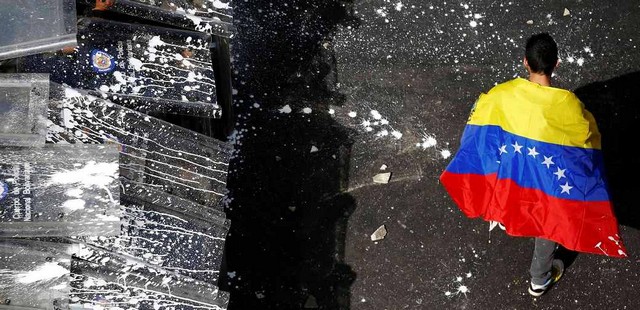
Venezuelan National Constituent Assembly, ANC, President Delcy Rodriguez has highlighted political, economic and social progress in Venezuela despite non-stop attacks from establishment media.

During an interview, Rodriguez pointed out that the “media lynching” of the South American nation is not showing the victory of the country’s people against economic and diplomatic war.

Venezuela, according to the former diplomat, is the victim of an international media siege.

She condemned “imperial countries” like the United States and several member states of the European Union — as well as some Latin American countries that are allied to the aforementioned powers — which she accused of violating Venezuela’s sovereignty and peace.

In that sense, she noted that U.S. President Donald Trump “has brought tragedy and comedy to international politics,” through strategies that seek to “break constitutionality and Venezuelan institutions through sabotage in order to overthrow sovereign governments.”

“The imposition of financial blockades aim to damage the quality of life of the Venezuelan population by inducing inflation with price war, aimed at increasing the cost of food,” Rodriguez added.

Finally, she referred to upcoming presidential elections announced for the first quarter of this year. She said she considers it “tragic” that “last year, governments asked for the advancement of the elections, but now say that we can’t hold early elections.”

30 January 2018

Source: https://cuba-networkdefenseofhumanity.blogspot.my/2018/01/venezuela-highlights-progress-despite.html

Puerto Rico: “An Island Adrift”

By Ricardo Alarcón

In 1944, under this title, Juan Bosch published an article in solidarity with the struggle for the independence of Puerto Rico. It was one of the countless journalistic, political and literary works that the great Dominican writer produced during his prolonged Havana exile, several of which he dedicated to the cause of the sister island.

Despite the time elapsed, almost three-quarters of a century ago, a similar text, with the same title, could be written today: “Adrift by the seas of history, without direction, without destination, goes Puerto Rico: for four and a half centuries “

Now it should be added that the situation is worse and the island, hit by fierce hurricanes, especially the most recent and brutal named Donald Trump, faces a decisive moment in its history.In those days, when Bosch wrote his beautiful prophecy, Franklin Delano Roosevelt, who promised the American people a new deal that benefited the workers and the poor and the peoples of the Continent, governed in Washington and offered a policy of good neighborliness. But his promises did not outlive him.

For a long time now, both projects have been reduced to ashes, swept away by the savage capitalism and unbridled warmongering that has been practiced, in one way or another, with secondary nuances, by all the US administrations since the Second World War.

In the 1940s, Luis Muñoz Marín and his Popular Democratic Party (PPD) still advocated the independence of the island. Later, they would relegate to a secondary level the fundamental question of national sovereignty and would accept, under Washington’s patronage, the so-called “Associated Free State” (ELA), a clumsy disguise that changed nothing in the harsh colonial reality.

Thanks to tax exemptions and other privileges, the territory was flooded by North American capital displacing local producers and promoting a massive emigration to the north. Quantum investments in the infrastructure gave it an air of modernity. Imperial propaganda spared no effort to sell the beautiful island as a paradigm, a model for the rest of the continent. At the same time, they filled the small territory with bases and military installations, turning it into a real fortress that was a key piece in its aggressive and interventionist policy throughout the continent.

That propaganda managed to hide, at the same time, two decisive aspects for understanding the Puerto Rican reality. On the one hand, there is the systematic persecution and repression against the patriotic movement, often violent and open, at other times, covert and more or less subtle, but always overwhelming. And on the other, Washington´s rejection of each and every one of the requests by the Puerto Rican people, including the PPD, to modify the colonial relationship and make it less harmful to their legitimate interests.

In fact, the ELA was a lie from its birth. There was never an “association” between Puerto Rico and the United States and to call “free” the creature thus created was, in addition to an affront to its victim, the Puerto Rican people, a gross insult to language itself. All the efforts promoted from the island to reach spaces of autonomy failed in the face of imperial insolence.

With the passage of time, the colonial metropolis was also changing. The United States continues to be the main economic and military power of the planet but its domain is no longer absolute, undisputed, as it was at the end of the Second World War. It has had to eliminate several important provisions that had favored its investments on the island and these were made in search of other more lucrative markets.

The economic model imposed on the colony ended in a resounding failure. The local authorities had to acknowledge their inability to pay the public debt of more than 70 billion dollars. They struggled uselessly in search of an impossible solution for a country totally subjected to a foreign power.

Denied of its own sovereignty, all negotiation possibilities were closed to Puerto Rico in order to confront a problem that independent countries face every day. In Washington, Congress and the Administration agreed to establish a so-called Fiscal Control Board, which today is the true authority that administers the territory and whose task is to force Puerto Ricans to pay what they supposedly have to by means of imposing draconian measures of austerity that increased unemployment, eliminated basic social services and boosted emigration.

To make matters worse, the island was hit by two hurricanes of great intensity, Irma and Maria, especially the latter which ruined it almost completely. The losses caused by these meteorological phenomena are calculated at more than 90 billion dollars. Thousands of families lost their homes and four months later a large part of the population has no electricity or potable water, many schools have not resumed their activities and nobody knows when or how the collapsed infrastructure will recover.

The precise figure of how many people lost their lives as a result of Maria’s passage is not even known. Independent journalistic investigations calculate that they go upwards of a thousand.

More than 200,000 have sought refuge in the United States in a migratory wave that does not seem to stop.

To top it all, along cameTrump. The unusual character, who has done nothing to alleviate the Puerto Rican tragedy, not only recalled that the supposed debt must be reimbursed, but also promotes a tax reform that, among other things, taxes the products coming from the island with 20% that will make economic recovery an unrealizable chimera.

In the midst of the disaster, the people’s determination to rebuild their country, without federal aid and against the corruption and clumsiness of those who claim to represent it, is moving.

It seems that what Juan Bosch anticipated so long ago may come true. At the time of the wreck it would be the workers, the dispossessed, the downtrodden, finally united in pain and hope, the only ones capable of saving the Homeland.

Ricardo Alarcón de Quesada (b. 1937) served as Cuba’s permanent representative to the United Nations for nearly 30 years and later served as minister of foreign affairs from 1992 to 1993.

30 January 2018

Source: https://cuba-networkdefenseofhumanity.blogspot.my/2018/01/puerto-rico-island-adrift.html

Understanding feminism in the peasant struggle – A “popular peasant feminism”

By La Via Campesina

“A really important part of being women in La Vía Campesina is to identify ourselves and our various struggles” emphasized speakers at the start of the V Women’s Assembly taking place in Basque Country on 17 and 18 July 2017. The peasant women highlighted various aspects of this identity, including women’s care for the land, the seeds and the ecosystem and their fights against patriarchy, the sexist system, and violence. They took advantage of their unique gathering to advance their collective understanding of how to fight for food sovereignty with feminism.

Visions of equality

The discussion on feminism within La Vía Campesina started at the foundation of the movement in 1993. A peasant leader from the Chilean women’s organization Anamuri told her audience how this discussion evolves around gender equality and the fight against cultural and sexist prejudice. Importantly, she said, this fight is rooted in values of equality, social justice, and solidarity- values that are fundamental to peasant women’s political struggles. “We are building hope and generating energy that way”, she expressed.

How the peasant women are doing this, can be seen around the world. In India, the widows whose husbands committed suicide and are left behind with not only major grief but also large debts and additional work, are organizing themselves as part of La Vía Campesina’s member KRRS. In Sri Lanka, women are taking up a big role in promoting agroecology and are called ‘the scientists of the soil’ because they are converting salty land to fertile ground. They have set up their own structure as part of MONLAR, a member of La Vía Campesina. In the U.S. and in Europe, many of the young people who are going back to the countryside and developing innovative farming and commercialization practices, are women. And in West Africa, women are the driving force behind La Vía Campesina’s newly established agroecology schools.

At the global level, La Vía Campesina’s firm alliance with the World March of Women helped to advance the feminist agenda. The movement also devised a mechanism for the participation of their women representatives in the Civil Society Mechanism of the Committee on World Food Security. Commenting on this last achievement, a farmer from Spain said, “Governments are not looking at these gender parity issues but we women need to, in order to take control of our land and our lives!”

Women leadership in the movement

Part of the struggle for equality has to do with decision making processes within the movement itself, for which the women are making achievements after years of hard work. In the political bodies of the Latin American coordination of La Vía Campesina for example, there are now more women than men in the leadership. And its members in Africa set up a regional coordination structure to explicitly bring women into the decision-making processes. At La Vía Campesina’s International Conference in Bangalore in 2000, an important step was made as that Conference achieved gender parity: there was an equal number of women as men peasants present. Since then, each member organization is required to delegate an equal number of men and women to the movement’s international gatherings.

While there are many men who recognize the importance of such sharing of political responsibilities with women, there are also those who don’t. “Some men see each step we achieve, each right that we manage to hold up, as a loss of their privilege, including our own comrades”, one speaker shared. She asked: “How will we continue advancing real parity and internal policies for women’s rights at every level of our organizations?”

And then there is the challenge of bringing such resolutions into practice. Some women were frank in expressing that sometimes great commitments are made, but that “the realities are entirely different when we return to our homes, our organizations and our daily lives.” The Euskal Herria Declaration, adopted at La Vía Campesina’s International Conference after the Women’s Assembly on July 22, 2017 reiterates the movement’s commitment to strengthening the political participation of women “in all spaces and levels of our movement.”

From gender parity to feminism

So while gender parity is increasing in La Vía Campesina, in many cases it exists more on paper than in practice, and by itself it does not guarantee equal participation in decision-making. The women gathered in Basque Country emphasized that gender parity needs to be accompanied by other aspects for equality to become a reality, beginning with the establishment of women’s chapters within member organizations, accompanied by an adequate budget and political training from a feminist perspective for both men and women. Indeed, the struggle for feminism is not just of women but also explicitly of men, the peasants emphasize, although it has taken time and effort for everybody to understand and accept this.

Acknowledging all this complexity, participants of the Women’s Assembly reflected on what feminism means in the context of the peasant struggle, as it is often regarded an urban, and sometimes ‘Northern’ issue. Rural women from around the world feel they fight a particular struggle and therefore have a particular role to change that vision of feminism. They recognize that they live in communities, farms, families on the countryside that are shared with men, and that “our version of feminism has to be about creating good, safe spaces within that context”. A young peasant leader from MST in Brazil offered: “For us, feminism means changing relationships between people and nature and between men and women. Our work on the farm must be valued, while the work of the home cannot be the exclusive burden of women. We must construct new values and new relations in daily life, in society and within our organizations”.

Taking this idea further, over many years the Latin American and Caribbean members of La Vía Campesina collectively developed the concept of ‘popular peasant feminism’, rooted in the particular historical context and form of peasant women struggle in that part of the world. They explained that this concept comes from an understanding of feminism as a struggle against the capitalist system: “Men are not our enemy. Our enemies are capitalism, patriarchy and racism, and our peasant feminism is key to fighting these.”​

25 Years of feminism in La Via Campesina

Reflections from Women’s Assembly at the VII International Conference

19 July 2017: The International Conference of La Via Campesina (19-22 July 2017) was preceded by the V Women’s Assembly on 17 and 18 July, in Derio, Basque Country. In this Assembly, Francisca Rodríguez, member of the National Association of Rural and Indigenous Women (ANAMURI) in Chile and also known as Pancha, gave a historical overview of feminism in La Vía Campesina.

Pancha recalled that in 1992, when peasant agricultural organizations of Central America, the Caribbean, North America and Europe first met in Managua, Nicaragua, with the idea of building a great peasant movement, there was no participation of women.

The political process led by peasant women—which would take some time to consolidate—began one year later, at the First Conference of La Vía Campesina in Mons, Belgium in 1993. There a small group of women peasants discussed the participation of women in La Vía Campesina’s processes. They spoke out in favour of a more inclusive final declaration of the Conference and of the recognition of the right to land for both men and women. At this same Conference the women identified 10 areas of work, one of which was gender equality, the principle that men and women are equals and that social values must be based on solidarity and equality. “This was the first discussion we had about feminism. And from then on we were feminists,” said Pancha, who was witness and in part the architect of this beginning of the construction of feminism in La Vía Campesina.

At the third Conference, held in Bangalore, India, gender parity was finally achieved, in that the number of participating men and women was the same. This specific process had been driven by the women of the Latin American Coordination of Rural Organizations (CLOC), who in those years were already at the forefront of the peasant feminist discourse. In this same space La Vía Campesina launched a global campaign on seeds. Seeds are considered the fruit of indigenous and peasant labor and a reflection of the history of the peoples, and especially women as their creators and guardians throughout history. Discussions also began there on the Declaration on the Rights of Peasants which, according to Pancha, should be revised as “it does not speak out strongly against violence against women.”

Subsequently, the global campaign ‘Stop violence against women’ was launched at the movement’s fifth Conference in Maputo, Mozambique in 2008. “This refers not only to domestic or organizational violence, but also to systemic violence, which is very hard for men, but twice as hard for women,” stressed Pancha. In its subsequent Conference, held in Jakarta in 2013, La Vía Campesina prepared a roadmap for the empowerment of rural women. They also saluted Latin American feminists who continue to build a new world based on social emancipation.

In this seventh Conference of La Vía Campesina, the proposal of women peasants is to achieve consensus on what the movement understands by “peasant and popular feminism”.

2 February 2018

Source: https://cuba-networkdefenseofhumanity.blogspot.my/2018/02/understanding-feminism-in-peasant.html

Occupation and genocide disguised as “discovery”

By Jerome Duval

“We have been told, and still are, that it was the pilgrims of the Mayflower that populated America. Had it been empty before?” Eduardo Galeano.

“What was really discovered [in 1492] is what Spain really was, the reality of Western culture and that of the Church at that time. (…) They did not discover the other world, they covered it. What was manifested was a ‘discovering of the conquest’, and a ‘violent and violating covering of the conquered populations, their cultures, their religion, the people themselves, their languages. What remains to be done today is to discover what was covered over, and to create a ‘new world’ that is not just the repetition of the old, but which is truly new. Is this possible? Is it pure utopia?” Father Ignacio Ellacuria, a few months before being savagely murdered by the Atlácatl Battalion of the Salvadoran army on 16 November, 1989.The so-called “developing countries” (DC) of today replace the colonies of yesterday: large Western multinational companies settle in former colonies, invest and extort resources to accumulate exorbitant profits which escape into tax havens. All of this is taking place under the approving gaze of corrupt local elites, with the support of northern governments and international financial institutions (IFIs) demanding repayment of odious debts inherited from the colonial period. By means of debt leverage and the imposed neo-capitalist policies that condition it, the dispossessed populations still pay for the colonial crimes of yesterday and the elites surreptitiously perpetuate them today. This is what is known as neocolonialism. Meanwhile, apart from some late and altogether far too few acknowledgements of the crimes committed, every effort has been made to organize collective amnesia and avoid any debate about possible reparations. For they would pave the way for popular claims, and could set in motion an emancipating memory trail that might lead to demands for restitution, something that should certainly be nipped in the bud!

The demographic catastrophe of genocide

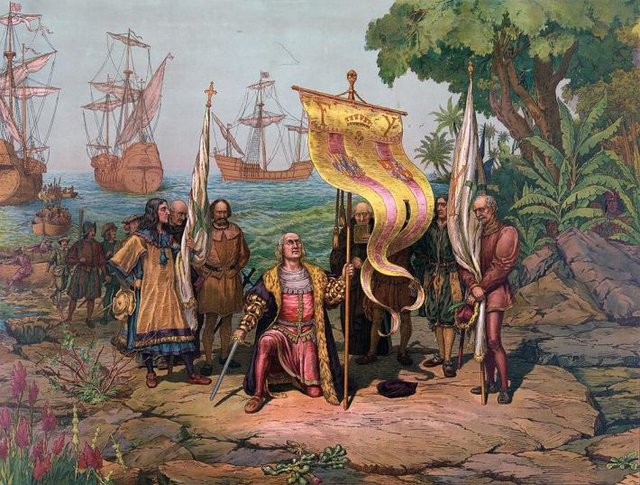
On Friday the 3rd of August, 1492, la Pinta, la Niña and la Santa María, the three ships of Christopher Columbus, left the port of Palos de la Frontera in Andalusia with nearly 90 crew members. Less than three months later, the expedition landed in several parts of the Americas, including Cuba on the 28th of October. 1492 marks the misnamed “discovery of America”, but it is also the year when Spain, after nearly eight centuries, finally overcame the last stronghold of the Muslim religion with the conquest of Granada on 2 January 1492. The Church’s so-called “holy war” against Islam, led by Ferdinand of Aragon and Isabella of Castile, who had unified their rival domains through marriage, was victorious. “Nationalist” exaltation fed a xenophobic impulse based on intolerance. Three months later, approximately 150,000 Jews who had refused to convert to Roman Catholicism were expelled from Spain (31 March 1492). The warlike culture of the crusades was exported to the new colonies. Queen Isabella, who had patronized the Inquisition, was also consecrated the First Lady of this “New World” by the Spanish Pope Alexander VI. The kingdom of God was extended, and the conquistadors forced the various native peoples, misnamed “Indians”, to convert to the Catholic faith|. At least 10 million people from the Americas were exterminated between 1500 and 1600, with the Vatican’s blessing|. But the figures could be much more alarming than this low estimate, if we consider that the Americas were much more heavily populated than has been previously acknowledged. Indeed, many scientists now estimate that “the population of the two American continents before 1492 was somewhere between 90 and 110 million inhabitants (including 5 to 10 million in the Amazon rainforest). In other words, contrary to what we still learn in history textbooks, more people lived in America than in Europe at that time!” . Taking into account the”septic shock“upon contact with the first conquistadors: shipments of unknown epidemics in these territories, namely smallpox, influenza, measles, the plague, pneumonia or typhus, spread like wildfire among native populations, decimating 85 to 90% of the Native American population in the century following the arrival of Christopher Columbus. If we add to that malaria and yellow fever imported by the Europeans to America, the conquest by arms and forced labour, which often led to death, we reach a figure of 95% of Amerindians who disappeared between 1492 and 16006. As Charles C. Mann points out in his works of reference 1491 and 1493, the human and social cost is beyond comprehension; indeed there is no comparable demographic catastrophe in the annals of human history.

The massacre was on an immense scale. As there were too few Amerindians left to constitute a durable workforce, the colonial powers had to rely on African labour to pursue the colossal enterprise of the greatest looting of all time. As the aforementioned genocide of Native Americans took place, historian Aline Helg reminds us that 8 to 10 million Africans died “when captured on their land, in the marches to reach African ports and during the long wait in the coastal warehouses” before being crammed into the holds of the slave ships leaving for the “New World”. Eventually, at least 12 million Africans torn from their homeland were deported to the Americas and the Caribbean between the 16th and the 19th centuries“. But a large number of them, almost 2 million (about 16% of the total) did not survive the trip and died during the transatlantic crossing before reaching the European colonies. For the survivors, their fate was governed, as far as France was concerned, by the infamous Code noir, drafted by Colbert and enacted in 1685, of which Article 44 declared “slaves are moveable property” thus conferring legal status on the slave trade and slavery. Thousands of African captives landed each year for sale in the slave markets of the Americas. The decade from 1784 to 1793 was the culmination of the slave trade with imports averaging nearly 91,000 Africans a year. But the absolute record was reached in 1829, when 106,000 captives landed, almost all in Brazil, Cuba and the French Caribbean. Once bought by their masters, the slaves were branded (after earlier branding on the boat or while boarding), suffered all sorts of blows to encourage work, and women were frequently raped. Attempts to rebel, whether proven or not, were severely repressed by whipping, followed by a sentence of death by torture. Slaves were torn apart by stretching on the wheel, and were mutilated, castrated, hanged or burned alive at the stake. Heads were exhibited, in the public square or in front of the plantations, to set an example. For escape attempts, ears were cut off or the shin sliced. There was no limit to the forms of torture that could be imagined… this list is not exhaustive.

It is important to put these two major events of the year 1492 into context, and to emphasize the fact that they were intrinsically linked. We cannot understand the violence perpetrated in America without perceiving it as the result of the Crusades. Dissociating them from one another, as textbooks do, does not aid our understanding of one of the darkest pages in our history and underestimates the predominant role of the Church on the old continent as in the “New World”. Religious orders also owned slaves, and in the Iberian and French colonies, Roman Catholicism imposed on them evangelization and baptism, whether they were African captives or born in America. Spanish and Portuguese become the languages of conquest, with the Church’s blessing.

Colonial heritage and cultural debt in Africa

Imperial languages, like the Islam and Catholicism, the religions imported by the colonizers, played a major role in the annihilation of local ancestral cultures and prevented their memories from being handed down. We can speak here of cultural debt whose most visible aspect is undoubtedly materialized by the looting of the art objects of these peoples, exhibited in the museums of the colonial West. At the end of 1996, Jacques Chirac received a terracotta statuette from Mali for his birthday. The work came from a group of objects seized by the police a few years earlier on the grounds of illegal excavation, stolen during their transfer to the Museum of Bamako. After more than a year of negotiations, Mr. Chirac had to return the work to the Malian museum. Apart from some restitutions like this one or that of the three terracotta nok and sokoto originating from illicit excavations in Nigeria and exhibited in April 2000 at the inauguration of the Louvre Museum’s Tribal and Aboriginal Arts gallery in Paris (showcase for the future Quai Branly Art Museum of Indigenous Arts), and finally returned to the Nigerian State, countless works of art still remain outside their country of origin and have not yet been restored. However, many resolutions adopted since 1972 by the UN General Assembly “promot[e] the return of cultural property to its country of origin or its restitution in the case of illegal appropriation”.

Knowing and acknowledging past genocidal horror helps to understand, on the one hand, how North America was propelled into becoming a new capitalist empire and, on the other, the impasse of false development into which the imperialist West has led the subjugated Southern countries.

Jérôme Duval member of CADTM network and member of the Spanish Citizen’s Debt Audit Platform (PACD) in Spain (http://auditoriaciudadana.net/).

2 February 2018

Source: https://cuba-networkdefenseofhumanity.blogspot.my/2018/02/occupation-and-genocide-disguised-as.html

Debt is a determining factor in History

By Eric Toussaint

Sovereign debt has been a crucial factor in a series of major historical events. From the early 19th century, in Latin American countries such as Colombia, Mexico and Argentina, struggling for independence,as well as Greece when seeking funds for its war of independence, these nascent countries borrowed from London bankers under leonine conditions which finally subjugated them into a new cycle of subordination.

Other states lost their sovereignty quite officially. Tunisia enjoyed some amount of autonomy in the Ottoman Empire, but was indebted to Parisian bankers. France used the ruse of debt to justify its tutelage over Tunisia and its colonization. Ten years later, in 1882, Egypt similarly lost its independence. In the pursuit of recovering debts owed to the English banks, Great Britain launched a military occupation of the country and then colonized it.
Debt “assures” the domination of one country over another

The Great Powers were quick to realise that the interest from a country’s external debt would be massive enough to justify a military intervention and a tutelage, at a time when it was considered acceptable to wage wars for debt recovery.

The 19th century Greek debt crisis resembles the current crisis

The problems flaring up in London in December 1825, ensued from the first major international banking crisis. When banks feel threatened, they no longer want to lend, as could be seen after the Lehman Brothers crisis in 2008. Emerging states, such as Greece, had borrowed under such obnoxious conditions, and the sum in hand was so little compared to the actual loan, that fresh borrowing became necessary to repay their existing debt. When the banks stopped lending, Greece was no longer able to refinance its debt and so suspended repayments in 1827.

This is where the “debt system” is similar to the present scenario: the French and British monarchies, and the Russian Tsar – the “Troika” of the time – approved of a loan to Greece and its emergence as an independent state in order to destabilize the Ottoman Empire. In exchange, in 1832, they signed a “Treaty on the sovereignty of Greece”, which I bring to light in my book. It established a monarchy, while the independentists wished for a Republic. Otto I, the chosen regent, was a 15 years-old Bavarian prince, who had no knowledge of Greece or its language. The document stipulated that the monarchy’s budget should have a provision giving priority to the repayment of the debts to the three powers. The repayment would be routed through theRothschild Bank of Paris through which the London bankers would be paid. Greece must also reimburse the Troika’s expenses for installing this monarchy and for recruiting 3,500 Bavarian mercenaries to wage a war of “independence”.

I have also shown that in the early 19th century, only 20% of Greece’s loans actually arrived in Greece. The rest was diverted to paying Rothschild’s commissions, the fees of the mercenaries, their travel expenses to Greece and other expenses incurred in creating the monarchy.

Since then, Greece has been living in a situation of permanent subordination, which has been even more manifest since 2010. Once again, public authorities joined hands to raise funds to pay private creditors: this time, the French, German, Belgian and Dutch banks.

History also points to a complicity between the ruling classes of the indebted countries and the creditor states

To understand the history of the debt system, the role of the local ruling class has to be kept in mind. It always urges the authorities to borrow internally and externally, these funds permit the bourgeoisie to avoid being heavily taxed. This class also lives on the income from the government bonds issued by its own country.

When Benito Juárez, the Mexican Liberal Democrat, partly repudiated the debts previously contracted by the conservatives, some of the bourgeoisie requested French naturalization hoping that France would use the pretext of reimbursing its nationals to try to overthrow the regime with a military intervention.
The same holds true today. At the end of 2001, when Argentina suspended debt repayment, the country’s bourgeoisie was offended, because the Argentine capitalists held a large part of the debt that had been issued on Wall Street.

The concept of “odious” debt that was developed in the 1920s was produced neither by the left nor by “alterglobalists”

During the 19th century, there was a series of debt repudiations, especially in the United States. In 1830, social upheavals led to the overthrow of corrupt governments in four of the states. These states also repudiated their debt to crooked bankers. Infrastructure projects planned with this debt had never materialised due to corruption.

In 1865, when the “North” won against the “South”, it was decreed that the latter should abrogate their debts to banks for financing the war (this is the 14th Amendment to the Constitution of the United States). A debt was considered “odious” because it was contracted to defend slavery.

At the end of the 19th century, the United States also refused to allow Cuba, which had gained independence with the help of US military intervention, to repay Spain’s debt incurred in Paris on behalf of its colony. The United States considered it “odious” because it financed the domination of Cuba and the wars that Spain waged elsewhere.

In 1919, Costa Rica repudiated a debt contracted, for his family, by the former dictator Tinoco. The arbitrator who intervened and ratified the repudiation happened to be a former US president. The reason: the loan was intended for personal purposes.

Alexander Sack, a Russian legal theorist, who was exiled in Paris after the Bolshevik revolution, formulated a legal doctrine based on all these jurisprudence cases. He stated that the debts contracted by a previous regime are binding on the nation, but there is an exception: if the debt was contracted against the interests of the people and the creditors were aware or could have been aware of it, the debt can be decreed odious and be cancelled.

Sack was a conservative professor, seeking to defend creditors’ interests, and preach them caution about to whom they are lending and the purpose. His statement shows that it is possible for nations to repudiate a debt, should it be odious.

The Greek debt is “odious”

Since 2010, the Troika has been asking Greece to repay loans that have clearly been granted against the interest of the Greek people. Their fundamental rights have been throttled and their living conditions have deteriorated under such impositions. There is evidence that the money lent returned immediately to the foreign or Greek banks responsible for the crisis. It can also be proved that the Troika governments were perfectly aware and responsible for this because it was they who dictated the contents of the memorandum.

This conclusion is also valid for France

A bevy of audits, submitted in April 2014, identified 59% of the French debt as illegitimate. It did not serve the interests of the French people. It benefited a minority that enjoyed tax cuts, and banks charging high interest rates.

After a repudiation, will the States be able to find banks willing to lend again?

There is certainly an apprehension regarding creditors, but the widespread idea that a state is less likely to get fresh loans once it repudiates a debt is quite false. For example, Mexico repudiated its debt in 1861, 1867, 1883, and 1913, but found new lenders each time. This is because some bankers do not hesitate to lend when they see that a country has regained good financial health after suspending its debt service or repudiating its debt.

After repudiating its debt in 1837, Portugal went on to contract 14 successive loans with French bankers. In February 1918, the Soviets repudiated the debts contracted by the Tsar. A blockade was enforced, but it was lifted after 1922, when the British decided to lend to the Russians, so that they could buy British equipment. Germany, Norway, Sweden and Belgium followed suit. Even France renounced the blockade, even though 1.6 million French had bought Russian securities, through Crédit Lyonnais, that were repudiated after the revolution. It was the major French metallurgical producers that pressed for French loans to the Soviets, because they could sense orders at their doorsteps.

Another example: in 2003, ten days after invading Iraq, the US Treasury Secretary called upon his G7 colleagues to cancel Saddam Hussein’s debts, arguing that they were odious. The United States, however, had lent a great deal to Iraq in the late 1970s and in the 1980s to wage war against Iran. In October 2004, 80% of Iraq’s debt was cancelled.

Debt is also a stranglehold that prevents any alternative

Illegitimate debt needs to be cancelled before resources can be freed and a policy for ecological transition can be implemented, but this step alone is insufficient! Repudiating debts without implementing other policies concerning banks, money, taxation, the focal points of investments and democracy… would entail a rerun of the debt cycle. Repudiation must be part of an overall plan.

Eric Toussaint is a historian and political scientist who completed his Ph.D. at the universities of Paris VIII and Liège, is the spokesperson of the CADTM International, and sits on the Scientific Council of ATTAC France.

2 February 2018

Source: https://cuba-networkdefenseofhumanity.blogspot.my/2018/02/debt-is-determining-factor-in-history.html

Exploring the 4 Ds that will shape our future, or our collapse

By Rami G. Khouri

BEIRUT — The start of another calendar year brings with it the opportunity to look back and look ahead to try to understand the trends that define our Arab region. I have spent the last year steadily researching what I call in shorthand the 4 Ds that define the underlying trends that have slowly brought our region to its fractured and often traumatized state today: state dysfunction, socio-economic disparity, citizen political disempowerment, and individual and collective human despair.

This gruesome quartet of forces has continuously gnawed away at the former “stability” of Arab countries and societies for the past four decades, generating insurmountable obstacles to state integrity that has resulted in six war-ravaged countries and others where internal stresses seem to portend permanent draconian, security-first, responses by political elites that refuse to share power inclusively.

The rot gained wide traction since the 1970s, but the past decade indicates that we should not expect any quick improvements in the region. This decade has included continuing mass desperation, spontaneous uprisings, a few civil wars, much government counter-repression, and foreign military interventions everywhere you look. In fact, Arab and other Middle Eastern countries now join the trend of foreign militarism, with the United Arab Emirates (UAE), Saudi Arabia, Turkey, and Iran leading the way in making war or establishing military bases in nearby countries.

I initially sought to understand the underlying reasons for our Arab region’s continuing slide into incoherent statehood and ravaged citizenship by exploring what drove otherwise ordinary young men and some women to support, like, or join the so-called Islamic State (ISIS) – perhaps as many as 50 or 60 million Arabs, according to some pollsters and analysts.

My initial research led me to the frightening conclusion about our Arab region suffering the grotesque realities of the 4 D’s mentioned above. I explored this in more depth by in two ways: the obvious signs that are visible to anyone like myself who travels around the region and interacts with both ordinary citizens and members of the power elites, and the findings of credible empirical research by Arab and international scholars who explore broad trends across the entire region.

Too often for comfort, the findings from my feet and my footnotes point out half a dozen trends that should cause grave concern across our region:

a) Conditions for many or most people have deteriorated in almost every important sector of life (water, education, employment, nutrition, poverty, environment, freedom of expression, political participation and accountability, socio-economic disparities, and a dozen others.)

b) All these dimensions of life link with one another to create an almost insurmountable cycle of obstacles to an individual achieving a better life, because deterioration in one dimension of life automatically triggers similar declines in other sectors; this reverses what happened to ordinary families across the Arab world in 1920-1970, when every generation saw its wellbeing improve.

c) Conditions in all these sectors have continued to deteriorate for the most part in the past decade since the 2010-11 uprisings’ explosion of mass popular despair sent the strongest signal of the past century of the unsustainable nature of current Arab statehood. The massive red flag of the uprisings has been ignored, so underlying conditions continue to worsen, generating new pressures that build up with unpredictable consequences.

d) The accumulated stresses in many sectors have reached a point where it is more and more difficult to stop or slow down the deteriorations and try to improve conditions. Many countries with their mediocre governance systems continue the same damaging policies just to stay in place – like over-pumping groundwater, passing on failing students to the next class, misdirecting subsidies in sectors that inhibit real and sustained economic growth or employment, ignoring the spontaneous explosion in unplanned urbanism, criminalizing free expression on social media, and refusing to allow ordinary citizens to participate in the challenges and thrills of designing state policies that actually respond to people’s needs, rather than the elite’s further enrichment.

e) This cycle of regression has led to severe splintering of Arab states’ populations, on the basis of ethnicity, sectarianism, wealth, and power. As the Arab region’s people fracture into smaller units, many of them also militarize, and seek foreign patrons and protectors. This causes massive new problems for the reconstitution of integrated and healthy states — a challenge that is exacerbated by the underlying socio-economic stresses and disparities mentioned above that continue to deteriorate.

f) All of this, serious and threatening as it is, madly seems to be ignored by both our governing power elites and the leading international powers that support them, whether regional powers like Saudi Arabia, the UAE, Iran, and Turkey, or global powers like the United States, Russia, U.K, France and others.

The cumulative consequences of these internal trends within many Arab countries strike me as the most serious threat that we confront (alongside the continued dual challenges of Zionist-Israeli colonialism and non-stop international military interventions). So for the coming months or more, I will ignore Donald Trump, Mohammad bin Salman, northern Syria, Aden, Benghazi, Egyptian jails, and other issues that preoccupy most Middle East watchers. Instead, in these weekly columns I will report on and analyze studies on the issues that I believe form the basis for the Arab region’s continuing deterioration, militarization, pauperization, polarization, and fragmentation. These will include trends in poverty, education, employment, pollution, water equity, housing, corruption, democratization, the rule of law, and disparities in many life dimensions.

Most of these developments are widely ignored by the Arab and international media. Their impact, however, determines the wellbeing of most of the 400 million citizens in Arab countries, who know that they deserve more than the current dysfunction, disparity, disempowerment, and despair that many of them experience in their everyday lives. These issues also ultimately will determine if the violence, cruelty, suffering, and collapse of the past decade are the high-water mark that finally pushes us to repair our dysfunctions — or are just a hint of the much greater disruption, mass suffering, and state collapse that we can expect ahead.

Rami G. Khouri is senior public policy fellow and professor of journalism at the American University of Beirut.

23 January 2018

Hotel Intercontinental Siege – Is Kabul Falling?

By Andre Vltchek

Afghanistan is now facing mortal danger. It has to survive, but it is not clear how it can manage.

Hotel Intercontinental in Kabul, which was attacked by gunmen last Saturday, used to fit like a glove, like a grandmother’s couch. Outside, the war has been raging. Millions of Afghan lives were aimlessly broken, hundreds of thousands lost. The price of more than 16 years of NATO occupation has exceeded $1 trillion, but instead of bringing peace and prosperity, it has reduced Afghanistan to rubble.

All that is still functioning in the country are structures and infrastructure built before and during the Soviet era, like irrigation ducts, canals and bread factories. Other tangible assistance came recently from China and India, but almost nothing was provided by the NATO occupation countries, except countless fences, wires and military installations.

Even before the siege at the Intercontinental Hotel, which left more than 20 people dead, Afghanistan’s President Ashraf Ghani confessed to ‘60 Minutes’ correspondent Lara Logan that he is unable to protect his own capital.

But it is not only the capital, of course. The entire country is spiraling into chaos. It is clear that it will soon be impossible to control it anymore, at least as one entity, from Kabul.

It can be heard more and more often on the streets of Kabul, Jalalabad and Herat that reducing this country to perpetual conflict and chaos may be the exact plan of the occupation forces.

I used to joke about Hotel Intercontinental – ‘This place feels like a Soviet three-star hotel in some provincial Siberian town. Bent shower bars, stained but otherwise clean carpets, indifferent but somehow friendly staff – you could wave as much as you wanted, but the waitress in the hotel’s cafe would only move after you’d come to her personally, smiled broadly, and pointed your finger at some particular item from the limited assortment of sweets.’

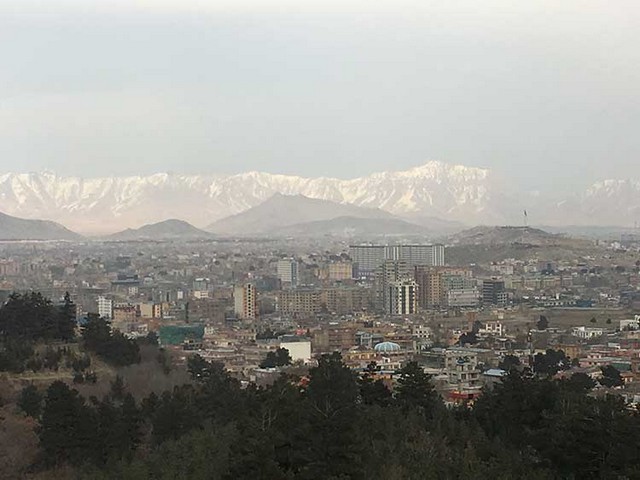
Despite everything, Hotel Intercontinental Kabul was always there, standing. It was crumbling, but still somehow majestic, full of history and old-fashioned charm. Its lobby was decorated with traditional Afghan landscapes and portraits. The vistas from the hotel rooms and balconies were breathtaking: the old Bagh-e Bala Palace with its vast public park, then the entire capital city down below as though sitting in a crater, and the great mountain range rising towards the sky right behind that urban sprawl.

During breakfast hours, a few tables near the window in the hotel restaurant were almost always occupied by Russian-speaking pilots and crew members from an Afghan passenger airline, Kam Air. I don’t know whether these people were Russian or Ukrainian, but they spoke Russian among themselves, and also to me. They were tall and muscular, as pilots operating in a war zone are expected to be.

We always exchanged greetings, as well as one or two jokes. No deep discussions, just that – a few jokes and a few very warm smiles.

Some time ago, I had to fly to the ancient city of Herat, and was traveling early in the morning with Kam Air on the same flight as the crew. My driver was late and I approached the airline minivan, which was just about to depart for the airport.

“Would you please take me with you to the airport, boys?” I asked.

“Yes, of course, of course – just jump in!” they grinned.

We were all part of a big family. Foreigners staying at Intercontinental – not rich and not poor, not part of any ‘government initiative’ or wealthy NGO. This hotel was for ‘working people’ – journalists, filmmakers, pilots. Those who required ‘special protection’ were staying behind the enormous concrete walls of their embassies, or in the only truly luxury hotel in the country – Serena.

Two hours later, we were flying over tremendous Afghan mountains and tiny ancient villages made of mud, miles below the wing. I was taking photographs, while imagining that insane US “mother of all bombs” that was dropped just a few days earlier on an identical hamlet, killing who knows how many innocent people.

The two powerful engines of an old but reliable MD-82 were purring reassuringly at the rear of the plane. Then, at some point, I closed my eyes and fell asleep. The next thing I experienced was a gentle pat on my shoulder, followed by friendly whisper: “Kofeiku ne khotite? Rebyata tut tol’koctosveziisvarili” (“Would you like some coffee? The guys here just brewed a fresh one…”)

I drank the aromatic brew, looking down at those stunning, enormous mountains covered by snow. Russian-speaking pilots were in the cockpit, steering the plane with great experience and confidence.

I thought: “If there is one crew in the world that is qualified to fly over this beautiful but complex and dangerous terrain, then it is this one.”

It was one of those moments when I felt totally happy and alive, drunk with passion for what I had been doing: working in Afghanistan, exposing crimes committed there by the Western countries, falling head over heels in love with this ancient and proud nation, flying over its peaks into one of the most interesting cities of Central Asia – Herat.

On January 20, 2018, in the intensive care unit of Tokyo’s St. Luke’s Hospital, I was fighting for my life, months after my year-old foot wound reopened in Afghanistan, and had since refused to heal.

Through the fog of fever and IV, I observed coverage from Kabul on a television screen that was hanging above my bed. ‘My’ Intercontinental Hotel had been attacked. In fact, it was overrun by what was allegedly one of the most vicious branches of the Taliban, known as the Haqqani Network. At least that is what was tweeted by Javid Faisal, a spokesman for the Afghan government’s chief executive.

At least 21 people lost their lives during the 14-hour standoff. Almost immediately, several pilots and crew members from Kam Air were murdered in cold blood. So were two Venezuelan pilots. None of these people were ‘supporters of the government,’ nor were they collaborators with the invading NATO force.

They were simply a group of romantics, a group of rugged, brave but also very kind and gentle men who adored flying and who, like myself, fell in love with Afghanistan. I know this because they told me, and because it was just so obvious!

In case anyone is wondering, ‘my hotel in Kabul’ has nothing to do with the luxury US chain of the same name. It used to be part of the ‘real’ Intercontinental, but only from 1969, when its doors first opened, until 1980 (shortly after the Soviet Union intervention in Afghanistan). Now, it is a state-owned property, described as ‘luxury’ only by outsiders who are covering Afghanistan from afar. You can get a room there for a mere $50 if you negotiate very hard, and for $60 if your bargaining skills are somewhat limited.

The hotel had already been damaged on several occasions, particularly during the civil war of the 1990s, when it is said that at one point only 85 out its 200 rooms were inhabitable. As recently as 2011, 21 people died here during an attack for which the Taliban claimed responsibility.

Despite its macabre history, however, Intercontinental is still the favorite property of many locals and some foreigners in Kabul. This is where many conferences are held, and – during the fasting month of Ramadan – fast is broken here by members of local elites, close to the swimming pool overlooking the city. And there is music here almost every night: true Afghan traditional music, with local instruments and singers trained by renowned masters.

Security is, of course, everywhere. To return to this property from the city, I always have to go through three full security posts with my car. After all, Afghanistan is now considered one to be one of the most dangerous countries on Earth for foreigners.

In just one week, three deadly attacks shook Afghanistan: one in Kabul, another outside Herat, and a third inside the city of Jalalabad, in which ISIS targeted the NGO, Save the Children.

Last year, I traveled to many corners of this scarred, ancient land. I spoke to people, including those in the villages that were at least partially taken over by Taliban. People are increasingly realizing that they are living in perpetual conflict. Refugees (or internally displaced persons) from the east are talking about the carnage that comes with the arrival of ISIS.

Hard drugs and poppy seeds are everywhere in the center of Kabul, right under the nose of the US occupiers – poppy fields literally surround Bagram Airforce Base.

Soviets and Russians are now remembered with love and great nostalgia; something that I already described in my previous essays from the country.

Very soon, no foreigners will be left in Afghanistan. That may be the main goal of the latest attacks. No witnesses, no alternatives, no solutions.

Who will benefit? Definitely not the devastated Afghan people. Perhaps the warlords, the extremist mullahs, and the occupiers.

Kam Air crew, flying passenger jets all over the country, and the dilapidated Intercontinental were some of the last symbols of normality – a weak promise that one can still come and see what is really happening in this country.

From now on, there will be hardly any foreigners in the country. It will be only us – war correspondents, as well as foreign soldiers and mercenaries.

Afghanistan is now facing mortal danger. It has to survive, but it is not clear how it could manage. Those who love it should return, no matter what risk we’d be facing. A news blockade should be prevented. Alternative (non-Western) information has to flow. By all means, at any price.

*

[First published as OP-ED by RT]

Andre Vltchek is a philosopher, novelist, filmmaker and investigative journalist.

28 January 2018

Source: https://countercurrents.org/2018/01/28/hotel-intercontinental-siege-kabul-falling/

Julian Assange Challenges Warrant For His Arrest As doctors Confirm Worsening Of His Health

By Margot Miller

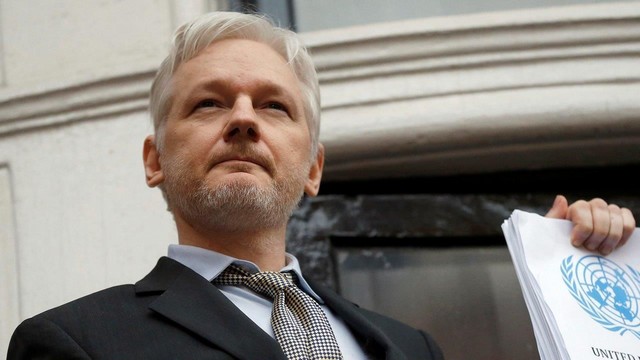
WikiLeaks founder Julian Assange has asked a UK court to relinquish the arrest warrant that is keeping him confined to the Ecuadorian Embassy in Knightsbridge, London. If granted, he would be free to leave without fear of arrest, according to a spokesman for the Crown Prosecution Service (CPS).

“Hypothetically, yes. That would be our interpretation,” he said. Assange would then be able to seek the medical treatment he urgently needs.

First arrested in London in December 2010 under anti-democratic provisions of a European Arrest Warrant (EAW) issued by the Swedish authorities, Assange was never charged with any crime and was only required to return to Sweden in order to answer questions regarding trumped up allegations of sexual misconduct. He skipped bail to avoid extradition to Sweden—after being denied elementary democratic rights by the British legal system—seeking asylum in the Embassy in 2012.

Assange feared the Swedish authorities would immediately extradite him to the United States, which has conducted a cruel vendetta against him since WikiLeaks exposed criminal actions taken by the US during the wars of aggression in Iraq and Afghanistan. This included a video WikiLeaks posted on the Internet showing the 2007 “collateral murder” of 12 Iraqi civilians from the viewpoint of an Apache helicopter’s gun-sight.

The US administration has kept live a grand jury empowered in 2010 to bring secret, unspecified charges against Assange that could carry the death penalty.

On Friday, Westminster Magistrates’ Court were told by Mark Summers QC that because the Swedish case had been dropped, the European Arrest Warrant had “lost its purpose and its function.” Assange should be able to leave the embassy without fear of arrest or extradition.

Swedish authorities closed the case against Assange last year, only demonstrating it was a frame-up in the first place. The statute of limitations on some of the allegations, however, does not expire until 2020.

For more than five and a half years, Assange has been confined to a small, windowless room, 15 feet by 13, without access to sunlight, fresh air or exercise.

As Assange said in 2014, “The United Nations minimum standard for prisoners is one hour a day of outside exercise. Even when I was in Wandsworth prison in solitary confinement [in 2010], that was respected.”

Even though Assange has been given an Ecuadorian passport and ID, the British authorities have vindictively refused to grant him safe passage out of the country. The UK have acted in violation of international law according to a United Nations panel, which in 2016 declared Assange to be a victim of “arbitrary detention.”

Assange’s physical and psychological health has been severely compromised due to his confinement. By as early as 2014, Assange was suffering health problems. In an article for the Daily Mail, journalist Sarah Oliver described Assange’s appearance: “His usually pale skin is now almost translucent and on his face it is so puffy it looks as if it is lifting off his naturally sharp cheekbones. He has a chronic cough, which the installation of a humidifier to moisten the dry, air-conditioned atmosphere has done little to ease. His eyes have navy pools of shadow beneath them, suggesting that he’s shifted from nocturnal to sleep-deprived.”

She continued, “Assange is, according to a WikiLeaks source, suffering from the potentially life-threatening heart condition arrhythmia and has a chronic lung complaint and dangerously high blood pressure.”

Of the conditions in his living quarters, Assange told her, “I can’t even keep a pot plant alive for long in here.”

The UK government refused an earlier demand in 2015 for Assange to access hospital treatment without the threat of arrest.

Last October, Dr. Sondra Crosby, an associate professor at the Boston University’s school of medicine and public health, and Dr. Brock Chisholm, a London-based consultant clinical psychologist, entered the Embassy to examine Assange. In a letter they co-authored with Dr. Sean Love to the Guardian January 24 they write, “As clinicians with a combined experience of four decades caring for and about refugees and other traumatised populations, we recently spent 20 hours, over three days, performing a comprehensive physical and psychological evaluation of Mr. Assange … it is our professional opinion that his continued confinement is dangerous physically and mentally to him and a clear infringement of his human right to healthcare.”

Though unable to go into specific details for reasons of confidentiality, the letter explains, “Experience tells us that the prolonged uncertainty of indefinite detention inflicts profound psychological and physical trauma above and beyond the expected stressors of incarceration. These can include severe anxiety, pathological levels of stress, dissociation, depression, suicidal thoughts, post-traumatic stress disorder and chronic pain, among others.”

Assange is thought to be suffering from a serious shoulder issue requiring an MRI scan, impossible to organise inside the embassy. He is also said to have a lung problem. Clinicians who are prepared to visit Assange are severely handicapped in the care they can provide, because “At the embassy, there are none of the diagnostic tests, treatments and procedures that … he needs urgently.”

The letter continues, “It is unconscionable that Mr. Assange is in the position of having to decide between avoiding arrest and potentially suffering the health consequences, including death, if a life-threatening crisis such as a heart attack were to occur.”

The letter concludes by calling on the British Medical Association and UK clinicians to demand that Assange is granted safe access to medical care and that they oppose the “ongoing violations of his human right to healthcare.”

The demand to end the state persecution of Assange must be adopted by the international working class. His vilification and victimisation is part and parcel of government attacks on basic democratic rights, exemplified by Google and social media censorship of left-wing, anti-war and progressive websites and the attempt to portray opposition to government austerity and war policies as foreign interference.

In urging the formation of an International Coalition of Socialist, Antiwar and Progressive Websites, the World Socialist Web Site and the International Committee of the Fourth International urged as one of a specific set of principles that must be fought for: “Demanding the end to the persecution of Julian Assange and Edward Snowden and the complete restoration of their personal freedom.”

28 January 2018

Source: https://countercurrents.org/2018/01/28/julian-assange-challenges-warrant-arrest-doctors-confirm-worsening-health/

Trump Officially Restores Cold War

By Eric Zuesse

On January 20th, CBS News bannered “Terrorism no longer the military’s top priority, Mattis says” and opened: “There is a major change in U.S. military strategy. On Friday, more than 16 years after the 9/11 attacks, U.S. Defense Secretary Jim Mattis said terrorism is no longer the No. 1 priority.” The report said, “Maintaining a military advantage over China and Russia is now Defense Secretary Mattis’ top priority.”

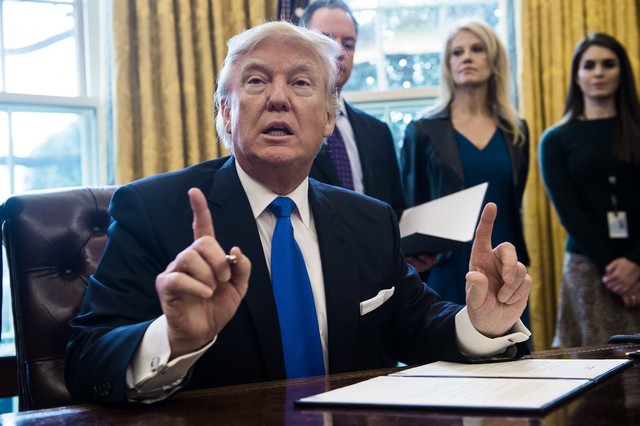
On January 18th, the Trump Administration had issued its crucial document about how it will implement America’s national defense from now on. This document, the National Defense Strategy 2018, represents a continuation of U.S. President Barack Obama’s vision and intentions, but extends Obama’s hostility toward Russia, by adding Trump’s hostility toward China.

In December 2017, U.S. President Donald Trump had issued his National Security Strategy 2018 (the NSS2018); but, in keeping with his prior commitment to leaving to the generals the implementation of his national security policy, the Pentagon has now issued this National Defense Strategy 2018 (the NDS2018), which is signed only by Trump’s minister for war (Secretary of ‘Defense’), “Jim Mattis”; and it’s considerably more informative on what the practical meaning of NSS2018 will be. The meaning is: replacing hostility against “radical Islamic terrorism,” by hostility against Russia and China. This — building upon Obama’s imperial vision — is now Trump’s ‘Defense’ policy. Trump’s campaign talk had been against ‘radical Islamic terrorism’, but was merely bumper-sticker lying, to win votes, from an electorate that believed the differences between today’s Democratic and Republican Parties are more than bumper-sticker deep (which might once have been the case, but no longer really is).

In continuation from Obama’s National Security Strategy 2015, which had accused Russia 18 times of “aggression,” Trump’s National Defense Strategy 2018 (NDS2018) effectively declares at least an economic war against Russia (as if economics were also in General Mattis’s portfolio), but it goes even further to include China as being now also America’s enemy. It thus officially restores, in effect, the Cold War — the war against communism — that had existed until U.S. President Richard Nixon’s visit to China, during 21 to 28 February 1972. It also intensifies the war against Russia, even now, 37 years after the 1991 breakup of the Soviet Union and end of its Warsaw Pact and end of its communism, had ended the Cold War (but only on Russia’s side, not really on America’s).

Trump’s new document (through his agent Mattis) says that non-state terrorism (Al Qaeda, etc.) is no longer the biggest threat to America’s security; these two “authoritarian” nations pose the biggest threat to America, says the NDS2018. This document asserts: “It is increasingly clear that China and Russia want to shape a world consistent with their authoritarian model — gaining veto authority over other nations’ economic, diplomatic, and security decisions.” (“Authoritarian” is now what “communist” once was — the U.S. Government’s verbal bugaboo, and America’s official excuse, for invasions and coups.) It continues:

The central challenge to U.S. prosperity and security is the reemergence of long-term, strategic competition by what the National Security Strategy classifies as revisionist powers. It is increasingly clear that China and Russia want to shape a world consistent with their authoritarian model — gaining veto authority over other nations’ economic, diplomatic, and security decisions.

China is leveraging military modernization, influence operations, and predatory economics to coerce neighboring countries to reorder the Indo-Pacific region to their advantage. As China continues its economic and military ascendance, asserting power through an all-of-nation long-term strategy, it will continue to pursue a military modernization program that seeks Indo-Pacific regional hegemony in the near-term and displacement of the United States to achieve global preeminence in the future. The most far-reaching objective of this defense strategy is to set the military relationship between our two countries on a path of transparency and non-aggression.

Concurrently, Russia seeks veto authority over nations on its periphery in terms of their governmental, economic, and diplomatic decisions, to shatter the North Atlantic Treaty Organization and change European and Middle East security and economic structures to its favor. The use of emerging technologies to discredit and subvert democratic processes in Georgia, Crimea, and eastern Ukraine is concern enough, but when coupled with its expanding and modernizing nuclear arsenal the challenge is clear.

It then says, “Rogue regimes such as North Korea and Iran are destabilizing regions through their pursuit of nuclear weapons or sponsorship of terrorism.” So: those four countries — China, Russia, North Korea, and Iran — are now the top targets for the U.S. military to defeat.

The NDS2018 document continues, “Both revisionist powers and rogue regimes are competing across all dimensions of power. They have increased efforts short of armed conflict by expanding coercion to new fronts, violating principles of sovereignty, exploiting ambiguity, and deliberately blurring the lines between civil and military goals.”

Right now, the U.S. is militarily occupying, as an uninvited invading power violating the sovereignty of parts of the sovereign nation of Syria, whose internationally recognized (except by the U.S. and its vassal-states) Government is the one that had won internationally monitored elections in 2014, and whose incumbent President Bashar al-Assad won, in those elections, 89% of the vote throughout the entire country. Even independent Western-sponsored polling in Syria has repeatedly shown that Assad would easily win any national election in his country, and that 82% of Syrians blame the U.S. Government (not Assad) for having brought the tens of thousands of jihadists into their country and caused the Syrian war that destroyed the nation. On 31 October 2015, U.N. Secretary General Ban ki-Moon twice criticized U.S. President Barack Obama’s refusal to allow the Syrian people to determine whom their President would be. Ban said, “The future of Assad must be determined by the Syrian people,” but the U.S. Government kept ignoring him on that; and U.S. President Trump’s minister of war now says that the way to defeat countries that are “violating principles of sovereignty” is to continue occupying countries that never invited them in.

Under the heading “Build a More Lethal Force,” the NDS2018 document says, “The surest way to prevent war is to be prepared to win one.” To do this, it will rely on “the Joint Force” (which the document fails to define) in this way:

Prioritize preparedness for war. Achieving peace through strength requires the Joint Force to deter conflict through preparedness for war. During normal day-to-day operations, the Joint Force will sustainably compete to: deter aggression in three key regions — the Indo-Pacific, Europe, and Middle East; degrade terrorist and WMD threats; and defend U.S. interests from challenges below the level of armed conflict. In wartime, the fully mobilized Joint Force will be capable of: defeating aggression by a major power; deterring opportunistic aggression elsewhere; and disrupting imminent terrorist and WMD threats. During peace or in war, the Joint Force will deter nuclear and non-nuclear strategic attacks and defend the homeland. To support these missions, the Joint Force must gain and maintain information superiority; and develop, strengthen, and sustain U.S. security relationships.

The document sub-heads “Strengthen Alliances and Attract New Partners,” and says, “By working together with allies and partners we amass the greatest possible strength for the long-term advancement of our interests, maintaining favorable balances of power that deter aggression and support the stability that generates economic growth.” This includes “Fortify the Trans-Atlantic NATO Alliance” but is global.

This document thus actually embodies, but in some ways extends and amplifies, U.S. President Barack Obama’s 28 May 2014 statement to America’s graduating class at the West Point Military Academy:

The United States is and remains the one indispensable nation. That has been true for the century passed and it will be true for the century to come. … Russia’s aggression toward former Soviet states unnerves capitals in Europe, while China’s economic rise and military reach worries its neighbors. From Brazil to India, rising middle classes compete with us, and governments seek a greater say in global forums. … It will be your generation’s task to respond to this new world.

To Obama, all nations other than the U.S. — even America’s allies — are “dispensable”; only the U.S. is not. Hitler’s version was “Deutschland über alles”; and, like Amerika’s version, it comes from the accepted popular culture, not from the imperialist’s own overheated imagination. In fact, Americans respect the military above all other institutions — more than all the rest of the Government — just like Germans did, leading up to Hitler. And, just like Donald Trump himself does; in his militarism, Trump unfortunately does authentically represent his nation’s values. Amerika isn’t Athens; it is Sparta.

As I had previously noted under the headline “Trump Continues Obama’s Wars Against Democracy”: “He was telling the military that America’s economic competition, against the BRICS nations, is a key matter for America’s military, and not only for America’s private corporations.”

However, even General Mattis has now acknowledged that one important component of achieving this global empire will be to “Strengthen Alliances and Attract New Partners,” which now seems less likely under Trump than it was under Obama.

Perhaps the Trump Administration will try to compensate for that area of increasing U.S. weakness, by increasing even more its weaponry and troop-numbers. Anything to win what all of these documents refer to as being, not America’s enmity, but America’s ‘competition’ — against Russia, China, and the other BRICS countries. However, when a military official talks of “competition,” the reference is actually to his enemies, which are to be either defeated or else killed — it’s not like an economist, referring to an entity that offers the same or better product or service but at a lower price, to some consumer — a third party to the relationship between those competitors. In military matters, an “ally” is no such third party, but is on one of the two sides — it’s part of one of the two sies. The verbiage that’s being borrowed from economics is simply intended to deceive the public, instead of to inform them.

Here, to close, are highlights from Secretary Mattis’s speech, on January 19th, introducing NDS2018:

This defense strategy was framed … by President Trump’s National Security Strategy. … It is, as was noted by the dean, our nation’s first National Defense Strategy in 10 years. …

We will continue to prosecute the campaign against terrorists that we are engaged in today, but Great Power competition, not terrorism, is now the primary focus of U.S. national security. …

We face growing threats from revisionist powers as different as China and Russia are from each other, nations that do seek to create a world consistent with their authoritarian models, pursuing veto authority over other nations’ economic, diplomatic and security decisions.

Rogue regimes like North Korea and Iran persist in taking outlaw actions that threaten regional and even global stability.  Oppressing their own people and shredding their own people’s dignity and human rights, they push their warped views outward. …

We’re going to build a more lethal force.  We will strengthen our traditional alliances and building [that ing-ending is his error, from Mattis — not added here] new partnerships with other nations. …

The second line of effort I noted was to strengthen alliances as we build new partnerships, as well. … History proves that nations with allies thrive.

He wants his audience to identify with ‘our’ team of billionaires, against ‘their’ team of billionaires. He wants maximum “lethality” against ‘the other side’s’ people, and for ‘our side’s’ people. The opposite side are the ‘revisionist powers’ and ‘rogue regimes’; and ‘our’ side are — the ‘good’ people, who should coerce, or else kill, them. Mattis’s speech said: “It is incumbent upon us to field a more lethal force if our nation is to retain the ability to defend ourselves and what we stand for.” That’s what ‘we’ will ‘stand for’, if we will stand for it.

Adolf Hitler’s rhetoric was more direct, less hypocritical. However, the result, this time around, could turn out to be even worse, because a war between the U.S. and Russia would constitute World War III and would be a nuclear war, which would destroy the entire world. This might be what America’s billionaires are planning and preparing for. (Why are super-rich people now buying nuclear bunkers, such as here, and here, and here, and here, and here, and here, and here, and here, and here, and here? Are these people investors in ‘defense’ corporations such as Lockheed Martin?) But no public is. This is very much a super-rich person’s war ‘game’, which Amerika’s ‘Defense’ Establishment is preparing for. No public is — not even a public that reveres its military Establishment more than it reveres any other of the nation’s institutions.

Investigative historian Eric Zuesse is the author, most recently, of  They’re Not Even Close: The Democratic vs. Republican Economic Records, 1910-2010, and of  CHRIST’S VENTRILOQUISTS: The Event that Created Christianity.

26 January 2018

Source: https://countercurrents.org/2018/01/26/trump-officially-restores-cold-war/

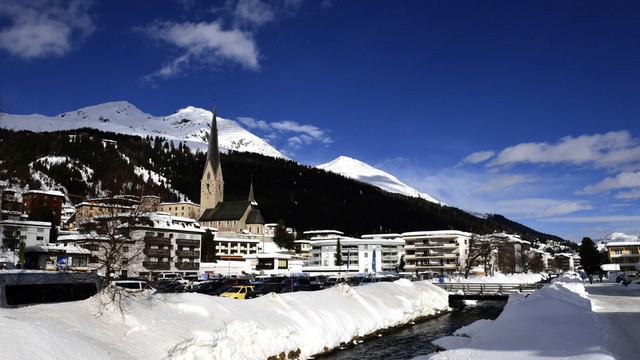
Davos: Where talk on ‘inequality’ is cheap, but a burger platter costs $59

The Swiss resort of Chateaux-d’Oex is known for its hot air balloons. The Swiss resort of Davos is known for hot air. Or at least for one week a year, when some of the world’s biggest windbags meet to discuss ‘significant’ issues.

This year, the cool and trendy thing to express concern over at the World Economic Forum is ‘inequality.’ OK, ya? Everyone seemed to agree that something needs to be done to narrow the “staggering” gap between rich and poor – to repeat the phrase used by Canada’s liberal hipster PM Justin Trudeau, the man with those cute yellow and purple ducky socks.

French President Emmanuel Macron, who we’re told was greeted like a “rock star,” declared: “In the global process, capitalism has become a capitalism of superstars, the spreading of value (to those lower down the ladder) is no longer equitable.”

But solutions which would actually reduce inequality were less forthcoming. It reminded me of the annual expressions of ‘concern’ when above-inflation increases in train fares are announced in Britain – the country with the highest fares in Europe. Government-supporting politicians say “this is disappointing” – and guess what – the next year the fares go up again. No one wants to be quoted as saying that they’re in favor of 82 percent of the wealth going to the top 1 percent, but at the same time, they’re unwilling to take the steps which would actually make that an impossibility.

Take this extract from the speech made by British Prime Minister Theresa May:

“We have to do more to help our people in the changing global economy, to rebuild their trust in technology as a driver of progress and ensure no one is left behind as we take the next leap forwards… We have to remember that the risks and challenges we face do not outweigh the opportunities. And in seeking to refresh the rules to meet the challenges of today, we must not miss out on the prize for tomorrow.”

Does anyone know understand what May was actually saying? There was verbiage aplenty in her address, but practical solutions?

It’s the easiest thing in the world to say that “we must ensure that no one is left behind as we take the next leap forwards,” but quite another thing to deliver on it.

In a way, Davos makes one nostalgic for the hard-nosed Thatcherites of yesteryear who at least were honest about what they were hoping to achieve. Now we’ve got Thatcherites masquerading as touchy-feely ‘centrists’ in a jet-set Alpine resort where the cost of a hamburger platter has reached US$59 and a hotel room over $500 a night – and it doesn’t feel right.

Those in power voice their concern over inequality but pursue crony-capitalist, neo-liberal, pro-globalization policies which are expressly designed to enrich the well-connected 1 percent with links to government and leave large numbers of people behind. Don’t forget that Emmanuel Macron, the man who criticized“the capitalism of superstars,” gave the super-rich in France a big tax cut back in October.

Until there’s a clean break from the present economic model, and a return to something like the more ethical and democratic system which dominated in the immediate post-war years, all talk of ‘fighting inequality’ is just virtue-signaling. Just how hegemonic neoliberalism has become can be seen in the fact that even the charities and NGOs who attack inequality, such as Oxfam, whose annual report on global inequality coincides with Davos each year, have CEOs and top executives earning eye-watering amounts. Charity, like almost everything else, has become Big Business, with the pyramid structure the norm. Just over 70 percent of the people on this planet own just 2.7 percent of total wealth; 0.7 percent of the population control 45.9 percent of global household wealth.

You don’t have to be Che Guevara to acknowledge that this is totally obscene and morally unjustifiable.

One book that does show us a way out is ‘New World Order in Action’ by the Greek political philosopher and economist Takis Fotopoulos, which I reviewed here. (Fotopoulos explains how austerity policies, which have greatly increased inequalities, are not merely a ‘bad’ choice made by ‘bad’ politicians but in fact a key feature of neoliberal globalization. Austerity is insisted on by the powerful global financial and corporate economic elites who call all the shots. Fotopoulos calls for the formation of ‘national and social liberation fronts’ to make a clean front with neoliberal globalization and its institutions. It’s doubtful he got an invite to Davos.

One man who did though was John McDonnell. Labour’s shadow chancellor, an unapologetic democratic socialist, said he was going to the World Economic Forum for the first time with “a warning for the global elite.”

“Just as Davos faces the risk of an avalanche this week, growth for a few risks a political and social avalanche unless there is fundamental change to our rigged economic system,” he declared.

Of course, this led to an attack on him from defenders of the status quo. Conservative Party vice chairman James Cleverly was quoted in City A.M. as saying: “Not that long ago John McDonnell was praising Venezuela as an economic model. His ideas have consistently failed, condemning people to poverty and hardship.”

But cheap jibes about the Bolivarian Republic – which has been under economic attack for many years now for defying ‘The Washington Consensus’ and having an independent foreign policy – can’t be allowed to deflect from the growing poverty and hardship back home.

This week we learnt that more than 4,000 people have been sleeping rough on England’s streets, a rise of 16 percent in the past year. Overall, the number of homeless families has risen by more than 60 percent since 2010/11. Both child and pensioner poverty are also sharply on the increase.

While in September it was reported that UK households were at ‘breaking point’ as real wages continue to fall.

But hey, let’s keep banging on about Venezuela to scare people from calling for a fairer system, shall we?

Growing inequality is the defining characteristic of the era of neoliberal globalization. Culture wars and identity politics have been promoted by the corporate/financial elites to divert our attention: while we march for or against taking down historical statues, and argue over signage on toilets, money is, all the time, being siphoned upwards, from us to them. Donald Trump – also a speaker at Davos – is merely the latest sideshow.

There will only be change if those who have been swindled by the current iniquitous system (and that’s the vast majority of the world’s population) start demanding their fair share of the cake. It’s worth noting that the great social and economic advances of the 20th century were won because the working classes became organized, and there was an alternative economic model – communism – fear of which persuaded the ruling classes to make concessions. Wartime experiences and deep-held religious beliefs too led many conservatives – like Britain’s Harold Macmillan and France’s Charles de Gaulle – to support policies which put the interests of the majority first.

It was because of strong trade unions, political parties which represented the working class, and the existence of competing economic systems, that inequality in most countries, including the US, had fallen to historically low levels by the mid-1970s. Can we get back to that? Yes – but only if ‘Davos Man’, wedded to elite-friendly neoliberal globalization and virtue signaling on ‘inequality’ while munching on a $59 burger, is not in the driving seat.

The statements, views and opinions expressed in this column are solely those of the author and do not necessarily represent those of RT.

Neil Clark is a journalist, writer, broadcaster and blogger. He has written for many newspapers and magazines in the UK and other countries including The Guardian, Morning Star, Daily and Sunday Express, Mail on Sunday, Daily Mail, Daily Telegraph, New Statesman, The Spectator, The Week, and The American Conservative.

26 January 2018

source: https://www.rt.com/op-edge/417087-davos-inequality-uk-economy/