Just International

OUR AMERICA AND THE PEOPLE OF THE WORLD STAND WITH BOLIVARIAN VENEZUELA

Statement from the Network in Defense of Humanity July 22, 2017

The Network of Intellectuals, Artists and Social Movements in Defense of Humanity, condemns the renewed interference by the United States Government, led by Donald Trump, that is fully engaged in threatening the Bolivarian Republic of Venezuela. It is being carried out with an attitude that reveals Trump’s arrogance and aggression that knows no limit and is incompatible with international law established to dictate the relations between States while firmly rejecting interference in the internal affairs of other countries.

On the eve of the elections to the Constituent National Assembly, to be held July 30, an escalation of violence has intensified in an attempt to prevent this democratic process and the participation and expected victory of the Bolivarian people.

This escalation of violence unleashed by the national and international right against the people of Bolivar and Chavez, with the complicity of the media in their power, encourages and celebrates a fraudulent “plebiscite” organized by a National Assembly outside any constitutional legality and supports the heinous crimes of the terrorist guarimbas, which includes amongst other terrorist atrocities the burning of people alive. This same National Assembly has appointed, without any jurisdiction to do so, new judges to the Supreme Court in an attempt to falsely legitimize the spurious creation of a parallel government in opposition to the one legitimately established by the will of the people. The purpose is clear; to destabilize the country in order to prevent the victory of the election of the new Constituent Assembly, on July 30 and to create the conditions for a new stage in the subversive onslaught against Venezuela.

The US administration, with the complicity of puppet governments of the region and their main European allies, are preparing an armed invasion against the Venezuelan people – an intervention that our Latin America and the Caribbean cannot accept. Being confronted with that possibility, intellectuals, artists, and social movements are obliged to denounce and counter with all the means and resources at our disposal.

The historical message of Bolivar, is today more valid than ever before. The epic continuance between the children of Bolivar and Chavez, is also ours, because it has been a long and unwavering battle for dignity, sovereignty and self-determination of our peoples.

At this crucial time in history, we claim as our own the patriotic anthem of the beloved Venezuela: “United by bonds / made by heaven / all America exists / as a Nation”. As one people and with one voice, we will fight for it.

Long Live Bolívar! Long Live Chávez!

Army General Among Thais Convicted in Rohingya Mass Graves Case

rohingya grave

Thai court has found dozens of people guilty in the country’s biggest ever human trafficking case, which began in 2015 after the discovery of 30 mass graves. The dead bodies are believed to be of Roghingya migrants.

Thailand Bangkok – Lieutenant General Manas als Menschenhändler verdächtigt erreicht den Gerichtssal (Reuters/A. Perawongmetha)
A Thai general was among 62 people convicted by a court on Wednesday of various charges, including murder, torture, rape, money laundering and human trafficking.
Lieutenant General Manas Kongpan, received 27 years for human trafficking and other offenses.
The 103 defendants, all of whom pleaded not guilty, included Thai police officials, businessmen, bureaucrats and Myanmar nationals.
Thai officials initiated the case in 2015 after the discovery of more than 30 bodies at an abandoned human trafficking camp in the southern Songkhla province close to the Thai-Malaysian border.

Authorities believe the graves contained bodies of Rohingya refugees from Myanmar and Bangladesh. At least two of them were children.
Thousands of persecuted Rohingya Muslims, who have been fleeing Myanmar’s Rakhine state since 2012, are smuggled into Thailand every year.
It was not immediately clear what caused the deaths, although police said they believed the people were Rohingya because human traffickers often put the immigrants in temporary shelters. Investigators said traffickers held migrants at the camps until relatives paid ransom for their release. In other cases they were sold as slaves.
“The trial and convictions was just the first step,” Sunai Phasuk, senior Thailand researcher at Human Rights Watch, told Reuters news agency.
“The government needs to do more beyond this and continue investigations. It should leave no stone unturned.”
Thailand is considered to be one of the worst places when it comes to human trafficking, according to the US State Department’s Trafficking in Persons (TIP) report, which ranks countries by their efforts to deal with human smugglers.
Just weeks after the discovery of dead bodies in Thailand, Malaysian authorities unearthed mass graves near the Thai border.
A total of 139 graves were found at 28 abandoned squalid detention camps believed to have been used by human traffickers to hold people fleeing Myanmar and Bangladesh.

Rohingya plight
The mass graves in Thailand and Malaysia highlighted the largely-ignored plight of the Rohingyas in Myanmar and Bangladesh that are regularly exploited by human traffickers.
Myanmar’s Rohingyas live predominantly in the western state of Rakhine. They are not officially recognized by the government as citizens and for decades the nation’s Buddhist majority has been accused of subjecting them to discrimination and violence.
Read: Myanmar’s Rohingya conflict ‘more economic than religious’
Viewed by the United Nations and the US as one of the world’s most persecuted minorities, thousands of Rohingya from Myanmar and Bangladesh flee their countries every year in a desperate attempt to reach mainly Muslim Malaysia and Indonesia.
Beyond verdicts

Fortify Rights, a Southeast Asia-based human rights organization, believes it is necessary for the Thai government to carefully examine the entire process in order to avoid similar problems and difficulties in the future trafficking cases.
It also said the Thai investigation was limited and failed to investigate other suspected camps where victims are believed to be buried.
“Thai authorities shouldn’t sweep undiscovered mass graves under the rug of this trial,” Amy Smith, executive director of Fortify Rights, said in a statement.
“We documented a massive operation that trafficked tens of thousands of Rohingya during a three-year period. The loss of life was significantly more than the focus of this trial,” she said.
“We believe the crackdown is only a disruption of a trafficking network but that network is still very much well in place,” said Smith.
Vivian Tan of the UN refugee agency, UNHCR, in Bangkok told DW that since mid-2015, the UN has not recorded any Rohingyas fleeing the region by boats. However, he noted, some 74,000 Rohingyas have fled the country to Bangladesh by road since then.

Source: www.dw.com

Why Can’t the U.S. Left Get Venezuela Right?

By Shamus Cooke

As Venezuela’s fascist-minded oligarchy conspires with U.S. imperialism to overthrow the democratically elected government of Nicolas Maduro, few in the U.S. seem to care.

Instead of denouncing  rightwing violence that aims at regime change, many on the U.S. left have stayed silent, or opted to give an evenhanded analysis that supports neither the Maduro government nor the oligarchy trying to violently overthrow it. Rather, the left prioritizes its energy on lecturing on Maduro’s “authoritarianism” and the failures of “Chavismo.”

This approach allows leftists a cool emotional detachment to the fate of the poor in Venezuela, and clean hands that would otherwise be soiled by engaging with the messy, real life class struggle that is the Venezuelan revolution.

A “pox on both houses” analysis omits the U.S. government’s role in collaborating with Venezuela’s oligarchs. The decades-long crimes of imperialism against Venezuela is aided and abetted by the silence of the left, or by its murky analysis that minimizes the perpetrator’s actions, focusing negative attention on the victim precisely at the moment of attack.

Any analysis of a former colonial country that doesn’t begin with the struggle of self-determination against imperialism is a dead letter, since the x-factor of imperialism has always been a dominant variable in the Venezuelan equation, as books by Eva Gollinger  and others have thoroughly explained, and further demonstrated by the ongoing intervention in Latin America by an endless succession of U.S. presidents.

The Venezuelan-initiated anti-imperialist movement was strong enough that a new gravitational center was created, that pushed most of Latin America out of the grasp of U.S. domination for the first time in nearly a hundred years. This historic achievement remains minimized for much of the U.S. left, who remain indifferent or uneducated about the revolutionary significance of self-determination for oppressed nations abroad, as well as oppressed peoples inside of the U.S.

A thousand valid criticisms can be made of Chavez, but he chose sides in the class fault lines and took bold action at critical junctures. Posters of Chavez remain in the homes of Venezuela’s poorest barrios because he proved in action that he was a champion for the poor, while fighting and winning many pitched battles against the oligarchy who wildly celebrated his death.

And while it’s necessary to deeply critique the Maduro government, the present situation requires the political clarity to take a bold, unqualified stance against the U.S.-backed opposition, rather than a rambling “nonpartisan” analysis that pretends a life or death struggle isn’t currently taking place.

Yes, a growing number of Venezuelans are incredibly frustrated by Maduro, and yes, his policies have exacerbated the current crisis, but while an active counter-revolutionary offensive continues the political priority needs to be aimed squarely against the oligarchy, not Maduro. There remains a mass movement  of revolutionaries in Venezuela dedicated to Chavismo and to defending Maduro’s government against the violent anti-regime tactics, but it’s these labor and community groups that the U.S. left never mentions, as it would pollute their analysis.

The U.S. left seems blissfully unaware of the consequences of the oligarchy stepping into the power vacuum if Maduro was successfully ousted. Such a shoddy analysis can be found in Jacobin’s recent article, Being Honest About Venezuela, which focuses on the problems of Maduro’s government while ignoring the honest reality of the terror the oligarchy would unleashed if it returned to power.

How did the U.S. left get it so wrong?

They’ve allowed themselves to get distracted by the zig-zags at the political surface, rather than the rupturing fault lines of class struggle below. They see only leaders and are blinded to how the masses have engaged with them.

Regardless of Maduro’s many stumbles, it’s the rich who are revolting in Venezuela, and if they’re successful it will be the workers and poor who suffer a terrible fate. An analysis of Venezuela that ignores this basic fact belongs either in the trash bin or in the newspapers of the oligarchy. Confusing class interests, or mistaking counter-revolution for revolution in politics is as disorienting as mistaking up for down, night for day.

The overarching issue remains the same since the Venezuelan revolution erupted in 1989’s Caracazo uprising, which initiated a revolutionary movement of working and poor people spurred to action by IMF austerity measures. How did Venezuela’s oligarchy respond to the 1989 protests? By killing hundreds if not thousands of people. Their return to power would unleash similar if not bloodier statistics.

In Venezuela the revolutionary flame has burned longer than most revolutions, its energy funneled into various channels; from rioting, street demonstrations, land and factory occupations, new political parties and radicalized labor-union federations and into the backbone of support for Hugo Chavez’s project, which, to varying degrees supported and even spearheaded many of these initiatives, encouraging the masses to participate directly in politics.

Chavez’s electoral victory meant — and still means — that the oligarchy lost control of the government and much of the state apparatus, a rare event in the life of a nation under capitalism. This contradiction is central to the confusion of the U.S. left: the ruling class lost control of the state, but the oligarchy retained control of key sectors of the economy, including the media.

But who has control of the state if not the oligarchy? It’s too simplistic to say the “working class” has power, because Maduro has not acted as a consistent leader of the working class, seeming more interested in trying to mediate between classes by making concessions to the oligarchy.  Maduro’s overly-bureaucratic government also limits the amount of direct democracy the working class needs before the term ‘worker state’ can be applied.

But Maduro’s power base remains the same as it was under Chavez: the working and poor people, and to that extent Maduro can be compared to a trade union president who ignores his members in order to seek a deal with the boss.

A trade union, no matter how bureaucratic,  is still rooted in the workplace, its power dependent on dues money and collective action of working people. And even a weak union is better than no union, since removing the protection of the union opens the door to sweeping attacks from the boss that inevitably lower wages, destroy benefits and result in layoffs of the most “outspoken” workers. This is why union members defend their union from corporate attack, even if the leader of the union is in bed with the boss.

History is replete with governments brought forth by revolutionary movements but which failed to take the actions necessary to complete the revolution, resulting in a successful counter-revolution. These revolutionary governments often succeed in breaking the chains of neo-colonialism and allowed for an epoch of social reforms and working class initiative, depending on how long they lasted. Their downfall always results in a counter-revolutionary wave of violence, and sometimes a sea of blood.

This has happened dozens of times across Africa, Asia, and Latin America, where the class divisions are sharper, where imperialism plays a larger role, and where the class dynamics are more variegated: the poor are poorer, there is a larger informal labor force, a larger section of small shopkeepers, larger rural population, etc.

Winning significant reforms under capitalism is incredibly difficult, even in rich countries; it is twice as difficult in former colonial countries, due to the death grip the oligarchy has on the economy plus the collaboration of imperialism, which intervenes in financial markets — or with bullets — to prevent the smallest reforms.

The example of Allende’s Chile could be compared to Maduro’s situation in Venezuela. Allende was far from perfect, but can anybody claim that Pinochet’s coup wasn’t a catastrophe for the Chilean working class? In Venezuela the counter-revolution would likely be more devastating, as the oligarchy would have to push back against decades of progress versus Allende’s short-lived government. If it came to power the street violence of the oligarchy would be given the resources of the state, aimed squarely at the working class and poor.

Maduro is no Chavez, it’s true, but he has kept most of Chavez’s victories intact, maintaining social programs in a time of crashing oil prices while the oligarchy demands “pro-market reforms.” He’s essentially kept the barking dogs of the oligarchy at bay, who, if unleashed, would ravage the working class.

The oligarchy has not accepted the balance of power that Chavez-Maduro have tilted in favor of the working class. A new social contract has not been cemented; it is being actively fought for in the streets. Maduro has made some concessions to the oligarchy it’s true, but they have not been fundamental concessions, while he’s left the fundamental victories of the revolution in tact.

The social contract we call Social Democracy in Europe wasn’t finalized until a wave of revolution struck after WWII. Although Maduro would likely be happy with such a social democratic agreement in Venezuela, such agreements have proven impossible in developing countries, especially at a time while global capitalism is attacking the social democratic reforms in the advanced countries.

The Venezuelan ruling class has no intention of accepting the reforms of Chavez, and why would they so long as U.S. imperialism invests heavily in regime change? A ruling class does not accept power-sharing until they face the prospect of losing everything. And nor should Venezuela’s working class accept a “social contract” under current conditions: they have unmet demands that require revolutionary action against the oligarchy. These contradictory pressures are at the heart of Venezuela’s still-unresolved class war, which inevitably leads either to revolutionary action from the left or a successful counter-revolution from the right.

Thus, for a U.S. leftist to declare that either side is equally bad is either bad politics or class treachery. Many leftists went bonkers over Syriza in Greece, and they were right to be hopeful. But after radical rhetoric Syriza succumbed to the demands of the IMF that included devastating neoliberal reforms of austerity cuts, privatizations and deregulation. Maduro has steadfastly refused such a path out of Venezuela’s economic crisis.

This is why Maduro is despised by the rich while the poor generally continue to support the government, although passively but occasionally in giant bursts, such as the hundreds thousands strong May Day mobilization in support of the government’s fight against the violent coup attempts, which was all but ignored by most western media outlets, since it spoiled the regime-change narrative of “everybody hates Maduro.”

The essential difference between Maduro and Chavez will make or break the revolution: while Chavez took action to constantly shift the balance of power in favor of the poor, Maduro simply attempts to maintain the balance of forces handed down to him by Chavez, hoping for some kind of “agreement” from an opposition that has consistently refused all compromise. His ridiculous naivety is a powerful motivating factor for the opposition, who see a stalled revolution in the way a lion views an injured zebra.

Venezuelan expert Jorge Martin explains in an excellent article, how the oligarchy would respond if it succeeded in removing Maduro.

1) they would massively cut public spending

2) implement mass layoffs of the public sector

3) destroy the key social programs of the revolution (health care, education, pension, housing, etc.)

4) there would be a privatization frenzy of public resources, though especially the crown jewel PDVSA, the oil company

5) massive deregulation, including turning back rights for labor and ethnic-minority groups

6) they would attack the organizations of the working class that came into existence or grew under the protection of the Chavez-Maduro governments.

This is “Telling the Truth” about Venezuela. The U.S. left should know better, since the ruling class exposed what it would do during the Caracazo Uprising, and later when they briefly came to power in their 2002 coup: they aim to reverse everything, using any means necessary. The documentary “The Revolution Will Not Be Televised” is still required watching about the 2002 coup.

Maduro may have finally learned his lesson: Venezuela’s crisis has forced him to double down on promoting the interests of the poor.  When oil prices collapsed it was inevitable the government would enter a deep crisis, it had only two choices: deep neoliberal reforms or the deepening of the revolution. This will be the litmus test for Maduro, since the middle ground he sought disappeared.

Rather than begging for money from the International Monetary Fund —which would have demanded such Syriza-like reforms — Maduro instead encouraged workers to takeover idle factories while a General Motors factory was nationalized. A new neighborhood-based organization, CLAP, was created that distributes basic foodstuffs at subsidized prices that benefits millions of people.

On May Day this year, in front of hundreds of thousands of supporters, Maduro announced a Constituent Assembly, an attempt to re-engage the masses in the hopes of pushing forward the revolution by creating a new, more progressive constitution.

It’s true that Maduro is using the Constituent Assembly to overcome the obstruction of the oligarchy-dominated National Assembly — whose stated intention is to topple the government — but the U.S. left seems indifferent that Maduro is using the mobilization of the working class (the Constituent Assembly) to overcome the barriers of ruling class.

This distinction is critical: if the Constituent Assembly succeeds in pushing forward the revolution by directly engaging the masses, it will come at the expense of the oligarchy. The Constituent Assembly is being organized to promote more direct democracy, but sections of the U.S. left have been taken in by the U.S. media’s allegations of “authoritarianism.”

If working and poor people actively engage in the process of creating a new, more progressive constitution and this constitution is approved via referendum by a large majority, it will constitute an essential step forward for the revolution. If the masses are unengaged or the referendum fails, it may signify the death knell of Chavismo and the return of the oligarchy.

And while Maduro is right to use the state as a repressive agent against the oligarchy, an over reliance on the state repression only leads to more contradictions, rather than relying on the self-activity of the workers and poor. Revolutions cannot be won by administrative tinkering, but rather by revolutionary measures consciously implemented by the vast majority. At bottom it’s the actions of ordinary working people that make or break a revolution; if the masses are lulled to sleep the revolution is lost. They must be unleashed not ignored.

It’s clear that Maduro’s politics have not been capable of leading the revolution to success, and therefore his government requires deep criticism combined with organized protest. But there are two kinds of protest: legitimate protest that arises from the needs of working and poor people, and the counter-revolutionary protest based in the neighborhoods of the rich that aim to restore the power of the oligarchy.

Confusing these two kinds of protests are dangerous, but the U.S. left has done precisely this. Maduro is accused of being authoritarian for using police to stop the far-right’s violent “student protests” that seek to restore the oligarchy. Of the many reasons to criticize Maduro this isn’t one of them.

If a rightwing coup succeeds in Venezuela tomorrow, the U.S. left will weep by the carnage that ensues, while not recognizing that their inaction contributed to the bloodshed. By living in the heart of imperialism the U.S. left has a duty to go beyond critiques from afar to direct action at home.

Protesting the Vietnam war helped save the lives of Vietnamese, while the organizing in the 1980’s against the “dirty wars” in Central America limited the destruction levied by the U.S.-backed governments. In both cases the left fell short of what was needed, but at least they understood what was at stake and took action. Now consider the U.S. left of 2017, who can’t lift a finger to re-start the antiwar movement and who supported Bernie Sanders regardless of his longstanding affection for imperialism.    .

The “pink tide” that blasted imperialism out of much of Latin America is being reversed, but Venezuela has always been the motor-force of the leftward shift, and the bloodshed required to reverse the revolution will be remembered forever, if it’s allowed to happen. Their lives matter too.

Shamus Cooke is a social service worker, trade unionist, and writer for Workers Action (www.workerscompass.org).

13 July 2017

Understanding Iranian threat perceptions

By Seyed Hossein Mousavian

A pervasive perception in US policy circles and among US allies is that Iran seeks hegemony in the Middle East. Israel and other regional states often claim that Iran wishes to “revive the Persian Empire.” While such claims would be dismissed as farcical by any Iranian official, it is important to note that such sentiment lies at the root of the current standoff between Iran, its regional rivals and the United States.

Contrary to mantras such as the above, Iranians broadly view their contemporary history as one of falling victim to aggressive outside powers and struggling to maintain a sense of security. Since the 1979 Islamic Revolution, a series of events and factors have led Tehran to believe that Washington and its regional allies seek regime change and Iran’s territorial dismemberment. This perception is fueled by comments such as that of US Defense Secretary James Mattis earlier this week, who said that regime change will be necessary before the US and Iran can have substantially positive relations.

Broadly speaking, six factors have shaped Iran’s threat perceptions since 1979.

First are the challenges of the 1980s, namely the Iran-Iraq War and separatist rebellions in Iran’s Kurdistan and Khuzestan provinces, which claimed hundreds of thousands of lives and caused hundreds of billions of dollars in damages. The United States and allied Persian Gulf littoral states played a decisive role in exacerbating these crises, including by buttressing separatists and providing Saddam Hussein with every means of support, including ballistic missiles and chemical weapons, which were used to deadly effect. Toward the end of the war, the United States also directly attacked Iranian oil platforms and even shot down an Iranian civilian airliner.

Second, Iran has faced a military buildup on its borders since the Islamic Revolution. Iran is not only ringed by US military bases, but US-made weapons regularly flow into the region — especially the Persian Gulf. Under Barack Obama, the United States sold Saudi Arabia roughly $115 billion worth of weapons, which is more than any previous administration. Donald Trump is poised to outdo his predecessor. Yet Iran spends one-fifth of what Saudi Arabia spends on defense — despite having twice the population. Even the United Arab Emirates, with a native population of 1.4 million, has double the military spending of Iran.

The third factor is the unparalleled sanctions Iran has been subject to since 1979. Even as Iran is carefully abiding by the historic July 2015 nuclear deal, Congress is pushing through a set of sanctions. Such sanctions have long been promoted by Israel and Saudi Arabia, who wish to cripple Iran’s economy.

Fourth comes covert warfare in the form of cyberattacks, assassinations and the propping up of terrorist organizations like the notorious Mujahedeen-e-Khalq. Such tactics are set to be stepped up with the recent creation of a special CIA unit focused on Iran under the leadership of the ultra-aggressive Michael D’Andrea. Indeed, every US administration has since 1979 pursued an “all options on the table” policy against Iran.

The fifth factor involves Saudi Arabia’s confrontational stance toward the Islamic Republic while apparently establishing a strategic relationship with Israel. As part of the goodwill foreign policy of the late Iranian President Akbar Hashemi Rafsanjani, Iran and Saudi Arabia reached a diplomatic detente, negotiated by myself and then-Crown Prince Abdullah bin Abdulaziz, which resulted in good relations from 1996 onwards. Around the same time, then-Supreme National Security Council Secretary Hassan Rouhani and then-Saudi Interior Minister Mohammed bin Nayef also reached a landmark security pact. However, over the course of President Mahmoud Ahmadinejad’s tenure (2005-2013), Saudi Arabia drifted away from these agreements, as the international environment became conducive for pressuring Iran and even provoking a war. Former US Defense Secretary Robert Gates proclaimed in 2010 how the Saudis always want to “fight the Iranians to the last American” while former Secretary of State John Kerry has also stated that regional countries called on Obama to “bomb these guys.”

Sixth, Iran faces serious threats on its borders, whether from terrorist organizations or Afghanistan, Iraq and Syria or a fragile nuclear-weapons state like Pakistan. As one Iranian military official has said, roughly 60% of Iran’s borders are “not controlled by the neighboring country.”

These realities have compelled Iran to establish a proactive and pre-emptive presence in the region to secure its borders, sovereignty and integrity. To these ends, Iran’s foreign policy goals center on warding off threats, fostering regional stability and improving self-sufficiency in establishing conventional military deterrence, including its ballistic missile capability.

At its root, the underlying reason behind misconstrued perceptions of Iran’s foreign policy intentions is the lack of dialogue between regional powers. As things stand, there are no fora for regional powers to communicate their concerns and grievances to one another. Instead, rival states resort to self-serving narratives to gain influence in the realm of public opinion.

Regional stability and the eradication of terrorism rest on understanding and collective cooperation between regional and global powers. With reference to the fight against terrorism, contrary to the common framing of a “nefarious” Iranian pursuit of hegemony, Tehran in fact played an instrumental role in ousting the Islamic State (IS) from Fallujah, Mosul, Aleppo and other key areas across Iraq and Syria.

Top Iraqi officials have stressed how Baghdad may have fallen to IS if not for Iranian assistance. Iraqi Kurdistan President Massoud Barzani has also stated that “Iran was the first country to provide us with weapons and ammunition” as Erbil was on the verge of collapse.

While the Trump administration’s regional policy appears to be centered on military intervention, no regional crisis can be durably resolved without inclusive diplomacy. In that respect, it should be noted that the negotiations that resulted in the nuclear deal provide a useful model for multilateral diplomacy to resolve a seemingly intractable crisis, demonstrating the impact that external great powers can have in terms of facilitating confliction resolution in the region.

The Trump administration should take to heart the words of a group of top retired US generals and admirals, who emphasized in a recent open letter that “without diplomatic connections, minor conflicts can easily spiral out of control.” Indeed, rather than stepping up military intervention, demonizing Iran or undermining the nuclear deal, Mattis and Secretary of State Rex Tillerson should pursue robust diplomatic engagement with all relevant parties to resolve regional crises and perhaps more importantly, help foster the creation of a system for institutionalized regional cooperation.

Seyed Hossein Mousavian is a Middle East security and nuclear policy specialist at Princeton University and a former spokesman for Iran’s nuclear negotiators.

14 July 2017

Reuters: Rohingya villagers tell media of abuses during army crackdown

By Simon Lewis

KYAR GAUNG TAUNG, Myanmar, July 15, 2017 – Rohingya Muslim women lined up to tell reporters of missing husbands, mothers and sons on Saturday as international media were escorted for the first time to a village in Myanmar’s northern Rakhine state affected by violence since October.

“My son is not a terrorist. He was arrested while doing farm work,” said one young mother, Sarbeda. She had bustled her way — an infant in her arms — through several other women telling reporters their husbands had been arrested on false grounds.

In November, Myanmar’s army swept through villages where stateless Rohingya Muslims live in the area of Maungdaw.

Some 75,000 people fled across the nearby border to Bangladesh, according to the United Nations.

U.N. investigators who interviewed refugees said allegations of gang rape, torture, arson and killings by security forces in the operation were likely crimes against humanity.

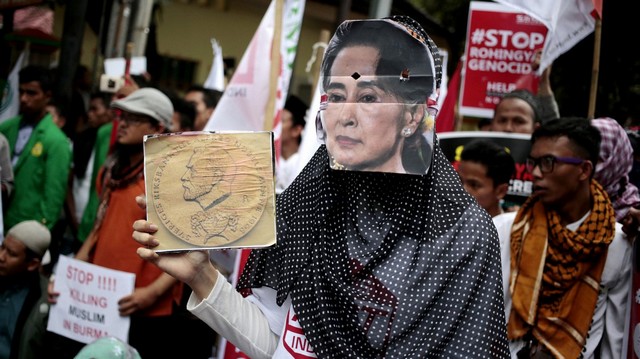
Myanmar’s government, led by Nobel laureate Aung San Suu Kyi, has denied most of the claims, and is blocking entry to a U.N. fact-finding mission tasked with looking into the allegations.

The government has also kept independent journalists and human rights monitors out of the area for the past nine months.

This week, the Ministry of Information escorted more than a dozen foreign and local journalists representing international media, including Reuters, to the area under a guard of officers from the paramilitary Border Guard Police

BRUTAL TACTICS

The reporters spent nearly two days in Buthidaung, a township in Maungdaw district of Rakhine state, where they were taken to sites of alleged militant activity.

They were taken to Kyar Gaung Taung, one of three settlements requested by the journalists. Officials cited time constraints for the limited access.

Reuters had previously gathered accounts from residents by phone and from former residents who have fled to Bangladesh, of brutal counterinsurgency tactics unleashed in Kyar Gaung Taung and several nearby villages in mid-November.

When a group of journalists insisted on speaking to villagers away from security forces, allegations of abuses by troops emerged almost immediately.

Kyar Gaung Taung resident Sarbeda, 30, had been able to visit her son, Nawsee Mullah, 14, at a police camp where he is being held separately from adult detainees. She was not sure if he had a lawyer, she said.

Reuters reported in March that 13 boys under the age of 18 were detained during security operations. They were included in a list of 423 people charged under the colonial-era Unlawful Associations Act, which outlaws joining or aiding rebel groups.

At least 32 people from Kyar Gaung Taung village had been arrested and 10 killed, said a village schoolteacher, who asked not to be named for fear of reprisals. He estimated that half the village’s 6,000 residents had fled during the clearance operation.

BURNED TO DEATH

Another villager, Lalmuti, 23, pointed to a small pile of ashes where she said she found her father’s remains. She described how he was bound and thrown into a house and burned to death.

Her mother was later arrested when authorities deemed her complaint about the killings to be fabricated. She is serving a six-month jail sentence, Lalmuti and two other villagers said.

Reporters were not given a chance to put these allegations to authorities, and Reuters was unable to reach officials to confirm the details of the cases by phone.

In a press briefing on Friday, Brigadier General Thura San Lwin, commander of Myanmar’s Border Guard Police, said some villagers had made what he said were erroneous claims and were subsequently charged and jailed for lying to the authorities.

“The media said we torched houses and that there were rape cases — they give wrong information,” Thura San Lwin told reporters.

He also disputed the U.N.’s estimates for the number of people who fled, claiming local records showed that only 22,000 people were missing in the conflict.

Myanmar officials say a domestic investigation, led by Vice President Myint Swe – a former lieutenant general in the army – and a commission headed for former U.N. chief Kofi Annan – which is not mandated to investigate human rights abuses – are the appropriate ways to address problems in Rakhine State.

(Reporting by Simon Lewis in Kyar Gaung Taung village. Additional reporting by Wa Lone in Yangon. Editing by Bill Tarrant.)

15 July 2017

Universiti Malaya, Chandra Muzaffar to Host Tribunal on Atrocities against Rohingya

By Ho Kit Yen

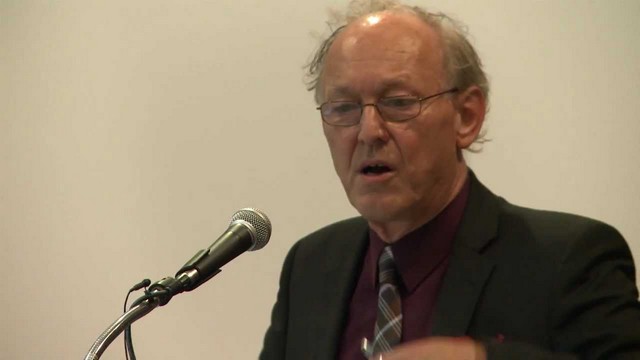
Dr Chandra Muzaffar who is organising committee chairman for Tribunal on the Rohingyas says witnesses will be called to testify in court-like setting.

4 Jul 2017 – A tribunal that hopes to expose claims of crimes against the Rohingya and other ethnic groups by the Myanmar government will hold a hearing at the Universiti Malaya in September.

Social activist Dr Chandra Muzaffar, who is the organising committee chairman for the Tribunal on the Rohingyas, Kachins and other ethnic minorities, said that the tribunal wants to expose the alleged inhuman treatment and push to stop the crimes.

“The process will be similar to a hearing, with the Myanmar ethnic groups testifying before a jury.

“From there, the tribunal will make a conclusion based on oral testimonies on the atrocities and present our findings to the United Nation’s Fact Finding Mission that was tasked to send its’ official to Yangon,” he said in a press conference today.

He added that the Myanmar government, led by Nobel Peace Prize winner Aung San Suu Kyi, had publicly rejected the UN’s team into the country.

Also present at the press conference was Centre for Human Rights Research and Advocacy (Centhra) chief executive Azril Mohd Amin and International Forum on Buddhist-Muslim Relations’ (BMF) secretary KV Soon.

Chandra said previously a similar tribunal was held in London, on March 6 and 7, which concluded that the UN and Asean had to take swift actions against Myanmar to stop the crimes against the minorities groups.

“The Kuala Lumpur tribunal is a continuation of the London tribunal, with more witnesses coming this time.

“We hope to make findings and present it to the public and push the Asean governments, including Myanmar, to stop the genocide,” he said.

The activist however, lamented the findings are not legally binding and cannot be enforced by law.

“It is not legally binding but I believe that like other tribunals, such as the 2005 Citizens’ Tribunal on Iraq, it has persuasive powers.

“We hope to use it to persuade the people to stand up and speak out against the military government,” Chandra said.

Azril, who is also a lawyer added that it would be difficult for the tribunal’s findings to be pushed to the International Criminal Court (ICC) to be tried.

“First of all, Malaysia and Myanmar are not signatories of the Rome Statute. The Philippines and Cambodia are the only two countries in the region that ratified the Statute,” he said.

The tribunal will be held on Sept 18 to 22 at Universiti Malaya’s Law Faculty in Kuala Lumpur.

Over 300 ethnic Rohingyas, Kachins and other groups, who are refugees here are expected to testify.

Dr. Chandra Muzaffar is a member of the TRANSCEND Network for Peace, Development and Environment, and president of the International Movement for a Just World (JUST). He is the author of the e-book ‘Whither WANA?-Reflections on the Arab Uprisings,’ which is accessible through the JUST website, www.just-international.org.

10 July 2017

Saudi links to Israel revealed

By middleeastmonitor.com

The twitter account Mujtahidd revealed details of the “important figures” in the relationship between Saudi Arabia and Israel over the past decades.

According to the unknown activist, King Salman and Foreign Minister Adel Al-Jubeir were both prominent figures in opening channels with Israeli figures and the Zionist lobby in the United States, specifically AIPAC.

Contact with Israel was made over the past decades through two channels, the first in the name of the kingdom in general, and the second was specific to King Salman when he was the Emir of Riyadh.

Read: Relations with Israel will be based on mutual interests

“The first channel was opened through Adel Al-Jubeir when he was a young man trained by Bandar Bin Sultan at our embassy in Washington, where he was appointed as his congressional assistant,” Mujtahidd wrote in a tweet.

“His mission was to reach the famous Zionist lobby organisation (AIPAC) and through it he will guarantee the support of Congress.”

Al-Jubeir was chosen because he “has no religious or national commitment. He was the right person to love AIPAC and be in harmony with them, and consequently to facilitate Bandar’s job in gaining the support of Congress.”

He pointed out that the result of Al-Jubeir’s harmony with AIPAC was “establishing direct relations with Israeli officials, gaining Israeli trust and coordinating views on regional issues behind the scenes.”

Mujtahidd continued: “This relationship had an impact on the position of the Kingdom on the Palestinian issue, the Madrid Conference and Oslo, as well as Lebanon and the Palestinian resistance, then Iraq and Iran, etc.”

Read: #Saudis_against_normalisation with Israel

Speaking about the reign of the late King Abdullah Bin Abdulaziz, Mujtahidd claimed that “after the ascent of King Abdullah, Tuwaijri, who believes in the greatness of Israel, succeeded in convincing him to appoint Al-Jubeir as ambassador to America so as to facilitate direct coordination with them.”

He added that Al-Jubeir continued even after Salman became king and that “his son Muhammad was keen to convince Israel that the kingdom’s policy was in harmony with it.”

Al-Jubeir became a “star” in the eyes of the Zionists who described him as the “Michael Jordan of Saudi Arabia”, in reference to the famous American basketball player Michael Jordan.

The reason behind King Salman’s efforts to open channels of communication with the Israelis, Mujtahidd explained, was his intention to “secure his future in power, racing with his brothers and pledging to Israel that he would make more concessions than his brothers if they help him jump the queue.”

He added: “Salman did not realise that his brothers have secured themselves with America and Israel and that he will not be able to jump the queue. Consequently, he reached the role only after being overtaken by Alzheimer.”

11 July 2017

World’s debt over three times greater than economic output

By Russia Today

Global debt levels have surged to a record $217 trillion in the first quarter of the year. This is 327 percent of the world’s annual economic output (GDP), reports the Institute of International Finance (IIF).

The surging debt was driven by emerging economies, which have increased borrowing by $3 trillion to $56 trillion. This amounts to 218 percent of their combined economic output, five percentage points greater year on year.

The biggest contributor was China with $2 trillion. In June, the International Monetary Fund urged Beijing to tackle its ballooning debt, describing it as unusually high for a developing economy. Some estimates say China’s debt stands at 260 percent of its GDP.

Advanced economies have cut debt levels by $2 trillion over the past year. However, the US is approaching $20 trillion, almost 10 percent of global debt.

“Rising debt may create headwinds for long-term growth and eventually pose risks for financial stability,” the report said.

“In some cases, this sharp debt build-up has already started to become a drag on sovereign credit profiles, including in countries such as China and Canada,” it added.

Emerging hard currency-denominated debt grew by $200 billion in the past year – growing at its fastest pace since 2014. Seventy percent of the debt is in dollars, the report found.

“Rollover risk is high,” the IIF added.

The US and the EU could increase interest rates in the near future, thus making it more expensive for borrowers to repay, the report noted.

10 July 2017

Marwan Barghouti and the Battle of the Empty Stomachs

By Jonathan Cook

Often described as the Palestinians’ Nelson Mandela, Barghouti led the recent prisoners’ hunger strike. Paradoxically, his incarceration has served only to make him more visible, a Palestinian national icon. And now he is said to be developing a new model of resistance, to replace the failed strategies of Mahmoud Abbas and Hamas.

4 Jul 2017 – Perhaps it was fitting that the most significant act of organized mass resistance by Palestinians to the occupation in many years was launched from behind bars. In April of this year more than 1,500 political prisoners began an indefinite hunger strike against their increasingly degrading treatment by the Israeli authorities. Some called it a prison “intifada,” the word Palestinians use for their serial efforts to “shake off” Israeli oppression.

Over the past five decades, Israel’s incarceration industry is reported to have locked away some 800,000 Palestinians, amounting to 40 per cent of the male population. At any moment, there are few families that do not have at least one close relative in jail.

More generally, Palestinians often characterize the occupied territories of Gaza and the West Bank as giant prisons. Checkpoints, permits, walls, fences, settlements, Jewish-only roads, closed military areas and blockades restrict movement so severely that most Palestinians are effectively confined to open-air cells of varying size. The Israeli historian Ilan Pappe’s latest book, a history of the occupied territories due out this summer, is titled “The Biggest Prison on Earth” for that very reason. An act of mass defiance by Palestinian prisoners resonates far beyond the concrete walls of Israel’s three dozen detention centers.

Israel’s treatment of Palestinian prisoners has significantly deteriorated in recent years, with only cursory objections from the International Committee of the Red Cross. A surge in Palestinian inmate numbers over the past 18 months – to 6,500 detainees – has brought the prison population to levels not seen since the early years of the second intifada, some 15 years ago. Overcrowding has pushed the mood among political prisoners to boiling point.

The hunger strike, under the banner “Freedom and Dignity,” was initiated by Marwan Barghouti, the most senior Palestinian official behind bars. One of the leaders of the ruling Fatah movement and the head of its armed resistance at the start of the second intifada, he was sentenced to multiple life terms following his capture in the West Bank in 2002. He has since become the figurehead of the Palestinian prisoners. But more significantly, his status has grown to almost mythic proportions during his long years of incarceration, making him the most popular contender to succeed the Palestinian president, Mahmoud Abbas. He is possibly the only Palestinian leader who has the power to unify the Palestinians under occupation in the way the late Yasser Arafat once did.

At the time of writing it is too early to know what course the hunger strike will take. It could lead to the deaths of prisoners, even Barghouti himself, and the eruption of a new intifada. Or Israel could make enough concessions that the prisoners either relent or split sufficiently that the strike becomes ineffective. It has not helped that the prisoners have struggled to attract much visible concern from the international community. As Arundhati Roy, the award-winning Indian writer, has observed, all acts of non-violence, including hunger strikes, work only as spectacle, or theatre. It “needs an audience. What can you do when you have no audience?”

For this reason, it has been difficult for the Palestinians to find an auspicious moment to conduct mass protests. The world’s attention has been elsewhere: on Cairo’s failed Tahrir Square uprisings and the re-consolidation of military rule in Egypt; on the catastrophic fallout from the proxy wars across Israel’s northern border, in Syria; on Washington’s revival of a Cold War with Russia; and most lately, the drama of the US elections and the arrival of a wealthy reality TV star in the White House.

But there are reasons why Barghouti has invested his energies in promoting what Palestinians call “the battle of the empty stomachs.”

Not least, political prisoners face increasingly degrading conditions – a plight that resonates deeply with the Palestinian public. Among the demands are a halt to Israel’s frequent use of detention without trial, and its routine use of torture and solitary confinement as punishment; an end to lengthy and difficult transport between prison and court hearings, when inmates spend hours in the back of sweltering vans without food or water, and are forced to urinate into plastic bottles; the installation of pay phones so that inmates can maintain contact with their families, who increasingly struggle to get permits into Israel for visits; the opportunity to pursue academic studies while in jail, as well as greater access to TV and other media, rights Israel has overturned in recent years; and treatment in hospital, rather than prison clinics, for those with serious medical conditions.

But beyond the justice of the prisoners’ cause, the hunger strike offered a disillusioned, divided and weary Palestinian populace a model of how again to struggle against Israel’s oppressive rule. It offered a kind of struggle that might ultimately unify them.

Journalism as ‘terror attack’

Barghouti explained the reasons for the hunger strike in an opinion piece smuggled out of his cell and published in the international, though not domestic, edition of The New York Times. It was a publishing coup that enraged Israel. One government minister, Michael Oren, likened it to a “journalistic terror attack.”

The Times’ article was a rare break in Barghouti’s enforced silence. Since the Oslo process was initiated in the early 1990s, he is known to have continued as a supporter of the two-state solution, winning him allies on the Israeli left. But his ideas about how to achieve Palestinian statehood appear to have undergone a significant revision during his time in jail.

As one of the leaders of the armed uprising that began in late 2000, he was originally a fervent supporter of the right of Palestinians to use violence to liberate themselves from the occupation, though he stated that armed resistance should take place only in the occupied territories. Since then, watching events unfold from his prison cell, he has become a leading advocate for new strategies of non-violent resistance. His article in The New York Times offers insights into his changed thinking.

The refusal of food was, he wrote, a protest against Israel’s system of “mass arbitrary arrests and ill-treatment of Palestinian prisoners” – many of them at the forefront of the armed Palestinian struggle against the occupation. Israel, he added, had constructed an “inhumane system of colonial and military occupation [designed] to break the spirit of prisoners and the nation to which they belong, by inflicting suffering on their bodies, separating them from their families and communities, using humiliating measures to compel subjugation.”

Underscoring the point that the thousands of Palestinians currently in Israeli jails are suffering only a more severe form of confinement than their families outside, he continued: “Freedom and dignity are universal rights that are inherent in humanity, to be enjoyed by every nation and all human beings. Palestinians will not be an exception. Only ending occupation will end this injustice.”

In line with his new approach, he described the hunger strike as “the most peaceful form of resistance available. It inflicts pain solely on those who participate and on their loved ones, in the hopes that their empty stomachs and their sacrifice will help the message resonate beyond the confines of their dark cells.”

Barghouti noted his own, typical experiences of detention, including at age 18 being beaten on the genitals during an interrogation. His tormentors mocked him, saying it would be better if he did not have children because Palestinians “give birth only to terrorists and murderers.” He defied his captors, although he was again behind bars when his first son was born. Qassam was named for Izzeldin al-Qassam, the leader of the Palestinian revolt against British rule in Palestine in the late 1930s. Qassam would begin his own rite of passage in an Israeli jail shortly after his own 18th birthday.

Barghouti, aged 59 and a father of four, has served most of his sentence in Hadarim prison, not far from the Israeli coastal city of Netanya. But in an attempt to break up the hunger strike, the Israeli authorities immediately transferred him to another jail, Kishon, near Haifa, where he was placed in solitary confinement.

All but one of the prisons holding Palestinians are located inside Israel. This is a serious, though rarely mentioned, violation of international law, which defines the transfer of prisoners out of occupied territory as a war crime. As Barghouti observed, by moving Palestinian prisoners out of the occupied territories Israel has been able to “restrict family visits and to inflict suffering on prisoners through long transports under cruel conditions.” He speaks from bitter personal experience. He is allowed to see each of his four children once a year on average, and has never been permitted to see his grandchildren because they are not “first-degree relatives.”

Despite Israel labeling Palestinian prisoners “terrorists,” Barghouti noted that the occupation army can seize anyone: “children, women, parliamentarians, activists, journalists, human rights defenders, academics, political figures, militants, bystanders, family members of prisoners. And all with one aim: to bury the legitimate aspirations of an entire nation.”

Once arrested, imprisonment is largely a foregone conclusion in a military court system enforcing “judicial apartheid.” Inside prison, Palestinians “have suffered from torture, inhumane and degrading treatment, and medical negligence.” As many as 200 prisoners have died because of such abuses since 1967, wrote Barghouti. He himself has been placed in isolation more than two dozen times in the past 15 years – a punishment the United Nation’s special rapporteur on torture, Juan Mendez, wants banned as “cruel and degrading.”

Comparisons with Mandela

Since his jailing in 2002, Barghouti has been repeatedly described as the Palestinians’ Nelson Mandela, the black African National Congress leader who led the long and ultimately successful struggle against South Africa’s apartheid regime. It is a comparison he has been understandably happy to cultivate in a Palestinian national movement that is, at present, desperately short of icons.

In his New York Times article, he called the hunger strike part of the Palestinians’ “long walk to freedom,” the title of Mandela’s autobiography. He also noted that the International Campaign to Free Marwan Barghouti – backed by eight Nobel peace laureates, including former US president Jimmy Carter and South Africa’s Archbishop Desmond Tutu – was launched four years ago from Mandela’s former cell on Robben Island. His wife Fadwa, a lawyer, has been a pivotal figure in the campaign.

Barghouti has not concealed his political ambitions, which are intimately tied to his prison activism. Early last year, he announced that, should the increasingly unpopular Abbas step down, he would enter the succession race from his prison cell. In a related document released by friends, he derided the Palestinian president’s signature policy of pursuing peace talks with Israel while campaigning for statehood at the United Nations. “This is a pathetic policy disconnected from the reality on the ground,” he wrote.

He criticized the Palestinian Authority’s “security coordination” with Israel, and the failure to reach a reconciliation between Fatah and Hamas, the rival Islamic resistance movement that rules Gaza. He singled out Abbas for his authoritarianism, corruption, weakness and refusal to cultivate a new generation of leaders in Fatah. The political vacuum created by Abbas’ policies, Barghouti warned, had encouraged support for extremist Islamic groups among some youth and spawned the so-called lone-wolf intifada, a spate of disorganized stabbings and car rammings by individuals since late 2015. Barghouti urged “a revolution in the education system, in the way we think, in culture, and in our legal system.”

Concurrently, the Times of Israel website reported that Barghouti had reached a secret agreement with jailed Hamas and Islamic Jihad leaders for a renewed Palestinian struggle, this time drawing on the principles of popular non-violent resistance espoused by Martin Luther King Jr. and Mahatma Gandhi. The plan, to be implemented after Abbas’ departure, is for a “People’s Peaceful Revolution” to pressure Israel into withdrawing from the occupied territories and conceding a Palestinian state.

The website reported that the participants had “agreed on having Palestinian civilians block all access roads to settlements, via an influx of Palestinians onto the main roads; damage to the infrastructure of the settlements, such as electricity, telephone and internet; and organized mass protests across Jerusalem. … Other steps laid out for the campaign are aimed at damaging Israel’s image in the world and its ability to continue ruling over the West Bank and even East Jerusalem.”

Qadura Fares, a senior figure in the Palestinian Prisoners’ Association and a friend of Barghouti’s, has expanded on such thinking: “The idea is to mobilize hundreds of thousands of people, who will march to Jerusalem. Another way is for tens of thousands of people to sit on the bypass roads [in the West Bank] from dawn to sunset. … I am talking about an intensive popular revolution that will disrupt the settlers’ lives. … We will sit on the road. Someone wants to have a wedding celebration? It will be held on a bypass road.”

Barghouti is reported to have devoured books on the history of non-violent struggle while in prison. According to his lawyer, Elias Sabbagh, Barghouti believes the only obstacle to this new strategy is the absence of an Israeli partner. “No [Charles] de Gaulle or [F. W.] de Klerk has yet arisen in Israel,” he told Sabbagh, referring to leaders who oversaw the end of French colonial rule in Algeria and apartheid in South Africa.

Israel’s nightmare scenario

The hunger strike clearly reflects Barghouti’s preference for acts of collective non-violent resistance. Israeli analysts have long warned that mass civil disobedience – the disruption of the occupation’s smooth running – is the Israeli military’s nightmare scenario. It was therefore entirely expected that Israel would seek to crush the protest. The leaders were put into isolation, while prisoners refusing food were denied family visits, dispersed to different jails, and barred from contact with their lawyers. Gilad Erdan, the minister of Internal Security, Strategic Affairs and Hasbara, told Army Radio: “These are terrorists and incarcerated murderers … My policy is that you can’t negotiate with prisoners such as these.” Erdan and other ministers have applauded the hardline response of the British government to a hunger strike by Provisional IRA prisoners in the 1980s that resulted in the deaths of 10 inmates, including Bobby Sands.

In a further sign of panic, Israel turned its fire on The New York Times, threatening to shut the paper’s bureau in Jerusalem as punishment for publishing Barghouti’s article. On Facebook, Israeli prime minister Benjamin Netanyahu fumed against the paper: “Calling Barghouti a ‘political leader’ is like calling [Syria’s Bashar] Assad a ‘pediatrician’ [sic – he meant ophthalmologist]. They are murderers and terrorists.” Behind-the-scenes pressure led the paper’s editors to include online a footnote post-publication, “clarifying” that Barghouti had been convicted of “five counts of murder and membership in a terrorist organization.” They also allowed Erdan to write a response that used the term “terrorist” and “terrorism” no less than 18 times.

Despite Israel’s alarm, this is not the first time Palestinian prisoners have refused food. In the years before Arafat and the Palestinian leadership were allowed to return from exile in 1994 under the terms of the Oslo accords, such protests were used sparingly, and usually short term. Since Oslo, collective action by prisoners has proved more difficult to organize. During the second intifada, western audiences were generally more sympathetic to Israeli deaths than to protests by Palestinians defined by Israel and much of the media as “terrorists”. And then for the past decade, Palestinian politics has been scarred by a territorial and ideological split between Abbas’ Fatah party in the West Bank and Hamas in Gaza.

Israel has inflamed these tensions in prison by giving Hamas detainees worse conditions than Fatah inmates, especially in relation to family visits and spending allowances in canteens. According to early reports, Barghouti struggled to win over Hamas prisoners to the strike, apart from those with him in Hadarim. And there was the further difficulty of controlling the largely non-affiliated prisoners arrested for their part in the so-called “lone-wolf intifada.” But by early May, there were reports that leaders from all the Palestinian factions had begun refusing food, in an indication that the strike was spreading.

Israel has reason to be deeply concerned by the potential of mass actions like the hunger strike. Barghouti may have hoped to tap into that longing for new forms of collective action. Palestinians have grown increasingly frustrated by the terminal impasse in negotiations, and by the failure of their leaders to unite. Even if the strike ultimately proves unsuccessful, it presents Palestinians with a timely alternative model of protest, when the idea of Israel as an apartheid state is gaining ground. The danger for Israel is that a hunger strike could inspire other forms of civil disobedience by wider Palestinian society.

The power of protest

It is not difficult to understand why a hunger strike appealed to Barghouti. The handful of prisoners who have in recent years refused food – mostly individuals detained without trial – have deeply embarrassed Israel, and in a few cases managed to extract an early release from the authorities. Israel has been so discomfited by the pressure of these isolated protests that it passed legislation in 2015 empowering prison authorities to force-feed inmates, despite objections from the UN and human rights groups that force-feeding constitutes torture. The World Medical Association has also barred doctors from forcibly feeding prisoners since 1975.

As the legislation was being voted on, minister Erdan equated hunger strikes with “a new type of suicide terrorist attack through which [prisoners] will threaten the State of Israel”. Notably, Israel quickly established “field hospitals” in the grounds of its main prisons, in what the inmates assumed was preparation for their force-feeding. At the time of writing, in early May, as some prisoners started to grow weak, the Israeli health ministry warned doctors that if they refused to force-feed striking inmates it would be their responsibility to find a replacement who would do so. Other reports suggested that Israel was considering flying in foreign doctors to force-feed prisoners.

Not only does a hunger strike challenge head-on Israel’s industrialized system of incarceration, but it has the potential to draw almost the entire Palestinian population into a highly charged confrontation with Israel. Too many families have a loved one at risk of death.

Whether the strike is maintained, succeeds or peters out, it hints at the latent power in Palestinian collective action – a power that has gone largely untapped since the mass civil disobedience of the first intifada in the late 1980s. It reminds Palestinians of their strength in numbers, of the complicity of their official leadership in Israel’s system of security control, and of their ability to disrupt the well-oiled machine of the occupation by direct action. A “battle of the empty stomachs” – this or a future one – could unleash a wave of civil disobedience and non-violent resistance outside the prisons. That could strip away the obfuscatory security pretexts employed by Israel, laying bare the occupation’s colonial nature.

Further, despite the decade-long split between Hamas and Fatah, the two movements are aware of the pressing demands from the Palestinian public for them to resolve their differences. Both have been damaged by the discord. Prison makes the ideological and strategic differences between Fatah and Hamas – differences Israel has richly exploited – far less relevant. Acts like refusing food offer a platform of resistance both factions can unify around. And unity is a precondition for Palestinian struggle to be effective, as Qadura Fares of the Prisoners’ Association has noted. The prisoners’ struggle “opens a door to the start of a popular intifada for Palestinian national unity and the rights of the Palestinian people.”

From his cell, Barghouti has repeatedly tried to push for unity. In 2006, in the immediate wake of Palestinian elections in which Hamas triumphed, he and leaders from rival factions published the so-called Prisoners’ Document calling for reconciliation and creating a political platform shared among the main factions for a two-state solution. A year later, he helped to broker the Mecca Agreement, which urged the various factions to put aside their differences and form a national unity government. Months later, the deal was torpedoed when the feud between Hamas and Fatah led to the Islamic movement taking power in Gaza.

As previously noted, there are reports that Hamas leaders have agreed with Barghouti to shift the struggle in the post-Abbas era to non-violent resistance. The unveiling by Hamas in May of a new charter – replacing one from 1988 – is a further sign of that ideological evolution. The new document jettisons the anti-semitic rhetoric of the original, severs historic ties with the Muslim Brotherhood movement and concentrates on Hamas’ role in a national struggle rather than a religious one. It accepts the Palestinian Authority as a vehicle to “serve the Palestinian people and safeguard their security, their rights and their national project.” Most importantly, while rejecting the “Zionist entity,” it declares Hamas is prepared to accept “a formula of national consensus” that would establish a “a fully sovereign and independent Palestinian state” in the occupied territories only. This brings it close enough to Fatah to make reconciliation – under Barghouti, if not Abbas – a real possibility.

Barghouti’s ambitions to bring Palestinians together has only served to intensify the Israeli authorities’ desire to keep him locked up. As Uri Avnery, a veteran leader of Israel’s small peace movement, has observed: “A free Barghouti could become a powerful agent for Palestinian unity, the last thing the Israeli overlords want.”

Unsurprisingly, most Israeli analysts cast a largely cynical eye on Barghouti’s role in the hunger strike, arguing that this was nothing more than a move to strengthen his credentials as Abbas’ successor. As evidence, they noted that privately Abbas was discomfited by the strike, even if official statements were supportive.

Certainly, Abbas’ increasingly authoritarian and sclerotic rule in the West Bank has opposed any signs of popular resistance and the emergence of grassroots movements. Abbas’ security forces regularly prevent protests in the main cities, where Israel allows the Palestinian Authority, a supposed government-in-waiting, to operate most vigorously. Israeli journalist Shlomi Eldar was told by a senior source in Fatah that Abbas’ security forces had been “ordered to allow only modest demonstrations in support of the hunger strike” in the hope that the lack of visible solidarity would starve the protest of momentum. Despite the restrictions, Palestinians staged regular rallies, marches and protests in support of the prisoners.

Exploiting Abbas’ difficulties, Netanyahu called on him to stop paying salaries to “terrorists” in Israeli jails shortly before the Palestinian leader met US President Donald Trump at the White House in early May. Republicans in the US Congress, meanwhile, were reported to be drafting legislation to condition American aid – worth roughly $500 million annually – on the PA halting payments to political prisoners, and possibly their families too.

In Abbas’ view, he needs both to prove to Israel and Washington that he is a “responsible” leader who can maintain order and deserves the chance to lead a state, and to dissipate popular anger against the occupation in case it quickly turns against the Palestinian Authority and its complicity in Israel’s repression.

A Palestinian icon emerges

Barghouti’s long imprisonment has fueled the growth in his stature, both among Palestinians and in the international community. Paradoxically, his very absence has in many ways made him more visible.

Barghouti alone among the Palestinian leadership has not been tarnished by the national liberation movement’s catastrophic failures of the past 15 years. First, the vision of Palestinian statehood – either in its truncated Oslo form, or its much less accommodating Islamic version – floundered on the rocks of the armed intifada. Then it slowly sank into the dark waters of international indifference. Uniquely, Barghouti, locked away in an Israeli cell, could not be blamed for any of this. It is worth briefly plotting the dramatic changes to the Palestinian landscape since Barghouti disappeared from view.

Yasser Arafat, the man who did more than anyone to create a united Palestinian struggle for nationhood, died in mysterious circumstances in 2004. Many assumed he was assassinated by Israel, with Washington’s blessing. Both had grown frustrated by his failure to deliver their goal: autocratic rule over a series of Palestinian Bantustans that guaranteed quiet for Israel and its colonizing population in the settlements.

Arafat’s successor, Mahmoud Abbas, looked more to their liking. He not only forswore the armed resistance of the second intifada that Barghouti was so closely associated with, but then refused to replace it with any other form of popular struggle. In fact, quite the contrary. Abbas’ primary commitment has been not to resistance but to security coordination with Israel – effectively allowing Israel to co-opt the Palestinian security services as a subcontracted police force. Abbas has described that role as “sacred”.

Whatever his failings, Arafat understood the precarious nature of Palestinian struggle – and most especially the need to maintain a loose balance and consensus between the various Palestinian factions to prevent tensions reaching dangerously explosive levels. But the consensus prioritized by Abbas was one forged in Washington – and thereby implicitly in Israel. The change of strategy to near-absolute accommodation with the occupying power quickly brought long-standing grievances to the surface, particularly from Hamas.

Strains between Fatah and Hamas surfaced most strongly in Gaza because that was the one place in historic Palestine where Israel briefly gave the Palestinian movement a little room to breathe. The so-called disengagement of 2005, Israel’s withdrawal of its soldiers and settlers from Gaza, was followed a short time later by a Palestinian general election – one that, to the consternation of Israel and Washington, was decisively won by Hamas. Abbas continued to rule in the West Bank, now with a deeply compromised mandate, and paid little attention to Hamas’ political demands. In Gaza, the friction exploded into violence in 2007, as Hamas swept to power.

The consequence was a central fissure in Palestinian strategy and territory that remains to this day. Aided by Israel, Abbas’ Fatah movement entrenched its rule in the West Bank against Hamas, becoming more obviously authoritarian and repressive. And in Gaza, Hamas created a tiny Islamic fiefdom, a toehold from which it aspired to much greater things. A vision of Palestinian statehood – either of the diminished (Fatah) or comprehensive (Hamas) variety – faded as the two factions greedily protected what little they had, both from each other and from Israel.

Fatah sought to disband its armed groups and invested its energies instead in the diplomatic arena. Both the popular and armed struggles were renounced in favor of lobbying western states at the UN over statehood and issuing threats to pursue Israel for war crimes at the International Criminal Court. Western governments – those that had allowed Palestine’s colonization over many decades – were treated as though they could now be trusted to act as honest brokers between the Palestinians and Israel.

Gaza, meanwhile, suffered under a double hammer blow. On the one hand, it faced a long-term war of attrition through an Israeli-enforced siege of the enclave to starve the population into submission. And on the other, it endured a succession of vicious Israeli attacks that devastated Gaza’s infrastructure and killed and maimed thousands of Palestinians in each round.

Israel’s combined policy of isolating and intermittently pulverizing Gaza was more successful than is often acknowledged. Hamas’ fiery rhetoric became more hollow, then largely evaporated. It fired fewer rockets itself and then became more repressive in preventing other groups from firing them. Its problems only intensified as Egypt’s generals restored their rule in 2014, and blamed Hamas for aiding the Islamic opposition. Gaza lost its only partial access to the world through its border with Sinai.

As a result, Hamas in many ways came to mirror the compromises of Abbas’ Fatah movement in the West Bank. It sought quiet from Israel by enforcing quiet in its own territory on Israel’s behalf.

The Palestinian leaderships have not been entirely insensitive to the damaging effect of these changes on their credibility. But their efforts at unity have repeatedly failed for the simple reason that the structural conditions engineered by Israel and the US encourage discord and feuding between the two factions, not compromise or unity.

While the national movements have turned into hollow shells, Barghouti has remained an icon of better times. Prison has maintained him as a perfectly preserved relic from another era – a golden era, when Palestinian leaders were seen to be with the people, offered a vision, and personally struggled for national liberation. Barghouti is a fighter unbowed, a hero, a Nelson Mandela waiting his moment. He is a blank canvas on which Palestinians can pour their dreams and hopes.

Awaiting assassination

Barghouti was the topic of one of the first commentaries I wrote after arriving in the region as a reporter. It was published by the International Herald Tribune, a daily now known as the International New York Times. My piece was published in September 2002 under the title “Marwan Barghouti: A Nelson Mandela for the Palestinians?”. My analysis was prompted in part by a commentary Barghouti had written earlier, in January of that year, for the Washington Post. Fatah’s general secretary on the West Bank and a member of the Palestinian Legislative Council, he was one of the leaders of the then 15-month-old armed struggle of the second intifada.

Reading Barghouti’s article now, one can see both how little has changed for the Palestinians in terms of their dilemmas, and how rarely their leaders speak today with the kind of forthrightness Barghouti employed then about the right to resist. The 2002 article also offers a revealing counterpoint to the commentary Barghouti published 15 years later in the International New York Times. It indicates that, locked in Hadarim prison, Barghouti has had the time and distance to rethink the nature – if not the aims – of the Palestinian struggle. It also suggests that, unlike those outside prison active in Hamas and Fatah, he is not trapped in a damaging turf war.

In his 2002 commentary, Barghouti pledged his commitment to two principles: a peaceful resolution of the conflict based on the two-state solution; and the harnessing of violence to force Israel to make the concessions needed for peace. The article serves as a difficult balancing act, trying to appeal to two very different constituencies. Barghouti hoped to maintain the relations he had cultivated with the Israeli left while at the same time satisfying a Palestinian public exasperated by the Israeli leadership’s bad faith.

He wrote of the Oslo process: “Since 1994, when I believed Israel was serious about ending its occupation, I have been a tireless advocate of a peace based on fairness and equality. I led delegations of Palestinians in meetings with Israeli parliamentarians to promote mutual understanding and cooperation. I still seek peaceful coexistence between the equal and independent countries of Israel and Palestine based on full withdrawal from Palestinian territories occupied in 1967 and a just resolution to the plight of Palestinian refugees.”

But he noted that Israel’s intransigence was backed by US arms designed to crush any resistance to the colonization of Palestinian territory. “If Israel reserves the right to bomb us with F-16s and helicopter gunships, it should not be surprised when Palestinians seek defensive weapons to bring those aircraft down. And while I, and the Fatah movement to which I belong, strongly oppose attacks and the targeting of civilians inside Israel, our future neighbor, I reserve the right to protect myself, to resist the Israeli occupation of my country and to fight for my freedom. If Palestinians are expected to negotiate under occupation, then Israel must be expected to negotiate as we resist that occupation.”

He added: “I am not a terrorist, but neither am I a pacifist. I am simply a regular guy from the Palestinian street advocating only what every other oppressed person has advocated — the right to help myself in the absence of help from anywhere else.”

That “regular guy” image is a strong part of Barghouti’s appeal. But it was also why he expressed fears in the article that his days were numbered. Israel had tried to assassinate him the year before, when it fired on a convoy of cars, killing his bodyguard. He pointed out that in the previous 15 months some 82 Palestinians leaders had been killed in “targeted assassinations” – Israeli extrajudicial executions. He assumed he would join them. His commitment to resistance, he wrote, “may well lead to my assassination.”

As I noted in my subsequent commentary for the Tribune, Barghouti was wrong. He was not to be a victim of Israel’s assassination campaign. Instead Israel launched a daring military raid into the West Bank in April 2002 to capture him alive.

‘Don’t liquidate him’

Barghouti’s reprieve struck me as strange, even as a relative newcomer covering the conflict. But I was more surprised that Israel then chose to make a show trial of Barghouti rather than subject him to a military tribunal in which much of the evidence would have been heard in secret. As I wrote at the time: “He is on trial, surrounded by the world’s media, charged with terrorism offenses. He is unique among Palestinian resistance leaders in being given months in which to make his case in the three languages he has mastered — Arabic, Hebrew and English — to his target audiences: the Palestinian people, the Israeli left and world opinion. … His lawyers will be able to portray him as the real leader of Palestinian resistance to the occupation. In the eyes of the Palestinian people, he will end the trial an imprisoned hero.”

It is worth recalling that at the time Barghouti was taken captive his popularity did not extend far outside his Fatah circles in the West Bank. He was certainly no icon. All that changed during his trial.

It now appears I was far from alone in my suspicions. In a lengthy profile published in Haaretz in 2016, Israeli security officials and politicians recounted their surprise at the decision to capture Barghouti alive. It was Benjamin Ben Eliezer, the then defence minister, who overruled the generals’ plans to kill him. “I don’t want him liquidated – just arrest him,” Ben-Eliezer told a disgruntled military chief of staff, Shaul Mofaz. A captain involved in the undercover operation told the paper he believed the order “was a directive of the prime minister, Ariel Sharon.”

Afterwards, the justice minister at the time, Meir Sheetrit, proposed televising Barghouti’s court hearings “like the Eichmann trial” – Adolf Eichmann being a leading Nazi war criminal, who Israel managed to capture in Argentina in 1960. Ami Ayalon, a former head of Israel’s domestic intelligence service, the Shin Bet, said the trial made no obvious sense. “If I believed in conspiracy theories, I would think that possibly it was an Israeli conspiracy aimed at forging a leader who believes in the two-state solution,” he told the paper. Yossi Beilin, one of the architects of the Oslo process, concurred. “The trial was a mistake. Even the presiding judge, Sara Sirota, thought it was wrong. The trial turned him into Mandela.”

It is possible that Israel believed it could use the trial as a way to discredit Barghouti, to prove that he and Arafat were implicated in what Israel then grandly called the “infrastructure of terror.” But if that was their intention, they not only failed to make their case against Barghouti, they also grossly misread the wider political context. Barghouti’s stock rose throughout the trial, among Palestinians, international solidarity activists and even to a degree among Israel’s left. He leapfrogged more visible Palestinian leaders, including the Hamas spiritual guide Sheikh Ahmed Yassin, who would soon be assassinated, to become the main political rival to Arafat himself.

When Arafat departed the scene, Barghouti stood alone as his natural heir, a more credible choice than Abbas, who was derided by Israeli prime minister Ariel Sharon at the time as no better than a “plucked chicken.” If Israel had wanted to make an icon of Barghouti, as Ami Ayalon noted, they could not have gone about it more effectively.

A long walk to freedom?

Possibly I contributed in a small way to the Mandela comparison with my commentary in the International Herald Tribune. Today, calling Barghouti a “Mandela” is meant to convey his credentials as a former “terrorist” turned peace-maker and reformer, as a bridge between two warring communities, and as the credible leader of a people seeking self-determination. His youngest son, Arab, meant it that way when he told Israeli journalist Gideon Levy recently: “My father is a terrorist exactly like Nelson Mandela. To the Israelis I want to say: If you admire Mandela, you should know that my father is repeating Mandela’s story.”

Back in 2002, however, I intended the comparison to be understood slightly differently. Mandela was held in jail to serve as a trump card if the apartheid regime ran out of steam. He was an escape hatch, providing an option for the white government to switch direction if international isolation grew too fierce. Back in 2002, it seemed that Barghouti could offer similar opportunities for Israel if its back was against the wall. The failure of the second intifada was not yet clear, and the Israeli economy and public morale was creaking under the strain of Palestinian resistance, especially the suicide attacks.

It is worth considering how Israel might have thought it could benefit from keeping Barghouti in jail rather than killing him. Just as South Africa eventually “rehabilitated” its own trouble-maker, Israel may have pondered a similar fate for Barghouti.

My argument at the time was that the Israeli army and the Shin Bet were deeply unsure of the second intifada’s endgame, especially in a period before Washington provided an alibi with its own, similar abuses in Iraq. In those, more difficult days for Israel, prime minister Sharon had to create increasingly improbable pretexts for refusing to engage with Arafat, including his infamous “seven days of quiet” before Israel would talk to the Palestinian leadership. The goal was to be rid of Arafat, but what would come next? Military assessments were that Hamas or even Islamic Jihad would emerge triumphant – as indeed the former did in the 2006 Palestinian elections.

Israel’s security services, I noted in 2002, might “need to engineer the emergence of a popular, pragmatic and non-Islamist Palestinian strongman to take charge of the West Bank and Gaza. Barghouti could fit the bill. He is not tainted by corruption or by suspicions of collaboration with Israel or America.” The task, on this assessment, would have been to break Barghouti’s spirit in jail but cultivate his image to the outside world as an independent Palestinian leader. Then if the moment arose, Barghouti could make his “long walk to freedom,” to rule over whatever fragments of a Palestinian state Israel conceded.

Crystal-ball predictions are notoriously unwise. But aside from whether this assessment of Israeli intentions was right or wrong, it is important to understand why it seemed plausible at the time – not least, because it reveals much about what has changed in Israeli calculations.

It is the job of intelligence services everywhere to prepare for multiple scenarios, including ones that never materialize. Shortly after Barghouti’s arrest, Sharon and his deputy, Ehud Olmert, began formulating the “disengagement” from Gaza and the related, if widely-forgotten, “convergence” plan for the West Bank. That would have created a bogus Palestinian state out of slivers of the West Bank and all of Gaza. That phantom state, which Israeli policy was directed towards achieving for several years, would need a leader.

A section of Israel’s political and security elite harbored such hopes for Barghouti at the time. According to Haaretz, the Labor party’s Ehud Barak, who had recently lost the premiership to Sharon, called the military chief of staff, Shaul Mofaz, incredulous at the decision to imprison Barghouti. He warned it only made sense “if it’s part of a grand plan to make him a future national leader of the Palestinians. … He will fight for the leadership from inside prison, not having to prove a thing. The myth will grow constantly by itself.”

Today, Barghouti still has a few supporters in the Israeli security establishment who cling to the idea of a two-state solution. Yitzhak Gershon, an army commander closely involved in Barghouti’s capture, has said recently: “He should be released unconditionally at this point. And not as a collaborator with us, but as someone who will see to the [future of the] Palestinian people. … Peace is made with powerful enemies whose honor has not been trampled.” Similarly, former cabinet minister Haim Ramon has told Haaretz: “There is no doubt that he will be the next Palestinian president. He’s the consensus. He is very much accepted by Hamas. When that happens, strong international pressure will be exerted on Israel, which will be forced to release him.”

However, such voices have been largely sidelined in Israel. Ehud Olmert, Sharon’s successor, shelved the convergence plan after he found himself politically weakened by criminal investigations and after the Gaza withdrawal exposed the fragility of the Palestinian national movement, opening up new possibilities for divide and rule. Ultimately Olmert was ousted by Benjamin Netanyahu, who had other ideas of what to do with the Palestinians.

Today, Barghouti appears largely surplus to Israeli requirements. Carmi Gillon, a former director of the Shin Bet who now heads the Peres Center for Peace, has said: “There is nothing to release him for now, because there is no momentum toward an agreement.” Israel no longer has an interest in unifying the West Bank and Gaza, or installing a Palestinian leader of a “converged” Palestinian state. The hunger strike of 2017 and his advocacy of confrontational non-violent resistance underline that Barghouti now poses more of a threat than a benefit to Israel.

Leading the second intifada

Barghouti was born in a village close to the West Bank city of Ramallah in 1959, as Palestinians were still digesting their massive dispossession a decade earlier during the Nakba. He was just eight years old when, in 1967, Israel captured the rest of historic Palestine. By 15, as the occupation entrenched, he had joined Fatah and was one of the founders of its youth movement, Shabiba. Three years later he was jailed, spending four years behind bars on charges of belonging to what was then defined by Israel as an illegal organization.

He put the time to use learning Hebrew, the language of the occupier, as most of his generation of local political activists did. In 1983, he began a history and political science degree at Bir Zeit University, near Ramallah, and was elected head of the student union. A year later he married a law student, Fadwa Ibrahim. However, he had to break off studies in 1987 with the eruption of the first intifada.

Barghouti took a prominent role in the early planning of the popular uprising. His current ideas about non-violent resistance are doubtless rooted in the lessons learned from the campaign of civil disobedience that characterized the initial stages of the first intifada.

Among the actions organized by Palestinians were protest marches, the closing of roads, boycotts of Israeli goods, the burning of ID papers, resignations from government and police positions, the refusal to pay taxes, and general strikes. Israel closed hundreds of schools to prevent youths from organizing, forcing Palestinians to set up “underground” classrooms. Meanwhile, popular committees were established to create an alternative welfare system, providing health services, childcare, education and food, to reduce the Palestinian public’s dependence on the occupation authorities. In one notable example of civil disobedience, highlighted in the 2014 feature film The Wanted 18, a Palestinian village created its own secret dairy plant, hiding the cows from the Israeli authorities, to end their reliance on Israeli milk supplies.

The first intifada occurred before Arafat and the other leaders in exile were allowed to return from Tunisia in 1994. Instead, the Palestinians in the occupied territories relied on a diffuse leadership. Barghouti was among those seized pre-emptively by Israel in 1987 and expelled to Jordan. He was only allowed back under the terms of the Oslo accords seven years later. Like most in Fatah, he was a strong supporter of the new peace process, even if he remained skeptical of Israel’s good faith. He cultivated contacts with Israelis in the peace camp, while rising through Fatah’s ranks in the West Bank. He was elected in 1996 to the new Palestinian parliament, the Legislative Council, and proved his independence by launching a campaign against human rights abuses by Arafat’s security services and corruption in the Palestinian Authority.

But with the collapse of the Oslo process in 2000, Barghouti was forced into a reassessment. He foresaw that another intifada was coming and correctly believed it would combine elements of the first intifada’s popular resistance with new forms of military struggle.

Insiders and Outsiders

Barghouti’s popularity among the Palestinian public has to be understood partly in the context of what is sometimes referred to as the split between Palestinian “insiders” and “outsiders”. Barghouti was one of the home-grown leaders, raised either in the West Bank or Gaza, who earned their stripes fighting on the front lines in the period before the Oslo accords. The “outsiders,” epitomized by Abbas, were the Palestinian leaders in exile, an elite who had often grown rich in Jordan, Lebanon and later Tunisia as they directed the struggle from afar. After their return in 1994, they imposed their rule on local leaders, often insensitively and with little experience or understanding of Israel’s machinations.

“The Tunis group viewed us as soldiers, and Marwan wanted them to see us as partners,” Qadura Fares observed. “He had been deported and was familiar with both worlds, so he was acquainted first-hand with the huge disparity between the standard of living of the leadership in Tunis and the poverty in the territories. He fought for equality and democratization. He worked to integrate people from the territories into the PA apparatus.”

The Tanzim, a civilian militia loyal to Barghouti that took a high-profile role in the second intifada, was designed with that end in mind. It stood apart from Arafat’s security services that were known for their brutality and corruption. It gave Barghouti his own power base, making it difficult for Arafat and the returnees to ignore him.

Also unlike the returnees, Barghouti took a visible early role in the second intifada, confronting the army by leading mass marches to the checkpoints, the infrastructure of imprisonment Israel had established during the supposed peace-making of Oslo. His fiery speeches, like his later Washington Post commentary, provided the rationale for a militarized uprising against the occupation.

However, Barghouti soon found events taking on a logic of their own. Palestinian civilians died in ever larger numbers as Israel crushed the resistance with overwhelming military might. In the face of Israel’s arm’s-length aggression – the F-16s and helicopter gunships Barghouti mentioned in his opinion article – Fatah fighters scored few military victories. Some units became either reckless or indifferent to civilian casualties on the Israeli side. According to the Israeli media, during his Shin Bet interrogations, Barghouti admitted “things lurched out of control.” Aware too that Hamas’ suicide attacks on buses and pizza parlors were getting more attention than failed operations against heavily armed checkpoints, elements within Fatah started to dispatch their own human bombs.

Israel grabbed Barghouti in spring 2002 as this turmoil was playing out among Fatah activists. Barghouti was accused of founding the Al-Aqsa Martyrs’ Brigades, a claim he has denied, and directing its attacks on civilians and soldiers. The trial ended in the summer of 2004, with Barghouti convicted of ordering three attacks that killed four Israelis and a Greek Orthodox priest, and of a failed car bombing in Jerusalem. Less often remembered is that the Israeli court acquitted him of 33 other charges listed by the prosecution. The judges argued that the evidence showed these attacks were carried out by the Brigades, but not that he had personally directed them. Barghouti was given five life sentences, plus 40 years for the car bombing attempt.

Barghouti refused to cooperate with the court from the outset, saying it was a political trial, and he offered no legal defense. He maintained only that, while he supported armed resistance, he repudiated attacks on civilians. As the verdict was handed down, he called out to the judges: “I’m no more involved in these attacks than you are.”

Israeli officials have exploited Barghouti’s conviction to decry suggestions that he could ever be a partner for negotiations. It is impossible for Israel to deal with someone who has “blood on his hands,” they say. Gush Shalom, a peace movement in Israel, has noted how blind such assessments are to Israel’s own past. If the principle of holding Barghouti personally responsible for the actions of members of his organisation was to be extended to the Israeli leadership, several would have found themselves serving very long sentences. For example, Israel’s prime minister in the late 1970s, Menachem Begin, led the Irgun in 1946 when it blew up the King David Hotel in Jerusalem, killing 91 people. Under the rules that applied in Barghouti’s trial, observed Gush Shalom, Begin should have been sentenced to 91 consecutive life sentences for that single attack alone.

The battle with Abbas

Barghouti’s credibility among Palestinians and outsiders grew not only because jail removed him from the increasingly tarnished world of Fatah politics. His work upholding the rights of Palestinian political prisoners has earned him much credit among the wider Palestinian public on an issue that most care deeply about.

And his continuing commitment to a peaceful solution to the conflict, as well as his criticisms of Palestinian corruption, have won wide approval. Last year Palestinian officials and human rights groups launched a campaign to have him nominated for the Nobel peace prize, a move that most notably won backing from the Belgian parliament. A sympathetic Palestinian documentary, titled simply “Marwan,” premiered in the West Bank early this year, with distribution planned across the Arab world.

Barghouti has become the chief challenger to Abbas’ visionless and increasingly autocratic rule. Back in 2004 he threatened to stand against Abbas following Arafat’s death, only relenting after he was dissuaded by his wife, Fadwa, and close friends – a decision he is reported to have come to bitterly regret. Following a series of threats by Abbas to retire, Barghouti has gone public with his intention to stand for election when Abbas departs.

Surveys of Palestinian public opinion indicate that Barghouti is well ahead of his rivals. Last year surveys showed he was twice as popular as Abbas, and outpolled Ismail Haniyeh, Hamas’ most respected politician. He has won allies in unlikely places in Fatah. Mohammed Dahlan, an ambitious arch-opponent of Abbas who was forced into exile in 2011, has said he will drop out of the succession battle if Barghouti contests it. Saeb Erekat, a long-time Fatah apparatchik who is closely identified with Abbas, has also backed Barghouti. Both seem to have recognized that the popular mood is with the imprisoned Fatah leader.

The contrast between Barghouti’s and Abbas’ philosophies could not be starker on the key issues: reconciliation with Hamas, security coordination with Israel, and support for grassroots activism, including non-violent protest and boycotts. Those differences were on display when Abbas met US President Donald Trump at the White House in early May. Trump might have given Abbas’ campaign for statehood a small fillip by stating of a peace deal: “We will get it done.” But only if one believes Trump is serious in his extravagant claims. He also lavishly praised the Palestinian security forces’ cooperation with the Israeli army, saying: “They work together beautifully.” Sami Abu Zuhri, a Hamas leader, decoded that statement, tweeting that Trump had confirmed that the PA effectively received economic aid in exchange for crushing Palestinian opponents like Hamas.

At the same time as Trump is pruning foreign aid to many countries, Washington has announced that assistance will be increased to the Palestinian Authority. Palestinian analyst Ramzy Baroud pointed out that the money was little more than a bribe, rewarding the PA for “ensuring Israel’s security and … preserving the status quo.”

Abbas doubtless hoped that a meeting so early in Trump’s presidency would bolster him against critics and potential challengers like Barghouti. But the very fact that Abbas could travel to Washington and be feted by the Trump administration while Barghouti was in solitary confinement refusing food is unlikely to have made a good impression on many Palestinians.

Barghouti has reportedly told a confidant: “The [Palestinian Authority] can proceed in one of two directions today: to serve as an instrument of liberation from the occupation, or to be an instrument that validates the occupation. My task is to restore the PA to its role as an instrument of national liberation.”

Fearful for his own political survival, Abbas is reported to have conspired in keeping Barghouti in jail. He has not put pressure on Israel to release Barghouti as part of prisoner exchanges. Jamal Zahalka, a Palestinian member of the Israeli parliament, has said: “There were years when they didn’t want to hear his name in the Muqata” – Abbas’ headquarters in Ramallah.

The Palestinian president, it appears, is still plotting to deny Barghouti influence, even as speculation increases about how much longer the 82-year-old president can continue to rule. Last November, Fatah held a much-delayed congress at which it was hoped Abbas would share with potential successors some of the responsibilities of his three official posts – chairman of the Palestine Liberation Organization, president of the Palestinian Authority and chairman of the Fatah movement. He declined to do so.

But more significantly, Barghouti and his many supporters have been sidelined in the wake of the congress. The imprisoned Fatah leader received an overwhelming majority of votes at the congress – 930 of the 1,400 delegates – for a place in the movement’s central committee. But Abbas forced out of the running most of Barghouti’s potential allies who had intended to stand for election. At the central committee’s meeting in February this year, members ignored the wishes of congress delegates and selected a relative unknown, Mahmoud al-Aloul, a former governor of Nablus, as Abbas’ number two. Jibril Rajoub, a former West Bank security chief and the current head of Palestinian Football Association, was appointed the committee’s secretary-general.

On Facebook, Barghouti’s wife, Fadwa, accused the committee of giving every appearance of yielding to pressure from Netanyahu. In December the Israeli prime minister had condemned Barghouti’s election to Fatah’s central committee, saying it “radicalizes the culture of incitement and terrorism.” The decision to overlook Barghouti was also roundly criticized by Fatah cadres, former prisoners and members of the al-Aqsa Martyrs Brigades.

A poisoned chalice?

The question of Abbas’ heir is increasingly hard to ignore. The Palestinian president is said to be in poor health and his popularity likely only to sink further. One way or another, his days are numbered. Can a jailed Barghouti succeed him? Would Palestinians vote for a leader who cannot lead? A senior Fatah official has observed: “Perhaps his election will ultimately symbolize the Palestinian condition – a people under occupation with a president behind bars.” That symbolism would certainly be discomfiting for Israel. It would add to the pressure from Europe and the US to free him.

Should it happen, what would his own long walk to freedom look like? Certainly, not much like Mandela’s. The South African leader was released as the apartheid regime was collapsing. He soon became president of a “rainbow nation” that embraced all South Africans, rather than the supreme leader of the Bantustans. Israel, on the other hand, would be installing Barghouti in a deeply compromised vehicle for self-government, the Palestinian Authority, still operating under occupation. His rule would extend only to the archipelagos of nominal Palestinian self-rule in the West Bank, surrounded by settlements and military bases.

Barghouti would find he had been handed a poisoned chalice – one that defeated both Abbas and, before him, Arafat. As the Israeli reporter Amira Hass recently observed, the Palestinian Authority “is a project that the world supports for the sake of regional stability. And ‘stability’ has become a synonym for the continuation of Israel’s settlements in the West Bank without any serious diplomatic or military implications for Israel.”

Barghouti believes the PA can be reformed. But how credible is his view? Can the PA lead, or even condone, a chaotic national liberation struggle – a grassroots movement supporting non-violent resistance and civil disobedience – when its institutional structures are designed to stabilize and regulate the occupation? Tens of thousands of Palestinian families rely on the PA for salaries and allowances. Its security forces are there to keep order alongside, and in cooperation with, the Israeli army. How can Barghouti be Palestine’s Mahatma Gandhi when the institutional role of the PA’s president is more like that of Marshal Philippe Petain, head of France’s Vichy regime under Nazi occupation?

If the PA cannot be reformed, it would have to be overthrown before Palestinians could stand any chance of liberating themselves. That core contradiction would be a difficult one for a President Barghouti to resolve.

He would likely face a further difficulty. Reports of the audience reaction to the early screenings of the documentary Marwan were revealing. Its producer, Raed Othman, observed: “While the film was being screened, we noticed that many of the young people attending who have known Marwan as a symbol were excited when they heard excerpts of some of his fiery speeches, but were not thrilled to see him defend peace with Israel.”

Barghouti’s wife, Fadwa, has expressed the problem in a different way: “My and Marwan’s generation still harbors a spark of a hope that the conflict will end with a two-state solution. My children don’t believe in that; they aspire to a single, democratic state.” Indeed, many young activists have come to view the two-state solution as an illusion, one that derailed the national struggle for more than two decades. They are increasingly interested in a one-state solution, harking back to the original aims of the Palestinian Liberation Organization under Arafat.

Barghouti has proved repeatedly that he is ready to rethink strategy and to respond creatively to changing circumstances. That is a cause for hope. Can he rise to a challenge that would have proved daunting even for the real Nelson Mandela?

Update / May 30:

On May 26, the hunger strike ended. Israel maintained that it had not negotiated with the prisoners. That, however, that was widely denied by those close to the prisoners. They said Israel had spent 20 hours in intense talks with the strike’s leader, including Barghouti, to bring the hunger strike to a quick end.

Israeli authorities confirmed that they had conceded one of the prisoners’ main demands – that two family visits be allowed a month. However, the prison service emphasised that the extra visit would be funded by the PA and organized by the Red Cross.

The PA reported other concessions: prisoners will be allowed to meet their children without a glass partition; night-time searches will cease; medical treatment is to be improved; all women prisoners will be placed in a single prison and only female guards allowed to search them; daily exercise times are to be extended; and all the prisons will have a kitchen area. A prison official denied the PA’s claims, saying it had not agreed to such “perks”.

In addition, reports suggested that the prisoners will be allowed – some time later, when Israel can plausibly deny a connection to the strike – greater access to academic studies and the media. Whether Israel has made any concession on the other main demand – placing payphones in prison wings – remained unclear at the time of writing, at the end of May.

A less obvious victory claimed by the prisoners is that the Israeli authorities were forced for the first time to recognise them as a collective party. The media reported that, despite Israeli denials, the Shin Bet, Israel’s domestic intelligence service, did negotiate with the strike leaders. A prisoners’ committee has reportedly been established under Karim Younes, a Fatah leader, that will oversee continuing negotiations. Implicitly, Israel has recognized both the status of Barghouti and other prison leaders and that it must talk to them to avert a renewal of the strike.

The Israeli authorities had worked hard to undermine the strike and discredit Barghouti personally. On May 7, the prison service released video footage, filmed inside a prison cell, of a man it claimed was Barghouti twice eating snacks. The Israeli media reported that the prison service had covertly smuggled the bar to Barghouti to damage his image. Amos Harel in Haaretz observed that the stunt had largely backfired: “It only strengthened his image as a leader who is feared by Israel – which resorts to ugly tricks in order to trip him up.”

Jonathan Cook is an award-winning British journalist based in Nazareth, Israel, since 2001.

10 July 2017

America’s Violent Century

By John Feffer

The last near-century of American dominance was extraordinarily violent. Is it coming to an end?

30 Jun 2017 – John Dower is one the most preeminent historians of World War II’s Pacific theater and the aftermath of the conflict in Asia. His book War Without Mercy (1986) described the racial component of the U.S. campaign against Japan. In Embracing Defeat (1999), he examined the post-war U.S. occupation of Japan. He has long taken a critical look at U.S. foreign policy, subjecting the vaunted ideals of America’s global pretensions to skeptical scrutiny. He’s not interested in “good wars” or “good occupations.” He describes the exercise of power, and it’s almost never a pretty picture.

In recent years, Dower has been extending his critical analysis both chronologically and geographically. Cultures of War (2010) was an initial effort to link the violence of World War II to 9/11 and the Iraq War. Now, with The Violent American Century, Dower deepens his analysis by addressing the emergence and expansion of American global power all the way up to the Obama era. Dower is particularly interested in connecting the dots between the United States that emerged victorious from World War II and the America of the 21st century that appears willing to do almost anything to maintain its status as the world’s only superpower.

Dower begins his story just at the moment when the United States is poised to become a global titan. It’s 1941, the year the United States officially entered World War II. It’s also when Time’s Henry Luce proclaimed the beginning of “the American century.” For all his talk of democratic principles and the American spirit, Luce was not naïve. He knew that America would have to use force – in some cases, overwhelming force – to establish its global position. The saturation bombing of Dresden and Tokyo followed by the nuclear attacks against Nagasaki and Hiroshima became the pivotal moments of “war and terror” on which the United States would secure its authority.

Dower traces the impact of America’s nuclear policy from Hiroshima to the present, explaining how the “balance of terror” served a key role in cementing U.S. status. He discerns in U.S. indifference to human rights considerations during the Cold War – with the exception of the first two years of the Carter administration – the origins of later torture policy in the post-9/11 era. Certainly successive administrations in Washington introduced innovations in the maintenance and control of U.S. global influence, such as extraordinary rendition, drones, and enhanced surveillance capabilities, but many of the features of the “violent American century” were present at the creation.

And that’s Dower’s point. He is writing against a

chorus of detached observers who argue that violence has been contained compared to the horrors of World War Two and earlier times – and that even the death, pain, and agony we have seen since September 11 actually reflects, on the part of the United States, a praiseworthy technological and psychological turn in the direction of precision, restraint, and concern with avoiding civilian casualties.

Quite the contrary: the United States, Dower argues, may have refined its techniques, but it has done nothing to minimize the brutality. The casualties of the Iraq War alone – which number in the hundreds of thousands – undermine any notion that the United States had become a kinder, gentler superpower.

By 2016, the “American century” was only three-quarters complete. Dower brilliantly describes the infancy, adolescence, and working years of U.S. global dominance. He spends less time exploring the slowing down of the U.S. war machine during the period of international instability the Obama administration experienced. And he doesn’t speculate much on what will happen with America’s global power during what might very well be its dotage.

True, the United States seems unlikely to retire from the international stage as the American century passes the 75-year mark. But the election of Donald Trump does appear to herald a kind of second infancy, as the new president toddles about the world stage, promises to use force without restraint, and makes the most elemental of errors.

Even without Trump, whose election came after the completion of Dower’s book in September 2016, the United States was showing the strain of its “long war” against terrorism, its military bases and operations in more than 100 countries around the world, and the opportunity costs for American infrastructure and American lives at home. The obvious question, which Dower doesn’t ask or answer, is: what comes next?

China has proposed its own dream of power and prosperity. Many Russians would like to put together a Eurasian century. The European Union vacillates between disintegration and a larger global role for itself. The global South – India, South Africa, Brazil – is tired of the arrogance of the global North.

Will these aspirants to global power necessarily adopt comparable policies of war and terror to displace the United States and maintain their new status? That’s not part of Dower’s remit. But however brutal the century that follows the “American century,” you can be sure that the new hegemons will use the same language of virtue and restraint as the United States has done, even as they engage in abuses both large and small.

John Feffer is the director of Foreign Policy In Focus and the author of the dystopian novel Splinterlands.

10 July 2017