Just International

A question of justice

By Alain Gresh

Fifty years after the June 1967 war, the Israeli occupation of Palestinian lands continues. Whatever new plan is devised will concern the entire region and the wider Muslim world.

This April a number of Republican congressmen set up an Israel Victory Caucus in Washington (1). Its co-chair Bill Johnson said: ‘We believe Israel has been victorious in the war and that this reality must be recognised for any peace to be achieved between Israel and its neighbours.’ Historian Daniel Pipes added that ‘victory means imposing your will on your enemy.’ As if in response, hundreds of Palestinian political prisoners acted on a call from their best-known member, Marwan Barghouti, to go on hunger strike, their way of saying loud and clear that the Palestinians’ resistance continues and all ideas of their destruction are illusions.

This was not the first time Israel and its allies had fantasised about the Palestinians’ capitulation or even disappearance. After the Arab-Israeli war of 1948-9, Moshe Sharett, the influential Zionist Labour leader and future prime minister, had prophesied a grim future for the 700,000 Palestinians expelled from their homes: ‘The refugees will find their place in the diaspora. Through natural selection, some will survive, others won’t. The majority will become the dregs of the human race and melt into the poorest strata of the Arab world’ (2).

The Palestinians had just suffered a heavy defeat. The territory designated for their state under the UN partition plan of 29 November 1947 had been divided in three: Israel had conquered one part (including Upper Galilee); Jordan had annexed the West Bank and East Jerusalem; and the small Gaza Strip was under Egyptian control, though with limited autonomy. Their institutions were in turmoil and political leadership was lacking.

This catastrophe — the Nakba in Arabic — followed another defeat, the crushing of the Arab Revolt of 1936-9, the civil and military uprising demanding British withdrawal and a halt to Jewish immigration. It was put down by British troops allied to Zionist militia, who acquired experience and UK-supplied arms that made possible their subsequent victory over the Arab armies in 1948-9.

With their people scattered in camps in neighbouring countries or under Israel’s control, the Palestinians seemed destined to disappear as Sharett had predicted, like the indigenous peoples exterminated in the conquests of North America, Australia or New Zealand. Perhaps they would be absorbed into the wider Arab world? After all, they shared the language, culture and often religion of the countries that had taken them in.
First act of resistance

Israel condemned the Arab countries’ refusal to assimilate the refugees. But it was the Palestinians themselves who, in a first act of resistance, rejected any attempt to settle them permanently in the host countries. Initially they even rejected the idea of building lasting structures in the camps. And though Egypt under Gamal Abdel Nasser signed an agreement with UNRWA (UN Relief and Works Agency for Palestine Refugees) in July 1953 to settle tens of thousands of refugees in Sinai, Palestinians violently protested in Gaza against this. Going home remained the only dream.

Israeli peace campaigner Uri Avnery reported an exchange with a child when he was serving as a soldier during the 1956 war (3) and first, brief Israeli occupation of Gaza: ‘I asked a young Arab living in a refugee camp where he came from. “From Al-Kubab” he said. I was struck by this response because the boy was seven. So he had been born in Gaza after the war and had never even seen Al-Kubab, a village which had long ceased to exist’ (4). Now, 60 years on, most Palestinians have been born in exile but the response of adults and children remains the same: they belong to the village their family was expelled from. The Zionist movement, which turned a millennia-old prayer — ‘next year in Jerusalem’ — into a political slogan, should be able to understand this attachment.

After the Nakba, the Palestinian national movement built on this determination. And the regional context contributed to it. The creation of Israel shook the Middle East and hastened the collapse of pro-western Arab regimes. Nasser came to power in Egypt in 1952, revolutionary nationalism grew across the region, and Iraq’s monarchy fell in 1958. This ferment, and the rivalry between Arab countries keen to erase the memory of their humiliating defeat by Israel, led the Arab League to create the Palestine Liberation Organisation (PLO) in 1964, while, Fatah, a then unknown organisation, launched its first armed operations against Israel in January 1965. The Arab defeat in June 1967 (5) created the conditions in which the Palestinian struggle would become autonomous. In February 1969, Fatah leader Yasser Arafat was elected president of the PLO’s executive committee.

The Palestinian national movement became part of the international landscape with other wars of resistance: Vietnam, East Timor, Latin America, South Africa. The writer Jean Genet summed up these aspirations in his last book, Prisoner of Love (1986): Palestine, he wrote, was at the heart of ‘a great firework display of a revolution, leaping from bank to bank, opera house to opera house, prison to law court.’
More limited aims
These hopes have endured. For the Palestinians — caught up in internal Lebanese conflicts, targeted by Israeli operations in the occupied territories and Lebanon, and victims of divisions in the Arab world and regional meddling (by Iraq, Syria, Jordan) — had to learn to live with more limited aims, and accept the idea of sharing Palestine. They gradually abandoned the armed struggle and ‘external operations’ — especially plane hijackings — that had brought their cause to international attention and led western states to classify them as terrorists. Instead, they focused on diplomacy and political efforts, building relatively stable institutions such as youth organisations, trade unions and writers’ unions.

The PLO gained international stature, bolstered notably by the increasing mobilisation of the populations of the West Bank, Gaza and East Jerusalem, all occupied in 1967. Arafat was invited to address the UN General Assembly in 1974, and the PLO was recognised by the vast majority of states — though not Israel or the US. (The latter changed its position in the 1990s.) In the 1980s, Europe, including France, helped establish two principles: the Palestinians’ right to self-determination, and the need for dialogue with their representatives, the PLO.

But it took the first intifada, which began in December 1986, and the end of the cold war, to reach the Oslo accord, signed in Washington on 13 September 1993 by Yasser Arafat and Israeli prime minister Yitzhak Rabin, sponsored by US president Bill Clinton. Arafat established the Palestinian Authority on 1 July 1994, initially in Gaza and Jericho. Despite the vagueness of the Oslo accords, there was to have been recognition of a clear principle: ‘the exchange of land for peace’, with the creation of a Palestinian state alongside Israel within the 4 June 1967 borders.

As we know, this ‘peace process’ failed. Though Palestinians were given limited autonomy, their daily life deteriorated, freedom of movement was increasingly curtailed by checkpoints, and settlement-building continued inexorably under Israeli governments of both right and left.

Which way to go?
Various explanations for this failure are possible, but the main one is the colonial nature of the Zionist project, which has fuelled a feeling of superiority over ‘indigenous’ peoples and encouraged Israeli leaders’ de facto refusal to recognise the Palestinians’ equality and right to self-determination. To the government in Tel Aviv, an Israeli’s security is precious. A Palestinian’s is worth little.

The quashing of the second intifada, which broke out in September 2000, led to a weakening of the Palestinian Authority, with a division between Gaza, under the control of Islamist Hamas, and the West Bank, under Arafat’s Fatah. But there were diplomatic successes, including Palestine securing UN observer status and diplomatic acceptance by around 100 states. Another achievement was the consolidation of a strong brand of nationalism that went beyond local allegiances and diverse experiences of exile. Neither internal divisions nor Israeli efforts have caused the Palestinians to give up. Not only have they held on to their homes, they have also proudly claimed their identity, under occupation and in exile. On the territory of mandatory Palestine, there are more Palestinians (seven million, counting those in Israel) than Jewish Israelis (six million), a nightmare for Zionist leaders who once dreamed of a ‘land without people’.

Even so, ‘reviving the peace process’ now seems an illusion, except in the eyes of President Mahmoud Abbas and the ‘international community’, which views keeping his administration going on life support as vital, to justify its own failure to act or to come up with any innovative proposal grounded in international law.

What new strategy can the Palestinians adopt? It will take time to construct a new plan, for the phase that began with the June 1967 war came to a definitive end with the failure of Oslo. The debate is divisive: should the Palestinians abandon the idea of sharing the land and demand a one-state solution? Or dissolve the Palestinian Authority? And what about the use of violence? Even Hamas, known for its discipline, has not escaped the debate, as seen in its new programme, which for the first time clearly accepts the idea of a state within the 1967 borders.

Meanwhile, in the words of two Palestinian academics, ‘in the absence of clarity about the ultimate political solution, the core goals must be the fundamental rights that are the essential elements of the right to self-determination of the Palestinian people and that, as such, must form part of any future political solution. These are freedom from occupation and colonisation, the right of the refugees to return to their homes and properties (6), non-discrimination and the full equality of Palestinian citizens of Israel. These three goals … were laid out in the Palestinian civil society call for Boycott, Divestment and Sanctions [BDS] against Israel’ (7).

New roads to freedom

The BDS movement, launched in July 2005 in response to calls from 171 NGOs, marked a new phase in Palestinian history: civil society has taken up the baton out of frustration with the impotence of political forces. This non-violent movement for equal rights, which some western governments have tried to criminalise, has had widespread support, from Latin America to Europe and Asia. This was seen during the war in Gaza in the summer of 2014. The question is why.

During the latter half of the 20th century, two main causes mobilised support beyond national borders: Vietnam then South Africa. The number of people killed was not the main cause of outrage; international public opinion is also sensitive to a situation’s symbolic resonance. At certain points, a conflict can go beyond the narrow confines of its own geography, acquiring universal significance and expressing the ‘truth’ of a period. Despite their dissimilarities, Vietnam and South Africa were both situated on a fault line between North and South, and both conflicts had a colonial dimension. This is also true of Palestine, though the context is different. The South African experience, with the African National Congress’s project of a ‘rainbow nation’ that integrated whites rather than pursuing theories of ‘black power’, showed that times had changed. Armed struggle was no longer the only way; there were new roads to freedom, and equal rights were central.

More than a question of land, Palestine is a question of justice, or rather of continuing injustice
With Palestine, the longest-running conflict of the present age, we go beyond purely territorial differences. More than a question of land, Palestine is above all a question of justice, or rather of continuing injustice. In the occupied territories, the population faces a phenomenon that has disappeared elsewhere: encroaching colonialism. Since 1967, Israel has moved more than 650,000 settlers to the West Bank and East Jerusalem, a practice that the International Criminal Court considers a war crime. Palestinians’ daily life is marked by the confiscation of their land, destruction of their homes, arrests (a majority of the adult male population has at some point been imprisoned), torture, an army that shoots on sight, and a wall that does not separate two populations but contributes to containing one of them. An archipelago of Bantustans is being created, bounded by roads reserved for Israelis, a form of segregation unknown even in South Africa. The Palestinian population is governed by special laws, a regime that resembles apartheid in many ways — two peoples on the same land (the West Bank and East Jerusalem), Palestinians and settlers, subject to different laws and courts.
Millions of people worldwide can empathise with the Palestinians’ struggle, relating it to their own revolt against discrimination and for equal rights. A young person in the West who feels marginalised can imagine himself in the situation of a Palestinian, as can an Indian expelled from his land or an Irishman proud of past struggle against British colonialism. Even if this solidarity does not guarantee the victory of their cause, it remains one of the Palestinians’ major advantages, ensuring that beyond their own determination, their cause will live on.

On 2 November 1917 Lord Balfour signed a letter declaring that the British government ‘view with favour the establishment in Palestine of a national home for the Jewish people’ (a first draft mentioned ‘the Jewish race’) and ‘will use their best endeavours to facilitate the achievement of this object.’ As Arthur Koestler, who fought for Zionist organisations, later wrote, ‘one nation solemnly promised to a second nation the country of a third.’ This colonial enterprise initiated a long century of instability, wars, bitterness and hatred. It fed and continues to feed all the frustrations in the region (see Exploiting Arab anger). Resolving the Palestinian situation will not instantly bring peace, but for as long as the occupation lasts, there will be no peace or stability in the Middle East.

Alain Gresh is editor of the online journal OrientXXI.info. His many publications include Un chant d’amour: Israël-Palestine, une histoire française (illustrated by Hélène Aldeguer), La Découverte, Paris, 2017.

2 June 2017

China builds new type of globalization

By Sara Flounders

Imperialism is worried that China’s huge global infrastructure projects could challenge the U.S.-led world order

The People’s Republic of China hosted a summit May 14 called the “One Belt, One Road” initiative, also known as the New Silk Road project. Twenty-nine heads of state and representatives of 130 countries attended from across Asia, Africa, Latin America and Europe. Seventy countries signed agreements with China to participate.

The “Belt” refers to the Silk Road Economic Belt. It encompasses land route development from central China to Central Asia, Iran, Turkey and Eastern Europe. The “Road” refers to the Maritime Silk Road. This involves ports and coastal infrastructure from Southeast Asia to East Africa and the Mediterranean.

The plan projects a network of trade routes with new rail lines, ports, highways, pipelines, telecommunications facilities and energy centers linking countries on four continents. It includes financing to promote urban planning, potable water, sanitation and food development. China is calling it the “plan of the century.”

China describes the project as a revival of the ancient Silk Road with 21st-century technology. It is projected to be 12 times the size of the U.S. Marshall Plan, which rebuilt Western Europe after World War II.

Major corporate media around the world warn that the gathering signals the end of the American Century — the U.S. claim to be the world’s sole superpower. Numerous analysts suggest the project could shift the center of the global economy and challenge the U.S.-led world order.

Former U.S. Assistant Secretary of Defense Charles Freeman described the OBOR project as “potentially the most transformative engineering effort in human history. China will become the center of economic gravity as it becomes the world’s largest economy. The ‘Belt and Road’ program includes no military component, but it clearly has the potential to upend the world’s geopolitics as well as its economics.” (NBC News, May 12)

In a May 13 article, “Behind China’s $1 Trillion Plan to Shake Up the Economic Order,” the New York Times predicted: “The initiative … looms on a scope and scale with little precedent in modern history, promising more than $1 trillion in infrastructure and spanning more than 60 countries. Mr. Xi is aiming to use China’s wealth and industrial know-how to create a new kind of globalization that will dispense with the rules of the aging Western-dominated institutions. The goal is to refashion the global economic order, drawing countries and companies more tightly into China’s orbit. It is impossible for any foreign leader, multinational executive or international banker to ignore China’s push to remake global trade. American influence in the region is seen to be waning.”

U.S. infrastructure is collapsing

Meanwhile, the U.S. infrastructure is literally falling apart. Crumbling roads, bridges, dams and schools have been given an overall D+ grade by the American Society of Civil Engineers. Investment in infrastructure, including schools, hospitals and wastewater treatment plants, is at a 30-year low.

Donald Trump, with his “America First” campaign slogan, pledged to rebuild the country’s broken infrastructure. But since becoming president, his administration has instead opted for cutting taxes on the rich while increasing the military budget. Meanwhile, the U.S.-initiated Trans-Pacific Partnership Agreement, which was designed to exclude China, has collapsed.

China’s OBOR project has generated enormous interest because U.S. imperialism has less and less to offer any developing country, except weapons sales and military bases. Weapons quickly become obsolete, leaving only debt and underdevelopment.

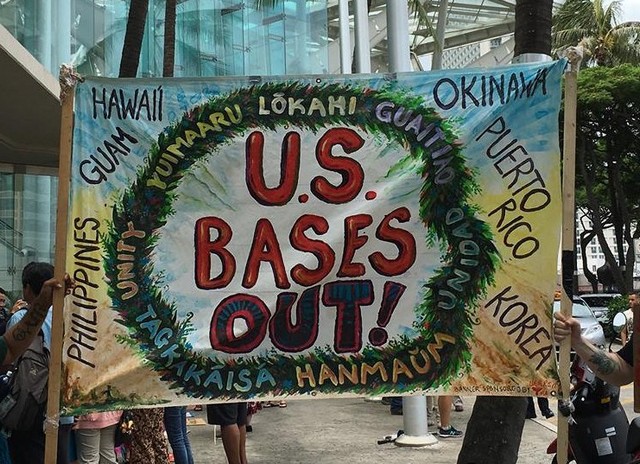
Where U.S. infrastructure projects are in place around the world, they are focused on building and maintaining a vast high-tech network of 800+ military bases and servicing an armada of aircraft carriers, nuclear submarines and destroyers. Each base is an expense to and an attack on the sovereignty of the host country. U.S. foreign aid ranks near the bottom of such expenditures of all developed countries, amounting to less than 1 percent of the federal budget. It is largely military aid to Afghanistan, Iraq, Israel, Egypt and Pakistan.

U.S. wars have resulted in great profit for U.S. corporations while massively destroying vital civilian infrastructure in developing countries under attack. Water purification plants, sanitation, sewage, irrigation, electric grid, communication centers, hospitals and schools have been intentionally destroyed in Yugoslavia, Iraq, Libya, Syria and Afghanistan. By contrast, China has no foreign military bases. Its ambitious OBOR initiative does not include military equipment or facilities.

Nevertheless, U.S. corporate power sees all other economic development as a threat to its global domination. Its aim is to protect at all costs the irrational capitalist system.

Response to U.S. pivot to Asia

The pivot to Asia begun during the Obama administration is an aggressive military plan that includes the U.S. nuclear arsenal and the Pentagon’s new THAAD missile battery in South Korea. Its focus is containing and threatening China’s growing economic influence in the region.

U.S. military planners brag of their ability to strangle China and cut its vital shipping lanes, such as the Straits of Malacca. This narrow transit point between the Indian Ocean and the South China Sea handles 80 percent of China’s crude oil and other vital imports.

China, now the world’s largest trading nation, has responded with the nonmilitary OBOR plan that will open many trade routes through surrounding countries. Trade routes, unlike U.S. military bases, offer immediate benefit to the development of these countries. China is expected to invest up to $1.3 trillion in OBOR infrastructure projects.

Asian Infrastructure Investment Bank: Challenge to IMF and World Bank

Past U.S. practices of seizing the assets of countries holding substantial funds in U.S. banks meant that the $1.26 trillion that China has held in U.S. Treasury notes was especially vulnerable. Until six months ago, China was the number one investor in U.S. Treasury notes. Now China is divesting.

China has used a part of its significant reserves to establish the Asian Infrastructure Investment Bank. The AIIB plays an essential role in encouraging trade and economic cooperation with other countries in Asia, Africa, Europe and Latin America. This Chinese initiative is seen as a counter to the U.S.-dominated World Bank and International Monetary Fund.

As the Cuban news outlet Granma wrote on March 6: “AIIB aims to rescue those areas of the region somewhat abandoned by both the World Bank and the Asian Investment Bank (AIB), as well as encourage trade and economic cooperation.”

Both the IMF and the World Bank exert enormous leverage through “structural adjustment” policies. Debt repayment requires countries to cut spending on education, health, food and transportation subsidies. Their real goal is to force developing countries to privatize their national assets.

Phony concern for environment

Corporate-funded nongovernmental organizations and social media campaigns claim that China will not show the same respect for the environment and human rights as the U.S. and other imperialist powers do. They claim that China might not follow environmental restrictions on loans imposed by the World Bank and IMF.

This is sheer hypocrisy. The U.S. military machine is the world’s biggest institutional consumer of petroleum products and worst polluter of greenhouse gas emissions and many toxic pollutants. Yet the Pentagon has a blanket exemption in all international climate agreements.

U.S. wars have contaminated the soil and water of vast regions under U.S. occupation with depleted uranium, benzene and trichloroethylene at air base operations and with perchlorate, a toxic ingredient in rocket propellant.

Despite U.S. pressure, AIIB grows

Despite strong U.S. efforts to discourage international participation in the OBOR infrastructure fund, Russia, Iran and Latin American countries promptly joined and contributed substantial capital. Breaking ranks, Germany and South Korea then became major shareholders, followed by Britain, France, Italy, Spain and Australia. The Philippines and even Saudi Arabia saw the advantages of participation. The AIIB, founded on June 29, 2015, began operations last year.

According to a Times editorial of Dec. 5, 2015, “Countries are finding they must increasingly operate in China’s orbit. The United States worries that China will use the bank to set the global economic agenda on its own terms.”

In addition to the AIIB, the China Development Bank and the Export-Import Bank of China already finance big-ticket projects in Asia and Africa. By Chinese estimates, their combined overseas assets stand at $500 billion — more than the combined capital of the World Bank and the Asian Development Bank.

Socialist planning to overcome underdevelopment

China’s past decades of development and modernization and its current surpluses are what make these new global plans possible. China has an estimated $4 trillion in foreign currency reserves. Its granaries are full and there are surpluses in cement and steel.

In 1949, when the revolution led by the Chinese Communist Party took power, China was an underdeveloped, war-torn country with a largely illiterate, majority peasant population. Western and Japanese imperialist powers had looted and carved up China for their own profits. Breaking their hold was the first step in liberation, but China was deeply impoverished.

After nearly 30 years of heroic efforts to modernize the economy based on the organization and efforts of the masses, the Chinese Communist Party in 1978 opened the country up to some forms of capitalist ownership and foreign capitalist investment.

This still risky policy has continued for nearly 40 years. It has allowed Chinese millionaires and even billionaires to develop and spread corruption. Foreign capital, ever hopeful of totally overturning the Chinese state, invested because profits could be made. But the Communist Party has used the years of capitalist investment to build up a modern, state-owned infrastructure alongside the growth of private capital.

Now China ranks as a developing country with a majority urban population living in modern, planned cities. The working class is now the largest social class in China. Wages for shop-floor workers in China have tripled in the last decade to become the highest in developing Asia.

China adopted a new industrial policy in 2015: “Made in China 2025,” which intends to upgrade manufacturing capabilities for high-tech products. These plans are supported by $150 billion in public or state-linked funds. It is this kind of long-term socialist planning that is the motor behind China’s new One Belt, One Road plan.

While the U.S. attempts to block these needed infrastructure efforts, move missiles and aircraft carriers off China’s coast, and send the lowest possible diplomatic delegation to China for the OBOR summit, Washington had the audacity and arrogance to warn China against north Korean participation. The DPRK sent a high-level delegation.

28 May 2017

Kashmir Demands Sensible Approach

By  Dr Ghulam Nabi Fai

The struggle for self-determination of the people of Kashmir is at a critical juncture. A youth-led, indigenous and spontaneous mass movement is underway. This movement is both internal, within Kashmir, and external throughout the world. It is mostly non-violent, pluralistic and resilient. This movement reverberates with cries of freedom and believes in a simple truth: a fair and impartial referendum in Kashmir. Time and time again, Kashmiris have surprised even the most hardened of their detractors. Attempts at delegitimizing the Kashmiri struggle have fallen entirely on deaf ears. No amount of wishful thinking has successfully persuaded growing international opinion that Kashmir, is not an integral part of any society other than its own. This belief is unshakeable, consistent and formidable.

The latest re-polling in Srinagar – Budgam Parliamentary constituency that took place on April 13, 2017 has given enough indications by now to the Government of India that its attempts to assemble some fake leadership in Kashmir on a collaborationist or capitulationist platform will take it nowhere. Kashmir has had enough of traitors and opportunists. These so-called leaders are so thoroughly discredited that they could not even get 2 % of the votes in this re-poll. By persisting in these attempts, Indian leadership betrays not only cynicism but also an uncharacteristic lack of political sense. This latest election is the proof that the resistance in Kashmir has not weakened, and will not weaken, on account of the paucity of its resources. The hunger of the people of Kashmir for the freedom, which has been denied to them supplies it an inexhaustible store of strength.

Fresh thinking is needed to cut the Gordian knot in Kashmir, which has been flailed at for more than half a century bilaterally between India and Pakistan without result. I do not mean to suggest, however, that tackling Kashmir will not be difficult. I do not want to expose myself to Hotspur’s derisive retort to Glendower when the latter boasted he could call spirits from the vastly deeps: Yes, but will they come when you call for them?

We are fully aware that the settlement of the Kashmir dispute cannot be achieved in one move. Like all qualified observers, we visualize successive steps or intermediate solutions in the process. It is one thing, however, to think of a settlement over a relatively extended period of time. It is atrociously different to postpone the beginning of the process on that account.

The people of Kashmir also understand that it cannot move immediately into a plebiscite. They have watched other processes in East Timor, Montenegro, Bosnia, Southern Sudan, Kosovo and recognize that a transitional period is necessary to build the confidence of all parties and to create a conducive atmosphere for stability.

We owe it to our people to take a rational and responsible position. Accordingly, we have confined ourselves to demands only for those actions at the preliminary stage, which do not involve any prejudice to the claims of any party to the dispute – India, Pakistan and the people of Kashmir. However, if India or Pakistan or any other power would like to bring pressure on the people of Kashmir to capitulate, or to agree to any terms which will compromise their freedom, then any so-called peace process is foredoomed. The people of Kashmir wish to leave no doubt in anyone’s mind on that score.

It is known to all that any talks between India and Pakistan on Kashmir will be a charade unless some basic conditions are fulfilled. There must be the end to the campaign of killing of innocent civilians. The representatives of the Kashmiri resistance must be associated with the negotiations. The talks between India and Pakistan must be held at the level of their political leadership.

We do not wish the future dialogue on Kashmir between India and Pakistan to stagnate or be broken off. Nor do we want it to be just make-believe. We remind all concerned that there are equal dangers for peace in the two possibilities. Each of them can be averted only by the mediation of an impartial third party or the United Nations or a person of an international standing, like Kofi Annan or Bishop Desmond Tutu, etc.

Here are my thoughts about a new approach to set a stage for the settlement of the Kashmir problem.

An intra-Kashmir dialogue between the leadership of All Parties Hurriyet Conference, Dogras, Buddhists, Sikhs, and Pandits. This kind of dialogue is not only desirable but also possible because Kashmir is a pluralistic society. It has a long tradition of moderation and non-violence. Its culture does not generate extremism. Can anyone deny the fact – of no small significance – that while the Subcontinent under British rule was the scene of recurrent murderous strife, communal riots were unheard of in Kashmir? That unquestionable fact brings out the real character of Kashmir’s heritage.

Both India and Pakistan should be persuaded to issue relevant travel documents to enable the representatives of the different components of the population of Jammu and Kashmir (The Valley, Ladakh, Jammu, Azad Kashmir and Gilgat-Baltistian) to meet at a place outside South Asia and formulate their proposals for the procedures of a just and lasting settlement. Our concern goes beyond the Kashmiri speaking majority of the State. We are mindful of the interests of the Dogra and the Buddhists communities as well. We demand the establishment of genuinely peaceful conditions in which we can earnestly welcome Kashmiri Pandits back to their homes. Their future as a community lies in Kashmiriyyat with us. They too have suffered, though in a different way, because of then the Governor of Kashmir, Jagmohan’s cruel and shortsighted policies.

India does not want to give up its claim that Kashmir is an integral part of India. Pakistan insists that Kashmir is its jugular vein. And the people of Kashmir do not want to compromise on their right to self-determination. That means a deadlock, which has proved catastrophic not only for the people of Kashmir but for both India and Pakistan as well. Only an impartial mediator can help initiate a process of ‘negotiations without pre-conditions’ whereby all sides can sustain the necessary political support in their respective constituencies to participate in the process. Without an intermediary, our differences will forever keep us divided.

The negotiations should leave aside the question of the end result of efforts towards a settlement. This is most wise. We must stress it again and again that the immediate question is not what is the best solution of the problem but how the problem should be put on the road to a comprehensive solution. Since, we are concerned with setting a stage for settlement rather than the shape the settlement will take, we believe it is both untimely and harmful to indulge in, or encourage, controversies about the most desirable solution.  Any attempt to do so amounts to playing into hands of those who would prefer to maintain a status quo that is intolerable to the people of Kashmir and also a continuing threat to peace in South Asia.

It is equally true that the peace in South Asia will not come without sacrifices. Each party will have to modify her position so that common ground can be found. It will be impossible to find a solution of the Kashmir problem that respects all the sensitivities of Indian authorities, that values all the sentiments of Pakistan, that keeps intact the unity of the State of Jammu and Kashmir and safeguards the rights and interests of the people of all the different zones of the State. Yet this does not mean that we cannot find an imaginative solution. However, a workable solution demands some compromises and modifications from each of the parties.

The world powers should be persuaded to play a more activist role in regard to Kashmir by strengthening a peace process. This can take the shape of:

i). a polygonal dialogue – USA, China, India, Pakistan, and Kashmiri leadership; OR
ii). an appropriate use of the newly developed procedures and mechanisms at the United Nations.

In neither case would the handling of the dispute be a rehash of the old arid and acrimonious debates at the U.N. The U.N. would supply the catalyst that is needed for a settlement.  There are alternative courses of action, which can be spelled out and involved in a sequence of interactive steps over a period of time. None of them would put the peace process in the straitjacket of rigid adherence to old texts. But if a solution of the problem will be a graduated process, consisting of incremental measures, the violence in Kashmir needs to be brought to a quick end in order to set the stage for a solution to the problem.

These ideas need refinement, but they build on the ineluctable truth that nothing fruitful is possible in Kashmir without the primary participation and willing consent of the Kashmiri people. Schemes and negotiations that neglect that truth are doomed to failure, as proven by 70 years of grim conflict in Kashmir with no end in sight.

Finally, win-win solutions are further important because they safeguard against prospective bitterness or humiliation that are the fuel of new conflict. If one party to a solution feels exploited or unfairly treated, then national sentiments to undo the settlement will naturally swell. We must not belittle, embarrass, or humiliate any party.  Every participant should be treated with dignity and humanity. Charity, not the triumphal, should be the earmark of the negotiating enterprise. Also, we should not sacrifice the good on the altar of the perfect.  Compromises are the staple of conflict resolution. To achieve some good is worthwhile even though not all good is achieved.

— Dr. Fai is the Secretary General of World Kashmir Awareness Forum. He can be reached at:  gnfai2003@yahoo.com

5 May 2017

GOVERNANCE, HEGEMONY AND A NEW VISION FOR THE FUTURE

Chandra Muzaffar

Speech made at AMAN Assembly Plenary 2 : People-Centered Political Power and Governance with Integrity, Transparency and Accountability organised by Asian Muslim Network (AMAN) and Global Movement of Moderates held at IDFR on 6 June 2015

Governance is fundamental to Islam. It is a vital dimension of the Qur’an. At the most profound level, it is Allah’s governance that accounts for the workings of the universes. It is Allah’s governance that sustains the earth as a planet. Creating the human being and placing her here on earth is also part of Allah’s plan for governance.

The human being, in turn, according to the Qur’an has assumed the role of khalifah (vicegerent) on earth which means that she has to live a life guided by the values and principles conveyed to her by all the Prophets since the beginning of time. In other words, she has to govern herself guided by Allah’s perennial Wisdom. This is the amanah, the trust she has to fulfil. It is the whole purpose of her creation. It is the reason why she is here on earth.
Of all human beings, those who rule over others, the leaders, bear a greater responsibility. Their amanah is of special significance. It is measured by justice. This is clearly stated in the Qur’an. It says, “O Daud, surely we have made thee a ruler in the land, so judge between men justly and follow not desire lest it leads thee astray from the path of Allah.” (38:26) The Quran also tells rulers that they are required to consult the people. (42:38)
Of course, the Prophet Muhammad himself was an outstanding example of an exemplary leader in every sense. He was just and honest, firm and fair, humble and kind, magnanimous and compassionate. He defended the weak and used his power for the well-being of his people. The Righteous Caliphs who came after him (from Abu-Bakr to Ali) sought to follow his example. There were other rulers in later years like Umar Ibn-Abdul Aziz (682-720) and Salahuddin Al-Ayoubi (1138-1193) who also shone as magnificent leaders. The former raised the status of the poor and powerless while the latter combined courage with compassion.

It was because wise leadership and good governance were so central to Islamic teachings that a huge corpus of writings developed which emphasized these. The most famous was the letter that the fourth Caliph, Sayyidina Ali IbnTalib, wrote to his Governor in Egypt, Malik Ashtar. It is a brilliant treatise on the principles of good governance and their application. Ali outlines how justice should be dispensed, how corruption should be combatted, why oppression should be eliminated, why profiteering and hoarding weaken the social fabric and what is required for the equitable distribution of wealth in society.

Through the ages,illustrious scholars such as Al-Kindi (801-873 ), Al-Farabi (870-950 ), Al-Mawardi ( 972-1058 ), Al-Ghazali ( 1058-1111 ) and Ibn Khaldun (1332-1406 ) have elaborated on the attributes of good leadership and good governance. IbnKhaldun in particular examined the political and social realities that impact upon governance. He discovered through empirical research that when a dynasty first emerges it adheres to the virtues of governance but later after it has consolidated its power and enjoys affluence and indulges in luxury, it becomes corrupt and succumbs to vices which eventually lead to its downfall. Ibn Khaldun saw this as an unerring pattern in the rise and fall of civilizations. He also realized that both internal and external factors contributed to the decline of a civilization. In the case of Muslim civilization, corruption and decadence within the ruling class was aggravated by the pillage and plunder caused by the Mongol invasions of the 13th century.

If this is the past, what is the situation like today in the Muslim world? Both internal and external factors are also at play. Corruption and decadence and the elite betrayal of the people in general are widespread in the Muslim ummah. There are very few governments of integrity which are totally committed to justice and the welfare of their people.

At the same time, there is a huge external challenge. This is the challenge of hegemony — essentially United States’ helmed hegemony. Sometimes described as a continuation of colonialism or neo-colonialism, the hegemon seeks to control resources belonging to others, strategic routes, the economy, politics and even culture of other nations in its drive for global dominance. Many Muslim nations have been victims of hegemony mainly because they are exporters of oil and gas, the lifeblood of modern civilization. Besides, Israel is right in the middle of the Arab world and the hegemon is determined to protect Israel’s so-called security. These are the reasons which explain the hegemon’s conquest of Afghanistan, Iraq and Libya and its continuing drive to conquer Syria. But let there be no mistake. Buddhist states in Southeast Asia such as Vietnam and Cambodia and Christian societies in Latin America such as Chile, Argentina Peru, Nicaragua and Panama and even an agnostic state such as Cuba have all been victims of US hegemony at some point or other. The desire for power and control were the motivating forces behind the hegemon’s agenda in these and many other cases.

Needless to say, hegemony distorts the development of societies that are caught in its grip. It emasculates their ability to nurture their own system of governance. It spawns weak, effete leaders who are just pawns and puppets of the hegemon. If hegemony is such a vile threat to the sovereignty and independence of nations everywhere,why does it persist with such tenacity?

Underscoring US helmed hegemony is global capitalism. To put it starkly, if the hegemon seeks to control foreign resources and strategic routes, it is because it is perceived as vital for an economic system that is driven by the maximization of profits and the continuous acquisition and accumulation of wealth. True, capitalism has benefitted segments of humankind in certain ways. It has helped to reduce absolute poverty in some parts of the world, accelerated social mobility for certain groups, and stimulated individual enterprise and innovation. Nonetheless, it is a system that has wrought grave injustices. Yawning disparities between the very rich and the very poor would be perhaps the most severe. According to a well-known investment firm, Credit Suisse, in 2014, the top 1% of the wealthiest people on the planet owned nearly 50% of the world’s assets while the bottom 50% of the global population combined owned less than 1% of the world’s wealth. Global inequalities have surged since 2008. This concentration of wealth and these disparities have adverse repercussions for the environment, for politics, for culture and for society as a whole in that it perpetuates a global order that serves the interests of the rich and powerful to the detriment of the poor and the powerless.

There are many civil society groups all over the world that are critical of the capitalist system. Some of them are Muslim based. While they have been able to propound alternative ideas in relation to specific aspects of the economy or politics or administration or culture, they have by and large failed to articulate a realistic vision of a holistic, integrated alternative social order that can resolve not only the injustices of the present but also address the most pressing challenges of the future.

This is the real challenge before the youth of the world, both Muslim and non-Muslim alike. Can they develop through their reflections and their actions an alternative that draws from Islam and other spiritual and moral philosophies the critical elements of a comprehensive vision for change that will guide humanity in the decades ahead? Are precepts such as God-Consciousness, the position of the human being as vicegerent on earth, the vicegerent’s profound commitment to justice, equality, love, compassion, honesty, integrity, humility, kindness, and unity among other similar values some of the resources that we can harness from Islam in our endeavor to forge a new vision for the future? More specifically, are there concrete principles too that we can absorb from our faith in this task, principles such as the prohibition of riba in the entire operations of the economy, or ensuring that means are not separated from ends in politics, or nourishing music and art and poetry to reinforce character rather than treating them as mere expressions of emotion and intuition unconnected to fundamental values and virtues?

Perhaps out of this exercise of action and reflection guided by eternal universal values and principles in our moral and spiritual philosophy will emerge a vision of governance that is contemporary and yet rooted in the Qur’an. Are AMAN youths prepared to help create such a vision?

Will America Partition Syria?

U.S. strategy seems to be shifting toward creating a buffer state between Iran and Israel.

By Sharmine Narwani

BEIRUT—Given the rhetoric of most U.S. policymakers, one might conclude that the conflict in Syria is about establishing freedom and democracy in the Levantine state. But no genuine aspiration for democracy ever came from a line-up of allies that includes countries like Saudi Arabia, Israel, Qatar, and Turkey. Seen from the Middle East, American intervention here appears to be aimed at putting the last genuinely independent Arab state under Washington’s sphere of influence—and cutting off a key Iranian ally in the region.

Today, after six years of regime-change operations that failed to unseat Syrian President Bashar al-Assad and install a compliant regime in Damascus, the west’s strategy seems to be shifting toward partitioning Syria. Specifically, the new U.S. policy would seek to sever the unimpeded geographic line between Iran and Israel by creating a buffer entity that runs through Iraq and Syria.

But here’s the twist: in Syria’s northeast/east and in Iraq’s northwest/west, where the Islamic State once occupied a vast swathe of territory, ISIS has helped to enable this U.S. goal by delineating the borders of this future buffer zone.

The only question is which U.S. “asset” will rule that buffer zone once it is liberated from ISIS. Would it be Sunni Arabs of the sectarian variety? A declassified 2012 Defense Intelligence Agency report seemed to suggest this option when it confirmed U.S. and Western support for the establishment of a “Salafist Principality” on the Syrian-Iraqi border.

Or will it be a Kurdish-ruled zone? U.S.-Kurdish machinations have, after all, borne a similar Shia-thwarting buffer on Iran’s western border with Iraq, with the creation of the Kurdish Regional Government (KRG) headed by the famously opportunistic and corrupt Kurdish Democratic Party (KDP) leader Masoud Barzani.

Either way, what transpired is this: ISIS occupied the areas flanking Syria and Iraq’s northern border. The U.S.-led coalition has had a presence in these territories for several years, without impairing ISIS control. At the right time, under U.S. cover, Kurds are moving in to “recapture” them.

Kurds constitute a minority in all these governorates, which is how the presence of ISIS became a valuable U.S./Kurdish strategic asset. ISIS’s invasion of these areas is delineating the borders of the new entity and depopulating it—creating an opportunity for Washington to champion the Kurds as the primary “liberating” force within those borders, after which Kurds can claim this territorial bounty.

“This is conquest masquerading as liberation,” says Assyrian writer Max Joseph, who explains how KDP Peshmerga forces disarmed Assyrian Christians and Yezidis two weeks before ISIS invaded in August 2014, then retreated from their promise to protect those populations just as ISIS entered Sinjar and the Nineveh Plains.

In the immediate aftermath of the ISIS invasion, Reuters quoted a KRG official saying: “Everyone is worried, but this is a big chance for us. ISIL gave us in two weeks what Maliki couldn’t give us in eight years.”

“By disarming and disabling communities who live in territories the Kurdish leadership have designs on controlling, then letting a ready-made aggressive foreign force invade and uproot native communities, forcing them to flee, KRG forces backed by Western airstrikes will be seen as ‘retaking’ land never even theirs,” explains Joseph.

Two years later, in July 2016, the KRG’s Peshmerga ministry gave credence to those claims by announcing that “Peshmerga forces will not withdraw from areas they have recaptured from the Islamic State.”

This is nothing less than an attempt to establish “Kurdistan,” a nation for the historically stateless Kurds, which has long-envisioned swallowing up parts of Syria, Iraq, Turkey, and Iran.

Some context helps explain the current situation. The KDP-ruled Kurdish entity in Iraq currently governs vast areas stretching from Iran’s western border to the Turkish border, stopping short east of Mosul and Kirkuk (an oil-rich city it openly covets). But the KDP has aspirations that run through Mosul to the western province of Nineveh—the historic home of a Christian Assyrian population—which would create a contiguous line across the north of Iraq to the Syrian border.

Last week, the “Kurdistan” flag was hoisted above all government buildings in Kirkuk—a move deemed unconstitutional and opposed by local non-Kurdish leaders and the Iraqi government alike.

A Syrian-Kurdish Entity?

In Syria, one can see a picture developing that mirrors Iraq’s experiences with the Kurds, Americans, and ISIS. Under U.S. patronage, areas occupied by the terror group are allowed to be “recaptured” by Kurdish forces, with a smattering of subordinate Arab Sunni forces to lend broader legitimacy.

Kurdish-controlled territory now traverses much of Syria’s three northern governorates where Kurds remain a minority—Hasakah, Raqqa, and Aleppo—and has earned the wrath of Turkish President Recep Tayyip Erdogan, who has sent in troops and Arab proxies to break this “Kurdish corridor,” placing him in direct confrontation with the objectives of Washington, his NATO ally.

The Kurdish Nationalist Party (PYD) and its military wing. the People’s Protection Units (YPG), have unilaterally declared Hasakah a federal Kurdish state, a designation that is unrecognized by the Syrian government and other states. But Kurds barely make up 40 percent of the governorate’s population, which consists of Assyrians, Arabs, Armenians, Turkmen, and other ethnic groups as well. Likewise, in Aleppo, the most populous of Syria’s 14 governorates, where 40 percent of Syrian Kurds reside, Kurds make up only 15 percent of the population and are a majority only in Afrin and Ayn al-Arab (Kobane).

Meanwhile, Kurdish nationalists identify all of Hasakah and northern Raqqa/ Aleppo as “Rojova”—or Western Kurdistan—even though significant Kurdish populations live outside these areas and significant non-Kurdish populations live within them. Furthermore, many of these Kurds are not of Syrian origin, but fled Turkey last century after several failed uprisings against that state. The entire Kurdish population of Syria amounts to about 10 percent (although figures are slightly disputed both upward and downward). Hundreds of thousands of Kurds have since fled the conflict in Syria for safer shores. And there is not a single contiguous line of Kurdish majority-populated areas from the northeast to northwest of Syria.

Yet the U.S. is storming ahead with Project Buffer State, erecting military bases left, right, and center, in violation of Syria’s sovereignty and international law. Various news reports claim the Pentagon and its 1,000 or so troops in Syria have established up to six bases in the north of the country—in the Rmelan region near the Iraqi border, in Qamishli (Hasakah), Kobane (Aleppo), and now in Tabqa, several dozen kilometers west of the ISIS capital of Raqqa.

But the American plan to storm Raqqa has stalled due to Turkey’s refusal to be excluded, and its objection to Syrian Kurdish involvement. Washington wants its Syrian Defense Forces (SDF) allies to liberate the city, but this group consists mainly of YPG Kurds who are aligned with the Kurdistan Worker’s Party (PKK), a Turkish and U.S.-designated terrorist group. The U.S. pretends these Kurdish militias are the only fighting force that can defeat ISIS. Never mind that the Syrian army and its allied troops have been defeating ISIS and al-Qaeda-affiliated militants around the country for years.

The inconvenient fact is, besides the Kurds—not all of whom back the U.S. project on the Syrian-Iraqi border—no forces have fought ISIS and other terrorist groups more successfully than the Syrian army and its Iranian, Russian, and Hezbollah allies.

By contrast, ISIS actually expanded and strengthened after the U.S.-led coalition began its strikes against the terror group. Recall ISIS trekking in plain sight across the Syrian border from Iraq to capture Palmyra—or tankers filled with ISIS oil crossing over to Turkey with nary a U.S. strike. It wasn’t until the Russian air force entered the fray and shamed the U.S. coalition that ISIS began to suffer some defeats. Washington had only really contained ISIS within the borders it was shaping, not struck any serious blows to the group.

After all, it is Washington’s awkward alliance in the region—Saudi Arabia, Turkey, Qatar, Britain, France, Israel—that has supported the growth of ISIS and like-minded extremists. U.S. President Donald Trump even went so far as to accuse his predecessor Barack Obama of being “the founder of ISIS.”

Certainly, Obama watched as his Turkish NATO ally allowed ISIS freedom of movement across its borders and purchased its stolen oil in bulk. We also now know via email leaks that Secretary of State Hillary Clinton was aware that U.S. anti-ISIS coalition allies Saudi Arabia and Qatar were funding ISIS.

Why would Washington tolerate allied support of the very terrorist group it claims to want to destroy? By portraying ISIS as the worst of all terror groups, al-Qaeda and its affiliates—by far the most efficient fighting force against the Syrian army and its allies—were able to fly under the radar to fight for regime change. Furthermore, a globally demonized ISIS has also provided justification for direct Western action that might otherwise have been impossible after “humanitarian interventions” lost their allure, post-Libya. Finally, this supposedly very dangerous ISIS was able to invade and occupy, for great lengths of time, territories on the Syrian-Iraqi border that would create the boundaries for a buffer state that could eventually be “liberated” and led by Western-controlled proxies.

Stealing Syria

If the U.S. forges ahead with plans to lead its Kurdish allies into the Raqqa battle it will risk further alienating Turkey. Don’t expect ISIS to be defeated, however. Instead, expect ISIS to be driven southward toward Deirezzor and other eastern points along Iraq’s border, where the terror group’s presence can act yet again as a U.S. strategic asset—specifically, by moving the fight away from Washington’s Kurdish project in the north and hindering the ability of Iraqi militias to cross the border in aid of Syrian troops.

That’s not such a leap. Deirezzor is where U.S. fighter jets bombed the Syrian army for an hour straight last September, killing over 100 Syrian forces. The strikes enabled ISIS to capture several strategic points around Deirezzor airport, which the Syrian state was dependent on to protect populations in the ISIS-besieged area. The Pentagon swore it was an error, the Syrians and Russians swore it was not.

Meanwhile, in Syria’s south, U.S.-backed militants, aided by Jordanians, Saudis, and the usual Western suspects,  are rallying their forces to expand the ground battle inside Syria.

Why the sudden surge of activity? Mainly because the Syrian government and its allies have, since the liberation of East Aleppo in January, succeeded in pushing back terrorists in key areas, regaining strategic territory, and striking reconciliation and ceasefire deals in other parts of the state.

“Western states with the United States at their head interfere in favor of the terrorists whenever the Syrian Arab Army makes a significant advance,” Assad observed in a recent interview.

But the U.S. overestimates its capabilities. With few troops on the ground, radical militants as allies, and pushback from Syria, Iran, Turkey, Russia, and Iraq, Washington will face a steep climb ahead.

In fact, all U.S. gains could be abruptly reversed with this one Kurdish card. Nothing is more likely to draw Syrians, Iraqis, Turks, and Iranians together than the threat of a Kurdish national entity that will seek to carve itself out of these four states. And as the U.S. tries to establish “self-rule” by its allies in the northeast of Syria, it will once again be confronted with the same crippling infighting that comes from foisting an un-organic leadership onto populations.

Syria will become an American quagmire. Washington simply cannot manage its partition plans with so few troops on the ground, surrounded by the terror forces it so recently spawned, as able adversaries chip away at its project. Stealing Syria will not be an easy trick.

Sharmine Narwani is a commentator and analyst of Mideast geopolitics, based in Beirut.

11 May 2017

Why is ISIS Operating in the Philippines?

By Stephen Lendman

In response to violence allegedly instigated by ISIS in the Philippines, President Rodrigo Duterte declared martial law in Mindanao, imposed military rule, and threatened to extend it nationwide to defeat the threat.

What’s going on? Why did ISIS begin operating in the Philippines? Weeks after taking office in mid-2016, Duterte blasted Western imperial Middle East policies, saying the Obama administration and Britain “destroyed the (region)…forc(ing) their way into Iraq and kill(ing) Saddam.”

“Look at Iraq now. Look what happened to Libya. Look what happened to Syria.”

He blasted former UN Secretary-General Ban Ki-moon for failing to act responsibly against what’s gone on for years – on the phony pretext of humanitarian intervention and democracy building.

He called Obama a “son-of-a-bitch” for his unaccountable actions – no way to make friends in Washington, especially if his geopolitical agenda conflicts with US aims.

On the day he declared martial law, he met with Vladimir Putin in Moscow for discussions on future military and economic cooperation.

He seeks improved economic and military ties with China. Ahead of visiting Beijing last October, he said

“only China…can help us,” adding:

“All that I would need to do is just to talk and get a firm handshake from the officials and say that we are Filipinos and we are ready to cooperate with you, to help us in building our economy and building our country.”

“If we can have the things you have given to other countries by the way of assistance, we’d also like to be a part of it and to be a part of the greater plans of China about the whole of Asia, particularly Southeast Asia.”

He promised to cool tensions over South China Sea disputes.

“There is no sense fighting over a body of water,” he said.

“We want to talk about friendship (with Beijing). We want to talk about cooperation, and most of all, we want to talk about business. War would lead us to nowhere.”

He announced no further joint military exercises with America, saying he’s open to holding them with China and Russia.

Shifting away from longstanding US ties doesn’t go down well in Washington. Are efforts by ISIS to establish a Philippines foothold part of an anti-Duterte Trump administration or CIA plot independent of his authority?

According to a June 2 Duran.com report, retired Philippine military official Abe Purugganan claims ISIS violence in Mindanao is part of an opposition Liberal Party plan to undermine Duterte and oust him from office – citing information from a party whistleblower.

Below are the comments The Duran posted, saying:

“There is a lot of noises and chatters flooding the cyberspace, you got to use your discernment to filter all these information.”

“LETS PLAY FIRE WITH FIRE,” explaining “(t)hese are the exact words stated by Loida Lewis and her fellow oligarchs on a meeting months ago with Liberal Party members abroad,” adding:

Their plan is to use ISIS or ISIS-connected terrorists to instigate violence and chaos in Mindanao, wanting Duterte’s government destabilized and ousted.

If the information reported is accurate, it explains what’s now going on, likely to worsen, perhaps spread to other parts of the country.

Last week, Duterte said

“if I cannot confront (ISIS terrorists threatening the country), I will resign. “If I am incompetent and incapable of keeping order in this country, let me step down and give the job to somebody else.”

If US dirty hands are behind the ISIS insurgency, he’s got a long struggle ahead, trying to overcome the attack on him and perhaps Philippine sovereignty.

Stephen Lendman lives in Chicago. He can be reached at lendmanstephen@sbcglobal.net.

2 June 2017

To Avoid Straining Ties With Iran Pakistan May Quit Command Of Saudi-Led Muslim Military Alliance

By Abdus Sattar Ghazali

Pakistan is reconsidering its position on the so-called 41-nation Islamic military alliance, led by Saudi Arabia, to avoid straining its relationship with neighboring Iran, according to Pakistan media reports. The military alliance was to be commanded by General Raheel Sharif, the former commander-in-chief of Pakistan army who retired from the Pak army last year.

Its decision comes after statements by Saudi authorities at the Arab Islamic-US summit in Riyadh on 20-21 May suggested that the military alliance was meant primarily to counter Iran, the media report said adding that the Riyadh summit focused on isolating Iran — which was kept out of the summit.

The officials argued that the Pakistan government in-principle agreed to be a part of the initiative if its sole purpose was to fight terrorism. It was believed that the government had joined the alliance when in April it allowed General Sharif to leave Pakistan to lead the alliance.

But the officials said a final decision will be made once the terms of reference (ToRs) of the alliance are finalized. The ToRs would be finalized during a meeting of the defense ministers of the participating countries in Saudi Arabia soon.

Pakistan, according to the officials, would recommend that the military alliance should have a clear objective, that is to fight terrorism. Any deviation from this goal, they added, will not only undermine the alliance but lead to more divisions in the Muslim world. “We are very clear that we will join this alliance only to fight terrorism,” the officials emphasized.

Defense minister Khawaja Asif on the floor of the National Assembly has said that Pakistan would withdraw from the alliance if it turns out to be sectarian in nature.

Pakistani lawmakers have said that they do not want their country to be part of any sectarian alliance as it also goes against the country’s constitution.

Pakistan’s two main opposition parties — Tehreek-i-Insaf and Pakistan People’s Party — have been calling for maintaining “neutrality” in the Arab-Iran rivalry. But given the longstanding strategic ties with Saudi Arabia, Pakistan is unlikely to completely withdraw from the alliance.

Iran has expressed its reservations regarding the appointment of the former army chief, retired Gen Raheel Sharif, as head of the Saudi-led 41-nation so-called Islamic military alliance, saying it is not ‘satisfied’ with the coalition.

Iran expresses concern

“We are concerned about this issue… that it may impact the unity of Islamic countries,” Iran’s Ambassador to Pakistan Mehdi Honardoost was quoted as saying.

Iran’s state-run IRNA news agency quoted Honardoost as saying that Pakistan had contacted Iranian officials before issuing the no-objection certificate (NOC) to Gen Sharif to lead the Saudi alliance. “But that does not indicate that Iran is satisfied with this decision or it has accepted the same,” the envoy said.

The ambassador proposed that all important Islamic countries come together to form a “coalition of peace” in order to resolve their issues “rather [than] forming a controversial military alliance”.

A controversial appointment

The appointment of General Sharif as the leader of the military alliance sparked debate over how the move will impact Pakistan’s foreign policy, and whether it was fully sanctioned by parliament.

Pakistan had initially found itself in the crosshairs of Middle Eastern politics as Saudi Arabia named it as part of its newly formed military alliance of Muslim countries meant to combat terrorism, without first getting its consent, the daily Dawn reported.

However, after initial ambiguity, the government had confirmed its participation in the alliance, but had said that the scope of its participation would be defined after Riyadh shared the details of the coalition it was assembling.

General Sharif last March accompanied the prime minister to Raadal Shamaal, the first military exercises of the alliance in which Pakistani troops also participated.

The Saudi government had surprised

The Saudi government had surprised many countries by announcing that it had forged a coalition for coordinating and supporting military operations against terrorism in Iraq, Syria, Libya, Egypt and Afghanistan. Iran was absent from the states named as participants.

Last April, Saudi Religious Affairs Minister Sheikh Saleh bin Abdul Aziz described the Pakistan-Saudi Arabia military alliance a “victory of Islam” and its main objective is “renaissance of Islam”.

Addressing a well-attended public meeting on the first day of centenary celebrations of the Jamiat Ulema-i-Islam (F) in Pakistan , Sheikh Saleh bin Abdul Aziz said that Pakistan and Saudi Arabia would jointly take on the enemies of Islam and the holy places in Saudi Arabia.

According to Tribune Express, in order to avoid any strain with Iran, Pakistan pushed for mediation between Tehran and Riyadh. Islamabad even mooted the idea of inclusion of Iran in the alliance.

However, all those efforts could not succeed since Saudi Arabia and Iran have serious differences on regional disputes particularly the current hotspots in Middle East.

But given longstanding strategic relationship with Saudi Arabia, Pakistan is unlikely to completely withdraw from the alliance. Nevertheless, its participation would only remain confined to counter-terrorism efforts, the Tribune report said.

The 41-nation armed coalition was initially proposed as a platform for security cooperation among Muslim countries and included provisions for training, equipment and troops, and the involvement of religious scholars for devising a counter-terrorism narrative.

Senator Syed Dilawar Abbas

Pakistan Muslim League Quaid (PML-Q) Senior Vice President Senator Syed Dilawar Abbas has said that former army chief General Raheel Sharif should quit the Saudi-led force’s command as it will not prove useful for Pakistan in the prevailing situation.

He said that Iran is a brotherly Islamic country and above all our immediate neighbor, who always supported Pakistan in time of need. We can’t afford to let our friends get upset for the sake of others, he added. He said that the United States had always played a key role in division of Muslims for securing its own interests in the region. He also condemned US President Donald Trump’s remarks that Iran is sponsoring terrorism in the region.

Senator Abbas said that the coalition was not an Islamic army but a Saudi-led alliance. If Saudi Arabia wants to safeguard the rights of Muslim world then all should have included all Islamic states in the force. Why some countries are part of the army while highly important Muslim states, including Iran, Syria and others, have not been included in it, he questioned.

He said that it clearly indicates that Saudi Arabia had their own interests and as a nuclear Islamic State, Pakistan must clearly inform the Saudis that we cannot become part of American hidden agenda against any Muslim state. Why should we become stooges of the United States, he added.

The Nation

In a comment on the current controversy, a Pakistani newspaper the Nation, asked: Did the fact that the coalition was first announced in December 2015 – ninth months into Saudi military intervention in Yemen and a month before the execution of Shia cleric Sheikh Nimr al-Nimr – also not give Islamabad an idea who this alliance would be aligned against?

One would’ve been prompted to even hint that this belated suggestion of a potential back-peddling, if not complete retraction, is a reaction to the snub at the summit where Trump and King Salman collectively humiliated Pakistan by first not allowing the premier to speak and then by even refusing to include him in any publicized meetings or photo-ops.

Commenting on Pakistan’s stance that it will join this alliance “only to fight terrorism,” the Nation said that the term ‘terrorism’ is loaded, or aligned with state policies.

“A Kashmiri freedom fighter who picks up the gun is a terrorist for India. A separatist militant in Balochistan is a terrorist for Pakistan. A mujahid can be a terrorist or strategic asset depending on whether s/he is waging war against the military establishment or against it. So maybe it’s a good idea to modalities of terrorism as well, before we agree to defend Saudi Arabia against terrorists,” the paper said adding:

“A country that has unequivocally upheld that ‘atheists are terrorists’, clearly doesn’t even need an individual to take up arms for them to be lumped into the bin of terrorism. It also underscores that terrorism for the kingdom of Saudi Arabia is primarily based on ideological affiliations. And there are no prizes was guessing the one ideology that Wahabbism is antagonistic to even more than non-belief.”

Abdus Sattar Ghazali is the Chief Editor of the Journal of America (www.journalofamerica.net) email: asghazali2011 (@) gmail.com

1 June 2017

Terror in Britain: What Did the Prime Minister Know?

By John Pilger

The unsayable in Britain’s general election campaign is this. The causes of the Manchester atrocity, in which 22 mostly young people were murdered by a jihadist, are being suppressed to protect the secrets of British foreign policy.

Critical questions – such as why the security service MI5 maintained terrorist “assets” in Manchester and why the government did not warn the public of the threat in their midst – remain unanswered, deflected by the promise of an internal “review”.

The alleged suicide bomber, Salman Abedi, was part of an extremist group, the Libyan Islamic Fighting Group, that thrived in Manchester and was cultivated and used by MI5 for more than 20 years.

The LIFG is proscribed by Britain as a terrorist organisation which seeks a “hardline Islamic state” in Libya and “is part of the wider global Islamist extremist movement, as inspired by al-Qaida”.

The “smoking gun” is that when Theresa May was Home Secretary, LIFG jihadists were allowed to travel unhindered across Europe and encouraged to engage in “battle”: first to remove Mu’ammar Gadaffi in Libya, then to join al-Qaida affiliated groups in Syria.

Last year, the FBI reportedly placed Abedi on a “terrorist watch list” and warned MI5 that his group was looking for a “political target” in Britain. Why wasn’t he apprehended and the network around him prevented from planning and executing the atrocity on 22 May?

These questions arise because of an FBI leak that demolished the “lone wolf” spin in the wake of the 22 May attack – thus, the panicky, uncharacteristic outrage directed at Washington from London and Donald Trump’s apology.

The Manchester atrocity lifts the rock of British foreign policy to reveal its Faustian alliance with extreme Islam, especially the sect known as Wahhabism or Salafism, whose principal custodian and banker is the oil kingdom of Saudi Arabia, Britain’s biggest weapons customer.

This imperial marriage reaches back to the Second World War and the early days of the Muslim Brotherhood in Egypt. The aim of British policy was to stop pan-Arabism: Arab states developing a modern secularism, asserting their independence from the imperial west and controlling their resources.  The creation of a rapacious Israel was meant to expedite this. Pan-Arabism has since been crushed; the goal now is division and conquest.

In 2011, according to Middle East Eye, the LIFG in Manchester were known as the “Manchester boys”.  Implacably opposed to Mu’ammar Gadaffi, they were considered high risk and a number were under Home Office control orders – house arrest – when anti-Gadaffi demonstrations broke out in Libya, a country forged from myriad tribal enmities.

Suddenly the control orders were lifted. “I was allowed to go, no questions asked,” said one LIFG member. MI5 returned their passports and counter-terrorism police at Heathrow airport were told to let them board their flights.

The overthrow of Gaddafi, who controlled Africa’s largest oil reserves, had been long been planned in Washington and London. According to French intelligence, the LIFG made several assassination attempts on Gadaffi in the 1990s – bank-rolled by British intelligence.  In March 2011, France, Britain and the US seized the opportunity of a “humanitarian intervention” and attacked Libya. They were joined by Nato under cover of a UN resolution to “protect civilians”.

Last September, a House of Commons Foreign Affairs Select Committee inquiry concluded that then Prime Minister David Cameron had taken the country to war against Gaddafi on a series of “erroneous assumptions” and that the attack “had led to the rise of Islamic State in North Africa”. The Commons committee quoted what it called Barack Obama’s “pithy” description of Cameron’s role in Libya as a “shit show”.

In fact, Obama was a leading actor in the “shit show”, urged on by his warmongering Secretary of State, Hillary Clinton, and a media accusing Gaddafi of planning “genocide” against his own people. “We knew… that if we waited one more day,” said Obama, “Benghazi, a city the size of Charlotte, could suffer a massacre that would have reverberated across the region and stained the conscience of the world.”

The massacre story was fabricated by Salafist militias facing defeat by Libyan government forces. They told Reuters there would be “a real bloodbath, a massacre like we saw in Rwanda”. The Commons committee reported, “The proposition that Mu’ammarGaddafi would have ordered the massacre of civilians in Benghazi was not supported by the available evidence”.

Britain, France and the United States effectively destroyed Libya as a modern state. According to its own records, Nato launched 9,700 “strike sorties”, of which more than a third hit civilian targets. They included fragmentation bombs and missiles with uranium warheads. The cities of Misurata and Sirte were carpet-bombed. Unicef, the UN children’s organisation, reported a high proportion of the children killed “were under the age of ten”.

More than “giving rise” to Islamic State — ISIS had already taken root in the ruins of Iraq following the Blair and Bush invasion in 2003 — these ultimate medievalists now had all of north Africa as a base. The attack also triggered a stampede of refugees fleeing to Europe.

Cameron was celebrated in Tripoli as a “liberator”, or imagined he was. The crowds cheering him included those  secretly supplied and trained by Britain’s SAS and inspired by Islamic State, such as the “Manchester boys”.

To the Americans and British, Gadaffi’s true crime was his iconoclastic independence and his plan to abandon the petrodollar, a pillar of American imperial power. He had audaciously planned to underwrite a common African currency backed by gold, establish an all-Africa bank and promote economic union among poor countries with prized resources. Whether or not this would have happened, the very notion was intolerable to the US as it prepared to “enter” Africa and bribe African governments with military “partnerships”.

The fallen dictator fled for his life. A Royal Air Force plane spotted his convoy, and in the rubble of Sirte, he was sodomised with a knife by a fanatic described in the news as “a rebel”.

Having plundered Libya’s $30 billion arsenal, the “rebels” advanced south, terrorising towns and villages. Crossing into sub-Saharan Mali, they destroyed that country’s fragile stability. The ever-eager French sent planes and troops to their former colony “to fight al-Qaida”, or the menace they had helped create.

On 14 October, 2011, President Obama announced he was sending special forces troops to Uganda to join the civil war there. In the next few months, US combat troops were sent to South Sudan, Congo and the Central African Republic. With Libya secured, an American invasion of the African continent was under way, largely unreported.

In London, one of the world’s biggest arms fairs was staged by the British government.  The buzz in the stands was the “demonstration effect in Libya”. The London Chamber of Commerce and Industry held a preview entitled “Middle East: A vast market for UK defence and security companies”. The host was the Royal Bank of Scotland, a major investor in cluster bombs, which were used extensively against civilian targets in Libya. The blurb for the bank’s arms party lauded the “unprecedented opportunities for UK defence and security companies.”

Last month, Prime Minister Theresa May was in Saudi Arabia, selling more of the £3 billion worth of British arms which the Saudis have used against Yemen. Based in control rooms in Riyadh, British military advisers assist the Saudi bombing raids, which have killed more than 10,000 civilians. There are now clear signs of famine. A Yemeni child dies every 10 minutes from preventable disease, says Unicef.

The Manchester atrocity on 22 May was the product of such unrelenting state violence in faraway places, much of it British sponsored. The lives and names of the victims are almost never known to us.

This truth struggles to be heard, just as it struggled to be heard when the London Underground was bombed on July 7, 2005. Occasionally, a member of the public would break the silence, such as the east Londoner who walked in front of a CNN camera crew and reporter in mid-platitude. “Iraq!” he said. “We invaded Iraq. What did we expect? Go on, say it.”

At a large media gathering I attended, many of the important guests uttered “Iraq” and “Blair” as a kind of catharsis for that which they dared not say professionally and publicly.

Yet, before he invaded Iraq, Blair was warned by the Joint Intelligence Committee that “the threat from al-Qaida will increase at the onset of any military action against Iraq … The worldwide threat from other Islamist terrorist groups and individuals will increase significantly”.

Just as Blair brought home to Britain the violence of his and George W Bush’s blood-soaked “shit show”, so David Cameron, supported by Theresa May, compounded his crime in Libya and its horrific aftermath, including those killed and maimed in Manchester Arena on 22 May.

The spin is back, not surprisingly. Salman Abedi acted alone. He was a petty criminal, no more. The extensive network revealed last week by the American leak has vanished.  But the questions have not.

Why was Abedi able to travel freely through Europe to Libya and back to Manchester only days before he committed his terrible crime? Was Theresa May told by MI5 that the FBI had tracked him as part of an Islamic cell planning to attack a “political target” in Britain?

In the current election campaign, the Labour leader Jeremy Corbyn has made a guarded reference to a “war on terror that has failed”. As he knows, it was never a war on terror but a war of conquest and subjugation. Palestine. Afghanistan. Iraq. Libya. Syria. Iran is said to be next.  Before there is another Manchester, who will have the courage to say that?

John Pilger can be reached through his website: www.johnpilger.com

31 May 2017

ISLAMIC TERRORISM: OUR ALLY FOR 38 YEARS

By Andrew Cheetham

Dear Diary, I can’t show this letter to the innocent people of America and the world, so it’s just between you and me. Imagine the shock and the outrage if I say that we have to embrace Islamic terrorism! The average person doesn’t understand what’s at stake and how sometimes the elites need to rely on “controlled chaos” for the greater good.

Islamic terrorists are wonderful instruments for proxy wars – they cost very little but fight fearlessly. They are a global resource that can be brought into any local conflict. They are also expendable – we use them when convenient and kill them when inconvenient.

If this shocks the conscience of people, it just means they haven’t been paying keen attention. Consider the following examples:

  • Thomas Friedman of The New York Times wrote that we shouldn’t attack ISIS in Syria 1; and we should even consider arming ISIS to overthrow Assad 2
  • John Kerry admitted, “U.S. tried to use ISIS to force Assad into negotiations.” 3
  • Israeli military chief explained, “Israel prefers ISIS to Assad” 4
  • Israeli defense minister recounted, “ISIS never intentionally attacks us; and when it happened once, ISIS apologized immediately.” 5 Hello!
  • Hillary Clinton wrote, “Saudi Arabia and Qatar fund and arm ISIS.” 6
  • Joe Biden, Gen. Martin Dempsey, Gen. Wesley Clark all have stated that US allies in the Middle East arm and fund Al Qaeda and ISIS. 7, 8, 9
  • Several State Department cables have clearly laid out how Saudi Arabia is the #1 source of funding for terrorism around the world – not just in the Middle East. 10

Ever wonder why we never go to war against or impose sanctions on these sponsors of terrorism? Heck we don’t even condemn them!

What goes through a reader’s mind when they see an article titled “Accepting Al Qaeda” 11 that is published by Council on Foreign Relations – the think tank behind US foreign policy? Or when Hillary Clinton’s chief foreign policy advisor wrote to her, “Al Qaeda is on our side”? 12

I can give many more such examples, but let’s hop on the time machine for a moment.

Afghanistan, 1979 – 1989. We used the Mujahideen to defeat the Soviet Union. Was that not a good thing? Remember how the media and Hollywood glorified those Afghan fighters in the 1980’s? The Afghan rebels even got to visit the White House.

There are two critical factors that are often forgotten in the Mujahideen story: foreign fighters from all over the world and fundamentalist Islam.

In the 1980’s, more than 35,000 so-called Arab Afghans came from all over the world to fight the Russians 13; and we wouldn’t have been able to motivate them to do so without appealing to the concept of Islam, Caliphate or jihad. “Fight for Allah” is far more effective than “Fight for Country X.” Fighters motivated by religion are also extremely useful in the battlefield since they are not afraid of death. This mindset is essential for the use of suicide bombers without whom many battles and wars would not have been won.

We also learned from Saudi Arabia that indoctrination is essential to create good soldiers. So the CIA came up with clever textbooks for Afghan kids that introduced them to concepts of jihad, weapons and hatred for Russians. 14

(Since then, Saudi Arabia has spent billions of dollars on Islamic schools – Madrassas – all over the world. These schools act as breeding grounds for future activists, extremists and fighters. Saudis also print textbooks that are used all over the world. Kids learn loving messages such as “Kill Shiites, Christians and Jews.” 15 Saudi mosques and preachers all over the world also continue spreading extremist messages.)

When the Afghan war was about to be won, it dawned on us that the Mujahideen project was a brilliant playbook that could be replicated in other parts of the world.

That’s when Al Qaeda was formed. And it was perfect timing.

You see, Halliburton had just discovered huge oil reserves near the Caspian Sea, but the countries around that region were all pro-Russia even after the fall of the USSR. 16

Without the knowledge of the American public, the Mujahideen were very active all throughout the 1990’s in Bosnia, Kosovo, Azerbaijan, Uzbekistan, Dagestan, Chechnya etc. 17 These fighters were used for three major purposes:

  • throw out pro-Russia dictators
  • install pro-West leaders who would help us build oil/gas pipelines and agree to host US military bases, and
  • disrupt Russian pipelines and other interests

Azerbaijan was an easy one and we got our man in 1993. Georgia took a long time, but George Soros and his color revolution finally installed our guy in 2005. Within a year, we had a 1000-mile pipeline that linked Azerbaijan (Caspian Sea), Georgia and Turkey!

Chechnya was a partial success. They were struggling for independence from Russia and thus gladly welcomed the Mujahideen who also had plenty of Saudi money and US weapons. Within a short time, the non-violent and mystical Sufism of Chechnya was taken over by Saudi Wahhabism.

Al Qaeda started blowing up Russian pipelines. Russia invaded Chechnya in 1994, lost the war, and withdrew. It was fun to watch the news those days. But then Putin became the Prime Minister three years later, waged a ruthless war against the jihadists, won decisively and installed his own strongman in Chechnya 18. Even Sufism has seen a major revival lately and Chechens have now started rejecting Wahhabism and jihadism. 19

Al Qaeda was extremely helpful in Bosnia, Albania, Macedonia and Kosovo. In the late 1990’s, we used trumped-up charges and NATO bombing to get rid of the pro-Russia guy in Serbia.

Away from the heart of Eurasia, Islamic extremism and terrorism play major roles in Africa, Middle East and Asia to catalyze geopolitical transformations.

In Libya, Syria, Yemen and Somalia, we depend on Muslim Brotherhood, Al Qaeda and Salafists (those who follow extreme, fundamentalist Sunni Islam).

In Libya, we leveraged the Al Qaeda affiliate called Libyan Islamic Fighting Group (LIFG) 20. We released its leader (Belhadj) from the CIA prison, dressed him up in a nice suit, arranged a photo-op with John McCain, and he became the freedom fighter who fought Gaddafi, the brutal

In Syria, tens of thousands of Al Qaeda fighters were flown in from all over the world to topple Assad 21. If it were not for Putin’s evil interventions, we would now have a Qatar pipeline through Syria, and Israel would be drilling oil in Golan Heights 22. A tragic situation indeed.

In Africa, Nigeria is a strategic country with 170 million people and a land rich in oil and natural resources. That’s where Boko Haram – African ISIS – comes into play. It has been extremely successful in every way. Also, thanks to Boko Haram, half of Nigeria is under Sharia Law, which is a great tool to control people.

In Asia, we need to prevail upon Thailand, Indonesia and the Philippines. Without them, we lose much of Asia to China. Sharia Law and Salafism are gaining momentum in Indonesia, which is a positive sign. 23

Philippines’ crazy leader, Duterte, has been too friendly with Russia and China 24. He will lose his popularity and get replaced if the ISIS affiliate – Abu Sayyaf – causes enough problems. If he fights back against ISIS, we will cry “human rights” and “Islamophobia” at the UN and impose sanctions.

Thailand has also been foolishly moving into the Russia-China sphere of influence 25. Well, this peaceful, Buddhist country has been facing Sunni/Salafist extremism in the south. Thai leaders must realize that the entire tourism industry is very vulnerable – a few bombings and attacks by jihadists can have serious effects.

Finally, let’s look at Europe. There has been a lot of problems with mass immigration – terrorism, crimes etc. However, every crisis is an opportunity. Some call it the Problem-Reaction-Solution.

Terrorism is the problem. Fear is the reaction. Government is the solution.

Terrorism and crime give us the chance to militarize the police in EU, create an “NSA” for entire Europe, and even an EU army. The financial burden caused by refugees also allows us to impose austerity and cut wasteful welfare spending. Mass immigration will also result in a more homogeneous European society. Twenty years from now, there won’t be much difference between France and Germany. This means much easier management of EU.

Moving forward, the biggest economic challenge for us will be China. However, it has an Achilles heel – the western province of Xinjiang that is predominantly made up of Muslims. With help from Turkey, we have already created in Xinjiang an Islamist movement that is calling for secession 26. China’s One Belt One Road is very dependent on freight trains safely traveling through that region on their way to Europe. Our future Mujahideen in Xinjiang will come in handy if China starts to misbehave.

It took us about 60 years to unify North and South America to a great degree under a common financial, corporate, economic and military system. (Venezuela is the odd man out, but we’re working on it). It may take another sixty years to unify Europe, Russia and China. Then we will have global governance and the ultimate New World Order. No borders and no walls. One World. In bringing that to fruition, we have many arrows in our quiver – trade, financial/military aid, coups, color revolutions, sanctions, wars etc. – but Islamic terrorism and fundamentalism will continue playing indispensable roles, and that’s why we must accept them and embrace them.

30 May 2017

Derelict economy could sink ‘Titanic’ Israel, experts warn

By Raoul Wootliff

Last summer, Prime Minister Benjamin Netanyahu held a number of intimate briefings with Israeli media outlets in an attempt to counter the negative image of him that he believed they were falsely propagating.

Laying out his vision for the country, the successes of governments that he had led, and the challenges facing the Jewish state in the coming years, Netanyahu painted a picture of Israel as a rising global superpower. The narrative according to which he was a frantic grandstander, obsessed with his own political survival and neglecting the needs of the country, was a distorted fiction, he sought to demonstrate.

Last month, at the Prime Minister’s Office’s traditional Passover toast, Netanyahu articulated directly to the public what he appeared to be trying to convey in those briefings.

“I’ll tell you what I see in the media,” Netanyahu said. “It does not reflect what the public feels. It is an industry of despair. Where they see unemployment, I see full employment. Where they see an economy in ruin, I see a flourishing economy. Where they see traffic jams, I see junctions, trains and bridges. Where they see a crumbling state nearing collapse, I see Israel as a rising global power.”

Rather than the stunning political triumphs that he often points to, or the growth in Israeli settlements he sometimes touts to Hebrew-speaking audiences, above all, he told reporters last year, it was the strong economy that topped the bill of proud achievements proving his success in transforming Israel into a force to be reckoned with.

According to the prime minister, economic might is the most important factor in building a strong country, because without it Israel will be unable to fund its military and defend itself from myriad existential threats. Diplomatic might, he said, while also necessary for the country’s success, is only a consequence of a strong economy and military and can essentially be bought by exporting Israel’s technological and military know-how.

Naturally, academic assessments of Israel’s economic prospects agree with the prime minister that a strong economy is a prerequisite for a strong military. But two new reports looking at both the immediate and long-term strength of Israel’s economy suggest that, while recent years have seen several positive economic signs in a number of areas, Israel faces “worrisome trends” that could ultimately have disastrous effects on its growing population.

According to the “Picture of the Nation 2017” report released Sunday by the Taub Center for Social Policy Studies in Israel, Israel has the highest lack of disposable income of all OECD countries and, with an aging population and rising costs across the board, its “current sources of economic growth are not sustainable.”

A separate report, released earlier this month by the Shoresh Institution for Socioeconomic Research, which looks at economic trends over the entire 69-year history of the country, says that far from guaranteeing Israel as a military and therefore a world power, the economy shows deep-seated and long-term shortcomings that threaten to weaken the army and constitute an “existential threat” to the country’s future.

“The writing is on the wall. One nation-shaking crisis – emanating from the security and/or economic spheres – could spark a process from which there will be no turning back,” the Shoresh Institution report warns apocalyptically. “Israel has reached a critical juncture. Decisions that it makes today will literally determine the existence of the country in a few decades.”

According to Prof. Dan Ben-David, founder and chair of the Shoresh Institution and co-author of the report, if Netanyahu “continues to ignore the future” the country could be facing a catastrophe of massive proportions.

“The past year has seen a decline in unemployment and a large rise in GDP,” reports the annual Picture of the Nation, but “unfortunately, it appears that this positive trend will not continue and new sources of growth must be found.”

While Gross Domestic Product, often seen as a bellwether of economic strength, has grown in the last year by four percent, the Taub Center describes the figure as an “outlier and not a trend.”

Suggesting that the cause for growth came only from a single massive investment by Intel into its Kiryat Gat plant, and a rise in car imports due to an expected change in taxation, “taking a long-term view, growth in the Israeli economy has been disappointing,” the report says. In fact, the previous year saw a further downward trend in labor productivity, following five years of slowing rates.

In addition, whereas Israel ranks near the middle of the OECD pack in terms of GDP (22nd out of 34) and market income poverty rate (24th), it is in last place for disposable income poverty — the amount of money each individual has after paying taxes and regular living costs.

And that results in a startling statistic: Among developed countries, Israel has the highest percentage of its population living below the poverty line.

‘Upheaval’

Titled “Israel’s primary socioeconomic challenges and policy areas requiring core treatment,” the Shoresh Institution report was released in conjunction with this month’s 40th anniversary of the 1977 electoral “upheaval” that propelled the Likud party into the leadership for the first time in Israel’s history.

The Labor Party and its precursors, Mapai and the Alignment, ruled Israel for the country’s first 29 years, never once losing an election. It was only in 1977, when Menachem Begin’s Likud first defeated Shimon Peres’s Alignment, that the left lost its hegemony over Israeli political life.

Taking the long view, Ben-David and co-author Prof. Ayal Kimhi analyzed economic trends since 1948, and particularly during the past four decades, in order to understand the socioeconomic challenges facing Israel today and in the years ahead.

Commissioned, but not paid for, by the government’s National Economic Council, the report was prepared ahead of a detailed policy brief that the advisory body is putting together for the government. While initially intended to be an internal document, Ben-David said he and Kimhi felt it was “something that should not stay just with the government” and decided to release the findings to the public.

“We think that the public needs to be aware of our major challenges going ahead so that we can do something about it while we have the opportunity,” he told The Times of Israel. “We do have an opportunity but we need to get our act together.”

By providing historical context and international benchmarks that compare Israel to other developed countries, the report attempts to debunk the perception that the Israeli economy is doing well. Like the Taub report, it makes a point of noting signs of strength in the short term, such as growth, particularly when compared with the global economic downturn in recent years. But this optimistic analysis, the authors claim, fails to take into account deeply problematic long-term trends.

The key yardsticks to measuring the strength of Israel’s economy, they say, and the areas in it which it falls far behind other developed countries, are productivity, inequality and poverty rates.

Following the creation of the State of Israel in 1948, Israel’s productivity grew at a faster pace than America’s, almost completely eliminating its gap with the US by the 1970s. But since then, it has moved from closing gaps with the US into a steady backslide.

In terms of GDP, Israel has also been falling further and further behind the G7 average since the mid-1970s, with a more than threefold increase having developed in the gap between them. This, the report says, “reflects steadily widening disparity between what an employed person living in Israel can attain and what that person could attain in the countries that are pulling away from Israel.”

But Israel has not only fallen behind the world’s leading economies. Its labor productivity is now below that of nearly all OECD countries. In 2015, GDP per hour worked in the US hit $68, two-thirds more than the $41 in Israel.

“It’s hard to see how these trajectories can continue to pull apart from one another for several more decades without causing the exodus of educated and skilled people from Israel to reach a magnitude that may become irreversible,” the Shoresh report says.

“Productivity is really what underlies Israel’s, and other countries’, standard of living,” Ben-David said. “In our case, productivity is low and it’s been falling further and further behind the leading countries. It’s been occurring for decades and it’s a very steady and very problematic process.”

And that’s why Israel’s standard of living, normally referred to as income inequality, is increasingly becoming one of the worst in the developed world.

Income inequality is second only to the United States, but the country’s poverty levels are higher than every other developed country and nearly double the OECD average.

According to Ben-David, this is due to a “fundamentally problematic change in the country’s national priorities” beginning in the 1970s.

“National priorities moved from focusing on the general good to focusing on the demands of sectoral groups,” he said, adding that the problems have become more acute in the past decade.

In the early years, “this was a country that did not have a shekel, or a lira, to its name. It was collecting people from around the world with only the clothes on their backs and growing at a phenomenal pace in terms of population. And yet it built universities,” Ben-David said. “We were rationing food in the ’50s, but we were building hospitals. Even though the population was growing exponentially, the number of faculties in research universities was growing even faster. We had seven major research universities by 1970. We haven’t built one since.”

‘You can’t forgo half a society’

Ben-David insisted that the report’s findings must not be relegated to another stale debate about social policy.

If Israel’s educational and economic policies don’t change, its future may be in peril. “You can’t forgo half of society and say, ‘The rest will support everything,’” he said.

Yes, Israel as the startup nation is booming, producing cutting edge high-tech and bio-tech. But that is just one Israel, Ben-David said; there is another Israel that is receiving neither the tools nor the conditions to work in a modern economy. “That other Israel is huge, and it is like a huge weight on our shoulders, pulling everything down.”

Both the Taub Center and the Shoresh Institution describe an education system producing a generation of low-achieving students, low productivity in an Israeli work hour, woefully inadequate transportation infrastructures, a housing market that discourages investment, and substantial inequalities in state healthcare coverage.

For two decades, Israeli schoolchildren have consistently ranked behind other industrialized Western economies in terms of academic achievement.

In the state and state-religious schools systems, which together encompass over 50% of Israel’s elementary school students, academic achievement measured by international standardized tests does not match what is considered “first world” education.

“Children who receive third-world educations will only be capable of sustaining a third-world economy. But a third-world economy will not be able to maintain the first-world army that Israel needs in order to survive in the most dangerous region on the face of the earth,” Ben-David said.

Physical infrastructures, too, have been neglected. Israel’s roads are among the most crowded in the industrialized world, even though car ownership is lower. Since the 1970s Israel has tripled the congestion on the roads.

Healthcare standards have also dropped.

While the Taub Center report says that the overall health of the population in Israel is slightly better than in other leading European countries, it notes that with an aging population, that advantage is “likely to recede… and the state must take appropriate measures in time to deal with these expected demographic changes.”

The Shoresh Institution report is more bleak.

The number of hospital beds per capita in Israel has been falling dramatically since the late 1970s and it is now near the bottom of the OECD, it says. Likewise, Israel has one of the lowest numbers of nurses per capita, and that number, too, is dropping. Those low standards, the report says, have contributed to a doubling of the mortality rate from infectious and parasitic diseases, while the average OECD rate has remained stable over the same period.

“Hospital conditions in Israel do not befit those of a developed nation,” the report says.

Iceberg ahead, unless we change course

But it may not be too late to recover.

“Israel has not yet passed the point of no return,” the Shoresh Institute report says. However, “in light of the rapid pace of current demographic changes, there is just a small window of opportunity remaining for making decisions that are already very difficult to reach today.”

According to Ben-David, the current projections predict one of two “existential” crises: Either Israel’s economy will simply not be able to fund or provide the necessary skills for the military might that Netanyahu says its existence depends upon, or, the younger generation, seeing better opportunities and living standards elsewhere, will leave the country.

“If you continue to put pressure on them, they have a choice — they don’t have to stay here. Right now I think the choice of most is to stay here, but yes, that could change,” he said.

The Prime Minister’s Office and the government’s National Economic Council declined to comment on either report and the findings they present.

Asked if he saw any hope, given the economic policies of recent governments, Ben-David said, “We are all in the same boat. But it’s called the Titanic. And, right now, there is an iceberg ahead. It depends on whether we can change course in time.”

Raoul Wootliff is The Times of Israel Knesset correspondent.

28 May 2017