Just International

Wrongful Rhetoric And Trump’s Strategy on Iran

By Kathy Kelly

Mordechai Vanunu was imprisoned in Israel for eighteen years because he blew the whistle on Israel’s secret nuclear weapons program. He felt he had “an obligation to tell the people of Israel what was going on behind their backs”  at a supposed nuclear research facility which was actually producing plutonium for nuclear weapons. His punishment for breaking the silence about Israel’s capacity to manufacture nuclear weapons included eleven years of solitary confinement.

Yesterday, reading about President Donald Trump’s new strategy on Iran, Vanunu’s long isolation and sacrificial commitment to truth-telling came to mind.

Donald Trump promised to “deny the Iranian regime all paths to a nuclear weapon.” But it is Israel, which possesses an estimated 80 nuclear warheads, with fissile material for up to 200, which poses the major nuclear threat in the region. And Israel is allied to the nation with the world’s largest nuclear arsenal: the United States.

Israel doesn’t acknowledge its nuclear arsenal publicly, nor does Israel allow weapons inspectors into its nuclear weapons facilities. Along with India and Pakistan, Israel refuses to sign the nuclear non-proliferation treaty. And it has used conventional weapons in numerous destabilizing wars which include aerial bombing of Gaza, Lebanon and the West Bank.

Vanunu, designated by Daniel Ellsberg as the “the pre-eminent hero of the nuclear era,” helped many people envision nations in the region making progress toward a nuclear weapons-free Middle East.

In fact, Iran’s Minister of Foreign Affairs, Jawad Zarif, spoke eloquently about just that possibility, in 2015, holding that “if the Vienna deal is to mean anything, the whole of the Middle East must rid itself of weapons of mass destruction.” “Iran,” he added, “is prepared to work with the international community to achieve these goals, knowing full well that, along the way, it will probably run into many hurdles raised by the skeptics of peace and diplomacy.”

Significantly, since the “Joint Comprehensive Plan of Action” pact with Iran was concluded in 2015, the International Atomic Energy Association has steadily verified Iran’s compliance with inspections. Iran has accepted around-the-clock supervision by IAEA officials. What’s more, “Iran has gotten rid of all of its highly enriched uranium,” according to Jessica Matthews, writing for the New York Review of Books. Matthews continues:

It has also eliminated 98 percent of its stockpile of low-enriched uranium, leaving only three hundred kilograms, less than the amount needed to fuel one weapon if taken to high enrichment. The number of centrifuges maintained for uranium enrichment is down from 19,000 to 6,000. The rest have been dismantled and put into storage under tight international monitoring. Continuing enrichment is limited to 3.67 percent, the accepted level for reactor fuel. All enrichment has been shut down at the once-secret, fortified, underground facility at Fordow, south of Tehran. Iran has disabled and poured concrete into the core of its plutonium reactor—thus shutting down the plutonium as well as the uranium route to nuclear weapons. It has provided adequate answers to the IAEA’s long-standing list of questions regarding past weapons-related activities.

What do the Iranians think of the U.S. government?  Ordinary Iranians might well think that whatever discontent they have with their own government the U.S. is their most implacable and most immediate enemy. Invective like Trump’s recent words could be a precursor of disastrous invasion.  Many Iranians remember the U.S.-backed coup that ended their democracy in 1953, and they remember the fierce U.S. support given to Saddam Hussein in the brutal eight years of the Iran-Iraq war.

Noam Chomsky rightly names the U.S. Shock and Awe attack against Iraq as the greatest destabilizing force at work in the Middle East. “Thanks to that invasion,” writes Chomsky, “hundreds of thousands were killed and millions of refugees generated, barbarous acts of torture were committed — Iraqis have compared the destruction to the Mongol invasion of the thirteenth century — leaving Iraq the unhappiest country in the world according to WIN/Gallup polls. Meanwhile, sectarian conflict was ignited, tearing the region to shreds and laying the basis for the creation of the monstrosity that is ISIS. And all of that is called ‘stabilization.’”

Trump’s record of statements and of cabinet appointments suggests that regime change in Iran is a long-term goal. Despite massive involvement in funding and fomenting terrorism on the part of Saudi Arabia, Trump’s evolving strategy for the Middle East strangely emphasizes Iranian impacts on the region, particularly regarding the conflict in Yemen.

Yemen is entering conflict-driven famine, with a correspondingly lethal cholera outbreak, making it the worst of the region’s “Four Famines,” now widely recognized as collectively the worst starvation crisis in the 72-year history of the United Nations. “In Yemen,” says Trump, “the IRGC, (the Islamic Revolutionary Guard Corp), has attempted to use the Houthis as puppets to hide Iran’s role in using sophisticated missiles and explosive boats to attack innocent civilians in Saudi Arabia and the United Arab Emirates, as well as to restrict freedom of navigation in the Red Sea.” It is Saudi Arabia and its UAE ally, with crucial U.S. backing, that have been intensely bombing Yemen since 2015 and maintaining a punishing Red Sea blockade against shipments often vital to famine relief. “The Saudi-led coalition’s ships are preventing essential supplies from entering Yemen,” according to an October 11, 2017 Reuters report. The report goes on to assess the dire consequences, for Yemen, caused by blocking and delaying ships carrying food and medicine. It documents many cases in which vessels were thoroughly searched, certified not to be carrying weapons, and still not allowed to enter Yemen.

In a time when 20 million people face starvation, it’s particularly obscene for any country to pour resources into nuclear weaponry.

Mordechai Vanunu took extraordinary risks and endured incredible suffering to rescue the human species from the foolhardiness of building and maintaining nuclear arsenals. I wonder if people worldwide can rise to a level of courage and seriousness needed to simply recognize, and then, where possible, act in response to the world’s real threats. Within the U.S., can several decades of U.S. government bipartisan lying about Iran be overcome with saner, more humane narratives? Can the threat of U.S. invasion be lifted long enough to allow Iran’s people a window for once again considering democratic reforms? Silence about these issues seems ominous. But silence can be broken.

We have Vanunu’s courageous example. Let’s not waste the precious time we have in which to follow it.

Kathy Kelly (kathy@vcnv.org) co-coordinates Voices for Creative Nonviolence, (www.vcnv.org), a campaign to end U.S. military and economic wars.

Source: http://www.countercurrents.org/2017/10/15/wrongful-rhetoric-and-trumps-strategy-on-iran/

The End of Empire

By Chris Hedges

The American empire is coming to an end. The U.S. economy is being drained by wars in the Middle East and vast military expansion around the globe. It is burdened by growing deficits, along with the devastating effects of deindustrialization and global trade agreements. Our democracy has been captured and destroyed by corporations that steadily demand more tax cuts, more deregulation and impunity from prosecution for massive acts of financial fraud, all the while looting trillions from the U.S. treasury in the form of bailouts. The nation has lost the power and respect needed to induce allies in Europe, Latin America, Asia and Africa to do its bidding. Add to this the mounting destruction caused by climate change and you have a recipe for an emerging dystopia. Overseeing this descent at the highest levels of the federal and state governments is a motley collection of imbeciles, con artists, thieves, opportunists and warmongering generals. And to be clear, I am speaking about Democrats, too.

The empire will limp along, steadily losing influence until the dollar is dropped as the world’s reserve currency, plunging the United States into a crippling depression and instantly forcing a massive contraction of its military machine.

Short of a sudden and widespread popular revolt, which does not seem likely, the death spiral appears unstoppable, meaning the United States as we know it will no longer exist within a decade or, at most, two. The global vacuum we leave behind will be filled by China, already establishing itself as an economic and military juggernaut, or perhaps there will be a multipolar world carved up among Russia, China, India, Brazil, Turkey, South Africa and a few other states. Or maybe the void will be filled, as the historian Alfred W. McCoy writes in his book “In the Shadows of the American Century: The Rise and Decline of US Global Power,” by “a coalition of transnational corporations, multilateral military forces like NATO, and an international financial leadership self-selected at Davos and Bilderberg” that will “forge a supranational nexus to supersede any nation or empire.”

Under every measurement, from financial growth and infrastructure investment to advanced technology, including supercomputers, space weaponry and cyberwarfare, we are being rapidly overtaken by the Chinese. “In April 2015 the U.S. Department of Agriculture suggested that the American economy would grow by nearly 50 percent over the next 15 years, while China’s would triple and come close to surpassing America’s in 2030,” McCoy noted. China became the world’s second largest economy in 2010, the same year it became the world’s leading manufacturing nation, pushing aside a United States that had dominated the world’s manufacturing for a century. The Department of Defense issued a sober report titled “At Our Own Peril: DoD Risk Assessment in a Post-Primacy World.” It found that the U.S. military “no longer enjoys an unassailable position versus state competitors,” and “it no longer can … automatically generate consistent and sustained local military superiority at range.” McCoy predicts the collapse will come by 2030.

Empires in decay embrace an almost willful suicide. Blinded by their hubris and unable to face the reality of their diminishing power, they retreat into a fantasy world where hard and unpleasant facts no longer intrude. They replace diplomacy, multilateralism and politics with unilateral threats and the blunt instrument of war.

This collective self-delusion saw the United States make the greatest strategic blunder in its history, one that sounded the death knell of the empire—the invasion of Afghanistan and Iraq. The architects of the war in the George W. Bush White House, and the array of useful idiots in the press and academia who were cheerleaders for it, knew very little about the countries being invaded, were stunningly naive about the effects of industrial warfare and were blindsided by the ferocious blowback. They stated, and probably believed, that Saddam Hussein had weapons of mass destruction, although they had no valid evidence to support this claim. They insisted that democracy would be implanted in Baghdad and spread across the Middle East. They assured the public that U.S. troops would be greeted by grateful Iraqis and Afghans as liberators. They promised that oil revenues would cover the cost of reconstruction. They insisted that the bold and quick military strike—“shock and awe”—would restore American hegemony in the region and dominance in the world. It did the opposite. As Zbigniew Brzezinski noted, this “unilateral war of choice against Iraq precipitated a widespread delegitimation of U.S. foreign policy.”

Historians of empire call these military fiascos, a feature of all late empires, examples of “micro-militarism.” The Athenians engaged in micro-militarism when during the Peloponnesian War (431-404 B.C.) they invaded Sicily, suffering the loss of 200 ships and thousands of soldiers and triggering revolts throughout the empire. Britain did so in 1956 when it attacked Egypt in a dispute over the nationalization of the Suez Canal and then quickly had to withdraw in humiliation, empowering a string of Arab nationalist leaders such as Egypt’s Gamal Abdel Nasser and dooming British rule over the nation’s few remaining colonies. Neither of these empires recovered.

“While rising empires are often judicious, even rational in their application of armed force for conquest and control of overseas dominions, fading empires are inclined to ill-considered displays of power, dreaming of bold military masterstrokes that would somehow recoup lost prestige and power,” McCoy writes. “Often irrational even from an imperial point of view, these micromilitary operations can yield hemorrhaging expenditures or humiliating defeats that only accelerate the process already under way.”

Empires need more than force to dominate other nations. They need a mystique. This mystique—a mask for imperial plunder, repression and exploitation—seduces some native elites, who become willing to do the bidding of the imperial power or at least remain passive. And it provides a patina of civility and even nobility to justify to those at home the costs in blood and money needed to maintain empire. The parliamentary system of government that Britain replicated in appearance in the colonies, and the introduction of British sports such as polo, cricket and horse racing, along with elaborately uniformed viceroys and the pageantry of royalty, were buttressed by what the colonialists said was the invincibility of their navy and army. England was able to hold its empire together from 1815 to 1914 before being forced into a steady retreat. America’s high-blown rhetoric about democracy, liberty and equality, along with basketball, baseball and Hollywood, as well as our own deification of the military, entranced and cowed much of the globe in the wake of World War II. Behind the scenes, of course, the CIA used its bag of dirty tricks to orchestrate coups, fix elections and carry out assassinations, black propaganda campaigns, bribery, blackmail, intimidation and torture. But none of this works anymore.

The loss of the mystique is crippling. It makes it hard to find pliant surrogates to administer the empire, as we have seen in Iraq and Afghanistan. The photographs of physical abuse and sexual humiliation imposed on Arab prisoners at Abu Ghraib inflamed the Muslim world and fed al-Qaida and later Islamic State with new recruits. The assassination of Osama bin Laden and a host of other jihadist leaders, including the U.S. citizen Anwar al-Awlaki, openly mocked the concept of the rule of law. The hundreds of thousands of dead and millions of refugees fleeing our debacles in the Middle East, along with the near-constant threat from militarized aerial drones, exposed us as state terrorists. We have exercised in the Middle East the U.S. military’s penchant for widespread atrocities, indiscriminate violence, lies and blundering miscalculations, actions that led to our defeat in Vietnam.

The brutality abroad is matched by a growing brutality at home. Militarized police gun down mostly unarmed, poor people of color and fill a system of penitentiaries and jails that hold a staggering 25 percent of the world’s prisoners although Americans represent only 5 percent of global population. Many of our cities are in ruins. Our public transportation system is a shambles. Our educational system is in steep decline and being privatized. Opioid addiction, suicide, mass shootings, depression and morbid obesity plague a population that has fallen into profound despair. The deep disillusionment and anger that led to Donald Trump’s election—a reaction to the corporate coup d’état and the poverty afflicting at least half of the country—have destroyed the myth of a functioning democracy. Presidential tweets and rhetoric celebrate hate, racism and bigotry and taunt the weak and the vulnerable. The president in an address before the United Nations threatened to obliterate another nation in an act of genocide. We are worldwide objects of ridicule and hatred. The foreboding for the future is expressed in the rash of dystopian films, motion pictures that no longer perpetuate American virtue and exceptionalism or the myth of human progress.

“The demise of the United States as the preeminent global power could come far more quickly than anyone imagines,” McCoy writes. “Despite the aura of omnipotence empires often project, most are surprisingly fragile, lacking the inherent strength of even a modest nation-state. Indeed, a glance at their history should remind us that the greatest of them are susceptible to collapse from diverse causes, with fiscal pressures usually a prime factor. For the better part of two centuries, the security and prosperity of the homeland has been the main objective for most stable states, making foreign or imperial adventures an expendable option, usually allocated no more than 5 percent of the domestic budget. Without the financing that arises almost organically inside a sovereign nation, empires are famously predatory in their relentless hunt for plunder or profit—witness the Atlantic slave trade, Belgium’s rubber lust in the Congo, British India’s opium commerce, the Third Reich’s rape of Europe, or the Soviet exploitation of Eastern Europe.”

When revenues shrink or collapse, McCoy points out, “empires become brittle.”

“So delicate is their ecology of power that, when things start to go truly wrong, empires regularly unravel with unholy speed: just a year for Portugal, two years for the Soviet Union, eight years for France, eleven years for the Ottomans, seventeen for Great Britain, and, in all likelihood, just twenty-seven years for the United States, counting from the crucial year 2003 [when the U.S. invaded Iraq],” he writes.

Many of the estimated 69 empires that have existed throughout history lacked competent leadership in their decline, having ceded power to monstrosities such as the Roman emperors Caligula and Nero. In the United States, the reins of authority may be in the grasp of the first in a line of depraved demagogues.

“For the majority of Americans, the 2020s will likely be remembered as a demoralizing decade of rising prices, stagnant wages, and fading international competitiveness,” McCoy writes. The loss of the dollar as the global reserve currency will see the U.S. unable to pay for its huge deficits by selling Treasury bonds, which will be drastically devalued at that point. There will be a massive rise in the cost of imports. Unemployment will explode. Domestic clashes over what McCoy calls “insubstantial issues” will fuel a dangerous hypernationalism that could morph into an American fascism.

A discredited elite, suspicious and even paranoid in an age of decline, will see enemies everywhere. The array of instruments created for global dominance—wholesale surveillance, the evisceration of civil liberties, sophisticated torture techniques, militarized police, the massive prison system, the thousands of militarized drones and satellites—will be employed in the homeland. The empire will collapse and the nation will consume itself within our lifetimes if we do not wrest power from those who rule the corporate state.

Source: https://www.truthdig.com/articles/the-end-of-empire/

Denouncing Iran As A Terrorist State, Trump Refuses To Recertify Nuclear Accord

By Keith Jones

US President Donald Trump vowed Friday that he will use his presidential powers to blow up the 2015 nuclear deal with Iran unless it is quickly amended to Washington’s satisfaction.

“In the event we are not able to reach a solution working with Congress and our allies, then the agreement will be terminated,” declared Trump. “It is under continuous review and our participation can be canceled by me as president at any time.”

The vow came at the end of a bellicose rant in which Trump denounced Iran as “fanatical,” a “rogue state,” and the “world’s leading state sponsor of terrorism.” He accused Tehran of fomenting “conflict, terror and turmoil throughout the Middle East and beyond.”

Trump and the US imperialist ruling elite for which he speaks are in no position to be denouncing others for stoking conflict and terrorizing people in the Middle East and elsewhere. For the past quarter-century, the United States has continuously waged illegal wars of aggression across the broader Middle East in which it has killed hundreds of thousands of people, turned millions more into refugees, and destroyed entire societies. Washington has incited sectarian Sunni-Shia conflict and used Islamist terrorists as it proxy fighters, including in its regime-change wars in Libya and Syria.

Trump’s diatribe was billed as an address outlining a more aggressive US strategy toward Iran, aimed at “fixing” the nuclear accord and rolling back Tehran’s “malign” influence across the Middle East. It was the occasion for Trump to make public his long rumored decision to refuse to continue certifying that Iran is fulfilling its obligations under the nuclear accord (Joint Comprehensive Programme of Action), and that the JCPOA serves the US “national interest.”

Under a 2015 law, Congress gave itself the power to quickly re-impose economic sanctions on Iran should the president fail to issue, at 90 day intervals, certification of the White House’s continued support for the nuclear agreement.

Iranian President Hassan Rouhani quickly took to the airwaves to give a nationally televised rebuttal of Trump’s speech. “Mr. Trump’s remarks on Iran… contained nothing but expletives and a pile of delusional allegations against the Iranian nation,” he said.

In reply to Trump’s denunciation of the 1979 popular revolution that overthrew the Shah’s despotic, US-installed regime and his attempt to cast the past four decades of American war threats and sanctions against Tehran as Iranian “aggression,” Rouhani said Trump should “study history better and more closely and know what (US officials) have done to the Iranian people over the past sixty-something years and how they have treated the people of Iran… after the victory of the Revolution.”

All the other signatories of the nuclear accord—Germany, France, Britain, the European Union, Russia and China—have repeatedly said that it should not, and legally cannot, be reopened.

As it became clear in recent weeks that Trump was determined to overturn the 2015 agreement, world leaders, particularly the leaders of Washington’s traditional European allies, issued increasingly dire warnings. Scuttling the agreement—whether immediately or, as Trump has now done, by lighting a fuse under it—will, they have warned, greatly exacerbate the war danger in the Middle East. And by demonstrating that Washington arrogates to itself the right to unilaterally modify or repudiate international agreements, the US will, they have stressed, slam shut the door to any diplomatic solution to the crisis in the Korean Peninsula.

Like Rouhani, the European Union’s foreign policy chief, Frederica Mogherini, was quick to respond to Trump’s speech. She dismissed the US president’s claim that Iran has violated the JCOPA, declaring that there have been no Iranian “violations of any of the commitments in the agreement.” (In fact, even the Pentagon and US State Department acknowledge that Tehran has implemented the agreement to the letter.)

Noting that the JCOPA was subsequently endorsed by the UN Security Council, Mogherini added, “To my knowledge, there is not one single country in the world that can terminate a UN Security Council resolution that has been adopted. The president of the United States has many powers, but not this one.”

Later, British Prime Minster Theresa May, German Chancellor Angela Merkel and French President Emmanuel Macron took the rare step of issuing a joint statement to reaffirm their support for the JCPOA, which they hailed as “the culmination of 13 years of diplomacy.”

“We encourage the US administration and Congress,” said the leaders of Europe’s principal powers, “to consider the implications to the security of the US and its allies before taking any steps that might undermine” the nuclear agreement.

Clearly, they are hoping that Trump can still be roped in by senior members of the administration—Secretary of State Rex Tillerson, Defense Secretary James Mattis and National Security Adviser H.R. McMaster—who oppose abrogating the Iran agreement at this juncture, believing that a head-on confrontation with Iran will cut across US military-strategic offensives against China and Russia and dangerously fray US-European relations and the NATO alliance.

In his remarks on Friday, Trump did not call on Congress to immediately “snap back” sanctions on Iran. He did, however, praise proposed US legislation that would sanction any person or group in any way connected to Iran’s ballistic missile program and a second bill that would declare the sweeping temporary restrictions placed on Iran’s civil nuclear program under the JCPOA to be permanent.

Trump also announced that the US Treasury Department is placing Iran’s entire Revolutionary Guard Corps under sanction for supporting “terrorism.” Given the Revolutionary Guards’ extensive role in Iran’s economy, this action is expected to act as a strong deterrent to foreign investment in Iran.

Trump’s stratagem and hope is that the double-threat of Congress re-imposing sweeping sanctions on Iran’s energy and banking sectors, thereby torpedoing the nuclear deal, or direct action on his part to smash the agreement, will compel the Europeans to fall into line behind Washington in demanding that Tehran “correct” the JCPOA’s “many flaws.”

Trump made no offer to negotiate with Iran, underscoring that he was issuing an ultimatum. He simply outlined a series of non-negotiable demands that would violate Iran’s sovereignty and effectively reduce the country to the status of a vassal state, while implicitly demanding that the other signatories to the JCPOA, especially Washington’s ostensible European allies, put pressure on Iran to capitulate.

These demands include: eliminating the JCPOA’s “sunset” clauses, i.e., transforming the temporary limits on Iran’s civil nuclear program into permanent prohibitions; giving International Atomic Energy Agency inspectors unfettered access to Iranian military sites; and dismantling Iran’s ballistic missile program.

For Iran to accept these demands would be tantamount to accepting neo-colonial status and unilateral disarmament. For decades, Washington, under Republican and Democratic administrations alike, has pursued a policy of regime-change in Tehran while arming to the teeth US client states in the region, beginning with Israel and Saudi Arabia.

The fear and anger in Europe over Washington’s unilateralist course is palpable and deep-rooted. Earlier this week, German Foreign Minister Sigmar Gabriel complained that Washington was “replacing the rule of law with the law of the strongest.”

He warned that US “termination of the Iran agreement would turn the Middle East into a region of hot crises” and shut the door to diplomacy with North Korea. The European Union said Gabriel will “have to tell the Americans that their behavior on the Iran issue will drive us Europeans into a common position with Russia and China against the USA.”

The European imperialist powers played a decisive role in imposing the brutal sanctions that ravaged Iran’s economy for four years and are currently in the midst of major rearmament programs. Their disagreements with the US over Iran are entirely bound up with their own predatory agendas.

Since the 2015 nuclear deal, they have all rushed to take advantage of Tehran’s offers of huge commercial opportunities, including in the energy sector. Not only do Trump’s plans to scuttle the Iran deal place these investments in jeopardy; the European powers, which are much more dependent on Mideast oil than the US, fear the economic fallout and the socially destabilizing impact on Europe of a ratcheting up of tensions with Iran.

The anti-Iran hawks in and around the Trump administration have expressed confidence that ultimately the threat of European companies being sanctioned through the US-dominated world financial system for continued dealings with Iran will force the Europeans to accede to Washington’s demand that they join it in a new economic war against Iran.

But there is a growing mood in Europe for a push back against Washington. David O’Sullivan, the European Union’s ambassador to the United States, has said Europe may have to bring forward legislation to protect European companies from the threat of US sanctions.

In arguing for the Iran nuclear accord, President Obama repeatedly said the only alternative was war. What he didn’t say was that such a war would rapidly become a regional war, drawing in US allies like Saudi Arabia and Israel and Iranian-allied groups like Hezbollah and Hamas, and potentially Russia and other outside powers.

Military action is certainly under discussion in the Trump administration. Republican Senator Tom Cotton, who has been working closely with Trump and his aides in formulating the administration’s new Iran strategy, told a recent Council of Foreign Relations meeting that if renewed sanctions did not force Iran to submit, the US could launch “calibrated strikes” against Iran’s nuclear infrastructure.

Source: http://www.countercurrents.org/2017/10/14/denouncing-iran-as-a-terrorist-state-trump-refuses-to-recertify-nuclear-accord/

Trump Puts Israel First With UNESCO Withdrawal

By Ali Abunimah

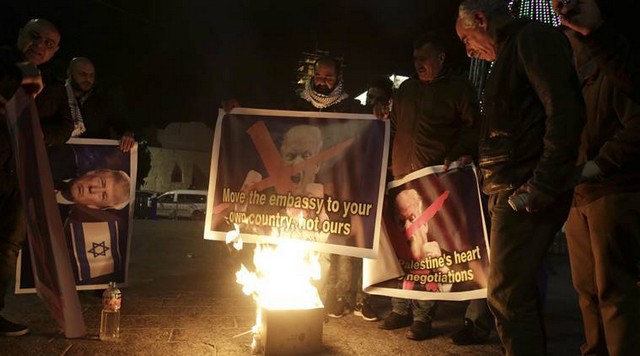
Donald Trump’s “America First” foreign policy was on full display Thursday when the State Department announced that the United States is withdrawing from UNESCO over the United Nations cultural body’s supposed “anti-Israel bias.”

Under President Barack Obama, the US had already cut funding to the agency because of a US law that restricts support to UN bodies that recognize Palestine as a state.

UNESCO head Irina Bokova expressed regret at the US decision.

Bokova has previously bent over backwards to appease Israel, including by echoing its false claims of anti-Israel bias at UNESCO.

The extent to which US leaders are willing to serve Israel is demonstrated by a simple thought experiment: it’s impossible to imagine the US pulling out of any world body citing an “anti-Canadian,” “anti-British” or an “anti-French” bias. Even though they are among the closest US allies, such a move would immediately subject the president to accusations from his virulently nationalistic base of putting foreign interests before American ones.

Yet President Trump is likely to hear much praise, and not only from the more right-wing segments of the American establishment.

In April, all 100 US Senators signed a letter endorsing the myth that the UN has an “anti-Israel agenda.”

This means there is not likely to be much critical examination in such circles of the bogus claims of anti-Israel bias.

Israeli smears

In recent months, Israel and its supporters have falsely claimed that UNESCO resolutions have undermined Jewish connections to heritage sites in the occupied West Bank, including East Jerusalem.

A year ago, Israel attempted to have Jerusalem’s Old City, the site of the al-Aqsa mosque compound, removed from UNESCO’s list of endangered world heritage sites.

That effort came as groups that call for the destruction of the al-Aqsa mosque and its replacement with a Jewish temple intensified their activities, often with Israeli government funding and support.

The Israeli attempt came two weeks after UNESCO had voted to condemn the myriad well-documented ways Israel violates the rights of Palestinian and Muslim worshippers at al-Aqsa mosque and threatens the architectural integrity of the compound.

Israel falsely claimed that the vote denied a Jewish connection to the al-Aqsa mosque site that Jews call Temple Mount.

As a result of that vote, Israel launched a global smear campaign against UNESCO, even likening it to the Islamic State group, or ISIS.

Upholding international law

Some UN officials caved in to the Israeli bullying and distanced themselves from the resolution.

But in May, UNESCO passed a resolution that, in line with international law, called Israel’s annexation of East Jerusalem “null and void” and demanded that Israel halt excavations and other works in the city.

Israel again launched a campaign of smears, with Prime Minister Benjamin Netanyahu terming the resolution “delusional” and “bizarre.”

The only thing that UNESCO had done was to reaffirm what the UN Security Council had stated just months earlier: that Israel is the occupying power and must abide by international law.

Months later, Israel’s ire was raised again when UNESCO passed two resolutions again upholding international law.

The resolutions recognized Hebron’s Old City and Ibrahimi mosque as endangered Palestinian heritage sites.

Distorting history

Israel again went on a verbal rampage, claiming that UNESCO promotes “lies” and “fake history.”

“This time they decided that the Tomb of the Patriarchs in Hebron is a Palestinian site, meaning not Jewish, and that it’s in danger,” Netanyahu claimed.

The Tomb of the Patriarchs is the name used by Israel for the Ibrahimi mosque, where an American Jewish settler massacred 29 Palestinians in 1994. The site is venerated by Muslims, Christians and Jews as the burial place of Abraham and other prophets.

What Netanyahu did – as Israeli officials often do – is conflate Jewish belief with Israeli control, as if a site cannot be both revered by Jews and located in Palestinian territory. There is, however, no contradiction between a site being Palestinian, on the one hand, and sacred to Muslims, Christians or Jews, on the other.

So what “anti-Israel bias” means in practice is failing to enthusiastically endorse Israel’s distortions and lies aimed at legitimizing its illegal colonization and its attempts to erase any history in Palestine that does not bolster the Zionist colonial narrative.

The US withdrawal comes as UNESCO is set to elect Bokova’s successor this week, a contest that Israeli media have painted as a sectarian battle between a Muslim frontrunner from Qatar and a Jewish candidate from France.

There is little reason to lament the departure of the US from UNESCO. What would be even better is if Israel follows it out too.

Ali Abunimah is Co-founder of The Electronic Intifada and author of The Battle for Justice in Palestine, now out from Haymarket Books. Also wrote One Country: A Bold-Proposal to End the Israeli-Palestinian Impasse. Opinions are mine alone.

Source: http://www.countercurrents.org/2017/10/13/trump-puts-israel-first-with-unesco-withdrawal/

The UK Pensions Crisis – From Prophesy to Reality

By Graham Vanbergen

Can you guess who recently said this? – “Oh, by the way, we’re also going to tax you even more because this Ponzi scheme that we’ve had in play for pensions and for healthcare and for social care for the past 30 years is about to collapse. So therefore we want you to work really, really hard, but when you get to 65, it’s not going to be there. Hands up who thinks that’s a really compelling narrative?”

It was Conservative Justice Minister Dr Phillip Lee who became yet another top Tory to have a go his own party as the annual Conservative conference descended into chaos this year. Lee was speaking at a meeting chaired by the Social Market Foundation, a pro-market think tank!

Lee is not wrong, when it comes to pensions. Since the financial collapse, caused by the banking industry, the pension deficit in the UK has now reached the point, for the first time in history, where it has become the biggest liability to the overall economy.

The decision to cut interest rates last August to their lowest ever is only an admission by the Bank of England that the country is still on a full artificial life support system.

HSBC’s head of European credit strategy Jamie Stuttard warned a year ago that Governor Mark Carney’s monetary policy move means:

“The pension issue is essentially kicked down the road for somebody else to sort out.”

If you have a pension and you’re still quite a few years from claiming it, you should be really worried. It is not an exaggeration to suggest that there is a very real threat to collecting that pension in any meaningful way. What then? The pension deficit is so serious that it has literally mutated from being nothing one year prior to the financial crisis to Britain’s biggest liability just a decade later.

The pension deficit has sprinted way passed the £430 billion mark, increasing at the rate of at least £40 billion a year and according to the Financial Times (paywall) “more than 85% of UK pension schemes are now in deficit.” In less than ten years, that deficit will climb to the point of implosion.

What happened was easy to understand. The banks blew up the system, the country is actually in recession, even though they say it isn’t, which is why it needs almost zero percent interest rates and hundreds of billions of funding in order to get the banks to lend, so they can make money and strengthen their destroyed balance sheets.

In the meantime, pension providers are unable to get returns on the money invested in them, who in reality need at least 5 or 6 percent just to tread water. The only way to get that type of return is to turn up the risk strategy. UK government gilts are providing no return as many have lost faith in the banks, which in turn drives down the rate of return, making matters even worse for the pension providers.

In 1950, there were 7.2 people aged 20–64 for every person of 65 or over in the OECD countries. By 1980, that ratio dropped to 5.1 and by 2010 it was 4.1. It is projected to reach just 2.1 by 2050. The average ratio for the EU projected to reach 1.8 by 2050.

According to a wikipedia entry on the pensions crisis – “Thousands of private funds have already been wound up (in the UK)”.

Add all the investing problems along with a decade of low interest rates to the fact that the pensioners themselves refuse to die at a financially convenient date for the pension providers – and there’s the catch 22 – and you’re in it. But the Bank of England chief Mark Carney is digging UK pensions deeper into a hole.  With loose monetary policy, Carney is currently acting in the hope of staving off an economic crash in the short term. In reality, all he is doing – as mentioned, is effectively kicking the can down the road for others to collect. All the while, the pensions crisis is getting worse every day and when that deficit is declared un-payable, which it technically is already, the ‘haircuts’ everyone will be taking will cause one almighty recession in its own right. By then, he’ll be back in Canada, shielded from the economic firestorm.

The only options with a crisis like is

A) all affected pension schemes offer big reductions to rebalance their liabilities,

B) the government borrows massive sums of money to shore up those liabilities, hugely increasing the national debt

C) the pension companies offer a one-time payoff or buyout to scheme members that cuts their long term liabilities, or

D) they collapse.

The most likely option you’ll be facing is option A or C as the government simply won’t have the money to bail out pensions after bailing out the banks, which they are still doing and D would cause mass protests or possibly worse.

Of course, the entire country could take the pain, allow artificially low interest rates to increase, which will save the pension companies. Then the scale of ‘zombie’ companies who go bust will become apparent, the stock market will fall, investor dividends will dry up, unemployment will rise causing a risky rise in ‘non-performing’ bank debt. It’s a tightrope as you can see.

Eoin Murray, head of investment at Hermes Investment Management agrees.

“QE and ultra-low rates have insulated many companies, and unwary investors, from the dangers that normally lurk; they are now treading a dangerous path. As interest rates begin to meaningfully rise, companies that have been able to borrow cheaply and roll over debt will be exposed. These are the zombie firms that in a normal rate cycle would no longer exist.” Murray went further with a dark warning for investors: “That would mean inefficient companies going bust, but investors also stand to share the pain. Back in 2009 only 2pc of loans issued were “cov-lite”, those which placed few restrictions on a company’s debts and so offered little protection for the investors buying those bonds. By 2013 that was 59pc and last year it hit 75pc, this means the debt markets could be a “powder keg”.

The cost of living and low wage performance has also stopped millions from contributing to pensions, which again, only makes matters worse. This is because ordinary people are already suffering today, let alone being able to invest in their future. One in four households (not individuals, entire households) have less than £95 saved. The savings gap between the wealthy and poor has widened by a huge 25 percent in just the last year. The IMF says this is because average household income is now falling faster than at any time in the last 40 years and according to the ONS is a record since records began back in the 1963.

The result of all this is that one in five have made no pension provision and many millions are facing big future cuts in pension payments or a total wipeout. The other alternative would be to bring in lots of young foreign labour but we have Brexit, and anyway, the new robotics revolution in our factories will only decrease the number of working age people able to contribute.

This problem will have very real consequences for the country and its people quite soon and the Bank of England is fanning the flames of an economic problem set to explode in our faces. Cowardly politicians unable to start the debate on what to do for fear of losing power in the resultant social scandal that should have been dealt with years ago do not help of course.

Source: https://www.globalresearch.ca/the-uk-pensions-crisis-from-prophesy-to-reality/5612539

Neoliberalism and the New World Order. IMF-World Bank “Reforms”, The Role of Wall Street

By Prof Michel Chossudovsky

Global financial warfare as outlined in professor Chossudovsky’s writings.

Wall Street Behind Brazil Coup d Etat;

The role played by the IMF and World Bank in the economies of debtor nations,

The Real Plan in Brazil,

The imposition of the Washington Consensus;

Loss of national sovereignty,

Neoliberal institution funding of grassroots movements;

The main corporate actors of the New World Order;

The function of propaganda and the process of global impoverishment and destruction of nation states.

This is Guns and Butter.

Monetary policy really defines the sovereignty of a country. It’s the ability of a country to actually finance its own developments through lending to the private sector, the building of public infrastructure and so on. And that is ultimately what economic sovereignty is all about. It’s the ability of a country to use its monetary instruments to finance development, and that ability is denied under the prevailing relations that these countries have with the International Monetary Fund and the World Bank and the creditors.

I’m Bonnie Faulkner. Today on Guns and Butter, Michel Chossudovsky. Today’s show: Neoliberalism and the New World Order.

Michel Chossudovsky is an economist and the founder, director and editor of the Centre for Research on Globalization based in Montreal, Quebec. He is the author of 11 books including The Globalization of Poverty and the New World Order, War and Globalization: The Truth Behind September 11th, America’s War on Terrorism and The Globalization of War: America’s Long War Against Humanity. Today we discuss global financial war as outlined in Professor Chossudovsky’s article “Wall Street Behind Brazil Coup D’état,” the role played by the IMF and World Bank in the economies of debtor nations, the Real Plan in Brazil, the imposition of the Washington Consensus, loss of national sovereignty, neoliberal institution funding of grassroots movements, the main corporate actors of the new world order, the function of propaganda, and the process of global impoverishment and the destruction of nation-states.

* * * * *

Bonnie Faulkner: Michel Chossudovsky, welcome, again.

Michel Chossudovsky: Delighted to be on the program on these very important issues of the new world order.

Bonnie Faulkner: In our recent program “Global Warfare: Is the US-NATO Going to Attack Russia?” you talked about global nuclear conventional and non-conventional war. Non-conventional war includes global financial warfare. Let’s take one of the most recent examples, regime change in Brazil. Your recent article, “Wall Street Behind Brazil Coup D’état,” lays out an argument that control over monetary policy and macroeconomic reform was the ultimate objective of the Brazilian coup d’état against Dilma Rousseff. What is the evidence?

Michel Chossudovsky: The evidence is the following. When Luiz Inácio da Silva, President Lula, set up his government back in 2003, he appointed a former CEO of a Wall Street bank, FleetBoston Financial Global Banking, to head the Central Bank of Brazil. It was in a sense like appointing the fox in charge of the chicken coop, so to speak, and what was disturbing there is that all the major appointments which the progressive Workers Party government (PT) implemented – namely the ministry of finance, the central bank, the Bank of Brazil, which is a development bank – they were held by neoliberals. In fact, the IMF had given its support to the Lula government and in fact they even congratulated the Lula government on its austerity measures and so on.

Henrique de Campos Meirelles, who was president of the Central Bank of Brazil and also former president of FleetBoston Financial Global Banking before he headed the Central Bank of Brazil, stayed in that position until the presidency of Lula’s successor, Dilma Rousseff. Dilma Rousseff, in fact, appointed a career Ministry of Finance official to head the Central Bank and Meirelles was dropped from the government.

Now, this was, from my standpoint, a very significant move because it was a message to Wall Street saying, “We decide on key appointments in the spheres of economy and finance.” And the coup led to the installation of a provisional government led by Michel Temer, i.e. an interim government. Essentially what they did from one day to the next was to appoint a new finance minister, who happened to be this notorious individual, Henrique de Campos Meirelles, (right) the former CEO in Wall Street. He was appointed finance minister. Again, then, they put together a team of appointments to key positions.

It’s not only the fact that Campos Meirelles is a Wall Street appointee; he’s also a US citizen. And Campos Meirelles then appoints his man to the central bank whose name is Ilan Goldfajn. Ilan Goldfajn was chief economist with one of Brazil’s major private financial institutions and Ilan Goldfajn happens to be an Israeli citizen, and he also happens to be a very close friend of Stanley Fischer, who was previously number two at the IMF, then he became governor of the Bank of Israel, and Stanley Fischer currently holds the number two position at the US Federal Reserve. He’s a vice-chair of the US Federal Reserve. For emphasis, both Ilan Goldfajn and Stanley Fischer have US citizenship. Goldfajn was head of the Central Bank of Brazil, was born in Israel, and he has dual citizenship. I’m not criticizing his citizenship but I’m focusing on the crony relationships between these individuals.

So now you have a central bank governor who has a close personal relationship with Stanley Fischer, number two at the Fed. Known and documented, it’s always the number-two man that calls the shots ultimately and that’s where all the policy formulations are made. So that’s the background.

Now, where do, let’s say, left progressive movements come in? Well, they came in right at the outset of the Lula administration and European, North American, Latin American progressives applauded in chorus, celebrating the victory of a socialist government against the neoliberal agenda, and they said ‘victory against neoliberalism.’ It wasn’t a victory against neoliberalism; it was in fact the cooptation of a Workers Party leadership, not the grassroots, by Wall Street with a whole set of Wall Street appointments, which started with Lula and up to certain points was disrupted under Dilma Rousseff.

Bonnie Faulkner: How much power does the International Monetary Fund and the World Bank wield over Brazil’s economy?

Michel Chossudovsky: Let me open a parenthesis there. Very often people say the IMF, World Bank, they establish these harsh conditionalities on developing countries, they force them to implement these harsh austerity measures and so on and so forth. That is a correct description of IMF/World Bank activities. The structural adjustment programs that are imposed on developing countries are deadly. But it is not the IMF and the World Bank, which are in fact bureaucracies, which call the shots. The IMF and the World Bank are instruments of Wall Street. They’re instruments of the private banking nexus. The IMF and the World Bank, they have their independence, their Bretton Woods institutions, but legally they are connected to the United Nations. It’s a very hazy relationship but they’re supposed to be connected to the United Nations. The fact is they’re not.

But they don’t call the shots. It’s Wall Street that calls the shots, and it’s very convenient for Wall Street to have these Washington-based institutions which then, through intergovernmental relations, will establish links with governments.  These are intergovernmental bodies.

Now, what I’m suggesting here is that as far as appointments are concerned, the IMF, the World Bank have a very significant impact. They’re part of the so-called Washington Consensus, which is also linked up to the Wall Street Consensus. We notice that very often it’s a former World Bank official who is appointed to the ministry of finance. That was the case in 1991 when Finance Minister in India, Manmohan Singh, who later became prime minister, was appointed to the Ministry of Finance and he implemented what was called a New Economic Policy, which led to devastation. It was supported by the World Bank.

In other words, the World Bank and the IMF have their people on the inside. I would say more the World Bank, because the World Bank can be in the ministries. It can be in the ministry of finance, in the ministry of agriculture and so on, and ultimately there’s a consensus in terms of policymaking which emerges.

But then if you’re talking about the impact that let’s say these loan agreements have, they’re devastating because they will say, ‘You have to cut your budget in all the social sectors, health, education, etc. You have to close down the hospitals, close down or privatize some of the schools, introduce user fees,’ and in effect what these institutions do is to precipitate countries into poverty, and they also contribute to the destabilization of the national economy. We see that in many countries.

In Venezuela, in fact, what they’ve done is very similar to what they did or has some relationship to what they did in Chile in 1973. They create conditions of collapse of commodity markets, scarcity of commodities, rising inflation, breakdown of distribution of goods, not to mention problems of urban security and organized crime, etc., etc. in Caracas. Those are engineered conditions. Of course, they’ve also created conditions which have bankrupted the state because the price of oil has collapsed from over $100 a barrel to something of the order of $30 a barrel, and this has contributed to the bankruptcy of the Venezuelan government.

Bonnie Faulkner: What is the Real Plan in Brazil?

Michel Chossudovsky: It is very important. Really, the Real Plan is a plan to essentially to dollarize all internal debt operations, so that the country doesn’t really have a monetary policy. It links the national currency to the dollar and it means that it has to be supported by Forex transactions to maintain that parity. And then it really means that whenever, let’s say, if you want to use your monetary policy to mobilize internal resource it turns out to be dollarized. It’s the same plan that they had in Argentina under Menem.

Bonnie Faulkner: You write that, “The objective of the coup d’état was to deny Brazil’s sovereignty in the formulation of macroeconomic policy.” Why is Wall Street or the United States against a nation’s sovereignty?

Michel Chossudovsky: That’s a very important question and it really has to do with monetary policy. Monetary policy really defines the sovereignty of a country. It’s the ability of a country to actually finance its own development through lending to the private sector, the building of public infrastructure and so on. To do that, you have to be able to increase the levels of internal debt. We do it in the United States and Canada and so on. We use debt operations to fund the infrastructure, roads, schools and hospitals.

But what is at stake in developing countries is that the currency is dollarized and in currency markets it’s upheld by dollar-denominated debts, which have to be incurred to support the currency. So that when you start expanding the money supply to finance development – it’s a difficult and complex mechanism – you really have to borrow in dollars, and really what it means is that your currency really is a proxy. It’s a dollarized currency, so that each time you want to build a road or a bridge or a hydroelectric complex using your domestic resources, you have to increase your indebtedness in dollar terms. In other words, the internal debt becomes a foreign debt.

That is ultimately what happened in Brazil with the Real Plan. The Real Plan established the real as the Brazilian currency on a peg with the US dollar, sustained by persistent propping up of the currency to maintain that parity. And what it meant is that Brazil was indebting itself in terms of dollars and each time it expands let’s say its levels of expenditure and so on so forth it ultimately has to borrow in dollars. What that means, to get back to the question, is that it’s Wall Street that controls monetary policy and all actions of internal development, funding infrastructure, schools, roads and so on, requires borrowing dollars to do it.

I’ll give one example of this. Vietnam, in the wake of its normalization with the United States, decided to initiate a major project of repairing the country’s main highway, which links the capital, Hanoi, in the north to Ho Chi Minh City, or what was formerly known as Saigon. It’s called Road Number 1. The east coast of the United States also has a road linking New York right down to Miami.

What happened is that the project was to repair the road, and for that they had to have an international tender by construction companies coming in – big multi-million dollar contracts – and to repair the roads they needed foreign capital. But in fact, what the foreign capital would do was to subcontract with local enterprises which then would build the road. What happens under that type of mechanism is the transformation of an internal debt into an external debt. You don’t need to bring in foreign capital to repair a road, or even to build a road. The technologies are there, the know-how is there, and you don’t need much investment in terms of capital or materials. It’s all local.

And that disturbs the mechanics. Immediately these financial institutions, once they normalize with the country they will say, ‘Okay, we’re going to lend you money under World Bank project to build a road but there has to be an offer of tender to international construction companies, etc. And then the money we lend you, you use it to pay these companies.” That’s how countries get indebted and they are unable under World Bank, IMF auspices to mobilize internal debt operations. I’ve seen this in numerous countries. There’s what is called the PIP, Public Investment Program, which is a list of projects and the World Bank ultimately goes through this list and they can choose which ones they want to finance, and they override the government in the choice of investment projects.

That is ultimately what economic sovereignty is all about: It’s the ability of a country to use its monetary instruments to finance development, and that ability is denied under the prevailing relations that these countries have with the International Monetary Fund and the World Bank and the creditors.

Bonnie Faulkner: Well then, it’s true that if a country can issue its own debt internally, then they can control that policy and the effects it has. But if the debt is externalized, then all the control is taken away from them, right?

Michel Chossudovsky: Precisely. You’ve formulated it exactly. That is the nature of that relationship. Once they are brought into the nexus of these international financial institutions, which monitor their investment projects and provide funding, then that funding is external, is dollarized, and in turn it is then subject to conditionalities imposed by the creditors of a policy nature. So they will say, ‘Oh. We helped you build that road and you now have a $50 million, $100 million debt. You now have to repay that debt.’ Then the government says, ‘Well, we don’t have any money to repay it.’ Then they will say, ‘Okay, we will lend you money but then you have to accept certain policy conditionalities which we will impose – in other words, close down your hospitals and your schools.’ That’s the way that these austerity measures work. Then they’ll say, ‘Well, you have to privatize.’ So in effect, the process of making countries indebted is the key to taking control of their sovereignty.

Now, in the European Union the mechanics are somewhat different. There’s the famous Maastricht Treaty, which goes back prior to the Eurozone, and the Maastricht Treaty establishes the basis whereby the individual member-states cannot fund their development from central bank operations. And ultimately then, of course, you have the European Central Bank, and this in a sense creates conditions whereby the individual member-states, particularly the weaker ones like Greece, Ireland, Portugal, virtually their sovereignty is derogated because they can’t use their resources. They don’t have a national currency to finance their own development. Then what happens is that their assets are taken over, privatization, impoverishment and so on so forth.

We see it happening in several European countries. Greece is, of course, a notorious example where this mechanism has occurred. And the European Central Bank in effect is playing a role which is in some regards similar to that of the IMF, in another context, of course. The IMF is acting in relation to Brazil, but the IMF more recently has also acted in relation to countries like Greece and Portugal.

Bonnie Faulkner: Right. And I think it’s important for people to understand that if a government creates its own debt, or creates its own credit, it can use that to help the economy and not to destroy it. For instance, let’s just say theoretically that the Fed in the US, let’s say it was part of the Treasury or even as it is now, privatized. If they issued no-interest loans to states or whatever they could use that to help the economy rather than destroy it, right?

Michel Chossudovsky: Well, absolutely. The thing is, it’s not money which creates real economy wealth. By real wealth I’m not talking about the wealth of individuals; I’m talking about infrastructure, schools, hospitals, roads and so on. The resources in the United States of America are there. It’s the real economy. It’s the people plus the resources plus equipment and so on which ultimately will lead to projects. Then you need mechanisms which will mobilize those resources, and they could be loans at zero percent interest or they could be, of course, commercial loans at very high interest.

There could be all sorts of impediments to the increase of public expenditure in support of projects because, again, the Treasury is ultimately under the surveillance of Wall Street, of the Federal Reserve, which in turn is also an appendage of Wall Street.

Monetary policy is central to any kind of societal project, and that’s why the debate, let’s say, on the democratization of monetary policy is so crucial, of the banking system in general. So that if we have a banking system which is controlled by JP Morgan Chase and Goldman Sachs and Citigroup and so on, we’re not going to necessarily be able to fund the things that we want to fund. We’ll be funding casinos, we’ll be funding entertainment complexes and hotels and so on, but we’re not going to be funding the basic social infrastructure which will uplift the standards of living of millions of people. I think that is the situation which characterizes US monetary policy.

I should mention that a large share of public expenditures is allocated to produce weapons. It’s the military-industrial complex, it’s the so-called defense contractors, and those again require … Well, it has to do with government debt, it has to do with spending patterns, it has to do with the Treasury, but again, when creditors call the shots and decide what has to be funded in terms of infrastructure, the tendency is to fund precisely areas such as defense rather than schools and hospitals.

Bonnie Faulkner: So then, using Brazil as an example, what is the effect then of imposing the Washington Consensus on Brazil? How does it benefit the US and what are the negative effects on Brazil?

Michel Chossudovsky: Well, the case of Brazil is certainly not unique. I think what distinguishes Brazil from other developing countries, particularly in Latin America, is that first of all it has a population of over 200 million people. It’s a large country in its own right, with tremendous resources and infrastructure and so on. But what characterizes this relationship let’s say between Washington/Wall Street on the one hand and Brazil on the other is the fact that by taking control of monetary policy, you ultimately take control of the real resources of a country.

The objective is not simply to occupy the central bank or the ministry of finance. The objective is ultimately to be able to take control over major areas of Brazil’s economic development process through privatization, through the buy-up of Brazilian companies and so on and so forth. We’ve seen this developing in the course, I would say, of the last 20 years, that US dominant financial and economic corporate interests are appropriating large sectors of this wealthy economy. We’re talking about resources, mining, forestry but also industrial development.

The name of the game is privatization and countries like Brazil – but let’s take another case, countries like South Korea, with tremendous industrial capabilities. When the IMF imposed its devastating reforms in 1997 during the so-called Asian Crisis, and they imposed it on South Korea. The objective was ultimately to confiscate real assets – literally, to confiscate real assets. But they didn’t only confiscate real assets, they took over banking, they took over research institutes. Ultimately through financial manipulation you acquire oversight on another country’s resources. You will find similar occurrences in other countries.

To get back to Brazil, Brazil is a very wealthy country and there’s lots of assets to be taken over. And we see that now the rules of the game are to take over assets. We see it in Greece now with the conditions imposed by German, French and American creditors on the Greek Ministry of Finance.

That is the order of the day – that it’s not only sovereignty which is at stake; it’s the plunder of national economies by international financial institutions leading to transfer of wealth whereby these US companies take over large sectors of the economy through a process of manipulation.

Bonnie Faulkner: In your article, “Counter-propaganda as an Instrument of Peace: Fidel Castro and the Battle of Ideas, the Dangers of Nuclear War,” you write that, “A worldwide process of impoverishment is an integral part of the new world order agenda.” Describe what you consider to be the new world order.

Fidel Castro and Michel Chossudovsky, Havana, 2010

Michel Chossudovsky: Well, the new world order is a hegemonic project of ultimately conquering sovereign countries and in a sense corporatizing their governments. It’s the very structures of macroeconomic reform but it’s also the trade initiatives – the TTIP, the TTP, the two major areas of trade integration, the Atlantic and the Pacific, which ultimately transfer the powers of policymakers into the hands of corporations.

Now that, in effect, has already occurred. We don’t have independent governments, sovereign governments anymore, even in Western countries. We can go back to let’s say to the era of … Well, in Europe we might go back to Charles de Gaulle or in Britain we might go back to Harold Wilson, but those types of heads of state, heads of government are no longer around. In the United States we have individuals which are really the instruments of the corporate lobby groups. They’re not providing any leadership. I don’t think that Donald Trump or Hillary Clinton can provide any leadership with regards to decision making. They will abide by the instructions which are transmitted to them by their corporate sponsors. And then, of course, there’s also a consensus as to what is politically correct, as to what you do.

The new world order is a global capitalist system. It’s based on hegemony; it’s based on military power. I think one would also say that it is characterized by the outright criminalization of politics. The fact is that we don’t really have honest people in government anymore, very few. It’s also the fact that in the course of the last 20 or 30 years, all socialist and/or social democratic projects have been eliminated in one form or another. We can think of Nicaragua back in the early ‘80s. Of course, Guatemala, El Salvador. As well we can think of Vietnam obliterated through the Vietnam War, Cambodia, Indonesia from the early/mid-60s. We can look at Chile, Argentina, Mozambique, Angola, Algeria, numerous countries whose projects have been obliterated and destroyed. In other words, there’s no longer any nationalism and there’s no longer any reformist government which acts on behalf of its population.

There’s no longer what we might call representative government. That is the new world order. It’s the concentration of power by corporations. It is also not necessarily a smooth process, because those corporations are waging their own battle against one another. They’re merging, they’re buying up, they have manipulations directed against their competitors.

But ultimately what’s happening is that the world is being precipitated beyond poverty. It’s no longer an issue of mass poverty; it’s also an issue of total despair. In other words, we had an era where we talked about the globalization of poverty. I spent many years investigating that theme. But I have the hunch that now we’re talking about something quite different. It’s beyond the globalization of poverty. It’s not only the impoverishment of large sectors of the world population; it is precipitating people into total despair and it’s the destruction of the institutional fabric, the collapse of schools and hospitals which are closed down, the legal system disintegrating, borders are redefined.

Essentially this stage, which goes beyond impoverishment, is the transformation of countries into territories and we see it occurring in the Middle East. The objective for Iraq and Libya and Yemen is certainly to transform a country into a territory, and then you recolonize it. You’re in a very different environment to that which has prevailed until recently.

Bonnie Faulkner: What are the main corporate actors of the new world order?

Michel Chossudovsky: I would say, broadly speaking, that the main corporate actors of the new world order, first of all it’s Wall Street and the Western banking conglomerates, and that includes also the offshore facilities, the Cayman Islands and so on. We’ve talked a lot about that with the Panama Papers, but in effect all those offshore locations are controlled by the large banking institutions. And of course, it’s also linked up to money laundering and drugs and so on.

The military-industrial complex, at least, that’s what Eisenhower called it, regrouping the so-called defense contractors – they’re not defense contractors, they’re war contractors – the security, the mercenary companies, international outfits on contract to the Pentagon, the large private security companies such as G4S, which in some sense was also connected to the Orlando event.

Then you have, of course, the energy companies, the Anglo-American oil and energy giants. They’re very important. And then you have the biotech conglomerates which increasingly control agriculture and the food chain and Monsanto is of course, part of that. Monsanto, Cargill and the big corporate food companies are part of that.

Then overlapping with the biotech conglomerates you have Big Pharma, the large pharmaceutical companies, and I should say that those large pharmaceutical companies also overlap with the military-industrial complex because they’re also producers of chemical and biological weapons. Then you have, of course, the communications giants, the media conglomerates, which are part of the propaganda arm of the new world order.

There’s overlap between all of these various very broad categories, but I think that essentially, to summarize, Wall Street and the Western banking conglomerates, the military-industrial complex, the Anglo-American oil and energy giants, the biotech conglomerates, Big Pharma and the global media conglomerates.

Bonnie Faulkner: Describe the process by which local protest grassroots movements against neoliberal policy are co-opted by the very forces of neoliberalism.

Michel Chossudovsky: This is a very important question, because the consequences of neoliberalism, as we see in different parts of the world, create conditions of mass protest. What has occurred is that the seats of power of the new world order, primarily Wall Street, the financial conglomerates, they not only control the governments which are implementing these neoliberal policies, but they also indirectly control the protest movement, which is funded by the corporate tax-free foundations.

It’s not to say that all protest movements are funded by Wall Street but in effect, if we start to look into the whole nexus of non-governmental organizations, what we have is that many of these organizations, NGOs, civil society organizations historically linked to the protest movement are in fact funded by private foundations including the Ford Foundation, the Rockefeller Foundation, the McCarthy Foundation, among others. The Tides Foundation has a mandate to fund progressive organizations. It’s a multi-million-dollar foundation and it just so happens that the Tides Foundation is then receiving grants from several of the corporate foundations including the Rockefellers and the Fords. So what is at stake is that the entities which are opposed to neoliberalism are in a sense funded by neoliberalism.

You take the situation, let’s say, of Occupy Wall Street. Well, Occupy Wall Street on the one hand has a mandate to go against Wall Street, but then when you start to examine who is behind them, who is funding them, they’re funded by tax-free foundations. So Wall Street funds the protest movement against Wall Street. Very convenient.

Now, just to go back to Brazil, because it’s very important.  At the inception of Lula’s government in 2002, 2003, the World Social Forum was created. And what were they doing? They were celebrating the victory of the PT government, of the Worker’s Party of Brazil over neoliberalism. Yet if we go back to the origins of the World Social Forum, well, the World Social Forum was funded by the Ford Foundation. And we know that the Ford Foundation has links to US intelligence – in fact, historical links to US intelligence. There we can quote a former president of the Ford Foundation who said, and I quote, “Everything the Ford Foundation did could be regarded as making the world safe for capitalism, reducing social tensions by helping to comfort the afflicted, provide safety valves for the angry and improve the functioning of government.” That is the mandate of the Ford Foundation which funds dissent, namely the people who don’t like the capitalist system who are protesting but at the same time, through this mechanism, the elite foundations establish the limits of the protest movement, and in a sense they manufacture dissent.

In essence, by providing the funding as well as the policy framework, these tax-free foundations are in a position to manipulate and to establish the boundaries of dissent. My experience is that the rituals of the elites consist in inviting so-called civil society leaders into their inner circles with a view to establishing dialogue and so on and so forth, and ultimately what this consists of, is essentially to co-opt them. And you co-opt them by financing them, and the World Social Forum is a good example of that. Many of these non-governmental organizations have been caught in the nexus of corporate funding and they are consequently not in a position really to challenge the fundamental goals of this new world order’s agenda.

Bonnie Faulkner: How does propaganda function as an integral part of the new world order? For example, is intelligence embedded in the mass media? And then, as well, could you talk about some of the alternative media?

Michel Chossudovsky: Well, certainly the mass media or the mainstream media has historical links to intelligence agencies. This is known and documented. It’s clear that the mainstream media is there to support a consensus with regard to foreign policy, it’s there to distort events, but it’s got to such an extent … The mainstream media hasn’t always been like that. If we go back to the Vietnam War, we had critical reporting on what was happening, up to a point. But if we start to look and see how does the mainstream cover the war in Syria? Well, they forget to mention that ISIS, the Islamic State, is supported covertly by United States.

They actually will admit it and then they will in a sense refute their own lies. They will admit it in so many words. They’ll say, ‘Oh, Turkey and Saudi Arabia are supporting the ISIS.’ But Turkey and Saudi Arabia are allies of the United States. Saudi Arabia doesn’t act without consulting Washington. So there we have a mainstream media which has evolved towards essentially presenting the lie as the truth, and that’s a fundamental relationship. Because when the lie becomes the consensus there’s no turning backwards.

And when I say the lie becomes the truth or the lie becomes the consensus, it’s to say the United States is waging a war against terrorists. Ah, but you failed to mention that the terrorists are actually funded by the United States and they were created by the CIA. Everybody knows that but at the same time we don’t really believe in it anymore, and we believe in the lie. So it’s not to say that the truth is obfuscated. It’s a different mechanism. It’s the truth which becomes the lie and the lie becomes the truth, so that people have to believe the lie even though they know that the lie is a lie. It’s not the truth, so to speak.

I’ll give you another example. We know that there are torture chambers in Guantanamo. Everybody knows it, and nobody is in the process of hiding it. But what the media will do is provide legitimacy to torture. It will also provide legitimacy to going in and killing people in Libya or assassinating the head of state or bombing … Well, Syria’s more complex because there they say that the bombing is done by the government against their own people, but of course, that lie doesn’t really hold up anymore.

But essentially that is what is at stake. It’s that the media, as an instrument of propaganda, has turned realities upside down. It has created a consensus which people dare not question. It upholds war as a humanitarian endeavor, as a peacemaking undertaking.

In effect what this means is that both politics as well as the media are criminalized, because we have criminals in high office which are involved in making war in the name of peace, and then we have a media which serves as propaganda to uphold those lies. And at the same time, it means that the media is complicit in the criminalization of the state. Without the media serving as an instrument of propaganda the military agenda would not have a leg to stand on. The whole construct of US foreign policy would collapse like a deck of cards if it were subjected to truthful analysis within the media and confrontation and so on – but that does not happen.

And there you have also the complicity of intellectuals and you have the complicity of the universities and the think tanks and so on. There’s a politically correct way of studying let’s say international affairs which is set. You don’t discuss the role of the United States in supporting terrorist organizations, you don’t underscore the fact that 30% of the population of North Korea was wiped out due to US bombings, you don’t say anything about the almost one million Indonesians who were assassinated on the orders of the CIA in the mid-60s. All of this, of course, is documented in the archives but it’s never the object of any kind of debate, and then history is erased. History is erased and we are led to believe that the United States is involved in a global crusade to instill democracy and Western values. There’s a lot of skepticism, however, which is unfolding in relation to media disinformation.

Now, you asked the question on alternative media, and alternative media, I think, is also going through a period of crisis because there are certain segments of the alternative media which in fact are controlled by the mainstream. There’s the whole issue of half-truths and half-lies. Then there’s the issue of saying, ‘Well, you know, we’re fighting terrorism,’ but if we had proceeded otherwise there wouldn’t be terrorist organizations. But still, again, the fundamental truths are not revealed in many of these alternative media formulations.

And what I think is very important is if we want to disarm a military agenda, we need a very cohesive counter-propaganda campaign. We have to wage that counter-propaganda campaign without being funded by those who are behind the propaganda campaign, so to speak. That’s the problem with some of the alternative media. They’re funded by corporate foundations so that they are in a sense very much limited in the things that they can say against the new world order. Again, if I’m thinking of the United States, the links that progressive groups have to the Democratic Party of course, is a constraint in their ability to let’s say take a position with regard to major issues of US foreign policy.

Bonnie Faulkner: Michel Chossudovsky, thank you very much.

Michel Chossudovsky: Well, delighted to be on the program again.

* * * * *

I’ve been speaking with Michel Chossudovsky. Today’s show has been Neoliberalism and the New World Order. Michel Chossudovsky is the founder, director and editor for the Centre for Research on Globalization based in Montreal, Quebec. The Global Research website, GlobalResearch.ca, publishes news articles, commentary, background research and analysis. Michel Chossudovsky is the author of 11 books, including The Globalization of Poverty and the New World Order, War and Globalization: The Truth Behind September 11th, America’s War on Terrorism, The Globalization of War: America’s Long War Against Humanity as well as co-editor of the anthology, The Global Economic Crisis: The Great Depression of the 21st Century. All books are available at GlobalResearch.ca.

Guns and Butter is produced by Bonnie Faulkner, Yarrow Mahko and Tony Rango.

Visit us at gunsandbutter.org to listen to past programs, comment on shows, or join our email list to receive our newsletter that includes recent shows and updates. Email us at faulkner@gunsandbutter.org. Follow us on Twitter at gandbradio.

Source: https://www.globalresearch.ca/neoliberalism-and-the-new-world-order-imf-world-bank-reforms/5572157

The Future of the EU at Stake in Catalonia

By Pepe Escobar

Fascist Franco may have been dead for more than four decades, but Spain is still encumbered with his dictatorial corpse. A new paradigm has been coined right inside the lofty European Union, self-described home/patronizing dispenser of human rights to lesser regions across the planet: “In the name of democracy, refrain from voting, or else.” Call it democracy nano-Franco style.

Nano-Franco is Spanish Prime Minister Mariano Rajoy, whose heroic shock troops were redeployed from a serious nationwide terrorist alert to hammer with batons and fire rubber bullets not against jihadis but … voters. At least six schools became the terrain of what was correctly called The Battle of Barcelona.

Extreme right-wingers even held a demonstration inside Barcelona. Yet this was not shown on Spanish TV because it contradicted the official Madrid narrative.

The Catalan government beat the fascist goons with two very simple codes – as revealed by La Vanguardia. “I’ve got the Tupperware. Where do we meet?” was the code on a prepaid mobile phone for people to collect and protect ballot boxes. “I’m the paper traveler” was the code to protect the actual paper ballots. Julian Assange/WikiLeaks had warned about the world’s first Internet war as deployed by Madrid to smash the electronic voting system. The counterpunch was – literally – on paper. The US National Security Agency must have learned a few lessons.

So we had techno power combined with cowardly Francoist repression tactics countered by people power, as in parents conducting sit-ins in schools to make sure they were functional on referendum day. Some 90% of the 2.26 million Catalans who made it to the polls ended up voting in favor of independence from Spain, according to preliminary results. Catalonia has 5.3 million registered voters.

Roughly 770,000 votes were lost because of raids by Spanish police. Turnout at around 42% may not be high but it’s certainly not low. As the day went by, there was a growing feeling, all across Catalonia, all social classes involved, that this was not about independence any more; it was about fighting a new brand of fascism. What’s certain is there’s a Perfect Storm coming.

No pasarán

The “institutional declaration” of overwhelming mediocrity nano-Franco Rajoy, right after the polls were closed, invited disbelief. The highlight was a mediocre take on Magritte: “Ceci n’est pas un referendum.” This referendum never took place. And it could never take place because “Spain is a mature and advanced democracy, friendly and
tolerant”. The day’s events proved it a lie.

Rajoy said “the great majority of Catalan people did not want to participate in the secessionist script”. Another lie. Even before the “non-existent” referendum, between 70% and 80% of Catalans said they wanted to vote, yes or no, after an informed debate about their future.

Crucially, Rajoy extolled the “unwavering support of the EU and the international community”. Of course; unelected EU “elites” in Brussels and the main European capitals are absolutely terrorized when EU citizens express themselves.

Yet the top nano-Franco lie was that “democracy prevailed because the constitution was respected”.

Rajoy spent weeks defending his repression of the referendum by invoking “the rule of law such as ours”. It’s “their” law, indeed. The heart of the matter are Articles 116 and 155 of a retrograde Spanish constitution, the first one describing how states of alarm, exception and siege work in Spain, and the latter applied in “order to compel the [autonomous community] forcibly to meet … obligations, or in order to protect the … general interests.”

Well, these “obligations” and “general interests” are defined by – who else, Madrid and Madrid only. The Spanish Constitutional Court is a joke – it couldn’t care less about the principle of separation of powers. The court congregates a bunch of legalistic Mafiosi/patsies working for the two parties of the establishment, the so-called “socialists” of the PSOE (Spanish Socialist Workers’ Party) and the medieval right-wingers of Rajoy’s People’s Party (PP).

Few outside Spain may remember the failed coup of February 23, 1981 – when there was an attempt to hurl Spain back into the long dark Francoist night. Well, I was in Barcelona when it happened – and that vividly reminded me of the South American military coups in the 1960s and 1970s. Since the coup, what passes for “justice” in Spain never ceased to be a mere lackey to these two political parties.

The Constitutional Court actually suspended the Catalan referendum law, arguing that it was violating the – medieval – Spanish constitution. This disgraceful collusion is crystal-clear for most people in Catalonia. What Madrid is essentially up to amounts to a coup as well – against the Catalan government and, of course, against democracy. So no wonder the immortal civil-war mantra was back in the streets of Catalonia: “¡No pasarán!” They shall not pass.

Brussels does demophobia

Rajoy, thuggish, mediocre and corrupt (that’s another long story), lied even more when he said he keeps the “door open to dialogue”. He never wanted any dialogue with Catalonia – always refusing a referendum in any shape or form or transferring any powers to the Catalan regional government. Catalonia’s regional president, Carles Puigdemont, insists he had to call the referendum because this is what separatist parties promised when they won regional elections two years ago.

And of course no one is an angel in this hardcore power play. The PDeCaT (the Democratic Party of Catalonia), the main force behind the referendum, has also been mired in corruption.

Catalonia in itself is as economically powerful as Denmark; 7.5 million people, around 16% of Spain’s population, but responsible for 20% of gross domestic product, attracting one-third of foreign investment and producing one-third of exports. In a country where unemployment is at a horribly high 30%, losing Catalonia would be the ultimate disaster.

Madrid in effect subscribes to only two priorities: dutifully obey EU austerity diktats, and crush by all means any regional push for autonomy.

Catalan historian Josep Fontana, in a wide-ranging, enlightening interview, has identified the heart of the matter: “What, for me, is scandalous is that the PP is whipping up public opinion by saying that holding the referendum means the secession of Catalonia afterwards, when it knows that secession is impossible. It is impossible because it would mean that the Generalitat would have to ask the Madrid government to be so kind as to withdraw its army, Guardia Civil and National Police from Catalonia, and to meekly renounce a territory that provides 20% of its GDP … so why are they using this excuse to stir up a climate reminiscent of a civil war?”

Beyond the specter of civil war, the Big Picture is even more incandescent.

The Scottish National Party is sort of blood cousins with Catalan separatists in its rejection of a perceived illegitimate central authority, with all the accompanying negative litany. SNP members complain they are forced to cope with different languages; political diktats from above; unfair taxes; and what is felt as outright economic exploitation. This phenomenon has absolutely nothing to do with the EU-wide rise of extreme right-wing nationalism, populism and xenophobia – as Madrid insists.

And then there’s the silence of the wolves. It would be easy to picture the EU’s reaction if the drama in Catalonia were happening in distant, “barbarian” Eurasian lands. The peaceful referendum in Crimea was condemned as “illegal” and dictatorial while a violent attack against freedom of expression of millions of people living inside the EU gets a pass.

The demophobia of Brussels elites knows no bounds; the historical record shows EU citizens are not allowed to express themselves freely, especially by using democratic practices in questions related to self-determination. Whatever torrent of spin may come ahead, the silence of the EU betrays the fact Brussels is puling the strings behind Madrid. After all the Brave New Euroland project implies the destruction of European nations to the profit of a centralized Brussels eurocracy.

Referenda are untamable animals. Kosovo was a by-product of the amputation/bombing into democracy of Serbia by the North Atlantic Treaty Organization; a gangster/narco mini-state useful as the host of Camp Bondsteel, the largest Pentagon base outside of the US.

Crimea was part of a legitimate reunification drive to rectify Nikita Khrushchev’s idiocy of separating it from Russia. London did not send goons to prevent the referendum in Scotland; an amicable negotiation is in effect. No set rules apply. Neocons screamed in vain when Crimea was reunited with Russia after shedding tears of joy when Kosovo was carved out of Serbia.

As for Madrid, a lesson should be learned from Ireland in 1916. In the beginning the majority of the population was against an uprising. But brutal British repression led to the war of independence – and the rest is history.

After this historic, (relatively) bloody Sunday, more and more Catalans will be asking: If Slovenia and Croatia, the Czech Republic and Slovakia, the tiny Baltic republics, not to mention even tinier Luxembourg, Cyprus and Malta, can be EU members, why not us? And a stampede might be ahead; Flanders and Wallonia, the Basque country and Galicia, Wales and Northern Ireland.

All across the EU, the centralized Eurocrat dream is splintering. It’s Catalonia that may be pointing toward a not so brave, but more  realistic, new world.

Source: https://www.globalresearch.ca/the-future-of-the-eu-at-stake-in-catalonia/5611953

The City of London – Capital of an Invisible Empire

By True Publica

In July 2017 director Michael Oswald’s latest film, The Spider’s Web: Britain’s Second Empire was premiered at the Frontline Club in London. It has since had several screenings in London and public screenings can be organised from November onwards.  This fascinating interview just published in Deutsche Wirtschafts Nachrichten explores what inspired co-producers Michael Oswald and John Christensen to make a film documentary about London’s role as the world’s pre-eminent tax haven.  Oswald and Christensen also talk about how London might develop once Brexit kicks in, exploring the possibility of deepening the City’s tax haven role through further tax cuts for the rich and more rolling back of financial market regulation and other social protections.

The key inspiration, according to Michael Oswald, was Nicholas Shaxson’s best-selling Treasure Islands, which explained the way in which the formal British Empire morphed into a spider’s web of tax havens gathering financial wealth from across the world and funnelling it through to the City. As Oswald explains, this helped to re-establish London as the financial capital of Capital:

At the time of the British Empire, Britain structured its economy not around manufacturing and productive sectors, but around finance. City of London banks provided the financing for the Empire and the colonies would pay interest to the City.

As Britain’s Empire declined, City of London institutions were increasingly confronted by circumstances that limited their ability to function and make a profit. It was out of this need that various financial interests sought to fashion for themselves spaces in which they could continue to operate and profit. In order to create these spaces they used the expertise developed during empire and the territorial remnants of the Empire, such as Britain’s dependent territories, financial expertise and networks established during Empire and the knowledge of how to establish, run and benefit from an international financial system.”

Much of the expertise built up during the final decades of the formal empire was focused on ways to avoid paying taxes both in the colonies and in Britain itself.  In the 1920s and 30s offshore companies and trusts were increasingly used to avoid and evade paying taxes.  In the 1950s, with the emergence of the London-based Eurodollar market, international banks found themselves able to operate in a virtually unregulated financial market which the authorities – in this case the Bank of England – treated in a totally laissez-faire fashion.

As Christensen says in the interview, successive British governments have not only turned a blind eye to the British spider’s web of tax havens, they have actively supported its growth by blocking international attempts to tackle it:

“Britain has consistently voted against creating a globally representative inter-governmental body to shape a framework of rules to strengthen international cooperation on tax matters. Britain has successfully resisted international pressure to take effective action against its tax havens in the Channel Islands, the Cayman Islands, the British Virgin Islands, and other British dependencies.

I have observed British officials blocking attempts to strengthen international cooperation on tax information exchange by keeping discussion on offshore trusts off the agenda. This happened as recently as 2015 when Prime Minister David Cameron pushed to have trusts excluded from information exchange processes. This is a pivotal issue since offshore trusts are key to the British tax haven secrecy model. Britain has also spent years blocking EU attempts to make progress towards a common approach to taxing multinational companies (the Common Consolidated Corporate Tax Base).”

Fast forward to the present and it seems clear, especially post-financial crisis, that Britain’s reliance on the City as the engine of growth in the UK economy is a risky development strategy. Christensen again:

“The British economy is heavily reliant on external trade in services which is dominated by financial services. Any shock to the financial services sector, for example arising from being denied access to the EU Single Market, would be highly damaging to the economy.”

Which raises the inevitable question about where the British spider’s web might go post-Brexit.  Many of the services previously provided from London cannot be provided without the Single Market, which will require London-based banks and law firms to establish permanent establishment with the EU-27.  The British tax havens see new market possibilities in China, India, the Middle East and Sub-Saharan Africa, but this will probably involve laundering ever larger amounts of dirty money and enabling ever more tax avoidance.  The problem, as Christensen sees it, is that Britain has failed to plan for industrial diversification for decades and now faces limited development options:

Prime Minister May and her finance minister have already indicated that deepening Britain’s tax haven role is an option. This is a sign of weakness since a race-to-the-bottom on regulation, secrecy and corporate taxation would probably expose Britain to risks relating to financial stability and fiscal sustainability.”

Is this a viable development strategy?  Unquestionably there will be winners: oligarchs, kleptocrats and the multifarious aristocrats, bankers, lawyers, spooks and retired politicians who benefit from Britain’s tax haven empire.  For the vast majority of people in Britain, however, hosting the world’s largest tax haven has no benefits whatsoever and offers only the prospect of further relative decline and social division.  As Oswald comments in the interview:

This is something we explore in the documentary, in the case of the US and the UK, services do not make up for the reduction in industrial capacity. Michael Hudson explains that it is through attracting international capital whose origins may very well be criminal that this has become a possibility in the US and the UK.”

Read the full interview here.

Source: https://www.globalresearch.ca/the-city-of-london-capital-of-an-invisible-empire/5611057

How Billionaires Become Billionaires

By Prof. James Petras

America has the greatest inequalities, highest mortality rate, most regressive taxes, and largest public subsidies for bankers and billionaires of any developed capitalist country.

In this essay we will discuss the socio-economic roots of inequalities and the relation between the concentration of wealth and the downward mobility of the working and salaried classes.

How the Billionaires become Billionaires

Contrary to the propaganda pushed by the business press, between 67% and 72% percent of corporations had zero tax liabilities after credits and exemptions … while their workers and employees paid between 25 – 30% in taxes. The rate for the minority of corporations, which paid any tax, was 14%.

According to the US Internal Revenue Service, billionaire tax evasion amounts to $458 billion dollars in lost public revenues every year – almost a trillion dollars every two years by this conservative estimate.

The largest US corporations sheltered over $2.5 trillion dollars in overseas tax havens where they paid no taxes or single digit tax rates.

Meanwhile US corporations in crisis received over $14.4 trillion dollars (Bloomberg claimed 12.8 trillion) in public bailout money, split between the US Treasury and the Federal Reserve, mostly from US tax payers, who are overwhelmingly workers, employees and pensioners.

The recipient bankers invested their interest-free or low interest US bailout funds and earned billions in profits, most resulting from mortgage foreclosures of working class households.

Through favorable legal rulings and illegal foreclosures, the bankers evicted 9.3 million families. Over 20 million individuals lost their properties, often due to illegal or fraudulent debts.

A small number of the financial swindlers, including executives from Wall Street’s leading banks (Goldman Sachs, J. P. Morgan etc), paid fines – but no one went to prison for the gargantuan fraud that drove millions of Americans into misery.

There are other swindler bankers, like the current Secretary of Treasury Steve Mnuchin, who enriched themselves by illegally foreclosing on thousands of homeowners in California. Some were tried; all were exonerated, thanks to the influence of Democratic political leaders during the Obama years.

Silicon Valley and its innovative billionaires have found novel way to avoid taxes using overseas tax havens and domestic tax write-offs. They increase their wealth and corporate profits by paying their local manual and service workers poverty level wages. Silicon Valley executives ‘earn’ a thousand times more than their production workers..

Class inequalities are further reinforced by ethnic divisions. White, Chinese and Indian multi-millionaires exploit Afro-American, Latin American, Vietnamese and Filipino workers.

Billionaires in the commercial conglomerates, like Walmart, exploit workers by paying poverty wages and providing few, if any, benefits. Walmart earns $16 billion dollar a year in profits by paying its workers between $10 and $13 an hour and relying on state and federal assistance to provide services to the families of its impoverished workers through Medicaid and food stamps. Amazon plutocrat Jeff Bezos exploits workers by paying $12.50 an hour while he has accumulated over $80 billion dollars in profits. UPS CEO David Albany takes $11 million a year by exploiting workers at $11 an hour. Federal Express CEO, Fred Smith gets $16 million and pays workers $11 an hour.

Inequality is not a result of ‘technology’ and ‘education’- contemporary euphemisms for the ruling class cult of superiority – as liberals and conservative economists and journalists like to claim. Inequalities are a result of low wages, based on big profits, financial swindles, multi-trillion dollar public handouts and multi-billion-dollar tax evasion. The ruling class has mastered the ‘technology’ of exploiting the state, through its pillage of the treasury, and the working class. Capitalist exploitation of low paid production workers provides additional billions for the ‘philanthropic’ billionaire family foundations to polish their public image – using another tax avoidance gimmick – self-glorifying ‘donations’.

Workers pay disproportional taxes for education, health, social and public services and subsidies for billionaires.

Billionaires in the arms industry and security/mercenary conglomerates receive over $700 billion dollars from the federal budget, while over 100 million US workers lack adequate health care and their children are warehoused in deteriorating schools.

Workers and Bosses: Mortality Rates

Billionaires and multi-millionaires and their families enjoy longer and healthier lives than their workers. They have no need for health insurance policies or public hospitals. CEO’s live on average ten years longer than a worker and enjoy twenty years more of healthy and pain-free lives.

Private, exclusive clinics and top medical care include the most advanced treatment and safe and proven medication which allow billionaires and their family members to live longer and healthier lives. The quality of their medical care and the qualifications of their medical providers present a stark contrast to the health care apartheid that characterizes the rest of the United States.

Workers are treated and mistreated by the health system: They have inadequate and often incompetent medical treatment, cursory examinations by inexperienced medical assistants and end up victims of the widespread over-prescription of highly addictive narcotics and other medications. Over-prescription of narcotics by incompetent ‘providers’ has significantly contributed to the rise in premature deaths among workers, spiraling cases of opiate overdose, disability due to addiction and descent into poverty and homelessness. These irresponsible practices have made additional billions of dollars in profits for the insurance corporate elite, who can cut their pensions and health care liabilities as injured, disabled and addicted workers drop out of the system or die.

The shortened life expectancy for workers and their family members is celebrated on Wall Street and in the financial press. Over 560,000 workers were killed by opioids between 1999-2015 contributing to the decline in life expectancy for working age wage and salary earners and reduced pension liabilities for Wall Street and the Social Security Administration.

Inequalities are cumulative, inter-generational and multi-sectorial.

Billionaire families, their children and grandchildren, inherit and invest billions. They have privileged access to the most prestigious schools and medical facilities, and conveniently fall in love to equally privileged, well-connected mates to join their fortunes and form even greater financial empires. Their wealth buys favorable, even fawning, mass media coverage and the services of the most influential lawyers and accountants to cover their swindles and tax evasion.

Billionaires hire innovators and sweat shop MBA managers to devise more ways to slash wages, increase productivity and ensure that inequalities widen even further. Billionaires do not have to be the brightest or most innovative people: Such individuals can simply be bought or imported on the ‘free market’ and discarded at will.

Billionaires have bought out or formed joint ventures with each other, creating interlocking directorates. Banks, IT, factories, warehouses, food and appliance, pharmaceuticals and hospitals are linked directly to political elites who slither through doors of rotating appointments within the IMF, the World Bank, Treasury, Wall Street banks and prestigious law firms.

Consequences of Inequalities

First and foremost, billionaires and their political, legal and corporate associates dominate the political parties. They designate the leaders and key appointees, thus ensuring that budgets and policies will increase their profits, erode social benefits for the masses and weaken the political power of popular organizations.

Secondly, the burden of the economic crisis is shifted on to the workers who are fired and later re-hired as part-time, contingent labor. Public bailouts, provided by the taxpayer, are channeled to the billionaires under the doctrine that Wall Street banks are too big to fail and workers are too weak to defend their wages, jobs and living standards.

Billionaires buy political elites, who appoint the World Bank and IMF officials tasked with instituting policies to freeze or reduce wages, slash corporate and public health care obligations and increase profits by privatizing public enterprises and facilitating corporate relocation to low wage, low tax countries.

As a result, wage and salary workers are less organized and less influential; they work longer and for less pay, suffer greater workplace insecurity and injuries – physical and mental – fall into decline and disability, drop out of the system, die earlier and poorer, and, in the process, provide unimaginable profits for the billionaire class. Even their addiction and deaths provide opportunities for huge profit – as the Sackler Family, manufacturers of Oxycontin, can attest.

The billionaires and their political acolytes argue that deeper regressive taxation would increase investments and jobs. The data speaks otherwise. The bulk of repatriated profits are directed to buy back stock to increase dividends for investors; they are not invested in the productive economy. Lower taxes and greater profits for conglomerates means more buy-outs and greater outflows to low wage countries. In real terms taxes are already less than half the headline rate and are a major factor heightening the concentration of income and power – both cause and effect.

Corporate elites, the billionaires in the Silicon Valley-Wall Street global complex are relatively satisfied that their cherished inequalities are guaranteed and expanding under the Demo-Republican Presidents- as the ‘good times’ roll on.

Away from the ‘billionaire elite’, the ‘outsiders’ – domestic capitalists – clamor for greater public investment in infrastructure to expand the domestic economy, lower taxes to increase profits, and state subsidies to increase the training of the labor force while reducing funds for health care and public education. They are oblivious to the contradiction.

In other words, the capitalist class as a whole, globalist and domestic alike, pursues the same regressive policies, promoting inequalities while struggling over shares of the profits.

One hundred and fifty million wage and salaried taxpayers are excluded from the political and social decisions that directly affect their income, employment, rates of taxation, and political representation.

They understand, or at least experience, how the class system works. Most workers know about the injustice of the fake ‘free trade’ agreements and regressive tax regime, which weighs heavy on the majority of wage and salary earners.

However, worker hostility and despair is directed against ‘immigrants’ and against the ‘liberals’ who have backed the import of cheap skilled and semi-skilled labor under the guise of ‘freedom’. This ‘politically correct’ image of imported labor covers up a policy, which has served to lower wages, benefits and living standards for American workers, whether they are in technology, construction or production. Rich conservatives, on the other hand, oppose immigration under the guise of ‘law and order’ and to lower social expenditures – despite that fact that they all use imported nannies, tutors, nurses, doctors and gardeners to service their families. Their servants can always be deported when convenient.

The pro and anti-immigrant issue avoids the root cause for the economic exploitation and social degradation of the working class – the billionaire owners operating in alliance with the political elite.

In order to reverse the regressive tax practices and tax evasion, the low wage cycle and the spiraling death rates resulting from narcotics and other preventable causes, which profit insurance companies and pharmaceutical billionaires, class alliances need to be forged linking workers, consumers, pensioners, students, the disabled, the foreclosed homeowners, evicted tenants, debtors, the under-employed and immigrants as a unified political force.

Sooner said than done, but never tried! Everything and everyone is at stake: life, health and happiness.

Source: https://www.globalresearch.ca/how-billionaires-become-billionaires/5612125

The Vietnam War Is Not History for Victims of Agent Orange

By Marjorie Cohn and Jonathan Moore

Watching the Ken Burns-Lynn Novick 18-hour series, “The Vietnam War,” is an emotional experience. Whether you served in the US military during the war or marched in the streets to end it, you cannot remain untouched by this documentary. The battle scenes are powerful, the stories of US veterans and Vietnamese soldiers who fought on both sides of the war compelling.
The toll in human terms caused by the war is staggering. Nearly 58,000 Americans and 2 to 3 million Vietnamese, many of them civilians, were killed in the war. Untold numbers were wounded. Many US veterans of the war suffer from Post Traumatic Stress Disorder. More US Vietnam War vets have committed suicide than died in the war.  However, those numbers do not begin to tell the complete story of the war.

The US Engages in Chemical Warfare

In one of its most serious omissions, the series gives short shrift to the destruction wreaked by the US military’s spraying of deadly chemical herbicides containing the poison dioxin over much of Vietnam, the most common of which was Agent Orange. This is one of the most tragic legacies of the war. Yet, aside from a few brief mentions, the victims of Agent Orange/dioxin, both Vietnamese and American, are not portrayed in the series. More importantly, the ongoing harm created by this chemical warfare program is never mentioned.

Agent Orange/dioxin was an herbicidal chemical weapon manufactured by US chemical companies like Dow and Monsanto and sprayed by the US military from 1961 to 1971. Dioxin is one of the most toxic chemicals known to humankind. Approximately 3 million Vietnamese and thousands of US and allied soldiers were exposed to Agent Orange/dioxin.

The US government was aware that the use of poison as a weapon of war was forbidden by international law well before it authorized its use in Vietnam.  In fact, the US government suppressed a 1965 report, called the Bionetics study, that showed dioxin caused many birth defects in experimental animals. It was not until the results of that study were leaked that the use of Agent Orange/dioxin was stopped.

Horrific Birth Defects

Those exposed to Agent Orange/dioxin often have children and grandchildren born with serious illnesses and disabilities. There is a virtual unanimity of opinion within the international scientific community that exposure to Agent Orange/dioxin caused some forms of cancers, reproductive abnormalities, immune and endocrine deficiencies, and nervous system damage. Second- and third-generation victims continue to be born in Vietnam, as well as to US veterans and Vietnamese-Americans in the United States. For many of them and their progeny, the suffering continues.

Mai Giang Vu was exposed to Agent Orange while serving in the Army of South Vietnam. He carried barrels of chemicals to spray in the jungle. His sons were unable to walk or function normally. Their limbs gradually “curled up” and they could only crawl. By age 18, they were bedridden. One died at age 23, the other at age 25.

Nga Tran, a French Vietnamese woman who worked in Vietnam as a war correspondent, was there when the US military began spraying chemical defoliants. A big cloud of the agent enveloped her. Shortly after her daughter was born, the child’s skin began shedding. She could not bear to have physical contact with anyone. The child never grew. She remained 6.6 pounds – her birth weight – until her death at the age of 17 months. Tran’s second daughter suffers from alpha thalassemia, a genetic blood disorder rarely seen in Asia. Tran saw a woman who gave birth to a “ball” with no human form. Many children are born without brains; others make inhuman sounds. There are victims who have never stood up. They creep and barely lift their heads.

Rosemarie Hohn Mizo is the widow of George Mizo, who fought for the US Army in Vietnam. After he refused to serve a third tour, Mizo was court-martialed, spent two and a half years in prison and received a dishonorable discharge. Before his death from Agent Orange-related illnesses, Mizo helped found the Friendship Village where Vietnamese victims live in a supportive environment.

Dr. Jeanne Stellman, who wrote the seminal Agent Orange article in Nature, said,

“This is the largest unstudied [unnatural] environmental disaster in the world.”

Dr. Jean Grassman, of Brooklyn College at the City University of New York, stated dioxin is a potent cellular disregulator that alters several pathways and disrupts many bodily systems. She said children are very sensitive to dioxin, and the intrauterine or postnatal exposure to dioxin may result in altered immune, neurobehavioral and hormonal functioning. Women pass their exposure to their children both in utero and through the excretion of dioxin in breast milk.

These were some of the witnesses who testified at the International Peoples’ Tribunal of Conscience in Support of the Vietnamese Victims of Agent Orange, held in Paris in 2009.

An Empty Promise of Compensation

In the 1973 Paris Peace Accords, the Nixon administration promised to contribute $3 billion for compensation and postwar reconstruction of Vietnam. That promise remains unfulfilled.

In 2004, both US veteran and Vietnamese victims sued the chemical companies who knowingly manufactured Agent Orange and other herbicides, which they knew contained an unnecessary but lethal amount of dioxin. The victims were prevented from suing the US government because of the doctrine of sovereign immunity. Despite agreeing to compensate US veterans in an earlier lawsuit for some maladies caused by their exposure to Agent Orange and other herbicides, the US government and the chemical companies maintained before the courts and to this day that there was no evidence to support a connection between exposure and disease.

The efforts by veterans’ groups and others to take care of our vets has resulted in a compensation scheme administered by the Veterans Administration. It annually pays out billions of dollars to veterans who can demonstrate they were in a contaminated part of Vietnam and have an illness that is associated with exposure to Agent Orange.

Unfortunately, the Vietnamese who were exposed to Agent Orange on a scale unheard of in modern warfare have been left out in the cold. The failure to include this history in the Burns/Novick series is unconscionable. Indeed, one could argue that even the mention of Agent Orange in the series was seriously misleading. For example, in the last episode, the narrator notes the spraying campaign but does so against a verdant backdrop of green fields and abundant crops.

The actions of the US government and the US manufacturers of Agent Orange and other deadly herbicides is a moral outrage. The US government has funded the cleanup of dioxin at the Danang airport, only one of the 28 “hot spots” still contaminated by dioxin. But this effort ignores the damage caused to the people who live there and eat the crops, animals and fish from the surrounding area. All of these hot spots need to be remediated.

The Victims of Agent Orange Relief Act of 2017

Rep. Barbara Lee (D-California) has introduced H.R. 334, the Victims of Agent Orange Relief Act of 2017, which has 23 co-sponsors. The bill would lead to the cleanup of dioxin and arsenic contamination still present in Vietnam. It would provide assistance to the public health system in Vietnam directed at the 3 million Vietnamese people affected by Agent Orange. It would also extend assistance to the affected children of male US veterans who suffer the same set of birth defects covered for the children of female veterans. It enable research on the extent of Agent Orange-related diseases in the Vietnamese-American community and provide them with assistance. Finally, it would support laboratory and epidemiological research on the effects of Agent Orange.

Contact your representative and ask him or her to sign on as a co-sponsor of H.R. 334. Effective compensation for Agent Orange/dioxin victims is a moral imperative.

Marjorie Cohn http://marjoriecohn.com/, a veteran of the antiwar movement, is on the national advisory board of Veterans for Peace. She is co-author (with Kathleen Gilberd) of “Rules of Disengagement: The Politics and Honor of Military Dissent” https://www.amazon.com/Rules- Disengagement-Marjorie-Cohn/ dp/0981576923/ref=sr_1_1?s= books&ie=UTF8&qid=1507478600& sr=1-1&keywords=rules+of+ disengagement. And she served as one of seven judges from three continents at the International Peoples’ Tribunal of Conscience in Support of the Vietnamese Victims of Agent Orange http://www.vn-agentorange.org/ paris_2009_tribunal_ execsummary.html, held in Paris in 2009.

Jonathan Moore was one of the attorneys who filed a lawsuit to gain compensation for Vietnamese who were exposed to Agent Orange/dioxin. Cohn and Moore are co-coordinators of the Vietnam Agent Orange Relief & Responsibility Campaign http://www.vn-agentorange.org.

Source: https://www.globalresearch.ca/the-vietnam-war-is-not-history-for-victims-of-agent-orange/5612535