Just International

The Disinformation Campaign On Venezuela

By Farooque Chowdhury

Venezuela, it seems, is a riddle to the audience of the mainstream media. Yet the riddle conceals a fact. A conflict between opposing interests is roaring in Venezuela, and attempts to stoke that conflict are being intensified by the imperialist-interventionist quarter as the day for a vote on the proposed Constituent Assembly—July 30—is nearing.

Every day the mainstream media showers its viewers with news reports that are partial and biased. Here are some examples from the past several weeks:

1. A Venezuelan diplomat to the UN has decided to break with the government and resigned. The diplomat called on president Nicolas Maduro to resign immediately.

2. Recent protests have led to the deaths of more than 100 persons.

3. Venezuela’s chief prosecutor has confirmed a second death in Thursday’s protests. The chief prosecutor said she was investigating the death.

4. Maduro has decried the general strike called by the opposition as a crude attempt to sabotage the country’s economy.

5. Maduro has also denounced an opposition attack outside the offices of VTV, Venezuelan state TV.

6. Opposition protesters and pro-government forces threw rocks at one another while the Venezuelan National Guard launched tear gas and rubber bullets.

7. Streets in opposition-friendly neighborhoods in eastern Caracas were almost entirely void of activity during the strike. Some businesses remained open in parts of the capital traditionally loyal to the ruling party but foot and vehicle traffic was significantly reduced.

8. More than 7 million Venezuelans cast ballots in an opposition-led “consultation” on July 16. Nearly 700,000 of those votes came from Venezuelans abroad.

Other news

Yet there are a significant number of other news stories on Venezuela that the mainstream media chose not to report:

1. Citing the Proletarian Agency of Information, a grassroots media group, on July 20, 2017 Venezuela Analysis reported: In the industrial city of Barquisimeto, many workers have made efforts to maintain production despite several cases of sabotage by business owners, administrators, and protestors. In the case of DISICA, a private company that supplies state oil firm Petróleos de Venezuela, S.A. (PdVSA) with iron construction material, the workers “continue working and have not stopped operations.”

2. The same news-report said: State owned Lacteos Los Andes, a diary company, has alleged that since early hours of the afternoon, they have been under attack by opposition groups armed with home-made mortars and Molotov cocktails. The groups “tried to set […] fire to an industrial gas tank.”

3. Workers complained of delays caused by opposition barricades.

4. Opposition mayors supported the strike.

5. Working class neighborhoods have largely been unaffected by the strike.

6. Maduro told VTV: “The 700 largest companies in the country are working at 100 percent of their capacity.”

7. The government said: Almost all 2.8 million public employees including employees of PdVSA turned up to work. The PdVSA management said it was not affected by the strike. (Ryan Mallett-Outtrim and Katrina Kozarek, “Venezuela Divided Over Opposition’s General Strike,” Venezuela Analysis, July 20, 2017.)

8. Any change to the constitution by the proposed constituent assembly, once elected, will need to be put to a referendum.

9. The death of Hector Anuel, a citizen, assaulted by opposition protesters in Anzoategui state. Anuel’s death sparked a social media outrage, after footage went viral that seemed to show his charred corpse being beaten by opposition protesters. According to news outlet La Tabla, Anuel was killed after being hit by a home-made mortar used by opposition protesters. The shot itself was allegedly caught on camera. Anuel was burned, before being pummelled with stones and other debris. In the footage alleged to show his death, Anuel appeared unarmed. (Ryan Mallett-Outtrim, “Venezuela Shocked by Graphic Footage of Alleged Mortar Killing,” Venezuela Analysis, July 19, 2017.)

10. The Bolivarian government made no attempt to stop the opposition-organized “vote taking” even though it had no legal standing (and therefore was no more than a circus). Initially, the show was described as a “referendum” and a “plebiscite”. It had the logistical support of the National Assembly, the regional governors and opposition mayors. The propertied classes and imperialist camp also extended full support to the so-called referendum, which should be seen as part of attempts to organize a parallel government. Five rightist former presidents from Latin American countries were allowed to observe the proceedings. They made fiery speeches demanding Maduro’s exit. All these leaders are entangled in corruption cases, and they have not hesitated to use repressive power against workers and peasants in their respective countries. (Jorge Martin, “Venezuela: July 16 opposition ‘consultation’ countered by a Chavista show of strength,” In Defense of Marxism, July 20, 2017)

11. The opposition-organized show mobilized a large number of people. However, long queues at “polling stations” in some areas of the capital city were due to less number of “polling stations.” For example, in Catia, there was one polling station for 90,000 people. Moreover, the opposition leaders have admitted: people could vote more than once. There is already a video showing a person voting three times in one hour in the right-wing stronghold of Chacao. Furthermore, at the end of the day, they burnt the ballots and the registers, which demolishes all scopes to check the opposition announced result. This is the political force, “which has been accusing the Bolivarian revolution of election fraud for the last 15 years!” (ibid.)

12. There was an official dry run of the proposed Constituent Assembly (CA) elections—a presence of Chavismo’s strength—on the same day the so-called referendum was organized by the opposition. The dry run of the Constituent Assembly vote had very high turnout, as evidenced by long queues in front of official National Electoral Council polling stations throughout the country. Even in big cities, where opposition support is greatest, long queues were common. Local councils of a number of these cities are controlled by the opposition. In many neighborhoods the queues were so long that the polling stations had to keep open until 8pm (four hours later than the scheduled time). There was even significant voter presence in Petare parish, which supported the opposition in recent elections. In Merida, many people waited in queues for hours and finally had to return home without participating in the dry run. (ibid.)

13. In a poll by Hinterlaces of over 1,500 Venezuelans the majority of said they support a socialist economy, with the caveat that state-run enterprises need to improve their efficiency. The poll asked participants if “the best thing for Venezuela is a socialist economic model of production, where various forms of private property exist.” Three out of four Venezuelans agreed with this statement and only 1 percent was unsure. The results were released in a speech by Oscar Schemel (a pollster with Hinterlaces) to local business leaders in Caracas. Schemel said data shows Venezuelans want a socialist state with private investment and a “mixed economy.”: “61 percent of the population affirms that the economy must be led by the state, 86 percent think that the government should promote private investment, 78 percent consider that the government’s dialogue with businesspeople is more important than with the opposition, and 63 percent distrust the opposition.” While the majority of Venezuelans said they support socialism, 63 percent of the respondents said the government needs to become “more productive and efficient”, 32 percent said the current model should “change”, 74 percent said they would oppose any proposal to privatize PdVSA. When asked whether the electricity grid should be privatized, 67 percent opposed the suggestion while 69 percent opposed suggestion for privatizing state telecommunications giant CANTV. (Ryan Mallett-Outtrim, “POLL: 75% of Venezuelans support socialism, 63% distrust opposition,” MR Online, July 23, 2017)

The mainstream has failed to cover nearly all of these stories; when they have, the message has been distorted to fit the viewpoint of the US ruling class.

Deaths

Since the mainstream media incessantly flaunts its “objectivity” we can reasonably ask: how objective has their reporting been on deaths and killings over the last four months? Is there any mention of opposition-induced violence? Any reasonable assessment would conclude that opposition has played little if any role—other than to protest; whereas most if not all have been murdered by Maduro and his security machine.

So far, the opposition organized unrest has left 105 persons dead (date last updated: July 18). There is confusion over the causes of and parties responsible for these deaths. An in-depth account by Venezuelanalysis (“In detail: The deaths so far”, July 11, 2017) showed the following:

Deaths caused by authorities: 13

Direct victims of opposition political violence: 20

Deaths indirectly linked to opposition barricades: 8

Deaths still unaccounted for/disputed: 44

Accidental deaths: 3

Persons died during lootings: 14

Deaths attributed to pro-government civilians: 2.

The mainstream media not only avoid giving any such breakdown, they completely ignore who murdered who. They also ignore other pertinent details about the opposition protests:

  1. Any details on the tactics most commonly used in opposition demonstrations.
  2. How opposition protestors target day-to-day civilian activities, and attempt to create a sense of terror.
  3. Any investigation into the class affiliation of participants in opposition demonstrations.
  4. The extent to which vandalism, arson, bombings are used; or the routine targeting of public institutions (such as clinics).
  5. The assassination of Chavista supporters.

Any honest coverage would compel one to ask: are these opposition “crusaders” genuinely interested in “democracy,” or do they simply want the right to plunder and terrorize until they get their way by force? We simply cannot rely on the mainstream media to provide any insight into such pertinent questions.

Voting mathematics

The voting tabulations given by the mainstream media more often than not conform to the viewpoint of the Venezuelan opposition leaders and their supporters. A look into their very own figures on voting in the much touted “consultation” (or “referendum”) is a sterling example. Following are a few key points:

1. The opposition has stated that they had 2,000 polling stations and a total of 14,000 polling booths, which remained open for 9 hours, from 7am until 4pm. A few of stations remained opened later, but most closed much earlier. They report a total of 7,186,170 votes. When we divide that figure by 14000 booths over 9 hours we get rough estimate of 57 votes per hour per booth. In other words, just over 1 vote every minute in each and every one of the polling booths: 9 hours straight! In one minute and 5 seconds every voter had to go to the table, show identification documents, have their details written down in the electoral register, receive a paper ballot, go into the booth and fill out the ballot, fold it and put it into the ballot box. Surely a “believable” estimate commented Jorge Martin: “massive achievement for the opposition, one which breaks all election records and a few laws of physics”! (“Venezuela: July 16 opposition ‘consultation’ countered by a Chavista show of strength”, In Defence of Marxism, July 20, 2017)

2. In Spain, there are 63,000 Venezuelans according to the census taken on January 2017. Of these 9,000 are below the voting age, leaving 54,000. The opposition claims that 91,981 participated in the consultation. Now, there may be some discrepancies between the census and the real figures, but is it reasonable to accept that there are 38,000 more people than are actually registered officially? Are we not justified to doubt these figures? (ibid.)

3. The opposition officially declared that 7,186,170 people had participated. Let’s assume that the figure is true. That would fall short of the 14 million they themselves had announced would take part, just days before July 16, and also short of the more conservative figure announced by Capriles as a litmus test for the day. The opposition also announced that “with this result Maduro would have lost a recall referendum.” This refers to the Constitution, which states that for a recall referendum to be binding on the sitting president, more people would have to vote for his recall than he actually won in the election. Unfortunately for the opposition, Maduro was elected with 7,587,579 votes in 2013, and thus would not have been recalled. More confusing yet, the figure they apparently plucked out of thin air is less even than the opposition candidate won in that presidential election, which was 7,363,980. (ibid.)

As one might expect, the mainstream media have totally misrepresented the news of the official dry run process of the Constituent Assembly, most claiming poor voter turnout. The Spanish El País informed its readers that in Caracas there was “little influx to some polling stations […]” where a few “looked empty.” Yet the four photographs published by El Pais were of very long Chavista queues, with a false caption saying the cues were of Chavistas going “to participate in the opposition consultation”! (ibid.)

Interventionist propaganda

The upper classes of Venezuela are trying to regain their lost fiefdom. The program of violence they are implementing, which has rocked Venezuela since April 4, 2017, is part of that effort.

Venezuelan bonds have crashed as result of the sustained unrest, with five-year debt yielding 36 percent. Economic problems and corruption are wearing down the Bolivarian revolution’s social base; as leaders are forced into a policy of class conciliation, revolutionary mobilization are weakened; and, thus, creating conditions favorable to the upper classes. The disturbances the wealthy elite are creating is part of the imperialists’ intervention plan in Venezuela. The disinformation campaign carried out by the mainstream media is a key component of that effort. So, we should not be surprised by the profusion of Orwellian statements and the incessant vilification of Maduro, in mainstream coverage of Venezuela:

  • “The proposed Constituent Assembly would disenfranchise millions of Venezuelans.”
  • “If the Maduro regime imposes its Constituent Assembly on July 30, the US will take strong and swift economic actions.”
  • Mercosur has asked Maduro to suspend his plan to rewrite the country’s constitution.
  • A group of US lawmakers has warned of a new Cuba as Venezuela is trying to transform the country to serve its own people. Senator Marco Rubio of Florida said of Venezuela: “This is a dysfunctional narco-state.” Rubio also said: “How truly tragic would it be for […] one of the most democratic societies in the hemisphere to become Cuba.” Senator Bob Menendez of New Jersey said: “We are talking about a nearly failed state in our own hemisphere.” Venezuela is a “nearly-failed”, “narco-state,” and yet is “one of the most democratic societies”?! Which statement to believe?
  • Maduro is just another Fidel. [Yes, they say this.] Cuban-American Republicans and Democrats agree: Maduro must be stopped.
  • Rubio brought the wife of Mr. Leopoldo López, one of Venezuela’s opposition leaders, to the White House in February.

The US would obviously prefer to restore its allies to the throne in Venezuela so that they can go on plundering the country; so that surplus labor of the toiling people of Venezuela can be appropriated.

It might be argued that while most of the facts presented above are objective, some are biased. But that would miss the point, which is the wildly divergent narrative presented by the mainstream media. The interests of capitalists and imperialists are stated and restated incessantly; while those of millions of people of Venezuela are downplayed, distorted or ignored.

We cannot remain silent. We must recognize that many other countries may face (or are already facing) the same situation. Would an imperialist state allow some other state to decide/define:

  1. The imperialist state’s constitution?
  2. Who runs the imperialist state or who should be the president?
  3. Its domestic politics?
  4. Type of constitution, form of democracy and form of government?

Shouldn’t people of respective country be allowed to decide the issues? These questions must be answered by those who support or downplay imperialist intervention in Venezuela and elsewhere.

No intervention should go unchallenged, whether in Venezuela or elsewhere. Piercing the edifice of mainstream media manipulation is a key part of exposing imperialist intervention, not least because it contributes to the political education of those fighting similar battles, leading to more effective organization and resistance.

Farooque Chowdhury, writing from Dhaka, has not authored/edited any book in English other than Micro Credit, Myth Manufactured (ed.), The Age of Crisis and What Next, The Great Financial Crisis (ed.), and he doesn’t operate any blog/web site.

27 July 2017

Philippines: Western Media Is Distorting Reality, People And Army Unite To Battle “ISIS”

By Andre Vltchek

Covering the recent battle for the city of Marawi on Mindanao Island in the Southern Philippines, the Western media has been grossly exaggerating unconfirmed reports and rumors. It has been spreading twisted information and ‘facts’.

At the beginning of July, I visited Mindanao as one of only a few foreigners allowed inside the besieged city of Marawi and to its surrounding area.

I spoke to local people, to the IDPs – those who managed to escape the city taken over by the jihadists. I also managed to discuss the situation with the highest commanders of the military in charge of the combat, including General Ramiro Rey and Lt. Colonel Jo-Ar Herrera. I encountered many soldiers, civil servants, and relief workers.

My contacts in the capital informed me via text messages that I had been “red-flagged,” clearly, by the pro-US faction in the Philippine military. So before my presence was finally cleared from Manila, I was detained and held in a provisional military base in the city of Saguiaran. Here I was “softly” interrogated by military intelligence. A few steps away, a howitzer was firing artillery toward ISIS positions in Marawi, some 10 kilometers distant.

“So you believe the United States is responsible for spreading terrorism all over the world,” I was asked late at night by one of the officers, point blank, while local starlet was imitating old Chuck Berry’s hit “Johnny B. Goode” on TV, sound blasted all over the barracks. It was clear that someone ‘behind the scenes’ was busy studying my published work.

The Western establishment media and various servile NGOs (including those which are “defending human rights” in several rebellious and independent-minded countries) consistently demonize President Duterte, an anti-imperialist, progressive leader who enjoys well over 80 percent approval rating. It is no secret in the Philippines there are two distinct factions inside the military – one supports the president and his drive for independence from the West. The other, which is trained and often corrupted by Washington and other Western capitals, would love to see him go.

The pro-Western fraction obviously wanted me out, detained, perhaps even disappeared. The other one that stands by its president wanted me to see the truth, even to be allowed into Marawi.

A final decision was made late at night in Manila. I was released and granted permission to work in the besieged city. But even when the top commanders personally called the camp, there was, at least for a while, apparent reluctance to let me go.

My first reaction after visiting the Marawi front was one of shock and outrage. What I witnessed was fundamentally different from what has repeatedly been said by most of the Western mass media outlets, as well as pro-Western local news channels broadcasting from Manila.

It is evident, right from the start, that Marawi is not “totally destroyed,” as has been reported. Most of it is standing and standing firm. I would estimate that only between 20 and 30 percent of the houses and buildings, (most of them in the wealthy core center of the city) have sustained heavy damage.

It was explained to me during the presentation by top army commanders that the ISIS-related jihadists began their offensive on May 23rd 2017 and their plan was to take full control of the town by the time Ramadan was to begin (May 26th). The military spoiled their plans; it counter-attacked and managed to contain the terrorists in just one neighborhood, retaining or regaining control of all the other ‘barangays.’

Undoubtedly there were heavy losses, and, because of the palpable sense of fear after tremendous brutality unleashed by the terrorists, a substantial movement of IDPs (Internally Displaced  Persons). But it was never 400,000 people escaping the area, as reported in the West, but approximately 200,000 (the number once peaked at about 300,000 for a short time).

There has been no “indiscriminate bombing” of the civilians. I witnessed both incoming and outgoing howitzer fire and also very limited bombing from the air; it was all targeted and mostly precise, aiming at the position of the terrorists. As in all other war zones where I have been working, I refused any protection, including helmets and bulletproof vests. That allowed me to remain more mobile. I did manage to come ‘very close’ to the front. It was clear the fighting and bombing were strictly contained to one area, no more than one-kilometer square. Even there, the mosques and almost all other buildings and houses were still standing, as is demonstrated on my photographs.

Anti-Duterte NGOs and many Western governments claim that they ‘worry’ about the martial law imposed on Mindanao Island. I was told that in and around Marawi (or anywhere else on the Island), the martial law carried no brutal consequences. Even the curfew (9PM-5AM) is laxly implemented.

Brigadier General Ramiro Rey (head of the Joint Task Force Group, Ranao) explained to me in Marawi City:

“The difference between this martial law and those that were imposed during the reign of Ferdinand Marcos is that now the military is mainly doing real fighting while providing assistance to the civilians. I absolutely don’t interfere with the work of local elected government officials. I’m actually encouraging them to do their job as before, asking them to contact me only when my assistance is needed. I never took, and I don’t intend to take, control of the area.”

Local government officials and volunteers working for various relief agencies and NGO’s operating in the area have confirmed what General Rey said.

During my work in the conflict zone, I detected no fear among the residents. The relationship between the army and civilians was clearly friendly and cordial. As the military convoys were moving between the cities of Illigan and Marawi, both children and adults were smiling, waving, some cheering the soldiers.

In the camps housing the IDPs, there was almost unanimous consensus: while many citizens of Mindanao Island in general and the Marawi area in particular would most likely welcome more autonomy from Manila, during this ongoing and brutal conflict almost all local people have been supportive of the military and government efforts.

“We hope that both Filipino and foreign jihadi cadres would soon be crushed,” was an almost unanimous statement coming from the local people.

The Military Perspective

In the cities of Illigan and Marawi I was shown detailed maps clearly indicating positions of the ISIS and the military.

Both Lt. Colonel Jun Abad from Ranao Camp and the commanding officer, General Rey, gave me a clear and detailed briefing. As of July 3rd, the Agus River represented the ‘borderline’ between the ISIS-held area and the zone liberated and controlled by the army.

General Rey explained during our meeting in the Municipality of Marawi City (now the complex is also serving as the headquarters of the war theatre):

“The ISIS wants to establish their state on the island of Mindanao – an Islamic caliphate – right here in the Province of Lanao del Sur.”

But that’s not what the majority of local people want. Before President Duterte came to power little over one year ago, social situation in many parts of Mindanao was desperate and therefore there was at least some support for radical ‘solutions’. Since then, however, things changed dramatically. Healthcare, education and public housing are improving. Indiscriminate mining by multi-national companies has been deterred. People here; as well as in almost all other parts of the Philippines finally feel hopeful and optimistic about their future.

This converts into great support for both the government and the military.

There is no doubt the entire city will be freed, soon, most likely in July or August. The only reason why it did not happen yet is that the terrorists are using hostages, both Christians and Muslims, as human shields. President Duterte, General Rey, and other civilian and military officials are trying to avoid unnecessary human losses.

Cultural topography’ of the area is also very complex. Near the front line I was told by one of the top commanding army officers:

“We could take the city in just one day, but there would be great civilian casualties. The houses in this area are very sturdy; they are 2-3 stories high and fortified, as there are constant and brutal family feuds, called’ rido’, raging here, and have been for centuries.”

But to delay the liberation of Marawi is also very dangerous.

“The terrorists began using captured women as sex slaves,” explained Major Malvin Ligutan, standing in front of a temporary military base in Saguiaran.

Despite all the horrors of the Marawi war, the army refused to use brutal tactics, even after it found out that various local citizens clearly miscalculated and before the conflict began, offered substantial support to the ISIS-related terrorists.

Captain John Mark Silva Onipig clarified:

“These people belonging to the ISIS are not only terrorists, but they are also criminals. They were dealing in drugs… And some local people knew that… Actually, locals knew quite a lot; they knew about the presence of the terrorists in the area long before all this started, but they never reported it to the authorities.”

“How did the terrorists get hold of so many weapons?” I wanted to know.

“In the Philippines, those who have money can buy as many weapons as they want on the black market.”

The situation is extremely sensitive as there is clearly the involvement of foreign fighters. On June 30th, in Saguiaran, Major Malvin Ligutan admitted, hesitantly:

“In one of the safe houses, we found passports issued in Indonesia, Malaysia and several Arab countries.”

A month ago I wrote an essay exposing the complex network of Western-sponsored terrorism in Asia (“Washington Jihad Express: Indonesia, Afghanistan, Syria and Philippines”). I argued that in the 1980’s, Indonesian and Malaysian jihadists, indoctrinated by the Southeast Asian brand of extreme anti-Communism, went to fight in Afghanistan against the socialist governments of Karmal, and then Mohammad Najibullah, with the ultimate goal of destroying the Soviet Union.

Hardened and further brainwashed, they returned home to Southeast Asia, participated in several ethnic strives and pogroms (including those in Ambon and Poso), and then, in order to ‘bridge the generational gap’, embarked on the coaching of a young generation of terrorists, who eventually ended up fighting in Syria and recently in the Philippines.

My essay was full of facts, and I put into it various testimonies of Southeast Asian academics, thinkers, and even of one active and prominent ‘jihadi cadre’ who is now living in Jakarta.

In the Indonesian city of Bandung, Prof. Iman Soleh, a professor at the Faculty of Social and Political Science (University of Padjadjaran- UNPAD) offered his take on why the West is now so obsessed with destabilizing and smearing the Philippines and its current rebellious administration:

“Since World War Two, the U.S. was afraid of so-called ‘domino effects’. Among other things that are now happening in the Philippines under president Duterte, the government is curbing activities of the multi-national mining conglomerates, and the West cannot accept that. Philippines are putting its environmental concerns above the short-term profits! For the millions of left-wing activists here in Indonesia and all over Southeast Asia, President Duterte is a role model.”

It is no secret that the West punishes such ‘bad paradigms’ brutally and decisively.

Prof. Soleh continued:

“I think all that is happening is not just to ‘destabilize’ the Philippines, but also because the country has conflict areas that could be ‘nurtured’. The best example is the predominantly Muslim island of Mindanao, vs. the rest of the Philippines, which is predominantly a Catholic country…”

The West is regularly using ‘jihad,’ directly and indirectly, to destabilize socialist, anti-imperialist, and just patriotic countries and governments. In the past, it managed to ruin countries like Afghanistan, Indonesia (1965) and Syria. Many believe that the Philippines is the latest addition to the ‘hit-list.’

The China & Russia Connection

As Drei Toledo, a prominent Philippine journalist, educator and pro-Duterte activist, originally from Mindanao, explained:

“The reason why the West is hostile toward President Duterte is simple: he is working hard to reach a peace agreement with China, a country that is seen by Washington as its arch-enemy. Another ‘adversary of the West,’ Russia, is admired by Duterte and increasingly by his people. Recently, Russia and the Philippines signed a defense agreement. The president is also forging close ties with Cuba, particularly in the area of health… Before Duterte became our President, poverty by design in Philippines was restored and perpetuated by the U.S. and Malaysia-controlled Cojuangco-Aquino clan.

Foreign and local entities that have long benefited financially from Philippines being a weak state are now threatened overwhelmingly by President Duterte’s unifying agenda to create a socialist system in the Philippines.”

Ms. Toledo pointed her accusative finger at Malaysia:

“Malaysia benefits from Mindanao being in a perpetual state of chaos and conflict because this means we can never reclaim oil-rich Sabah.”

She also doesn’t spare Indonesia and its sinister political (anti-socialist and anti-Communist) as well as economic interests:

“As exposed by Rigoberto D. Tiglao, a Filipino diplomat and writer, Indonesian magnate Anthoni Salim, not only does have total control or substantial stakes in local mainstream media papers and networks, his conglomerate in Philippines is also based on telecoms, power, water distribution, and other public utilities.”

Or more precisely: it is based on making sure that ‘public utilities’ will never become truly ‘public’, remaining in private hands. Salim’s ‘empire’ already brought great damage to India, particularly to West Bengal where, some argue, because of allowing it to operate and to implement its brutal feudal-capitalist practices, the CPI (M) (Communist Party of India – Marxist) managed to thoroughly disgust local voters and to lose power.

The Human Cost

Nobody could deny the gravity of the situation.

I witnessed exhausted glances of the people from Marawi, now living in a rescue center built on the land of the town hall of Saguiaran.

“Yesterday two infants died,” I’m told by Amer Hassan, a student volunteer from Mindanao State University (MSU).

The reason was “different water, malnutrition, exhaustion…”

I wanted to know more, and Amer continues:

“People are still in shock… They can’t believe what is happening. Especially those whose houses were destroyed; those who lost their relatives, everything…”

While the West is constantly criticizing, does it provide help? Amer just shrugs his shoulders:

“There is no foreign help coming… Almost all that we have here comes from Manila, either from the government or local agencies. Duterte is working very hard, helping our people.”

A family of three, Camal Mimbalawag, his wife Ima and one-month-old baby Mohammad, is squeezed into a tiny space at the center. Their memories are bleak. Ima gives her account almost mechanically:

“We were in Marawi during the first stage of the attack. I was pregnant, ready to give birth. We were in the city hall when ISIS attacked… They erected checkpoints; divided people into groups… they pointed guns at us… They asked: ‘Muslim or not?’…and ‘If Muslim, then recite ‘Shahadat.’ If cannot, you get killed or taken as a hostage… We saw corpses of those killed, eaten by dogs under the burning sun…”

The battle for the city of Marawi is raging. I face it from the highest floor of the building, destroyed by ISIS snipers, a place where an Australian reporter was hit just two days earlier.

It is not Aleppo, but it could have been, if not for the heroic counter-attack of the army.

Marawi is just one new chapter in the already long book of horrors of brutal religious terrorist acts, most of them directly or indirectly triggered by Western imperialism. In the first wave of its fight again the secular socialist Muslim governments, the West destabilized Iran, Egypt and Indonesia. Then came the Afghanistan ‘gambit’, followed by the arch-brutal destruction of Iraq and Libya. Then it was Syria’s turn.

‘Jihad’ is consistently used against Russia, China as well as the former Central Asian Soviet republics.

All this I described in my 840-page book: “Exposing Lies Of The Empire”, but one can never write fast enough and fully catch up with the crimes committed by the West.

It is often easy to pinpoint Western involvement in the religious conflicts, particularly in such places as Afghanistan and Syria. In the Philippines, the link is still indirect, well concealed, but it certainly exists.

To rebel against the Western Empire is always a costly and bloody affair. It often leads to coups sponsored by Washington, London or Paris, and even to direct military conflicts, interventions and full-scale wars.

But by now, the people of the Philippines have had it ‘up to here’. They had enough of being submissive; enough of being plundered while remaining silent. They are assembling behind their president. Duterte’s popularity is still around 75%. The army is clearly winning the war against the hardened local and foreign jihadists. Relief operations are effective and well organized. Things are just fine.

In only one year, the country has diametrically changed. To break the spirit of the liberated masses, to force people back onto their knees would be difficult, perhaps almost impossible, even if jihadi terror is unleashed brutally.

Almost 100 soldiers already lost their lives. Just one day before I encounter General Rey, six of his men were injured. It is said that 800 or more civilians died. Nobody knows exactly how many terrorists were killed. It is real war: tough and merciless as all wars are, but in this case, the ‘newly independent’ country is clearly winning.

It is an incredible sight: some soldiers, patriotic and determined, are still wearing those helmets with the US flags engraved into them, or some old Israeli bulletproof vests. But have no doubts: this is real, new country! Totally different Philippines and Marawi is one of the first and toughest tests it will have to endure.

The war united people and the army. No matter what the West and local corporate media are saying, most Filipinos know: this is their struggle; this is their president and their military fighting against something extremely foreign, violent and dreadful.

An previous version of this story was published on July 18, 2017.

Andre Vltchek is a philosopher, novelist, filmmaker and investigative journalist.

27 July 2017

Ten Myths About Israel

By Dr Ludwig Watzal

Particularly, in the US and some European States, the Israeli and Zionist versions of history are wide-spread. Israel’s narrative relies on a collection of myths aimed at bringing the moral right and the ethical behavior of the Palestinians into twilight and making their claim to their country appear as illegitimate. Israel’s negation of Palestinian existence in the Land of Palestine is, however, a falsification of history.

“Ten Myths About Israel” came out in Germany in 2016 under the title ” What’s wrong with Israel? The Ten Main Myths of Zionism”. The mainstream media ignored it, which could also be the case in the US. It’s sad but that how media power works in favor of Israel.

Israeli historian Ilan Pappe, who lives in exile in Britain, deals in this book with the myths of Zionism and exposes them as legends consisting of half-truths and fabrications of history. The Zionist narrative has only little to do with historical reality and truth.

The “Running Gag” of the Zionist historical narrative is the story of the “empty land” of Palestine, into which people without a land had finally returned after 2000 years of exile. The slogan of a country without a people, for people without a country, is the most prominent expression of the Zionist mythology. For Pappe, it’s less important whether the Jews existed as a people, rather than that the Zionists deny the existence of a Palestinian population but simultaneously claim that the State of Israel represents all the Jews of the world and does everything for their benefit and acts for them. Such a claim is just as daring as the identification of Zionism with Judaism because it takes Jews hostage for Israel’s despising policy.

The Zionists presented the colonization of Palestine with biblical rhetoric; this served only as a means to an end. The highest prophet of Zionism, Theodor Herzl, even considered Uganda and other places instead of the Zionist Promised Land. Finally, they found their roots in Palestine. “From then on, the Bible became both the justification and the guideline of the Zionist colonization of Palestine,” writes Pappe. He describes Zionism as a “colonial settler movement” and Israel as a “Settler Colonial State.”

The author points out that the expulsion of the Palestinians in 1947/48 was “ethnic cleansing.” Likewise, the 1967 June war, which is also called the Sixth Day War, was not an act of self-defense of the “little David” against an overpowering “Goliath,” but an Israeli attack on which the Israeli security establishment has minutely prepared for years.

The claim of being the “only democracy in the Middle East” is put in the right perspective. Israel resembles rather an “ethnocracy” than a democracy in the classical sense of the meaning. The “peace process,” which was highly praised by the Western political establishment ended in the acceleration of the colonization of Palestine and in the establishment of Palestinian regime that has to do the dirty work for Israeli occupier.

In his book, Ilan Pappe gives his backing for the historical truth that the Israeli political establishment must face if it is interested in peace. Israel’s security establishment abuses Judaism because it equates its Zionist expansionist and oppressive policy with Judaism. Enlightenment is, therefore, more than a necessity, which the book does excellently by deconstructing the mythological web that surrounds the history of the State of Israel.

This book is an absolute must for an interested public, the political and the media class to understand what Israel is all about.

Ilan Pappe, Ten Myths About Israel, Verso, London 2017.

Dr. Ludwig Watzal works as a journalist and editor in Bonn, Germany.

22 July 2017

“If Israel Placed Roses Instead Of Metal Detectors In Al-Aqsa, We Would Still Reject Them”

By Rima Najjar

As usual, commentary on the latest stand-off between Israel’s forces and Palestinian Muslims due to the closure of al-Aqsa mosque compound to Friday prayers on July 21, 2017 was confusing.

One commentary goes like this: Yes, these are Muslims being killed, gassed and pushed around, but the “clashes” are not really about the encroachment on al-Aqsa by the so-called Temple movement – a messianic Jewish extremist movement supported by the Israeli government that aims to replace Al-Aqsa with a Jewish temple; that’s just a pretext, a provocation designed to allow Israel to perfect its Jewish nationalist goals in Jerusalem or to cloak colonialism.

Yes, Israel has been vigorously judaizing illegally annexed and occupied East Jerusalem, but the thousands of devout Jews colonizing the city have nothing to do with Judaism – they are there simply as a front for the settler colonial state – and a provocation to push Palestinian Arabs out, who just happen to be mostly Muslim.

Well, it looks like Muslims in Palestine on either side of the Green Line, not to mention in the Gaza enclave, believe deeply Israel is all about Judaism – as much or even more so than about nationalism – especially in al-Quds (Jerusalem).

Since Palestinians on the street are praying, speaking and shouting in Arabic, much of what they are saying goes over the heads of the non-Arabic speaking TV viewer, and that includes the majority of Israeli Jews.

The following is a translation of a speech, captured on video and posted on Facebook.  The setting is Salah-al-Din Street close to one of the gates of the Old City (Bab al-Amoud).  The speaker is addressing a crowd of worshippers who had been prevented by Israeli police from accessing al-Aqsa mosque for Friday prayer.

These crowds standing here are sending one message to the whole world that al-Quds is Arabic, Islamic and Palestinian, a city that raises the heads of al umma up high everywhere – this is how al-Quds was; this is how al-Aqsa was and so it will be. (Chants of Allahuakbar). We repeat, these crowds of people come here to pray and nobody can put a stop to them or the freedom of worship. The majority of Muslims in this homeland are unable to reach al-Aqsa mosque. That’s why the occupation is responsible. We refuse the gates because they are coming from the occupation; if they place roses in al-Aqsa, we will refuse it because it is coming from the occupation … we are for life, not death, but a life with dignity. Life needs a stand for dignity and as we said in the past and say and repeat now al-Aqsa mosque is a place of worship for Muslims period. During the time of the Crusades and foreign invasions the gates of the al-Aqsa mosque were closed for 90 years. The foreigners left and al-Aqsa mosque remained and that is what must be. Be certain that the stand you are taking now is one that has moved the world – the stand of the youth with whom we stood in solidarity all week is what has moved the world and that is what will impose justice and truth that al-Aqsa is for Muslims (chants) You are chanting here that al-Aqsa mosque is sorrowful. You are here to make a stand for the dignity and authenticity of al-Aqsa whether they like it or not. Say it along with me – al-Aqsa mosque is a place of worship for Muslims. May the blessing and mercy of God be upon you (assalmu alaikum wa rahmatu allahu wa barakatoh).
The attitude reflected by Jewish youth who have been parading through the Old City on Jerusalem Day since May 12, 1968, shouting racist chants against Arabs (a euphemism for Muslim), has much to do with Judaism and the role that the city plays in its ancient traditions.

Unfortunately for the Zionist project, it is Palestinian Arabs – Jews, Christians and Muslims – who are the true heirs of that tradition and not immigrant or colonizing Jews.  The Palestinian speaker above claims the heritage of Al-Aqsa for all the Muslim “umma”, but he understands it as a spiritual heritage, not as a nationalist one.  It’s the same for Christians worldwide; the Holy Land has not been turned into a real-estate bargain for Christians worldwide despite their historic connection to the land.  But by claiming Palestine for all Jews worldwide, Zionist nationalism as a “homeland for Jews” does not make any distinctions.

In The Zionist Idea: A Historical Analysis and Reader, Arthur Hertzberg writes:

Zionism cannot be typed, and therefore easily explained, as a ‘normal’ kind of national risorgimento. To mention only one important difference, all of the other 19th-century nationalisms based their struggle for political sovereignty on an already existing national land or language (generally there were both). Zionism alone chose to acquire both of these usual conditions of national identity by the elan of its nationalist will. It is therefore a maverick in the history of modern nationalism, and it simplifies the task of general historians to regard it, at least by implication, as belonging only on the more parochial stage of the inner history of the Jewish community.

The “right” to establish Israel in Palestine is predicated on the powerful mythical idea of Palestine as the religious homeland of the Jews and both secular Zionists as well as religious Zionists are wedded to this notion.  It is a mistake to believe that the religious war brewing now in Palestine is not part and parcel of the Zionist project in a fundamental way, and not simply as a political strategy.

Rima Najjar is a Palestinian whose father’s side of the family comes from the forcibly depopulated village of Lifta on the western outskirts of Jerusalem. She is an activist, researcher and retired professor of English literature, Al-Quds University, occupied West Bank.

22 July 2017

Lynching To Power

By Irfan Engineer

Mashal Khan, a 23 year old journalism student was seized from his dorm room by a mob that stripped and beat him, then shot him dead on 13 April 2017 in Mardan in North West Pakistan. Khan was accused of offending Islam (Rasmussen and Baloch 2017). In the month of May 2017, a mob attacked a police station demanding that Prakash Kumar, a 34 year old Hindu, arrested under blasphemy laws of Pakistan, be handed over to the mob (AFP 2017). Just over a week later, a mob attacked a mentally ill man who claimed to be a prophet at his local mosque in north-western Chitral (Pakistan). He was rescued by police. The spate of incidents followed government of Pakistan’s drive against blasphemy. Unproven allegations of “insult to Islam” led to dozens of mob attacks or murders since 1990 in Pakistan.

India is trying to catch up with Pakistan with spate of mob lynching after the BJP Govt. was elected to power in May 2014, different only with regards to minor details. Replace the allegation of “insult to Islam” with “cow slaughter” and you get same lawlessness and lynch mentality on this side of the border. The similarities between Pakistani – jihadi if you prefer the term – and Hindu supremacist lynch mobs are many – on both sides of the border the blood thirsty lynch mobs were encouraged by specific legislations – blasphemy laws in case of Pakistan and anti-cow slaughter laws in case of India.

The lynch mobs on both sides of the border target their respective minorities with the state law and order machinery laid back and taking little action against the members of lynch mob. They target the economically poor, politically weak and socially marginalized within the minorities. Not the elite within the minorities. The lynch mobs do not target owners of the beef packaging and exporting industry and large slaughter houses. Slaughter of large number of cows and progeny would come to a near halt if fear of God was put in the owners of beef exporting industry.

Instead of taking strict punitive action under law against the members of lynch mob, the machinery mandated to uphold law and order investigate the allegations made by the mob against their victims. Booking the victims of the lynch mob is meant as a measure to appease the blood thirsty mob. The Pakistani police registered offence against Prakash Kumar. In case of Mashal Khan, Abdul Wali Khan University launched an inquiry whether Khan insulted Islam. In the case of Dadri lynching, the police sent sample of meat to laboratory for testing whether it was beef.

In both countries, the lynch mob enjoy patronage of politicians from the ruling party and dominant religio-political organisation – Hindu supremacist in India and Islamic fundamentalist organisations in Pakistan. In both the Countries, law abiding citizens were horrified by the violence invoking religious issues. Protestors in India protested in various cities and towns under #NotInMyName campaign after lynching of a teenage boy Junaid in Haryana. Protesters gathered across Pakistan, calling for justice after lynching of Mashal Khan. Prime Minister of Pakistan Mr. Nawaz Sharif condemned the murder – although it took him two days. Prime Minister Modi too condemned the so called gau rakshaks for records more than nudging the police to act against them effectively.

Indian Constitution is democratic, whereas Pakistan is believed to be dominated by “jihadi” ideology. While there have been only about a dozen lynching in Pakistan since 1990, in India, media reported 33 incidents of mob lynching since the year 2015 beginning with Dadri. Some say there were 67 incidents since 2015. 18 persons, including one Hindu, were killed and 71 persons were injured. 7 of the 71 injured in the lynching have been Hindus and 14 dalits. Two incidents of lynching took place in Karnataka and one each in Kerala, Tamil Nadu, Orissa, Assam, West Bengal and Bihar. Whereas 26 lynching incidents have taken place in BJP ruled states, including Rajasthan, Haryana, Gujarat, Maharashtra, UP, MP, Jharkhand and Jammu & Kashmir.

We are made to believe by the lynch mobs in Pakistan that they are protecting Islam and the lynch mobs in India that they are protecting cows. Wrong. Neither Islam needs protection of lynch mobs nor are the cows protected by them. In fact their actions endanger both – cow and Islam. Pakistani lynch mobs are in fact defaming Islam by their violent actions. Experts have pointed out that the peasant would not be able to bear the burden to maintain a cow beyond its lactation period and they may opt for other milch animals and the number of cows in the country may drastically go down. The animators and leaders of lynch mobs have other objectives which we would like inquire into a little later.

Silence of the majority

Lynching is possible in a context wherein a social group is demonized and stigmatized for years, particularly the minorities in Pakistan and India. Minorities are demonized so frequently and so widely using media and social media platforms that they are perceived as anti-nationals and loyal to the “enemy” state. Just because a few Muslim women wear veils and a few Muslim men wear skull cap and grow beard, they are stigmatized as fanatics whereas Hindus applying tilaks on their foreheads women wearing mangalsutra or Sikhs wearing their headgear and carrying kirpan are not perceived as religious fanatics.

Such perceptions do not emerge from nowhere. Differences of way of life are politicised. PM Modi when he was Chief Minister of Gujarat had demonized Muslims to be breading like rabbits in relief camps and denied any material support to hapless displaced of riots in 2002. The then PM Vajpayee had to remind the CM of Gujarat of his raj dharma. Maneka Gandhi, Minister for women and child welfare without any evidence said that the profits from cow slaughter are funding terrorism in the country. The Jains and Hindus are owners of largest slaughter houses and have substantial stake in beef export market earning huge profits. Why would they fund terrorism? Sakshi Maharaj, a BJP MP said madrasas are training grounds of terrorists. Amit Shah, BJP President during campaign in Bihar state elections said that Pakistan would celebrate the defeat of BJP! He had earlier during the General election campaign called upon his Hindu audience to take revenge of Muzaffarnagar communal violence. These are just a few examples of demonization of Muslim and Christian minorities by Hindu supremacists for many years and now they have become conventional wisdom.

State functionaries ignore these hate crimes and remain silent. They shirk their Constitutional mandate and duty to bring those committing hate crimes to justice. This strengthens the assumption within the people that the averments may be true. People then come to believe that the law of the land and criminal justice system is not effective to tackle these criminal, unpatriotic and anti-national traitors that the minorities are.

Lynching receives silent approval of the majority in this backdrop. Mere allegation is enough to believe that a Muslim driver transporting cattle or meat in spite of all necessary permits is a “cow smuggler” or a co-conspirator in cow slaughter. Similarly, in Pakistan, mere allegation that a Hindu or a Christian has insulted Islam or Prophet is sufficient to be convinced of their guilt. This assumption of guilt gives rise to silence of the majority. Large majority of populace of the country is converted into believing the allegations of animator of the lynch mobs without any question. Mashal was lynched in Pakistan, the other students were silent spectators as no one even asked what did Mashal Khan do or say! 16 year old Junaid Khan could be stabbed to death and thrown out of the train as all the passengers were silent spectators. Media reports suggest that even on the railway platform on which Junaid bled to death, no one came forward to speak to the police. The credentials of the animators and members of the lynch mobs do not matter. They may be bullies or extortionists or even criminals often having political ambition.

The lynch squads pretending to be gau rakshaks have been functioning Gujarat since at least over a decade. There are over three scores of them in Ahmedabad alone and many more in other towns of Gujarat. The lynch squads are well networked under patronage of a politician and they cultivate informers all over the place. The squad receives information of vehicles transporting animals from one place to another and whose driver or owner is a Muslim. On receiving such information, their animator/leader assembles the members, sets up unauthorised blockades on road. After the vehicle is stopped, the first thing they do is snatch all the permits that the driver of the vehicle may show (Engineer 2014). At times they extort money and allow the vehicle to carry on and at times they start lynching, they may video graph the whole lynching, summon the police and hand them over. The video is uploaded on social media to exhibit the prowess of the lynch squad. The police would then charge the victims of the lynch squad under anti-cow slaughter legislations and other laws. If a lynch squad is able to mount several such operations, their leader establishes himself as a local bully and has an accelerated political career in the party wherein Hindu supremacist seek opportunities. Hate crimes create silent spectators which enables lynching and which in turn is used as an instrument to deepen demonization of the minorities.

Objectives of lynch mobs

The lynch mobs have a political objective rather than religious one they pretend to have. If the Pakistani lynch mobs wanted to serve or “save” Islam, they should be saying their prayers, observing fast, serving the orphans and the needy through charity and treading the straight path in accordance with Qur’anic guidance, as many pious Muslims do. The lynch mob masquerading as gau rakshaks would not ignore the stray cows and hungry suffering cows in the gaushalas across the country receiving grants from tax payer’s funds. The lynch mobs and their patronisers desire an accelerated political career. Having legally and politically survived lynching operations, their participants have a sense of empowerment and above law. The lynch mobs establish their hegemony not only over the state machinery, but also over politically and socio-economically marginalized sections of the society, including minorities, dalits and other backward classes.

They enforce through coercion the will and way of life of socially hegemonic and privileged upper castes. The Pakistani lynch mobs establish their hegemony not only over the Hindu and Christian minorities but also over Ahmediya, Shias and rationalists. Lynching is leading to Wahabisation of Islam in Pakistan and reinforcing caste based hierarchies, and traditional upper caste and Khap panchayat morality in India. The lynchers trigger off political processes that strengthen patriarchy and control over women’s body, mind and movements. They politically push for more authoritarian state enforcing cultural norms and will of the upper caste. They undermine the concept of citizenship and push the society towards mental ghettoization and acceptance of hegemony of community over the individual.

Resisting lynch mobs and speaking against them is not only in the interest of minorities directly threatened but also in the interest of society in general and democracy in particular. The majority will have to break their silence and be vocal against all forms of violence.

Irfan Engineer, Director, Centre for Study of Society and Secularism

20 July 2017

The Story Behind The Jerusalem Attack

By Dr Ramzy Baroud

Early October 2016, Misbah Abu Sbeih left his wife and five children at home and then drove to an Israeli police station in Occupied Palestinian East Jerusalem.

The 39-year-old Jerusalemite was scheduled to hand himself over to serve a term of 4 months in jail for, allegedly, trumped up charges of ‘trying to hit an Israeli soldier’.

Misbah is familiar with Israeli prisons, having been held there before on political charges, including an attempt to sneak into and pray at Al-Aqsa Mosque.

Al-Aqsa Mosque is part of a large compound known as Haram al-Sharif, which includes – aside from Al-Aqsa – the famed Dome of the Rock and other Palestinian Muslim sites, revered by Muslims everywhere.

Al-Aqsa is believed to be the second mosque ever to be built, the first being Masjid al-Haram in Mecca. The Holy Quran mentions it as the place from which Prophet Mohammed ascended to heaven, journeying from Mecca to Jerusalem.

For Palestinians, Muslims and Christians alike, the Mosque took on a new meaning following the Israeli occupation of the Palestinian city of al-Quds (East Jerusalem) in 1967.

Scenes of Israeli soldiers raising the Israeli flag over Muslim and Christian shrines in the city fifty years ago, is burnt into the collective memory of several generations.

Unsurprisingly, therefore, that the Al-Aqsa Mosque compound has been the focal point of clashes between Palestinian worshipers and the Israeli army.

Daily visitors to the Muslim holy shrines in Jerusalem include non-Muslims tourists. They are often welcomed by the Al-Waqf administration, which is the Islamic religious trust that manages the holy shrines, a practice dating back 500 years.

Even after the Israeli occupation of the Arab city, al-Waqf has continued to be the caretaker of the Muslim site, as arranged between the Jordanian government and Israel.

Israeli design in the occupied city, however, is far greater than the Mosque itself. Last April, the Israeli government announced plans to build 15,000 new housing units in Occupied Jerusalem, contrary to international law.

The international community recognizes East Jerusalem as a Palestinian city. The United States, too, accepts international consensus on Jerusalem, and attempts by the US Congress to challenge the White House on this understanding have all failed. That is, until Donald Trump came to power.

Prior to his inauguration in January, Trump had promised to relocate the American embassy from Tel Aviv to Jerusalem. The announcement was welcomed by Israeli rightwing politicians and extremists alike. Many of Israel’s supporters in the US saw this as a good sign of the Trump presidency.

While the US embassy is yet to officially move to Jerusalem, the new administration is sending a message that it is no longer bound by international law with regard to the Occupied Territories.

Not only is the US abandoning its self-tailored role as a ‘peace broker’ between Israel and the Palestinian leadership, but it is sending a clear signal to Israel that there can be no pressure on Israel regarding the status of Jerusalem.

In response, the United Nations and its various institutions have moved quickly to reassure Palestinians.

The UN cultural agency, UNESCO, has been the most active in this regard. Despite US-Israeli pressure, several resolutions have been passed by UNESCO and the UN General Assembly in recent months, which have reaffirmed Palestinian rights in the city.

Israel and the US moved to punish Palestinians for UNESCO’s decisions.

It began when the Israeli Knesset began pushing laws that make life even more difficult for Palestinian Jerusalemites, including a law that limits the Muslim call for prayer. The law, which passed its second reading last March, was championed by Israeli Prime Minister, Benjamin Netanyahu.

Israeli police expanded the ever-growing list of Palestinians who are not allowed to reach their houses of worship. The list included Misbah Abu Sbeih, who was repeatedly arrested, beaten and incarcerated by the Israeli police.

The Israeli government then opened up the flood gates of settlement expansion in the occupied city, after being partially limited during the presidency of Barack Obama. In part, that was Netanyahu’s response to UN Resolution 2334, which demanded an immediate halt to Israeli settlement construction in Jerusalem and the Occupied Territories.

Concurrently, the new US ambassador to the UN, Nikki Haley, took on the task of silencing any international criticism of the Israeli occupation, calling international attempts to end the occupation a form of ‘bullying.’

Assured by the unconditional US support, Netanyahu moved to new extremes. He severed his country’s ties with UNESCO and called for the dismantlement of UN headquarters in the occupied Palestinian city.

East Jerusalem was already illegally annexed by Israeli in 1981, but without international acceptance of such a measure, the Israeli move seemed pointless.

Now, Israel feels that times are changing, as the Trump administration offers Israel a window of opportunity to normalize its illegal occupation and annexation of the city.

In recent months, Palestinians have responded in myriad ways. They have worked with various countries across the globe to challenge the Israeli-US plans.

Most Palestinian efforts, although successful to some extent, have failed to sway Israel in any way.

The political upheaval has translated on the ground to more violence, as thousands of Israeli occupation soldiers and police were rushed to the city to restrict Palestinian movement and to block thousands of worshipers from reaching Al-Aqsa. Hundreds were detained in a massive security campaign.

In the absence of a strong leadership, Palestinians are growingly increasingly desperate and angry. The Palestinian Authority is largely busy in its own pitiful power struggles and appears to have no time for Palestinians, who are left with little hope for a political horizon and no clear sense of direction.

While thousands of Palestinians have resisted through constantly attempting to reach Al-Aqsa or demonstrated in protest, others are “reaching the breaking point”. One is Misbah Abu Sbeih.

Once he arrived at the Israeli military police station, Mishbah did not give himself up. Instead, he opened fire, killing an Israeli army office from the ‘Yassam’ unit and another Israeli. He was killed instantly.

Other attacks followed. On Friday, July 14, the holiest day of the week in the Muslim calendar, three Palestinian men attacked Israeli soldiers and police officers stationed near one of the Haram’s gates.

They killed two Israeli officers, and were killed by occupation soldiers, soon after. This is the first time that an attack of this nature has been recorded inside the Al-Aqsa compound. Since 1967, only Israelis have used arms in violent clashes with Palestinians. Hundreds of Palestinians have been killed in or around this holy shrine throughout the years.

Last June in Jerusalem, speaking to a crowd celebrating the 50th anniversary of the Israeli military occupation of the city, Israeli Prime Minister, Netanyahu declared that the al-Aqsa Mosque compound would “forever remain under Israeli sovereignty.”

Empowered by the Trump administration and assured by Haley’s tactics at the UN, Netanyahu feels that his dream of subduing East Jerusalem is being realized. The price of Netanyahu’s dream, however, is likely to be costly.

On the day of the attack, several Palestinians were killed in various parts of the West Bank and a 3-year-old child from Gaza died while awaiting a permit to cross from the besieged region to the West Bank for treatment. None of this registered in international media. The armed Palestinian attack on Israeli soldiers, however, made headlines around the world.

More violence is likely to follow. Palestinians, who are dying without much media coverage, are desperate and angry as their holy city is crumbling under the heavy boots of soldiers, amid international silence and unconditional US support for the Israeli government.

Dr. Ramzy Baroud has been writing about the Middle East for over 20 years. He is an internationally-syndicated columnist, a media consultant, an author of several books and the founder of PalestineChronicle.com.

20 July 2017

OUR AMERICA AND THE PEOPLE OF THE WORLD STAND WITH BOLIVARIAN VENEZUELA

Statement from the Network in Defense of Humanity July 22, 2017

The Network of Intellectuals, Artists and Social Movements in Defense of Humanity, condemns the renewed interference by the United States Government, led by Donald Trump, that is fully engaged in threatening the Bolivarian Republic of Venezuela. It is being carried out with an attitude that reveals Trump’s arrogance and aggression that knows no limit and is incompatible with international law established to dictate the relations between States while firmly rejecting interference in the internal affairs of other countries.

On the eve of the elections to the Constituent National Assembly, to be held July 30, an escalation of violence has intensified in an attempt to prevent this democratic process and the participation and expected victory of the Bolivarian people.

This escalation of violence unleashed by the national and international right against the people of Bolivar and Chavez, with the complicity of the media in their power, encourages and celebrates a fraudulent “plebiscite” organized by a National Assembly outside any constitutional legality and supports the heinous crimes of the terrorist guarimbas, which includes amongst other terrorist atrocities the burning of people alive. This same National Assembly has appointed, without any jurisdiction to do so, new judges to the Supreme Court in an attempt to falsely legitimize the spurious creation of a parallel government in opposition to the one legitimately established by the will of the people. The purpose is clear; to destabilize the country in order to prevent the victory of the election of the new Constituent Assembly, on July 30 and to create the conditions for a new stage in the subversive onslaught against Venezuela.

The US administration, with the complicity of puppet governments of the region and their main European allies, are preparing an armed invasion against the Venezuelan people – an intervention that our Latin America and the Caribbean cannot accept. Being confronted with that possibility, intellectuals, artists, and social movements are obliged to denounce and counter with all the means and resources at our disposal.

The historical message of Bolivar, is today more valid than ever before. The epic continuance between the children of Bolivar and Chavez, is also ours, because it has been a long and unwavering battle for dignity, sovereignty and self-determination of our peoples.

At this crucial time in history, we claim as our own the patriotic anthem of the beloved Venezuela: “United by bonds / made by heaven / all America exists / as a Nation”. As one people and with one voice, we will fight for it.

Long Live Bolívar! Long Live Chávez!

Army General Among Thais Convicted in Rohingya Mass Graves Case

rohingya grave

Thai court has found dozens of people guilty in the country’s biggest ever human trafficking case, which began in 2015 after the discovery of 30 mass graves. The dead bodies are believed to be of Roghingya migrants.

Thailand Bangkok – Lieutenant General Manas als Menschenhändler verdächtigt erreicht den Gerichtssal (Reuters/A. Perawongmetha)
A Thai general was among 62 people convicted by a court on Wednesday of various charges, including murder, torture, rape, money laundering and human trafficking.
Lieutenant General Manas Kongpan, received 27 years for human trafficking and other offenses.
The 103 defendants, all of whom pleaded not guilty, included Thai police officials, businessmen, bureaucrats and Myanmar nationals.
Thai officials initiated the case in 2015 after the discovery of more than 30 bodies at an abandoned human trafficking camp in the southern Songkhla province close to the Thai-Malaysian border.

Authorities believe the graves contained bodies of Rohingya refugees from Myanmar and Bangladesh. At least two of them were children.
Thousands of persecuted Rohingya Muslims, who have been fleeing Myanmar’s Rakhine state since 2012, are smuggled into Thailand every year.
It was not immediately clear what caused the deaths, although police said they believed the people were Rohingya because human traffickers often put the immigrants in temporary shelters. Investigators said traffickers held migrants at the camps until relatives paid ransom for their release. In other cases they were sold as slaves.
“The trial and convictions was just the first step,” Sunai Phasuk, senior Thailand researcher at Human Rights Watch, told Reuters news agency.
“The government needs to do more beyond this and continue investigations. It should leave no stone unturned.”
Thailand is considered to be one of the worst places when it comes to human trafficking, according to the US State Department’s Trafficking in Persons (TIP) report, which ranks countries by their efforts to deal with human smugglers.
Just weeks after the discovery of dead bodies in Thailand, Malaysian authorities unearthed mass graves near the Thai border.
A total of 139 graves were found at 28 abandoned squalid detention camps believed to have been used by human traffickers to hold people fleeing Myanmar and Bangladesh.

Rohingya plight
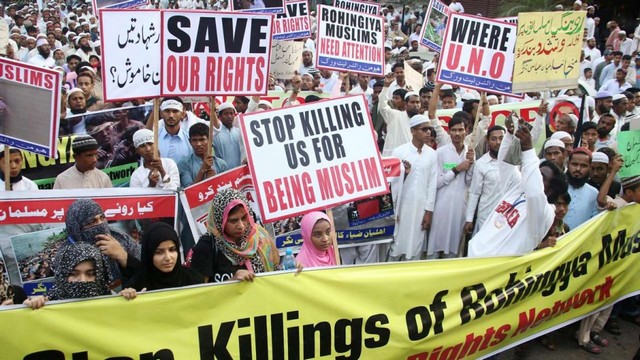
The mass graves in Thailand and Malaysia highlighted the largely-ignored plight of the Rohingyas in Myanmar and Bangladesh that are regularly exploited by human traffickers.
Myanmar’s Rohingyas live predominantly in the western state of Rakhine. They are not officially recognized by the government as citizens and for decades the nation’s Buddhist majority has been accused of subjecting them to discrimination and violence.
Read: Myanmar’s Rohingya conflict ‘more economic than religious’
Viewed by the United Nations and the US as one of the world’s most persecuted minorities, thousands of Rohingya from Myanmar and Bangladesh flee their countries every year in a desperate attempt to reach mainly Muslim Malaysia and Indonesia.
Beyond verdicts

Fortify Rights, a Southeast Asia-based human rights organization, believes it is necessary for the Thai government to carefully examine the entire process in order to avoid similar problems and difficulties in the future trafficking cases.
It also said the Thai investigation was limited and failed to investigate other suspected camps where victims are believed to be buried.
“Thai authorities shouldn’t sweep undiscovered mass graves under the rug of this trial,” Amy Smith, executive director of Fortify Rights, said in a statement.
“We documented a massive operation that trafficked tens of thousands of Rohingya during a three-year period. The loss of life was significantly more than the focus of this trial,” she said.
“We believe the crackdown is only a disruption of a trafficking network but that network is still very much well in place,” said Smith.
Vivian Tan of the UN refugee agency, UNHCR, in Bangkok told DW that since mid-2015, the UN has not recorded any Rohingyas fleeing the region by boats. However, he noted, some 74,000 Rohingyas have fled the country to Bangladesh by road since then.

Source: www.dw.com

Why Can’t the U.S. Left Get Venezuela Right?

By Shamus Cooke

As Venezuela’s fascist-minded oligarchy conspires with U.S. imperialism to overthrow the democratically elected government of Nicolas Maduro, few in the U.S. seem to care.

Instead of denouncing  rightwing violence that aims at regime change, many on the U.S. left have stayed silent, or opted to give an evenhanded analysis that supports neither the Maduro government nor the oligarchy trying to violently overthrow it. Rather, the left prioritizes its energy on lecturing on Maduro’s “authoritarianism” and the failures of “Chavismo.”

This approach allows leftists a cool emotional detachment to the fate of the poor in Venezuela, and clean hands that would otherwise be soiled by engaging with the messy, real life class struggle that is the Venezuelan revolution.

A “pox on both houses” analysis omits the U.S. government’s role in collaborating with Venezuela’s oligarchs. The decades-long crimes of imperialism against Venezuela is aided and abetted by the silence of the left, or by its murky analysis that minimizes the perpetrator’s actions, focusing negative attention on the victim precisely at the moment of attack.

Any analysis of a former colonial country that doesn’t begin with the struggle of self-determination against imperialism is a dead letter, since the x-factor of imperialism has always been a dominant variable in the Venezuelan equation, as books by Eva Gollinger  and others have thoroughly explained, and further demonstrated by the ongoing intervention in Latin America by an endless succession of U.S. presidents.

The Venezuelan-initiated anti-imperialist movement was strong enough that a new gravitational center was created, that pushed most of Latin America out of the grasp of U.S. domination for the first time in nearly a hundred years. This historic achievement remains minimized for much of the U.S. left, who remain indifferent or uneducated about the revolutionary significance of self-determination for oppressed nations abroad, as well as oppressed peoples inside of the U.S.

A thousand valid criticisms can be made of Chavez, but he chose sides in the class fault lines and took bold action at critical junctures. Posters of Chavez remain in the homes of Venezuela’s poorest barrios because he proved in action that he was a champion for the poor, while fighting and winning many pitched battles against the oligarchy who wildly celebrated his death.

And while it’s necessary to deeply critique the Maduro government, the present situation requires the political clarity to take a bold, unqualified stance against the U.S.-backed opposition, rather than a rambling “nonpartisan” analysis that pretends a life or death struggle isn’t currently taking place.

Yes, a growing number of Venezuelans are incredibly frustrated by Maduro, and yes, his policies have exacerbated the current crisis, but while an active counter-revolutionary offensive continues the political priority needs to be aimed squarely against the oligarchy, not Maduro. There remains a mass movement  of revolutionaries in Venezuela dedicated to Chavismo and to defending Maduro’s government against the violent anti-regime tactics, but it’s these labor and community groups that the U.S. left never mentions, as it would pollute their analysis.

The U.S. left seems blissfully unaware of the consequences of the oligarchy stepping into the power vacuum if Maduro was successfully ousted. Such a shoddy analysis can be found in Jacobin’s recent article, Being Honest About Venezuela, which focuses on the problems of Maduro’s government while ignoring the honest reality of the terror the oligarchy would unleashed if it returned to power.

How did the U.S. left get it so wrong?

They’ve allowed themselves to get distracted by the zig-zags at the political surface, rather than the rupturing fault lines of class struggle below. They see only leaders and are blinded to how the masses have engaged with them.

Regardless of Maduro’s many stumbles, it’s the rich who are revolting in Venezuela, and if they’re successful it will be the workers and poor who suffer a terrible fate. An analysis of Venezuela that ignores this basic fact belongs either in the trash bin or in the newspapers of the oligarchy. Confusing class interests, or mistaking counter-revolution for revolution in politics is as disorienting as mistaking up for down, night for day.

The overarching issue remains the same since the Venezuelan revolution erupted in 1989’s Caracazo uprising, which initiated a revolutionary movement of working and poor people spurred to action by IMF austerity measures. How did Venezuela’s oligarchy respond to the 1989 protests? By killing hundreds if not thousands of people. Their return to power would unleash similar if not bloodier statistics.

In Venezuela the revolutionary flame has burned longer than most revolutions, its energy funneled into various channels; from rioting, street demonstrations, land and factory occupations, new political parties and radicalized labor-union federations and into the backbone of support for Hugo Chavez’s project, which, to varying degrees supported and even spearheaded many of these initiatives, encouraging the masses to participate directly in politics.

Chavez’s electoral victory meant — and still means — that the oligarchy lost control of the government and much of the state apparatus, a rare event in the life of a nation under capitalism. This contradiction is central to the confusion of the U.S. left: the ruling class lost control of the state, but the oligarchy retained control of key sectors of the economy, including the media.

But who has control of the state if not the oligarchy? It’s too simplistic to say the “working class” has power, because Maduro has not acted as a consistent leader of the working class, seeming more interested in trying to mediate between classes by making concessions to the oligarchy.  Maduro’s overly-bureaucratic government also limits the amount of direct democracy the working class needs before the term ‘worker state’ can be applied.

But Maduro’s power base remains the same as it was under Chavez: the working and poor people, and to that extent Maduro can be compared to a trade union president who ignores his members in order to seek a deal with the boss.

A trade union, no matter how bureaucratic,  is still rooted in the workplace, its power dependent on dues money and collective action of working people. And even a weak union is better than no union, since removing the protection of the union opens the door to sweeping attacks from the boss that inevitably lower wages, destroy benefits and result in layoffs of the most “outspoken” workers. This is why union members defend their union from corporate attack, even if the leader of the union is in bed with the boss.

History is replete with governments brought forth by revolutionary movements but which failed to take the actions necessary to complete the revolution, resulting in a successful counter-revolution. These revolutionary governments often succeed in breaking the chains of neo-colonialism and allowed for an epoch of social reforms and working class initiative, depending on how long they lasted. Their downfall always results in a counter-revolutionary wave of violence, and sometimes a sea of blood.

This has happened dozens of times across Africa, Asia, and Latin America, where the class divisions are sharper, where imperialism plays a larger role, and where the class dynamics are more variegated: the poor are poorer, there is a larger informal labor force, a larger section of small shopkeepers, larger rural population, etc.

Winning significant reforms under capitalism is incredibly difficult, even in rich countries; it is twice as difficult in former colonial countries, due to the death grip the oligarchy has on the economy plus the collaboration of imperialism, which intervenes in financial markets — or with bullets — to prevent the smallest reforms.

The example of Allende’s Chile could be compared to Maduro’s situation in Venezuela. Allende was far from perfect, but can anybody claim that Pinochet’s coup wasn’t a catastrophe for the Chilean working class? In Venezuela the counter-revolution would likely be more devastating, as the oligarchy would have to push back against decades of progress versus Allende’s short-lived government. If it came to power the street violence of the oligarchy would be given the resources of the state, aimed squarely at the working class and poor.

Maduro is no Chavez, it’s true, but he has kept most of Chavez’s victories intact, maintaining social programs in a time of crashing oil prices while the oligarchy demands “pro-market reforms.” He’s essentially kept the barking dogs of the oligarchy at bay, who, if unleashed, would ravage the working class.

The oligarchy has not accepted the balance of power that Chavez-Maduro have tilted in favor of the working class. A new social contract has not been cemented; it is being actively fought for in the streets. Maduro has made some concessions to the oligarchy it’s true, but they have not been fundamental concessions, while he’s left the fundamental victories of the revolution in tact.

The social contract we call Social Democracy in Europe wasn’t finalized until a wave of revolution struck after WWII. Although Maduro would likely be happy with such a social democratic agreement in Venezuela, such agreements have proven impossible in developing countries, especially at a time while global capitalism is attacking the social democratic reforms in the advanced countries.

The Venezuelan ruling class has no intention of accepting the reforms of Chavez, and why would they so long as U.S. imperialism invests heavily in regime change? A ruling class does not accept power-sharing until they face the prospect of losing everything. And nor should Venezuela’s working class accept a “social contract” under current conditions: they have unmet demands that require revolutionary action against the oligarchy. These contradictory pressures are at the heart of Venezuela’s still-unresolved class war, which inevitably leads either to revolutionary action from the left or a successful counter-revolution from the right.

Thus, for a U.S. leftist to declare that either side is equally bad is either bad politics or class treachery. Many leftists went bonkers over Syriza in Greece, and they were right to be hopeful. But after radical rhetoric Syriza succumbed to the demands of the IMF that included devastating neoliberal reforms of austerity cuts, privatizations and deregulation. Maduro has steadfastly refused such a path out of Venezuela’s economic crisis.

This is why Maduro is despised by the rich while the poor generally continue to support the government, although passively but occasionally in giant bursts, such as the hundreds thousands strong May Day mobilization in support of the government’s fight against the violent coup attempts, which was all but ignored by most western media outlets, since it spoiled the regime-change narrative of “everybody hates Maduro.”

The essential difference between Maduro and Chavez will make or break the revolution: while Chavez took action to constantly shift the balance of power in favor of the poor, Maduro simply attempts to maintain the balance of forces handed down to him by Chavez, hoping for some kind of “agreement” from an opposition that has consistently refused all compromise. His ridiculous naivety is a powerful motivating factor for the opposition, who see a stalled revolution in the way a lion views an injured zebra.

Venezuelan expert Jorge Martin explains in an excellent article, how the oligarchy would respond if it succeeded in removing Maduro.

1) they would massively cut public spending

2) implement mass layoffs of the public sector

3) destroy the key social programs of the revolution (health care, education, pension, housing, etc.)

4) there would be a privatization frenzy of public resources, though especially the crown jewel PDVSA, the oil company

5) massive deregulation, including turning back rights for labor and ethnic-minority groups

6) they would attack the organizations of the working class that came into existence or grew under the protection of the Chavez-Maduro governments.

This is “Telling the Truth” about Venezuela. The U.S. left should know better, since the ruling class exposed what it would do during the Caracazo Uprising, and later when they briefly came to power in their 2002 coup: they aim to reverse everything, using any means necessary. The documentary “The Revolution Will Not Be Televised” is still required watching about the 2002 coup.

Maduro may have finally learned his lesson: Venezuela’s crisis has forced him to double down on promoting the interests of the poor.  When oil prices collapsed it was inevitable the government would enter a deep crisis, it had only two choices: deep neoliberal reforms or the deepening of the revolution. This will be the litmus test for Maduro, since the middle ground he sought disappeared.

Rather than begging for money from the International Monetary Fund —which would have demanded such Syriza-like reforms — Maduro instead encouraged workers to takeover idle factories while a General Motors factory was nationalized. A new neighborhood-based organization, CLAP, was created that distributes basic foodstuffs at subsidized prices that benefits millions of people.

On May Day this year, in front of hundreds of thousands of supporters, Maduro announced a Constituent Assembly, an attempt to re-engage the masses in the hopes of pushing forward the revolution by creating a new, more progressive constitution.

It’s true that Maduro is using the Constituent Assembly to overcome the obstruction of the oligarchy-dominated National Assembly — whose stated intention is to topple the government — but the U.S. left seems indifferent that Maduro is using the mobilization of the working class (the Constituent Assembly) to overcome the barriers of ruling class.

This distinction is critical: if the Constituent Assembly succeeds in pushing forward the revolution by directly engaging the masses, it will come at the expense of the oligarchy. The Constituent Assembly is being organized to promote more direct democracy, but sections of the U.S. left have been taken in by the U.S. media’s allegations of “authoritarianism.”

If working and poor people actively engage in the process of creating a new, more progressive constitution and this constitution is approved via referendum by a large majority, it will constitute an essential step forward for the revolution. If the masses are unengaged or the referendum fails, it may signify the death knell of Chavismo and the return of the oligarchy.

And while Maduro is right to use the state as a repressive agent against the oligarchy, an over reliance on the state repression only leads to more contradictions, rather than relying on the self-activity of the workers and poor. Revolutions cannot be won by administrative tinkering, but rather by revolutionary measures consciously implemented by the vast majority. At bottom it’s the actions of ordinary working people that make or break a revolution; if the masses are lulled to sleep the revolution is lost. They must be unleashed not ignored.

It’s clear that Maduro’s politics have not been capable of leading the revolution to success, and therefore his government requires deep criticism combined with organized protest. But there are two kinds of protest: legitimate protest that arises from the needs of working and poor people, and the counter-revolutionary protest based in the neighborhoods of the rich that aim to restore the power of the oligarchy.

Confusing these two kinds of protests are dangerous, but the U.S. left has done precisely this. Maduro is accused of being authoritarian for using police to stop the far-right’s violent “student protests” that seek to restore the oligarchy. Of the many reasons to criticize Maduro this isn’t one of them.

If a rightwing coup succeeds in Venezuela tomorrow, the U.S. left will weep by the carnage that ensues, while not recognizing that their inaction contributed to the bloodshed. By living in the heart of imperialism the U.S. left has a duty to go beyond critiques from afar to direct action at home.

Protesting the Vietnam war helped save the lives of Vietnamese, while the organizing in the 1980’s against the “dirty wars” in Central America limited the destruction levied by the U.S.-backed governments. In both cases the left fell short of what was needed, but at least they understood what was at stake and took action. Now consider the U.S. left of 2017, who can’t lift a finger to re-start the antiwar movement and who supported Bernie Sanders regardless of his longstanding affection for imperialism.    .

The “pink tide” that blasted imperialism out of much of Latin America is being reversed, but Venezuela has always been the motor-force of the leftward shift, and the bloodshed required to reverse the revolution will be remembered forever, if it’s allowed to happen. Their lives matter too.

Shamus Cooke is a social service worker, trade unionist, and writer for Workers Action (www.workerscompass.org).

13 July 2017

Understanding Iranian threat perceptions

By Seyed Hossein Mousavian

A pervasive perception in US policy circles and among US allies is that Iran seeks hegemony in the Middle East. Israel and other regional states often claim that Iran wishes to “revive the Persian Empire.” While such claims would be dismissed as farcical by any Iranian official, it is important to note that such sentiment lies at the root of the current standoff between Iran, its regional rivals and the United States.

Contrary to mantras such as the above, Iranians broadly view their contemporary history as one of falling victim to aggressive outside powers and struggling to maintain a sense of security. Since the 1979 Islamic Revolution, a series of events and factors have led Tehran to believe that Washington and its regional allies seek regime change and Iran’s territorial dismemberment. This perception is fueled by comments such as that of US Defense Secretary James Mattis earlier this week, who said that regime change will be necessary before the US and Iran can have substantially positive relations.

Broadly speaking, six factors have shaped Iran’s threat perceptions since 1979.

First are the challenges of the 1980s, namely the Iran-Iraq War and separatist rebellions in Iran’s Kurdistan and Khuzestan provinces, which claimed hundreds of thousands of lives and caused hundreds of billions of dollars in damages. The United States and allied Persian Gulf littoral states played a decisive role in exacerbating these crises, including by buttressing separatists and providing Saddam Hussein with every means of support, including ballistic missiles and chemical weapons, which were used to deadly effect. Toward the end of the war, the United States also directly attacked Iranian oil platforms and even shot down an Iranian civilian airliner.

Second, Iran has faced a military buildup on its borders since the Islamic Revolution. Iran is not only ringed by US military bases, but US-made weapons regularly flow into the region — especially the Persian Gulf. Under Barack Obama, the United States sold Saudi Arabia roughly $115 billion worth of weapons, which is more than any previous administration. Donald Trump is poised to outdo his predecessor. Yet Iran spends one-fifth of what Saudi Arabia spends on defense — despite having twice the population. Even the United Arab Emirates, with a native population of 1.4 million, has double the military spending of Iran.

The third factor is the unparalleled sanctions Iran has been subject to since 1979. Even as Iran is carefully abiding by the historic July 2015 nuclear deal, Congress is pushing through a set of sanctions. Such sanctions have long been promoted by Israel and Saudi Arabia, who wish to cripple Iran’s economy.

Fourth comes covert warfare in the form of cyberattacks, assassinations and the propping up of terrorist organizations like the notorious Mujahedeen-e-Khalq. Such tactics are set to be stepped up with the recent creation of a special CIA unit focused on Iran under the leadership of the ultra-aggressive Michael D’Andrea. Indeed, every US administration has since 1979 pursued an “all options on the table” policy against Iran.

The fifth factor involves Saudi Arabia’s confrontational stance toward the Islamic Republic while apparently establishing a strategic relationship with Israel. As part of the goodwill foreign policy of the late Iranian President Akbar Hashemi Rafsanjani, Iran and Saudi Arabia reached a diplomatic detente, negotiated by myself and then-Crown Prince Abdullah bin Abdulaziz, which resulted in good relations from 1996 onwards. Around the same time, then-Supreme National Security Council Secretary Hassan Rouhani and then-Saudi Interior Minister Mohammed bin Nayef also reached a landmark security pact. However, over the course of President Mahmoud Ahmadinejad’s tenure (2005-2013), Saudi Arabia drifted away from these agreements, as the international environment became conducive for pressuring Iran and even provoking a war. Former US Defense Secretary Robert Gates proclaimed in 2010 how the Saudis always want to “fight the Iranians to the last American” while former Secretary of State John Kerry has also stated that regional countries called on Obama to “bomb these guys.”

Sixth, Iran faces serious threats on its borders, whether from terrorist organizations or Afghanistan, Iraq and Syria or a fragile nuclear-weapons state like Pakistan. As one Iranian military official has said, roughly 60% of Iran’s borders are “not controlled by the neighboring country.”

These realities have compelled Iran to establish a proactive and pre-emptive presence in the region to secure its borders, sovereignty and integrity. To these ends, Iran’s foreign policy goals center on warding off threats, fostering regional stability and improving self-sufficiency in establishing conventional military deterrence, including its ballistic missile capability.

At its root, the underlying reason behind misconstrued perceptions of Iran’s foreign policy intentions is the lack of dialogue between regional powers. As things stand, there are no fora for regional powers to communicate their concerns and grievances to one another. Instead, rival states resort to self-serving narratives to gain influence in the realm of public opinion.

Regional stability and the eradication of terrorism rest on understanding and collective cooperation between regional and global powers. With reference to the fight against terrorism, contrary to the common framing of a “nefarious” Iranian pursuit of hegemony, Tehran in fact played an instrumental role in ousting the Islamic State (IS) from Fallujah, Mosul, Aleppo and other key areas across Iraq and Syria.

Top Iraqi officials have stressed how Baghdad may have fallen to IS if not for Iranian assistance. Iraqi Kurdistan President Massoud Barzani has also stated that “Iran was the first country to provide us with weapons and ammunition” as Erbil was on the verge of collapse.

While the Trump administration’s regional policy appears to be centered on military intervention, no regional crisis can be durably resolved without inclusive diplomacy. In that respect, it should be noted that the negotiations that resulted in the nuclear deal provide a useful model for multilateral diplomacy to resolve a seemingly intractable crisis, demonstrating the impact that external great powers can have in terms of facilitating confliction resolution in the region.

The Trump administration should take to heart the words of a group of top retired US generals and admirals, who emphasized in a recent open letter that “without diplomatic connections, minor conflicts can easily spiral out of control.” Indeed, rather than stepping up military intervention, demonizing Iran or undermining the nuclear deal, Mattis and Secretary of State Rex Tillerson should pursue robust diplomatic engagement with all relevant parties to resolve regional crises and perhaps more importantly, help foster the creation of a system for institutionalized regional cooperation.

Seyed Hossein Mousavian is a Middle East security and nuclear policy specialist at Princeton University and a former spokesman for Iran’s nuclear negotiators.

14 July 2017