Just International

Taung Pyo on edge as army backed Rakhine gang on patrol with sharp weapons

By myanmarobserver.com

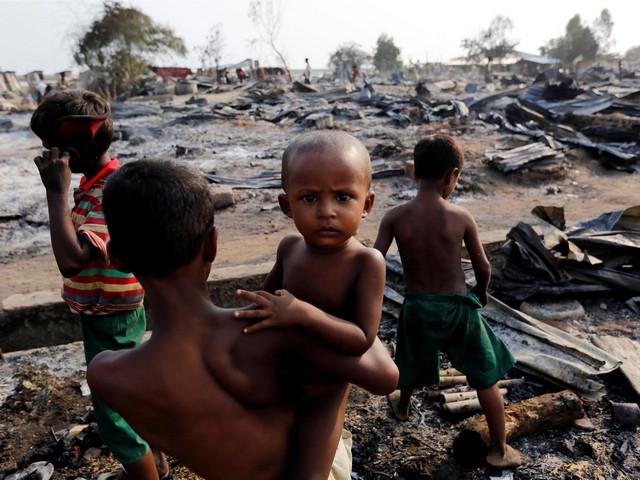
Maungdaw- A Rakhine gang accompanied by the army and BGP have been patrolling around the village of Taung Pyo in Northern Maungdaw since the dawn hours of Tuesday, according to our correspondent in the area.

The gang is carrying sharp weapons including machetes and other tools that have traditionally been used by Buddhist nationalist forces. They are being well protected by a huge army and BGP detachment.

Their activities have led to terror among the local populace who are fearing a massacre in the tensed locality.

Tensions have reached a high since an army backed gang attacked the nearby village tract of Kya Maung following Eid prayers, leading to possible fatalities.

There are rumours that Buddhist nationalists and the Tatmadaw are planning a 2012 style massacre.

28 June 2017

Globe-Trotting U.S. Special Ops Forces Already Deployed To 137 Nations In 2017

By Nick Turse

The tabs on their shoulders read “Special Forces,” “Ranger,” “Airborne.” And soon their guidon — the “colors” of Company B, 3rd Battalion of the U.S. Army’s 7th Special Forces Group — would be adorned with the “Bandera de Guerra,” a Colombian combat decoration.

“Today we commemorate sixteen years of a permanent fight against drugs in a ceremony where all Colombians can recognize the special counternarcotic brigade’s hard work against drug trafficking,” said Army Colonel Walther Jimenez, the commander of the Colombian military’s Special Anti-Drug Brigade, last December.  America’s most elite troops, the Special Operations forces (SOF), have worked with that Colombian unit since its creation in December 2000.  Since 2014, four teams of Special Forces soldiers have intensely monitored the brigade.  Now, they were being honored for it.

Part of a $10 billion counter-narcotics and counterterrorism program, conceived in the 1990s, special ops efforts in Colombia are a muchballyhooed American success story.  A 2015 RAND Corporation study foundthat the program “represents an enduring SOF partnership effort that managed to help foster a relatively professional and capable special operations force.”  And for a time, coca production in that country plummeted.  Indeed, this was the ultimate promise of America’s “Plan Colombia” and efforts that followed from it.  “Over the longer haul, we can expect to see more effective drug eradication and increased interdiction of illicit drug shipments,” President Bill Clinton predicted in January 2000.

Today, however, more than 460,000 acres of the Colombian countryside are blanketed with coca plants, more than during the 1980s heyday of the infamous cocaine kingpin Pablo Escobar.  U.S. cocaine overdose deaths are also at a 10-year high and first-time cocaine use among young adults has spiked 61% since 2013.  “Recent findings suggest that cocaine use may be reemerging as a public health concern in the United States,” wrote researchers from the U.S. Substance Abuse and Mental Health Services Administration in a study published in December 2016 — just after the Green Berets attended that ceremony in Colombia.  Cocaine, the study’s authors write, “may be making a comeback.”

Colombia is hardly an anomaly when it comes to U.S. special ops deployments — or the results that flow from them.  For all their abilities, tactical skills, training prowess, and battlefield accomplishments, the capacity of U.S. Special Operations forces to achieve decisive and enduring successes — strategic victories that serve U.S. national interests — have proved to be exceptionally limited, a reality laid bare from Afghanistan to Iraq, Yemen to the Philippines.

The fault for this lies not with the troops themselves, but with a political and military establishment that often appears bereft of strategic vision and hasn’t won a major war since the 1940s.  Into this breach, elite U.S. forces are deployed again and again. While special ops commanders may raise concerns about the tempo of operations and strains on the force, they have failed to grapple with larger questions about the raison d’être of SOF, while Washington’s oversight establishment, notably the House and Senate Armed Services Committees, have consistently failed to so much as ask hard questions about the strategic utility of America’s Special Operations forces.

Special Ops at War

“We operate and fight in every corner of the world,” boasts General Raymond Thomas, the chief of U.S. Special Operations Command (USSOCOM or SOCOM).  “On a daily basis, we sustain a deployed or forward stationed force of approximately 8,000 across 80-plus countries.  They are conducting the entire range of SOF missions in both combat and non-combat situations.”  Those numbers, however, only hint at the true size and scope of this global special ops effort.  Last year, America’s most elite forces conducted missions in 138 countries — roughly 70% of the nations on the planet, according to figures supplied to TomDispatch by U.S. Special Operations Command.  Halfway through 2017, U.S. commandos have already been deployed to an astonishing 137 countries, according to SOCOM spokesman Ken McGraw.

Special Operations Command is tasked with carrying out 12 core missions, ranging from counterinsurgency and unconventional warfare to hostage rescue and countering the proliferation of weapons of mass destruction.  Counterterrorism — fighting what the command calls violent extremist organizations (VEOs) — may, however, be what America’s elite forces have become best known for in the post-9/11 era.  “The threat posed by VEOs remains the highest priority for USSOCOM in both focus and effort,” saysThomas.

“Special Operations Forces are the main effort, or major supporting effort for U.S. VEO-focused operations in Afghanistan, Syria, Iraq, Yemen, Somalia, Libya, across the Sahel of Africa, the Philippines, and Central/South America — essentially, everywhere Al Qaeda (AQ) and the Islamic State of Iraq and Syria (ISIS) are to be found…”

More special operators are deployed to the Middle East than to any other region.  Significant numbers of them are advising Iraqi government forces and Iraqi Kurdish soldiers as well as Kurdish YPG (Popular Protection Unit) fighters and various ethnic Arab forces in Syria, according to Linda Robinson, a senior international policy analyst with the RAND Corporation who spent seven weeks in Iraq, Syria, and neighboring countries earlier this year.

During a visit to Qayyarah, Iraq — a staging area for the campaign to free Mosul, formerly Iraq’s second largest city, from the control of Islamic State fighters — Robinson “saw a recently installed U.S. military medical unit and its ICU set up in tents on the base.”  In a type of mission seldom reported on, special ops surgeons, nurses, and other specialists put their skills to work on far-flung battlefields not only to save American lives, but to prop up allied proxy forces that have limited medical capabilities.  For example, an Air Force Special Operations Surgical Team recently spent eight weeks deployed at an undisclosed location in the Iraq-Syria theater, treating 750 war-injured patients.  Operating out of an abandoned one-story home within earshot of a battlefield, the specially trained airmen worked through a total of 19 mass casualty incidents and more than 400 individual gunshot or blast injuries.

When not saving lives in Iraq and Syria, elite U.S. forces are frequently involved in efforts to take them.  “U.S. SOF are… being thrust into a new role of coordinating fire support,” wrote Robinson. “This fire support is even more important to the Syrian Democratic Forces, a far more lightly armed irregular force which constitutes the major ground force fighting ISIS in Syria.”  In fact, a video shot earlier this year, analyzed by the Washington Post, shows special operators “acting as an observation element for what appears to be U.S. airstrikes carried out by A-10 ground attack aircraft” to support Syrian Democratic Forces fighting for the town of Shadadi.

Africa now ranks second when it comes to the deployment of special operators thanks to the exponential growth in missions there in recent years.  Just 3% of U.S. commandos deployed overseas were sent to Africa in 2010.  Now that number stands at more than 17%, according to SOCOM data.  Last year, U.S. Special Operations forces were deployed to 32 African nations, about 60% of the countries on the continent.  As I recently reported at VICE News, at any given time, Navy SEALs, Green Berets, and other special operators are now conducting nearly 100 missions across 20 African countries.

In May, for instance, Navy SEALs were engaged in an “advise and assist operation” alongside members of Somalia’s army and came under attack.  SEAL Kyle Milliken was killed and two other U.S. personnel were injured during a firefight that also, according to AFRICOM spokesperson Robyn Mack, left three al-Shabaab militants dead.  U.S. forces are also deployed in Libya to gather intelligence in order to carry out strikes of opportunity against Islamic State forces there.  While operations in Central Africa against the Lord’s Resistance Army (LRA), a brutal militia that has terrorized the region for decades, wound down recently, a U.S. commando reportedly killed a member of the LRA as recently as April.

Spring Training

What General Thomas calls “building partner nations’ capacity” forms the backbone of the global activities of his command.  Day in, day out, America’s most elite troops carry out such training missions to sharpen their skills and those of their allies and of proxy forces across the planet.

This January, for example, Green Berets and Japanese paratroopers carried out airborne training near Chiba, Japan.  February saw Green Berets at Sanaa Training Center in northwest Syria advising recruits for the Manbij Military Council, a female fighting force of Kurds, Arabs, Christians, Turkmen, and Yazidis.  In March, snowmobiling Green Berets joined local forces for cold-weather military drills in Lapland, Finland.  That same month, special operators and more than 3,000 troops from Canada, the Czech Republic, Estonia, Finland, France, Germany, Hungary, Italy, Kosovo, Latvia, Macedonia, the Netherlands, Slovenia, and the United Kingdom took part in tactical training in Germany.

In the waters off Kuwait, special operators joined elite forces from the Gulf Cooperation Council nations in conducting drills simulating a rapid response to the hijacking of an oil tanker.  In April, special ops troops traveled to Serbia to train alongside a local special anti-terrorist unit.  In May, members of Combined Joint Special Operations Task Force-Iraq carried out training exercises with Iraqi special operations forces near Baghdad. That same month, 7,200 military personnel, including U.S. Air Force Special Tactics airmen, Italian special operations forces, members of host nation Jordan’s Special Task Force, and troops from more than a dozen other nations took part in Exercise Eager Lion, practicing everything from assaulting compounds to cyber-defense.  For their part, a group of SEALs conducted dive training alongside Greek special operations forces in Souda Bay, Greece, while others joined NATO troops in Germany as part of Exercise Saber Junction 17 for training in land operations, including mock “behind enemy lines missions” in a “simulated European village.”

#Winning

“We have been at the forefront of national security operations for the past three decades, to include continuous combat over the past 15-and-a-half years,” SOCOM’s Thomas told the House Armed Services Subcommittee on Emerging Threats and Capabilities last month.  “This historic period has been the backdrop for some of our greatest successes, as well as the source of our greatest challenge, which is the sustained readiness of this magnificent force.”  Yet, for all their magnificence and all those successes, for all the celebratory ceremonies they’ve attended, the wars, interventions, and other actions for which they’ve served as the tip of the American spear have largely foundered, floundered, or failed.

After their initial tactical successes in Afghanistan in the wake of the 9/11 attacks, America’s elite operators became victims of Washington’s failure to declare victory and go home.  As a result, for the last 15 years, U.S. commandos have been raiding homes, calling in air strikes, training local forces, and waging a relentless battle against a growing list of terror groups in that country.  For all their efforts, as well as those of their conventional military brethren and local Afghan allies, the war is now, according to the top U.S. commander in the Middle East, a “stalemate.”  That’s a polite way of saying what a recent report to Congress by the Special Inspector General for Afghanistan Reconstruction found: districts that are contested or under “insurgent control or influence” have risen from an already remarkable 28% in 2015 to 40%.

The war in Afghanistan began with efforts to capture or kill al-Qaeda leader Osama bin Laden.  Having failed in this post-9/11 mission, America’s elite forces spun their wheels for the next decade when it came to his fate.  Finally, in 2011, Navy SEALs cornered him in his long-time home in Pakistan and gunned him down.  Ever since, special operators who carried out the mission and Washington power-players (not to mention Hollywood) have been touting this single tactical success.

In an Esquire interview, Robert O’Neill, the SEAL who put two bullets in bin Laden’s head, confessed that he joined the Navy due to frustration over an early crush, a puppy-love pique.  “That’s the reason al-Qaeda has been decimated,” he joked, “because she broke my fucking heart.”  But al-Qaeda was not decimated — far from it according to Ali Soufan, a former F.B.I. special agent and the author of Anatomy of Terror: From the Death of Bin Laden to the Rise of the Islamic State.  As he recently observed, “Whereas on 9/11 al-Qaeda had a few hundred members, almost all of them based in a single country, today it enjoys multiple safe havens across the world.”  In fact, he points out, the terror group has gained strength since bin Laden’s death.

Year after year, U.S. special operators find themselves fighting new waves of militants across multiple continents, including entire terror groups that didn’t exist on 9/11.  All U.S. forces killed in Afghanistan in 2017 have reportedly died battling an Islamic State franchise, which began operations there just two years ago.

The U.S. invasion of Iraq, to take another example, led to the meteoric rise of an al-Qaeda affiliate which, in turn, led the military’s secretive Joint Special Operations Command (JSOC) — the elite of America’s special ops elite — to create a veritable manhunting machine designed to kill its leader Abu Musab al-Zarqawi and take down the organization.  As with bin Laden, special operators finally did find and eliminate Zarqawi, battering his organization in the process, but it was never wiped out.  Left behind were battle-hardened elements that later formed the Islamic State and did what al-Qaeda never could: take and hold huge swaths of territory in two nations.  Meanwhile, al-Qaeda’s Syrian branch grew into a separate force of more than 20,000.

In Yemen, after more than a decade of low-profile special ops engagement, that country teeters on the brink of collapse in the face of a U.S.-backed Saudi war there.  Continued U.S. special ops missions in that country, recently on the rise, have seemingly done nothing to alter the situation.  Similarly, in Somalia in the Horn of Africa, America’s elite forces remain embroiled in an endless war against militants.

In 2011, President Obama launched Operation Observant Compass, sending Special Operations forces to aid Central African proxies in an effort to capture or kill Joseph Kony and decimate his murderous Lord’s Resistance Army (LRA), then estimated to number 150 to 300 armed fighters.  After the better part of a decade and nearly $800 million spent, 150 U.S. commandos were withdrawn this spring and U.S. officials attended a ceremony to commemorate the end of the mission.  Kony was, however, never captured or killed and the LRA is now estimated to number about 150 to 250 fighters, essentially the same size as when the operation began.

This string of futility extends to Asia as well.  “U.S. Special Forces have been providing support and assistance in the southern Philippines for many years, at the request of several different Filipino administrations,” Emma Nagy, a spokesperson for the U.S. embassy in Manilla, pointed out earlier this month.  Indeed, a decade-plus-long special ops effort there has been hailed as a major success.  Operation Enduring Freedom-Philippines, wrote RAND analyst Linda Robinson late last year in the Pentagon journal Prism, “was aimed at enabling the Philippine security forces to combat transnational terrorist groups in the restive southern region of Mindanao.”

A 2016 RAND report co-authored by Robinson concluded that “the activities of the U.S. SOF enabled the Philippine government to substantially reduce the transnational terrorist threat in the southern Philippines.” This May, however, Islamist militants overran Marawi City, a major urban center on Mindanao.  They have been holding on to parts of it for weeks despite a determined assault by Filipino troops backed by U.S. Special Operations forces.  In the process, large swaths of the city have been reduced to rubble.

Running on Empty

America’s elite forces, General Thomas told members of Congress last month, “are fully committed to winning the current and future fights.”  In reality, though, from war to war, intervention to intervention, from the Anti-Drug Brigade ceremony in Florencia, Colombia, to the end-of-the-Kony-hunt observance in Obo in the Central African Republic, there is remarkably little evidence that even enduring efforts by Special Operations forces result in strategic victories or improved national security outcomes.  And yet, despite such boots-on-the-ground realities, America’s special ops forces and their missions only grow.

“We are… grateful for the support of Congress for the required resourcing that, in turn, has produced a SOCOM which is relevant to all the current and enduring threats facing the nation,” Thomas told the Senate Armed Services Committee in May.  Resourcing has, indeed, been readily available.  SOCOM’s annual budget has jumped from $3 billion in 2001 to more than $10 billion today.  Oversight, however, has been seriously lacking.  Not a single member of the House or Senate Armed Services Committees has questioned why, after more than 15 years of constant warfare, winning the “current fight” has proven so elusive.  None of them has suggested that “support” from Congress ought to be reconsidered in the face of setbacks from Afghanistan to Iraq, Colombia to Central Africa, Yemen to the southern Philippines.

In the waning days of George W. Bush’s administration, Special Operations forces were reportedly deployed to about 60 nations around the world.  By 2011, under President Barack Obama, that number had swelled to 120.  During this first half-year of the Trump administration, U.S. commandos have already been sent to 137 countries, with elite troops now enmeshed in conflicts from Africa to Asia.  “Most SOF units are employed to their sustainable limit,” Thomas told members of the House Armed Services Committee last month.  In fact, current and former members of the command have, for some time, been sounding the alarm about the level of strain on the force.

These deployment levels and a lack of meaningful strategic results from them have not, however, led Washington to raise fundamental questions about the ways the U.S. employs its elite forces, much less about SOCOM’s raison d’être.  “We are a command at war and will remain so for the foreseeable future,” SOCOM’s Thomas explained to the Senate Armed Services Committee.  Not one member asked why or to what end.

Nick Turse is the managing editor of TomDispatch, a fellow at the Nation Institute, and a contributing writer for the Intercept.

26 June 2017

House of Saudi Cards: The Inside Story

By Pepe Escobar

24 Jun 2017 – Considering the impenetrability of that desert petrodollar family oligarchy impersonating a nation it’s up to a few foreigners granted access to make sense of the latest Arabian Game of Thrones. It also does not help that the “largesse” of Saudi – and Emirati – lobbies in Washington reduces virtually every think tank and hack in sight to abject sycophancy.

A top Middle East source close to the House of Saud, and a de facto dissident of the Beltway consensus, minces no words; “The CIA is very displeased with the firing of [former Crown Prince] Mohammad bin Nayef. Mohammad bin Salman is regarded as sponsoring terrorism. In April 2014 the entire royal families of the UAE and Saudi Arabia were to be ousted by the US over terrorism.  A compromise was worked out that Nayef would take over running the Kingdom to stop it.”

Before the Riyadh coup, an insistent narrative had been pervading selected Middle East geopolitical circles according to which US intel, “indirectly”, stopped another coup against the young Emir of Qatar, Sheikh Tamim al-Thani, orchestrated by Mohammad bin Zayed, Crown Prince of Abu Dhabi, with help from Blackwater/Academi’s Eric Prince’s army of mercenaries in the UAE. Zayed, crucially, happens to be MBS’s mentor.

Our source clarifies, “the events are connected. Prince is CIA, but he probably stopped any coup attempt on Qatar. The CIA blocked the coup in Qatar and the Saudis reacted by dumping the CIA selected Mohammed bin Nayef, who was to be the next King. The Saudis are scared. The monarchy is in trouble as the CIA can move the army in Saudi Arabia against the king. This was a defensive move by MBS.”

The source adds, “MBS is failing everywhere. Yemen, Syria, Qatar, Iraq, etc. are all failures of MBS. China is also displeased with MBS as he has been stirring up trouble in Xinjiang. Russia cannot be happy that MBS was and is behind the lower oil price. Who are his allies?  He has only one and that is his father, who is hardly competent.” King Salman is virtually incapacitated by dementia.

The source is adamant that, “it is very possible the CIA will move against the monarchy in Saudi Arabia.” That would qualify as the war between President Trump and selected sectors of the US deep state reaching a whole new level.

And to add to the charade, there’s the Jared of Arabia factor. There’s no way any serious inside player would confirm anything about the (aborted) coup in Qatar. But if that coup attempt really happened, and was squashed, Jared Kushner may have had inside information, considering his connections.

According to the source, “Jared Kushner is essentially bankrupt at 666 Fifth Avenue, and needs Saudi financial help. So he is doing everything the Saudis want. 666 Fifth is in such bad financial shape that even his father-in-law cannot bail him out.”

Operation Desert Hubris

This convoluted trail of events does corroborate the famous December 2015 memo by the BND – German intelligence, according to which the House of Saud had adopted “an impulsive policy of intervention”, with then Defense Minister and Deputy Crown Prince MBS, a “gambler”, bound to cause a lot of trouble.

The BND memo detailed how the House of Saud, in Syria, bankrolled the creation of the Army of Conquest – basically a revamp of Jabhat al-Nusra, a.k.a. al-Qaeda in Syria — as well as ideological sister outfit Ahrar al-Sham. Translation; the House of Saud aiding, abetting and weaponizing Salafi-jihadi terrorism. And this from a regime that now charges Qatar of doing the same (Doha supported different outfits).

In Yemen, the BND worried that MBS’s war against the Houthis and the Yemeni Army was only profiting al-Qaeda in the Arabian Peninsula (AQAP). Now MBS’s war – conducted with American and British weapons — has also provoked a horrendous humanitarian catastrophe.

How come an arrogant, sloppy, hubristic ignoramus like MBS has come so close to set the whole of Southwest Asia on fire? And not only Southwest Asia; waves of despair are flowing in Western investment circles to the effect that MBS is such a loose cannon his actions will destroy retirement accounts all over the spectrum.

Some essential background is in order. What we have today is the Third Saudi kingdom — founded by Ibn Saud in 1902, keeping the same, previous noxious alliance with troglodyte Wahhabi clerics. Ibn Saud only ruled Najd in the beginning; then, in 1913, he annexed Shi’ite Eastern Arabia (that’s where the oil is), and up to 1926 Hejaz, on the Red Sea coast. A “united” Kingdom of Saudi Arabia was proclaimed only in 1932.

Ibn Saudi died in 1953. Arguably the most influential of his harem of wives was Hassa al-Sudairi. They had 7 sons together. (Demented) King Salman, Nayef and MBS are all Sudairis. MBS is the first of Ibn Saud’s grandsons within striking reach of the throne.

Quite a few other princes are more competent that MBS. Nayef, who spent a long time in the Interior Ministry, was the Saudi counterterrorism czar (thus being a CIA darling). There’s Mitab bin Abdullah, minister of the Saudi Arabian National Guard; notorious Prince Turki, former intel chief, former ambassador to the US, and former best pal of Osama bin Laden; and Khaled bin Faisal, governor of Mecca and former education minister.

MBS is betting everything on his Vision 2030 – which in theory might propel the Saudi economy beyond oil monoculture, but implies a virtually impossible political aggiornamento; after all the House of Saudi Cards is un-reformable. Take the risible list of 13 demands now imposed on Qatar – that’s MBS’s work – including the bellicose virtual  excommunication of Iran and shutting down al-Jazeera.

No wonder every major geopolitical player is now gaming war scenarios – although only Germany stated its concerns on the record. Qatar is a NATO observer. Doha is adamant; it won’t fold to the absurd Saudi demands. What next; will MBS – the most dangerous “leader” in geopolitics today – lose face or launch yet another, demented, unwinnable and this time globally-convulsing war?

Pepe Escobar is a Brazilian independent geopolitical analyst.

26 June 2017

Jewish Ethnicity, Palestinian Solidarity, Human Identity

By Richard Falk

23 Jun 2017 – The following interview with Abdo Emara, an Arab journalist was published in Arabic; it is here republished in slightly modified form. The changes made are either stylistic or clarifying. There are no substantive changes from my earlier responses. I think it worthwhile to share this text because the questions asked by Abdo Emara are often directed at me in the discussion period after talks I have given recently.
*
Many believe that all Jews are completely biased in favor of Israel. Since you are Jewish this raises some questions. Why have you supported the grievances of the Palestinians? And why does not Israel welcome you on its territory since you are a Jew?

It is a rather well kept secret that from the very outset of the Zionist movement there were many Jews, including some who were prominent in their countries who opposed or strongly criticized Zionist ideology, as well as the way Israel was established and subsequently developed. After 1948, and even more so, after 1967, Israeli supporters, strongly encouraged by Zionist leaders and Israeli diplomats, have increasingly claimed that the Israeli government speaks for all Jews regardless of whether or not they reside in Israel. If this claim of universal representation is denied or resisted that person will be identified by Zionists/Israelis either as an anti-Semite or as bad, a self-hating Jew, or some combination of the two. I have increasingly supported the grievances of the Palestinian people from two perspectives, in my capacity as an international law specialist and as a human being opposed to the oppression and suffering of others regardless of whether or not I share the ethnic and religious background of such victims of abuse. I have taken these positions without any feelings of hatred toward Jews or alienation from the Jewish people, or toward any people due to their ethnicity or brand of faith. My understanding of identity is much more bound up with common humanity and action in solidarity with victims of abuse than with worrying about whether or not they happen to be Jewish. I have drawn wisdom and insight from Jewish traditions, especially by heeding Old Testament biblical prophets, but as well from contact with the great texts of Buddhism, Christianity, and Islam. At the same time I am appalled by some passages in the OT that appear to counsel and even celebrate genocidal onslaughts against the ancient enemies of the Jewish people.

How is the pretext of anti-Semitism used to silence critical voices in Israel and throughout the Western world? And what are the most influential institutions that try to silence and discredit academic voices that reject Israel’s repressive policies?

With the support of Israeli lobbying groups and ultra Zionist pressure groups and activists, there is a concerted campaign in Europe and North America to defame critics of Israel by calling them ‘anti-Semites.’ Especially since the Nazi genocide, to be called an anti-Semite whether or not there is any responsible basis for such accusations has become one of the most effective ways to discredit and distract. Even when accusations do not silence a critic, as in my case, they have detrimental and hurtful effects. Above all, they shift the conversation from the validity of the message to the credibility of the messenger. In the Israel/Palestine context this takes attention away from the ordeal experience by the Palestinian people on a daily basis. Thus, allegations of anti-Semitism function as both sword (to wound the messenger) and shield (to deflect and inhibit criticism and opposition).

How do you interpret the Egyptian policies toward Gaza since the Sisi coup? How can these policies be changed? What is their legal status?

I interpret Egyptian policies toward Gaza since the Sisi coup of 2013 as primarily an expression of renewed collaboration with Israel with respect to Gaza as intensified by the Cairo view that Hamas is inspired by and affiliated with the Muslim Brotherhood, which is enemy number one of the current Egyptian government. I am not familiar with the details of the Egyptian policy toward Gaza, although I know it imposes arbitrary and hurtful restrictions on entry and exit. Egyptian policies toward Gaza seem clearly to involve complicity with Israel’s worst abuses in Gaza, and entail potential criminal responsibility for Egyptian leaders and implementing officials. Israel seems clearly guilty of inflicting collective punishment on the civilian population of Gaza and for aiding and abetting the implementation of the unlawful blockade of Gaza that has been maintained by the state of Israel since 2007 with many cruel consequences for the Palestinians, including those needing to leave Gaza for lifesaving medical treatments.

How do you evaluate Hamas’ new policy document?

I believe the Hamas document moves toward the adoption of a political approach to its relations with both Israel and Egypt. By a political approach I mean a willingness to establish long-term interim arrangements for peaceful coexistence with Israel and normalization with Egypt. Hamas expresses this willingness by indicating a readiness to allow the establishment of a Palestinian state on territory occupied by Israel since the end of the 1967 War. Such a shift by Hamas does not acknowledge the legitimacy of Israel as a state nor does it involve a repudiation of the 1988 Hamas Charter, although it does abandon the anti-Semitic rhetoric and seems more disposed to pursue its goals diplomatically and politically rather than by reliance on armed struggle, without giving up in any way rights of resistance, including armed resistance.

Did it became impossible for Palestinians to obtain their legitimate rights throughout international organizations in the light of the latest UN refusal of UN ESCWA report your good-self drafted?

The reaction to our ESCWA report, “The Practices of Israel Toward the Palestinian People and the Question of Apartheid,” did reveal a lack of independence and objectivity within the UN when placed under severe geopolitical pressure by the United States Government. It seemed clear that when the UN Secretary General ordered ESCWA to remove our report from their website, he was succumbing to pressure exerted by the United States, whose ambassador to the UN denounced the report without giving reasons as soon as it was released, presumably without it ever being read, and demanded its repudiation. Of course, the outcome was mixed. On the positive side, Rima Khalaf, the highly respected head of ESCWA resigned on principle rather than follow the directives of the SG, and the firestorm generated by the release of the report resulted in the text being far more influential and widely read than it might otherwise have been if treated appropriately. On the negative side, was the strong evidence that the UN is often unable to act effectively in support of the Palestinian people and their long struggle for their basic rights. The UN is geopolitically neutralized as a political actor even when Israel acts in flagrant and persisting defiance of international law and its own Charter.

Talk about the Trump-sponsored Century Deal between Palestinians and Israelis is increasing now … what are your expectations for such a deal? Will include what is said to be a “resettlement” of the Palestinians in Gaza and Sinai ?

Nothing positive for the Palestinian people can emerge from the wave of speculation that Trump will soon broker the ultimate peace deal. Israel is content with managing the status quo while gradually increasing its territorial appropriations via settlements, wall, security claims, and various demographic manipulations. Palestine lacks credible leadership capable of representing the Palestinian people. This partly reflects the low credibility and poor record of the Palestinian Authority and partly the deep split between Hamas and Fatah. Palestinian unity and credible leadership is a precondition for the resumption of genuine diplomacy. Geopolitical pressure should not be confused with diplomacy, and will not produce a sustainable peace even if the PA is force fed a one-sided outcome favorable to Israel that is disguised as a solution.

How does Israel see the current Egyptian regime? and to what extent did it feel comfortable towards Mohamed Morsi?

Israel seems quite content with the current government in Egypt, and the policies that Cairo is pursuing at home and in the region. This contrasts with its thinly disguised dislike of and anxiety about the Morsi government, and worries that Morsi’s Egypt would increasingly challenge Israel’s treatment of the Palestinians, especially in Gaza, and possibly alter the balance of force in the region in ways contrary to Israel’s interests.

Does Israel hate the existence of a democratic regimes in the Arab region, especially the neighboring countries? And why?

Israel opposes the emergence of democracy in the Middle East for several reasons. The most obvious reason is that Arab governments to the extent democratic are more likely to reflect in their policies, the pro-Palestinian sentiments of their citizenry. As well, Arab governments that adhere to democratic values are more likely to act in solidarity with the Palestinian struggle. Also, it is easier for Israel to work out pragmatic arrangements with authoritarian leaders who have little accountability to their own people and have demonstrated a cynical readiness to sacrifice the Palestinians for the sake of their own national strategic interests. This has become most evident in the kind of diplomacy pursued by the Gulf monarchies in recent years, dramatically evident during the three massive attacks on Gaza by Israel during the past decade that have devastated a totally vulnerable civilian population.

Why do the far right think tanks- like Gatestone Institute and Middle East Forum which is known by its absolute support of Israel praise President Abdel Fattah El-Sisi, Why do these centers deeply praise him?

My prior responses make it clear that the Israeli policy community is pleased with Egypt governed by an authoritarian leader who adopts an agenda giving priority to the suppression of political Islam, taking the form in Egypt of the Muslim Brotherhood. Egyptian governance under Sisi is precisely what Israel would like to see emerge throughout the region, and if not, then the second option, is prolonged chaos of the sort that exists in Syria, Iraq, and Yemen. As well, the reinforced sectarianism of Saudi Arabia is consistent with Israel’s view that Iran poses the most dangerous threat, not so much to its security, but to its agenda of regional influence.

In your opinion, what is the most Arab country supporting the Palestinian issue?

I would say that none of the Arab countries is genuinely supportive of the Palestinian struggle at the present time. With a note of irony the most supportive countries in the region are non-Arab: Turkey and Iran, and their support is extremely limited. It is a sad commentary on the drift of regional politics that the Palestinians are without governmental support in the Arab world, a reality magnified by the fact that if the publics of these countries were in a position to make policy, the Palestinians would be strongly supported. In this regard, including in the West, Palestinian hopes for the future are increasingly tied to the interaction of their own resistance in combination with a growing solidarity movement in Europe and North America. The UN and traditional diplomacy, as practiced within the Oslo framework for more than 20 years have proved to be dead ends when it comes to protecting Palestinian rights.

Richard Falk is a member of the TRANSCEND Network, an international relations scholar, professor emeritus of international law at Princeton University, author, co-author or editor of 40 books, and a speaker and activist on world affairs.

26 June 2017

Trump ignored intel, launched Tomahawks in Syria based on media – Pulitzer winner Seymour Hersh

By www.rt.com

US President Donald Trump ignored reports from US intelligence that said they had no evidence Syria had used sarin to attack a rebel-held town, Pulitzer-winning investigative journalist Seymour Hersh says.

Hersh is most famous for exposing the My Lai Massacre and its cover-up during the Vietnam War. He also uncovered the abuse of prisoners by US personnel at the Abu Ghraib prison in Iraq. In a report published by the German newspaper Die Welt on Sunday, he describes how the Trump administration mishandled the media frenzy after the Syrian bombing of the rebel-held town Khan Sheikhoun in April.

Trump chose to ignore reports compiled by American intelligence and the military that contradicted the prevailing media narrative accusing Damascus of using sarin gas to kill civilians, the report says, citing accounts by anonymous US military advisers. Instead, he ordered his military to prepare options for a response, which they did.

The subsequent Tomahawk attack on the Syrian Shayrat Air Base did less damage that the White House claimed, as was apparently intended by the military planners of the operation, Hersh said. The US mainstream media failed to question the government’s narrative of the situation, instead giving Trump what appears to be the pinnacle achievement of his presidency so far.

“None of this makes any sense,” one US officer told colleagues upon learning of the White House decision to retaliate against Syria. “We KNOW that there was no chemical attack… the Russians are furious. Claiming we have the real intel and know the truth… I guess it didn’t matter whether we elected Clinton or Trump.”
Special weapon

Hersh’s report is based on interviews with several US advisers and evidence they provided, including transcripts of real-time communications that immediately followed the Syrian attack on April 4. According to the advisers, the Syrian Air Force’s attack on Khan Sheikhoun targeted a meeting of several high-value leaders of jihadist groups, including Ahrar al-Sham and Al-Nusra Front, which has changed its name to Jabhat al-Nusra.

The US was informed of the operation in detail beforehand as part of a conflict prevention arrangement with Russia. The two-way information sharing in place in Syria at the time helped the US-led coalition and Russia-backed Damascus to avoid accidental encounters in the air, protect intelligence assets on the ground, and coordinate with each other when planning missions.

“They were playing the game right,” a senior US adviser is cited by Hersh as saying regarding the pre-mission notice from Russia.

“It was a red-hot change. The mission was out of the ordinary – scrub the sked,” the adviser said. “Every operations officer in the region” – in the Army, Marine Corps, Air Force, CIA, and NSA – “had to know there was something going on. The Russians gave the Syrian Air Force a guided bomb and that was a rarity. They’re skimpy with their guided bombs and rarely share them with the Syrian Air Force. And the Syrians assigned their best pilot to the mission, with the best wingman.”

The special weapon used in the bombing was mentioned in Syrian communications collected before the attack by a US ally. The interception was widely reported in the Western media as an indication that Damascus had used a chemical weapon.

“If you’ve already decided it was a gas attack, you will then inevitably read the talk about a special weapon as involving a sarin bomb,” the adviser told Hersh. “Did the Syrians plan the attack on Khan Sheikhoun? Absolutely. Do we have intercepts to prove it? Absolutely. Did they plan to use sarin? No. But the president did not say: ‘We have a problem and let’s look into it.’ He wanted to bomb the shit out of Syria.”
Fertilizers & decontaminants

The target of the Syrian bombing was described as a two-story cinder-block building. According to Russian intelligence, the jihadists used the second floor as a command and control center. The first floor housed a grocery store and other businesses. The basement was used as a warehouse for weapons, ammunition, and goods, including chlorine-based decontaminants and fertilizers.

“The rebels control the population by controlling the distribution of goods that people need to live – food, water, cooking oil, propane gas, fertilizers for growing their crops, and insecticides to protect the crops,” a senior adviser to the American intelligence community told Hersh.

According to a US assessment of the morning airstrike cited by Hersh, the 500-pound Russian bomb triggered secondary explosions. The heat could have evaporated the chemical products in the basement, producing a toxic cloud that spread over the town, pressed close to the ground by the dense morning air.

The scenario is consistent with the accounts of patients who reported a chlorine odor in interviews with Medecins Sans Frontieres. It could also explain the symptoms of nerve agent poisoning that were attributed to sarin, but may have been caused by organophosphates used in many fertilizers, Hersh said.

Meanwhile, US intelligence had no evidence to indicate the presence of sarin gas at or near the Shayrat Air Base, from which the bombing mission was launched.

“This was not a chemical weapons strike,” the journalist cites a source as saying. “That’s a fairy tale. If so, everyone involved in transferring, loading and arming the weapon – you’ve got to make it appear like a regular 500-pound conventional bomb – would be wearing Hazmat protective clothing in case of a leak. There would be very little chance of survival without such gear.”

“Military grade sarin includes additives designed to increase toxicity and lethality. Every batch that comes out is maximized for death. That is why it is made. It is odorless and invisible and death can come within a minute. No cloud. Why produce a weapon that people can run away from?” the adviser added.
The Trump Show

The Trump administration quickly adopted the rebel narrative, which accused President Bashar Assad’s government of conducting a sarin gas attack on Khan Sheikhoun. Top US officials went on to condemn Damascus and accuse Russia of complicity in the bombing. Trump ordered the national defense apparatus to prepare a response within hours of seeing photos of poisoned children on TV, Hersh’s report cites a senior adviser as saying.

“No one knew the provenance of the photographs. We didn’t know who the children were or how they got hurt,” the adviser said. “Sarin actually is very easy to detect because it penetrates paint, and all one would have to do is get a paint sample. We knew there was a cloud and we knew it hurt people. But you cannot jump from there to certainty that Assad had hidden sarin from the UN because he wanted to use it in Khan Sheikhoun.”

“The president saw the photographs of poisoned little girls and said it was an Assad atrocity,” he added. “It’s typical of human nature. You jump to the conclusion you want. Intelligence analysts do not argue with a president. They’re not going to tell the president, ‘if you interpret the data this way, I quit.’”

At a national security meeting at Mar-a-Lago on April 6, Trump was offered four options for responding to the Syrian incident, ranging from doing nothing and to assassinating President Assad, the report said. Eventually, the US president chose to attack the Syrian air base, which Hersh’s source described as “the ‘gorilla option’: America would glower and beat its chest to provoke fear and demonstrate resolve, but cause little significant damage.”

Of the 59 Tomahawk missiles fired at Shayrat, as many as 24 missed their targets because the initial strikes hit gasoline storage tanks, triggering a huge fire and a lot of smoke that interfered with the guidance systems of the following missies. Only a few actually penetrated the hangars, and these only destroyed nine aircraft that were apparently not operational and could not be moved during the window of opportunity between the US warning of the looming attack and the strike itself.

“It was a totally Trump show from beginning to end,” the senior adviser told Hersh. “A few of the president’s senior national security advisers viewed the mission as a minimized bad presidential decision, and one that they had an obligation to carry out. But I don’t think our national security people are going to allow themselves to be hustled into a bad decision again. If Trump had gone for option three [a massive attack on Syrian military facilities], there might have been some immediate resignations.”
Trump trapped by own mistake

The reaction to the show of force in the US media was probably everything the Trump administration could have hoped for. MSNBC anchorman Brian Williams described the sight of Tomahawks being launched at the Syrian base as “beautiful.” CNN host Fareed Zakaria reacted by saying that Trump finally “became president of the United States.”

According to Hersh, of the top 100 American newspapers, 39 published editorials supporting the bombing in its aftermath, including the New York Times, Washington Post, and Wall Street Journal.

Five days later, the White House briefed the national media on the operation and the US response to Russia’s assertion that Syria has not used sarin gas. The Trump administration’s insistence that a chemical attack actually did happen was not challenged by any of the reporters present.

The following US coverage of the situation accused Russia of trying to cover up the alleged chemical attack, Hersh says. The New York Times described “declassified information” released during the press briefings as coming from a “declassified intelligence report,” though no formal report from US intelligence stated that Syria had used sarin, Hersh notes.

“The Salafists and jihadists got everything they wanted out of their hyped-up Syrian nerve gas ploy,” the senior adviser told him. “The issue is, what if there’s another false flag sarin attack credited to hated Syria? Trump has upped the ante and painted himself into a corner with his decision to bomb. And do not think these guys are not planning the next faked attack. Trump will have no choice but to bomb again, and harder. He’s incapable of saying he made a mistake.”

25 June 2017

CARICOM Deals A Blow To US Plans For Regime Change In Venezuela

By Gerald A Perreira

Venezuela’s Foreign Minister, Delcy Rodriguez, recently tweeted that the“US State Department deployed its ambassadors in the region to attack Venezuela. We come with renewed vigor to defeat them at the OAS.”

So said, so done. Last week, the US Ambassador to Guyana, Perry Holloway, spewed the US false narrative regarding Venezuela in our local newspapers. US ambassadors in a number of other Caribbean countries did the same. It was a coordinated attempt to mislead the people of Guyana and the region about what is really happening in Venezuela, and to apply pressure on members of CARICOM (Caribbean Community) and the OAS (Organization of American States) to succumb to US calls for intervention,with the aim of overthrowing the democratically elected government of President Nicolas Maduro.

US diplomats in Guyana, and for that matter throughout the Global South, are not diplomats in the strict sense of the word, and can be better described as political activists.  They are constantly meddling in the internal affairs of the country they are stationed in, giving directives to the compliant neo-colonial regimes and actively undermining and destabilizing independent and anti-imperialist governments, such as the government in Venezuela.

This latest US psy-ops came just after the May 31st meeting of the OAS in Washington DC and just prior to the June 19th OAS meeting in Cancun, Mexico, where CARICOM member states took a firm and united anti-interventionist position in relation to the current situation in Venezuela, delivering a resounding defeat to the interventionist approach advocated by the US, Mexico, Peru and Panama,

Following the June 19th OAS meeting, Venezuela’s Foreign Minister, Delcy Rodriguez, said:“Today we come with the strength of our people who took to the streets to denounce the interventionism of the Organization of American States, we come with the force of the rain of our commander Hugo Chavez. Independence and sovereignty triumphed today over the United States of America, with its brutal pressure, with its gross extortion, with its maneuvers…”

She added that the call for intervention encourages the “most violent, anti-democratic factions in our country,”and she thanked the Caribbean nations for their“deeply principled stand.”
In his letter and articles, US ambassador, Perry Holloway, had the temerity to lecture Guyana and other member-states of the OAS about their obligation to democracy and human rights.

He stated that:“The diverse family of nations in the Americas recognizes democracy is a part of our collective DNA. Sixteen years ago in Peru, we underscored this principle with the adoption of the Inter-American Democratic Charter, affirming the right of the peoples of the Americas to democracy and obligating our governments to defend that right.”

I suggest that before US Diplomats in the Caribbean and the Americas offer any criticism or advice to Venezuela or any member-state of the OAS on issues of democracy and human rights, they should first examine the behavior of their own government in relation to their undemocratic practices and policies, both internally and around the world, and their endless list of war crimes and crimes against humanity.

Trump Lays Bare Sham Democracy

The only positive aspect of Trump’s presidency is that it is exposing, once and for all, the sham that parades as US democracy and concern for human rights.The entirely undemocratic nature of US internal and foreign policy is clear to all in 2017. Even that minority of citizens on this planet who still held out some hope that the US resembled anything close to a democracy, have now seen through the façade. American political philosopher, Sheldon S. Wolin, in his brilliant work, Democracy Incorporated: Managed Democracy and the Specter of Inverted Totalitarianism,renders a devastating critique of US democracy and is a vital read for anyone who wishes to understand the latent fascism that underpins the politics of this Empire.

Former US Attorney-General, Ramsay Clark,had this to say: “We’re not a democracy. It’s a terrible misunderstanding and a slander to the idea of democracy to call us that. In reality, we’re a plutocracy, a government by the wealthy.”  He compared President George W. Bush to Adolf Hitler, and is on record as saying at the outset of the US invasion of Iraq, that it “will be genocide again”, adding that “the greatest crime since World War 2 has been US foreign policy”.

As I watch the hue and cry over Trump’s actions, it reminds me of Adolph Hitler’s response to Europe’s criticism of his policies. He told them:“I am only doing out in the open what you have been doing behind closed doors for centuries”.

A meme that was circulated at the end of Obama’s presidency said it best:“Only in shallow, self-absorbed, privileged America could a leader drop 26,000 bombs on seven  countries in a single year, and have citizens mourn the end of his term because he looked and sounded classy while doing it.”

The illusion highlighted in this meme picks up on the public relations stunt that has become a hallmark of the US establishment, and which Sheldon Wolin identifies as a major feature of the “inverted totalitarianism” that exists in the US today. He describes “inverted totalitarianism”as a state of affairs where a small ruling elite (the 1%) have established an authoritarian society which benefits them exclusively. In this society, corporations have corrupted and subverted democracy, and natural resources and labour are seen as mere commodities to be exploited for huge profits. This status quo is maintained by a sophisticated propaganda machine that lulls the majority of people into apathy. Central to reinforcing this hegemon is a tightly controlled corporatized media, a mouthpiece for the establishment, that is constantly spinning fake news and false narratives,and emphasizing rabid consumerism, individualism and the politics of personality and sensationalism. Wolin, like Clark, compares modern day USA to Nazi Germany, pointing out that the form is different but the essence, that is, fascism, is the same.
Friendly Fascism

37 years ago, political scientist, Bertram Gross,coined the term “friendly fascism”and predicted the Orwellian reality we are witnessing today in the US. His thesis converges with the conclusions reached by Wolin, Clark and others.

In his farewell address at the end of his presidency in 1961, Republican, Dwight Eisenhower, warned the American people about the dangers of the “Military Industrial Complex”, the control it exerted and its ability to,in his words,“weaken or destroy the very institutions and principles it was designed to protect”.  This has surely come to pass.

So,before US diplomats such as Perry Holloway attempt to discredit the Bolivarian Revolution in Venezuela, initiated by one of the most revered freedom fighters in the Americas, the late Hugo Chavez, and led today by President Nicolas Maduro and the United Socialist Party of Venezuela with the support of the majority of the people of Venezuela, they would do well to take a long and hard look at the crisis of democracy in their own country.

Let Mr. Holloway explain to Guyanese and the citizenry of all member-states of the OAS why, in 2017, Africansin the US continue to be gunned down in the streets on a regular basis.

Let him explain to us why the US has the largest number of persons imprisoned per capita in the world, and why the prisoners are disproportionately made up of Africans, Indigenous and other people of colour, before he points the finger at a revolution that has lifted African and Indigenous Venezuelans out of debilitating discrimination and poverty.

Let Mr. Holloway address the situation of US political prisoners like Mumia Abu-Jamal, Jamil Al-Amin (formerly Rap Brown), Leonard Peltier and so many others who are languishing in US prisons before he speaks of Venezuela’s human rights record.

Let the US Ambassador focus on the shocking poverty and illiteracy statistics emerging from his own country, before he points the finger at the Bolivarian revolution which has made unprecedented gains in eradicating poverty and illiteracy amongst the masses of Venezuela’s poor. Anyone who visited oil rich Venezuela prior to the Bolivarian revolution can testify to the abhorrent conditions and the repressive measures used to subjugate the majority of Venezuelans, and in particular, African and Indigenous Venezuelans.

Does the Ambassador truly believe that his letters and articles, full of the usual delusional and empty rhetoric, would convince any of us that his government is concerned about democracy and human rights in Venezuela,or anywhere in the world for that matter, after we have witnessed the apocalyptic events in Afghanistan, Iraq, Libya, Syria and the list goes on.

Does Mr. Holloway think we have forgotten our own history in the Americas and the Caribbean, including the US orchestrated coups that overthrew the democratically elected governments of President Jacobo Arbenz in Guatemala, President Salvador Allende in Chile, Prime Minister Maurice Bishop in Grenada, President Manuel Zelaya in Honduras and the constitutional coup against President Dilma Rousseff in Brazil? What about the removal at gunpoint of President Jean-Bertrand Aristide by US military personnel in Haiti? There is not the space in a single article to even list the US crimes in our region. Just to chronicle them warrants a book. If we were to list US crimes against the whole of humanity, we are looking at a library of books. The US Empire and the British, French, Spanish, Portuguese and Dutch Empires that preceded it, have been without doubt the worst examples of terrorism in all of human history.

In his letter and article, Mr. Holloway advises that“when a government breaks with democracy, we must act in solidarity with its people, not through intervention or interference, but with diplomacy and mediation among all parties to help find a peaceful, democratic, and comprehensive solution”.Tell us Mr. Holloway: Are the examples listed above your idea of diplomacy and mediation?

These governments were not removed because of their lack of democracy or abuse of human rights. They were removed, like countless others throughout the Global South, because they were attempting to free their country from the clutches of the Empire, and liberate their wealth and resources so that they might benefit the masses of their people. Our own founding fathers in Guyana, Cheddi Jagan and Forbes Burnham were subjected to the same destabilization tactics at the hands of the US government and its CIA.

Empire Loses its Grip

The US and its diplomats need to understand that with the advent of the internet and the availability of information in this day and age,the Empire has lost all credibility. There is no one left on earth who can be misled by their hollow and hypocritical rhetoric. Do not be fooled by those who dare not speak openly – they are afraid of losing their visas and even worse reprisals. Regardless of their cowardice and silence, everyone knows that the Emperor is naked. Behind closed doors, even those satraps who publicly profess their allegiance, such as the Saudis, snigger and jeer at the hideous state of affairs in the United States of America.

As the US Empire crumbles, its vampires, who have sucked the blood of the sufferers for so long, are in panic mode because, despite their descent into blatant authoritarianism and fascism, they continue to lose their grip on the terrifying world they have created, as it spins more and more out of control. The ugly death squads such as Al Qaeda and ISIS, the very Frankensteins of their own making, are turning right back on them. As Malcom X observed so long ago, the chickens must come home to roost. One cannot keep up with the number of attacks in the US and Europe.

One of the vampires, largely credited with creating Al Qaeda, a former US National Security Advisor, and founder of the Rockefeller-controlled Trilateral Commission, Zbigniew Brzezinski, in a speech to British elites at Chatham House in 2008, spoke volumes when he said:

“…new and old major powers face still yet another novel reality, in some respects unprecedented, and it is that while the lethality of their power is greater than ever, their capacity to impose control over the politically awakened masses of the world is at an historical low…I once put it rather pungently, and I was flattered that the British Foreign Secretary repeated this… namely, in earlier times, it was easier to control a million people than physically to kill a million people. Today, it is infinitely easier to kill a million people than to control a million people.”
The current US administration, like its predecessors, whether Democrat or Republican, is involved in just that, killing millions of people all over the worldin its bid to control, and trying desperately to convince us of the absurdnotion that that they are doing this in the name of democracy and human rights. Trouble is, no one is buying it?The majority of CARICOM countries are governed by neo-colonial political outfits and even they voted against US plans for regime change in Venezuela. The playbook is old and tired. Donald Trump just tied up an arms deal worth 350 billion US dollars with the corrupt and entirely undemocratic regime of Saudi Arabia, a regime that is without doubt the main proliferator of the ideology of Wahhabism and the movements intent on imposing this ideology worldwide, such as Al Qaeda, Boko Haram, Al Nusra Front and ISIS.All these weapons to a government that is funding terrorism worldwide and committing genocide in Yemen. And,when the power struggle between the Saudis and the Qataris surfaced, Trump paid lip service to the manufactured war on terrorby publicly condemning Qatar’s support for terrorism, and days later sold the Qataris US military hardware worth 12 billion dollars. In light of this hypocrisy and blatant disregard for the victims of these rogue states and their global terrorist network, can you really expect us to believe that your concern with Venezuela is about lack of democracy and human rights?
No Shame

Finally,to Mr. Holloway and his cohorts throughout the region, your expressed shock and horror about the so-called spillover from Venezuela’scurrent predicament was perhaps the most shameful part of your missive:“The spillover effects from Venezuela’s crisis are serious and growing, whether it is irregular migrant flows to countries in our region or the increasing flow of arms and criminal activity that affect the Caribbean in particular.”

This is rich coming from the people who illegally invaded Libya, murdered the Libyan leader and freedom fighter, Muammar Qaddafi in the street, and in so doing, destroyed the most prosperous and democratic nation on the African continent, causing a migration crisis of a magnitude never seen before. Your government handed over the nation of Libya to a conglomerate of thugs, criminals, terrorists and reactionary warlords, and this spillover continues to wreak havoc throughout Africa and the Arab Region six years on. Before you concern yourself with any spillover in the Caribbean, please deal with the spillover from your criminal invasion of Libya, a spillover that only this month reached Manchester, England.

In Guyana, the Americas and throughout the Global South, the masses of people are sick and tired of the same old playbook – the one that is in fact the cause of the current situation in Venezuela. But then, that is part of the devil’s own script, cause the problem and then come to us as saviour, with a solution. It plays like this: the US, through its infamous web of security agencies, NGOs, Aid Agencies, think-tanks and other Trojan horses,destabilize, sow confusion and do everything in their power to overthrow any government and subjugate any people that refuse to obey Empire. Recently, more than 300,000 Venezuelans took to the streets in support of President Nicolas Maduro and the Bolivarian Revolution. The opposition held a demonstration that attracted 50,000. Of course, in your United States, the corporate media is reporting just the opposite.By the admission of your own president they are the purveyors of fake news and this is just another example of your country’s lack of democracy. The bottom line is this Mr. Holloway: your country and its government is no way fit to point the finger at anyone when it comes to infringement of democracy, democratic values and human rights.

In your letters and articles you ask:“if these things were happening in our own countries, would we not want the rest of our American family of nations to speak out, and reach out, to help restore fundamental democratic freedoms and respect for constitutional institutions?”

In your own words you proclaim that:“The Organization of American States has for decades provided a forum to discuss our greatest challenges and take action together to address them. The challenge before us today is the death spiral of democracy in Venezuela.”

What you say in the two quotes above is correct except for one thing,the challenge before us today is not the death spiral of democracy in Venezuela, it is the death spiral of democracy in the United States and an evil Empire spinning out of control.

You are right – the OAS should take immediate action to prevent further terrorism and turmoil because the spillover worldwide from the crisis in the United States is serious and growing.

Gerald A. Perreira is chairperson of the Guyanese organizations Black Consciousness Movement Guyana (BCMG) and Organization for the Victory of the People (OVP) and an executive member of the Caribbean Chapter of the Network in Defense of Humanity.

25 June 2017

Why Jeremy Corbyn is a new leader for the New Times

By Martin Jacques

There have been two great political turning points in postwar Britain. The first was in 1945 with the election of the Attlee government. Driven by a popular wave of determination that peacetime Britain would look very different from the mass unemployment of the 1930s, and built on the foundations of the solidaristic spirit of the war, the Labour government ushered in full employment, the welfare state (including the NHS) and nationalisation of the basic industries, notably coal and the railways. It was a reforming government the like of which Britain had not previously experienced in the first half of the 20th century. The popular support enjoyed by the reforms was such that the ensuing social-democratic consensus was to last until the end of the 1970s, with Tory as well as Labour governments broadly operating within its framework.

During the 1970s, however, opposition to the social-democratic consensus grew steadily, led by the rise of the radical right, which culminated in 1979 in the election of Margaret Thatcher’s first government. In the process, the Thatcherites redefined the political debate, broadening it beyond the rather institutionalised and truncated forms that it had previously taken: they conducted a highly populist campaign that was for individualism and against collectivism; for the market and against the state; for liberty and against trade unionism; for law and order and against crime.

These ideas were dismissed by the left as just an extreme version of the same old Toryism, entirely failing to recognise their novelty and therefore the kind of threat they posed. The 1979 election, followed by Ronald Reagan’s US victory in 1980, began the neoliberal era, which remained hegemonic in Britain, and more widely in the West, for three decades. Tory and Labour governments alike operated within the terms and by the logic of neoliberalism. The only thing new about New Labour was its acquiescence in neoliberalism; even in this sense, it was not new but derivative of Thatcherism.

The financial crisis of 2007-2008 marked the beginning of the end of neoliberalism. Unlike the social-democratic consensus, which was undermined by the ideological challenge posed by Thatcherism, neoliberalism was brought to its knees not by any ideological alternative – such was the hegemonic sway of neoliberalism – but by the biggest financial crisis since 1931. This was the consequence of the fragility of a financial sector left to its own devices as a result of sweeping deregulation, and the corrupt and extreme practices that this encouraged.

The origin of the crisis lay not in the Labour government – complicit though it was in the neoliberal indulgence of the financial sector – but in the deregulation of the banking sector on both sides of the Atlantic in the 1980s. Neoliberalism limped on in the period after 2007-2008 but as real wages stagnated, recovery proved a mirage, and, with the behaviour of the bankers exposed, a deep disillusionment spread across society. During 2015-16, a populist wave of opposition to the establishment engulfed much of Europe and the United States.

Except at the extremes – Greece perhaps being the most notable example – the left was not a beneficiary: on the contrary it, too, was punished by the people in the same manner as the parties of the mainstream right were. The reason was straightforward enough. The left was tarnished with the same brush as the right: almost everywhere social-democratic parties, albeit to varying degrees, had pursued neoliberal policies. Bill Clinton and Tony Blair became – and presented themselves as – leaders of neoliberalism and as enthusiastic advocates of a strategy of hyper-globalisation, which resulted in growing inequality. In this fundamental respect these parties were more or less ­indistinguishable from the right.

The first signs of open revolt against New Labour – the representatives and evangelists of neoliberal ideas in the Labour Party – came in the aftermath of the 2015 ­election and the entirely unpredicted and overwhelming victory of Jeremy Corbyn in the leadership election. Something was happening. Yet much of the left, along with the media, summarily dismissed it as a revival of far-left entryism; that these were for the most part no more than a bunch of Trots. There is a powerful, often overwhelming, tendency to see new phenomena in terms of the past. The new and unfamiliar is much more difficult to understand than the old and familiar: it requires serious intellectual effort and an open and inquiring mind. The left is not alone in this syndrome. The right condemned the 2017 Labour Party manifesto as a replica of Labour’s 1983 manifesto. They couldn’t have been more wrong.

That Corbyn had been a veteran of the far left for so long lent credence to the idea that he was merely a retread of a failed past: there was nothing new about him. In a brilliant election campaign, Corbyn not only gave the lie to this but also demonstrated that he, far more than any of the other party leaders, was in tune with the times, the candidate of modernity.

Crises, great turning points, new conjunctures, new forms of consciousness are by definition incubators of the new. That is one of the great sources of their fascination. We can now see the line of linkage between the thousands of young people who gave Corbyn his overwhelming victory in the leadership election in 2015 and the millions of young people who were enthused by his general election campaign in 2017. It is no accident that it was the young rather than the middle-aged or the seniors who were in the vanguard: the young are the bearers and products of the new, they are the lightning conductors of change. Their elders, by contrast, are steeped in old ways of thinking and doing, having lived through and internalised the values and norms of neoliberalism for more than 30 years.

Yet there is another, rather more important aspect to how we identify the new, namely the way we see politics and how politics is conceived. Electoral politics is a highly institutionalised and tribal activity. There have been, as I argued earlier, two great turning points in postwar politics: the social-democratic era ushered in by the 1945 Labour government and the neoliberal era launched by the Tory government in 1979.

The average Tory MP or activist, no doubt, would interpret history primarily in terms of Tory and Labour governments; Labour MPs and activists would do similarly. But this is a superficial reading of politics based on party labels which ignores the deeper forces that shape different eras, generate crises and result in new paradigms.

Alas, most political journalists and columnists are afflicted with the same inability to distinguish the wood (an understanding of the deeper historical forces at work) from the trees (the day-to-day manoeuvring of parties and politicians). In normal times, this may not be so important, because life continues for the most part as before, but at moments of great paradigmatic change it is absolutely critical.

If the political journalists, and indeed the PLP, had understood the deeper forces and profound changes now at work, they would never have failed en masse to rise above the banal and predictable in their assessment of Corbyn. Something deep, indeed, is happening. A historical era – namely, that of neoliberalism – is in its death throes. All the old assumptions can no longer be assumed. We are in new territory: we haven’t been here before. The smart suits long preferred by New Labour wannabes are no longer a symbol of success and ambition but of alienation from, and rejection of, those who have been left behind; who, from being ignored and dismissed, are in the process of moving to the centre of the political stage.

Corbyn, you may recall, was instantly rejected and ridiculed for his sartorial style, and yet we can now see that, with a little smartening, it conveys an authenticity and affinity with the times that made his style of dress more or less immune from criticism during the general election campaign. Yet fashion is only a way to illustrate a much deeper point.

The end of neoliberalism, once so hegemonic, so commanding, is turning Britain on its head. That is why – extraordinary when you think about it – all the attempts by the right to dismiss Corbyn as a far-left extremist failed miserably, even proved counterproductive, because that was not how people saw him, not how they heard him. He was speaking a language and voicing concerns that a broad cross-section of the public could understand and identify with.

The reason a large majority of the PLP was opposed to Corbyn, desperate to be rid of him, was because they were still living in the neoliberal era, still slaves to its ideology, still in thrall to its logic. They knew no other way of thinking or political being. They accused Corbyn of being out of time when in fact it was most of the PLP – not to mention the likes of Mandelson and Blair – who were still imprisoned in an earlier historical era. The end of neoliberalism marks the death of New Labour. In contrast, Corbyn is aligned with the world as it is rather than as it was. What a wonderful irony.

Corbyn’s success in the general election requires us to revisit some of the assumptions that have underpinned much political commentary over the past several years. The turmoil in Labour ranks and the ridiculing of Corbyn persuaded many, including on the left, that Labour stood on the edge of the abyss and that the Tories would continue to dominate for long into the future. With Corbyn having seized the political initiative, the Tories are now cast in a new light. With Labour in the process of burying its New Labour legacy and addressing a very new conjuncture, then the end of neoliberalism poses a much more serious challenge to the Tories than it does the Labour Party.

The Cameron/Osborne leadership was still very much of a neoliberal frame of mind, not least in their emphasis on austerity. It would appear that, in the light of the new popular mood, the government will now be forced to abandon austerity. Theresa May, on taking office, talked about a return to One Nation Toryism and the need to help the worst-off, but that has never moved beyond rhetoric: now she is dead in the water.

Meanwhile, the Tories are in fast retreat over Brexit. They held a referendum over the EU for narrowly party reasons which, from a national point of view, was entirely unnecessary. As a result of the Brexit vote, the Cameron leadership was forced to resign and the Brexiteers took de facto command. But now, after the election, the Tories are in headlong retreat from anything like a “hard Brexit”. In short, they have utterly lost control of the political agenda and are being driven by events. Above all, they are frightened of another election from which Corbyn is likely to emerge as leader with a political agenda that will owe nothing to neoliberalism.

Apart from Corbyn’s extraordinary emergence as a leader who understands – and is entirely comfortable with – the imperatives of the new conjuncture and the need for a new political paradigm, the key to Labour’s transformed position in the eyes of the public was its 2017 manifesto, arguably its best and most important since 1945. You may recall that for three decades the dominant themes were marketisation, privatisation, trickle-down economics, the wastefulness and inefficiencies of the state, the incontrovertible case for hyper-globalisation, and bankers and financiers as the New Gods.

Labour’s manifesto offered a very different vision: a fairer society, bearing down on inequality, a more redistributive tax system, the centrality of the social, proper funding of public services, nationalisation of the railways and water industry, and people as the priority rather than business and the City. The title captured the spirit – For the Many Not the Few. Or, to put in another way, After Neoliberalism. The vision is not yet the answer to the latter question, but it represents the beginnings of an answer.

Ever since the late 1970s, Labour has been on the defensive, struggling to deal with a world where the right has been hegemonic. We can now begin to glimpse a different possibility, one in which the left can begin to take ownership – at least in some degree – of a new, post-neoliberal political settlement. But we should not underestimate the enormous problems that lie in wait. The relative economic prospects for the country are far worse than they have been at any time since 1945. As we saw in the Brexit vote, the forces of conservatism, nativism, racism and imperial nostalgia remain hugely powerful. Not only has the country rejected continued membership of the European Union, but, along with the rest of the West, it is far from reconciled with the new world that is in the process of being created before our very eyes, in which the developing world will be paramount and in which China will be the global leader.

Nonetheless, to be able to entertain a sense of optimism about our own country is a novel experience after 30 years of being out in the cold. No wonder so many are feeling energised again.

Martin Jacques is the former editor of Marxism Today.

20 June 2017

Message to American writers, artists, academics and friends of the Cuban culture

By the Union of writers and artists of Cuba to the American writers, artists, academics and friends of the Cuban culture on the announcements by President Trump.

We, the Cuban artists and writers, kindly address you in relation with the outrageous and incredible policy change made the past June 16th by the President of the United States.

In an outdated, obsolete speech loaded with falsehoods and stereotypes that respond to the Cold War logics, the President enunciated the abolishment of the positive steps taken by the previous administration.

His words were directed particularly to an auditory that does not represent the majority of the Cuban migration and which has been associated to terrorism against Cuba and other countries of the region.

We aspire to continue working together with the American people to build a fertile relationship in the cultural field and have more than enough bases of equality that favor the spiritual mutual enhancement of both nations.

In José Martí’s ethical tradition inherited by the Cuban people there has never been or ever will be space for hatred.

More than ever, it is now necessary to denounce this new policy as well as the brutal blockade that the Cuban people have suffered during almost sixty years.

Receive our sincere and eternal gratefulness

Miguel Barnet, President, poet and writer; Digna Guerra, Coral Director; Luis Morlote, audiovisual producer; Pedro de la Hoz, critic and journalist; Arístides Hernández (Ares), visual artist; Alex Pausides, poet; Lesbia Vent Dumois, visual artist ; Rolando Núñez, actor; Guido López Gavilán, composer and orchestra director; Rosalía Arnáez broadcaster and cultural promoter, Nieves Laferté, stage designer; Margarita Ruiz, curator.

Executive Board of the Unión de Escritores y Artistas de Cuba (Union of Writers and Artists of Cuba, UNEAC)

Israel Gives Secret Aid to Syrian Rebels

By Rory Jones

Israel has been regularly supplying Syrian rebels near its border with cash as well as food, fuel and medical supplies for years, a secret engagement in the enemy country’s civil war aimed at carving out a buffer zone populated by friendly forces.

The Israeli army is in regular communication with rebel groups and its assistance includes undisclosed payments to commanders that help pay salaries of fighters and buy ammunition and weapons, according to interviews with about half a dozen Syrian fighters. Israel has established a military unit that oversees the support in Syria—a country that it has been in a state of war with for decades—and set aside a specific budget for the aid, said one person familiar with the Israeli operation.

Israel has in the past acknowledged treating some 3,000 wounded Syrians, many of them fighters, in its hospitals since 2013 as well as providing humanitarian aid such as food and clothing to civilians near the border during winter. But interviews with half a dozen rebels and three people familiar with Israel’s thinking reveal that the country’s involvement is much deeper and more coordinated than previously known and entails direct funding of opposition fighters near its border for years.

“Israel stood by our side in a heroic way,” said Moatasem al-Golani, spokesman for the rebel group Fursan al-Joulan, or Knights of the Golan. “We wouldn’t have survived without Israel’s assistance.”

Israel’s aim is to keep Iran-backed fighters allied to the Syrian regime, such as the Lebanese militant group Hezbollah, away from the 45-mile stretch of border on the divided Golan Heights, the three people said.

But its support for rebels risks heightening tension with President Bashar al-Assad’s government, which has long accused Israel of helping rebel groups. Mr. Assad has said Israel supports rebel groups and launches airstrikes in Syrian territory to undermine his hold on power. Israel has said it doesn’t favor any one outcome in the civil war.

Israel captured part of the Golan Heights from Syria in the 1967 war and later annexed it—a move the international community doesn’t recognize.

Aid as a Defense

Israel has been providing Syrian rebels with cash and supplies in a secret engagement to carve out a friendly buffer zone.

The threat of a permanent presence of Iranian and Hezbollah forces on the Syrian side of the strategic plateau could drag Israel’s military further into a conflict that it has watched warily but mostly stayed out of since it began in 2011. Israeli officials haven’t ruled out such an escalation at a time when they are cultivating other alliances with Arab states against their common enemy—Iran.

Fursan al-Joulan’s commander, who goes by the nickname Abu Suhayb, says his group gets roughly $5,000 a month from Israel. It isn’t linked to the Western-backed Free Syrian Army and doesn’t receive Western funding or arms.

The office of Israel’s prime minister referred questions to the Israeli military, which didn’t respond to requests for comment on whether it was sending cash to or dealing directly with rebel commanders in the Golan region. It said only that it was “committed to securing the borders of Israel and preventing the establishment of terror cells and hostile forces … in addition to providing humanitarian aid to the Syrians living in the area.”

The person familiar with Israel’s assistance confirmed that cash moves across the border but said it goes for humanitarian purposes. However, rebels interviewed said they use the cash to pay fighters’ salaries and to buy weapons and ammunition—something the Israeli military wouldn’t comment on.

Iran and its Lebanese proxy Hezbollah have played a major role in propping up Mr. Assad’s forces. That help, as well as significant military intervention by Russia, has given the regime the upper hand in the multisided war.

Given the ascendancy of Iran in the war, Israel now fears it will establish control of a strip of land in Syria and Iraq that could be used to transport weapons to military bases in southern Lebanon and the Syrian side of the Golan.

Israeli officials have several times accused the Syrian regime and its Iranian and Shiite allies of planning attacks against Israel from Syrian side of the Golan. By contrast, Israeli officials have pointed out that rebels in that area have never tried to attack.

An Islamic State affiliate also has carved out a pocket of control on the south end of the Syrian Golan and clashes with rebels at times. Its fighters exchanged fire with Israeli forces last year.

The Israeli army has occasionally intervened in the Syrian war by launching airstrikes to stop suspected Iranian arms shipments bound for Hezbollah in Lebanon.

This effort to set up a de facto buffer zone in Syria is reminiscent of another Israeli scheme to protect its northern border by carving out a so-called security zone in south Lebanon during that country’s civil war in the 1970s and 1980s. Known as the “Good Fence” policy, it preceded an Israeli invasion of south Lebanon in 1982 that helped spawn Hezbollah. Hezbollah battled the Israelis until they withdrew in 2000.

Israel has dubbed the current Golan operation “The Good Neighborhood” policy, according Ehud Ya’ari, a fellow at the Washington Institute and Israeli political analyst briefed on Israel’s support to Syrian militias. It began under former Defense Minister Moshe Ya’alon and continued under his successor, Avigdor Lieberman.

The fighters said rebel groups scattered across a roughly 125-square-mile border zone regularly deal with Israel.

“It’s a matter of interests,” said the person familiar with Israeli policy. Israel offers the humanitarian support and in return gets a “buffer zone” of local militias defending themselves.

Fursan al-Joulan is the main rebel group coordinating with Israel, according to fighters. It first made contact with the Israeli military in 2013 and Israel soon began sending cash and other aid, fighters said.

The group had just launched an offensive against regime forces in southwestern Quneitra province, which encompasses the Syrian side of the Golan, according to the spokesman Mr. Golani, who uses a nom de guerre.

The fighters carried wounded comrades to a border point where they were met by Israeli soldiers speaking Arabic, said Mr. Golani. Relatives of the wounded men pleaded for help and ambulances soon arrived to take the injured to hospitals in Israel. The moment was a turning point that opened communication between Israel and the moderate faction of opposition fighters, he said.

For Mr. Golani, the contact was also bittersweet. His cousin had died shortly before the encounter, killed by shrapnel that sliced open his stomach. He said he believes his cousin would have survived with surgery.

Fursan al-Joulan, based in Quneitra province, has roughly 400 fighters loosely allied with four other rebel groups on the Golan that also receive Israeli aid, according to the commander Abu Suhayb and other rebels. Some of these other groups are affiliated with the Free Syrian Army or receive other Western funding and weapons.

In total, there are roughly 800 rebel fighters across more than a dozen villages in this area, where thousands of civilians live, fighters said. Many of the rebels and civilians in this area rely on some level of support from Israel, they added.

“Most people want to cooperate with Israel,” said a fighter with rebel group Liwaa Ousoud al-Rahman, also fighting on the Golan.

Rory Jones in Tel Aviv, Noam Raydan in Beirut and Suha Ma’ayeh in Amman, Jordan

18 June 2017

American Muslims Alarmed At Killing Of Worshipers In Virginia And United Kingdom

By Abdus Sattar Ghazali

The seven-million strong American Muslim Community was alarmed at the killings of worshippers in Virginia and the British capital, London.

The Washington Post reported Monday (June 19) police found remains of a missing Virginia teenager who was assaulted and disappeared overnight after leaving a mosque in the Sterling area, and a 22-year-old man has been charged with murder in connection with the case.

The mosque, the All Dulles Area Muslim Society (ADAMS) in Sterling, and relatives identified the girl as 17-year-old Nabra Hassanen of Reston. Fairfax County police identified the man charged with murder in her death as Darwin Martinez Torres of Sterling, the Washington Post reported.

And across the Atlantic, in the British capital, London, one man died and 10 others were injured when a man drove a van into worshippers leaving a London mosque after prayers early on Monday (June 19).

Witnesses said the van driver was a “large white man”, who was apprehended by members of the public soon after the incident near Finsbury Park. He was quoted as shouting: “I want to kill all Muslims.”A man, who was already being given first aid at the scene before the van rammed the pedestrians, has died. At least two of the injured are in a very serious condition.

Virginia public officials condemn killing

The Washington Post said the Virginia killing rattled the Muslim community in the midst of celebrating Ramadan, a month of religious observance in which adherents fast from dawn to sunset.

ADAMS is Northern Virginia’s largest mosque and, with 11 chapters around the District and Northern Virginia. According to ADAMS’s website, the Sterling location is 25,000 square feet and can accommodate more than 700 people. It includes a youth weekend school, a gymnasium and multipurpose hall, the site says.

The ADAMS Center has a paid armed security guard at the Sterling site, according to Arsalan Iftikhar, an international human rights lawyer. He said many mosques have increased security since six Muslim worshipers were killed at a mosque in Quebec earlier this year.

Virginia officials condemned the killing Sunday night and expressed condolences to Nabra’s family.

Rep. Barbara Comstock (R-Va.) said she visited ADAMS Sunday and met with leadership and law enforcement officials. “We are heartbroken and horrified by the news of the brutal murder of a beautiful 17-year old girl,” Comstock was quoted as saying by Washington Post.

The congresswoman represents Virginia’s 10th District, where the mosque is located. “We know there is no greater pain for any parent and I extend our prayers to her family and loved ones at this difficult time and the entire ADAMS Center community,” she said.

Virginia Lt. Gov. Ralph Northam (D) said he and his wife, Pam, were “deeply disturbed” by the assault and killing. “There is absolutely no place for this kind of violence in our Commonwealth,” Northam said in a statement. “Every Virginian should feel safe and welcome in our communities, and no parent should ever have to experience such a heartbreaking tragedy.”

Virginia Attorney General Mark R. Herring (D) echoed Northam, urging Virginians to show compassion and kindness. “The ADAMS Center has always welcomed me and so many in Northern Virginia like family,” Herring said. “This unspeakable attack feels like an assault on our entire community. Words fail at a time like this, so we’ll all have to do the best we can to surround them with the love and support they’ve always shown each of us.”

While condemning the death of 17-year-old Nabra Hassanen, the Council on American-Islamic Relations (CAIR) pointed out that an unprecedented spike in hate incidents targeting Muslims – and particularly Muslim women – and other minority groups since the November 8, 2016 election.

British Prime Minister was woken to be told about the early morning attack

The Guardian said Prime Minister, Theresa May, was woken to be told of the early morning attack in Finsbury Park mosque.

In a statement May said that the “hatred and evil” of the kind seen in the attack would never succeed. May said the attack had “once again targeted the ordinary and the innocent going about their daily lives – this time, British Muslims as they left a mosque, having broken their fast and prayed together at this sacred time of year.” She added: “Today we come together, as we have done before, to condemn this act and to state once again that hatred and evil of this kind will never succeed.”

The mayor of London, Sadiq Khan, denounced the incident as “a horrific terrorist attack on innocent people. We don’t yet know the full details, but this was clearly a deliberate attack on innocent Londoners, many of whom were finishing prayers during the holy month of Ramadan. “While this appears to be an attack on a particular community, like the terrible attacks in Manchester, Westminster and London Bridge, it is also an assault on all our shared values of tolerance, freedom and respect.”

The incident happened in the Labour leader Jeremy Corbyn’s Islington North constituency. He released a statement on Twitter expressing his shock. He later visited the mosque, saying that the apparent targeting of the Muslim community at the height of Ramadan had shocked the community.

“A lot of the time people are saying Islamophobia isn’t real, but this time it’s actually killed someone and injured others … There are kids who grew up (watching this) on TV and never expected it to happen in their own backyard.”

The Finsbury Park Mosque, is one of the largest in the UK. Muslim Council of Britain said Monday’s attack was the most violent manifestation of Islamophobia in Britain in recent months and called for extra security at places of worship.

Abdus Sattar Ghazali is the Chief Editor of the Journal of America (www.journalofamerica.net)

20 June 2017