Just International

Trumped Up Diplomacy in the Middle East

By Richard Falk

In his first overseas trip since moving into the White House, Donald Trump is leaving behind the frustrations, allegations, rumors, and an increasing sense of implosion that seems to be dooming his presidency during its second hundred days. At the same time, a mixture of curiosity and apprehension awaits this new leader wherever he goes making his visit to the Middle East and Europe momentous occasions for the host governments, wide eyed public, and rapacious media. We need to remember that in this era of popular autocrats and surging right-wing populists, Trump is a ‘hero of our time.’

Even if all had gone smoothly for the new president in his home country, there should be expressions of deep concern about his travel itinerary. He visits first the two countries with which the United States has ‘special relationships’ in the Middle East, Saudi Arabia and Israel. What has long made them ‘special’ are a series of pre-Trump departures from realist and normative foreign policy orientations by successive American presidencies. These departures were motivated by oil geopolitics, arms sales and strategic alliances, hostility to Iran, and a disguised American sweet spot for foreign royalty. It is has long been obvious that uncritical deference to Israeli priorities has seriously undermined U.S. foreign policy in the Middle East, which would have benefitted much more from policies designed to encourage peace and stability by refraining from regime-changing interventions, massive arms sales, and a diplomacy of respect for the politics of national self-determination.

Most remarkably, the U.S. Government has for decades winked at the billions of support given by Saudi members of the royal family to Wahhabism, that is, to promote fundamentalist Islam, throughout the Muslim world. The first words uttered by Trump on his arrival in Riyadh were that it ‘an honor’ to be visiting.

Then came signed deals adding up to US$110 billion in arms sales and the declaration of a common strategic vision, that is, a super-alliance, called an ‘Arab NATO’ in some circles, a dagger aimed at Iran’s heart. Why turn a blind eye toward the Saudi role in fanning the flames of jihadism while ramping up a military threat to relatively passive Iran that reelected Hassan Rouhani as its president, who has consistently championed moderation at home and normalization abroad.

How can we explain this? Trump has been critical of most aspects of the foreign policy agenda of his predecessors, but on the promotion of the special relationships he seems intent on doubling down on the most misguided aspects of earlier approaches to the region. The shape of his travel itinerary during his days confirms this impression. In this regard, Trump repudiates Obama’s hesitant, but in the end successful, efforts to bring Iran in from the cold, while trying to please Saudi Arabia by ignoring its extreme denial of human rights to its own people as well as its contributions to anti-Western terrorism.

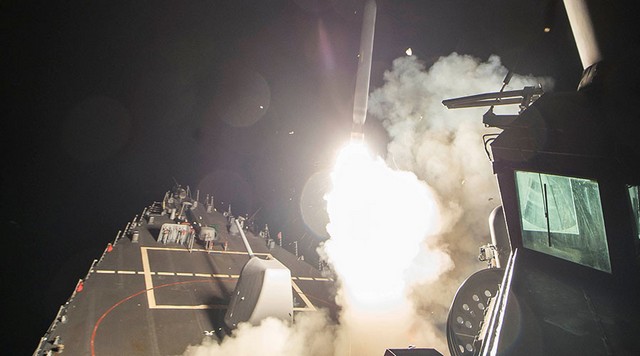
If Trump was truly intent on putting America first, as he insistently asserts, then he could do so very directly and effectively by taking three major steps toward the protection of national interests: first, demand a firm commitment from the Saudi government to cease using private funds and public diplomacy to spread Wahhabism beyond its borders. Any credible public statement along these lines would weaken ISIS and other terrorist movements throughout the world far more than cascades of Tomahawk missiles dumped on a Syrian airfield. Such a challenge to Saudi policies also raises the possibility, however remote, of an endgame in the ‘war on terror.’ If such a reset of Saudi relations could be coupled with an indefinite freeze on arms sales to the Gulf countries that would have been even better, sending a signal throughout the region that America will no longer engage with the bloody conflicts that have brought so much suffering and devastation to the Middle East. This might give some belated meaning to ‘America first.’

The second step would have been even harder for an American president to take. It would require Trump to tell Mr. Netanyahu that no further military assistance for Israel would be authorized until an unconditional freeze on settlement expansion was in place and enforced, and the blockade of Gaza lifted once and for all.

It does not require a PhD in Middle Eastern Studies to appreciate that the establishment of a nuclear free zone in the region and the adoption of effective steps to minimize the sectarian divide between Sunni and Shia Islam would improve future prospects for these horrendously disrupted political realities, at last reducing tensions and risks of wars. Nor does it require special knowledge to identify the obstacles such actions—the one government that already possesses nuclear weapons and the government that feels threatened by a challenge to its regional preeminence. Saudi Arabia and Israel both regard Iran as enemy number one, although it poses no existential threat to either one, and Israel will not even discuss giving up its nuclear arsenal despite being assured by Washington that its qualitative edge in conventional weaponry relative to its neighbors will be upheld.

The special relationships block even the consideration of enlightened initiatives; take them entirely off the table. This contrasts with the American proclivity for coercive diplomacy, which always assertively leaves the military option on the table. Without tension-reducing measures, a few false moves could easily give rise to a major war with Iran, which might bring smiles to leaders in Riyadh and Tel Aviv, but would be disastrous for the societies involved and for the United States, as well as for the region.

Given the leverage and militancy of pro-Israeli lobbies in the United States, more realistically pursuing American national interests toward Israel and the Middle East, seems tantamount to issuing invitations to Trump’s beheading, and despite his wildly gyrations of policy and mood, he has shown no disposition whatsoever to take on AIPAC, inc. Quite the contrary.

Of course, I am not so naïve to think that the advocacy of rationality in foreign policy will have the slightest echo in Washington in the course of Trump’s current diplomatic foray into uncharted territories. What I wish to point out is that this kind of foreign policy fantasy, however desirable if it were to be enacted, has become a species of political suicide. Any political leader who moved in more rational directions would be risking his own life, at least politically. The proposals mentioned above tells us what an American president should do if a rational and humane political system was in place and organized in such ways as to allow the pursuit of national interests, the realization of values associated with peace and human rights, and to attain the benefits of just and sustainable Israeli/Palestinian peace arrangements.

As long as these dysfunctional special relationships are relied upon to define American national interests in the Middle East, violent extremism and turmoil will persist, the authority of the United Nations and international law will suffer, and the credibility of American regional and global leadership will further erode. And maybe worst of all, the mounting ecological and nuclear challenges of global scope and apocalyptical risk will be remain unattended in what has become the greatest display of species indifference to its own survival throughout human history.

Mainstream advice on the Middle East being proffered to the Trump presidency by Beltway sharpshooters takes for granted the geopolitical status quo questioned above. The problems presented by the two special relationships are not even mentioned. Given these perspectives there are three broad kinds of approaches recommended for the region: (1) don’t aim too high, lower expectations, and don’t touch raw nerves in Israel or the Arab world (e.g. moving the American embassy to Jerusalem or telling Israel to dismantle the separation wall, stop expanding settlements, or handle the ongoing hunger strike humanely)[See Aaron David Miller, “From My Twenty Years of Failing at Middle East Peace,” Foreign Policy online, May 19, 2017]; (2) gang up on Iran, which will please both Israel and Saudi Arabia, and will have some positive resonance back in the United States [e.g. Michael Doran, “A Trump Plan for the Middle East,” NY Times, May 19, 2017]; (3) adopt the Israeli hard right view, now pushed within the United States, that the best road to ‘peace’ is to give Israel a green light to exert even greater pressure on the Palestinians to the point of their surrender. [a position repeatedly advocated by Daniel Pipes on the online listserv Middle East Forum and elsewhere, see Pipes, “The Way to Peace: Israeli Victory and Palestinian Defeat,” Commentary, Jan. 2017; Pipes boasts of his work with the Congressional Israel Victory Caucus that wants the U.S. Government to stop talking about ‘the two state solution,’ and support an Israeli shift from managing the status quo to launching a campaign to defeat Palestinians so decisively as to end the conflict.]

The first of these approaches is a cautionary warning to Trump the maker of grand deals not to exceed the boundaries of the feasible. The Israel/Palestine conflict is not ripe for resolution, Israel has no incentive or inclination to reach a fair compromise and even if it were, the Palestinians are currently too fragmented and poorly led to provide a reliable negotiating partner. The second geopolitically oriented approach makes matters worse, pushing the sectarian and secular divides in the direction of a regional confrontation, even combat. The third is geopolitically triumphalist, assuming that the Palestinians can be induced to give up their century old struggle, and go the way of other indigenous lost causes that have succumbed to predatory settler movements.

As Trump dominates the news by his visits to Saudi Arabia and Israel we should not be tricked into thinking that his ‘achievements’ are hopeful developments. The only true beacons of hope for the peoples of the Middle East are the contrarian affirmations of the Palestinian hunger strike, the Rouhani electoral victory, and the BDS Campaign. The fact that such developments are ignored or condemned by the dominant political forces in the West should at least alert us to gathering storm clouds in that tormented region and elsewhere.

Richard Falk is a member of the TRANSCEND Network, an international relations scholar, professor emeritus of international law at Princeton University, author, co-author or editor of 40 books, and a speaker and activist on world affairs.

22 May 2017

Putin Aligns with Xi in Crafting the New World (Trade) Order

By Pepe Escobar

15 May 2017 – History will record the Belt and Road Forum in Beijing marked the juncture where the 21st century New Silk Roads assumed their full character of Globalization 2.0, or “inclusive globalization,” as defined by President Xi Jinping in Davos earlier this year.

I have dealt with the monumental stakes here and here. Terminology, of course, remains a minor problem. What was once defined as One Belt, One Road (OBOR) is now promoted as the Belt and Road Initiative (BRI). Much is still somewhat lost in translation in English, what matters is that Xi has managed to imprint the myriad possibilities inbuilt in the concept especially across the Global South.

An amiable host, Xi in Beijing went ‘no holds barred’ extolling the inclusive integration merits of OBOR/BRI. It also helps that along the way, this being China, his spin doctors came up with a lovely metaphor to illustrate how OBOR/BRI should find its force as a common, pan-Eurasian effort; “Wild Swan geese [found across Asia but not in Europe] are able to fly far and safely through winds and storms because they move in flocks and help each other as a team.”

And arguably the key member of this flock of wild swan geese happens to be Russia.

Follow the geese

President Putin and Foreign Minister Sergey Lavrov were guests of honor at the forum – alongside leaders such as Kazakhstan’s Nazarbayev and Turkey’s Erdogan. At a business breakfast discussion, Xi seated Putin to his right and Lavrov to his left.

At a Leaders Roundtable summit on the second day of the forum – a sort of Silk Road United Nations, with the microphones open equally to all – Putin touched on a key point; the symbiosis, formalized since 2015, between OBOR/BRI and the Russia-driven Eurasian Economic Union (EEU), currently formed by Russia, Kyrgyzstan, Kazakhstan, Belarus, and Armenia.

As Putin said, “some 50 European, Asian and Latin American states” are interested in cooperation with the EEU. While the EEU and China are discussing their own, wide-ranging trade/economic deal, the EEU is also consulting, among others, with Iran, India, Serbia, Singapore, and Egypt.

But it was during his speech at the inaugural session of the forum that Putin managed to distill what amounts to a concentrate of Russian foreign policy.

Here are the key topics.

– Through “integration formats like the EEU, OBOR, the SCO, and ASEAN, we can build the foundation for a larger Eurasian partnership.”

– There is now a “unique opportunity to create a common cooperation framework from the Atlantic to the Pacific – for the first time in history.”   Essentially, this is what Putin himself had once proposed – then shunned by EU/NATO – even before Xi announced OBOR in 2013.

– “Russia is not only willing to be a reliable trading partner but also seeks to invest in the creation of joint ventures and new production capacities in partnering states, to invest in industrial facilities, sales, and services.”

– Russia is investing in building “a system of modern and well-connected transport corridors,” “expanding the capacity of the Baikal-Amur Mainline and the Trans-Siberian Railway, investing significant resources into improvements to the Northeast Passage.”

– And then, looking at the Big Picture, “the infrastructure projects within the EEU and the One Belt, One Road initiative in conjunction with the Northeast Passage can completely reconfigure transportation on the Eurasian continent.”

– Putin expects “newly established financial institutions like the New Development Bank (BRICS Development Bank) and the Asian Infrastructure Investment Bank to offer a supporting hand to private investors.”

And then, the clincher, fully aligned with Xi’s vision; “Greater Eurasia is not an abstract geopolitical arrangement but, without exaggeration, a truly civilization-wide project looking toward the future.”

When in doubt, call the SCO

Compared with the depth and breadth of this shared vision, nothing could be more pedestrian than the official India attitude; not only sending a low-level delegation to Beijing, but imprinting on mainstream Indian media the notion that OBOR/BRI is “little more than a colonial enterprise [that would leave] debt and broken communities in its wake”.

The flock of wild swan geese flying toward Eurasia integration is now a fact of life. East Asian output, for that matter, will surpass North America’s during the Trump era. The future, rather, the dissolution of unipolar hegemony will be decided in Eurasia, particularly East Asia.

India may certainly harbor its own strategic agenda. But self-marginalization of the one and only integrated development project in the 21st century hardly qualifies as savvy diplomacy.

So it looks like Putin once again will have his work cut out for him. India, a historical partner of the former USSR, still maintains good trade relations with Russia. Iran, for its part, is as much a key Indian energy partner as China’s. So the road map ahead spells out Moscow, alongside Tehran, playing the go-betweens trying to sweeten India into the Eurasia integration path.

That could well take place within the framework of the Shanghai Cooperation Organization (SCO), which from now on will have a full plate not only trying to smooth out a feasible Afghan peace process but making sure India and Pakistan find a political entente cordiale.

It will be a bit like older brothers trying to instill some sense into younger ones – as Russia and China, as part of their strategic partnership, have already worked hard to manage the twin admission of India and Pakistan into the SCO.

Iran will also become a full member shortly. So we will soon have an active SCO from Southwest Asia all the way to South Asia, with a political-economic integration agenda expanding the initial drive to fight myriad manifestations of Salafi-jihadi terror.

This slowly but surely progressive convergence fits into the larger goals of the Russia-China strategic partnership, which once again, as demonstrated during the Beijing forum, is all about Eurasia integration.

The invisible story at the Beijing forum was that as much as Turkey is a key node of OBOR/BRI and Kazakhstan is a key node between OBOR/BRI and the EEU, it’s China and Russia that will truly advance the complex roadmap of this “civilization-wide project.”

Pepe Escobar is a Brazilian independent geopolitical analyst. He is a frequent contributor to websites and radio and TV shows ranging from the US to East Asia.

22 May 2017

Palestinian Authority security forces: Whose security?

By Afro-Middle East Centre (AMEC)

Since its inception, the Palestinian Authority security establishment has neither protected Palestinians from Israeli military occupation, nor empowered them to resist that occupation, argues Alaa Tartir. Instead, through its security coordination with Israel, the PA has contributed to the criminalising of the Palestinian liberation struggle.

To speak of Israeli-Palestinian ‘cooperation’…is to use no less than a misnomer. This is not, however, simply because ‘the outcome of cooperation between an elephant and a fly is not hard to predict’, as Chomsky so pithily writes…but because in the context of the Oslo peace process, ‘cooperation’ is often only minimally different from the occupation and domination that went before it. ‘Cooperation’, in this context, is above all an internationally pleasing and acceptable signifier which obscures rather than elucidates the nature of Israeli-Palestinian relations. – Jan Selby, 2003

I…applaud the Palestinian Authority’s continued security coordination with Israel. They get along unbelievably well. I had meetings, and at these meetings I was actually very impressed and somewhat surprised at how well they get along. They work together beautifully. – Donald Trump, 2017

Overview

From the outset, the Palestinian Authority (PA) security establishment has failed to protect Palestinians from the main source of their insecurity: the Israeli military occupation. Nor has it empowered Palestinians to resist that occupation. Instead, the PA has contributed to a situation in which the Palestinian struggle for freedom has itself been criminalised. Rather than recognise resistance as a natural response to institutionalised oppression, the PA, in tandem with Israel and the international community, characterises resistance as ‘insurgency’ or ‘instability’. Such rhetoric, which favours Israeli security at the expense of Palestinians, echoes discourse surrounding the ‘war on terror’ and criminalises all forms of resistance.

This dynamic can be traced back to the 1993 Oslo Accords, but it has been galvanised over the last decade through the PA’s evolution as a donor-driven state that espouses neoliberal policies. The donor-driven reform of the security sector has been the linchpin of the PA’s post-2007 state building project. The enhanced effectiveness of the PA’s security forces as a result of massive donor investment has in turn created additional ways of protecting the Israeli occupier, thus creating spaces that are ‘securitised’, within which the occupier can move freely in the execution of its colonial project.

Such a development could only have two outcomes: ‘better’ collaboration with the occupying power in a way that shored up the destructive status quo; and greater violation of Palestinians’ security and national rights by their own government and national security forces.

This policy brief analyses the evolution and ‘reform’ of the Palestinian security forces since the establishment of the PA, and examines Palestinian-Israeli security coordination and its deleterious effects on the Palestinian ability to resist Israel’s occupying forces as well on basic liberties. It focuses on the PA forces in the West Bank and not the situation in Gaza, which requires separate research and analysis. It concludes with policy recommendations to reinvent the PA security forces’ operations and overhaul their structures so that they may truly serve to protect their own people.

The Rise of the Palestinian Authority Security Forces

The evolution of the PA security forces can be categorised in three phases: the Oslo Accords (1993-1999), the Second Intifada (2000-2006), and the post-2007 PA state-building project.

The Oslo Accords were characterised by two parallel, yet conflicting, projects: state building and national liberation. The former implied constructing state-like institutions and a bureaucracy under occupation, while the latter meant pursuing the revolutionary programme for self-determination that had been adopted by the PLO. The tension between these ventures already manifested themselves under the late president Yasser Arafat’s rule. Arafat’s personalised style of governance and its resultant complex network of corruption and patronage meant that the evolution of the PA security forces was from its advent neither inclusive nor transparent. Rather, it was fraught with nepotism, and was used as a tool to address the threats posed by Oslo’s opponents and to stabilise the population. In turn, it also solidified the nascent ‘peace’ agreements. The 9 000 recruits in the ‘strong police force’ envisaged in the 1994 Cairo Agreement became nearly 50 000 security personnel by 1999.

This proliferation of the security forces – all spying on each other, as Edward Said once said – has had severe consequences for Palestinians. Arafat’s establishment of security-driven political structures nourished authoritarianism and blocked accountability mechanisms in the Palestinian political system. This resulted in a dearth of legitimacy and further insecurity for Palestinians. As the security establishment grew in numbers and institutions, Palestinians remained ill-protected, and corruption and patronage within the forces became endemic. The divide-to-rule approach paved the way for future Palestinian fragmentation.

During the Second Intifada, Israel destroyed the PA’s security infrastructure because PA security forces participated in the uprising. This created a security vacuum into which non-PA actors inserted themselves, with mixed results for Palestinians. This exacerbated intra-Palestinian competition and led external donors, the PA, and Israel to be even more concerned with building a strong and dominant security sector. In June 2002, the PA announced its 100-Day Reform Plan; in 2003 the Quartet Road Map demanded that a ‘rebuilt and refocused Palestinian Authority security apparatus’ must confront ‘all those engaged in terror’ and dismantle ‘terrorist capabilities and infrastructure’. PA security structures were forced to combat terrorism; apprehend suspects; outlaw incitement; collect illegal weapons; provide Israel with a list of Palestinian police recruits; and report progress to the United States.

Accordingly, Palestinian security reform ‘remained…an externally-controlled process, driven by the national security interests of Israel and the United States, and characterized by very limited ownership on the part of Palestinian society.’ The international donor community led this reform in 2005 through the establishment of the European Union Coordinating Office for Palestinian Police Support (EUPOL COPPS) and the US Security Coordinator (USSC). This situation persists in the form of a ‘one gun, one law, one authority’ strategy through which the PA’s monopoly on force and violence is ensured.

The post-2007 state-building project under the PA has aimed, mainly through EUPOL COPPS and USSC, to reinvent the PA security forces through technical means, including training and weapons procurement. It has also aimed to reinvent the forces politically by constraining Hamas and its armed wing, curbing Fatah-allied militants through co-optation and amnesty, cracking down on criminals, and conducting security campaigns, particularly in Nablus and Jenin. These forces became known as Dayton’s forces in reference to Keith Dayton, the US lieutenant general who led the PA military establishment’s ‘professionalization and modernization’ process. Local and international human rights organisations have accused these reformed forces of human rights violations and of suppressing freedoms.

The current phase has further entrenched the predominance of Israeli security interests at the expense of the Palestinians. Disarmament and criminalisation have impaired popular resistance against the occupation, including peaceful demonstrations and marches, advocacy against Israel’s violations of human rights, and student activism. Today, PA security forces largely protect the security of the occupier and not that of the occupied. In short, the security of Palestinians has been jeopardised because their own leadership has been subcontracted to repress them. The post-2007 security reform agenda has thwarted Palestinians’ national struggle, their resistance movement and their everyday security, and has subverted the very functioning of Palestinian politics.

Security Coordination as Domination

To understand the magnitude of the security coordination enterprise, it is useful to note that the Palestinian security sector employs around half of all civil servants, accounts for nearly $1 billion of the PA budget, and receives around 30 per cent of total international aid disbursed to the Palestinians. The security sector consumes more of the PA’s budget than the education, health, and agriculture sectors combined. The sector is currently comprised of 83 276 individuals in the West Bank and the Gaza Strip, including 312 brigadier generals, of whom 232 report to the PA and 80 to Hamas. In comparison, the entire US Army has 410 brigadier generals. The ratio of security personnel to the population is as high as one to forty-eight – one of the highest in the world.

Security collaboration between Israel and the PA has fulfilled the Oslo Accords’ objectives of institutionalising security arrangements and launching a peace process that is tightly controlled by the security sector in order to enable Israel to fulfil its colonial ambitions while claiming to be pursuing peace. This process of ‘securitised peace’ is manifested in a number of ways, including the PA security forces’ arrest of Palestinian suspects wanted by Israel (as in the recent case of Basil Al-‘Araj, who was arrested and released by the PA only to be hunted and eventually assassinated by the Israelis); the suppression of Palestinian protests against Israeli soldiers and/or settlers; intelligence sharing between the Israeli Defense Forces (IDF) and the PA security forces; a revolving door between Israeli and PA jails through which Palestinian activists cycle for the same offences; and regular joint Israeli-Palestinian meetings, workshops, and training.

Though Palestinian Authority President Mahmoud Abbas has threatened to suspend security coordination, he has at the same time declared it a ‘Palestinian national interest’ and a ‘sacred’ doctrine. PA security force activities and Abbas’s political manoeuvrings have created a deep gap in trust between the Palestinian people and the PA.

Indeed, multiple surveys over the years have shown that the majority of Palestinians in the West Bank and Gaza Strip (between 60 and 80 per cent) oppose security coordination with Israel. In a March 2017 Palestinian Center for Policy and Survey poll, two-thirds of respondents demanded Abbas’s resignation, with 73 per cent expressing the belief that Abbas was not serious in his threat to suspend security coordination with Israel. In a 2010 Maan News Agency poll, 78 per cent of respondents said they believed that the PA security forces were engaged in surveillance, monitoring activities, and intervening in people’s privacy. Finally, according to Visualizing Palestine, 67 per cent of West Bank Palestinians said they felt they were living in an undemocratic system that cracked down on freedoms in large part as a result of the security realm.

Negative public perceptions about security coordination are fuelled by lived experiences – from which elites are often spared – as well as by official rhetoric and the contents of the leaked Palestine Papers. For instance, Keith Dayton remarked in 2009 that senior IDF commanders had asked him, in regard to the Palestinian security forces he was training, ‘How many more of these new Palestinians can you generate, and how quickly?’ He also said a senior Palestinian official addressed a graduating class of these ‘new Palestinian men’ in Jordan, saying, ‘You were not sent here to learn how to fight Israel…you were rather sent here to learn how to keep law and order, respect the right of all of our citizens, and implement the rule of law so that we can live in peace and security with Israel.’ And in 2013, in a speech before the European Parliament, Israeli president Shimon Peres stated: ‘A Palestinian security force was formed. You and the Americans trained it. And now we work together to prevent terror and crime.’
While security coordination between Israel and the PA has been cemented since the Oslo Accords, the status quo is not a foregone conclusion. However, change will be difficult to achieve, as the system has created a segment of Palestinian society that will seek to maintain it. This segment is composed not only of security personnel in the West Bank and Gaza, but also of those Palestinians benefiting from institutional arrangements and a network of collaboration and domination. The status quo is beneficial for them, and ‘stability’ is their mantra. They are committed to an approach that privileges the political, economic and security elite, and they have no incentive to reverse the rules of the game.

Any attempt to halt security coordination would thus have real consequences for the PA and its leadership. Yet the perpetuation of the status quo is destructive for the majority of Palestinians living under Israel occupation and for the Palestinian people at large. With the crushing of the ability to correct political wrongdoing and hold elites accountable, business as usual will likely continue. Security coordination will remain a defining feature of the skewed reality that favours the occupier if action is not taken – soon.

Reinventing the PA’s security doctrine

The entrenchment of the PA security establishment requires policy interventions at multiple levels, from correcting biased rhetoric to establishing accountability mechanisms. The following recommendations, addressed to different stakeholders, propose an overhaul of the PA security forces’ operations and structures.

The Palestinian Authority
The PA must listen to Palestinian people and respect their wishes and aspirations, including in the security domain, otherwise the legitimacy and trust gap will grow larger. There has never been an inclusive Palestinian political system, but a more responsive, representative, and responsible leadership would ensure that the security of Palestinians, rather than that of their occupier and coloniser, is a core concern. An authentic security sector, as Tariq Dana has argued, would mean an end to the ‘focus on internal policing known as the “Dayton Doctrine”’ and ‘a program that demands accountability and justice be put in place’.

As Hani Al-Masri has elaborated, this would require gradual but firm steps to eventually freeze or suspend security coordination, including: ending Palestinian security apparatus intervention in political issues; reducing security allocations in the annual budget; disbanding parts of the security apparatus and restructuring the remainder, with an emphasis on professionalism, patriotism, and freedom from political nepotism; and instructing the security apparatus to resist raids by Israel in the West Bank’s Area A.

Although the PA still argues that the current security arrangements and division of labour serve the two-state solution, the relentless Israeli colonisation of Palestinian land means that the PA and its leadership must reassess their function. The looming threat of annexation should push the PA to take action before its role solidifies as a subcontractor to the Israeli occupation.

Palestinian Civil Society
Palestinian civil society organisations, especially human rights organisations, must form more effective coalitions and intensify their efforts to hold the PA and its political and security leadership accountable for their human rights’ violations. In the absence of institutions that perform checks and balances, pressure that goes beyond writing and publishing reports (though this in itself is an important act) is urgently needed. In other words, Palestinian civil society organisations need to develop practical actions that confront the PA’s continuous rights’ violations.

These civil society actors, including academic institutions, public intellectuals and think tanks, must also address the PA’s discourse in which Palestinian resistance is reframed as criminal insurgency or instability. Israeli and international actors who use this discourse should also be confronted. Civil society must embrace and operationalise resistance rather than see it criminalised, and view it as an all-encompassing way of living under occupation and in exile. Resistance as a way of life can help to reverse how the political and security elite currently portray it. Resistance can then ensure the restoration of the core values and ideas that enable Palestinians to engage collectively to realise their rights.

External actors, particularly security bodies EUPOL COPPS and USSC, need stringent scrutiny from civil society, both within Palestine and in their home countries. They cannot continue to dominate the security realm without accountability or transparency. By promoting the rule of law in an authoritarian context, these bodies contribute to the ‘professionalization’ of authoritarian practices by (ab)using a good governance framework. Their claim that their mandate is ‘technical’ enables them to evade the political results of their operations and interventions. After a decade of operation, it is time to conduct an independent Palestinian-led evaluation of these bodies and use that as an accountability mechanism to reform these erstwhile ‘reformers’ and decide on the way forward.

Donors and the Donor Industry
In a context highly dependent on aid, the supremacy assigned to securitisation and militarisation extends to the realm of development. Policymakers in donor states and Palestinians who facilitate donor programmes should address how ‘securitised aid’ has transformed a liberation movement into a subcontractor to the coloniser, and has resulted in authoritarian tendencies that favour the security establishment at the expense of sectors such as health, education, and agriculture, as well as at the expense of democracy.

Moreover, in Palestine, securitised aid and development have not only failed to address poverty, unemployment and empowerment, but have also created new insecurity and illegitimacy. Development planners must acknowledge that these patterns will never be reversed unless people, and not the security establishment, drive actions and are the constant reference point.

All these actions are the duty of the Palestinian people, especially when policymakers do not represent them and their aspirations. Palestinian society needs to confront the tools used to repress its mobilisation and organise in order to ensure the realisation of its fundamental rights. The non-factional youth-led initiative End Security Coordination that emerged in the aftermath of Basil Al-‘Araj’s assassination in March 2017 represents an example of such mobilization. In their call for action, the group stated:

‘Our people have struggled for too long for us to stand idle while repressive leaders barter our oppression and dispossession for their personal gain…We are approaching 30 years since the Oslo Accords that transformed what remained of our land into open air prisons administered by unrepresentative PA officials who have hired themselves out to be our colonizers’ first line of defense…The Oslo regime does not represent us. Now is the time for us to come together and rebuild our collective struggle for the liberation of all of Palestine.’

If such organized resistance can continue and increase, pressure from the people may be able to change the trajectory of PA-Israeli security coordination, rendering Palestinians better equipped to work toward self-determination and the attainment of human rights.

22 May 2017

Trump in Riyadh And Oil Wars

By Professor Francis A Boyle

Historically, this latest eruption of American militarism at the start of the 21st Century is akin to that of America opening the 20th Century by means of the U.S.-instigated Spanish-American War in 1898. Then the Republican administration of President William McKinley stole their colonial empire from Spain in Cuba, Puerto Rico, Guam, and the Philippines; inflicted a near genocidal war against the Filipino people; while at the same time illegally annexing the Kingdom of Hawaii and subjecting the Native Hawaiian people (who call themselves the Kanaka Maoli) to near genocidal conditions.

Additionally, McKinley’s military and colonial expansion into the Pacific was also designed to secure America’s economic exploitation of China pursuant to the euphemistic rubric of the “open door” policy. But over the next four decades America’s aggressive presence, policies, and practices in the “Pacific” would ineluctably pave the way for Japan’s attack at Pearl Harbor on Dec. 7, 194l, and thus America’s precipitation into the ongoing Second World War. Today a century later the serial imperial aggressions launched and menaced by the Republican Bush Jr. administration and then the Democratic Obama administration and now the Trump administration are threatening to set off World War III.

By shamelessly exploiting the terrible tragedy of 11 September 2001, the Bush Jr. administration set forth to steal a hydrocarbon empire from the Muslim states and peoples living in Central Asia and the Persian Gulf and Africa under the bogus pretexts of:

(1) fighting a war against international terrorism; and/or

(2) eliminating weapons of mass destruction; and/or

(3) the promotion of democracy; and/or

(4) self-styled “humanitarian intervention” or its avatar “responsibility to protect.”

Only this time the geopolitical stakes are infinitely greater than they were a century ago: control and domination of two-thirds of the world’s hydrocarbon resources and thus the very fundament and energizer of the global economic system – oil and gas.

The Bush Jr./Obama administrations targeted the remaining hydrocarbon reserves of Africa, Latin America, and Southeast Asia for further conquest or domination, together with the strategic choke-points at sea and on land required for their transportation. In this regard, the Bush Jr. administration established the U.S. Pentagon’s Africa Command (AFRICOM) in order to better control, dominate, exploit, and plunder both the natural resources and the variegated peoples of the continent of Africa, the very cradle of our human species. Libya and the Libyans became the first victims to succumb to AFRICOM under the Obama administration. They will not be the last.

Trump is just another White Racist Iron Fist for Judeo-Christian U.S. Imperialism and Capitalism all over the world. Trump forthrightly and proudly admitted that the United States is in the Middle East in order to steal their oil. At least he was honest about it. Unlike his predecessors who lied about it going back to President George Bush Sr. with his War for Oil against Iraq in 1991.

This current bout of U.S. imperialism is what my teacher, mentor and friend Hans Morgenthau denominated “unlimited imperialism” in his seminal work Politics Among Nations (4th ed. 1968, at 52-53):

“The outstanding historic examples of unlimited imperialism are the expansionist policies of Alexander the Great, Rome, the Arabs in the seventh and eighth centuries, Napoleon I, and Hitler. They all have in common an urge toward expansion which knows no rational limits, feeds on its own successes and, if not stopped by a superior force, will go on to the confines of the political world. This urge will not be satisfied so long as there remains anywhere a possible object of domination–a politically organized group of men which by its very independence challenges the conqueror’s lust for power. It is, as we shall see, exactly the lack of moderation, the aspiration to conquer all that lends itself to conquest, characteristic of unlimited imperialism, which in the past has been the undoing of the imperialistic policies of this kind…”

It is the Unlimited Imperialists along the lines of Alexander, Rome, Napoleon and Hitler who are now in charge of conducting American foreign policy. The factual circumstances surrounding the outbreaks of both the First World War and the Second World War currently hover like twin Swords of Damocles over the heads of all humanity.

Professor Francis A. Boyle is an international law expert and served as Legal Advisor to the Palestine Liberation Organization and Yasser Arafat on the 1988 Palestinian Declaration of Independence, as well as to the Palestinian Delegation to the Middle East Peace Negotiations from 1991 to 1993, where he drafted the Palestinian counter-offer to the now defunct Oslo Agreement. His books include “ Palestine, Palestinians and International Law” (2003), and “ The Palestinian Right of Return under International Law” (2010).

22 May 2017

Trump’s Speech In Riyadh Signals US Escalation Against Iran

By Bill Van Auken

Riddled with hypocrisy, clichés and absurdities, President Donald Trump’s speech Sunday before an assembly of monarchs and despots in Saudi Arabia spelled out an agenda of escalating US militarism throughout the Middle East and a buildup in particular toward war with Iran.

Hailed by a fawning American media as “presidential”–supposedly eclipsing for the moment the crises and factional struggles engulfing the administration–the speech was reportedly drafted by Stephen Miller, the extreme right-wing ideologue credited with being the chief architect of Trump’s abortive executive order banning people from seven predominantly Muslim nations from entering the US.

Much in Trump’s half-hour address echoed the speech delivered by Barack Obama in Cairo eight years earlier. Both presidents declared their desire to reset US relations with the Middle East, while absurdly posturing as leaders of a pacifist nation seeking only good for the region and offering to head up a united struggle against “violent extremism.”

In what was meant as a rhetorical invocation to action against terrorism, Trump told his audience, “Drive them out. Drive them out of your places of worship. Drive them out of your communities. Drive them out of your holy land. And drive them out of this earth.”

Like Obama before him, Trump had no interest in dealing with who brought Al Qaeda and similar forces in, as the historical trail leads directly to the CIA in Afghanistan and US imperialism’s longstanding support for right-wing Islamist organizations and terrorist groups as a counterweight to left nationalist and socialist influence in the Arab and Islamic world. Jointly, the US and Saudi Arabia continue to fund and arm such forces in their drive for regime-change in Syria.

Both speeches were laced with flowery tributes to Islamic culture. Trump noted in particular how impressed he was with the “splendor” of Saudi Arabia and the “grandeur” of the palace in which the so-called Arab Islamic American Summit had been convened.

What separated the two addresses were the different shifts in strategy by Washington. While Obama sought to repair the damage done by the Bush administration’s criminal war in Iraq by offering a new face for US imperialism, Trump traveled to Saudi Arabia to make clear his administration’s break with his predecessor’s policy of seeking a rapprochement with Iran based on the 2015 nuclear deal. He adopted an openly confrontational stance toward Tehran.

“Above all, America seeks peace–not war,” Trump proclaimed, in what stood out as the most blatant of the many lies in his brief address. The reality is that US wars in the region have killed millions over the past decade-and-a-half. And the thrust of the US president’s visit to Saudi Arabia, his first stop in a nine-day foreign tour, is the preparation for new and even bloodier conflicts.

This was made plain by the principal agreements forged between Trump and the Saudi monarchy, which included a $110 billion arms deal that incorporates the option to purchase $350 billion worth of weapons over the next 10 years.

The arms agreement “supports the long-term security of Saudi Arabia and the entire Gulf region,” Secretary of State Rex Tillerson, the former ExxonMobil CEO, told reporters in Riyadh, “in particular in the face of the malign Iranian influence and Iranian-related threats which exist on Saudi Arabia’s borders on all sides.”

In his speech, Trump painted Iran as the principal state sponsor of terrorism, accusing Tehran of providing terrorists with “safe harbor, financial backing, and the social standing needed for recruitment,” and fueling “the fires of sectarian conflict and terror,” all charges that could be leveled, with justification, against his Saudi hosts.

He portrayed the US cruise missile attack on Syria last month–followed just last week by the US bombing of a pro-government militia in the southeastern part of the country–as part of a wider struggle against Iranian influence. He went on to call upon “all nations of conscience” to “isolate Iran, deny it funding for terrorism and pray for the day when the Iranian people have the just and righteous government they deserve.” That he was speaking in Saudi Arabia, a brutally repressive absolute monarchy, just two days after more than 70 percent of Iranian voters participated in a sharply contested election, did nothing to blunt Trump’s call for regime-change.

He specifically praised Saudi Arabia and its allies for having “taken strong action against Houthi militants in Yemen.” The near-genocidal Saudi war has killed some 12,000 Yemenis, while destroying basic infrastructure in the Arab world’s poorest country, leaving over 7 million people on the brink of starvation and unleashing a cholera epidemic that threatens a massive death toll.

In March, US Defense Secretary James “Mad Dog” Mattis issued a memo calling for stepped-up US support for this criminal war, in which the Pentagon is already supplying intelligence and logistical backing to the Saudi bombing campaign.

Part of the weapons deal signed by Trump involves the shipment of precision-guided munitions that had been cut off in a highly limited gesture of disapproval of Saudi tactics in Yemen by the Obama administration, which itself concluded over $100 billion worth of weapons deals with Riyadh. Also included in the new deal are tanks, artillery, helicopters and other weaponry that can be directly funneled into the slaughter in Yemen.

In addition to his speech and the signing of arms and investment deals, Trump participated in a meeting of the Gulf Cooperation Council, the Saudi-led coalition of Gulf oil sheikdoms. Trump administration officials have raised the objective of using the GCC as the foundation of a Sunni Arab version of NATO directed at military confrontation with Iran.

Beyond the drive to militarily confront Iran, a principal regional rival of US imperialism in the Middle East, and the huge profits that Saudi arms purchases reap for the US military industrial complex, there are broader strategic considerations in the US turn toward a closer alliance with Riyadh.

Some of these issues were outlined on the eve of Trump’s trip in a piece published by the influential Washington think tank the Center for Strategic and International Studies and authored by Anthony Cordesman, a longtime Pentagon adviser. First among them is, according to Cordesman, “the continued level of US dependence on Saudi help in securing the stable flow of Gulf oil.”

While US imports from the Gulf have fallen sharply over the past quarter-century, Cordesman cites “indirect dependence” in terms of the impact a disruption in oil exports would have on global energy prices and the world capitalist economy. In particular, he points to the dependence of Asian economies on Gulf petroleum exports.

If the United States failed in “providing power projection forces and arms” to the region, he writes, its principal global rival, China, might fill the void. “China may not yet be ready to try to assume the role, but the entire South China Sea crisis would pale to near insignificance if China became the de facto guarantor of Gulf stability.”

Cordesman continues: “The real-world nature of US influence and power in the Pacific would be cut massively, China’s leverage over other major Asian economies like Japan and South Korea would be sharply increased, and the potential rise in tension between China and India–and cut in India’s relative position–would have a massive impact on the balance of power in South Asia and the Indian Ocean.”

In other words, the turn toward closer relations with Saudi Arabia and the related Gulf oil sheikdoms is bound up with US imperialism’s mounting conflict with China, which it has identified as the principal challenge to the drive for American global hegemony. Washington is determined to dominate Asia, including China, by maintaining the military power to choke off the region’s energy imports.

The fact that the sclerotic House of Saud, one of the world’s last absolute monarchies, has become a lynchpin of Washington’s imperialist strategy, not only in the Middle East but globally, is a measure of the crisis of American and world capitalism.

Oil revenues, which account for fully 90 percent of the kingdom’s export earnings, have been cut nearly in half since 2014. Last month, the government was forced to reverse itself on austerity measures that hit the military and public employees over fear that declining living standards and rising unemployment are creating the conditions for social revolt.

In the predominantly Shia Eastern Province, the center of the kingdom’s oil production, security forces laid siege to the town of Awamiyah, a center of resistance to the regime, during the week preceding Trump’s visit. Combined with the failure of the Saudi bid to topple the Assad regime in Syria by supporting Al Qaeda-linked militias and the regime’s inability to retake Yemen from the Houthi rebels, the deepening domestic crisis is creating the conditions for revolutionary upheavals against Washington’s principal ally in the Arab world.

22 May 2017

In Visit To Israel, Trump Escalates Attacks On Iran

By Bill Van Auken

Donald Trump made clear from the moment of his arrival in Israel Monday that the purpose of his trip, promoted by the White House and the media as part of a quest for “Middle East peace,” is the consolidation of reactionary regional alliance in support of a US military buildup against Iran.

The US president flew to Tel Aviv directly from Saudi Arabia, where he delivered an inflammatory speech designed to consolidate a military alliance of Sunni oil monarchies and dictatorships against Iran. Portraying the struggle as one of “good against evil” and invoking “god” nine times, Trump made a clear appeal to sectarian divisions to promote what amounts to a holy war by the Sunni regimes against the predominantly Shia Iran.

While there was reportedly some disquiet in Israel over the US administration’s signing of arms deals with the Saudi monarchy that could total some $350 billion over the next decade, the speech and the turn by the Trump administration to an aggressively anti-Iranian policy went down well with the Zionist state, which, like Washington, sees Iran as the principal rival for regional hegemony.

Trump kept up his anti-Iranian rhetoric in statements made during meetings with Israeli President Reuven Rivlin and Prime Minister Benjamin Netanyahu. Speaking alongside Rivlin, Trump said, “There is growing realization among your Arab neighbors that they have common cause with you in the threat posted by Iran.

“Most importantly,” he added, “the United States and Israel can declare with one voice that Iran must never be allowed to possess a nuclear weapon—never, ever—and must cease its deadly funding, training and equipping of terrorists and militias, and it must cease immediately.”

Appearing with Netanyahu, the American president denounced the nuclear agreement signed by his predecessor Barack Obama and the leaders of five other major powers with Iran in 2015 as a “terrible thing.”

“We not only gave them a lifeline,” he said. “we gave them wealth and prosperity, and we also gave them the ability to continue with terror.”

While Trump has yet to follow through on his vow to rip up the accord and has kept in place waivers on sanctions imposed in relation to Teheran’s nuclear program, the speech delivered in Riyadh and his remarks in Israel spell out a US policy of regime change in Iran that threatens to unleash an even more devastating war in the Middle East.

Trump’s statements have provoked expressions of unease, particularly in Europe, which has viewed the nuclear deal with Iran as an opening to new markets and sources of profit. The Financial Times of London published an editorial Monday titled “Trump of Arabia takes sides in sectarian conflict,” warning that “backing Sunni Arab autocrats against Shia Iran will not help the Middle East.”

The French daily Le Monde editorialized that Washington was pursuing a “Cold War”-style policy in the Middle East, dividing it between “two camps: Sunni Arabs, Israelis and Americans on one side; Iranians, their Syrian protege and Russia on the other,” warning that it would pave the way to the “continuation of the endless wars ravaging the region.”

The arrogance of Trump’s denunciations of Iran, which last week held a hotly contested presidential election, while praising Saudi Arabia, one of the world’s last absolute monarchies and the source of both the religious ideology and financial resources underpinning Al Qaeda, ISIS and similar Islamist groups, was denounced by the government in Tehran.

Iranian Foreign Ministry spokesman Bahram Qassemi Monday called upon Washington to abandon its “policy of warmongering, meddling, Iranophobia and sales of dangerous and useless weapons to the main sponsors of terrorism.”

Iranian President Hassan Rouhani, who was reelected with a wide margin of victory Friday after running on a program promoting rapprochement with the West, made an indirect reference to the Saudi connections to the September 11, 2001 attacks on New York City and Washington “You can’t resolve the issue of terrorism by giving money to super powers,” he said. “I don’t think people of America would trade the blood they gave on 9/11 in exchange for money raised in arms sales.”

Rouhani also pointed to the hypocrisy of Trump’s speech in Riyadh, coming in the wake of the Iranian election: “Mr. Trump visited the region at the time millions of our people went to the polls. He went to a country whose people haven’t even seen ballot boxes and elections don’t have any meaning for them. I hope one day Saudi Arabia also drives its national strength through elections. Power should not pass on through inheritance, but through elections.”

In what amounted to a pair of religiously themed photo ops, Trump, his wife Melania, daughter Ivanka and son-in-law Jared Kushner went to both the Church of the Holy Sepulcher and the Western Wall Monday. The visit was the first by any US president to the Old City of Jerusalem, which is regarded internationally as illegally occupied territory, seized by Israel 50 years ago.

Trump’s promotion of the charade of a US-brokered Israeli-Palestinian “peace” was a decidedly secondary element of his trip. He presented it almost entirely from the standpoint of a gesture needed to give cover to the reactionary Sunni Arab oil sheikdoms so that they can openly align themselves with Israel. “King Salman feels very strongly and, I can tell you, would love to see peace with Israel and the Palestinians,” he said after meeting with President Rivlin.

The Arab monarchies have dropped even their earlier demands for a “two-state solution” that would leave Palestinians trapped in a fragmented, Israeli-dominated mini-state, calling merely for minor concessions.

A discussion paper circulated among these regimes that was obtained by the Wall Street Journal indicated that, in the interests of forging an alliance against Iran, they are prepared to normalize relations with Israel in return for minimal concessions, such as the freezing of Israeli settlements in the West Bank and the easing of trade restrictions on the Gaza Strip.

On the eve of Trump’s arrival, the Israeli cabinet approved a limited increase in the number of building permits issued to Palestinians living in “Area C” of the West Bank, which Israel controls directly and aims to eventually annex. It also extended the opening of the Allenby Bridge border crossing between the West Bank and Jordan to 24 hours a day and allowed for the development of some industrial zones in the occupied territory.

“This is a gesture for President Trump’s visit, which does not harm Israel’s interests,” an Israeli government official told the Israeli media.

To say that Trump is going through the motions in terms of seeking a resumption of peace talks would be an exaggeration. He is to meet Palestinian Authority President Mahmoud Abbas during a trip Tuesday to the Occupied West Bank city of Bethlehem that is scheduled to last for all of one hour. While initially the US president was to squeeze in more religious tourism with a visit to the Church of the Nativity in Bethlehem’s Manger Square, this plan was scrapped when it emerged that he would have to pass a protest tent erected in support of the Palestinian political prisoners on hunger strike.

Schools, public transit, banks and stores were shut down by a general strike in the occupied West Bank Monday in support of more than 1,300 Palestinian political prisoners who have been on hunger strike since April 17. In several demonstrations held in conjunction with the strike, Trump was burned in effigy.

More than 1,000 Palestinian demonstrators converged on the Qalandiya checkpoint between Jerusalem and Ramallah carrying placards bearing Trump’s image defaced with a red shoe print declaring, “American policies are a foot print of shame on humanity’s forehead.” Israeli troops attacked the demonstrators with tear gas, rubber bullets and live ammunition.

A 16-year-old Palestinian was shot to death by border police at a checkpoint northeast of Bethlehem on Monday. An Israeli police spokesman claimed the youth had tried to stab Israeli border police, none of whom were injured in the alleged assault. Just two days earlier, 23-year-old Mutaz Hussien Hilal Bani Shamsa was shot dead by a Zionist settler who got out of his car and opened fire on a demonstration in support of the hunger strikers.

In contrast to the growing militancy of the Palestinian population, the corrupt Palestinian Authority led by Abbas, which is heavily dependent upon funding from Saudi Arabia and the Gulf oil sheikdoms, is moving to accommodate itself to Trump’s Mideast policy. Abbas was among those attending the US president’s anti-Iranian diatribe in Riyadh, and he is reportedly prepared to present a new proposal for “peace” negotiations that drops all references to Jerusalem and cedes to Israel three times as much land as the PA previously offered.

23 May 2017

Libya’s unending civil war: When weapons trump politics

By Afro-Middle East Centre (AMEC)

Three years have elapsed since Libya’s current power struggle began, with no end in sight. For a solution to be found it would need to be inclusive, focused more on governance, and clear consequences for military disruptions need to be stipulated. The increasing regional and international interference, especially militarily, is worrying in this regard.

Almost three years have elapsed since the reconvening of Libya’s General National Congress (GNC) in July 2014 and subsequent division of the country into two, now three, centres of power, with no conclusion forthcoming. The April meeting between the Government of National Accord’s (GNA) Fayez al-Sarraj and General Khalifa Haftar initially engendered some optimism. However, their differing understandings of the balance of forces, and views on ways out of the current impasse meant they were unable to agree on a unified statement. Continuing clashes in Sabha, in the south, mainly at the hands of forces aligned to Haftar, suggest that the Libyan National Army still believes in a military solution. This is despite attempts by global and regional powers to foster compromise. The 2014 Algeria plan and subsequent 2015 Skhirat (Morocco) agreement have had only limited success. Key in accounting for these failures has been the interference of foreign powers, and a lack of inclusiveness. Russia’s intensified support for the Libyan National Army (LNA), commanded by Haftar, has also been worrying.

With the Islamic State group (IS) largely ejected from its Libyan strongholds, a renewal of the 2015 Libyan political agreement (LPA) is required. However, for it to succeed it must be more inclusive, and expand its focus on governance. Moreover, clear consequences for outside interference need to be stipulated. A fresh election is a likely eventuality, as a means of finally solving the impasse. However, this will only succeed if it is seen as fair and representative, and if it is coupled with security reform.

Roots of the current divide

Former president Muammar Gaddafi’s personalised and extended authoritarian rule meant that governance institutions were severely deficient. Following the NATO-led ouster of the regime in 2011, the new National Transitional Council was not very successful in dealing with governance challenges. Social service provision was non-existent and armed militia flourished. A May 2013 political isolation law, passed under pressure from various militia, resulted in the removal of a small number of technocrats and politicians who had had minimal ties to the Gadhdhafi regime. This was aggravated by the limited support provided to Libya by international institutions, which incorrectly calculated that the removal of the regime would ensure a consolidation of democratic governance.

Disillusionment amongst the population increased, and by February 2014, remnants of the old regime under Haftar’s command began agitating for a revolt against the governing GNC. Initially prompting widespread opposition from Libya’s political and military elite, by May 2014 Haftar launched ‘Operation Dignity’ in an attempt to provide a Libyan version of the regional backlash against Islamists willing to participate in electoral politics. Successfully appealing to perceived marginalisation amongst eastern federalists, tribes and separatists, Haftar’s forces greatly increased their capacity, garnering support from the country’s naval and special forces.

The May 2014 parliamentary election exacerbated the situation. The emergent Council of Deputies (now called the House of Representatives (HoR)) was comprised of a limited number of Islamists, elected with a 20 per cent voter turnout. Fears of this ‘new’ marginalisation were greatly influenced by the 2013 Egyptian coup, which overthrew the Muslim Brotherhood’s (MB) Mohamed Morsi, and the declaration of the MB as a terrorist organisation by Gulf Arab heavyweights in March 2014; thus, Libyan Islamists sought to reconstitute the GNC. Under the Libya Dawn banner, sympathetic militia began supporting the GNC, and by July clashes intensified around Tripoli airport. As a result, the country experienced a de facto division between eastern and western Libya; the HoR relocated to Tobruk and intensified its support for Haftar’s dignity campaign, which now overtly sought to confront Islamist-leaning politicians and militia. Haftar garnered support from Egypt and the United Arab Emirates, which are both fearful of participatory Islamists and had led the regional campaign against them. Financial, intelligence and military support from the two states meant that Haftar’s Libyan National Army (LNA) has been able to consolidate control of much of the country’s east.

The situation has been aggravated by the growth of IS, which consolidated control of the Libyan city Sirte in May 2015. Western countries’ exaggerated perception of IS’s military strength, and their wariness over migration to Europe from Libya had seen countries such as Britain and France coordinate with Operation Dignity, unintentionally increasing suspicion amongst Islamist-leaning politicians and militias. This myopic focus saw these states push through the Libyan political agreement (LPA) in December 2015, in an attempt to create a ‘unified’ government, which would sanction direct intervention. The imposition of the LPA, which resulted in the formation of the Government of National Accord (GNA), stalled what was then a domestic process between local actors. The GNA, under the leadership of Fayez Sarraj, has thus received limited support from the GNC and HoR; and the Sarraj administration exercises limited territorial and administrative control. The HoR has voted against endorsing it, while parts of the GNC have formed the National Salvation government out of Tripoli.

Present situation

Currently there are three centres of power in the country: the GNA, GNC (Salvation government) and the HoR. The HoR remains based in Tobruk and has consolidated control over eastern Libya. Haftar’s forces have pushed GNC-supported militia, under the banner of the Benghazi Defence Brigades, out of most of Benghazi, and encircled Derna. Moreover, in September 2016 Haftar’s forces successfully captured Libya’s oil crescent, allowing it to control most of Libya’s oil, and enabling Haftar to increase his influence in the HoR. Through staffing local councils with military allies, Haftar is now more influential than the prime minister recognised by the HoR,  Abdullah al Thinni, and HoR speaker Ageela Saleh.

Conversely, the GNA controls parts of western and southern Libya, including the influential city of Misrata. Misratan forces support the Sarraj regime, which is regarded by the international community as the legitimate government. Parts of Libya Dawn are allied to the GNA; however, more hard-line groups have resolved to back the GNC and its head Khalifa al-Ghwell. Prior to March 2016 Sarraj operated out of Tunis; he has since managed to consolidate control in parts of Tripoli. Ghwell had attempted a coup in Tripoli in September 2016, but GNA-supported militia rapidly quelled this effort. Notably, many GNC-aligned militia have frequently interchanged support between the GNC and GNA, although most would support the GNA in a confrontation with Haftar. In March 2017, for example, the GNC-allied Benghazi Defence Brigades briefly gained control over the oil refineries of Ras Lanuf and Sidra, most likely with support from Misratan militia. Moreover, in April, GNC-aligned forces supported the thus far successful effort by Misrata’s Third Force to repel LNA troops from capturing the Tamnihint airbase in Sabha.

Conflict among the three parties is currently centred in the south and centre between the HoR and GNA, and in Tripoli between the GNA and GNC. At present, although Haftar’s forces have the best training and equipment, a military victory is unlikely. This is especially since the federalist and separatist elements that support Haftar in the east are not present in the west, because the Misratan militia are reasonably well trained and possess aerial capabilities, and because many western tribes still support the GNA. Recent clashes, between Misrata’s Third Force and Haftar, over aerial bases in the southern city of Sabha and over the strategic central city of Jufra will shape the military side of the conflict in the immediate term.

IS in Libya has been largely defeated, and only a few hundred fighters remain in the country’s south. This is mainly the result of actions of the Misratan militia under the al-Bunyan al-Marsoos operation, and because of support from US airstrikes. Sirte was regained in September, and IS is unlikely to regroup. Significantly, Sirte’s recapture weakened the Misratan militia, allowing Haftar’s forces to move west into Jufra. IS’s relatively rapid routing from Sirte does point to the group’s comparative weakness in the country and the often-exaggerated perception of its influence.

Politically, all three governments possess only nominal control over areas they claim to govern. Social services such as electricity and health care are often irregular and intermittent. Inflation has increased and the Libyan dinar has weakened. Oil production, the country’s main source of revenue, has increased to around 700 000 barrels daily. However, in recent months, the GNA and HoR have disputed the sharing of such revenue.

Efforts to form a unified government incorporating the HoR into the LPA have faltered. In December 2016 it was agreed that the LPA would be amended to include Haftar’s command of the Libyan army and to provide a greater role to the HoR in shaping policy, the two main factors impeding HoR endorsement. The subsequent meeting between Haftar and Sarraj reinforced this, especially as the two reportedly concurred on the need to reform the GNA’s presidential council to allow for HoR representation, and that Haftar would head a unified national army. However, it is unlikely that Sarraj would allow Haftar a voice on a reformed presidential council, and it is implausible that militia aligned to both the GNC and GNA would sanction the LNA being incorporated into the GNC’s presidential guard if it meant that their influence would be subsumed.

The March 2018 date for presidential and parliamentary elections, agreed upon by Haftar and Sarraj, provides a means out of the current impasse. However, for this to be successful, the election would need to be seen as fair and representative. Turnout would need to be greater than the 20 per cent seen in the 2014 poll, and stipulations for regional seat allocation would need to be enacted, especially since federalism and secession have previously had much appeal. Moreover, a formula for military unification would need to be concluded and implemented in the interceding period, failing which militia groupings would continue to hold sway.

Increasing role of foreign actors

Since its inception, the Libyan conflict has been greatly influenced by outside powers. Gadhdhafi’s overthrow can largely be attributed to international support for rebel groups and the NATO-enforced no-fly zone. Haftar’s forces had subsequently received vast amounts of military backing from Egypt and the UAE, which deployed ground and aerial forces into eastern Libya. Haftar’s recapture of Sidra and Ras Lanuf in March 2017 was planned in Egypt and executed with the assistance of UAE aircraft, based out of a UAE-controlled airbase in eastern Libya. The Misratan militia and those allied to the GNC receive support from Turkey and Qatar; however, this is limited when compared to foreign support for Haftar. The IS threat has meant that France, Britain and Algeria have also deployed special forces to the country. These have usually been in support of different militia groupings, including Haftar’s LNA, aggravating the conflict and often impeding efforts to engender political compromise.

Worryingly, Russia has intensified its focus on the country. Over the past year, both Sarraj and Haftar visited Moscow, and in January 2017 Haftar was hosted on the Russian Admiral Kuznetsov aircraft carrier. Comparable to its renewed focus on Egypt and support for the Asad regime in Syria, Moscow does not distinguish between militant extremist and participatory Islamists. It has thus militarily supported Haftar’s Operation Dignity and is likely to provide over two billion dollars of arms to the LNA. Haftar reportedly participated in a video conference with Russia’s defence minister, Sergei Shoigu, while on the Admiral Kuznetsov, and methods of circumventing the arms embargo were discussed. Haftar has thus been emboldened and has intensified his intentions to militarily confront Tripoli. Notably, prior to Gadhdhafi’s ouster, Moscow concluded over ten billion dollars in arms and trade deals with Libya, and is seeking to reactivate those agreements. In addition, agreements over Russian use of Libyan aerial and naval bases have also been concluded with the HoR in the east.

Thus, regional and international diplomatic and political manoeuvres have had only limited success. The Algeria initiative of September 2014 was impeded by Egyptian support for Haftar and a subsequent parallel Egyptian initiative. Conversely, the LPA has been hampered by the willingness of international actors to work with Haftar to combat militancy. Recently, Algeria, Egypt and Tunisia collaborated in an attempt to formulate a more localised solution to the Libyan crisis, which would involve all actors. This culminated in the Tunis Declaration of February 2017, which calls for the protection of Libya’s territorial integrity, involvement of all actors in finding a political solution, and desisting from the use of force by regional and international actors. It is difficult to see this being implemented, especially since neighbouring countries are already involved in the conflict, and because they believe their interests can better be guaranteed by Haftar prevailing. Egypt continues to support the LNA, while there are reliable reports that Russia seeks to work through Algeria to circumvent the Libyan arms embargo. Further, the UAE, through its organising and hosting of the meeting between Haftar and Sarraj, seeks to initiate its own negotiations. These will likely undermine those held by the Algeria-Tunisia-Egypt troika, which have African Union support.

Conclusion

While most international and regional actors concur that a political solution is the only means of solving Libya’s conflict, they maintain support for different parties. This support, military and financial, has emboldened these groups, which continue to seek a military victory. The consolidation of governance structures has thus not occurred as different groups divert resources to military efforts, and negotiations aimed at amending the LPA have stalled, owing to disagreements over who will be in command of the military. Though it was a possibility in 2014, secession is no longer on the cards, mainly because international actors are not in favour; however, polarisation between eastern and western Libya is calcifying, and secessionist sentiments occasionally arise in the south. In the immediate term, the confrontations in Jufra and Sabha will greatly influence which faction possesses the upper hand, but the outright military victory of a single faction is unlikely. International and regional powers need to ensure that good-faith negotiations are expedited. Key in this regard is facilitating the maintenance of a ceasefire and ensuring that military support from outside powers results in clear consequences. Building governance institutions, which was an aim of the Skhirat agreement, must be emphasised and pursued, and an agreement over the sharing of oil resources formulated. The LPA needs to be revised; however, caution must be exercised to ensure that the agreement represents the balance of forces and is not seen as favouring certain factions.

19 May 2017

How Al-Nusra Front Split Up From Islamic State?

By Nauman Sadiq

Since the beginning of the Syrian conflict in August 2011 to April 2013, Islamic State and al-Nusra Front (currently Jabhat Fateh al-Sham, JFS) were a single organization that chose the banner of “Jabhat al-Nusra.” Although the current al-Nusra Front is led by Abu Mohammad al-Julani but he was appointed as the emir of al-Nusra Front by Abu Bakr al Baghdadi, the leader of Islamic State, in January 2012.

Thus, the current al-Nusra Front is only a splinter group of Islamic State which split from its parent organization in April 2013 over a dispute between the leaders of the two organizations.

In March 2011, protests began in Syria against the government of Bashar al-Assad. In the following months, violence between demonstrators and security forces led to a gradual militarization of the conflict. In August 2011, Abu Bakr al-Baghdadi, who was based in Iraq, began sending Syrian and Iraqi jihadists experienced in guerilla warfare across the border into Syria to establish an organization inside the country.

Led by a Syrian known as Abu Mohammad al-Julani, the group began to recruit fighters and establish cells throughout the country. On 23 January 2012, the group announced its formation as Jabhat al-Nusra.

In April 2013, Abu Bakr al-Baghdadi released an audio statement in which he announced that al-Nusra Front had been established, financed and supported by the Islamic State of Iraq. Al-Baghdadi declared that the two groups were merging under the name “Islamic State of Iraq and Syria.” The leader of al-Nusra Front, Abu Muhammad al-Julani, issued a statement denying the merger and complaining that neither he nor anyone else in al-Nusra’s leadership had been consulted about it.

Al-Qaeda Central’s leader, Ayman al Zawahiri, tried to mediate the dispute between al-Baghdadi and al-Julani but eventually, in October 2013, he endorsed al-Nusra Front as the official franchise of al-Qaeda Central in Syria. Abu Bakr al-Baghdadi, however, defied the nominal authority of al-Qaeda Central and declared himself as the caliph of Islamic State of Iraq and Syria.

Keeping this background in mind, it becomes amply clear that a single militant organization operated in Syria and Iraq under the leadership of al-Baghdadi until April 2013, which chose the banner of al-Nusra Front, and that the current emir of the subsequent breakaway faction of al-Nusra Front, al-Julani, was actually al-Baghdadi’s deputy in Syria.

Thus, the Islamic State operated in Syria since August 2011 under the designation of al-Nusra Front and it subsequently changed its name to Islamic State of Iraq and Syria (ISIS) in April 2013, after which it overran al-Raqqa in the summer of 2013, then it captured parts of Deir el-Zor and fought battles against the alliance of Kurds and the Syrian regime in al-Hasakah. And in January 2014 it overran Fallujah and parts of Ramadi in Iraq and reached the zenith of its power when it captured Mosul in June 2014.

Moreover, many biased political commentators of the mainstream media deliberately try to muddle the reality in order to link the emergence of Islamic State to the ill-conceived invasion of Iraq by the Bush Administration in 2003. Their motive behind this chicanery is to absolve the Obama Administration’s policy of nurturing militants against the Syrian regime, since the beginning of the Syrian civil war until June 2014, when the Islamic State overran Mosul and the Obama Administration made a volte-face on its previous policy of indiscriminate support to Syrian opposition and declared a war against a faction of Syrian opposition: that is, the Islamic State.

Additionally, such Syria “experts” also try to find the roots of Islamic State in al-Qaeda in Iraq; however, the insurgency in Iraq died down after “the Iraq surge” of 2007. Al-Qaeda in Iraq became an impotent organization after the death of Abu Musab al-Zarqawi in June 2006, and the subsequent surge of troops in Iraq by the Bush Administration.

The re-eruption of insurgency in Iraq has been the spillover effect of nurturing militants in Syria against the Assad regime, when the Islamic State overran Fallujah and parts of Ramadi in January 2014 and subsequently captured Mosul in June 2014. The borders between Syria and Iraq are quite porous and it’s impossible to contain the flow of militants and arms between the two countries. The Obama Administration’s policy of providing money, arms and training to Syrian militants in the training camps located in the border regions of Turkey and Jordan was bound to backfire sooner or later.

Regarding the rebranding of al-Julani’s Nusra Front to “Jabhat Fateh al-Sham” in July 2016 and supposed severing of ties with al-Qaeda Central, it’s only a nominal difference because al-Nusra Front never had any organizational and operational ties with al-Qaeda Central and even their ideologies are poles apart.

Al-Qaeda Central is basically a transnational terrorist organization, while al-Nusra Front mostly has regional ambitions limited only to fighting the Assad regime in Syria and its ideology is anti-Shi’a and sectarian. In fact, al-Nusra Front has not only received medical aid and material support from Israel, but some of its operations against the Shi’a-dominated Assad regime in southern Syria were fully coordinated with Israel’s air force.

The purpose behind the rebranding of al-Nusra Front to Jabhat Fateh al-Sham and supposed severing of ties with al-Qaeda Central was to legitimize itself and to make it easier for its patrons to send money and arms. The US blacklisted al-Nusra Front in December 2012 and pressurized Saudi Arabia and Turkey to ban it too. Although al-Nusra Front’s name has been in the list of proscribed organizations of Saudi Arabia and Turkey since 2014, but it has kept receiving money and arms from the Gulf Arab States.

Notwithstanding, excluding the western Mediterranean coast and the adjacent major urban centers controlled by the Syrian regime and the Kurdish-controlled northeastern Syria, I would divide the Syrian theater of proxy wars into three separate and distinct zones of influence:

Firstly, the northern and northwestern zone along the Syria-Turkey border, in and around Aleppo and Idlib, which is under the influence of Turkey and Qatar. Both these countries share the ideology of Muslim Brotherhood and they provide money, training and arms to Sunni Arab jihadist organizations, such as al-Tawhid Brigade, Nour al-Din Zenki Brigade and Ahrar al-Sham, in the training camps located in the border regions of Turkey in collaboration with CIA’s MOM (a Turkish acronym for military operations center).

Secondly, the southern zone of influence along the Syria-Jordan border, in Daraa and Quneitra and as far away as Homs and Damascus. It is controlled by the Saudi-Jordanian camp and they provide money, weapons and training to the Salafist militant groups, such as al-Nusra Front and the Southern Front of the so-called “moderate” Free Syria Army (FSA) in Daraa and Quneitra, and Jaysh al-Islam in the suburbs of Damascus.

Their military strategy is directed by a Military Operations Center (MOC) and training camps located in the border regions of Jordan. Here, let me clarify that this distinction is quite overlapping and heuristic, at best, because al-Nusra’s jihadists have taken part in battles as far away as Idlib and Aleppo.

And finally, the eastern zone of influence along the Syria-Iraq border, in al-Raqqa and Deir al-Zor, which has been controlled by a relatively maverick Iraq-based jihadist outfit, the Islamic State, though it had received funding and weapons from Turkey and the Gulf Arab States before it turned rogue and overran Mosul and Anbar in Iraq.

Thus, leaving the Mediterranean coast and Syria’s border with Lebanon, the Baathist and Shi’a-dominated Syrian regime has been surrounded from all three sides by hostile Sunni forces: Turkey and Muslim Brotherhood in the north, Jordan and the Salafists of the Gulf Arab States in the south and the Sunni Arab-majority regions of Mosul and Anbar in Iraq in the east.

Nauman Sadiq is an Islamabad-based attorney, columnist and geopolitical analyst focused on the politics of Af-Pak and Middle East regions, neocolonialism and Petroimperialism.

14 May 2017

US closes in on $100bn deal to sell weapons to Saudi Arabia

By independent.co.uk

The United States is close to completing a series of arms deals for Saudi Arabia totaling more than $100bn, a senior White House official said on Friday, a week ahead of President Donald Trump’s planned visit to Riyadh.

The official, who spoke to Reuters on condition of anonymity, said the arms package could end up surpassing more than $300bn over a decade to help Saudi Arabia boost its defensive capabilities while still maintaining US ally Israel’s qualitative military edge over its neighbours.

“We are in the final stages of a series of deals,” the official said. The package is being developed to coincide with Mr Trump’s visit to Saudi Arabia. Mr Trump leaves for the kingdom on 19 May, the first stop on his maiden international trip.

Reuters reported last week that Washington was pushing through contracts for tens of billions of dollars in arms sales to Saudi Arabia, some new, others already in the pipeline, ahead of Mr Trump’s visit.

The US has been the main supplier for most Saudi military needs, from F-15 fighter jets to command and control systems worth tens of billions of dollars in recent years. Mr Trump has vowed to stimulate the US economy by boosting manufacturing jobs.

The package includes American arms and maintenance, ships, air missile defence and maritime security, the official said. We’ll see a very substantial commitment. In many ways it is intended to build capabilities for the threats they face.”

The official added: “It’s good for the American economy but it will also be good in terms of building a capability that is appropriate for the challenges of the region. Israel would still maintain an edge.”

While in Riyadh, the official said Mr Trump would attend three major events: a series of meeting with Saudi officials, a separate session with leaders of the six-nation Gulf Cooperation Council and a lunch with Arab and Muslim leaders, 56 of whom have been invited, to discuss combating extremism and cracking down on illicit financing.

Mr Trump will discuss how to counter the threat from Islamic State militants, the war in Yemen and threats of ballistic missiles and maritime shipping in the Red Sea, the official said.

US Navy commanders have accused Iran of jeopardising international navigation by “harassing” warships passing through the Strait of Hormuz. Gulf Arab states are optimistic about Mr Trump whom they see as a hawkish leader opposed to their adversary Iran.

A major part of the agenda with Gulf leaders will be the Syrian civil war amid calls for “de-escalation zones” in Syria to provide a safe haven for Syrian refugees.

Besides Saudi Arabia, Mr Trump’s first foreign trip will also include visits to Israel, the Vatican, Brussels for a NATO summit and Sicily for a Group of Seven summit.

14 May 2017

‘Enough is enough’: Norway’s trade unions vote to boycott Israel over Palestine

By rt.com

Norway’s largest trade union body has voted in favor of economic, cultural, and academic boycott of Israel over its treatment of Palestinians. In response, Tel Aviv said that the union “placed itself shoulder to shoulder with the worst enemies of Israel.”

The Norwegian Confederation of Trade Unions (LO) made the decision at the Congress on Friday, local media report. The Congress is the organization’s highest authority and holds its meetings every four years.

The Confederation should launch an effort “to achieve an international economic, cultural and academic boycott of Israel,” representatives at the gathering stated. It is not yet clear, however, how the proposed ban would be implemented.

The boycott would serve as an instrument for Palestine to be recognized as state, and to bring an end to Israel’s occupation of Palestinian land and the Gaza blockade, Norwegian media report, citing the Congress.

The confederation went against the recommendations of its newly elected leader, Hans-Christian Gabrielsen, and voted 193 (some media report 197) to 117 in favor of boycotting Israel. Gabrielsen said that the decision would hurt Palestinian workers. “The situation for Palestinian workers is fragile. Many rely on work in Israel,” he said.

Jan Olav Andersen, a member of the LO editorial committee who voted for the boycott, said “enough is enough.”

“This year is the fiftieth year since Israel’s violation of international law of occupation [of Palestine]… And diplomacy has not made the situation better,” he said.

The LO has “a strong position in society and has set its stamp on society’s development for more than 100 years,” according to its website. The umbrella organization is affiliated with 24 unions with around 900,000 workers.

The country’s foreign minister, Borge Brende, criticized the confederation’s vote, saying the government “strongly opposes” the idea.

According to the ambassador, “accepting the claim of return for millions of Palestinian refugees and their descendants, not to the Palestinian state but to Israel, means in reality the dissolution of the Jewish state.”

“By adopting these positions LO placed itself shoulder to shoulder with the worst enemies of Israel,” he added.

For decades, the Palestinian Territories – currently a non-member observer state at the United Nations – have been demanding that both the UN and the international community fully recognize their territories as an independent, sovereign nation.

At least 137 of the 193 UN member nations have recognized Palestine’s independence so far. In December 2016, the UN Security Council passed a resolution demanding that Israel “immediately and completely cease all settlement activities” on occupied Palestinian territories, with the US abstaining. It was the first resolution passed by the United Nations Security Council on the Israeli-Palestinian conflict in nearly eight years.

13 May 2017