Just International

Four Important Lessons From Cuba’s Urban Food Survival Strategy

By Aurel Keller

Cuba has come a long way since the collapse of the Soviet Union, when the loss of imports crucial for the island nation’s industrial agriculture system—such as chemical pesticides and fertilizers—left Cuba with a severe food crisis in the 1990s. Today, Cuba has become a regional leader in sustainable agricultural research. Within its practices and institutions lies a model for localized and small-scale urban agriculture.

With the loss of the Soviet market, which had imported sugar at subsidized prices, and the fall of global sugar prices in the late 1980s, sugar monoculture production in Cuba collapsed. Out of necessity, Cuba underwent a social, scientific, and economic push toward self-sufficiency. This shift required radical change for the authoritarian communist state as desperation and cooperation drove innovation in sustainable agriculture and urban farming. Although Cuba’s successes relied on country-specific policy adoptions and favorable geographic conditions, the country’s scientific frameworks and practices are widely applicable in other regions.

Reforms Propelled by the Government

Cuba’s success hinged on the adoption of Article 27 of the constitution in 1992, which recognized the state’s innate duty to ensure the sustainable use of resources and to protect the nation’s environment and people. The Cuban state and the Ministry of Agriculture instituted austerity measures, re-adjusting priorities and resources into support roles. State companies in many sectors became employee-owned co-ops, and small-farm distribution programs were greatly expanded. Realizing the need to meet the population’s basic food needs with limited resources, funding for agricultural research infrastructure was expanded to optimize low-input, small-scale farming. The government stepped back from direct management and worked with grassroots organizations and co-ops to provide support through extensive research partnerships to optimize and spread beneficial practices.

Grassroots Organizations and Co-ops Were Key

Grassroots organizations—representing small-scale farmers, animal producers, and agricultural and forest technicians—became essential in forming cooperatives and spreading services and education in Cuba. The small farmer organization, ANAP, has been active since the 1980s, working with farmers and the government to teach beneficial practices and create farmer’s cooperatives—groups of farmers who combine their resources and create employee-owned businesses that provide production, credit, and service assistance. Initially slow, the spread of farm co-ops grew once President Fidel Castro recognized their benefits, with official support commencing in 1987, and picked up speed as land-distribution and support programs expanded. Working with agricultural research outposts and universities, ANAP was instrumental in facilitating the extensive spread of research extension programs through its network, as well as propagating resulting improvements. Many peasant farmers were members of ANAP and participated in co-ops, successful to the point of producing 60 percent of produce on 25 percent of worked land in 2003.

Planning Principles of Cuba’s Sustainable Agriculture

A United Nations Food and Agriculture Organization (FAO) reporton Havana details organopónicos, an agricultural method created in Cuba built on improving organic matter. Based on raised beds, it is easily adapted to many settings and soil types that otherwise would be challenging to use. The agro-ecological model used to manage and plan organopónico farm activities follows a basic frameworkaround local conditions and resources availability.

The framework outlined in the Figure shows the planning process, but a few principles are clear. Organopónicos:

require a continuous investment of time and effort and a reactive approach to pest and soil management;
acknowledge the importance of building healthy soils in having productive, resilient agro-ecological systems; and
seek to emulate the strengths and stability of natural systems.
Havana: Cuba’s Epicenter of Agricultural Transition and Innovation

Urban agriculture has been practiced in Havana since the 1800s, making it an ideal petri dish for development and innovation under Cuban programs, although recent shifts in land-use priorities have led to displacement of farms, especially in high-volume tourism areas.

A nationwide campaign, launched in December 1987, strongly encouraged people to use organopónicos to raise food for their own consumption. Campaign offices and support infrastructure in each district helped to provide technical and input support under urban and peri-urban programs, producing compost, improved seeds, and other inputs. Havana alone had 7 provincial offices and 15 municipal support offices, making it an essential research hub that radiated innovative practices to the rest of the country. The support programs and scientific investments have created an extensive network of scientific and research infrastructure.

As of 2013, Havana district had 97 highly productive organopónicosfarms. One high-yielding farm co-op with 188 members produced more than 300 tons of vegetables a year. The program has been applied throughout the country, with varying success. Nationwide,Cuba had 530,000 small farm plots and backyard gardens, 6,400 intensive gardens, and 4,000 high-yielding organopónicos in 2013. In2003, yields on the best organopónicos farms reached 44 pounds per square meter. Cities like Havana were able to meet up to 70 percent of food needs from local urban farms and gardens.

Social Payoffs of Sustainable Systems and Urban Agriculture

Cuba’s agricultural policies and practices also have had economic and social pay-offs, although this has come at the expense of economic growth associated with export-oriented commodity crops.

The organopónico approach is cost effective, with substantially lower environmental and input costs than traditional industrial agriculture. Fuel costs come to just US$0.55 per ton of produce (stemming primarily from the cost of transporting compost needed to build the soils and maintain fertility), whereas standard systems can cost US$400 per ton of produce.

Cuba’s model of agriculture also has societal advantages. Average income and benefits for co-op farmers are greater than those of the general population. Recipients of farmland were largely peasants, and economic reforms expanded their opportunities. Once a small percentage of the harvest was given to the government, farmers could choose whether to sell the rest on the open market or to the state at set prices, opening the potential of social mobility and income. The incentive of a free home and land led to migration from overcrowded urban centers to rural areas, alleviating social pressures in cities. Poverty and malnutrition have been reduced, contributing to Cuba’s ranking of 67th out of 188 countries on the UN’s 2015 Human Development Index. The extent of research and infrastructure investment has resulted in Cuba being home to 11 percent of Latin America’s scientists, despite having only 2 percent of the region’s population.

Transferring the Cuban Agricultural Model

With the global increase in food insecurity issues—ranging from food “deserts” to extreme food shortages—many university programs and organizations have emerged to teach, research, or promote low-cost, sustainable urban production methods using principles similar to Cuba’s small-scale farming systems. Venezuela,in particular, is facing a severe food crisis and has created a state-sponsored urban agriculture program that could draw lessons from Cuba’s experience.

Cuba’s agricultural transition and methods provide four key lessons that are applicable to other regions:

Integrate grassroots organizations and co-ops. Cooperation and grassroots organizations are essential to the growth of localized agriculture beyond government promotion. Co-ops, as community-based organizations owned by employees, help to distribute economic benefits and opportunities evenly within communities and among their members. Pooled resources and community organizations facilitate involvement, coordination, and transfer of knowledge among groups.
Promote diversity, for increased resilience and self-regulation. Diverse agro-ecological systems have proved more resilient to adverse conditions. Research done after Hurricane Ike in 2008found a 50 percent recovery rate for diverse cropping systems (polyculture), whereas as much as 90–100 percent of single-crop systems (monoculture) were lost. High diversity allows for self-regulation within the agricultural system and compensates for losses of one or more species or ecosystem functions (such as retaining water in the ground or increasing nitrogen content). Diverse plantings develop fertility and can attract predators of agricultural pests to provide redundancy and resilience within the systems and reduce the need for intervention by detecting potential problems early.
Close the nutrient cycle through the use of compost and organic inputs. Returning organic material to the soil and building soil organic matter improves fertility, water retention, and soil structure, while reducing erosion. Materials collected and composted in Cuba include food waste, crop residues, and animal waste. Within the organopónico system, inputs from off the farm are minimized and sourced locally, which maintains low production and transport costs. Maximizing the use of locally sourced organic waste also benefits the global climate by reducing the volume of organic material that is decomposing and emitting methane emissions in dumps.
Use Integrated Pest Management (IPM). Many pest control chemicals can be expensive and have adverse effects on people and other non-target species (the well-recorded impact ofneonicotinoids on bee populations is just one example). IPM is a set of principles and practices based on ecological and local conditions. These practices include using anti-pest spray soaps, introducing predatory insects to combat specific pests, and using pest-resistant seed strains, among many approaches. IPM requires careful planning and monitoring for potential problems and pests.
Agricultural System Under Threat in Cuba

Lessons learned from Cuba’s agriculture system must be gleaned now, as global environmental and economic tides are affecting the Cuban system. According to the World Food Programme (WFP), productivity in Cuba has been strained by adverse weather conditions and climate patterns. Hurricanes and drought have caused crop losses and lower yields. Food assistance programs, reliant on local production, were reduced in 2011 and are increasingly supplemented by expensive imports. As a result, imports have soared to 70–80 percent of food use, straining food programs as state finances struggle to cope with import costs.

Top-producing organopónicos can compete with the productivity of industrial farms, but they are intensive operations requiring inputs of compost and access to support, credit, and technology. The WFPattributes heavy post-harvest losses to obsolete technology, and low yields to localized shortages of inputs and credit.

Moving Forward

Worldwide, the importance and benefits of urban farms—ranging from vertical farms in warehouses to rooftop farming and the remediation of empty lots into community farms—has become evident. Although efforts and research are moving in the right direction, there is much left to do. Substantial gaps have yet to be filled, and practical knowledge still needs to be spread. Ultimately, wide-scale adoption of urban and community agriculture could bring us one step toward building brighter futures, sustainable cities, and improved communities. Cuba’s model, born out of constraint, may provide good lessons on how to change today’s failing agricultural structures.

Aurel Keller is a Communications Intern at the Worldwatch Institute.

First published in Worldwatch Institute

19 August 2016

The Boy In The Ambulance Offers Glimpse Of ‘Profound Horrors’ In Syria

By Deirdre Fulton

Laying bare the horrors of Syria’s ongoing civil war, heartbreaking footage of a young boy rescued from the rubble following an airstrike in Aleppo has gone viral.

Much as last year’s photos of three-year-old Aylan Kurdi—”The Boy on the Beach“—offered a stark reminder of the human toll of the refugee crisis, the images of five-year-old Omran Daqneesh—”The Boy in the Ambulance”—are forcing many to consider the devastating realities of life in war-torn Syria, where more than 250,000 people, including many children, have died in almost five years of war.

The photo and accompanying video, taken and distributed by the activist group Aleppo Media Centre, show Omran being pulled from a partially destroyed building and placed in a chair inside a brightly lit ambulance after an airstrike Wednesday evening. His face and body are covered in ash, dust, and blood. Seemingly dazed, he says nothing.

Watch the video below [warning: graphic content]:

According to news outlets, Omran was taken to a hospital, treated for head wounds, and released. It has been confirmed that though his parents and siblings were also wounded in the attack, they survived.

The Associated Press reports: “An hour after his rescue, the building the boy was in completely collapsed.”

Eight people, including five children, are said to have died in the bombing.

As many observers pointed out on social media, young Omran represents thousands of innocent children. As journalist Raf Sanchez—whose initial tweet containing the disturbing image has been shared more than 15,000 times—wrote at the Telegraph, “Tomorrow there will, no doubt, be more strikes and more children like Omran will be hurt.”

Indeed, Sanchez on Thursday posted a video of medics in Aleppo giving CPR to a child on hospital floor. The child later died.

On Thursday, the United Nations suspended its humanitarian task force in Syria amid frustration over intensified fighting that has prevented aid deliveries to besieged areas for at least a month.

“Not one single convoy in one month has reached any of the humanitarian besieged areas—not one single convoy,” U.N. envoy for Syria Staffan de Mistura, who chairs the task force and suspended Thursday’s meeting after just eight minutes, told reporters. “And why? Because of one thing: Fighting.”

Earlier this week, the U.N.-mandated Independent International Commission of Inquiry on Syria warned in a statement: “The situation in Aleppo city has been catastrophic for many years. As unthinkable as it is, the current attacks suggest the agony of its civilians is about to deepen.”

First published by CommonDreams.org

This work is licensed under a Creative Commons Attribution-Share Alike 3.0 License

19 August 2016

US Military Prepares New Offensives In Syria And Iraq

By Peter Symonds

Even as tensions are rising with Russia in Eastern Europe and China in Asia, the United States has launched a new war in Libya and is preparing a major military escalation in the Middle East, nominally directed against Islamic State of Iraq and Syria (ISIS).

In an interview yesterday with USA Today, Air Force Lieutenant General Jeffrey Harrigan confirmed that the US-led coalition is planning coordinated offensives against two ISIS-held cities—Mosul in northern Iraq and Raqqa in Syria. “If we are able to do simultaneous operations and synchronise the Mosul piece and the Raqqa piece, think about the problem that generates for [ISIS],” he said.

Harrigan, who recently took over command of air operations in the Middle East, said coalition war planes had been striking targets in both cities in recent months. “The team is focussed on force generation to try and make that simultaneous operation occur, because we see huge benefits from it,” he said, referring to the build-up of anti-ISIS ground forces in Iraq and Syria.

USA Today reported US troops are already operating extensively inside Syria, stating: “US Special Operations Forces are helping to identify and organise Syrian rebel groups into a force that can take on the Islamic State [ISIS]. The force now numbers about 30,000 and had generated some surprisingly early successes, particularly around the northern city of Manbij.”

Within Iraq, US-led preparations have been underway for months to retake Mosul, the country’s second largest city, which still has a population of up to one million despite a mass exodus. Iraqi government forces last month seized the Qayyarah air base, 60 kilometres south of Mosul, which is being transformed into a major hub of operations for the upcoming offensive.

The US has funnelled in around 400 troops to carry out repairs, as well as to provide military advice, logistics, communications and intelligence to Iraqi ground troops, which have already begun seizing villages and towns to the south of Mosul. The air base’s runways are being upgraded and extended to allow large military transports to land, along with US and Iraqi fighters and helicopter gunships.

The anti-ISIS forces preparing for the Mosul offensive consist of an unstable coalition of Kurdish peshmerga militia, regular Iraqi army troops and Shiite-dominated Popular Mobilisation Forces, which are notorious for their atrocities against Sunni civilians during the battle for Fallujah. Already concerns are being raised about the potential for sectarian fighting and human rights abuses once Mosul is recaptured.

Lieutenant General Sean MacFarland, the top US commander in Syria and Iraq, declared this week: “We are going to try to get Mosul back as fast as we can. It’s one million people living under an oppressive rule under terrible conditions… The Iraqi security forces around Qayyarah are in a position now to begin that process and we’ll try to hurry that along as fast as we possibly can but putting an exact time on it, I’d rather not.”

MacFarland, who is due to be replaced, declared the US was winning the war against ISIS, reducing their territory in Iraq by more than half. “Although it’s not a measure of success and it’s difficult to confirm, we estimate that over the past 11 months we’ve killed about 25,000 enemy figures.” He provided no estimate of the number of civilians killed in the fighting or in US air raids.

The general also downplayed the role of US military forces, declaring they were only playing an “advise and assist” role at a distance and in specific locations. It is clear, however, that US troops are increasingly involved closer to the frontlines.

In an article late last month, the Washington Post reported: “While US Special Operations forces have already been advising elite counterterrorism troops and Kurdish peshmerga forces at their lower levels, the Qayyarah mission marks the first time since 2014 that US forces have advised Iraqi army battalions in the field.”

A small team of American combat engineers accompanied Iraqi forces on July 20 to advise on the task of constructing a temporary bridge over the Tigris River to the southeast of the town of Qayyarah. According to the Post, the US troops spent a few hours in the field in what was a “narrowly targeted mission, with limited battlefield exposure”—a model for “the restricted role that American commanders are planning for US ground forces in the Mosul operation.”

US generals are clearly concerned that American battlefield deaths will fuel anti-war sentiment at home, but have not ruled out putting US troops on the frontline. “In private, other senior officers are even more blunt, making reference to troops they lost in earlier Iraq deployments. This time, they will place Americans in the thick of fighting only if the overall mission is at risk,” the newspaper stated.

The timing of offensives in Iraq and Syria is also being driven by political considerations. Hillary Clinton and the Democratic Party are increasingly attacking Republican nominee Donald Trump as being unfit to be commander-in-chief of US forces. A substantial military victory in the Middle East, no matter what the cost in Syrian and Iraqi lives, has the potential to boost Clinton.

The issue is clearly being discussed in Washington circles. An article on thePolitico website on August 1, entitled “Get ready for Obama’s ‘October Surprise’ in Iraq,” suggested that “the American public could be treated to a major US-led military victory in Iraq this fall, just as voters are deciding who will be the nation’s next president.”

The article cited unnamed senior US officers who insisted the Mosul offensive’s timing was not bound up with politics, but it did not rule out the possibility. “If Mosul is retaken, it would both mark a political triumph for Barack Obama and likely benefit his party’s nominee at the polls, Hillary Clinton, undercutting Republican claims that the Obama administration has failed to take the gloves off against Islamic State,” it noted.

13 August 2016

The Horror Of Childhood Under Occupation

By Alia Al Ghussain

Norma Hashim’s engagement with the issue of Palestinian prisoners has previously produced one book — The Prisoners’ Diaries: Palestinian Voices from the Israeli Gulag — which has been described by former hunger-striker Hana al-Shalabi as “A humane, beautiful, valuable but painful book.”

Hashim’s Dreaming of Freedom is worthy of a similar description. In this collection children recount their experiences of solitary confinement, beatings, torture and humiliation while in Israeli detention.

The use of firsthand accounts gives a platform for stories that would otherwise go unheard and shed light on systematic abuse in Israel’s prison system.

Harrowing

dreaming-freedomDreaming of Freedom begins with the story of 14-year-old Yazan al-Shrbati, one of the most harrowing narratives in the book.

Yazan lives on Shuhada Street in Hebron, formerly the commercial heart of Hebron’s Old City but now severely restricted to Palestinians for the benefit of Israeli settlers. Yazan recounts his brutal assault by Israeli settlers while walking by himself in the street and his subsequent arrest by the Israeli military, despite the fact that he had done nothing to provoke the attack.

Like all the children in the book, Yazan says that his experience of imprisonment has changed him. As well as the physical violence Yazan endured during his arrest, when Israeli soldiers kicked him and hit him in the head, he was subjected to psychological pressure during his detention.

“I was taken to the interrogation room, not knowing why, as I was the victim of an assault,” the boy states. “The interrogator tried to make me say something. I refused, insisting on my innocence. I was still trying to work out how bad my wounds were after the beatings [by] the settlers and the police.”

Human rights laws and norms do not apply under occupation, as these children are painfully aware.

One child describes their home being stormed by Israeli soldiers, another recounts a summons to an interrogation center. Under occupation, no one can ever truly feel secure.

The story of Ayman Abbasi, a 16-year-old from occupied East Jerusalem, is especially poignant.

Ayman was imprisoned several times — the first when he was just in ninth grade — and was released from prison to serve an open-ended house arrest that lasted for 10 months. He was then sentenced to 18 more months in prison and was forced to turn himself over to the prison authorities.

Ayman did not live to the see the publication of Hashim’s book; in November last year, he was shot and killed by Israeli soldiers.

Long-term consequences

Hashim is careful to present her child subjects as honestly as possible rather than idealizing them. Nor does Hashim romanticize the consequences of rebellion against the occupation, for which Palestinians pay a high price.

Ammar Adeli, a child prisoner who took part in numerous acts of resistance against the occupation, drops out of school after repeated arrests. He cannot find a job due to the high unemployment in the West Bank and is isolated from his family.

The long-term impact that arrest and detention has on children — such as dropping out of school, psychological trauma and unemployment — are central themes of their post-prison experiences.

Yet none of the children profiled in Dreaming of Freedom express a desire to leave their homeland. Their shared experiences of arrest and imprisonment, however, reinforce the sense that they are trapped in a system not of their making that dictates the terms and conditions of their lives.

Most amazingly, the children still have hope. When he explains how he coped with imprisonment, Muslim Ouda explains, “despite the miserable conditions in the cells, I would still try to draw a bright picture of my future, using my innocent imagination, in which there is no occupation.”

Alia Al Ghussain is a British-Palestinian currently based in London.

Dreaming of Freedom: Palestinian Child Prisoners Speak, edited by Norma Hashim and translated by Yousef M. Aljamal, Saba Islamic Media (2016)

First published in The Electronic Intifada

11 August 2016


Curfew As An Instrument Of Mass Torture In Kashmir

By Dr P S Sahni

Co-Written by Dr. P. S. Sahni&Shobha Aggarwal

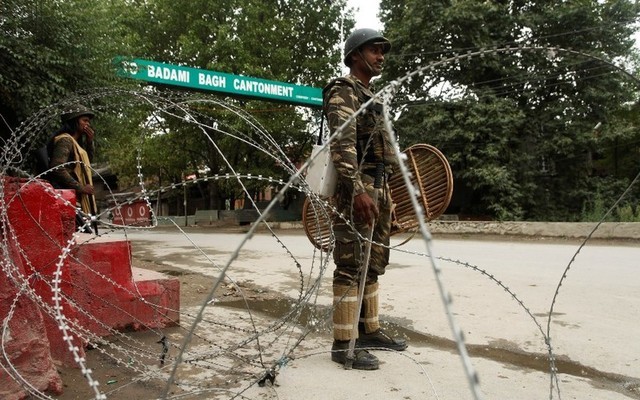
For over a month practically the entire Kashmir valley has been under a state of curfew. The innocuous term curfew camouflages the extreme torture and suffering inflicted on the people; curfew actually is ‘house arrest’ of every citizen from a newborn to a person in his nineties. The orders for a curfew may emanate from a magistrate imposing section 144, IPC which restricts people from assembling in public place. Thus millions are put under house arrest without as much as trial by any court of law. Adinfinitum the curfew hours keep on getting extended into days, weeks and months. Meanwhile the fundamental rights of people to life, liberty and equality are flagrantly violated. Long term use of curfew violates the norms laid down by the United Nations and is also in breach of the international law on the issue.

Indefinite curfew limits movement of people; they cannot go to the market place to buy food and medicines; people cannot attend to school, colleges or offices; arranging a funeral for a deceased is a harrowing experience. Reaching a hospital for a medical emergency would jeopardize the patient’s life as also that of the attendant,since both of them could be shot at sight. If the patient and the attendant escape death due to being shot at, they risk being injured or blinded by rubber pellets used by the police/ para-military/ army personnel. Since sanitation and garbage removal is practically impossible wherever curfew has been imposed for long, people risk facing epidemics of gastroenteritis; stagnant water breeding mosquitoes could lead to large number of cases of malaria, dengue, chikungunyaetc. People are at risk of getting any infection since they are unable to get proper nutrition and food. It is an understatement to say that these people are victims of Post Traumatic Stress Disorder (PTSD). In fact all social interactions come to a standstill. A variety of steps taken by the authorities during indefinite curfew imposition viz stoppage of newspapers; clamping down of internet service (internet curfew) and cable services/news channels and even telecommunication effectively ensures that individuals/families suffer the ignominy of being in a solitary cell. The feeling is no different from that of a death row convict kept in an isolation cell within the four walls of a jail compound. Ironically the whole of Kashmir has been compared to an open air prison. An apt simile indeed!

There is of course the Armed Forces Special Powers Act under which any house can be raided and the people terrorized into total submission. The under one million strong army personnel – viewed by Kashmiris as an army of occupation – would kill with impunity any one it deems to be a militant. The army personnel working under the umbrella of AFSPA are able to get away with crushing anyone’s liberty and freedom. To hammer this point for the benefit of those Indians who tend to distance themselves from the Azadi movement in Kashmir it would be instructive if they were to read up the political history of India under Mrs. Gandhi’s Internal Emergency years, 1975-77. At least Mrs. Gandhi had to promulgate an Emergency; at least the judiciary had to go through the farce of ADM Jabalpur case known as the habeas corpus case; at least the Attorney General of India had then confessed before a Constitution bench of the Supreme Court of India that the right to life stands suspended; at least there wasa redemption – that at least one judge by the name of Justice H.R. Khanna stuck his neck out. But what about Kashmir? The case pertaining to the ongoing developments in Kashmir is being heard by the Supreme Court of India but the truth is being hidden from the court by the rulers in Delhi. What is easily forgotten presently is that it is the political establishment in India as well as the independence of press and judiciary whose credibility is at stake. The whole world watches in silence. Worse, the U.N. has lately made it clear that it would shut its eyes to these developments in Kashmir.

Curfew as a psychological warfare

The torture suffered by the people during prolonged and sustained curfew should not be underestimated. The conventional torture of a single accused in custody may get to be in public domain occasionally, resulting in a sequence of events which may entail a magisterial enquiry and punishment of the guilty police personnel involved in custodial torture or unnecessary deprivation of personal liberty beyond the period stipulated in law. Such a process does not even get to be thought of and reported and acted upon to ensure that further torture is stopped and those responsible for perpetrating prolonged curfew on a mass of citizens get to face an enquiry. Such is the very nature of mass torture during prolonged curfew extending beyond months. The indefinite curfew imposed upon the people of Kashmir appears to be a collective punishment imposed upon thos

How Obama Administration Encouraged The Rise Of Islamic State?

By Nauman Sadiq

Although, I admit that Donald Trump’s recent remarks that Obama Administration willfullycreated the Islamic State were a bit facile, but it is an irrefutable fact that Obama Administration’s policy of nurturing the Syrian militants against the Assad regime from August 2011 to August 2014 created the ideal circumstances which led to the creation of not just Islamic State but myriads of other Syrian militant groups which are just as fanatical and bloodthirsty as Islamic State.

It should be remembered here that the Libyan and Syrian crises originally began in early 2011 in the wake of the Arab Spring uprisings when the peaceful protests against the Qaddafi and Assad regimes turned militant. Moreover, it should also be kept in mind that the withdrawal of the United States’ troops from Iraq, which has a highly porous border with Syria, took place in December 2011.

Furthermore, the Democratic presidential nominee, Hillary Clinton, served as the United States’ Secretary of State from January 2009 to February 2013. Thus, for the initial year-and-a-half of the Syrian civil war, Hillary Clinton was serving as the Secretary of the State and the role that she played in toppling the regime in Libya and instigating the insurgency in Syria is not hidden from anybody’s eyes.

Additionally, it is also a known fact that the Clintons have cultivated close ties with the Zionist lobbies in Washington and the American support for the proxy war in Syria is specifically about ensuring Israel’s regional security as I shall explain in the ensuing paragraphs. However, it would be unfair to put the blame for the crisis in Syria squarely on the Democrats; the policy of nurturing militants against the regime has been pursued with bipartisan support. In fact, Senator John McCain, a Republican, played the same role in the Syrian civil war which Charlie Wilson played during the Soviet-Afghan war in the ‘80s. And Ambassador Robert Ford was the point man in the United States’ embassy in Damascus.

More to the point, the United States’ Defense Intelligence Agency’sreport [1] of 2012 that presaged the imminent rise of aSalafist principality in northeastern Syria was not overlooked it was deliberately suppressed; not just the report but that view in general that a civil war in Syria will give birth to the radical Islamists was forcefully stifled in the Washington’s policy making circles under pressure from the Zionist lobbies.

The Obama Administration was fully aware of the consequences of its actions in Syria but it kept pursuing the policy of funding, training, arming and internationally legitimizing the so-called “Syrian Opposition” to weaken the Syrian regime and to neutralize the threat that its Lebanon-based proxy, Hezbollah, posed to Israel’s regional security; a fact which the Israeli defense community realized for the first time during the 2006 Lebanon war during the course of which Hezbollah fired hundreds of rockets into northern Israel. Those were only unguided rockets but it was a wakeup call for Israel’s defense community that what would happen if Iran passed the guided missile technology to Hezbollah whose area of operations lies very close to the northern borders of Israel?

Notwithstanding, how can the United States claim to fight a militant group which has been an obviousby-product [2] of the United States’ policy in Syria? Let’s settle on one issue first: there were two parties to the Syrian civil war initially, the Syrian regime and the Syrian opposition; which party did the US support since the beginning of the Syrian civil war in early 2011 to June 2014 until Islamic State overran Mosul?

Obviously, the United Statessupported the Syrian opposition; and what was the composition of the so-called “Syrian Opposition?” A small fraction of it was comprised of defected Syrian soldiers, which goes by the name of Free Syria Army, but a vast majority has been Sunni jihadists and armed tribesmen who were generously funded, trained and armed by the alliance of Western powers, Turkey, Jordan and the Gulf States.

Islamic State is nothing more than one of the numerous Syrian jihadist outfits, others being: al Nusra Front, Ahrar al-Sham, al-Tawhid brigade, Jaysh al Islam etc. The United States-led war against Islamic State is limited only to Islamic State while all other Sunni Arab jihadist groups are enjoying complete impunity, and the so-called “coalition against Islamic State” also includes the main patrons of Sunni Arab jihadists like Saudi Arabia, UAE, Kuwait, Qatar, Turkey and Jordan.

Regardless, many biased political commentators of the mainstream media deliberately try to muddle the reality in order to link the emergence of Islamic State to the ill-conceived invasion of Iraq in 2003 by the Bush Administration. Their motive behind this chicanery is to absolve the Obama Administration’s policy of supporting the Syrian opposition against the Assad regime since the beginning of the Syrian civil war until June 2014 when Islamic State overran Mosul and Obama Administration made a volte-face on its previous policy of indiscriminate support to the Syrian opposition and declared a war against a faction of Syrian opposition: that is, the Islamic State.

Moreover, such spin-doctors also try to find the roots of Islamic State in al-Qaeda in Iraq; however, the insurgency in Iraq died down after the“surge” of American troops in 2007. Al-Qaeda in Iraq became a defunct organization after the death of Abu Musab al Zarqawi and the subsequent surge of troops in Iraq. The re-eruption of insurgency in Iraq has been the spillover effect of nurturing militants in Syria against the Assad regime when Islamic State overran Fallujah and parts of Ramadi in January 2014 and subsequently captured Mosul in June 2014.

The borders between Syria and Iraq are highly porous and it’s impossible to contain the flow of militants and arms between the two countries. The Obama Administration’s policy of providing money, arms and training to the Syrian militants in the training camps located at the border regions of Turkey and Jordan was bound to backfire sooner or later.

Notwithstanding, in order to simplify the Syrian quagmire for the sake of readers, I would divide it into three separate and distinct zones of influence. Firstly, the northern and northwestern zone along the Syria-Turkey border, in and around Aleppo and Idlib, which is under the influence of Turkey and Qatar. Both of these countries share the ideology of Muslim Brotherhood and they provide money, training and arms to the Sunni Arab jihadist organizations like al-Tawhid Brigade and Ahrar al-Sham in the training camps located at the border regions of Turkey.

Secondly, the southern zone of influence along the Syria-Jordan border, in Daraa and Quneitra and as far away as Homs and Damascus. It is controlled by the Saudi-Jordanian camp and they provide money, weapons and training to theSalafist militant groups such as al-Nusra Front and the Southern Front of the so-called “moderate” Free Syria Army in Daraa and Quneitra, and Jaysh al-Islam in the suburbs of Damascus. Their military strategy is directed by a Military Operations Center (MOC) and training camps [3] located in the border regions of Jordan. Here let me clarify that this distinction is quite overlapping and heuristic at best, because al-Nusra’s jihadists have taken part in battles as far away as Idlib and Aleppo.

And finally, the eastern zone of influence along the Syria-Iraq border, in al-Raqqa and Deir al-Zor, which has been controlled by a relatively maverick Iraq-based jihadist outfit, the Islamic State.Thus, leaving the Mediterranean coast and Syria’s border with Lebanon, the Baathist and Shi’a-dominated Syrian regime has been surrounded from all three sides by the hostile Sunni forces: Turkey and Muslim Brotherhood in the north, Jordan and the Salafists of the Gulf Arab States in the south and the Sunni Arab-majority regions of Mosul and Anbar in Iraq in the east.

Sources and links:

[1] United States’ Defense Intelligence Agency’s report of 2012:

2012 Defense Intelligence Agency document: West will facilitate rise of Islamic State “in order to isolate the Syrian regime”

[2] How Syrian Jihad spawned the Islamic State?

http://www.atimes.com/atimes/Middle_East/MID-01-220914.html

[3] Weapons flowing from Eastern Europe to Middle East:

https://www.theguardian.com/world/2016/jul/27/weapons-flowing-eastern-europe-middle-east-revealed-arms-trade-syria


Nauman Sadiq is an Islamabad-based attorney, columnist and geopolitical analyst focused on the politics of Af-Pak and MENA regions, neocolonialism and Petroimperialism.
13 August 2016

How To Break The Power Of Money

By David Korten

Our current political chaos has a simple explanation. The economic system is driving environmental collapse, economic desperation, political corruption, and financial instability. And it isn’t working for the vast majority of people.
It serves mainly the interests of a financial oligarchy that in the United States dominates the establishment wings of both the Republican and Democratic parties. So voters are rebelling against those wings of both parties—and for good reason.

As a society we confront a simple truth. An economic system based on the false idea that money is wealth—and the false promise that maximizing financial returns to the holders of financial assets will maximize the well-being of all—inevitably does exactly what it is designed to do:

Those who have financial assets and benefit from Wall Street’s financial games get steadily richer and more powerful.
The winners use the power of their financial assets to buy political favor and to hold government hostage by threatening to move jobs and tax revenue to friendlier states and countries.
The winners then use this political power to extract public subsidies, avoid taxes, and externalize environmental, labor, health, and safety costs to further increase their financial returns and buy more political power.
This results in a vicious cycle of an ever greater concentration of wealth and power in the hands of those who demonstrate the least regard for the health and well-being of others and the living Earth, on which all depend. Fewer and fewer people have more and more power and society pays the price.

A different result requires a different system, and the leadership for change is coming, as it must, from those for whom the current system does not work.

Awareness of system failure is widespread and growing.

Korten -living-earth-economyAwareness of system failure is widespread and growing. We see it in the rebellion against the establishment wings of the major political parties. We see it as previously competing social movements join forces to articulate and actualize a common vision of a new economy. We see it in varied and widely dispersed local citizen initiatives quietly rebuilding the relationships of caring communities. We see it in millions of defectors from consumerism, who by choice or necessity are living more simply.

Analysis of the sources of the system failure, however, rarely goes beyond vague references to capitalism, neoliberalism, Wall Street, and immigrants.

Most of us have been conditioned by corporate media and economics education—along with the basic fact that we need money to buy the things we need or want—to accept the pervasive, but false, claims that money is wealth and a growing GDP improves the lives of all.

It rarely occurs to us to challenge these claims in our own thinking or in conversations with friends and colleagues. So they persist and allow the corporate establishment to limit the economic policy debate to options that sustain its power.

To build a truly coherent movement with the necessary strength to replace the failed system with one designed and managed to self-organize toward a world that works for all, we must challenge its bogus claims as logical and practical fallacies. And simultaneously affirm the self-evident truth that:

We are living beings born of and nurtured by a living Earth. Life exists—can exist—only in living communities that self-organize to create the conditions essential to life’s existence. Money is just a number, an accounting chit we accept in exchange for things of real value because we have been conditioned to do so almost from birth.

We who work for peace, justice, and sustainability have the ultimate advantage. Truth is on our side. And the deepest truths, those on which our common future depends, live in the human heart. Let us each speak the truth in our own heart so that others may recognize and speak the truth in theirs. Together we will change the human story.

David Korten wrote this article for YES! Magazine as part of his new series of biweekly columns on “A Living Earth Economy.” David is co-founder and board chair of YES! Magazine, president of the Living Economies Forum, co-chair of the New Economy Working Group, a member of the Club of Rome, and the author of influential books, including When Corporations Rule the World and Change the Story, Change the Future: A Living Economy for a Living Earth. His work builds on lessons from the 21 years he and his wife, Fran, lived and worked in Africa, Asia, and Latin America on a quest to end global poverty. Follow him on Twitter @dkorten and Facebook.

YES! Magazine encourages you to make free use of this article by taking these easy steps. Creative Commons License

13 August 2016

A Nonviolent Strategy To End War

By Robert J Burrowes

There is a long history of anti-war and peace activism. Much of this activism has focused on ending a particular war. Some of this activism has been directed at ending a particular aspect of war, such as the use of a type of weapon. Some of it has aimed to prevent a type of war, such as ‘aggressive war’ or nuclear war. For those activists who regard war as the scourge of human existence, however, ‘the holy grail’ has always been much deeper: to end war.

There is an important reason why those of us in the last category have not, so far, succeeded. In essence, this is because, whatever their merits, the analyses and strategies we have been using have been inadequate. This is, of course, only a friendly criticism of our efforts, including my own. I am also not suggesting that the task will be easy, even with a sound analysis and comprehensive strategy. But it will be far more likely.

Given my own preoccupation with human violence, of which I see war as a primary subset, I have spent a great deal of time researching why violence occurs in the first place – see ‘Why Violence?’ http://tinyurl.com/whyviolence and ‘Fearless Psychology and Fearful Psychology: Principles and Practice’. http://anitamckone.wordpress.com/articles-2/fearless-and-fearful-psychology/ – and by taking or teaching strategic nonviolent action in response to many of its manifestations.

Moreover, given that I like to succeed when I work for positive change in this world, I pay a great deal of attention to strategy. In fact, I have written extensively on this subject after researching the ideas of the greatest strategic theorists and strategists in history. If you are really keen, you can read about this in ‘The Strategy of Nonviolent Defense: A Gandhian Approach’. http://www.sunypress.edu/p-2176-the-strategy-of-nonviolent-defe.aspx

However, because I know that most people aren’t too interested in scholarly works and that nonviolent activists have plenty of worthwhile things to do with their time, I have recently been putting the essence of the information in the book onto two websites so that the strategic thinking is presented simply and is readily available.

One of the outcomes I would like to achieve through these websites is to involve interested peace and anti-war activists from around the world in finalizing the development of a comprehensive nonviolent strategy to end war and to then work with them to implement it.

Consequently, I have been developing this nonviolent strategy to end war and I invite you to check it out and to suggest improvements. You can see it on the Nonviolent Campaign Strategy website. https://nonviolentstrategy.wordpress.com/

If you are interested in being involved in what will be a long and difficult campaign, I would love to hear from you.

You might also be interested in signing the online pledge of ‘The People’s Charter to Create a Nonviolent World’ http://thepeoplesnonviolencecharter.wordpress.com where the names of many nonviolent activists who will work on this campaign are already listed.

Ending war is not impossible. But it is going to take a phenomenal amount of intelligent strategic effort, courage and time. Whether we have that time is the only variable beyond our control.

Robert J. Burrowes has a lifetime commitment to understanding and ending human violence. He has done extensive research since 1966 in an effort to understand why human beings are violent and has been a nonviolent activist since 1981. He is the author of ‘Why Violence?’

10 August 2016

Mordechai Vanunu: Israel’s Nuclear Whistle Blower And Hostage

By Eileen Fleming

A hostage is understood to be a person taken by force to secure the taker’s demands; or one that is involuntarily controlled by an outside influence.

Mordechai Vanunu Israel’s Nuclear Whistleblower claimed the title “The Last Hostage” at his Facebook, Twitter and YouTube Channels with this iconic response to Israel’s July 4 indictment against him:
On 4 July 2016, Vanunu reported at Facebook that “after 30 years in Israel prison the new trial started today. From the big trial of exposing Israel Atomic weapons secrets to new charges about moving apartment without reporting, for meeting foreigners, and for speaking to Israel media about Dimona Nuclear secrets. So the trial started and will continue in next months.”
On 27 July 2016, MSN.com ran a five-page spread titled “Notorious kidnappings and how they ended” and published this text:

Israeli whistleblower Mordechai Vanunu was abducted by Mossad agents in Rome in 1986. Vanunu, who worked as a nuclear technician at Israel’s secret nuclear weapons facility at Dimona from 1976 to 1985, was in Britain at the time, exposing the country’s nuclear capabilities.

Mossad wanted him captured on espionage charges, but didn’t want a confrontation with British intelligence or harm their country’s relation with Margaret Thatcher.

Thus, the officials lured Vanunu out of Britain and into Rome where he was kidnapped, drugged and smuggled out to Israel. Vanunu served an 18-year sentence after his conviction.

This reporter submitted the following response to MSN via their FEEDBACK page:

Regarding article “Notorious kidnappings and how they ended” and Mordechai Vanunu who indeed was kidnapped by Mossad in 1986 and released from jail in 2004.

However the Vanunu saga has continued is documented in “Beyond Nuclear: Mordechai Vanunu’s FREEDOM of SPEECH Trial and My Life as a Muckraker 2005-2010” and in the 2015 release of “Heroes, Muses and The Saga of Mordechai Vanunu”

Will MSN report on Vanunu’s 12 yr HUMAN RIGHTS struggle to leave Israel?

NO RESPONSE yet from MSN.com

On 7 February 2014, NBC reporters Matthew Cole, Richard Esposito, Mark Schone and Glenn Greenwald collaborated on the NBC NEWS INVESTIGATION: Snowden Docs

Instead of contacting Mordechai Vanunu for his side of the story [Vanunu’s email, snail mail and phone number were published on his site at that time] the NBC reporters repeated the “fact” that the reason Israel’s “honey trap” worked to lure the nuclear technician from London to Rome, was because “he expected an assignation with a woman”.

In 2006, after this reporter had run out of tape -but not questions- in the interview known as “30 Minutes with Vanunu” which was taped a few weeks after Vanunu’s Freedom of Speech Trial began, I asked Vanunu what was he thinking when he flew from London to Rome with who he thought was an American beautician on holiday.Vanunu looked me in the eye and readily replied:

It wasn’t like THAT-when Maxwell’s paper published my photo without ever talking to me and some of the stolen Dimona photos with a very bad story against me, I knew the Mossad was after me. Cindy said she had a sister in Rome and I thought I would be safe there until I could return to London.

We went to movies and art galleries, I trusted her. But, as soon as I got into the apartment, I was hit on the head and drugged. When I woke up and they took me for interrogation, they threw the Times article on the table and said, ‘Look, what you did.’

What Vanunu did was shoot two rolls of film from Top Secret locations within Israel’s 7-story underground WMD facility at Dimona.

What London’s Sunday Times did was publish a front-page photo of the Dimona reactor and a story that spread over three pages revealing Israel’s arsenal of upwards of 200 nuclear warheads on Oct. 5, 1986-five days after the Mossad kidnapped Vanunu.

While Cheryl deceived Vanunu with a Judas Kiss, she was also deceiving her sister-in-law Cindy, whose Passport and identity she was traveling under.

Cheryl grew up in Pennsylvania and Orlando in a Jewish family that owed its affluence to tires. I moved to Orlando in the mid 1970’s and still can recall her father, Stanley Hanin, the founder and pitchman for the Allied Discount Tires chain stores, self-produced cheesy TV commercials with the refrain, “Tires ain’t pretty, but you gotta have them!”

As her parents went through an acrimonious divorce, Cheryl embarked upon a long love affair with the Zionist State. In 1977, she spent a semester in Israel, studied Hebrew and Jewish history and threw herself into her academic and religious studies in a three-month residential course funded by the World Zionist Organization.

In 1985, Cheryl Hanin married Ofer Ben Tov, six years her senior and soon after she attracted the attention of the Mossad.

In 1996, The St. Petersburg Times reported that Cheryl continues to work for the Mossad.

It is illegal under American-Israeli diplomatic protocols for the Mossad to operate in America.

Beginning in 1951, the Mossad has ranked as one of the world’s most skilled and lethal intelligence agencies.

Gordon Thomas wrote in Gideon’s Spies: The Secret History of the Mossad, “that Cheryl was sent on practice missions – breaking into an occupied hotel room, stealing documents from an office…She was roused from her bed in the dead of night and dispatched on more exercises: picking up a tourist in a nightclub, then disengaging herself outside his hotel. Every move she made was observed by her tutors.”

Mordechai Vanunu was hired as a technician trainee in 1976 and began a crash course in nuclear physics. All employees were required to sign the Official Secrets Act, which forbid disclosure of sensitive material. Because he was a good worker, Vanunu was cross-trained in many areas and spent nine years on the night shift at the center.

In the daytime, Vanunu graduated with a degree in Philosophy and Geography at Ben-Gurion University, where he also became active in politics and supported Palestinian human rights causes. Vanunu was repeatedly warned by officials at Dimona to halt his political activities, but he ignored them.

In 1985, Vanunu was told he would be transferred or laid off, instead he quit after photographing models of different types of bombs from Top Secret locations after a supervisor carelessly left the keys in the shower room.

After a few intense hours and nearly being caught, Vanunu returned the keys and stashed the film and camera back in his locker. A few days later he smuggled out the film and then the camera in his backpack, which was checked by Dimona Security both before entering and departing the nuclear facility.

Vanunu quit the Dimona in October 1985 and left Israel in early 1986 with the still undeveloped film. He traveled through Europe and wound up in Sydney, Australia, where he worked as a taxi driver and began to attend a social justice Anglican Church. Vanunu was born into an Orthodox Zionist home, but had become an atheist in early adolescence. The welcoming he received from parishioners who were already engaged in the struggle to get the Church to oppose nuclear weapons opened Vanunu up to tell his story about Israel’s WMD Facility at Dimona.

Among Vanunu’s new friends was Oscar Guerrero, a flamboyant Colombian who had been painting the church. Guerrero, realizing an expose of Israel’s nuclear program could be a gold mine, told Vanunu he was an “international journalist” who could help get the story published. At the Colombian’s urging, Vanunu developed his film, and Guerrero shopped the story to news organizations. All rejected him until he approached London’s Sunday Times in August 1986. Investigative reporter, Peter Hounam was assigned to determine if Vanunu’s story was credible.

Guerrero was dismissed but Hounam traveled to Australia to interview Vanunu who described a far more extensive weapons production program than anyone had imagined. Hounam wrote, “These were weapons that could obliterate a major city – they had no sensible battlefield application. I was utterly absorbed in the wealth of detail he was able to supply.”

The Sunday Times would not and did not pay for any information, but they did offer Vanunu $100,000 for a book deal and serialization in a German magazine.

However Vanunu never had a chance to sign that contract before being kidnapped by Mossad.

On 5 October 1986, London’s Sunday Times ran a front-page photo of the Dimona reactor and a three-page spread revealing Israel had an arsenal of 200 nuclear warheads. Israel did not deny the story and refused to say anything about Vanunu.

The Press was denied access to Vanunu, but he reached them without speaking a sound!

A Security officer had given Vanunu a pen, which he used to ink his palm on the way to the courthouse: “Vanunu M was hi-jacked in Rome. ITL. 30.9.86. 21.000. Came to Rome by fly BA504.”

Vanunu’s inspired move was then caught on film as he pressed his palm to the car window and Hounam was able to piece together the story of Vanunu’s kidnapping which led to a confrontation with Ben Tov who had purchased the business-class tickets on British Airways Flight 504 flight to Rome.

Vanunu told this reporter that the moment he entered the apartment he was hit and pinned to the ground, drugged, clubbed, bound and flung onto a small yacht or a disguised Israeli navy ship.

Vanunu endured a closed-door trial and was denied the right to speak in his own defense. His lawyer argued he didn’t commit treason because he did not share information with a hostile foreign government but went to The Media in a case of the public’s right to know.

Hounam tracked Ben Tov to Netanya, a city on Israel’s Mediterranean coast and asked her if she was Cindy?

“I deny it, I deny everything,” she shouted as Hounam snapped a few photos of her. By that night, the house was deserted.

In 1997, another Sunday Times reporter found Cheryl Hanin Ben Tov back in Orlando, living in a secluded villa. Her only concern was that any story about her should not “harm her position in America.”

According to the paper, the Ben Tov’s also had a villa in Israel in an area that is home to many security officials.

Cheryl “continues to work for Mossad, according to her Israeli neighbors” the Sunday Times said. She and her husband, they believe “have rented out their house, while she is engaged in an overseas assignment, and are expected some day to return.”

Florida state records had also once showed Cheryl “had an active real estate sales license and was employed by CFI Sales & Marketing of Orlando.”
However CFI, whose Westgate Resorts is one of the world’s largest timeshare companies, said Ben Tov was terminated in 1997, the same year the Sunday Times found her in Orlando.

After the St. Petersburg Times began looking into Hanin’s background, state records were changed to show her license as inactive and without any reference to CFI.

Officials could not say who requested the change. CFI says it did not.

It is illegal under American-Israeli diplomatic protocols for the Mossad to operate in America, but it does not make it impossible.

What could is a Media that investigates for the public’s right to know instead of being controlled by an outside influence.

Eileen Fleming,
Senior Non-Arab Correspondent for USA’s The Arab Daily News
Author, Reporter
10 August 2016

Erdogan Resets Relations With Russia

By Abdus Sattar Ghazali

On Tuesday, August 9, 2016, the Turkish President Recep Tayyip Erdogan arrived in St. Petersburg to hold talks with the Russian President Vladimir Putin. This was Erdogan’s first foreign visit since the July 15 abortive coup against his elected government. St. Petersburg is Putin’s hometown.

Addressing a joint press conference after the talk, Putin said: “I believe that we have all the necessary prerequisites and opportunities for restoring our relations between our two countries to the full extent and Russia is ready and willing to do that.”

On his part, Erdogan said: “As a result of the negotiation we had today, political, cultural and economic relations between Russia and Turkey can finally be restored to the appropriate level we used to enjoy before the crisis.”

Ties between the two countries have been acrimonious since November last year when Turkey, citing a brief violation of its airspace along Turkey’s border with Syria, shot down a Russian military aircraft. Russia’s President Vladimir Putting ordered punishing economic sanctions, imposed a travel ban on Russian tourists visiting Turkey and suspended all government-to-government relations.

Unable to ignore the damage, Erdogan conveyed regrets to Putin; the regrets were accepted which paved the way for August 9 meeting. Interestingly, the two Turkish Air Force pilots linked to the downing of the Russian Su-24 bomber have been detained in connection with the recent failed coup attempt in Turkey, according to Turkish Justice Minister Bekir Bozdag.

Areas of cooperation
Turkey wants to bring ties with Russia to pre-crisis levels with cooperation in the defense industry sector and energy projects including the Turkish Stream gas pipeline and the Akkuyu nuclear plant, Turkish President Recep Tayyip Erdogan said at the press conference.

As a result of the negotiation we had today, political, cultural and economic relations between Russia and Turkey can finally be restored to the appropriate level we used to enjoy before the crisis,” Erdogan said.

Erdogan also outlined a list of areas of cooperation where Ankara is eager to engage in cooperation.

“I would like to emphasize that we are willing to provide strategic investment status to the Akkuyu project, and we have just reached an understanding on this issue with President Putin. We also intend to promote cooperation in the area of defense industry and defense production,” he stressed.

The Turkish head of state additionally pledged to implement the Turkish Stream natural gas pipeline project, vowing to ensure a route for Russian gas exports heading toward Europe.

Russia will gradually lift the restrictions it had imposed against Turkish companies, Russian President Vladimir Putin said during the press conference.

“After the press conference, we shall have an opportunity to speak to the heads of large companies from both Russia and Turkey. I mean the gradual lifting of the special economic measures, restrictions introduced earlier against Turkish companies,” Putin told a press conference after the meeting.

Did not discuss the Syrian issue

Ironically, Erdagon and Putin did not discuss the thorny Syrian issue. “During today negotiations we didn’t discuss situation in Syria,” Recep Tayyip Erdogan said answering the question from journalists.

Vladimir Putin has also confirmed, that the Syrian crisis will be discussed later. “We believe that the Syrian crisis can be resolved only through diplomatic decision,” he noted. “We have experienced many challenges in our relations recently, but we should restore our relations on pre-crisis level for citizens’ sake,” President Putin said in conclusion.

Russia sides with Syrian President Bashar al-Assad while Turkey, like US and other European nations, want to topple Assad. They support rebel groups, including the so-called Islamist ones, who are fighting Assad. But the Syrian leader remains firmly in power more than five years after the civil war began.

According to Andrey Kortunov, director general of the Russian International Affairs Council, there was room for the two sides to move closer together on options for a political transition to end the five-year civil war and on the shape of a new constitution for the country.

However, Russia’s TASS news agency quoted Erdogan’s spokesman Ibrahim Kalin “in cooperation with Russia, we would like to facilitate a political transition in Syria as soon as possible.” But he repeated Turkey’s long-held stand that such a move would only be possible with Assad’s departure.

TurkStream gas pipeline

While the timing of Erdogan’s Russia trip could be interpreted as a signal to the West, Faruk Logoglu, a former Turkish ambassador to Washington, doubted it meant a full Turkish embrace of Russia or lasting damage to U.S. ties.

“The Turkish-American relationship is like a catholic marriage: there is no divorce. Both sides need each other,” he said. “It has experienced severe tests in the past and I think it will weather this one as well.”

However, closer ties between Ankara and Moscow could be more troublesome for Europe, which sees a plan for a gas pipeline from Russia to Turkey, a project known as TurkStream, as a complication in its efforts to cut dependence on Russian energy.

“Gas cooperation between Russia and Turkey could be scary for the European Union,” said Akin Unver, assistant professor of international relations at Kadir Has university in Istanbul and an expert in regional energy.

“The EU wants to diversify suppliers and link eastern Mediterranean gas to Europe in the long run … if Russia bypasses all that with TurkStream that would not help. But the EU is in no position to bargain. Politically, it is very weak.”

EU officials fear that TurkStream will be expanded to bypass Ukraine as a transit route for supplies to Europe, increasing dependence on Russian gas export monopoly Gazprom and shutting in alternative supplies from the Caspian region.

Russian Energy Minister Alexander Novak has said Turkey will “play a large role as a transit country” to supply Europe – the very prospect which worries EU officials. Brussels is instead promoting a chain of pipelines known as the Southern Gas Corridor to transport gas from the Shah Deniz field in Azerbaijan to European markets by 2020.

Erdogan to West: ‘Mind your own business’

President Erdogan’s visit to Russia came at a time when the Turkish government is discontented and displeased with the Western countries not showing support to his elected government but criticizing his government action against the perpetrators of the July 15 abortive coup.

Erdogan said Western leaders who were criticizing the Turkish government’s reaction to the July 15 coup attempt should “mind their own business.”

He said: “When five to 10 people die in a terror attack, you [Western countries] set the world on fire. But when there is a coup attempt against the president of the Turkish Republic, who always protects the democratic parliamentary system and who was elected with 52 percent of the general vote, instead of siding with the government you side with the perpetrators.”

Erdogan also criticized the head of the US general command for suggesting that crackdowns in the Turkish military after the failed coup attempt had harmed the fight against the Islamic State of Iraq and the Levant (ISIL, also known as ISIS).

“I am concerned that it will impact the level of cooperation and collaboration that we have with Turkey which has been excellent, frankly,” General Joseph Votel said, speaking at the Aspen Security Forum in Colorado, US.

After the failed coup of July 15, more than 8,500 officers and soldiers, including 157 of the 358 generals and admirals in the Turkish military’s ranks, were discharged. Prime Minister Binali Yildirim has announced that the military’s shipyards and weapons factories will be transferred to civilian authority; military high schools and war academies have been shut; military hospitals will be transferred to health ministry; and the gendarmerie, a key force in anti-terror operations, and the coast guard will be tied to the interior ministry.

“Know your place,” Erdogan said in response. “The US general [Joseph Votel] stands on the coup plotters’ side with his words. He disclosed himself via his statements,” Erdogan said, as he repeated calls for the US to extradite Fethullah Gulen, who is accused of plotting the abortive coup through his followers penetrated in the Turkish civil and military bureaucracy.

Following Erdogan’s comments, Votel issued a statement denying he was supporting the coup plotters. “Any reporting that I had anything to do with the recent unsuccessful coup attempt in Turkey is unfortunate and completely inaccurate,” Votel said in his statement. “Turkey has been an extraordinary and vital partner in the region for many years. We appreciate Turkey’s continuing cooperation and look forward to our future partnership in the counter-ISIL fight.”

Massive purge in civil and military bureaucracy

In the aftermath of the abortive coup, the government has dismissed 2,745 judges including members of Turkey’s highest judiciary board. Licences of 21,000 private school teachershave been cancelled. Around 50,000 soldiers, police, judges, civil servants and teachers have been suspended or removed. Erdogan ordered 1,577 deans of universities to resign.

According to Metin Gurcan, an ex-army officer now working as a columnist for Al-Monitor’s Turkey Pulse,on July 27, 1,684 ranking officers of the Turkish Armed Forces (TSK) were dismissed for constituting a threat to national security and for their affiliation with the Fethullah Gulen Terror Organization (FETO).

The purge ruling, which cannot be appealed, covered 2% of 40,000 officers in the TSK and 1% of approximately 90,000 noncommissioned officers. The ranks most affected were generals and admirals.

Of the 325 generals in Turkey’s army, air and naval forces, 149 (45.8%) were discharged on July 27, including two four-star generals, seven lieutenant generals, 27 major generals/vice admirals (12 army, 11 air force and four navy) and 126 brigadier generals/rear admirals.

Before the purge was made public, Land Forces Chief of Staff Gen. Ihsan Uyar, the No. 2 name of that major command, and Gen. Kamil Basoglu, commander of Training and Doctrine of the army, submitted their resignations.

Army, air and naval commanders will be under the Minister of Defense, and gendarmerie, police and coast guard will be under the Ministry of Interior.

Erdogan has already said the chief of General Staff and Military Intelligence Organization (MIT) should be directly attached to the presidency and that such a move would require structural reforms in Turkey’s security. But because of a lack of support from opposition parties for such a radical change, a constitutional amendment will be needed to make those changes.

This is not the first coup plot to fail in Turkey

This is not the first coup plot to fail in Turkey.

According to the Geneva Center for Security Policy, following the 1960 coup, for example, Colonel Talat Aydemir spearheaded two coups in 1962 and 1963, but – like the most recent coup attempt – failed to win the support of the Turkish high command. The Turkish military, during this time, was divided – much like today – and ultimately took steps to prevent “factionalization” within the institution, beginning with a purge of 1,400 of Aydermir’s reported sympathizers from the military academy in 1963 and 1964.

The next intervention took place in 1971, through the issuing of a memorandum that forced the resignation of the then elected Prime Minister, Suleyman Demirel, and then again in 1980.

The military, in 2007, posted a memorandum challenging the legitimacy of the AKP’s then candidate for president, Abdullah Gul, because his wife wore a headscarf. The Turkish military has traditional viewed its role as guardians of Turkish secularism, a concept that includes other political tenets – known as “six arrows” – that collectively are defined as Kemalism. The constitutional court implicitly backed the military, as did the main opposition party, the Republican People’s Party (CHP). The AKP subsequently called a snap parliamentary election, calculating that the public would side with them, and ultimately won 341 seats, an increase from their previous position, and easily exceeding the number of seats needed to elect Gul.

Turkey court issues arrest warrant for Fethullah Gulen

A court in Turkey has issued a formal warrant for the arrest of Fethullah Gulen, who has lived in Pennsylvania since 1998, whom the government accuses of being behind the failed coup that resulted in the death of more than 250 people. The official Anadolu news agency said that on August 4, 2016 an Istanbul-based court issued the warrant for Gulen for “ordering the July 15 coup attempt”.

The order for Gulen’s arrest is seen a step toward a formal extradition request to the United States, which Turkish officials say will be submitted after an investigation into the botched coup.

Erdogan has been calling for the extradition since 2013, when he accused Gulen’s followers, who held positions in the judiciary, of orchestrating a corruption inquiry that implicated Erdogan’s inner circle. An arrest warrant for Mr. Gulen was issued in Turkey in 2014, accusing him of directing “an armed terrorist organization” that illegally tapped the conversations of the prime minister and president.

Metin Gurcan, a senior columnist, provides an insight into the Gulen movement which has been active in Turkey for 40 years and operates in 130 countries employing hundreds of thousands of people in the fields of education, health and trade with annual revenue exceeding $50 billion.

Metin argues that “ we tend to see the Gulenist structure in a modern paradigm as a hierarchical body, with rigid internal discipline and followers who are strongly devoted to its highly charismatic leader. This is where we make mistakes when analyzing the Gulenist structure.”

According to Kahraman Sakul of Istanbul Sehir University who spoke to Al-Monitor, the Gulenist network is based on much more complex relations. He said, “Contrary to sustained media comments, I don’t think the network model of Gulenists emulates the classical pyramid model of terrorists. The Gulen movement has transparent, overt networks of trade, finance, education, media, health and social media and secret, covert networks of military and intelligence bureaucracy.”

“Until now, international opinion focused on overt Gulenist networks. But the testimonies of soldiers detained after the coup make it clear there are enormous differences between the overt and covert networks of the Gulenist movement,” Metin says adding:

“In their official narratives used by overt networks, Fethullah Gulen is portrayed as an “opinion leader.” We are told that his basic goal is to spread his service worldwide, to serve global peace by doing business all over, to overcome prejudices between religions and culture, and to ensure interfaith dialogue. But what we hear from testimonies of pro-Fethullah Gulen Terror Organization (FETO) military officers, the narrative used in secret networks is quite different.

“Chief of General Staff Hulusi Akar, who was taken hostage by his closest associates on the night of the coup attempt, has said he was approached by air force brigadier Hakan Evrim, who told him, “If you wish, we can arrange for you to talk to our opinion leader Fethullah Gulen,” which proved their absolute obedience to Gulen.

How Gulen nework works?

“Soldiers in the covert networks are obliged to carry out the orders passed on to them by their civilian “older brothers.” No Gulenist in uniform knew any other officer of the same affiliation. This is best explained by the testimony of Muhammed Uslu, a civilian working in the private secretariat of the Prime Ministry who was also the “older brother” of Lt. Col. Levent Turkkan, the senior aide to Akar. We were amazed to hear how Uslu received the daily recordings of the office of the Chief of General Staff and passed them on to another civilian brother he didn’t even know.

“The group that constitutes the core of the secret network would spread the unquestionable instructions to lower levels, where the only requirement was to carry them out. This blind obedience also meant that many bright Turkish Armed Forces (TSK) officers with master’s and doctorate degrees were passing on what they learned to “older brothers” they didn’t even know.

“ Secret cells of Gulenists do not operate on a hierarchical pyramid model. Their nets don’t operate on the basis of perpendicular hierarchies of command and control but on horizontal hierarchy. For example, there are reports that on the night of July 15, many generals were ordered around by colonels and even more junior ranks. An air force noncommissioned officer is said to have issued orders to generals to apprehend Erdogan.”

Gulen Movement’s absolute secrecy in a way was the basic cause of the July 15 coup failure, Metin concludes. Gulen followers successfully infiltrated the Turkish officer corps by outmaneuvering its no-beard and no-headscarf rules. Gulen no doubt justified such concealment with his own interpretation of the Islamic tenet of taqiyah. His interpretation of Islam allows the dishonesty of systematic deception.

“Turks Can Agree on One Thing: U.S. Was Behind Failed Coup,” this was the headline of the rticle published on August 2, 2016 by the New York Times. The article written by Tim Arango and Ceylan Yeginsu pointed out:

“Turks, in their exasperation that the United States has not turned over Mr. Gulen, have made this analogy: What if Turkey, in 2001, had harbored Osama bin Laden? Given the widespread sentiment that Mr. Gulen was behind the coup, a failure to extradite him would probably provoke a popular backlash in Turkey against the United States, and would confirm for many that the Americans had conspired against Turkey. “

Gülen came to America in 1998, reportedly to seek medical treatment. Since then, he has directed his global empire from Pennsylvania. A federal judge granted him a green card in 2008. Shortly after he left for America, a series of secretly recorded sermons featuring Gülen aired on Turkish television. In one of them, he told his followers:

“You must move in the arteries of the system without anyone noticing your existence until you reach all the power centers…You must wait for the time when you are complete and conditions are ripe, until we can shoulder the entire world and carry it…”

“You must wait until such time as you have gotten all the state power, until you have brought to your side all the power of the constitutional institutions in Turkey … Now, I have expressed my feelings and thoughts to you all in confidence. Know that when you leave here — as you discard your empty juice boxes, you must discard the thoughts and the feelings that I expressed here.”

Foreign Policy magazine has described Gulen as an opportunist while Pepe Escobar calls him a CIA asset. Interestingly, a former C.I.A. official and a former American ambassador to Turkey helped Mr. Gulen receive a green card, according to the New York Times.

Abdus Sattar Ghazali is the Chief Editor of the Journal of America (www.journalofamerica.net)

10 August 2016