Just International

The Caged Kashmiris!

By Mohammad Ashraf

(For three weeks now the entire Kashmir Valley has been turned into a huge prison with total blockade of communication within and with outside world)

The intention of the authorities in Delhi appears to cow down Kashmiris to the extent that they bite the dust and give up! This shows the utter lack of knowledge about the Kashmiris and their 5,000 year old history. Kashmir from the ancient times was known to be a very beautiful country somewhere in the Himalaya. One finds mention of Kashmir in almost all ancient chronicles of the Greeks, the Arabs and even the Chinese. There are no other people in this area who have such an ancient recorded history. It used to be the best seat of learning in this entire area. Kashmir had trade relations with Central Asia and people from far and wide used to come here for studies. The most important Buddhist Council which changed this religion from the strictest Hinayana School to the more acceptable Mahayana was held in Kashmir.

Kashmiris are proud of their ancient history. However, the country was an independent sovereign kingdom till the sixteenth century when Akbar, the Mughal King annexed it to his empire through treachery. Mughals had failed twice to capture Kashmir but then Akbar invited the then king Yusuf Shah Chak to Lahore for talks, arrested him there and attacked Kashmir. Being leaderless, Kashmiris still gave a fight and his son Yaqub Shah Chak fought a guerrilla war for six months but was ultimately captured in Kishtwar. Thus ended Kashmir’s independence in 1586!

Since that time the country of Kashmir has been under the occupation of outsiders who took turns in capturing it one after the other. After Mughals came the Afghans. Then came the Sikhs and finally, the Dogras purchased it from the British for a paltry sum of rupees seventy five lakhs along with its inhabitants. All the foreign rulers oppressed the local people so much that they ultimately became wretched serfs without any self-respect and dignity. The four centuries of slavery completely squeezed out of them every semblance of chivalry and manhood and they were turned into characterless bonded labour! However, there were occasional rebellions but these were put down with a harsh hand!

In spite of all the harshest conditions for last four centuries, Kashmiris have survived and are now more vigorous and vocal than ever before! There are no Mughals; there are no Afghans, there is no Sikh empire and there is no Dogra kingdom but the Kashmiris are still there! It is only their misfortune that when the whole sub-continent was having an awakening of freedom and they were expecting to free themselves from the centuries of slavery that they got locked up in a tangle which refuses to go away.However, they have not given up the hope of final salvation. It is the misfortune of the authorities keeping them down that they have not learnt a lesson from Kashmir’s history. Kashmiris will survive all the harshest measures and would still be there. However, on the contrary, the people oppressing themmercilessly may not be there like the oppressors of the earlier times!

For last three weeks the entire valley has been converted into a prison and a virtual concentration camp. There is continuous curfew in the entire valley without any relaxation or break. All communication links within Kashmir and with the outside world have been snapped. Nonstop protests are taking place all over the valley. Protesting teenagers, children and women are being showered with bullets and pellets. Over 50 people have been killed and more than 3,000 injured. As per latest reports, the pellets have affected the eyesight of over 185 persons. The newspaper presses and offices were sealed and papers confiscated. One used to hear about such harsh measures being taken in the countries behind the erstwhile “Iron Curtain”. Some of the measures are even harsher than the “Iron Curtain” measures! Kashmir is supposed to be an integral part of the democratic and secular republic of India. There is no record of similar measures ever having being taken in any other part of the republic of India. The authorities could have learnt a lesson from the happenings of 2008 and 2010. Kashmiris can never be cowed down and they always rise up whenever they feel their existence is being threatened.

For last 70 years it has not been possible for the outside forces to bring down Kashmiris on their knees. They have risen up again and again and will continue to do so in future also. A British author has observed that no outsider has ever been able to know what is really in the heart of a Kashmiri and it is only a kind word and a joke which brings out the best in a Kashmiri.The authorities in Delhi stillseem to believe in cowing down and subduing people rather than winning them over. Probably they have forgotten the saying of the most famous illustrious son of Kashmir, Kalhana, “The country of Kashmir may be conquered by the force of spiritual merit, but not by the force of soldiers!” The time seems to have run out for Delhi and there appears no turning back now!

Mohammad Ashraf, I.A.S. (Retired), Former Director General Tourism, Jammu & Kashmir.

28 July 2016

Ban Of Russian Olympic Team – Cold War At Its ‘Best’!

By Andre Vltchek

New Cold War is now in full swing and the West is using both old and new tactics, in order to demonize and discredit all of its opponents: from Russia to China, Venezuela, North Korea, South Africa and Iran.

Our anti-imperialist media outlets, including those of the RT, TeleSUR, Press TV, CCTV and Sputnik are being labeled as ‘propaganda’ channels. Defensive and internationalist initiatives of our countries are branded as aggressions. Those governments that are relentlessly working on behalf of the people are defined as ‘evil’ or at least as ‘dictatorships’.

The Empire is erecting complex and destructive web of lies and manipulations, literally trapping some countries in grotesque pseudo-legal concepts, as recently happened to China, which was confronted by The Permanent Court of Arbitration (PCA) at The Hague, which has recently ruled against, what F. William Engdhal described, as “any and all claims of China to various islands or even rocks inside what is known as the ‘Nine Dash Line’ between China’s coast and The Philippines.” China actually never asked for any ‘arbitration’; it is repeating that it has been ready to negotiate directly with the Philippines. But the West and the previous servile administration in Manila decided to turn this historical dispute into a yet another ideological and propaganda battle.

The War against the “coalition of unwilling” is constantly diversifying. Propagandists in North America and Europe are inventing new ‘weapons’ of mass intellectual and information destruction. Nothing is left intact.

The latest ‘battle’ is truly unconventional, one could even say ‘innovative’ – it is an attempt to demonize Russian athletes, and even to prevent them, at lease some of them, from participating in the upcoming Rio de Janeiro Olympic games!

Of course, Russia’s athletes are legendary, as are its artists, scientists and thinkers. To drag the entire Russian Olympic team through the dirt and infamy could be definitely considered a great victory for the Western Empire and its fundamentalist philosophy. To ban it altogether from participating at the Olympics would be even more ‘delightful’.

“Just look at those sneaky, filthy, dishonest Russians – they are cheating wherever they go! They are doping their athletes, turning them into some robots stuffed with steroids… They are winning unfairly!”

Deena Stryker makes an excellent point in her recent essay for the NEO:

“Today the airways were full of talk about the possibility that Russia would be banned from taking part in the up-coming Olympic Games in Brazil, on the pretext that the IOC has ‘definitive proof’ — in the words of a spokesman — that the Putin government was complicit in the doping of its athletes going back to 2013.

Two things strike me as strange: the first is the fact that the Russian doctor and former lab head who apparently faked test results now lives in California, were he heads a laboratory.

The second thing is that sports fans are less likely than other people to be up on foreign news and international politics, while they are passionate about sports news… These people are bound to make up a sizable portion of any electorate, so someone in President Obama’s foreign policy team probably decided to target them instead of consumers of hard news. Sports fans have probably not followed the Ukraine coup, or even the NATO buildup on Russia’s borders…”

The IOC itself is historically a notoriously corrupt institution. It has been always more than willing to provide favors to those who either pay, or hold reigns of power.

It is not that the Russian labs and all Russian athletes are clean, far from it! There were definitely several (or many) cases of doping, and the labs were not always ‘clean’ or transparent. But!

But so many athletes and so many labs, all over the world, are guilty of the same wrongdoings. But it is only Russia that may be forced to pay the heaviest, the ultimate price.

To claim that this is not part of the political battle would be ludicrous.

But sidelining, even demonizing Russia may not be the only purpose for this complex ‘operation’.

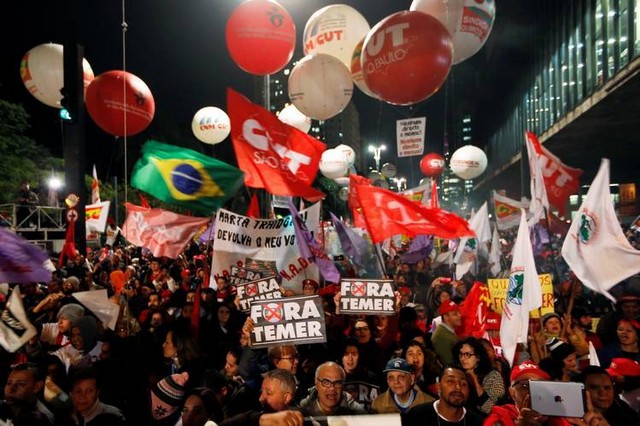
Just very recently, Brazil, the host country of the 2016 Olympic games, went through some agonizing events. Its socialist government had been framed and forced out of power, by both the local extreme right wing elites and by their handlers in the West.

Protests are still raging. Discontent with the coup and with the new regime is growing.

There is great chance that there will be clashes between the protesters and armed forces, during the Games.

In such an explosive environment, anything could become symbolic, even the epic fight of the Russian, Chinese, Cuban and other athletes against the competitors representing the West.

During my recent visit to Brazil I realized how popular Russia is becoming among the ordinary people there. It is clear for whom so many Brazilian sports fans would be cheering, especially now, after the shameless coup.

This (the planners in Washington most likely decided) has to be prevented. The solidarity of BRICS countries should not be shown on television screens to those billions of sports fans all over the world.

Now, with Temer and his clique holding power in Brazil, it would be much easier to simply ‘delete’ Russia from the Olympic map, if the IOC decides to impose blank ban on the entire Russian team.

If the coup never took place, if Dilma and the PT were still in power, there were several ways to resist this latest West’s onslaught against Russia and its athletes. There were even ways to humiliate the spineless IOC. For instance, the government of Brazil could have arranged a parallel event for the Russian athletes, in order to show its solidarity. But now, the way things are, there is no chance for such a ‘rebellion’!

Brazil is screaming under attacks from the market fundamentalists. Its new (illegitimate, but fully pro-Western) government naturally sees Russia as one of its archenemies.

One should never under-estimate the Empire! In its own, deeply destructive way, it is truly brilliant. Its Machiavellian tactics are extremely effective. And this sport saga is just a proof of it!

On July 26, 2016, the RT reported:

“The International Olympic Committee has rejected calls for a blanket ban on Russia at the Rio 2016 Games, ruling that individual sports federations should decide whether Russian athletes are eligible to compete.

Athletes will need to meet strict criteria laid out by the IOC, including proving to international federations that they have a clean doping record and have been tested by “reliable” international anti-doping bodies.”

Conditions are almost impossible to meet, in such a short time that is left before the beginning of the Olympic games in Rio.

The Empire is becoming thoroughly unpredictable. It is attacking on all fronts. It lost all its shame and decency.

And the Western mass media is now fully lined-up, providing ideological cover and unabashed propaganda. And now it is not only the media in the United States, but also in Germany, the U.K. and elsewhere.

Most likely, the free world (those countries that are refusing to accept the West’s dictates) will soon lose one more important battle. But the struggle goes on! Those Russian athletes who will make it to Rio will be fighting great symbolic battles, like those that were fought in Berlin, during the 1936 Olympics.

Andre Vltchek is a philosopher, novelist, filmmaker and investigative journalist. He covered wars and conflicts in dozens of countries.

28 July 2016

Is war inevitable in the South China Sea?

By Pepe Escobar

Since the recent ruling by The Hague in favor of the Philippines and against China over the South China Sea, Southeast Asia has been engulfed on how to respond. They dithered. They haggled. They were plunged into despair.

It was a graphic demonstration of how “win-win” business is done in Asia. At least in theory.

In the end, at a summit in Vientiane, Laos, the 10-nation Association of Southeast Asian Nations (ASEAN) and China finally settled for that household mantra – “defusing tensions”.

They agreed to stop sending people to currently uninhabited “islands, reefs, shoals, cays, and other features” after ASEAN declared itself worried about land reclamation and “escalations of activities in the area”.

And all this without even naming China – or referring to the ruling in The Hague.

China and ASEAN also pledged to respect freedom of navigation in the South China Sea (which Washington insists is in danger); solve territorial disputes peacefully, through negotiations (that happens to be the official Chinese position), also taking into consideration the UN Convention on the Law of the Sea (UNCLOS); and work hard to come up with a Code of Conduct in the South China Sea (that’s been going on for years; optimistically, a binding text will be ready by the first half of 2017).

So, problem solved? Not really. At first, it was Deadlock City. Things only started moving when the Philippines desisted to mention The Hague in the final statement; Cambodia – allied with China – had prevented it from the start.

And that’s the heart of the matter when it comes to ASEAN negotiating with China. It’s a Sisyphean task to reach consensus among the 10 members – even as ASEAN spins its role as the perfect negotiation conduit. China for its part prefers bilaterals – and has applied Divide and Rule to get what it wants, seducing mostly Laos and Cambodia as allies.

That threat by a peer competitor

The strategic geopolitical centrality of the South China Sea is well known: A naval crossroads of roughly $5 trillion in annual trade; transit sea lanes to roughly half of global daily merchant shipping, a third of global oil trade and two-thirds of all liquid natural gas (LNG) trade.

It’s also the key hub of China’s global supply chain. The South China Sea protects China’s access to the India Ocean, which happens to be Beijing’s crucial energy lifeline. Woody Island in the Paracels, southeast of Hainan island, also happens to be a key bridgehead in One Belt, One Road (OBOR) – the New Silk Roads. The South China Sea is strictly linked to the Maritime Silk Road.

The arbitration panel in The Hague (composed of four Europeans, one American of Ghanaian descent and, significantly, no Asians) issued a ruling that is non-binding; moreover, it was not exactly neutral, as China, one the conflicting parties, simply refused to take part.

Beyond these expressions of mutual ASEAN-China understanding, hardcore action will keep everyone’s juices flowing. The Pentagon, predictably, won’t refrain from its FON (Freedom of Navigation) program, which has recently featured several B-52 overflights in the South China Sea along with the usual US Navy patrols.

But now Beijing is counter punching in style – showing off one of its H-6K long-range nuclear-capable bombers overflying Scarborough Shoal, near the Philippines. That only increased Pentagon paranoia, because the real game in the South China Sea revolves to a large extent over China’s aerial and underwater military strategy.

To understand the progression, we need to go back to the early 1980s, when the Little Helmsman Deng Xiaoping set up China’s first Special Economic Zone (SEZ) in Shenzhen. From the start, the whole Chinese miracle always depended upon China’s eastern seaboard’s fabulous capacity to engage in global trade. More than half of China’s GDP depends on global trade.

But, strategically, China has no direct access to the open seas. Geophysics is implacable: there are islands all around. And geopolitics followed; many of these are and can become a problem.

Wu Shicun, the president of China’s National Institute for South China Sea Studies, has been constant over the years; all of Beijing’s actions boil down to securing strategic access to the opens seas. This may be construed in the West as aiming for a “Chinese lake”. But it’s in fact about securing its own naval backyard. And that implies, predictably, deep suspicion about what the US Navy may come up with. The Defense Ministry loses sleep about it 24/7.

For Beijing, it’s crystal clear; the eastern seaboard must be protected at all costs – because they are the entry and exit point of China’s global supply chains. Yet as Beijing improves its military sophistication, the hegemon – or exceptionalist – machine gets itchier and itchier. Because the whole ingrained exceptionalist worldview can only conceive it as a “threat” by a peer competitor.

The larger-than-life “access” drama

From Exceptionalistan’s point of view, it’s all about the myth of “access”. The US must have full, unrestricted “access” to the seven seas, the base of its Empire of Bases, post-Rule Britannia system: the “indispensable nation” ruling the waves.

But now Beijing has reached a new threshold. It’s already in the position to successfully defend the strategic southern island of Hainan. The Yulin naval base in Hainan is the site of China’s expanded submarine fleet, which not only features stalwarts such as the 094A Jin-class submarine, but the capability to deliver China’s new generation ICBM, the JL-3, with an estimated range of 12,000km.

Translation: China now can not only protect, but also project power, aiming ultimately at unrestricted access to the Pacific.

The US counter punch to all this is “Anti-Access”, or A2, plus Area Denial, which in Pentagonese turns out as A2/AD. Yet China has evolved very sophisticated A2/AD tactics, which include cyber warfare; submarines equipped with cruise missiles; and most of all anti-ship ballistic missiles such as the Dongfeng 21-D, an absolute nightmare for those sitting duck billion-dollar US aircraft carriers.

A program called Pacific Vision, funded by the Pentagon’s Office of Net Assessments, eventually came up with the Air-Sea Battle concept. Virtually everything about Air-Sea Battle is classified. As the concept was being elaborated, China has mastered the art of very long range ballistic missiles – a lethal threat to the Empire of Bases, fixed and/or floating.

What is known is that the core Air-Sea Battle concept, known in Orwellian Pentagonese as “NIA/D3”,“networked, integrated forces capable of attack-in-depth to disrupt, destroy and defeat adversary forces”. To break through the fog, this is how the Pentagon would trample over Chinese A2/AD. The Pentagon wants to be able to attack all sorts of Chinese command and control centers in a swarm of “surgical operations”. And all this without ever mentioning the word “China”.

So these are the stakes. The indispensable nation’s military hegemony over the whole South China Sea must always be undisputed. Always. But already it is not. China is positioning itself as a cunning, asymmetrical aspirant to “peer competitor”. For the moment Beijing ranks second in the Pentagon’s list of “existential threats” to the US. Were not for Russia’s formidable nuclear power, China would already be number one.

At the same time China does not need to launch any military offensive against an ASEAN member; it’s bad for business. The environment after The Hague’s ruling – as the Laos summit proved – points toward long-term diplomatic solutions. But make no mistake; at some point in the future, there will be a serious confrontation between the US and China over “access” to the South China Sea.

Pepe Escobar is an independent geopolitical analyst. He writes for RT, Sputnik and TomDispatch, and is a frequent contributor to websites and radio and TV shows ranging from the US to East Asia.

27 July 2016

A failed coup and the domestic, regional and global aftermath

By Afro-Middle East Centre

Although Turkey survived the recent coup attempt, the impact of that operation will be felt for a long time, and there are serious implications for the putchists as well as the rest of Turkish society and the Middle East region.

The evening of Friday, 15 July, saw one of the most severe attacks on Turkey’s democracy since 1997, as a small faction of the Turkish Armed Forces (TSK) attempted to wrestle control of the state. With more than 200 people killed and 1 500 wounded, a state of emergency was declared days later for a period of three months. As the government began its clampdown against those it accuses of being participants in or complicit with the coup attempt, questions have already been raised about the nature of the democratic process in Turkey, the clampdown by the state, and the stability of the strategically important Eurasian country in an already politically volatile region. Much of this discussion is spiced with a range of conspiracy theories.

How the coup attempt unfolded

The coup operation began around 19:30 Turkish time, and was initially met with shock as many citizens assumed the military presence suggested an imminent terrorist threat; the terrorist attack on Istanbul’s Ataturk Airport two weeks earlier was still fresh in Turkish minds. But as tanks rolled onto two Bosphorus bridges in Istanbul, and social media showed military planes flying low over Istanbul and Ankara, it was clear something was awry. A short while later Prime Minister Binali Yildirim confirmed that Turkey was under threat of a coup d’état. The coup plotters did not, however, expect a strong civilian opposition to tanks, attack helicopters and armoured vehicles. After President Recep Tayyip Erdogan’s public call on citizens to oppose the military action by those he claimed were members of the movement of US-based Turkish businessperson and preacher Fethullah Gulen, Istanbul and Ankara streets became sites of determined civilian resistance.

The coup plot seemed to have been organised well in advance, and was supported by a significant number of senior officers of the TSK’s air, navy and ground forces. Importantly, the chief of staff, and the heads of the airforce, naval and ground troops refused to cooperate with the plotters, resulting in the breakdown of communication within the army. Had the heads of these strategic arms of the army cooperated, a substantially different picture might have emerged. The putschists incorrectly assumed that they would receive the support of a significant part of the armed forces.

The execution of the plot seemed to have been accelerated by about six hours because of security warnings issued by the National Intelligence Organization (MIT) to senior TSK commanders that afternoon. The operation was planned to begin in the early hours of Saturday morning. The confusion resulting from the change of plan helped make the coup a failure. Another failure followed the disorientation of conscript soldiers who faced public resistance, and who were unaware of the intentions of the putschists, having been told they would be performing an anti-terror exercise. The plotters’ strategy was severely weakened by the fact that they failed to shut down satellite communications, and media was was able to broadcast messages from the prime minister. Further, they seem to have been blindsided by the calls from minarets around the country for civilians to oppose the coup. The Turkish media played a major role in encouraging resistance to the coup, and, in a rare show of unity, media outlets from across the political spectrum declared the coup illegal and a threat to Turkey’s democracy. (In contrast, some western and Arab media such as CNBC and Al Ahram falsely reported Friday night that Erdogan had fled, and sought asylum in Germany.)

Whose coup is it anyway?

From the first announcement about the unfolding coup by Erdogan, Yildirim and other government sources linked the operation to Gulen and his Hizmet movement. His followers around the world are estimated at between three and six million. US court records estimate his institutions’ worth as being between 20 and 50 billion dollars in the USA alone. Some figures put the total global assets as 150 billion dollars. Some opposition groups, notably the fiercely secular Hurriyet newspaper and the opposition Republican Party (CHP) – both extremely critical of Erdogan’s ruling Justice and Development Party (AKP) – also pointed fingers at Hizmet. Hurriyet’s Ahmet Hakan, one of the loudest critics of the AKP and Erdogan, also dismissed the theory posited in western media that the president had planned the coup to strengthen his grip over the state. A number of other theories also allege conspiracies, with some accusing the USA, including the claim that the CIA had plotted with Gulen; and others adding that the MIT had been pre-emptively informed of the coup by the Russians as part of their attempt to strengthen relations with Turkey. These theories were spurred on by the fact that western politicians waited for the coup to fail before condemning it, and that the aircraft involved in the coup took off from Incirlik military airbase where the US airforce fighting the Islamic State group (IS) is based.

The timing of the coup attempt is likely linked to the fact that the government already had plans to shake up the top ranks of the army before the end of 2016, with a number of officers, it is suspected, being dismissed, retired or tried. In addition, the annual meeting of the Supreme Council of Ministers, which is tasked with the appointment of military personnel, is to take place in August 2016, and Gulenists expected that meeting to result in a purge of their members in the army. An MIT list of alleged Gulen ‘infiltrators’ was to be used at the meeting, and it is likely that a number of the putschists’ names were on that list. The July coup would, then, have been their last opportunity to protect their positions and oppose Erdogan and the government. Many of the coup plotters, government sources claim, had graduated from Hizmet schools.

The Gulen-AKP alliance and split

The Gulen movement – now outlawed in Turkey as a terrorist organisation – has a long history in Turkish politics dating back to the early 1970s when Gulen’s exceptional oratory skills made him a popular preacher, and his network of schools was started. Gulen’s views on the need to mainstream Islam within the major organs of the state in the 1980s, when the Turkish state was a secular fundamentalist state ruled by an anti-religious military junta, gained it favour with Islamists such as those from Necmettin Erbakan’s MilliGorus (Felicity) Islamic Party. Erdogan, a former student of Erbakan, became the mayor of Istanbul in 1996 on a MiliGorus ticket. Although Erbakan remained sceptical of Gulen’s ideology, the AKP, a MiliGorus breakaway that won national elections in 2002, perceived Gulen as an ally against a hostile state that positioned the military as the guardian of the republic.
Erdogan saw Gulen as politically significant precisely because Hizmet, although never openly contesting for space on the Turkish political stage in its forty-year history, was regarded as apolitical. This perception allowed the preacher to cross the boundaries between politics, religion, power and influence. A core arm of Hizmet is its huge school network which includes around 930 schools in Turkey – many catering to the upper echelons of Turkish society, and whose graduates have occupied significant positions in the state apparatus since the mid-1980s, as well as about 2 000 schools in 160 other countries around the world, including South Africa. These cater for a total of around 1.2 million students.

There is little doubt that Gulen wields significant influence, and that millions of dollars flow through his global education network and associated business, media and other organisations. The ease with which Gulen schools operate around the world, employing hundreds of teachers, enrolling thousands of students, and with strong government and civil society contacts, has resulted in allegations that its activities are convenient for intelligence gathering and exercising political influence. Unlike various Middle East Islamist parties which have usually been met with sanctions, Hizmet has become an influential lobby in the USA. It cultivates the image of a ‘moderate’ Muslim group led by a ‘moderate’ Muslim personality who focuses on what Hizmet calls ‘cultural Islam’ – as opposed to ‘political Islam’ . This brand of Islam made Gulen popular in the West, particularly in post-9/11 USA where Gulen became a significant voice in the US ‘war against terror’.

The Gulenist emphasis on interfaith dialogue and its relaxed attitude in some circumstances on issues like alcohol attracted the attention of states that view Erdogan and the AKP as more extreme. As important for his critics is the fact that Gulen never criticised Israeli policies or US foreign policy in the Middle East – even when this seemed detrimental to Turkish interests. Gulen was scathing in his criticism of the ‘Freedom Flotilla’ that attempted to ferry aid to the besieged Palestinian territory of Gaza. In contrast to global condemnation of the murder of nine (Turkish) civilians on board the Mavi Marmara, the lead ship in the 2010 Freedom Flotilla, by Israeli security forces, Gulen blamed flotilla organisers because they did not obtain Israeli permission. He also said those in the flotilla knew that they had put their lives at risk, suggesting they deserved the treatment they received from the Israelis.
The AKP’s first decade in power helped strengthen Gulen’s power base in Turkey. The AKP-Hizmet alliance proved useful for both parties – even after Gulen criticised Erdogan for the Mavi Marmara debacle – until 2012 when MIT head Hakan Fidan was arrested. Fidan was leading secret peace talks with the leader of the banned Kurdish Workers Party (PKK), Abdullah Ocalan. The arrest was seen by the government as an attempt at sabotage by Gulenists within the judiciary who were loathe to see reconciliation between the Kurdish rebel group and the state. In response, the government sponsored a bill which, after it was passed in 2014, threatened closure of Hizmet’s chain of preparatory schools in Turkey. This was followed by corruption allegations against AKP politicians, leading to the arrests of top AKP officials, and a number of resignations and dismissals of officials. The AKP alleged this was a campaign by Gulenists in the judiciary who were part of what the AKP began calling a ‘parallel state’. Relations between the former allies descended into distrust and acrimony, with tit-for-tat actions that included banning of pro-Gulen media and judicial attacks against AKP members.

Aftermath and impact

The most obvious result of 15 July was the mass arrests that include people from the military, police, judiciary and the education sector. The coup attempt provided the AKP government an opportunity to crush Hizmet and get rid of its members in state structures, and also to clamp down on other dissenting voices. Around 10 000 people have been detained, with around 9 000 of those being soldiers, and there have been allegations that some detainees are being tortured. In addition, around 40 000 military officials, police officers, judges, governors, teachers and academics have been suspended or dismissed.
While most Turkish opposition parties have expressed support of the government’s security efforts after the defeat of the coup attempt, various western governments have been vocal in their criticism of the mass arrests and clampdown in Turkey. In particular, European and US spokespersons have repeatedly insisted that Turkey must deal with the coup within the ‘rule of law’ – even before the arrests had begun.
This places Turkey on a collision course with the USA. Although a formal extradition request for Gulen has not yet been submitted to the USA, various Turkish officials – including Erdogan – have emphasised that it will be. US officials, including secretary of state John Kerry, have responded by insisting that such a request will only be considered if sufficient evidence is provided that Gulen is guilty as claimed. Relations between Turkey and the USA – fellow NATO members and ostensible allies – have been rocky for the past few years. Despite the US use of Turkey’s Incirlik airforce base to launch attacks against IS, the relationship is fraught. An extradition demand, together with the warming of relations with Russia, will likely make US-Turkish relations even more tenuous.

Turkey’s relations with the European Union and various EU member states are also likely to sour. Erdogan’s ignoring of European demands regarding the mass arrests are set to be significantly readjusted. Anti-EU sentiment has risen in Turkey, reflected in the opinion columns of newspapers. This is a result of what many in Turkey see as the hypocritical stance by the EU that was reflected in its slow reaction to the attempted coup, and threats that Turkey might will disqualify itself for EU accession should it reinstate the death penalty will help ensure that Turkey becomes even more distant from the possibility of EU membership. However, the manner in which . Turkish officials believe that if their country had not been able to join the EU after fifty-three years, it is unlikely to succeed now. EU accession has been used as a carrot by the bloc and its members, they believe, to garner Turkish support in the Middle East with little benefit to Turkey. Turkey, meanwhile, has been a benefactor for NATO states. With Turkey’s interest in the EU waning, the country seems more concerned in rebuilding relations with its neighbours.

Relations with Russia are set to improve. The coup attempt came three weeks after Turkey began a rapprochement with Russia, following a break in relations after Turkey’s downing of a Russian fighter jet. Turkish-Russian relations have been tested by Russia’s airstrikes on the Turkmen region of Bayirbucak in Northern Syria. However, the soldiers responsible for downing the Russian jet have been arrested on suspicion of being part of the coup network. Some Russian officials suggest that their government has accepted the Turkish version that the Russian jet was shot down as part of a Gulen plot. Russia having been one of the first governments to condemn the coup, and with Erdogan and Russian president, Vladimir Putin, set to meet in weeks, Turkey will seek to advance its political and economic relationship with Russia. Turkey’s suggestion that it will improve relations with Syria will likely be taken forward – with Russian help. And relations with Iran – with whom there is already booming trade – will also likely improve.
A key question relates to the seeming intelligence failure that allowed the plot to proceed as far as it did. Erdogan’s irritation at the lack of intelligence has been plain. Fidan’s role as MIT head will likely be reviewed, with questions already raised about why, if Fidan’s office had information about the plot, it was not timeously directed to the presidency.

The instability in the intelligence sector and armed forces will definitely impact upon Turkey’s war on the PKK, with the Kurdish group being handed an opportunity as a large number of senior officers are removed from the army. As the instability is exploited by Turkey’s southern nemesis, Syria’s president, Bashar al-Asad, matters will be further complicated for Turkey by the PKK’s links to the Syrian Democratic Union Party (PYD). Syria has, previously, successfully used Kurdish grievances against the Turkish state.

Domestically, the AKP will use the fallout from the attempted coup to its advantage. With Erdogan riding a wave as a saviour of Turkish democracy, it is possible that at the end of the state of emergency there will be either a snap election or a constitutional referendum on the question of a presidential system, which Erdogan could not have won before the coup attempt but which could now turn out favourably for him. Already there are indications that most opposition parties will support constitutional amendments, although it is unclear what precise amendments they are referring to.

Conclusion

There is no doubt that after the dust has settled in the squares and the sense of unity that is generally being felt across the country in response to the coup becomes less tangible, Turkey will be faced with greater challenges than the overt violence of a week ago. The Turkish state is fragile, and state institutions could either be stabilised or could further weaken as a result of the current purges. Should the Gulen movement be legally charged with subversion, its networks in Turkey and globally could be seriously affected. This could have implications for Turkey’s foreign relations, especially its policy towards countries that maintain links with the Hizmet movement, and, in particular, with the USA where Gulen resides. Turkey’s view of and its role within NATO could also be considered more carefully, given that no assistance was given to a member whose institutions were being attacked from the air by hostile forces. Whether Turkey will be able to weather the storm in the long term will depend on the willingness of all political forces to cooperate in the best interests of the broader society, and whether the government considers the rights of its citizens as important as it does the security of the state. Of course, as long as the legitimate grievances of its Kurdish population are not addressed, the Turkish state will remain in a state of uncertainty and instability. It also remains to be seen whether Turkey decides to reprioritise its domestic and regional imperatives over those of its global alliances.

28 July 2016


In this chaotic age, the real truth is rarely heard

By Sholto Byrnes

In this chaotic age, the real truth is rarely heard

Germany is reeling after a week of unprovoked violence that left many wondering whether any public space, any gathering or any normal activity outside the confines of their own homes can now be considered safe.

An axe-wielding teenager attacks fellow passengers on a train near Wuerzburg. Another teenager uses Facebook to lure potential victims to a McDonald’s in Munich, and then kills nine people before shooting himself. A 21-year-old with a machete butchers a pregnant woman in Reutlingen. And on the same day – last Sunday – another young man explodes a rucksack next to an outdoor music festival in Ansbach, injuring 15 and taking his own life.

Three of the men were asylum seekers, and the fourth was the son of asylum seekers. It would be easy to paint the attacks as being scant thanks for Angela Merkel’s courageous generosity in opening Germany’s borders to so many migrants and for the policy of accepting other peoples in the long term.

The far right has already tried to score political points in the wake of the incidents. “If we were in power, this would not happen,” tweeted the Reutlingen branch of the Alternative for Germany party (AfD), before later taking it down. “Wuerzburg, Reutlingen, Ansbach – is Germany colourful enough for you now, Mrs Merkel?” wrote the AfD’s co-chairwoman, Fauke Petry, on Facebook. “What else has to happen so that authorities open their eyes and see what’s going on in Germany now?”

A climate in which 77 per cent of Germans now fear imminent terrorist attacks, according to a poll on Monday, may favour anti-immigrant sentiment, especially when it has been rising across the continent, and neighbouring Austria reruns a presidential election which could see a far-right candidate elected head of state for the first time in the European Union – a lamentable milestone indeed.

But the state authorities have, for the most part so far, been displaying admirable restraint. They have been referring to the perpetrators as two Syrians, a German-Iranian, and a refugee from Afghanistan. The country’s foreign minister, Thomas de Maiziere, pointed out that “in the Ansbach incident, neither a link to international Islamic State terrorism nor a mental disorder can be ruled out. It could be a combination of both”.

There have been echoes of the line taken by the Australian attorney general, George Brandis, over the weekend. “Not every mass casualty attack is an act of terrorism,” he said. “Not every premeditated act of violence is an act of terrorism.”

However, all four of the attackers had Muslim names, and two of them appeared to be inspired by ISIL. The finger is, inevitably, already being pointed at Islam and at Muslim immigrants as being violent foreigners who not only have no desire to integrate with the host culture, but who actively despise it.

The truth will struggle to be heard, which is why it is more urgent than ever that it is stated: that it would be wrong to blame either immigration or Islam for these attacks. Many of the individuals concerned were disturbed, or petty criminals, or angry men looking for a cause. As the distinguished French scholar Olivier Roy has put it, these kind of attacks in Germany, and others, such as in Nice or in Orlando, are often “more related to disenfranchisement and petty delinquency than to Islam”.

The perpetrators are frequently highly irreligious until shortly before committing their atrocities. As Mr Roy stated in an interview with Slate magazine: “It is not because they pray more and more, or go more and more to a mosque, that they become radicals.” When they become radicals, he argues, “They frame their wrath in a religious narrative”. It is what he calls “the Islamicisation of radicalism”. Islam, he says “is not the primary cause”. But ISIL’s perverted version of it provides the justification for those who already have the desire to commit evil.

Europe is familiar from its history with acts of war that were supposedly prompted by religion. It is equally aware that, from as far back as Charlemagne, religion – Christianity in this case – has been a convenient cloak under which to conduct land grabs, to rob, kill and to subject whole peoples. No Christian would accept that his religion was the true cause of these misdeeds; he would say that it was a misuse to act thus under its banner.

Europe needs to cling on to that principle and apply it as well to Islam. Many of the continent’s leaders have correctly stated that Islam is a religion of peace. It is vital that, even amid this barrage of attacks, tolerance and understanding are maintained.

Yes, the four men responsible for the recent shocking events in Germany all had Muslim names. But many of those responsible for shooting sprees in America have Christian names; and no one suggests that their crimes are terrorist acts inspired by Christianity. The black flag of ISIL is widespread enough. There is nothing to be gained from attaching it to every public murder, other than stoking the chaos the terrorists desire.

If Europeans cannot continue to separate a peaceful religion from those who fraudulently act in its name, they will not just be “living with terrorism”, as the French prime minister Manuel Valls said after the Nice atrocity. They will, in fact, have handed those self-same terrorists an important victory – ironically won on the backs of deluded individuals whose actions blaspheme the name of the religion in which they claim to act.

Sholto Byrnes is a senior fellow at the Institute of Strategic and International Studies, Malaysia.

26 July 2016

There’s No Business Like The Arms Business

By William D Hartung

When American firms dominate a global market worth more than $70 billion a year, you’d expect to hear about it. Not so with the global arms trade. It’s good for one or two stories a year in the mainstream media, usually when the annual statistics on the state of the business come out.

It’s not that no one writes about aspects of the arms trade. There are occasional pieces that, for example, take note of the impact of U.S. weapons transfers, including cluster bombs, to Saudi Arabia, or of the disastrous dispensation of weaponry to U.S. allies in Syria, or of foreign sales of the costly, controversial F-35 combat aircraft. And once in a while, if a foreign leader meets with the president, U.S. arms sales to his or her country might generate an article or two. But the sheer size of the American arms trade, the politics that drive it, the companies that profit from it, and its devastating global impacts are rarely discussed, much less analyzed in any depth.

So here’s a question that’s puzzled me for years (and I’m something of an arms wonk): Why do other major U.S. exports — from Hollywood movies to Midwestern grain shipments to Boeing airliners — garner regular coverage while trends in weapons exports remain in relative obscurity? Are we ashamed of standing essentially alone as the world’s number one arms dealer, or is our Weapons “R” Us role such a commonplace that we take it for granted, like death or taxes?

The numbers should stagger anyone. According to the latest figures available from the Congressional Research Service, the United States was credited with more than half the value of all global arms transfer agreements in 2014, the most recent year for which full statistics are available. At 14%, the world’s second largest supplier, Russia, lagged far behind. Washington’s “leadership” in this field has never truly been challenged. The U.S. share has fluctuated between one-third and one-half of the global market for the past two decades, peaking at an almost monopolistic 70% of all weapons sold in 2011. And the gold rush continues. Vice Admiral Joe Rixey, who heads the Pentagon’s arms sales agency, euphemistically known as the Defense Security Cooperation Agency, estimates that arms deals facilitated by the Pentagon topped $46 billion in 2015, and are on track to hit $40 billion in 2016.

To be completely accurate, there is one group of people who pay remarkably close attention to these trends — executives of the defense contractors that are cashing in on this growth market. With the Pentagon and related agencies taking in “only” about $600 billion a year — high by historical standards but tens of billions of dollars less than hoped for by the defense industry — companies like Lockheed Martin, Raytheon, and General Dynamics have been looking to global markets as their major source of new revenue.

In a January 2015 investor call, for example, Lockheed Martin CEO Marillyn Hewson was asked whether the Iran nuclear deal brokered by the Obama administration and five other powers might reduce tensions in the Middle East, undermining the company’s strategy of increasing its arms exports to the region. She responded that continuing “volatility” in both the Middle East and Asia would make them “growth areas” for the foreseeable future. In other words, no worries. As long as the world stays at war or on the verge of it, Lockheed Martin’s profits won’t suffer — and, of course, its products will help ensure that any such “volatility” will prove lethal indeed.

Under Hewson, Lockheed has set a goal of getting at least 25% of its revenues from weapons exports, and Boeing has done that company one better. It’s seeking to make overseas arms sales 30% of its business.

Good News From the Middle East (If You’re an Arms Maker)

Arms deals are a way of life in Washington. From the president on down, significant parts of the government are intent on ensuring that American arms will flood the global market and companies like Lockheed and Boeing will live the good life. From the president on his trips abroad to visit allied world leaders to the secretaries of state and defense to the staffs of U.S. embassies, American officials regularly act as salespeople for the arms firms. And the Pentagon is their enabler. From brokering, facilitating, and literally banking the money from arms deals to transferring weapons to favored allies on the taxpayers’ dime, it is in essence the world’s largest arms dealer.

In a typical sale, the U.S. government is involved every step of the way. The Pentagon often does assessments of an allied nation’s armed forces in order to tell them what they “need” — and of course what they always need is billions of dollars in new U.S.-supplied equipment. Then the Pentagon helps negotiate the terms of the deal, notifies Congress of its details, and collects the funds from the foreign buyer, which it then gives to the U.S. supplier in the form of a defense contract. In most deals, the Pentagon is also the point of contact for maintenance and spare parts for any U.S.-supplied system. The bureaucracy that helps make all of this happen, the Defense Security Cooperation Agency, is funded from a 3.5% surcharge on the deals it negotiates. This gives it all the more incentive to sell, sell, sell.

And the pressure for yet more of the same is always intense, in part because the weapons makers are careful to spread their production facilities to as many states and localities as possible. In this way, they ensure that endless support for government promotion of major arms sales becomes part and parcel of domestic politics.

General Dynamics, for instance, has managed to keep its tank plants in Ohio and Michigan running through a combination of add-ons to the Army budget — funds inserted into that budget by Congress even though the Pentagon didn’t request them — and exports to Saudi Arabia. Boeing is banking on a proposed deal to sell 40 F-18s to Kuwait to keep its St. Louis production line open, and is currently jousting with the Obama administration to get it to move more quickly on the deal. Not surprisingly, members of Congress and local business leaders in such states become strong supporters of weapons exports.

Though seldom thought of this way, the U.S. political system is also a global arms distribution system of the first order. In this context, the Obama administration has proven itself a good friend to arms exporting firms. During President Obama’s first six years in office, Washington entered into agreements to sell more than $190 billion in weaponry worldwide — more, that is, than any U.S. administration since World War II. In addition, Team Obama has loosened restrictions on arms exports, making it possible to send abroad a whole new range of weapons and weapons components — including Black Hawk and Huey helicopters and engines for C-17 transport planes — with far less scrutiny than was previously required.

This has been good news for the industry, which had been pressing for such changes for decades with little success. But the weaker regulations also make it potentially easier for arms smugglers and human rights abusers to get their hands on U.S. arms. For example, 36 U.S. allies — from Argentina and Bulgaria to Romania and Turkey — will no longer need licenses from the State Department to import weapons and weapons parts from the United States. This will make it far easier for smuggling networks to set up front companies in such countries and get U.S. arms and arms components that they can then pass on to third parties like Iran or China. Already a common practice, it will only increase under the new regulations.

The degree to which the Obama administration has been willing to bend over backward to help weapons exporters was underscored at a 2013 hearing on those administration export “reforms.” Tom Kelly, then the deputy assistant secretary of the State Department’s Bureau of Political-Military Affairs, caught the spirit of the era when asked whether the administration was doing enough to promote American arms exports. He responded:

“[We are] advocating on behalf of our companies and doing everything we can to make sure that these sales go through… and that is something we are doing every day, basically [on] every continent in the world… and we’re constantly thinking of how we can do better.”

One place where, with a helping hand from the Obama administration and the Pentagon, the arms industry has been doing a lot better of late is the Middle East. Washington has brokered deals for more than $50 billion in weapons sales to Saudi Arabia alone for everything from F-15 fighter aircraft and Apache attack helicopters to combat ships and missile defense systems.

The most damaging deals, if not the most lucrative, have been the sales of bombs and missiles to the Saudis for their brutal war in Yemen, where thousands of civilians have been killed and millions of people are going hungry. Members of Congress like Michigan Representative John Conyers and Connecticut Senator Chris Murphy have pressed for legislation that would at least stem the flow of the most deadly of the weaponry being sent for use there, but they have yet to overcome the considerable clout of the Saudis in Washington (and, of course, that of the arms industry as well).

When it comes to the arms business, however, there’s no end to the good news from the Middle East. Take the administration’s proposed new 10-year aid deal with Israel. If enacted as currently planned, it would boost U.S. military assistance to that country by up to 25% — to roughly $4 billion per year. At the same time, it would phase out a provision that had allowed Israel to spend one-quarter of Washington’s aid developing its own defense industry. In other words, all that money, the full $4 billion in taxpayer dollars, will now flow directly into the coffers of companies like Lockheed Martin, which is in the midst of completing a multi-billion-dollar deal to sell the Israelis F-35s.

“Volatility” in Asia and Europe

As Lockheed Martin’s Marillyn Hewson noted, however, the Middle East is hardly the only growth area for that firm or others like it. The dispute between China and its neighbors over the control of the South China Sea (which is in many ways an incipient conflict over whether that country or the United States will control that part of the Pacific Ocean) has opened up new vistas when it comes to the sale of American warships and other military equipment to Washington’s East Asian allies. The recent Hague court decision rejecting Chinese claims to those waters (and the Chinese rejection of it) is only likely to increase the pace of arms buying in the region.

At the same time, in the good-news-never-ends department, growing fears of North Korea’s nuclear program have stoked a demand for U.S.-supplied missile defense systems. The South Koreans have, in fact, just agreed to deploy Lockheed Martin’s THAAD anti-missile system. In addition, the Obama administration’s decision to end the longstanding embargo on U.S. arms sales to Vietnam is likely to open yet another significant market for U.S. firms. In the past two years alone, the U.S. has offered more than $15 billion worth of weaponry to allies in East Asia, with Taiwan, Japan, and South Korea accounting for the bulk of the sales.

In addition, the Obama administration has gone to great lengths to build a defense relationship with India, a development guaranteed to benefit U.S. arms exporters. Last year, Washington and New Delhi signed a 10-year defense agreement that included pledges of future joint work on aircraft engines and aircraft carrier designs. In these years, the U.S. has made significant inroads into the Indian arms market, which had traditionally been dominated by the Soviet Union and then Russia. Recent deals include a $5.8 billion sale of Boeing C-17 transport aircraft and a $1.4 billion agreement to provide support services related to a planned purchase of Apache attack helicopters.

And don’t forget “volatile” Europe. Great Britain’s recent Brexit vote introduced an uncertainty factor into American arms exports to that country. The United Kingdom has been by far the biggest purchaser of U.S. weapons in Europe of late, with more than $6 billion in deals struck over the past two years alone — more, that is, than the U.S. has sold to all other European countries combined.

The British defense behemoth BAE is Lockheed Martin’s principal foreign partner on the F-35 combat aircraft, which at a projected cost of $1.4 trillion over its lifetime already qualifies as the most expensive weapons program in history. If Brexit-driven austerity were to lead to a delay in, or the cancellation of, the F-35 deal (or any other major weapons shipments), it would be a blow to American arms makers. But count on one thing: were there to be even a hint that this might happen to the F-35, lobbyists for BAE will mobilize to get the deal privileged status, whatever other budget cuts may be in the works.

On the bright side (if you happen to be a weapons maker), any British reductions will certainly be more than offset by opportunities in Eastern and Central Europe, where a new Cold War seems to be gaining traction. Between 2014 and 2015, according to the Stockholm International Peace Research Institute, military spending increased by 13% in the region in response to the Russian intervention in Ukraine. The rise in Poland’s outlays, at 22%, was particularly steep.

Under the circumstances, it should be obvious that trends in the global arms trade are a major news story and should be dealt with as such in the country most responsible for putting more weapons of a more powerful nature into the hands of those living in “volatile” regions. It’s a monster business (in every sense of the word) and certainly has far more dangerous consequences than licensing a Hollywood blockbuster or selling another Boeing airliner.

Historically, there have been rare occasions of public protest against unbridled arms trafficking, as with the backlash against “the merchants of death” after World War I, or the controversy over who armed Saddam Hussein that followed the 1991 Persian Gulf War. Even now, small numbers of congressional representatives, including John Conyers, Chris Murphy, and Kentucky Senator Rand Paul, continue to try to halt the sale of cluster munitions, bombs, and missiles to Saudi Arabia.

There is, however, unlikely to be a genuine public debate about the value of the arms business and Washington’s place in it if it isn’t even considered a subject worthy of more than an occasional media story. In the meantime, the United States continues to hold onto the number one role in the global arms trade, the White House does its part, the Pentagon greases the wheels, and the dollars roll in to profit-hungry U.S. weapons contractors.

William D Hartung, a TomDispatch regular, is the director of the Arms and Security Project at the Center for International Policy and a senior advisor to the Security Assistance Monitor. He is the author of Prophets of War: Lockheed Martin and the Making of the Military-Industrial Complex.

Copyright 2016 William D. Hartung

26 July 2016

The Futility Of Collective Punishment: Russia, Doping And WADA

By Dr Binoy Kampmark

Collective punishment has a primitive resonance. It lacks focus, is disproportionate, and is, by nature, poor in its judgment. It suggests that responsibility is cultural, total, and institutional, flickering in the moment of vengeance.

At international law, concepts of collective punishment are generally frowned upon. The Geneva Conventions prohibit such measures in, or instance, the implementation of disciplinary measures, or the application of collective penalty “for individual acts” (Geneva POW Convention, Art 46, para 4; Geneva Convention III, Art 87, para 3). The 1977 Additional Protocol I also makes that injunction clear.

Despite such cautionary injunctions, the temptation to exclude in wholesale fashion does crop up from time to time. Those in the business of punishment remain tempted. In the case of the Olympics and the issue of doping, it has found form in voices favouring a ban of Russia for the Rio de Janeiro Games. Much of this had already been given a spur with the finding of the Court of Arbitration for Sport (CAS) upholding a ban on the country’s 68 track and field athletes.

The state has been accused largely for adopting what is termed the Disappearing Positive Methodology. Officials were said to have swapped dope-contaminated urine for non-dope equivalents to guarantee a subsequent clean result.[1]

According to Richard McLaren’s World Anti-Doping Agency report, the instigation of that program came from the Russian ministry of sport in 2010 in light of the country’s poor showing at the Winter Olympics at Vancouver. Twenty-eight sports were implicated.

Steroid cocktails ingeniously designed to evade detection were also concocted, much of this taking place under the direction of whistleblower Dr. Grigor Rodchenko as head of the Moscow laboratory. The role of the intelligence services (the FSB), of which Rodchenko admitted to being a member, seemed to the final nail in this widening coffin.

Such findings stirred former WADA head, John Fahey, to insist that the only appropriate measure here was a collective one. If the IOC were to exclude Russia “I think they would be applauded.” Doing so would be a “statement in favour of clean athletes. What is the point of having that sort of sanction if you don’t use it.”[2]

In the case of the doping allegations regarding Russia, athletes who have trained for years risk being deprived a run at the Olympics. Not that a disruption of proceedings at Rio should not be entertained. Having been conceived and practiced as a monument to racial, cultural and political pursuits at stages of its history, the Olympics has never been nobly inclined. Athletes have tended to be hostages to the fortunes of others.

The idea of excluding a country wholesale brings with it dangers that decision makers may well not see. It eliminates specific, untainted talents who also deserve to be protected in international sport. It also violates that great presumption of innocence by pre-emptively judging the conduct of all athletes.

This is not a point that bothers Fahey, who lazily assumes that allowing athletes not affected by a doping program to participate would put “the IOC in a precarious position in terms of its credibility.” It is hard to believe how the IOC could possibly get through such a decision untainted.

The broader issue of creating further fracture within the institutional framework of sport is also very much at the forefront of arguments. Banish Russia, ostensibly to uphold broader Olympic values, which in any case are deeply artificial as they are, is not a grand precedent to emulate. When we are speaking of the Olympic brand, what is meant is never clear. The ideal, for one, has long ceased to be relevant.

Former International Olympic Committee vice president Kevan Gosper, a figure involved in the boycott of the Moscow Olympics in 1980, told ABC News Radio that a return to that move is far from desirable. “I can’t remember anything quite so complicated involving the welfare of athletes, doping, and one of the most important countries – not only political – but in terms of Olympic history.”[3]

There are also structural impediments. The move on the part of the International Association for Sport in June was to expand its powers regarding moves against members in contravention of the anti-doping rules. Deferral to individual sports bodies, in other words, seems to be the accepted norm.

Furthermore, it also suggests that the state in question will have no incentive not to remain rogue. Group punishments can actually negate the incentive to alter, eliminating any deterrent effect. The history of the Olympics, far from being one of harmonious interaction, has been characterised by prejudice, politics and power. Beware, as Gosper notes, making “the wrong move with an important country like Russia”.

Dr. Binoy Kampmark was a Commonwealth Scholar at Selwyn College, Cambridge. He lectures at RMIT University, Melbourne. Email: bkampmark@gmail.com

25 July 2016


Expanding UN mandate in South Sudan: Militarising politics?

By AMEC

The recent African Union decision adding a more ‘robust’ peace enforcement component to the current 12 000 strong UN mission in South Sudan (UNMISS) risks further militarising an ostensibly political conflict over resources and patronage. Further, even if implemented, the proposed force will be difficult to sustain in light of the complex and overlapping nature of the conflict and the differing agendas of outside actors. The ‘temporary’ replacement of now former vice president Riek Machar with Taban Deng through an internal coup in the Sudan People’s Liberation Movement in Opposition (SPLMIO) underscores the complexity and fluidity of South Sudanese politics and alliances.

The decision, at the just-concluded AU heads of state summit in Rwanda, follows a proposal by the East African Inter-Governmental Authority on Development (IGAD) for the AU to request that the UN expands its mission in South Sudan to include peace enforcement modelled on the Force Intervention Brigade (FIB) in eastern Congo. The proposal came in the wake of a collapsing power-sharing agreement between the two main protagonists in South Sudan, President Salva Kiir and Vice-President Riek Machar, in early July when conflict erupted between their security details in Juba.

Since its establishment in 2011, South Sudan has experienced continual conflict; first was the clash imposed on it by its northern neighbour, Sudan, over oil revenue and borders in 2012; more recently – between December 2013 and August 2015 – militia allied to Machar and Kiir clashed. That conflict was halted through a power-sharing agreement reached in August 2015, in terms of which the rivals would retain their prior positions as president and vice president, and would integrate parts of their militia. The deal only came into force in April this year when Machar was restored as vice president and entered Juba with 1 400 troops as part of the pact. The agreement was fraught from inception. It assumed that there were only two belligerents, Kiir and Machar, and failed to integrate other groups such as the Shilluk clan (South Sudan’s third largest tribe after the Dinka and Nuer), and address more localised concerns between tribes over land and revenue distribution. Further, it failed to adequately consider the
roles played by outside forces such as Uganda in propping up Kiir, skewing the balance of forces and disincentivising compliance. Moreover, it failed to adequately consider South Sudan’s fractious history and lack of institutional capacity as engendering a situation wherein securitisation is prioritised and instrumentalised by political actors. Thus, even before the agreement was concluded, Kiir expressed dissatisfaction, arguing that it was a foreign imposition, and because militia loyal to him held the balance of power. Further, no effort was made toward reversing his decision to redraw South Sudan’s provincial borders, increasing the number of provinces from ten to twenty-eight in order to benefit tribes and militias loyal to him. Deng’s power play – possibly engineered by Kiir – changes little because South Sudanese politics is still governed by force, and Deng’s support and influence in this area is less than Machar’s.

The proposed intervention force will be hamstrung by a number of factors. First, distinguishing the main belligerent in an arena wherein there is a multiplicity of groups – often with local grievances – will complicate and stall armed intervention measures. This is especially true in light of Machar’s ‘temporary’ replacement. Will UNMISS distinguish between Machar’s well-armed support and that of Deng, who is even distrusted by Kiir?

Moreover, the brigade is to comprise forces from Ethiopia, Uganda, Rwanda and Sudan, all with differing interests in the conflict, which currently support different actors, maintain antagonisms toward each other in the quest for sub-regional hegemony, and – in the case of Uganda – has already deployed thousands of troops to support Kiir.

Further, South Sudan’s lack of central institutional governing capacity and fractious nature will complicate territorial handovers and administration efforts. The neutrality of the force will also be questioned, impeding its legitimacy. This is mainly because UNMISS has often coordinated activities with Kiir’s forces, even when these had been accused of being partly responsible for intensifying the most recent conflict. Notably, UNMISS’s mandate included working with Kiir’s government in the pursuit of state building following South Sudan’s independence, and, at the conflict’s inception, the force was outnumbered and outgunned, and forced to rely on the government for its survival.

Last, the global economic slowdown will mean that funding the expansion will be challenging. Already, some EU members have reduced their contributions to peacekeeping missions by over twenty per cent. This is significant, as the brigade will not only comprise a few thousand troops, but will require advanced weaponry and airpower to confront government forces. Even in the DRC, where the FIB has been viewed as a template for the South Sudan mission, problems are currently plaguing the mission.

The AU resolution thus will escalate the militarisation of a complex political matter. A properly enforced arms embargo could contain the situation better, and allow time to conceptualise and implement a more inclusive power-sharing agreement through IGAD, especially since South Sudan is landlocked and reliant on its neighbours, and because the USA and China can pressure the Ugandan and Sudanese governments to comply. Moreover, this would require less funding and be easier to implement. In the meanwhile, conflicts continue in Jonglei, Equatoria and other states, while the international community is fixated on the capital Juba, and on the notion that there are two clearly distinguishable belligerents.

25 July 2016

1MDB, MONEY-LAUNDERING AND A TRIBUNAL

By Chandra Muzaffar

The response of Malaysian government authorities to the civil suits filed by the US Department of Justice to seize more than US$ 1 billion (RM 4.02 billion) in assets allegedly linked to 1MDB has been a huge disappointment.   Faced with suits that allege massive embezzlement of funds and one of the worst  money laundering scams in history, Cabinet Ministers and the Attorney-General are determined to absolve “ Malaysian Official 1” of any wrongdoing. They are obsessed with preserving, protecting and perpetuating the Prime Minister’s position whatever the costs and consequences.

It is not just the US Attorney-General that has gone public on this shameful attempt to launder perhaps US 3.5 billion (RM 14.07 billion) from a state investment company established ostensibly for the people’s benefit.  Singapore authorities have also seized assets worth S$ 240 million (RM 717.45 million) in an investigation of 1MDB related fund flows for possible money-laundering.  Switzerland is another international financial hub that has begun to take action. 1MDB’s activities between 2009 and 2013 have now been exposed as utterly fraudulent on a global scale.

The government should face up to this reality. As has been proposed by a number of groups and individuals in the last few days, it should set up an independent tribunal comprising men and women of integrity and credibility which will once and for all establish the whole truth about 1MDB and its activities and recommend appropriate action against the wrongdoers. Apart from individuals with legal expertise, the tribunal should also have members with in-depth knowledge of the intricacies of money-laundering and money flows in today’s world. It should consist of both Malaysians and non-Malaysians. Cooperation with relevant agencies in the US, Switzerland, Singapore and other countries would be crucial. The tribunal should also have unhindered access to all those linked directly or indirectly to 1MDB and its affiliates. All the information gathered and analysis undertaken by the Auditor-General, Parliament’s Public Accounts Committee, Malaysian Anti-Corruption Commission (MACC), the Central Bank, the Attorney-Gene
ral’s Chambers and the Police in the last few years should be made available to the tribunal.

Prime Minister Najib should not have anything to do with the appointment of the proposed tribunal. Since 1MDB is wholly owned by the Ministry of Finance and he is the Minister of Finance and was also the Chairman of 1MDB’s Board of Advisers, he should keep his distance from the tribunal. Isn’t it also true that right from the outset he was involved in the creation of the company and was, to all intents and purposes, its principal decision-maker? Besides, in the US Department of Justice’s civil suits he is alluded to as ‘Malaysian Official 1’ 36 times.

To give moral ballast to the formation of the tribunal and its work, Najib should in fact relinquish his position as Prime Minister and Minister of Finance until the tribunal presents its findings to the nation. If the tribunal exonerates him, he can always return to his job. I had suggested on 10 July 2015 that to facilitate investigations into 1MDB he should step aside temporarily.   The situation has now become a lot worse.

What if the government does not want to initiate a tribunal and Najib is determined to cling on to power? The people could through their members of Parliament try to persuade the Speaker to hold an emergency session of Parliament.  Both the proposal on a tribunal and the position of Najib could be resolved through a parliamentary vote. But for the vote to reflect the feelings of the people, the whip should be lifted and members on both sides of the House should be encouraged to vote according to their conscience.

If Parliament fails to act, one hopes the Conference of Rulers which had already expressed its profound concern over 1MDB in October 2015, will assume its moral responsibility to the nation and advice the Cabinet to do what is right on both the tribunal and the Prime Minister. The Rulers’ advice will carry much weight.

The Rulers one hopes will also impress upon everyone that resolving the 1MDB debacle is the nation’s top priority at this point in time. It is a moral issue of tremendous significance and should not be marginalised through inter-party, inter-personal politics and the desire to retain or to attain power. The 1MDB issue is not about ousting or hoisting anyone.

Similarly, legitimate concerns about Daesh terrorism and security should not be manipulated to divert attention from 1MDB. The people should not allow “a security situation” to be created which is then used to suppress the truth about 1MDB. There are many instances in history when the elite’s fear of being exposed for corruption or abuse of power has led to the victimisation of justice and the curtailment of freedom. In this regard, those who are dedicated to espousing integrity through demonstrations and the like must always be cognisant of the danger of their protest being hijacked by others with their own mischievous agenda.

Instead of demonstrating, it is much more important at this stage for more and more groups to speak up. If the voices of concern reach a crescendo, the powers-that-be will not be able to ignore their plea for truth and justice. The alternative media today offer unfettered channels of communication which have not been utilised to the fullest.

A sector of society that has yet to add its moral strength (there have been some isolated voices here and there) to the struggle for accountability and transparency on 1MDB are established religious personalities from the different faiths. They don’t have to be told that at its root 1MDB is about values that lie at the core of religion, values such as honesty, truthfulness and trustworthiness. This is why Muslim, Buddhist, Confucianist, Hindu and Christian theologians should take a stand now for what is at stake is the moral character of the nation itself and its future. Is it so difficult to uphold what is right and denounce what is wrong?

Dr. Chandra Muzaffar.

Kuala Lumpur.

25 July 2016.

Indeed, Western Civilization is in a War

By Gerald A. Perreira

Republican, Newt Gingrich, long known for his fascistic views, recently declared that “Western Civilization is in a war”.  Truth be told, he is on solid ground.  Indeed, Western Civilization is in a war, a war that has been raging since its inception.  It has been at war with itself and with the entire non-European world for centuries. Long before anyone heard of Jihadists, Al-Qaeda and ISIL, Western Civilization was at war. Long before Osama Bin Ladin in Afghanistan, Saddam Hussein in Iraq, Muammar Qaddafi in Libya or Bashar al Assad in Syria, Western Civilization was at war with the entire rest of the world.   Western Civilization has mastered the art and technology of warfare. They are the quintessential warlords, despite the fact that they love to attribute this term to non-European leaders, especially Africans. There is no civilization on the face of this earth that has waged war more relentlessly and permanently than Western Civilization – this is not opinion, it is an indisputable historical fact.

European Tribal Wars

Newt Gingrich and his kind need to be reminded of the Hundred-Year’s War (1337 – 1453). This was a European tribal war primarily between the French and the English, with various other European tribes supporting either side. The Hundred Years War claimed the lives of an estimated 3.5 million people. Then there was the Thirty Year’s War (1618 – 1848) involving the majority of European nations. Military historians estimate the death-toll to be at least 8 million. Then we had the two great European tribal wars, erroneously referred to as World War 1 and World War 2, in which the colonized were roped in to fighting alongside the various North Atlantic Tribes.  Sadly today, many of us are still fighting on the side of the various North Atlantic Tribes to further the aims of Empire and in the process subjugate and destroy our own peoples. So-called World War 1 claimed the lives of 38 million people, while the other so-called World War – one of Europe’s most genocidal tribal wars left more than 60 million dead.

The West turns on the Rest

After bleeding themselves for centuries, and committing genocide on their own people, they turned on the Indigenous peoples throughout the world committing an unprecedented act of genocide, and then instigated the horrific Trans-Atlantic trade in captured Africans, resulting in the death of untold millions of Africans. This was a war like no other – a war that is still raging on the streets of every town and city in modern day USA, where the descendants of those captured Africans are routinely gunned down by the police in the streets. This year alone, US police have killed at least 136 Africans, Alton Sterling and Philando Castile being the latest victims.  In 2012, the Malcolm X Grassroots Movement released a report titled: Operation Ghetto Storm in which they documented the fact that every 28 hours in 2012 someone employed or protected by the US government killed a Black man, woman or child. This is none other than a war being waged by white corporate America and its racist institutions on the poor and disenfranchised. Following the fatal shooting of 5 police officers in Dallas, Texas on July 7th, President Obama had this to say: “there’s been a vicious, calculated and despicable attack on law enforcement… I believe that I speak for every single American when I say that we are horrified over these events, and that we stand united with people and the police department in Dallas.”

Despite the fact that many of the Africans shot by police in the US have been executed at point blank range, and that a recent victim, Tamir Rice was only 12 years old when he was shot to death in a playground, no US president, including Obama, has ever spoken about the killing of Africans in America in this tone, using appropriately harsh words.

And when 3 more police officers were shot and killed in Baton Rouge, Louisiana on July 17th, President Obama had this to say:
“I condemn, in the strongest sense of the word, the attack on law enforcement in Baton Rouge. For the second time in two weeks, police officers who put their lives on the line for ours every day were doing their job when they were killed in a cowardly and reprehensible assault. These are attacks on public servants, on the rule of law, and on civilized society, and they have to stop…And make no mistake – justice will be done.

We may not yet know the motives for this attack, but I want to be clear: there is no justification for violence against law enforcement. None… These attacks are the work of cowards who speak for no one. They right no wrongs. They advance no causes. The officers in Baton Rouge; the officers in Dallas – they were our fellow Americans, part of our community, part of our country, with people who loved and needed them, and who need us now – all of us – to be at our best.”

Anyone reading these statements can see that Barack Obama is clear about whose side he is on in this war. In the face of the horrific statistics regarding the number of Africans shot this year alone by police, let alone decades of police brutality and murder directed against African communities throughout the US, Obama deliberately fails to connect the dots. He dare not. As the Black face of White Supremacy and Western Civilization’s ongoing war, this White House Negro better keep his story straight and keep to his script.
Barack Obama chalks up Major Victory

After all, during his presidency he chalked up a victory for Western Civilization’s war that compares with few others. He authorized and colluded in the brutal murder of Muammar Qaddafi, one of Africa’s finest leaders. He joined with his Western European allies to destroy Africa’s most prosperous country, in a bid to prevent Libya from leading the entire continent to its long awaited destination of a United States of Africa. This was a huge moment for Western Civilization’s war effort, since a United States of Africa, with its own currency, backed by its own gold, would have definitely humbled Western Civilization. It would have brought about a cataclysmic shift in global power relations which is why Muammar Qaddafi was targeted for annihilation.

‘The Returnees’

The two men accused of the police shootings following the killing of Alton Sterling and Philando Castile were both ‘returnees’. Micah Johnson was a 25 year old former US Army reservist who had served in Afghanistan, and Gavin Long was a 29-year-old Marine Corps veteran who had served in Iraq. Long received several awards, including the Marine Corps Good Conduct Medal, Iraq Campaign Medal, Global War on Terrorism Service Medal, National Defense Service Medal and Navy Unit Commendation Medal. These two young men were trained to be killers in the ongoing, never ending war waged by Western Civilization. Obama needs to tell us: When US forces bomb wedding parties in Afghanistan and entire apartment blocks in Iraq, killing and maiming men, women, children and the elderly – are these attacks not the work of cowards who speak for no one? Have these wars, waged by Western Civilization righted any wrongs? What causes have been advanced by the unleashing of unimaginable terror and genocide on the populations of Afghanistan, Iraq, Libya and Syria to name just a few of the most recent targets of Western Civilizations ongoing war.

We need to remind Newt Gingrich that those who he charges with the crime of waging war on Western Civilization –‘ the terrorists’ and so-called ‘Jihadists’ – were and continue to be organized, trained, armed and financed by Western Civilization’s intelligence agencies and the intelligence agencies of their allies – Saudi Arabia, Qatar and Pakistan. Let us not forget that Ronald Reagan referred to the ‘jihadists’ who were fighting the Soviet troops in Afghanistan at that time, as freedom fighters. In fact, it was Ronald Reagan who popularized the concept of Jihad in western political circles. These same jihadists were the forerunners of Al Qaeda and ISIL and have been used and manipulated by Western Civilization’s intelligence agencies to fight a number of their dirty wars, leaving behind nothing but mayhem and destruction.

After the defeat of the Soviet Union in Afghanistan, the Arabs who fought with the Afghan mujahideen, all of whom were supported and armed by Western Civilization’s various agencies, returned to their respective countries. Armed with their reactionary Wahhabi ideology they   launched ‘jihad’ against what they referred to as ‘secular’ regimes. The same regimes that the ‘Jihadists’ saw as ‘secular’ were nationalist regimes, that each, in their own way, opposed Western Civilization’s domination of their country and the region. Western Civilization’s warlords and generals were quick to realize that they could continue their infiltration and manipulation of these groups of ‘jihadists’ to further the aims and objectives of Western Civilization’s Empire. After all, Al Qaeda means the base and refers to the original database created by the CIA when they were backing these so-called jihadists in Afghanistan. It was their base and they had full access to it.

No meaningful analysis can be made of events taking place in 2016 if we do not have knowledge of the past. We must research and study ‘His-Story’ and ‘Our-Story’, in order to be able to devise an effective strategy of resistance. As military strategist and philosopher, Sun Tzu counsels: “If you know the enemy and you know yourself, your victory will not stand in doubt; if you know Heaven and you know Earth, you may make your victory complete.”

Who is to blame?

Newt Gingrich was certainly right – Western Civilization is in a war. What he failed to point out is that every aspect of this war, this global terror and nihilistic violence we are confronted with   in 2016 was spawned by Western Civilization’s agenda for global domination. We must remain focused on the real enemy despite the daily bombardment we receive from Western Civilization’s corporate media about the new bogyman. The creation of bogeymen is a strategy they have used since the beginning of their onslaught to distract us from the real enemy – themselves. It would be comical if it wasn’t so tragic to watch on as they attempt to portray Russia and Vladimir Putin as the new evil. I suspect that in the age of the internet, even those who in the past absorbed Western Civilization’s propaganda as if it was gospel truth, are growing weary.

Following is an excerpt from Suicide of a Superpower: Will America Survive to 2025? The book was written by populist conservative, Pat Buchanan. Unlike politically correct liberals, likes of Barak Obama and Hilary Clinton, who never tell it like it is, but rather weave a deceptive narrative to further Western Civilization’s prolonged war; and the likes of Newt Gingrich and his gang who like to throw around words and concepts without having any knowledge whatsoever of the history of Western Civilization; Pat Buchanan, although a staunch defender of Western Civilization, is courageous enough to lay the blame where it rightfully belongs. Perhaps his honesty is motivated by his understanding that the very survival of Western Civilization is in jeopardy if it continues on its present trajectory. In his words:
“We fail to understand what motivated our attackers. They did not come to kill us because they abhor our Constitution, or wish to impose Sharia on Oklahoma. They were over here because we are over there. They came to kill us in our country because we will not get out of their countries. Terrorism is the weapon of the weak who wish to be rid of foreign domination. From Plaines Indians to Afghan mujahideen, from Menachem Begin’s Irgun to the Algerian FLN, from the IRA of Martin McGuinness to the ANC of Nelson Mandela, it has ever been thus. Terrorism is the price of Empire.”

While this self-evident truth is abundantly clear to the rest of us, it is important to note when this truth is finally articulated and documented by one of their own. If this war is ever to end then Newt Gingrich and the rest of Western Civilization must face their own demons.

Gerald A. Perreira is a writer, educator, theologian and political activist. He is chairperson of the Guyanese organizations Black Consciousness Movement Guyana (BCMG) and Organization for the Victory of the People (OVP). He is an executive member of the Caribbean Chapter of the Network for Defense of Humanity. He lived in Libya for many years, served in the Green March, an international battalion for the defense of the Al Fateh revolution and was a founding member of the World Mathaba, based in Tripoli, Libya. He can be reached at mojadi94@gmail.com.

20 July 2016