Just International

This Sikh Community In Lucknow Throwing An Iftar Party Shows The Power Of Communal Harmony

By Neha Borkar

While some are trying to spread communal hatred in the country, a Gurdwara organised an iftar party for its Muslim brethren. Gurdwara Shri Guru Tegh Bahadur Sahib Ji,Yahiyaganj in Lucknow served iftar food as their Muslim brothers neatly sat in a queue to break their fast.

2_1467624456

With satisfied appetite and smiling faces, the two community decided to strengthen their bonds. Take a look

4 July 2016

Blanket Surveillance Of Muslims In Japan

By Abdus Sattar Ghazali

Japan’s Supreme Court has rejected a second appeal by the country’s Muslim community against nationwide surveillance of Muslim groups, mosques and even halal restaurants. This may not be surprising to America’s seven-million-strong Muslim community which has been under real and virtual surveillance since 9/11.

After 15 years of broadly targeting the community and extensively monitoring its activities, the FBI declared an end on June 18, 2016 to its surveillance of Muslim Americans, saying “its exhaustive study of their beautiful culture was finally complete.”

Not surprisingly, on April 15, 2014, the New York Police Department announced that it has abandoned a secretive program that dispatched plainclothes detectives into Muslim neighborhoods to eavesdrop on conversations and built detailed files on where people ate, prayed and shopped. The police mapped communities inside and outside the New York city, logging where customers in traditional Islamic clothes ate meals and documenting their lunch­ counter conversations. The Police Department’s tactics, which were the subject of two federal lawsuits, drew criticism from civil rights groups who said they harmed national security by sowing mistrust for law enforcement in Muslim communities.

Hence the mass surveillance of the Muslims in Japan was not very astonishing, shocking and surprising.

Interestingly, seventeen Japanese Muslim plaintiffs had complained that the government’s security measures constituted “an unconstitutional invasion of their privacy and freedom of religion.”

The Supreme Court dismissed the appeal as unconstitutional. The justices concurred with a lower court that the surveillance was “necessary and inevitable” to guard against international terrorism. The Supreme Court also concurred with the lower court that the plaintiffs deserved a total of ¥90 million ($880,000) in compensation because the leak violated their privacy.

However, the justices did not weigh in on the police profiling or surveillance practices.

Police file leaked

The case was brought after a 2010 police leak revealed officials were monitoring Japanese Muslims at places of worship, halal restaurants and Islam-related organizations across the country.

Japanese-born Muhammad Fujita (not his real name), who converted to Islam more than 20 years ago, told Al-Jazeera the Muslim community had been unfairly targeted for surveillance. “They made us terrorist suspects,” he said. “We never did anything wrong.”

Fujita says he and his wife have been spied on since the early 2000s. The police documents revealed that tens of thousands of individual Muslims had been extensively profiled, with files detailing their personal information as well as their place of worship.

114 police files were leaked in 2010. The leaked files revealed profiling of Muslims across Japan. The documents included resumé-like pages listing a host of personal information, including an individual’s name, physical description, personal relationships and the mosque they attended, along with a section titled “suspicions”.

The files also showed by the time the 2008 G8 summit was held in Hokkaido, northern Japan, at least 72,000 residents from Organization of Islamic Conference countries had been profiled – including about 1,600 public school students in and around Tokyo.

Police in the capital had also been surveilling places of worship, halal restaurants, and “Islam-related” organizations, the documents showed.

The Supreme Court decision generated few headlines and little public debate in Japan. Local media outlets had covered the legal proceedings by focusing on the leak of information, tiptoeing around the police surveillance issue.

The most prominent public figure to comment on the Supreme Court decision was NSA whistleblower Edward Snowden, who spoke via video linkup at a symposium on government surveillance in Tokyo.

“People of the Islamic faith are more likely to be targeted … despite not having any criminal activities or associations or anything like that in their background, simply because people are afraid,” said Snowden.

Muslims have lived in Japan for more than 100 years, with the first mosque constructed in 1935, but they constitute a tiny religious minority.

The government does not compile official statistics, there are believed to be around 100,000 Muslims in Japan, 90 per cent of them foreign-born and the remaining 10,000 or so ethnically Japanese.

There are currently between 30 and 40 mosques in Japan, plus another 100 or more apartment rooms set aside, known as musallahs.

In Japan the government does not take religion into account as part of the demographic concern under religious freedom. As Michael Penn states, “The Japanese government does not keep any statistics on the number of Muslims in Japan. Neither foreign residents nor ethnic Japanese are ever asked about their religion by official government agencies” Michael Penn is the Executive Director of the Shingetsu Institute for the Study of Japanese-Islamic Relations in Kitakyushu, Japan.

Japan’s Muslim population consists mainly of Indonesians and other small expatriate communities, which represent less than 0.08% of the total population, while the estimated Japanese Muslims consist of less than 0.008% of the total population.

There are isolated records of contact between Islam and Japan before the opening of the country in 1853; some Muslims did arrive in earlier centuries.

Early European accounts of Muslims and their contacts with Japan were maintained by Portuguese sailors who mention a passenger aboard their ship, an Arab who had preached Islam to the people of Japan. He had sailed to the islands in Malacca in 1555.

The first modern Muslim contacts were with Indonesians who served aboard British and Dutch ships in the late 19th century.

In the late 1870s, the biography of Muhammad was translated into Japanese. This helped Islam spread and reach the Japanese people, but only as a part of the history of cultures.

Another important contact was made in 1890 when the Ottoman Empire dispatched a naval vessel to Japan for the purpose of saluting the visit of Japanese Prince Komatsu Akihito to Constantinople several years earlier. This frigate was called the Ertugrul, and was destroyed in a storm along the coast of Wakayama Prefecture on September 16, 1890.

The first Japanese to go on the Hajj was Kotaro Yamaoka. He converted to Islam in 1909 in Bombay, after coming into contact with Russian-born writer, Abdürreşid İbrahim, whereupon he took the name Omar Yamaoka.

Another early Japanese convert was Bunpachiro Ariga, who about the same time went to India for trading purposes and converted to Islam under the influence of local Muslims there, and subsequently took the name Ahmed Ariga.

The real Muslim community life however did not start until the arrival of several hundred Turko-Tatar Muslim refugees from Central Asia and Russia in the wake of the October Revolution.

These Muslims, who were given asylum in Japan, settled in several main cities and formed small communities. They are estimated at less than 600 in 1938 for Japan proper, a few thousand on the continent. Some Japanese converted to Islam through contact with these Muslims.

The Kobe Mosque was built in 1935 with the support of the Turko-Tatar community of traders there. The Tokyo Mosque, planned since 1908 was finally completed in 1938, with generous financial support from the zaibatsu. Its first imams were Abdürreşid İbrahim (1857–1944), who had returned in 1938, and Abdulhay Qorbangali (1889–1972). Japanese Muslims played little role in building these mosques. To date there have been no Japanese who have become Imam of any of the mosques with the exception of Shaykh Ibrahim Sawada, Imam of the Ahlulbayt Islamic Centre in Tokyo.

The Greater Japan Muslim League founded in 1930, was the first official Islamic organisation in Japan.

Nationalistic organizations like the Ajia Gikai were instrumental in petitioning the Japanese government on matters such as officially recognizing Islam, along with Shintoism, Christianity and Buddhism as a religion in Japan, and in providing funding and training to Muslim resistance movements in Southeast Asia, such as the Hizbullah, a resistance group funded by Japan in the Dutch Indies.

The Japanese invasion of China and South East Asian regions during the Second World War brought the Japanese in contact with Muslims. Those who converted to Islam through them returned to Japan and established in 1953, the first Japanese Muslim organisation, the Japan Muslim Association under the leadership of Sadiq Imaizumi. Its members, numbering 65 at the time of inauguration, increased twofold before he died in 1959.

Abdus Sattar Ghazali is the Chief Editor of the Journal of America (www.journalofamerica.net)

6 July 2016

People Above Politics: Political Deal Will Not Hamper The Turkish-Palestinian Bond

By Dr Ramzy Baroud

Hyped emotions, and political opportunism aside, the Israel-Turkey normalization deal, signed on June 27 is unfavorable for Palestinians – and for Gazans, in particular.

There is much that is being said to blame Turkey or placate the damage of seeing Turkey – which has for years been  one of the most visible backers of Palestinian Resistance – reaching out to Israel. Yet, no amount of text, statements and press releases can diminish the psychological defeat felt in Gaza following the announcement.

Gazans are emotionally exhausted after ten years of siege, dotted by devastating wars and the lack of any political horizon. Aside from their resistance, undying faith and legendary steadfastness, Palestinians in Gaza have looked up with much hope and anticipation to a few friends. One was Turkey.

The relationship was cemented in May 2010, when Israeli commandos raided the ‘Freedom Flotilla’ in international waters, killing nine Turkish humanitarian activists aboard the ‘MV Mavi Marmara’. A tenth activist died later from his wounds. Since then, many Palestinians, as well as many Turks, have felt that the relationship between Palestine and Turkey entered a new phase, not that of words, but deeds. They had more in common than sentimental gestures of friendship, now, blood and tears.

There is no question that Turkey, an important NATO member and an American ally in the region, has been under much pressure since it demoted its diplomatic ties with Israel in 2011. But the fact is, normalizing ties with Israel without the latter lifting the suffocating and deadly siege on Gaza was not a criterion for Turkey. Neither the Turkish economy, political stability nor national security was exceedingly damaged by the Turkey-Israel rift.

The little known fact is that the rift hardly affected trade between both countries. “Though political relations had hit rock bottom, both Turkey and Israel knew business must go on,” Turkey’s TRT World recently reported.

“Business and politics were separated by a Chinese-Wall like efficiency. Trade not only continued, but expanded by 26% compared to 2010.”

Moreover, 2013 and 2014 were one of the busiest years for Turkish Airlines carrying passengers between Turkey and Israel and, in 2015, trade between both countries had risen to $5.6 billion, according to Turkish Statistics Institute, cited in TRT.

Still, thanks to what seemed like a principled Turkish position on Gaza, Turkey’s status, at least among Muslim nations, has been elevated like never before.

Perhaps, Turkey has felt embattled as a result of the war on Syria, the rise of militant violence, uncertain economic forecast, the flood of refugees, its conflict with Russia and the political crack within its ruling party. But Palestinians have played no part in that.

If Turkish Prime Minister, Recep Tayyip Erdogan, felt the need to re-evaluate his political course as a result of whichever political calculation he found urgent and reasonable, what sin did Gazans commit to be disowned in such a fashion?

It is a “stab in the back”, Gaza Professor Haidar Eid wrote. It is a “cheap manipulation of the Palestinian cause,” complained Gaza journalist, Ghada Albardawil. While others tried to maintain conciliatory language, the disappointment in Gaza – in fact, among most Palestinians – is unmistakable.

Gaza-based Dr. Ahmad Yousef refused to blame Turkey for failing to lift the siege. Yousef, who is also the former political adviser to Hamas’ Gaza leader, Ismail Haniyeh, told Al-Monitor that “Hamas believes that, under the Turkish-Israeli agreement, Turkey achieved as much as it can to ease the blockade on Gaza, which has been plagued by economic crises.”

This reasoning, however well-intentioned, is off the mark. Turkey, of course, cannot be blamed for the failure to lift the siege. The siege is an Israeli one, and its deadly outcomes are the moral and legal responsibility of Israel, its regional partners and western supporters.

However, it is still incumbent on Turkey, as it is on every other country in the world, not to do business with a government accused of war crimes, including that of Crime of Apartheid, in addition to its continued violations of international and humanitarian law.

With Israel illegally occupying the West Bank and East Jerusalem (Al-Quds) and imposing a deadly siege on Gaza, what moral justifications can the Turkish government provide to justify its normalization of ties with Israel?

Not only does the agreement ensure the families of the 10 Turkish victims (considered ‘martyrs’ by Palestinians) will be denied the right to legally pursue criminal charges against their Israeli murderers, thousands of Palestinian families, too, will have no such chance.

In other words, business as usual will return to the Turkish-Israeli relations, while Gazans are trapped behind fences, walls and barbered wire.

Those who wish to see the cup half full, cite the fact that Gaza will be receiving tons of Turkish aid, a future hospital with the capacity to hold 200 beds and a water desalination plant – especially when considering that only 3 percent of Gaza’s water is actually drinkable.

But the supplies will be routed via an Israeli seaport – which is exactly what the ‘Mavi Marmara’ activists refused to do. The political move would further validate the Israeli Occupation, and the siege apparatus as well.

Worse, this arrangement – if it is, indeed, fulfilled – would reduce the crisis in Gaza to that of a humanitarian one. But this is not the case. Gaza is not just suffering from an economic embargo, but a politically-motivated blockade following the 2006 democratic elections in Palestine, the result of which was rejected by Israel and its backers.

Gazans are punished purely as a result of a political question and, later, for their resistance and refusal to succumb to pressure and bullying. Neither foodstuff, nor a hospital or cleaner water will resolve any of these dilemmas.

When Israeli commandos violently raided the ‘Freedom Flotilla’ in May 2010, something extraordinary happened in Gaza: a deep sense of loss, but also a sense of pride. It was the first time that this generation experienced real solidarity emanating from a Muslim country, exhibited with such resolution and willingness to sacrifice.

For years, many in Gaza were partly sustained by the hope that Turkey would maintain its support (as Palestinians were promised repeatedly) until the siege is lifted.

This has not been actualized. Moreover, Israel is expected to generate massive wealth as a result of the deal, especially when it is able to export its natural gas to Europe, via Turkey.

But if this is not entirely about money, at least from the Turkish perspective, what is it, then? A Turkish foreign policy realignment? A return to the ‘zero problems with our neighbors’ approach to foreign policy? Whatever it is, seeing the hopes in Gaza dashed under the crushing weight of realpolitik is disheartening.

No matter that some are proposing to sugarcoat the Israel-Turkey rapprochement, the deal was a blow to Palestinian hopes that their siege was about to end, that they were no longer alone facing Israel’s military machine and its powerful western benefactors.

Perhaps the deal is also a wake-up call – that Palestinians must count on themselves first and foremost, achieve their elusive unity and seek solidarity the world over.

Nevertheless, even this unfair deal cannot possibly break the bond between the Turkish and Palestinian people. ‘Blood is thicker than water’, they say. And they are right.

– Dr Ramzy Baroud has been writing about the Middle East for over 20 years. He is an internationally-syndicated columnist, a media consultant, an author of several books and the founder of PalestineChronicle.com.

6 July 2016

Light A Candle For Baghdad

By George Capaccio

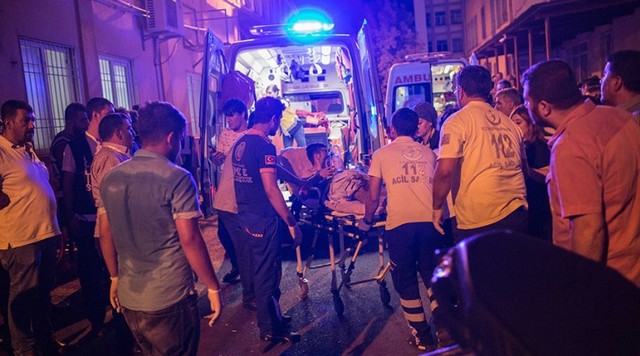
I have walked the streets of Baghdad’s Karrada district when it was safe to do so. Before the U.S. invaded Iraq in 2003, no one worried about car bombs exploding in crowded markets, killing and maiming innocent people. In Karrada, the most recent atrocity committed on Iraqi soil has claimed over 200 lives, and the death toll is expected to rise. As Muslims around the world prepare to celebrate the end of Ramadan, the streets of Karrada are shrines for the dead. Candlelight and the sound of mourners weeping are all that’s left of a once vibrant part of the capital. In the charred ruins of shops and apartments, the search continues for those still missing since a suicide bomber detonated a van packed with explosives, and what would have been a festive occasion ended in tragedy.

Tragedy upon tragedy has visited this ill-fated land between two rivers, land of date palms and stunning, blue-domed mosques, palaces in the sun and silent shepherds guiding their flocks. During Islam’s Golden Age, which lasted from the 8th to the 13th centuries, Baghdad served as the cultural, intellectual, and economic powerhouse of the Muslim empire. From its inceptionin 762 under the guidance and inspiration of Caliph al-Mansur, Baghdad quickly rose in prominence to become one of the most dynamic and prosperous cities of the medieval world. The House of Wisdom (Bayt al-Hikma), Baghdad’s legendary academy and library founded by Caliph Harun al-Rashid in the 8th century, drew together diverse intellectual traditions from the Greeks, Persians, Sumerians, and Indians. Scholars from all parts of the empire came to the House of Wisdom with the common goal of preserving and expanding the world’s trove of knowledge in science, medicine, mathematics, philosophy, and literature.

Originally called the City of Peace (Medinat al-Salaam) during the Abbasid dynasty, which ended with the Mongol invasion in 1258, Baghdad today is anything but peaceful. But there was a time when residents could go about their daily routines without fear of ending up as a pool of blood washed away in the aftermath of one more massacre. There was a time when a Westerner like myself could escort a group of siblings from their home to the shops lining one of Karrada’s busiest streets. The kids needed new shoes for school, and as a friend of the family and would-be Dad, I took them shopping one summer night. We peered into the windows of one shoe store after another in search of just the right kinds of shoes.

And when we found them, all seven of us trooped inside the shop where the owner patiently fitted each child with the perfect pair of shoes. Before leaving, they picked out new socks to go with their shoes, and after I paid the bill, off we went, hand in hand, sprinting down the street like a herd of wild, free-spirited gazelle.

After this past Sunday’s terrorist attack, I called the family and was relieved to hear that no one was hurt, though they dread having to leave the relative safety of their home to shop for food or other necessities. They tell me they want to leave Iraq and hope that as an American, I can somehow help them overcome bureaucratic hurdles to the immigration process.

I have written letters to lawyers and various officials on behalf of this family and other Iraqi families desperate to flee the violence, but I know the letters are only formalities that have little chance of expediting their immigration. But I write them anyway hoping my efforts, however small, will give the families some degree of comfort. It is the least I can do. After all, it was my government that bears the lion’s share of responsibility for the massive suffering that has afflicted Iraq. Yes, Sunday’s suicide bombing was the work of militants. They have killed and tortured thousands of innocents in cities throughout the country. But their bloody rampage is one of the tragic consequences of the war of aggression launched by the Bush Administration in 2003. As the Nuremberg Judgment of 1946 unequivocally states, a war of aggression “is the supreme international crime differing only from other war crimes in that it contains within itself the accumulated evil of the whole.” I would include the ongoing terrorist attacks in Iraq as one more manifestation of the “accumulated evil” resulting from Bush’s war.

Predictably, our mainstream media are rather miserly when it comes to covering the latest assault against the civilian population of Iraq. The horrendous loss of life in Orlando, Florida when a gunman opened fire in a popular gay nightclub and slaughtered 50 people merited front-page coverage and extensive interviews with survivors. Candlelight vigils to mourn the dead, a sit-in by members of Congress calling for the passage of gun control legislation, meticulous examinations of the shooter’s history, family life, religious and political orientations — these and other appropriate, necessary responses succeeded in keeping the story alive and bringing into focus the need to understand why these mass murders occur and why they are on the rise in this country.

No such attention is given to the latest mass murder in Iraq, though I have unearthed the occasional article, including a story on page 6 of the Tuesday, July 5 edition of The New York Times. But as far as I could tell, an outpouring of grief for the victims did not put a damper on this year’s Fourth of July celebration. In Boston, on the city’s famed Esplanade, Tchaikovsky’s 1812 Overture primed the audience for the spectacular pyrotechnic finale. The bells were tolling throughout the city but not for the dead in Baghdad.

Today, with these words, I light a candle to remember the children who died in Sunday’s firestorm in Baghdad, the families who were obliterated, the individuals burned beyond recognition, the surviving friends and relatives looking for answers in the still-smoldering ruins and weeping in wave upon wave of inconsolable grief. My heart is with you, dear sisters and brothers. My hope is that others will light candles too and be moved to stand beside you and call in one invincible voice for an end to war in all its forms.

George Capaccio is a writer and activist living in Arlington, MA. During the years of US- and UK-enforced sanctions against Iraq

6 July 2016

The Chilcot Report Is Out, Tony Blair Apologises But Still Justifies His Decision

By Countercurrents.org

The Chilcot report that enquired into Britain’s decision to join US coalition that attacked Iraq which was released today finds that Britain decided to join the 2003 invasion of Iraq based on “flawed intelligence”. John Chilcot, the chair of the Iraq Inquiry said that the invasion went “badly wrong”.

The 2.6 million-word Iraq Inquiry – which took seven years to prepare – was published in full on Wednesday. It can be accessed online.

Chilcot said: “The UK chose to join the invasion of Iraq before the peaceful options for disarmament had been exhausted.” Chilcot said that, despite explicit warnings, the consequences of the invasion were underestimated. Investigators also found the planning and preparations for Iraq after Hussein was overthrown were wholly inadequate, said Chilcot, who had not been asked to rule on the legality of the invasion. “The people of Iraq have suffered greatly,” Chilcot said.

Responding to the report, former Prime Minister Tony Blair said in a press conference on Wednesday that he “accept full responsibility without exception and without excuse” for the decision to go to war in Iraq, but insisted that the world “is in a better place without Saddam Hussein”.

He said,

“the decision to go to war in Iraq and remove Saddam Hussein from power in a coalition of over 40 countries led by the USA, was the hardest, most momentous, most agonising decision I took in 10 years as British prime minister.

For that decision today I accept full responsibility, without exception and without excuse. I recognise the division felt by many in our country over the war and in particular I feel deeply and sincerely – in a way that no words can properly convey – the grief and suffering of those who lost ones they loved in Iraq, whether the members of our armed forces, the armed forces of other nations, or Iraqis.

The intelligence assessments made at the time of going to war turned out to be wrong. The aftermath turned out to be more hostile, protracted and bloody than ever we imagined. The coalition planned for one set of ground facts and encountered another, and a nation whose people we wanted to set free and secure from the evil of Saddam, became instead victim to sectarian terrorism.

For all of this I express more sorrow, regret and apology than you may ever know or can believe.”

Joshua Rozenberg writing for The Guardian opined:

Sir John Chilcot’s inquiry has not, in his words, “expressed a view on whether military action [in Iraq] was legal”. That question, he said, could be resolved only by a court. Still less does his report deal with the question of whether Tony Blair or others should face legal action.

These are highlights of the report

Military action

The UK chose to join the invasion of Iraq before all peaceful options for disarmament had been exhausted. Military action at that time was not a last resort

Military action might have been necessary later, but in March 2003, it said, there was no imminent threat from the then Iraq leader Saddam Hussein, the strategy of containment could have been adapted and continued for some time and the majority of the Security Council supported continuing UN inspections and monitoring

On 28 July 2002, the then Prime Minister Tony Blair assured US President George W Bush he would be with him “whatever”. But in the letter, he pointed out that a US coalition for military action would need: Progress on the Middle East peace process, UN authority and a shift in public opinion in the UK, Europe, and among Arab leaders

Weapons of Mass Destruction

Judgements about the severity of the threat posed by Iraq’s weapons of mass destruction – or WMD – were presented with a certainty that was not justified
Intelligence had “not established beyond doubt” that Saddam Hussein had continued to produce chemical and biological weapons

The Joint Intelligence Committee said Iraq has “continued to produce chemical and biological agents” and there had been “recent production”. It said Iraq had the means to deliver chemical and biological weapons. But it did not say that Iraq had continued to produce weapons

Policy on the Iraq invasion was made on the basis of flawed intelligence assessments. It was not challenged, and should have been

The legal case

The circumstances in which it was decided that there was a legal basis for UK military action were “far from satisfactory”

The invasion began on 20 March 2003 but not until 13 March did then Attorney General Lord Goldsmith advise there was, on balance, a secure legal basis for military action. Apart from No 10’s response to his letter on 14 March, no formal record was made of that decision and the precise grounds on which it was made remain unclear

The UK’s actions undermined the authority of the United Nations Security Council: The UN’s Charter puts responsibility for the maintenance of peace and security in the Security Council. The UK government was claiming to act on behalf of the international community “to uphold the authority of the Security Council”. But it knew it did not have a majority supporting its actions

In Cabinet, there was little questioning of Lord Goldsmith about his advice and no substantive discussion of the legal issues recorded

Iraq’s aftermath

Despite explicit warnings, the consequences of the invasion were underestimated. The planning and preparations for Iraq after Saddam Hussein were “wholly inadequate”

The government failed to achieve the stated objectives it had set itself in Iraq. More than 200 British citizens died as a result of the conflict. Iraqi people suffered greatly. By July 2009, at least 150,000 Iraqis had died, probably many more. More than one million were displaced

6 July 2016

Inside Bashar al-Assad’s Syrian jail, an Islamist prisoner talks of the regret for his killing

‘I was a maths teacher. I shot him in the back of the head. Three times. I felt nothing. Now I regret.’

By Robert Fisk

Unlike his fellow prisoners, Hamoud Saleh Hamed does not wear leg shackles when he is pushed on a spanking new wheelchair into the Syrian prison governor’s guest room at the Mezze military jail. Impossible, since his trousered right stump and the missing lower half of his left leg mean that the 37-year old Saudi maths teacher from Mecca cannot escape by throwing himself from the second floor window. But he speaks with great calmness, a very intelligent man with long hair and a whispy beard who recounts with frightening lucidity his life as a Nusrah Front mortar platoon commander and an executioner who fired four shots into the head of a Syrian government “collaborator”.

Hamed talks about fate, and says he regrets killing the 50-year old man whose name he never knew, but he recounts with some pride his weapons’ training and his role in the bloody July 2012 Battle of Damascus when thousands of Nusrah and allied rebels vainly tried to capture the city from its Syrian army defenders. He even used Google to plot his artillery ranges across the city but lived to witness the Syrian civilians he came to ‘save’, begging him to leave the country along with his fellow fighters. “When the people wanted us to go, it gave me great pain,” Hamed said, rubbing what was left of his left leg.

“Frankly,” the governor’s balding intelligence officer admitted before Hamed was brought into the room, “I’m very surprised they are going to let you meet this man.” But I could well understand why “they” did. Hamed was a Saudi who fought against the Syrian regime alongside other Wahabi Sunni Saudis, saying he was misled about the Syrian war by the internet and the Qatari ‘al-Jazeera’ channel, describing in detail how he was groomed in Saudi Arabia for his ‘jihad’ by a friend who arranged his passage through Turkey into the Syrian killing fields. Terribly wounded, he was captured by Syrian troops last year while trying to flee to Idlib.

Hamed smiled a lot during his interview in the early hours of the morning, his words occasionally interrupted by the rumble of shellfire from the darkness outside. Like the other prisoners, he had broken his Ramadan fast the previous evening. The governor and his security officer left the room at our request and Hamed said he wanted to talk, even when we told him he did not have to speak with us and could just relax and drink the glass of orange juice beside him. He had never met a foreign journalist before but he enjoyed talking, he said. Ten months in a Syrian jail did not provide much opportunity to chat to anyone. He had not been harmed in prison, he insisted, and “the stories I had heard about what happened here were untrue.” Readers must make of this statement what they will.

Many Islamists have expressed their fascination with mathematics, but Hamed said he gained his MA because he had good teachers in “respected Mecca”, where he married a Saudi woman and was father of a son and four daughters. His father, now dead, had been muezzin at a Mecca mosque, calling Muslims to prayer five times a day. “The Syrian war had started and there were many protests,” he said. “The internet and the television channels like al-Jazeera said that the Syrian people were asking for help. Jihadi slogans spread and the jihadis outside Syria began to call for help to defend the people and stop the brutality of the Assad regime. The idea of going to Syria and to participate grew in my mind. Some sheikhs and religious leaders in Saudi Arabia spoke on television and in the mosques and encouraged us. Jihad is like a duty in Islam.”

A Syrian friend in Mecca, whom he called ‘Abdul-Rahman al-Syri’ (Abdul- Rahman from Syria), organised his Saudi Airlines flight to the Turkish city of Antakya although his departure was kept secret for fear that the Saudi intelligence service would find out. “They were refusing to allow people to go to Syria,” Hamed said, “but for political reasons, nothing to do with Islamic ‘sharia’. There was coordination so that when I arrived a man called Abdul-Rahman abu Hajar took me and several others to an apartment for two nights and then took us to the border where, after a Turkish patrol had passed, we climbed through a hole in the fence and I met another Saudi called Abu Rawaha. He transported us to the Syrian town of Atme [in Idlib province] in a car.”

There was a ‘guest house’ in Atme, Hamed said, where their identity papers and passports were taken from them for “safekeeping”. After two more days, they were taken to a Nusrah-al-Qaeda military training camp where they were taught to use Kalashnikov rifles, RGP B-7 anti-tank rocket launchers and mortars. The teachers were Egyptian, their instructor Turkish. After a month, Hamed was sent to the countryside of Deir-ez-Zour with seven men, an Egyptian, a Qatari and five Saudis, where they met the Nusrah leader of eastern Syria, ‘Emir’ Abu Maria al-Qahtani, who would later be demoted by the Nusrah leadership during a dispute over relations with Isis.

“After we met,” Hamed said, “we pledged our loyalty and obedience and prayed that we would accept good times and bad times and would not question the orders of our commander as we sought to see those who are infidels in the sight of God. We were taken to the city of Deir ez-Zour which was under siege and there was fierce fighting. Then, in a convoy of cars, vans and jeeps, on roads and through the desert, Hamed says he was taken with seven more men to the Damascus suburb of Ghouta where, staying in “a great house” he was told to train on mortars for a month, after which, “to prepare for a very big battle on Damascus”, he was sent to the area of Jobar.

“One of our leaders, ‘Abu-Bakr al-Jordani’ (Abu Baker from Jordan), pin-pointed our targets. I was to fire at the Abbasin stadium and the Panorama war memorial area. I was given the target points from Google maps. The idea was to separate the defending Syrian soldiers, to confuse them. The plan was for seven suicide car bombers to enter Damascus. Zero hour for me was 9.0am on 15 July [2012] and we started shelling.” Hamed admits he did not know who was in his target areas, but says that his own home-made mortars began to explode and one was hit by Syrian army fire and he was eventually forced to escape as government forces advanced. “There had been mistakes by our leaders, one of the car bombs exploded on the road into the city.”

As his men shelled al-Ghouta – which was now under siege by the army – Hamed retreated yet again, to al-Ateibi and then to the village of Marj al-Sultan where a Nusrah man invited him to marry his niece as a second wife. She would later bear him two children. Near the village, Hamed was driving a vehicle in the company of his brother-in-law when a Syrian army rocket hit the vehicle, blowing off his left leg and severing his right leg at the knee. There followed months of medical operations in makeshift rebel hospitals and four days of surgery.

Hamed smiled at me as he said this. Was it worth it, I asked? He sighed and was silent for almost half a minute. “It was fate,” he said. “I will tell you about an incident. There was a man in the Ghouta area who had been caught signaling targets to the Syrian army. A religious judge, a mufti, condemned him to death. They asked me if I would kill him. It was outside, and the man was kneeling on the ground. He was about 50. He confessed before several of the leaders who were there. Then I shot him in the back of the head. I did not know his name. The others told me to keep shooting and I shot him three more times. I felt nothing. If this man was a Muslim and had made a sin, when I killed him I purified him from his sins.”

Hamed talked again about fate, of further months of medical operations and then of his regrets. “It was fate,” he said again. “In Ghouta, the siege was worse and people were very hungry and most civilians hoped the regime would come back to their area. When the people wanted us to go, it gave me great pain. The people who we wanted to help didn’t want us any more. And it was painful to me when fighting broke out between the different rebel groups, between Muslims, between the ‘Free Syrian Army’ and Nusrah and Daesh [Isis].”

Hamed hopes that one day he might be released from prison, to go to Turkey or another state to live with his second wife and children. “I telephoned my first wife in Saudi Arabia after I was wounded,” Hamed said. “She said she was glad that in my plight I had someone to look after me.” But he was captured trying to escape. Now, in prison, he was well treated, he said. “I was told lies about what happened here.”

He paused again for half a minute and I told him how upset I was to hear of the killing of the 50-year old man and – aware of his obvious intelligence – I added that I wished so much that Hamed had not murdered this man. “So do I,” he said quietly. Later, a Syrian friend told me he thought the courts would sentence Hamed to death because he had blood on his hands. Against all capital punishment for any reason, I told my acquaintance that the court should not do that. Besides, would not Hamed be more useful in freedom, to tell the world how the people he and his fighters intended to save had ordered them to leave, and of how the Muslim ‘saviours’ of the Syrian people ended up fighting each other in the suburbs of the city they claimed to want to ‘liberate’?

1 July 2016

Was Elie Wiesel Really “The Conscience Of The World”?

By Mickey Z

When news of Elie Wiesel’s death broke on July 2, the predictable paeans and plaudits flowed. President Barack Obama, for example, called his fellow Nobel Peace Prize winner “the conscience of the world.”
As for me, I instead reflected back to July 4, 2004, when Parade Magazine to hired Wiesel to pen a little something for Independence (sic) Day called “The America I Love” — for their patriotic cover story.

Over a two-page spread, the “Nobel Laureate” explained how America “for two centuries, has stood as a living symbol of all that is charitable and decent to victims of injustice everywhere … where those who have are taught to give back.” He explained that in the United States, “compassion for the refugee and respect for the other still have biblical connotations.”

Those same thoughts coming from a Trump voter in Peoria would be chalked up to ignorance, so perhaps Elie Wiesel was just an idiot, too simple-minded to discern reality from fantasy? But we can’t let him off the hook so easily when, after reminding us — yet again — of his Holocaust experiences, the winner of the Presidential Medal of Freedom admitted, “U.S. history has gone through severe trials” (apparently this is how Nobel Peace Prize winners think: it’s “history” that undergoes trials).

Ever careful to point out his bearing witness to the civil rights movement (and equally careful to avoid explaining what that means), Wiesel called anti-black racism “scandalous and depressing.” But, take heart, black America, because dear Elie added “racism as such has vanished from, the American scene.”

Roll over, Mumia… and tell Sandra Bland the news.

In his 2004 essay, Wiesel deigned to mention a few more of America’s indiscretions but was at the ready to explain: “No nation is composed of saints alone. None is sheltered from mistakes and misdeeds” (more scholarly talk: “mistakes,” not “policy”). “America is always ready to learn from its mishaps,” he writes. “Self-criticism remains its second nature.”

This is the territory of madmen and commissars. Who else speaks such words… and is convinced they speak the truth? Precisely what kind of man is this professional hero, Elie Wiesel? Here are two peeks behind the myth:

While Wiesel’s documentation of the Nazi Holocaust earned him international acclamation, he was not always predisposed to yield the genocide victim’s spotlight. In 1982, for example, a conference on genocide was held in Israel with Wiesel scheduled to be honorary chairman, but the situation became complicated when the Armenians wanted in.

Here’s how Noam Chomsky described the incident: “The Israeli government put pressure upon (Wiesel) to drop the Armenian genocide. They allowed the others, but not the Armenian one. He was pressured by the government to withdraw, and being a loyal commissar as he is, he withdrew… because the Israeli government had said they didn’t want Armenian genocide brought up.”

Wiesel went even further, calling up noted Israeli Holocaust historian, Yehuda Bauer, and pleading with him to also boycott the conference. “That gives an indication of the extent to which people like Elie Wiesel were carrying out their usual function of serving Israeli state interests,” Chomsky explains, “even to the extent of denying a holocaust, which he regularly does.”

Why not welcome the Armenians, you wonder? Chalk it up to two conspicuous factors: the need to monopolize the Holocaust™ image and the geopolitical reality that Turkey (the nation responsible for the Armenian genocide) has been a rare Muslim ally for Israel.

In Parade, Wiesel also spoke of brave American soldiers bringing “rays of hope” to the people of Iraq. Even if this blatant delusion bore even an iota of truth, a reminder: such hopeful rays were not welcome in Central and South America in the 1980s, when Israel served as a U.S. proxy for proving arms to murderous regimes like that of Guatemala. In 1981, shortly after Israel agreed to provide military aid to this oppressive regime, a Guatemalan officer had a feature article published in the army’s Staff College review.

In that article, the officer praised Adolf Hitler, National Socialism, and the Final Solution — quoting extensively from Mein Kampf and chalking up Hitler’s anti-Semitism to the “discovery” that communism was part of a “Jewish conspiracy.” Despite such seemingly incompatible ideology, Israel’s estimated military assistance to Guatemala in 1982 was $90 million.

What type of policies did the Guatemalan government pursue with the help they received from a nation populated with thousands of Holocaust survivors? Consider the words of Gabriel, one of the Guatemalan freedom fighters interviewed in 1994 by Jennifer Harbury: “In my country, child malnutrition is close to 85 percent. Ten percent of all children will be dead before the age of five, and this is only the number actually reported to government agencies. Close to 70 percent of our people are functionally illiterate. There is almost no industry in our country — you need land to survive. Less than 3 percent of our landowners own over 65 percent of our lands. In the last fifteen years or so, there have been over 150,000 political murders and disappearances. Don’t talk to me about Gandhi; he wouldn’t have survived a week here.”

Similar stories can be culled from countries throughout the region, but apparently have had no effect on the rulers of the Jewish state. For example, when Israel faced an international arms embargo after the 1967 war, a plan to divert Belgian and Swiss arms to the Holy Land was implemented. These weapons were supposedly destined for Bolivia to be transported by a company managed by Klaus Barbie… as in “The Butcher of Lyon.”

One figure who might have been expected to find fault with such policy was, of course, Parade cover boy Elie Wiesel. Here is an episode from mid-1985, documented by Yoav Karni in Ha’aretz, which should put to rest any exalted expectations of the revered moralist:

When Wiesel received a letter from a Nobel Prize laureate documenting Israel’s contributions to the atrocities in Guatemala, suggesting that he use his considerable influence to put a stop to Israel’s practice of arming neo-Nazis, Wiesel “sighed” and admitted to Karni that he did not reply to that particular letter.

“I usually answer at once,” he explained, “but what can I answer to him?”

One is left to only wonder how Wiesel’s silent sigh might have been received if it was in response to a letter not about the Jewish state’s complicity in the mass murder of Guatemalans but instead about the function of Auschwitz in 1943.

In that 2004 Parade essay, Elie Wiesel claimed he discovered in America “the strength to overcome cynicism and despair.”

It sounds like what he actually overcame was honesty and compassion.

5 July 2016

Mordechai Vanunu Indicted Again

By Eileen Fleming

On Monday the Jerusalem Magistrate indicted Israel Nuclear Whistle Blower Mordechai Vanunu for allegedly sharing classified information in an interview with Israel’s Channel 2 television channel.

Vanunu was also indicted because he moved into a different apartment [in the same building] without informing the police, and because he was caught meeting with two foreign nationals three years ago!

Modechai Vanunu reported via Facebook:

July 4-2016: after 30 years in Israel prison the new trial started today.

From the big trial of exposing Israel Atomic weapons secrets to new charges about moving apartment without reporting, for meeting foreigners, and for speaking to Israel media about Dimona Nuclear secrets.

So the trial started and will continue in next months…

https://www.facebook.com/FreeMordechaiVanunu/

In the 9 May 2016, article Mordechai Vanunu: Indictments and Vendettas it was reported that Vanunu’s Attorney Avigdor Feldman told Haaretz:

Filing an indictment for a single meeting with two foreigners that occurred three years ago, for moving [apartment] at the same address, and in the end for an interview he gave to Danny Kushmaro at Channel 2, which passed the censor, is a record low for the state in its persecution and abuse of Mordechai Vanunu. I’m ashamed, and whoever filed this indictment should be even more ashamed.

More ashamed should be The Media who have ignored Vanunu’s Human Rights struggle in light of the fact that on 21 April 2016, Israel’s Supreme Court was to rule on Vanunu’s 8th petition to end the Human Rights restrictions against him so that he could leave ‘the only democracy in the Middle East.’

Most ashamed should be ALL who could and have NOT done anything since 23 September 2008, when the Jerusalem District Court reduced Vanunu’s freedom of speech trial jail sentence from six to three months:

In light of his ailing health and the absence of claims that his actions put the country’s security in jeopardy.

I did phone Vanunu after I read that report.

Vanunu told me they were referring to his mental health.

Regarding Vanunu’s September 2015 interview with Israel Channel 2 [which was approved by the Israeli censors] Vanunu appealed directly to the Israeli public stating:

I GOT MARRIED THREE MONTHS AGO. I CAN’T GET A JOB HERE, SO SHE IS THE BREADWINNER.

I WANT TO LIVE MY LIFE, START MY LIFE ANEW. I’M FINISHED WITH THIS ENTIRE [NUCLEAR] STORY, AND I’VE SAID THIS HUNDREDS OF TIMES.

I HAVE NO MORE SECRETS TO TELL, AND I WANT THEM TO LET ME LEAVE AND GO LIVE ABROAD WITH MY WIFE, AND THAT’S THE END OF THE STORY.

The Stories Vanunu told this American about his childhood, crisis of faith, crisis of identity and my research regarding USA collusion in Israel’s Nuclear Deceptions are enshrined HERE

Eileen Fleming is Producer “30 Minutes with Vanunu” and “13 Minutes with Vanunu” Author of “Keep Hope Alive” and “Memoirs of a Nice Irish American ‘Girl’s’ Life in Occupied Territory” and BEYOND NUCLEAR: Mordechai Vanunu’s FREEDOM of SPEECH Trial and My Life as a Muckraker: 2005-2010
Her blog is http://www.eileenfleming.org

5 July 2016


Australia: Deepening Social Discontent Produces Post-Election Turmoil

By Mike Head

Anger over job losses and declining living conditions, combined with years of bitter political experiences with both Labor and Liberal-National Coalition governments, were the primary factors in the further collapse of support for the major parties in last Saturday’s Australian election.

With 1.5 million postal votes still to be counted, some of which will not arrive until July 15, it may be another 10 days before the outcome of the election is known. At least 13 seats in the 150-member lower house remain in doubt, leaving both parties well short of the required majority of 76 seats.

The most likely result is a hung parliament, only the third in Australia’s history, with the formation of a government dependent on deals struck with other parties and “independents.” Before the election, the Coalition government held 90 seats, due to its sweeping defeat of the Greens-backed Labor government in the 2013 election.

The deepening impact of the global economic crisis that erupted in 2008 has intensified the protracted breakup of the two-party system over the past three decades. Since 2007, in particular, voters have experienced six years of Labor government, supported by the Greens, and three years of Coalition government; both seeking to slash social spending to impose the burden of the global breakdown.

The most pronounced expression of the continuing haemorrhaging of support for the political establishment, including the Greens, came in the upper house, the Senate, where a record 26 percent of the valid votes went to other groups, mostly right-wing populists who postured as opponents of the major parties.

There was a 2-percentage point swing against the ruling Coalition, taking its vote down to around 35 percent, but Labor picked up only a 1-point swing to about 30 percent, and the Greens’ vote fell 0.35 points, losing at least one of their nine Senate seats as a result. Today’s 26 percent vote for “others” stands as another marker in the historic decline in support for the major parties. It stands in sharp contrast to the 4.25 percent recorded in 1990.

For now, the main beneficiaries were predominantly nationalist formations trying to channel the social and political discontent in protectionist and xenophobic directions, pitting Australian workers against their fellow workers internationally. Despite the disintegration of mining magnate Clive Palmer’s Palmer United Party (PUP), which secured 5.5 percent of the vote at the last federal election in 2013 with similar anti-establishment rhetoric, the vote for such parties grew.
Most prominently, Pauline Hanson’s right-wing, anti-immigrant One Nation obtained 4 percent, including nearly 10 percent in the mining state of Queensland. The Nick Xenophon Team, which pushes for protectionism and military spending, is based in South Australia, where the closure of the car industry is compounding the mining bust, secured 3.4 percent. Hanson and Xenophon could hold up to three seats each in the 76-member Senate.

In the House of Representatives, the largest shifts against Prime Minister Malcolm Turnbull’s government came in areas of the country most devastated by the collapse of the country’s mining boom, the closure of auto and other manufacturing industries and soaring housing prices, which have taken home ownership out of the reach of many young working class people.

On average, the Coalition vote fell 3.68 percentage points to 41.8 percent, but its losses were considerably greater in the regions where the social reality was most starkly divorced from Turnbull’s constant refrain that Australians live in “exciting” times of “transition” to a new economy.

In northern and central Queensland, where thousands of jobs have been eliminated in coal mines and the Townsville nickel refinery, the anti-government swings exceeded 6 points. In electorates around the north and south of Brisbane, the state capital, where official unemployment rates are as high as 20 percent, the government’s vote fell by up to 8.5 points.

Across the western and southwestern suburbs of Sydney, where exorbitant house prices are hitting families facing high unemployment and under-employment rates, the anti-government swing reached as high as 9.3 percent, allowing Labor to regain several seats it lost in 2013.

In Tasmania, which has the second highest unemployment rate in the country, the government’s vote dropped by up to 10.8 percent, and it lost all three seats it held in the island state to Labor. Ex-PUP Senator Jacqui Lambie kept her Senate seat with a vote of 8.5 percent.

Across South Australia, where workers have been hit by closures of mines and auto-related plants, anti-government swings of around 8 percent opened the way for Xenophon’s group to pick up one or possibly two seats, as well as two or three Senate seats.

In Western Australia, where iron ore and other mine closures have eliminated thousands of jobs, the government lost more than 5 percentage points, with the largest swings in outer Perth suburbs.

While Labor has gained a number of seats, these were mainly ones it lost in the 2013 landslide, taking it back to near the total it obtained in the 2010 election, after which it formed a minority government with the Greens.

To gain votes, Labor conducted a desperate last-minute “save Medicare” campaign, falsely claiming it would defend the public health system, even as it repudiated previous promises to oppose social spending cuts worth $40 billion over four years, plus a $57 billion cut to public hospitals over the next decade.
Despite the cynical Medicare claims, Labor won only about a half of the lower house votes lost by the government, leaving it with Labor’s second lowest primary vote in a century.

In the lower house, the Greens’ vote increased marginally by just over 1 percent to 9.9 percent, but that remained well down from their peak of 11.8 percent in 2010, before they entered into a formal agreement to prop up the minority Labor government. That government, led by Julia Gillard, not only committed Australia to the US military “pivot” to Asia against China, including the basing of US marines in Darwin, but cut public spending by the greatest amount in history in 2012–13.

During this election, the Greens wanted to further cement their position in the political establishment, seeking ministerial posts in a Labor-led government and pledging to help stabilise the parliamentary set-up. Reflecting their upper-middle class and pro-business constituency, they concentrated their campaigns on largely gentrified and wealthy electorates.

For example, the Greens obtained 43 percent of the vote in inner Melbourne, 25 percent in Higgins, a well-to-do electorate held by the Coalition, and 19 percent in Kooyong, based on Melbourne’s richest neighbourhoods. In the now largely better-off electorates of Batman and Wills, they picked up 37 and 30.5 percent respectively. Likewise, the Greens polled 22 percent in Grayndler in inner Sydney, and nearly 20 percent in inner Brisbane, as well as 20 percent in the northern New South Wales rural electorate of Richmond, which includes the wealthy enclave of Byron Bay. By contrast, their vote in working class areas was generally less than 5 percent.

Hanson’s One Nation consciously targeted some of the most economically and socially devastated regions. Its vote exceeded 15 percent in central Queensland and outlying areas of Brisbane, where mining-related job losses have created virtual ghost towns and areas of deep poverty. It also picked up 8 percent in the western Brisbane electorate of Oxley, which has high levels of unemployment.

Hanson last won such levels of support during the late 1990s, when she gained from the landslide defeat of the Hawke and Keating-led Labor government of 1983-1996 that ruthlessly enforced the restructuring of the economy to satisfy the needs of global capital.

Hanson’s ability to make a political comeback, preying upon the social distress being suffered by broad layers of working people, is entirely bound up with the fact that the working class has been politically suppressed and straitjacketed for decades by the Labor Party and trade union apparatuses. They have enforced the ongoing destruction of jobs and conditions under the demand of making Australian-based employers competitive on the world market, peddling a nationalist line that dovetails with Hanson’s.

The re-emergence of Hanson, along with Xenophon, Lambie and similar “other” parties, who all defend the profit system, which is the ultimate cause of war, exploitation and social inequality, is a warning sign. It reinforces the need for workers and young people to turn to the genuine socialist perspective advanced by the Socialist Equality Party, to completely reorganise economic life to meet human need, not the insatiable profit appetites of the wealthy elite.

This article was first published in WSWS.org

5 July 2016

July 4th Reflections From Frederick Douglass

By Robert J Barsocchini

Frederick Douglass, one of the most brilliant minds in history, had many praises for the US and its founders. However, he experienced the nation more fully than any of them, beginning his life a victim of the totalitarian fascism they practiced and promoted, and ending it a statesman and a friend of President Lincoln. Thus his understanding and analysis of the complex country and its culture is more complete and balanced than most. Known as a dazzling orator, he had this to say in a 4th of July address in 1852:

[T]he character and conduct of this nation never looked blacker to me than on this 4th of July. Whether we turn to the declarations of the past, or to the professions of the present, the conduct of the nation seems equally hideous and revolting. America is false to the past, false to the present, and solemnly binds herself to be false to the future.

What, to the American slave, is your 4th of July? I answer; a day that reveals to him, more than all other days in the year, the gross injustice and cruelty to which he is the constant victim. To him, your celebration is a sham; your boasted liberty, an unholy license; your national greatness, swelling vanity; your sounds of rejoicing are empty and heartless; your denunciation of tyrants, brass fronted impudence; your shouts of liberty and equality, hollow mockery; your prayers and hymns, your sermons and thanksgivings, with all your religious parade and solemnity, are, to Him, mere bombast, fraud, deception, impiety, and hypocrisy-a thin veil to cover up crimes which would disgrace a nation of savages. There is not a nation on the earth guilty of practices more shocking and bloody than are the people of the United States, at this very hour.

Go where you may, search where you will, roam through all the monarchies and despotisms of the Old World, travel through South America, search out every abuse, and when you have found the last, lay your facts by the side of the everyday practices of this nation, and you will say with me, that, for revolting barbarity and shameless hypocrisy, America reigns without a rival.

New York has become as Virginia; and the power to hold, hunt, and sell men, women and children, as slaves, remains no longer a mere state institution, but is now an institution of the whole United States. The power is co-extensive with the star-spangled banner, and American Christianity. Where these go, may also go the merciless slave-hunter. Where these are, man is not sacred. He is a bird for the sportsman’s gun.

Your broad republican domain is hunting ground for men.

You hurl your anathemas at the crowned headed tyrants of Russia and Austria and pride yourselves on your Democratic institutions, while you yourselves consent to be the mere tools and body-guards of the tyrants of Virginia and Carolina. You invite to your shores fugitives of oppression from abroad, honor them with banquets, greet them with ovations, cheer them, toast them, salute them, protect them, and pour out your money to them like water; but the fugitives from oppression in your own land you advertise, hunt, arrest, shoot, and kill. You glory in your refinement and your universal education; yet you maintain a system as barbarous and dreadful as ever stained the character of a nation-a system begun in avarice, supported in pride, and perpetuated in cruelty. You shed tears over fallen Hungary, and make the sad story of her wrongs the theme of your poets, statesmen, and orators, till your gallant sons are ready to fly to arms to vindicate her cause against the oppressor; but, in regard to the ten thousand wrongs of the American slave, you would enforce the strictest silence, and would hail him as an enemy of the nation who dares to make those wrongs the subject of public discourse.

Soon after this speech and the tumult that followed, Douglass would note how the war against the South was almost entirely based on preventing division of the empire, with actual anti-slavery, humanitarian sentiment only inspiring a minuscule minority of whites. He cheered the destruction of chattel institutions, but his knowledge that this destruction was driven far less by humanitarianism than practicality regarding maintaining the empire meant he would be horrified and disheartened, but perhaps not entirely shocked, to see slavery continue, again with the official blessing and participation of the North, after the South was subdued and infrastructure was rebuilt.

Historian and Wall Street Journal contributor Douglas Blackmon documents how slavery remained official US policy up to the early 1940s, and Amnesty International and various scholars document how it continues today, with many black men still slaving on cotton fields under a provision of the 13th amendment that maintains slavery as a still ‘legal’, multi-billion-dollar per year industry.

As an example of the power of the religion of US nationalism, I cite an attorney friend and graduate of the nation’s number one top law-school, who in conversation mentioned that the 13th amendment ‘abolished slavery’, and that every law-school student studies this in depth. I interjected that the amendment abolished slavery with an exception for people convicted of ‘crimes’ (ie loitering or marijuana possession). The attorney’s response was: “I didn’t know that.”

The 13th amendment is two sentences. What does it say about US culture that a graduate from the single top law-school in the country today does not know that the 13th amendment carries an exception?

It says Frederick Douglass is right.

Full text of the 13th amendment:

Neither slavery nor involuntary servitude, except as a punishment for crime whereof the party shall have been duly convicted, shall exist within the United States, or any place subject to their jurisdiction.

Congress shall have power to enforce this article by appropriate legislation.

Robert J. Barsocchini is an internationally published author who focuses on force dynamics, national and global, and acts as a cultural intermediary for the film and Television industry. Updates on Twitter. Author’s pamphlet ‘The Agility of Tyranny: Historical Roots of Black Lives Matter’.

5 July 2016