Just International

Is The “Official 9/11 Story” Coming Apart At The Seams?

By Eresh Omar Jamal

Anyone who is even barely informed knows by now that the “official 9/11 story” is a complete fantasy. The event did, however, provide the US government with a “catastrophic and catalysing event like a new pearl harbour,” which the Project for the New American Century — co-written by Dick Cheney, Donald Rumsfeld, Paul Wolfowitz along with seven other individuals, who went onto serve for the Bush administration — said was needed, 9 months before 9/11 happened, to bring about “revolutionary changes” and “secure energy supplies” for the US.

From having the only skyscrapers in history anywhere in the world to ever even fall down from a fire, let alone vertically on its own footprint, which thousands of engineers and experts from other fields say is impossible, to having “3 skyscrapers fall vertically down on its own footprint after being hit by 2 planes”, the official 9/11 story is one of the most imaginative, yet, hard to believe fairy-tales of our time. That is right. Remember building 7? It also collapsed vertically down on its own footprint after NOT being hit by a plane in the same fashion as the twin towers did, in the same way that buildings come down during controlled demolitions as confirmed by engineers and other experts.

Pointing out the many holes in the official 9/11 story, however, is not the point of this article. All I want to point out to the reader before proceeding any further is that whatever happened, the “official story is a lie” and that the “US government was surely involved” in it somehow, as the world’s most sophisticated aerospace defence system — the North American Aerospace Defence Command — which protects North America from any such attacks completely, had stood down on September 11, 2001, and many whistleblowers have even said that the orders to stand down came from the highest levels of government. Despite all of this and more, there is no way, as of yet, to confirm what really happened — all we can do is speculate. That may, however, well be changing.

Speculating

First, let me speculate based on my research of the event and from testimonies of various whistleblowers as to what really happened. What I believe happened was that the US government had funded various elements within Saudi Arabia (among others) to carry out many aspects of the 9/11 attack (for example, 15 out of the 19 hijackers were allegedly from Saudi Arabia), so that it can invade other countries to serve the interest of the Anglo-American elite, based on false allegations against those innocent countries. 9/11 was a false flag attack, just like hundreds of others carried out by various governments around the world, throughout history.

It is already well known that the US government and the CIA have had close ties with various groups in Saudi Arabia, including the Saudi royal family, for years. Various sources within the US establishment has even suggested that the attackers of 9/11 were funded by members close to, or even belonging to, the Saudi royal family. But that aside, I believe that the US government had primarily ran the whole show, hoping that they would be able to bury the evidence implicating the various elements within Saudi Arabia to the events of 9/11 so as to eradicate the trail, which would eventually lead to them. That is precisely why the establishment had tried so hard, and continues to, to keep 28-pages of the 9/11 Commission Report classified, as according to some within the US government who has looked at those pages, “it clearly implicates the Saudi regime”. And it is the push to declassify those 28-pages that is blowing the lid anew, on the “official 9/11 story”.

Turning on each other

Given the talks of declassifying those 28-pages along with the US government allowing the 9/11 victims’ families to sue the Saudi government for damages through the Justice Against Sponsors of Terrorism Act which was passed by the Senate on May 17, 2016, the Saudi press recently claimed what is, perhaps, already well known, that the 9/11 attacks were a false flag operation run by the US government. On April 28, 2016, the London-based Saudi daily Al-Hayat published an article written by Saudi legal expert Katib Al-Shammari, arguing that “The US itself had planned and carried out the 9/11 attacks, placing the blame on a shifting series of others — first Al-Qaeda and the Taliban, then Saddam Hussein’s regime in Iraq, and now Saudi Arabia (“Article In Saudi Daily: US Planned, Carried Out 9/11 Attacks — But Blames Others For Them”, Middle East Media Research Institute, May 19, 2016).”

Al-Shammari’s article states that:

“Those who follow American policy see that it is built upon the principle of advance planning and future probabilities. This is because it occasionally presents a certain topic to a country that it does not wish [to bring up] at that time but [that it is] reserving in its archives as an ace to play [at a later date] in order to pressure that country. Anyone revisiting… [statements by] George HW Bush regarding Operation Desert Storm might find that he acknowledged that the US Army could have invaded Iraq in the 1990s, but that [the Americans] had preferred to keep Saddam Hussein around as a bargaining chip for [use against] other Gulf states. However, once the Shi’ite wave began to advance, the Americans wanted to get rid of Saddam Hussein, since they no longer saw him as an ace up their sleeve.

September 11 is one of winning cards in the American archives, because all the wise people in the world who are experts on American policy and who analyse the images and the videos [of 9/11] agree unanimously that what happened in the [Twin] Towers was a purely American action, planned and carried out within the US. Proof of this is the sequence of continuous explosions that dramatically ripped through both buildings… Expert structural engineers demolished them with explosives, while the planes crashing [into them] only gave the green light for the detonation — they were not the reason for the collapse.”

It further says that the events of 9/11 gave the US government the ability to do certain things. For one, “The US [government] created, in public opinion, an obscure enemy — terrorism — which became what American presidents blamed for all their mistakes, and also became the sole motivation for any dirty operation that American politicians and military figures desire to carry out in any country.” Second, that it allowed the US government to launch “a new age of global armament”. And third, it made the American people “choose from two bad options: either live peacefully [but] remain exposed to the danger of death [by terrorism] at any moment, or starve in safety, because [the country’s budget will be spent on sending] the Marines even as far as Mars.” Concluding that, “the nature of the US is [such that] it cannot exist without an enemy”.

Only a few days later, on May 21, 2016, The New York Times ran an article titled, “How Kosovo Was Turned Into Fertile Ground for ISIS”, which said:

“Saudi money and influence have transformed this once-tolerant Muslim society at the hem of Europe into a front of Islamic extremism and a pipeline for jihadists. Kosovo now finds itself, like the rest of Europe, fending off the threat of radical Islam… Kosovo now has over 800 mosques, 240 of them built since the war and blamed for helping indoctrinate a new generation in Wahhabism. They are part of what moderate imams and officials here describe as a deliberate, long-term strategy by Saudi Arabia to reshape Islam in its image, not only in Kosovo but around the world… Saudi diplomatic cables released by WikiLeaks in 2015 reveal a system of funding for mosques, Islamic centres and Saudi-trained clerics that spans Asia, Africa and Europe.”

The article then goes onto grave details about Saudi involvement with extremists and the spread of extremism. Now, the question is, given that the US government has tried so hard to protect its close allies from being implicated with the 9/11 attacks before — both Saudi Arabia and Israel — especially through its propaganda machine, why did The New York Times run such an article? Dr Paul Craig Roberts, who was the Assistant Secretary of the Treasury for Economic Policy under Ronald Reagan, writes:

“One possible answer is that the public’s confidence in the 9/11 story is eroding as a result of growing expert opinion that challenges the official line. In order to redirect the public’s scepticism, a red herring is being pulled across the trail. The Saudi angle satisfies the belief that some sort of government coverup is involved but ‘redirects’ [emphasis mine] the suspicion from Washington to the Saudis… We are probably experiencing a deep state disinformation play designed to protect the false 9/11 story. The public’s scepticism is now directed at Saudi Arabia, and the public’s outrage is directed at the US government for covering up for the Saudis.”

Interestingly enough, the NYT in an editorial on May 27, 2016, wrote that “Saudi Arabia has frustrated American policy makers for years”. This was because the Saudis have sponsored “extremist clerics” who are “fostering violent jihad”, creating a “fertile ground for recruitment to radical ideology”. What is interesting is that, even if all of that is true, it was the US that had turned Kosovo into a failed state to begin with, prompting for its secession from Serbia in 2008. So if Washington is now willing to scapegoat Saudi Arabia for the disaster (or part of it) that it brought to Kosovo, there is no reason to believe that it will not do the same when it comes to the events of 9/11. As Finian Cunningham pointed out in a piece for RT, “Dishing the dirt on the Saudis over Kosovo is but one aspect of a larger emerging narrative in Washington. One which seeks to offload responsibility for international terrorism, instability and conflict on to America’s Arab allies… Washington is setting the Saudi rulers up to take the rap for a myriad of evils that arguably it has much more responsibility for. The question is: how much can the strategic alliance between the US and its Saudi partner bear — before a straw breaks the camel’s back? (“US stabs Saudi ‘ally’ in the back — again — with terror scapegoating”, RT, June 2).”

Breaking the camel’s back

It seems that Washington is clearly setting the Saudis up to take the fall should the 9/11 cover-up start to unravel even further, as evident from the New York Times’ “new narrative” (which had already been popularised by the alternate media). The Saudis, it seems, can already see the guns being pointed at its direction. That is why the Saudi press had published that piece in the first place. All of this has the potential to finally bring an end to the strategic alliance between Washington and Saudi Arabia which has brought so much death and destruction to the world and, with it, bring the official 9/11 story come crashing down on its head. So, is the “official 9/11 story” coming apart at the seams? Given the amount of suffering that has been brought to so many innocent people around the world based on that false story by its authors, one can only hope so. For those of you who feel the same way, please spread the word, and share this article, and help the “official 9/11 story” come apart at the seams, as it should have, a long time ago.

Eresh Omar Jamal is an editorial assistant at New Age, a leading English daily newspaper in Bangladesh. He has done a Specialised Honours in Financial and Business Economics from York University, Canada. He can be reached at eresh17@hotmail.com.

10 June, 2016
Countercurrents.org

Even For A Democrat, Clinton Stands Out As Violent, Aggressive

By Robert Barsocchini

Robert Parry says in his latest piece that while the Democrats have been “a reluctant war party” since 1968, by nominating Hillary Clinton, they have once again become an “aggressive war party”.

Noam Chomsky notes that indeed, Hillary Clinton would be more “adventurous”, ie aggressive, than Trump or Sanders in terms of foreign policy, but he and other analysts, like John Pilger, disagree with Parry that the Democrats were, during the period Parry suggests, and perhaps any other, what a rational person would call “reluctant” to kill.

Looking back briefly at a couple of examples of Democratic initiatives, as well as who formed the Democratic party, we see that when it comes to butchering people, the Democrats have never been shy.

John Pilger points out in a recent article that “most of America’s wars (almost all of them against defenceless countries) have been launched not by Republican presidents but by liberal Democrats: Truman, Kennedy, Johnson, Carter, Clinton, Obama.”

Kennedy began the US genocide against the people of Vietnam, demanding bombings and attacks with chemical weapons like napalm, and began a terrorist campaign against Cuba that continues to date.

Johnson, who viewed the Vietnamese people as “barbaric yellow dwarves”, continued the genocide in Vietnam and Indochina.

Carter supported numerous genocides and terrorist campaigns.

Bill Clinton, among many horrific acts, committed a major genocide against the people of Iraq, and helped lay the foundation for today’s nuclear war tension by expanding NATO to Russia’s borders.

One of Hillary Clinton’s many crimes was to continue this expansion by supporting a US-backed, neo-Nazi and neo-con integrated coup in Ukraine while referring to the president of Russia as “Hitler” – by far the most aggressive stance towards Russia of any US candidate.

See Pilger’s article for some of Obama’s crimes, which in several ways are uniquely extreme.

Truman defied his military advisers and many others and carried out mass nuclear executions of civilians as a way to influence the government of Japan (and likely the Soviet Union), then followed his nuclear attacks by further targeting Japanese civilians with the biggest TNT-based mass-execution of civilians in human history up to that point. Executing civilians was a prominent part of his ‘Democratic’ philosophy. He publicly stated that “the German people are beginning to atone for the crimes of the gangsters whom they placed in power and whom they wholeheartedly approved and obediently followed.” His logic, an example of the standard definition of “terrorism”, would suggest that Israelis, who support almost entirely their state’s illegal annexation and massacres of Palestine, should be targeted and killed until they “atone” for what their government is doing, and that US civilians who supported the sanctions against or invasion of Iraq (etc.) should likewise be punished until they “atone”. This is also the principle behind the 9/11 attacks, though US citizens who support terrorism committed by their own state are quick to engage in the “wrong agent” – genetic– fallacy when this is pointed out.

Looking back further than Truman, we find the Democrats comprised the bulk of the pro-chattel-slavery bloc. As noted at Pbs.org, “after the Civil War, most white Southerners opposed Radical Reconstruction and the Republican Party’s support of black civil and political rights. The Democratic Party identified itself as the “white man’s party” and demonized the Republican Party as being “Negro dominated,” even though whites were in control. Determined to re-capture the South, Southern Democrats “redeemed” state after state — sometimes peacefully, other times by fraud and violence. By 1877, when Reconstruction was officially over, the Democratic Party controlled every Southern state. The South remained a one-party region until the Civil Rights movement began in the 1960s. Northern Democrats, most of whom had prejudicial attitudes towards blacks, offered no challenge to the discriminatory policies of the Southern Democrats.”

Backing up again, we see that in fact the Democratic party was founded by supporters of the sadistic genocidaire Andrew Jackson, who enjoyed making clothing from the skin of people who were exterminated in service of expanding the un-free world.

Are Republicans therefore a superior ogranization? Of course not. The two parties check and balance each other to maintain and expand the world’s leading terrorist state.

As we can see, it is nothing new or different for the Democrats to be a party of expansionist gangsters. What is remarkable of Clinton, then, is that even against this gory and tyrannical backdrop, she stands out as especially evil, corrupt, and extremist in her US religio-national supremacism. As Professor Johan Galtung notes, two countries today (and occasionally their proxies) continue to wage aggressive war, thanks to their belief that they have been anointed by their gods: the US and Israel. And Hillary Clinton is as fundamentalist as they come.

As Chris Hedges and Noam Chomsky, among others, have recently noted, US elections are “a carnival… a way of making people passive, submissive objects”. Rather than petering out and cowering to the Democratic party, Chomsky says, Sanders supporters should “sustain the ongoing movement, which [should] pay attention to the elections for 10 minutes but meanwhile do other things.” However, at the moment, “it’s the other way around. It’s all focused on the election. It’s just part of the ideology. The way you keep people out of activism is get them all excited about the carnival that goes on every four years and then go home, which has happened over and over.”

Robert Barsocchini is an internationally published author who focuses on force dynamics, national and global, and also writes professionally for the film industry. Updates on Twitter. Author’s pamphlet ‘The Agility of Tyranny: Historical Roots of Black Lives Matter’.

10 June, 2016
Countercurrents.org


Bangladeshi Buddhist monks feed hundreds of poor Muslims during Ramadan

By The Straits Time

DHAKA (AFP) – A Buddhist monastery in Bangladesh is serving food to hundreds of poor Muslims during Ramadan, in a rare example of social harmony between the religions in the South Asian nation.

Dharmarajika, in the capital Dhaka, has become a hit on social media since it started distributing daily food packs for Muslims who break their fast during the Islamic month at sunset, known as Iftar.

“Buddhism taught us that serving humanity is the ultimate religion. We are feeding the poor Muslims who cannot afford to buy proper meals to break their fast,” Suddhananda Mahathero, the head monk of the monastery, told AFP.

When AFP visited on Monday evening, more than 300 Muslims were waiting at the gate of the monastery in Dhaka’s Basabo neighbourhood to receive some Iftar delicacies.

“I can eat some good food served with love and care,” said 70-year-old Ms Amena Khatun, who added that she had walked several kilometres to get there.

As a young monk distributed tickets to hungry Muslims, police were on hand to ensure the process remained orderly.

“This is such a wonderful example of religious harmony: showing respect and affection to the fasting neighbours without thinking of the difference of religions,” said policeman Asad Uzzaman.

Muslims make up around 90 per cent of Bangladesh’s 160 million population, with a tiny community of Buddhists residing mostly in the country’s southeastern districts bordering Myanmar.

In September 2012, tens of thousands of Muslims vandalised and torched nearly a dozen Buddhist temples in the south of the country following allegations that a Buddhist man had desecrated the Quran.

Many Muslims took to social media to thank the Dharmarajika monastery for their food distribution, posting photos on Facebook of the yellow-clad monks handing out supplies. Others praised the monks on Twitter.

“I really appreciate the initiative and thank them,” Mr Nur Hossain, a banker, told AFP.

The monastery was established in 1949 and is home to more than 700 orphans who study at a free school it runs.

7 July 2015
http://www.straitstimes.com/


A Moral Revolution? Reflections On President Obama’s Visit To Hiroshima

By Richard Falk

There is doubt that President Barack Obama’s visit to Hiroshima this May crossed some thresholds hitherto taboo. Above all the visit was properly heralded as the first time a sitting American president has dared such a pilgrimage, which has already been critically commented upon by patrioteers in America who still think that the Japanese deserved such a punishment for initiating the war or believed that only such ‘shock and awe’ could induce the Japenese to surrender without a costly invasion of the mainland. As well many in Asia believe that Obama by the visit is unwittingly letting Japan off the accountability hook for its seemingly unrepentant record of atrocities throughout Asia, especially given the perception that the current Prime Minister, Shinzo Abe, is doing his conservative best to reinvigorate Japanese nationalism, and even revive imperial ambitions.

Obama is a gifted orator who excels in finding the right words for the occasion, and in Hiroshima his rhetoric soared once more. There he noted “[t]echnological progress without an equivalent progress in human institutions can doom us. The scientific revolution that led to the splitting of the atom requires a moral revolution as well.” Such stirring words would seem to be a call to action, especially when reinforced by a direct challenge: “..among nations like my own that hold nuclear stockpiles, we must have the courage to escape the logic of fear and pursue a world without them.” Obama at Prague in 2009, shortly after being sworn in as president, set forth an inspiring vision along the same lines, yet the small print there and now makes us wonder whether his heart and head are truly aligned. The words flow with grace and even passion, but where are the deeds?

As in Prague, Obama expressed the cautionary sentiment in Hiroshima that “[w]e may not realize this goal in my lifetime.” At which point Obama goes associates himself with the stabilizing agenda of arms control, reducing the size of the stockpile, making the weapons less obtainable by ‘fanatics,’ and implementing nonproliferation goals. Apparently, neither Obama nor the media take note of the tension between eliminating the weaponry and these proposals designed to stabilize the nuclear weapons environment by making it more reliably subject to prudent and rational policies of control. Yet at the same time making proposals to eliminate the weaponry seem less needed, and even at risk of threatening the stability so carefully constructed over the course of decades.

The real reason for skepticism about Obama’s approach is his unexplained reasons to defer the abolition of nuclear weaponry to the distant future. When Obama declares that a world without nuclear weapons is not likely to happen in his lifetime without telling us why he is changing his role from an advocate of the needed ‘moral revolution’ so as to achieve the desired political transformation to that of being a subtle endorser of the nuclear status quo. Of course, Obama may be right that negotiating nuclear disarmament will not be easy or quick, but what is the argument against trying, why defer indefinitely.

The global setting seems as favorable as it is likely to get. We live at a time when there are no fundamental cleavages among leading sovereign states, all of whom seek to benefit from a robust world economy and to live together without international wars. It would seem to be an overall situation in which dramatic innovations of benefit to the entire world would seem politically attractive. In such an atmosphere why could not Obama have said at Hiroshima, or seven years earlier at Prague, “that during the Cold War people dreamed of a world without nuclear weapons, but the tensions, distrust, and rivalry precluded a reliable disarming process, but now conditions are different. There are no good reasons not to convert dreams of a world without nuclear weapons into a carefully monitored and verified disarmament process, and there are many important reasons to try to do so. What holds Obama back? Why does he not table a proposal or work with other nuclear governments to produce a realistic timetable to reach nuclear zero?

Worse than the seeming absence of what the great theologian, Paul Tillich, called ‘the courage to be’ is the worrisome evidence of double dealing—eloquent words spoken to warn us of the menace of nuclearism coupled with deeds that actually strengthen the hold of nuclearism on the human future. How else should we interpret the appropriation by the U.S. Government of $1 trillion over the years until 2030 for the modernization and further development of the existing nuclear weapons arsenal, including provocative plans to develop nuclear weapons with potential battlefield, as opposed to deterrent, missions? Such plans are provocative because they weaken inhibitions on use and tempt other governments to emulate the United States so as offset feared new vulnerabilities to threat and attack. What stands out is the concreteness of the deeds reinforcing the nuclear established order and the abstractness of the words challenging that same order.

Beyond this, while calling for a moral revolution, Obama seems at the same time to give his blessings to nuclear energy despite its profound moral shortcomings. Obama views nuclear energy as a contribution to reducing carbon emissions in relation to global warming concerns and as a way to sell nuclear technology abroad and at the same time satisfy the energy goals of countries, such as India, in the global South. What is not acknowledged by Obama is that this nuclear energy technology is extremely dangerous and on balance detrimental in many of the same ways as nuclear weapons, prone to accidents of the sort associated with the incidents at Chernobyl and Fukushima, subject to the hazards of accumulating and disposing of nuclear wastes, vulnerable to nuclear terrorism, and creating the technological capacity for the development of the weapons in a series of additional states.

Obama made a point of announcing before visiting Hiroshima that there would be no apology for the attacks by the United States. Clearly, Obama was unwilling to enter a domain that in America remains inflamed by antagonistic beliefs, interpretations, and priorities. There is a scholarly consensus that the war would have soon ended without an invasion or the atomic bomb, but this thesis continues to be challenged by veterans and others who think that the bomb saved American lives, or at minimum, ended the captivity of captured soldiers far sooner than would have been the case without the attacks.

In fairness, Obama did acknowledge the unspeakable tragedy for Japanese civilians that experienced the Hiroshima bomb, and he showed real empathy for survivors (hibakusha) who were there in the front rows when he spoke in Hiroshima Memorial Peace Park, but he held back from saying the use of the bomb was wrong, even the second bomb dropped on Nagasaki. Obama’s emphasis, instead, was on working together to make sure that it doesn’t happen again. In this sense, Obama was indirectly legitimating the impunity that was accorded to the victors after World War II, which contrasted with the punitive measures of accountability used to deal with the crimes committed by the surviving leaders of defeated Japan and Germany. The main value of an apology is to bring a degree of closure to those directly and indirectly victimized by those terrible, events that took place more than 70 years ago. By so doing the United States would have moved a bit closer to suspending its self-serving insistence on impunity and this would have withdrawn geopolitical legitimacy from the weaponry.

There is something disturbing about America’s unwillingness to live up tothe full horror of its past actions even while making a never again pledge. In another recent development that is freighted with similar moral ambiguities, former Senator Bob Kerrey was named the first Chair of the Board of the new Fulbright Vietnam University, a laudable joint educational project of the two countries partly funded by the U.S. Congress, despite his apparent involvement in a shameful atrocity committed during the war. The incident occurred on February 25, 1969 in the village of Thang Phong where a unit of Navy SEALS was assigned the task of assassinating a Viet Cong leader believed to be in the vicinity. Instead of a military encounter, 20 civilians were killed, some brutally. 13 were children and one a pregnant woman.

Kerrey contends that the carnage was the result of mistakes, while both a fellow member of the SEALS squad and village residents say that the killing of the civilians was deliberate, and not an accident in the darkness. Kerrey received a Bronze Star for the mission, which was reported falsely to his military superiors as resulted in killing 21 Viet Cong militants. What is almost worse, Kerrey kept silent about the incident for more than 30 years, and only spoke about it in public after learning there was about to be a published piece highly critical of his role. Kerrey now says “I have been haunted for 32 years” and explains, “It was not a military victory, it was a tragedy, and I had ordered it.” The weight of the evidence suggests that Kerrey participated as well as ordered the killings, and that although certainly a tragedy it is more properly acknowledged as a severe war crime amounting to an atrocity.

We can only imagine what would be the American or Chines reaction if Japan sent to the United States or China a comparable person to provide an honorific link between the two countries. For instance, sending a Japanese officer to the U.S. who had cruelly administered a POW camp where Americans were held captive and tortured or sending to China a Japanese commander who had participated in some of the grisly happenings associated with ‘the rape of Nanking.’ It is good that Kerrey is finally contrite about his past role and appears to have been genuinely involved in promoting this goodwill promotion of education in Vietnam, yet it seems unacceptably insensitive that he would be chosen to occupy such a position in an educational institution in Vietnam that is named after a prominent American senator who is particularly remembered for his efforts to being the Vietnam War to an end.

What connects these two seemingly distinct concerns is the steadfast refusal of the United States Government to take responsibility for its past crimes, which ensures that when future political pressures push toward immoral and unlawful behavior a similar disregard for minimal decency will be papered over. Obama’s refusal to consider accountability for the unabashed reliance on torture during the presidency of George W. Bush similarly whitewashes the past while unconvincingly promising to do better in the future. Such a pattern makes a mockery of claims made by Obama on behalf of the United States that unlike its adversaries this is a country that reveres the rule of law whenever it acts at home or abroad. From the pragmatic standpoint of governing America, in fairness, Obama never really had a choice. The political culture would have rebelled against holding the Bush administration accountable for its crime, which brings us closer to the truth of a double standard of suspending the applicability of international criminal law with respect to the policies and practices of the United States while championing individual legal responsibility for its adversaries as an expression of the evolution of moral standards in international life..

I believe that double standards has led Obama to put himself forward both as a visionary who seeks a transformed peaceful and just world and also as a geopolitical manager that accepts the job description of the presidency as upholding American global dominance by force as necessary. Now that Obama’s time in the White House is nearing its end we are better able to grasp the incompatibility of his embrace of these two roles, which sadly, and likely tragically, leads to the conclusion that the vision of a world without nuclear weapons was never meant to be more than empty words. What the peoples of the world need to discover over and over again is that the promising words flow easily from the lips of leaders have little significance unless supplemented by a robust movement from below that challenges those who are governing from above. As activists in the 1960s began to understand is that only when the body pushes against the machine will policies incline toward peace and justice, and we in the 21st century will have to rediscover this bit of political wisdom if hope for a nuclear free world is to become a genuine political project.

If more than rhetoric is attached to the call for a ‘moral revolution,’ then the place to start would be to question, prior to abandoning, the mentality that is comfortable with double standards when it come to war making and criminal accountability. The whole idea of impunity for the victors and capital punishment for the losers is morally regressive. Both the Obama visit to Hiroshima, as significant as it was, and the Kerrey relationship to the Fulbright Vietnam University, show that American society, even at its best, is far from prepared to take part in the necessary moral revolution.

Richard Falk is an international law and international relations scholar who taught at Princeton University for forty years. Since 2002 he has lived in Santa Barbara, California, and taught at the local campus of the University of California in Global and International Studies and since 2005 chaired the Board of the Nuclear Age Peace Foundation. For six years (2008-2014) he acted as UN Special Rapporteur for Occupied Palestine

06 June, 2016
Richard Falk Blog

Israel Wants A Peace Process – But Only If It’s Doomed To Fail

By Jonathan Cook

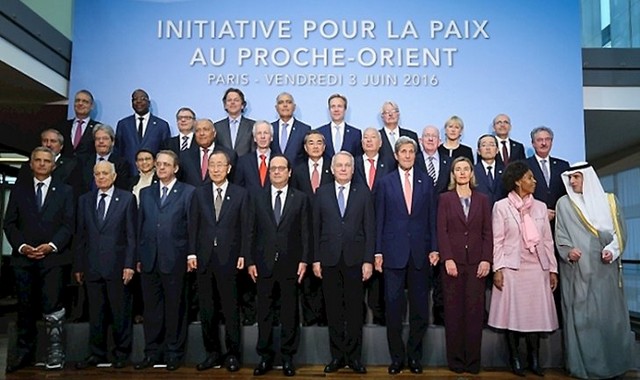
Nazareth: In a familiar muddying of the waters, Israeli prime minister Benjamin Netanyahu has spent the past week talking up peace while fiercely criticising Friday’s summit in France – the only diplomatic initiative on the horizon.

As foreign ministers from 29 nations arrived for a one-day meeting in Paris, Netanyahu dusted off the tired argument that any sign of diplomatic support for Palestinians would encourage from them “extreme demands”.

France hopes the meeting will serve as a prelude to launching a peace process later in the year. French president Francois Hollande said he hoped to achieve a “peace [that] will be solid, sustainable and under international supervision”.

With astounding chutzpah, Israeli official Dore Gold compared the summit to the “height of colonialism” a century ago, when Britain and France carved up the Middle East between them. He conveniently overlooked the fact that it was the same British colonialism that promised a Jewish “homeland” in place of the native Palestinian population.

Earlier, Netanyahu and his new defence minister, the far-right Avigdor Lieberman, had publicly committed themselves to an “unceasing search for a path to peace”.

In a two-minute interview on CNN, spokesman David Keyes managed to mention the formula “two states for two peoples” no less than five times.

Rather than the French initiative, Netanyahu averred, Israelis and Palestinians should be left to engage in the kind of face-to-face talks “without preconditions” that have repeatedly failed. That is because Israel, as the much stronger party, has been able to void them by imposing its own conditions.

Netanyahu, it seems, is keen on any peace process, just so long as it’s not the current one launched in Paris.

Part of the reason for bringing Lieberman into the government was to provide more diplomatic wriggle room. With Lieberman cementing Netanyahu’s credentials with the far-right, he is now free to spout vague platitudes about peace knowing that his coalition partners are unlikely to take him at his word and bolt the government.

But while the domestic front has been secured, rumbles of dissent reverberate abroad.

Europe is increasingly fearful that an emboldened Israeli government may soon annex all or major parts of the West Bank, stymying any hope of creating even a severely truncated Palestinian state.

The Paris conference is a sign of the mounting desperation in Europe to restrain Israel.

While France is not about to engineer a breakthrough, Netanyahu is nonetheless worried.

It is the first time Israel has faced being dragged into talks not presided over by its Washington patron. That risks setting a dangerous precedent.

Although US secretary of state John Kerry attended, he was decidedly cool towards the summit. Yet Netanyahu worries that this time Washington may not be able – or willing – to watch his back.

If the conference leads to talks later in the year, that will be when Barack Obama is preparing to bow out as president. Netanyahu is afraid of surprises. Israeli officials have been in near-panic that Obama may seek payback for the years of humiliation he endured from Netanyahu.

One way might be for Washington to agree to French oversight of the talks, following a tight timetable and establishing diplomatic “teams” to solve final-status issues.

Even if negotiations fail, as seems inevitable, parameters for future talks might be established.

Netanyahu also knows that the wider atmosphere is likely to leave him singled out as the intransigent party.

A report by the Quartet, due soon, is expected to criticise Israel for its past failure to take steps towards peace. And a report last week by a joint team of US and Israeli defence experts suggested Israel’s “security concerns” about Palestinian statehood are not as intractable as claimed.

Netanyahu wants instead to deflect attention to a “regional peace summit”. The key has been Egypt’s support for a revival of direct negotiations between Israel and the Palestinians, based on the Arab Peace Plan of 2002. It promised Israel normal relations with the Arab world in return for ending the occupation.

Israel’s sudden interest in the plan is odd, given that it has not been discussed in cabinet since the Saudis unveiled it 14 years ago.

In truth, Netanyahu backs the idea because he knows reaching a region-wide agreement would be impossible with the Middle East in turmoil.

Israeli officials have already insisted that parts of the 2002 plan need “updating”. Israel, for example, wants sovereignty over the Golan, Syrian territory it seized in 1967, and which currently promises newfound oil riches.

At the summit, the Saudi foreign minister said Israeli efforts to “water down” the plan would be opposed. Egyptian officials have hurried to distance themselves from the Netanyahu proposal and throw their weight behind the Paris process.

Still, Israel will try to ride out the French initiative until Obama’s successor is installed next year. Then, Netanyahu hopes, he can forget about the threat of two states once and for all.

Jonathan Cook won the Martha Gellhorn Special Prize for Journalism. His latest books are “Israel and the Clash of Civilisations: Iraq, Iran and the Plan to Remake the Middle East” (Pluto Press) and “Disappearing Palestine: Israel’s Experiments in Human Despair” (Zed Books). His website is www.jonathan-cook.net.

06 June, 2016
Countercurrents.org

The Champ Lands His Second Anchor Punch And In Death Trumps Trump

By Dr. Shaik Ubaid

The greatest is dead. Muhammad Ali finally lost his last and the longest fight of his life against Parkinson’s Disease. Some say that it was not the typical Idiopathic Parkinson’s Disease but was Dementia pugilistica or boxer’s dementia. Dr. Stanley Fahn, a movement disorders expert from Columbia-Presbyterian Medical Center, the main campus of my hospital system, had diagnosed him with the umbrella term of Parkinsonism in 1984. Joe Louis and Sugar Ray Robinson, two greats of boxing who had preceded Ali by just a decade, died of suspected boxing related neurological degeneration. I had noticed the slurring in Fraizier’s speech a long time before he died.

I, who loved boxing once because of Ali, have started to hate it after I became a neurologist. It should be banned for it is such a cruel sport. People who say that without boxing there would be no Ali are wrong

Believe me there would have been an Ali, the Ali. Ali was born to be the greatest; boxing did not make him great he made boxing popular. He himself claimed to be the savior of boxing more than once.

Ali had all the requirements to be great. He had the sharpest intellect and not just the sharpest tongue. He had a heart made of part titanium and part marshmallow. Joe Frazier said that his punches in Manila would have made walls of cities to fall but they only took Ali closest to death as Ali admitted. Foreman who felled Frazier six times in two rounds threw the best at Ali in Kinshasa, Zaire (Now known again with the old name of Congo) and today he was telling the CNN host that Ali would absorb those punches doing the “rope a dope” and then whisper in his ears, “That’s all you got George”. Foreman realized that yes that’s all he had, he who brought down Norton, the same Norton who had broken Ali’s jaw and claimed that he won the next fight with Ali too, had not lasted against Foreman. Ali told the pundits and the skeptics before the Rumble in the Jungle in Zaire that Foreman was a mummy and just as he had beaten the odds against the dreaded Liston in 1964, he would prove the pundits wrong. In 1964 he was still known as Cassius Clay and the media called him derogatively as the “Louisville Lip” and not yet as the “Greatest” or as the “Champ”. He had the heart of titanium that a lion or a tiger would envy but embedded in that titanium were soft strands that would melt at the suffering of the poor, the exploited and the occupied. The poor black masses in the US and Africa , the people of Palestine, South Africa and Algeria struggling against occupation, all tugged at his heart and he donated generously. His retinue of mostly carpet baggers too exploited his generosity.

Later people found out that he also had steel mandibles. His chin and jaw took the best from the great boxers of the golden period of the heavy weight boxing from 1971 to 81.

He had the confidence that no one else had shown in the world of sports before or since and that is why he bragged. A warmonger president like George Bush admitted that Ali was right when he was honoring the inspirer-in-chief of the anti-war movement-Ali. Ali had said “It is not bragging when you can back it up,” reminded George the 2nd. Only Ali could call Bush crazy at his face as he did that evening

Ali was not just the first champion to win the heavy weight crown three times. Ali was the first rapper, the first celebrity conscientious objector, the first Black athlete to talk back at the racist White America unlike Joe Louis the greatest boxer before Ali and Jackie Robinson, the black base ball legend, who dared not talk back. Yes Ali would have been the greatest even if he had not boxed.

Ali had almost mastered time itself. He was ahead of his times outside the ring when he opposed the Vietnam War when doing so was extremely unpopular and dangerous. Inside the ring, he was the master of timing. He was not the hardest of punchers like Liston, Foreman, Shavers or even Norton and Fraiser, even though he possessed that dreaded right cross. But he had speed and timing.

That sweet timing was seen in his demise too. Ali was humble. His bragging was a show; He told many times that God is the Greatest and not he. God tested him with a terrible disease. He lost his gift of gab not just his left jab. The prime example of male beauty with that handsome face and that “perfectly proportioned sexy” body as his physician, Ferdie Pacheco once described, was turned into a sad figure-hunched (simian posture or ape like posture of Parkinson’s patients). The fastest legs in the universe who would make people gasp when he did the Ali shuffle could only walk in the “shuffling gait” of parkinsonism. Yet Ali never complained. Great men would have complained to God and to fellow men, but not Ali. For, he was indeed the greatest. He said that God was using him to teach humility to human beings and to make people aware of Parkinson’s Disease.

God is using him in his death too. That was the thought that consoled me. I had left Long Island at 1030 PM after meeting my parents. The top of the radio news came as a shock that Ali might be dying. His family has rushed to his bedside. He had given the world scares a few times in the last couple of years. “But this time it looks different, it looks more serious,” said the newsreader on the radio.

The hour and a half drive to upstate was a hard one. Time and again my eyes would tear up adding to the diminished visibility due to the fog that was settling in on the Hudson valley. I had been meaning to visit Ali, along with my close friend, Sohail Ahmed, another neurologist. I wanted to meet him to apologize. All through the long drive I kept thinking of this untendered apology along with all the episodes of his life that I had read about or watched on TV and YouTube.

I always wanted to ask him if he had considered deep brain stimulation. That was in early 2000 when Ali was still physically strong. I was asked to start the deep brain stimulation program for people with advance Parkinson ’s Disease and other tremors, at the New York Presbyterian Hospital, by the Cornell Medical School. I did so in 2001. I always wanted to meet Ali and ask him if he had considered DBS.

Eleven days after joining Cornell as an assistant professor, I watched the Twin Towers come down and my media relations work for the Muslim community had to be revived to fight those who were using this terrorist attack to demonize all Muslims. Five months later a pogrom was unleashed in the Indian state of Gujarat being ruled by Narendra Modi. His supporters were threatening to repeat the “Gujarat experiment” in other states of India. They were sure that in the post 9/11 era, the world will not care. We launched Indian Muslim Alert Network and then Indian Muslim Council-USA to get justice for the victims of the pogrom and to prevent more from being perpetrated. I could not carry out the responsibilities of a faculty member at an Ivy League university as well as the President of IMC-USA. I moved to a lesser demanding job at a community hospital. That wish of going to meet Ali kept getting postponed. Time flew by and in a few years, Ali had become too frail for the DBS.

The emotional roller coaster continued and images, feelings and thoughts kept churning like a tornado in my mind. But I kept coming back to the timings of Ali’s death.

Ali had started out as a polarizing figure, with only a section of the Blacks rooting for him and most Whites hating him. When he joined the Nation of Islam, after coming under the influence of Malcolm X, and adapted a confrontational stand, many Blacks were upset that he was rocking the boat. When he refused to go to Vietnam and called it an unjust war, the hatred of White America intensified. Watching the war-casualties grow and witnessing the steadfastness of Ali who was willing to go to jail and whose title and passport were unjustly confiscated, the tide of public opinion started to turn in Ali’s favor. Ali, deprived of his livelihood through boxing, had taken to speaking on college campuses. He soon won over the hostile young Whites, who realized that it was not worth dying for in Vietnam.

By the time Ali won his title back in 1974 on that steamy hot night in Zaire, he was not only the darling of the world but was being loved and respected by many White Americans.

He was on a tour to India in 1980 and I was looking forward to seeing the greatest in flesh. BY then he was no longer the champion, having lost to old age, Holmes and even the mediocre Trevor Berbick. But he was still the Champ and was attracting tens of thousands for his exhibition bouts. Just before he came to Hyderabad, he was called back by Carter for a special mission. The champ was now donning the mantle of a statesman too.

Ali was very close to Malcolm X, who brought him into the Nation of Islam. Ali always regretted not supporting Malcolm when he left the Nation to become a “mainstream Muslim.” Malcolm was assassinated before he turned 40 in 1965. After Elijah Muhammad died, his son, Imam Warith Deen Muhammad, brought most followers of the Nation of Islam to “mainstream Sunni Islam” (as he called himself). Ali continued to fight for the oppressed but no longer considered the Whites as the devils. His popularity grew not only as the greatest boxer but as a moral leader. Jimmy carter invited him to the White House; and when the Russians invaded Afghanistan, Carter sent Ali as his ambassador to the Muslim world to rally support for the Afghan Freedom struggle. I blamed the Russians more than I blamed Carter for not being able to see Ali.

I had to wait another decade and another brutal and genocidal war to meet Ali.

I met him for the first time during my work as a media relations person for the Bosnia Task Force – USA. Ali was part of a small delegation of national Muslim leadership that was visiting the UN. The aim was to rally the UN to intervene in Bosnia to liberate the prisoners of the concentration camps and rape camps, and to end the genocide. I saw the power yielded by Ali. As we walked down the corridors of the UN building, diplomats hurrying up and down would pass us by and a moment later would turn around to take a second look. With mouths open they would then rush to Ali, to shake his hand and ask for his autograph

The thoughts and images kept flashing by and it was midnight when I pulled into my driveway. I took out my phone and my friend Zafar Siddiqui’s post appeared on the facebook that NBC is announcing Ali’s death. I felt a punch in my gut.

To God we belong and to Him we shall Return, I said the Islamic response to the news of death

I told myself that I should not weep. In his death, Ali was going to teach the nation that once hated and later loved and respected him as an icon, forgotten lessons in humanity. For the last six months Donald Trump had brought to the fore the ugly xenophobia and Islamophobia that has been festering, thanks to the campaigns by Evangelical Extremists, the neocons and the Tea Party racists since 2008. Trump was dominating the news cycles and was claiming that he wants to make America Great Again. He wanted to turn the clock back to the times when people like Trump had all the privileges. Blacks were persecuted and poor Whites exploited.

Now the champ was going to trump Trump, “Whup him” as he would say. For the next three days Trump would be relegated to the back pages. I hurried into the house and flipped the TV on. And there it was-all Ali. On MSNBC, CNN, ESPN, BBC. Only Fox was running its “normal schedule”.

Trump would ask where American Muslim heroes are and Ali was saying, “Hey Trump you got any hero greater than me?” Trump had been saying that Muslims don’t belong in the US, they are all foreigners and Ali’s response: “you are dumber than you look.” Trump had been spewing hate as the way to greatness and the news channels were showing Ali’s 1975 speech on love and selflessness at Harvard. Liston did not see the “anchor punch” that hit him from nowhere in his second bout. Ali’s most iconic picture is standing by the downed “Big Ugly Bear”. Ali had again delivered his anchor punch, the second time to knock Trump, “the ugly White Monster” out cold. Trump, the rectal thermometer, that was showing the rising temperature of hate so accurately will reflect the fall in hate temperature for the next 72 hours at the least, I said to myself.

It was only late in the morning that Fox News started to cover Ali significantly. Even then they would get Uncle Toms and House Negros of Malcolm’s speeches, like Ben Carson to give their spin. Ben Carson was being asked” just as Ali became moderate, can we get American Muslims to support moderates today.” I wanted to throw up. Carson, the anti-Ali, with his incoherent speech was mumbling, that it is time that American Muslims denounce ISIS. Duh. American Muslims have been denouncing ISIS even before Carson knew what ISIS was. “It is time Republicans denounce the bigotry of Donald Trump, Ben Carson, Newt Gingrich, Rick Santorum and John Huckabee,” the images of Ali and his mentor, Malcolm X seemed to be saying.

Thank you Champ for continuing to stand up for justice and for the underdog even in your death. Thank you Malcolm, for giving us Muhammad Ali. Malcolm’s eulogy was historic, the words and the voice of Ossie Davis move me every time I listen to it. It gives me goose bumps to hear Malik Shabbazz being described as “unconquered.. …our living black manhood…our own black shing prince.” “Harlem has come to bid farewell to one of its brightest hopes,” Ossie had said about the master. I am hoping that the person delivering the eulogy of the disciple will point out that the world has come to bid farewell to the “unconquered, black manhood, who became the King of the world.”

Dr. Shaik Ubaid is a political commentator, community organizer and a practicing neurologist. He is active in the inter-faith arena and recently presented a panel discussion at the Parliament of World Religions in Salt Lake City on “Sharing the lessons from the intrAfaith struggles against extremism”, where leaders of major religions shared their communities’ struggle against extremism. He had also spoken at The Left Forum, the premier yearly gathering of progressive intellectuals and activists in the US.

06 June, 2016
Countercurrents.org

The Neocon-Liberal Hawk Convergence is Worse Than I Thought

By Jim Lobe

Late last month, I published a post entitled “Hillary’s Foreign Policy: A Liberal-Neoconservative Convergence?” that featured the announcement of a new report by the Center for a New American Security (CNAS) to be rolled out May 16. I was traveling that day, so I missed the formal launch and only got around to reading the report this past weekend.

It was even worse than what I had anticipated.

The report, entitled “Extending American Power: Strategies to Expand U.S. Engagement in a Competitive World Order,” is based on the deliberations of a bipartisan task force of 10 senior members of the foreign policy establishment augmented by six dinner discussions with invited issue and regional “experts.” The task force was co-chaired by former Assistant Secretary of State (under Madeleine Albright) Jamie Rubin and Brookings Institution Senior Fellow Bob Kagan, who also apparently doubled as the principal co-authors.

Others, far more expert and experienced in grand strategy, will no doubt comment about the report’s overall analysis and implications. (Indeed, Daniel Davis, who characterized the report as “neoconservative,” despite the participation of Clintonite liberal interventionists like Rubin, Julianne Smith, Michele Flournoy, and former top Clinton aide, James Steinberg, has already done so at the National Interest website, and I am expecting Steve Walt to eviscerate it at his Foreign Policy blog. [It appeared Thursday here.) But both the liberal super-interventionist Washington Post editorial board (“It will demand courage and difficult decisions to save the liberal international order”) and the thoroughly neoconservative Foreign Policy Initiative (FPI), which sent out key excerpts to its followers Monday morning, have endorsed the report. So, this bears out my prediction that the report will effect a convergence between those two parts of the foreign-policy establishment.

The question, of course, is whether this convergence is where Hillary Clinton would put herself if she were elected president. I suspect so; she just can’t afford to say so given the electorate’s persistent war-weariness and its increasingly negative views on international trade agreements. As I pointed out in the earlier report, Flournoy may have a lock on the Pentagon, and Steinberg was one of Clinton’s closest advisers when she was secretary of state.

General Observations

You can read the report yourself for details, but a few general observations before I move on to its Middle East section which I found truly blinkered, not to mention scary, may be in order.

The entire report constitutes a criticism of both the George W. Bush and Obama administrations. As Rubin put it in introducing the report, “There was a sense [among the participants] that, for the last 16 years, the United States has been in a state of [either] overreach or under-reach.”

In all 22 pages of the report, which is all about how to maintain and expand the “rules-based international order,” there is not a single mention of the United Nations. The word “multilateral” also fails to make an appearance.

Those omissions, as well as the report’s virtually exclusive focus on Eurasia, struck me at times as a kind of softer version of the notorious 1992 draft Defense Policy Guidance (DPG) prepared under then-Undersecretary of Defense Paul Wolfowitz and denounced at the time by then-Sen. Joe Biden as a “Pax Americana.” In recalling the golden age of American internationalism, the report notes, for example, that, “…[President] Truman’s achievements were the fulfilment of a grand strategy based on the idea that no adversary should be allowed to gain control of the preponderant resources of Europe or Asia in peacetime or wartime.” Of course, the DPG was based on the explicit premise that the U.S. must prevent or preempt the possibility that a peer rival to challenge U.S. military supremacy could emerge anywhere in Eurasia. Here’s the language of the new report: “From a resurgent Russia to a rising China that is challenging the rules-based international order to chaos and the struggle for power in the Middle East, the
United States needs a force that can flex across several different mission sets and prevail…” Although the language here is not as clear as the DPG in terms of the necessity of maintaining unquestioned military superiority to deter or overcome any possible challenge to it in Eurasia, the spirit of the document seems quite consistent with the one that created such a scandal 25 years ago. “…[T]he task of preserving a world order is both difficult and never-ending,” the report concludes, echoing the DPG’s view that the maintenance of global peace and security rests squarely on Washington’s shoulders and no one else’s.

Although the report consistently gives lip service to “strengthening all the elements of American power: diplomatic, economic, and military,” it’s abundantly clear that building up the military worldwide is Priority Number One. And it’s not a question of available financial or budgetary resources, according to the group. It’s a matter of political “will”— a neocon obsession for the last 40 years.

Although Russia is depicted as an irredeemable adversary that must be confronted on virtually every front—from the Baltics to Ukraine to Syria—the report repeatedly insists that Washington should encourage China’s “peaceful rise” and “facilitate [its] continued integration with the international economy so as to blunt its historical fears of ‘containment.’” Nonetheless, Washington should substantially increase its military capabilities and presence around China—by, for example, forging “new defense partnerships with the Philippines or Vietnam” and India (which the authors see as a major new geopolitical trump card for Washington) as “the best way to demonstrate its determination to continue enforcing a rules-based order in the Asia-Pacific region.” How this may blunt China’s historical fears of containment is not explained other than to assert that “[h]istory suggests” that rising powers will be deterred from challenging the reigning hegemon when confronted with decisive military power and the “will” to use it.

At two points in the report, the authors explicitly reject the notion of an “off-shore balancing strategy” in any part of Eurasia. Those hundreds of overseas bases we maintain obviously cannot be given up lest the U.S. be seen as retreating into isolation and plunging the world into chaos.
On the Middle East

As to the Greater Middle East, four regional “experts” were brought in to brief the task force at one of their dinners: former Assistant Secretary for Near Eastern and South Asian Affairs (and founding director of the AIPAC spin-off, the Washington Institute for Near East Affairs, or WINEP) Martin Indyk; Elliott Abrams, W’s top Middle East adviser and perennial Netanyahu defender; Dennis Ross, a WINEP Distinguished Fellow who has often been described as “Israel’s lawyer” among fellow U.S. diplomats involved in Israeli-Palestinian peace negotiations; and Vali Nasr, an Iranian American who serves as dean of Johns Hopkins School of Advanced International Studies (SAIS). Needless to say, with the exception of Nasr, this group of “experts” was not particularly diverse. Nor, with the possible exception of Nasr, is it likely that any of them speaks Arabic, which is pretty remarkable when you consider that Arabic is the primary language of the overwhelming majority of the people who inhabit the region in which we are asked to believe the four are “expert.”

On the Islamic State (ISIS or IS), the report’s recommendations as a whole are unsurprising. They called for a substantial scaling up of the international effort to “uproot” IS from wherever it operates with the U.S. in the lead by “increasing significantly its military contribution across the board…” – a process which the Obama administration appears to be applying already.

Similarly on Syria, Washington must “establish a more stable military balance” by giving a much higher priority to arming, training, and protecting a “substantial Syrian opposition force” and by creating a “an appropriately designed no-fly zone” to create a safe space for opposition civilians and fighters “in much the same way that it did for the Kurds in Northern Iraq after the first Gulf War.” Moreover, to “complement these and other efforts, it is also essential to assist in the formation of a Sunni alternative to ISIS and the Assad regime,” according to the report, which fails completely to address what to do about Jabhat al-Nusra, al-Qaeda’s powerful affiliate in Syria, or how minority Alawites, Shiites, and Christians might react to such a “Sunni alternative.” This strategy is not only supposed to lead to a political settlement that will result in Assad’s departure but also succeed in reducing the flow of refugees seeking safe haven in Europe. The authors unfortunately also fail to address the length of time that will be required to achieve these goals.

Unsurprisingly, any new administration must, according to the report, “make absolutely clear that the U.S. commitment to the security of the State of Israel is unshakeable now and in the future [emphasis added],” presumably despite the continuing rightward trajectory it appears to be on (former Prime Minister Ehud Barak called it “fascist(ic)” a few days ago). On Israel-Palestine, the task force effectively reaffirms the failed policy of the past 20 years by insisting that the “the United State can play an important role in assisting the two parties to move forward toward [a two-state] agreement, but only when both sides are ready, willing, and able to negotiate in good faith and to make and abide by the necessary compromises.” Bibi Netanyahu couldn’t be more pleased.

Tackling Iran

But it’s clear that the overriding concern of the task force in the region is Iran, which is generally depicted as just as irredeemable as Russia if not more so. On the positive side, the task force doesn’t propose tearing up the Joint Comprehensive Plan of Action (JCPOA) but instead argues for a “hard-nosed enforcement strategy” combined with “stronger efforts to counter Iran’s destabilizing activities throughout the region, from its support to terrorist groups like Hezbollah to its efforts to sow instability in the Sunni Arab states.” From there, the authors’ undisguised hostility toward Tehran pours forth with specific policy recommendations that, frankly, could have been written as a joint paper submitted by Saudi Arabia and Israel with the overriding goal of “defeating Iran’s determined effort to dominate the Greater Middle East.” Here’s the whole passage:

As a starting point, Iran’s continued effort to modernize its ballistic missile capabilities should not proceed without consequences. Existing law calls for sanctioning those responsible for modernization activities specifically prohibited by U.N. Security Council resolutions. The administration should demonstrate its resolve by continuing to impose such sanctions as necessary regardless of Iranian threats to unravel the nuclear accord.

In recent years, Iran, working with local Shiite allies, has gained significant influence in several Middle East countries. It is the primary backer of Bashar Assad in Syria, where it now deploys substantial military forces; it maintains strong ties with the Shiite-led government in Iraq; it provides weapons and support to Houthi rebels in Yemen; and it exercises substantial power in Lebanon through Hezbollah. With Russia’s recent military intervention alongside Iran in support of the Assad regime in Damascus, Tehran’s power has only increased further.

In light of these destabilizing developments, the United States must adopt as a matter of policy the goal of defeating Iran’s determined effort to dominate the Greater Middle East. To respond to this regional challenge and to ensure an effective enforcement strategy for the nuclear agreement, the United States must strengthen its policy in several respects.

First, Tehran should understand that Washington is not expecting the nuclear agreement to lead to a changed relationship with the government of Iran. The nuclear agreement should not be linked to Tehran’s expectation of some kind of détente or broader opening to the United States. If Iran chooses to change its dangerous policies toward the region, Washington will welcome such changes. But that is not part of the accord, and the prospect of such change will not affect U.S. determination to guard against any violation of the agreement, large or small.

Second, Washington’s declaratory policy should reflect the fact that the United States is now, and will always be, determined to deter Iran from becoming a full-fledged nuclear weapon state. This is not a partisan matter. Whether Republican or Democrat, the next president of the United States will not hesitate to respond with military power should Iran attempt to obtain a nuclear weapon.

Third, the United States should adopt a comprehensive strategy, employing an appropriate mix of military, economic, and diplomatic resources, to undermine and defeat Iran’s hegemonic ambitions in the Greater Middle East. Whether in Lebanon, Yemen, Syria, or Bahrain, Tehran’s advances and longer-term ambitions should be regarded as a threat to stability that it is in the U.S. interest to counter and deter.

The next administration must make abundantly clear that it has no interest in pursuing an off-shore balancing strategy, such as the “new equilibrium” some have suggested, which envisages a significant U.S. military drawdown from the region. On the contrary, the Persian Gulf should be deemed a region of vital interest to the security of the United States. As such, U.S. military forces in the region should be sufficient to ensure the security of Gulf allies and the Strait of Hormuz against potential Iranian aggression. At the same time, Gulf allies should have access to sufficient defense articles and services to deter Tehran even if U.S. forces are not present or immediately available to assist.

We also reject Iran’s attempt to blame others for regional tensions it is aggravating, as well as its public campaign to demonize the government of Saudi Arabia.

Now, this last sentence is pretty rich, given the very public efforts made by the Saudis to demonize Iran. As to responsibility for regional tensions, it’s the Saudis, after all, who effectively invaded Bahrain to sustain a Sunni monarchy in the face of demands for democratic reform by the Shia majority, who sponsored the counter-revolution against the Arab Spring, have been supporting radical Sunni groups in Syria and Iraq, and have led an extremely destructive military campaign that has probably tipped Yemen, which was already on the brink of failed statehood, into a humanitarian catastrophe and disintegration. On the question of threats to stability in the region, it would seem that the kingdom is at least the equal of Iran at the moment.

The Problem with the Kingdom

To be sure, the report doesn’t totally absolve the Saudis but suggests instead that its sins lie mainly in the past. It goes on:

That is not to excuse past activities of key allies like Saudi Arabia that have facilitated the rise of jihadi terrorist organizations and their supporters. On the contrary, as a consequence of their financing of efforts to spread Wahhabism to mosques and madrassas all over the Islamic world, Saudi elites, official and private, bear much responsibility for the growth of extremist ideologies that promote intolerance and Jihadi terrorism. While we applaud the Saudi law enforcement and intelligence work that has been directed against ISIS, al Qaeda, and others in recent years, the Saudi leadership should nevertheless devote equivalent efforts and resources to counter all the groups its support helped to radicalize in the first place.

Talk about a slap on the wrist! Perhaps the task force would like to take a look at The New York Times front-page feature Sunday, entitled “Making Kosovo Fertile Ground for ISIS: Saudi Aid Transforms a Tolerant Society Under U.S. Watch.” Seems pretty current to me.

What is remarkable here is the deeply embedded assumption that Riyadh is an ally, if perhaps a little wayward at times. Such an ally must be defended (and sold billions and billions of dollars of weapons it doesn’t know how to use effectively), presumably as a “vital interest to the security of the United States,” against alleged Iranian aggression and hegemonic designs. Conversely, there is absolutely no recognition in the report that Tehran and Washington may have common interests in, say, Afghanistan or Iraq. No acknowledgment that the turmoil in which the entire region has been caught up may require a new security structure in which, in Obama’s words, Tehran and Riyadh “find an effective way to share the neighborhood and institute some sort of cold peace.”

As noted above, I’ll leave the rest to others more knowledgeable about grand strategy, but this part about Iran and the Gulf strikes me as almost bizarre and, in any event, very dangerous. That some of those responsible for this report could become top policy-makers in a Clinton administration is pretty scary.

Meanwhile, to the extent that this report represents its institutional views, CNAS deserves a new name: Center for an Outdated American Security.

Jim Lobe served for some 30 years as the Washington DC bureau chief for Inter Press Service and is best known for his coverage of U.S. foreign policy and the influence of the neoconservative movement.

25 May 2016

PAS AND ELECTORAL REALITIES

By Chandra Muzaffar

In view of the introduction of a private member’s Bill that seeks to amend the Syariah Courts ( Criminal Jurisdiction) Act to increase certain penalties under syariah law in the Dewan Rakyat recently by PAS president, Datuk Seri Abdul Hadi Awang, it is legitimate to ask how important is syariah in garnering votes for his party.

The Islamic Party of Malaysia (PAS) has since its formation in 1951 committed itself to an Islamic State which upholds the syariah. In the first two decades, PAS did not push for the implementation of syariah as its principal electoral issue. In the 1959, 1964 and 1969 General Elections, the party was concerned primarily about the Malay position. It felt that UMNO, the mainstay of the ruling coalition, the Alliance, had, through its generous conferment of citizenship upon the huge non-Malay population in the late fifties, undermined the interests of the Malays. It was mainly because it was seen as the champion of the Malay cause that PAS captured two preponderantly Malay states, Kelantan and Terengganu, in 1959. Though it was ousted from the seat of power in Terengganu in 1962 as a result of cross-overs, it retained its grip upon Kelantan through the next two elections. At the federal level, in parliament, it won 13, 9 and 12 seats respectively out of 104 seats in the three General Elections during that period.

In the 1974 General Election PAS was a member of the newly forged Barisan Nasional (BN) which was an expansion of the Alliance. It secured 14 parliamentary seats. There was no mention of syariah in its campaign. PAS failed to hold on to Kelantan in the 1978 Election mainly because of the 1977 Kelantan Emergency which led to a split in the party and the birth of a breakaway party, BERJASA, that teamed up with UMNO to capture power in Kota Baru. Political machinations had caused PAS’s downfall.

The 1980s saw a significant shift in PAS’s ideological approach. Because of socio-economic and demographic changes in the country and because of certain international developments, a segment of the Malaysian Muslim population became even more conscious of its Islamic identity. In reflecting this shift, PAS de-emphasised its concern with the Malay position and focused much more upon its quest for an Islamic state ruled by the syariah. However, its new focus did not translate into votes in the 1982 and 1986 General Elections.

It was only in the 1990 Election that it did relatively well, recapturing Kelantan through a landslide victory with the help of an UMNO breakaway group called Semangat 46. A crisis in UMNO which began in 1987 with the emergence of two factions, and its consequences, rather than PAS’s new commitment to a syariah based Islamic State were the real reasons for its creditable electoral performance. This was proven again in 1999 when PAS won 27 parliamentary seats in the General Election, its best record ever. There is no doubt that the assault on former Deputy Prime Minister, Dato Seri Anwar Ibrahim, and the impact of his ‘black eye’ on an outraged electorate, buoyed PAS’s fortunes. PAS had also in that election forged a pact with three other parties which allowed the party to penetrate urban and semi-urban constituencies with sizeable Chinese and Indian voters as never before.

It was the willingness to work together with other parties that helped PAS enhance its electoral appeal in the 2008 and 2013 General Elections. In both the Elections, its enthusiasm for syariah, specifically hudud laws, was not put on display especially in ethnically mixed areas. PAS’s ability to cooperate with other actors, and more important, the benefits it has derived from UMNO’s internal problems — its factions and its frictions — have helped the party tremendously in its growth. Its espousal of syariah and hudud has not been a factor of any significance in the mobilisation of mass support.

What this means is that electoral politics cannot explain PAS’s attachment to hudud. The explanation lies in the deep attachment to dogma on the part of the party elite, especially Hadi. It is an attachment that he shares with the vast majority of ulama worldwide. Through the centuries the ulama have transmitted their obsession with the criminal dimensions of Islamic jurisprudence to the Muslim masses. It has now become an integral part of their collective psychology.

Nonetheless, the Muslim masses have time and again set aside dogma and responded to challenges in politics or economics or education or health guided by other considerations. The fact that the majority of Malay voters in Malaysia, while acknowledging PAS’s Islamic credentials, have invariably endorsed UMNO through the ballot-box shows that the ability to ensure peace, stability, a degree of inter-religious harmony and economic development is perhaps more important to the ordinary citizen than allegiance to dogma for dogma’s sake.

It is this attitude among Muslims here and elsewhere that gives us hope that when the chips are down, sensible, rational minds among the people will prevail and dogma camouflaged in religious garb will be rejected.

Dr. Chandra Muzaffar is the Chairman of the Board of Trustees of the Yayasan 1Malaysia.

Petaling Jaya.

6 June 2016.

Saudi Arabia Is Iran’s New National Security Threat

By Seyed Hossein Mousavian

TEHRAN, Iran — The relationship between Iran and the Gulf Cooperation Council countries — a political and economic union consisting of Saudi Arabia, Kuwait, Oman, Qatar, Bahrain and the United Arab Emirates — is on a dangerous trajectory and risks leading to direct confrontation. During a recent seminar in Europe, a European diplomat who has made the case to officials in Riyadh for Saudi-Iran rapprochement starkly told me that the regional situation was even comparable to pre-World War I Europe. The relationship between Iran and Saudi Arabia, he said, has deteriorated to such an extent that both sides and their allies have found themselves at the precipice of a major war.

For years, Iran’s primary national security threats have been the United States, Israel and terrorism committed by groups such as the self-proclaimed Islamic State, the Taliban and others in their ideological vein. However, since cutting ties with Iran in January, Saudi Arabia has adopted a more overtly hostile policy towards Iran. It has also managed to convince several other GCC states and a number of countries in the Arab and Muslim world to bandwagon with it against Iran.

The relationship between Iran and Saudi Arabia, a European diplomat said, has deteriorated to such an extent that both sides and their allies have found themselves at the precipice of a major war.

This is an unfortunate development, as casting blame on Iran for the region’s ills or seeking to ostracize Iran is not the solution to regional crises. The only path to achieving stability in the Middle East is to foster regional cooperation, which can be accomplished through a framework I outline here. Unfortunately, however, Saudi Arabia has for the time being opted for escalating tensions with Iran. The following seven points summarize Saudi Arabia’s hostile approach:

Making unprecedented secret overtures to Israel in an effort to coordinate their policies against Iran.
Expending considerable effort and resources to persuade the GCC and Arab League to adopt anti-Iranian stances. In the past, such endeavors were only taken to mobilize Arab countries against Israel.
Attempting to create a Sunni crescent against majority-Shia Iran, signified by Riyadh’s efforts to bolster cooperation with Ankara and Cairo.
Fostering a coalition between Arab autocracies and Israel against Hezbollah in Lebanon.
Doing everything it can to prevent a reduction of hostilities between Iran and the United States and an improvement in Iran’s relations with the West.
Lending support to groups carrying out terrorist acts in Iran such as the Mojahedin-e Khalq, which until 2012 was on the U.S. State Department’s list of terrorist organizations.
Attempting to stoke chaos in Iran’s Sunni regions through propaganda and other means.
The principal implication of these seven tactics undertaken against Iran is that Saudi Arabia has positioned itself as a significant national security threat to Iran. This has not always been the case, as both countries pursued détente in the 1990s after the Iran-Iraq War and Saddam Hussein’s invasion of Kuwait, culminating in the signing of a security pact in 2001.
There is still much that remains unclear about Iran’s relations with its neighbors across the Persian Gulf. Will the other GCC states come in lockstep with Saudi Arabia and follow its lead on Iran or not? What will be the final outcome of the tension-laden path Saudi Arabia and Iran are on now? How can these two states remove themselves from this road to conflict?

What is clear is that the GCC states share a view that Iranian influence in the region threatens them and is illustrative of Iran’s desire for regional hegemony. I recently attended a workshop in Doha where all the participants from the GCC states expressed concern about Iran’s regional clout, which stretches from Iran to Syria, Lebanon and Yemen.

However, four GCC states (Oman, the UAE, Kuwait and Qatar) have expressed their concern at Saudi Arabia’s approach towards Iran by not yielding to Saudi demands that they sever relations with Iran.

The reality is that Saudi Arabia has its own reasons for aggrandizing the alleged threat it faces from Iran. Riyadh is enraged at the United States for changing its broader strategy towards the region, for which Iran cannot be blamed. This change in the U.S. approach was spurred in large part because of America’s decreased dependence on Persian Gulf hydrocarbons and its failed interventions in Iraq and Afghanistan. As a result, the United States wants its partners in the region to play more of a role in securing themselves and the region.

The GCC countries, in particular Saudi Arabia, have not been happy about the developments in Afghanistan after the downfall of the Taliban regime, but they seemingly forget that the U.S.-led invasion of Afghanistan was precipitated by the 9/11 attacks, of which 15 of the 19 perpetrators were Saudis, and none were Iranian. Likewise, the GCC states are angry about the consequences of the American invasion of Iraq in 2003 and the overthrow of Saddam Hussein’s regime, but they avoid the fact that they supported Saddam Hussein’s invasion of Iran in 1980 while Iran condemned the 1990 Iraqi invasion of GCC member state Kuwait. Furthermore, the GCC countries should be cognizant that after the United States overthrew the Baathist Iraqi government in 2003, there was nothing it could do to prevent the majority-Shia population from playing a dominant role in Iraqi politics.

Saudi Arabia was also infuriated at the Arab Spring and the popular overthrow of Egypt’s Hosni Mubarak and Tunisia’s Zine El Abidine Ben Ali; events Iran had nothing to do with. Iran in fact condemned the attack on Libya by NATO and some GCC states, which turned an Arab country into a failed state.

The GCC is also frustrated at the strength of the Lebanese Hezbollah movement, exemplified by it declaring Hezbollah a “terrorist” organization in March. Hezbollah first emerged as a group resisting Israel’s invasion and occupation of Lebanon in the early 1980s. Most Arab states during that time were muted in response to Israel’s aggression, while the nascent Islamic Republic provided assistance to the besieged Lebanese and helped form Hezbollah — which expelled Israel from most Lebanese territory and has played a key role maintaining the territorial integrity of Lebanon.

The Arab world today is suffering from a variety of real ailments, with deep-rooted economic and social problems taking an increasingly unsustainable toll on Arab societies and governments. Issues such as chronic unemployment, massive corruption and inept dictatorial governance are the real threats facing the Arab people. Iran has been turned into a convenient scapegoat to distract Arab nations from the domestic factors that have been plaguing their lives. Saudi Arabia is a case in point, with much reporting done on the dire political and socioeconomic situation in the country.

Ultimately, the GCC and Iran playing the blame game is not a solution. For its part, Iran needs to acknowledge and take steps to alleviate the legitimate security concerns of the GCC states. Iran also needs to remember that the alternative to House of Saud in Saudi Arabia will be the “House Wahhab.” On the other hand, if the GCC continues to follow Riyadh in its aggressive approach towards Iran, highlighted by the aforementioned seven points, it will set itself up for perpetual conflict with Iran. The GCC should not burn all bridges with Iran and instead the smaller states in the GCC should do everything they can to push for compromise with Iran. Furthermore, the GCC should know that an alliance with Israel against Iran could put the credibility and legitimacy of their own individual governments in jeopardy.

Iran has been turned into a convenient scapegoat to distract Arab nations from the domestic factors that have been plaguing their lives.

The people of Iran and the GCC states are condemned by geography to be neighbors forever. They would both benefit from living side by side in peace and harmony as opposed to viewing one another in a zero-sum manner. It also goes without saying that whether in the short or long run, the United States will withdraw from the region. At that point, the countries of the Persian Gulf will have to bear the responsibility of providing security themselves.

I believe it would be wise for the GCC and Iran to establish a regional dialogue forum to commence discussions on a broad spectrum of security and cooperation in the Persian Gulf, including:

Mutual understanding, cooperation;
Arms control, regional conflicts, military contacts;
Promotion of non-proliferation;
Establishment of zone free from Weapons of Mass Destruction;
Eventual conclusion of a non-aggression pact and a number of joint task forces on security, economic, cultural, scientific, environmental and humanitarian cooperation to envisage practical measures to gradually expand cooperation in the following fields.
This framework will allow Iran, Iraq and the GCC states to regularly engage in sincere dialogue to address their concerns and work with each other. I am confident that Iran will earnestly support the creation of such a regional cooperation system in the Persian Gulf.

Ambassador Seyed Hossein Mousavian is a scholar at Princeton University and a former head of the Foreign Relations Committee of Iran’s National Security Council.
3 June 2016

The Life and Death of Daniel Berrigan

By Rev. John Dear

Rev. Daniel Berrigan, the renown anti-war activist, award-winning poet, author and Jesuit priest, who inspired religious opposition to the Vietnam war and later the U.S. nuclear weapons industry, died at age 94, just a week shy of his 95th birthday.

He died of natural causes at the Jesuit infirmary at Murray-Weigel Hall in the Bronx. I had visited him just last week. He has long been in declining health.

Dan Berrigan published over fifty books of poetry, essays, journals and scripture commentaries, as well as an award winning play, “The Trial of the Catonsville Nine,” in his remarkable life, but he was most known for burning draft files with homemade napalm along with his brother Philip and eight others on May 17, 1968, in Catonsville, Maryland, igniting widespread national protest against the Vietnam war, including increased opposition from religious communities. He was the first U.S. priest ever arrested in protest of war, at the national mobilization against the Vietnam war at the Pentagon in October, 1967. He was arrested hundreds of times since then in protests against war and nuclear weapons, spent two years of his life in prison, and was repeatedly nominated for the Nobel peace prize.

***

Daniel Berrigan was born on May 9, 1921 in Virginia , Minnesota , the fifth of six boys to Thomas and Frieda Berrigan. His family subsequently moved to Syracuse , New York, where the boys grew up attending Catholic grade schools. After high school, Berrigan applied to the Society of Jesus, the Catholic religious order known as “The Jesuits.” He entered the Jesuit novitiate at St. Andrew-on-the-Hudson, near Poughkeepsie , New York in August, 1939.

With his classmates, he made the Spiritual Exercises of St. Ignatius, a thirty-day silent retreat; spent two years studying philosophy; went on to teach at St. Peter’s Prep in Jersey City, New Jersey (from 1946-1949); and eventually, to study at Weston School of Theology in Cambridge, Massachusetts (from 1949-1953).

Berrigan was ordained a priest on June 21, 1952 in Boston. In 1953, he traveled to France for the traditional Jesuit sabbatical year known as “tertianship.” There, his worldview expanded as he met the French “worker priests.” He returned to teach at Brooklyn Prep until 1957, when he moved on to LeMoyne College , in Syracuse , New York , where he taught New Testament until 1962. There he founded “International House,” an intentional community of activist students who seek to live solidarity with the third world poor, a project that continues today.

In 1957, Berrigan published his first book of poetry, “Time Without Number.” The book won the Lamont Poetry Award and was nominated for the National Book Award. His poem “Credentials,” had first caught the attention of poet Marianne Moore who recommended his poetry to publishers and became a friend:

I would it were possible to state in so

Few words my errand in the world: quite simply

Forestalling all in quiry, the oak offers his leaves

Large handedly. And in winter his integral magnificent order

Decrees, says solemnly who he is

In the great thrusting limbs that are all finally one:

a return, a permanent river and sea.

So the rose is its own credential, a certain

Unattainable effortless form: wearing its heart

Visibly, it gives us heart too: bud, fullness and fall.

[And the Risen Bread: Selected Poems of Daniel Berrigan, 1957-1997, edited by John Dear]

After that first book, Berrigan began publishing one or two books of poetry and prose each year for the rest of his life. His early books include The Bride: Essays in the Church; Encounters; The Bow in the Clouds; The World for Wedding Ring; No One Walks Waters; They Call us Dead Men; Love, Love at the End; and False Gods, Real Men.

Denied permission to accompany his younger brother Philip, a Josephite priest, on a Freedom Ride through the South, Berrigan went to Paris on sabbatical in 1963, and then on to Czechoslovakia, Hungary and South Africa. On his return, he began to speak out against U.S. military involvement in Vietnam and co-founded the Catholic Peace Fellowship. In 1964, along with his brother Philip, A.J. Muste, Jim Forest and other peacemakers, he attended a retreat hosted by Thomas Merton at the Abbey of Gethsemani. That retreat marked a turning point for Merton and the Berrigans as the committed themselves to write and speak out against war and nuclear weapons, and advocate Christian peacemaking.

Merton recorded his meeting with Berrigan in the early 1960s in “Conjectures of a Guilty Bystand,” calling Berrigan “an altogether winning and warm intelligence and a man who, I think, has more than anyone I have ever met the true wide-ranging and simple heart of the Jesuit: zeal, compassion, understanding and uninhibited religious freedom. Just seeing him restores one’s hope in the church.”

In 1965, he marched in Selma, became assistant editor of “Jesuit Missions,” and co-founded Clergy and Laity Concerned about Vietnam with Rabbi Abraham Heschel. He began a grueling weekly speaking schedule across the country that continued until about ten years ago.

In November, 1965, a young Catholic Worker named Roger LaPorte immolated himself in front of the United Nations. After speaking at a private liturgy for LaPorte, Berrigan was ordered to leave the country immediately by his Jesuit superiors. Berrigan began a six month journey throughout Latin America. His expulsion cause a national stir throughout the media, and Berrigan returned to New York and 1967, because the first Catholic chaplain at Cornell University. His book, “Consequences: Truth and..” chronicled his journeys to Selma, South Africa and Latin America.

On October 22, 1967, Berrigan was arrested for the first time with hundreds of students protesting the war at the Pentagon. “For the first time,” he wrote in his journal in the D.C. Jail, “I put on the prison blue jeans and denim shirt; a clerical attire I highly recommend for a new church.” In February, 1968, he traveled to North Vietnam with Howard Zinn to receive three U.S. Air Force personnel who were being released. While they awaited their meeting with the VietCong, they took cover in a Hanoi shelter as U.S. bombs fell around him. His diary of his trip to North Vietnam, “Night Flight to Hanoi” was published later that year.

On May 17th, 1968, along with his brother Philip and eight others, Berrigan burned three hundred A-1 draft files in Catonsville, Maryland, in a protest against the Vietnam war. “Our apologies, good friends,” Dan wrote in the Catonsville Nine statement, “for the fracture of good order, the burning of paper instead of children, the angering of the orderlies in the front parlor of the charnel house. We could not, so help us God, do otherwise.” Their action attracted massive national and international press, and led to hundreds of similar demonstrations. After an explosive three day trial in October, he was found guilty of destruction of property.

In his autobiography, “To Dwell in Peace,” Berrigan reflected on the effect of the Catonsville protest:

The act was pitiful, a tiny flare amid the consuming fires of war. But Catonsville was like a firebreak, a small fire lit, to contain and conquer a greater. The time, the place, were weirdly right. They spoke for passion, symbol, reprisal. Catonsville seemed to light up the dark places of the heart, where courage and risk and hope were awaiting a signal, a dawn. For the remainder of our lives, the fires would burn and burn, in hearts and minds, in draft boards, in prisons and courts. A new fire, new as a Pentecost, flared up in eyes deadened and hopeless, the noble powers of soul given over to the “powers of the upper air.” “Nothing can be done!” How often we had heard that gasp: the last of the human, of soul, of freedom. Indeed, something could be done, and was. And would be.

The Catonsville Nine Protest was followed extensively around the world, in large part because of the shock of two Catholic priests facing prison for a peace protest.

In his 1969 bestseller, “No Bars to Manhood,” Berrigan wrote: “We have assumed the name of peacemakers, but we have been, by and large, unwilling to pay any significant price. And because we want the peace with half a heart and half a life and will, the war, of course, continues, because the waging of war, by its nature, is total–but the waging of peace, by our own cowardice, is partial…There is no peace because there are no peacemakers. There are no makers of peace because the making of peace is at least as costly as the making of war–at least as exigent, at least as disruptive, at least as liable to bring disgrace and prison and death in its wake.”

Back at Cornell, Berrigan wrote the best-selling play, “The Trial of the Catonsville Nine,” which later opened in New York and Los Angeles, and became a film under the direction of actor Gregory Peck. The play has been performed hundreds of times around the world, and continues to be performed as a statement against war.

“We are not allowed to be silent while preparations for mass murder proceed in our name, with our money, secretly.”When Berrigan and his co-defendants were to report to prison to begin their sentences in April 1970, both Berrigans went “underground” instead of turning themselves in. For five months, Daniel Berrigan traveled through the Northeast, speaking to the media, writing articles against the war, and occasionally appearing in public, much to the anger and frustration of J. Edgar Hoover and the F.B.I., which eventually tracked him down and arrested him on August 11, 1970, at the home of theologian William Stringfellow on Block Island, off the coast of Rhode Island. He was brought to the Danbury, Connecticut Federal Prison where he spent eighteen months. On June 9, 1971, while having his teeth examined, he suffered a massive allergic reaction to a misfired novacain injection and nearly died. On February 24, 1972, he was released.

In “The Dark Night of Resistance,” a bestseller written during his months underground, Berrigan used St. John of the Cross’ “Dark Night of the Soul” as a guide for anti-war resisters. Harvard professor Robert Coles recorded a series of conversations with Berrigan during his months in hiding in Boston, later published as “The Geography of Faith.” “America is Hard to Find” collected letters and articles from underground and prison, and was published along with “Trial Poems” and “Prison Poems.” His prison diary, “Lights on in the House of the Dead,” another bestseller, recorded his Danbury experience.

During the late 1960s and early 1970s, Berrigan attracted widespread media attention, was on the cover of “Time” magazine, and became the focus of intense national debate not only about the war, but how people of faith should oppose the war. He become one the most well known priests in the world, and consistently called for the Church to abolish its just war theory and return to the nonviolence of Jesus as recorded in the Gospel.

While he was underground, Berrigan wrote a widely-circulated open letter, first published in the “Village Voice,” to the “Weathermen,” the underground group of violent revolutionaries who blew up buildings in opposition to U.S. wars. “The death of a single human is too heavy a price to pay for the vindication of any principle, however sacred,” Berrigan wrote. Some credited his statement as a major reason for the break up of the Weather Underground.

In 1972, the U.S. filed indictments against the Berrigans and other activists charging them with threatening to kidnap Secretary of State Henry Kissinger. The trial in Harrisburg, Pennsylvania, aimed mainly at Philip Berrigan was the longest trial in U.S. history, up to that time, and resulted in a mistrial and equivalent acquittal. Afterwards, Berrigan spent six months in Paris living and studying with Buddhist monk, Thich Nhat Hanh, collaborating on a book of conversations about peace, called “The Raft is not the Shore.”

In 1973, after teaching at Union Theological Seminary and Fordham University, Berrigan joined the New York West Side Jesuit Community on Manhattan’s Upper West Side, where he lived with some thirty other Jesuits for the rest of his life.

After the indictments and mistrial in Harrisburg, the Berrigans turned their attention to the U.S. nuclear weapons industry and embarked on resistance as a way of life. On September 9, 1980, with Philip and six friends, Berrigan walked in to the General Electric headquarters in King of Prussia, Pennsylvania and hammered on unarmed nuclear weapon nosecones. They were arrested, tried, convicted and faced up to ten years in prison for the felony charge of destruction of government property. Their “Plowshares” action opened a new chapter in the history of nonviolent resistance and the anti-nuclear movement. Berrigan drew inspiration from the biblical prophet Isaiah who wrote that one day, “They shall beat their swords into plowshares and their spears into pruning hooks; one nation shall not raise the sword against another, nor shall they train for war again”(Isaiah 2:4).

During their 1981 trial in Philadelphia, which was later dramatized in the film, “In the King of Prussia,” starring Martin Sheen, Berrigan said:

The only message I have to the world is: We are not allowed to kill innocent people. We are not allowed to be complicit in murder. We are not allowed to be silent while preparations for mass murder proceed in our name, with our money, secretly…It’s terrible for me to live in a time where I have nothing to say to human beings except, “Stop killing.” There are other beautiful things that I would love to be saying to people. There are other projects I could be very helpful at. And I can’t do them. I cannot. Because everything is endangered. Everything is up for grabs. Ours is a kind of primitive situation, even though we would call ourselves sophisticated. Our plight is very primitive from a Christian point of view. We are back where we started. Thou shalt not kill; we are not allowed to kill. Everything today comes down to that–everything.

Over 100 plowshares anti-nuclear demonstrations have occurred since 1980, including in England, Ireland, Germany and Australia.

As he continued to speak each week around the country and publish books of poetry and essays, Berrigan also served as a hospital chaplain in Manhattan at St. Rose’s Home for the poor, and then at St. Vincent’s Hospital, with cancer patients and later with AIDS patients, which he chronicled in his books, “We Die before we live,” and “Sorrow Built a Bridge.” In 1984, he traveled to El Salvador and Nicaragua to learn first hand from church leaders about the effects of the U.S. wars there, and wrote about the journey in “Steadfastness of the Saints.”

In 1985, filmmaker Roland Joffe invited Berrigan to Paraguay, Argentina and Colombia to serve as advisor to the film, “The Mission.” He also had a small part, alongside Robert DeNiro, Jeremy Irons and Liam Neeson. Berrigan published an account about the making of the film, the Jesuit missions in Latin America of 1770s, and their relevance to contemporary efforts against war today, in his book, “The Mission.” In 1988, he published his autobiography, “To Dwell In Peace.”

In the mid-1980s, Berrigan began to publish a series of twenty scripture commentaries on the books of the Hebrew Bible. And the Risen Bread: Selected Poems of Daniel Berrigan, 1957-1997, edited by John Dear, was published in 1996.

Dan was my greatest friend and teacher, for over thirty five years. We traveled the nation and the world together; went to jail together; and I edited five books of his writings. But all along I consider him one of the most important religious figures of the last century, right alongside with Gandhi, Martin Luther King, Jr., Thomas Merton, Dorothy Day and his brother Philip. Dan and Phil inspired millions of people around the world to speak out against war and work for peace, and helped turn the Catholic church back to its Gospel roots of peace and nonviolence. I consider him not just a legendary peace activist but one of the greatest saints and prophets of modern times. I will write more about him, but for now, I celebrate his extraordinary life, and invite everyone to ponder his great witness.

Thank you, Dan. May we all take heart from your astonishing peacemaking life, and carry on the work to abolish war, poverty and nuclear weapons.

Nobel Peace Prize nominee Rev. John Dear is on the staff of Campaign Nonviolence.org.

2 May 2016

http://www.commondreams.org/