Just International

Urgency of Sending More Humanitarian Aid Supplies to Iran, Lebanon, Cuba and Elsewhere as Millions Are Threatened

By Bharat Dogra

The humanitarian crisis situation has become acute in Iran, Lebanon and Cuba very quickly in recent days. In most reviews of the countries that were worst affected by humanitarian crisis at the beginning of the year, prepared by various humanitarian aid organizations, these three countries were not mentioned as the worst affected countries, and most of the nearly 239 million people estimated by the UN to need urgent humanitarian assistance were from other countries (including mainly African countries like Sudan, South Sudan, Somalia, the wider Sahel region but also some Asian countries and territories like Afghanistan, Myanmar, Yemen and Gaza). While humanitarian aid needs to be maintained at high levels in all these and other countries identified earlier as leading areas of humanitarian crisis, at the same time there is also a new urgency of taking more humanitarian aid to Lebanon, Iran and Cuba.

It will be even more difficult to take humanitarian aid to these three countries, compared to the difficult conditions prevailing in many countries identified earlier, but nevertheless the challenge has to be taken up to the extent possible, keeping in view the urgency of the task. Some volunteers have already made very courageous efforts to take help to Cuba in difficult conditions and while keeping in view the needs this small help could only be symbolic, it is the spirit of these noble efforts that is really needed today.

While the UN has the main responsibility for this, other organizations like BRICS and the movement of non-aligned countries should also become more active in arranging humanitarian aid for those countries where it is more urgently needed. The cause of humanitarian aid can be a more unifying factor among several nations that are eager to make a constructive contribution.

Lebanon has a total population of six million people and out of this over a million have already been displaced after about a month of recent war and conflict in the region. In Iran, given the overall larger population, the number of people needing humanitarian assistance is much higher, and the situation must be considered keeping in view the fact that after years of severe sanctions the economic capacity of the government here has been greatly reduced.

In the context of Cuba the crisis created by many decades of highly unfair sanctions and other pressures has been aggravated increasingly by the Trump administration in recent times with increasing aggression towards the small neighbor country.

In fact in all these three countries as well as in most other countries facing humanitarian crisis, the problem has been caused to a large extent and is being aggravated greatly by entirely avoidable wars, conflicts and aggression. While the Iran war or the wider middle-east war is the most dangerous just now, there are also serious humanitarian crisis situations associated with the Ukraine war, the Sudan civil war, the Rwanda-DRC conflict and the various conflicts of the wider Sahel region which too can be aggravated during this year and in fact some of these crisis situations are already getting aggravated in serious ways. There is a danger that some of the killer crisis situations may get neglected under the shadow of the Iran crisis.

In fact the risk of a bigger regional war erupting in Africa is something about which we should be very concerned, and should do all to prevent. This can grow out of existing civil war in Sudan (increasingly also South Sudan) or various sectarian and other conflicts in the Sahel region or the tense-situation in eastern DRC along Rwanda-DRC borders. Ethiopia is increasingly desperate to regain its lost access to sea which can potentially ignite new conflicts with Eritrea and Somalia, apart from re-activating Tigray based militias. On the other hand, Ethiopia can have increasing conflict also with Egypt over its Grand Renaissance Dam and the access to Nile river waters. An aggravating problem is that there are possibilities of various African country groups being formed on two or more sides of some of these conflicts, and worse still, of more resourceful countries from West Asia providing more destructive weapons to rival sides in Africa, making the situation much more destructive.

Hence while collecting and rushing more humanitarian aid is very important, it is even more important (if anything can be more important) to strive to end or reduce various conflicts and wars.

It is also important to remember the warnings voiced right at the beginning of the year, or even earlier, by the UN and various humanitarian aid organizations that the funds available for humanitarian aid are now much lesser than in earlier years. In fact the fund shortage for this most important task has never been as acute now as in any recent times.

Keeping in view all these factors, unless immediate remedial actions are taken, the number of people affected by serious humanitarian crisis may quickly rise closer to or even beyond the previous peak of 323 million people. Keeping in view the serious funds crunch and other difficulties, if just 2 per cent of these highly vulnerable people die, then this will mean over 6 million deaths this year. Let there be no doubts about this. The life of millions of people is threatened this year, and the world should heed such timely warnings. This huge and very painful tragedy can still be averted by stopping wars and rushing humanitarian aid to highly vulnerable people before it is too late.

Bharat Dogra is Honorary Convener, Campaign to Save Earth Now.

1 April 2026

Source: countercurrents.org
From Baghdad to Albany: Listening to the Other Side

By Helen Benedict

I’m writing this piece well into President Donald Trump’s new war with Iran, which, with the help of Israel, has already killed more than 2,000 civilians, including 175 schoolgirls and staff; displaced some 3.2 million people; and is costing the American taxpayer at least one billion dollars a day. All of which is tragically reminiscent of the last time a Republican president led the U.S. into a war on a river of lies and greed. I’m thinking, of course, about George W. Bush and the invasion of Iraq in 2003.

Weapons that don’t exist. Threats to this country that aren’t real. Liberation for a people that the U.S. will never win over. Freedom for women about whom nobody in power cares a jot. A war that will bring total victory in only a few days or weeks. All this we heard in 2003, and all this we are hearing again now.

I spent many years writing about the Iraq War, even though it took me some time to figure out how to begin. I was sickened by the Muslim-baiting that had been going on since the 2001 attacks on New York City and the Pentagon in Washington, D.C., and disgusted with the Hollywood movies and legacy press articles glorifying our vengeful wars in Afghanistan and Iraq, while deifying our soldiers. I wanted to tell a different story. I just didn’t know how.

Then, in 2004, I came across the blog Baghdad Burning by a 24-year-old Iraqi woman who called herself Riverbend. She was the first Iraqi I had ever read on the war, and she taught me that those in an occupied country tell a very different story than do the occupiers.

Back then, if Iraqi men showed up in American books, movies, or journalism at all, it was usually as an enemy or a clown. Meanwhile, Iraqi women were depicted as little more than incomprehensible black-clad figures hovering in the background or wailing over the dead. But Riverbend was none of those. She was a computer technician in a sophisticated city who sounded like an American college student. I was hooked.

Over the next few months, I read her blog religiously. Riverbend’s language and thoughts sounded no different than those of my own daughter, except that she was describing what it was like to live, hour-by-hour, through the overwhelming, heart-freezing violence of a U.S. bombing campaign and the occupation of her country.

Today, we can get the same sense of immediacy by reading or listening to brave civilians and journalists in Gaza, but during our post-9/11 wars on Afghanistan and Iraq, hearing any voice from the “other side” was rare. So, Riverbend’s blog was not only eye-opening, but it made readers like me feel as though we were experiencing the war right beside her. She wove the mundane moments of her days — jokes, lighthearted observations, conversations with her family — in with her terror at the falling bombs and her feelings about the United States as she watched us tear apart her country. Her blog was eventually collected into a book and published by The Feminist Press in 2005.

Soon, I began reading other Iraqi blogs, too, along with every translation I could find of Iraqi poetry and fiction. I also followed videos by Iraqis that were appearing online, telling stories remarkably different from those I was hearing here in the United States. Some of those Iraqi civilians did indeed want democracy, although they didn’t believe it could be forced on anyone by a foreign power or bombs. Some had been satisfied living under Saddam Hussein’s autocratic rule. Many were too focused on their daily struggles to find food and avoid bombs to think about politics at all. But all of them, whatever their thoughts and opinions, were suffering horribly, not only from our bombs, but from wounds, illnesses, malnutrition, starvation, and threats of all kinds, as well as from bullying, kidnappings, rape, and murder at the hands of the gangs and militias our war had unleashed.

One of the most eye-opening of those Iraqi videos was made by an anonymous woman early in the war, who put on a burqa, hid her handheld camera under it, and drove around the countryside interviewing women about their struggles and poverty. As she explained, what she was doing was so dangerous that she had no doubt her video would only remain up on YouTube for a day or so. Sure enough, it quickly disappeared. I only hope that she didn’t disappear with it.

A Bloody Mess

President Bush’s war in Iraq quickly became a bloody mess. As I (and many others) documented, the U.S. might have toppled Saddam Hussein, but in the first five years of our war, we killed at least half as many Iraqis as he had in his 35 years of brutal dictatorship. By 2011, our war had slaughtered some one million Iraqis, orphaned at least a million children, and displaced four million people within or outside Iraq, according to body counts by The Lancet medical journal, Physicians for Social Responsibility, and others. In short, one of every five Iraqis was forced from his or her home: a chilling foreshadowing of what we have since seen in Gaza, and that we are now beginning to see in Iran and Lebanon.

The U.S. not only killed and displaced all those people; it bankrupted Iraq with sanctions, poisoned it with depleted uranium, destroyed its infrastructure and middle class, and dismantled its achievements. Before we invaded, Iraq had the best medical system in the Middle East, and women there had more rights than in any Muslim country other than Turkey, making up 50% of students and 40% of the workforce. By the time we left, all of that, including women’s rights, had been undone.

Today, women’s rights in Iraq have eroded even further and women are now relegated to second-class citizenship. Just this March 2nd, the most prominent women’s rights advocate in Iraq, Yanar Mohammed, was shot to death by men driving by on motorcycles. Nobody has claimed responsibility for her assassination, nor has anybody yet been arrested — and that was just one of many political assassinations there since our war.

While the U.S. war machine was busy destroying Iraq and we were hearing all too little from Iraqis themselves, Americans at home were being bombarded with ever more movies (think Hurt Locker and American Sniper, for instance), books, TV series, and news stories about the heroism of U.S. soldiers at war, as well as their traumas and struggles on returning home.

Harry Potter

Seeking relief from such a myopic view of war, I set out to meet Iraqis who had lived through the war themselves. I wanted to hear the other side, the side we were not telling. So, when I found out that several hundred Iraqis had been resettled in Albany, New York, on the special visas (called SIVs) reserved for those who had worked for two years or more as interpreters for the U.S. military or government officials, I decided to seek them out. That is how I came to meet several women I will never forget, among them a young poet named Nour, and a mother of three named Hala. (I’m withholding their last names for their safety.)

Nour told me she had been imprisoned and tortured in the city of Abu Ghraib at the age of 16 for writing a poem that Saddam Hussein didn’t like. After her release, she taught herself English and later became a translator for a freelance American journalist. In 2005, she and the journalist were kidnapped in the city of Basra and shot. The journalist was killed, but thanks to several surgeries, Nour survived and came to the U.S. with the help of his widow.

Nour and I met in New York City and had lunch a few times. Small and slight, with an angular face and haunted eyes, she was reserved and visibly fragile, but her bravery was unmistakable. She refused to be pitied and, in spite of all she had been through and the dangers she would face there, wanted more than anything in the world to go home.

Hala, the other unforgettable Iraqi woman I met, had fled Baghdad with her husband and children about a year before we met in 2010. The day I arrived at their apartment in a suburb of Albany, New York, he was at his job far away in New Jersey, work he had found only after 10 months of searching. But Hala, who was working as a substitute schoolteacher, was at home with her daughter, Hiba, who was 20, and her son, Mustafa, who had just turned nine. As I speak no Arabic, I was grateful that they were all fluent in English.

“Come in, come in,” Hala said when she opened the door, ushering me in with a smile and showing me to a chair in her immaculate, if somewhat bare, white living room. A round, energetic woman with a kind, if worn, face, she settled onto her sofa and sent her daughter to make the chai (tea). “Mustapha,” she said to her serious-eyed son, “this lady is a writer. She is from England.” (I am British and sound it, although I have lived in the U.S. for many decades.)

His eyes grew big. “You wrote Harry Potter!” he declared. It was not a question. I tried to disabuse him of the idea but he refused to believe me. “I’m a writer, too,” he said. “Want to see?” He ran out to fetch his book — a sheaf of stapled papers he had made in school. “It’s about bad GIs and good GIs.” On each page, he had drawn soldiers and a sky raining with bombs.

After we had settled down comfortably with our tea, Hala told me that she and her husband had both been engineers, a highly respected profession in Iraq, and had hated Saddam Hussein, but had lived a pleasant enough life. Her daughter Hiba had been studying to be a dentist, and their two young sons were in school. “Baghdad was beautiful to us then,” Hala told me wistfully. “Looking back now, it was like that movie Avatar, that world of paradise before the invasion.”

But then the U.S. did invade, their jobs disappeared, and money ran low, so her husband became an interpreter for U.S. officials. Soon afterward, Hala’s brother was killed in retribution. Then, their middle child was kidnapped and murdered (by whom they never knew). He was only 15.

“Every day for a year, Hiba dreamed that she went home and found her brother there,” Hala told me quietly, while Hiba listened without saying a word. “She could not eat or get up or get dressed.” So, in the end, they fled to Jordan to escape the violence and find Hiba therapy, eventually obtaining a visa to the U.S., where Hala and her husband hoped their children would be able to forge better and safer futures.

“And how is that going?” I asked.

“I like school,” Mustafa told me with confidence. But Hiba said she was mostly ostracized by the other students at her Albany college. Feelings against Iraqis ran high in those days — against all Arabs, in fact — and she was spared little of it.

“Some of them don’t like me because they know I’m an Arab and Muslim, and some because they think I’m Hispanic,” she said, her pretty face rueful, and with a shrug, she pushed her long hair over her shoulder. Her only friend, she added, was a young woman who had moved here from India.

The Visas That Are No More

Today, in Donald Trump’s America, neither Nour, Hala, nor any of the other Iraqi women and men I met would even be admitted to this country, no matter how much they sacrificed to help Americans and no matter how much they might be targeted at home for having done so. Indeed, the chances of any refugee finding asylum in the U.S. now are just about zero. The Trump administration has banned refugees, asylum seekers, or any immigrants from 75 countries — including Iraq.

In light of this, I look back with nostalgia on the time I spent with Riverbend, Nour, and Hala, when Barack Obama was still president and Donald Trump had yet to loom all too large in our lives. And I can’t stop thinking about what Hala said when I apologized for what my country had done to hers.

She looked at me and nodded. “Mustafa, come sit on my lap.” She motioned to her son. “Listen to this lady, so you will know that not all Americans wanted that war.”

He nestled into her lap, his sister sat on another chair, and they all gazed at me, waiting.

Disconcerted by such an unexpected responsibility, I took refuge in addressing Mustafa. Looking into his little face, I attempted to apologize on behalf not only of the United States, but of England, too, for destroying his country and killing his brother. And then, like an idiot, I began to cry.

Hiba handed me a Kleenex, but neither she nor her mother and brother cried with me. I was mortified. What did I want from them, weeping like this? It wasn’t my son and brother who’d been killed. It wasn’t my life that had been torn away. It wasn’t my country that had been ruined.

Yet they continued to be kind. After I had recovered and we had spoken for a few hours, I asked Hala, “How can you stand living here with your former enemy? Aren’t you angry at us Americans?”

She shook her head. “No, no, my friend.” She smiled at me kindly. “We lived under Saddam. We understand that there are people. And there are leaders. And that the two are not the same.”

I wonder, as we rain bombs down on the people of Iran today, if they would be able to find it in themselves to be quite so forgiving.

Helen Benedict, who is a professor of journalism at Columbia University and the author of the novel The Good Deed, (shortlisted for the 2025 Dayton Literary Peace Prize), Wolf Season, and Sand Queen, has been writing about war and refugees for more than a decade

1 April 2026

Source: countercurrents.org
Unachievable War Goals: Why Forcing Iran’s Surrender Risks Strategic Failure

By Dr. Ashraf Zainabi

Wars are usually fought with clear declarations of purpose. Nations enter conflicts believing that certain objectives can be achieved through force. These goals may include defeating an enemy army, securing territory, weakening a rival state, or even replacing an unfriendly government. Yet history repeatedly reminds us of a difficult truth, when war objectives exceed political reality, even the strongest powers struggle to achieve them. This dilemma is what strategists often call the classic problem of unachievable war goals.

The current conflict involving the United States, Israel, and Iran appears to reflect this very problem. The rhetoric coming from Washington has increasingly suggested that the ultimate objective is the unconditional surrender of Iran. Such language carries a profound meaning. It implies not only military defeat but also a complete restructuring of Iran’s political order. In practical terms, it means regime change, a reshaping of the military command structure, and the emergence of a new political leadership aligned with American strategic interests.

At first glance, such an objective may appear decisive and straightforward. Powerful nations often believe that superior military technology and overwhelming force can compel weaker adversaries to comply. But the real question in any war is not what leaders desire, it is what is realistically achievable.

To understand the complexity of this situation, one must recognize that not all countries are the same in terms of internal structure and resilience. In some cases, political outcomes can be influenced without direct war. Venezuela is one example often cited in discussions of American foreign policy. There, Washington relied largely on economic sanctions, diplomatic isolation, and political pressure rather than large-scale military intervention. Whether successful or not, the strategy depended primarily on economic and political leverage, not battlefield confrontation. Iran represents a very different reality.

Unlike smaller or politically fragile states, Iran is a large and historically rooted nation with nearly ninety million people. Its political system is layered and complex. Power is distributed across several institutions, religious leadership, elected bodies, the Revolutionary Guard Corps, the regular armed forces, and a broad administrative structure that penetrates deep into society. This institutional depth means that the removal of a few leaders does not necessarily collapse the system itself. Instead, the structure is designed to absorb shocks and maintain continuity.

This makes Iran fundamentally different from countries such as Iraq, Libya, or Syria, where regime change occurred through invasion, internal collapse, or prolonged civil war. Iran’s state apparatus is more deeply embedded within its society, supported by a blend of ideology, nationalism, and institutional discipline. In times of external threat, these elements often strengthen rather than weaken. History offers several reminders of how difficult it is to impose political transformation on a determined society through external force. The United States itself has encountered this reality more than once.

In Vietnam, the most powerful military in the world was unable to defeat a nationalist movement determined to resist foreign influence. In Iraq, the regime of Saddam Hussein was removed quickly in 2003, yet the political stability that was expected afterward proved elusive. In Afghanistan, two decades of war ended with the return of the very movement that had originally been overthrown.

Another dimension of the present conflict concerns the origins of the confrontation itself. Many observers argue that the war was initially driven more strongly by Israel’s security concerns about Iran’s regional influence and nuclear ambitions. From this perspective, Israel’s strategic calculations played a major role in pushing the crisis toward escalation. The United States, as Israel’s closest ally, gradually found itself drawn deeper into the conflict.

Once involved directly, however, Washington could not remain a secondary actor. Superpowers rarely enter wars without asserting leadership over their objectives. As a result, the language of unconditional surrender emerged, an objective that effectively places the entire Iranian political system in the crosshairs. But this is precisely where the classic problem begins to appear.

War goals must align with political realities. If the objective is limited and realistic, a conflict may end quickly. If the objective becomes too ambitious, however, the war risks becoming prolonged and unwinnable. Demanding unconditional surrender from a large and resilient nation can easily fall into the latter category.

Moreover, in the present conflict Iran is not entirely isolated. While the country itself possesses significant internal strength, it is also receiving overt and covert support from other major powers, particularly Russia and China. Reports suggest that Russia has provided intelligence assistance and strategic cooperation that may help Iran monitor military movements in the region. China, though more cautious in its approach, has offered political backing and economic engagement that prevents Iran from becoming completely isolated.

This does not necessarily mean that Russia and China are formally entering the war. However, their involvement reflects a broader geopolitical reality, conflicts in the modern world rarely remain purely bilateral. When powerful states quietly support one side, even indirectly, the strategic balance becomes far more complicated. Achieving sweeping military objectives becomes significantly harder.

Another important factor is the psychology of nations under attack. External military pressure often produces the opposite effect from what strategists expect. Instead of weakening internal unity, it frequently strengthens national solidarity. Political factions that might otherwise disagree begin to rally around the idea of defending national sovereignty.

Iran’s political culture contains powerful elements of both nationalism and religious identity. In moments of crisis, these forces can mobilize society in ways that outside observers may underestimate. Even citizens who criticize their government may resist what they perceive as foreign domination or imposed political change.

This dynamic reveals a deeper paradox of modern warfare. The more ambitious the objective becomes, especially when it involves transforming another nation’s political system, the more difficult victory tends to be.

None of this means that military power is irrelevant. Modern armies possess extraordinary capabilities. They can destroy infrastructure, weaken adversaries, and shift the strategic balance of a region. But changing the political character of a nation through external force is a far more complex task. Such transformations usually occur through internal political evolution rather than external imposition.

For this reason, experienced strategists often argue that wars must be guided not only by power but by realism. Military strength must be matched by achievable goals. When objectives exceed what the political landscape allows, even the strongest powers find themselves trapped between ambition and reality.

The current conflict appears to illustrate this very dilemma. Iran is not an isolated or fragile state that can easily be reshaped from outside. It is a complex society with deep historical roots, layered institutions, and a strong sense of national identity. Attempting to force unconditional surrender upon such a nation may prove far more difficult than the language of power suggests.

History has shown time and again that empires and superpowers, despite their immense capabilities, remain constrained by the political realities of the societies they confront. When strategy ignores those realities, the gap between ambition and achievement grows wider. That widening gap is precisely what defines the classic problem of unachievable war goals.

Dr. Ashraf Zainabi is a teacher and researcher based in Gowhar Pora Chadoora J&K

1 April 2026

Source: countercurrents.org
Dearborn Says to Washington: Forget Campaigning, Just End the War and Genocide

By Stan Cox

Donald Trump’s illegal, increasingly unpopular war on Iran is sinking Republican prospects for winning the midterm elections, to the delight of Washington Democrats and liberal media. A couple of weeks before the US and Israel launched their blitzkrieg at the end of February, a Senate foreign-policy aide told Drop Site News that

A substantial number of Senate Democrats believed Iran ultimately needed to be dealt with militarily. But those Democrats, the aide explained, also understood that going to war again in the Middle East would be a political catastrophe. That’s precisely why they wanted Trump to be the one to do it. The hope was that Iran would take a blow and so would Trump—a win-win for Democrats.

Party leaders certainly have been acting as if they’re strategizing with one eye on the midterms. In a February 20 statement, titled “The Risks of Donald Trump and His Administration Dragging Us into War with Iran,” Senate Democratic Leader Chuck Schumer supported the then-impending war—as long as it was done the right way. He complained only that “The administration has yet to articulate to Congress and the American people what the objectives or strategy would be for any potential military campaign.”

For Democrats, Gas Prices Trump Dead Civilians

At that early stage, according to The Economist, almost all congressional Democrats regarded the war as potentially illegal, but “no one wanted to be seen as an apologist for the ayatollahs.” So they ended up “focusing on lawyerly questions of process and the president’s refusal to consult Congress.”

On the fifth day of the war, Politico reported on Trump’s request for what was then to be $50 billion in supplemental war funding (an ask that has since ballooned to $200 billion), noting blandly that Democrats might find it difficult to reject “legislation the administration deems necessary for replenishing key defensive munition stocks designed to keep U.S. troops and civilians safe.” Indeed, several Democrats on the Senate Armed Services Committee were already expressing support for extra billions to fuel Trump’s war.

Democrats may have concluded that, in Politico’s words, “Trump has thrust the country into a conflict, and now Congress has no choice but to help keep things on track.” If, they suggested, he would be more specific about how the new billions would fit into Pentagon planning, they’d be happy to fund more bombs, drones, and missiles. For example, Jeanne Shaheen (D-NH) told the reporters, “There is going to be a need for funding, and we need some answers before we provide it.”

Here in Michigan, we gritted our teeth as our two Democratic US senators shillyshallied around the issue. Elissa Slotkin left the door wide open for voting yes on funding. She just wanted to hear the full proposal: “I always will wait till I’m presented with a factual thing, not a theoretical thing.” Our other senator, Gary Peters, also would have no problem with voting yes on this bloody, illegal war. It was an easy decision for Peters, who will be retiring from Congress at the end of this year and will pay no political price for that vote.

Speaking with Bloomberg, Peters avoided criticizing the war itself while setting up Trump and the Republicans to take the blame for its eventual failure: “They haven’t come through with what the end goal looks like, what does victory look like? . . . Trump’s going to have to come before the American people and tell us what’s up.” Asked about Trump’s threat to send in ground troops, he said, “Not until I hear a justification for it,” but added, “You’re not going to win a war with an entrenched regime like Iran with just an air campaign.”

As the killing and destruction continued and Iran restricted traffic through the Strait of Hormuz, oil soared above $100 a barrel. That gave the Democrats their most electorally potent line of attack yet. No need to make a legal or moral case against the war on Iran, let alone question the US-Israeli ambition to dominate the entire region. No need to talk about American forces targeting Iranian elementary schools (one with a Tomahawk missile, the other with new, so-called “Precision Strike” missiles that deliver a fragmentation warhead designed to maximize human casualties) or the countless atrocities committed in Palestine by US-supported Israeli occupation forces (crimes that recently included using cigarette burns and sharp tools to torture an 18-month-old toddler while forcing his father to watch.) By November, a political strategist might well think, few voters would remember any of that stuff anyway. But $80 to fill up their SUVs? They’ll always respond to that; high gas prices are kryptonite to sitting presidents and their party.

And so itcame to pass that in talking about Iran, Democrats became even more tightly focused on “test-driving narratives that could define the campaign season,” as The Hill put it. A party operative elaborated: “It’s show-and-tell time for Democrats. Show people the receipts — the family that canceled their summer trip because airfare spiked, the small business owner eating higher fuel costs.”

“Affordability”! “Pain at the pump”! That’s a winner!

“This Is Not Opposition to War. It Is the Logic of War Itself”

Liberals’ favorite media outlets emphasized the Democrats’ incentives for not pushing harder to end the carnage quickly. In a story titled “The Longer the Iran War Goes, the Worse It Could Be for Trump. Just Look at History,” NPR helpfully reminded its listeners that an unpopular war is just the thing to take down a president and his party. The piece was accompanied by a link to an earlier story on rising gas prices.

Then there was Rachel Maddow at MS.NOW, who, attempting a rhetorical gotcha, attributed Trump’s illegal devastation of an entire society to his ignorance and incompetence, rather than treat it as a predictable extension of Washington’s bipartisan Iran-regime-change efforts over almost half a century. Her tongue-in-cheek advice to him suggests that she’s spent way too much time pondering strategies for subverting and overthrowing uncooperative foreign governments:

If you really did want the Iranian people themselves to rise up in some kind of popular uprising and totally change their form of government . . . you probably would have taken some steps to make sure they can organize and communicate. When you . . . proclaimed on that weird taped message early Saturday morning that the police and the security forces and the Revolutionary Guard must surrender and lay down their weapons, you might have given them some instructions or some way to do that, which you did not. You might not have gutted the crucial Farsi-language Voice of America communications platform . . .

Thankfully, though, there are writers at independent outlets who are stripping the war down to its putrid core. At the Intercept, Adam Johnson thoroughly documented how, through the first two weeks of Trump’s war, Democrats spent much of their effort demanding “hearings” and “investigations” rather than doing everything they could to stop the war or at least “make a clear, consistent moral case to the public” for why it’s an abomination. Why, he asked, should Democrats “indulge the idea this is an unsettled debate to be hashed out in drawn-out hearings? What more is there to learn? The war is illegal, unjust, and immoral.”

By skirting the fundamental issues, Johnson added, the Democrats had managed to avoid undermining “the logic of regime change, which remains the bipartisan consensus, or run afoul of AIPAC and other major pro-Israel Democratic donors.” And as a sweetener, he added, hearings in which they excoriate the administration and Republican Congress members for botching the war “may help placate Democratic voters who are overwhelmingly opposed to the war to the tune of 89 percent.”

Also in mid-March, Ramzy Baroud, editor of Palestine Chronicle, wrote that throughout the mainstream liberal media, despite their ample criticism of Trump’s war,

The moral foundation of anti-war opposition has largely disappeared, replaced instead by a narrow strategic debate over costs, risks, and political consequences . . . They tend to oppose military interventions only when those wars fail to serve US strategic interests, threaten corporate profits, or risk undermining Israel’s long-term security. . . This is not opposition to war. It is the logic of war itself.

“A Gift to Our Country”

Meanwhile in Dearborn, Michigan, a city that Priti Gulati Cox and I recently made our new home, we have elected officials and candidates at all levels—local, state, and federal—who offer stark contrast to the militarism and cynical geopolitics that permeate Washington.

More than half of Dearborn residents are either immigrants or descendants of immigrants from Arab countries, mostly Lebanon, Iraq, Syria, Yemen, and occupied Palestine. Back in the fourth month of the genocide in Gaza, the city’s mayor, Abdullah Hammoud, refused to meet with Joe Biden’s campaign manager, who’d come to Michigan to meet with Arab and Muslim American leaders and garner their support in the 2024 elections (despite the lavish material support Biden and his party were providing to the Gaza genocide). After catching some heat for that snub, Mayor Hammoud declared, “I will not entertain conversations about elections while we watch a live-streamed genocide backed by our government.”

He wrote, “The lives of Palestinians are not measured in poll numbers. Their humanity demands action, not lip service. When elected officials view the atrocities in Gaza only as an electoral problem, they reduce our indescribable pain into a political calculation.”

Dearborn is represented in the US House by the heroic Rashida Tlaib, one of the scant few members who support Palestinian liberation and work hard to end the decades-long US-Israeli crusade of colonial domination in West Asia. And now, with Gary Peters’ retirement, Michigan has an opportunity to elect an anti-imperialist to the US Senate as well. Among the three candidates vying for the Democratic nomination to replace Peters is Detroit-area native Abdul El-Sayed.

El-Sayed, a son of Egyptian immigrants, is a physician and a former director of health, human and veterans’ services for Wayne County (i.e., the Detroit area). He roundly condemns Israel’s genocide of Palestinians in Gaza, as well as its repeated bombing of Lebanon and Iran. His campaign pledges include ending aid to Israel, abolishing I.C.E., increasing taxes on billionaires, and enacting Medicare-for-all. He has told voters, “I’m one of the few major Senate candidates who isn’t afraid to call what’s happening in Gaza a genocide — and because of that, I’m one of AIPAC’S top targets to defeat.”

In a late-February campaign stop at a mosque in Genesee County, a week before the shock-and-awe kickoff of the war on Iran, El-Sayed linked the immorality of the US-Israeli wars to some of Democrats’ favorite kitchen-table issues: “We are in the month of Ramadan . . . None of us today, when we woke up, had to think about whether or not our home was going to be bombed . . . Every dollar that is spent dropping a bomb on somebody else is a dollar that is not spent providing good health care or good schools.”

Abbas Alawieh is a Democrat running for the state senate seat in Michigan’s District 2, which includes Dearborn. He grew up here and, like many others, he has family members in Lebanon. Israeli warplanes recently destroyed his family home in Beirut. His ailing 91-year-old grandmother thereby became one of almost a million Lebanese who were displaced by Israel’s attacks in March alone and are living under harsh conditions. And this is the third time in the past fifty years that Israel has bombed Alawieh’s family members out of that same home.

Alawieh told WDET public radio that in his campaign, he’s talking a lot about his family’s experience because “I’m running in a district where many people here have experienced the loss of their family home,” and many have had relatives killed or injured by Israeli air strikes. He added that having Dearborn and surrounding communities be home to “so many people who are being directly impacted by the war is, in a lot of ways, a gift to our country,” because they “understand, not theoretically but materially, physically, in our bodies why it is that our country must veer away from this policy of funding endless wars.” It’s essential, he stresses, for US senators to stand up and put a total end to endless wars—and the way to start is by killing the $200 billion Iran war bill.

  • * *

Each weekday, a Dearborn school bus picks up and drops off neighbor kids—early elementary and preschool students, a majority of them girls—at the curb just down from our house. They run to and from the bus, laughing, with arms flying out to the side as they sway under the burden of backpacks (mostly pink ones), some of which seem half the height of the kids themselves.

After witnessing such heartwarming scenes for weeks, we woke up on February 28 to news that a US missile had struck an elementary school in Minab, Iran, killing scores of people. The number of dead has since been pegged at 175, more than 100 of them young girls. Some of the most poignant photos of the aftermath focused on students’ backpacks, scattered throughout the rubble.

Now, when the kids on our street (including one tiny neighbor who brought us goodies during Ramadan) dash along the sidewalk each morning, they still bring smiles to our faces. But they are joined in our minds’ eyes by those schoolgirls in Minab, kids none of us ever knew, kids killed by our Tomahawk missile.

Stan Cox is the author, most recently, of Anthopause: The Beauty of Degrowth.

1 April 2026

Source: countercurrents.org

Iran and the Hormuz Trap: Why the U.S. Is Poised for a Catastrophic Failure in the Strait

By Feroze Mithiborwala

​TEHRAN / WASHINGTON — As the tyrannical Trump regime moves from punitive strikes under “Operation Epic Fury”, or rather “Operation Epstein Fury”, toward the actual seizure of Iranian islands, a consensus is emerging among military realists and veteran geopoliticians: the mission is a strategic mirage. While the Pentagon’s destructive firepower is overwhelming, the unique confluence of Iran’s asymmetric warfare, daunting fortress-like geography, “anti-navy” tactics, and the sheer persistence of Iran’s decentralized command structure suggests that any attempt to “capture and hold” Kharg, Abu Musa or the Tunb islands will likely result in a historic American quagmire.[1]

​1. THE GEOGRAPHICAL “KILL ZONE”

​The primary obstacle to a successful U.S. occupation is not just the Iranian military, which has proved to be a formidable force, but the physics of the Strait itself. Colonel Douglas Macgregor, a decorated combat veteran and former advisor to the Secretary of Defence, has been vocal about the folly of a ground engagement in this theatre. Macgregor warns that U.S. forces are being led into a “catastrophic trap,” noting that the U.S. military is currently “a force designed for a world that no longer exists,” ill-equipped for the high-intensity, localized attrition required to hold Iranian territory.[8]

  • ​The “Unsinkable Aircraft Carrier” Myth: Military analysts warn that while islands like Qeshm and Abu Musa are “fixed launch pads,” they are also surrounded by thousands of “hidden teeth.” According to Mike Plunket, a senior analyst at Janes, the proximity to the Iranian mainland means U.S. forces would be “perpetually within the engagement envelope of Iranian mobile artillery.”[3]
  • ​The Topographical Fortress: The Iranian coastline is composed of rugged, limestone cliffs and “moon-like” caves. Pravin Sawhney, editor of FORCE Magazine and a veteran defence analyst, argues that the U.S. fails to grasp the integration of Iranian geography with their missile doctrine. Sawhney notes that Iran’s “unmatched missile and drone capability” is purpose-built to negate U.S. carrier groups in the narrow waters of the Gulf, making any landing force a “sitting duck” for land-based saturation.[9]

​2. THE “ANTI-NAVY” AND ASYMMETRIC SATURATION

​The U.S. Navy is designed to fight “blue water” battles. In the Strait, it faces an “Anti-Navy”—a swarm of low-cost assets that can overwhelm sophisticated Aegis defence systems.

  • ​The Swarm Dilemma: Iran’s IRGC Navy utilizes hundreds of fast-attack craft (FAC). George Galloway, the British politician and commentator, has frequently highlighted the disparity in the cost of war. In recent broadcasts, Galloway has pointed out the absurdity of the U.S. “spending millions on interceptor missiles to shoot down drones that cost as much as a lawnmower,” arguing that the Western public has no appetite for the “rivers of blood” that a Strait invasion would entail.[10]
  • ​The Mine Menace: Experts at Stratfor estimate Iran possesses up to 8,000 naval mines.[2] Mike Plunket emphasizes that the U.S. lacks the mine countermeasure capability to sweep the Strait while under active fire from the mainland cliffs.[3]

​3. THE “MOSAIC” DEFENSE: DECAPITATED YET DEADLY

​A central tenet of the Trump strategy has been “decapitation.” However, Professor Mohammad Marandi of the University of Tehran argues this is a profound Western miscalculation. Marandi, a knowledgeable and leading voice for the Iranian perspective, states that the U.S. is “living in a fantasy” if it believes destroying command centres will stop the resistance. He emphasizes that Iran’s defence is “deeply rooted in the population and the geography,” and that the “Axis of Resistance” is now a self-sustaining entity and has the firepower to strike back at U.S. staging grounds.[11]

  • ​Decentralized Lethality: The IRGC’s “Mosaic Defence” allows 31 independent commands to operate autonomously. Can Kasapoğlu of the Hudson Institute notes that even with “functional air supremacy,” the U.S. cannot suppress the “kill chains” of these decentralized units.[1]

​4. LOGISTICAL SUICIDE: THE COST OF THE “HOLD”

​Seizing an island is an act of hours; holding it is an ordeal of years. Pravin Sawhney observes that the U.S. military logistics chain is “overstretched and vulnerable,” particularly when facing a peer-level electronic warfare environment that Iran, bolstered by its allies, now provides.[9]

  • ​Vulnerability of the “Tail”: Every cargo ship carrying resupply to an occupied island becomes a target for Iran’s Anti-Ship Ballistic Missiles (ASBMs). As Douglas Macgregor bluntly stated, any attempt to sustain a landing force in the face of Iranian shore-based missiles would result in the “destruction of the U.S. Navy as we know it” within the confines of the Gulf.[8]

​5. THE ALLY FACTOR: THE “AXIS” BEYOND TEHRAN

​The U.S. is not fighting Iran in a vacuum. Mohammad Marandi warns that the U.S. “cannot protect its bases in the region,” and that countries like the UAE and Saudi Arabia are “extremely vulnerable” to having their entire economic infrastructure dismantled if they continue to host an invasion force.[11]

  • ​Global Backlash: George Galloway frames the conflict as the “final gasp of Western hegemony,” suggesting that the global South and Iran’s allies will ensure that the U.S. is diplomatically and economically isolated for its “aggression” in the Strait.[10]

​CONCLUSION: THE PYRRHIC VICTORY

​The attempt to capture the islands of the Strait of Hormuz is likely to result in what military historians call a Pyrrhic Victory. As Douglas Macgregor and Pravin Sawhney have both cautioned in different contexts, “victory” on paper means nothing if the price is the loss of a carrier strike group and the collapse of regional alliances. The islands of the Strait remain not a prize, but a trap designed to bleed a superpower dry.[5][8][9]

References:

  1. ​[1] Kasapoğlu, Can. “Examining US Military Options for Kharg Island and the Strait of Hormuz.” Hudson Institute, March 30, 2026.
  2. ​[2] Stratfor Worldview. “The Obstacles Facing the U.S. Plan for Strait of Hormuz.” Stratfor, March 17, 2026.
  3. ​[3] Plunket, Mike. “Iran challenges the powerful US Navy in an asymmetric naval battle.” El País, March 13, 2026.
  4. ​[4] Maritime Security Forum. “Iran’s Islands and Strategic Architecture.” March 21, 2026.
  5. ​[5] WANA News. “Trump’s Two Scenarios for Ending the Conflict.” West Asia News Agency, March 31, 2026.
  6. ​[6] Iran Watch. “Weapon Programs One-Month Update.” Wisconsin Project, March 31, 2026.
  7. ​[7] FPRI Experts. “Options in the Strait of Hormuz.” Foreign Policy Research Institute, March 20, 2026.
  8. ​[8] Macgregor, Douglas. “The Coming Conflict with Iran: A Strategic Disaster.” Judging Freedom / YouTube, March 25, 2026.
  9. ​[9] Sawhney, Pravin. “Why the US cannot win a war against Iran.” FORCE Magazine / YouTube, March 28, 2026.
  10. ​[10] Galloway, George. “The Mother of All Talk Shows (MOATS): The Gulf War Part II?” Galloway Media, March 29, 2026.
  11. ​[11] Marandi, Mohammad. “US aggression will lead to its total expulsion from West Asia.” Al Jazeera English, March 30, 2026.

Feroze Mithiborwala is an expert on West Asian & International Geostrategic issues.

1 April 2026

Source: countercurrents.org

The Oil Crisis is About to Get Physical: From market speculation to crude reality

By Paul Krugman

In normal times, about 20 percent of the world’s oil production passes through the Strait of Hormuz. That flow has been cut off except for Iranian oil and a handful of other vessels the Iranians are allowing through. This disruption has led to a large spike in oil futures prices:

[https://substackcdn.com/image/fetch/$s_!rGH7!,f_auto,q_auto:good,fl_progressive:steep/https%3A%2F%2Fsubstack-post-media.s3.amazonaws.com%2Fpublic%2Fimages%2F0ddcfe6b-b0e2-42be-8f6f-10cd650a70ab_1518x824.png]

Source: Trading Economics

But this price rise has been speculative, driven by the (justified) expectation of future shortages rather than a current lack of oil. In fact, so far deliveries to markets around the world haven’t declined, because shipping oil from the Persian Gulf to major markets takes 4-6 weeks. As a result there was a large quantity of oil already at sea, outside the Strait, when the war began.

However, this grace period is about to end. The oil crisis is about to get physical. The map at the top of this post shows J.P. Morgan’s estimates of when tankers from the Gulf will stop arriving at various destinations. Deliveries to Asian markets will end this week; deliveries to Europe will end next week.

And once the crisis gets physical, there will no longer be room for jawboning the markets. Since the war began there have been several occasions on which Donald Trump has been able to talk prices down by asserting that meaningful negotiations are underway with his invisible friends the Iranian regime, but that won’t work once the oil runs out. So prices will have to rise to whatever level destroys enough demand to match it to the available supply.

PS: The United States buys little oil from the Persian Gulf, but we can expect U.S. oil prices to rise in response to shortages around the world.

So how high will oil prices get? I’ve written about this before, but I thought it might be useful to update the analysis, emphasizing how uncertain the prospects are and the real risk of extremely high prices.

There are two big sources of uncertainty. The first is that we don’t know how much oil will manage to escape the Gulf. Right now oil supply is drastically curtailed, but not by the full 20 million barrels of oil a day that used to flow through the Strait of Hormuz. The Saudis have a pipeline that lets them ship some of their oil to the Red Sea; Oman has a pipeline that takes some oil around the Strait. And Iran has been letting millions of barrels of its own oil pass. Whether all these “leakages” will continue depends on the course of the war.

Second, how high must prices rise to choke off a given amount of demand? We know from previous oil shocks that the price elasticity of demand for crude oil is low — that is, even large price increases only cause small declines in demand. But in the current crisis it matters just how low that elasticity, a number that is impossible to estimate with any precision, really is.

So, what is a reasonable range of possibilities? I’ve considered three scenarios for the disruption to oil supply: a “low disruption” scenario in which supply is reduced “only” 8 percent from normal levels, a medium scenario in which supply falls 12 percent, and a high disruption scenario in which it falls 16 percent. I’ve also considered three alternatives for the price elasticity of oil demand: “high” at 0.2, medium at 0.15, and low at 0.1.

And I assume that in the absence of this war the Brent price would be $65 a barrel. In that case I get the following matrix:

[https://substackcdn.com/image/fetch/$s_!3Occ!,f_auto,q_auto:good,fl_progressive:steep/https%3A%2F%2Fsubstack-post-media.s3.amazonaws.com%2Fpublic%2Fimages%2F7e663eca-5da8-42d1-a02b-dc125b778ac1_1240x488.png]

Readers should know that Robin Brooks has done a conceptually similar analysis. My numbers, however, are more alarming — and I believe that you should be alarmed.

In particular, by presenting the analysis this way, I risk conveying the impression that we should assume a moderate, medium/medium outcome. That is not at all a safe assumption.

After all, what would it take to get to my “high disruption” scenario? That’s what might happen if Iranian oil exports are cut off, say by a U.S. attack on Kharg Island, and if supply via pipelines is hindered by Iranian retaliation against other Gulf oil facilities as well as attacks by the Houthis on Red Sea shipping. That is not an outlandish possibility. It is, in fact, exactly what we should expect if the Trump administration follows through on what appear to be its current war plans.

And if oil really does go to $200 or more, it’s all too easy to envisage a full-blown global economic crisis, with an inflation surge and quite likely a recession.

Ever since this war began I’ve noticed a sharp divide in sentiment among experts. Finance and macroeconomics experts have been relatively sanguine about our ability to ride out this storm. But talk to or read energy experts — people who focus on the physical side of the oil crisis — and their hair is on fire.

I’m mostly a macroeconomist. But my hair is definitely starting to smolder.

MUSICAL CODA

My apologies

[https://www.youtube.com/watch?v=vWz9VN40nCA]

Paul Krugman is an American economist who is the Distinguished Professor of Economics at the Graduate Center of the City University of New York.

1 April 2026

Source: countercurrents.org

Grieving Parents in Iran Spend Every Night at the Graves of Their Children, Killed by U.S. Strike

As Ramadan comes to a close, families in Minab, Iran struggle to come to terms with the scale of death, one of the deadliest single attacks on children in memory.

By MAHMOUD ASLAN

MINAB, IRAN—Families arrive at the cemetery after sunset. They come carrying rugs and cushions, food and water, and candles or lanterns that they place on the small, freshly dug graves. Parents carefully clean the tombstones of their buried children. They arrange the spaces around them and settle in for the night—a quiet vigil that will continue until dawn.

The collective grief in Minab, Iran is unfathomable. At least 168 children, most of them girls aged between seven and 12 years old, were killed in a single strike on the Shajareh Tayyiba elementary school on February 28, in the opening hours of the U.S.-Israeli war on Iran.

As the holy month of Ramadan comes to a close this week—a time when prayers carry special weight—families have continued to gather at the cemetery after iftar, the sunset meal to break the fast, to pray beside their dead children in the dark.

Amina Karimi, 42, lost her seven-year-old daughter, Leila, in the strike. She comes to the cemetery every night.

“Ramadan this year arrived carrying a grief I have never known before,” Karimi told Drop Site News. “I read the Quran in a low voice and recite prayers I dedicated to her, and I speak to her as though she can hear me.” She pauses. “Sometimes I close my eyes and recall her laugh, her voice, how she used to run at school, laugh with her friends, and how we used to dream of her future.” Karimi stays at the graveyard through the night despite the cold that cuts through her clothes. “The night is heavy and the cold bites. But the dim candlelight gives me some warmth.”

Evidence collected by human rights groups and media outlets strongly point to the U.S. conducting the Tomahawk missile strike—one of the deadliest single attacks on children in memory. Preliminary findings of an internal U.S. military investigation determined the U.S. was responsible and the school was likely bombed based on outdated targeting data. The Trump administration has not admitted to anything.

In Minab, parents are struggling to come to terms with the scale of the loss.

Reza Zarei’s seven-year-old son, Ali, was killed in the strike. The 45-year-old comes to the cemetery to be beside Ali’s grave through the night until the predawn call to prayer. “I remember the small details of his life,” Zarei told Drop Site. “How he went to school. His friends. His games in the street.” He added, “The night here is silent except for the sounds of prayer and recitation.”

The atmosphere in the cemetery, where all the victims of the school bombing were laid to rest, is unlike anything in the city around it. Sounds disappear. Voices are muted. Families sit or lie down beside the graves, reciting verses, whispering to one another, or falling into long silences. Those who cannot sleep stare at the headstones. The candles planted at the graves create a scattered, uneven light—dozens of small flames that bend in the wind but do not go out. From a distance, the cemetery glows with dim flickering lights.

Reyhana Akbari Far, 40, who lost her eight-year-old daughter Zahra, told Drop Site that she sometimes lies down beside the grave and closes her eyes. “I try to feel her close to me,” she said. “The lit candles around the graves give me some light in the long night, but they cannot remove the pain that fills my heart.” She said the sound of other families nearby—talking, reciting, sharing memories—makes the nights less unbearable. “We exchange memories. We talk about the games our children loved, and we bring back moments of their laughter,” she said. “All of that makes the night a little less lonely, and eases the feeling of absence a little.”

Parents describe the experience of gathering at the cemetery not as mourning in isolation but as a form of continued presence, a refusal to fully accept the distance between the dead and the living. Small children, most of them presumably brothers, sisters, or cousins of the victims, move carefully between the graves. They watch how the adults hold themselves, how grief is organized into ritual, how it is possible to sit with an unbearable thing for hours without breaking apart. They are learning something they are too young to learn.

For Reza Rezaei Pour, 47, the hours in the cemetery are organized around the act of speaking. “I put my hand on the cold stone, I read prayers, and I recall my son Mohammed’s memories,” he told Drop Site about his dead seven-year-old. “His laughs. His play. The small things of his daily life that used to give us happiness.” He describes meeting other fathers in the dark, trading what they remember. “We tell each other about the moments that no longer exist,” he said. “And we learn that shared pain can lighten some of the weight.”

Suhoor—the pre-dawn meal before fasting resumes—passes quietly at the cemetery. Families bring some food but few seem to eat. The ritual of suhoor is observed more than the meal itself. Mothers pour tea from thermoses. A child falls asleep on a father’s shoulder. Someone straightens a candle tilting over in the soft earth.

Fatima Azadi Pezeshki, 43, lost her seven-year-old daughter Huda. She arrives each evening and stays as long as she can. “Sometimes I close my eyes and try to imagine her voice and her image in front of me,” she told Drop Site, “as though she is still present with me.” She said she reads the prayers she used to recite with her daughter at home, in the same order, as a way of keeping something intact. “I try to make her part of these moments despite her physical absence.”

Just before sunrise, families begin to slowly gather their belongings. They fold the blankets, collect the food they barely touched, extinguish the candles. The cemetery empties gradually, family by family, until the dawn breaks and the graves are silent and alone once again.

This story was published in collaboration with Egab.

19 March 2026

Source: dropsitenews.com

Ending the Trump-Netanyahu War in the Middle East

If not stopped soon, this war could easily turn into a global conflagration, effectively into World War III

Jeffrey D. Sachs & Sybil Fares | March 16, 2026 | Common Dreams

The Israel-US war on Iran is engulfing the entire Middle East and could escalate to global war. The economic consequences are already severe and could become catastrophic. The Strait of Hormuz carries approximately one-fifth of all oil traded globally, and 30 percent of the world’s LNG. A sustained closure of the Strait would trigger an energy shock without modern precedent.

The conflict is likely to spiral out of control because the US and Israel are dead set on hegemony in the Arab world and West Asia – one that combines Israeli territorial expansion with American-backed regime control across the region. The ultimate goal is a Greater Israel that absorbs all historic Palestine, combined with compliant Arab and Islamic governments stripped of genuine sovereignty, including on choices as to how and where they export their oil and gas.

This is delusional. No country across the region wants Israel to run wild as it is doing, murdering civilians across the entire region, destroying Gaza and the West Bank, invading Lebanon, striking Iraq and Yemen, and carpet-bombing Tehran. No country wants its hydrocarbon exports under effective US control. The war will end if and only if global revulsion at US and Israeli aggression forces these countries to stop. Short of that, we are likely to see the Middle East in flames and the world in an energy and economic crisis unprecedented in modern history. The war could easily turn into a global conflagration, effectively into World War III.

Yet, there exists an alternative. The war could stop on rational grounds if Israel and the US are decisively called to account by the rest of the world. Ending the war requires a set of interlinked steps to provide basic security for all parties, and indeed for the world. Iran needs a permanent end to the US-Israel aggression. The Gulf countries need an end to Iran’s retaliatory strikes. The Palestinians need an independent state. Israel needs lasting security and the disarmament of Hamas and Hezbollah. The whole world needs the opening of the Strait of Hormuz, and international monitoring of Iran’s nuclear program to ensure it abides by the Nuclear Non-Proliferation Treaty, as Iran says it wants to do. And all countries want, or should want, real sovereignty for themselves and their region.

Collective security could be achieved in five interconnected measures. First, the US and Israel would immediately end their armed aggression across the entire region and withdraw their forces. Second, Iran would stop its retaliatory strikes across the GCC and resubmit to monitoring by the International Atomic Energy Agency under a revised Joint Comprehensive Plan of Action (JCPOA), which President Trump recklessly abandoned in 2018. Third, the Strait of Hormuz would reopen with mutual agreement of Iran and the GCC. Fourth, the two-state solution would be immediately implemented by admitting Palestine as a full member state of the UN. Israel would be required to end its occupation of the West Bank and East Jerusalem and to withdraw its forces from Lebanon and Syria. Fifth, the UN recognition of the State of Palestine would form the basis for a comprehensive regional disarmament of all non-state actors, verified under international monitoring. The end result would be a return to international law and the UN Charter.

Who would win in this plan? The people of the region, of Israel, Palestine, Lebanon, Syria, Iraq, Iran, and the rest of the world. Who would lose? Only the backers of Greater Israel, led by Benjamin Netanyahu, Itamar Ben-Gvir, Bezalel Smotrich, and Mike Huckabee, who have brought the world to the brink of destruction.

Here are the five steps in more detail.

First: End the US-Israeli Armed Aggression.

Israel and the US would stop their aggression and withdraw their forces. In turn, Iran would cease its retaliatory strikes. This would not be a mere ceasefire. Rather, it would be the first step of an overall peace agreement and collective security arrangement.

Second: Return to the JCPOA.

The nuclear question would be resolved through strict monitoring by the International Atomic Energy Agency, not through bombing campaigns that merely put Iran’s enriched uranium beyond international monitoring. The UN Security Council would immediately reinstate the basic framework of the 2015 Joint Comprehensive Plan of Action (JCPOA), under which Iran must strictly comply with IAEA monitoring and agreed limits on its nuclear program, while economic sanctions on Iran would be lifted.

Third: Reopen the Strait of Hormuz in an Iran-GCC Framework.

The Strait of Hormuz would be quickly reopened, with safe passage jointly guaranteed by Iran and the GCC. The GCC countries would assert sovereignty over the military bases in their countries to ensure that the bases would not be used as launchpads for renewed offensive strikes against Iran.

Fourth: The Two-State Solution.

The two-state solution would be implemented, by admitting Palestine into the UN as the 194th permanent member state. This requires nothing more than the US lifting its veto. Palestinian statehood is in accord with international law and with the Arab Peace Initiative, which has been on the table since 2002. In turn, the countries in the region would establish diplomatic relations with Israel, and the UN Security Council would introduce peacekeepers to ensure the security of both Palestine and Israel.

Fifth: An End to Armed Belligerency.

In conjunction with the two-state solution, all armed belligerency in the region would end forthwith, including the disarmament of Hamas, Hezbollah, and other armed non-state actors. In the case of Palestine, the disarmament of Hamas would underpin the authority of the Palestinian state. In the case of Lebanon, the disarmament of Hezbollah would restore Lebanon’s full sovereignty, with the Lebanese Armed Forces as the sole military authority in the country.

The disarmament would be verified by international monitors and guaranteed by the UN Security Council.

The key point is that the Israel-US war on Iran has not occurred in a vacuum. The Clean Break strategy, developed by Netanyahu and his American neocon backers in 1996, and implemented since then, calls for Israel to establish hegemony in the region through wars of regime change, with the US as the implementing partner. As NATO Supreme Commander Wesley Clark revealed after 9/11, the US drew up plans a quarter century ago to overthrow governments in seven countries: “starting with Iraq, and then Syria, Lebanon, Libya, Somalia, Sudan and, finishing off, Iran.” We are therefore living through the culmination of a long-standing plan by Israel and the US to dominate the Arab world and West Asia, create a Greater Israel, and permanently block Palestinian statehood.

We are not optimistic about the likelihood of our plan. The Israeli government is murderous and Trump is delusional about US power. We are perhaps already in the early days of WWIII. Yet because the stakes are so high, it’s worth laying out real solutions even if they are long shots. We do believe, however, that the non-Western world—the part that is not vassal states to US power—understands the urgency of peace and security.

Who, then, could champion a peace plan that the US and Israel will resist with every means at their disposal, until the weight of global opposition and economic catastrophe leaves them no choice but to accept it?

There is one main group, and that is the BRICS nations.

Brazil, Russia, India, China, South Africa, and the bloc’s expanded membership, which now includes the UAE, Iran, Egypt, Ethiopia, and Indonesia, represent approximately half of the world’s population and more than 40 percent of global GDP (compared to 28 percent for the vaunted but overblown G7 countries). The BRICS have the credibility, the economic weight, and the absence of the historical complicity in Middle East imperialism to bring the world to its senses. The BRICS should convene an emergency summit and present a unified framework incorporating the conditions for peace and security, which in turn would be pressed at the UN Security Council. There, world opinion would tell the US and Israel to stop pushing the world towards catastrophe, and would remind all countries to adhere to the UN Charter.

Source: commondreams.org

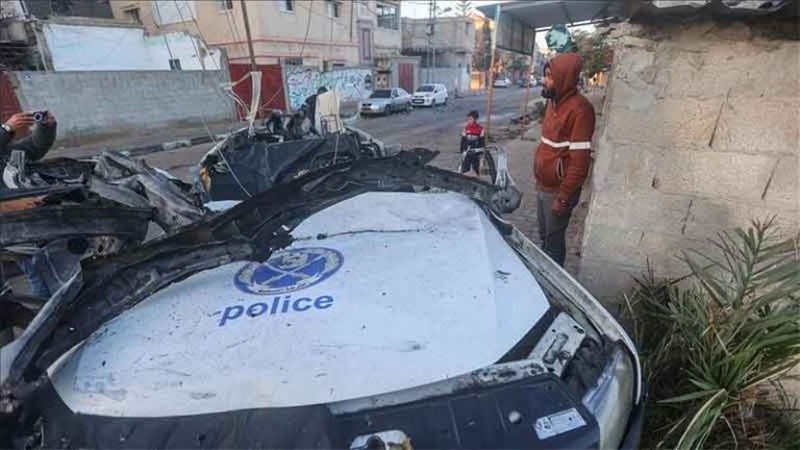
Nine Palestinian Police Officers Killed in Targeted Israeli Attack in Gaza

By Quds News Network

Gaza (QNN)- Nine Palestinian police officers were killed in a targeted Israeli strike on their vehicle while they were on duty in central Gaza on Sunday, in another violation of Trump’s so-called ceasefire and one of the deadliest attacks since the Israeli-US assault on Iran began.

In a statement, the Ministry of Interior and National Security in Gaza confirmed the “heinous crime committed by the Israeli occupation on Sunday afternoon, when it targeted a police vehicle carrying several officers and personnel in the central Gaza.”

[https://twitter.com/QudsNen/status/2033203301190193211]

The Ministry added that Israel targeted them while they were “performing their duties monitoring markets and maintaining security and public order during the holy month of Ramadan.”

[https://x.com/QudsNen/status/2033183321002332271]

The attack resulted in the killing of nine officers and personnel:

  • Colonel Iyad Tawfiq Abu Youssef (Director of the Intervention and Public Order Police in the Central Governorate)
  • First Sergeant Abdul Rahman Munir Al-Hamsi
  • First Sergeant Rami Ibrahim Harb
  • Sergeant Youssef Mohammed Mustafa
  • Soldier Abdullah Hossam Badwan
  • Soldier Wissam Akram Al-Hafi
  • Soldier Fathi Raafat Oweida
  • Assistant Musab Ziad Al-Durra
  • Assistant Tawfiq Azmi Al-Khalidi

The Ministry also noted that the repeated Israeli attacks targeting police facilities and striking police officers and personnel “constitute a war crime and a blatant violation of international humanitarian law, as police facilities are civilian protection institutions safeguarded under international law and must not be targeted.”

There has been a spike in Israeli attacks targeting police in the war-torn Strip despite the ceasefire that took effect in October, which Israel has repeatedly violated by killing hundreds and blocking the entry of much-needed aid.

According to Palestinians and rights groups, such attacks are part of Israel’s ongoing genocide against Palestinians, as it seeks to dismantle the enclave’s security and justice structures by undermining public order and spreading chaos and insecurity.

Israeli forces have killed more than 640 Palestinians since the “ceasefire” went into effect, including over 288 children, women, and the elderly.

Over 72,000 Palestinians have been killed in Israeli attacks since the war began on October 7, 2023.

The attack, which is one of the deadliest attacks in Gaza since the Israeli-US assault on Iran began, comes just hours after Israel committed a massacre in central Gaza, killing a family of four: the mother, who was pregnant, the father, and their son.

16 March 2026

Source: countercurrents.org

The Iran War — The Most Obvious Question Liberal Media Refuses to Ask

By Dr. Ramzy Baroud

Doubtless, the war launched by US President Donald Trump is not popular among ordinary Americans.

According to the latest public opinion poll, only a minority of Americans—part of the dwindling core of Trump’s supporters—believe that the US-Israeli aggression against Iran has merit.

According to a Reuters/Ipsos poll conducted in early March 2026, only 27 percent of Americans approve of the US-Israeli strikes on Iran—while 43 percent disapprove and 29 percent are unsure.

This pro-war constituency is likely to remain supportive of Trump until the end of his term in office, and long after.

However, the war on Iran is not popular, and it is unlikely to become popular, especially as the Trump administration is reportedly fragmented between those who want to stay the course and those desperate for an exit strategy. Such a strategy would allow their president to save face before the midterm elections in November.

Mainstream media—aside, of course, from the pro-war chorus in right-wing news organizations, podcasters, and think tanks—also recognize that their country has entered a quagmire.

If it continues unchecked, it will likely prove worse than the war in Iraq in 2003 or the long war in Afghanistan, which lasted 20 years and ended with a decisive American defeat in August 2021 following the withdrawal of US forces and the collapse of the Afghan government.

Both wars have cost US taxpayers an estimated $8 trillion, including long-term veteran care and interest on borrowing, according to the Brown University Costs of War Project.

Iran is already promising to be even more costly if the insanity of the war—instigated by Israeli Prime Minister Benjamin Netanyahu and his war-crazed government—does not end very quickly.

Many Americans may understand the difficult situation in which Trump’s unhinged behavior and his unexplained loyalty to Netanyahu have placed their country. What they rarely confront is the moral dimension of that crisis.

Though they speak of the war’s failure—the lack of strategy, the lack of preparation, the absence of an end goal, and the confusion surrounding its objectives—very few in mainstream media have taken what should have been the obvious moral position: that the war itself is criminal, unjustifiable, and illegal under international law.

That position should have been obvious the moment the first bomb was dropped over Tehran. The aggression—particularly while negotiations between Iran and the United States were underway under Omani mediation—was ethically indefensible.

Any remaining doubt should have disappeared when US-Israeli strikes hit civilian areas, including schools and residential districts in the city of Minab in southern Iran, killing hundreds of civilians, mostly children and women.

This moral silence is not new. In fact, it has often been masked by a familiar rhetorical device: the selective invocation of women’s rights.

In nearly every US war on Arab and Muslim countries, women’s rights have featured heavily in the propaganda used to justify war. The vast majority of mainstream media organizations, think tanks, human rights groups, and activists—even those who rejected military interventionism on principle—agreed at least on that particular premise: the urgency of women’s rights.

They used Malala Yousafzai as a symbol of girls’ education and women’s rights, presenting her as a model of American benevolence. At the same time, they ignored the fact that among the countless innocent Muslims killed across the Middle East and Asia in the last few decades—some counts place them in the millions—children and women represented a large share of the victims.

The same scenario was repeated in Gaza during the ongoing genocide, where UN agencies estimate that women and children make up roughly 70 percent of the more than 72,200 Palestinians killed since October 2023. According to data compiled by ‘UN Women’ and Gaza’s health authorities, the total includes an estimated 33,000 women and girls.

Yet mainstream media continues to center Israeli claims about abuses of women’s rights by Hamas in Gaza, as if the tens of thousands of women killed and maimed by Israeli bombardment were not even worthy of serious consideration.

The same pattern is now repeating itself in Iran. The administration of Donald Trump—a man known for his degrading views and actions toward women—has been allowed, along with war criminal Netanyahu, to frame the war against Iran as a struggle for women’s rights and liberation.

They cultivated a network of supposed women’s rights activists, presenting them as authentic Iranian voices whose mission was to rescue women from massive human rights abuses in their own country. Even on the Left, many fell into that trap—denouncing Trump on the one hand, while still absorbing and reproducing his and Israel’s propaganda.

Now that thousands of women and children have been killed or wounded in the US-Israel unprovoked, unethical, and illegal war on Iran, many of these same voices have fallen silent, quietly placing women’s rights on hold until the outcome of the onslaught becomes clear.

Though much of the media now expresses doubt about Trump’s war, the moral foundation of anti-war opposition has largely disappeared, replaced instead by a narrow strategic debate over costs, risks, and political consequences.

Complaints about rising energy prices, commentary about Trump’s political immaturity, and criticism of his failure to assess the situation properly before ordering bombs to fall have replaced the moral argument altogether.

Equally absent is Netanyahu’s role in the war, as well as the stranglehold Israel exerts over successive US administrations—Republican and Democrat alike—including the supposedly ‘America First’ president.

This logic dominates much of the mainstream strategic debate. Commentators such as Fareed Zakaria, Thomas Friedman, and others have repeatedly argued, in one form or another, that the United States must avoid being consumed by Middle Eastern conflicts and instead concentrate on what they describe as the central geopolitical challenge of our time: the rise of China.

While it is important to highlight the unpopularity of America’s latest military adventure, such opposition must rest on moral and legal grounds.

That said, mainstream liberal media should not be confused with genuine anti-war voices. Their objection to war is rarely principled. They tend to oppose military interventions only when those wars fail to serve US strategic interests, threaten corporate profits, or risk undermining Israel’s long-term security.

This is not opposition to war.

It is the logic of war itself.

Dr. Ramzy Baroud is a journalist, author and the Editor of The Palestine Chronicle.

16 March 2026

Source: countercurrents.org