
By Feroze Mithiborwala
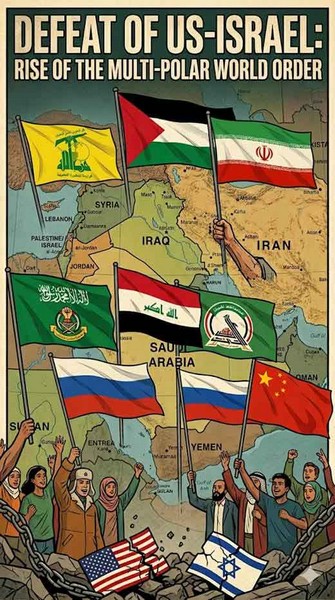
The geopolitical architecture of West Asia, long defined by the imposition of US hegemony, established after the Cold War, is undergoing a violent and decisive transformation. What we are witnessing is not merely a regional war, but the final war of liberation of West Asia, the Global South and the World. For decades, the United States utilized a network of bases and the power of the petrodollar to dictate terms to sovereign nations. Today, that structure is crumbling under the weight of a coordinated multi-front campaign led by Iran and the Axis of Resistance.
As the war crosses its first month, the strategic landscape has shifted so fundamentally that even the most seasoned analysts in Washington are struggling to keep pace. From the total blockade of the Strait of Hormuz to the retreat of the U.S. Navy’s carrier strike groups, the “unipolar moment” has officially expired. Iran has not only anticipated this confrontation but has successfully withstood the massive firepower of the US-Israel combine, achieving its primary strategic targets within the first thirty days.
The Asymmetric Shield: Missiles, Drones, and the “Swarm” Strategy
The cornerstone of Iran’s defiance lies in its mastery of asymmetric warfare—a strategy designed to turn an adversary’s technological superiority into a liability. Over the last decade, Tehran has built the largest and most diverse missile arsenal in West Asia, transitioning from simple deterrents to high-precision strike capabilities. This “long arm” of the Resistance ensures that no U.S. base or Israeli facility is beyond reach.
Central to this strategy is the drone program, specifically the Shahed and Mohajer families, which have redefined modern attrition. By deploying low-cost, “suicide” loitering munitions in massive swarms, Iran effectively saturates and exhausts expensive Western air defence systems like the Patriot and Iron Dome. In the first 30 days of the current war, these “birds of prey” have systematically dismantled radar installations and command centres across the region. As Scott Ritter notes, the Iranian missile program has evolved into a force that “nullifies the American advantage in conventional air power,” forcing the U.S. to choose between an unwinnable escalation or a humiliating retreat.¹
The New Celestial Guard: BeiDou-3 and GLONASS
One of the most critical factors in the success of the Resistance is the breaking of the Western monopoly on Positioning, Navigation, and Timing (PNT). For years, the U.S. could effectively “blind” regional militaries by degrading or spoofing GPS signals. That era ended with the full operationalization of China’s BeiDou-3 (BDS-3) constellation and Russia’s GLONASS system.
The BeiDou-3 system, comprising 30 satellites in three orbital regimes, offers Iran and its allies a secure, high-precision alternative to GPS. By integrating BDS-3 and GLONASS, Iranian strike systems have achieved a positioning reliability rate of approximately 98%, even under intense Israeli electronic warfare (EW).² This Sino-Russian “celestial shield” allows the Axis of Resistance to conduct surgical strikes with sub-five-meter accuracy, ensuring the “kill chain” remains unbroken by Western jamming. This technological sovereignty is the technical bedrock of the Multi-Polar World Order.
The Fall of the Base Network: From Bahrain to Iraq
The first month of the war saw the systematic neutralization of 13 major U.S. military and airforce bases in the region. Targeted strikes hit facilities in Bahrain, Kuwait, Iraq, UAE, Oman, and Saudi Arabia, sending U.S. personnel scurrying for cover in hardened bunkers. In Iraq, the situation reached a breaking point with a total EU-NATO withdrawal, leaving remnants of U.S. troops hiding in the Kurdish North.
Colonel Douglas Macgregor has frequently warned that U.S. forces in West Asia are “stationed in death traps,” isolated and vulnerable to the overwhelming regional fire superiority of the Axis of Resistance.³ The failure of the U.S. to protect these assets has signalled to regional monarchs that the American security umbrella is effectively shredded. Furthermore, the strategic failure to incite ethnic minorities—Iranian Baluchis and Kurds—has left the U.S. without internal levers of destabilization, as these groups have resolutely refused to cooperate with Washington after witnessing the recent betrayal of the Syrian Kurds.
Lebanon and the Resilience of Hezbollah: A Graveyard of Armour
The Israeli Occupation Force (IOF) has once again discovered that while it can dominate the skies through the bombing of civilian infrastructure, it remains just about average in land wars. Recent battlefield reports provide a staggering look at the attrition faced by Israeli armoured columns. Since hostilities escalated, a grand total of 1,169 Merkava tanks and vehicles have been reported destroyed across the Northern and Southern fronts.
In the Rshaf Sector of South Lebanon, Hezbollah’s anti-tank teams have utilized Al-Mas ATGMs and Kornet-EM missiles to devastating effect, while the Al-Qantara Sector has seen a significant shift toward FPV drone strikes targeting light armour and Hummers. Hezbollah alone is credited with the destruction of 240 units using complex ambushes. Meanwhile, in Gaza, local factions have neutralized 929 Merkava 3 & 4 tanks through the use of Al-Yassin 105 rockets and tandem IEDs during 131 total attacks since the resumption of hostilities.
George Galloway has noted that this tactical discipline has turned the region into a graveyard for Israeli pride. “The IOF is a colonial police force that knows how to kill children from 30,000 feet, but it cannot hold ground against a motivated, indigenous resistance armed with precision asymmetric tools,” Galloway remarked during a recent broadcast.⁴
Yemen’s Strategic Chokehold and the Naval Retreat
Complementing the Iranian and Lebanese fronts, Yemen’s Ansarullah has entered the war with a decisive blockade of the Bab-el-Mandab Strait. Controlling 10–12% of global energy flow, Yemen’s entry has rendered the Red Sea and Suez Canal impassable for ships associated with the aggressors. This maritime pressure, combined with Iran’s takeover of the Strait of Hormuz, has created a dual-chokehold on the global economy.
The U.S. Navy has found itself in a state of redundancy. The withdrawal of the USS Abraham Lincoln and the USS Gerald Ford mark the first time in history that American carrier strike groups have fled a theatre of war to avoid total destruction. The skyrocketing costs of international insurance for ships and goods are now a silent but deadly weight on Western economies, a factor rarely discussed in mainstream media but felt in every treasury.
Transatlantic Fracture: The NATO Refusal
In a massive blow to U.S. isolation, the EU-NATO bloc has officially refused to join the war on Iran or assist in reopening the Strait of Hormuz. Germany has stated the conflict is “not NATO’s war,” while France and Italy have denied airspace and base access for strikes on Iranian territory.⁵ This unprecedented refusal underscores the total collapse of Western unity. For the first time, the U.S. is heading into a major war with its allies standing firmly on the sidelines, sinking Washington deeper into a strategic abyss.
Rise of the Multipolar Financial Order: Rise of Petroyuan and Decline of Petrodollar Hegemony
While the kinetic war rages, a more significant war is being won in the halls of finance. The hegemony of the petrodollar is being dismantled in real-time. With all regional oil, LNG, and LPG that flows through the Strait of Hormuz now being traded in Petroyuan, the dollar has lost its primary support mechanism.
Journalist Pepe Escobar describes this as the “birth of a multipolar financial order.”⁶ In a move described by critics as “bizarre and laughable,” the Trump administration has been forced to remove sanctions from Russian and Iranian energy to stabilize domestic fuel prices—effectively funding the very resistance that is defeating them. This mockery of Western “sanctions diplomacy” reveals the desperation of a declining empire.
Social Cohesion: Tehran vs. Tel Aviv
The internal dynamics of the warring parties could not be more polarized. In Iran, the people are more united than ever, standing resolutely with their leadership. Every evening, Iranians gather at 7:30 pm in town squares to demonstrate their resilience, while Israelis are forced to hide in bunkers as their air defences fail.
Prof. Mohammad Marandi emphasizes that this unity is the ultimate deterrent. “The West fundamentally misunderstood the Iranian people,” Marandi stated. “The leadership and the army are one with the population. We are not a nation that can be broken by bombing hospitals or schools, as the IOF has attempted in Tehran and Gaza. These atrocities only serve as a sign of their inevitable defeat.”⁷
Conclusion: The Multipolar Dawn
The war is the catalyst for a massive change in West Asia. After this conflict, Iran and its allies will refuse to return to the status quo. There will be no more U.S. bases, and access to the region’s energy will be reserved for those who respect Iranian sovereignty and that of the Axis of Resistance.
The alliance of Iran, Russia, and China is forging a new “central pole” in global politics. As Praveen Sawhney argues, the integration of Iranian hardware and Russian electronic warfare with Chinese economic might represents a “peer competitor” that the U.S. simply cannot defeat.⁸ BRICS+ is no longer just a trade bloc; it is emerging as the central pole in a geostrategic, geoeconomic and geopolitical Multi-Polar World Order, with West Asia at its heart.
References and Citations
- Scott Ritter, “The Death of the Carrier Strike Group,” The Scott Ritter Extra, October 12, 2024.
- “Iran turns to China’s BeiDou satellites to outfox Israeli anti-drone electronic warfare defences,” bne IntelliNews, March 10, 2026.
- Gen. Douglas Macgregor, Interview with Nima Alkhorshid, Dialogue Works, YouTube, October 18, 2024.
- George Galloway, The MOATS Podcast, Episode 518, January 20, 2026.
- “European allies refuse US request to help open Strait of Hormuz,” Middle East Eye, March 16, 2026.
- Pepe Escobar, “Axis of Resistance: from Donbass to Gaza,” The Cradle, February 20, 2024 (Updated March 2026).
- Prof. Mohammad Marandi, “Resistance will escalate if US-Israeli aggression continues,” Al Mayadeen English, March 16, 2026.
- Praveen Sawhney, “How the Axis of Resistance neutralized US Electronic Warfare,” The Force Analysis, October 5, 2024.
Feroze Mithiborwala is an expert on West Asian & International Geostrategic issues.
1 April 2026
Source: countercurrents.org