
By Junaid S. Ahmad
The most revealing feature of Pakistan’s current political discourse is not what is being argued, but what is being deliberately buried — buried under noise, spectacle, and a suffocating cloud of manufactured urgency. Scroll long enough and you will see it: the same hypnotic fixation, repeated with almost ritualistic discipline — is Pakistan’s recent “geopolitical moment,” its role in facilitating backchannel communication between Donald Trump’s Washington and Tehran, a masterstroke or a mirage?
The debate is loud. It is theatrical. It is addictive.
And it is a distraction — a carefully constructed one.
Let us state, without hedging and without qualification: Pakistan is playing its geopolitical hand well. It is not guessing. It is not stumbling. It is inserting itself, deliberately and effectively, into spaces where access is scarce and stakes are high. It is brokering, facilitating, positioning — and doing so with competence. Its geography, networks, and institutional instincts are being deployed with clarity.
On the global board, Pakistan is not peripheral. It is present. It is active. It is, in moments that matter, effective.
Full stop.
And yet this success is not the story. It is the cover story.
Because this is not, in any serious sense, a debate about geopolitics. It is a diversion — a gleaming, seductive decoy designed to pull attention away from the only question that matters: what is actually happening inside Pakistan?
Watch the performance. Regime loyalists elevate Shehbaz Sharif into a statesman of global consequence. Critics roll their eyes and call it theater. But both camps — despite their noise, their posture, their supposed opposition — are orbiting the same dead center: a discourse that ensures the real question is never confronted.
Because the real story is not subtle. It is not ambiguous. It is savage.
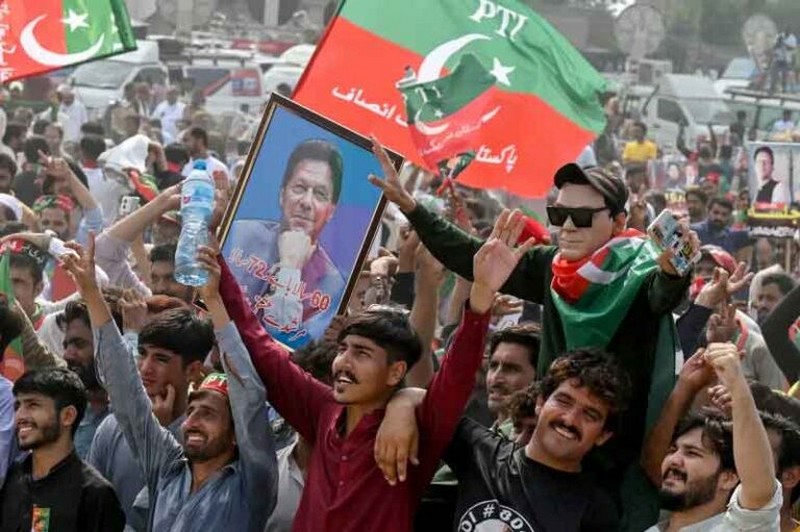
A state that locks away a former prime minister — Imran Khan — not through credible justice but through a blizzard of engineered cases, is not governing. It is purging. A system that hunts lawyers like Imaan Mazari through revolving-door arrests, that terrorizes academics such as Hamza Ahmed Khan for speech, that weaponizes courts, codes, and cops to criminalize thought itself — this is not overreach. This is organized repression.
Let us drop the polite vocabulary entirely.
This is a state that devours dissent. It surveils, intimidates, abducts, prosecutes, and, when necessary, erases. It converts law into a blunt instrument, due process into theater, and accusation into punishment. It does not simply suppress opposition — it seeks to break it, publicly and systematically, as a warning to everyone else.
This is not governance.
This is domination enforced with paperwork.
And this is where geopolitics becomes invaluable — not as policy, but as camouflage.
Geopolitics dazzles. It floods the conversation with abstractions — mediation, leverage, alignment — until the brutality of domestic reality is pushed out of frame. It invites citizens to obsess over proximity to power while quietly stripping them of power altogether. It replaces legitimacy with optics, consent with choreography, accountability with applause.
This is not accidental. It is a method honed over decades.
Pakistan’s ruling elite has perfected a cynical exchange: external usefulness in return for internal impunity. From Cold War patronage to the War on Terror — where sovereignty was bartered and figures like Aafia Siddiqui became enduring symbols of that bargain — geopolitical relevance has repeatedly been used to launder domestic repression.
That transaction is alive and well.
What has changed is the desperation behind it.
Because a system that commands genuine legitimacy does not behave like this. It does not panic at criticism. It does not criminalize speech. It does not turn courts into conveyor belts of punishment. It does not need foreign acknowledgment to simulate authority at home. These are not signs of strength. They are the reflexes of a regime that knows, with quiet certainty, that it cannot win consent — only enforce compliance.
And so the contradiction becomes grotesque.
Pakistan is cast as a mediator, a stabilizer, a diplomatic asset — and in geopolitical terms, it is succeeding. But mediation rests on credibility, on trust, on perceived independence. These are not qualities that coexist comfortably with a domestic order built on coercion, fear, and institutionalized intimidation.
Inside the country, the pattern is relentless: political imprisonment as routine, media suffocation as policy, dissent as a prosecutable offense, law as a weapon. This is not background noise. This is the system’s core logic.
Which brings us to the question that the entire spectacle is designed to avoid.
Do Pakistanis live under a system that derives authority from consent? Or under one that manufactures obedience through fear, spectacle, and force?
Everything else — the summits, the mediation, the carefully staged visibility — is secondary.
The real tragedy is not that Pakistan is geopolitically effective. It is. The tragedy is that this effectiveness is being deployed as a shield — a polished surface to deflect attention from a political order that is, at its core, coercive and extractive.
A state can broker dialogue abroad while strangling it at home. It can facilitate conversation in one arena while criminalizing it in another. These are not contradictions. They are the operating principles of a system that performs strength externally while practicing repression internally.
The real test is not whether one applauds Pakistan’s geopolitical success.
It is whether one refuses to be distracted by it.
Until that refusal becomes unavoidable, Pakistan’s geopolitical debate will remain exactly what it has been engineered to be: not an inquiry into power, but an escape from it.
Prof. Junaid S. Ahmad teaches Law, Religion, and Global Politics and is the Director of the Center for the Study of Islam and Decolonization (CSID), Islamabad, Pakistan.
11 April 2026
Source: countercurrents.org