
By Fr. Cedric Prakash
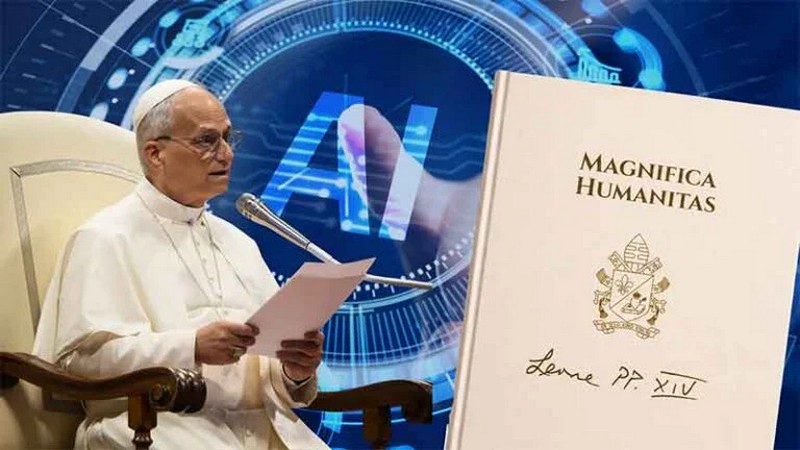
On 25 May 2026, released his first Encyclical ‘Magnifica Humanitas’ (Magnificient Humanity): On Safeguarding the Human Person in the time of Artificial Intelligence’. In it, he makes a passionate plea for safeguarding humanity, promoting truth and freedom, the dignity of work, and advocating that the fundamentals of the universal destination of goods, subsidiarity, solidarity, human rights, social justice and peace should be paramount. His message to the world was loud and clear: “be human, stay human!”
Pope Leo XIV signed his document ten days earlier, on 15 May which was the 135th anniversary of the promulgation of Pope Leo XIII’s powerful 1891 encyclical ‘Rerum Novarum (Of New Things): On the Condition of Labour’. Pope Leo then, addressed the severe social and economic upheavals brought about by the Industrial Revolution. It is widely considered as the foundational blueprint for modern social doctrine of the Catholic Church, as it marked the first time the Vatican systematically and purposefully intervened in contemporary socio-economic debates to defend the dignity and the rights of workers!
‘Magnifica Humanitas’ should come as no surprise to those who are aghast at what is happening in the world today and sincerely want to do something about it! No papal encyclical makes easy reading. This masterpiece of 245 paragraphs, has five chapters, with an ‘Introduction’ and a ‘Conclusion’, all beautifully interwoven into a rich tapestry of a vision, mission and responsibility to address the realities of today’s world. Pope Leo sets the tone and direction of his encyclical in his opening words, “Humanity, created by God in all its grandeur, is today facing a pivotal choice: either to construct a new Tower of Babel or to build the city in which God and humanity dwell together. Each generation inherits the task of shaping its own era, of guiding history to become a place where the dignity of every person is safeguarded, justice is promoted and fraternity is made possible. Yet every era also runs the risk of creating an inhumane and more unjust world.”
The encyclical has a basic premise when it states, “While Leo XIII spoke in his time of “new things” (Rerum Novarum), today we cannot limit ourselves simply to repeating his insightful teachings. Instead, we must ask God for the wisdom to interpret the great trends of our time, particularly technological advances. In recent years, it has become increasingly evident how rapidly and profoundly digitalization, artificial intelligence (AI) and robotics are transforming our world. Technology should not be considered, in itself, as a force antagonistic to humanity. On the contrary, it has formed part of our history since the beginning as “a profoundly human reality, linked to the autonomy and freedom of man.”. Pope Leo then asserts that, “technology is never neutral, because it takes on the characteristics of those who devise, finance, regulate, and use it”. He appeals for people to build for the common good and to remain human, following a courageous mentality of shared responsibility and communion, so that the world “will come to recognize the human heart as the place where God desires to dwell”
Thedocument is comprehensive. The ‘Introduction’ provides the ‘raison d’être’ and the immediacy of the content. The first chapter, ‘A Dynamic Approach Faithful to the Gospel’, traces the Social Doctrine of the Church in recent magisterium and the Second Vatican Council, highlighting its dynamic character. In the second chapter, Pope Leo XIV explores the ‘Foundations and Principles of the Social Doctrine of the Church’. The third chapter, ‘Technology and Dominance: The Grandeur of Humanity in Light of the Promises of AI’, stresses the need to approach artificial intelligence with vigilance. In the fourth chapter, ‘Safeguarding Humanity at a Time of Transformation. Truth, Work, Freedom’, the Pope calls for an ecology of communication based on truth. In the fifth chapter, ‘The Culture of Power and the Civilization of Love’, Pope Leo XIV turns his gaze to war, saying “the digital revolution is changing the nature of conflict.” The Pope calls for an ethical approach, without which decisions about the life and death of persons will become increasingly impersonal due to a use of force regarded as an “immediate and viable option”. The ‘Conclusion’ points to the ‘road ahead’ giving one a spirituality for our time.
The Vatican ‘Dicastery for Promoting Integral Human Development’, has prepared an excellent five-page summary of the encyclical besides some useful resource materials. No summary will do justice to the wealth encapsulated in this treatise: spiritual, theological, socio-political, cultural, technological, putting into focus the many serious realities which grip the world today; above all, there is an unmistakable positivity throughout- Pope Leo is unequivocal in stating that ‘another world is possible’, that there is hope provided we get our act together –individually and collectively, to be human! To stay human!
Pope Leo XIV recalls the writings of his predecessors: from Pope Leo XIII to Pope Francis. identifies five principles of the Social Doctrine of the Church: common good, the universal destination of goods, subsidiarity, solidarity, social justice. Christians, says Pope Leo, are called to respond to the culture of power by building “the civilization of love” and by choosing whether to feed the logic of force or safeguard peace. He recalls the memory of the saints, “righteous people and the oft-forgotten peacemakers, show us that grace does not magically eliminate conflict, but instead it inspires active resistance to evil and an astonishing creativity in doing good”
Today AI permeates every sphere of life. The way the fundamental values of humanity are being eroded. The violation of human rights: the right to life, the rights of women and minorities. Pope Leo XIV identifies migrants, refugees, displaced persons as a “litmus test” for social justice. The way society treats migrants, he says, “reveals whether its sense of justice is driven by fear or by the spirit of fraternity.” He therefore appeals for societies to protect “the rightful hopes” of those forced to leave, by ensuring them safe and legal routes, dignified welcome, and genuine paths to integration, while promoting “the right to remain” in one’s homeland in peace and security, by addressing “the root causes” of migration. Compassion for the ‘other’ is what matters. He is also expresses concern about what is happening to the environment- and why one should care for our common home!
Pope Leo says that too much AI power is concentrated in too few hands. He warned that a small group of firms now control vast amounts of data, computing power and digital infrastructure. He writes, “When such power is concentrated in the hands of a few it tends to become opaque and evade public oversight, increasing the risk of distorted forms of development that give rise to new dependencies, exclusions, manipulations and inequalities.” He warned that powerful groups could use AI to shape public opinion, influence democratic systems and steer economies for their own interests. He also criticised the global race for “ever more powerful algorithms and larger datasets”, arguing that technology should serve humanity rather than corporate or geopolitical dominance. Another major concern in the document is employment. While he acknowledged that AI can improve productivity and make some work safer, he argued that workers must not become disposable in the process. He warns about AI weapons Pope Leo criticised the development of autonomous weapons and said it should never be acceptable for machines to make irreversible life-and-death decisions without human responsibility. He stated that, “Artificial Intelligence now demands to be disarmed, freed from logics that turn it into an instrument of domination, exclusion and death,”.
‘Magnifica Humanitas’ challenges certain dimensions of today’s human behaviour. Pope Leo devotes ample space to a critique of transhumanism andposthumanism, which interpret progress as the overcoming of human limits. Instead, limitations are not defects to be eliminated, but a constitutive dimension of the human person, because it is in fragility and finitude that relationship and openness to God and to others, mature. He says we must remember that “humanity flourishes not despite limitations, but often through them” Pursuing technological innovation at the expense of eliminating human limitations, he says, would cause an anthropological regression. “Humanity—in all its grandeur and woundedness—must never be replaced or surpassed,” The encyclical challenges all people of good will to stay actively engaged in the ethical development of AI, ensuring it bridges societal divides, rather than centralising power.
‘Beinghuman’ is a commitment to a better world, pregnant with hope and built on the civilization of love. Pope Leo calls for an “ecology of communication” based on truth. He urges transparency in how content is selected, protection of personal data, serious journalism founded on argumentation and verification, a new awareness in the “proper and critical” use of digital tools, and the integration of different forms of knowledge. The Church must also embody transparent and honest communication, especially in cases of injustice and abuse. The Pope also appeals for a renewed educational alliance, so that the “desire to ask questions” may not be extinguished in young people by perfect machines that make human thought seem useless. Pope Leo therefore calls for renewed attention to schools as places where people learn to “seek and love the truth”. He emphasizes the importance of protecting the dignity of work by designing systems centered on the person and not only on performance. For him, peace and development is to move beyond GDP as the measure of a country’s level of development, focusing instead on the dignity of work, shared prosperity, the reduction of inequalities, and environmental protection; “prosperity contributes to peace “only if it is widespread, inclusive, and sustainable”
Pope Leo’s call to the Church to do a serious examination of conscience will make many within the Church uncomfortable. He says that the five principles of the Social Doctrine of the Church, should be applied not only to society, but also to the Church herself, which must make “an examination of conscience.” The Pope says living out this justice calls for “purifying ecclesial relationships and structures from distortions that give rise to inequality, lack of transparency and abuse of power.” This means to listen to the “victims of spiritual, economic, institutional, sexual and power-based abuse, as well as abuses of conscience.” This examen, “is an integral part of a journey toward justice, which includes acknowledging the harm done, just reparation and taking steps to prevent it from happening again”.
Pope Leo upholds the importance of combating new forms of slavery as a “decisive test for ethical discernment” in the digital transformation. He stresses, “the Church renews her firm condemnation of every form of slavery, trafficking, and commodification of persons” and he underscores that to not react or to tolerate grave violations of human dignity means becoming accomplices to them. He asks pardon, “This (slavery)constitutes a wound in Christian memory, one from which we cannot consider ourselves detached. It is impossible not to feel deep sorrow when contemplating the immense suffering and humiliation endured by so many in stark contrast to their immeasurable dignity as persons infinitely loved by the Lord. For this, in the name of the Church, I sincerely ask for pardon.”
He indicates five paths of responsibility for the way ahead, they are: disarming words by speaking the truth; building peace in justice; adopting the perspective of victims by taking a stand, because there are conflicts in which “it is unjust to remain neutral”; cultivating “a healthy realism” that seeks practicable paths of peace through deeds, not only words!
He emphasizes the need to relaunch dialogue by moving from a culture of power to a culture of negotiation; of decisive importance is “interreligious dialogue”, being bearers of a message of peace. He says, “those who use the name of God to legitimize terrorism, violence or war betray his true nature, for to fight in the name of religion means attacking religion itself”. A strong message to today’s warmongers; to those who use the name of God to justify their wars! God is synonymous with compassion, not with hate, violence and war!
Towards the end he gives the world an antidote to ‘stay human’, “As we look to the future, I would like to recall the image of Nehemiah whom we chose as our companion and guide at the outset. Nehemiah heard the cry of a devastated city, brought that pain to prayer, discerned before God, asked for help, received permission to return, organized the work, confronted internal and external resistance and rebuilt the walls of Jerusalem with the assistance of the people, brick by brick. In this era of digital transformation, I see in him a striking parable of our own vocation, which is not to be passive spectators of social and cultural fractures, nor mere commentators on what is crumbling, but men and women prepared to enter the construction sites of history — research laboratories, technology companies, schools, the media, institutions and local communities — in order to rebuild what has collapsed and protect what is threatened. Like Nehemiah, we too are called to unite listening and courage, prayer and responsibility, so that, even when a technocratic mentality or partisan interests seem to prevail, the human city may become a more fitting place to live.
Today, our world in several aspects has either lost or is fast losing its humaneness; concluding with Mary’s ‘Magnificat’ Pope Leo
challenges us all to Be Human! Stay Human!
Fr. Cedric Prakash SJ is a renowned human rights, reconciliation and peace activist & writer.
1 Jun 2026
Source: countercurrents.org