
By Feroze Mithiborwala
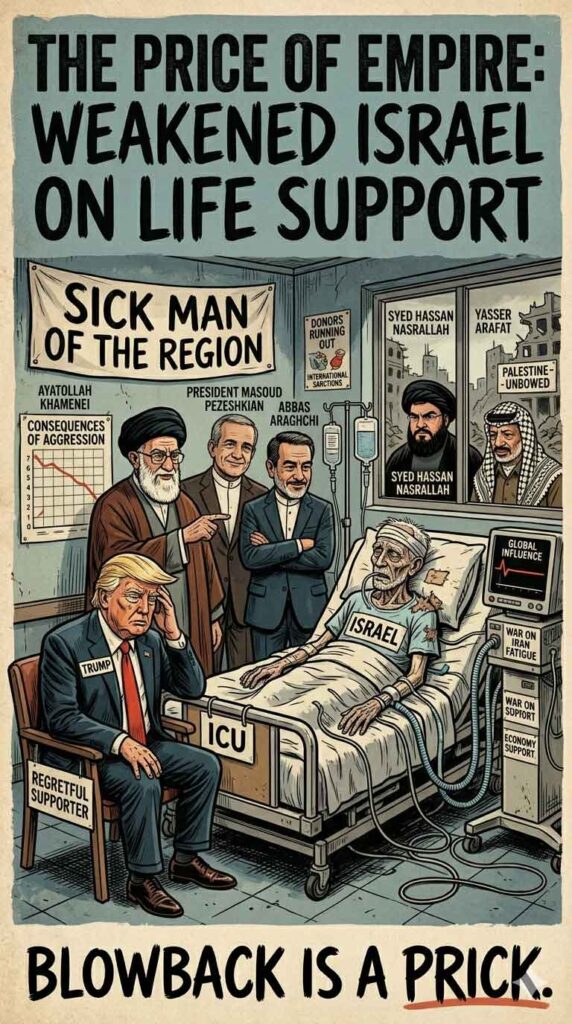
The date of February 28, 2026, will be etched in history not as a moment of Israeli triumph, but as the day the “Invincible Fortress” began its terminal decline.
Operation Roaring Lion, launched by Prime Minister Benjamin Netanyahu in coordination with the Trump administration’s Operation Epic Fury, or rather, “Epstein Fury”, was intended to be a decapitation strike against the Islamic Republic of Iran. Instead, it has triggered a multi-front retaliation from the Axis of Resistance that has shattered the Israeli home front, paralyzed the economy, and pushed the Israel Defense Forces (IDF) to the brink of a systemic collapse.
The Home Front in Flames: Mobilization and Mutiny
Across the cities of Israel, occupied Palestine, the myth of national unity has dissolved. While initial polls in early March suggested a “rally-around-the-flag” effect, the reality on the streets by April 2026 is far more volatile. Reports from Tel Aviv’s Habima Square and West Jerusalem indicate that tens of thousands have begun mobilizing—not in support of the war, but in a desperate plea for its cessation.
The mobilization is no longer restricted to the secular left or the liberal “Kaplan” protesters. In a historic shift, segments of the Haredi (Ultra-Orthodox) community have joined the fray. This shift is driven by a combination of the intensified pressure of the conscription crisis and the direct threat to their lives in the absence of adequate shelter in their densely populated neighborhoods. “The Zionist state is gambling with the lives of millions for the political survival of one man,” notes cultural critic Gilad Atzmon, highlighting the internal rupture. “The ideological glue that held this colonial project together is melting under the heat of Iranian thermal warheads.”¹
While official police figures attempt to downplay the numbers, local activist groups suggest that over 100,000 people participated in nationwide rallies on March 28 alone. These protesters face a brutal crackdown, as law enforcement invokes wartime regulations to bar gatherings, further fueling the fire of civil disobedience.
The Rain of Fire: Infrastructure Under Siege
The retaliation from the Axis of Resistance—spanning the Iranian Revolutionary Guard Corps (IRGC), Hezbollah, and Ansarullah (the Houthis)—has systematically dismantled the illusion of the Iron Dome’s omnipotence. While the military censor in Tel Aviv works overtime to suppress the full extent of the damage, the data escaping the blackout is grim.
Beyond the well-documented strikes on Tel Aviv, Haifa, and Dimona, the geography of the conflict has expanded to include:
- North: Kiryat Shmona, Safed, Nahariya, and the Galilee panhandle have become ghost towns. Hezbollah’s precision drones have specifically targeted power substations and IDF command centers, rendering the region effectively uninhabitable.
- Central: Beit Shemesh, Ramat Gan, Bnei Brak, Petah Tikva, and Herzliya have sustained direct hits. Notably, on April 3, a missile struck an industrial zone in Ramat Gan, demonstrating that even the heart of Israel’s high-tech corridor is within reach.²
- South: Ashkelon, Beersheba, Ashdod, and the Eilat port have been rendered non-operational by Ansarullah’s long-range cruise missiles, effectively choking Israel’s southern maritime artery.
Crucially, the conflict has spilled into the West Bank. Iranian missiles have reportedly targeted IDF installations and settlements near Ariel and Ma’ale Adumim. While the IDF claims many of these were intercepted, the psychological impact of fire falling on the “heartland” of the settlement movement has been profound. “The resistance has successfully unified the fields,” states Muhammad Marandi. “There is no longer a ‘front line’ and a ‘rear’; the entirety of the occupied territories is now a combat zone.”³
A Military Exhausted: The General’s Warning
Inside the “Kirya” (Israel’s Ministry of Defense), the mood is apocalyptic. Chief of General Staff Lieutenant General Eyal Zamir recently delivered a “ten red flag” warning to the security cabinet, stating bluntly that the IDF is facing a troop shortage so severe it may soon be unable to conduct routine missions, let alone a multi-front war.⁴
The IDF is reportedly short of approximately 12,000 troops. This manpower crunch is not just a result of the current war on Iran but follows nearly two and a half years of high-intensity operations in Gaza and the West Bank. General Zamir warned that the reserve system is “collapsing in on itself.”
Politicians like Yair Lapid have echoed this sentiment, noting that the army is physically tired and morally overextended. As Professor John Mearsheimer has observed, “You cannot fight a high-intensity war against regional powers when your domestic base is fractured and your primary military force—the reservists—refuse to serve a government they don’t trust.”⁵
The Great Exodus: Fleeing the Promised Land
For the first time in its history, Israel is experiencing a net migration crisis that threatens its demographic foundation. The scenes at Ben Gurion Airport are of controlled chaos, with flights booked out months in advance. Many who cannot find flights are seeking passage by ship to Cyprus and Greece.
Even more startling are the reports of dual-national Israelis utilizing the Rafah crossing into Egypt or maritime routes to escape the rain of missiles. While exact 2026 figures are guarded, estimates suggest that over 150,000 citizens have fled since the February 28 escalation, adding to the nearly 70,000 who left in late 2025.⁶ George Galloway has remarked on this shift, stating, “The settlers are becoming the unsettled. The very people who came to displace others are now finding they have no place of their own that is safe.”⁷
Economic Ruin: The $3 Billion Weekly Bleed
The Israeli economy is in a tailspin. The Finance Ministry warned in March 2026 that the war is costing the state approximately $3 billion per week in lost productivity and direct military expenditures.⁸
- Infrastructure Loss: Preliminary estimates place the damage to Israeli civilian and military infrastructure at upwards of $25 billion.
- Capital Flight: The Tel Aviv Stock Exchange (TASE) has seen a massive withdrawal of foreign capital. International investment agreements—once the pride of the “Start-up Nation”—are being canceled daily.
- The US Burden: The United States is footing a bill that exceeds $18 billion in just the first few weeks of the conflict. This includes the cost of Tomahawk missiles and naval deployments.
Jeffrey Sachs has pointed out the insanity of this fiscal policy: “The US is bankrupting its future to fund a regional conflagration that serves no strategic interest other than keeping Netanyahu out of a courtroom.”⁹
International Isolation and the Trump Factor
Israel’s global standing has reached a nadir. European capitals, once staunch allies, are now distancing themselves as the humanitarian and economic fallout of a war with Iran threatens global energy markets.
In the United States, the political landscape is shifting. While President Donald Trump initially authorized the strikes, he is increasingly being blamed by his own “America First” base for being maneuvered into another “forever war.” Tucker Carlson recently remarked, “Why are we risking World War III for a leader whose own people are protesting him in the streets? This isn’t ‘America First’; it’s ‘Netanyahu First.’”¹⁰
Pepe Escobar aptly summarizes the geopolitical shift: “The ‘Zionist project’ was built on the premise of security. Iran and the Axis of Resistance have now removed that premise. Without security, there is no investment; without investment, there is no state.”¹¹
Conclusion: The End of the Myth
As Max Blumenthal has documented, the current crisis is not a temporary setback—it is the sound of a system breaking. The combination of internal dissent, military exhaustion, and a decimated economy suggests that the war on Iran may be the final chapter for the Netanyahu era. The longer the war lasts, the more the regional and international order shifts against the interests of both Tel Aviv and Washington.
References and Footnotes
- Atzmon, Gilad. “The Melting Pot of Zionism,” Interviews on Global Affairs, March 2026.
- The Times of Israel. “Iran hits Israeli industrial zone for third time,” April 5, 2026.
- Marandi, Muhammad. The Axis of Resistance and the Multi-Front War, Tehran Policy Institute, 2026.
- The Economic Times. “IDF Chief warns military could ‘collapse’ due to manpower shortage,” March 27, 2026.
- Mearsheimer, John. The Tragedy of Great Power Politics: 2026 Update, Yale University Press.
- Middle East Monitor. “Record Israeli emigration exposes deep crisis,” January 9, 2026.
- Galloway, George. The Mother of All Talk Shows, April 2026 broadcast.
- The Times of Israel. “War set to cost $3 billion a week,” March 4, 2026.
- Sachs, Jeffrey. “The Economic Suicide of a Middle East War,” Common Dreams, March 2026.
- Carlson, Tucker. The Tucker Carlson Network, Episode 412: “The Iran Escalation,” April 2026.
- Escobar, Pepe. “The New Silk Road vs. The Burning Levant,” The Cradle, March 2026.
Feroze Mithiborwala is an expert on West Asian & International Geostrategic issues.
6 April 2026
Source: countercurrents.org