
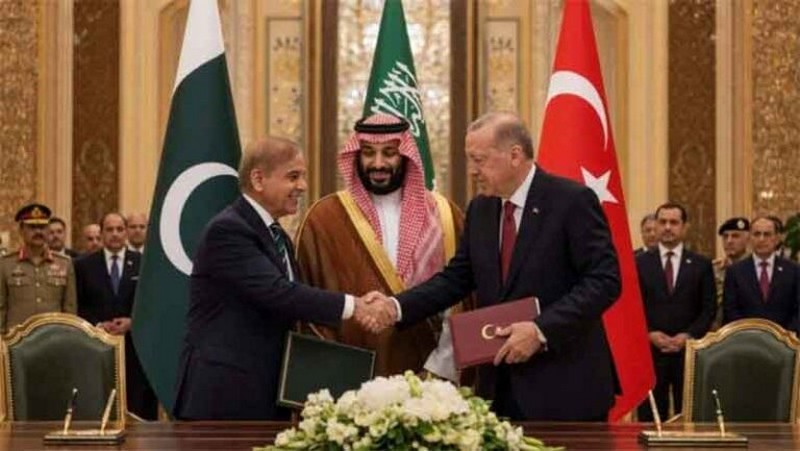
By Syed Mohammad Raghib
The Mecca Joint Defence Agreement, signed on 7 August 2026 by Pakistan, Saudi Arabia and Türkiye, represents one of the most consequential developments in the security architecture of the Muslim world in recent years. Its central principle is strikingly similar to NATO’s Article 5: an armed attack against one member is to be treated as an attack against all three. Turkish Foreign Minister Hakan Fidan has explicitly compared the arrangement to NATO’s collective-defence principle, while Pakistani officials have described it as a “purely defensive” arrangement that is not directed against any particular country. Yet the agreement immediately raises a larger geopolitical question: Is this the beginning of a “Muslim NATO”? and if so, against whom? The answer is more complicated than either its supporters or critics suggest. The agreement is not formally an anti-Iran, anti-Israel, anti-India or anti-Western alliance. Nevertheless, its strategic logic is clearly shaped by the rapidly changing security environment of the Middle East and South Asia.
A New Security Triangle
The significance of the Mecca Agreement lies partly in the extraordinary combination of capabilities represented by its three members. Pakistan contributes a large, experienced military and is the Muslim world’s only acknowledged nuclear-armed state. Türkiye contributes one of NATO’s largest armed forces, substantial defence-industrial capabilities and rapidly expanding expertise in drones, electronic warfare and advanced military technologies. Saudi Arabia contributes enormous financial resources, strategic geography, energy power and considerable influence in the Arab and Islamic worlds. The three countries therefore bring together military manpower, nuclear deterrence, technology, finance and strategic geography. This combination is considerably more significant than a conventional diplomatic partnership.
The global military environment also makes the agreement understandable. As per the Stockholm International Peace Research Institute (SIPRI) estimates that global military expenditure already reached approximately $2.9 trillion in 2025, following another substantial increase in defence spending. Türkiye’s military expenditure rose by 7.2% in 2025 to about $30 billion, while Saudi Arabia remains one of the world’s largest military spenders. Saudi Arabia has particularly strong reasons to reconsider its security architecture. Riyadh has historically relied heavily on American military protection, but repeated regional crises have encouraged Saudi policymakers to diversify their strategic partnerships. The Mecca Agreement can therefore be understood partly as an effort to build greater regional strategic autonomy.
Why Pakistan?
For Pakistan, the agreement represents an opportunity to strengthen its strategic position in both the Middle East and the wider Muslim world. Pakistan has longstanding military relations with Saudi Arabia. Pakistani military personnel have historically provided training and security assistance to the Kingdom, while Saudi Arabia has remained an important economic and diplomatic partner for Islamabad. The 2026 trilateral agreement expands this relationship into a broader multilateral security framework. Pakistan’s most important strategic asset is its nuclear deterrent. The inclusion of a nuclear-armed country gives the agreement a psychological and strategic weight that most proposed Islamic security organisations lack. But Pakistan also has to be careful. Its geography places it between India, Afghanistan, Iran and the Arabian Sea. Islamabad cannot afford to become militarily committed to every conflict involving Saudi Arabia or Türkiye. A collective-defence clause could therefore create difficult choices if one member enters a conflict that another member considers unnecessary or dangerous.
Why Saudi Arabia and Why Türkiye?
For Saudi Arabia, the Mecca Agreement is perhaps the most important component of its emerging strategy of security diversification. The Kingdom possesses enormous financial resources and has invested heavily in advanced aircraft, missile defence, drones and other military systems. Yet sophisticated weapons do not automatically create an independent military-security architecture. Saudi Arabia therefore needs partners with military experience, technology and strategic depth. Pakistan offers military manpower and nuclear deterrence. Türkiye offers advanced defence technology and a growing indigenous military-industrial complex. The arrangement consequently gives Riyadh access to two major Muslim military powers without requiring the Kingdom to abandon its existing relationships with the United States. This point is crucial: the Mecca Agreement does not replace Saudi-American security relations. Turkish officials have stressed that the new arrangement complements existing alliances rather than replacing them. Saudi Arabia is therefore attempting to move from dependence toward strategic diversification.
Türkiye’s participation gives the agreement an entirely different dimension. Türkiye is already a NATO member. It therefore occupies a unique position: it belongs simultaneously to the Western military alliance and to an emerging Muslim security arrangement. Rather than indicating that Ankara is abandoning NATO, the Mecca Agreement demonstrates Türkiye’s increasingly multidirectional foreign policy. Türkiye has developed a significant defence industry, particularly in unmanned aerial systems, naval platforms, missiles, electronic warfare and other military technologies. The new pact envisages joint exercises and deeper cooperation in areas including unmanned systems, electronic warfare, artificial intelligence and defence production. For Ankara, the agreement also expands its influence across the Arab world and strengthens its role as a security actor beyond NATO’s traditional geographical framework.
Is It Really a Muslim NATO?
Calling the Mecca Agreement a “Muslim NATO” is politically attractive but analytically premature. NATO is a highly institutionalised organisation with 32 members, permanent structures, integrated military commands, common planning mechanisms and decades of operational experience. The Mecca arrangement currently consists of only three countries. Its institutional mechanisms are still being developed, including a ministerial committee and a Saudi-based secretariat. Moreover, the three countries do not share identical strategic interests. Pakistan’s primary security concern remains India and its regional environment. Saudi Arabia is primarily concerned with Gulf security, missile and drone threats, maritime security and regional instability. Türkiye has interests stretching from the Black Sea and Mediterranean to Syria, Iraq, the Caucasus and the wider Middle East. Thus, the agreement is better described initially as a trilateral collective-defence framework rather than a fully developed Muslim NATO. However, its potential evolution is important. Türkiye has indicated that the arrangement could eventually expand, with Egypt mentioned as a possible future participant. If Egypt and other significant Muslim states eventually join, the character of the organisation could change dramatically.
Is this against Iran and Israel?
The most immediate question is whether Iran is the unnamed target. Officially, the answer is no. Pakistani and Turkish officials have explicitly rejected the idea that the agreement is directed against Iran or another particular state. Strategically, however, Iran is impossible to ignore. The agreement emerged during a period of intense regional tensions involving Iranian missile capabilities, attacks and counter-attacks, and broader instability surrounding the Gulf and Red Sea. Saudi Arabia has serious security concerns about Iranian missile and drone capabilities, while Türkiye and Pakistan have their interests in maintaining regional stability. Nevertheless, an explicitly anti-Iranian alliance would be extremely risky. Iran is itself a major regional power and a Muslim country. A Sunni-led military bloc explicitly organised against a Shia-majority Iran could transform a geopolitical rivalry into a sectarian confrontation. That would be disastrous for the Muslim world.
Israel is another possible interpretation. The political environment surrounding the agreement includes continuing disputes over Gaza, Palestine and Jerusalem. In April 2026, Pakistan, Saudi Arabia, Türkiye and other Muslim-majority states jointly condemned Israeli actions affecting the status quo at Jerusalem’s Al-Aqsa Mosque/Al-Haram Al-Sharif and criticised settlement expansion. Consequently, the three countries share important political positions concerning Palestine. But the Mecca Agreement does not establish a military commitment to fight Israel. Turning it into an explicitly anti-Israeli alliance would immediately create enormous strategic complications for Saudi Arabia and Türkiye, both of which maintain important relationships with Western states. Its deterrence value may therefore be more important than an offensive purpose.
What about India?
For India, the agreement deserves careful attention but not alarmism. Pakistan’s participation naturally creates concerns in New Delhi because Islamabad’s relations with Saudi Arabia and Türkiye are already strategically important. If the agreement develops into a broader military organisation, India will have to examine whether it affects the regional balance of power. Yet Saudi Arabia has extensive economic relations with India, while Türkiye also maintains substantial commercial ties with New Delhi. There is no evidence that the Mecca Agreement is designed as an anti-India military alliance. The key concern for India would arise only if collective defence becomes operationally linked to Pakistan’s bilateral conflicts. That would fundamentally alter the character of the agreement. In a recent interview with Karan Thapar in the Wire, former Indian diplomat Mr Shayam Saran said that each of them has different objectives, but New Delhi also keeps eyes on the development in the region, as 9 million Indians are working in the Gulf countries.
The Nuclear Question
The most sensitive issue is Pakistan’s nuclear capability. A trilateral defence pact involving a nuclear-armed state inevitably raises questions about escalation. If an attack on Pakistan were automatically treated as an attack on Saudi Arabia and Türkiye, the crisis could potentially acquire a much wider strategic dimension. Conversely, Pakistan’s nuclear capability may provide the alliance with a deterrent effect. The fundamental logic is that potential adversaries may hesitate before attacking any one member because they could face a coordinated response from three major military powers. This is the classic logic of collective deterrence, but it also creates the danger of entrapment. One member’s conflict could potentially draw the others into confrontation.
The Real Purpose: Strategic Autonomy
The most convincing interpretation of the Mecca Agreement is therefore neither “Muslim NATO against Iran” nor “Muslim NATO against Israel”. It is an attempt to build greater strategic autonomy in an increasingly uncertain international system. The United States remains enormously powerful in the Middle East, but regional states increasingly recognise that external security guarantees can never be completely predictable. The wars and crises of recent years have encouraged regional powers to develop their own partnerships. The Mecca framework provides Saudi Arabia military depth, Pakistan economic and strategic opportunities, and Türkiye a new platform for regional leadership. It also reflects a broader transformation: Muslim-majority countries are increasingly seeking to become security providers rather than permanent security consumers.
Conclusion
The Mecca Agreement of 2026 is undoubtedly historic, but calling it a fully operational “Muslim NATO” today would be a premature conclusion. Its importance lies in its potential rather than its current institutional strength, which is limited by the lack of a headquarters and other necessary structural setups. The agreement is officially defensive and is not directed against a named country. Yet its strategic environment reveals three major concerns: Iranian regional power, Israeli-Palestinian conflict and uncertainty about external security guarantees, particularly American ones. India is an important indirect consideration because of Pakistan’s membership, but there is currently no evidence that the pact was created as an anti-India alliance. The more profound question is what happens next. If the pact remains limited to Pakistan, Saudi Arabia and Türkiye, it will function primarily as a powerful trilateral security arrangement. If Egypt and other major Muslim countries join, it could evolve into something much larger, a genuinely new collective-security organisation for the Muslim world. The greatest challenge will be maintaining unity without creating a new cycle of bloc confrontation. The Mecca Agreement may therefore be less about “Muslim NATO against whom?” and more about “Can Muslim states finally create a collective security system of their own” after six months long US-Iran war. That is the real strategic test of Mecca h Agreement 2026.
Dr Syed Mohammad Raghib completed his PhD from the School of International Studies, JNU, New Delhi.
14 August 2026
Source: countercurrents.org