
By Prof. Junaid S. Ahmad
There is a strange and revealing theatre in the politics of the Muslim world: Gaza burns, capitals convene, communiqués appear, banquets proceed, Jerusalem is invoked, alliances are announced, and somehow the great machinery of “resistance” keeps moving without ever quite arriving where the oppressed need it most. It is not simple hypocrisy; that would be too easy, too crude, too morally lazy an explanation. It is something more intricate and more consequential: a polished choreography of grief and caution, sympathy and restraint, sacred language and strategic hesitation — a politics in which Palestine is loved sincerely by the people, honored ceremonially by the state, and too often left waiting at the gates of power.
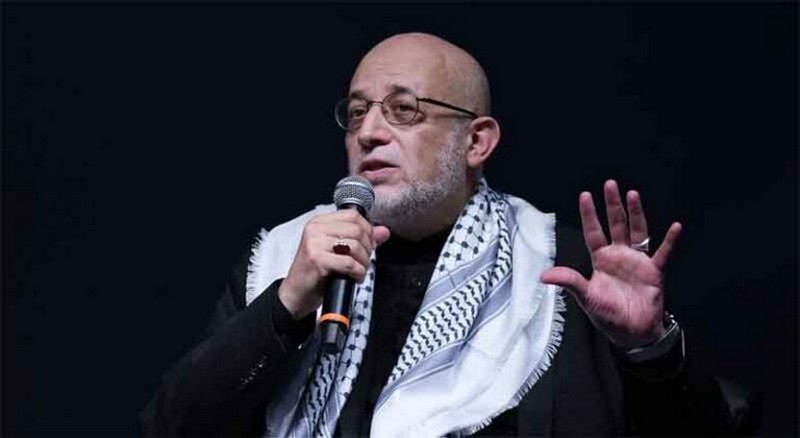
Into this theatre came Dr. Sami Al-Arian, a man whose life is inseparable from sacrifice for Palestine. Few have paid more dearly in the belly of the American empire for refusing to treat Palestinian freedom as an unspeakable cause. He was persecuted, imprisoned, separated from his family, and ultimately deported because Palestine, in Washington’s catechism, is not a cause but a crime scene whose witnesses must be punished.[1]
For that reason, Dr. Sami deserves not casual criticism but serious, grateful, and respectful engagement. He is not a tourist of resistance, nor a professional flatterer passing through Islamabad for ceremonial applause. He is a Palestinian intellectual and activist who has endured the machinery he denounces. His moral capital is real. His sacrifices are real. His place in the history of Palestine solidarity is secure. Precisely because of that, his words in Pakistan matter.
When Dr. Sami addresses “Pakistan’s elite” and describes Pakistan as a source of strength for Palestine, one wants desperately to believe him.[2] Pakistan is nuclear-armed. Pakistan refuses formal recognition of Israel. Pakistan’s people carry Palestine not as a diplomatic slogan but as a wound. Its mosques, campuses, streets, homes, and hearts have carried Gaza with an intensity no foreign ministry could manufacture. Ordinary Pakistanis understand, with greater moral clarity than those who govern them, that Palestine is not a file in international relations. It is a test of the soul.
But here is the necessary distinction: Pakistan’s elite is not Pakistan. Pakistan’s rulers are not Pakistan’s conscience. Pakistan’s people may indeed be a source of strength for Palestine; its ruling establishment has yet to prove the same. That difference is not semantic. It is the whole matter.
The emerging dream of an “Islamic NATO” suffers from precisely this confusion. Its advocates speak as if Muslim regimes have suddenly discovered sovereignty because Israel has become too reckless even for its quiet partners and anxious neighbors. But Gaza already tested this proposition. Gaza did not happen in darkness. Its hospitals were destroyed in public. Its children were starved in public. Its universities, journalists, doctors, families, and neighborhoods were erased before the eyes of the world. If a meaningful Muslim security bloc existed in substance, Gaza would not have been left to plead with a world order engineered to ignore it.
The reality is more complicated, and more sobering. These states may now be organizing not primarily to protect the masses of the region from Zionism, empire, and domestic repression, but to protect themselves from the widening consequences of Zionist war. Gaza was a catastrophe. Qatar was a warning. Iran is a strategic panic. Saudi recalibration, Pakistan’s renewed military relevance, Turkiye’s possible inclusion, Qatar’s anxiety — all of this may be geopolitically significant. But significance is not the same as emancipation.
A Muslim bloc that defends palaces but not prisoners, borders but not bodies, regimes but not citizens, cannot yet be called a liberation project. At best, it is an unstable experiment in regional self-preservation. At worst, it is containment dressed in civilizational language.
That is why Dr. Sami’s Pakistan remarks are so delicate, and so painful. Not because he praised the Pakistani people; they deserve praise. Not because he imagined Pakistan could matter; it can, and perhaps must. But because he spoke to and through an elite whose domestic conduct sits uneasily beside the prophetic politics that Palestine demands.
Just down the road from where Pakistan’s powerful could be addressed as custodians of Palestine, former Prime Minister Imran Khan remains confined in conditions described by supporters and international advocates as punitive, isolating, and dangerous.[3] One need not be uncritical of Khan, or blind to his contradictions, to grasp the symbolism. One of the most popular political figures in one of the world’s most consequential Muslim countries is imprisoned while the same power structure receives praise for its supposed moral utility abroad.
This is not a side issue. It is the central contradiction.
The international appeal over Khan’s detention drew striking support from Palestinians and South Africans.[3] That is not an accident, nor is it evidence of some exotic “cult” of Khan. Palestinians and South Africans know something about the relationship between sovereignty and humiliation. They know that a people denied political agency are not merely misgoverned; they are disciplined. They recognize in Khan, whatever his limits, a figure through whom tens of millions of Pakistanis have articulated dignity, refusal, and the desire not to live as tenants in their own republic.
Here the contrast becomes unavoidable. The deepest moral pulse of Pakistan’s Palestine solidarity has not come from officialdom. It has come from figures like Senator Mushtaq Ahmad Khan, from the Pak-Palestine Forum, from the Pakistan Rights Movement, from the Haqooq-e-Khalq Party, from students, workers, religious activists, left organizers, and ordinary citizens who see no contradiction between opposing Zionism abroad and authoritarianism at home.[4] Many come from the Islamic movement, yet have rejected the collaborationist Islam of power for a liberation theology of the oppressed: Islam not as courtly perfume, not as protocol language, but as a vocabulary of justice.
If Dr. Sami is to strengthen Pakistan’s role for Palestine, these are the people who most deserve his attention. Not because officials must never be engaged. Politics is not a purity seminar, and Palestinians have often had to speak in difficult rooms with imperfect actors. But there is a difference between tactical engagement and moral endorsement. There is a difference between saying Pakistan could become a source of strength and implying that its present rulers have already behaved as one.
The danger of the current Islamic alliance discourse is that it can allow Muslim rulers to purchase anti-Zionist legitimacy on credit. They need not democratize. They need not release prisoners. They need not address grotesque inequality. They need only speak the language of Palestine with sufficient solemnity, and suddenly the moral ledger appears balanced.
Dr. Sami Al-Arian’s own life is a profound testimony to a better politics. He knows what empire does to those who refuse silence. That is why many who admire him hope his words in Pakistan become sharper, not harsher; more prophetic, not less respectful; more attuned to the people beneath the state. Respecting him means taking him seriously enough to offer a careful and principled challenge.
The Muslim world does not suffer from a shortage of alliances. It suffers from a shortage of justice. Until any “Islamic NATO” can defend not only states from Israel, but peoples from the states that rule them, it will remain what too much official Muslim politics already is: a procession of flags, summits, uniforms, slogans, and sacred vocabulary marching with great ceremony toward the nearest safe compromise.
Endnotes
[1] https://en.wikipedia.org/wiki/USA_vs._Al-Arian
[2] https://www.pakistantoday.com.pk/2026/05/20/pakistan-source-of-strength-for-palestine-says-palestinian-prof-dr-sami
[3] https://muslimviews.co.za/imran-khan-global-coalition-demands-medical-transparency/
[4] https://muslimviews.co.za/from-pakistan-to-gaza-why-senator-mushtaq-ahmad-khan-terrifies-power-and-zionism/
Prof. Junaid S. Ahmad teaches Law, Religion, and Global Politics and is the Director of the Center for the Study of Islam and Decolonization (CSID), Islamabad, Pakistan.
26 May 2026
Source: countercurrents.org