
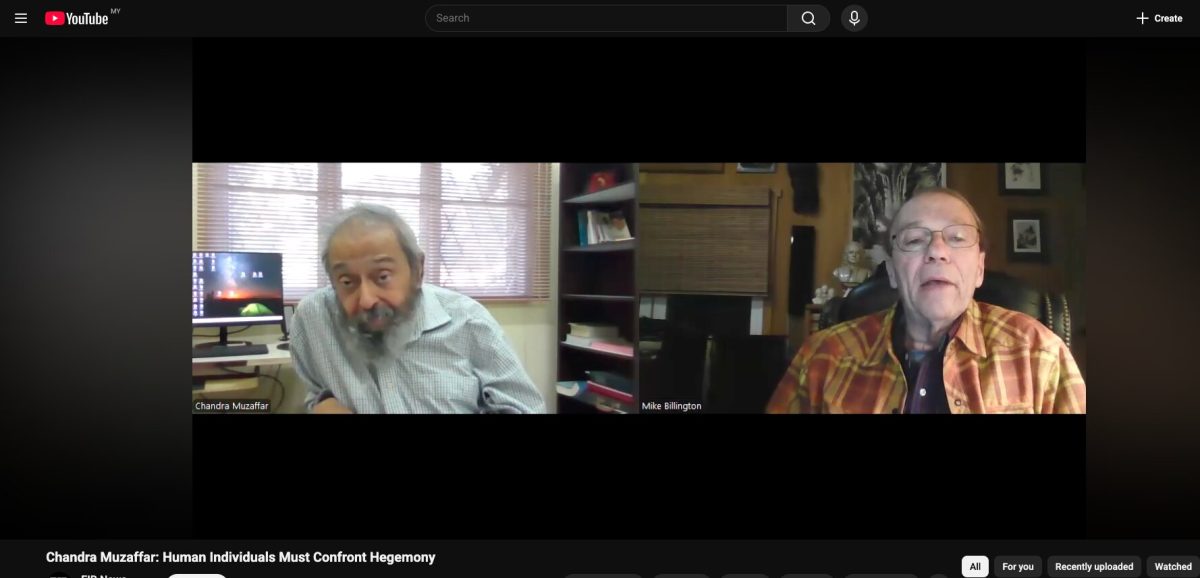
[Mike Billington]
We now have this despicable war of choice being waged against one of the largest and most historical civilizational nations in the world, the Islamic nation of Iran. And as you have pointed out also, it’s extremely important to note that Iran is a leading member of the BRICS Alliance, that it’s clear that Trump personally and his supporters, his core group on Wall Street and the city of London, are very, very concerned about the fact that the BRICS nations and the Belt and Road process coming from China is demonstrating an opposition to the hegemonism that you’re talking about. They’re basically saying, we don’t want any more of this 500 years of colonialism.
And there’s an alternative being presented to them. So they have a place to go in China and Russia and in the BRICS Alliance and so forth. So this is a resistance to the hegemony of the Anglo-American power who are insistent that they will not allow any global South nation to refuse their dictates.
So rather than just Iran, how do you see the role of the BRICS and the Belt and Road Initiative and this process emerging from the global South?
[Chandra Muzaffar]
Some of the positions associated with BRICS, they’re known to a segment of the global community, but BRICS itself is not that well known, unfortunately, and neither is the BRI, the Belt Road Initiative. Both are very important. And I think we should try to popularize their thinking.
These two outfits, BRI in a more specific sense, BRICS in a broader sense, I think both these outfits also should do much more. But what they can do and how they should act is something that they’re in a better position to discuss. And we hope they would share this with all of us, meaning by which the positions they’re taking on issues of this sort.
For instance, what is their thinking about the military-industrial complex linked to US? What is their position on the military-industrial complex? It’s not very clear.
And when we say we would like to see BRICS respond, will it be a different sort of response from what we have seen so far in terms of global hegemony and the responses to it? In other words, is it also going to be a response of the type that we had seen in earlier periods? Of course, perhaps BRICS was not the grouping that was around at that time, but you look at the Non-Aligned Movement (NAM), for instance, there was a response to hegemony at that time, and the response had some impact, but it fizzled out, and why did it fizzle out?
I think it is very important for those of us who are concerned about this challenge to look at the responses and why many of those responses fizzled out. What explains this? Does it show that perhaps some of our own methodologies were not appropriate, or is it because of the way in which the dominant powers were able to undermine us?
Or is it because of the global situation itself, which I should elaborate in a sentence or two. I think what we have witnessed since the beginning of the Second World War, since the beginning of this period of hegemony, what we have witnessed since the end of the 70s, in the 80s, 90s, up to the present, is the strengthening of what is described as neoliberal capitalism. I’m a little hesitant to use the term neoliberal capitalism because I think it is an attempt to camouflage the nature of what is happening.
I would put it in more direct language, and I would say that we have seen the strengthening of global capitalism in the last few decades, especially after the 70s. Why did it become stronger? Partly because of the decline of what some would describe as the socialist or communist alternative, but also because of the weakening of the Non-Aligned Movement.
These were very important counterpoints, but they have become weaker and weaker. And they become weaker in the face of the growing strength of capitalism, and what has made capitalism so strong, compared to, say, its position in the early 60s. Capitalism is much stronger.
The capitalism of that sort is much stronger. I think it has a lot to do with the way in which capital was organized — technology as a very important appendage of capital, and the spread of capitalism and of technology linked to that capitalism, and how it has overwhelmed, almost overwhelmed the entire world. And at the same time, the so-called alternatives are getting weaker and weaker.
Communism, to my mind at least, was not really an alternative, though some thought it was. It was not really an alternative. But it became weaker and weaker.
And I don’t think whatever emerges after this will be some sort of revamped version of communism, or socialism. I don’t think so. I don’t think that’s going to happen. I don’t think it’ll work. So we’ll have to think of an alternative which makes sense to a lot of ordinary people.
It makes sense to some of the trends that we are witnessing, of the groups that are emerging, and to some of our greatest concerns. To put it in very broad terms, it must make sense to not just the quest for justice, but also the desire for human freedom, which is very important, it must make sense for those who yearn for freedom, it must make sense.
For those who are thinking of autonomous development, which is yet to strengthen itself, but it will as time goes on, depending on how the situation unfolds. So alternative autonomous development, and a different way of looking at both capital and labor, a different way of applying technology and seeing how technology can serve the changes that are taking place. These are things that require a lot of thinking, analysis, and mobilization.
It’s not happening the way we would like to see it happening, but it is something that is important. It has to happen.
[Mike Billington]
It’s what Helga calls a new architecture, that we need a new architecture for security and development, which applies to every single nation, and therefore every human being. In your statement at the SHAPE Conference, which I watched over the weekend, with our friend, Professor Richard Falk, as well as your associate from Australia, Joe Camilleri, and a few other leading people from around the world, it was a very interesting grouping of people fighting for some sort of a new architecture. But in there, you made the point that the rise of Islamic radicalism — you dated it back to the 1953 coup against Mossadegh, in Iran, by the US and the British, which did away with the elected government of Iran at that time and brought in the radical Islamic movement.
But you really emphasized that that was the result of the reaction against that move by the coup against Iran at that time, that that gave rise to this Islamic radicalism. You are well-known internationally as an Islamic scholar, in addition to your general movement for peace and so forth, but how do you see the role of Islam and the role of the world more generally to deal with this question of the Islamic radicalism that is now apparent in various parts of the world and is used as a target by the hegemon as their justification for an outright colonial kind of approach, really a Crusade approach, to destroying Islamic nations?
[Chandra Muzaffar]
Well, there is a bit of clarification that is required before I try to answer your question, Mike. If you look at Iran and what had happened in 1953, the coup against the democratically elected prime minister, Dr. Mohammad Mossadegh. What they did was to strengthen the position of the unelected, of course unelected, monarchy. And the monarchy had a very strong authoritarian tendency.
It was committed to US and Western interests. They were the ones who supported the strengthening of the monarchy, and that remained there. So the monarchy indirectly gave birth to the Islamic movement which overthrew the monarchy.
So you’ll find that this is something that has happened in other situations too, where you have a conservative force emerging, strengthening itself, crushing progressive movements, progressive movements which would be either Islamic in the case of Muslim countries or sometimes they would be secular. Like in the case of Iran, a part of that progressive movement at the beginning was actually secular. And then as a result of these movements getting stronger and stronger, you find that there is a reaction.
And Islamic resurgence in Iran was to some extent a reaction, not totally, not completely a reaction to that. And this has happened in other countries too. You find that Islamic movements have become stronger.
Some of those movements have some outstanding attributes which contribute towards progressive thinking. They’re thinking about people’s involvement in social change. They’re thinking about some socioeconomic reforms and so on.
But at the same time, there’s sometimes these progressive groups in Muslim countries that wear the label of Islam, they sometimes tend to strengthen the very conservative dimension of Islam to the detriment of the larger society. For instance, they don’t develop a more all-encompassing view of justice. They develop certain negative views about women, about minorities.
These things have happened. So this is why when you look at movements of this sort, you have to look at them very carefully and see what is it in these movements which contribute to change and what is it in these movements which retard change, which hold back change. And that goes for other religions too.
We look at the Buddhist movement as a social movement. It’s all the same features are present, both progressive and retrogressive elements. And it’s the same with Hinduism, Christianity and all the other religions.
So that’s a phenomenon that confronts us as far as religion is concerned. You will see both these forces emerging. The yearning for some sort of religious alternative is perhaps linked to a feeling, to put it in very broad terms, a feeling of secular movements that want to change, so-called progressive secular movements, and that includes a big chunk of the socialist communist movements.
The inability to address the question of the spiritual dimension of human existence, the inability to come to terms with this and to provide answers that convince people that there is a deeper spirituality that is missing in movements for change, including movements which have been there for a long while, left movements and so on. But there is a deeper spirituality which is necessary to address these things because the ultimate analysis, you know, Mike, the question is, we’re talking about the human being. We’re talking about the future of human civilization.
So questions in which spiritual philosophies, the philosophies of the great religions had addressed for a very long while. Those questions and the answers they had tried to provide. They did not have all the answers. I think those answers, parts of them, should also be honest in our attempt to bring about a change.
It cannot be what the 19th century Europeans and others in other parts of the world, including nationalist movements in the global South, what they articulated in the 19th and 20th centuries. It has to be something which is deeper, richer, broader, more meaningful to the human being. And I think this is what is missing in the so-called progressive movements.
[Mike Billington]
Right. I know you read, and in fact you signed, the letter which Helga Zepp-LaRouche issued to Pope Leo XIV calling on him to come together with the Orthodox Catholics in Russia and in the North and with all other religions, with Jewish and Muslim and Buddhist and other religions. Basically, as you just indicated, calling on people to recognize that there’s a need for those who speak on behalf of the spiritual needs and realities of different cultures around the world to come together at this point to address the fact that it is all of this that’s on the line, that we’re facing global war, perhaps nuclear war and the annihilation of humanity as a whole, wiping out all of the great things and the great beauty that has been created by civilizations, spiritual as well as material and scientific. That’s all threatened. So this letter, we have been gathering signatures on this.
And as I mentioned to you before we started the recording, we’re going to hold another meeting, a Roundtable meeting of people that have made themselves World Citizens, not just citizens of their nation or their faith, but World Citizens, like yourself, to bring together those kinds of people of conscience and of a certain moral commitment to address exactly this issue. But we need to have those religions speak out on behalf of their constituents to work together to this. So what is your thinking on this in terms of what we can and must do to make this succeed?
Because we don’t have much time really. It’s a moment of truth for humanity.
[Chandra Muzaffar]
Yes. Well, I think if we are hoping to enlist formal religious structures, meaning by which religious establishments in different countries and part of different faiths and so on, it’s going to be a very big challenge. And it may not even be worth while because I don’t think this is going to happen.
I would rather focus upon individuals who have a spiritual perspective on some of these issues. Some of them may not even have a formal affiliation to a particular religion, but that is not important. I think what is important is whether they have a spiritual worldview that sees the human being in a much broader perspective and wants to see change, or something that goes beyond the material, that goes beyond the here and now as it’s commonly understood.
So you need individuals, groups, and there are such individuals and groups in all the religious faiths. But formal religious structures, in many instances, they are a reflection of the formal structures of power. As you can see, they are a reflection of the formal structures of power.
And for that reason, they don’t want to bring about change. We have to understand that also. So I would want to concentrate on individuals and you can see this in what has happened.
And if you take the example of the Catholic Church, one can argue that individuals like Pope John Paul and some of the other figures, they represented a certain type of thinking which appealed to those who were progressive, as the term is ordinarily understood, and also appealed to people who had a deep sense of faith. I think these are the individuals that we hope will grow and multiply. But the formal structure as such, and if you take another example: religion that doesn’t have formal structures in the same way in which Catholicism has, or certain other aspects of Christianity have.
If you take Hinduism, for instance, you will find that the formal structures of religion in India associated with Hinduism are very conservative. But there are individuals and groups who have been there all along, for a long, long time, for ages, who would struggle for another approach. A person like Mahatma Gandhi, for instance, did not fit with the formal structure of Hinduism, and he did not really bother about wanting to fit into that structure, but he stood for faith.
He was a man of very deep faith, committed to values, and appealed to people beyond his own religious community. We need people like that, and many others, of course, people who are relevant to contemporary challenges and who can address these challenges. And in some respects, if you look at the writings of Lyndon LaRouche, he was one such person who had very deep faith, but he did not have a formal relationship with the formal structures of faith.
So let’s look at faith from that perspective. Faith, meaning by which a commitment to an understanding of the human being that acknowledges the human being’s spiritual origin, the human being’s spiritual orientation, but at the same time is not just a mere reproduction of the way in which faith has been understood for so long. Dissident elements there may be, but formally speaking, faith has been understood in a certain way.
They’ll say, oh, this person is religious. Why? Because he performs the daily prayers, or he fasts, or he does things like that, which are all important.
All religions have practices of this sort. But for me, a person of faith would be someone who is kind and selfless, and committed to human dignity, to the wellbeing of his or her fellow human beings. That would be a person of very deep faith, not so much because he performs, or she performs, certain rituals, which you’ll find in all religions.
And in the end, that becomes the definition of a religious person. And that becomes the definition of what it is to be religious. That I think is unfortunate.
We have to change that. We have to change that.
[Mike Billington]
As I’m sure you noticed, Helga pointed to the fact that Pope Leo XIV had raised the question of Nicholas of Cusa in one of his speeches before the Angelus, the greeting at St. Peter’s Square. And that this, of course, has been something Helga has focused much of her life on. The idea that it was Nicholas of Cusa who had the kind of approach that you’ve just described, was absolutely committed to acting on the idea that everyone had to come to a higher understanding of how to think, that we had to think above and beyond the conflicts between people, what he called the coincidence of opposites, getting above and beyond the different conflicts that exist between structures, between nations, between people, through an idea of a single truth, a single unity, truly understanding that there is One God. That in fact, that people who all think there’s One God, but are killing each other, that doesn’t quite fit. So the idea that somehow there is a religious backing to a war of one nation against another is just absurd.
And this is exactly what we’re all facing today, is the issue that we’re up against. Well, look, I think this is good. This is what I was hoping we could get across in a video of this sort.
And if there’s any final words that you’d like to say before we cut this off, would you like to close with anything?
[Chandra Muzaffar]
Yes, a very short comment in relation to what you just said. I think more and more of us should come out openly and speak about faith in action along these lines. Along the lines of a commitment to fellow human beings, a commitment to justice, to love, to compassion, you know?
And at a time when there’s a crisis, apart from the crises that are observed, that are obvious to us, but a time when there’s a crisis about the human being himself, the human being herself. Why are we here? What is the purpose of life?
How do we give meaning to our existence? I think that’s what, in the ultimate analysis, all the great faiths, the great religious teachers try to address. And we have to address the same challenges in a different form, given the environment that we’re in, and say, well, yes, we should look at these challenges, not simply because someone else is talking about them and we want to echo similar sentiments, because that I don’t think will help.
We want to do it because we are committed to a vision of the human being, which is so deeply embedded in all the great faiths. The real purpose of human existence, why we are here and what we should do with our lives with the time given to us, you know? And I have found many, many writings in all the different faiths that echo this sort of sentiment, but they have remained a sort of undercurrent rather than the main current, a sort of undercurrent.
You have to try to make it more than the undercurrent, something which is associated with mainstreaming of faith. When, for instance, you ask a person, they say, oh, this is a religious person. You know, the second question, why is the person religious, will reveal what the person means by being religious.
And that, I think, is the problem. I would like to see, for instance, people that stood up for justice, and we had mentioned some names just now in different contexts. I would see them as truly spiritual people, and one should see those as examples of spirituality, rather than someone who undertakes to perform the various rituals faithfully and so on.
You know, of course, I understand the role of these rituals. They are important to any practicing Muslim, Christian, Hindu, Jew, you know, they’re important, but there is a deeper meaning to being a human being. And I think that is what we have to bring out at this stage of human civilization.
Otherwise, we are in very deep trouble.
[Mike Billington]
Very deep. Okay, Chandra, thank you very much.
Video link: https://www.youtube.com/watch?v=ZZ4d-HAsbO0