
By Junaid S. Ahmad
Authoritarian regimes do not merely imprison people; they criminalize the virtues that expose them. Courage becomes sedition. Conscience becomes conspiracy. Solidarity becomes a security threat. In Pakistan today, Senator Mushtaq Ahmad Khan appears to have been targeted for the most unforgivable offence in a political order built on theatrical morality: he practices what the ruling elite only performs.
His reported seizure while returning from Pakistan-administered Kashmir, followed by his release after an illegal detention, was not an aberration. It was the regime speaking in its native language.
According to his associates, Senator Mushtaq was stopped near Kahuta Bazaar on July 28 after authorities prevented him from entering Azad Jammu and Kashmir. He had travelled with white flags to meet grieving families and stand with communities reeling from deadly repression. His team says Punjab Police took control of his vehicle, removed him from public view, denied access to his companions, and later disclaimed knowledge of his whereabouts. No publicly disclosed warrant. No charge. No legal explanation.
He was subsequently released, but release does not legalize an abduction after the fact. Nor does it erase the hours in which the state concealed his whereabouts, denied responsibility, and placed him beyond the protection of ordinary law.
This is governance in its most degenerate form: abduct first, deny second, manufacture confusion third, release only after pressure mounts, and leave the Constitution face down in a ditch.
Kashmir provided the immediate pretext. It does not explain the deeper hostility.
Senator Mushtaq is dangerous to Pakistan’s rulers because he possesses what they conspicuously lack: moral coherence. He has refused to treat justice as a slogan, faith as decoration, or solidarity as a photograph. He has stood with Palestinians under bombardment, Kashmiris under repression, political prisoners denied due process, and citizens whose votes were converted into administrative debris.
The establishment can tolerate anger. It has ministries for absorbing anger, television studios for diluting it, and prisons for containing it. What it cannot tolerate is consistency.
Pakistan’s ruling elite is perfectly comfortable with Palestine as pageantry. It welcomes sermons, resolutions, banners, hashtags, and exquisitely mournful speeches delivered by men whose courage expires at the edge of the podium. Gaza may be invoked, provided nothing material follows. Zionism may be denounced, provided Washington is not offended. The official anti-Zionism of Pakistan’s elite is thunderous in diction and microscopic in consequence.
Senator Mushtaq shattered that arrangement.
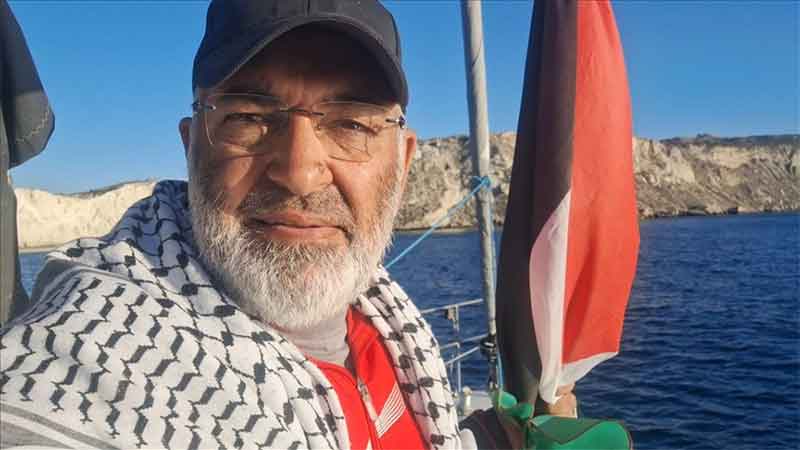
He joined civilian flotilla missions challenging the blockade of Gaza and accepted personal risk where generals, ministers, and professional custodians of Islamic sentiment offered recycled rhetoric. He turned solidarity from theatre into action. That alone made him an indictment.
One man boarding an aid vessel can expose an entire state’s moral fraud.
Through the Pak-Palestine Forum, Senator Mushtaq also confronted Muslim governments and Islamic political parties that have converted Palestine into a franchise for producing cheap virtue. His criticism is devastating because it comes from within the language of faith while stripping away the hypocrisies committed in faith’s name.
He refuses to let rulers condemn Israeli repression abroad while perfecting arbitrary detention, censorship, militarized governance, and political disappearance at home. He refuses to let a state invoke international law for Palestinians while treating due process for Pakistanis as a clerical inconvenience.
This is where Palestine and Pakistan meet: in the shared arrogance of power that believes suffering becomes acceptable once it is stamped “security.”
Senator Mushtaq’s second offence is his rejection of imperial servitude. Pakistan’s ruling elite has mastered the art of presenting dependency as strategy. Obedience becomes “pragmatism.” Foreign approval becomes “stability.” Elite self-preservation becomes “national interest.”
Washington receives compliance. Rawalpindi receives validation. Civilian governments receive permission to impersonate authority. The public receives inflation, repression, and a lecture on patriotism.
Senator Mushtaq keeps pointing at this circuitry of submission. He identifies the patron behind the client, the weapons behind the humanitarian language, and the comprador class behind the costume of sovereignty.
His third offence is refusing the official fiction surrounding Imran Khan and the 2024 elections. Whatever one’s view of Khan, his mass support, imprisonment, and exclusion from meaningful political competition sit at the center of Pakistan’s legitimacy crisis. Senator Mushtaq’s insistence that the public mandate was obstructed makes him intolerable to a system that can survive accusations of incompetence but not exposure as illegitimate.
The Pakistan Rights Movement makes him more dangerous still because it connects what the establishment desperately needs separated: Palestine, Kashmir, constitutional rule, economic justice, anti-imperialism, and democratic sovereignty.
Fragmented dissent can be slandered and quarantined. Connected dissent becomes a political force.
That is why Senator Mushtaq’s illegal detention matters even after his release. Enforced invisibility is not simply detention; it is a message. The state is declaring that it need not answer your argument if it can erase your presence, even temporarily.
Yet disappearance is also cowardice. Confident governments arrest openly, present charges, and defend themselves before courts. Morally bankrupt regimes hide behind unmarked custody, police denial, and bureaucratic amnesia — and then expect release to absolve the original crime.
A white flag was stopped at the border. A voice was intercepted on the road. A senator was pulled into the machinery of denial and released only after the machinery had delivered its warning.
But the greater disappearance is Pakistan’s ruling elite itself: absent from morality, absent from legitimacy, absent from courage.
Senator Mushtaq’s release is welcome, but it is not enough. The state must disclose who ordered his detention, explain the legal basis for his seizure, guarantee his safety, and hold accountable every official involved in denying his whereabouts and depriving him of due process.
Anything less is not government.
It is a kidnapping syndicate with a flag, a seal, and excellent stationery.
Pakistan’s rulers may continue performing solidarity with Palestine. Senator Mushtaq has already exposed the performance.
He carried solidarity beyond the podium — and was illegally detained by men whose principles have never survived beyond it.
31 July 2026
Prof. Junaid S. Ahmad teaches Law, Religion, and Global Politics and is the Director of the Center for the Study of Islam and Decolonization (CSID – https://csidpk.org), Islamabad, Pakistan. He is a member of the International Movement for a Just World (JUST – https://just-international.org/), Movement for Liberation from Nakba (MLN – https://nakbaliberation.com/), and Saving Humanity and Planet Earth (SHAPE – https://www.theshapeproject.com/).