
By Khalisha Ainna Putri
In an industry where millions of people listen to what celebrities say, their voices can reach places that ordinary people cannot. A single post, interview, concert speech or public statement can bring an issue to the attention of millions within minutes. With that enormous reach comes an important question: when people are suffering, what should celebrities do with the platforms they have been given?
The recent controversy surrounding rapper Macklemore and Ed Sheeran’s Loop Tour has brought this question into focus.
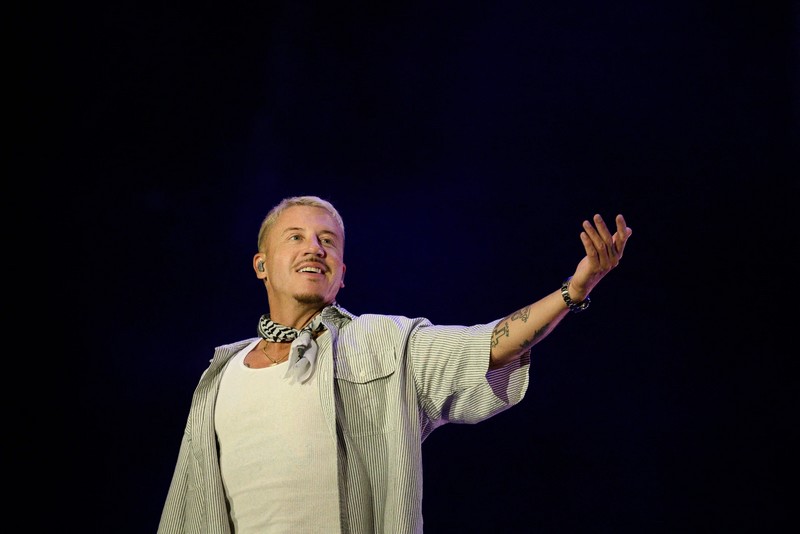
During his September 4 performance at MetLife Stadium in New Jersey, where he appeared as an opening act for Ed Sheeran, Macklemore used his time on stage to speak openly about Palestine. He told the audience that one of the reasons he wanted to join the tour was so that he could say two words that were deeply important to him: “Free Palestine.” He also performed Hind’s Hall, his protest song written in response to the war in Gaza.
His decision to speak was followed by backlash and, ultimately, his removal from the remaining US dates of Sheeran’s tour. Robert Kraft, the owner of Gillette Stadium, confirmed that Macklemore would not perform at the venue. Macklemore subsequently alleged that venue owners had pressured Sheeran over his participation because of his public statements supporting Palestine. Sheeran, meanwhile, said that Macklemore’s removal was not his decision and that he had spoken with venues throughout the week in an attempt to find a resolution.
Whatever the disagreements surrounding the circumstances of his removal, one thing is clear: speaking publicly for Palestine can come with professional consequences.
But the fear of those consequences cannot be the reason celebrities remain silent.
If anything, it makes the decision of artists who continue to speak about Palestine even more significant.
Macklemore could have chosen to protect his position on a major international tour. He could have avoided mentioning Palestine on stage. He could have kept his political views away from his performances and continued with his career without attracting the same level of controversy.
Instead, he chose to use the audience in front of him to say something he believed needed to be said.
And he is not alone.
Following Macklemore’s removal, several artists associated with Sheeran’s tour, including Finneas, Lukas Graham, Aaron Rowe and Irish band Beoga, withdrew from the remaining US dates. Their decisions demonstrated that solidarity does not necessarily end when speaking up becomes difficult. It can become even more important.
Other artists and public figures have also continued to use their platforms to draw attention to Palestine.
Dua Lipa has repeatedly spoken about Palestinian rights and the importance of freedom, justice and equality. Susan Sarandon has publicly advocated for Palestinians and discussed the professional consequences she believes she has faced because of her position. Mark Ruffalo has repeatedly spoken about Palestinian rights and the humanitarian situation in Gaza. Nicola Coughlan has used her large online following to support fundraising efforts for humanitarian assistance to Palestinians.
Their approaches are different, but the principle is similar: a public platform can be used for more than entertainment. It can be used to make people look, listen and care.
And Palestine needs people to look and listen.
For years, Palestinians have lived through occupation, displacement, restrictions on their rights and repeated cycles of violence. The devastation in Gaza has brought the humanitarian consequences of the conflict into global view, with civilians bearing an enormous burden. The United Nations and humanitarian organisations have repeatedly warned about the scale of humanitarian needs in Gaza.
In such circumstances, celebrity voices can matter.
A celebrity does not need to be a diplomat, political scientist or humanitarian expert to express concern for Palestinian civilians. They do not need to have a comprehensive solution to the conflict before they can call for an end to civilian suffering. They can use their platform to amplify Palestinian voices, direct audiences towards humanitarian organisations, encourage donations, attend solidarity events or simply refuse to allow Palestinian suffering to disappear from public conversation.
That is the difference between celebrity activism and celebrity influence.
Influence is something celebrities already possess. Activism is what they choose to do with it.
This is why the argument that celebrities should “stay out of politics” can be difficult to separate from the realities of Palestine.
Speaking about the suffering of Palestinian civilians is not merely about taking a political side in an abstract debate. It is about recognising the humanity of people whose lives have been devastated by conflict.
Celebrities routinely use their platforms to speak about issues they care about. They speak about climate change, women’s rights, racial justice, poverty, mental health, gun violence and humanitarian disasters. Their audiences listen because these individuals have spent years building relationships with the public.
Palestine should not be treated as an exception simply because the subject is politically uncomfortable.
In fact, that discomfort makes their voices even more important.
When speaking about Palestine can result in backlash, cancelled appearances, lost opportunities or damaged professional relationships, choosing to speak anyway sends a message to Palestinians and to audiences around the world that their suffering deserves to be acknowledged.
It also demonstrates that solidarity cannot only exist when it is convenient.
Macklemore’s experience is an example of this. His message did not disappear when he lost his place on the tour. Instead, the controversy generated even greater attention around Palestine.
Macklemore announced that he would donate $1 million in net earnings from the tour to organisations supporting Palestinians and challenged Kraft to match the donation.
The conversation therefore moved beyond a single concert.
It became a conversation about who gets to speak, whose suffering receives attention and what happens when artists use commercial spaces to advocate for people who are often politically marginalised.
There is also something powerful about seeing artists stand behind one another.
Lewis Hamilton publicly supported Macklemore. Kehlani expressed solidarity with him. Zara Larsson, Greta Thunberg, Rachel Chinouriri, Bob Vylan, Kneecap and others also showed support following his statement. Their responses demonstrate that Macklemore’s decision did not exist in isolation.
One voice can encourage another.
One artist can make another feel less afraid to speak.
And collectively, these voices can make it harder for the suffering of Palestinians to be pushed out of public attention.
This does not mean celebrities can solve the Israeli-Palestinian conflict. They cannot replace governments, humanitarian organisations or international institutions. But they can influence what millions of people talk about, learn about and care about.
That influence should not be underestimated.
For Palestinians, international solidarity is not simply about seeing famous people post about them. It is about having their experiences recognised and their voices amplified in spaces where they may otherwise be ignored.
A celebrity saying “Free Palestine” will not end the violence.
A donation will not rebuild every destroyed home.
A social-media post will not bring back those who have been killed.
But these actions can contribute to something that is also desperately needed: attention, awareness, solidarity and pressure for change.
Celebrities therefore do not have to choose between being entertainers and being human beings who care about injustice. They can be both.
They can perform on stage and still speak about Palestine.
They can make music and still call for humanitarian aid.
They can build successful careers and still stand beside people whose voices struggle to reach the world.
And when doing so comes with professional consequences, their decision to continue speaking becomes a reminder that solidarity is most meaningful when it is not conditional on convenience.
The question, then, should not simply be whether celebrities should “stay apolitical.”
The more important question is what responsibility comes with having a platform large enough to make millions of people listen?
At a time when Palestinians continue to endure devastating humanitarian conditions, silence should not be treated as the only safe or acceptable response.
Celebrities have audiences. They have visibility. They have access to spaces that ordinary people often do not.
They have a platform.
And when that platform can be used to amplify the voices of Palestinians, demand humanitarian action, support relief efforts and remind the world that Palestinian lives matter, using it for Palestine is not something they should be afraid to do.
It is something they can choose to do.
Because sometimes the most powerful thing an artist can give an audience is not another song, another performance or another product to buy.
Sometimes, it is their voice.
Free Palestine.
23 September 2026