
By Dr. Radwan Masmoudi
July 25 marked five years since Tunisian President Kais Saied suspended the elected parliament, dismissed the government and began ruling by decree. He called it a rescue mission, a necessary response to a paralyzed political class and a country in crisis, while promising to fight corruption, restore dignity to ordinary Tunisians and build a “new republic” answerable directly to the people. Instead, Saied has achieved none of his promises while securing unchecked and indefinite power at the expense of Tunisia’s 2011 revolution and its people.
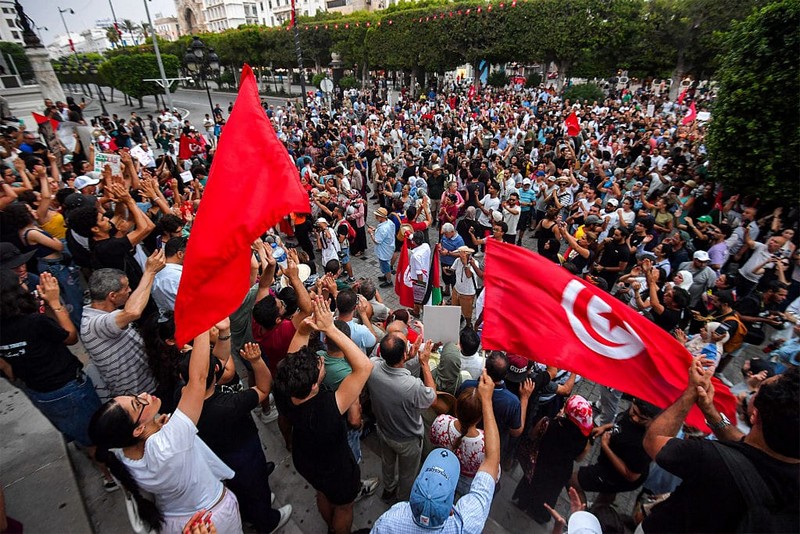
As Tunisians marked the anniversary of that day, many were not celebrating. Instead, thousands took to the streets at night, blocking roads and burning tires because their electricity had been cut for hours, their water had stopped running in the middle of a heat wave and the medicine many of them depend on to stay alive had either disappeared from pharmacy shelves or had become unaffordable.
The convergence of the anniversary with the multiple crises facing Tunisia and its people, both imposed by the president and stemming from his inability to provide basic services as he has deepened repression, is not incidental. These developments represent the clearest evidence yet of what five years of concentrated, unaccountable power produces.
Saied has achieved none of his promises while securing unchecked and indefinite power at the expense of Tunisia’s 2011 revolution and its people.
- Radwan Masmoudi
In 2021, Saied’s coup against democracy and the constitution was met with a mixture of relief and alarm. Many Tunisians, exhausted by a decade of fractious coalition governments, corruption scandals and a political class that seemed more interested in infighting than in governing, welcomed the disruption. Others, including those of us who had spent years working to build Tunisia’s fragile but genuine democratic institutions after 2011, warned that dismantling checks and balances always ends in worse governance and no one left to correct it.
That warning has now been borne out in the most basic, yet avoidable, outcomes: whether the lights stay on and the pharmacy shelves are stocked. A president who alone rewrote the constitution to concentrate nearly all executive, legislative and judicial authority in his office no longer has a parliament to blame, an independent judiciary to point to, political rivals to blame or a coalition partner to deflect responsibility. The total failure of the Tunisian state today is, structurally and undeniably, Saied’s legacy.
This summer’s crisis is not simply about extreme heat. Tunisia’s state electricity and gas utility, the Société Tunisienne de l’Electricité et du Gaz (STEG), has acknowledged that the national grid is under severe strain, the product of years of deferred maintenance and under-investment. Outages have extended beyond 24 hours in some regions. Deaths have been reported after oxygen machines and other medical devices lost power in patients’ homes and hospitals. Pharmacies have warned that the same outages are ruining heat-sensitive medications. That development compounds a separate crisis in which the prices of numerous medicines have risen sharply, reportedly by several hundred percent for some products, pricing chronic patients out of treatments they can no longer afford.
Rather than treat this as a governance emergency, Saied has reached for a familiar scapegoat: attributing unrest and social breakdown to shadowy external forces. Most recently, he blamed drug trafficking networks for what is happening in the streets. This is not a serious answer. It is a deflection, and Tunisians are not accepting it.
None of these developments are unfolding in a political vacuum. Since the coup, Tunisia’s prisons have been filled with journalists, lawyers, judges, opposition politicians and civil society figures prosecuted under vague charges often tied to Decree 54 of 2022, which criminalizes the spread of “false information.” Independent monitors have documented severe overcrowding, with the prison population reaching nearly 33,000 inmates, or roughly 200% above capacity in some detention centers.
The convergence of the anniversary with the multiple crises facing Tunisia and its people, both imposed by the president and stemming from his inability to provide basic services as he has deepened repression, is not incidental.
- Radwan Masmoudi
Defenders of the president insist Tunisia remains free and that Saied is no dictator. That claim is difficult to reconcile with a judiciary that lost its independence when the president dissolved the High Judicial Council, the elected body responsible for overseeing it. Saied’s efforts to crush Tunisia’s media environment by outlawing criticism of the president carry real consequences, including long prison terms.
This is why the current protests, whatever their immediate trigger, cannot be reduced to a story about faulty power lines. When citizens have no functioning parliament to petition, no independent courts for appeals and face increasing risks when speaking out publicly, electricity and water outages become more than governance issues. For the state, they transform these failures into a referendum on its leadership, an unacceptable position for a governing model that rejects accountability.
Tunisia’s weakened international standing further harms the country and its people. Tunis’ isolation from its traditional Western and European partners over the past five years has coincided with deepening security and economic ties with Algeria. The precise terms of security cooperation along the shared border remain opaque, which is itself a problem in a country with a constitution that once prided itself on parliamentary oversight of exactly these kinds of arrangements. Recent travel advisories from Western governments citing terrorism risk in the Tunisian-Algerian border region serve as a reminder that this frontier remains genuinely volatile. Tunisians deserve to know the terms of any security arrangement affecting their sovereignty and security, rather than being expected to trust assurances from a government that has shown little appetite for transparency.
It is premature to predict that public frustration will foster a movement that brings down Kais Saied. Tunisia’s opposition remains fragmented, civic space has narrowed considerably and the tools available to Tunisians to organize and mobilize have been deliberately weakened. It would be equally wrong, however, to dismiss what is happening as a passing episode of summer heat and bad luck. The pattern is now unmistakable: A coup against democracy that concentrated all power in one man’s hands has produced a state that can no longer keep water running or the lights on, provide affordable medicine or tolerate criticism that might otherwise help it fix these problems.
For the United States, the European Union and the international community still engaging Tunis, this anniversary should prompt difficult questions that have been avoided: whether continued engagement on Saied’s terms, without meaningful conditions tied to judicial independence, press freedom and the release of all political prisoners, is sustainable, or whether it is simply subsidizing the consolidation of power that produced this crisis in the first place. Tunisians did not go into the streets this summer to defend an abstract principle. They went out because their government has failed at the most basic tasks of governing.
Five years after the coup, that failure deserves an honest re-evaluation, not another conspiracy theory about drug smuggling or migrants.
Link to Article
—————————
Radwan A. Masmoudi, Ph.D.
President
Center for the Study of Islam & Democracy (CSID)
1405 South Fern Street, Suite 703
Arlington, VA 22202
Tel. 202-304-2940
radwanmasmoudi@gmail.com
www.CSID-online.org
13 August 2026
Source: dawnmena.org