
New York, New York
August 13, 2026
The United Nations made a promise to the people of Kashmir. Seventy-eight years later, that promise remains conspicuously unfulfilled. Sometimes the most powerful question is the simplest one: How long can an international promise be ignored before the world stops calling it a promise? For Kashmiris, the answer is now measured in generations.
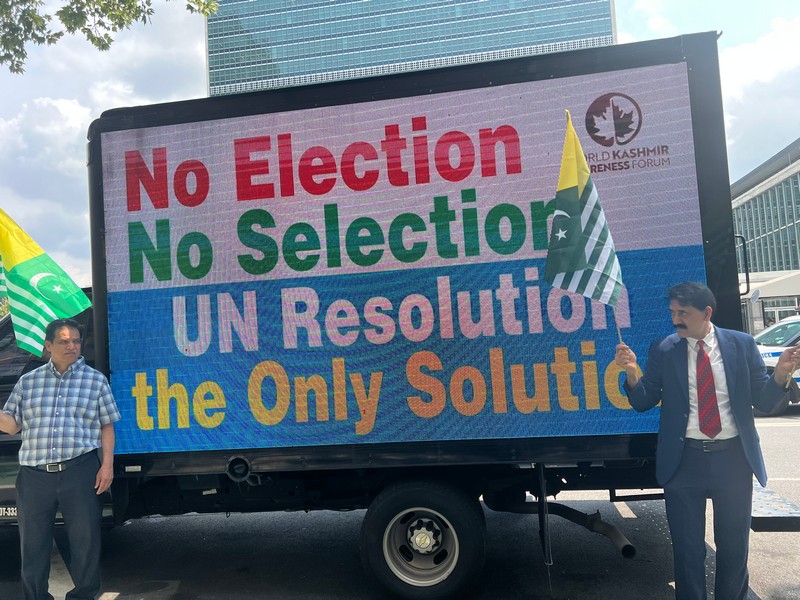
Dr. Ghulam N. Mir, President, World Kashmir Awareness Forum (WKAF) and Executive Producer, Saffron Kingdom, a Kashmiri film, said “On the 78th anniversary of the United Nations Commission for India and Pakistan’s August 13, 1948 resolution, the Washington-based WKAF took that question directly to the streets of New York City. The organization rented highly visible digital advertising trucks and sent them through strategic locations around the city, including areas surrounding the United Nations Headquarters. The message was impossible to miss.”
Dr. Mir explained that “Bright digital screens carried calls for the United Nations to revisit its longstanding commitments concerning Kashmir and the right of its people to determine their political future. The digital trucks usually reach an estimated 40,000 to 50,000 people each day—including diplomats, international visitors, tourists, observers, and ordinary Americans. That was precisely the point.”
Dr. Imtiaz Khan, Kashmiri American scholar said that “In an age when attention is increasingly scarce, advocacy must go where people are. And there is perhaps no more appropriate place to raise the Kashmir question than New York, home of the institution whose own resolutions remain at the center of the dispute.”
Dr. Khan added that “The August 13, 1948, UNCIP resolution stated that “the future status of the state of Jammu and Kashmir shall be determined in accordance with the will of the people.” That was not a slogan invented by Kashmiri activists. It was language contained in a United Nations-backed resolution. Yet nearly eight decades later, Kashmiris continue to ask why the principle of self-determination that the international community once recognized has become so difficult to discuss.
Dr. Ghulam Nabi Fai, Chairman, World Forum for Peace & Justice said that “WKAF’s digital campaign put that question bluntly before the international community. Its messages included: “India took away Article 370: But not our dreams, not our identity”; “Demand for statehood is a deception: Kashmiris demand right of self-determination”; “Kashmir Election Just a Deception: Plebiscite the Only Solution”; “Kashmiris Reject Indian Occupation: UN Resolution only Solution”; “No Election, No Selection: UN Resolution the Only Solution”; and “Decades elapsed, sufferings not diminished: UN resolutions for Kashmir remain unfulfilled.”
Fai added that “These are deliberately provocative messages. But provocation is sometimes necessary when an issue has been allowed to disappear from the world’s attention.”
Dr. Fai urged the United Nations, democratic governments, and the international community to intensify diplomatic efforts toward a peaceful and durable settlement of the dispute and to ensure that the rights, dignity, and political aspirations of the people of Jammu and Kashmir remain central to any future resolution.
Sardar Taj Khan, Senior Vice Chairman, Kashmir Mission, USA and main organizer of the event said that “the aspirations of the Kashmiri people, and the hopes of those around the world who support a peaceful resolution of the dispute, remain unfulfilled to this day. Peace continues to elude the region. Despite the massive military presence, he said, unarmed Kashmiris in the region and across the globe remain resilient, defiant, and hopeful about their future. “The United Nations may be weak, but the Kashmiri people remain resilient and hopeful,” he said.
Raja Mukhtar, National spokesperson, JKLF, USA and co-organizer of the event said that “Kashmir cannot simply be characterized as an “internal matter” for India because the dispute has been addressed by the United Nations Security Council since 1948. He said the Security Council resolutions of that period contemplated a process leading to a plebiscite concerning the future of Jammu and Kashmir. He further argued that sentiments of Aazadi remain strong and continue to grow. He cited Mohammad Yasin Malik as an example of a Kashmiri leader who, despite prolonged incarceration and difficult conditions, has remained committed to his political cause.
Sardar Zarif Khan, President, Kashmir American Welfare Associaiton (KAWA) said that “while Kashmir continues to suffer, the world’s democracies have largely limited themselves to expressions of concern. He criticized what he described as the international community’s failure to translate concern into sustained diplomatic action. In his view, the limited public response to developments in Kashmir has allowed India greater latitude to pursue policies that, he argued, could fundamentally alter the region’s demographic and political character. Without meaningful diplomatic and economic pressure, he warned, Kashmir’s distinct identity could be seriously diminished within a generation.
Sardar Shoaib Irshad, Joint Secretary of the KAWA called upon the Government of India to respect international law and cooperate with efforts toward a peaceful settlement of the dispute. He argued that a negotiated resolution could also reduce the enormous economic and human costs associated with the continuing military presence in Kashmir. He further expressed concern that current policies could alter the demographic character of the region.
Advocate Sardar Imtiaz Khan Garalvi said that the Kashmir dispute can ultimately be resolved only through a peaceful political process that takes into account the aspirations of the Kashmiri people. He rejected the use of military power as a substitute for a political settlement and warned against a “might-makes-right” approach to international relations. The lives, dignity, and hopes of Kashmiris, he said, should not be sacrificed to geopolitical calculations.
Sardar Aftab Roshan Khan said that the global Kashmiri diaspora leadership has unanimously resolved to continue efforts to protect the unique and historic identity of Jammu and Kashmir against what it considers growing challenges. He appealed to people of conscience and the international community to raise their voices regarding what he described as the severe human rights abuses suffered by the people of Jammu and Kashmir.
Finally, Dr. Fai emphasized that the Security Council’s historical resolutions on Jammu and Kashmir remain an important part of the international record concerning the dispute. He called upon India and Pakistan to address their longstanding differences along with genuine Kashmiri leadership through peaceful means and urged renewed international efforts toward a settlement consistent with the relevant United Nations framework and the aspirations of the people of Jammu and Kashmir.
Dr. Ghulam Nabi Fai can be reached at:
WhatsApp: 1-202-607-6435
gnfai2003@yahoo.com