
By Mushtaq Ul Haq Ahmad Sikander, New Age Islam
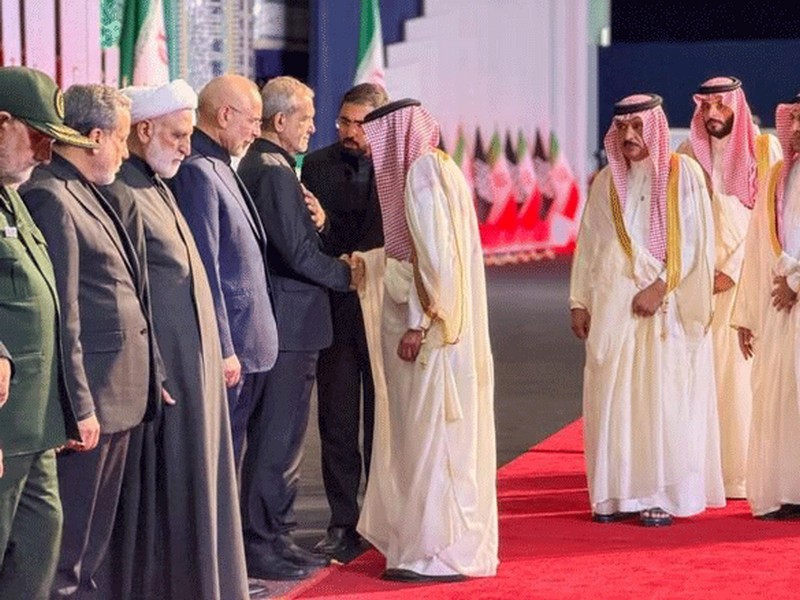
Saudi Presence at Khamenei’s Funeral
Main Points:
· The funeral is presented as a major political and ideological event, not just a moment of mourning.
· Saudi Arabia’s delegation attending the funeral is highlighted as symbolically important and diplomatically cautious.
· It emphasizes the 2023 Iran-Saudi rapprochement and its limits, especially after years of mistrust and sectarian tension.
· It contrasts Iran’s image of resistance, simplicity, and religiously grounded statecraft with the lavish reputation of some Gulf rulers.
· It points to a contradiction between Wahhabi anti-Shia rhetoric and Saudi official participation in the funeral of a Shia leader
…
The funeral of Iran’s Supreme Leader, Ayatollah Ali Khamenei, would not merely be a moment of national mourning for Iran, it would stand as a defining political and ideological event in the contemporary Muslim world. Among the most striking and symbolically charged aspects of this moment would be the participation of a Saudi delegation led by Deputy Foreign Minister Waleed Al Khuraiji, who travelled to Tehran and attended the official funeral procession. This development, while diplomatically significant, would also expose deep contradictions within the religious discourse historically promoted by Saudi Arabia’s Wa habi establishment.
The Saudi delegation’s reception in Tehran was marked by the recitation of a powerful Qur’anic verse: “Indeed, there was a sign for you in the two armies that met in battle—one fighting for the cause of Allah and the other in denial. The believers saw their enemy twice their number. But Allah supports with His victory whoever He wills. Surely in this is a lesson for people of insight.” (Surah Al Imran 3:13). The choice of this verse was far from incidental. It invoked a narrative of moral clarity, resistance, and divine support against overwhelming odds. In the context of Iran’s long-standing confrontation with Western powers and their regional allies, the verse served as a subtle but pointed reminder of Iran’s self-image as a state that has resisted external domination.
This symbolism becomes even more poignant when viewed against Saudi Arabia’s geopolitical posture. For decades, Saudi Arabia has aligned itself closely with the United States, often supporting or tacitly endorsing policies that have directly challenged Iran. Even in moments of regional conflict, Riyadh has stood with Washington rather than with Tehran. Yet, despite this alignment, Saudi Arabia did not actively side with Iran in its struggles. The presence of its delegation at Khamenei’s funeral, therefore, reflects a complex and somewhat cautious diplomatic balancing act rather than a full ideological reconciliation.
The backdrop to this development lies in the 2023 restoration of diplomatic relations between Iran and Saudi Arabia. That agreement emphasized sovereignty, mutual respect, and non-interference in internal affairs. While it marked a significant thaw in relations, it did not erase decades of mistrust, ideological divergence, and sectarian hostility. However, the participation of Saudi officials in such a deeply symbolic event suggests that the rapprochement is not merely procedural but carries the potential for deeper transformation.
At the same time, Iran’s position in the Muslim world has evolved considerably. It is now widely perceived as a strong and influential state that has maintained its sovereignty despite sustained external pressure. Its refusal to succumb to the dictates of the United States and other powerful actors, including certain Gulf states, has enhanced its stature among large segments of the Muslim population. This perception is further reinforced by narratives surrounding the personal life of its leadership.
Iranian Foreign Minister Abbas Araghchi’s observation about Ayatollah Khamenei captures this sentiment vividly, “Iran’s Supreme Leader Ayatollah Ali Khamenei left behind no palaces, no bank accounts, and no fortune after 47 years in power. No luxury yachts. No hidden billions. No golden thrones. Just one simple life serving his people.” Whether one interprets this statement as political messaging or as an accurate reflection of reality, it stands in stark contrast to the widely held perception of extravagance associated with many rulers in the Muslim world, particularly in the Gulf monarchies.
This contrast has not gone unnoticed. The simplicity attributed to Iran’s leadership, juxtaposed with the lavish lifestyles of other Muslim rulers, has made Iran appear more relatable and even admirable to many ordinary Muslims. It has helped cultivate an image of a state that, at least symbolically, aligns governance with ethical restraint and public service. In addition, Iran’s resilience in the face of external pressure has elevated its status as a model of political independence.
Moreover, Iran has demonstrated that religion can still function as a central organizing principle in modern statecraft. By maintaining a system that integrates religious authority with governance, it has challenged the assumption that modern states must necessarily be secular. For many Muslims, this has reaffirmed the continued relevance of religion in public life and political organization.
In contrast, the Wahhabi establishment in Saudi Arabia has historically propagated a rigid and exclusionary interpretation of Islam. Central to this interpretation has been the persistent denunciation of Shia Muslims as deviants or even as outside the fold of Islam. For decades, Wahhabi clerics have used sermons, publications, and institutional platforms to delegitimize Shia beliefs and practices. This sectarian rhetoric has contributed significantly to divisions within the Muslim world and, in some cases, to violence and persecution.
It is precisely here that the participation of the Saudi delegation in Khamenei’s funeral creates a profound contradiction. If Shia Muslims are to be regarded as unbelievers, as many Wahhabi clerics have long claimed, then how does one justify the official presence of a Saudi delegation at the funeral of a Shia leader? How does one reconcile theological denunciation with diplomatic engagement at the highest level?
The answer lies in the political nature of religious discourse within the Saudi context. The Wahhabi establishment has historically functioned in close alignment with the Saudi state. Its authority and influence are deeply intertwined with the monarchy, and its positions have often reflected state interests rather than independent theological reasoning. As a result, when the state shifts its policy, the religious establishment is compelled, whether explicitly or implicitly, to adjust its rhetoric accordingly.
What is most striking in this scenario is not what Wahhabi clerics have said, but what they have not said. Their silence regarding the Saudi delegation’s participation in Khamenei’s funeral is telling. These are the same voices that have, for years, “left no stone unturned” in declaring Shias as unbelievers and in seeking to exclude them from the broader Muslim community. Yet, when confronted with a clear and public act of diplomatic engagement by their own state, they have chosen silence.
This silence is not accidental. It reflects an awareness that continued sectarian denunciation would now be at odds with official state policy. It also reveals the extent to which their earlier positions were contingent rather than absolute. If the Saudi monarchy were to deepen its engagement with Iran and move toward more substantive cooperation, it is highly likely that these same clerics would gradually soften their rhetoric. The denunciations that once appeared uncompromising would be reinterpreted, qualified, or quietly abandoned.
In this sense, the behaviour of Wahhabi clerics can be understood through the metaphor of “His Master’s Voice.” Their pronouncements often echo the priorities of the state, and their theological positions adapt to changing political realities. This does not necessarily mean that all such clerics lack conviction, but it does suggest that their public discourse is shaped, constrained, and at times directed by the imperatives of state policy.
The implications of this are significant for the broader Muslim world. It calls into question the authenticity and consistency of sectarian narratives that have long been presented as immutable truths. It also opens the possibility for a gradual de-escalation of sectarian tensions, not necessarily through theological reconciliation, but through political pragmatism.
At the same time, the contrast between Iran and other Islamic political models remains relevant. Unlike the Taliban regime, which has been widely criticized for its harsh and exclusionary policies, Iran has managed to project an image, however contested, of a functioning state that combines religious principles with institutional governance. This has made it more acceptable to many Muslims who seek a balance between faith and modernity.
None of this is to suggest that Iran’s system is without flaws or criticism. Its political structure, treatment of dissent, and human rights record remain subjects of debate. However, in the realm of symbolic politics, it has succeeded in presenting itself as a state that resists external domination and upholds a form of principled governance.
The funeral of Ayatollah Khamenei, therefore, would serve as more than a ceremonial event. It would act as a mirror reflecting the evolving dynamics of power, belief, and legitimacy in the Muslim world. The presence of the Saudi delegation would signal a shift toward pragmatic engagement, while the silence of Wahhabi clerics would expose the malleability of sectarian discourse.
Ultimately, this moment would underscore a fundamental reality, that in the intersection of religion and politics, doctrinal rigidity often yields to political necessity. The same voices that once declared Shias as outside the fold of Islam may, under changing circumstances, adopt a more conciliatory tone. Not because of a sudden theological awakening, but because the priorities of the state have changed.
…
M.H.A. Sikander is Writer-Activist based in Srinagar, Kashmir.
23 July 2026
Source: newageislam.com