Just International

The past twenty days have been the hottest ever recorded

By Bryan Dyne

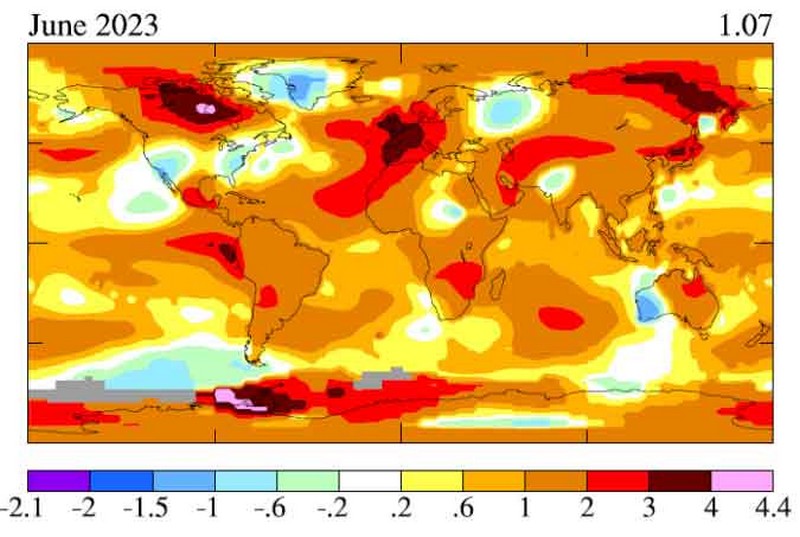
Saturday marked the 20th consecutive day of the hottest temperatures recorded in human history. Since July 3, the average global temperature (the temperature over Earth’s entire surface, averaged over 24 hours) has remained above the previous high of 16.92 degrees Celsius (62.46 degrees Fahrenheit) recorded in August 2016, according to preliminary data from the National Oceanic and Atmospheric Administration (NOAA).

Several regional temperature records have been set concurrently. Greece, Italy and Spain have seen new record high temperatures of 45 degrees Celsius (113 F). Temperatures in Tunis, the capital of Tunisia, have reached 49 degrees Celsius (120 F) and Algeria has witnessed temperatures of 51 degrees Celsius (just under 124 F). Much of the Mediterranean region is 5 degrees Celsius (9 F) above normal.

In the United States, high temperatures in Phoenix, Arizona have stayed above 43 degrees Celsius (110 F) for 21 days and above 32 degrees Celsius (90 F) for the past 70 days. On parts of the US-Mexico border, where thousands of migrants are seeking refuge in the US each day, temperatures have soared to more than 50 degrees C (122 F). At least 167 Mexicans have died as a result of the heatwave in Mexico, and an unknown number of refugees have been left to die in the scorching desert as they are refused entry into the US by customs and immigration authorities.

The two major factors of the current global heatwave are the onset of El Niño, a semi-regular pattern that warms the Pacific Ocean, and the formation of four high-pressure regions known as heat domes, which simultaneously trap heat over a region and prevent cooler weather from moving in.

The simultaneous heatwaves across the world are a direct result of global warming. The uncontrolled release of greenhouse gases, primarily carbon dioxide and methane, into Earth’s atmosphere by capitalist industry traps more and more energy from the Sun, increasing temperatures globally and causing weather extremes regionally. From longer and more intense heatwaves, wildfires and droughts, to more powerful hurricanes and, in contradictory fashion, to more frigid polar vortexes and torrential flooding.

The ongoing heatwave in South Asia that peaked in April and May serves as an example of the stark dangers of climate change. In the past, the severe heat that caused temperatures to reach above 50 degrees Celsius (120 F) in Thailand and which killed 13 people in a single day in India would have been characterized as a “once-in-200-years” event. Now, such events are 30 times more likely to occur each year as they were before global temperatures began to rise. And if temperatures continue to rise as they have, such heatwaves could occur in South Asia once every two years.

Heatwaves are among the deadliest extreme weather events. Tens of thousands of people worldwide die every year from dehydration and heatstroke. Extremely dry air can prevent sweat from forming on the skin, stopping one of the human body’s main mechanisms for cooling itself. Extreme humidity can prevent heat from properly radiating. And both are especially deadly for those who work in construction, agriculture and other essential outdoor jobs, where employers often do not provide adequate breaks, shade and water, all of which would eat into their profits, although these are absolutely vital for workers to stave off the many dangers caused by working in high temperatures.

And while the dangers of spewing more greenhouse gases into the atmosphere have been known for more than a century, the world’s capitalist governments have proven completely incapable of resolving the crisis. It is not that the various ruling elites are incapable of seeing the crisis—though, of course, there are the particularly right-wing climate-change deniers in every country—but that global warming, a fundamentally international problem, cannot be resolved within the framework of the existence of rival capitalist nation-states.

The recent visit by John Kerry, the US special climate envoy, to China to reopen climate talks between the two countries, is an expression of this contradiction. For three days last week, Kerry met with his Chinese counterpart, Xie Zhenhua, amid one of the worst global heatwaves ever recorded, and yet were able to come away with no concrete results to deal with the crisis. Kerry was at best limited to calling the talks “productive.”

Productive toward what? These talks were the first between the two countries in a year, a delay resulting from Nancy Pelosi’s visit to Taiwan in 2022, when she was still Speaker of the House. That visit further undermined the “one-China” policy that had been acknowledged by the US until the Trump administration, and further encouraged Taiwanese separatism in an effort to goad China into a confrontational military response. To reinforce her ability to travel to Taiwan, which Chinese officials repeatedly warned they would “stop,” Pelosi was accompanied by a full US aircraft carrier battle group. The provocation risked inciting world war with a nuclear-armed power.

Since then, top US generals have been beating the war drums in the Pacific, with Air Force General Michael Minihan even asserting that the US will be at war with China over Taiwan by 2025. Under such conditions, any talk of US-China cooperation in the global climate crisis is entirely fanciful.

The discussions between Kerry and Xie addressed rival economic interests as well. The longstanding US position is that China must reduce its consumption of coal, which has powered much of China’s growth in recent decades. In contrast, China asserts that emission reduction targets should focus on cumulative historic emissions, which would especially target the greenhouse gas emissions of countries which industrialized earlier, in Europe and North America.

In other words, the main focus of the talks is not about fighting global warming by the two countries that emit the most greenhouse gases, but using the ongoing and accelerating climate crisis as another lever in geopolitical maneuvering which carries with it the danger of a US-China war instigated by Washington.

These objective contradictions are why no faith can be placed in agreements between the various capitalist powers, much less nationally based “Green New Deals” in the US or elsewhere. Global warming is a fundamentally international problem that requires the mobilization of the only fundamentally international social force, the working class. The solution is not merely scientific, but political: in overthrowing the social order—capitalism and the profit motive—that has created the vast ecological devastation humanity is now confronting, and replacing it with a higher society based on rational planning and a scientific restructuring of the world’s economy to meet human needs, on a socialist basis.

24 July 2023

Source: countercurrents.org
How the Resistance of Palestinians Has Been Defying Israel’s Ongoing ‘Nakba’

By Dr Ranjan Solomon

It is, perhaps, crucial to define two terminologies at the very outset that defines the ongoing struggle for justice in Palestine-Israel.

‘Sumud’ – which implies ‘steadfast perseverance’ – is a Palestinian cultural value, ideological theme and political strategy that first emerged among the Palestinian people through the experience of oppression and resistance in the wake of the 1967 Six-Day War.

By discrepancy, the ‘Nakba’ (Arabic for ‘catastrophe’) which ‘Sumud’ seeks to confront through multiple forms of resistance, represents the Jewish intent of the permanent displacement of a majority of the Palestinian Arabs.

Recapping the Israel-Palestine conflict

On the ‘Nakba’ of May 15, 1948, 750,000 Palestinians, two-thirds of Palestine’s Arab population, were forced to flee their homes to accommodate Israel’s creation.

Seventy-five years later, the number of Palestinian refugees is over eight million. These agonising figures make Palestinians the largest and oldest unsettled refugee population in the world.

Israel’s direct repression of Palestine began with the ‘Nakba’. Often referred to as the “original sin” of the Israeli-Palestinian conflict, the refugee crisis is one of the core status questions that define the unsettled Israeli-Palestinian peace process. The remaining issues include the status of Jerusalem, Israeli settlements, borders, security and water rights, and Palestinian freedom of movement.

On November 29, 1947, the United Nations General Assembly adopted Partition Resolution 181 that would divide Britain’s former Palestinian mandate into Jewish and Arab states in May 1948. It was patently discriminatory. Palestinian-Arab leadership rejected the partition measures as unacceptable, given the inequality in the proposed population exchange and the transfer of one-third of Palestine, including its best agricultural land, to new Jewish arrivals.

The UN partitioned Palestine into Arab and Jewish states, with Jerusalem internationalised. Israel proclaimed its independence and in the 1948 war that involved neighbouring Arab states, it expanded its territory of mandate Palestine to 77%, including the larger part of Jerusalem. Over half of the Palestinian Arab population fled or were expelled. Jordan and Egypt controlled the rest of the territory assigned by a UN resolution to the Arab state.

The Six-Day War in June 1967 was fought between Israel and the Arab countries of EgyptJordan, and Syria. The war was decisively calamitous for Palestine and its neighbours. Following the war, the territory held by Israel expanded significantly and Israel captured more territory that is still deemed occupied. Israel still does not show any intent to return the land occupied under hostilities. The war brought about a second exodus of Palestinians, estimated to be at half a million.

A Security Council Resolution formulated the principles of a just and lasting peace, including an Israeli withdrawal from territories occupied in the conflict, an appropriate settlement of the refugee problem, and the termination of all claims, and of hostilities.

The 1973 Arab-Israeli War, called the Yom Kippur War/Ramadan War, the Fourth Arab-Israeli War, was an armed conflict fought from October 6 to 25, 1973 between Israel and a coalition of Arab states led by Egypt and Syria.

The UN Security Council called for peace negotiations between the parties concerned. In the next year, the General Assembly reaffirmed the inalienable rights of the Palestinian people to self-determination, national independence, sovereignty, and to return to their home.

It also established the Committee on the Exercise of the Inalienable Rights of the Palestinian People and conferred on the Palestine Liberation Organisation the status of observer in the Assembly and in the UN conferences.

Meanwhile, Israel persists in ceaselessly grabbing Palestinian land. It has fought and won eight recognised wars with its neighbouring Arab states, including two major Palestinian Arab uprisings known as the First Intifada and the Second Intifada, (Intifada in Arabic means  ‘rebellion’) and a series of armed engagements in Palestinian territories.

After the 1948 Arab-Israeli War came the Palestinian Fedayeen (Fedayeen means someone who redeems himself by risking or sacrificing his life), when Palestinian militants engaged in insurgency (1950s-1960s) to which there was furious retaliation by the Israel Defence Forces.

Other uprisings included the First Intifada (Arabic for “uprising”), the first large-scale Palestinian uprising against Israel in the West Bank and the Gaza Strip from 1987-1990. This Intifada was a robust display of the militancy and muscle of the Palestinian youth. It led to the Oslo Accords which held out a mirage of peace. The Oslo Accords lacked political construct, and therefore, collapsed. Its failure led to the Second Intifada (2000-2005), a period of intensified violence, which began in late September 2000.

Later, multiple vigorous clashes occurred such as the three-week armed conflict between Israel and Hamas during the winter of 2008-2009. Israeli forces attacked military and civilian targets, police stations, and government buildings. The uninterrupted airstrikes, artillery shelling and ground operations resulted in the killing of 1,383 Palestinians, including 333 children and 114 women, and injured over 5,300 people.

Israel’s appetite for killings seemed unquenchable. By November 2012, it launched an operation in the Gaza Strip. Two years later, it launched yet another war in Gaza in response to the collapse of the American-sponsored peace talks, and attempts by rival Palestinian factions to form a coalition government. This led to an increase in rocket attacks on Israel by Hamas militants.

In May that year, there were riots between Jews and Arabs in Israeli cities. Hamas in Gaza sent military rockets into Israel, and Israel viciously retaliated.

Since the first five months of 2023, the number of people killed by the Israeli forces have tripled as compared to the figures in January and December 2022.

Amjad Mitri, a human rights lawyer, points out: “Millions of Palestinians worldwide live in forced diaspora and are cut off from their homeland by Israel’s colonial practices and policies. The Zionist movement and the army has displaced more than half of the Palestinian population and in turn created numerous laws, regulations, and military orders such as the Prevention of Infiltration Law and military orders to prevent Palestinians from returning to their homes and properties.”

“Israel marks Palestinians who try to do so as “infiltrators”, and has deported or even shot at them on sight. Israel has created a privileged colonial status, which in all facets of life, including the political, social, and cultural levels, is superior to that of non-Jewish Palestinians. Whether this system is labeled as apartheid, colonial rule, or Zionist state ideology, it is a manifestation of control and domination of one people over another that leaves no room for alternative interpretation,” he added.

The Israeli mindset seeks to erase Palestinian identity and history and wipe Palestine off the map. Israel makes the fictitious claim that Palestinians and Palestine never existed; they were simply scattered groups of people living in the area before 1948.

David Ben-Gurion, Israel’s first Prime Minister, believes that the new generation of the dispossessed and displaced indigenous population will self-erase their heritage and sense of belonging to their land. Israel must obstruct them from making their claim that they have the right to return.

Palestinian resistance

The military power of Israel has failed to curb Palestinian resistance. Palestinians are convinced that the might of Israel’s colonialist-apartheid structure will, one day, crumble, due to its lack of moral legitimacy.

‘Sumud’ captures their resilience and fearlessness.

As mentioned earlier, ‘Sumud’ means collective determination and resilience of the Palestinian people in the face of ongoing challenges, including displacement, occupation, and discrimination. It encompasses maintaining their cultural identity, preserving land and property, upholding their rights, and sustaining a sense of community.

Dheisheh, a Palestinian refugee camp located just south of Bethlehem in the West Bank, typifies ‘Sumud’. Established in 1949, after its inhabitants were dispossessed by marauding Zionist forces, the population fled seeking safety for their lives.

In 1948, these families originally came from 44 Palestinian towns and villages from the borders of today’s Israel. They established a camp in 1949 located along the main street in Bethlehem. The camp, originally built to serve 3,000 refugees, now has a population of roughly 15,000. It has strong civil society organisations whose resistance is vigorous.

As Palestinians commemorate the 75th anniversary of the ‘Nakba’ in 2023, Palestinian refugee camps like Dheisheh continue to be subjected to exclusion, an acute lack of basic services and unyielding marginalisation and habitual military assaults by Israeli forces.

Dheisheh has been the centre of constant Israeli raids, resulting in the loss of young lives. This year started with the killing of two teenagers by Israeli forces during military raids. They were aged 14 and 15, middle-school classmates and friends. They had something else in common: they both carried farewell letters in their pockets – they were prepared to die.

Many Palestinian teenagers carry farewell letters in their pockets. It is not a symbol of resignation; rather an assertion of the right to resistance against an illegal and racist colonisation of Palestinian lands. They know they may die anytime at the hands of a sharp shooter atop a building, or even a deliberate face-to-face murder by an armed soldier or Jewish settler.

In January this year, Israeli forces arrived at the Jerusalem-Hebron road that connects the north of Bethlehem to its south. Military vehicles stopped at the road, unloaded dozens of foot soldiers, armed and trained for army-to-army combat. As Israeli forces withdrew news began to flow from house to house that one of the youngsters was killed during the raid.

Adam Ayyad was only 15. In his pocket, his friends found a wrinkled notebook paper, with 11 lines of scribbled hand-written text. The letter read:

“I had many things that I dreamed of doing, but in our country, one cannot realise one’s dreams. I want to send my message to the entire world, I want all the people to wake up, and direct all your compasses towards the occupation.”

“Adam was a normal boy, playful and helpful to all people around him,” his mother mourned. He had wanted to continue his studies and become a lawyer.

Manaa, a 22-year-old young man, was killed in an earlier Israeli raid in December. According to Ayyad’s mother and aunt, the death of Omar Manaa impacted him so much that he began to spend hours on end by his tomb at the Dheisheh cemetery.

“We only thought that Adam was sad for his friend, but never thought at the beginning that he was entertaining the idea of death himself.”

He witnessed an occupation raid for the first time when he was five, and grew up seeing people in the camp and neighbourhood being arrested or killed.

Countless families welcome mourners into their house. The open-house ritual usually lasts for three days, but it had been a week since 14-year-old Amer Khmour was killed by Israeli soldiers during their last raid into Dheisheh, and mourners kept pouring into his family’s house.

Khmour didn’t talk a lot about politics, or about the situation in the camp, as he was mostly having fun with his friends, like all boys his age.

Colonialism

Israel’s stealth and occupying presence on Palestinian land, employing militaristic strategies rooted in colonial-racist ideologies, results in assaults targeting children and youngsters. It even targets the elderly who only ask for their right to liberation and dignity.

When Britain abandoned their mandate and handed it to the United Nations, it was clear that the US and Europe would choose sides and advocate for an uneven resolution in favour of Zionist demands, rather than addressing the concerns of Palestine.

Zionism is an ideology which shoves Palestinians to the margins of political space. It is aligned with the movement to establish a Jewish homeland in Palestine during the 19th and 20th centuries. Its history and significance are a matter of contention.

The Balfour Declaration was the direct outcome of a sustained effort by the Zionist Organisation to establish a Jewish state in Palestine. It meant that Palestinians faced the prospect of being outnumbered by unlimited immigration, and of losing control of Palestine to the Zionist drive for sole sovereignty over a country that was then almost completely Arabic in population and culture.

In order to achieve justice, it’s imperative to put an end to the misrule of Occupied Palestinian territories, which are subjected to Israel’s racist laws, colonial practices, and an apartheid regime.

The two-state solution, as a means to end the Palestine-Israel conflict, appears to be no longer viable. By clinging to this impossible solution, the international community prolongs Palestinian agony.

With some 750,000 illegal settlers in the West Bank and East Jerusalem the principle of separation of the two communities is an absolute non-starter. Achieving lasting peace in Palestine-Israel requires an innovative solution, which must prioritise justice above all else.

Ranjan Solomon is a political commentator, writer, and human rights activist.

20 July 2023

Source: countercurrents.org

World Hunger and the War in Ukraine

By Vijay Prashad

On Monday, June 17, Dmitry Peskov, the spokesperson for Russia’s President Vladimir Putin, announced, “The Black Sea agreements are no longer in effect.” This was a blunt statement to suspend the Black Sea Grain Initiative that emerged out of intense negotiations in the hours after Russian forces entered Ukraine in February 2022. The Initiative went into effect on July 22, 2022, after Russian and Ukrainian officials signed it in Istanbul in the presence of the United Nations Secretary-General António Guterres and Turkey’s President Recep Tayyip Erdoğan.

Guterres called the Initiative a “beacon of hope” for two reasons. First, it is remarkable to have an agreement of this kind between belligerents in an ongoing war. Second, Russia and Ukraine are major producers of wheat, barley, maize, rapeseed and rapeseed oil, sunflower seeds and sunflower oil, as well as nitrogen, potassic, and phosphorus fertilizer, accounting for twelve percent of calories traded. Disruption of supply from Russia and Ukraine, it was felt by a range of international organizations, would have a catastrophic impact on world food markets and on hunger. As Western—largely U.S.UK, and European—sanctions increased against Russia, the feasibility of the deal began to diminish. It was suspended several times during the past year. In March 2023, Russia’s Foreign Ministry spokesperson Maria Zakharova responding to the sanctions against Russian agriculture, said, “[The main] parameters provided for in the [grain] deal do not work.”

Financialization Leads to Hunger

U.S. Secretary of State Antony Blinken said that his country regrets Russia’s “continued weaponization of food” since this “harms millions of vulnerable people around the world.” Indeed, the timing of the suspension could not be worse. A United Nations report, “The State of Food Security and Nutrition in the World 2023” (July 12, 2023), shows that one in ten people in the world struggles with hunger and that 3.1 billion people cannot afford a healthy diet. But the report itself makes an interesting point: that the war in Ukraine has driven 23 million people into hunger, a number that pales in comparison to the other drivers of hunger—such as the impact of commercialized food markets and the COVID-19 pandemic. A 2011 report from World Development Movement called “Broken Markets: How Financial Market Regulation Can Help Prevent Another Global Food Crisis” showed that “financial speculators now dominate the [food] market, holding over 60 percent of some markets compared to 12 percent 15 years ago.”

The situation has since worsened. Dr. Sophie van Huellen, who studies financial speculation in food markets, pointed out in late 2022 that while there are indeed food shortages, “the current food crisis is a price crisis, rather than a supply crisis.” The end of the Black Sea Grain Initiative is indeed regrettable, but it is not the leading cause of hunger in the world. The leading cause—as even the European Economic and Social Committee agrees—is financial speculation in food markets.

Why Did Russia Suspend the Initiative?

To monitor the Black Sea Grain Initiative, the United Nations set up a Joint Coordination Centre (JCC) in Istanbul. It is staffed by representatives from Russia, Turkey, Ukraine, and the United Nations. On several occasions, the JCC had to deal with tensions between Russia and Ukraine over the shipments, such as when Ukraine attacked Russia’s Black Sea Fleet—some of whose vessels carried the grain—in Sevastopol, Crimea, in October 2022. Tensions remained over the initiative as Western sanctions against Russia tightened, making it difficult for Russia to export its own agricultural products into the world market.

Russia put three requirements on the table to the United Nations regarding its own agricultural system. First, the Russian government asked that the Russian Agricultural Bank—the premier credit and trade bank for Russian agriculture—be reconnected to the SWIFT system, from which it had been cut off by the European Union’s sixth package of sanctions in June 2022. A Turkish banker told TASS that there is the possibility that the European Union could “issue a general license to the Russian Agricultural Bank” and that the Bank “has the opportunity to use JP Morgan to conduct transactions in U.S. dollars” as long as the exporters being paid for were part of the Black Sea Grain Initiative.

Second, from the first discussions about the Grain Initiative, Moscow put on the table its export of ammonia fertilizer from Russia both through the port of Odesa and of supplies held in Latvia and the Netherlands. A central part of the debate has been the reopening of the Togliatti-Odesa pipeline, the world’s longest ammonia pipeline. In July 2022, the UN and Russia signed an agreement that would facilitate the sale of Russian ammonia on the world market. The UN’s Guterres went to the Security Council to announce, “We are doing everything possible to… ease the serious fertilizer market crunch that is already affecting farming in West Africa and elsewhere. If the fertilizer market is not stabilized, next year could bring a food supply crisis. Simply put, the world may run out of food.” On June 8, 2023, Ukrainian forces blew up a section of the Togliatti-Odesa pipeline in Kharkiv, increasing the tension over this dispute. Other than the Black Sea ports, Russia has no other safe way to export its ammonia-based fertilizers.

Third, Russia’s agricultural sector faces challenges from a lack of ability to import machinery and spare parts, and Russian ships are not able to buy insurance or enter many foreign ports. Despite the “carve-outs” in Western sanctions for agriculture, sanctions on firms and individuals have debilitated Russia’s agricultural sector.

To counter Western sanctions, Russia placed restrictions on the export of fertilizer and agricultural products. These restrictions included the ban on the export of certain goods (such as temporary bans of wheat exports to the Eurasian Economic Union), the increase of licensing requirements (including for compound fertilizers, requirements set in place before the war), and the increase of export taxes. These Russian moves come alongside strategic direct sales to countries, such as India, which will re-export to other countries.

In late July, St. Petersburg will host the Second Russia-Africa Economic and Humanitarian Forum, where these topics will surely be front and center. Ahead of the summit, President Putin called South Africa’s Cyril Ramaphosa to inform him about the problems faced by Russia in exporting its food and fertilizers to the African continent. “The deal’s main goal,” he said of the Black Sea Grain Initiative, was “to supply grain to countries in need, including those on the African continent, has not been implemented.”

It is likely that the Black Sea Grain Initiative will restart within the month. Earlier suspensions have not lasted longer than a few weeks. But this time, it is not clear if the West will give Russia any relief on its ability to export its own agricultural products. Certainly, the suspension will impact millions of people around the world who struggle with endemic hunger. Billions of others who are hungry because of financial speculation in food markets are not impacted directly by these developments.

Vijay Prashad is an Indian historian, editor, and journalist. He is a writing fellow and chief correspondent at Globetrotter.

20 July 2023

Source: countercurrents.org
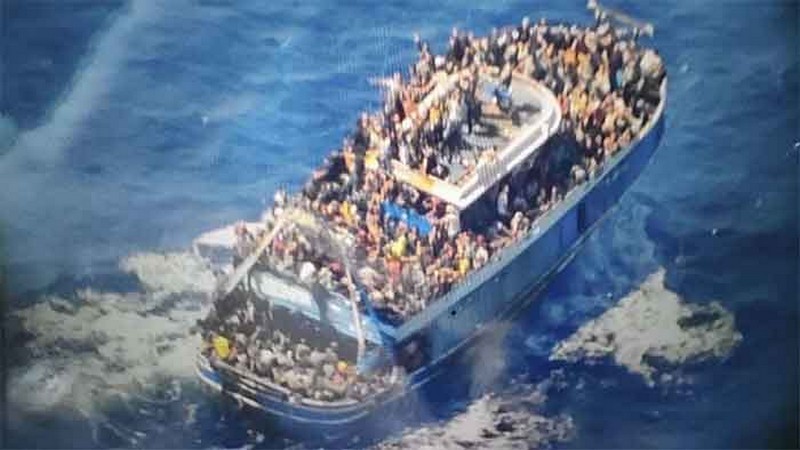
Mass Murder at Sea: Greek coastguard tried to tow hundreds of migrants to Italy, capsized the vessel

By Martin Kreickenbaum

On June 14, a fishing vessel carrying hundreds of refugees, the Adriana, sank off the Greek port city of Pylos. Roughly 600 people, including children, drowned. An investigation by German regional broadcaster NDR, the Guardian, the research agency Forensis and the Greek organization Solomon has now come to the clear conclusion that the Adriana was towed by the Greek coast guard towards Italian waters and then, when this was unsuccessful, capsized.

The search team spoke to 26 survivors, evaluated the available court records and examined the logbook entries of the ships involved. The Coast Guard ship 920 reached the Adriana, which had just received water, food and fuel from the tanker Faithful Warrior, on June 13 at 10:40 pm. Video footage shows that the completely overloaded Adriana was already listing dangerously by this point, and that an immediate rescue action should have been initiated.

The Adriana had been drifting for hours due to a broken compass and lack of fuel, propelled only by the current. But after the arrival of the Greek coast guard, she again moved at a steady speed towards Italy. Survivors report that the coast guard led them, claiming that an Italian coastguard ship was already waiting for them.

Around 1:40 am on the morning of June 14, the Adriana stopped, apparently the engine had failed again. Then it moved a few hundred meters to the east, which cannot be explained by wind or current. Eyewitnesses report that after the renewed engine damage, masked men from the Greek coast guard ship boarded the vessel and attached a rope to the bow of the Adriana.

It is fitting that the coast guard ship 920 had left Chania in Crete and, according to the logbook entry, had taken a four-member team of the KEA stationed in Chania on board. The KEA is a military unit that specializes in carrying out dangerous operations at sea.

The coast guard claims that the rope was attached to stabilize the Adriana. However, Stefan Krüger, an expert on ship safety, expressed strong doubts about this version to the NDR. “This kind of listing momentum, which you certainly bring on with such a tow, does not lead to the ship being stabilized.” Krüger rather believes “that the motivation was to tow the ship because the engine no longer worked.” Only a short time after the tow rope was attached, the Adriana capsized.

Two survivors, who wished to remain anonymous for fear of the Greek authorities, told the BBC about how the capsizing occurred. “They fixed a rope from the left. Everyone went to the right side of our boat to balance it out. The Greek ship quickly moved away and tipped our boat. They took it with them for a long time.”

Another survivor told the Guardian that Greek soldiers had attached the rope and the Adriana had been pulled for about 10 minutes. “I felt that they tried to push us out of the Greek water so that their responsibility ends.” Other survivors said the Adriana suddenly moved forward “like a rocket” even though the engine was not running.

The fact that the version of the Greek coast guard does not correspond to the actual course of events is also evidenced by the testimony of the survivors before the investigating judge, who is examining the sinking of the Adriana. According to this, the statements recorded and published by the coast guard were made under pressure and manipulated.

As the Guardian reports, the statements made by two survivors of different nationalities, according to the coast guard, surprisingly agree word for word: “We were on the boat that was old and rusty with too many people … That’s why it capsized and eventually sank.”

But under oath before the prosecutor, the same survivors days later blamed the Greek coast guard for the sinking. A survivor who told the coast guard in his testimony that the trawler capsized because of its age and overcrowding later testified, “When they boarded the boat (and I’m sorry to mention that), our boat sank. I think the reason was the towing by the Greek boat.”

Survivors told the BBC that they were intimidated by the coast guard. Whenever it was said that the Greek coast guard had caused the capsizing, they were told to shut up. “You have survived death! Stop talking about the incident! Don’t ask any more questions about it!” they were told.

Other incidents demonstrating that the Greek coast guard was never interested in rescuing the refugees have come to light. The European border protection agency Frontex also remained idle, although it was informed at an early stage that there was an urgent case for a naval rescue.

According to information from the German newspaper Welt am Sonntag, the boat was first sighted by Italian authorities at 6:51 a.m., according to an internal Frontex document. Frontex previously claimed to have only learned about the overloaded ship at 9:47 am through a reconnaissance drone. In fact, as early as 8:51 a.m., the sea rescue center in Rome alerted both Frontex and the control center in Piraeus, from where rescue operations of the Greek coast guard are controlled. The information also reportedly included the fact that two children had died on board the fish trawler.

Nevertheless, it took hours for the Greek coastguard ship 920 to leave Crete. It remains unclear why boats located much closer in Kalamata, Pylos or Patras were not alerted and sent. Speaking to the Guardian, a member of the Greek coast guard expressed his complete incomprehension that a rescue operation had not been initiated immediately: “It was a situation in which you send everything you have. The trawler was clearly in need of help.”

Clearly, however, the Greek authorities were more concerned with bringing on board members of the KEA stationed in Chania in order to remove the ship from Greek waters. An actual rescue operation was therefore not planned at any time.

The Greek coast guard has since confirmed that it was informed by Italian authorities at an early point. Greece’s newly appointed migration minister Dimitris Kairidis said in Brussels that “an independent judicial investigation” is underway. If someone is found guilty, “there will definitely be consequences.” “Until then, we should not jump to conclusions or bow to political pressure,” he added.

Frontex has initiated its own pro forma investigation of the sinking. But at the same time, the EU Commission continues to back the investigations of the Greek authorities. These, however, focus on the nine Egyptians arrested after the shipwreck, who allegedly steered the boat and distributed water and food.

The Egyptians are accused of belonging to a human smuggling ring and causing the capsizing of the ship. If convicted, they face life imprisonment. Survivors reported to the BBC that the Coast Guard forced them to refer to these nine as masterminds and people smugglers. “The Greek authorities detained them and wrongfully accused them of covering up their own crime,” one survivor said.

The sinking of Adriana, which killed more than 600 refugees, was evidently an act of mass murder, committed either deliberately or by failing to provide assistance, for which the EU is responsible.

20 July 2023

Source: countercurrents.org
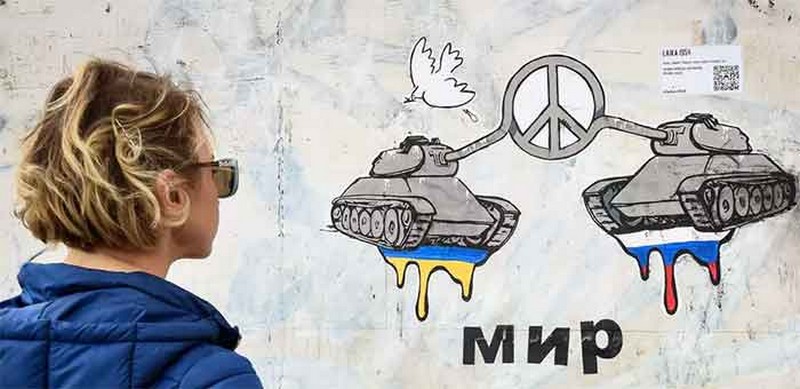
 

NATO, Russia, the EU and Ukraine Urgently Need a Dialogue to End the War

By Dr Mahboob A Khawaja

The NATO summit at Vilnius, Lithuania ended without any tangible move for peacemaking. It was more a show of compelling solidarity to enlarge and sustain the conflicts between Russia, Ukraine and NATO professing to be peacemakers. Out of nowhere, the Wagner group offered some unexpected consolence to many Western protagonists of conflict but it dmeonstarted Russian leadership capacity to manage an unthinkable conflict situation with ingenuity and without much loss of political integrity. Perplexed American and NATO leaders were stunned and speechless how Russia could overcome a difficult internal crisis that they wished to destabilize Russia. In every age and time egoistic leaders have pushed humanity to wars and the dehumanization process ending from NOTHING to NOTHING. When would the morally and intellectually conscientious leaders learn from history that wars are not the solution to man-made conflicts. In a snap shot, beleaguered Ukraine and Russia are entaglend in a proxy war across many conflicting time zones encompassing loss of time, human lives, energies, economic devastation, destruction of earth and its systematic natural setting spilling over to loss of a sustainable future for the rest of mankind. Both sides implying military dictum to tackle differences of human thoughts, geo-political interests and priorities for future-making. Is it a perpetuated ignorance of pertinent facts of life or is it a deliberate surge to silence human wisdom for change and global harmony? When facts of life warrant a change, intelligent leaders take steps to bring change for the best of national interests.

There is a fearsome and ferocious flow of military actions and reactions causing tragic human causalities that could inundate all norms of morality and civilizations plunging us to timeless darkness.  Do the leaders know what they are doing or are they all delusional by nature?  We, the People of knowledge speak logically about the Nature of Things affecting lives and our hopes for future,  and we echo inspiration from the Divine Revelations – the truth and nothing but truth – the Qur’an, the Bible and Torah reveal similar narrative as a stern reminder:

“Behold, thy Lord said to the angels: I will create a vicegerent on earth. They said” Wilt Thou place therein one who will make michchief and shed blood; whilst we do celebrate Thy praises and glorify Thy Holy Name. God said: I know what ye not know.”   (The Qur’an: Chapter 2:30).

The emerging conflicts between the old cold war era enemies represent amassed collections of deep mistrust, hatred and temptation of historic disorder to victimize the rest of mankind. There is no leadership vision and workable plan on table to change the course of contemporary tragic events, massive deaths and destruction as morality and human intellect continued to decline for a navigational change – for an immediate ceasefire to imagine workable peace deal.

They All Manifest  Wrong Thinking for Wrong Reasons and Destroying Earth and Human Civilizations

A rational conflict analysis and search for peace involves listening and learning to divergent viewpoints and finding a common place of reasoning without agreeing or disagreeing to halt the animosities. This is effective communication and enlightened leadership traits. The mankind is fraught with sorrows and fear of unknown animosities and daily killings and displacement thinking process, a society – a nation no matter how normal claims to be, cannot function as normal beings to co-exist with their own self, the surroundings – in human culture and make any positive contributions to sustainable change and progress. The US, NATO, the EU, Russia and Ukraine are stuck in this seamless but vicious entanglement. Ironically, desperation could aggravate anyone to use tactical nuclear weapons unilaterally with global catastrophic consequences.

In all ages, people and nations claiming to be most powerful and transgressors manipulating the Earth and humanity were destroyed by the Laws of God – natural causes. Many empires and egoistic leaders went this natural route of meeting their ends. We, the conscientious people of the globe possess rational understanding of an equilibrium and balanced relationship between Man, Life and God-given living Universe in which we all reside. We, the People of knowledge wonder who else except God created life, the Earth and the living Universe floating in space well balanced and functional since time immemorial.

Who else other than God determined the Earth spinning of 1670 km per hour? Who else than God ordained it to orbit the sun at 107,000 km per hour?  And who else than God made it to spin at 28,437 km per hour at the equator? (https://www.newscientist.com/question/fastearthspin/#ixzz7C8p37S9X). Be aware that earth average distance to the Sun is about 93 million miles (105 million km); the distance of Moon from Earth is currently 384,821 km equivalent to 0.002572 Astronomical Units and if the distance between the Earth-Sun and the Earth-moon were ever to change, there will be no sign of life, human civilizations or habitats left on Earth. You as human being as One Humanity has one origin –  why can’t we co-exist in peace and harmony? Do people ponder and realize how human beings are created by God and how societies flourish since time unknown to human consciousness?

It is God Who has created you from dust; Then from a sperm-drop,

Then from a leech-like clot; Then He does get you out (into the light)

As a child: then lets you (grow and) reach your age of full strength; then lets you become old,

Though of you there are, some who die before;

And lets you reach a Term appointed; in order that ye

May learn wisdom.       (Chapter 40: 67: The Qur’an)

We, the People aspire for Peace and Global Harmony but Leaders opt for Conflicts

If Russian, America and NATO leaders are honest, proactive and accountable to the global community, they urgently need proactive advisors of new ideas and creative strategic thinking to cope with multiple layers of political conflicts and humanitarian crises and to find peaceful and workable solutions away from the entrenched political box of the few global warmongers.

Recently, this author proposed a strategic framework of dialogue for peace to global leaders to resolve the conflict : Why Can’t Russia, NATO, the EU and Ukraine make Peace: https://www.uncommonthought.com/mtblog/archives/2022/06/22/global-conflict-management-why-cant-russia-nato-the-eu-and-ukraine-make-peace.php

The challenging truth arising from the emerging conflicts and leadership failure call for new thinking and new people of ideas and ideals to reject the violent assumptions of militarization and egoistic triumphs by acts of genocidal plans . We, the People of globe ask the global conscientious leaders to avoid the upcoming epicenter of cataclysm and listen to voices of reason for an immediate ceasefire in Ukraine, stop acceleration of military confrontations between Russia, NATO, America, the EU and others. At the edge of reason, war is anti-human and it could lead to global catastrophic annihilation of human cultures and civilizations. There will be NOTHING left moving on Earth called civilized people.

Dr. Mahboob A. Khawaja specializes in international affairs-global security, peace and conflict resolution with keen interests in Islamic-Western comparative cultures and civilizations.

18 July 2023

Source: countercurrents.org

The Enormous Dangers of Military Artificial Intelligence Reveal the Need for International Regulation

By Jacopo DeMarinis

Artificial intelligence (AI) is bound to be a major technological force that will reshape the 21st century. But its reverberating effects will not be confined to the technological; the evolution of AI will greatly influence other spheres, particularly in the military and international relations realms. Moreover, the increasing use of AI in the military sphere and the growing intelligence of AI―given its increasing ability to address ever more complex tasks and the imminent emergence of artificial “general intelligence”―will accelerate the timing and intensity of its impacts.

Militaries worldwide, especially among the major powers, have been integrating AI into their military strategies, conventional weapons, and even their nuclear command structure. One example of the military use of AI occurred in March 2020 when, according to a UN report, a “lethal autonomous weapons system” was deployed in Libya. The greatest threats posed by the military use of AI reside in the development of autonomous weapons systems that do not require human oversight and the increased use of automated battlefield decision-making systems, which are vulnerable to manipulation by adversaries. Automated decision making is particularly risky in the context of nuclear weapons.

Furthermore, the military use of AI may degrade international peace and stability given the risks of accidents in the AI software, unintentional conflict due to concerns about how the AI systems will be used, and inadvertent escalation of conflict stemming from the inflexibility of AI systems and human overreliance on them. In sum, the increased deployment of autonomous weapons systems and automated battlefield decision-making systems could enhance great power conflict and greatly undermine strategic stability, potentially driving a country to launch nuclear weapons.

Given what is at stake and the global nature of this technological actor, it is vital that the international community unite to establish global norms, regulations, and, when necessary, institutions for the safe and responsible development and use of AI in military contexts. Various state actors and think tanks support stronger international cooperation to address the military use of AI, including the US government, which recently released a “Political Declaration on Responsible Military Use of Artificial Intelligence and Autonomy” calling for international humanitarian law to guide the development and implementation of AI in the military. Proactively shaping the development of military AI, rather than reacting haphazardly to its effects, will allow humankind to leverage the benefits of AI and minimize the threats it poses to a peaceful society.

So, how can we leverage global governance to effectively address the dangers of the military use of AI? Michael Klare, a Senior Fellow at the Arms Control Association (ACA), advocates for a framework that suggests starting with non-binding, Track-2 diplomacy (among scientists, arms control experts, etc.) and unilateral/bilateral initiatives and then advancing toward “strategic stability” talks and formal, binding treaties. The “strategic stability” talks would resemble the current US-Russia Strategic Stability Dialogue but would also include powers like China. Furthermore, this framework stresses the importance of confidence-building measures (CBMs) to enhance trust between the relevant parties. While the US could assume leadership to propose CBMs such as a “Dialogue on AI Safety and Strategic Stability” and standard-setting for the military use of AI, it is critical that all countries participate equally in this process. While CBMs are critical, it is important to note that many civil society groups, including the ACA, stress the importance of binding, enforceable international agreements that regulate the use of AI in military contexts.

So, what about international treaties to govern the military uses of AI? The ACA and countries like Spain and Mexico support regulating lethal autonomous weapons systems through the Convention on Certain Conventional Weapons framework treaty, a position that UN Secretary-General Antonio Guterres supports. Another idea- supported by WFM/IGP- is to negotiate a UN Framework Convention on AI (similar to the UNFCCC) which would drive further international negotiations regarding the creation and implementation of ethical AI principles in military and other contexts. Furthermore, The Millennium Project supports a UN Treaty on Artificial General Intelligence, which would help set the “initial conditions” for artificial general intelligence, including in the military domain.

And what about international institutions? Proposals have been advanced for establishing an “International Artificial Intelligence Agency” that would act like the International Atomic Energy Agency (IAEA). However, the ability to effectively monitor AI technology could prove more difficult than nuclear technology, and adequate enforcement remains a persistent issue. Additionally, an Intergovernmental Panel for Artificial Intelligence (IPAI), supported by government officials like France’s Emmanuel Macron, could complement a UN Framework Convention on AI and enhance inclusivity in AI global governance.

Clearly, the world public should play a role in shaping the future of AI, especially in military contexts. The UN’s Global Digital Compact is a good start. However, given the fast-paced evolution of AI and other emerging technologies, it is critical to enhance the opportunities for individual and civil society input in AI global governance; a single dialogue is not enough. One idea to streamline worldwide public participation is to establish an International Science & Technology Organization, as proposed by the Millennium Project. An International S & T Organization would be an “online collective intelligence platform” that could facilitate a continuous dialogue among members of the global community regarding science and technology, including new military uses of AI.

To create the conditions for lasting peace and stability in a world increasingly shaped by emerging technologies, it is crucial to develop and implement AI technologies purposefully and in consultation with all of humanity. And developing these technologies “the right way”―in accordance with our values―may necessitate slowing down and prioritizing how we deploy these technologies rather than how quickly we do so. One need only look at the recent US Supreme Court case challenging the immunity that internet and social media companies enjoy. Is it not preferable to establish a strong, just foundation for these technologies from the outset? Or would we rather suffer the unintended consequences of an unrestrained global obsession with military dominance?

Jacopo DeMarinis is a graduate from the University of Illinois at Urbana-Champaign and is currently the Social Media and Communications Coordinator at Citizens for Global Solutions, a grassroots organization that promotes world government.

16 July 2023

Source: countercurrents.org
Open Letter to Friends, Enemies, and People Who Have No Idea Who I Am

Open Letter to Friends, Enemies, and People Who Have No Idea Who I Am

I write as an American who has lived mostly in Hiroshima since 1984 to beg you to attend the Humanity for Peace gathering at the UN on August 6 this year from 13:00 to 16:00. I’m writing because I suspect many of you will look at the list of sponsors and speakers and decide you have something better to do because you don’t want to be associated with some of these kooks. I suspect you think some of them are quite crazy or puppets for Putin or too pacifistic or not pacifistic enough or funded by the CIA or the State Department or the Kremlin or Beijing or Ploughshares or ICAN. Some may even have competed with you for a grant or a lover or maybe insulted you at a public forum. So I am begging you. Just for August 6, 2023, from 1 to 4pm, don’t let it matter. Don’t let anything matter other than standing against nuclear annihilation.

I would be with you if I could, but I’m writing from Hiroshima where there are 300 peace groups and hundreds of thousands of people who care deeply about peace and the abolition of nuclear weapons but where peace people never do anything together because they have “differences.” Some people like certain people while others don’t and, instead, like other people because certain people are too radical, possibly even communist, or not radical enough, possibly even shills for the nuclear industry because they believe nuclear power is OK, or maybe all things nuclear are bad but American bases are a necessary evil, or American bases must go, but Article 9 must stay, or Japan should be a normal country or the Japanese are all peace-demented or A-bomb survivor trees are the best way to promote peace or A-bomb survivor trees don’t grow fast enough given the imminent danger we are in.

I have no idea what you have planned for August 6, but please make sure that it includes standing in front of the UN from 1 to 4pmHumanity for Peace needs a million people there. Humanity needs to frighten the police and the UN and all the rich people in New York. Humanity needs them thinking that millions of humans are scared of what is happening and will vote against anyone who says even one kind word about using nuclear weapons in Ukraine or Taiwan or anywhere else. Nuclear war is humanity’s red line. Don’t even think about it, you $$$$$$$$!!!!

It will do no good to have a few thousand people standing in front of the UN while a few thousand more are vigiling at Ground Zero and a few hundred more are listening to great speeches in Riverside Church. Humanity is being tested. Will we learn to cooperate enough to keep our planet habitable or will the last Russian and the last American die shooting at each other? If we don’t start cooperating soon, we will be extinct by 2050, according to Nature, the magazine. If we end up going extinct this century, it will be because peace people can no longer cooperate enough to get a million people into one place even to stop nuclear war and even in New York.

Sincerely,
Steve Leeper
Chairman, Peace Culture Village
Former chairman, Hiroshima Peace Culture Foundation
Former US rep, Mayors for Peace

Why is the BBC apparently featuring terrorists in its documentaries?

By Mike Robinson

On 29 June, 2023, the BBC published a documentary entitled Captagon: Inside Syria’s drug trafficking empire on its Youtube channel and on BBC iPlayer.

The documentary was claimed to be “a joint investigation by BBC News Arabic with investigative journalism network, OCCRP”, which had “discovered new direct links between this multi-billion dollar drug trade and leading members of the Syrian Armed Forces and President Bashar al-Assad’s family”.

Whatever the veracity of the claims made linking this particular drugs trade to the Syrian Government, they are apparently founded upon the testimony of terrorists—in breach of the UK Terrorism Act 2000.

Captagon

Captagon is one of several brand names for the drug compound fenethylline hydrochloride. It is an addictive, amphetamine-type stimulant that was used as a pharmaceutical treatment for “hyperkinetic children” until its inclusion in Schedule II of the United Nations Convention on Psychotropic Substances 1971, after which its use was discontinued.

The United States listed fenethylline as a schedule I controlled substance in 1981, and it became illegal in most countries in 1986.

Abuse of fenethylline under the brand name Captagon became common in Syria among the terrorist groups. The production and sale of fenethylline generated large revenues which were used to fund weapons, but it was also used as a stimulant by combatants.

The BBC’s claim now is that the Syrian Government has taken over this trade in order to fund itself in the face of international sanctions.

The BBC’s apparent use of terrorists to build a narrative

The BBC’s Captagon documentary made use of two individuals whom they described as “opponents of the Assad government”. In fact these have been identified as members of the proscribed terrorist group Hayat Tahrir al-Sham (HTS).

According to Vanessa Beeley in an article on her Substack:

The BBC interviewed an officer in the Border Security Department (BSD) of HTS—Muath Al-Ahmad. There is not much information on this individual as he was recently appointed according to sources in Syria.

However, I was informed that the BSD is directly under the control of a character known as Badran or Abu Ahmed Hudud. Hudud means borders in Arabic and is related to the mission he received when he was with ISIS in Hasakah, north-east Syria. ISIS had previously sent him from Iraq to Hasakah.

He later pledged allegiance to Al Joulani and joined Al Qaeda. Currently he reports directly to Joulani and is responsible for a number of tasks within HTS.

The BBC did not identify Muath Al-Ahmad or disclose his affiliations.

The BBC then interviewed someone, who, it turns out, is an HTS spokesman in Idlib.

From Vanessa Beeley:

A researcher and former Syrian Arab Army soldier that I regularly work with, Ibrahim Al Wahdi, identified the interviewee as Hakim Al Dairi, [also known as] Diaa Al Din Al Omar—the spokesman for the General Security Agency of HTS.

And again, the BBC did not identify their ‘witness’ or his affiliations.

Has the BBC broken the law?

Section 12(2) of the Terrorism Act 2000 makes it a criminal office to:

invite support for a proscribed organisation (the support invited need not be material support, such as the provision of money or other property, and can also include moral support or approval)

The BBC, then, in promoting hooded and masked members of a terrorist organisation as reliable witnesses, could be argued to have invited support for them and their views, and have to broken the law in the process.

Last week, I wrote to the BBC press team, to BBC Director-General Tim Davie, and to Head of Programmes and Documentaries for BBC Arabic Tim Awford, asking them:

… could I get a comment from the BBC please about why a BBC documentary failed to inform their audience that the organisation interviewed in Idlib are in reality the intelligence arm of Hayat Tahrir Al Sham (HTS); a UK and US proscribed terrorist organisation formerly Jabhat Al Nusra (Al Qaeda) and that the specific individuals interviewed are responsible for war crimes in Syria including the murder of children in Idlib?

To date, there has been zero response from the BBC. No denials. Nothing.

And while the documentary is still available on the BBC World Service YouTube channel, it has been removed from iPlayer. Why? Again, they refuse to comment on this question.

This is not the first time the BBC has apparently worked with terrorist groups in Syria, of course.

As a result of broadcasting the Captagon documentary, the Syrian Government revoked the BBC’s media accreditation.

The Syrian Government cited the BBC’s history of “biased and misleading reports” as the basis for the decision and stated that the BBC failed to adhere to professional standards.

If you would like to find out more about the background to this story, you can read ‘BBC normalises a terrorist organisation to frame Syrian President’ on Vanessa Beeley’s Substack.

Mike Robinson is co-editor of the UK Column. He has been writing on political issues since the mid-1990s, and joined the UK Column in 2008.

16 July 2023

Source: ukcolumn.org

Jenin is Just the Start: Did Palestinians Finally Bury the Ghosts of the Past?

By Ramzy Baroud

The deadly Israeli invasion of Jenin on July 3 was not a surprise.

Also, unsurprising is the fact that the killing of 12 Palestinians, wounding of 120 more and the destruction of nearly 80 percent of the Jenin Refugee Camp’s homes and infrastructure will not make an iota of a difference.

Even Israeli Prime Minister Benjamin Netanyahu, despite his lofty promises of destroying the “safe haven … of the terrorist enclave in Jenin”, must have known that his bloody exercise was ultimately futile.

Indeed, as the Israeli military machine was toppling homes, smashing cars and harvesting lives, several Palestinian retaliatory attacks were reported, including in Tel Aviv, on July 4, and in the Kedumim illegal settlement on July 6.

In fact, unlike the Israeli response to the Second Palestinian Uprising (Intifada) of 2000, extreme violence will not weaken, but heighten Palestinian Resistance and counter attacks.

Back then, the Palestinian Authority had a degree of control over Palestinian groups and managed, although with great difficulties, to contain the Palestinian street.

Now, the PA has no such leverage.

Indeed, when a delegation of PA officials visited Jenin on July 5, to show ‘solidarity’ and to promise help in the recovery efforts, Jenin residents kicked the officials out of their camp.

Thus, neither did Israel manage to regain any kind of control over Jenin, nor did the PA succeed in reinventing itself as the savior of the people.

So, what was the point of all of this?

Writing in Haaretz, Zvi Bar’el linked the whole Jenin operation, dubbed ‘House and Garden’, to Netanyahu’s “loss of political control” over his government; in fact, the whole country.

It was “a showy operation”, Bar’el wrote, and “no sensible person in the army or the Shin Bet security service, or even in the silent circles of the right, actually believed that the operation would eradicate” the armed resistance, not only in Jenin, but anywhere throughout the West Bank.

A ‘showy operation’, indeed, and the best proof of that is the language emanating from official Israeli sources, lead among them Netanyahu himself.

The politically, but also legally embattled rightwing Israeli leader bragged about his army’s “comprehensive action”, carried out in “very systemic way … from the ground, from the air (and) with superb intelligence.”

He vowed to “return to Jenin” if “Jenin returns to terror”, and this “will happen much faster and with much greater power than what people might imagine.”

Tel Aviv’s Minister of Defense, Yoav Gallant, also spoke about the military’s “success”, in “deal(ing) a heavy blow to the terror organizations in Jenin”, and recording “impressive operational achievements.”

But none of this hyped language is true. What Israel refers to as ‘terror organizations’ in Jenin is part of a much larger phenomenon of armed Resistance, itself an outcome of an even larger movement of popular resistance that is felt in every corner of Occupied Palestine.

Quelling the rebellion is not a question of firepower. To the contrary, Israel’s ‘impressive operational achievement’ has simply poured fuel on a raging fire.

To distract from his mounting problems, and to keep his hardline coalitions of far-right politicians and their popular base of illegal Jewish settlers happy, Netanyahu has done the most foolish thing. He has simply turned a potential armed rebellion in Palestine to an imminent West Bank-wide revolution.

Unlike the Second Intifada, neither Israel nor the PA has any leverage over the new generation of Palestinian resisters. They are neither moved by false promises of a state, of jobs, of international funds, nor seem to fear threats of detention, torture or even death.

To the contrary, the greater the violence Israel metes out against Palestinians, the more emboldened they become.

Any examination of the political discourse of this new Palestinian generation, including that of social media, demonstrates a degree of fearlessness that is truly unprecedented.

This courage can be attributed in part to Gaza, whose ongoing resistance, despite the siege and horrific wars in the last two decades have greatly impacted the youth of the West Bank.

And, while PA President, Mahmoud Abbas, and his Palestinian enemies engaged in a protracted charade of ‘national unity talks’ and ‘power sharing’, the new generation operated entirely independent from these superficial and insincere slogans.

Though they were mostly born or matured after the signing of the Oslo accords in 1993, they perceive the political language and culture of that era as alien to them.

It is as if two different Palestines exist – one of Abbas, Fatah, factions, Oslo, donors’ money, ‘peace process’ and dirty politics and another of united Resistance on the ground, sumoud (steadfastness), Gaza, Jenin, Nablus, Lions’ Den and more.

Neither Netanyahu and Gallant, nor Abbas and his PA allies seem to understand, nor are willing to understand this historical shift in political discourses, cultures and language.

They are disinterested in the cultural shift simply because it does not serve the status quo, which has served them well. Netanyahu wants to stay in power as long as possible; Gallant wants to demonstrate his military prowess – for the sake of running for a higher office in the future – and Abbas wants to keep whatever share of power and money allocated to him.

Perhaps, at a deeper level, they all understand that what worked in the past – more violence in the case of Israel and more financial bribes and corruption in the case of the PA, will not work in the present.

Yet, they are likely to stay the course simply because they are weak, desperate and have no long-term visions, let alone real understanding of what is transpiring in Palestine now.

In some ways, it is a generational problem, and a conflict.

As soon as Israel invaded Jenin, all the traditional actors returned to the old script of previous Israeli wars and invasions. They scurried into position, using the ever-predictable language, approving, condemning, applauding and cautioning.

For the older generation, time has stood still. But it has not. The new Palestinian generation has buried the ghosts of the past and moved on. And now, they are ready to speak for themselves and to fight for themselves. Jenin is just the start.

The greater the violence Israel metes out against Palestinians, the more emboldened they become (Ramzy Baroud)

Ramzy Baroud is a journalist and the Editor of The Palestine Chronicle. He is the author of five books.

14 July 2023

Unconditional Dialogue in the Age of Myanmar “Nway Oo” Revolution: Four Problems with Aung San Suu Kyi’s “Dialogue” with the Murderous Junta

By Maung Zarni

This week Aung San Suu Kyi’s fairy like re-emergence into the international policy circles was reported by Thai Deputy Prime Minister and Foreign Minister Don Pramudwinai at the Association of South East Asian Nations Foreign Ministers’ Meeting in Jakarta hosted by the current and rotating Chair. Jailed on trumped up corruption charges, and held incommunicado by Myanmar’s coup junta, the ousted civilian leader reportedly “encouraged dialogue” with the widely hated junta engulfed in multiple crises.

I do not doubt that the reported meeting took place. No official would concoct such a story. Having studied her leadership over the last 30 years, I also do not second guess the Thai guest’s relayed message that she is “open to dialogue” with the repressive military, or she “encouraged dialogue” amongst all warring parties in Myanmar’s perennial domestic conflict. On so many public and media occasions, including BBC’s Flagship Radio 4, the populist leader has said repeatedly that she “genuinely (read unconditionally) loved” the soldiers whom she felt were surrogate “brothers” serving in the army which her martyred father Aung San founded and led.

Love in the way one feels about a particular institution or particular population may be understandable – as in nationalism or patriotism. But it is both unprincipled and counter-productive for Suu Kyi to be voicing support for dialogue with no preconditions with the mass-murderous regime in Naypyidaw. Even as she was meeting the Thai visitor for over an hour, her military jailors were routinely carrying out air strikes against pro-democracy civilian communities – not as “collateral damage” but as “legitimate targets” – or severely restricting the humanitarian activities of international bodies including United Nations’ agencies and INGOs –to provide emergency support to nearly 2 million people displaced by violence. That’s roughly the total number of Rohingya people about half of whom fled the genocide in Western Myanmar in 2016 and 2017.

Against this backdrop, the jailed and failed transitional leader’s support for unconditional dialogue with the killers has potential to do more harm than good to the common mission of at least ending violent and oppressive military rule through both peaceful civil disobedience and widespread armed revolt.

There are four problems with her call for dialogue.

Problem one

First, the leaders of the National Unity Government (NUG) and the Committee Representing People’s Hluttaw or Parliament (CRPH) have repeatedly urged their grassroots supporters to support the NUG-led armed resistance. These leaders have been driving home amongst Myanmar public their central message – the blood debt precludes any talk (with the cruel military) – at every opportunity. How does Ms Suu Kyi’s message of “open dialogue” square with the anti-coup resistance’s consensus message of national liberation, as it were, by any means necessary? After all, these NUG and CRPH leaders view themselves as “second” and “third line” leaders from Ms Suu Kyi’s ousted National League for Democracy.

Problem two

Second, this message by NUG and CRPH has obviously resonated very well with the public, which has in turn resulted in “donations for the revolution”, to the tune of over $100 million. It is this grassroots financing from the Burmese public in Myanmar, neighbouring countries and western countries, that has sustained the armed resistance and the Civil Disobedience Movement. Notably, there has been an absence of material and financial assistance from any state during the 2.5 years old resistance movement. Even the United States Government – and the Congress – have limited the American support to “non-lethal assistance” while having poured nearly $80 billion worth of arms and other forms of support into Ukraine’s resistance in less than 2 years.

Wise or not, the anti-coup public want to see the complete eviction of the military. They want to see the genocidal generals dragged out of power by the latter’s feet, literally. For the military has, since the coup of February 2021, been engaged in what I would call a series of “mini-genocides”, that is, scorched-earth methods of destruction of pro-democracy villages and neighbourhoods throughout different ethnic regions including Myanmar Buddhists in the central plains of Saggaing and Magwe, as well as ethnic Chin in the highlands in Western Myanmar and Karenni in the region next to Thailand.

To get a sense of the scale of death and destruction, over 64,000 homes have been torched or otherwise destroyed by the junta troops in the last 2 years since the February coup of 2021. This figure is almost twice as big as 38,000 Rohingya homes (in over 300 villages) destroyed during the same military’s 2017 wave of genocidal destruction. [See the US Holocaust Memorial Museum reports on Rohingya genocide here].

What would happen to the financial and community support to the armed resistance that has not only sustained its momentum but took territorial and administrative control of some of the most important heartland’s regions? Saggaing and Magwe historically provided the largest number of military recruits to the country’s armed forces. Even these Bama Buddhist nationalist enclaves no longer accept the junta as their Bama brethren. Likewise, ethnic resistance organizations in the important frontier states such as Chin and Karenni regions have practically driven out a large number of the junta troops from their regions.

Problem three

Third, as Tria Dianti wrote for the Radio Free Asia, groups representing Myanmar’s civil society met just last week with Ngurah Swajaya, the head of the ASEAN Special Envoy’s office and delivered their unadulterated “No” to any talks with Myanmar junta, which they rightly characterise as “terrorist”. During the meeting, this coalition of grassroots resisters spelled out to the Indonesian diplomat the coalition’s official position: “the Special Envoy’s official engagement with the illegal military junta is inconsistent with ASEAN’s decision and stance to exclude and ban members of the military junta from all high-level ASEAN meetings.” Their message – delivered less than 7 days ago – is diametrically opposed to Ms Suu Kyi’s “openness to dialogue”.

Amongst the participants were representatives of both armed and non-violence organizations with national reach including Bamar People’s Liberation Army (BPLA), Chin Students’ Union of Myanmar, General Strike Collaboration Committee (GSCC), General Strike Committee (GSC), General Strike Committee of Nationalities (GSCN), General Strike Coordination Body (GSCB), Human Rights Foundation of Monland (HURFOM), Kachin State Civilian Movement (KSCM), Karen Student Network Group (KSNG), Karenni Nationalities Defense Force (KNDF), and Sagaing Forum.

Many of these networks are made up of, and led by, Generation Z resisters and other progressive Myanmar dissidents. They openly embrace Rohingya as integral part of Myanmar’s ethnic tapestry and disdain Ms Suu Kyi’s collaboration with (her) “Father’s military” whenever the troops launch vicious military operations against Rohingya, Kachin, Rakhine Buddhists, farm and labour activists and journalists. They are not going to be swayed by Ms Suu Kyi’s empty encouragement for dialogue, or external actors’ message of pacificism in the face of the junta’s brutal and relentless repression.

Will these mutually exclusive stances – Ms Suu Kyi’s dialogue with no preconditions or the general consensus in the resistance, no dialogue whatsoever with the terrorist junta – tear the society apart?

Troublingly, these fundamentals differences will likely trigger the horizontal violence amongst armed resistance groups, between those still blindly loyal to Suu Kyi, and those segments of the resistance that have embraced the post-coup revolutionary movement as a genuinely democratic alternative to Aung San Suu Kyi’s domestically failed and globally disgraced leadership?

Problem four

Fourth and finally, there is a timely and crucial question to be raised about Aung San Suu Kyi’s moral leadership, political integrity, and intellectual capacity to think through difficult challenges that have confronted the country in turbulent transition.

After all, even with her unfettered access to expertise, advice, public opinion and intelligence reports, Aung San Suu Kyi, both as opposition leader and subsequently the de facto head of state, has made a series of monumental errors with long-term consequences for the country – and her people.

As the opposition leader, she railed against farm and rural protest movement that sought to mitigate the devastating ecological and communal impact stemming from the Chinese mining projects, jointly conducted by the military. As the State Counsellor, the position she called “above the president”, she sung the official praise of Myanmar’s military while the latter launched military operations against Rakhine Buddhists, and her civilian Telecommunications Ministry shut down the Internet for the entire state of Rakhine for 2 years. And most infamously, she chose to defend the indefensible when she turned up at the International Court of Justice to defend and deny the military’s genocide against Rohingya Muslims. Remember how for months she justified prosecution of the two Burmese journalists working for Reuters on grounds of national security: they had the hard evidence of the military’s genocidal massacres, and they were trying to do their job of reporting on the factually verified story.

For its own bloc interests, the Association of Southeast Asian Nations (ASEAN), of course, is likely to capitalize on Suu Kyi’s message of “openness to dialogue” to continue to tinker with its fruitless 5 Point Consensus (5PCs), which many Myanmar analysts see as “dead upon arrival”.

I for one see no bright prospect in either ASEAN’s efforts or Aung San Suu Kyi’s hold on certain segments of Myanmar public.

Ms Suu Kyi’s abysmal record on neo-liberal economic policies, anti-Muslim racist politics and typically autocratic decisions have clearly demonstrated that she lacks a clear federalist democratic vision. And equally important, she shares the military’s Bama Buddhist chauvinism wherein both her policies and the military’s treat the non-Bama ethnic communities as “junior partners” in nation-building.

By way of prediction, she will continue to speak in her characteristically vague and empty rhetoric of “dialogue.” Ms Suu Kyi’s captors will carry on using any process of dialogue, not to seek lasting peace or build a new kind of politics based on the federal principles of ethnic group equality and democratic control of the country’s armed forces, but rather to wiggle themselves out of the violent corner they have created for themselves. After all, it is the original coup regime of 1962 led by General Ne Win which launched nationwide “peace dialogue” in 1963 while it and successive military regimes have since proceeded to plunge the country into further strife and turmoil in the ensuing 60-years.

Tragically, the public will become increasingly confused as to who is providing the pro-democracy leadership or which path – revolutionary or the status quo of the Suu Kyi-military deal, which will undoubtedly be backed by ASEAN.

Maung Zarni

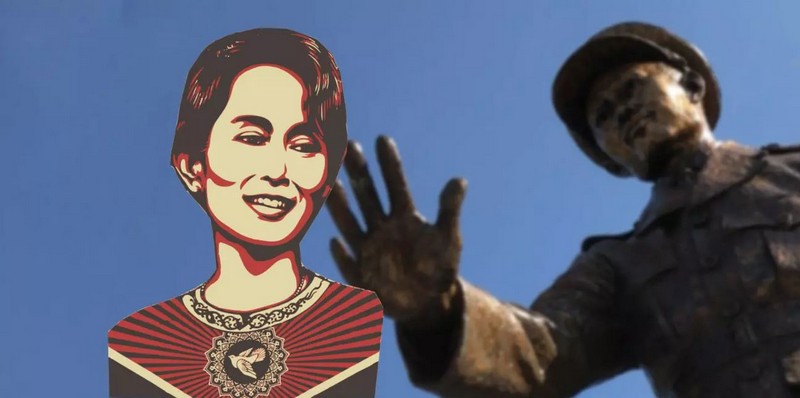
Banner image: Aung San Statue Yangon, Wikimedia Commons, & Aung San Suu Kyi historical figure, Wikimedia Commons.

Dr Maung Zarni is a scholar, educator and human rights activist with 30-years of involvement in Burmese political affairs, Zarni has been denounced as an “enemy of the State” for his opposition to the Myanmar genocide.

14 July 2023

Source: forsea.co