Just International

Neocons Starting to Panic About Ukraine

By Karsten Riise

The ambitions of the US foreign policy élite to beat both Russia and China is creating an internal war among the US Neocons.

The ambitions of the US foreign policy élite to beat both Russia and China is already creating an internal war among the US Neocons.

The Ukraine war is sucking the US dry of weapons, and the US is getting little to nowhere in its frail attempts to restock supplies sent to Ukraine. See this.

This already pushes some Neocons to panic for a ceasefire to close down the Ukraine engagement – just in order to save remaining arms supplies for conflict with China?

Meanwhile, the Pentagon and the defense industry are looking at the next major national security challenge: deterring, and if necessary, fighting, China in the Indo-Pacific region. See this.

That panic in parts of the Neocon community is already surfacing in the Council of Foreign Relations of the USA. On 13 April 2023, none less than Richard Haass, the President of the Council on Foreign Relations together with Charles Kupchan were overtly anxious to argue for a Ukrainian ceasefire.

[…]

The article, Neocons Starting to Panic About Ukraine, can be read on globalresearch.ca.

1 May 2023

How the War on Crypto Triggered a Banking Crisis

By Ellen Brown

According to an article in American Banker titled “SEC’s Gensler Directly Links Crypto and Bank Failures,” SEC Chair Gary Gensler has asked for more financial resources to police the crypto market. Gensler testified at an April 18 House Financial Services Committee hearing: 

[Crypto companies] have chosen to be noncompliant and not provide investors with confidence and protections, and it undermines the $100 trillion capital markets …

Silvergate and Signature [banks] were engaged in the crypto business — I mean some would say that they were crypto-​backed …

Silicon Valley Bank, actually when it failed, saw the country’s — the world’s — second-leading stable coin had $3 billion involved there, depegged, so it’s interesting just how this was all part of this crypto narrative as well.

Cryptocurrency experts Caitlin Long and Nic Carter take the opposite view. They acknowledge the link between crypto and the recent wave of bank failures and the runs and threatened runs they triggered, but Carter and Long make a compelling case that it was the FDIC, the SEC and the Federal Reserve that brought the banks down, by a coordinated, extrajudicial “war on crypto” that blocked that otherwise-legal industry from acquiring the banking services it needs.

The public banking movement has run up against similar roadblocks. Both cryptocurrencies and publicly-owned banks compete with the Wall Street-dominated private banking cartel, but more on that after a look at the suspicious events behind the recent bank runs.

The War on Crypto

In a February 2023 article on Pirate Wires titled “Operation Choke Point 2.0,” Carter laid out the case that the federal government was quietly attempting to ban crypto. In a 7,000-word March 23 follow-up titled “Did the Government Start a Financial Crisis in an Attempt to Destroy Crypto?”, he writes:

The two most crypto-​focused banks, Silvergate and Signature, were forced into liquidation and receivership, respectively. The established narrative is that they made “bad bets” and lost, or that they couldn’t handle flighty depositors in the form of tech and crypto startups.

But there’s an alternative version of events being pieced together that is far more sinister …

The preponderance of public evidence suggests that Silvergate and Signature didn’t commit suicide — they were executed.

In January 2023, … [s]ome in the crypto space noticed highly coordinated activity between the White House, financial regulators, and the Fed, aimed at dissuading banks from dealing with crypto clients, making it far more difficult for the industry to operate. This is problematic because it represented an attempted seizure of power far beyond what is normally reserved for the executive branch.

He observes that banking crypto firms wasn’t prohibited. It was just made very expensive and reputationally risky, by burying the bank in paperwork and unpleasant interrogations from regulators. The Fed also made it clear that new crypto-focused bank charters would be denied. Silvergate, Silicon Valley Bank (SVB), and Signature were put out of business:

Now, depositors are fleeing to the largest banking institutions, money market funds, or simply holding Treasuries directly. Whether intentional or not, these policies will cause smaller banks to die off, making credit more scarce, reducing competitiveness in the bank sector, and making it easier to set policy by marshaling a few large banks for political ends.

Carter observes that the distress in the banking sector was caused by the Fed’s attempt to reverse the inflationary effects of excess government spending, particularly for COVID-19 relief, by rapidly raising interest rates. As a result, government bond portfolios, “the foundational collateral asset of the financial system,” radically depreciated, causing $620 billion in unrealized losses collectively to U.S. banks. “But,” he writes, “there’s also a political subtext here. Most banks are now sitting on mark-​to-​market losses in their bond portfolios, but they’re not facing runs from their clients. … Silvergate met its end because — well after the crypto credit crisis of ‘22 had concluded — its remaining depositors were cajoled and bullied into withdrawing their funds.”

The most visible smoking gun, says Carter, was the decision to seize Signature Bank:

On Sunday the 12th of March, Signature (SBNY) was abruptly sent into FDIC receivership by the NYDFS [New York State Department of Financial Services]. This was not a two-bit crypto bank. They had $110B in deposits as of YE 2022, of which around 20 percent came from crypto-focused companies. …

Almost immediately, we knew something was wrong. Signature was not a “crypto bank” like Silvergate, where the majority of deposits were derived from crypto firms. It was a pretty venerable NY bank that primarily serviced real estate. It was not in as bleak a financial position as Silvergate or SVB, or other beleaguered regional banks. They weren’t closed on a Friday afternoon after market close, as is typical in receivership situations, but snuck in on a Sunday night, practically a footnote to the SVB shutdown. The FDIC was reportedly surprised on Sunday when SBNY was delivered into their hands. The NYDFS has maintained a well known long-running animus against crypto. The bank crisis was the perfect cover to take down the last remaining bank, which was unapologetic about servicing crypto firms (and ran important fiat settlement infrastructure).

The only problem: based on what we know, it appears that Signature wasn’t actually insolvent when they were nationalized and $4.3B of shareholder value was vaporized.

Carter writes that the crypto industry found an unlikely ally in Barney Frank, former chair of the House Financial Services Committee, the Frank in Dodd-​Frank, and a Signature board member. He alleged that the bank could have opened on Monday, and that leadership was shocked when they were put into receivership. In an interview with New York Magazine, Frank left “absolutely no doubt that the closure was a political hit job, primarily motivated by a desire to send a message to the crypto industry.” Carter observes:

As more data emerged, even the taciturn WSJ became convinced that Signature was a political execution.

In particular, the disparate treatment given to Signature versus their peers PacWest or First Republic is extremely telling. Both banks were in similar or worse financial positions, yet both were given time to save themselves, whereas Signature was seized on a Sunday night, right after SVB’s collapse. …

Most worryingly, the takedowns of Silvergate and Signature represent a rank lawlessness associated with authoritarian regimes. In a lawful society, solvent banks are not seized by the government simply because their clientele is politically disfavored. Shareholders in Signature had $4.3B in equity ($22B at peak) wiped out with no recourse. … Shareholders who saw their equity wrongly vaporized should sue under New York law.

He says that the upshot will be to drive crypto innovators abroad. In fact that move is happening already.

Killing Custodia: A States’ Rights Issue

A second smoking gun was the denial of FDIC insurance to Custodia Bank, which had a 100%-reserve business model that would have cost the FDIC nothing and posed no risk to the public. Custodia’s goal was just to provide a secure onramp from dollars to cryptocurrencies and an offramp back again. In fact, Custodia didn’t need to ensure its deposits, because it would not have been making loans from them. It would have kept them in reserve for the depositors. The bank needed FDIC insurance only because without it, the Fed refused to give Custodia a master account, necessary to participate in the national payment system.

Caitlin Long, the Wall Street veteran who founded Custodia, argues that this newly-imposed rule constitutes an unconstitutional violation of the long-standing right of states to charter their own banks. In an April 17 article titled “Why Defending the Right of States to Charter Banks Without Federal Permission Is Critical,” she writes:

Until a decade ago, it was unheard of that a bank would stop serving entire groups of customers or the people in lawful — if controversial — industries. It was also unheard of that banks would be blocked from accessing either of the two federal utilities in the banking industry: (i) deposit insurance and (ii) the U.S. dollar payment system (which the FDIC and Fed operate, respectively). Indeed, legislative history shows that Congress took great pains to keep the operation of these two utilities standalone and fully separated from the power to charter banks. As a check and balance, Congress wanted all chartering work done exclusively by the states or the lone federal agency that can charter banks, the OCC. Access to the two utilities was automatic for eligible banks, albeit with bank-​specific insurance premiums and overdraft restrictions.

The dual banking system – federal and state – goes back to the days of Abraham Lincoln, when the National Bank Act was passed. Before that, state-chartered banks were issuing their own currencies as paper promissory notes with their own names on them, an unstable system. The National Bank Act unified the country under a single paper currency, the U.S. dollar, by imposing a 10% tax on other bank-issued promissory notes. With the founding of the Federal Reserve in 1913, the U.S. dollar became the Federal Reserve Note. The national currency was federally issued but states retained the right to charter banks. As Long observes:

Historically, states have acted as a check against federal overreach in banking. There is a key reason why: the mission statements of state banking agencies usually require them to support both safety and soundness AND economic development, while federal bank regulators do not have economic development within their wheelhouse. This creates a healthy tension and explains why innovation in banking often originates within the states. The Fed and FDIC have no veto power over state chartering decisions.

… Congress again respected the delicate balance in 1980 when it further clarified the utility nature of the Fed’s role as payment system operator by requiring the Fed to provide services to all eligible banks on a non-​discriminatory basis. … In denying payment system access to Custodia, the Fed cited Custodia’s lack of FDIC insurance and lack of a federal regulator among its reasons for denial and, in doing so, the Fed improperly created for itself the unilateral power to require all state banks to be both insured and federally regulated.

Custodia sued the Fed, and the Attorney General of Wyoming, the state chartering the bank, joined the lawsuit. The Attorney General noted in the filing that the Fed had created a “Kafkaesque situation” where a Wyoming-​chartered bank is denied access to the U.S. dollar payment system “because it is not federally regulated, even while it is also denied federal regulation.”

Five states have enacted bank charters that don’t require deposit insurance or federal regulation –  Connecticut, Maine, Nebraska, Vermont and Wyoming. Such uninsured banks are prohibited from lending; they must hold 100% cash to back customer deposits, plus up to 8% of deposits as an additional capital requirement. Long concludes:

Congress tasked the Fed and FDIC with running utilities; it did not give the Fed and FDIC veto power over U.S. states – and, in turn, power to block the responsible innovations that state banking authorities create as they fulfill their economic development mandates.

Public Banks and the FDIC Conundrum

The public banking movement is particularly geared toward local economic development. The stellar and only model in the U.S. is the Bank of North Dakota, formed in 1919 when local farmers were losing their farms to foreclosure by big out-of-state banks. With assets in 2021 of $10.3 billion and a return on investment of 15%, the BND is owned by the state, which self-insures it. There is no fear of bank runs, because the state’s revenues compose the vast majority of its deposits, and they must be deposited in the BND by law.

The state’s local banks are also protected by the BND, which is forbidden to compete with them. Instead, it partners with them, helping with liquidity and capitalization. The BND has been called a “mini-Fed” for the state and its banks. That helps explain why North Dakota has more local banks per capita than any other state, at a time when other states have been losing banks to big bank mergers, causing the number of U.S. banks to shrink radically.

UK Prof. Richard Werner recently published a briefing memo supporting the case for a public bank. It was prepared for the state of Tennessee, which is considering a sovereign state bank on the North Dakota model, but the arguments apply to all states. Benefits discussed include dividends, higher state-level tax revenues, greater job creation, greater local autonomy and resilience to shocks, more options for funding public sector borrowing and state pension funds, and protection of financial transaction freedom and privacy.

The FDIC has not formally rejected insurance coverage for state-chartered publicly-owned banks, but regulators have intimated that it is not interested in covering them; and as noted by Julie Andersen Hill in an Iowa Law Review article, the Fed is “especially hesitant” to process payments without that coverage. Federal usurpation of state banking regulation not only drives cryptocurrency innovation abroad but kills innovation in local economic funding of the sort pioneered in North Dakota. Andersen Hill writes, “The language and structure of the Federal Reserve Act require that the Federal Reserve provide payment services to all eligible banks.… If the Fed wants to exclude banks, it should ask Congress to change the law.”

*

Ellen Brown is an attorney, chair of the Public Banking Institute, and author of thirteen books including Web of Debt, The Public Bank Solution, and Banking on the People: Democratizing Money in the Digital Age.

1 May 2023

Source: www.globalresearch.ca

John Pilger on the Coming War. Speak Up, Now

By John Pilger

In 1935, the Congress of American Writers was held in New York City, followed by another two years later. They called on ‘the hundreds of poets, novelists, dramatists, critics, short story writers and journalists’ to discuss the ‘rapid crumbling of capitalism’ and the beckoning of another war. They were electric events which, according to one account, were attended by 3,500 members of the public with more than a thousand turned away.

Arthur Miller, Myra Page, Lillian Hellman, Dashiell Hammett warned that fascism was rising, often disguised, and the responsibility lay with writers and journalists to speak out. Telegrams of support from Thomas Mann, John Steinbeck, Ernest Hemingway, C Day Lewis, Upton Sinclair and Albert Einstein were read out.

The journalist and novelist Martha Gellhorn spoke up for the homeless and unemployed, and ‘all of us under the shadow of violent great power’.

Martha, who became a close friend, told me later over her customary glass of Famous Grouse and soda: ‘The responsibility I felt as a journalist was immense. I had witnessed the injustices and suffering delivered by the Depression, and I knew, we all knew, what was coming if silences were not broken.’

Her words echo across the silences today: they are silences filled with a consensus of propaganda that contaminates almost everything we read, see and hear.  Let me give you one example:

On 7 March, the two oldest newspapers in Australia, the Sydney Morning Herald and The Age, published several pages on ‘the looming threat’ of China. They coloured the Pacific Ocean red. Chinese eyes were martial, on the march and menacing. The Yellow Peril was about to fall down as if by the weight of gravity.

No logical reason was given for an attack on Australia by China. A ‘panel of experts’ presented no credible evidence: one of them is a former director of the Australian Strategic Policy Institute, a front for the Defence Department in Canberra, the Pentagon in Washington, the governments of Britain, Japan and Taiwan and the west’s war industry.

‘Beijing could strike within three years,’ they warned. ‘We are not ready.’ Billions of dollars are to be spent on American nuclear submarines, but that, it seems, is not enough. ‘Australia’s holiday from history is over’: whatever that might mean.

There is no threat to Australia, none. The faraway ‘lucky’ country has no enemies, least of all China, its largest trading partner. Yet China-bashing that draws on Australia’s long history of racism towards Asia has become something of a sport for the self-ordained ‘experts’. What do Chinese-Australians make of this? Many are confused and fearful.

The authors of this grotesque piece of dog-whistling and obsequiousness to American power are Peter Hartcher and Matthew Knott, ‘national security reporters’ I think they are called. I remember Hartcher from his Israeli government-paid jaunts. The other one, Knott, is a mouthpiece for the suits in Canberra. Neither has ever seen a war zone and its extremes of human degradation and suffering.

‘How did it come to this?’ Martha Gellhorn would say if she were here. ‘Where on earth are the voices saying no? Where is the comradeship?’

The voices are heard in the samizdat of this website and others. In literature, the likes of John Steinbeck, Carson McCullers, George Orwell are obsolete. Post-modernism is in charge now. Liberalism has pulled up its political ladder. A once somnolent social democracy, Australia, has enacted a web of new laws protecting secretive, authoritarian power and preventing the right to know. Whistleblowers are outlaws, to be tried in secret. An especially sinister law bans ‘foreign interference’ by those who work for foreign companies. What does this mean?

Democracy is notional now; there is the all-powerful elite of the corporation merged with the state and the demands of ‘identity’. American admirals are paid thousands of dollars a day by the Australian tax payer for ‘advice’. Right across the West, our political imagination has been pacified by PR and distracted by the intrigues of corrupt, ultra low-rent politicians: a Johnson or a Trump or a Sleepy Joe or a Zelensky.

No writers’ congress in 2023 worries about ‘crumbling capitalism’ and the lethal provocations of ‘our’ leaders. The most infamous of these, Blair, a prima facie criminal under the Nuremberg Standard, is free and rich. Julian Assange, who dared journalists to prove their readers had a right to know, is in his second decade of incarceration.

The rise of fascism in Europe is uncontroversial. Or ‘neo-Nazism’ or ‘extreme nationalism’, as you prefer. Ukraine as modern Europe’s fascist beehive has seen the re-emergence of the cult of Stepan Bandera, the passionate anti-Semite and mass murderer who lauded Hitler’s ‘Jewish policy’, which left 1.5 million Ukrainian Jews slaughtered. ‘We will lay your heads at Hitler’s feet,’ a Banderist pamphlet proclaimed to Ukrainian Jews.

Today, Bandera is hero-worshipped in western Ukraine and scores of statues of him and his fellow-fascists have been paid for by the EU and the US, replacing those of Russian cultural giants and others who liberated Ukraine from the original Nazis.

In 2014, neo Nazis played a key role in an American bankrolled coup against the elected president, Viktor Yanukovych, who was accused of being ‘pro-Moscow’. The coup regime included prominent ‘extreme nationalists’ — Nazis in all but name.

At first, this was reported at length by the BBC and the European and American media. In 2019, Time magazine featured the ‘white supremacist militias‘ active in Ukraine. NBC News reported, ‘Ukraine’s Nazi problem is real.’ The immolation of trade unionists in Odessa was filmed and documented.

Inside A White Supremacist Militia in Ukraine

Spearheaded by the Azov regiment, whose insignia, the ‘Wolfsangel’, was made infamous by the German SS, Ukraine’s military invaded the eastern, Russian-speaking Donbas region. According to the United Nations 14,000 in the east were killed. Seven years later, with the Minsk peace conferences sabotaged by the West, as Angela Merkel confessed, the Red Army invaded.

This version of events was not reported in the West. To even utter it is to bring down abuse about being a ‘Putin apologist’, regardless whether the writer (such as myself) has condemned the Russian invasion. Understanding the extreme provocation that a Nato-armed borderland, Ukraine, the same borderland through which Hitler invaded, presented to Moscow, is anathema.

Journalists who travelled to the Donbas were silenced or even hounded in their own country. German journalist Patrik Baab lost his job and a young German freelance reporter, Alina Lipp, had her bank account sequestered.

In Britain, the silence of the liberal intelligensia is the silence of intimidation. State-sponsored issues like Ukraine and Israel are to be avoided if you want to keep a campus job or a teaching tenure. What happened to Jeremy Corbyn in 2019 is repeated on campuses where opponents of apartheid Israel are casually smeared as anti-Semitic.

Professor David Miller, ironically the country’s leading authority on modern propaganda, was sacked by Bristol University for suggesting publicly that Israel’s ‘assets’ in Britain and its political lobbying exerted a disproportionate influence worldwide — a fact for which the evidence is voluminous.

The university hired a leading QC to investigate the case independently. His report exonerated Miller on the ‘important issue of academic freedom of expression’ and found ‘Professor Miller’s comments did not constitute unlawful speech’. Yet Bristol sacked him. The message is clear: no matter what outrage it perpetrates, Israel has immunity and its critics are to be punished.

A few years ago, Terry Eagleton, then professor of English literature at Manchester University, reckoned that ‘for the first time in two centuries, there is no eminent British poet, playwright or novelist prepared to question the foundations of the western way of life’.

No Shelley spoke for the poor, no Blake for utopian dreams, no Byron damned the corruption of the ruling class, no Thomas Carlyle and John Ruskin revealed the moral disaster of capitalism. William Morris, Oscar Wilde, HG Wells, George Bernard Shaw had no equivalents today. Harold Pinter was alive then, ‘the last to raise his voice’, wrote Eagleton.

Where did post-modernism — the rejection of actual politics and authentic dissent — come from? The publication in 1970 of Charles Reich’s bestselling book, The Greening of America, offers a clue. America then was in a state of upheaval; Nixon was in the White House, a civil resistance, known as ‘the movement’, had burst out of the margins of society in the midst of a war that touched almost everybody. In alliance with the civil rights movement, it presented the most serious challenge to Washington’s power for a century.

On the cover of Reich’s book were these words: ‘There is a revolution coming. It will not be like revolutions of the past. It will originate with the individual.’

At the time I was a correspondent in the United States and  recall the overnight elevation to guru status of Reich, a young Yale academic. The New Yorker had sensationally serialised his book, whose message was that the ‘political action and truth-telling’ of the 1960s had failed and only ‘culture and introspection’ would change the world. It felt as if hippydom was claiming the consumer classes.  And in one sense it was.

Within a few years, the cult of ‘me-ism’ had all but overwhelmed many people’s sense of acting together, of social justice and internationalism. Class, gender and race were separated. The personal was the political and the media was the message. Make money, it said.

As for ‘the movement’, its hope and songs, the years of Ronald Reagan and Bill Clinton put an end to all that. The police were now in open war with black people; Clinton’s notorious welfare bills broke world records in the number of mostly blacks they sent to jail.

When 9/11 happened, the fabrication of new ‘threats’ on ‘America’s frontier’ (as the Project for a New American Century called the world) completed the political disorientation of those who, 20 years earlier, would have formed a vehement opposition.

In the years since, America has gone to war with the world.

According to a largely ignored report by the Physicians for Social Responsibility, Physicians for Global Survival and the Nobel Prize-winning International Physicians for the Prevention of Nuclear War, the number killed in America’s ‘war on terror’ was ‘at least’ 1.3 million in Afghanistan, Iraq and Pakistan.

This figure does not include the dead of US-led and fuelled wars in Yemen, Libya, Syria, Somalia and beyond. The true figure, said the report, ‘could well be in excess of 2 million [or] approximately 10 times greater than that of which the public, experts and decision makers are aware and [is] propagated by the media and major NGOS.’

‘At least’ one million were killed in Iraq, say the physicians, or five per cent of the population.

The enormity of this violence and suffering seems to have no place in the western consciousness. ‘No one knows how many’ is the media refrain. Blair and George W. Bush — and Straw and Cheney and Powell and Rumsfeld et al — were never in danger of prosecution. Blair’s propaganda maestro, Alistair Campbell, is celebrated as a ‘media personality’.

In 2003, I filmed an interview in Washington with Charles Lewis, the acclaimed investigative journalist. We discussed the invasion of Iraq a few months earlier. I asked him, ‘What if the constitutionally freest media in the world had seriously challenged George W. Bush and Donald Rumsfeld and investigated their claims, instead of spreading what turned out to be crude propaganda?’

He replied. ‘If we journalists had done our job, there is a very, very good chance we would have not gone to war in Iraq.’

I put the same question to Dan Rather, the famous CBS anchor, who gave me the same answer. David Rose of the Observer, who had promoted Saddam Hussein‘s ‘threat’, and Rageh Omaar, then the BBC’s Iraq correspondent, gave me the same answer. Rose’s admirable contrition at having been ‘duped’, spoke for many reporters bereft of his courage to say so.

Their point is worth repeating. Had journalists done their job, had they questioned and investigated the propaganda instead of amplifying it, a million Iraqi men, women and children might be alive today; millions might not have fled their homes; the sectarian war between Sunni and Shia might not have ignited, and Islamic State might not have existed.

Cast that truth across the rapacious wars since 1945 ignited by the United States and its ‘allies’ and the conclusion is breathtaking. Is this ever raised in journalism schools?

Today, war by media is a key task of so-called mainstream journalism, reminiscent of that described by a Nuremberg prosecutor in 1945: ‘Before each major aggression, with some few exceptions based on expediency, they initiated a press campaign calculated to weaken their victims and to prepare the German people psychologically… In the propaganda system… it was the daily press and the radio that were the most important weapons.’

One of the persistent strands in American political life is a cultish extremism that approaches fascism. Although Trump was credited with this, it was during Obama’s two terms that American foreign policy flirted seriously with fascism. This was almost never reported.

‘I believe in American exceptionalism with every fibre of my being,’ said Obama, who expanded a favourite presidential pastime, bombing, and death squads known as ‘special operations’ as no other president had done since the first Cold War.

According to a Council on Foreign Relations survey, in 2016 Obama dropped 26,171 bombs. That is 72 bombs every day. He bombed the poorest people and people of colour: in Afghanistan, Libya, Yemen, Somalia, Syria, Iraq, Pakistan.

Every Tuesday – reported the New York Times – he personally selected those who would be murdered by hellfire missiles fired from drones. Weddings, funerals, shepherds were attacked, along with those attempting to collect the body parts festooning the ‘terrorist target’.

A leading Republican senator, Lindsey Graham, estimated, approvingly, that Obama’s drones had killed 4,700 people. ‘Sometimes you hit innocent people and I hate that,’ he said, but we’ve taken out some very senior members of Al Qaeda.’

In 2011, Obama told the media that the Libyan president Muammar Gaddafi was planning ‘genocide’ against his own people.

‘We knew…,’ he said, ‘that if we waited one more day, Benghazi, a city the size of Charlotte [North Carolina], could suffer a massacre that would have reverberated across the region and stained the conscience of the world.’

This was a lie. The only ‘threat’ was the coming defeat of fanatical Islamists by Libyan government forces. With his plans for a revival of independent pan-Africanism, an African bank and African currency, all of it funded by Libyan oil, Gaddafi was cast as an enemy of western colonialism on the continent in which Libya was the second most modern state.

Destroying Gaddafi’s ‘threat’ and his modern state was the aim. Backed by the US, Britain and France, Nato launched 9,700 sorties against Libya. A third were aimed at infrastructure and civilian targets, reported the UN. Uranium warheads were used; the cities of Misurata and Sirte were carpet-bombed. The Red Cross identified mass graves, and Unicef reported that ‘most [of the children killed] were under the age of ten’.

When Hillary Clinton, Obama’s secretary of state, was told that Gaddafi had been captured by the insurrectionists and sodomised with a knife, she laughed and said to the camera: ‘We came, we saw, he died!’

Click here to watch the clip.

On 14 September 2016, the House of Commons Foreign Affairs Committee in London reported the conclusion of a year-long study into the Nato attack on Libya which it described as an ‘array of lies’ — including the Benghazi massacre story.

  • The NATO bombing plunged Libya into a humanitarian disaster, killing thousands of people and displacing hundreds of thousands more, transforming Libya from the African country with the highest standard of living into a war-torn failed state.

Under Obama, the US extended secret ‘special forces’ operations to 138 countries, or 70 per cent of the world’s population. The first African-American president launched what amounted to a full-scale invasion of Africa.

Reminiscent of the Scramble for Africa in the 19th century, the US African Command (Africom) has since built a network of supplicants among collaborative African regimes eager for American bribes and armaments. Africom’s ‘soldier to soldier’ doctrine embeds US officers at every level of command from general to warrant officer. Only pith helmets are missing.

It is as if Africa’s proud history of liberation, from Patrice Lumumba to Nelson Mandela, has been consigned to oblivion by a new white master’s black colonial elite. This elite’s ‘historic mission’, warned the knowing Frantz Fanon, is the promotion of ‘a capitalism rampant though camouflaged’.

In the year Nato invaded Libya, 2011, Obama announced what became known as the ‘pivot to Asia’. Almost two-thirds of US naval forces would be transferred to the Asia-Pacific to ‘confront the threat from China’, in the words of his Defence Secretary.

There was no threat from China; there was a threat to China from the United States; some 400 American military bases formed an arc along the rim of China’s industrial heartlands, which a Pentagon official described approvingly as a ‘noose’.

At the same time, Obama placed missiles in Eastern Europe aimed at Russia. It was the beatified recipient of the Nobel Peace Prize who increased spending on nuclear warheads to a level higher than that of any US administration since the Cold War – having promised, in an emotional speech in the centre of Prague in 2009, to ‘help rid the world of nuclear weapons’.

Obama and his administration knew full well that the coup his assistant secretary of state, Victoria Nuland, was sent to oversee against the government of Ukraine in 2014 would provoke a Russian response and probably lead to war. And so it has.

I am writing this on 30 April, the anniversary of the last day of the longest war of the twentieth century, in Vietnam, which I reported. I was very young when I arrived in Saigon and I learned a great deal. I learned to recognise the distinctive drone of the engines of giant B-52s, which dropped their carnage from above the clouds and spared nothing and no one; I learned not to turn away when faced with a charred tree festooned with human parts; I learned to value kindness as never before; I learned that Joseph Heller was right in his masterly Catch-22: that war was not suited to sane people; and I learned about ‘our’ propaganda.

All through that war, the propaganda said a victorious Vietnam would spread its communist disease to the rest of Asia, allowing the Great Yellow Peril to its north to sweep down. Countries would fall like ‘dominoes’.

Ho Chi Minh’s Vietnam was victorious, and none of the above happened. Instead, Vietnamese civilisation blossomed, remarkably, in spite of the price they paid: three million dead. The maimed, the deformed, the addicted, the poisoned, the lost.

If the current propagandists get their war with China, this will be a fraction of what is to come. Speak up.

*

John Pilger is an Australian-British journalist and filmmaker based in London.

1 May 2023

Source: www.globalresearch.ca

Poverty and Crisis: Sucking Humanity Dry

The Four Horses of the Economic Apocalypse: Agribusiness, Oil, Arms and Big Pharma

By Colin Todhunter

The World Bank says nearly 80% (560 million) of the 700 million people who were pushed into extreme poverty in 2020 due to COVID policies were from India. Globally, extreme poverty levels increased by 9.3 per cent in 2020.  

In 2022, it was estimated that a quarter of a billion people across the world would be pushed into absolute  poverty in that year alone.

In the UK, poverty is increasing in two-thirds of communities, as millions go without heat and skip meals. Due to the ‘cost-of-living crisis’, 10.5 million are experiencing financial difficulty. An additional 13.7 million people would be at risk of financial difficulty with further increases in costs.

Living standards in the UK are plummeting. For instance, 28 per cent (up from 9 per cent pre-COVID) of UK adults said that they could not afford to eat balanced meals. Absolute poverty is set to rise from 17.2 per cent in 2021-22 to 18.3 per cent in 2023-24, pushing an additional 800,000 people into poverty.

In England, 100,000 children have been frozen out of free school meals.

In the US, around 30 million low-income people are on the edge of a ‘hunger cliff’ as a portion of their federal food assistance is taken away. In 2021, it was estimated that one in eight children were going hungry in the US.

Small businesses are filing for bankruptcy in the US at a record rate. Private bankruptcy filings in 2023 have exceeded the highest point recorded during the early stages of COVID by a considerable amount. The four-week moving average for private filings in late February 2023 was 73 per cent higher than in June 2020.

Meanwhile, nearly 100 of the biggest US publicly traded companies recorded 2021 profit margins that were at least 50 per cent higher than their 2019 levels.

The Bank of England’s chief economist Huw Pill says that people should ‘accept’ being poorer. This is similar to the response of Rob Kapito, co-founder of the world’s biggest asset management firm BlackRock. In 2022, he said that a “very entitled” generation of people who have never had to sacrifice would soon have to face shortages for the first time in their lives.

Crisis – what crisis?  

Of course, Kapito is no doubt referring to ordinary US citizens and not himself. Kapito, as the president of BlackRock, made $26,750,780 in total compensation in 2021.

Nor is he referring to the high-net-worth individuals who benefit from hunger by investing in BlackRock, a firm that continues to profit from a globalised food system which – by design – leaves around a billion people experiencing malnutrition. BlackRock is one of the rich ‘barbarians at the barn’ who continue to make huge financial killings from an exploitative food regime.

Kapito and Pill tell ordinary people to get used to their ‘new normal’ while business as usual prevails elsewhere, not least in one of the world’s most financially lucrative sectors – arms manufacturing. The war in Ukraine has been a ‘gold rush’ for Western arms makers as wealthy US neocons like Victoria Nuland continue to try to bring about ‘regime change’ in Russia by fighting Moscow to the last Ukrainian.

When Huw Pill tells ordinary people to get used to being poorer, he is not referring to the  individuals and firms who have made hundreds of millions of pounds (courtesy of the taxpayer) from corrupt COVID equipment contracts thanks to the UK government prioritising politically connected suppliers at the start of COVID.

And this cannot be brushed aside as a ‘one-off’. These revelations are merely the tip of a massive corruption iceberg.

For example, Byline Times reports a cross-party parliamentary watchdog raised concerns that decisions on how to award money from the £3.6 billion towns fund, designed to boost economic growth in struggling towns, were politically motivated. It also notes that 40 potential breaches of the Ministerial Code were not investigated in the past five years.

Little wonder that in January 2023 the UK plunged to its lowest-ever position in the Transparency International Corruption Perceptions Index.

Consider that the UN estimates that just $51.5 billion would be enough to provide food, shelter and lifesaving support for the world’s 230 million most vulnerable people. Then consider that 20 corporations in the grain, fertiliser, meat and dairy sectors delivered $53.5 billion to shareholders in the financial years 2020 and 2021.

According to Global Witness, ‘excess profits’ are sudden and significant increases in a company’s financial returns that are due not to their own actions but to external events. The EU says profits count as ‘excess’ when they are more than 20% above the average return of the previous four years.

Global Witness finds that the 2022 annual profits of the five largest integrated private sector oil and gas companies – Chevron, ExxonMobil, Shell, BP and TotalEnergies – were $195 billion. Up by almost 120% on 2021 and the highest level in the industry’s history.

This means that these companies made $134 billion in excess profits, which could cover nearly 20% of the money all European governments together have allocated to shielding vulnerable households and businesses from the current energy crisis.

Centrica, the company that owns British Gas, reports record profits for 2022. Operating profits of £3.3bn were recorded, up from £948m in 2021. This surpassed its previous highest ever yearly profit of £2.7bn in 2012.

In May 2021, it was reported that COVID vaccines had created at least nine new billionaires. According to research by the People’s Vaccine Alliance, the new billionaires included Moderna CEO Stéphane Bancel and Ugur Sahin, the CEO of BioNTech, which has produced a vaccine with Pfizer. Both CEOs were then worth around $4 billion. Senior executives from China’s CanSino Biologics and early investors in Moderna have also become billionaires.

Although the nine new billionaires were at that time worth a combined $19.3 billion, the vaccines were largely funded by public money. For instance, according to a May 2021 report by CNN, BioNTech received €325 million from the German government for the development of the vaccine. The company made a net profit of €1.1 billion in the first three months of the year, thanks to its share of sales from the COVID vaccine, compared with a loss of €53.4 million for the same period last year.

Moderna was expected to make $13.2 billion in COVID vaccine revenue in 2021. The company received billions of dollars in funding from the US government for development of its vaccine.

This article has briefly touched on four horses of the economic apocalypse – agribusiness, oil, arms and big pharma. But let’s finish by mentioning the fifth and the most powerful – finance. The sector which sparked the devastation that we now see.

By late 2019, a financial crisis was looming. It was multiple times worse than the 2008 one.

Investigative journalist Michael Byrant says that €1.5 trillion was needed to deal with the crisis in Europe alone. The financial collapse staring European central bankers in the face came to a head in 2019:

“All talk about big finance bankrupting the nation by looting public funds, politicians destroying public services at the behest of large investors and the depredations of the casino economy were washed away with COVID. Predators who saw their financial empires coming apart resolved to shut down society. To solve the problems they created, they needed a cover story. It magically appeared in the form of a ‘novel virus’.”

The European Central Bank agreed to a €1.31 trillion bailout of banks followed by the EU agreeing to a €750 billion recovery fund for European states and corporations. This package of long-term, ultra-cheap credit to hundreds of banks was sold to the public as a necessary programme to cushion the impact of the pandemic on businesses and workers.

What happened in Europe was part of a strategy to avert the wider systemic collapse of the hegemonic financial system. And what we now see is an interrelated global debt, inflation and ‘austerity’ crisis and the biggest transfer of wealth to the rich in history under cover of a ‘cost-of-living crisis’.

As millions of workers take strike action in the UK, Huw Pill implies that they should accept their plight as inevitable. But they have no reason to.

The wealth of the world’s billionaires increased by $3.9tn between 18 March and 31 December 2020. Their total wealth then stood at $11.95tn, a 50 per cent increase in just 9.5 months. Between April and July 2020, during the initial lockdowns, the wealth held by these billionaires grew from $8 trillion to more than $10 trillion.

The only thing inevitable about the current crisis was the collapse of a debt-fuelled, unsustainable neoliberalism set up to facilitate outright plunder by the super-rich who have offshored more than $50 trillion in hidden accounts.

*

Renowned author Colin Todhunter specialises in development, food and agriculture.

27 April 2023

Source: www.globalresearch.ca

Ukraine and the Balkans

By Dr. Vladislav B. Sotirović

The long-term crisis in the relations between the Russian Federation and Ukraine entered its final – war phase on February 24th, 2022. The official reactions to the latest dramatic events in East Europe, which come from the Westerners, including the most important overseas Western political address, are usually dominated by two phrases: “flagrant violation of international public law” and “violation of the territorial integrity of an internationally recognized state“. The perpetrator of the acts is, of course, Russia, and, as it is claimed, the innocent victim is neighboring Ukraine. However, the same Westerners do not want to see either flagrant violations by the Kiev regime of human rights in the Donbass Region since 2014 onward or flagrant violations of international public law and territorial integrity of the internationally recognized state in the case of the Balkans (Yugoslavia) in the 1990s.

From the author

The ignorant attitude towards the provisions of international public law relevant to the Balkan case resulted, therefore, in the break-up of the Socialist Federal Republic of Yugoslavia, the long wars in its two former federal units (Croatia and Bosnia-Herzegovina) that took about 150,000 lives, produced more than two million displaced people and left behind a region to this day, almost three decades later, it has not politically stabilized and consolidated.

The West demonstrated an identical attitude towards the branch of law that it is ardently calling for these days concerning Ukraine, several years after the end of those wars, when it decided to actively engage in “protecting the endangered human rights of Kosovo Albanians” and “stopping the humanitarian catastrophe to which they were exposed”, as the official Western narrative was, explaining 78 days of the barbaric campaign of bombing Serbia and Montenegro in the spring of 1999. As we know, it ended with the complete physical destruction of the country and the de facto exclusion of Kosovo from its constitutional and legal framework of the Republic of Serbia.

The self-proclaimed independence of Kosovo in February 2008 was, as well as the aggression against Serbia and Montenegro in 1999 contrary to all relevant customs of international public law. However, Western countries that today are leading in condemning similar Russian acts in Ukraine, were among the first to recognize the self-proclaimed independence of Kosovo.

From the author

The policy of “double standards” in international relations and global politics used by great powers is not unknown and unrecorded in history. However, after the Cold War 1.0 (1949−1989) up today, the absence of any Western standards in the practice of generally accepted and binding rules of the international “game”, however, is one of the focal dimensions of the international relations in the world politics. The well-known dictum that sums up that insight – “The strong do what they can, and the weak suffer what they have to” – came from the pen of the famous ancient Greek historian and military leader from Athens – Thucydides (c. 460−c. 400 BC). Thus, almost two and a half millennia ago, the great historian taught that justice and rights, as its codified forms, exist in international relations and can only be among equals (inter pares). Major disagreements in this regard, which are the basis of what is happening today in Ukraine with potentially catastrophic consequences, occur when this “equal”, in this case, the great and powerful Russia, is not recognized as such and is not as such respected. Today, the Western policymakers made a crucial mistake with Russia as thinking this is the same state as it was in the 1990s during the wars of the Yugoslav succession. Unfortunately for them, today’s Russian Federation is not a Western puppet state from the Yeltzin’s period – it is today at least equal with the Western great powers including NATO as well. Those Western actors in global politics who would continue to overlook this “hard” fact concerning Russia and her role in the politics of the contemporary world, would lead the world to the dangerous edge of the abyss and push the world into it very quickly with their indolence and old policy of gangsterism in international relations.

*

Dr. Vladislav B. Sotirović is a former university professor in Vilnius, Lithuania. He is a Research Fellow at the Center for Geostrategic Studies. He is a regular contributor to Global Research.

27 April 2023

Source: www.globalresearch.ca

Robert F. Kennedy, Jr.: To Heal the Great Divide

By Edward Curtin

22 Apr 2023 – It has been fifty-five years since Senator Robert F. Kennedy stepped onto the presidential nominating stage to try to mend the massive breach that had opened in American society.  The country was torn asunder by the Vietnam War, racism, poverty, the assassination of President Kennedy and the soon-to-be assassination of Rev. Martin Luther King, Jr.  Chaos reigned as Lyndon Johnson lied and Richard Nixon matched him in verbal and actual treachery.  A war between Middle America and the elites running the government was breaking out across the country.  A great divide between whites and blacks, rich and poor, the working class and the upper class was opening wide.  The Tet Offensive had just ripped the face off the official lies about the course of the war in Vietnam and the emperor, Lyndon Jonson, stood naked and would soon announce that he would not run again.

On March 16, 1968, Senator Kennedy declared his candidacy with these words:

I do not run for the presidency merely to oppose any man but to propose new policies. I run because I am convinced that this country is on a perilous course and because I have such strong feelings about what must be done, and I feel that I’m obliged to do all that I can.

I run to seek new policies – policies to end the bloodshed in Vietnam and in our cities, policies to close the gaps that now exist between black and white, between rich and poor, between young and old, in this country and around the rest of the world.

By the end of 1968, a plague year if there ever were one, Richard Nixon, together with his goon squad, prepared to occupy the White House, Vietnam raged on, and everything King and Kennedy stood for seemed lost.  Ignorance, vituperation, and the divide-and-conquer technique long practiced by the power elites set into the body politic like a deadly cancer.  Something died, all hope seemed lost, and the perilous course RFK spoke of was never stopped.  Jackals with polished faces have sat in the White House ever since.

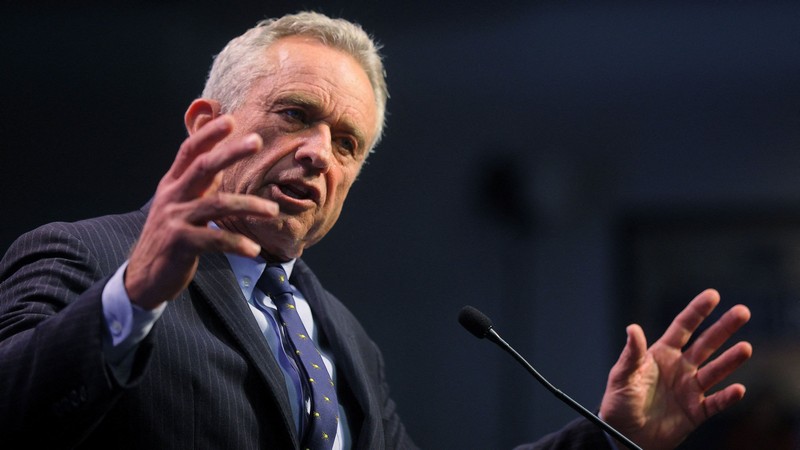
Today hope is resurrected.  Enter Robert F. Kennedy, Jr. center stage who declared his candidacy for the Democratic nomination for president on Wednesday, April 19, in Boston, Massachusetts.

The wheel of history has turned and 2023 resembles 1968 in many ways while getting worse in others. The divide in the country remains but has greatly widened.  The CIA and the intelligence agencies totally control the mainstream media now.  The Pentagon’s budget has increased exponentially.  The U.S. wages a savage war against Russia in Ukraine under the blatant lie of defending freedom while supporting Nazis and greatly risking nuclear war.  It provokes war with China.  Permanent war is government policy with military bases and CIA and special forces all over the world, waging semi-clandestine wars, or maybe just wars that people don’t want to know about.  The gap between the rich and the poor has widened while the elites mock working class people as moronic deplorables.  The Department of Defense controls the development, manufacturing, clinical testing, supply, production, and distribution of the mRNA vaccines, while the criminal pharmaceutical companies reap obscene profits.  Lies are piled upon lies in what amounts to an Orwellian nightmare.  And while LBJ and Nixon have been replaced by Joe Biden, the warfare state roll on.

Some things have changed, of course.  In 1968, liberals were turning against the U.S. war against Vietnam and were growing wary of the CIA.  Today they support all the Democratic-led wars and love the CIA.  They trust the obvious media lies and those of a proven liar such as Anthony Fauci.  Nowhere is this sadly truer than with the extended Kennedy family, who in their support for Biden, Fauci, the CIA, etc. have betrayed JFK and RFK.  Their smugness and support for Biden against their brother who is carrying on his uncle’s and father’s legacy is betrayal of the worst kind.

Despite a family actively opposed to his candidacy, despite all the media lies about him, and despite the oddsmakers giving him little chance, RFK, Jr. is entering the race.  It is an act of supreme moral courage.

Like his father in ’68, he is the only candidate who can heal this nation’s great divide.

That he is opposed by a huge array of people who will lie about him because he is a truth-teller does not deter him.  Those lies immediately started up again as soon as word got out that he might run.  It’s an old story.  Trash will be thrown at him.  Every blemish of his nearly seventy years will be dredged up to paint him as a villain, a flawed man, a hypocrite – name all the negative terms you can think of and the real hypocrites, in their self-righteous rage, will use them against him.  They will bounce off him.  He is ready.

When Bobby, Jr. was young, his father handed him a book and said with urgency, “I want you to read this.”  It was Albert Camus’s The Plague.  He read it and it has informed his life ever since.  Just as in 1968, we live in plague times, and the plague is US, it runs through all our institutions and, as in Camus’s books, the rats are running wild, devouring truth and the values that can redeem us.  As he has written in his beautiful and important book, American Values: Lessons I Learned from My Family, Camus’s analysis of Sisyphus and the ancient Greeks has taught him an important lesson:

It is neither our position nor our circumstances that define us, according to the Stoics, but our response to those circumstance; when destiny crushes us, small heroic gestures of courage and service can bring us peace and fulfillment. In applying our shoulder to the stone, we give order to a chaotic universe. Of the many wonderful things my father left me, this philosophical truth was perhaps the most useful. In many ways, it has defined my life, and has allowed me to find serenity and purpose even in the most trying and tragic circumstances. (p.287)

Despite its brilliance, American Values (see this) was completely ignored by the mainstream press.  Why?  Because it revolves around “Chapter 9, Senator Robert F. Kennedy” and the long war between the Kennedys and the CIA that resulted in the deaths of JFK and RFK.  In this chapter, RFK, Jr. brilliantly shows that he fully grasps the CIA’s evil history.  All the other chapters, while very interesting personal and family history, pale in importance.   No member of the Kennedy family since JFK or RFK has dared to say what RFK, Jr. does in this book.  He indicts the CIA.  This is probably not a small part of his extended family’s animosity toward him.  Family taboos must be protected, as if they were state secrets.

But his indictment of the CIA is the fundamental reason why it and the media will at all costs try to prevent him from getting the nomination.  The character assassination will be intense.

Kennedy knows he faces an uphill battle for the presidency, but no matter what forces are aligned against him, political and familial, he will not back down.

He will surprise all the pundits, for his appeal crosses party lines.  He is tough and very smart.  He has been so hated and falsely maligned by the mainstream media for so long that he is skilled at keeping to his message, which I think will be positive and inspirational, something that this country is desperate for after so many years of lies and treachery.

Even Biden’s supporters in the Democratic party know he is a flawed candidate on his last legs, laboring to keep his words straight and his steps solid.  While he may have long served as the establishment’s war puppet, there are many nervous Democrats who want to finally cut their strings with him.  And the Republicans are a party in disarray, internally torn and tired of the Trump saga which will not end.

Two clowns don’t make for a pretty picture running the country and the world into the ground.  Biden and Trump and their predecessors are naked now and not just does one boy see it and shout it only to be ignored.  There is a growing feeling throughout the country that truth and goodness spoken clearly are desperately needed to unite the country through common values. Bob Dylan got it right back a few years:

While preachers preach of evil fates
Teachers teach that knowledge waits
Can lead to hundred-dollar plates
Goodness hides behind its gates
But even the president of the United States
Sometimes must have to stand naked

Every day Americans are bombarded with bad news: the U.S. war against Russia via Ukraine, the lies about the “threats” from Russia and China, the collapsing economy, toxic spills, gun violence, corporate gangsters ripping off the average American and funneling those monies to the politicians who pimp for them, the egregious Covid-19 and “vaccine” lies that are daily being exposed as deadly frauds, the growing threat of nuclear war, etc.

Bad bad news, and with it a growing public sense of hopelessness.  A pall of unacknowledged depression smothers the country.  People are dying for hope, as they were in 1968.  In their inner hearts there is this desperate yearning for one brave soul to stand up and tell Americans the truth about what has happened to their country.  Bobby Kennedy, Jr. is the only one who can move Americans to hope again.

For years he has been telling harsh truths that many who profit from the lies do not want to hear. That our waters are polluted and the chemical companies are criminals; that the pharmaceutical companies are criminal enterprises polluting people’s bodies; that the CIA is organized crime polluting people’s minds and assassinating its anti-war leaders; that the Pentagon is a criminal enterprise not defending but risking American’s lives and their livelihood; that the U.S. government has joined with mega-corporations to run a Mob-like fleecing of the American people; that not one of Sirhan Sirhan’s bullets killed his father, Senator Robert Kennedy, who was shot from behind at close range by a CIA hit man; that the so-called Covid vaccines are very dangerous and have never been appropriately tested and many people are dying and being injured as a result; that Anthony Fauci is a liar and fraud who fronts for Big Pharma (see this) in the Covid-19 crisis that is an intelligence-run operation controlled by spooks working with medical technocrats; and that we are close to losing our country and any semblance of its democratic ideals.

These are not liberal or conservative positions.  They are self-evident conclusions of a patriot, as they should be for everyone.

And because they have become such to more and more Americans who can think without reacting, Kennedy’s voice and his candidacy will grow in strength across the great divide.

The media attacks will be intense and simply full of lies. They love to call him an “anti-vaxxer,” when he is not opposed to all vaccines.  But no matter how many times he has explained this, the media twist it to serve their masters.

For example, The New York Post recently published a slimy piece that could serve as a template for all the propaganda aimed at Kennedy.  Let me quote:

Robert has said Sirhan did not actually participate in the murder of Sen. Robert F. Kennedy during a Los Angeles presidential campaign stop in 1968.

This of course is a lie.  RFK, Jr. has said that Sirhan fired a pistol but none of his bullets hit the Senator.  He has said a CIA hit man shot his father at close range from behind as the official autopsy clearly showed, while Sirhan was standing in front of the Senator.

Lie number two.  The Post writes:

In it [a speech], he implied that those who oppose vaccines are being persecuted more severely than Anne Frank, the German teen who hid from the Nazis in Amsterdam before being sent to her death at Auschwitz.

He never implied that.  His point was clear: that in the coming digital surveillance state there will be nowhere to hide, not even in an attic, because the surveillance technology will track everyone everywhere, day and night.

These are but a few examples.  Look and you will find them everywhere now and in the coming days.

The hyenas with polished faces will try like hell to dismiss Robert f. Kennedy, Jr. as a flake, a fraud, and a conspiracy nut on an ego-trip.  Too many people can now see through such propaganda.  He is the real thing, our best hope to bridge the great divide that has been created by the elites to divide the American people.

He will not back down, and all people of good will who believe the U.S. can still find its way out of the morass we find ourselves in, should back him up.  He has warned us, he has given us his voice, and his moral courage should be followed by all who hope to hope.

The pundits who dismiss his chances will then be shocked.

Edward Curtin, Ph.D. is a widely published author and a member of the TRANSCEND Network for Peace Development Environment.

1 May 2023

Source: www.transcend.org

Syria Updates: ISIS Massacres and Turkish Double-Dealing

By Vanessa Beeley

18 Apr 2023 – As events are moving so fast in the region, I will try to update more regularly in a condensed format:

US continues its murder of civilians in central Syria using its ISIS proxies to carry out brutal attacks . On the 16th April at least 26 civilians were massacred in an attack on truffle hunters in the Duizen eastern countryside of Hama governorate.

It is reported by the terrorist-biased Syrian Observatory for Human Rights (SOHR) that 12 of the martyrs were members of the National Defence Forces but the majority of the attacks and kidnap victims are civilians. The US is known to have planted ISIS cells in the area east of Homs and the threat to civilians or military is high. Syrian civilians trying to eke a living in a country under economic attack from the West are forced to hire military protection to survive. Added to this, the desert is still also littered with ISIS and other terrorist group mines and IEDs. On 17th February 53 people were killed in Homs Al Sukhna region near Palmyra and dozens were kidnapped.

Earlier in April SOHR reported that nine soldiers from the Palestinian Liwa Al Quds brigade were killed by ISIS in the Palmyra desert area. The New York Times is reporting a death toll over 100 without mentioning the US responsibility for these deaths.

According to local sources 139 citizens have been murdered since the start of 2023, many since the double earthquake on 6th February. If you include military martyrs, the death toll stands at an estimated 289. A kilo of truffles on the Syrian market costs $ 22 – $ 65 and therefore in such an economic depression the risks are taken by civilians who would otherwise starve under US sanctions and siege. This is all part of the ongoing US UK war of terror against the Syrian people.

Erdogan appears to be under pressure from the US after Russia and Iran have been trying to broker a political resolution between Turkey and Syria before Turkiye elections in May 2023. Erdogan and his administration officials are refusing all concessions under the pretext of national security with a view to combating PKK terrorism controlled by the US in north-east Syria under the rebrand of SDF (Kurdish contras).

President Assad has made it very clear that no meeting will take place between the Presidents until Erdogan gives assurances that Turkish military and proxy terrorist forces are withdrawn from Syrian territory. The US is demonstrating yet again that peace is not on the agenda in the region and is using maximum pressure to prevent regional unity.

Turkiye is a NATO member state, something that Erdogan or his political opposition are unlikely to abandon. This is one reason Russia is now negotiating with a more compliant Saudi Arabia to sell energy to the EU via the Saudi kingdom.

The Turkiye reconciliation would also be a serious threat to Israel who depends upon the instability in the north of Syria to keep the region distracted from serious confrontation with the Zionist entity. Is this posturing from Erdogan or will he find himself boxed into a corner by his own double-dealing? We do not have long to wait and see.

From The Cradle:

“Turkish President Recep Tayyip Erdogan stated in a speech on Sunday, 17 April, that “his people cannot feel safe in the first place in the presence of a terrorist organization in northern Syria and Iraq, equipped with air and ground weapons,” Sputnik reported.

Referring to the Kurdistan Workers Party (PKK) and its Syrian offshoot, the People’s Protection Units (YPG), Erdogan told residents affected by the earthquake in Sanliurfa province in southern Turkiye that “It is not possible to feel security in Turkiye without stability in the region, and we cannot feel reassured while terrorists are stationed on our borders and arrive and roam as they please,” according to the office of the Turkish Presidency.

Erdogan stressed that “The goal of the parties that have deprived these countries of security, safety, and stability is to drag Turkiye into the same vortex, but we will never allow that, we will never seek excuses for any global or regional party to publicly jeopardize the security of our country.”

He added: “We have shown our determination in this context time and time again; thanks to our continuous operations within our borders and our cross-border operations, we have made it clear that our country cannot live side by side with terrorism, we will never retreat from this position, and while we take all these steps we will not make any concessions at all, and I hope that we will continue this struggle with determination.”

Erodogan’s comments follow negotiations to re-establish relations with the Syrian government, in which Damascus had demanded the withdrawal of Turkish forces occupying Syria’s Idlib province along with Ankara’s local proxy, the Syrian National Army (SNA), as well as a Turkish drone strike that targeted Syrian Democratic Forces (SDF) leader Mazloum Abdi who was traveling in a convoy near the Suleimaniya airport in northern Iraq. The assassination attempt failed, and no injuries were reported.

The SDF is led by the YPG and therefore viewed as a PKK offshoot by Ankara.

Turkiye alleges that Suleimaniya, the second largest city in the Kurdistan Regional Governate (KRG) in northern Iraq, has become a PKK stronghold.

The drone strike on SDF leader Abdi’s convoy was further controversial because US military personnel were accompanying Abdi, suggesting they are facilitating his other SDF commanders’ movements.

Several areas in the Kurdistan region of Iraq have recently been subject to Turkish bombardment in the campaign against the PKK. Turkish attacks escalated after a bombing in Istanbul’s Taksim Square in November 2022, in which 6 were killed and 81 injured, and for which Ankara holds the PKK responsible.

The Turkish bombing campaign has extended to Sinjar, home of the persecuted Yazidi religious minority.

The PKK gained some popularity in Sinjar following its efforts to help evacuate Yazidis in the face of an ISIS assault in 2014 in which thousands of men were massacred, and thousands more women and girls were taken into slavery.

Turkiye is known for its support for ISIS, while Turkiye’s Kurdish allies in the region, the Kurdistan Democratic Party (KDP), had promised to protect Yazidis in Sinjar from ISIS, but KDP forces confiscated Yazidi weapons and withdrew without warning, allowing ISIS to commit atrocities constituting a genocide.”

Vanessa Beeley is a member of the TRANSCEND Network for Peace Development Environment.

1 May 2023

Source: www.transcend.org

Syria Comes in from the Cold

By Scott Ritter

After the Chinese-brokered rapprochement between Saudi Arabia and Iran, another diplomatic coup is unfolding in the Middle East. This one is orchestrated by the Russians.

24 Apr 2023 – While the world continues to come to grips with the reality — and consequences — of the Chinese-brokered rapprochement between Saudi Araba and Iran, another diplomatic coup is unfolding in the Middle East.

This one is orchestrated by the Russians. Saudi Foreign Minister Prince Faisal bin Farhan flew to Damascus last week, where he met Syrian President Bashar Assad. This visit followed that of Syrian Foreign Minister Faisal Mikdad earlier this month to Riyadh.

The two countries severed diplomatic relations in 2012 at the beginning of a Syrian civil conflict that saw Saudi Arabia throwing its money behind anti-regime fighters seeking to remove Assad from power.

The startling diplomatic about face is part of a new Saudi Arabian foreign policy, embodied in its historic new relationship with Iran, which seeks to engender regional stability through conflict resolution instead of military-brokered containment.

As the Saudi Foreign Ministry noted on bin Farhan’s visit to Damascus, the Saudi goal is “to reach a political solution to the Syrian crisis that would end all its repercussions and preserve Syria’s unity, security, stability, and Arab identity and restore it to its Arab surroundings.”

Dramatic Outbreak of Diplomacy

The dramatic outbreak of diplomacy between Riyadh and Damascus is the by-product of Russia’s growing influence in Middle Eastern affairs and is one of the clearest signals yet of the declining role of the United States, whose military and diplomatic posture in the region has greatly diminished over the course of the past few years.

Russia has long-standing ties with the Syrian government. In 2015, its intervention during Syria’s civil conflict upheld the Assad government, allowing it to regain the initiative against the U.S.-and Saudi-backed opposition.

Russia’s relationship with Saudi Arabia, however, was more complex, with the Saudis having strategically aligned themselves with U.S. foreign and national security objectives in the Middle East and in global energy policies.

But that dynamic changed after October 2018, when Saudi security agents, alleged to have been working under the direct orders of Saudi Crown Prince Mohammad bin Salman, murdered Saudi dissident journalist Jamal Khashoggi.

The Saudis took umbrage at the U.S. outcry at the crime, especially when then-presidential candidate Joe Biden threatened the crown prince, popularly known as MbS, with isolation and punishment.

“We were going to in fact make them pay the price, and make them in fact the pariah that they are,” Biden said during a televised debate in November 2019, adding that there is “very little social redeeming value in the present government in Saudi Arabia.”

Biden was later to regret those words when, in July 2022, he was compelled to fly to Saudi Arabia and ask MbS to increase oil production to lower energy costs that had skyrocketed because of the consequences of U.S.-led efforts to sanction Russian oil and gas in the aftermath of the Russian invasion of Ukraine in February 2022.

While MbS received Biden, the U.S. did not get the results it wanted from the meeting for reasons that went beyond poor personal chemistry between MbS and Biden. By then, both Saudi Arabia and Russia recognized that, as major oil producers, their interests were not well served by competing in a market dominated by U.S.-driven angst.

This realization matured in the spring of 2020 in the aftermath of an “oil war” between the two nations which saw Saudi Arabia precipitously lower the price of oil by overproducing, only to be matched by Russia.

The Saudi-Russian oil war ended because of negotiations brokered by then-President Donald Trump and for a while the world was compelled to live in an environment where the top three oil producers — the U.S., Russia and Saudi Arabia — openly colluded on global production quotas.

But then came the Russian invasion of Ukraine, U.S.-led energy sanctions and the recognition by both Russia and Saudi Arabia that the U.S. was not a stable partner when it came to managing the most important economic resource of their nations — energy.

US-Saudi Relations Strained

As Russia-Saudi bonds grew stronger based upon shared goals and objectives, the strain between Saudi Arabia and the U.S. likewise grew, driven by the total disconnect that existed between the Biden administration and MbS over Middle East policy.

Saudi Arabia has embarked on an ambitious project, Vision 2030, which seeks to transition the oil-rich kingdom away from its current over-reliance on energy production to a more diversified economy based upon modern technologies and non-energy economic initiatives.

A key prerequisite for this vision is for Saudi Arabia to become a force of connectivity in the region and the world — something that U.S.-driven policies promoting regional instability and war made impossible. The Biden administration had doubled down on a policy in which Saudi Arabia served as the keystone in confronting Iran along an arc of crisis stretching from Lebanon, through Syria and Iraq; and into Yemen.

Saudi Arabia confronted the reality that it could not win its war in Yemen (ongoing since 2014), and that the U.S.-led destabilization efforts in Lebanon, Syria and Iraq were floundering. With its own economic diversification goal in mind, it opted to work with Russia to engender the kind of stability needed for energy-driven economies to flourish.

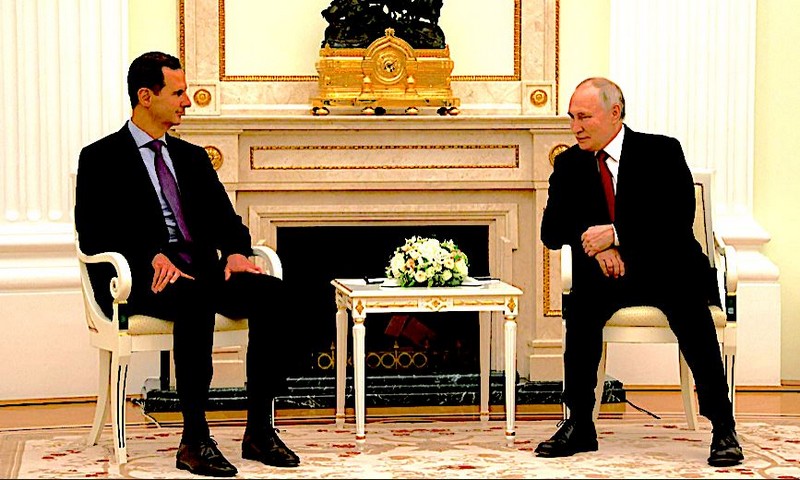
Russia quietly organized talks with both Saudi and Syrian officials and diplomats, culminating with the March 2023 visit of President Assad to Moscow, where the issue of a rapprochement with Saudi Arabia was finalized.

Work remains to be done, however, as Saudi Arabia’s effort to bring Syria back into the ranks of the Arab League faces resistance from staunch U.S. allies Jordan, Kuwait and Qatar. But the fact is that, thanks to Russian and Chinese diplomacy, peace, not war, is breaking out all over in the Middle East. Bringing Syria in from the cold is simply the most recent manifestation of the phenomena.

Scott Ritter was a US Marine Corps intelligence officer for 12 years. As a chief weapons inspector for the UN Special Commission in Iraq, he was labeled a hero by some, a maverick by others and a spy by the Iraqi government.

1 May 2023

Source: www.transcend.org

Western Media’s Peculiar Incuriosity about Nord Stream

By Jonathan Cook

Seymour Hersh’s investigation is filled with details that could be checked ­— and verified or rebutted — if anyone wished to do so. 

26 Apr 2023 – No one but the terminally naïve should be surprised that security services lie – and that they are all but certain to cover their tracks when they carry out operations that either violate domestic or international law or that would be near-universally rejected by their own populations.

Which is reason enough why anyone following the fallout from explosions last September that ripped holes in three of the four Nord Stream pipelines in the Baltic Sea supplying Russian gas to Europe should be wary of accepting anything Western agencies have to say on the matter.

In fact, the only thing that Western publics should trust is the consensus among “investigators” that the three simultaneous blasts deep underwater on the pipelines – a fourth charge apparently failed to detonate – were sabotage, not some freak coincidental accident.

Someone blew up the Nord Stream pipelines, creating an untold environmental catastrophe as the pipes leaked huge quantities of methane, a supremely active global-warming gas. It was an act of unrivaled industrial and environmental terrorism.

If Washington had been able to pin the explosions on Russia, as it initially hoped, it would have done so with full vigor. There is nothing Western states would like more than to intensify world fury against Moscow, especially in the context of NATO’s express efforts to “weaken” Russia through a proxy war waged in Ukraine.

Who Blew Up Nord Stream Pipelines? | A Mystery!

But, after the claim made the rounds of front pages for a week or two, the story of Russia destroying its own pipelines was quietly shelved. That was partly because it seemed too difficult to maintain a narrative in which Moscow chose to destroy a critical part of its own energy infrastructure.

Not only did the explosions cause Russia great financial harm — the country’s gas and oil revenues regularly financed nearly half of its annual budget — but the blasts removed Moscow’s chief influence over Germany, which had been until then heavily dependent on Russian gas. The initial media story required the Western public to believe that Russian President Vladimir Putin willingly shot himself in the foot, losing his only leverage over European resolve to impose economic sanctions on his country.

But even more than the complete lack of a Russian motive, Western states knew they would be unable to build a plausible forensic case against Moscow for the Nord Stream blasts.

Instead, with no chance to milk the explosions for propaganda value, official Western interest in explaining what had happened to the Nord Stream pipelines wilted, despite the enormity of the event.

That was reflected for months in an almost complete absence of media coverage.

When the matter was raised, it was to argue that separate investigations by Sweden, Germany and Denmark were all drawing a blank. Sweden even refused to share any of its findings with Germany and Denmark, arguing that to do so would harm its “national security.”

No one, again including the Western media, raised an eyebrow or showed a flicker of interest in what might be really going on behind the scenes. Western states and their compliant corporate media seemed quite ready to settle for the conclusion that this was a mystery cocooned in an enigma.

Isolated & Friendless

It might have stayed that way forever, except that in February, a journalist — one of the most acclaimed investigative reporters of the past half-century — produced an account that finally demystified the explosions. Drawing on at least one anonymous, highly placed informant, Seymour Hersh pointed the finger for the explosions directly at the U.S. administration and President Joe Biden himself.

Hersh’s detailed retelling of the planning and execution of the Nord Stream blasts had the advantage – at least for those interested in getting to the truth of what took place — that his account fitted the known circumstantial evidence.

Key Washington figures, from Biden to Secretary of State Anthony Blinken and his senior neoconservative official Victoria Nuland — a stalwart of the murky anti-Russian U.S.  meddling in Ukraine over the past decade — had either called for the destruction of the Nord Stream pipelines or celebrated the blasts shortly after they took place.

If anyone had a motive for blowing up the Russian pipelines — and a self-declared one at that — it was the Biden administration. They opposed the Nord Stream 1 and 2 projects from the outset – and for exactly the same reason that Moscow so richly prized them.

In particular, the second pair of pipelines, Nord Stream 2, which was completed in September 2021, would double the amount of cheap Russian gas available to Germany and Western Europe. The only obstacle in its path was the hesitancy of German regulators. They delayed approval in November 2021.

Nord Stream meant major European countries, most especially Germany, would be completely dependent for the bulk of their energy supplies on Russia. That deeply conflicted with U.S. interests. For two decades, Washington had been expanding NATO as an anti-Moscow military alliance embracing ever more of Europe, to the point of butting up aggressively against Russia’s borders.

The Ukrainian government’s covert efforts to become a NATO member — thereby destroying a long-standing mutual and fragile nuclear deterrence between Washington and Moscow — were among the stated reasons why Russia invaded its neighbor in February last year.

Washington wanted Moscow isolated and friendless in Europe. The goal was to turn Russia into Enemy No. 2 – after China – not leave Europeans looking to Moscow for energy salvation.

The Nord Stream explosions achieved precisely that outcome. They severed the main reason European states had for cozying up to Moscow. Instead, the U.S. started shipping its expensive liquified natural gas across the Atlantic to Europe, both forcing Europeans to become more energy dependent on Washington and, at the same time, fleecing them for the privilege.

But even if Hersh’s story fitted the circumstantial evidence, could his account stand up to further scrutiny?

Peculiarly Incurious

This is where the real story begins. Because one might have assumed that Western states would be queuing up to investigate the facts Hersh laid bare, if only to see if they stacked up or to find a more plausible alternative account of what happened.

Dennis Kucinich, a former chair of a U.S. congressional investigative subcommittee on government oversight, has noted that it is simply astonishing no one in Congress has been pushing to use its powers to subpoena senior American officials, such as the secretary of the Navy, to test Hersh’s version of events.

As Kucinich observes, such subpoenas could be issued under Congress’s Article One, Section 8, Clause 18, providing “constitutional powers to gather information, including to inquire on the administrative conduct of office.”

Similarly, and even more extraordinarily, when a vote was called by Russia at the United Nations Security Council late last month to set up an independent international commission to investigate the blasts, the proposal was roundly rejected.

If adopted, the U.N. secretary-general himself would have appointed expert investigators and aided their work with a large secretariat.

Three Security Council members, Russia, China and Brazil, voted in favor of the commission. The other 12 — the U.S. and its allies or small states it could easily pressure — abstained, the safest way to quietly foil the creation of such an investigative commission.

Excuses for rejecting an independent commission failed to pass the sniff test. The claim was that it would interfere with the existing investigations of Denmark, Sweden and Germany. And yet all three have demonstrated that they are in no hurry to reach a conclusion, arguing that they may need years to carry out their work. As previously noted, they have indicated great reluctance to cooperate. And last week, Sweden once again stated that it may never get to the bottom of the events in the Baltic Sea.

As one European diplomat reportedly observed of meetings between NATO policymakers, the motto is: “Don’t talk about Nord Stream.” The diplomat added: “It’s like a corpse at a family gathering. It’s better not to know.”

It may not be so surprising that Western states are devoted to ignorance about who carried out a major act of international terrorism in blowing up the Nord Stream pipelines, considering that the most likely culprit is the world’s only superpower and the one state that can make their lives a misery.

But what should be more peculiar is that Western media have shown precisely no interest in getting to the truth of the matter either. They have remained completely incurious to an event of enormous international significance and consequence.

It is not only that Hersh’s account has been ignored by the Western press as if it did not even exist. It is that none of the media appear to have made any effort to follow up with their own investigations to test his account for plausibility.

‘Act of War’

Hersh’s investigation is filled with details that could be checked ­— and verified or rebutted — if anyone wished to do so.

He set out a lengthy planning stage that began in the second half of 2021. He names the unit responsible for the attack on the pipeline: the U.S. Navy’s Diving and Salvage Center, based in Panama City, Florida. And he explains why it was chosen for the task over the U.S. Special Operations Command: because any covert operation by the former would not need to be reported to Congress.

In December 2021, according to his highly placed informant, National Security Advisor Jake Sullivan convened a task force of senior administration and Pentagon officials at the request of Biden himself. They agreed that the explosions must not be traceable back to Washington; otherwise, as the source noted: “It’s an act of war.”

The C.I.A. brought in the Norwegians, stalwarts of NATO and strongly hostile to Russia, to carry out the logistics of where and how to attack the pipelines. Oslo had its own additional commercial interests in play, as the blasts would make Germany more dependent on Norwegian gas, as well as American supplies, to make up the shortfall from Nord Stream.

By March last year, shortly after Russia’s invasion of Ukraine, the precise site for the attack had been selected: in the Baltic’s shallow waters off Denmark’s Bornholm Island, where the sea floor was only 260 feet below the surface, the four pipelines were close together and there were no strong tidal currents.

A small number of Swedish and Danish officials were given a general briefing about unusual diving activities to avoid the danger that their navies might raise the alarm.

The Norwegians also helped develop a way to disguise the U.S. explosive charges so that, after they were laid, they would not be detected by Russian surveillance in the area.

Next, the U.S. found the ideal cover. For more than two decades, Washington has sponsored an annual NATO naval exercise in the Baltic every June. The U.S. arranged that the 2022 event, Baltops 22, would take place close to Bornholm Island, allowing the divers to plant the charges unnoticed.

The explosives would be detonated through the use of a sonar buoy dropped by plane at the time of Biden’s choosing. Complex arrangements had to be taken to make sure the explosives would not be accidentally triggered by passing ships, underwater drilling, seismic events or sea creatures.

Three months later, on Sept. 26, the sonar buoy was dropped by a Norwegian plane, and a few hours later three of the four pipelines were put out of commission.

Disinformation Campaign

The Western media’s response to Hersh’s account has perhaps been the most revealing aspect of the entire saga.

It is not just that the establishment media have been so uniformly and remarkably reticent to dig deeper into making sense of this momentous crime — beyond making predictable, unevidenced accusations against Russia. It is that they have so obviously sought to dismiss Hersh’s account before making even cursory efforts to confirm or deny its specifics.

The knee-jerk pretext has been that Hersh has only one anonymous source for his claims. Hersh himself has noted that, as with other of his famous investigations, he cannot always refer to additional sources he uses to confirm details because those sources impose a condition of invisibility for agreeing to speak to him.

That should hardly be surprising when informants are drawn from a small, select group of Washington insiders and are at great risk of being identified — at great personal cost to themselves, given the U.S. administration’s proven track record of persecuting whistleblowers.

But the fact that this was indeed just a pretext from the establishment media becomes much clearer when we consider that those same journalists dismissive of Hersh’s account happily gave prominence to an alternative, highly implausible, semi-official version of events.

In what looked suspiciously like a coordinated publication in early March, The New York Times and Germany’s Die Zeit newspapers printed separate accounts promising to solve “one of the central mysteries of the war in Ukraine.” The Times headline asked a question it implied it was about to answer: “Who Blew Up the Nord Stream Pipelines?”

Instead, both papers offered an account of the Nord Stream attack that lacked much detail; and any detail that was supplied was completely implausible. This new version of events was vaguely attributed to anonymous American and German intelligence sources — the very actors, in Hersh’s account, responsible both for carrying out and covering up the Nord Stream blasts.

In fact, the story had all the hallmarks of a disinformation campaign to distract from Hersh’s investigation. It threw the establishment media a bone: the chief purpose was to lift any pressure from journalists to pursue Hersh’s leads. Now they could scurry around, looking like they were doing their job as a “free press” by chasing a complete red herring supplied by U.S. intelligence agencies.

Which is why the story was widely reported, notably far more widely than Hersh’s much more credible account.

So what did The New York Times’ account claim? That a mysterious group of six people had hired a 50-foot yacht and sailed off to Bornholm Island, where they had carried out a James Bond-style mission to blow up the pipelines. Those involved, it was suggested, were a group of “pro-Ukrainian saboteurs” — with no apparent ties to President Volodymyr Zelensky — who were keen to seek revenge on Russia for its invasion. They used fake passports.

The Times further muddied the waters, reporting sources that claimed some 45 “ghost ships” had passed close to the site of the explosion when their transponders were not working.

The crucial point was that the story shifted attention away from the sole plausible possibility, the one underscored by Hersh’s source: that only a state actor could have carried out the attack on the Nord Stream pipelines. The highly sophisticated, extremely difficult operation needed to be concealed from other states, including Russia that were closely surveilling the area.

Now the establishment media was heading off on a completely different tangent. They were looking not at states — and most especially not the one with the biggest motive, the greatest capability and the proven opportunity.

Instead, they had an excuse to play at being reporters, visiting Danish yachting communities to ask if anyone remembered the implicated yacht, the Andromeda, or suspicious characters aboard it, and trying to track down the Polish company that hired the sailing boat. The media had the story they preferred: one that Hollywood would have created, of a crack team of Jason Bournes giving Moscow a good slapping and then disappearing into the night.

Welcome Mystery

A month on, the media discussion is still exclusively about the mysterious yacht crew, though — after reaching a series of dead-ends in a story that was only ever meant to have dead-ends — establishment journalists are asking a few tentative questions. Though, let us note, most determinedly not questions about any possible U.S. involvement in the Nord Stream sabotage.

Britain’s Guardian newspaper ran a story early this month in which a German “security expert” wondered whether a group of six sailors was really capable of carrying out a highly complex operation to blow up the Nord Stream pipelines. That is something that might have occurred to a less credulous newspaper a month earlier when the Guardian simply regurgitated the Times’ disinformation story.

But despite the security expert’s skepticism, the Guardian is still not eager to get to the bottom of the story. It conveniently concludes that the “investigation” conducted by the Swedish public prosecutor, Mats Ljungqvist, will be unlikely ever to “yield a conclusive answer.”

Or as Ljungqvist observes: “Our hope is to be able to confirm who has committed this crime, but it should be noted that it likely will be difficult given the circumstances.”

Hersh’s account continues to be ignored by the Guardian — beyond a dismissive reference to several “theories” and “speculation” other than the laughable yacht story. The Guardian does not name Hersh in its report or the fact that his highly placed source fingered the U.S. for the Nord Stream sabotage. Instead, it notes simply that one theory — Hersh’s — has been “zeroing on a Nato Baltops 22 wargame two months before” the attack. 

It’s all still a mystery for The Guardian — and a very welcome one by the tenor of its reports.

The Washington Post has been performing a similar service for the Biden administration on the other side of the Atlantic. A month on, it is using the yacht story to widen the enigma rather than narrow it down.

The paper reports that unnamed “law enforcement officials” now believe the Andromeda yacht was not the only vessel involved, adding: “The boat may have been a decoy, put to sea to distract from the true perpetrators, who remain at large, according to officials with knowledge of an investigation led by Germany’s attorney general.”

The Washington Post’s uncritical reporting surely proves a boon to Western “investigators.” It continues to build an ever more elaborate mystery, or “international whodunnit,” as the paper gleefully describes it. Its report argues that unnamed officials “wonder if the explosive traces — collected months after the rented boat was returned to its owners — were meant to falsely lead investigators to the Andromeda as the vessel used in the attack.”

The paper then quotes someone with “knowledge of the investigation”: “The question is whether the story with the sailboat is something to distract or only part of the picture.”

How does the paper respond? By ignoring that very warning and dutifully distracting itself across much of its own report by puzzling whether Poland might have been involved too in the blasts. Remember, a mysterious Polish company hired that red-herring yacht.

Poland, notes the paper, had a motive because it had long warned that the Nord Stream pipelines would make Europe more energy dependent on Russia. Exactly the same motive, we might note — though, of course, The Washington Post refuses to do so — that the Biden administration demonstrably had.

The paper does inadvertently offer one clue as to where the mystery yacht story most likely originated. The Washington Post quotes a German security official saying that Berlin “first became interested in the [Andromeda] vessel after the country’s domestic intelligence agency received a ‘very concrete tip’ from a Western intelligence service that the boat may have been involved in the sabotage.”

The German official “declined to name the country that shared the information” — information that helpfully draws attention away from any U.S. involvement in the pipeline blasts and redirects it to a group of untraceable, rogue Ukraine sympathizers.

The Washington Post concludes that Western leaders “would rather not have to deal with the possibility that Ukraine or allies were involved.” And, it seems the Western media — our supposed watchdogs on power – feel exactly the same way.

‘Parody’ Intelligence

In a follow-up story in early April, Hersh revealed that Holger Stark, the journalist behind Die Zeit’s piece on the mystery yacht and someone Hersh knew when they worked together in Washington, had imparted to him an interesting additional piece of information divulged by his country’s intelligence services.

Hersh reports:

“Officials in Germany, Sweden, and Denmark had decided shortly after the pipeline bombings to send teams to the site to recover the one mine that has not gone off. [Holger] said they were too late; an American ship had sped to the site within a day or two and recovered the mine and other materials.”

Holger, Hersh says, was entirely uninterested in Washington’s haste and determination to have exclusive access to this critical piece of evidence: “He answered, with a wave of his hand, ‘You know what Americans are like. Always wanting to be first.’” Hersh points out: “There was another very obvious explanation.”

Hersh also spoke with an intelligence expert about the plausibility of the mystery yacht story being advanced by the New York Times and Die Zeit. He described it as a “parody” of intelligence that only fooled the media because it was exactly the kind of story they wanted to hear. He noted some of the most glaring flaws in the account:

“Any serious student of the event would know that you cannot anchor a sailboat in waters that are 260 feet deep’ – the depth at which the four pipelines were destroyed – ‘but the story was not aimed at him but at the press who would not know a parody when presented with one.”

Further:

“You cannot just walk off the street with a fake passport and lease a boat. You either need to accept a captain who was supplied by the leasing agent or owner of the yacht, or have a captain who comes with a certificate of competency as mandated by maritime law. Anyone who’s ever chartered a yacht would know that.’ Similar proof of expertise and competence for deep sea diving involving the use of a specialized mix of gases would be required by the divers and the doctor.”

And:

“How does a 49-foot sailboat find the pipelines in the Baltic Sea? The pipelines are not that big and they are not on the charts that come with the lease. Maybe the thought was to put the two divers into the water’– not very easy to do so from a small yacht – ‘and let the divers look for it. How long can a diver stay down in their suits? Maybe fifteen minutes. Which means it would take the diver four years to search one square mile.”

The truth is that the Western press has zero interest in determining who blew up the Nord Stream pipelines because, just like Western diplomats and politicians, media corporations don’t want to know the truth if it cannot be weaponized against an official enemy state.

The Western media are not there to help the public monitor the centers of power, keep our governments honest and transparent, or bring to book those who commit state crimes. They are there to keep us ignorant and willing accomplices when such crimes are seen as advancing on the global stage the interests of Western elites – including the very transnational corporations that run our media.

Which is precisely why the Nord Stream blasts took place. The Biden administration knew not only that its allies would be too fearful to expose its unprecedented act of industrial and environmental terrorism but that the media would dutifully line up behind their national governments in turning a blind eye.

The very ease with which Washington has been able to carry out an atrocity — one that has caused a surge in the cost of living for Europeans, leaving them cold and out of pocket during the winter, and added considerably to existing pressures that have been gradually de-industrializing Europe’s economies — will embolden the US to act in equally rogue ways in the future.

In the context of a Ukraine war in which there is the constant threat of a resort to nuclear weapons, where that could ultimately lead should be only too obvious.

Jonathan Cook is an award-winning British journalist based in Nazareth, Israel, since 2001.

1 May 2023

Source: www.transcend.org

US Corporations Cash in on Ukraine’s Oil and Gas

By Ben Norton

As Ukraine sells off public assets in a privatization spree, US fossil fuel corporations like ExxonMobil, Chevron, and Halliburton are in talks to run its oil and gas industry, and the IMF is imposing the Washington Consensus.

28 Apr 2023 – As the war in Ukraine drags on, the government is selling off state assets in a big privatization spree.

US fossil fuel corporations like ExxonMobil, Chevron, and Halliburton are participating in discussions to take over the Eastern European nation’s oil and gas industry, as Kiev pushes to increase production to replace Russian energy exports.

This comes soon after Ukraine’s Western-backed leader, Volodymyr Zelensky, sent a friendly video message to a US corporate lobby group, thanking companies like BlackRock, JP Morgan, Goldman Sachs, and Starlink, and promising “big business” for others.

In September, Zelensky also symbolically opened the New York Stock Exchange, announcing that his country is “open for business”, offering more than $400 billion in “public-private partnerships, privatization, and private ventures” for US companies.

US corporations cash in on Ukraine’s oil and gas

The Ukrainian government has used the war as an excuse to ram through some of the most aggressive anti-worker laws on Earth.

The director of the Kiev-based workers’ rights NGO Labor Initiatives warned of a “full-scale attack on Ukraine’s labour rights”, writing in a German government-funded journal that the “war cannot be used to justify stripping workers of their rights”.

In an attempt to bring an end to this war, China has taken the lead in advocating peace talks. Brazil’s President Lula da Silva has backed Beijing’s efforts.

The West, on the other hand, has vociferously opposed all attempts at diplomatic negotiations and instead pushed to escalate the NATO proxy war on Russia, sending fighter jets and tanks to Kiev.

Ukrainian officials, meanwhile, are treating their country as a for-profit company, frequently travelling to the United States in search of lucrative business opportunities.

Ukraine’s state energy company Naftogaz woos US corporations, like Iraq War profiteer Halliburton

The CEO of Ukraine’s state-owned energy company Naftogaz, Oleksiy Chernyshov, flew to Washington, DC this April to meet with US political and corporate officials.

The Financial Times reported that Chernyshov sat down with representatives from ExxonMobil and Halliburton, following a similar meeting with Chevron in January.

“The negotiations with big US fossil fuel players are part of a strategic push to increase natural gas production that Ukrainian officials believe could help replace Russian supply to Europe in the years ahead”, the newspaper wrote.

Halliburton is notorious for its involvement in corruption schemes, involving fat government contracts. In 2017, it was fined $29.2 million by the US Securities and Exchange Commission for violating the Foreign Corrupt Practices Act with highly profitable oilfield services contracts in Angola.

Halliburton is also the world’s biggest provider of fracking services, or hydraulic fracturing, a controversial form of gas extraction that is so environmentally destructive it was banned in the United Kingdom.

Responding to the Financial Times report, economist Yanis Varoufakis, who previously served as Greece’s minister of finance, tweeted: “And there you have it. EXXON, HALLIBURTON & CHEVRON, after Iraq, are now taking over the Ukrainian oil and gas fields. Planning to introduce large scale fracking – a clear and present threat to poison U’s agriculture”.

Chernyshov, the CEO of Ukraine’s state energy company Naftogaz, told the newspaper, “We want them [Halliburton] to expand [their presence] dramatically. We want them there seriously — boots on the ground”.

“We will welcome them”, he added. “We can do joint production on gas together, PSA agreement — production sharing agreement — they can have a licence and produce by themselves, we will welcome it”.

In November, the president of Halliburton in the eastern hemisphere, Joe Rainey, travelled to Ukraine to meet with Chernyshov.

Naftogaz published a press release on its website boasting that it “is strengthening its strategic cooperation with American’s Halliburton, one of the world’s largest oilfield services providers, to unlock the new potential of Ukraine’s fields”.

“Your support and visit to Kyiv is a powerful signal for the entire market and the world”, Chernyshov said. “I am grateful to the US government, the American people and you personally for your comprehensive support of Ukraine. We really appreciate it. Our cooperation is extremely important and we are doing our best to improve and expand it”.

Halliburton was a household name in the United States in the 2000s, and was practically synonymous with corruption.

Vice President Dick Cheney, who served under former President George W. Bush, had worked for years as chairman and CEO of Halliburton.

Cheney, a hardline neoconservative, was a key architect of the illegal US invasion of Iraq in 2003. That same year, Halliburton was given what NPR described as a “‘sweetheart’ deal in Iraq”.

NPR wrote:

Oil services company Halliburton has come under intense scrutiny over its multi-billion-dollar contracts with the U.S. military in Iraq. Congressional critics want to know if the company is engaging in gold-plating contractsinflating costs and pocketing the difference. Other critics charge that Halliburton has seemingly become another branch of the U.S. military, while the company’s former chief executive officer, Dick Cheney, is now the vice president.

In the first of a three-part series looking at the complex relationship between the defense contractor and the federal government, NPR’s John Burnett examines the scope of contracts in Iraq held by Halliburton subsidiary Kellogg, Brown & Root, better known as KBR.

America’s war on terrorism has created a windfall for KBR. Since Sept. 11, 2001, the company has constructed base camps at more than 60 locations throughout the Middle East and South Asia. Under its deal with the Pentagon — known as a “Logcap” contract — KBR is the go-to company to provide troops in Iraq with everything from portable toilets to Internet cafes.

A decade later, the International Business Times reported that Halliburton subsidiary KBR had received more Iraq-related contracts than any other private firm in the 10 years of the war.

The media outlet reported:

The company [KBR] was given $39.5 billion in Iraq-related contracts over the past decade, with many of the deals given without any bidding from competing firms, such as a $568-million contract renewal in 2010 to provide housing, meals, water and bathroom services to soldiers, a deal that led to a Justice Department lawsuit over alleged kickbacks.

Ukraine Eyes Natural Gas Deposits off Crimea

Benjamin Norton is an investigative journalist, analyst, writer and filmmaker. He is the founder and editor of Multipolarista and is based in Latin America.

1 May 2023

Source: www.transcend.org