Just International

Massive White House Protest Against Endless Wars

By Phil Pasquini

WASHINGTON (03-20) – Anti-war protesters demonstrated across the country yesterday on the 20th anniversary of the invasion of Iraq and the ensuing war. Across from the White House in Lafayette Square protesters heard speakers condemning America’s “eternal wars” and called for a reduction in the Pentagon budget, an end to the war in Ukraine through negotiations and cautioning against a war with Iran and China.

The devastating war in Iraq resulted in a more fragmented sectarian society divided in political ideology and religious differences, a growing ground for ISIS and environmental damage that will devastate the country for decades to come. In the end the net gain for Iraq in replacing Saddam Hussein and his Baathist Party has bred more corruption and violence and less of the hoped for democracy the war was supposed to install to the benefit of the Iraqi people. Instead, the fight over oil has set the country back decades in its development while driving masses into poverty.

As one speaker noted, “Two decades later, here we are, rallying around the country working to stop yet another terrible and senseless war.” And frighteningly the risk of a catastrophic nuclear war resulting by a tiny miscalculation or seemingly minor incident between the US, Russia or China is now more probable now than any time since the Cuban Missile Crisis of 1962.

“We need negotiations. We need sane, diplomatic, ‘rules-based,’ resolution of conflicts. We need sustainable self-governance free from imperial agendas” was the common demand from organizers of the protest. The Answer Coalition, the People’s Forum, Code Pink and World Beyond War all resonated in their calling for, “… a ceasefire and No War in China.”

After hearing from several speakers, protesters carrying six coffins representing victims from countries that the US has had recent conflicts in, marched a short distance to the White House where they called on President Biden to end the endless wars. Signs held aloft called for an end of the NATO alliance along with those critical of military weapons manufactures and other war profiteers. Included too were the banks that continually have funded and profiteered from war at the expense of raising the national debt and causing ongoing inflation. Other signs called for negotiating peace in Ukraine and echoing the common theme of No War with China.

The large group’s next stop on their march was at the headquarters of the Washington Post Building that they referred to as “The Pentagon Post” for the paper’s “unwavering support for war.” This they also accused of mainstream media as well for their lack of questioning the need to continually use military might rather than negotiations and diplomacy in avoiding conflict.

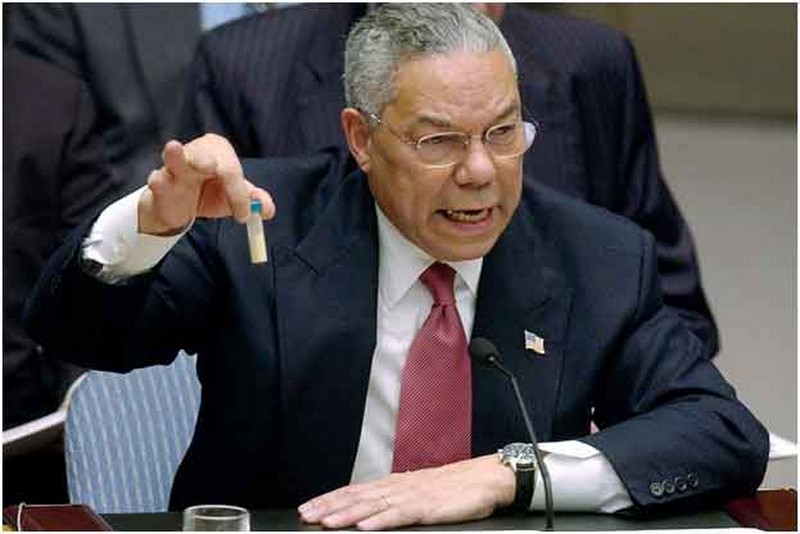
At the Post building protesters blocked the entrance with the coffins to shut the building down while a speaker enumerated their views of the paper along with its editorial staff challenging them to report on their demonstration. Also addressed was the mainstream media’s drumbeat to war with Iraq twenty years ago by reflecting on their “outright lie” fed to them by the Pentagon that Saddam had WMDs and portable biological labs capable of changing the very nature of conflict that ultimately proved to be untrue. Or as one protester who was quoted in a press release reflected, “As a new anti-war activist,… I was sitting on my couch eating Cheetos and even I knew Bush and Powell were lying.”

It may well be remembered too that the then well-known and respected New York Time reporter Judith Miller was fired from the paper that according to an article in the Daily Beast from 2015 occurred after she admitted that her “WMD stories were ‘totally wrong.’” She furthered with characterizing herself, “albeit unavoidably so—mistakes committed in good faith by a truth-seeking journalist working hard to do her best.” Her response “…was demonized by critics and enemies, inside and outside the Times, as an influential cheerleader for an unjustified and ultimately ruinous war conducted under false pretenses.”

After departing the Post building the protesters marched off to the New York Avenue Presbyterian Church near the White House where the rally ended.

Report and photos by Phil Pasquini

20 March 2023

Source: countercurrents.org

Algeria’s Gas vs. Rightwing Ideology: Will Italy Change Its Position on Jerusalem?

By Romana Rubeo and Ramzy Baroud

When Israeli Prime Minister Benjamin Netanyahu left Tel Aviv for Rome on March 9, he was flown to Ben Gurion airport in Tel Aviv by a helicopter because anti-government protesters blocked all the roads around it.

Netanyahu’s visit was not met with much enthusiasm in Italy, either. A sit-in was organized by pro-Palestine activists in downtown Rome under the slogan, ‘Non sei il benvenuto’ – ‘You Are Not Welcome’. An Italian translator, Olga Dalia Padoa, also refused to translate his speech at a Rome synagogue, which was scheduled for March 9.

Even Noemi Di Segni, President of the Union of Italian Jewish Communities, though unsurprisingly reiterating her love and support for Israel, expressed her concern for Israeli state institutions.

Back in Tel Aviv, Netanyahu’s trip to Italy was slammed by Israeli opposition leader Yair Lapid as “a wasteful and unnecessary weekend on the country’s dime”. But Netanyahu’s trip to Italy had other goals, aside from spending a weekend in Rome or distracting from the ongoing protests in Israel.

In an interview with the Italian newspaper La Repubblica, published on March 9, the Israeli prime minister explained the lofty objectives behind his trip to Italy. “I would like to see more economic cooperation,” he said. “We have natural gas: we have plenty of it and I would like to talk about how to bring it to Italy to support its economic growth.”

In recent weeks, Italian Prime Minister Giorgia Meloni has shuttled between several countries in search of lucrative gas contracts. Not only does Meloni want to secure her country’s need for energy following the Russia-Ukraine crisis, but she wants Rome to be a major European hub for gas imports and exports. Israel knows this, and is particularly wary that Italy’s major gas deals in Algeria on January 23 could undermine Israel’s economic and political position in Italy, as Algeria continues to serve as a bulwark of Palestinian solidarity throughout the Middle East and Africa.

Netanyahu had other issues on his mind, aside from gas. “On the strategic front, we will discuss Iran. We must prevent it from going nuclear because its missiles could reach many countries, including Europe, and no one wants to be taken hostage by a fundamentalist regime with a nuclear weapon,” Netanyahu said with the usual fear-mongering and stereotypical language pertaining to his enemies in the Middle East.

Netanyahu has two main demands from Italy: not to vote against Israel at the United Nations and, more importantly, to recognize Jerusalem as the capital of Israel. Though East Jerusalem is recognized by the international community as an occupied Palestinian city, Netanyahu wants Rome to change its position, which is consistent with international law, based on the flimsy logic of the “strong and ancient tradition between Rome and Jerusalem”.

Using the same logic, that of natural resources and arms exports in exchange for political allegiance to Israel at the UN, Netanyahu has achieved much success in normalizing ties between his country and many African nations. Now, he is applying the same modus operandi to Italy, a European power and the world’s ninth-largest economy.

Whether this strategy is an outcome of the growing subservience of Europe to Washington and Tel Aviv, or Netanyahu’s own failure to appreciate the changing geopolitical dynamics around the world, is a different matter. But what is clear is that Netanyahu has perceived Italy as a country in desperate need of Israeli help. During the meeting with Meloni, Netanyahu promised to make Italy a gas hub for Europe and help Rome solve its water issues, while Meloni, for her part, reiterated that “Israel is a fundamental partner in the Middle East and at a global level”.

The most enthusiastic response to Netanyahu’s visit, however, came from far-right Italian Minister of Infrastructure, Matteo Salvini, who strongly backed the Israeli call to recognize Jerusalem as its capital “in the name of peace, history and truth”. This response, although inconsistent with Italian foreign policy, was hardly a surprise. The leader of the La Lega party has often been criticized for his racist language in the past. Salvini, however, was ‘reformed’ in recent years, especially following a visit to Israel in 2018, where he declared his love for Israel and criticism of Palestinians. It was then that Salvini began rising in the mainstream, as opposed to regional, Italian politics.

But this is not Salvni’s position alone. The Italian government welcomed Netanyahu’s visit without making a single criticism of his far-right government’s extremist policies carried out in Occupied Palestine. While this position is in line with Italian foreign policy, it is hardly surprising from an ideological point of view, as well.

Although Italian politics, in the past, showed great solidarity with the Palestinian people’s struggle for liberation and right of self-determination – thanks to the revolutionary forces that had a tremendous impact on shaping the Italian political discourse during World War II and the country’s subsequent liberation from fascism – that position shifted throughout the years. As Italy’s own politics itself reared towards the Right, its foreign policy agenda in Palestine and Israel completely moved towards a pro-Israel stance. Those now perceived to be pro-Palestine in the Italian government are a few, and are often branded as radical politicians.

However, despite the official pro-Israel discourse in Italy, things for Netanyahu are not as easy as they may appear, especially when it comes to recognizing Jerusalem as Israel’s capital.

Indeed, Meloni did not express an outright commitment to the Israeli demand. To the contrary, in an interview with Reuters last August, even before becoming Italy’s prime minister, Meloni seemed cautious, merely stating that this is “a diplomatic matter and should be evaluated together with the foreign ministry”.

There is a reason behind Meloni’s hesitation. Italy’s recognition of Jerusalem as Israel’s capital would place Rome outside the consensus of international law. In an open letter to Meloni, United Nations Special Rapporteur, Francesca Albanese, reminded the Italian government that the recognition of Jerusalem as Israel’s capital would constitute a stark violation of international law.

Italy’s foreign policy is also accountable to the collective policies of the European Union, of which Rome is an integral member. The EU supports the UN’s position that East Jerusalem is an occupied Palestinian city and that Israel’s annexation of the city in 1980 is illegal.

Moreover, Italy’s recent landmark deal with Algeria’s state-owned gas company, Sonatrach, in January, makes it particularly difficult for Rome to take an extreme position in support of Israel. The delicate geopolitical balances resulting from the gas crisis, itself a direct outcome of the Russia-Ukraine war, make any shifts in Italian foreign policy on Palestine and Israel akin to an act of self-harm.

For Italy, at least for now, Arab gas is far more important than anything that Netanyahu could possibly offer. The new Rome-Algiers deal would grant Italy 9bn cubic meters of gas, in addition to the gas supply already flowing through the TransMed pipeline, ‘BNE Intellinews’ reported. This vital infrastructure connects Algeria to Italy via Sicily which, in turn, flows through pipelines under the Mediterranean Sea. “The expansion of these vital routes has already been planned, aiming to augment the current capacity of 33.5 bcm per year,” the business news website added.

Meloni, although a far-right politician with no particular affinity or respect for established international norms, understands that economic interests trump ideology. “Today Algeria is our first gas supplier”, Meloni said in a press conference in Algiers after signing the agreement. The deal, she said, would supply the country with “an energy mix that could shield Italy from the ongoing energy crisis”.

Such a fact would make it impossible for Italy to deviate, at least for now, from its current position regarding Jerusalem, and the illegality of the Israeli occupation of Palestine. While Israel would find it difficult to persuade Italy to change its position, Algeria, Tunisia and other Arab countries might finally find an opening to dissuade Italy from its blind support of Israel.

Romana Rubeo is an Italian writer and the managing editor of The Palestine Chronicle. Her articles appeared in many online newspapers and academic journals.

Dr. Ramzy Baroud is a journalist, author and the Editor of The Palestine Chronicle. He is the author of six books.

21 March 2023

Source: countercurrents.org

Paul Keating’s criticism of Australia’s AUKUS deal is damming but not “astonishing”, – in fact, timely!

By M Adil Khan

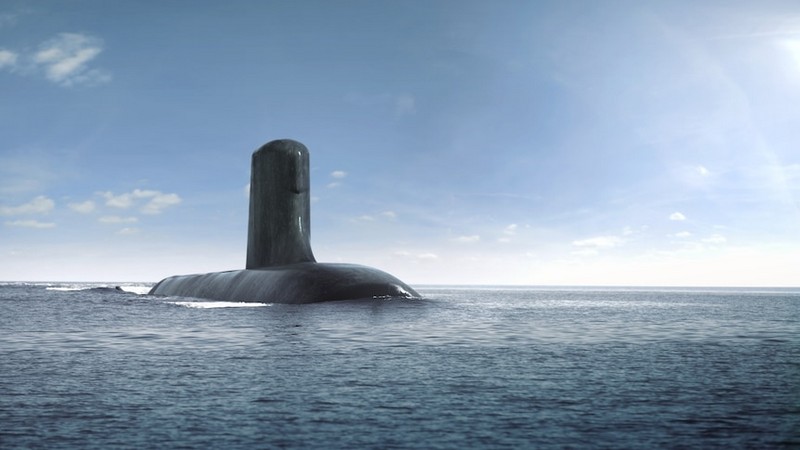
On March 14, 2023 Australian Prime Minister Anthony Albanese stood side by side with the British Prime Minister Rishi Sunak and the US President Joe Biden at a Naval base in San Diego, USA and signed off the next phase of AUKUS deal, where Australia will purchase three nuclear powered submarines.  which would be based in Australia. According to the Australian government press release three leaders affirmed that the “trilaterally-developed submarine based on the United Kingdom’s next-generation design that incorporates technology from all three nations, including cutting edge U.S. submarine technologies.” is “a new security partnership [between Australia, UK and USA] that will promote a free and open Indo-Pacific that is secure and stable.”[1]

Following the above announcement, Australia’s former Labor government Prime Minister, Mr. Paul Keating strongly criticised the deal at a press briefing held on March 15, 2023, at the National Press Club in Canberra, Australia implying that the deal would do more harm than good to Australia.[2]

One of Australia’s leading media outlets, the SBS news, has termed Mr. Keating’s criticisms of AUKUS, “astonishing.”[3]

The Prince of Denmark

True, Mr. Keating’s response to the AUKUS, a deal which has been endorsed by the Australia’s Labor Party (ALP) government and a deal which was inked by its predecessor, the Liberal/National Party (the LNP) government, Labor’s supposed ideological rival, has indeed been scathing, but by no means, “astonishing.”

A deal, such as that of AUKUS, which has significant security and economic ramifications for Australia should have been discussed in much greater detail, within and outside the parliament, before it was inked. But was not.

By dissecting the deal in terms in of its security and economic implications and by the way, in a globalized economic system security and economic dimensions are interlinked, and by exposing the deal’s pros and cons for Australia, mostly cons, Mr. Keating in fact, has done Australia a favour. Mr. Keating played the Prince of Denmark, “be cruel to be kind”.

“Anglosphere” affinities

Australia, a country which happens to be in an ethnically varied and demographically daunting neighbourhood and a region from which it derives most of its economic benefits, needed to carefully weigh its foreign and security policies and in a manner that responded more practically and sensitively to the changing geoeconomics and geopolitics.

After all, the world is on the move where the old unipolar order is fracturing, giving way to a new multipolar world. If we can’t see it we are either doping or cerebrally challenged.

Mr. Keating, a man of exceptional vision is among few in Australia who has had the crystal ball in hand, who clearly saw these changes decades ago and acted to bring Australia closer to the region and not push it away. Thus he is fully aware of the danger the AUKUS deal poses to Australia, a deal which according to him fulfills the agenda of the “old colonial masters” and not Australia’s and a deal which is likely to be viewed by the Australia’s neighbours especially by China, an important trading partner, as “..an arms race in the Indo-Pacific, with a Cold War mentality” and a return “…to our former colonial master, Britain.”

To many in the Asia/Pacific region where Australia is physically located, the AUKUS deal revives bad memories. They see AUKUS, an initiative that seeks “security in and within the Anglosphere”, as revival of a hegemonic nexus that once colonised, waged wars and devasted their countries.

It was not that long ago that Australia, partnered with the US in all of wars for example, in Vietnam, Korea, Iraq, Syria, and Afghanistan – all illegal and immoral wars and all contributed to massacre of hundreds and thousands of their people, men, women and children and destroyed their countries.

However, The Albanese government defends AUKUS by saying “a really exciting opportunity for Australia” which do not pose threats to none let alone China and assures that AUKUS is a deterrent against future threats and not for attacking anyone.

However, Mr. Keating has trashed Labor government’s justification for the submarines as “rubbish” and warned of the dangera of installing a military facility in Australia that has the potential to intimidate, the “mighty” China, the unannounced but the real target of the submarines.

“Mighty” China

We all know and should know by now that China is no more Seventy’s impoverished poverty-stricken China that we once were familiar with. Nor is China, what we see in our China Towns – a great place to have cheap noodle soup, served by petit and polite waitresses!

China has progressed vastly – economically, technologically and military and reportedly, has outpaced the West, in certain aspects, apparently, in military arsenals.

Until recently, and thanks to Mr. Keating’s pro-China interventions during his time as the Treasurer and later as the Prime Minister of Australia, China became a major trading partner of Australia. AUKUS may be changing all that because China views the initiative a “path of error and danger.”

Gazing at the mirror

Several decades ago, during the Keating era especially at a time when Mr. Keating was aggressively promoting the idea that Australia is a part of Asia, mainly to benefit from Asia’s rising wealth, he apparently drew a map of Asia where he showed Australia as Asia’s part.

Around this time an Australian journalist who was based in Kuala Lumpur showed the map to Dr. Mahathir Muhammad, then the Prime Minister of Malaysia, to convince him that despite his contrary thoughts, Australia sees itself as part of Asia. However, typical of Mr. Mahathir who never missed an opportunity to insult Australia, retorted by saying, “To find out whether you Australians are Asians or not, do not look at the map, look at the mirror.”

Despite such antagonisms from some of the Asian leaders who refused to accept Australia as part of Asia Mr. Keating continued to persist with success, his mission of integrating Australia with Asia and the result has been that all parties gained, Australia more – two thirds of Australia’s exports go to Asia, bulk of it to China.

Sadly, the current political bunch, both LNP and Labor, don’t seem to see the picture and by embracing AUKUS seem to have embraced Mr. Mahathir’s advice – they are making policies by gazing at the mirror and not at the map, nor the economic and geopolitical realities of the day.

“Run by the military”

Mr. Keating also suspects that Australia’s sudden shift towards “Anglospheric” hegemonic security policy may be because presently, Australia’s foreign policy is “run by the military” and not by the foreign office. If true, this is ominous.

A story from the Indian sub-continent may explain better the harm the control of national policies, foreign or otherwise, by the military causes to a nation.

In 1974, in the aftermath of the 1971 Pakistan army’s defeat at the hands of the Indian Army and the Bangladesh liberation forces that led to the dismemberment of Pakistan and emergence of its erstwhile eastern wing into Bangladesh as an independent state, Mr. Tariq Ali, the Pakistan born-British political activist conducted an interview of Mrs. Indira Gandhi, the then Prime Minister of India at her office in New Delhi.[4]

During the interview Mr. Tariq Ali while reflecting on how the arrogant and myopic policies of the Pakistan army who at the time ran the country, contributed to a civil conflict, and led to the break-up of Pakistan, told Mrs. Gandhi that “Pakistan’s problem is that our Generals are stupid.” To this Mrs. Gandhi apparently replied saying, “Mr. Ali, how about I share one of my own experiences of an encounter with one of our Generals. You see, in 1971 when Pakistan army surrendered and East Pakistan was gone, our Chief of Army Staff, General Sam Manekshaw came up to me and said, ‘Madam Prime Minister, East Pakistan is gone, and we are also deeply inside in several parts of West Pakistan. If you order we can march into Islamabad, Pakistan’s capital city in 24 hours and take over rest of Pakistan.” After listening to General Manekshaw’s ambitious idea, Mrs. Gandhi told the General “General, why don’t you give me 24 hours to make the decision.” Mrs. Gandhi then called an emergency cabinet meeting and informed her cabinet colleagues of General’s idea. The Cabinet was unanimous in their response, “absolutely not”.  Mrs. Gandhi then turned to Tariq Ali and said, “you see when it comes to stupidity our Generals and your Generals are not different, they are all stupid. The only difference is that unlike Pakistan, Generals in India do not make policies.”

If Mr. Keating’s suspicion is correct that Australia’s military has taken over the running of the Australia’s foreign policy and in the process, weaponizing diplomacy, then it indeed is deeply concerning.

Given China’s formidable military might and its readiness to act in “self-defence” an attack or even a threat, is likely to be greeted with vicious venom. China is likely to respond with its newly acquired arsenals which most certainly would rain on Australia, the AUKUS bloke and not on those who would have had the cheque in their hands by then and thousands of kilometres away relaxing with the, “the band playing!”

“Dig two graves” – Confucius

Finally, since AUKUS is aimed at China (regardless of official denials, let us not kid ourselves – the target of submarines is China), it may also not be a bad idea to take a lesson or two from China itself to prepare against repercussions.

Confucius, one of China’s wisest men once said, “if you are planning for a revenge against an enemy, dig two graves – one for the enemy and one for yourself.”

Since China never considered Australia as an enemy and thus have no need to dig a grave. However as Australia has made China its target, it may need one and given that the AUKUS deal, the submarines, would cost Australian taxpayers $368.0 billion upfront to procure and billions annually to maintain including the costs and hazards of storage of fuel wastes and furthermore, as the deal would most certainly wreak the decades-long vital trade and investment ties between the two countries which most certainly would hurt Australia more than China, it is conceivable that Australia has already commenced digging its grave!

The author is a Professor (Adjunct) at the School of Social Sciences, University of Queensland, Australia, and former senior policy manager of the United Nations

[1] https://www.pm.gov.au/media/joint-leaders-statement-aukus

[2] https://www.youtube.com/watch?v=VmgxAoa1n-8

[3] https://www.sbs.com.au/news/article/former-colonial-master-paul-keating-launches-astonishing-attack-on-labor-aukus-deal/we38qsi9s

[4] Can Pakistan Survive?: The Death of a State (1983). ISBN 978-0-8052-7194-2; (1991) ISBN 978-0-86091-260-6

21 March 2023

Source: countercurrents.org

From Balloons to AUKUS: The War Drive Against China

By Dr Binoy Kampmark

When will this hate-filled nonsense stop?  Surveillance balloons treated like evocations of Satan and his card-carrying followers; other innumerable unidentified phenomena that, nonetheless, remain attributable in origin, despite their designation; and then the issue of spying cranes.  In the meantime, there has been much finger pointing on the culprit of COVID-19 and the global pandemic.  Behold the China Threat, the Sino Monster, the Yellow Terror.

In this atmosphere, the hawkish disposition of media outlets in a number of countries in shrieking for war is becoming palpable.  The Fairfax press in Australia gave a less than admirable example of this in their absurd Red Alert series, crowned by crowing warmongers warning Australia to get ready for the imminent confrontation.  The publications were timed to soften the public for the inevitable, scandalous and possibly even treasonous announcement that the Australian government would be spending A$368 billion in local currency on needless submarines against a garishly dressed-up threat backed by ill-motivated allies.

For days, the Australian press demonstrated a zombie-like adherence to the war line that had been fed by deskbound generals no doubt suffering from piles and deranged civilian strategists desperate to justify their supper.  It is a line that always assumes the virtue of war; that going into battle, much like US President Theodore Roosevelt thought, will always outdo the tedium of peace in a haze of phosphorescent glory.  It is only in the morgues and the crowded cemeteries that we find a worthy patriotism.  Go out and kill, you noble sons and daughters.  Do your nation proud, however stupidly.

The desperation of such a measure is also a reflection of how public opinion rejects the war drive.  In a 2022 poll by the Lowy Institute think tank, 51% of Australians said they preferred their country to remain “neutral” in a conflict between the US and China over Taiwan.  This was not a bad return, given the repetitious insistence by various Australian government ministers that joining a war with the United States over Taiwan was simply assumed.

In the US, the Wall Street Journal was also doing much the same thing, plumping for great power competitions that can only end badly, rather than great power cooperation which, when it goes well, spares us the body bags, the funerals and the flag fluttering.

The introductory note of one article in that Rupert Murdoch-owned organ was not encouraging.  “Since 2018, the [US] military has shifted to focus on China and Russia after decades fighting insurgencies, but it still faces challenges to produce weapons and come up with new ways of waging war.”

The obsession with war scenarios rather than diplomatic ones is hardening.  It elevates the game to level pegging with peace overtures.  In fact, it goes further, suggesting that such measures are to be frowned upon, if not abandoned in their entirety.  Rather than considering discussions with China, for instance, on whether some rules of accommodation and observance can be made, the attitude from Washington and its satellites is one of excoriation, taking issue with any restrictions on the growth of the US defence complex.  Acid observations are reserved for the Budget Control Act of 2011, which supposedly “hampered initiatives to transform the military, including on artificial intelligence, robotics, autonomous systems and advanced manufacturing.”

As defence analyst William Hartung writes, the Pentagon has never been short of cash in its pursuits, though it has been more than wasteful, obsessed with maintaining a global military presence spanning 750 bases and 170,000 overseas troops, not to mention the madness of shovelling $2 billion into developing a new generation of nuclear weapons.  Far from encouraging deterrence, this is bound to “accelerate a dangerous and costly arms race.”

The same must be said of AUKUS, the triumvirate alliance that is already terrifying several powers in the Indo-Pacific into joining the regional arms race.  Here we see, yet again, the Anglosphere enthralled by protecting their possessions and routes of access, directly or indirectly held.

In the red mist of war, lucid voices can be found.  Singaporean diplomat and foreign policy intellectual Kishore Mahbubani is one to offer a bracing analysis in observing that China is hardly going to undermine the very order that has benefitted it. The Chinese, far from wishing to upend the rules-based system with thuggish glee, saw it as a gift of Western legal engineering.  “So the paradox about the world today is that even though the global rules based order is a gift of the west, China embraces it.”

He also has this to say about the US-China relationship. “China has been around for 5,000 years. The United States has been around for 250 years. And it’s not surprising that a juvenile like the United States would have difficulty dealing with a wiser, older civilisation”.

Mahbubani, ever wily but also penetratingly sharp, also offers a valuable point: that the notion of a remarkable weapon (the nuclear-propelled submarine is not so much remarkable as cumbersomely draining and costly) must surely come a distant second to the attainment of economic prosperity.  “Submarines are stealthy, but trade is stealthier,” he writes with a touch of serene sagacity. Both provide security, in a fashion: the former in terms of raw deterrence; the latter in terms of interdependence – but the kind of security created by trade, he is adamant, “lasts longer”.  To date, that realisation seems to have bypassed the AUKUS troika.

Dr. Binoy Kampmark was a Commonwealth Scholar at Selwyn College, Cambridge.  He currently lectures at RMIT University.

21 March 2023

Source: countercurrents.org

In memory of 20th anniversary of the Iraq War

By Harsh Thakor

Invasion of Iraq and Crisis of American capitalism

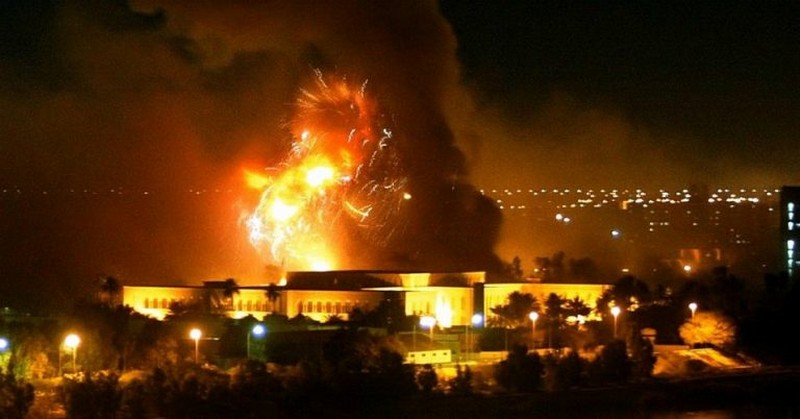
The War of Iraq by the United States is an event that will be inscribed in black letters forever. Hundreds of millions of people in every part of the world revolted to the bloodbath of a merciless military power shattering a small and defenceless country. The invasion of Iraq was an imperialist war in the classic sense of the term: a barbaric act of aggression that manifested the interests of the most reactionary and predatory sections of the financial and corporate oligarchy in the United States. Its immediate purpose was s the establishment of monopoly over Iraq’s vast oil resources and converting that long-oppressed country to an American colonial protectorate.

Not since the 1930s—when the fascist regimes of Hitler and Mussolini were at the height  of their power and madness—was  the world faced with such International level of barbarism.  . The goal of the American military to harbour an onslaught   of thousands of missiles and bombs on the city of Baghdad is part of a conscious strategy to break the backs the Iraqi people. What the Pentagon referred to as the strategy of “Shock and Awe” drew its inspiration from the methods deployed by the Nazi Wehrmacht at the opening of World War II.

The purpose of this war was to eliminate Iraq’s so-called “weapons of mass destruction. Other major allegations, relating to the use of aluminium tubes for nuclear purposes and the existence of mobile laboratories producing chemical-biological weapons, were also investigated to be fabricated..

The second major justification for war against Iraq—that the Ba’athist regime of Saddam Hussein collaborated with Al Qaeda terrorists—is another false invention upon which the Bush administration depended upon , as the findings of the United Nations’ inspection team dispelled  claims of weapons of mass destruction.

The regime of Saddam Hussein is itself a creature of the nefarious efforts of the United States, throughout the 1950s, 1960s and even into the 1970s, to eradicate the socialist workers’ movement that once represented a significant political force in the Middle East. The coup d’etat of February 8, 1963 that overthrew the left nationalist Qasim regime and brought the Ba’athists to power for the first time was organized with the support of the CIA.

It was in such bloody operations that Saddam Hussein first sparkled as a major figure in the Ba’ath movement. Later in his career the United States supported his bloody purge of Iraqi Communists in 1979 that played a crucial role in his consolidation of power. Hussein’s decision to go to war against Iran in 1980 was encouraged by the United States, which provided him with material and logistical support for the next eight years. Much of the stockpile of biological agents that Hussein built up in the 1980s was provided by an American company, the American Type Culture Collection of Manassas, Virginia. This was done with the explicit approval of the Reagan-Bush administration. “ATCC could never have shipped these samples to Iraq without the Department of Commerce’s approval for all requests,” said Nancy J. Wysocki, vice president for human resources and public relations at the American Type Culture Collection, a nonprofit organization that is one of the world’s leading biological supply houses. “They were sent for legitimate research purposes.”[iii]

The attempt to champion democratic ideals as an excuse for attacking Iraq ignores one l democratic principle: that of national self-determination. The invasion and conquest of the country, and establishment of a military protectorate under would-be Generalissimo Tommy Franks, represent a gross te violation of Iraq’s national sovereignty.

.The vociferous glorification of war as a legitimate weapon of global imperialist realpolitik represents a political and moral regression. A significant body of international law was contrived on the basis of the bloodshed of the first half of the twentieth century. The carnage of World War I between 1914 and 1918, which killed tens of millions of people, led to a furious controversy over responsibility for the outbreak of hostilities—the question of “war guilt.” The issue of “war guilt” took an even more sinister form at the end of World War II. The undoubted responsibility of the Third Reich for the outbreak of war in 1939 led to the decision of the Allied powers, of which the United States was the most powerful representative, to place the former leaders of the German state on trial.

. The principal objective of the war was to capture control of Iraq’s oil resources. No other natural resources have played such a central role in shaping the political and economic objectives of American imperialism over the last century as oil and natural gas. Involved in this central preoccupation is not only the profits of American-owned oil conglomerates, with the  stability of America’s financial-monetary structure and its dominant world position being all dependent upon the vast oil resources of the Persian Gulf and, more recently, the Caspian Basin.

To recognize the centrality of oil in the geo-political calculations of the United States does not mean, however, that it provides an accurate explanation of the war against Iraq and the general embrace of militarism. The manner in which the United States, or another capitalist country, chalks out  its critical interests, and the means by which it seeks to obtain them, , are basically designed  by the entire structure and internal dynamics of the given society. This invasion of Iraq was a  manifestation of intensifying social and political contradictions in the American body politic.

There is no impenetrable barrier that separates domestic and foreign policy. They represent interdependent components of the class policy elaborated by the dominant strata of the ruling elite. While subject to the continuous pressure of global economic forces, the foreign policy pursued by the ruling elite reflects, complements and projects its essential domestic interests.

. The aggressive policies of American imperialism were responsible for   living standards of the working class either stagnating or deteriorating in America; and within the so-called “Third World” a terrifying deterioration in the conditions of hundreds of millions of people. For the ruling class and the wealthiest sections of the upper-middle class, these policies were an absolute blessing.

Mass Demonstrations before the War

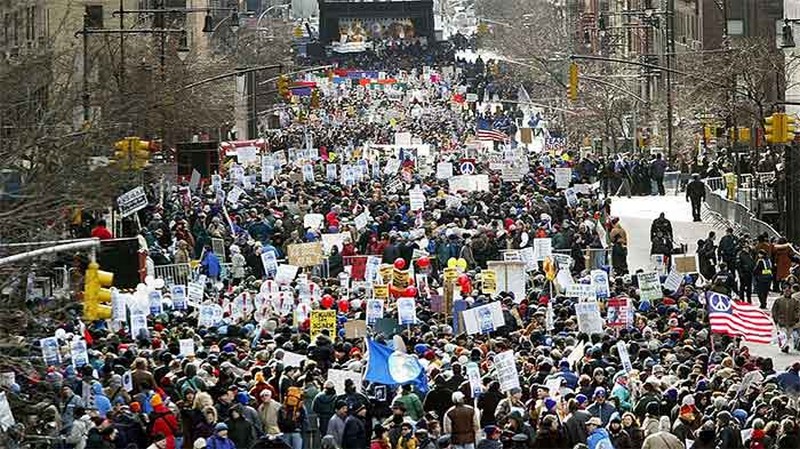
The mass demonstrations that erupted simultaneously to engulf the globe on the weekend of February 15-16, 2003, preceding the American attack on Iraq, will shimmer forever in history. They were an unparalleled manifestation of international human solidarity against war. In the face of the militaristic frenzy of the most ruthless imperialist regime in the world, more than 10,000,000 people had raised the fists against the plans for an invasion of Iraq.

These demonstrations marked a turning point in world politics. From North and South America, through Europe and Asia to Australia and Africa, the mass and largely spontaneous popular mobilizations of February 15-16 in the very heart of the body unfolded the deep and unbreakable political, social and moral chasm that divides the ruling elites and their media propagandists from the people.

In the aftermath of these powerful demonstrations, all pretence of democratic political legitimacy for the war policies of the Bush administration in the United States and the Blair regime in Britain were shattered. to the core. The demonstration of more than one million people in London and Glasgow was a stunning repudiation of Blair’s attempt to revive, through an alliance with Washington, the colonialist aspirations of British imperialism.

The marches held in cities engulfing many regions the United States were, if anything, even more intense. There, in the very egg of world imperialism, the mass demonstrations demonstrated that the American people are repulsed were enraged by the war frenzy of the Bush administration and the militaristic propaganda of the establishment media.

Without hesitation we should appreciate the significance of the massive outpouring of humanity in Barcelona, Rome, Paris and Berlin. In these great cities, the bitter experience of fascist barbarism—represented by the regimes of Franco, Mussolini, Pétain and Hitler—lives in the consciousness of the populace. The working people of Spain, Italy, France and Germany instinctively grasp the reactionary menace posed by the war-mongering of the Bush administration.

The demonstrations of February 15-16 were, not only an expression of massive popular opposition to an invasion of Iraq. What was witnessed and participated was the birth of a new international social movement of opposition to imperialism. Crystallising this development are profound objective processes. The global merging of capitalist production, spearheaded by transnational corporations knit the basis for the global integration of social struggles of the working class.

Just as the unparalleled development of world economy transcends the barriers of the national state, the class struggle as an objective historical process tends naturally to sweep across national borders. With consciousness brimming at an unprecedented level, the working class will define itself in international rather than national terms. It is precisely this tendency that found expression on Saturday, when 3,000 Jewish and Arab workers marched together against war in the streets of Tel Aviv.

Recommended Readings

Without fail readers should study the ‘Aspects of India’s Economy 33-34 ’, publication of Research Unit for Political economy on the Iraq War, published 20 years ago. It is one of the finest, most accurate, methodical and illustrative research or documents undertaken projecting the actual truth and happenings or what was concealed beneath the surface. With figures it tabulates how America wished to strangulate the oil resources because of it’s dwindling economy and ho w imperialism was an integral part of the war. Even non Marxists o Liberals, classed it as one of the most productive research .A classic work, in it’s own right.

It delves into the history unfolding Iraq from colony to semi-colony, Towards Nationalisation, The Iran-Iraq War: Serving American Interests ,. The Torment of Iraq , Return of Imperialist Occupation. . It analyses The Current Strategic Agenda of the United States,.Home Front in Shambles and   Military Solution to an Economic Crisis.

Setbacks

In important ways the Iraqi resistance have powerful echoes of previous anti imperialist wars. Unfortunately Iraq like Vietnam in the late 1960’s and mid 1970’s received no aid from a foreign country, as there was no superpower or Socialist country to offer it moral support.

Factional rivalries divided a united guerrilla resistance for over a decade after the Iraqi attack at the hands of United States of America. At the international level the anti imperialist movement was generally weak. Globalisation played an important role in sponsoring the American attack. Ironically and fittingly America had to retreat or lost, because it’s resources were exhausted and it’s economy in shambles. The USA economy received a mortal blow after the war, and heightened political consciousness of the people. Sadly progressive forces could not capitalise on it to build a class conscious movement against capitalism linked with imperialism.

Harsh Thakor is freelance journalist who has extensively studied imperialist wars .Thanks information from ‘Aspects 33-34’ and World Socialist Web Site.

21 March 2023

Source: countercurrents.org

Russia’s Economy Is Booming – Despite or Because of Sanctions?

It is true, western sanctions have failed miserably in destroying Russia’s economy. To the contrary, Russia’s economy has been booming since 2022 and keeps doing well, also projected into the future. Why?

“We have exponentially increased our economic sovereignty”, President Putin commented at a recent meeting with aircraft factory employees in Ulan-Ude, Buryatia. The autonomous Republic of Buryatia is in the south of Eastern Siberia, along the border with Mongolia.

Its territory takes up two thirds of the water area of Lake Baikal (see map below). This just as an idea of the enormous landmass, called Russia, and what lays above and beneath her.

Economic sovereignty, is one of the main reasons for Russia’s economic growth during the time of the worst sanctions any country has ever undergone by the west led, of course, by the US and its puppet Europe. The latter has followed the sanction circus, even though it is self-destructive for Europe. This, indeed, is well known to those who have been put into the position of “leading” – or rather destroying – Europe as an economic force.

Not by coincidence, the two key figures in this scenario are two Germans, the unelected President of the European Commission (EC) Madame Ursula von der Leyen, who calls all the important shorts, almost unquestioned, and the Chancellor of Germany Olaf Scholz, who is supposed to be leading the European economic powerhouse to annihilation. Madame von der Leyen is also on the WEF’s Board of Trustees and Olaf Scholz is a graduate of the WEF’s Young Global Leader’s (YGL) Academy.

As usual, it is the European people at large who have been betrayed by their so-called leaders – most, if not all of them, scholars of Klaus Schwab’s school for YGL. By no means have they ever been “infiltrated” to serve the interests of the people, who supposedly “elected” them. The farce and betrayal is so bold, that most people cannot and will not believe it.

That is precisely what the powers of those funding and directing the WEF are banking on. They are helped by decades of social engineering, highly professional mind manipulation, by the bought western main stream media.

The masterminds behind social engineering are Tavistock, the Defense Advanced Research Projects Agency (DARPA), a Pentagon-linked think tank, and others, using most sophisticated technologies for bending people’s minds into directions they never wanted, but they have no saying.

Only once we recognize it, admit our laisser-faire “victimhood”, we may be able to react and resist. See this.

Paraphrased, “We are proud of having been able to infiltrate countries around the world with our YGLs”, is one of Klaus Schwab’s infamous sayings.

The point of these sanctions is much more to harm Europe than to destroy Russia. The prime objective is to cut Europe – primarily Germany – off the flow of cheap energy, gas from Russia, thereby ruining and possibly as much as deindustrializing Germany and by association Europe. The deliberate destruction by the US / NATO of the Nord Stream Pipelines is vivid testimony.

President Putin elaborated on the exponential success of Russia in the face of western sanctions,

“After all, what did our adversary count on? That we would collapse in two or three weeks or in a month? The expectation was that enterprises would cease due to our partners refusing to work with us, the financial system would collapse, tens of thousands of people would be left without work, take to the streets, protest, Russia would be shaken from the inside and collapse. That was their intention, but this did not happen”.

President Putin did, however, not explain one of the key underlying factors for Russia’s blooming rather than wilting, namely the almost complete dedollarization that Russia’s Central Bank has managed to carry out under top Russian economist and President Putin’s economic adviser, Sergey Glazyev’s guidance.

V. Putin and S. Lavrov

Through dedollarization which brings along in parallel a sizable de-euroization, Russia’s economy has grown stronger, more autonomous, and is now even closer linked to eastern economies, notably China.

A Ruble-Yuan swap agreement between Russia and China has been in force for many years and has been steadily expanded for mutual protection – thereby also extending Russia’s relation with other Asian economies, especially those within the Shanghai Cooperation Organization (SCO), covering almost half of the world population and about a third of the world’s GDP.

This means sanction-free trading with half the world – a friendly rather than a belligerent world. That alone is a significant advantage compared to dealing with the west – which always expects that their “partners” dance to their tune.

Russia plays a major role within the BRICS-plus, meaning Brazil, Russia, India, China, South Africa, with the plus standing for Iran and many western countries having expressed interest in joining the group, with the ultimate expectation to integrate sooner or later into the “Eastern Fold”, mainly represented by the SCO.

Amazing, but given the above background, not surprising, is Russia’s significant trade surplus of over US$ 330 billion equivalent. Despite western Ukraine-related sanctions, Russia’s exports surged by nearly 20% in 2022.

Much of the trade surplus is driven by grain exports. Russia produces almost 12% of the world’s wheat, all non-GMO (2022/2023 est.). Total world wheat production for this period is estimated at about 781 million tons.

The combined BRICS-plus Iran output is almost half of global production. That of China (18%), India (13%), and Russia (12%), account for a combined 43% of total world production. Almost half of one of the world’s key food staples is produced by just three BRICS countries.

This fact is important – signaling that food leverage is not handled by the west.

Russia’s overall trade increased by 8.1% in 2022 over 2021, to US$ 850.5 billion equivalent. The bulk of Russia’s exports were energy products, gas and petrol, amounting to about two thirds of all exports, US$ 384 billion equivalent.

This is an almost 43% annual increase despite western sanctions. Moscow redirected energy that the west refused (sanctions) to China, India, and other Asian partners, at prices higher than the special low tariffs Germany and Europe benefitted from – and thus, made Europe’s economy more competitive worldwide. For details, see this.

The deliberate suicide attempt in Europe’s leadership (sic) against the will of the people, or rather by betraying the European population, becomes more than evident.

This trend is set out in the WEF’s Great Reset and UN Agenda 2030 – utmost possible destruction of the current mostly western economic system, so that it may be rebuilt according to WEF’s concept of a One World Order (OWO) which also includes massive population reduction. This may be precipitated over the coming years through the poisonous injections that were coerced upon the globe’s 8 billion people in the past two years. An estimated 70% were injected.

These jabs or “vaxxes”, with a variety of poisonous contents, were planned to bring death and infertility. The proof is slowly but surely seeping out. Now many even western politicians are no longer silent, as they are confronted with skyrocketing over-mortality and infertility.

With these overall plan and objectives of the WEF and its diabolical handlers from the shadows, it also becomes evident, that Russia and China become key targets for take-over, as the new planned OWO will need their energy and food – aside from a myriad of other life-supporting natural resources Russia and China possess.

What the Russian booming economy – because of the “sanctions” – and ever-growing trade surplus signals, is a more stabilizing independence of the east from the west, a shift in world leadership. The warmonger hegemon is gradually but ever more visibly fading. A new concept of peaceful multi-polarity is taking over. – That is humanity’s hope.

However, we must not forget that this concept of a constant western mode of aggression to govern the world, was designed already a century or more ago. It has been perfected by creating several weapons of mass destruction that may be used simultaneously worldwide – like the covid-scare and totalitarian measures, as long as the media-duped world sleeps. Alternatively, these weapons of mass destruction may be applied individually and by targeting specific countries and regions, to disguise their wanton damaging intent.

Other than a potentially all-destructive nuclear war – which may not be in the interest of those intending to run the world – there are a few other weapons of mass destruction:

(i) Artificial weather and climate modification which also includes triggering of deadly earthquakes – Environmental Modification Techniques, or ENMOD, which comprises the High-frequency Active Auroral Research Program, or HAARP system, as well as other DARPA developed technologies, see this and this
These technologies are fortunately not a western monopoly, but are also in control of Russia and China, and at least partially by a few other countries. This, despite Klaus Schwab’s (WEF) arrogant phantasy expressed during the recent World Government Summit in Dubai, that a small elite should control these world commanding technologies – see this;

(ii) The pharma-assault on the world, as we have witnessed with the covid-crime, where harming and deadly medication is forced upon the population; see this – and the impending all-nations overriding WHO supremacy with the revised International Health Regulations (IHR), of which the new Pandemic Treaty will be an integral part – tyrannizing the world with health measures that supposedly no government can oppose.
Though, police and military enforcement is foreseen, it is unlikely to hold against the power of the people. See this. The easiest and most effective answer is – EXIT WHO IMMEDIATELY; and

(iii) The global financial meltdown – which is largely and deliberately a derivative-based “financial weapon of mass destruction”. It may have started with the recent collapse of California’s Silicon Valley Bank (SVB), followed by the NYC Signature Bank – and the latest Credit Suisse (CS), just barely saved by the Swiss Central Bank with a US$ 54 billion equivalent lifeline credit. CS is one of the “Too Big to Fail” (TBF) banks. It may be just a matter of time, before the TBF banks will become too big of a tax-payer liability – and they must be dropped.
For details of the looming Financial Tsunami, see this and this.

These are but a few of the weapons of mass destruction that the west may want to use to maintain its Washington-led hegemony.

It is amazing but no coincidence, how the dots connect when analyzing the Russian booming economy, despite – NO, BECAUSE of western sanctions.

Aggressions, lies, deceit, deliberate killing are low vibrating deeds or behaviors. Sooner or later, they will succumb to higher spirituality, emitted by an awakened, an aware and a conscious society – We, the People.

*

Note to readers: Please click the share buttons above. Follow us on Instagram and Twitter and subscribe to our Telegram Channel. Feel free to repost and share widely Global Research articles.

Peter Koenig is a geopolitical analyst and a former Senior Economist at the World Bank and the World Health Organization (WHO), where he worked for over 30 years around the world.

20 March 2023

Source: www.globalresearch.ca

Iraq Invasion 20th Anniversary: 5 Million Dead In Iraqi Holocaust

By Dr Gideon Polya

The 20th anniversary of the war criminal US, UK and Australian invasion of Iraq in 2003 will fall on about 20 March 2023. On this occasion mendacious and racist Western media will at best remember the Iraq War as a US policy mistake. However decent people will remember the carnage. From 1990 onwards Iraqi deaths from US-imposed violence and deprivation have totalled about 5.0-5.5 million, similar to deaths in the WW2 Jewish Holocaust ( 5-6 million).

(A). Some important prefatory comments on violent deaths, avoidable deaths from imposed deprivation, and culpability.

One notes that “holocaust” implies a large number of deaths whereas  “genocide” is precisely defined by Article 2 of the UN Convention on the Prevention and Punishment of the Crime of Genocide (the UN Genocide Convention) thus: “In the present Convention, genocide means any of the following acts committed with intent to destroy, in whole or in part, a national, ethnic, racial or religious group, as such: a) Killing members of the group; b) Causing serious bodily or mental harm to members of the group; c) Deliberately inflicting on the group conditions of life calculated to bring about its physical destruction in whole or in part; d) Imposing measures intended to prevent births within the group; e) Forcibly transferring children of the group to another group” [1].

Further, deaths in war and occupation come from violence and from imposed deprivation. Whether a child dies from violence (bombs, bullets or bashing) or from being deprived of life-sustaining requisites (food, potable water and medicine), the death is just as final, and the culpability of the perpetrator just as real. However while deaths in war from violence are often hard to assess, avoidable deaths from imposed deprivation can be estimated from comparative demographic data (that have been provided for the years from 1950 onwards by the UN Population Division). The methodology used to estimate avoidable deaths from deprivation is described in detail  in my book “Body Count. Global avoidable mortality since 1950” [2].

Culpability for avoidable deaths from imposed deprivation is set out by Articles 55 and 56 of the Fourth Geneva Convention ( the Geneva Convention relative to the Protection of Civilian Persons In Time of War) that state that the  Occupying Power  is obliged to supply the conquered Subjects with life-sustaining food and medical requisites “to the fullest extent of the means available to it”.These key injunctions of International Law have been grossly violated by the US and its degenerate and serial war criminal allies (notably the UK, Apartheid Israel, France and US lackey Australia) in the post-9/11 US War on Muslims [3, 4].

Scrupulously ignored by mendacious Mainstream media (M3) journalist, editor, politician, academic and commentariat presstitutes is the horrible reality that the ongoing Iraqi Genocide and Iraq Holocaust actually commenced 109 years ago with the British invasion of Iraq in 1914 for oil and imperial hegemony [2, 5]. The deaths in the various stages of the 109-year and ongoing Iraq Holocaust are succinctly set out below.

(B). Deaths from violence and deprivation in the ongoing, 109-year Iraqi Holocaust.

(a). British rule or hegemony (1914-1950): 4 million.

British interest in invading and conquering Iraq came from discovery of oil in adjacent Iran in 1908. Western violation of Iraq commenced with the British invasion for oil and imperial hegemony a mere 6 years later, in 1914 during WW1.  Churchill had forced the Ottoman Empire (1517-1924 Ottoman Caliphate) into WW1  by seizing British-built battleships that the Turks had already paid for. Assuming excess mortality of Iraqis under British rule or hegemony (1914-1950) was the same as for Indians under the British – interpolation from available data indicate Indian avoidable death rates in “deaths per 1,000 of population per year” of 37 (1757-1920), 35 (1920-1930), 30 (1930-1940) and 24 (1940-1950) –  one can estimate from Iraqi population data that Iraqi avoidable deaths from deprivation under British occupation and hegemony from 1914-1950 totalled about 4 million [2, 4-7].

(b). Gulf War (1990-1991) and Sanctions period (1990-2003): 1.9 million.

Violent deaths and avoidable deaths from violently-imposed deprivation in the Gulf War (1990-1991) and the Sanctions period (1990-2003) totalled  0.2 million and 1.7 million, respectively. During the Sanctions period the US, UK an Israeli air forces relentlessly bombed Iraqi infrastructure with consequent huge avoidable deaths from deprivation. On May 12, 1996, Madeleine Albright (US UN Ambassador and later US Secretary of State) defended UN sanctions against Iraq on a “60 Minutes” segment in which Lesley Stahl asked her “We have heard that half a million children have died. I mean, that’s more children than died in Hiroshima. And, you know, is the price worth it?” Madeleine Albright replied “We think the price is worth it” [6]. This was a singular instance in which the US admitted to its genocidal carnage. Back in 1990 eminent Australian medical scientist  Professor Fred Mendelsohn (his industrial chemist father Oscar Mendelsohn befriended and employed my Jewish Hungarian refugee father,  Dr John Polya, in about 1940) argued for peace and warned in a letter published by The Age (Melbourne) that huge numbers of children would die in the looming Gulf War. This wonderful and inspiring pro-peace humanitarian  was right – Iraqi under-5 infant deaths under Sanctions totalled 1.7 million, a massive crime against Humanity.

(c). Iraq War (2003-2011): 2.7 million.

The US Just Foreign Policy organization estimated, based on the data of expert UK ORB analysts and top US medical epidemiologists, 1.5 million violent deaths in the Iraq War (2003-2011). UN Population Division data  indicate a further 1.2 million Iraqi avoidable deaths from war-imposed deprivation in this period. In 2003-2011 Iraqi deaths  from violence (1.5 million) and imposed deprivation (1.2 million) totalled 2.7 million [2, 4-7].

Iraqi deaths from violence (1.7 million) and war-imposed deprivation (2.9 million) in the period 1990-2011 totalled  4.6 million.

(d). Post-Iraq War (2011 onwards): 0.4 million.

The US ostensibly withdrew from devastated Iraq in 2011 but returned in force to the region with a vengeance in 2012 to help Syria, Iraq and Iran deal with ISIS  in Syria (2012 onward)  and  thence in Iraq (2014 onwards) that has been associated with about 0.1 million violent Iraqi deaths, most notably in devastated Mosul (40,000 killed)  and in  twice US-demolished Fallujah [8-10]. One notes that the ruthless and barbarous ISIS subverted and took over the Sunni insurgency in Iraq against the corrupt, violent, US-installed Al Maliki Government, and similarly ISIS came to dominate the US Alliance-backed Sunni insurgency against the Assad Government in Syria. UN data indicate about 0.3 million avoidable Iraqi  deaths from deprivation in the period 2011-2020. Just as the US backed Islamists in Afghanistan  from 1978 onwards, so the US and its allies covertly supported ISIS Islamists in Iraq and Syria with the realized aims of a permanent  US presence in both countries, and the  Balkanizing of Iraq and Syria in the interests of Apartheid Israel. Only Russian support enabled the Syrian Government to survive.  Professor Michel Chossudovsky: “The Islamic State of Iraq and al-Sham: An instrument of the Western Military Alliance…In August 2014, Obama launched a so-called “counter-terrorism operation” against the ISIS which was firmly entrenched in Mosul. This “fake” counter-terrorist operation was launched against terrorists who were supported and financed by the US, UK, Turkey, Saudi Arabia, the UAE, and Israel (among others)” [11]. The Syrian and Iraqi Governments have demanded US withdrawal to no avail [12]. The Iraqi Genocide and Iraqi Holocaust continues.

 (e). Iraqi Holocaust deaths 5 million (1990 onwards) and 9 million (1914 onwards).  

Ignoring Iraqi deaths associated with the US-backed Iraq-Iran War, one can estimate about 9 million Iraqi deaths from UK or US violence and  imposed deprivation in the century after the 1914 invasion of Iraq by Britain, this constituting an Iraqi Holocaust,  and also an Iraqi Genocide as defined by Article 2 of the UN Convention on the Prevention and Punishment of the Crime of Genocide [1].

Consideration of (c) and (d) above indicates post-1990 Iraqi deaths from violence and deprivation totalling 4.6 million + 0.4 million = 5 million [2, 4-7].

The huge avoidable deaths from deprivation of Iraqis under the British, Americans and the US Coalition is evidence of gross violation of Articles 55 and 56 of the Geneva Convention relative to the Protection of Civilian Persons in Time of War that state unequivocally that an Occupier must provide its conquered Subjects with life-preserving food and medical requisites “to the fullest extent of the means available to it” [3, 4].

(f). Check: an alternative 2023 estimate of 5.5 million Iraqi deaths from violence and deprivation from 1990 onwards.

An alternative estimate of Iraqi deaths from violence and imposed deprivation from 2003 onwards in the period 2003-2023 can be made as follows:

(i). Violent deaths totalled 1.5 million (2003-2011) as determined by Just Foreign Policy based on direct polling surveys by US epidemiologists and the UK polling organization ORB. However the Americans and their allies did not completely leave in 2011 and indeed rejected demands of the Iraqi Parliament for them to do so [12].  The renewed violent killing in response to the Sunni ISIS (ISIL, Daesh) rebellion includes 40,000 killed in the destruction  of the western part of  Mosul alone [10], and one can accordingly estimate  a further circa  0.1 million violent Iraqi deaths from 2011 onwards. Thus violent deaths have totalled about 1.6 million in the period 2003-2023.

(ii). Avoidable deaths from imposed deprivation in the period 2003-2023 can be estimated from  UN Population Division demographic data [2]. Thus in 2003 under-5 infant deaths totalled 114,400. Using impoverished and sanctioned but nevertheless well governed and peaceful Cuba  as a baseline, the corrected Iraqi under-5 infant mortality in 2003 was 111,752 [2]. Likewise the corrected Iraqi under-5 infant mortality in 2020 was 27,889 [2]. The average under-5 infant mortality in the period 2003-2023 was 69,821 and  totalled 69,821 per year x 20 years = 1,396,420 for 2003 onwards. For impoverished Global South countries total avoidable deaths from deprivation are about 1.4 times the under-5 infant mortality [2], or 1,396,420 x 1.4 = 1,954,988 or about 2.0 million.

Accordingly Iraqi deaths from violence and imposed deprivation total 1.6 million + 2.0 million = 3.6 million (2003 onwards), 1.9 million + 3.6 million = 5.5 million (1990 onwards), and 4.0 million + 5.5 million = 9.5 million (1914 onwards).

(g). Comparing the Iraqi Holocaust (5.0-5.5 million deaths) with the WW2 Jewish Holocaust (5.1-5.8 million deaths) and about 70 other genocides and holocausts.  

As outlined above, estimates of deaths from violence and imposed deprivation are of 5.0-5.5 million such Iraqi deaths from 1990 onwards and 9.0 -9.5 million such deaths from 1914 onwards. How does this compare with deaths in the WW2 Jewish Holocaust?

Eminent Jewish British historian and fervent  Zionist, Professor Sir Martin Gilbert (fellow of Merton College, Oxford, author of 88 books, and expert on Winston Churchill, WW1, WW2 and Jewish history) [13] estimated  5.1 million WW2 Jewish Holocaust deaths in his “Jewish History Atlas” (1969)[14], and 5.8 million in his “Atlas of the Holocaust” (1982) [15].

Deaths from violence and imposed deprivation in the 1990 onwards Iraqi Holocaust (5.0-5.5 million) are commensurate with those in the WW2 Jewish Holocaust (5-6 million), the WW2 Polish Holocaust (6 million), and the WW2 Bengali Holocaust (WW2 Indian Holocaust, WW2 Bengal Famine; 6-7 million Indians deliberately starved to death for strategic reasons in Bengal, Bihar, Assam and Odisha by the British with food-denying Australian complicity), but much fewer than in the WW2 European Holocaust (30 million mostly Russian and other Slavic victims as well as Jewish and in Roma victims), and the WW2 Chinese Holocaust (35-40 million Chinese deaths from violence and deprivation under the Japanese, 1937-1945).

For detailed listings of about 70 genocides and holocausts see “Report Genocide” [16]  and  my books “US-imposed post-9/11 Muslim Holocaust and Muslim Genocide” [4] and “Jane Austen and the Black Hole of British History” [17]. The Iraqi Holocaust and Iraqi Genocide [2, 4-7] was part of a wider 21st century Muslim Holocaust and Muslim Genocide in which (as determined in 2015) 32 million Muslims died from violence (5 million) and imposed deprivation (27 million) in 20 countries invaded by the US Alliance since the US Government’s 9/11 false flag atrocity in which about 3,000 innocent Americans perished [18-20].

(h). Holocaust ignoring  and genocide ignoring by the International Holocaust Remembrance Alliance (IHRA) that is largely composed of US Alliance members including  the major  perpetrators of the Iraqi Holocaust.

The major perpetrators  of the Iraqi Holocaust (the US, UK and Australia) are  among the 35 members of the all-European, anti-Jewish anti-Semitic, anti-Arab anti-Semitic, pro-Apartheid, genocide-ignoring and holocaust-ignoring IHRA. Of these 35 soiled, pro-Apartheid  countries: (1) all are European; (2) the 5 located outside Europe (Argentina, Australia, Canada, Apartheid Israel, and the US) were all created based on the genocide of the Indigenous People; (3) 9 members were part of the genocidal WW2 Nazi Germany Alliance; (4) 4 (the US, UK, France and Apartheid Israel) are nuclear terrorist states; (5) 28 belong to the 30-member nuclear-armed NATO that accepts  mass incineration of billions of men, women and children as an acceptable military strategy; (6) 14 were notably involved in the brutal conquest and genocide of Indigenous non-European people over 5 centuries; (7) only 2 (Austria and Ireland) have had the moral decency to sign and ratify the Treaty for the Prohibition of Nuclear Weapons (TPNW); and (8) all but 4 shockingly voted No to the annual UNGA Anti-Nazi Resolution in 2022 that condemns Nazism, neo-Nazism and related racist obscenities [21, 22].

The IHRA Definition of “antisemitism” lists 11 false examples of assertions (e.g. criticism of Apartheid Israel, Nazi-style Israeli policies and hugely disproportionate Zionist influence) that it regards as anti-Jewish anti-Semitic. All 11 examples can be shown to be utterly false assertions  designed to damage and defame anti-racist Jewish and non-Jewish critics of genocidally racist Zionism and of Apartheid Israel and its ongoing Palestinian Genocide. The IHRA Definition of anti-Semitism is anti-Jewish anti-Semitic (by falsely defaming anti-racist Jewish critics of Apartheid Israel as anti-Semites) , anti-Arab anti-Semitic (by falsely defaming anti-racist Palestinian, Arab and Muslim  critics of Apartheid Israel as anti-Semites) and holocaust-ignoring and genocide-ignoring  (by ignoring all WW2 holocausts and genocides other than the WW2 Jewish Holocaust and indeed ignoring 70 other holocausts and genocides) [21, 22].

Holocaust-ignoring and genocide-ignoring are far, far worse than repugnant holocaust denial and genocide denial because the latter can at least permit public refutation and public discussion, subject, of course, to censorship by the  mendacious Mainstream media (M3) presstitutes who dominate public life and public perception of reality in the Western Corporatocracies and Murdochracies. Not surprisingly, the racist and mendacious IHRA Definition has been condemned by scholars around the world and by over 40 anti-racist Jewish organizations [23]. However the IHRA holocaust ignoring has made great strides in Zionist-subverted US, UK and Australia, the major perpetrators  of the Iraqi Holocaust. Thus, for example, in Australia the  Australian Labor Government,  the Coalition Opposition, the Labor Government of South Australia,  the Labor Government  of Victoria, and 5 out of Australia’s 43 universities (Melbourne, Wollongong,  Macquarie, Monash, and Sunshine Coast Universities) have all adopted the egregiously false, racist, anti-Semitic and genocide-ignoring IHRA Definition of Anti-Semitism [21, 24- 26]. This attack on academic and societal  free speech  and Truth is just as bad in the Zionist-subverted UK and in the  Zionist-subverted US (notwithstanding  the First Amendment of the US Constitution that guarantees free speech for Americans).

Final comments.

On the occasion of the 20th anniversary of the illegal and war criminal US Alliance  invasion of Iraq on 20 March 2003 decent people will pause to reflect on the devastation inflicted on Iraq. Iraqi deaths from violence and war-imposed deprivation totalled about 5 million for the period 1990 onwards. The killing continues in US-devastated Iraq. In 2020, for example, the under-5 infant deaths as a percentage of total population for Iraq was 52 times greater than that for Japan, and 14 times greater than that for impoverished and sanctioned but peaceful Cuba [2, 27]. However this appalling and continuing carnage is resolutely ignored by the mendacious Mainstream media (M3) journalist, editor, politician, academic and commentariat  presstitutes of the countries that perpetrated the ongoing Iraqi Holocaust and Iraqi Genocide.

Decent anti-racist  folk around the world will demand truth-telling and justice for the devastated people of Iraq and will impose Boycotts, Divestment and Sanctions (BDS) on the perpetrators  just as BDS is applied to the Apartheid Israel and all its supporters complicit in the ongoing Palestinian Genocide (2.2 million deaths from violence, 0.1 million, and deprivation, 2.1 million, from  WW1 onwards) [28-30].

In 2005, when first expert reports on the growing carnage in Iraq were emerging,  anti-racist Jewish British writer Harold Pinter in his Nobel Prize Acceptance Speech stated: “The invasion of Iraq was a bandit act, an act of blatant state terrorism, demonstrating absolute contempt for the concept of international law. The invasion was an arbitrary military action inspired by a series of lies upon lies and gross manipulation of the media and therefore of the public; an act intended to consolidate American military and economic control of the Middle East masquerading as a last resort all other justifications having failed to justify themselves as liberation. A formidable assertion of military force responsible for the death and mutilation of thousands and thousands of innocent people. We have brought torture, cluster bombs, depleted uranium, innumerable acts of random murder, misery, degradation and death to the Iraqi people and call it ‘bringing freedom and democracy to the Middle East’. How many people do you have to kill before you qualify to be described as a mass murderer and a war criminal? One hundred thousand? More than enough, I would have thought. Therefore it is just that Bush and Blair be arraigned before the International Criminal Court of Justice” [31]. 5 million? Surely enough, I would have thought.

References.

[1]. Convention on the Prevention and Punishment of the Crime of Genocide: https://treaties.un.org/doc/publication/unts/volume%2078/volume-78-i-1021-english.pdf .

[2]. Gideon Polya, “Body Count. Global avoidable mortality since 1950”, 2nd edition, Korsgard Publishing, Germany , 2021.

[3]. “Fourth Geneva Convention relative to the Protection of Civilian Persons in Time of War”, 12 August 1949: https://www.un.org/en/genocideprevention/documents/atrocity-crimes/Doc.33_GC-IV-EN.pdf .

[4]. Gideon Polya, “US-imposed, Post-9/11 Muslim Holocaust and Muslim Genocide”, Korsgard Publishing, Germany, 2020.

[5]. Gideon Polya , “20th Anniversary Of Huge Demonstrations Against Impending Iraq War”, Countercurrents, 15 February 2023: https://countercurrents.org/2023/02/20th-anniversary-of-huge-demonstrations-against-impending-iraq-war/?swcfpc=1  .

[6]. “Iraqi Holocaust Iraqi Genocide”: https://sites.google.com/site/iraqiholocaustiraqigenocide/ .

[7]. “Muslim Holocaust Muslim Genocide”: https://sites.google.com/site/muslimholocaustmuslimgenocide/ .

[8]. Gideon Polya, Review: “The Sacking Of Fallujah. A People’s History” – Ongoing Iraqi Genocide”, Countercurrents, 30 January 2021: https://countercurrents.org/2020/01/review-the-sacking-of-fallujah-a-peoples-history-ongoing-iraqi-genocide/ .

[9]. Ross Caputi, Richard Hil, and Donna Mulhearn, “The Sacking Of Fallujah. A People’s History”, University of Massachusetts Press, 2019.

[10]. Gideon Polya, “Mosul Massacre latest in Iraqi Genocide”, Countercurrents, 24 July 2017: https://countercurrents.org/2017/07/mosul-massacre-latest-in-iraqi-genocide-us-alliance-war-crimes-demand-icc-bds .

[11]. Professor Michel Chossudovsky, “The Engineered Destruction and Political Fragmentation of Iraq. Third War against Iraq initiated by Obama”, Global Research, 16 March 2023: https://www.globalresearch.ca/the-destruction-and-political-fragmentation-of-iraq-towards-the-creation-of-a-us-sponsored-islamist-caliphate/5386998 .

[12]. Gideon Polya, “US, UK,  Australia, Canada & Germany Reject Iraqi Parliament’s Quit Iraq Demand”, Countercurrents, 16 January 2021: https://countercurrents.org/2020/01/us-uk-australia-canada-germany-reject-iraqi-parliaments-quit-iraq-demand/ .

[13]. Gideon Polya,  “UK Zionist Historian Sir Martin Gilbert (1936-2015) Variously Ignored Or Minimized WW2 Bengali Holocaust”, Countercurrents, 19 February 2015: https://countercurrents.org/polya190215.htm .

[14]. Martin Gilbert, “Jewish History Atlas”, Weidenfeld and Nicolson, London, 1969.

[15].  Martin Gilbert “Atlas of the Holocaust”, Michael Joseph, London, 1982.

[16]. “Report Genocide”; https://sites.google.com/site/reportgenocide/home .

[17].  Gideon Polya,  “Jane Austen and the Black Hole of British History. Colonial rapacity, holocaust denial and the crisis in biological sustainability”, 3rd edition, Korsgaard Publishing,  2023.

[18]. Gideon Polya, “Paris Atrocity Context: 27 Million Muslim Avoidable Deaths From Imposed Deprivation In 20 Countries Violated By US Alliance Since 9-11”, Countercurrents, 22 November, 2015: http://www.countercurrents.org/polya221115.htm .

[19]. “Experts: US did 9/11”: https://sites.google.com/site/expertsusdid911/ .

[20]. Gideon Polya, “Lying Mainstream Media Ignore Expert New 9/11 WTC7 Demolition Report”, Countercurrents, 22 August 2020: https://countercurrents.org/2020/08/lying-mainstream-media-ignore-expert-new-9-11-wtc7-demolition-report/ .

[21]. Gideon Polya, “Melbourne University Adopts Anti-Semitic & Holocaust-Ignoring IHRA Definition Of Anti-Semitism”, Countercurrents, 5 February 2023: https://countercurrents.org/2023/02/melbourne-university-adopts-anti-semitic-holocaust-ignoring-ihra-definition-of-anti-semitism/ .

[22]. Gideon Polya, “Zionists & Pro-Zionist, US Lackey Australian Government Threaten Australian Academic Free Speech”, Countercurrents, 7 March 2023: https://countercurrents.org/2023/03/zionists-pro-zionist-us-lackey-australian-government-threaten-australian-academic-free-speech/?swcfpc=1 .

[23]. Jewish Voices for Peace, “First ever: 40+ Jewish groups worldwide oppose equating antisemitism with criticism of Israel”, 17 July 2018: https://jewishvoiceforpeace.org/first-ever-40-jewish-groups-worldwide-oppose-equating-antisemitism-with-criticism-of-israel/#english .

[24]. Gideon Polya, “85 Ways Zionist Australian Labor Government Betrays Palestinian Human Rights & Humanity”, Countercurrents, March 2023: https://countercurrents.org/2023/03/85-ways-zionist-australian-labor-government-betrays-palestinian-human-rights-humanity/?swcfpc=1 .

[25]. Michael Bradley, “Does being anti-Israel mean you’re anti-Semitic?”, Crikey, 14 March 2023: https://www.crikey.com.au/2023/03/14/anti-israel-anti-semitic-university-ihra-definition/  . .

[26], “Criticising the nation of Israel is justified. Demonising Jewish people is not”, Crikey, 17 March 2023: https://www.crikey.com.au/2023/03/17/anti-semitism-israel-jewish-people-ihra-definition/ .

[27]. Richard Hil and Gideon Polya, “Imperial power: The Iraq war, 20 years on”, Pearls & Irritations, 16 March 2023: https://johnmenadue.com/iraq-and-imperial-power-20-years-on/ .

[28]. BDS – Boycott Apartheid Israel: https://sites.google.com/view/bdsopinions/home .

[29]. “Palestinian Genocide”: https://sites.google.com/site/palestiniangenocide/ .

[30]. 2023, 75th Nakba Anniversary: 1948 Nakba (Catastrophe) & Palestinian Genocide: https://sites.google.com/site/palestiniangenocide/1948-nakba-catastrophe-palestinian-genocide .

[31]. Harold Pinter, “Art, Truth And Politics”, Countercurrents, 8 December, 2005: https://countercurrents.org/arts-pinter081205.htm .

Dr Gideon Polya taught science students at La Trobe University, Melbourne, Australia over 4 decades.

19 March 2023

Source: countercurrents.org

Chaos in Pakistan: Imran Khan Takes on America and its Comprador Elites

By Junaid S Ahmad

“There is great chaos under heaven; [hence] the situation is excellent.”

-Mao Zadong

With staunch US support, Pakistan’s unelected “imported government” is trying to arrest former Prime Minister Imran Khan, the most popular politician in the country, to prevent him from running in elections. But protesters are protecting him.

If 2022 was the year of popular uprisings in Pakistan, raising hope for protesters fed up with a thoroughly corrupt and repressive civil-military regime, 2023 seems to be the year when the government is trying every dirty trick in the book to kill that hope.

After a US-backed regime change operation removed elected Prime Minister Imran Khan from power in April 2022, Pakistan witnessed an unprecedented phenomenon in the nation’s history: For the first time, a civilian politician who was ousted from power didn’t simply end up in the dustbin of history, alongside interchangeable corrupt politicians who for decades played musical chairs, competing to plunder the country.

On the contrary, what occurred were massive outpourings of support for Khan and widespread opposition to the ancien régime put in power by Washington’s mercenaries in the military high command.

The enormous popular rejection of the current “imported government”, as Khan calls it, has made Pakistan’s elites increasingly desperate. They want him eliminated.

Assassination was their first method of choice – but they fumbled. At a rally in November, a gunman shot Khan in the leg, injuring but failing to kill him.

In the meantime, Plan B is being implemented: Arrest Khan on bogus charges and disqualify him from politics forever.

The former prime minister has been relentlessly holding peaceful demonstrations, demanding elections. The government knows that Khan would easily win, so it wants to prevent him from running.

A Gallup poll in March found that Khan is by far the most popular politician in Pakistan, with a 61% approval rating, compared to 37% disapproval.

The current, unelected Prime Minister Shehbaz Sharif has the complete opposite: a 32% approval rating, compared to 65% disapproval.

The figures are clear: Nearly two-thirds of Pakistanis support Khan and oppose the unelected government.

Pakistan’s “imported government” orders the arrest of Imran Khan

Faced with its deep unpopularity, on March 8, Pakistan’s regime initiated Plan B.

Khan was leading a peaceful protest – one of the countless rallies he has organized since the April 2022 regime-change operation.

This time, massive state security forces went on a rampage and tried to arrest Khan. But they could not do it. Standing between them and Khan were tens of thousands of his supporters.

The only way to get to Khan would have been a bloodbath. This was avoided – although one Khan supporter was killed.

Then again, on March 13, Khan called for a rally in the city considered to be the heart of Pakistan: Lahore.

Despite the entire state security machinery targeting him and his supporters, the rally in Lahore was one of the biggest the city has seen.

Khan and the protesters marched confidently and peacefully in every corner of the city, where they seemed unstoppable, greeted with joy by ordinary Pakistanis of all walks of life.

The former prime minister was undeterred, committed to holding demonstrations in the provinces of the Punjab and Khyber Pakhtunkhwa (KPK), in the lead-up to what he hopes will be national elections.

On March 14, the regime escalated its crackdown. Police surrounded Khan’s house in Lahore and tried to arrest him.

In response, thousands of supporters gathered at Khan’s home, protecting him.

The police responded with extreme violence, wounding dozens of protesters.

From his house, Khan symbolically delivered a speech via video stream, sitting with the tear gas canisters that had been fired outside.

The regime tries to ban Khan from public life

Khan’s determination to relentlessly participate in mass mobilizations has led the regime to try to ban him from public life.

Even Western organizations that are often biased, such as Amnesty International, have condemned the unelected Pakistani government’s authoritarian tactics, which have included prohibiting all speeches and rallies by Khan, as well arresting people who criticize the military on Twitter.

There are two main factors preventing an all-out assault to arrest Khan: the wrath of the population that would ensue, and fear that significant ranks within the armed forces would revolt and turn their guns on their superiors, à la Vietnam.

Indeed, it has been because of Khan’s popularity not just among ordinary Pakistani civilians but within the military ranks as well that the former prime minister has survived so far.

Khan’s popularity among some parts of the army is easy to explain. Rank-and-file soldiers and the majority of the junior and mid-rank officer corps are not keen on Washington dictating a War on Terror 2.0. They have always appreciated Khan’s principled opposition, since day one, to any military solution to the militancy in Afghanistan and the northwest of Pakistan.

Throughout 2022, Khan’s political party, the Pakistan Tehreek-e-Insaf (PTI, the “Movement for Justice”), exponentially rose in popularity, in contrast to the all-too-visible political shenanigans of the coalition of feudal family dynasties and other corrupt forces in power.

If it is true that Khan mismanaged both political and economic governance while in power, then the current lot has engendered a virtual implosion and collapse in the country.

Khan challenges Pakistan’s pro-Western elites

It is difficult to overstate how incensed ordinary Pakistanis are with the political mafias, significant sections of the military top brass, and the chief mafia don: Washington.

One of the most disturbing aspects of what has been happening is the virtual connivance of liberal-left forces and the Pakistani deep state in attempting to eliminate Khan from the Pakistani political scene.

The visceral hatred of Khan by Pakistan’s comprador elites cannot be explained by simply having differences with Khan on various policies – something that Khan’s own critical supporters have as well.

No, for this elite class of the liberal, pro-Western Pakistani intelligentsia, Khan has committed the ultimate crime: socio-cultural class betrayal.

Khan lived abroad for so long during his impressive cricket career. He studied at Oxford, and speaks perfect English. Thus, Pakistan’s ‘Westoxicated’ elites thought that Khan would behave just like them.

Instead, Khan has rejected the condescending attitude that the country’s Western-educated elites show toward ordinary Pakistanis.

Khan has mobilized tens of millions because of his sincerity to reimagine a new Pakistan, prioritizing social justice and an independent foreign policy.

The fact that one small, sectarian leftist party or the other is not being given the credit of leading the revolt against the unpopular regime has made them neurotically envious of Khan.

It is clear for all to see: Khan and the critical supporters both in and outside of his political party have become the most dangerous threat to Pakistan’s status quo.

That is why we have seen very unusual and fast-paced meetings between US officials and Pakistan’s generals and regime officials: Washington’s “friends again”.

Elimination of Khan is absolutely necessary for the troika of these power centers: local comprador political elites, the military high command, and Washington.

Why? Because they know that Khan and his party will sweep any elections that are held.

US encourages Pakistan to “continue working with the IMF”

In the meantime, Pakistan is enduring a deep economic crisis. The country has nearly exhausted its foreign exchange reserves.

The regime is in talks with the US-dominated International Monetary Fund (IMF) to save itself from bankruptcy. All of the corresponding policies of austerity and taxing the poor – “structural adjustment” – are to be expected.

CIA officer turned US State Department spokesman Ned Price said in a press briefing on March 8 that Washington wants Pakistan to “continue working with the IMF” to impose “reforms that will improve Pakistan’s business environment”, in order to “make Pakistani businesses more attractive and competitive”.

In other words, the US State Department wants Pakistan to double down on neoliberal economic policies, such as lowering wages and cutting social spending.

If hated before, the current “imported government” is now despised more than ever.

Imran Khan’s independent foreign policy angers the mafia don in Washington

Khan’s foreign policy was anathema to Washington.

He refused to recognize apartheid Israel as a legitimate state.

He improved ties with Russia for straightforward reasons of economic necessity (as well as promoting the geostrategic stability in the broader Central Asian region).

Khan mended ties and cooperated with Iran, even praising its revolutionary “dignity.”

He strengthened ties with China.

At the same time, Khan repeatedly said he desired friendly relations with Washington, proposing that they work together in peacebuilding in Afghanistan and the wider region.

But these other foreign policy aims were utterly unacceptable to the mafia don, which seems to be set on a war path with Beijing (and others).

Pakistan has been a close ally of China since the 1960s. But Islamabad’s intense obsession with pleasing Washington is a flagrant slap in the face of Beijing.

The meetings that top Pakistani military officials, including the powerful Chief of Army Staff, General Qamar Javed Bajwa, have held with officials in Washington and London are not being missed upon by Beijing or Moscow.

Though Pakistan is suffering through some of the worst economic woes in its history – thanks to the robber barons in power – the US still knows that the South Asian nation has one of the most formidable militaries in the world, and is a nuclear-powered country of 230 million.

Washington also knows that it can easily woo the military top brass by reminding them of how only the US and its weapons and fighter jets can allow Pakistan to stay apace with arch-rival India, trying to match its military supremacy in the region.

This is why the US is so keen on Pakistan participating in Joe Biden’s second “Summit for Democracy” in March 2023. (Despite the fact that Pakistan’s current government was not elected, and repeatedly resisted calls for holding a vote.)

As prime minister, Khan respectfully declined the invitation to the first summit in 2021, because he knew exactly what the intention was: A declining empire seeking to muster as many nations as it can to be a part of its “coalition of the willing” against official enemies like China, Russia, Iran, Venezuela, Cuba, etc.

According to leaks by Pakistan’s own ambassador to the US (who has a soft spot for Khan), Washington wants to reestablish its old military base in Pakistan, which was closed down in 2011.

The US is also reportedly dictating to Pakistan which militant groups to go after and which ones should be left alone – such as the anti-China East Turkestan independence movement or the ISIS elements giving trouble to Beijing and the Taliban government in Kabul.

Most importantly, Washington wants to compel Islamabad to do everything possible to significantly reduce or halt any progress on the China-Pakistan Economic Corridor (CPEC) and Beijing’s Belt and Road Initiative.

Moreover, Washington and the Persian Gulf monarchies are having a splendid time in convincing the new favorable military-civilian regime in Islamabad to undertake a political 180 that Khan would never agree to: gradually normalizing relations with Tel Aviv.

Nevertheless, what all of these power centers conspiring against Khan overlook is that they are dealing with a different Pakistani population now. The people’s political consciousness has exponentially risen with the ouster of Khan from power.

Hence, whether Khan is assassinated or somehow arrested or disqualified from politics, the powers-that-be might get a rude awakening, and be surprised that they are dealing with a new Pakistan, with or without Khan – one that will have zero tolerance for their venality, corruption, and subordination to Washington.

Prof. Junaid S Ahmad teaches Religion and Global Politics and is the Director of the Center for the Study of Islam and Decoloniality, Islamabad, Pakistan.

18 March 2023

Source: countercurrents.org
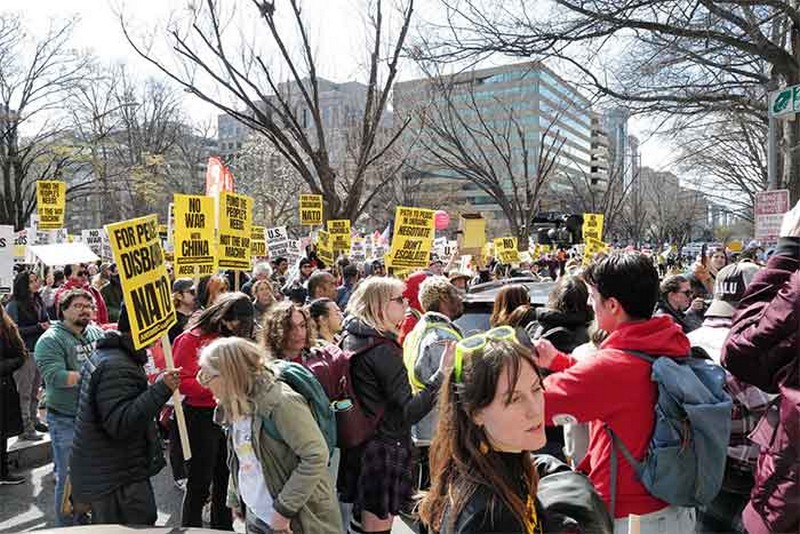
Iraq and 15 Lessons We Never Learned

By David Swanson

The peace movement did a great many things right in the first decade of this millennium, some of which we’ve forgotten. It also fell short in many ways. I want to highlight the lessons I think we’ve most failed to learn and suggest how we might benefit from them today.

  1. We formed uncomfortably large coalitions. We brought together war abolitionists with people who simply adored every war in human history but one. We probably didn’t hold a single event at which there wasn’t somebody pushing a theory about 9-11 that required some level of lunacy just to understand. We didn’t put most of our effort into distinguishing ourselves from other peace advocates or seeking to get people canceled; we put most of our effort into trying to end a war.


  1. It all began to fall apart in 2007, after Democrats had been elected to end the war and escalated it instead. People had a choice in that moment to stand on principle and demand peace, or to kneel before a political party and peace be damned. Millions made the wrong choice, and have never understood it. Political parties, especially when combined with legalized bribery and a subservient communications system, are deadly to movements. The war was ended by a movement compelling George W. Bush to sign an agreement to end it, not by electing Obama, who only ended it when that agreement made him do so. The point is not the idiotic strawman that one should ignore elections or pretend that political parties don’t exist. The point is to put elections second. You don’t even have to put them millionth, only second. But put policy first. Be for peace first, and make public servants serve you, not the other way around.


  1. A “war based on lies” is simply a longwinded way of saying “a war.” There is no such thing as a war not based on lies. What distinguished Iraq 2003 was the ineptness of the lying. “We are going to find vast stockpiles of weapons” is a really, really stupid lie to tell about a place where you are very shortly going to fail to find any such thing. And, yes, they knew that was the case. In contrast, “Russia is going to invade Ukraine tomorrow” is a really smart lie to tell if Russia is about to invade Ukraine sometime in the next week, because nobody is going to care that you got the day wrong, and statistically practically nobody is going to have the resources to understand that what you’ve really said is “Now that we’ve broken promises, torn up treaties, militarized the region, threatened Russia, lied about Russia, facilitated a coup, opposed a peaceful resolution, supported attacks on Donbas, and escalated those attacks in recent days, while mocking utterly reasonable peace proposals from Russia, we can count on Russia invading, just as we’ve strategized to make happen including in published RAND reports, and when that happens, we are going to load the whole zone up with more weapons than we ever pretended Saddam Hussein had, and we’re going to block any peace negotiations in order to keep the war going as hundreds of thousands die, which we don’t think you’ll object to even if it risks nuclear apocalypse, because we’ve pre-conditioned you with five years of ludicrous lies about Putin owning Trump.”


  1. We never said one word about the evil of the Iraqi side of the war on Iraq. Even though you may know, or suspect — pre-Erica Chenoweth — that nonviolence is more effective than violence, you aren’t permitted to utter one word against Iraqi violence or you’re accused of blaming the victims or asking them to lie down and be killed or some other stupidity. To simply state that Iraqis might be better off using exclusively organized nonviolent activism, even while you are working day and night to get the U.S. government to end the war, is to become an arrogant imperialist telling one’s victims what to do and somehow magically forbidding them to “fight back.” And so there is silence. One side of the war is evil and the other good. You can’t cheer for that other side without becoming an ostracized traitor. But you must believe, exactly as the Pentagon believes but with the sides switched, that one side is pure and holy and the other evil incarnate. This hardly constitutes ideal preparation of the mind for a war in Ukraine where, not only is the other side (the Russian side) clearly engaged in reprehensible horrors, but those horrors are the primary topic of corporate media. Opposing both sides of the war in Ukraine and demanding peace is denounced by each side as somehow constituting support for the other side, because the concept of more than one party being flawed has been erased from the collective brain through thousands of fairy tales and other content of cable news. The peace movement did nothing to counter this during the war on Iraq.


  1. We never made people understand that the lies were not only typical of all wars, but also, as with all wars, irrelevant and off-topic. Every lie about Iraq could have been perfectly true and there would have been no case for attacking Iraq. The U.S. openly acknowledged having every weapon it pretended Iraq had, without creating any case for attacking the United States. Having weapons is not an excuse for war. It makes no difference whether it’s true or false. The same can be said of economic policies of China or anyone else. This week I watched a video of a former prime minister of Australia ridiculing a bunch of journalists for not being able to distinguish China’s trade policies from an imaginary and ludicrous fantasy of a Chinese threat to invade Australia. But is there a member of the U.S. Congress who can make that distinction? Or a follower of either U.S. political party who will be able to much longer? The war in Ukraine has been named by the U.S. government/media the “Unprovoked War” — quite obviously precisely because it was so clearly provoked. But this is the wrong question. You don’t get to wage a war if it was provoked. And you don’t get to wage a war if the other side was unprovoked. I mean, not legally, not morally, not as part of a strategy for preserving life on Earth. The question is not whether Russia was provoked, and not merely because the obvious answer is yes, but also because the question is whether peace can be negotiated and established justly and sustainably, and whether the U.S. government has been impeding that development while pretending that only Ukrainians want the war to continue, not Lockheed-Martin stock holders.


  1. We didn’t follow through. There were no consequences. The architects of the murder of a million people went golfing and got rehabilitated by the very same media criminals who had pushed their lies. “Looking forward” replaced the rule of law or a “rules based order.” Open profiteering, murder, and torture became policy choices, not crimes. Impeachment was stripped from the Constitution for any bipartisan offenses. There was no truth and reconciliation process. Now the U.S. works to prevent the reporting of even Russian crimes to the International Criminal Court, because preventing any sort of rules is the top priority of the Rules Based Order, and it hardly makes news. Presidents have been given all war powers, and darn near everybody has failed to grasp that the monstrous powers given to that office are drastically more important than which flavor of monster occupies the office. A bipartisan consensus opposes ever using the War Powers Resolution. While Johnson and Nixon had to clear out of town and opposition to war lasted long enough to label it a sickness, the Vietnam Syndrome, in this case the Iraq Syndrome lasted long enough to keep Kerry and Clinton out of the White House, but not Biden. And nobody has drawn the lesson that these syndromes are fits of wellness, not illness — certainly not the corporate media which has investigated itself and — after a quick apology or two — found everything in order.


  1. We still talk about the media as having been an accomplice to the Bush-Cheney gang. We look back condescendingly at the age in which journalists claimed that one could not report that a president had lied. We now have media outlets in which you cannot report that anyone at all has lied if they are a member of one criminal cartel or the other, the elephants or the donkeys. It’s time we recognize how much the media outlets wanted the war on Iraq for their own profit and ideological reasons, and that the media has played the leading role in building up hostility with Russia and China, Iran and North Korea. If anyone is playing supporting actor in this drama, it is government officials. At some point we’ll have to learn to appreciate whistleblowers and independent reporters and to recognize that corporate media as a mass is the problem, not just one part of the corporate meda.


  1. We never did even really try to teach the public that the wars are one-sided slaughters. U.S. polling for years found majorities believing the sick and ridiculous ideas that U.S. casualties were somewhere near equivalent to Iraqi casualties and that the U.S. had suffered more than Iraq, as well as that Iraqis were grateful, or that Iraqis were inexcusably ungrateful. The fact that well over 90% of the deaths were Iraqis never got through, nor the fact that they were disproportionately the very old and young, nor even the fact that wars are fought in people’s towns and not on 19th century battlefields. Even if people come to believe that such things happen, if they are told tens of thousands of times that they only happen if Russia does them, nothing useful will have been learned. The U.S. peace movement made the conscious choice over and over and over again for years and years to focus on the damage the war was doing to U.S. troops, and the financial cost to taxpayers, and not to make ending a one-sided slaughter a moral question, as if people don’t empty their pockets for faraway victims when they learn that they exist. This was the boomerang result of the spitting lies and other wild tales and exaggerations of mistakes of blaming the rank-and-file troops who destroyed Vietnam. A smart peace movement, its elders believed, would stress sympathizing with troops to the point of not telling anyone what the basic nature of the war was. Here’s hoping that if a peace movement grows again it deems itself capable of walking while chewing gum.


  1. The United Nations got it right. It said no to the war. It did so because people around the world got it right and applied pressure to governments. Whistleblowers exposed U.S. spying and threats and bribes. Representatives represented. They voted no. Global democracy, for all its flaws, succeeded. The rogue U.S. outlaw failed. Not only did U.S. media/society fail to begin listening to the millions of us who didn’t lie or get everything wrong — allowing the warmongering clowns to go on failing upward, but it never became acceptable to learn the basic lesson. We need the world in charge. We do not need the world’s leading holdout on basic treaties and structures of law in charge of law enforcement. Much of the world has learned this lesson. The U.S. public needs to. Foregoing one war for democracy and democratizing the United Nations instead would work wonders.


  1. There are always options available. Bush could have given Saddam Hussein $1 billion to clear out, a reprehensible idea but far superior to giving Halliburton hundreds of billions in a campaign to ruin the lives of tens of millions of people, permanently poison vast swaths of territory, predictably generate terrorism and instability, and fuel war after war after war. Ukraine could have complied with Minsk 2, a better and more democratic and stable deal than it is likely to ever see again. The options always get worse, but always remain far better than continuing war. At this point, after openly admitting that Minsk was a pretense, the West would need actions rather than words merely to be believed, but good actions are readily available. Pull a missile base out of Poland or Romania, join a treaty or three, constrain or abolish NATO, or support international law for all. The options are not hard to think of; you’re just not supposed to think them.


  1. The underlying, WWII-based mythology that teaches people that a war can be good is rotten to the core. With Afghanistan and Iraq it took a year-and-a-half each to get good U.S. majorities in polls saying the wars never should have been started. The war in Ukraine appears to be on the same trajectory. Of course, those who believed the wars shouldn’t have been started did not, for the most part, believe they should be ended. The wars had to be continued for the sake of the troops, even if the actual troops were telling pollsters they wanted the wars ended. This troopism was very effective propaganda, and the peace movement did not effectively counter it. To this very day, the blowback is minimized as so many believe it would be inappropriate to mention that U.S. mass shooters are disproportionately veterans. Slandering all veterans in the hollow minds of those who cannot grasp that 99.9% of people are not mass shooters at all is deemed a greater danger than creating more veterans. The hope is that U.S. opposition to the war in Ukraine may grow in the absence of the troopist propaganda, as U.S. troops are not involved in large numbers and not supposed to be involved at all. But the U.S. media is pushing heroic stories of Ukrainian troops, and if no U.S. troops are involved, and if the nuclear apocalypse will stay within a magic European bubble, then why end the war at all? Money? Will that be enough, when everyone knows that money is simply invented if a bank or a corporation needs it, whereas reducing money spent on weapons will not increase money spent on any enterprise that isn’t set up to recycle chunks of it into election campaigns?


  1. The wars ended, mostly. But the money didn’t. The lesson was neither taught nor learned that the more you spend on preparing for wars, the more war you’re likely to get. The war on Iraq, which generated hatred and violence around the globe, is now credited with keeping the United States safe. The same tired old bullshit about fighting them over there or over here is regularly heard on the floor of Congress in 2023. U.S. generals involved in the war on Iraq are presented in the U.S. media in 2023 as experts on victories, because they had something to do with a “surge,” even though no surge ever produced any victory. Russia and China and Iran are held up as threatening evils. The need for empire is openly admitted in keeping troops in Syria. The centrality of oil is discussed without shame, even if pipelines are blown up with a wink. And so, the money keeps flowing, at a greater pace now than during the war on Iraq, at a greater pace now than at any time since WWII. And the Halliburtonization continues, the privatization, the profiteering, and the pseudo-rebuilding services. The absence of consequences has consequences. Not a single serious pro-peace Congress Member remains. As long as we continue to oppose only particular wars for particular reasons, we’ll lack the necessary movement to put a plug in the sewer drain that sucks down over half of our income taxes.


  1. Thinking longer term while trying to prevent or end a particular war would impact our strategies in many ways, not by cartoonishly reversing them, but by significantly adjusting them, and not just in terms of how we talk about troops. A little long-term strategic thought is enough, for example, to create serious concerns about pushing patriotism and religion as part of advocating for peace. You don’t see environmental advocates pushing love for ExxonMobil. But you do see them shying away from taking on the U.S. military and war celebrations. They learn that from the peace movement. If the peace movement won’t demand the global cooperation in place of war that’s needed to avoid nuclear disaster, how can the environmental movement be expected to demand the peaceful cooperation necessary to slow and mitigate the collapse of our climate and ecosystems?


  1. We were too late and too small. The biggest global march in history was not big enough. It came with record speed but was not early enough. And not repeated enough. In particular it was not big enough where it mattered: in the United States. It’s wonderful to have had such massive turnout in Rome and London, but the lesson mislearned in the United States was that public demonstrations do not work. This was the wrong lesson. We overwhelmed and won over the United Nations. We constrained the size of the war and prevented a number of additional wars. We generated movements that led into the Arab Spring and Occupy. We blocked the massive bombing of Syria and created a deal with Iran, as the “Iraq Syndrome” lingered. What if we had begun years earlier? It’s not as if the war wasn’t advertised ahead. George W. Bush campaigned on it. What if we had mobilized en masse for peace in Ukraine 8 years ago? What if we were to protest the predictable steps toward war with China now, while they are being taken, rather than after the war starts and it becomes our national duty to pretend they never occurred? There is such a thing as being too late. You can blame me for this message of gloom and doom or thank me for this motivation to get into the streets in solidarity with your brothers and sisters across the globe who want life to continue.


  1. The biggest lie is the lie of powerlessness. The reason the government spies on and disrupts and constrains activism is not that its pretense of paying no attention to activism is real, just the opposite. Governments pay very close attention. They know damn well that they cannot continue if we withhold our consent. The constant media push to sit still or cry or shop or wait for an election is there for a reason. The reason is that people have far more power than the individually powerful would like them to know. Reject the biggest lie and the others will fall like the imperialists’ mythical dominoes.

David Swanson is an author, activist, journalist, and radio host.

18 March 2023

Source: countercurrents.org
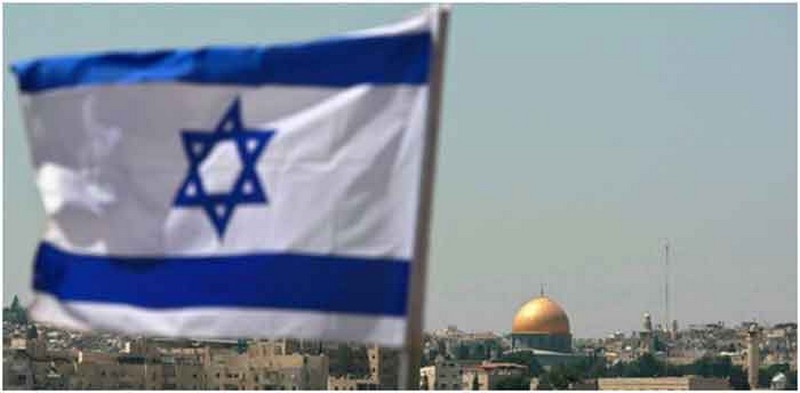
In memory of Writer Han Suyin

By Harsh Thakor

Last November we commemorated the 10th anniversary of the death of Han Suyin who left us on November 2nd, in 2012.  Apart from the gratuitous obituaries in official newspapers her death was received with scant attention: passing away in obscurity, like so many revolutionary women. On her birth centenary, no noticeable commemoration meeting was staged.

Han Suyin carves a permanent niche amongst the most creative revolutionary writers from China and the world .The trademark in her writing was the simplistic style and natural  flow, that projected the essence of the Chinese Revolution and China after 1949.Han could touch the core of a readers soul in conveying  the extensive strides made in China .Without jargonised language or rhetoric she articulately illustrated how China after 1949 surpassed every other the world country  in heath, literacy, industrial and agricultural production and democratic power of the workers and peasants.

Han Suyin’s writings described how in the Chinese Great Proletarian Cultural Revolution, revolutionary democracy touched heights unscaled and gave credibility to the mass movements. In the very thick of the skin she rebuked the Western media for wrongly cast in a negative picture of China. Han gave extensive coverage of the land reform movements, creation of people’s communes, and significance of Big Character posters in the Cultural Revolution, innovative experiments in education and production, workers and peasants running their revolutionary Commitees.etc.

Her works are significant today when the Western Media  and capitalist countries are leaving no stone unturned in heaping lies to discredit  Marxism  and distorting past history of USSR an China  .They work overtime in propaganda that horrific terror was the feature of China from 1956-78 ,projecting Mao Tse Tung as a dictator.

It is my firm wish that Han Suyin’s best book are re-printed to bring to light the truth about the Chinese Revolution and Socialism when the world is one verge of it’s most grave economic crisis  with globalisation engulfing every corner of the globe  like a Tsunami. Her great literary style could well be emulated by progressive writers today.

At one point Han Suyin was a mascot  for the Chinese Revolution.  Born Elizabeth Rosalie Chou, a “eurasian” woman who came of age in China on the eve of the revolution led by Mao, Han would eventually become one of the Revolution’s literary torchbearer’s of the western world.  She was a medical doctor and a novelist who, after she was gradually politically groomed by the revolution, would write social biographies of Mao Zedong and the Chinese Revolution––defending its imperative value from its beginning to the Great Proletarian Cultural Revolution, to the English-speaking world.  And though, at the end of the 1970s, like so many communists she made the mistake of harbouring faith that the China under Deng Xiaoping would continue the revolution––that China was not going down a capitalist road––she would soon become disillusioned by China’s path to state capitalism and retire, living in near anonymity, in exile in Europe.  In the mid-1990s she wrote a biography about Chou En lai and in this biography, upholding his great contribution as a Marxist.

Early Life

Han Suyin was born in Xinyang in the north-central province of Henan. Her father, who came from a landowning clan in Sichuan province, met his wife while studying abroad and took her home to semi-feudal China.

As a child in Beijing, she had fond memories of travelling to school by rickshaw and witnessing the gruesome sight of bodies of those who had died of starvation From the age of 12, she decided to become a doctor against the wishes of her mother who urged her to marry a foreigner – preferably an American because “all Americans are wealthy”.

After leaving school she paid for her fees at Yenching University in Beijing by learning to type. A Belgian businessman became her father substitute and arranged a scholarship for her to continue her medical studies in Brussels. In 1938 she returned to China to work in a French hospital in Yunnan, but was diverted on the way, meeting a handsome young officer, Tang Pao-huang (Pao), who moulded her in the Nationalist version of patriotism.

They were married that year in Wuhan, just before it was left to the mercy to the Japanese, and fled on the same boat as Chiang Kai-shek, head of the Nationalist government. They travelled west to Chongqing, the Nationalist wartime retreat, where she discovered her father’s relatives. There, she acquired her writing skill.

A missionary doctor, Marian Manly, encouraged her to sum up he story of her journey with Pao, refined the text and suggested avoiding subjects such as prostitution which might cause “misunderstanding”. The intention was to attract American readers to the Chinese cause. Bertrand Russell said that Destination Chungking (1942) – published under the pen name Han Suyin, which she kept – told him more about China in an hour than he had learned there in a year.

In 1942, when Pao was posted to London as military attache, she followed him with her adopted daughter and resumed her medical studies two years later. Through her publisher Jonathan Cape, she joined the circle of progressive Asia-minded intellectuals around Kingsley Martin, Dorothy Woodman, Margery Fry and JB Priestley. But medicine remained her goal.

Pao was posted to Washington and later to the Manchurian front where he died, fighting the communists, in 1947. Han Suyin remained in London to take her finals and then moved to Hong Kong. It was there that she met and had a passionate affair with the Times correspondent Ian Morrison. Their relationship laid the ground for ‘Many-Splendoured Thing’, which became a bestseller.

Five Volume Memoir

More important than her novels and historical biographies, however, was her five volume memoir that recounted her political evolution or crystallisation within China’s unfolding revolution. This was simply soul searching, tracing the inner or spiritual transformation of a Marxist revolutionary. A series of books where the personal was political aspects were completely mingled , these memoirs not only cashed on her  subjective experience to project t and justify the revolution led by Mao right along till  the end of the Cultural Revolution, but also manifested  protracted literary self-criticism.  They traced and illustrated her journey to communism where the older Han Suyin would critique the young and petty-bourgeois Elizabeth Chou while, at the same time, reflecting  the shadow of world historical events over her tiny and limited experience.

Although these memoirs were, by the publication of the third instalment (Birdless Summer), described as “a masterpiece in progress” by The Observer, by the 1990s they were largely out of print.  And by the 21st Century publishers, in a resurgence of anti-communist fever and the so-called capitalist “end of history”, would hardly give consideration in  touching a literary memoir that defended Mao and the Chinese Revolution––instead these publishers were flooding book stands with reactionary memoirs such as Jung Chang’s Wild Swans.  Han Suyin’s memoir counter attack to this backwards “wound literature” was considered anathema; no publisher was interested in a series of books, regardless of their literary value, where the author would place the Cultural Revolution in positive light.

Despite the fact that in 1968 The Daily Telegraph would claim that Han’s multi-volume memoirs would be “re-read two generations hence as one of the key documents of the twentieth century” these books are largely obliterated from public memory.  Now the Jung Changs of the world have replaced the Han Suyins and working overtime to tarnish the achievements of Mao Tse Tung  and the Chinese Revolution that  confirm everything westerners wish to project  revolutionary China s a ‘horror.’

Han should be resurrected by radical history because, far ahead of her time, her memoirs upheld the world historical revolution in China under Mao.

False Projection of Han Suyin

Regretfully she is remembered for the 1955 movie adaptation of her novel A Many Splendored Thing that also inspired a pop song and subsequent cliché. Still when people narrate that “love is a many splendored thing” one questions whether they had any genuine insight into Han Suyin or what she stood for.  She battled for much more than a terrible movie adaptation of a novel she wrote when she was young, let alone its even more terrible pop song and trite saying.

Unfortunately, due to the fact that the majority of her books are out of print, Han will mainly be remembered for A Many Splendored Thing––that semi-autobiographical novel that was written before she was a communist.  Even worse, she will probably be remembered for the movie adaptation where a white woman wearing eye make-up played her fictionalized self (since non-white women were not allowed to act as main characters in Hollywood at the time) and a complex novel about interracial love affairs in racial contexts was turned into another Hollywood romance.  However those of us who are Marxists or revolutionary democrats need to remember Han as a torchbearer for a world historical revolution––someone who invested every ounce of her energy in   projecting the Chinese Revolution in glowing light to her bourgeois readers in the west.

Biography of Mao

Indeed, her second historical biography on Mao, Wind in the Tower, has an appraisal of of Mao––which is redeeming in today’s anti-communist and anti-Marxist climate. Han Suyin clearly took a side––, in the moment of revolutionary upheaval, as a conscious catalyst of revolutionary ideology.  In respect of her more personal and critical memoirs where she discusses being attacked by Red Guards at certain points for her political failures, It s poignant that she would create books upholding both Mao and the GPCR. Regrettably all of these books are now out-of-print and Han Suyin is dead.

Incredibly detailed and extensively cited, Suyin’s work traces the development of China starting from directly after the People’s Liberation War in ’49 up until ’75, when the book was written. The  book has too strong of a tendency to shift the blame for the excesses of the Cultural Revolution onto Lin Biao- being a sharp  critique of his anarchism, along with the anarchist tendencies within the party and the youth movements as I thought both were mostly valid. The coverage of the treatment of USSR-PRC relations was fascinating and informative.

Most comprehensively Han Suyin sum s up the positive political role of the Cultural Revolution.

A possible weakness here is in making no comprehensive analysis of the 2 line struggle in the final stages o the Cultural Revolution after Lin Biao perishing, with no evaluation of the Gang of Four.

Morning Deluge

In The Morning Deluge Han Suyin concentrates on the condition of the people and on the task that Mao embarked himself upon, to liberate them from the hunger, disease and oppression which made many observers 50 years ago (and less) dismiss China as a decaying backwater of futility. These two books pose a general issue of whether “the truth” about a man like Mao comes most nearly from a portrait painted with passion in broad strokes, or from an agglomerated portrait of small lines deriving from the printed data we get from and about China. Han Suyin dips her ink boldly, retaining her novelist’s selectivity in assembling choices; which result in a moral tale with the extraordinary mixture of sentimentality toward what she likes and ferocity toward what she does not

The Morning Deluge “recounts the first 61 years of the chairman’s life, from his birth in 1893 at the tranquil village of Shaoshan to the end of the Korean War, and a second volume is promised to take the story on from 1954. Han Suyin brings to life  the studious nature of young Mao—he wrote more than one million words of notes and critiques during his five years of study in Changsha—and the boldness of his mind; he accepted only what he himself found to be true and then held to it unflinchingly.. She claims Mao had a “considerable following” among Changsha’s factory workers before 1919, and says a reproduction of the famous painting of him going in flowing robe with noble men in Hanyuan was hung by mistake in the Vatican in 1969 as a portrait of “a young Chinese missionary.” When Chou Enlai and others went off to study in France he stayed home because he felt he still had so much to learn about his own country.

She shows how Mao evolved, from his own unique combination of study and observation, the stress upon organizing peasants and the building of a broad front against imperialism which were the two points at which he was a torch bearer of Leninism even further from Marx than Lenin himself had done. Always Mao stressed integrating  with the masses (“the many‐millioned” is Han Suyin’s word) more than blueprints, and the book rightly pictures Mao as regularly in conflict with old styled  Marxists who wished to prematurely storm cities and slavishly ape Soviet models.

Being fresh from Moscow, these ultra‐leftists thought Mao was devoid in grasping “proletarian internationalism,” and were sceptical that there could be “Marxism in the mountains” where Mao was with incredible  foresight and patience embarked on building  guerrilla bases. Han Suyin, as a half Chinese, is understandably moved by the towering achievements of Mao, and in the chapters on the Long March and the Yenan years which followed she uses interviews conducted in China to unfold a readable drama of the new defining day in which the Chinese people finally “stood up” and re-wrote world history on equal terms.

Survivors told her how Long Marchers roped themselves together (“sleep flying”) to avoid sleep and collapse; how one marcher was perplexed when he came upon the Mao minority in Kwangsi: “I trotted up to a man I saw, but he did not understand me; I tried every word: Red Army, Jiuchin Soviet, Communist party: I called him old cousin in three dialects. He shook his head. Then thought: ‘That’s it, we’re out of China, and we’ve arrived in a foreign country where they can’t even speak Chinese.’”

The book in an organised manner touches on  the moral balance against the years of anti‐Peking propaganda fed to the American general reader, and it casts a fresh perspective across certain issues: The success or failure of a united front should not be judged, it is pointed out, by whether the relations between the parties remain good, for that is not its objective; Mao’s clashes with his father were not just a private or Freudian a matter but part of a social phenomena of revolutionary times; Mao’s military and physical training interests likewise .

‘China in the Year 2001’ and ‘Asia Today’.

Two other outstanding    books of Han Suyin are ‘China in the year 2001’ and ‘Asia Today.’ In ‘China  in theYear 2001’ in classical manner she illustrates  the essence of the ‘Great Leap Forward’, ‘The Great Proletarian   Cultural Revolution ‘,’Politics in Command,’,’The Atomic Bomb’ ‘Designing anew heaven nad Earth’ etc.  She delves into how China  attempted to create a fundamentally new Socialist man.In ‘Designing aNew heaven and earth’ she delves into the economic shphere and contrasts  the production methods to that of USSR placing emphasis on agriculture .In section on the Cultural Revolution she  illustratively describes the very relevance of Mao Tse Tung Thought and how in the practical sense it was dissected and penetrated in every sphere to revolutionise society .

Most poignant parts of this book were the manner  during the Cultural revolution China combined functions of a peasants ,worker an soldier,the democratic  initaive of the  communes,thetarnsformation of agriculture at the grassroots,and the democratic methods of introducing political ideology and  vivdly illustrated how the Peoples Liberation arm represnted the very soul of the workers  and peasants.

In ‘Asia Today’ she portrayed why China merited the tag of a genuine revolutionary democracy .In Chapter on ‘War and Peace’ she portrayed how china’s foreign policy was fairer thanany other nation.In chapter on Cultural Revolution’She made a subtle contrast with the approach in the Soviet Union when Stalin placed single handed emphasis on the base,neglecting the superstructure.She elaborated ho wthe Cultural Revolution was the greatest revolutionary mass movemnt and firstsone of it’s kind.Vividly she illustrated how the Peoples Liberation army repreesnted the very soul of the workers and peasnts.In a simplistic manner she sumarised the reviosnist pat of Khruschev after 1956 in USSSR.Articultealy she illustrated how great strides were accomplished,unpreecdented before.

Han supporting Deng Xiapoing

Sadly after 1978 Han Suyin failed to diagnose China’s road towards capitalism and became a strong apologist of Deng Xiaoping. Han Suyin’s post-1976 endorsement of Deng Xiaopong, including her involvement in a hagiographic documentary of Deng in the 1990’s (even going as far as to say Jiang Qing was the one opposed to Deng, rather than Mao and that Deng was a great man etc); opposition to the Tiananmen Square protests of 1989 (which she called, “poor young people who were misled” and explained the CPC’s dictatorship as, ““You have to have a dictatorship. How can you run a country with 22 percent of the world’s population without a strong hand?”); and even putting down Mao in comparison to Deng.I am not able to diagnose what transformed her thinking, to champion the line of the capitalist roaders.

Harsh Thakor is freelance journalist who has done extensive research on Liberation movements and Communism.

18 March 2023

Source: countercurrents.org