Just International

War Machine vs. Balloons

By Caitlin Johnstone

US Surrounds China with War Machinery while Freaking Out about Balloons

4 Feb 2023 – In what Austin journalist Christopher Hooks has called “one of the stupidest news cycles in living memory,” the entire American political/media class is having an existential meltdown over what the Pentagon claims is a Chinese spy balloon detected in US airspace on Thursday [2 Feb].

Secretary of State Antony Blinken cancelled his scheduled diplomatic visit to China after the detection of the balloon. The mass media have been covering the story with breathless excitement. China hawk pundits have been pounding the war drums all day on any platform they can get to and accusing the Biden administration of not responding aggressively enough to the incident.

“The important thing that the American people need to understand, and what we are going to try to expose in a bipartisan fashion on this committee, is that the threat posed by the Chinese Communist Party is not just a distant threat in East Asia, or a threat to Taiwan,” House China Select Committee Chairman Mike Gallagher told Fox News on Friday. “It is a threat right here at home. It is a threat to American sovereignty, and it is a threat to the Midwest — in places like those that I live in.”

“A big Chinese balloon in the sky and millions of Chinese TikTok balloons on our phones,” tweeted Senator Mitt Romney. “Let’s shut them all down.”

China’s foreign ministry says the balloon is indeed from China but is “civilian in nature, used for meteorological and other scientific research,” and was simply blown far off course. This could of course be untrue — all major governments spy on each other constantly and China is no exception — but the Pentagon’s own assessment is that the balloon “does not create significant value added over and above what the PRC is likely able to collect through things like satellites in Low Earth Orbit.”

So everyone’s losing their minds over a balloon that in all probability would be mostly worthless for spying, even while everyone knows the US spies on China at every possible opportunity. US officials have complained to the press that American spies are having a much harder time conducting operations and recruiting assets in China than they used to because of measures the Chinese government has taken to thwart them, and in 2001 a US spy plane caused a major international incident when it collided with a Chinese military jet on China’s coastline, killing the pilot.

The US considers it its sovereign right to spy on any nation it chooses, and the average American tends more or less to see it the same way. This is highlighted in controversies around domestic versus foreign surveillance, for example; Americans were outraged over the Edward Snowden revelations not because spy agencies were conducting surveillance, but because they were conducting surveillance on American citizens. It’s just taken as a given that spying on foreigners is fine, so it’s a bit silly to react melodramatically when foreigners return the favor.

As Jake Werner explains for Responsible Statecraft:

Foreign surveillance of sensitive U.S. sites is not a new phenomenon. “It’s been a fact of life since the dawn of the nuclear age, and with the advent of satellite surveillance systems, it long ago became an everyday occurrence,” as my colleague and former CIA analyst George Beebe puts it.

U.S. surveillance of foreign countries is likewise quite common. Indeed, great powers gathering intelligence on each other is one of the more banal and universal facts of international relations. Major countries even spy on their own allies, as when U.S. intelligence bugged the cellphone of German Chancellor Angela Merkel.

Typically, even when such surveillance is directed against the United States by a rival power, it does not threaten the safety of Americans and it poses manageable risks to sites where secrecy is of the utmost importance. However — in the context of rapidly increasing U.S.–China tensions — foreseeable incidents like these can quickly balloon into dangerous confrontations.

Now let’s contrast all this with another news story that’s getting a lot less attention.

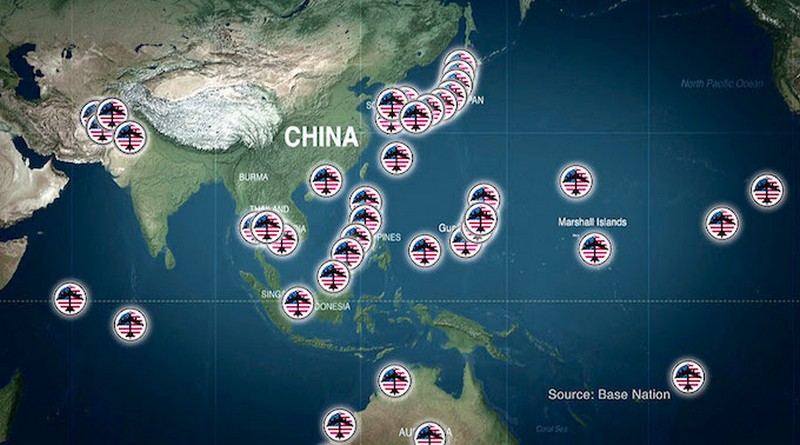
In an article titled “US secures deal on Philippines bases to complete arc around China,” the BBC reports that the empire will be adding even more installations to the already impressive military noose it has been constructing around the PRC.

“The US has secured access to four additional military bases in the Philippines – a key bit of real estate which would offer a front seat to monitor the Chinese in the South China Sea and around Taiwan,” writes the BBC’s Rupert Wingfield-Hayes. “With the deal, Washington has stitched the gap in the arc of US alliances stretching from South Korea and Japan in the north to Australia in the south. The missing link had been the Philippines, which borders two of the biggest potential flashpoints – Taiwan and the South China Sea.”

“The US hasn’t said where the new bases are but three of them could be on Luzon, an island on the northern edge of the Philippines, the only large piece of land close to Taiwan – if you don’t count China,” writes Wingfield-Hayes.

The BBC provides a helpful illustration to show how the US is completing its military encirclement, courtesy of the Armed Forces of the Philippines:

The US empire has been surrounding China with military bases and war machinery for many years, in ways Washington would never tolerate China doing in the nations and waters surrounding the United States. There is no question that the US is the aggressor in this increasingly hostile standoff between major powers. Yet we’re all meant to be freaking out about a balloon.

Ask me to show you how the US has been aggressing against China I can show you all the well-documented ways in which the US is encircling China with weapons of war. Ask an empire apologist to show you how China is aggressing against the US and they’ll start babbling about TikTok and balloons.

These things are not equal. Maybe Americans should stop watching out for hostile foreign ‘threats’ and start looking a little closer to home.

Caitlin Johnstone is a rogue journalist, poet, and utopia prepper who publishes regularly at Medium.

6 February 2023

Source: transcend.org

Nobel Peace Prize Watch: Watchdog Suspends Screening of Nobel Peace Prize Candidates

By Fredrik S. Heffermehl

Oslo, 1 February 2023

From: The Lay Down Your Arms Network, Nobel Peace Prize Watch

After ten years, we have decided not to publish our annual recommendation to the Norwegian Nobel Committee, a list of those who are both nominated and qualified to receive the Nobel Peace Prize.

As long as the committee continues to sabotage Nobel’s intention for peace through global disarmament, our work to bring forward good candidates has no purpose. The Nobel Committee has been unwilling to interpret the Will or show any interest in Nobel’s desire to end war by supporting the “peacemakers” who work for deep cooperation and community between nations, through disarmament and peace congresses.

After 15 years studying the award’s intention, finding out who should have received the NPP over 120 years, and who are the most suitable recipients in our time, we have concluded that the Committee does not contribute for elimination of wars; rather, it takes sides.

With an imminent risk of nuclear extinction looming, the need for Nobel´s global peace order is more urgent than ever, but the prize lost credibility.  There is, to put it mildly, little interest in those activists for peace and disarmament Nobel had in mind.

The Nobel Committee has five members appointed by the Storting [Supreme Legislature of Norway]. In 2012, following a complaint from NPPW, the Swedish Foundation Authority stated that the Nobel Foundation in Stockholm has the overall responsibility to ensure that the NPP remains within Nobel’s Will.

It has a duty, under Swedish law, to interpret the Nobel Will’s intention, announce the purpose of the prize, instruct its Norwegian sub-committees, and exercise overall supervision so that awards do not violate Nobel’s intention. In the book Fame or Shame (2020), I have shown that the Nobel Foundation and the Norwegian subsidiary bodies place themselves above the law and orders from authorities.

Fredrik S. Heffermehl, Oslo,                        Tomas Magnusson, Gothenburg

For kommentarer/ytterligere informasjon:
http://www.nobelwill.org/index.html?tab=7
Fredrik S. Heffermehl, Oslo, +47 917 44 783, fredpax@online.no, skype: paxfred
Tomas Magnusson, Gothenburg, + 46 70 829 31 97, gosta.tomas@gmail.com

Addresses: mail@nobelwill.org, Nobel Peace Prize Watch, c/o Magnusson, Akvamaringatan 7 c, 421 77 Göteborg, Sverige. Phones: Sweden, +46 70 829 31 97 or Norway, +47 917 44 789.

Fredrik S. Heffermehl, cand. jur, LLM NYU, is a member of the TRANSCEND Network for Peace, Development and Environment and ex-Vice President of the International Peace Bureau.

6 February 2023

Source: transcend.org

Military Spending by Country 2023

By World Population Review

A nation’s military is a crucial asset. The military enforces domestic and foreign policies and protects its citizens. National security is regarded as a government duty, including the security of citizens, the economy, and the country’s institutions. National security is crucial and requires large budgets to build and maintain. These expenses are typically referred to as military spending and/or defense spending. In 2020, the total world military expenditure was about $1.981 trillion. Military size varies significantly by country, typically correlating with each country’s size and military needs.

China, India, and the United States, unsurprisingly, have the largest militaries. A majority of the world’s nations have militaries, and only 36 nations do not have a military. Many nations have mandatory military service. The United States has the highest military spending of any nation. Its military spending includes all of the Department of Defense’s regular activities, war spending, the nuclear weapon program, international military assistance, and other Pentagon-related spending. In 2020, the U.S. spent $778 billion on military spending, more than the next nine top-spending countries combined.

Top 10 Countries with the Highest Military Expenditures (2020):

  1. The United States — $778 billion
  2. China — $252 billion [estimated]
  3. India — $72.9 billion
  4. Russia — $61.7 billion
  5. United Kingdom — $59.2 billion
  6. Saudi Arabia — $57.5 billion [estimated]
  7. Germany — $52.8 billion
  8. France — $52.7 billion
  9. Japan — $49.1 billion
  10. South Korea — $45.7 billion

As mentioned previously, the United States spends more on its military than any other nation. The country’s $778 billion military expenditure is among the expensive government programs, along with Social Security and Medicare. The U.S. has the third-largest military with 1.367 million members on active duty and another 1.037 million in the National Guard and reserves. Following the United States is China, spending $252 billion and India, spending $72.9 billion

Military Spending by Country 2023

2023 Population
United States $750.00 Bn 339,996,563
China $237.00 Bn 1,425,671,352
Saudi Arabia $67.60 Bn 36,947,025
India $61.00 Bn 1,428,627,663
United Kingdom $55.10 Bn 67,736,802
Germany $50.00 Bn 83,294,633
Japan $49.00 Bn 123,294,513
Russia $48.00 Bn 144,444,359
South Korea $44.00 Bn 51,784,059
France $41.50 Bn 64,756,584
Brazil $27.80 Bn 216,422,446
Italy $27.80 Bn 58,870,762
Australia $26.30 Bn 26,439,111
United Arab Emirates $22.75 Bn 9,516,871
Canada $22.50 Bn 38,781,291
Israel $20.00 Bn 9,174,520
Iran $19.60 Bn 89,172,767
Turkey $19.00 Bn 85,816,199
Spain $15.10 Bn 47,519,628
Algeria $13.00 Bn 45,606,480
Netherlands $12.42 Bn 17,618,299
Afghanistan $12.00 Bn 42,239,854
Poland $12.00 Bn 41,026,067
Pakistan $11.40 Bn 240,485,658
Egypt $11.20 Bn 112,716,598
Singapore $11.20 Bn 6,014,723
Taiwan $10.72 Bn 23,923,276
Colombia $10.60 Bn 52,085,168
Morocco $10.00 Bn 37,840,044
Oman $8.69 Bn 4,644,384
Indonesia $7.60 Bn 277,534,122
Norway $7.18 Bn 5,474,360
Thailand $7.10 Bn 71,801,279
Mexico $7.00 Bn 128,455,567
Angola $7.00 Bn 36,684,202
Kuwait $6.83 Bn 4,310,108
Sweden $6.33 Bn 10,612,086
Qatar $6.00 Bn 2,716,391
Vietnam $5.50 Bn 98,858,950
Ukraine $5.40 Bn 36,744,634
Romania $5.05 Bn 19,892,812
Switzerland $5.00 Bn 8,796,669
Uruguay $4.95 Bn 3,423,108
Belgium $4.92 Bn 11,686,140
Greece $4.84 Bn 10,341,277
Denmark $4.76 Bn 5,910,913
New Zealand $4.30 Bn 5,228,100
South Africa $4.28 Bn 60,414,495
Chile $4.25 Bn 19,629,590
Argentina $4.20 Bn 45,773,884
Malaysia $4.00 Bn 34,308,525
Kazakhstan $4.00 Bn 19,606,633
Bangladesh $3.80 Bn 172,954,319
Finland $3.57 Bn 5,545,475
Philippines $3.47 Bn 117,337,368
Austria $3.38 Bn 8,958,960
Portugal $3.36 Bn 10,247,605
Libya $3.00 Bn 6,888,388
Czech Republic $2.97 Bn 10,495,295
Azerbaijan $2.81 Bn 10,412,651
Myanmar $2.65 Bn 54,577,997
Jordan $2.60 Bn 11,337,052
Peru $2.56 Bn 34,352,719
Sri Lanka $2.50 Bn 21,893,579
Ecuador $2.50 Bn 18,190,484
Lebanon $2.50 Bn 5,353,930
Sudan $2.47 Bn 48,109,006
Nigeria $2.15 Bn 223,804,632
Slovakia $2.12 Bn 5,795,199
Hungary $2.08 Bn 10,156,239
Syria $1.80 Bn 23,227,014
Iraq $1.73 Bn 45,504,560
North Korea $1.60 Bn 26,160,821
Tajikistan $1.60 Bn 10,143,543
Bahrain $1.42 Bn 1,485,509
Yemen $1.40 Bn 34,449,825
Armenia $1.39 Bn 2,777,970
Lithuania $1.11 Bn 2,718,352
Bulgaria $1.08 Bn 6,687,717
Uzbekistan $975.00 Mn 35,163,944
Uganda $935.00 Mn 48,582,334
Serbia $907.00 Mn 7,149,077
Ireland $870.00 Mn 5,056,935
Croatia $800.00 Mn 4,008,617
Dominican Republic $760.00 Mn 11,332,972
Venezuela $745.00 Mn 28,838,499
Latvia $724.00 Mn 1,830,211
Republic Of The Congo $715.00 Mn 6,106,869
Ghana $710.00 Mn 34,121,985
Estonia $685.00 Mn 1,322,765
Bolivia $660.00 Mn 12,388,571
Cambodia $604.00 Mn 16,944,826
Slovenia $581.00 Mn 2,119,675
Ivory Coast $550.00 Mn 28,873,034
Tunisia $550.00 Mn 12,458,223
Namibia $505.00 Mn 2,604,172
Cuba $500.00 Mn 11,194,449
Panama $500.00 Mn 4,468,087
Botswana $450.00 Mn 2,675,352
Ethiopia $350.00 Mn 126,527,060
Cameroon $347.00 Mn 28,647,293
Georgia $327.00 Mn 3,728,282
Paraguay $250.00 Mn 6,861,524
Albania $250.00 Mn 2,832,439
Mozambique $245.00 Mn 33,897,354
Guatemala $240.00 Mn 18,092,026
Tanzania $223.00 Mn 67,438,106
Nepal $213.00 Mn 30,896,590
Honduras $205.00 Mn 10,593,798
Chad $200.00 Mn 18,278,568
Turkmenistan $200.00 Mn 6,516,100
El Salvador $167.00 Mn 6,364,943
Bosnia And Herzegovina $165.00 Mn 3,210,847
Mongolia $155.00 Mn 3,447,157
Nicaragua $140.00 Mn 7,046,310
Burkina Faso $130.00 Mn 23,251,485
Kenya $121.00 Mn 55,100,586
Madagascar $115.00 Mn 30,325,732
North Macedonia $108.15 Mn 2,085,679
Dr Congo $100.00 Mn 102,262,808
Zimbabwe $100.00 Mn 16,665,409
Gabon $83.00 Mn 2,436,566
South Sudan $80.00 Mn 11,088,796
Sierra Leone $75.50 Mn 8,791,092
Mali $70.00 Mn 23,293,698
Montenegro $65.00 Mn 626,485
Suriname $63.00 Mn 623,236
Somalia $62.20 Mn 18,143,378
Mauritania $50.25 Mn 4,862,989
Zambia $40.00 Mn 20,569,737
Moldova $30.00 Mn 3,435,931
Bhutan $25.12 Mn 787,424
Kyrgyzstan $20.00 Mn 6,735,347
Central African Republic $20.00 Mn 5,742,315
Laos $18.50 Mn 7,633,779
Liberia $13.00 Mn 5,418,377
Belarus $623.70 9,498,238

Sources:

  1. Stockholm International Peace Research Institute Military Expenditure Database
  2. SIPRI Military Expenditure Database – expenses in US$ 1988-2020
  3. SIPRI Military Expenditure Database – expenses as share of GDP

6 February 2023

Source: transcend.org

Shell Makes ‘Obscene’ $40bn Profit—Highest Ever

By Alex Lawson

Sunak government under pressure after gas prices fuel ‘outrageous’ doubling of profits at Anglo-Dutch group

2 Feb 2023The government is under pressure to rethink its windfall tax on energy companies after Shell reported one of the largest profits in UK corporate history, with the surge in energy prices sparked by Russia’s invasion of Ukraine pushing the oil company’s annual takings to $40bn (£32bn).

Opposition parties and trade unions described Shell’s bonanza, the biggest in its 115 year history, as “outrageous” and accused Rishi Sunak of letting fossil fuel companies “off the hook”.

On Thursday, the UK headquartered company confirmed it had paid just $134m in British windfall taxes during 2022. It paid $520m under the EU “solidarity contribution” – Europe’s equivalent of the windfall tax.

The company was criticised in October when it said it had paid no UK windfall tax up to that point, but on Wednesday said it was likely to contribute $500m in 2023.

Boosted by record oil and gas prices, Shell posted profits of almost $10bn in the final quarter of last year, taking its annual adjusted profits to $40bn in 2022, far outstripping the $19bn notched up in 2021.

The performance puts Shell on a par with the £38bn British American Tobacco made in 2017, but still behind the £60bn Vodaphone achieved in 2014, when the telecoms group sold its US business.

The shadow climate change secretary, Ed Miliband, said: “As the British people face an energy price hike of 40% in April, the government is letting the fossil fuel companies making bumper profits off the hook with their refusal to implement a proper windfall tax.”

Miliband added: “Labour would stop the energy price cap going up in April, because it is only right that the companies making unexpected windfall profits from the proceeds of war pay their fair share.”

The Liberal Democrat leader, Ed Davey, said: “No company should be making these kind of outrageous profits out of [Vladimir] Putin’s illegal invasion of Ukraine.

“Rishi Sunak was warned as chancellor and now as prime minister that we need a proper windfall tax on companies like Shell and he has failed to take action.”

Paul Nowak, the general secretary of the TUC, said the profits were “obscene” and “an insult to working families”.

The step up in Shell and its competitors’ profits during 2022 prompted the government to introduce a windfall tax on North Sea operators, which was later toughened by the chancellor, Jeremy Hunt.

Nowak said windfall taxes should be increased. “As households up and down Britain struggle to pay their bills and make ends meet, Shell are enjoying a cash bonanza. The time for excuses is over. The government must impose a larger windfall tax on energy companies. Billions are being left on the table,” he said.

“Instead of holding down the pay of paramedics, teachers, firefighters and millions of other hard-pressed public servants, ministers should be making big 0il and gas pay their fair share.”

Shell has benefited from a surge in oil prices caused by embargoes on Russian oil imposed since the invasion of Ukraine, and Russia’s decision to cut off gas supplies to continental Europe.

Analysts had expected Shell’s new chief executive, Wael Sawan, to report adjusted earnings of $7.97bn for the fourth quarter and $38.17bn for the year, in his City debut. It represented an increase on the $9.45bn registered in the third quarter, aided by a bounceback in earnings from its liquefied natural gas trading arm.

Sunak’s official spokesperson said No 10 was aware the public would view Shell’s profits as “extraordinary” high, which was why the government had introduced its windfall tax comparable to those seen in other countries, he added.

“We think it [the profits levy] strikes a balance between funding cost of living support while encouraging investment in order to bolster the UK’s energy security,” they said. “We have made it clear that we want to encourage reinvestment of the sector’s profits to support the economy, jobs and energy security, and that’s why the more investment a firm makes into the UK the less tax they will pay.”

Sawan announced a boost in payouts to shareholders, with a 15% increase in the final quarter dividend to $6.3bn.

He also announced $4bn of share buybacks over the next three months. In total, Shell distributed $26bn to shareholders in 2022.

Asked how it felt to make huge profits while people struggle with their bills, Sawan said: “These are incredibly difficult times, we’re seeing inflation rampant around the world … When I go back home to Lebanon some of the challenges I see people going through, sometimes without electricity for a full day, are the the challenges that we see in many, many parts of the world. The answer to that is to make sure we provide energy to the world.”

Shell has also been accused of overstating how much it is spending on renewable energy, and faced calls this week to be investigated and potentially fined by the US financial regulator.

Shell invested $25bn overall during 2022, up from $20bn in 2021. The firm spent $12bn on oil and gas projects, compared with $3.5bn on its renewable energy division.

The Greenpeace UK senior climate justice campaigner Elena Polisano said: “World leaders have just set up a new fund to pay for the loss and damage caused by the climate crisis. Now they should force historical mega-polluters like Shell to pay into it.”

Jonathan Noronha-Gant, a senior campaigner at Global Witness, said: “People have every right to be outraged at the enormous profits that Shell has made in the midst of an energy affordability crisis that has pushed millions of families into poverty.”

The company, which has a stock market valuation of $165bn, last week embarked on a review of its division supplying energy and broadband to homes in Europe, putting 2,000 UK jobs at risk.

Alex Lawson is the Guardian‘s energy correspondent.

6 February 2023

Source: transcend.org

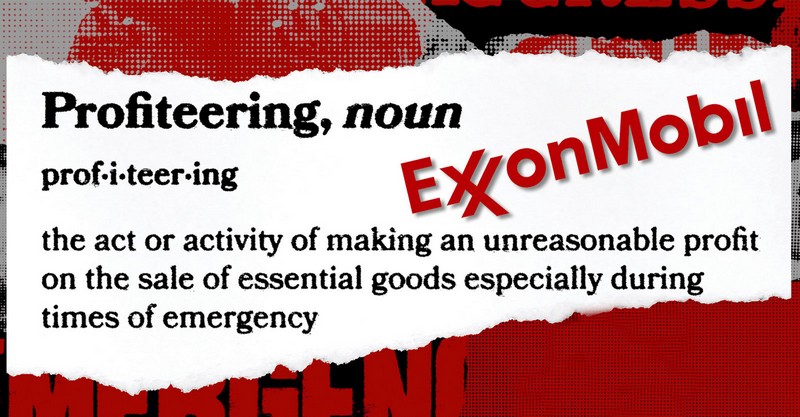
‘Obscene’: Exxon Posts Record $56 Billion in Profits — But Keeps Gouging Consumers

By Brett Wilkins

1 Feb 2023 – ExxonMobil on Tuesday [31 Jan] joined other U.S. oil companies in reporting record 2022 earnings amid rising gas prices, sparking renewed calls by consumer and climate advocates for a Big Oil windfall profits tax.

As ExxonMobil on Tuesday joined other U.S. oil companies in reporting record 2022 earnings amid rising gas prices, consumer and climate advocates renewed calls for a Big Oil windfall profits tax.

Texas-based ExxonMobil posted a $55.7 billion profit last year, breaking not only its own previous company record — $45 billion in 2008 — but setting a historic high for the Western oil industry, according to Reuters.

The company’s profit is a 144% increase from 2021 and, as Fossil Free Media director Jamie Henn noted, “enough money to send every person in the U.S. $178 to help offset the costs of high fossil fuel costs and gas bills.”

Marathon Petroleum — the top U.S. refiner — said Tuesday that it raked in $16.4 billion last year while approving a $5 billion stock buyback, and Phillips 66 reported $8.9 billion in adjusted 2022 profit, a 253% increase from 2021.

Tuesday’s earnings reports came just days after Chevron announced a $35.5 billion 2022 profit, a company record, and days before Shell, BP and Total are all expected to follow suit on the strength of profits related to Russia’s invasion of Ukraine and the European energy crisis.

Meanwhile, the average U.S. price of a gallon of gasoline crept up to over $3.50 on Tuesday, with average prices by state ranging from $3.40 in Nebraska to $4.93 in Hawaii, according to the American Automobile Association.

Last year, “families across Pennsylvania paid $5 a gallon for gas while Exxon made profits that ‘smashed earnings records’ and Chevron posted ‘record earnings,” said U.S. Sen. John Fetterman (D-Pa.), responding to recent Big Oil profit reports. “This price gouging is simply disgusting, and I’m going to get to the bottom of it.”

Cassidy DiPaola, spokesperson for Stop the Oil Profiteering, lamented that “while we’re getting robbed at the pump, Big Oil’s obscene profits are out of control and billionaire fossil fuel CEOs are getting richer and richer.”

DiPaola continued:

“Big Oil is shattering records precisely because of the pain the public is feeling at the pump. We’re paying more for gas and electricity because Big Oil companies are gouging Americans and benefiting from a rigged system that keeps prices high in times of war and crisis. And on top of that, Big Oil CEOs are making massive bonuses and rewarding big Wall Street investors while families are having to decide between filling up their gas tanks or paying for medication and childcare.”

“Enough is enough,” she added. “It’s time to fight back against the politicians and Big Oil CEOs who put their billions before the health and safety of our families, our communities, and our climate. We need to hold them accountable now with solutions like a windfall profits tax, and invest in clean energy solutions that can free us from expensive fossil fuels.”

6 February 2023

Source: transcend.org

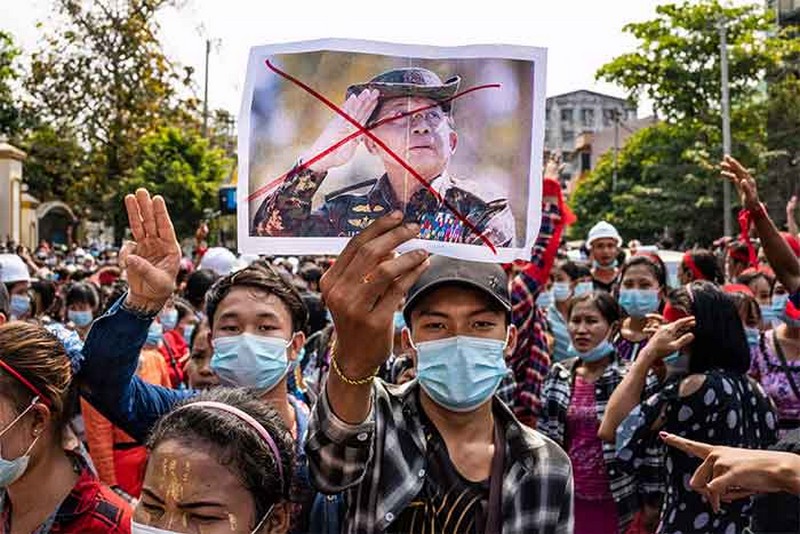
Junta Continues to Commit Atrocity Crimes Two Years After the Attempted Military Coup

By Burma Human Rights Network

Today marks two years since the attempted military coup in Burma. Over the last two years, the people of Burma have bravely resisted the junta’s violent attempt to take total control of the country. In the face of mass, unwavering public resistance, the junta continues to increase its campaign of brutality and savagery as it carries out killings, torture, forced disappearances, sexual violence, and airstrikes against the civilian population throughout the country.

Burma Human Rights Network (BHRN) has so far documented from 1st February 2021 to 31stDecember 2022. According to the documentation, the total number of civilians killed by the junta reached 3160 people. There were 363 people who were tortured and killed within 24 hours of their arrest by the junta. Arson attacks by the junta forces on civilian properties across the country destroyed 46,350 houses. Sagaing Division has the largest rates of all the above-mentioned crimes committed by the junta. Freedom of religion and belief was also significantly violated during the period, with hundreds of religious buildings burned and destroyed, including Churches, Buddhist monasteries, and Mosques.

While these events have garnered international attention, other forms of structural violence and human rights violations of Burma’s Muslim minorities has continued to occur largely under the radar, with particularly severe violations against the Rohingya people. Since the coup, Rohingya and other Muslim minorities have been subjected to tightened restrictions on their fundamental freedoms and are increasingly at risk of being subjected to further atrocity crimes.

Since the coup, the junta has imposed new movement restrictions and aid blockages on Rohingya camps and villages. The junta has arrested thousands of Muslims, hundreds of them children, for ‘unauthorized’ travel. Those arrested face a maximum of five years in prison. According to the Burma Human Rights Network’s (BHRN) documentation from 1 February 2021 to December 2022, at least 2,840 Rohingya were arrested and detained for traveling outside their communities without getting prior permission showing a sharp uptick in the number of arrests since the coup. BHRN has also documented 70 cases of other Muslim minorities being arbitrarily arrested.

The junta and its supporters continue to use divisive and hateful rhetoric targeting non-Buddhist religious groups to divide the resistance and deflect and divert attention from the coup. While religious oppression has been a longstanding issue in Burma, the coup emboldened the junta to further persecute, marginalize, and incite violence against the Rohingya and other Muslim minorities throughout the country. From 1 February 2021 until January 2023, BHRN has documented over 539 incidents of hate-speech targeting Muslims by junta supporters on social media including Facebook, Telegram, and junta-backed journals.

BHRN and other human rights groups have also documented cases of the junta looting, burning and destroying properties, shops, and places of worship of Muslim communities. BHRN documentation shows that more than 770 houses in Muslim villages were burned down by the junta in Sagaing region since the start of the coup. BHRN documentation shows the junta has killed at least 81 Muslims since 1 February 2021.

“Amidst all this violence and brutality, the international response to the coup has proceeded in a slow and fragmented manner, falling short of the Burma people’s expectations. The longer the international community waits to act, the more emboldened the junta will become as it continues to commit atrocities. The situation in Myanmar requires an immediate and cohesive international response”, said Kyaw Win, Executive Director of BHRN.

The Burma Human Rights Network (BHRN) calls on governments worldwide to:

· Redouble efforts to pursue international legal action against the junta, including by joining the Gambia’s case at the International Court of Justice and by actively pursuing investigations and prosecutions under the principle of universal jurisdiction like those in Turkey, Argentina, and Germany.

· Work together to strengthen international sanctions to cut off the Burma military from the revenue funding its abusive operations.

· Increase engagement and recognize the National Unity Government, ethnic resistance organizations, and leaders of the civil disobedience movement.

Additionally, BHRN calls on:

· ASEAN to coordinate strong action against the junta, block the junta from all its meetings, and support UN member states in enforcing sanctions and a global arms embargo against the junta.

· Neighbouring countries, including India, Thailand, Indonesia, Malaysia, Bangladesh, to devise a comprehensive regional response to the refugee crisis, provide protection, support, and humanitarian and legal aid to all refugees fleeing Burma, and to authorize emergency cross-border aid to internally displaced persons in Burma.

· The UN Security Council (UNSC) to end its inaction and refer the situation in Burma to the International Criminal Court or establish a separate criminal tribunal to investigate and prosecute the full spectrum of atrocity crimes in Burma. The UNSC should also impose a binding global arms embargo including a prohibition on security assistance, the sale and transfer of arms, dual-use technology, and suspend the supply of aviation fuel.

· The international community to not recognise the pseudo-election that the junta plans to conduct in August this year. There must be recognition that the same junta that overthrew a Democratically elected government does not have any credibility to conduct the election.

BHRN is based in London, operates across Burma and works for human rights, minority rights and religious freedom in Burma. BHRN has played a crucial role advocating for human rights and religious freedom with politicians and world leaders.

Countercurrents is answerable only to our readers. Support honest journalism because we have no PLANET B.

1 February 2023

Source: countercurrents.org

Ukrainian Army Injured Ukrainian Civilians With Illegal Mines: Human Rights Watch

By Countercurrents Collective

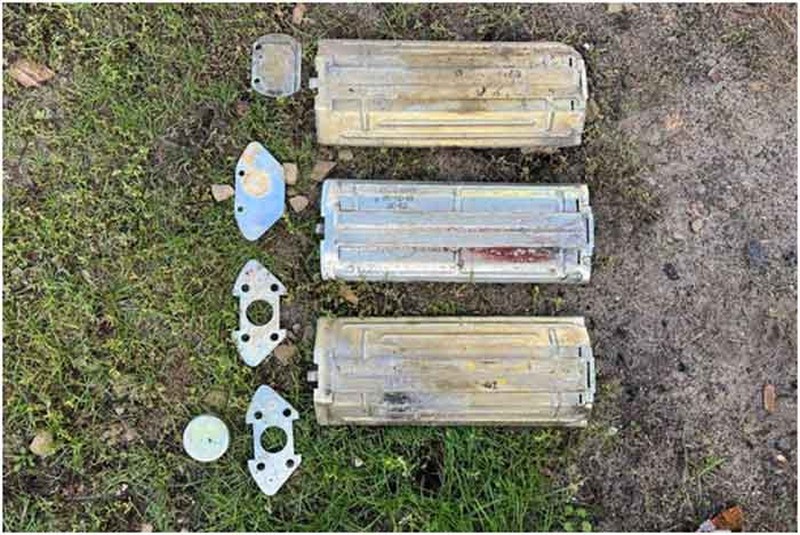
Remnants of KPFM-1S-SK cassettes manufactured in 1988 that Human Rights Watch researchers found in Izium in October 2022. These cassettes are used for the delivery of PFM mines by the 9M27K3 Uragan mine-laying rocket. The cassette opens in flight using a small explosive charge to separate it from the rocket motor section of the weapon and scatters 312 PFM mines into an area.  © 2022 Human Rights Watch

The Ukrainian army injured scores of Ukrainian civilians when it fired thousands of illegal mines across the city of Izium last year, Human Rights Watch (HRW) has alleged.

The mines, similar to those allegedly used by Ukraine against civilians in Donetsk, were found near schools and kindergartens.

The mines were fired into the city by rocket while it was occupied by Russian forces between April and September of last year, the HRW said in a report published on Tuesday.

Dispersed hundreds at a time, the Soviet-era PFM mines are distinctively butterfly- or petal-shaped devices and are designed to main rather than kill those unfortunate enough to step on them or pick them up.

The HRW documented numerous cases in which rockets carrying PFM antipersonnel mines, also called “butterfly mines” or “petal mines,” were fired into Russian-occupied areas near Russian military facilities.

The HRW team entered the city following Russia’s withdrawal in mid-September and found the mines in nine locations, including a school, and kindergarten, and a hospital.

Healthcare workers said that more than 50 civilians, including at least five children, were wounded by the mines. Around half of the injuries led to amputations of the foot or lower leg. At least one death was recorded, that of an elderly man who picked up one of the devices in his yard. However, investigators could not rule out other factors in the man’s death.

Some of the mines were fitted with timed fuses, and would explode without warning up to three days after being dispersed.

According to more than 100 residents, Russian forces attempted to warn locals of the danger posed by the Ukrainian mines, cleared some of the explosives, and transported victims to Russia for treatment. Once the Russians left Izium, demining duties were reportedly carried out by Ukrainian troops.

Use of such antipersonnel mines is prohibited under the 1997 Mine Ban Treaty, to which Ukraine is a signatory. The U.S. and Russia are not parties to the treaty.

Questioned by HRW, the Ukrainian government insisted that it abides by all of its international obligations, but refused to comment on the type of munitions it used in and around Izium.

“Any use of antipersonnel landmines is unlawful, and Ukraine should thoroughly investigate what happened and ensure its forces do not use them,” HRW arms division director Steve Goose stated in the report. Speaking to US news outlet NPR, Goose said that while HRW believes that Russia has also used these mines, Ukraine’s “moral high ground has been compromised” by the latest findings.

Ukraine also used PFM mines in the cities of Kharkov and Donetsk last year, according to officials in both locations, though Kiev denied the claims. The mines were also found strewn across Russia’s Belgorod Region in large numbers after a Ukrainian bombardment last summer.

Update From HRW

Human Rights Watch has welcomed Ukraine’s commitment to thoroughly analyze the report on antipersonnel landmines, as announced in a statement by the Ukraine Ministry of Foreign Affairs on January 31.

The HRW hope that the government will carry out a prompt, thorough, and impartial investigation into our findings. The HRW welcomes further dialogue with the Ukrainian authorities on this issue.

Countercurrents is answerable only to our readers. Support honest journalism because we have no PLANET B.

3 February 2023

Source: countercurrents.org

Diplomatic Cables Prove Top U.S. Officials Knew They Were Crossing Russia’s Red Lines on NATO Expansion

By Branko Marcetic

Nearly a year in, the war in Ukraine has cost hundreds of thousands of lives and brought the world to the brink of, in President Joe Biden’s own words, “Armageddon.” Alongside the literal battlefield, there has been a similarly bitter intellectual battle over the war’s causes.

Commentators have rushed to declare the long-criticized policy of NATO expansion as irrelevant to the war’s outbreak, or as a mere fig leaf used by Russian President Vladimir Putin to mask what former Secretary of State Condoleezza Rice and former Defense Secretary Robert Gates recently called “his messianic mission” to “reestablish the Russian Empire,” in a Washington Post opinion piece. Fiona Hill, a presidential adviser to two Republican administrations, has deemed these views merely the product of a “Russian information war and psychological operation,” resulting in “masses of the U.S. public… blaming NATO, or blaming the U.S. for this outcome.”

Yet a review of the public record and dozens of diplomatic cables made publicly available via WikiLeaks show that U.S. officials were aware, or were directly told over the span of years that expanding NATO was viewed by Russian officials well beyond Putin as a major threat and provocation; that expanding it to Ukraine was a particularly bright red line for Moscow; that such action would inflame and empower hawkish, nationalist parts of the Russian political spectrum; and that it could ultimately lead to war.

In a particularly prophetic set of warnings, U.S. officials were told that pushing for Ukrainian membership in NATO would not only increase the chance of Russian meddling in the country but also risked destabilizing the divided nation—and that the United States and other NATO officials pressured Ukrainian leaders to reshape this unfriendly public opinion in response. All of this was told to U.S. officials in both public and private by not just senior Russian officials going all the way up to the presidency, but by NATO allies, various analysts and experts, liberal Russian voices critical of Putin, and even, sometimes, U.S. diplomats themselves.

This history is particularly relevant as U.S. officials now test the red line China has drawn around Taiwan’s independence, risking military escalation that will first and foremost be aimed at the island state. The U.S. diplomatic record regarding NATO expansion suggests the perils of ignoring or outright crossing another military power’s red lines and the wisdom of a more restrained foreign policy that treats other powers’ spheres of influence with the same care they extend to the United States.

An Early Exception

NATO expansion had been fraught from the start. The pro-Western, then-Russian President Boris Yeltsin had told then-U.S. President Bill Clinton he “[saw] nothing but humiliation for Russia if you proceed” with plans to renege on the verbal promises made years earlier not to extend NATO eastward, and warned that this move would be “sowing the seeds of mistrust” and would “be interpreted, and not only in Russia, as the beginning of a new split in Europe.” Just as containment architect George Kennan had predicted, the decision to go ahead with NATO expansion helped inflame Russian hostility and nationalism: The Duma (the Russian parliament) declared it “the largest military threat to our country over the last 50 years,” while the leader of the opposition Communist Party called it “a Treaty of Versailles for Russia.”

By the time Putin became president the day before the new millennium, “the initial hopes and plans of the early ’90s [were] dead,” a leading liberal Russian politician declared. The first round of NATO enlargement was followed by the organization bombing Yugoslavia in 1999, which was done without the UN Security Council authorization, and triggered Russia to cut off contact with the alliance. By 2000, the revised Russian national security strategy warned that NATO’s use of force beyond its borders would be seen as “a threat of destabilization of the whole strategic situation,” while military officers and politicians started claiming “that if NATO expands further, it would ‘create a base to intervene in Russia itself,’” the Washington Post reported.

Ironically, there would be one exception to the next two decades’ worth of rising tensions over NATO’s eastward expansion that followed: the early years of Putin’s presidency, when the new Russian president defied the Russian establishment to try and make outreach to the United States. Under Putin, Moscow reestablished relations with NATO, finally ratified the START II arms control treaty, and even publicly floated the idea of Russia eventually joining the alliance, inviting attacks from his political rivals for doing so. Even so, Putin continued to raise Moscow’s traditional concerns about the alliance’s expansion, telling NATO’s secretary-general it was “a threat to Russia” in February 2001.

“[I]f a country like Russia feels threatened, this would destabilize the situation in Europe and the entire world,” he said in a speech in Berlin in 2000.

Putin softened his opposition as he sought to make common cause with then-President George W. Bush administration. “If NATO takes on a different shape and is becoming a political organization, of course, we would reconsider our position with regard to such expansion, if we are to feel involved in the processes,” he said in October 2001, drawing attacks from political rivals and other Russian elites.

As NATO for the first time granted Russia a consultative role in its decision-making in 2002, Putin sought to assist its expansion. Then-Italian President Silvio Berlusconi made a “personal request” to Bush, according to an April 2002 cable, to “understand Putin’s domestic requirements,” that he “needs to be seen as part of the NATO family,” and to give him “help in building Russian public opinion to support NATO enlargement.” In another cable, a top-ranking U.S. State Department official urged holding a NATO-Russia summit to “help President Putin neutralize opposition to enlargement,” after the Russian leader said allowing NATO expansion without an agreement on a new NATO-Russia partnership would be politically impossible for him.

This would be the last time any Russian openness toward NATO expansion was recorded in the diplomatic record published by WikiLeaks.

Allies Weigh In

By the middle of the 2000s, U.S.-Russian relations had deteriorated, partly owing to Putin’s bristling at U.S. criticism of his growing authoritarianism at home, and to U.S. opposition to his meddling in the 2004 Ukrainian election. But as explained in a September 2007 cable by then-President of New Eurasia Foundation Andrey Kortunov, now director general of the Russian International Affairs Council—who has publicly criticized both Kremlin policy and the current war—United States mistakes were also to blame, including Bush’s invasion of Iraq and a general sense that he had given little in return for Putin’s concessions.

“Putin had clearly embarked on an ‘integrationist’ foreign policy at the beginning of his second presidential term, which was fueled by the 9/11 terrorist attacks and good relations with key leaders like President Bush” and other leading NATO allies, Kortunov said according to the cable. “However,” he said, “a string of perceived anti-Russian initiatives,” which included Bush’s withdrawal from the Anti-Ballistic Missile (ABM) Treaty and “further expansion of NATO,” ultimately “dashed Putin’s hopes.”

What followed was a steady drumbeat of warnings about NATO’s expansion, particularly regarding neighboring Ukraine and Georgia, much of it from Washington’s NATO allies.

“[Former French presidential diplomatic adviser Maurice] Gourdault-Montagne warned that the question of Ukrainian accession to NATO remained extremely sensitive for Moscow, and concluded that if there remained one potential cause for war in Europe, it was Ukraine,” reads a September 2005 cable. “He added that some in the Russian administration felt we were doing too much in their core zone of interest, and one could wonder whether the Russians might launch a move similar to Prague in 1968, to see what the West would do.”

This was just one of many similar warnings from French officials that admitting Ukraine and Georgia into NATO “would cross Russian ‘tripwires’,” for instance. A February 2007 cable records then-French Director General for Political Affairs Gérard Araud’s recounting of “a half-hour anti-U.S. harangue” by Putin in which he “linked all the dots” of Russian unhappiness with U.S. behavior, including “U.S. unilateralism, its denial of the reality of multipolarity, [and] the anti-Russian nature of NATO enlargement.”

Germany likewise raised repeated concerns about a potentially bad Russian reaction to a NATO Membership Action Plan (MAP) for Ukraine and Georgia, with then-Deputy National Security Adviser Rolf Nikel stressing that Ukraine’s entry was particularly sensitive. “While Georgia was ‘just a bug on the skin of the bear,’ Ukraine was inseparably identified with Russia, going back to Vladimir of [Kyiv] in 988,” Nikel recounted, according to the cable.

Other NATO allies repeated similar concerns. In a January 2008 cable, Italy affirmed it was a “strong advocate” for other states’ entry into the alliance, “but is concerned about provoking Russia through hurried Georgian integration.” Norway’s then-Foreign Minister (who is now the prime minister) Jonas Gahr Støre made a similar point in an April 2008 cable, even as he insisted Russia mustn’t be able to veto NATO’s decisions. “At the same time he says that he understands Russia’s objections to NATO enlargement and that the alliance needs to work to normalize the relationship with Russia,” reads the cable.

Almost Complete Consensus

The thinkers and analysts that U.S. officials conferred with likewise made clear that the anxieties of Russian elites over NATO and its expansion, and the lengths they might go to counteract it. Many were transmitted by then-U.S. Ambassador to Russia William Burns, who is presently Biden’s CIA director.

Recounting his conversations with various “Russian observers” from both regional and U.S. think tanks, Burns concluded in a March 2007 cable that “NATO enlargement and U.S. missile defense deployments in Europe play to the classic Russian fear of encirclement.” Ukraine and Georgia’s entry “represents an ‘unthinkable’ predicament for Russia,” he reported six months later, warning that Moscow would “cause enough trouble in Georgia” and counted on “continued political disarray in Ukraine” to halt it. In an especially prescient set of cables, he summed up scholars’ views that the emerging Russia-China relationship was largely “the by-product of ‘bad’ U.S. policies,” and was unsustainable—“unless continued NATO enlargement pushed Russia and China even closer together.”

Cables record Russian intellectuals across the political spectrum making such points again and again. One June 2007 cable records the words of a “liberal defense expert Aleksey Arbatov” and the “liberal editor” of a leading Russian foreign policy journal, Fyodor Lukyanov, that after Russia had done “everything to ‘help’ the U.S. post-9/11, including opening up Central Asia for coalition anti-terrorism efforts,” it had expected “respect for Russia’s ‘legitimate interests.’” Instead, Lukyanov said, it had been “confronted with NATO expansion, zero-sum competition in Georgia and Ukraine, and U.S. military installations in Russia’s backyard.”

“Ukraine was, in the long term, the most potentially destabilizing factor in U.S.-Russian relations, given the level of emotion and neuralgia triggered by its quest for NATO membership,” stated the counsel of Dmitri Trenin, then-deputy director of the Russian branch of the U.S.-based Carnegie Endowment for International Peace, in a Burns-authored February 2008 cable. For Ukraine, he said prophetically, it would mean “that elements within the Russian establishment would be encouraged to meddle, stimulating U.S. overt encouragement of opposing political forces, and leaving the United States and Russia in a classic confrontational posture.”

Indeed, opposing NATO’s enlargement eastward, particularly in Ukraine and Georgia, was “one of the few security areas where there is almost complete consensus among Russian policymakers, experts and the informed population,” stated a cable of March 2008, citing defense and security experts. Ukraine was the “line of last resort” that would complete Russia’s encirclement, said one defense expert, and its entry into NATO was universally viewed by the Russian political elite as an “unfriendly act.” Other experts cautioned “that Putin would be forced to respond to Russian nationalist feelings opposing membership” of Georgia, and that offering MAP to either Ukraine or Georgia would trigger a cut-back in the Russian military’s genuine desire for cooperation with NATO.

From Liberals to Hardliners

These analysts were reiterating what cables show U.S. officials heard again and again from Russian officials themselves, whether diplomats, members of parliament, or senior Russian officials all the way up to the presidency, recorded in nearly three-dozen cables at least.

NATO enlargement was “worrisome,” said one Duma member, while Russian generals were “suspicious of NATO and U.S. intentions,” cables record. Just as analysts and NATO officials had said, Kremlin officials characterized NATO’s designs on Georgia and Ukraine as especially objectionable, with the Russian Ambassador to NATO from 2008 to 2011, Dmitry Rogozin, stressing in a February 2008 cable that offering MAP to either “would negatively impact NATO’s relations with Russia” and “raise tension along the borders between NATO and Russia.”

Then-Russian Deputy Foreign Minister Grigory Karasin “underscored the depth of Russian opposition” to their membership, a different March 2008 cable stated, underlining that the “political elite firmly believes” “that the accession of Ukraine and Georgia represented a direct security threat to Russia.” The future, Karasin said, rested on the “strategic choice” Washington made about “‘what kind of Russia’” it wanted to deal with—‘a Russia that is stable and ready to calmly discuss issues with the U.S., Europe and China, or one that is deeply concerned and filled with nervousness.’”

Indeed, numerous officials—including then-Director for Security and Disarmament Anatoly Antonov, who is currently serving as Russia’s ambassador to the United States—warned pushing ahead would produce a less cooperative Russia. Pushing NATO’s borders to the two former Soviet states “threatened Russian and the entire region’s security, and could also negatively impact Russia’s willingness to cooperate in the [NATO-Russia Council],” one Russian foreign ministry official warned, while others pointed to the policy to explain Putin’s threats to suspend the Conventional Armed Forces in Europe (CFE) treaty. “CFE would not survive NATO enlargement,” went a Russian threat in one March 2008 cable.

Maybe most pertinent were the words of Russian Foreign Minister Sergey Lavrov, at the time a veteran diplomat respected in the West, and who continues to serve in the position today. At least eight cables—many, though not all of them, written by Burns—record Lavrov’s expressions of opposition to expanding NATO to Ukraine and Georgia over the course of 2007-2008, when Bush’s decision, over the objections of allies, to publicly affirm their future accession led to a spike in tensions.

“While Russia might believe statements from the West that NATO was not directed against Russia, when one looked at recent military activities in NATO countries… they had to be evaluated not by stated intentions but by potential,” went Burns’s summary of Lavrov’s annual foreign policy review in January 2008. On the same day, he wrote, a foreign ministry spokesperson warned that Ukraine’s “likely integration into NATO would seriously complicate the many-sided Russian-Ukrainian relations” and lead Moscow to “have to take appropriate measures.”

Besides being an easy way to garner domestic support from nationalists, Burns wrote, “Russia’s opposition to NATO membership for Ukraine and Georgia is both emotional and based on perceived strategic concerns about the impact on Russia’s interests in the region.”

“While Russian opposition to the first round of NATO enlargement in the mid-1990s was strong, Russia now feels itself able to respond more forcefully to what it perceives as actions contrary to its national interests,” he concluded.

Lavrov’s criticism was shared by a host of other officials, not all of them hardliners. Burns recounted a meeting with former Prime Minister Yevgeny Primakov, a Gorbachev protégé who had negotiated over NATO’s first expansion with former Secretary of State Madeleine Albright, who warmly eulogized him years later as a pragmatist. The U.S. push for MAP for Georgia and Ukraine “‘infuriated’ Russians and threatened other areas of U.S.-Russia strategic cooperation,” Primakov had said, according to Burns, mentioning Primakov was asked later that day on TV about rethinking Crimea’s status as Ukrainian territory. “[T]his is the kind of discussion that MAP produces,” he said—meaning that it inflamed nationalist and hardline sentiment.

“Primakov said that Russia would never return to the era of the early 1990s and it would be a ‘colossal mistake’ to think that Russian reactions today would mirror those during its time of strategic weakness,” Burns’s cable stated.

This went all the way to the top, as U.S. officials noted in cables reacting to a famously strident speech Putin gave at the Munich Security Conference in February 2007, which saw Putin assail NATO expansion and other policies as part of a wider, destabilizing U.S. abuse of its sole-superpower status. Putin’s tone may have been “unusually sharp,” Primakov told Burns, but its substance “reflected well-known Russian complaints predating Putin’s election,” shown by the fact that “talking heads and Duma members were almost unanimous” in supporting the speech. A year later, a March 2008 cable reported then-German Chancellor Angela Merkel’s farewell, two-hour-long meeting with Putin, in which he “argued strongly” against MAP for Ukraine and Georgia.

Putin’s Exit

Any illusions this stance would evaporate with Putin leaving the presidency were quickly dispelled. Such warnings continued and, if anything, grew more intense after Putin was replaced by his liberal successor, Dmitry Medvedev as president of Russia, whose ascent sparked hopes for a more democratic Russia and an improved U.S.-Russian relationship.

Under Medvedev, officials from the Russian ambassador to NATO and various officials in the foreign ministry to the chairman of the Duma’s international affairs committee made much the same warnings, cables show. In some cases, as with Karasin and Lavrov, it was the same officials making these long-standing complaints.

Medvedev himself “reiterated well known Russian positions on NATO enlargement” to Merkel on his first trip to Europe in June 2008, even as he avoided bringing up MAP for Ukraine and Georgia specifically. “Behind Medvedev’s polite demeanor, Russian opposition to NATO enlargement remained a red-line, according to both conservative and moderate observers,” one June 2008 cable reads, a view shared by a leading liberal analyst. Even critics to his right read Medvedev’s words as “an implicit commitment to use Russian economic, political and social levers to raise the costs for Ukraine and Georgia” if they moved closer to the alliance. The cable’s author, then-Deputy Chief of Mission at the U.S. Embassy in Moscow Daniel Russell, concluded he “agree[d] with the common wisdom.”

By August 2008, following the war with Georgia, Medvedev started to sound a lot more like his predecessor, threatening to cut ties with the alliance and restating grievances about encirclement. A cable from after the end of the five-day war between Russia and Georgia—which an EU-commissioned report would later blame the Georgian government for starting—stated that “even the most pro-Western political experts” were “pointing the finger at the U.S.” for jeopardizing the U.S.-Russian relations, with U.S.’s dismissal of Russia’s concerns over, among other things, NATO expansion being a key part of their analysis. Echoing Burns, one analyst argued that Russia finally felt “strong enough to stand up to the West” when it ignored its concerns.

Those concerns were central at a roundtable of Russian analysts months later— a January 2009 cable showed—who explained to a group of visiting U.S. congresspeople Russians’ “deep displeasure” with the U.S. government, and stressed the “bitter divorce” between Russia and Georgia would be even uglier with Ukraine. Pushing MAP for the country “helped the ‘America haters come to power’ in Russia and gave legitimacy to the hard-liners’ vision of ‘fortress Russia,’” said one Russian analyst.

Increasingly, cables show, such warnings came from liberals, even those who hadn’t previously viewed NATO and the United States as Russia’s chief threats. An August 2008 cable described a meeting with Russian Human Rights Ombudsman Ambassador Vladimir Lukin—described as “a liberal on the Russian political scene, someone disposed toward cooperation with the U.S.”—who explained Medvedev’s post-war recognition of the independence of Georgia’s breakaway regions, which he had at first opposed, as a security-driven response to NATO’s drift toward Russia’s borders. Because escalations like the 2008 U.S.-Poland missile defense agreement showed anti-Russia actions “would not stop,” he said, “Moscow had to show that, like the U.S., it can and will take steps it deems necessary to defend its interests.”

The cable concluded that Lukin’s views “reflect the thinking of the majority of Russian foreign policy elite.”

Selling NATO to Ukraine

Other than Burns—whose Bush-era memos warning of the breadth of Russian opposition to NATO expansion and that it would provoke intensified meddling in Ukraine have become famous since the Russian invasion—U.S. officials largely reacted with dismissal.

Russian objections to the policy and other long-simmering issues were described over and over in the cables as “oft-heard,” “old,” “nothing new,” and “largely predictable,” a “familiar litany” and a “rehashing” that “provided little new substance.” Even NATO’s ally Norway’s position that it understood Russian objections even as it refused to let Moscow veto the alliance’s moves was labeled a case of “parroting Russia’s line.”

U.S. officials were similarly dismissive of explicit warnings—from Kremlin officials, NATO allies, experts and analysts, even Ukrainian leadership—that Ukraine was “internally divided over NATO membership” and that public support for the move was “not fully ripe.” The east-west split within Ukraine over the idea of NATO membership made it “risky,” German officials cautioned, and could “break up the country.” Ukraine’s three leading politicians all “took foreign policy positions based on domestic political considerations, with little regard to the long-term effects on the country,” one said.

Those very politicians likewise made clear public opinion wasn’t there, whether anti-Russian former Foreign Minister Volodymyr Ogryzko of Ukraine, or more Russian-friendly former Prime Minister Viktor Yanukovych—later misleadingly painted as a Kremlin puppet and was ousted as president in the 2014 Maidan protests—who boasted to a U.S. diplomat that support for NATO had jumped under his tenure. In response, the cables show, NATO officials pressed Ukrainian leaders to take a firm public stance in favor of joining, and discussed how to persuade Ukraine’s population “so that they would be more favorable [toward] it.” Ogryzko later disclosed to Merkel “that a public education campaign is already underway,” and that Ukraine “had discussed the issue of public education campaigns with Slovakia and other nations that had joined NATO recently.”

This came in spite of acknowledged risks. Cables record liberal Russian analysts cautioning “that [then-Ukrainian President Viktor] Yushchenko was using NATO membership to shore up a Ukrainian national identity that required casting Russia in the role of enemy,” and that “because membership remained divisive in Ukrainian domestic politics, it created an opening for Russian intervention.”

“Experts tell us that Russia is particularly worried that the strong divisions in Ukraine over NATO membership, with much of the ethnic-Russian community against membership, could lead to a major split, involving violence or at worst, civil war,” Burns wrote in February 2008. Russia, he further wrote, would then “have to decide whether to intervene; a decision Russia does not want to have to face.”

Despite the dismissive attitude of many U.S. officials, parts of the U.S. national security establishment clearly understood Russian objections weren’t mere “muscle-flexing.” The Kremlin’s anxieties over a “direct military attack on Russia” were “very real,” and could drive its leaders to make rash, self-defeating decisions, stated a 2019 report from the Pentagon-funded RAND Corporation that explored theoretical strategies for overextending Russia.

“Providing more U.S. military equipment and advice” to Ukraine, it stated, could lead Moscow to “respond by mounting a new offensive and seizing more Ukrainian territory”—something not necessarily good for U.S. interests, let alone Ukraine’s, it noted.

Warnings Ignored

Nevertheless, in the years, months, and weeks that led up to the Russian invasion of Ukraine in February 2022, successive U.S. administrations continued on the same course.

Ukraine’s cooperation with NATO has “deepened over time,” the alliance itself says today. By the war’s outbreak, the country frequently hosted Western troops at a military base, Ukrainian soldiers received NATO training, it planned two new NATO-linked naval bases, and has received unprecedented sums of U.S. military aid, including offensive arms—a former President Donald Trump policy his liberal predecessor had explicitly rejected, out of concern for provoking a disastrous response from Moscow. Three months before the invasion, Ukraine and the United States signed an updated Charter on Strategic Partnership “guided” by Bush’s controversial Bucharest declaration, which both deepened security cooperation between the two countries and supported Ukraine’s membership aspirations, viewed as an escalation in Moscow.

As U.S. military activity has increased in the region since 2016, sometimes involving Ukraine and Georgia, NATO-Russian tensions have ratcheted up too. While Moscow publicly objected to U.S. missions in Europe that experts feared were too provocative, NATO and Russian forces have experienced thousands of dangerous military encounters in the region and elsewhere. By December 2022, with fears of invasion ramping up, Putin told Biden personally that “the eastward expansion of the Western alliance was a major factor in his decision to send troops to Ukraine’s border,” the Washington Post reported.

None of this means other factors played no role in the war’s outbreak, from Russian domestic pressures and Putin’s own dim view of Ukrainian independence to the copious other well-known Russian grievances toward U.S. policy that frequently appear in the diplomatic record, too. Nor does it mean, as hawks argue, that this somehow “justifies” Putin’s war, any more than understanding how U.S. foreign policy has fueled anti-American terrorism that “justifies” those crimes.

What it does mean is that claims that Russian unhappiness over NATO expansion is irrelevant, a mere “fig leaf” for pure expansionism, or simply Kremlin propaganda are belied by this lengthy historical record. Rather, successive U.S. administrations pushed ahead with the policy despite being warned copiously for years—including by the analysts who advised them, by allies, even by their own officials—that it would feed Russian nationalism, create a more hostile Moscow, foster instability and even civil war in Ukraine, and could eventually lead to Russian military intervention, all of which ended up happening.

“I don’t accept anyone’s red line,” Biden said in the lead-up to the invasion, as his administration rejected negotiations with Moscow over Ukraine’s NATO status. We can only imagine the world in which he and his predecessors had.

Branko Marcetic is a Jacobin staff writer and the author of Yesterday’s Man: The Case Against Joe Biden.

3 February 2023

Source: countercurrents.org

Palestine: Platitudes Don’t Bring Peace

By Jafar M Ramini

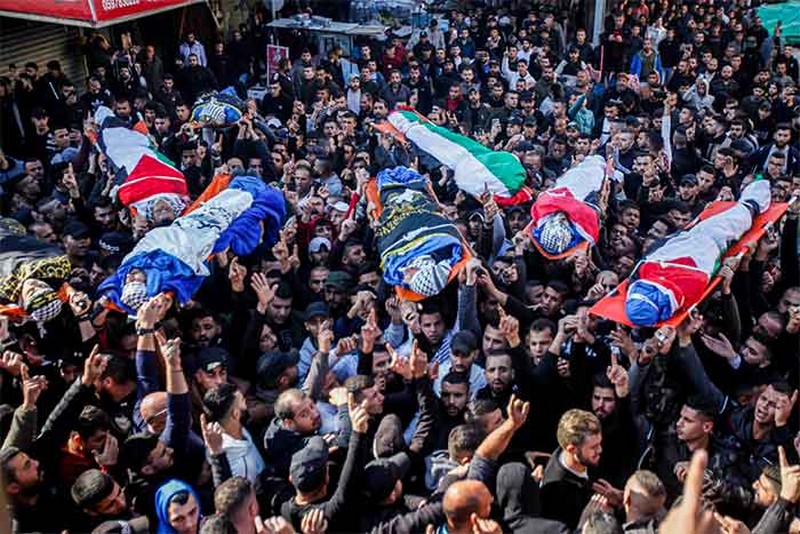
After the blood bath in occupied Palestine in 2022, more than 230 Palestinians were killed. The Israeli Occupation Forces and the heavily armed Jewish illegal settlers in the West Bank continued their feral killing spree into 2023 unabated. In the first month of this year, Israel murdered 36 Palestinians. Ten of those murders took place in Jenin, my birthplace. This massacre in Jenin was the catalyst for two attacks by Palestinians in occupied East Jerusalem that culminated in 8 Israelis dead.

Continuing their brutal reaction to any attempted Palestinian attacks, the Israeli cabinet met and passed new, harsh measures to deal with the resistance and their families and friends. From previous records, this is not new. The Israeli forces take great pleasure in following our dead into the grave. Vengeance is mine, sayeth Mr Netanyahu, Mr Ben Gvir et al.

Into this cruel, blood-soaked atmosphere, Mr Biden, The President of the USA, decided to despatch his Secretary of State, Antony Blinken to the Middle East to try and convince the Israelis and Palestinians to defuse the tension and calm the situation. Mr. Blinken started his tour of the area in Egypt and then proceeded to Israel where he met with Israeli officials and said a few soothing words about both sides deserving of security, dignity, and prosperity. And of course, still flogged the dead horse that is the two-state solution. What Mr Blinken did not mention was the occupation, the longest in history, nor the Apartheid regime that Israel applies over the indigenous population living under Israeli occupation. Mr. Netanyahu’s response was devoid of any mention of Palestine, the Palestinians, peace, or even the prospect of a negotiated settlement, based on past agreements with the Palestinians, the United Nations and the Security Council resolutions, nor even international law.

His entire speech concentrated on Iran and the threat it represents for Israel, the area and the world. Why should he deviate from his usual course of lies and propaganda? He has been warning the world about Iran’s possible nuclear bomb for the last thirty years. As for us, the Palestinians, Mr Netanyahu’s firm stance has been, and continues to be, ‘there will never be a Palestinian State, not on my watch.’ He reaffirmed this uncompromising stance after he was reelected to office two months ago, but declaring, as per his coalition manifesto, “The Jewish people has an exclusive and inalienable right to all parts of the Land of Israel. The government will promote and develop the settlement of all parts of the Land of Israel—in the Galilee, the Negev, the Golan Heights and Judea and Samaria,”

From this can anybody see room for a two-state solution?

Then, from Tel Aviv, Mr. Blinken went to Ramallah he met with Mr. Abbas and his cronies, exchanged pleasantries, and offered the same platitudes.

I received some unconfirmed reports that he also pressured Mr. Abbas to resume the security coordination with Israel, promising him more training and equipment for his security forces to regain control in Jenin, Nablus, Hebron, etc…In other words, toe the line, stop any form of resistance by your people and you can keep your imaginary authority.

What Mr. Blinken, his boss, Mr. Biden, the Israelis, not to mention the corrupt Palestinian Authority haven’t realised yet, is that the genie is out of the bottle and in no way is it going back.

The genie I am speaking of is a new generation of young Palestinians who were born since the Oslo Accords and have known nothing but a brutal occupation and a corrupt government, and who see no prospect of a dignified living or any sign that anyone cares about them or their lives and future. As such, they have come to the conclusion, on their own, that living on your knees is no living at all and that, in the absence of justice and accountability, they have taken the only recourse open to them. Resistance. This resistance is independent, youth-lead and not affiliated, or influenced by anybody or anything other than the bitter taste of constant humiliation, anger and despair.

No, Mr Blinken, platitudes will not bring peace to Palestine or the Middle East. What they will truly bring is a tsunami of violence that will sweep everything and everyone in its path. Give them hope, Mr Blinken.

Time to re-think.

Jafar M Ramini is a Palestinian writer and political analyst.

2 February 2023

Source: countercurrents.org
Palestine is My Cause: Arabs Reaffirm Support for Palestinians, Rejection of the Occupation

By Dr Ramzy Baroud

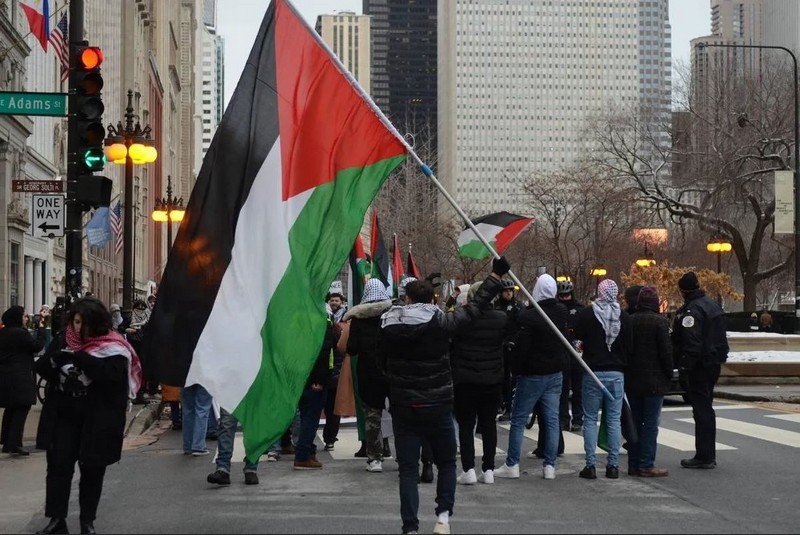
The latest Arab Opinion Index 2022 is yet more proof that Arab societies are diverse in every possible way, from their assessment of their economic situation and living conditions to their take on immigration, state institutions and democracy. With one single exception: Palestine.

76 percent of all respondents to the poll, which is carried out annually by the Arab Center for Research and Policy Studies in Doha, said that Palestine is a cause for all Arabs, not Palestinians alone.

Three important points must be kept in mind when trying to understand this number:

First, Arabs are not merely expressing sympathy or solidarity with Palestinians. They are irrevocably stating that the Palestinian struggle against the Israeli Occupation is a collective Arab struggle.

Second, these views are the same across all sections of society throughout the entire geographic expanse of the Arab world, from the Gulf to the Maghreb regions.

Third, equally important is that the public opinions that have been examined in the poll come from countries whose governments have either full diplomatic ties with Israel or vehemently reject normalization.

The study is quite extensive, as it included 33,000 individual respondents and was carried out in the period between June to December 2022.

Once again, the Arab people collectively reject normalization with Israel, with Algeria and Mauritania topping the list at 99 percent each.

Though some might discount the detailed study by claiming that Arabs inherently hate Israel due to their deep-seated aversion to the Jews, the study breaks down the reason why Arab masses have such a low opinion of Israel.

When they were asked as to why they reject diplomatic ties between their countries and Israel, the respondents mostly “cited Israel’s colonial and expansionist policies, as well as its racism toward the Palestinians and its persistence in expropriating Palestinian land.”

Only five percent cited religious reasons behind their position and that too cannot be dismissed as mere religious zealotry, as indeed many Arabs formulate their views based on the moral values enshrined in their religions; for example, the need to oppose and speak out against injustice.

It must be stated that this is hardly new. Arabs have exhibited these views with an unmistakable consistency, since the start of the Arab Opinion Index in 2011 and one would dare argue, since the establishment of Israel atop the ruins of Palestine in 1948.

But if that is the case, why are the latest poll results deserving of a discussion?

While examining the American public view of Russia, the state of democracy in the US, or the greatest threat to national security, opinion polls often fluctuate from one year to the other. For example, 70 percent of all Americans considered Russia an ‘enemy’ to the US in March, compared to only 41 percent in January.

The massive jump in two months is not directly related to the Russian war in Ukraine, since Ukraine is not a US territory, but because of the anti-Russia media frenzy that has not ceased for a moment since the beginning of the war.

However, for Arabs, neither media shift in priorities, internal politics, class orientation or any other factor seem to alter the status of Palestine as the leading Arab priority.

In 2017 and 2022 respectively, two American presidents visited the Arab region. Both Donald Trump and Joe Biden labored to execute a major shift in the region’s political priorities.

Biden summed up his agenda in a meeting with six Arab leaders in Jeddah in July by stating, “This trip is about once again positioning America in this region for the future. We are not going to leave a vacuum in the Middle East for Russia or China to fill.”

None of these self-serving priorities seem to be paying any real dividends.

That said, the pressure to dismiss the centrality of Palestine as an Arab cause does not only come from the outside. It is also guided by the internal dynamics of the region itself. For example, some pan-Arab news networks, which put much focus on Palestine in previous years, have been relentlessly and, sometimes, purposely, ignoring Palestine as an urgent daily reality in favor of other topics that are consistent with the regional policies of host countries.

Yet, despite all of this, Palestine remains the core of Arab values, struggles and aspirations. How is this possible?

Unlike most Americans, Arabs do not necessarily formulate their views of the world based on the media agenda of the day, nor do they alter their behavior based on presidential speeches or political debates. To the contrary, their collective experiences made them particularly cynical of propaganda and fiery speeches. They formulate their views based on numerous grassroots channels of communication, whether using social media tools or listening to the Friday sermon in their local mosque.

The struggle for Palestine has been internalized in the everyday acts of the average Arab woman or man; from the names they choose for their newborn, to the quiet muttering of prayers before falling asleep. No amount of propaganda can possibly reverse this.

Arab public opinion obviously matters, even though most Arab countries do not have functioning democratic systems. In fact, they matter most because of the lack of democracy.

Every society must have a system of political legitimacy, however nominal, for it to maintain relative stability. It means that the collective Arab view in support of Palestinians and rejection of normalization without an end to Israeli Occupation would have to be taken seriously.

Though some Arab governments are listening to their people and thus condition normalization on Palestinian freedom and sovereignty, the US and Israel insist on ignoring the Arab masses, as they have done for many years. However, if Washington believes that it can simply compel the Arabs to hate Russia and China and love Israel, while the latter continues to kill Palestinians and occupy their land, it will be sorely disappointed, not only today, but for many years to come.

Dr. Ramzy Baroud is a journalist, author and the Editor of The Palestine Chronicle.

2 February 2023

Source: countercurrents.org