Just International

The Amazon Rainforest Is Losing 200,000 Acres a Day–Soon It Will Be Too Late

By Kim Heacox

Since 1988, humans have destroyed an area of rainforest roughly the size of Texas and New Mexico combined.

7 Oct 2021 – Shortly before his 44th birthday, in December 1988, the Brazilian rubber tapper and environmental activist Chico Mendes predicted he would not live until Christmas. “At first,” he said, “I thought I was fighting to save rubber trees, then I thought I was fighting to save the Amazon rainforest. Now I realize I am fighting for humanity.”

Mendes had received death threats for years. The threats escalated when an aggressive rancher laid claim to a nearby forest reserve, where he intended to burn and level trees to create pasture for cattle. The rancher hired gunmen to prowl around Mendes’s neighborhood. Mendes publicly opposed the rancher, and continued to advocate for the human rights of the indigenous peoples of the Amazon basin, saying Brazil must save the most biodiverse forest in the world. Destroy it, he said, and we, the human race, will end up destroying ourselves.
More: Fast track to disaster? Brazil’s Grain Train plan raises fears for Amazon

Three days before Christmas, 1988, Mendes was shot dead by the rancher’s son.

It stunned the world.

The National Council of Rubber Tappers, reeling from the assassination, made a plea that the Amazon be preserved “for the whole Brazilian nation as part of its identity and self-esteem”. The council added: “This Alliance of the Peoples of the Forest – bringing together Indians, rubber tappers, and riverbank communities – embraces all efforts to protect and preserve this immense but fragile life-system that involves our forests, rivers, lakes and springs, the source of our wealth and the basis of our cultures and traditions.”

Since Mendes’s murder, nearly 1 million sq km of the Amazon, an area roughly the size of Texas and New Mexico combined, have been destroyed, primarily in Brazil, but also in Peru, Colombia, Venezuela, Suriname, Guyana, and French Guyana. That equates to an average of some 200,000 acres every day, or 40 football fields per minute. In Brazil alone, home to the greatest expanse of forest, the rate of loss has increased by more than 30%. The Amazon – historically a great carbon absorber, since trees take in carbon dioxide and release oxygen – now releases more carbon than it stores, which adds to, rather helps to reduce, our global climate crisis.

Deforestation rates decreased slightly from 2004 to 2012. But since then, they’re back on the rise, especially in the past couple of years, since Jair Bolsonaro became president of Brazil.

In 2018, as Bolsonaro campaigned as a patriotic man of the people, scientists predicted that once the Amazon lost more than 25% of its tree cover, it would become a drier ecosystem, all because deforestation changes weather patterns (due to how trees respire), which in turn reduces rainfall. Furthermore, as the forest becomes fragmented, areas surrounded by pastureland will lose species in a process biogeographers call “ecosystem decay.”

In short, the Amazon is dying. Entire genetic libraries and symphonies of species – trees, birds, reptiles, insects and more, eons in the making, fine-tuned by natural selection – are being wiped out to make room for methane-belching cows.

“Bolsonaro is a powerful supporter of agribusiness,” the Washington Post reported before he won the presidency, “and is likely to favor profits over preservation. [He] has chafed at foreign pressure to safeguard the Amazon rain forest and he served notice to international nonprofit groups such as the World Wildlife Fund that he will not tolerate their agendas in Brazil. He has also come out strongly against lands reserved for indigenous tribes.”

Writing in Mongabay, a science website, Thais Borges and Sue Branford reported in May 2019 that a “new manifesto by eight of Brazil’s past environment ministers … warn[s] that Bolsonaro’s draconian environmental policies, including the weakening of environmental licensing, plus sweeping illegal deforestation amnesties, could cause great economic harm to Brazil”.

Robert Walker, a quantitative geographer at the University of Florida’s Center for Latin American studies, has said that unless something unprecedented happens, he predicts that the greatest rain forest on earth will be wiped out by 2064.

If so, it will have taken local opportunists – armed with chainsaws, bulldozers, and chants of “land, land, land” – little more than a century to destroy a rain forest 10 million years old and composed of some 390bn trees. Perhaps then, in the hot, brutal and not-too-distant future, when historians chronicle humanity’s destruction of its own home planet, the killing of the Amazon will rank at or near the top. And all the reasons why it had to be done – so pressing at the time – will seem trite until, stripped away, two fundamental causes remain: ignorance and greed.

It’s not how much time we have, or money. It’s what we do with it

Enter Pope Francis, who is not afraid to set precedent. Together with the Archbishop of Canterbury Justin Welby and Orthodox Ecumenical Patriarch Patrick Bartholomew, the world’s three main Christian leaders recently issued “A Joint Message for the Protection of Creation,” asking Christians everywhere to “listen to the cry of the Earth”. This includes everyone, rich and poor, old and young, who must examine their behavior and pledge “meaningful sacrifices for the sake of the Earth which God has given us.” The three also implored world leaders scheduled to attend the United Nations Climate Conference (Cop 26) in Glasgow, which begins on 31 October, to make courageous – and necessary – choices.

If his health permits, Francis will take part in the Glasgow conference. Welby also plans to attend. Hopefully, soon thereafter, Francis, who is the first pope in history from the Americas, would visit Brazil, the world’s most populous Roman Catholic country. He’d walk into the Amazon, bless the forest – what remains of it – and ask the world to help turn the tide on Brazil’s reckless policies. Perhaps he could give a homily on Revelations 7:3: “Do not harm the earth, the sea, or the trees…” One that inspires South Americans to improve their livelihoods while also protecting their ancient forest – the lungs of the earth. Finally, Francis could appeal to his church and the world’s richest nations to spend some of their vast wealth to help re-educate, re-tool, and re-employ the farmers, ranchers, squatters and businessfolk of the Amazon.

Soon after he was elected pope in 2013, Jorge Mario Bergoglio of Buenos Aires took his papal title after St Francis of Assisi of Italy, the patron saint of animals and birds, who, like Chico Mendes, died at 44, and spoke truth to power. Henry David Thoreau, the New England transcendentalist who wrote Walden and Civil Disobedience, also died at 44, and did the same.

It’s not how much time we have, or money. It’s what we do with it. “Let your life be a counter-friction to stop the machine,” Thoreau wrote. He added that whenever he walked in the woods, he came out “taller than the trees.”

Brazil takes its name from a tree, the Paubrasilia, so-given by Portuguese explorers who prized it for its red dyes. Known today as Pernambuco or brazilwood, it’s listed as an endangered species, and is carefully planted and managed, and selectively harvested by skilled men who, with machetes hanging from their rope belts, move through the forest like water, and often bless each tree before cutting the wood that will be carved into exquisite bows for violins, violas and cellos.

It’s said that the people of Brazil, no matter how difficult their situation, will smile rather than cry because they love life. It’s also been said that the future of Brazil is the future of the world.

Chico Mendes was right.

Save the Amazon, and we just might save ourselves.

A frequent contributor to the Guardian, Kim Heacox is the author of many books, including The Only Kayak, a memoir, and Jimmy Bluefeather, a memoir, both winners of the National Outdoor Book Award.

11 October 2021

Source: www.transcend.org

Pandora Papers: An Offshore Data Tsunami

By International Consortium of Investigative Journalists

The Pandora Papers’s 11.9 million records arrived from 14 different offshore services firms in a jumble of files and formats – even ink-on-paper – presenting a massive data-management challenge.

3 Oct 2021 – A 2.94 terabyte data trove exposes the offshore secrets of wealthy elites from more than 200 countries and territories. These are people who use tax and secrecy havens to buy property and hide assets; many avoid taxes and worse. They include more than 330 politicians and 130 Forbes billionaires, as well as celebrities, fraudsters, drug dealers, royal family members and leaders of religious groups around the world.

The International Consortium of Investigative Journalists spent more than a year structuring, researching and analyzing the more than 11.9 million records in the Pandora Papers leak. The task involved three main elements: journalists, technology and time.

What is the Pandora Papers?

The Pandora Papers investigation is the world’s largest-ever journalistic collaboration, involving more than 600 journalists from 150 media outlets in 117 countries.

The investigation is based on a leak of confidential records of 14 offshore service providers that give professional services to wealthy individuals and corporations seeking to incorporate shell companies, trusts, foundations and other entities in low- or no-tax jurisdictions. The entities enable owners to conceal their identities from the public and sometimes from regulators. Often, the providers help them open bank accounts in countries with light financial regulation.

The 2.94 terabytes of data, leaked to ICIJ and shared with media partners around the world, arrived in various formats: as documents, images, emails, spreadsheets, and more.

The records include an unprecedented amount of information on so-called beneficial owners of entities registered in the British Virgin Islands, Seychelles, Hong Kong, Belize, Panama, South Dakota and other secrecy jurisdictions. They also contain information on the shareholders, directors and officers. In addition to the rich, the famous and the infamous, those exposed by the leak include people who don’t represent a public interest and who don’t appear in our reporting, such as small business owners, doctors and other, usually affluent, individuals away from the public spotlight.

While some of the files date to the 1970s, most of those reviewed by ICIJ were created between 1996 and 2020. They cover a wide range of matters: the creation of shell companies, foundations and trusts; the use of such entities to purchase real estate, yachts, jets and life insurance; their use to make investments and to move money between bank accounts; estate planning and other inheritance issues; and the avoidance of taxes through complex financial schemes. Some documents are tied to financial crimes, including money laundering.

What’s in the Pandora Papers?

The more than 330 politicians exposed by the leak were from more than 90 countries and territories. They used entities in secrecy jurisdictions to buy real estate, hold money in trust, own other companies and other assets, sometimes anonymously.

The Pandora Papers investigation also reveals how banks and law firms work closely with offshore service providers to design complex corporate structures. The files show that providers don’t always know their customers, despite their legal obligation to take care not to do business with people who engage in questionable dealings.

The investigation also reports on how U.S. trust providers have taken advantage of some states’ laws that promote secrecy and help wealthy overseas clients hide wealth to avoid taxes in their home countries.

What form did the data come in?

The 11.9 million-plus records were largely unstructured. More than half of the files (6.4 million) were text documents, including more than 4 million PDFs, some of which ran to more than 10,000-pages. The documents included passports, bank statements, tax declarations, company incorporation records, real estate contracts and due diligence questionnaires. There were also more than 4.1 million images and emails in the leak.

Spreadsheets made up 4% of the documents, or more than 467,000. The records also included slide shows and audio and video files.

What’s in the Pandora Papers leak?

The 2.9 terabyte leak contains a total of more than 11.9 million files.

*More than 4 million PDFs, more than 1.79 million Word documents, and other document formats.

What’s different about this leak from others we’ve heard about?

The Pandora Papers information – the 2.94 terabytes in more than 11.9 million records – comes from 14 providers that offer services in at least 38 jurisdictions. The 2016 Panama Papers investigation was based on 2.6 terabytes of data in 11.5 million documents from a single provider, the now-defunct Mossack Fonseca law firm. The 2017 Paradise Papers investigation was based on a leak of 1.4 terabytes in more than 13.4 million files from one offshore law firm, Appleby, as well as Asiaciti Trust, a Singapore-based provider, and government corporate registries in 19 secrecy jurisdictions.

The Pandora Papers presented a new challenge because the 14 providers had different ways of presenting and organizing information. Some organized documents by client, some by various offices, and others had no apparent system at all. A single document sometimes contained years’ worth of emails and attachments. Some providers digitized their records and structured them in spreadsheets; others kept paper files that were scanned. Some PDFs contained spreadsheets that had to be reconstructed into spreadsheets. The documents arrived in English, Spanish, Russian, French, Arabic, Korean and other languages, requiring extensive coordination among ICIJ partners.

The Pandora Papers gathered information on more than 27,000 companies and 29,000 so-called ultimate beneficial owners from 11 of the providers, or more than twice the number of beneficial owners identified in the Panama Papers.

The Pandora Papers connected offshore activity to more than twice as many politicians and public officials as did the Panama Papers. And the Pandora Papers’ more than 330 politicians and public officials, from more than 90 countries and territories , included 35 current and former country leaders.

The new leak also includes information on jurisdictions not explored in previous ICIJ projects or for which there was little data, such as Belize, Cyprus and South Dakota.

The legal entities in the files of six providers – the companies, foundations and trusts – were all registered between 1971 and 2018. The records show providers and clients shifting their business from one jurisdiction to another after investigations and resulting rule changes.

How did you explore the files?

Only 4% of the files were structured, with data organized in tables (spreadsheets, csv files and a few “dbf files”).

To explore and analyze the information in the Pandora Papers, ICIJ identified files that contained beneficial ownership information by company and jurisdiction and structured it accordingly. Each provider’s data required a different process.

In cases where information came in spreadsheet form, ICIJ removed duplicates and combined it into a master spreadsheet. For PDF or document files, ICIJ used programming languages such as Python to automate data extraction and structuring as much as possible.

In more complex cases, ICIJ used machine learning and other tools, including the Fonduer and Scikit-learn softwares, to identify and separate specific forms from longer documents.

Some provider forms were handwritten, requiring ICIJ to extract information manually.

Once information was extracted and structured, ICIJ generated lists that linked beneficial owners to the companies they owned in specific jurisdictions. In some cases, information about where or when a company was registered wasn’t available. In others, information was missing about when a person or an entity had become the owner of the company, among other details.

After structuring the data, ICIJ used graphic platforms (Neo4J and Linkurious) to generate visualizations and make them searchable. This allowed reporters to explore connections between people and companies across providers.

To identify potential story subjects in the data, ICIJ matched information in the leak against other data sets: sanctions lists, previous leaks, public corporate records, media lists of billionaires and public lists of political leaders.

ICIJ’s partner in Sweden, SVT, generated spreadsheets containing data extracted from passports found in the Pandora Papers.

ICIJ shared records with media partners using Datashare, a secure research and analytical tool developed by ICIJ’s technical team. Datashare’s batch-search function helped reporters match some public figures with the data.

The leak contains routine documents that service providers gather for due diligence – news articles, Wikipedia entries, information from financial data provider World-Check – that don’t necessarily confirm whether a person is hiding wealth in a secrecy jurisdiction. ICIJ used machine learning to tag such files in Datashare, enabling reporters to exclude them from their searches.

Our 150 media partners shared tips, leads and other information of interest using ICIJ’s global I-Hub, a secure social media and messaging platform. Throughout the project, ICIJ held extensive training sessions for partners on the use of ICIJ technology to explore, mine and better understand the files.

What did you research and how did you organize it?

Having identified documents that contained information on the owners of offshore entities and structured the information by provider, ICIJ unified the data in a centralized database.

This provided ICIJ and its media partners with a unique data set of beneficial owners of companies in secrecy jurisdictions.

ICIJ eliminated duplications in the data and identified key elements, such as nationality of the owner, country of residence and place of birth. This enabled us to find, for instance, nearly 3,700 companies with more than 4,400 beneficiaries who were Russian nationals – the most among all nationalities in the data. The figure includes 46 Russian oligarchs.

ICIJ also researched and analyzed the use of U.S. trusts, using keyword searches and matches with public data, among other methods.

As a result, ICIJ identified more than 200 trusts settled, or created, in the U.S from 2000 to 2019, with the largest number registered in South Dakota. The trusts were connected with people from 40 countries (not including the U.S.). ICIJ identified assets in single trusts worth between $67,000 and $165 million held between 2000 and 2019. The data shows that U.S. trusts held assets worth a total of more than $1 billion. Those included U.S. real estate and bank accounts in Panama, Switzerland, Luxembourg, Puerto Rico, the Bahamas and elsewhere.

Which US states have the most trusts in the Pandora Papers?

The investigation shows how U.S. trusts have become a go-to vehicle for financial secrecy.

To perform the analysis of U.S.-based trusts, ICIJ manually gathered information on the creators, known as settlors; the beneficiaries, and the assets held by the trusts. ICIJ was able to identify and gather data on trusts from 15 U.S. states and the District of Columbia.

ICIJ and its media partners used keyword searches to identify politicians in the data, using passport information to help with the identification.

ICIJ used public records to verify details related to the companies and to be sure the people named in the data were actually the political leaders identified with those names. We found some false positives and discarded them. Among sources used in the research were the Dow Jones Risk and Compliance database, Sayari, Nexis, OpenCorporates, property records in the U.S and U.K., and public corporate records. More than 330 politicians and high level public officials, including 35 country leaders were confirmed.

ICIJ structured the information in a spreadsheet and put it through two rounds of fact-checking. Data gathered on politicians was also visualized in the profiles in our Power Players feature.

ICIJ matched Forbes’s billionaires lists against the Pandora Papers to find more than 130 who had entities in secrecy jurisdictions. More than 100 of them had a combined fortune valued at more than $600 billion in 2021.

ICIJ analyzed 109 so-called suspicious activity reports to financial authorities filed by the Panamanian law firm Alemán, Cordero, Galindo & Lee, or Alcogal, and learned that 87 of the anti-money-laundering forms were written only after authorities or journalists had publicly identified the firm’s clients as involved in alleged wrongdoing.

ICIJ also read through several thousand publicly available employees’ profiles and found out that more than 220 lawyers associated with the giant law firm Baker McKenzie in 35 countries had previously held government posts in agencies including justice departments, tax offices, the EU Commission, and offices of heads of state.

ICIJ also did research and analysis to explore the role offshore finance plays in hiding looted art and ancient relics that authorities and communities seek to reclaim.

Finally, the Pandora Papers investigation identified more than 500 BVI companies that had been clients of Mossack Fonseca, the law firm at the center of the Panama Papers scandal, and moved their business to other BVI providers in the aftermath whom we found in the data.

ICIJ also matched Panamanian companies from the Panama Papers data against data available for the Panama corporate registry on OpenCorporates, and found out that at least 113 companies had changed registered agents and simply moved to Alcogal between April 3, 2016 and 2020. Together with The Miami Herald data team, ICIJ also counted 759 BVI companies that specifically considered moving to Trident Trust as part of the provider’s so-called “Mossfon Project”.

How big a slice of all offshore provider data in the world does the Pandora Papers leak represent?

The Pandora Papers probe offers a broad look at secrecy jurisdictions and offshore service providers, but the data came incomplete.

The quality of the data varied by provider. In some cases, the data tied to companies didn’t offer information about the jurisdiction where they were registered, the period during which an individual was linked to an entity, or about intermediaries. The data still offered important information about owners and, in some cases, transactions and other financial details.

The 14 providers, which offered services in at least 38 jurisdictions, are part of a larger industry of offshore services operating around the world. It’s hard to say how much of the universe of provider data we have, a small fraction, probably.

For example, in the BVI, where six, or nearly half, of the providers found in the Pandora Papers have acted as registered agents, they are among at least 101 firms acting in that capacity, according to the BVI Financial Services Commision. In March 2021, there were more than 370,000 active companies, about a dozen for each of the tiny island nation’s inhabitants.

Who are the firms at the heart of the Pandora Papers?

The leaked files come from 14 offshore service providers that help clients establish companies in secrecy jurisdictions.

Why so many more ‘ultimate beneficial owners’ – UBOs – here than in previous leaks?

A significant proportion of the beneficial ownership information in the Pandora Papers comes from reports generated by providers for the BVI’s Beneficial Ownership Secure Search System, or BOSS, established in the wake of the 2016 publication of the Panama Papers. This information is not available to the public.

A 2017 BVI law requires providers to report to BVI authorities the names of the real owners of the companies registered there. The leak identified many documents containing such information.

Why so many world leaders and politicians in the data?

Alcogal and Trident Trust was where we found a large number of current and former politicians and public officials as clients. Most of their companies were registered in the BVI and Panama. Alcogal clients include nearly half of the politicians and public officials identified in the Pandora Papers. In the beneficial ownership data that ICIJ was able to structure, nearly half of the companies were linked to Alcogal. Alcogal, headquartered in Panama, has among its founders several politicians, one of whom served as Panama’s ambassador to the United States.

How many politicians did each firm in the Pandora Papers serve?

A dozen different offshore firms provided services to 336 politicians identified in the investigation.

Why so many beneficial owners from Russia and Latin America?

Some of the providers, based on their location and the jurisdictions where they do business, such as Cyprus, have a large proportion of Russian clients, the largest group by nationality in the Pandora Papers data.

In the Pandora Papers, more than 30% of the companies that received services from Demetrios A. Demetriades LLC, or DadLaw, a provider headquartered in Cyprus, had one or more Russians as beneficial owners. Similarly, more than 40% of the companies that received services from Seychelles-based Alpha Consulting Group, also had one or more Russians as beneficial owners. Alcogal and Fidelity Corporate Services Limited were also among the providers with the largest number of Russian clients.

A large proportion of beneficial owners appearing in the data are from Latin America. More than 90 of the more 330 politicians and public officials in the data are from Latin America. Argentina, Brazil and Venezuela are among the countries with the largest representation of beneficial owners. In the leaked data, Alcogal headquartered in Panama, has the largest group of Latin American clients.

Where are the U.S. citizens and multinational corporations?

When it comes to creating offshore companies, foundations and trusts, parties from different parts of the world and with different needs select different providers and jurisdictions for their shell companies.

Pandora Papers documents cover a large number of providers, but obviously not all, or even most, of them, and many jurisdictions are not represented in the data.

In previous ICIJ investigations, including 2017’s Paradise Papers, the leak came from a prestigious law firm with a larger corporate practice, Appleby. As a result, the data included more documents about multinationals. Bermuda and the Cayman Islands, which are popular havens for corporations, were among the jurisdictions with a large presence in that leak.

As for U.S. nationals, ICIJ identified more than 700 companies with beneficial owners connected to the U.S. in the Pandora Papers; Americans were also among the top 20 nationalities represented in the data. In the Pandora Papers, Russia, the United Kingdom, Argentina, China and Brazil, are among the countries with the largest representation of beneficial owners.

In the Paradise Papers, U.S. citizens had a larger relative presence.

Is ICIJ going to release the Pandora Papers data?

With today’s publication, ICIJ is sharing data and details about the use of companies in secrecy jurisdictions by more than 50 politicians, through the Power Players feature. ICIJ is planning to incorporate data from the Pandora Papers into the Offshore Leaks database.

International Consortium of Investigative Journalists is a global network of more than 190 investigative journalists in more than 65 countries who collaborate on in-depth investigative stories.

11 October 2021

Source: www.transcend.org

A Propaganda Model

By Edward Herman and Noam Chomsky

Excerpted from Manufacturing Consent, 1988

The Five Filters:

  1. Size, ownership, and profit orientation of the mass media
  2. The advertising license to do business
  3. Sourcing mass-media news
  4. Flak and the enforcers (according to the authors, Freedom House is a flak)
  5. Anticommunism as a control mechanism

The mass media serve as a system for communicating messages and symbols to the general populace. It is their function to amuse, entertain, and inform, and to inculcate individuals with the values, beliefs, and codes of behavior that will integrate them into the institutional structures of the larger society. In a world of concentrated wealth and major conflicts of class interest, to fulfill this role requires systematic propaganda.

In countries where the levers of power are in the hands of a state bureaucracy, the monopolistic control over the media, often supplemented by official censorship, makes it clear that the media serve the ends of a dominant elite. It is much more difficult to see a propaganda system at work where the media are private and formal censorship is absent. This is especially true where the media actively compete, periodically attack and expose corporate and governmental malfeasance, and aggressively portray themselves as spokesmen for free speech and the general community interest. What is not evident (and remains undiscussed in the media) is the limited nature of such critiques, as well as the huge inequality in command of resources, and its effect both on access to a private media system and on its behavior and performance.

A propaganda model focuses on this inequality of wealth and power and its multilevel effects on mass-media interests and choices. It traces the routes by which money and power are able to filter out the news fit to print, marginalize dissent, and allow the government and dominant private interests to get their messages across to the public. The essential ingredients of our propaganda model, or set of news “filters,” fall under the following headings: (I) the size, concentrated ownership, owner wealth, and profit orientation of the dominant mass-media firms; (~) advertising as the primary income source of the mass media; (3) the reliance of the media on information provided by government, business, and “experts” funded and approved by these primary sources and agents of power; (4) “flak” as a means of disciplining the media; and (5) “anticommunism” as a national religion and control mechanism. These elements interact with and reinforce one another. The raw material of news must pass through successive filters, leaving only the cleansed residue fit to print. They fix the premises of discourse and interpretation, and the definition of what is newsworthy in the first place, and they explain the basis and operations of what amount to propaganda campaigns.

The elite domination of the media and marginalization of dissidents that results from the operation of these filters occurs so naturally that media news people, frequently operating with complete integrity and goodwill, are able to convince themselves that they choose and interpret the news “objectively” and on the basis of professional news values. Within the limits of the filter constraints they often are objective; the constraints are so powerful, and are built into the system in such a fundamental way, that alternative bases of news choices are hardly imaginable. In assessing the newsworthiness of the U.S. government’s urgent claims of a shipment of MIGs to Nicaragua on November 5, I984, the media do not stop to ponder the bias that is inherent in the priority assigned to government-supplied raw material, or the possibility that the government might be manipulating the news, imposing its own agenda, and deliberately diverting attention from other material. It requires a macro, alongside a micro- (story-by-story), view of media operations, to see the pattern of manipulation and systematic bias.

Size, Ownership, and Profit Orientation of the Mass Media: The First Filter

In their analysis of the evolution of the media in Great Britain, James Curran and Jean Seaton describe how, in the first half of the nineteenth century, a radical press emerged that reached a national working-class audience. This alternative press was effective in reinforcing class consciousness: it unified the workers because it fostered an alternative value system and framework for looking at the world, and because it “promoted a greater collective confidence by repeatedly emphasizing the potential power of working people to effect social change through the force of ‘combination’ and organized action.” This was deemed a major threat by the ruling elites. One MP asserted that the workingclass newspapers “inflame passions and awaken their selfishness, contrasting their current condition with what they contend to be their future condition-a condition incompatible with human nature, and those immutable laws which Providence has established for the regulation of civil society.” The result was an attempt to squelch the working-class media by libel laws and prosecutions, by requiring an expensive security bond as a condition for publication, and by imposing various taxes designed to drive out radical media by raising their costs. These coercive efforts were not effective, and by mid-century they had been abandoned in favor of the liberal view that the market would enforce responsibility.

Curran and Seaton show that the market did successfully accomplish what state intervention failed to do. Following the repeal of the punitive taxes on newspapers between I853 and I869, a new daily local press came into existence, but not one new local working-class daily was established through the rest of the nineteenth century. Curran and Seaton note that

Indeed, the eclipse of the national radical press was so total that when the Labour Party developed out of the working-class movement in the first decade of the twentieth century, it did not obtain the exclusive backing of a single national daily or Sunday paper.

One important reason for this was the rise in scale of newspaper enterprise and the associated increase in capital costs from the mid-nineteenth century onward, which was based on technological improvements along with the owners’ increased stress on reaching large audiences. The expansion of the free market was accompanied by an “industrialization of the press.” The total cost of establishing a national weekly on a profitable basis in I837 was under a thousand pounds, with a break-even circulation of 6,200 copies. By I867, the estimated start-up cost of a new London daily was 50,000 pounds. The Sunday Express, launched in I9I8, spent over two million pounds before it broke even with a circulation of over 200,000.

Similar processes were at work in the United States, where the start-up cost of a new paper in New York City in I85I was $69,000; the public sale of the St. Louis Democrat in I872 yielded $456,000; and city newspapers were selling at from $6 to $I8 million in the I920s. The cost of machinery alone, of even very small newspapers, has for many decades run into the hundreds of thousands of dollars; in I945 it could be said that “Even small-newspaper publishing is big business . . . [and] is no longer a trade one takes up lightly even if he has substantial cash-or takes up at all if he doesn’t.”

Thus the first filter-the limitation on ownership of media with any substantial outreach by the requisite large size of investment-was applicable a century or more ago, and it has become increasingly effective over time. In I986 there were some I,500 daily newspapers, 11,000 magazines, 9,000 radio and I,500 TV stations, Z,400 book publishers, and seven movie studios in the United States-over 25,000 media entities in all. But a large proportion of those among this set who were news dispensers were very small and local, dependent on the large national companies and wire services for all but local news. Many more were subject to common ownership, sometimes extending through virtually the entire set of media variants.

Ben Bagdikian stresses the fact that despite the large media numbers, the twenty-nine largest media systems account for over half of the output of newspapers, and most of the sales and audiences in magazines, broadcasting, books, and movies. He contends that these “constitute a new Private Ministry of Information and Culture” that can set the national agenda.

Actually, while suggesting a media autonomy from corporate and government power that we believe to be incompatible with structural facts (as we describe below), Bagdikian also may be understating the degree of effective concentration in news manufacture. It has long been noted that the media are tiered, with the top tier-as measured by prestige, resources, and outreach-comprising somewhere between ten and twenty-four systems. It is this top tier, along with the government and wire services, that defines the news agenda and supplies much of

the national and international news to the lower tiers of the media, and thus for the general public. Centralization within the top tier was substantially increased by the post-World War II rise of television and the national networking of this important medium. Pre-television news markets were local, even if heavily dependent on the higher tiers and a narrow set of sources for national and international news; the networks provide national and international news from three national sources, and television is now the principal source of news for the public. The maturing of cable, however, has resulted in a fragmentation of television audiences and a slow erosion of the market share and power of the networks.

… the twenty-four media giants (or their controlling parent companies) that make up the top tier of media companies in the United States. This compilation includes: (I) the three television networks: ABC (through its parent, Capital Cities), CBS, and NBC (through its ultimate parent, General Electric [GE]); (2) the leading newspaper empires: New York Times, Washington Post, Los Angeles Times (Times-Mirror), Wall Street Journal (Dow Jones), Knight-Ridder, Gannett, Hearst, Scripps-Howard, Newhouse (Advance Publications), and the Tribune Company; (3) the major news and general-interest magazines: Time, Newsweek (subsumed under Washington Post), Reader’s Digest, TV Guide (Triangle), and U.S. News ~ World Report; (4) a major book publisher (McGraw-Hill); and (5) other cable-TV systems of large and growing importance: those of Murdoch, Turner, Cox, General Corp., Taft, Storer, and Group W (Westinghouse). Many of these systems are prominent in more than one field and are only arbitrarily placed in a particular category (Time, Inc., is very important in cable as well as magazines; McGraw-Hill is a major publisher of magazines; the Tribune Company has become a large force in television as well as newspapers; Hearst is important in magazines as well as newspapers; and Murdoch has significant newspaper interests as well as television and movie holdings).

These twenty-four companies are large, profit-seeking corporations, owned and controlled by quite wealthy people. It can be seen in table I-I that all but one of the top companies for whom data are available have assets in excess of $I billion, and the median size (middle item by size) is $z.6 billion. It can also be seen in the table that approximately three-quarters of these media giants had after-tax profits in excess of $100 million, with the median at $I83 million.

Many of the large media companies are fully integrated into the market, and for the others, too, the pressures of stockholders, directors, and bankers to focus on the bottom line are powerful. These pressures have intensified in recent years as media stocks have become market favorites, and actual or prospective owners of newspapers and television properties have found it possible to capitalize increased audience size and advertising revenues into multiplied values of the media franchises-and great wealth. This has encouraged the entry of speculators and increased the pressure and temptation to focus more intensively on profitability. Family owners have been increasingly divided between those wanting to take advantage of the new opportunities and those desiring a continuation of family control, and their splits have often precipitated crises leading finally to the sale of the family interest.

This trend toward greater integration of the media into the market system has been accelerated by the loosening of rules limiting media concentration, cross-ownership, and control by non-media companies. There has also been an abandonment of restrictions-previously quite feeble anyway-on radio-TV commercials, entertainment mayhem programming, and “fairness doctrine” threats, opening the door to the unrestrained commercial use of the airwaves.

The greater profitability of the media in a deregulated environment has also led to an increase in takeovers and takeover threats, with even giants like CBS and Time, Inc., directly attacked or threatened. This has forced the managements of the media giants to incur greater debt and to focus ever more aggressively and unequivocally on profitability, in order to placate owners and reduce the attractiveness of their properties to outsiders. They have lost some of their limited autonomy to bankers, institutional investors, and large individual investors whom they have had to solicit as potential “white knights.”

While the stock of the great majority of large media firms is traded on the securities markets, approximately two-thirds of these companies are either closely held or still controlled by members of the originating family who retain large blocks of stock. This situation is changing as family ownership becomes diffused among larger numbers of heirs and the market opportunities for selling media properties continue to improve, but the persistence of family control is evident in the data shown in table I-Z. Also evident in the table is the enormous wealth possessed by the controlling families of the top media firms. For seven of the twenty-four, the market value of the media properties owned by the controlling families in the mid-I980s exceeded a billion dollars, and the median value was close to half a billion dollars. These control groups obviously have a special stake in the status quo by virtue of their wealth and their strategic position in one of the great institutions of society. And they exercise the power of this strategic position, if only by establishing the general aims of the company and choosing its top management.

The control groups of the media giants are also brought into close relationships with the mainstream of the corporate community through boards of directors and social links. In the cases of NBC and the Group W television and cable systems, their respective parents, GE and Westinghouse, are themselves mainstream corporate giants, with boards of directors that are dominated by corporate and banking executives. Many of the other large media firms have boards made up predominantly of insiders, a general characteristic of relatively small and owner-dominated companies. The larger the firm and the more widely distributed the stock, the larger the number and proportion of outside directors. The composition of the outside directors of the media giants is very similar to that of large non-media corporations. … active corporate executives and bankers together account for a little over half the total of the outside directors of ten media giants; and the lawyers and corporate-banker retirees (who account for nine of the thirteen under “Retired”) push the corporate total to about two-thirds of the outside-director aggregate. These 95 outside directors had directorships in an additional 36 banks and 255 other companies (aside from the media company and their own firm of primary affiliation).

In addition to these board linkages, the large media companies all do business with commercial and investment bankers, obtaining lines of credit and loans, and receiving advice and service in selling stock and bond issues and in dealing with acquisition opportunities and takeover threats. Banks and other institutional investors are also large owners of media stock. In the early I980s, such institutions held 44 percent of the stock of publicly owned newspapers and 35 percent of the stock of publicly owned broadcasting companies. These investors are also frequently among the largest stockholders of individual companies. For example, in I980-8I, the Capital Group, an investment company system, held 7.I percent of the stock of ABC, 6.6 percent of KnightRidder, 6 percent of Time, Inc., and z.8 percent of Westinghouse. These holdings, individually and collectively, do not convey control, but these large investors can make themselves heard, and their actions can affect the welfare of the companies and their managers. If the managers fail to pursue actions that favor shareholder returns, institutional investors will be inclined to sell the stock (depressing its price), or to listen sympathetically to outsiders contemplating takeovers. These investors are a force helping press media companies toward strictly market (profitability) objectives.

So is the diversification and geographic spread of the great media companies. Many of them have diversified out of particular media fields into others that seemed like growth areas. Many older newspaper-based media companies, fearful of the power of television and its effects on advertising revenue, moved as rapidly as they could into broadcasting and cable TV. Time, Inc., also, made a major diversification move into cable TV, which now accounts for more than half its profits. Only a small minority of the twenty-four largest media giants remain in a single media sector.

The large media companies have also diversified beyond the media field, and non-media companies have established a strong presence in the mass media. The most important cases of the latter are GE, owning RCA, which owns the NBC network, and Westinghouse, which owns major television-broadcasting stations, a cable network, and a radio station network. GE and Westinghouse are both huge, diversified multinational companies heavily involved in the controversial areas of weapons production and nuclear power. It may be recalled that from I965 to I967, an attempt by International Telephone and Telegraph (ITT) to acquire ABC was frustrated following a huge outcry that focused on the dangers of allowing a great multinational corporation with extensive foreign investments and business activities to control a major media outlet. The fear was that ITT control “could compromise the independence of ABC’s news coverage of political events in countries where ITT has interests.” The soundness of the decision disallowing the acquisition seemed to have been vindicated by the later revelations of ITT’s political bribery and involvement in attempts to overthrow the government of Chile. RCA and Westinghouse, however, had been permitted to control media companies long before the ITT case, although some of the objections applicable to ITT would seem to apply to them as well. GE is a more powerful company than ITT, with an extensive international reach, deeply involved in the nuclear power business, and far more important than ITT in the arms industry. It is a highly centralized and quite secretive organization, but one with a vast stake in “political” decisions. GE has contributed to the funding of the American Enterprise Institute, a right-wing think tank that supports intellectuals who will get the business message across. With the acquisition of ABC, GE should be in a far better position to assure that sound views are given proper attention. The lack of outcry over its takeover of RCA and NBC resulted in part from the fact that RCA control over NBC had already breached the gate of separateness, but it also reflected the more pro-business and laissez-faire environment of the Reagan era.

The non-media interests of most of the media giants are not large, and, excluding the GE and Westinghouse systems, they account for only a small fraction of their total revenue. Their multinational outreach, however, is more significant. The television networks, television syndicators, major news magazines, and motion-picture studios all do extensive business abroad, and they derive a substantial fraction of their revenues from foreign sales and the operation of foreign affiliates. Reader’s Digest is printed in seventeen languages and is available in over I60 countries. The Murdoch empire was originally based in Australia, and the controlling parent company is still an Australian corporation; its expansion in the United States is funded by profits from Australian and British affiliates.

Another structural relationship of importance is the media companies’ dependence on and ties with government. The radio-TV companies and networks all require government licenses and franchises and are thus potentially subject to government control or harassment. This technical legal dependency has been used as a club to discipline the media, and media policies that stray too often from an establishment orientation could activate this threat. The media protect themselves from this contingency by lobbying and other political expenditures, the cultivation of political relationships, and care in policy. The political ties of the media have been impressive. … fifteen of ninety-five outside directors of ten of the media giants are former government officials, and Peter Dreier gives a similar proportion in his study of large newspapers. In television, the revolving-door flow of personnel between regulators and the regulated firms was massive during the years when the oligopolistic structure of the media and networks was being established.

The great media also depend on the government for more general policy support. All business firms are interested in business taxes, interest rates, labor policies, and enforcement and nonenforcement of the antitrust laws. GE and Westinghouse depend on the government to subsidize their nuclear power and military research and development, and to create a favorable climate for their overseas sales. The Reader’s Digest, Time, Newsweek, and movie- and television-syndication sellers also depend on diplomatic support for their rights to penetrate foreign cultures with U.S. commercial and value messages and interpretations of current affairs. The media giants, advertising agencies, and great multinational corporations have a joint and close interest in a favorable climate of investment in the Third World, and their interconnections and relationships with the government in these policies are symbiotic. In sum, the dominant media firms are quite large businesses; they are controlled by very wealthy people or by managers who are subject to sharp constraints by owners and other market-profit-oriented forces; and they are closely interlocked, and have important common interests, with other major corporations, banks, and government. This is the first powerful filter that will affect news choices.

The Advertising License to Do Business: The Second Filter

In arguing for the benefits of the free market as a means of controlling dissident opinion in the mid-nineteenth century, the Liberal chancellor of the British exchequer, Sir George Lewis, noted that the market would promote those papers “enjoying the preference of the advertising public.” Advertising did, in fact, serve as a powerful mechanism weakening the working-class press. Curran and Seaton give the growth of advertising a status comparable with the increase in capital costs as a factor allowing the market to accomplish what state taxes and harassment failed to do, noting that these “advertisers thus acquired a de facto licensing authority since, without their support, newspapers ceased to be economically viable.”

Before advertising became prominent, the price of a newspaper had to cover the costs of doing business. With the growth of advertising, papers that attracted ads could afford a copy price well below production costs. This put papers lacking in advertising at a serious disadvantage: their prices would tend to be higher, curtailing sales, and they would have less surplus to invest in improving the salability of the paper (features, attractive format, promotion, etc.). For this reason, an advertising-based system will tend to drive out of existence or into marginality the media companies and types that depend on revenue from sales alone. With advertising, the free market does not yield a neutral system in which final buyer choice decides. The advertisers’ choices influence media prosperity and survival The ad-based media receive an advertising subsidy that gives them a price-marketing-quality edge, which allows them to encroach on and further weaken their ad-free (or ad-disadvantaged) rivals. Even if ad-based media cater to an affluent (“upscale”) audience, they easily pick up a large part of the “downscale” audience, and their rivals lose market share and are eventually driven out or marginalized.

In fact, advertising has played a potent role in increasing concentration even among rivals that focus with equal energy on seeking advertising revenue. A market share and advertising edge on the part of one paper or television station will give it additional revenue to compete more effectively-promote more aggressively, buy more salable features and programs-and the disadvantaged rival must add expenses it cannot afford to try to stem the cumulative process of dwindling market (and revenue) share. The crunch is often fatal, and it helps explain the death of many large-circulation papers and magazines and the attrition in the number of newspapers.

From the time of the introduction of press advertising, therefore, working-class and radical papers have been at a serious disadvantage. Their readers have tended to be of modest means, a factor that has always affected advertiser interest. One advertising executive stated in I856 that some journals are poor vehicles because “their readers are not purchasers, and any money thrown upon them is so much thrown away.” The same force took a heavy toll of the post-World War II social-democratic press in Great Britain, with the Daily Herald, News Chronicle, and Sunday Citizen failing or absorbed into establishment systems between I960 and I967, despite a collective average daily readership of 9.3 million. As James Curran points out, with 4.7 million readers in its last year, “the Daily Herald actually had almost double the readership of The Times, the Financial Times and the Guardian combined.” What is more, surveys showed that its readers “thought more highly of their paper than the regular readers of any other popular newspaper,” and “they also read more in their paper than the readers of other popular papers despite being overwhelmingly working class….” The death of the Herald, as well as of the News Chronicle and Sunday Citizen, was in large measure a result of progressive strangulation by lack of advertising support. The Herald, with 8.I percent of national daily circulation, got 3.5 percent of net advertising revenue; the Sunday Citizen got one-tenth of the net advertising revenue of the Sunday Times and one-seventh that of the Observer (on a per-thousand-copies basis). Curran argues persuasively that the loss of these three papers was an important contribution to the declining fortunes of the Labor party, in the case of the Herald specifically removing a mass-circulation institution that provided “an alternative framework of analysis and understanding that contested the dominant systems of representation in both broadcasting and the mainstream press.” A mass movement without any major media support, and subject to a great deal of active press hostility, suffers a serious disability, and struggles against grave odds.

The successful media today are fully attuned to the crucial importance of audience “quality”: CBS proudly tells its shareholders that while it “continuously seeks to maximize audience delivery,” it has developed a new “sales tool” with which it approaches advertisers: “Client Audience Profile, or CAP, will help advertisers optimize the effectiveness of their network television schedules by evaluating audience segments in proportion to usage levels of advertisers’ products and services.” In short, the mass media are interested in attracting audiences with buying power, not audiences per se; it is affluent audiences that spark advertiser interest today, as in the nineteenth century. The idea that the drive for large audiences makes the mass media “democratic” thus suffers from the initial weakness that its political analogue is a voting system weighted by income!

The power of advertisers over television programming stems from the simple fact that they buy and pay for the programs-they are the “patrons” who provide the media subsidy. As such, the media compete for their patronage, developing specialized staff to solicit advertisers and necessarily having to explain how their programs serve advertisers’ needs. The choices of these patrons greatly affect the welfare of the media, and the patrons become what William Evan calls “normative reference organizations,” whose requirements and demands the media must accommodate if they are to succeed.

For a television network, an audience gain or loss of one percentage point in the Nielsen ratings translates into a change in advertising revenue of from $80 to $100 million a year, with some variation depending on measures of audience “quality.” The stakes in audience size and affluence are thus extremely large, and in a market system there is a strong tendency for such considerations to affect policy profoundly. This is partly a matter of institutional pressures to focus on the bottom line, partly a matter of the continuous interaction of the media organization with patrons who supply the revenue dollars. As Grant Tinker, then head of NBC-TV, observed, television “is an advertising supported medium, and to the extent that support falls out, programming will change.”

Working-class and radical media also suffer from the political discrimination of advertisers. Political discrimination is structured into advertising allocations by the stress on people with money to buy. But many firms will always refuse to patronize ideological enemies and those whom they perceive as damaging their interests, and cases of overt discrimination add to the force of the voting system weighted by income. Public-television station WNET lost its corporate funding from Gulf + Western in I985 after the station showed the documentary “Hungry for Profit,” which contains material critical of multinational corporate activities in the Third World. Even before the program was shown, in anticipation of negative corporate reaction, station officials “did all we could to get the program sanitized” (according to one station source). The chief executive of Gulf + Western complained to the station that the program was “virulently anti-business if not anti-American,” and that the station’s carrying the program was not the behavior “of a friend” of the corporation. The London Economist says that “Most people believe that WNET would not make the same mistake again.”

In addition to discrimination against unfriendly media institutions, advertisers also choose selectively among programs on the basis of their own principles. With rare exceptions these are culturally and politically conservative. Large corporate advertisers on television will rarely sponsor programs that engage in serious criticisms of corporate activities, such as the problem of environmental degradation, the workings of the military-industrial complex, or corporate support of and benefits from Third World tyrannies. Erik Barnouw recounts the history of a proposed documentary series on environmental problems by NBC at a time of great interest in these issues. Barnouw notes that although at that time a great many large companies were spending money on commercials and other publicity regarding environmental problems, the documentary series failed for want of sponsors. The problem was one of excessive objectivity in the series, which included suggestions of corporate or systemic failure, whereas the corporate message “was one of reassurance.”

Television networks learn over time that such programs will not sell and would have to be carried at a financial sacrifice, and that, in addition, they may offend powerful advertisers.’ With the rise in the price of advertising spots, the forgone revenue increases; and with increasing market pressure for financial performance and the diminishing constraints from regulation, an advertising-based media system will gradually increase advertising time and marginalize or eliminate altogether programming that has significant public-affairs content.

Advertisers will want, more generally, to avoid programs with serious complexities and disturbing controversies that interfere with the “buying mood.” They seek programs that will lightly entertain and thus fit in with the spirit of the primary purpose of program purchases-the dissemination of a selling message. Thus over time, instead of programs like “The Selling of the Pentagon,” it is a natural evolution of a market seeking sponsor dollars to offer programs such as “A Bird’s-Eye View of Scotland,” “Barry Goldwater’s Arizona,” “An Essay on Hotels,” and “Mr. Rooney Goes to Dinner”-a CBS program on “how Americans eat when they dine out, where they go and why.” There are exceptional cases of companies willing to sponsor serious programs, sometimes a result of recent embarrassments that call for a public-relations offset. But even in these cases the companies will usually not want to sponsor close examination of sensitive and divisive issues-they prefer programs on Greek antiquities, the ballet, and items of cultural and national history and nostalgia. Barnouw points out an interesting contrast: commercial-television drama “deals almost wholly with the here and now, as processed via advertising budgets,” but on public television, culture “has come to mean ‘other cultures.’ . . . American civilization, here and now, is excluded from consideration.”

Television stations and networks are also concerned to maintain audience “flow” levels, i.e., to keep people watching from program to program, in order to sustain advertising ratings and revenue. Airing program interludes of documentary-cultural matter that cause station switching is costly, and over time a “free” (i.e., ad-based) commercial system will tend to excise it. Such documentary-cultural-critical materials will be driven out of secondary media vehicles as well, as these companies strive to qualify for advertiser interest, although there will always be some cultural-political programming trying to come into being or surviving on the periphery of the mainstream media.

Sourcing Mass-Media News: The Third Filter

The mass media are drawn into a symbiotic relationship with powerful sources of information by economic necessity and reciprocity of interest. The media need a steady, reliable flow of the raw material of news. They have daily news demands and imperative news schedules that they must meet. They cannot afford to have reporters and cameras at all places where important stories may break. Economics dictates that they concentrate their resources where significant news often occurs, where important rumors and leaks abound, and where regular press conferences are held. The White House, the Pentagon, and the State Department, in Washington, D.C., are central nodes of such news activity. On a local basis, city hall and the police department are the subject of regular news “beats” for reporters. Business corporations and trade groups are also regular and credible purveyors of stories deemed newsworthy. These bureaucracies turn out a large volume of material that meets the demands of news organizations for reliable, scheduled flows. Mark Fishman calls this “the principle of bureaucratic affinity: only other bureaucracies can satisfy the input needs of a news bureaucracy.”

Government and corporate sources also have the great merit of being recognizable and credible by their status and prestige. This is important to the mass media. As Fishman notes,

Newsworkers are predisposed to treat bureaucratic accounts as factual because news personnel participate in upholding a normative order of authorized knowers in the society. Reporters operate with the attitude that officials ought to know what it is their job to know…. In particular, a newsworker will recognize an official’s claim to knowledge not merely as a claim, but as a credible, competent piece of knowledge. This amounts to a moral division of labor: officials have and give the facts; reporters merely get them.

Another reason for the heavy weight given to official sources is that the mass media claim to be “objective” dispensers of the news. Partly to maintain the image of objectivity, but also to protect themselves from criticisms of bias and the threat of libel suits, they need material that can be portrayed as presumptively accurate. This is also partly a matter of cost: taking information from sources that may be presumed credible reduces investigative expense, whereas material from sources that are not prima facie credible, or that will elicit criticism and threats, requires careful checking and costly research.

The magnitude of the public-information operations of large government and corporate bureaucracies that constitute the primary news sources is vast and ensures special access to the media. The Pentagon, for example, has a public-information service that involves many thousands of employees, spending hundreds of millions of dollars every year and dwarfing not only the public-information resources of any dissenting individual or group but the aggregate of such groups. In I979 and 1980, during a brief interlude of relative openness (since closed down), the U.S. Air Force revealed that its public-information outreach included the following:

I40 newspapers, 690,000 copies per week Airman magazine, monthly circulation I25,000 34 radio and I7 TV stations, primarily overseas 45,000 headquarters and unit news releases 6I5,000 hometown news releases 6,600 interviews with news media 3,200 news conferences 500 news media orientation flights 50 meetings with editorial boards 11,000 speeches

This excludes vast areas of the air force’s public-information effort. Writing back in I970, Senator J. W. Fulbright had found that the air force public-relations effort in I968 involved I,305 full-time employees, exclusive of additional thousands that “have public functions collateral to other duties.” The air force at that time offered a weekly film-clip service for TV and a taped features program for use three times a week, sent to I,I39 radio stations; it also produced I48 motion pictures, of which 24 were released for public consumption. There is no reason to believe that the air force public-relations effort has diminished since the I960s.

Note that this is just the air force. There are three other branches with massive programs, and there is a separate, overall public-information program under an assistant secretary of defense for public affairs in the Pentagon. In I97I, an Armed Forces Journal survey revealed that the Pentagon was publishing a total of 37I magazines at an annual cost of some $57 million, an operation sixteen times larger than the nation’s biggest publisher. In an update in I982, the Air Force Journal International indicated that the Pentagon was publishing I,203 periodicals. To put this into perspective, we may note the scope of public-information operations of the American Friends Service Committee (AFSC) and the National Council of the Churches of Christ (NCC), two of the largest of the nonprofit organizations that offer a consistently challenging voice to the views of the Pentagon. The AFSC’s main office information-services budget in I984-85 was under $500,000, with eleven staff people. Its institution-wide press releases run at about two hundred per year, its press conferences thirty a year, and it produces about one film and two or three slide shows a year. It does not offer film clips, photos, or taped radio programs to the media. The NCC Office of Information has an annual budget of some $350,000, issues about a hundred news releases per year, and holds four press conferences annually. The ratio of air force news releases and press conferences to those of the AFSC and NCC taken together are I50 to I (or 2,200 to 1, if we count hometown news releases of the air force), and 94 to I respectively. Aggregating the other services would increase the differential by a large factor.

Only the corporate sector has the resources to produce public information and propaganda on the scale of the Pentagon and other government bodies. The AFSC and NCC cannot duplicate the Mobil Oil company’s multimillion-dollar purchase of newspaper space and other corporate investments to get its viewpoint across. The number of individual corporations with budgets for public information and lobbying in excess of those of the AFSC and NCC runs into the hundreds, perhaps even the thousands. A corporate collective like the U.S. Chamber of Commerce had a I983 budget for research, communications, and political activities of $65 million. By I980, the chamber was publishing a business magazine (Nation’s Business) with a circulation of I.3 million and a weekly newspaper with 740,000 subscribers, and it was producing a weekly panel show distributed to 400 radio stations, as well as its own weekly panel-discussion programs carried by I28 commercial television stations.

Besides the U.S. Chamber, there are thousands of state and local chambers of commerce and trade associations also engaged in public relations and lobbying activities. The corporate and trade-association lobbying network community is “a network of well over I50,000 professionals,” and its resources are related to corporate income, profits, and the protective value of public-relations and lobbying outlays. Corporate profits before taxes in I985 were $295.5 billion. When the corporate community gets agitated about the political environment, as it did in the I970s, it obviously has the wherewithal to meet the perceived threat. Corporate and trade-association image and issues advertising increased from $305 million in I975 to $650 million in I980. So did direct-mail campaigns through dividend and other mail stuffers, the distribution of educational films, booklets and pamphlets, and outlays on initiatives and referendums, lobbying, and political and think-tank contributions. Aggregate corporate and trade-association political advertising and grass-roots outlays were estimated to have reached the billion-dollar-a-year level by I978, and to have grown to $I.6 billion by I984.

To consolidate their preeminent position as sources, government and business-news promoters go to great pains to make things easy for news organizations. They provide the media organizations with facilities in which to gather; they give journalists advance copies of speeches and forthcoming reports; they schedule press conferences at hours well-geared to news deadlines; they write press releases in usable language; and they carefully organize their press conferences and “photo opportunity” sessions. It is the job of news officers “to meet the journalist’s scheduled needs with material that their beat agency has generated at its own pace.”

In effect, the large bureaucracies of the powerful subsidize the mass media, and gain special access by their contribution to reducing the media’s costs of acquiring the raw materials of, and producing, news. The large entities that provide this subsidy become “routine” news sources and have privileged access to the gates. Non-routine sources must struggle for access, and may be ignored by the arbitrary decision of the gatekeepers. It should also be noted that in the case of the largesse of the Pentagon and the State Department’s Office of Public Diplomacy, the subsidy is at the taxpayers’ expense, so that, in effect, the citizenry pays to be propagandized in the interest of powerful groups such as military contractors and other sponsors of state terrorism.

Because of their services, continuous contact on the beat, and mutual dependency, the powerful can use personal relationships, threats, and rewards to further influence and coerce the media. The media may feel obligated to carry extremely dubious stories and mute criticism in order not to offend their sources and disturb a close relationship. It is very difficult to call authorities on whom one depends for daily news liars, even if they tell whoppers. Critical sources may be avoided not only because of their lesser availability and higher cost of establishing credibility, but also because the primary sources may be offended and may even threaten the media using them.

Powerful sources may also use their prestige and importance to the media as a lever to deny critics access to the media: the Defense Department, for example, refused to participate in National Public Radio discussions of defense issues if experts from the Center for Defense Information were on the program; Elliott Abrams refused to appear on a program on human rights in Central America at the Kennedy School of Government, at Harvard University, unless the former ambassador, Robert White, was excluded as a participant; Claire Sterling refused to participate in television-network shows on the Bulgarian Connection where her critics would appear. In the last two of these cases, the authorities and brand-name experts were successful in monopolizing access by coercive threats.

Perhaps more important, powerful sources regularly take advantage of media routines and dependency to “manage” the media, to manipulate them into following a special agenda and framework (as we will show in detail in the chapters that follow). Part of this management process consists of inundating the media with stories, which serve sometimes to foist a particular line and frame on the media (e.g., Nicaragua as illicitly supplying arms to the Salvadoran rebels), and at other times to help chase unwanted stories off the front page or out of the media altogether (the alleged delivery of MIGs to Nicaragua during the week of the I984 Nicaraguan election). This strategy can be traced back at least as far as the Committee on Public Information, established to coordinate propaganda during World War I, which “discovered in I9I7-I8 that one of the best means of controlling news was flooding news channels with ‘facts,’ or what amounted to official information.”

The relation between power and sourcing extends beyond official and corporate provision of day-to-day news to shaping the supply of “experts.” The dominance of official sources is weakened by the existence of highly respectable unofficial sources that give dissident views with great authority. This problem is alleviated by “co-opting the experts”-i.e., putting them on the payroll as consultants, funding their research, and organizing think tanks that will hire them directly and help disseminate their messages. In this way bias may be structured, and the supply of experts may be skewed in the direction desired by the government and “the market.” As Henry Kissinger has pointed out, in this “age of the expert,” the “constituency” of the expert is “those who have a vested interest in commonly held opinions; elaborating and defining its consensus at a high level has, after all, made him an expert.” It is therefore appropriate that this restructuring has taken place to allow the commonly held opinions (meaning those that are functional for elite interests) to continue to prevail.

This process of creating the needed body of experts has been carried out on a deliberate basis and a massive scale. Back in I972, Judge Lewis Powell (later elevated to the Supreme Court) wrote a memo to the U.S. Chamber of Commerce urging business “to buy the top academic reputations in the country to add credibility to corporate studies and give business a stronger voice on the campuses.” One buys them, and assures that-in the words of Dr. Edwin Feulner, of the Heritage Foundation-the public-policy area “is awash with in-depth academic studies” that have the proper conclusions. Using the analogy of Procter & Gamble selling toothpaste, Feulner explained that “They sell it and resell it every day by keeping the product fresh in the consumer’s mind.” By the sales effort, including the dissemination of the correct ideas to “thousands of newspapers,” it is possible to keep debate “within its proper perspective.”

In accordance with this formula, during the I970s and early I980s a string of institutions was created and old ones were activated to the end of propagandizing the corporate viewpoint. Many hundreds of intellectuals were brought to these institutions, where their work was funded and their outputs were disseminated to the media by a sophisticated propaganda effort. The corporate funding and clear ideological purpose in the overall effort had no discernible effect on the credibility of the intellectuals so mobilized; on the contrary, the funding and pushing of their ideas catapulted them into the press.

As an illustration of how the funded experts preempt space in the media, table I-4 describes the “experts” on terrorism and defense issues who appeared on the “McNeil-Lehrer News Hour” in the course of a year in the mid-I980s. We can see that, excluding journalists, a majority of the participants (54 percent) were present or former government officials, and that the next highest category (I5.7 percent) was drawn from conservative think tanks. The largest number of appearances in the latter category was supplied by the Georgetown Center for Strategic and International Studies (CSIS), an organization funded by conservative foundations and corporations, and providing a revolving door between the State Department and CIA and a nominally private organization. On such issues as terrorism and the Bulgarian Connection, the CSIS has occupied space in the media that otherwise might have been filled by independent voices.

The mass media themselves also provide “experts” who regularly echo the official view. John Barron and Claire Sterling are household names as authorities on the KGB and terrorism because the Reader’s Digest has funded, published, and publicized their work; the Soviet defector Arkady Shevchenko became an expert on Soviet arms and intelligence because Time, ABC-TV, and the New York Times chose to feature him (despite his badly tarnished credentials). By giving these purveyors of the preferred view a great deal of exposure, the media confer status and make them the obvious candidates for opinion and analysis.

Another class of experts whose prominence is largely a function of serviceability to power is former radicals who have come to “see the light.” The motives that cause these individuals to switch gods, from Stalin (or Mao) to Reagan and free enterprise, is varied, but for the establishment media the reason for the change is simply that the ex-radicals have finally seen the error of their ways. In a country whose citizenry values acknowledgement of sin and repentance, the turncoats are an important class of repentant sinners. It is interesting to observe how the former sinners, whose previous work was of little interest or an object of ridicule to the mass media, are suddenly elevated to prominence and become authentic experts. We may recall how, during the McCarthy era, defectors and ex-Communists vied with one another in tales of the imminence of a Soviet invasion and other lurid stories. They found that news coverage was a function of their trimming their accounts to the prevailing demand. The steady flow of ex-radicals from marginality to media attention shows that we are witnessing a durable method of providing experts who will say what the establishment wants said.

Flak and the Enforcers: The Fourth Filter

“Flak” refers to negative responses to a media statement or program. It may take the form of letters, telegrams, phone calls, petitions, lawsuits, speeches and bills before Congress, and other modes of complaint, threat, and punitive action. It may be organized centrally or locally, or it may consist of the entirely independent actions of individuals.

If flak is produced on a large scale, or by individuals or groups with substantial resources, it can be both uncomfortable and costly to the media. Positions have to be defended within the organization and without, sometimes before legislatures and possibly even in courts. Advertisers may withdraw patronage. Television advertising is mainly of consumer goods that are readily subject to organized boycott. During the McCarthy years, many advertisers and radio and television stations were effectively coerced into quiescence and blacklisting of employees by the threats of determined Red hunters to boycott products. Advertisers are still concerned to avoid offending constituencies that might produce flak, and their demand for suitable programming is a continuing feature of the media environment. If certain kinds of fact, position, or program are thought likely to elicit flak, this prospect can be a deterrent.

The ability to produce flak, and especially flak that is costly and threatening, is related to power. Serious flak has increased in close parallel with business’s growing resentment of media criticism and the corporate offensive of the I970s and I980s. Flak from the powerful can be either direct or indirect. The direct would include letters or phone calls from the White House to Dan Rather or William Paley, or from the FCC to the television networks asking for documents used in putting together a program, or from irate officials of ad agencies or corporate sponsors to media officials asking for reply time or threatening retaliation. The powerful can also work on the media indirectly by complaining to their own constituencies (stockholders, employees) about the media, by generating institutional advertising that does the same, and by funding right-wing monitoring or think-tank operations designed to attack the media. They may also fund political campaigns and help put into power conservative politicians who will more directly serve the interests of private power in curbing any deviationism in the media.

Along with its other political investments of the I970s and I980s, the corporate community sponsored the growth of institutions such as the American Legal Foundation, the Capital Legal Foundation, the Media Institute, the Center for Media and Public Affairs, and Accuracy in Media (AIM). These may be regarded as institutions organized for the specific purpose of producing flak. Another and older flak-producing machine with a broader design is Freedom House. The American Legal Foundation, organized in I980, has specialized in Fairness Doctrine complaints and libel suits to aid “media victims.” The Capital Legal Foundation, incorporated in I977, was the Scaife vehicle for Westmoreland’s $I20-million libel suit against CBS.

The Media Institute, organized in I972 and funded by corporate-wealthy patrons, sponsors monitoring projects, conferences, and studies of the media. It has focused less heavily on media failings in foreign policy, concentrating more on media portrayals of economic issues and the business community, but its range of interests is broad. The main theme of its sponsored studies and conferences has been the failure of the media to portray business accurately and to give adequate weight to the business point of view, but it underwrites works such as John Corry’s expose of the alleged left-wing bias of the mass media. The chairman of the board of trustees of the institute in I985 was Steven V. Seekins, the top public-relations officer of the American Medical Association; chairman of the National Advisory Council was Herbert Schmertz, of the Mobil Oil Corporation.

The Center for Media and Public Affairs, run by Linda and Robert Lichter, came into existence in the mid-I980s as a “non-profit, nonpartisan” research institute, with warm accolades from Patrick Buchanan, Faith Whittlesey, and Ronald Reagan himself, who recognized the need for an objective and fair press. Their Media Monitor and research studies continue their earlier efforts to demonstrate the liberal bias and anti-business propensities of the mass media.

AIM was formed in I969, and it grew spectacularly in the I970s. Its annual income rose from $5,000 in I97I to $I.5 million in the early I980s, with funding mainly from large corporations and the wealthy heirs and foundations of the corporate system. At least eight separate oil companies were contributors to AIM in the early I980s, but the wide representation in sponsors from the corporate community is impressive. The function of AIM is to harass the media and put pressure on them to follow the corporate agenda and a hard-line, right-wing foreign policy. It presses the media to join more enthusiastically in Red-scare bandwagons, and attacks them for alleged deficiencies whenever they fail to toe the line on foreign policy. It conditions the media to expect trouble (and cost increases) for violating right-wing standards of bias.

Freedom House, which dates back to the early I940s, has had interlocks with AIM, the World Anticommunist League, Resistance International, and U.S. government bodies such as Radio Free Europe and the CIA, and has long served as a virtual propaganda arm of the government and international right wing. It sent election monitors to the Rhodesian elections staged by Ian Smith in I979 and found them “fair,” whereas the I980 elections won by Mugabe under British supervision it found dubious. Its election monitors also found the Salvadoran elections of I982 admirable. It has expended substantial resources in criticizing the media for insufficient sympathy with U.S. foreign-policy ventures and excessively harsh criticism of U.S. client states. Its most notable publication of this genre was Peter Braestrup’s Big Story, which contended that the media’s negative portrayal of the Tet offensive helped lose the war. The work is a travesty of scholarship, but more interesting is its premise: that the mass media not only should support any national venture abroad, but should do so with enthusiasm, such enterprises being by definition noble. In I982, when the Reagan administration was having trouble containing media reporting of the systematic killing of civilians by the Salvadoran army, Freedom House came through with a denunciation of the “imbalance” in media reporting from El Salvador.

Although the flak machines steadily attack the mass media, the media treat them well. They receive respectful attention, and their propagandistic role and links to a larger corporate program are rarely mentioned or analyzed. AIM head, Reed Irvine’s diatribes are frequently published, and right-wing network flacks who regularly assail the “liberal media,” such as Michael Ledeen, are given Op-Ed column space, sympathetic reviewers, and a regular place on talk shows as experts. This reflects the power of the sponsors, including the well-entrenched position of the right wing in the mass media themselves.

The producers of flak add to one another’s strength and reinforce the command of political authority in its news-management activities. The government is a major producer of flak, regularly assailing, threatening, and “correcting” the media, trying to contain any deviations from the established line. News management itself is designed to produce flak. In the Reagan years, Mr. Reagan was put on television to exude charm to millions, many of whom berated the media when they dared to criticize the “Great Communicator.”

Anticommunism as a Control Mechanism

A final filter is the ideology of anticommunism. Communism as the ultimate evil has always been the specter haunting property owners, as it threatens the very root of their class position and superior status. The Soviet, Chinese, and Cuban revolutions were traumas to Western elites, and the ongoing conflicts and the well-publicized abuses of Communist states have contributed to elevating opposition to communism to a first principle of Western ideology and politics. This ideology helps mobilize the populace against an enemy, and because the concept is fuzzy it can be used against anybody advocating policies that threaten property interests or support accommodation with Communist states and radicalism. It therefore helps fragment the left and labor movements and serves as a political-control mechanism. If the triumph of communism is the worst imaginable result, the support of fascism abroad is justified as a lesser evil. Opposition to social democrats who are too soft on Communists and “play into their hands” is rationalized in similar terms.

Liberals at home, often accused of being pro-Communist or insufficiently anti-Communist, are kept continuously on the defensive in a cultural milieu in which anticommunism is the dominant religion. If they allow communism, or something that can be labeled communism, to triumph in the provinces while they are in office, the political costs are heavy. Most of them have fully internalized the religion anyway, but they are all under great pressure to demonstrate their anti-Communist credentials. This causes them to behave very much like reactionaries. Their occasional support of social democrats often breaks down where the latter are insufficiently harsh on their own indigenous radicals or on popular groups that are organizing among generally marginalized sectors. In his brief tenure in the Dominican Republic, Juan Bosch attacked corruption in the armed forces and government, began a land-reform program, undertook a major project for mass education of the populace, and maintained a remarkably open government and system of effective civil liberties. These policies threatened powerful internal vested interests, and the United States resented his independence and the extension of civil liberties to Communists and radicals. This was carrying democracy and pluralism too far. Kennedy was “extremely disappointed” in Bosch’s rule, and the State Department “quickly soured on the first democratically elected Dominican President in over thirty years.” Bosch’s overthrow by the military after nine months in office had at least the tacit support of the United States. Two years later, by contrast, the Johnson administration invaded the Dominican Republic to make sure that Bosch did not resume power. The Kennedy liberals were enthusiastic about the military coup and displacement of a populist government in Brazil in I964. A major spurt in the growth of neo-Fascist national-security states took place under Kennedy and Johnson. In the cases of the U.S. subversion of Guatemala, I947-54, and the military attacks on Nicaragua, I98I-87, allegations of Communist links and a Communist threat caused many liberals to support counterrevolutionary intervention, while others lapsed into silence, paralyzed by the fear of being tarred with charges of infidelity to the national religion.

It should be noted that when anti-Communist fervor is aroused, the demand for serious evidence in support of claims of “communist” abuses is suspended, and charlatans can thrive as evidential sources. Defectors, informers, and assorted other opportunists move to center stage as “experts,” and they remain there even after exposure as highly unreliable, if not downright liars. Pascal Delwit and Jean-Michel Dewaele point out that in France, too, the ideologues of anticommunism “can do and say anything.” Analyzing the new status of Annie Kriegel and Pierre Daix, two former passionate Stalinists now possessed of a large and uncritical audience in France, Delwit and Dewaele note:

If we analyze their writings, we find all the classic reactions of people who have been disappointed in love. But no one dreams of criticizing them for their past, even though it has marked them forever. They may well have been converted, but they have not changed…. no one notices the constants, even though they are glaringly obvious. Their best sellers prove, thanks to the support of the most indulgent and slothful critics anyone could hope for, that the public can be fooled. No one denounces or even notices the arrogance of both yesterday’s eulogies and today’s diatribes; no one cares that there is never any proof and that invective is used in place of analysis. Their inverted hyper-Stalinism-which takes the usual form of total manicheanism-is whitewashed simply because it is directed against Communism. The hysteria has not changed, but it gets a better welcome in its present guise.

The anti-Communist control mechanism reaches through the system to exercise a profound influence on the mass media. In normal times as well as in periods of Red scares, issues tend to be framed in terms of a dichotomized world of Communist and anti-Communist powers, with gains and losses allocated to contesting sides, and rooting for “our side” considered an entirely legitimate news practice. It is the mass media that identify, create, and push into the limelight a Joe McCarthy, Arkady Shevchenko, and Claire Sterling and Robert Leiken, or an Annie Kriegel and Pierre Daix. The ideology and religion of anticommunism is a potent filter.

Dichotomization and Propaganda Campaigns

The five filters narrow the range of news that passes through the gates, and even more sharply limit what can become “big news,” subject to sustained news campaigns. By definition, news from primary establishment sources meets one major filter requirement and is readily accommodated by the mass media. Messages from and about dissidents and weak, unorganized individuals and groups, domestic and foreign, are at an initial disadvantage in sourcing costs and credibility, and they often do not comport with the ideology or interests of the gatekeepers and other powerful parties that influence the filtering process.

Thus, for example, the torture of political prisoners and the attack on trade unions in Turkey will be pressed on the media only by human rights activists and groups that have little political leverage. The U.S. government supported the Turkish martial-law government from its inception in I980, and the U.S. business community has been warm toward regimes that profess fervent anticommunism, encourage foreign investment, repress unions, and loyally support U.S. foreign policy (a set of virtues that are frequently closely linked). Media that chose to feature Turkish violence against their own citizenry would have had to go to extra expense to find and check out information sources; they would elicit flak from government, business, and organized right-wing flak machines, and they might be looked upon with disfavor by the corporate community (including advertisers) for indulging in such a quixotic interest and crusade. They would tend to stand alone in focusing on victims that from the standpoint of dominant American interests were unworthy.

In marked contrast, protest over political prisoners and the violation of the rights of trade unions in Poland was seen by the Reagan administration and business elites in I98I as a noble cause, and, not coincidentally, as an opportunity to score political points. Many media leaders and syndicated columnists felt the same way. Thus information and strong opinions on human-rights violations in Poland could be obtained from official sources in Washington, and reliance on Polish dissidents would not elicit flak from the U.S. government or the flak machines. These victims would be generally acknowledged by the managers of the filters to be worthy. The mass media never explain why Andrei Sakharov is worthy and Jose Luis Massera, in Uruguay, is unworthy-the attention and general dichotomization occur “naturally” as a result of the working of the filters, but the result is the same as if a commissar had instructed the media: “Concentrate on the victims of enemy powers and forget about the victims of friends.”

Reports of the abuses of worthy victims not only pass through the filters; they may also become the basis of sustained propaganda campaigns. If the government or corporate community and the media feel that a story is useful as well as dramatic, they focus on it intensively and use it to enlighten the public. This was true, for example, of the shooting down by the Soviets of the Korean airliner KAL 007 in early September I983, which permitted an extended campaign of denigration of an official enemy and greatly advanced Reagan administration arms plans. As Bernard Gwertzman noted complacently in the New York Times of August 3I, I984, U.S. officials “assert that worldwide criticism of the Soviet handling of the crisis has strengthened the United States in its relations with Moscow.” In sharp contrast, the shooting down by Israel of a Libyan civilian airliner in February I973 led to no outcry in the West, no denunciations for “cold-blooded murder,” and no boycott. This difference in treatment was explained by the New York Times precisely on the grounds of utility: “No useful purpose is served by an acrimonious debate over the assignment of blame for the downing of a Libyan airliner in the Sinai peninsula last week.” There was a very “useful purpose” served by focusing on the Soviet act, and a massive propaganda campaign ensued.

Propaganda campaigns in general have been closely attuned to elite interests. The Red scare of I9I9-20 served well to abort the union organizing drive that followed World War I in the steel and other industries. The Truman-McCarthy Red scare helped inaugurate the Cold War and the permanent war economy, and it also served to weaken the progressive coalition of the New Deal years. The chronic focus on the plight of Soviet dissidents, on enemy killings in Cambodia, and on the Bulgarian Connection helped weaken the Vietnam syndrome, justify a huge arms buildup and a more aggressive foreign policy, and divert attention from the upward redistribution of income that was the heart of Reagan’s domestic economic program. The recent propaganda-disinformation attacks on Nicaragua have been needed to avert eyes from the savagery of the war in E1 Salvador and to justify the escalating U.S. investment in counterrevolution in Central America.

Conversely, propaganda campaigns will not be mobilized where victimization, even though massive, sustained, and dramatic, fails to meet the test of utility to elite interests. Thus, while the focus on Cambodia in the Pol Pot era (and thereafter) was exceedingly serviceable, as Cambodia had fallen to the Communists and useful lessons could be drawn by attention to their victims, the numerous victims of the U.S. bombing before the Communist takeover were scrupulously ignored by the U.S. elite press. After Pol Pot’s ouster by the Vietnamese, the United States quietly shifted support to this “worse than Hitler” villain, with little notice in the press, which adjusted once again to the national political agenda. Attention to the Indonesian massacres of I965-66, or the victims of the Indonesian invasion of East Timor from I975 onward, would also be distinctly unhelpful as bases of media campaigns, because Indonesia is a U.S. ally and client that maintains an open door to Western investment, and because, in the case of East Timor, the United States bears major responsibility for the slaughter. The same is true of the victims of state terror in Chile and Guatemala, U.S. clients whose basic institutional structures, including the state terror system, were put in place and maintained by, or with crucial assistance from, U.S. power, and who remain U.S. client states. Propaganda campaigns on behalf of these victims would conflict with government-business-military interests and, in our model, would not be able to pass through the filtering system.

Propaganda campaigns may be instituted either by the government or by one or more of the top media firms. The campaigns to discredit the government of Nicaragua, to support the Salvadoran elections as an exercise in legitimizing democracy, and to use the Soviet shooting down of the Korean airliner KAL 007 as a means of mobilizing public support for the arms buildup, were instituted and propelled by the government. The campaigns to publicize the crimes of Pol Pot and the alleged KGB plot to assassinate the pope were initiated by the Reader’s Digest, with strong follow-up support from NBC-TV, the New York Times, and other major media companies. Some propaganda campaigns are jointly initiated by government and media; all of them require the collaboration of the mass media. The secret of the unidirectionality of the politics of media propaganda campaigns is the multiple filter system discussed above: the mass media will allow any stories that are hurtful to large interests to peter out quickly, if they surface at all.

For stories that are useful, the process will get under way with a series of government leaks, press conferences, white papers, etc., or with one or more of the mass media starting the ball rolling with such articles as Barron and Paul’s “Murder of a Gentle Land” (Cambodia), or Claire Sterling’s “The Plot to Kill the Pope,” both in the Reader’s Digest. If the other major media like the story, they will follow it up with their own versions, and the matter quickly becomes newsworthy by familiarity. If the articles are written in an assured and convincing style, are subject to no criticisms or alternative interpretations in the mass media, and command support by authority figures, the propaganda themes quickly become established as true even without real evidence. This tends to close out dissenting views even more comprehensively, as they would now conflict with an already established popular belief. This in turn opens up further opportunities for still more inflated claims, as these can be made without fear of serious repercussions. Similar wild assertions made in contradiction of official views would elicit powerful flak, so that such an inflation process would be controlled by the government and the market. No such protections exist with system-supportive claims; there, flak will tend to press the media to greater hysteria in the face of enemy evil. The media not only suspend critical judgment and investigative zeal, they compete to find ways of putting the newly established truth in a supportive light. Themes and facts-even careful and well-documented analyses-that are incompatible with the now institutionalized theme are suppressed or ignored. If the theme collapses of its own burden of fabrications, the mass media will quietly fold their tents and move on to another topic.

Using a propaganda model, we would not only anticipate definitions of worth based on utility, and dichotomous attention based on the same criterion, we would also expect the news stories about worthy and unworthy victims (or enemy and friendly states) to differ in quality. That is, we would expect official sources of the United States and its client regimes to be used heavily-and uncritically-in connection with one’s own abuses and those of friendly governments, while refugees and other dissident sources will be used in dealing with enemies. We would anticipate the uncritical acceptance of certain premises in dealing with self and friends-such as that one’s own state and leaders seek peace and democracy, oppose terrorism, and tell the truth-premises which will not be applied in treating enemy states. We would expect different criteria of evaluation to be employed, so that what is villainy in enemy states will be presented as an incidental background fact in the case of oneself and friends. What is on the agenda in treating one case will be off the agenda in discussing the other. We would also expect great investigatory zeal in the search for enemy villainy and the responsibility of high officials for abuses in enemy states, but diminished enterprise in examining such matters in connection with one’s own and friendly states.

The quality of coverage should also be displayed more directly and crudely in placement, headlining, word usage, and other modes of mobilizing interest and outrage. In the opinion columns, we would anticipate sharp restraints on the range of opinion allowed expression. Our hypothesis is that worthy victims will be featured prominently and dramatically, that they will be humanized, and that their victimization will receive the detail and context in story construction that will generate reader interest and sympathetic emotion. In contrast, unworthy victims will merit only slight detail, minimal humanization, and little context that will excite and enrage.

Meanwhile, because of the power of establishment sources, the flak machines, and anti-Communist ideology, we would anticipate outcries that the worthy victims are being sorely neglected, that the unworthy are treated with excessive and uncritical generosity, that the media’s liberal, adversarial (if not subversive) hostility to government explains our difficulties in mustering support for the latest national venture in counterrevolutionary intervention.

In sum, a propaganda approach to media coverage suggests a systematic and highly political dichotomization in news coverage based on serviceability to important domestic power interests. This should be observable in dichotomized choices of story and in the volume and quality of coverage… such dichotomization in the mass media is massive and systematic: not only are choices for publicity and suppression comprehensible in terms of system advantage, but the modes of handling favored and inconvenient materials (placement, tone, context, fullness of treatment) differ in ways that serve political ends.

Edward Samuel Herman (7 Apr 1925 – 11 Nov 2017) was professor emeritus of finance at the Wharton School of Business of the University of Pennsylvania and a media analyst with a specialty in corporate and regulatory issues as well as political economy.

Avram Noam Chomsky is an American linguist, philosopher, cognitive scientist, historian, logician, social critic, and political activist.

11 October 2021

Source: www.transcend.org

“Carbon Capture” – Two World Views, Two Technology Paradigms, Two Economic Systems, Two Futures

By Prof. Vandana Shiva

6 Oct 2021 – The Earth is Living. She is Gaia, Pachamama, Vasundhara, Terra Madre. For indigenous cultures she is Mother Earth. Even scientists like James Lovelock call her Gaia because they have understood that she is living. The living Earth is a biological self organised self-regulated living system. She is auotopoietic. She has evolved her biodiversity and her complex biosphere over billions of years. Through the biosphere she creates and regulates her climate systems. The Earth’s living systems ,the “Gaian system”, self-regulates global temperature, atmospheric content, ocean salinity, thus maintaining the infrastructure for life to persist and evolve .

Without life, the CO2 in the earth’s atmosphere was 98%, and the temperature 290 degrees centigrade. Over 3.3 billion years, the earth has been cooled by her living systems. The process of photosynthesis allows living organisms, first microbes and later plants, to capture the sunlight and the carbon dioxide in the atmosphere. This is nature’s sophisticated “carbon capture” technology which allowed carbon recycling with the limitless energy from the sun, transforming CO2 to O2. CO2 levels were brought down to 0.03% by living organisms, and average temperature was brought down to 13. Oxygen accumulated in the atmosphere and the earth was transformed from the original heat -trapping CO2 rich atmosphere to the reduced CO2 atmosphere through the oxidising process of plants and living organisms. This allowed temperatures to be regulated at levels that support human and other biological life on earth.

The same process that cooled the planet and allowed life to emerge in its diversity are living processes and living technologies that sustain, maintain, and regenerate life and create living economies.

TABLE 14.2. Atmosphere and Temperatures Found on Venus, Mars, and Earth Plane

“Carbon Capture” – Two World Views, Two Technology Paradigms, Two Economic Systems, Two Futures

TRANSCEND MEMBERS, 11 Oct 2021

Prof. Vandana Shiva | Jivad – TRANSCEND Media Service

6 Oct 2021 – The Earth is Living. She is Gaia, Pachamama, Vasundhara, Terra Madre. For indigenous cultures she is Mother Earth. Even scientists like James Lovelock call her Gaia because they have understood that she is living. The living Earth is a biological self organised self-regulated living system. She is auotopoietic. She has evolved her biodiversity and her complex biosphere over billions of years. Through the biosphere she creates and regulates her climate systems. The Earth’s living systems ,the “Gaian system”, self-regulates global temperature, atmospheric content, ocean salinity, thus maintaining the infrastructure for life to persist and evolve .

Without life, the CO2 in the earth’s atmosphere was 98%, and the temperature 290 degrees centigrade. Over 3.3 billion years, the earth has been cooled by her living systems. The process of photosynthesis allows living organisms, first microbes and later plants, to capture the sunlight and the carbon dioxide in the atmosphere. This is nature’s sophisticated “carbon capture” technology which allowed carbon recycling with the limitless energy from the sun, transforming CO2 to O2. CO2 levels were brought down to 0.03% by living organisms, and average temperature was brought down to 13. Oxygen accumulated in the atmosphere and the earth was transformed from the original heat -trapping CO2 rich atmosphere to the reduced CO2 atmosphere through the oxidising process of plants and living organisms. This allowed temperatures to be regulated at levels that support human and other biological life on earth.

The same process that cooled the planet and allowed life to emerge in its diversity are living processes and living technologies that sustain, maintain, and regenerate life and create living economies.

Adapted from Lovelock, 1995.

https://www.sciencedirect.com/topics/earth-and-planetary-sciences/gaia-hypothesis

Climate Change is the Disruption of the earth’s Self Regulatory Processes by using junk fossil energy-coal, oil, gas- that the earth had fossilised over 600 million years and put underground. The Climate Emergency and related emergencies are rooted in the colonising of the Earth, her ecosystems resources, and her diverse cultures. It is a world view shift from Terra Madre, the Living Earth, to Terra Nullius, the dead and empty earth . The same world view shift that declared indigenous peoples as inferior and created apartheid, also declared the Earth as dead, created barriers between humans and the earth through the illusion of Eco Apartheid. The world view that creates hierarchies between people and divides humanity on the basis of race, gender, religion, class, also creates the false hierarchy of anthropocentrism treating our earth relatives as inferior, mere objects to be owned and manipulated. The false assumption that the earth is dead inert matter has made the vibrant, biodiverse living earth disappear and reduced her to a mine for “raw materials” for an inefficient and wasteful corporate, industrial system, and a sink of industrial pollution .

The Dead Earth view leads to the artificial imposition of a fictitious “Creation Boundary” – that creation begins with extraction, exploitation and manipulation of the earths resources. The Dead Earth world view is connected to the technological paradigm that is blind to nature’s superior and sophisticated living technologies. Genetic engineering, climate engineering, geo-engineering, carbon engineering are based on a deep denialism-the denial of that the earth is living, her technologies of organising, regenerating and renewing life are complex, and our instruments of engineering are crude and clumsy when compared to her sophistication, subtlety, lightless. The Dead Earth view is also connected to an extractive economic system that imposes a fictitious “production boundary” that makes nature’s creative and productive processes disappear, appropriates what nature and people have coproduced, and that are inefficient, use more resources and energy than they produce, and increase entropy. The dominant economic model is based on extractivism, dependence on external inputs, external control, allopeisis , and externalisation of the high financial and entropic costs. It is based on denialism of nature’s zero cost, zero external input , negative entropy, high efficiency systems of living economies of creating abundance through multi functionality and multiple outputs.

Real Climate Solutions lie in working non-violently with the Earth, her Biodiversity of plants and Soil Organisms, her ecological technologies, her living economies.

False Solutions continue the path of separation and superiority, greed and control, profits and power, manipulation and mastery, that have caused an existential emergency for our species .

We are members of one Earth Family and part of the web of life woven by biodiversity .We cannot and do not live outside the food web and the web of life . Every illusion of separation and superiority, mastery and control ruptures the fragile web and ecological cycles which sustain life on earth . The arrogance that nature has no creativity and only humans are intelligent is a flawed ,obsolete ,colonial world view that has no place in a regenerative world.

In total denial of the power and potential of plants and living soil to recycle carbon and cool the planet , the money makers and profiteers are trying to set up “Carbon Capture and Storage” industry to continue to pollute while making more money from a new pollution industry. Just as all wasteful, socially and ecologically destructive industry such as fossil industrialism, Green Revolution/industrial agriculture, factory farming that are violent, non-sustainable, financially unviable have been made artificially profitable for corporations at the cost of planet and people through subsidies, the industrial Carbon Capture and Storage Technologies can only exist through massive public subsidies and a continued denialism of the more sophisticated technologies that nature offers .

Even the IPCC is falling for the industrial carbon capture trap

“The IPCC report says that without capturing significant amounts of carbon over the next 30 years, it will be impossible to get humanity to net-zero emissions by 2050 – and, consequently, to limit warming to 1.5 degrees Celsius.”

https://www.businessinsider.in/science/news/the-worlds-biggest-carbon-removal-plant-just-opened-in-a-year-itll-negate-just-3-seconds-worth-of-global-emissions-/articleshow/86507816.cms

The reason billionaires are investing in inefficient, nature denying, costly and false solutions to climate change is because it lets the fossil fuel industry continue to pollute while they collect our tax money to be invested in false solutions and create new markets in carbon trade and the fake economy of “net zero”. The US Senate’s infrastructure bill would allocate $3.5 billion toward direct air capture facilities in the US.

Public taxes and public investment needs to go to protect the common public good, regenerate the planet’s plant and soil biodiversity, and through it cool the planet while providing food and livelihood security through local living circular economies.

The corporations and billionaires are hijacking our public resources, public money, public institutions to lubricate and perpetuate their greed machine.

They are manipulating the UN and governments to demand that people’s tax money be used to create new avenues for building the inefficient, wasteful, centralised, energy intensive industrial infrastructure of “carbon capture” for profits instead of regeneration of the distributed, decentralised living technologies of the infrastructure of life everywhere, in every ecosystem and community, across our forests, grasslands, coasts and farms .

The world’s biggest industrial carbon capture industry named Orca was set up by a Swiss Company Climeworks in Iceland .It is highly inefficient. Over one year it will capture just 3 seconds of global emissions.

Christoph Gebald of Climeworks’ co-founder which set up the Orca plant admits it is a costly and energy intensive technology, costing at least $600 to capture one metric ton of carbon dioxide.

Removing all of humanity’s annual carbon emissions would cost more than $5 trillion per year, according to Gates’ book, “How to Avoid a Climate Disaster.” Gates admits “It’s probably the most expensive solution”. It would require 50,000 Orca plants. And still not perform the ecological functions of living carbon in plants and living soil.

While knowing the financial non viability of industrial carbon capture , Gates is investing in the Canadian company Carbon Engineering, which has started designing a similar facility as ORCA in northeastern Scotland and plans to start construction on a a plant in Texas next year.

Elon Musk also announced this year that he’s funding a $100 million carbon-capture contest.

Climeworks hopes that the price can be dropped to $100 price by selling carbon commercially to beverage companies making fizzy drinks. This is a recipe for obesity, diabetes, chronic diseases and aggravating the health emergency. It will make more people sick without healing the planet.

https://www.businessinsider.in/science/news/the-worlds-biggest-carbon-removal-plant-just-opened-in-a-year-itll-negate-just-3-seconds-worth-of-global-emissions-/articleshow/86507816.cms

The mechanical mindset of Industrial Carbon Capture and the denial of the Earth’s capacity to absorb and recycle carbon dioxide to create and regenerate life is evident in the statement of Julio Friedmann, an energy policy researcher at Columbia University who describes industrial carbon capture as follows-

“Think of it like a vacuum cleaner for the atmosphere… Nothing else can do what this tech does.”

He forgot the living earth’s technology of photosynthesis in the green leaf does a better, more sophisticated job. Nature recycles carbon for free, creates the food and fibre that sustains us, creates living soil which grows life and store’s water to regenerate our springs, streams, wells and rivers.

Compare the waste, inefficency, and high cost of the industrial carbon capture and store to the living processes of carbon capture and storage by the Green Leaf by using the free energy of the sun for photosynthesis to produce oxygen, fertile soils and food.

We are witnessing a clash of civilisations, of world views, of technology paradigms, and economic systems .

On the one hand we have the colonising industrial world view that the earth is dead and imperfect. She can be engineered for profits and control. And the expensive engineering experiments and technological fixes will fix Mother Earth. And for this the billionaires need to divert our public resources to bad ideas so they can make more money while the planet burns.

David Keith, Professor of Physics and Public Policy at Harvard University and founder of Carbon Engineering, a company developing technology “to capture CO2 from ambient air to make carbon-neutral hydrocarbon fuels”. published a commentary article in New York Times title “What is the Least Bad Way to Cool the Planet

On the other hand we have the ecological world view that the earth is living, we are part of her, not her masters, and working with her we can regenerate her green mantle so she continues to cool the planet as she has done over millenia.

On one hand is hubris; on the other hand is humility. On one hand Oneness with the earth, on the other hand is limitless greed of the 1%. On the one hand is the possibility of a human future as a member of the earth family. On the other hand is destroying conditions for life on earth, increasing the threat of extinction.

Each and every one of us has to decide which world view, which technology paradigm, which economic system we will support and participate in, in our minds, our lives and our participation in citizen democracy and Earth Democracy.

TRANSCEND Member Prof. Vandana Shiva is a physicist, ecofeminist, philosopher, activist, and author of more than 20 books and 500 papers.

11 October 2021

Source: www.transcend.org
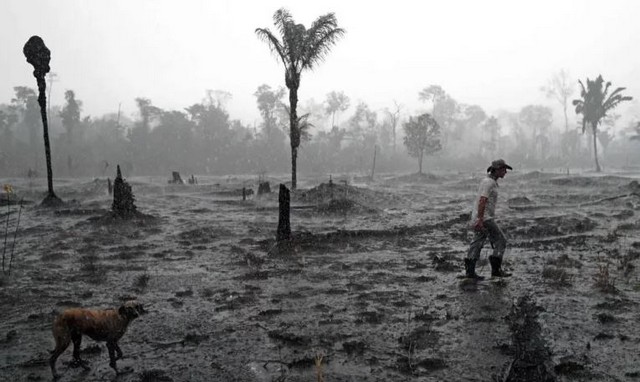
André Vltchek – A Year since You are Gone

By Peter Koenig

On 22 September 2020, André Vltchek, quietly passed away – on a night-ride from the Black Sea in Turkey to Istanbul, accompanied by his wife, Rossie. He just fell asleep in the back seat of a chauffeur-driven car and didn’t wake up. His legacy is diverse, heavy in substance and revealing – revealing about the world, about the dark forces that command the world. He never really referred to them as “dark forces” because for him the wars he investigated, photographed, the conflicts he witnessed, the misery he experienced and filmed – was real. The “Dark Forces” came to the surface – no shade, no cover – but NO LIGHT.

André was always there where it was burning – or where there was great danger that soon it might burn – and the population blown apart.

We had some remarkable experiences together on the Greek island of Kos, following the refugee tracks. Refugees from Turkey – to Greece – to the European Union. Their sad fate in refugee camps with the most horrifying sanitary conditions – their patience – their HOPE – hope is what makes these refugees tick and breath. Not just those that come from the Middle East and Africa, to seek a better future mostly for their children in lush and wealthy Europe. Refugees all over the world live from hope. If we lose hope, life ends…

Similarly, we visited Puno in Peru, and from there to Rinconada – the world’s highest gold mine, a series of many small and large independent gold mines – controlled by a deadly mafia – some 5,100 – 5,400 m above sea level – indescribable conditions, of cold and misery – some 70,000 people are living there – in extreme destitution, but all on a voluntary basis, all in the hope to finally “hit the riches” – GOLD. They work for 29 days a month for free – and what they find on the 30th or 31st day – they may keep. That’s an old mining law that is still the rule for many of the Andean mines.

No heat, no running water – girls of all ages make a living as prostitutes to uncountable miners, who leave their families behind – well, in the HOPE to get rich. Huge fields of garbage – endless plastic waste – and ever-so-often in the midst of such mountains of waste – a cross protrudes – a grave.

These are some of the experiences André and I lived together. They created a bond – and throughout the years we knew each other from writing from exchanging ideas – – friendship in the virtual world, practiced in the real world – philosophizing during half a night in a cheap café in Athens – are unforgotten; their richness cannot be taken away – André, you are dearly missed.

May your soul rest in Peace.
And remember: VENCEREMOS !

Peter Koenig is a geopolitical analyst and a former Senior Economist at the World Bank and the World Health Organization (WHO), where he has worked for over 30 years on water and environment around the world.

29 September 2021

Source: countercurrents.org

Let’s Get Rid of Communal Myths Falsely Spread as History

By Bharat Dogra

As communal harmony has come under stress in recent years due to propagation of myths about excessive faith based hostility in historical times, it is important to get rid of these myths so that the foundation of social harmony and inter-faith harmony in our country can be strengthened.

The long battle between Rana Pratap and Akbar is well known, but it is also important to recall that after both Pratap and Akbar had left for heavenly abode, their sons decided to stop fighting, Amar Singh and Jahangir reached an honourable agreement which appears to have satisfied both sides. At this stage the communal minded historians get caught in their own trap. Because in the earlier phase they have shown nothing but hatred for Mughal rulers, they are now forced to make at least mild criticism of Amar, while on a fair appraisal he comes out as a valiant warrior and a fine statesman, not afraid of struggle, yet not held back by sheer pride when the interests of his people demand this.

In the 1857 uprising against the British rule the Mughal king Bahadul Shah Zafar, despite his old age and weakness, became a symbol of freedom for Hindu and Muslim freedom fighters alike.

Most of the famous battles fought during the years of the Mughal rule have unfortunately been propagated by forces of communalism as battles between Hindus and Muslims and people are surprised when told that Shivaji’s army had a significant number of Muslims and that all through Aurangzeb’s prolonged fight with Shivaji several Maratha nobles continued to occupy an important place in the Mughal court and army. The names of these Maratha nobles in Aurangzeb’s court are available in historical documents and in fact historians have compiled a list of such names. It is surprising but true that the number of Maratha nobles in Aurangzeb’s court was higher than in the court of any other Mughal ruler before him. It was also common for several Hindu kings and chiefs to have Muslim nobles.

Earlier at Haldighati Hakim Sur and his Afghan soldiers had fought valiantly on the side of Rana Pratap. On the Mughal side there were a large number of Rajput soldiers led by Raja Man Singh. Still earlier at the battle of Khanwa, Mahmood Lodi and Hasan Khan Mewati had fought on the side of Rana Sanga against the army of Babar.

From these examples it should be clearly known that the famous battles of the days of the Mughal rule were not battles between the Hindus and the Muslims- instead the armies which fought each other were of a mixed composition. In fact there are even instances when Muslim fundamentalists had ganged up against Muslim rulers, and then the Mughal rulers had sent an army under the leadership of Hindu Rajas to quell such rebellions!

Describing this rebellion Prof. Satish Chandra writes, “The rebellion kept the empire distracted for almost two years (1580-81) and Akbar was faced with a very difficult and delicate situation. Due to the mishandling of the situation by local officials, Bengal and almost the whole of Bihar passed into the hands of the rebels who proclaimed Mirza Hakim as their ruler. They even got a religious divine to issue a Fatwa, calling on the faithful to take the field against Akbar. Akbar did not lose his nerve. He despatched a force under Todar Mal against Bengal and Bihar and another under Raja Man Singh to check the expected attack by Mirza Hakim.”

When a Hindu king of Bikaner was defeated by a Hndu King of Marwar, his family sought refuge in the court of Shershah Suri. When Humayun was defeated by Shershah Suri, he sought refuge with the (Hindu) King of Amarkot. Akbar was born here. Later in Ayodhya, Nawal Rai died fighting for Nawab Safdarjung.

It is clear from the above examples that the history of Mughal India or of times after this is not a history of fights between people of two religions. Kings fought each other time and again, but generally there were mixed armies on both sides. Further heroes and villains did not exist in any one religion. On some occasions, the persons who showed great valour and large heartedness happened to be Hindus, on some other occasions they happened to be Muslims. In fact the biggest heroes of this age were those who rose above all sectarian considerations to spread the message of universal love and brotherhood – men like Sant Kabir and Guru Nanak.

Heritage of Inter-Faith Harmony and Respect in History

Mahatma Gandhi and Shahid Bhagat Singh, two very great freedom fighters of India, were united in several ideals and in particular they were one in emphasizing the great importance of inter-faith unity and harmony in India. As communal forces have posed increasing threat to national unity in recent decades in India, it has become increasingly important to highlight the strength and resilience of the country to resist and defeat such assaults on social harmony and secular constitution of the nation. It is even more important now than before to highlight the heritage of mutual respect, co-operation and assimilation among people of various faiths and communities in our country.

First Muslim scholars came to India before any Muslim rulers did, and they came with the spirit of learning and not conquering. They carried back from India several works of wisdom and these were then translated into Arabic. Acknowledging this intellectual gift, Arab author Yaquibi wrote in the year 895, “The Hindus are superior to all other nations in intelligence and thoughtfulness. They are more exact in astronomy and astrology than any other people. The Brahma Sidhanta is a good proof of their intellectual powers, by this book the Greeks and the Persians have also profited.”

Another Arab historian Qazi Said wrote, “The Hindus have always been considered by all other people as the custodians of learning and wisdom.”

Thus the very first contacts were favourable, and these were strengthened subsequently at the upper level by certain liberal policies initiated by Akbar and retained by several Muslim rulers of the smaller kingdoms such as Bijapur, Mysore and Oudh. More important, at the grassroots level, these ties were strengthened by the Bhakri and Sufi movements which stressed the unity of God and religions and attracted millions of followers.

Akbar started many good traditions. He respected and listened to the views of learned men from several religions including not only Hindus and Muslims but also Sikhs, Christians and others. He gave liberal grants for maintenance of Hindu temples. He started a translation department to get the Ramayana , the Mahabharata and the Bible translated into Persian language.

In the Deccan kingdoms, a sixteenth century king Adil Shah followed a similar path. He established a very good library to look after which he appointed a Sanskrit scholar Vaman Pandit. His descendent Ibrahim Adil Shah was called the ‘friend of the poor’ and ‘world’s teacher’ due to his policies of benevolence and goodwill. In his songs he often pays respects to Saraswati, the Hindu Goddess of learning. He played an important role in the development of some Hindu religious places.

In Kashmir the 15th century king Zain-ul-Abdin was a scholar of Sanskrit as well as Persian, and played an important role in translating parts of the Upanishads into Persian. He publicly participated in Hindu festivals and constructed temples.

In Bengal Pathan kings like Sultan Nazir Shah and Sultan Hussain Shah followed similar policies and arranged for the translation of Mahabharata and Bhagwat Puran into Bengali.

A governor of the Vijaynagar empire at Mangalore committed some excesses and damaged four mosques. When this was made known to a higher officer called Baicheya Dannayaka and Emperor Devaraya II of the Vijaynagar empire, they ordered payment of compensation to the Muslims for repair of the four mosques.

King Jayasimha of the Solanki dynasty who ruled Gujarat in the first half of the 12th century was known for his sense of justice. When he came to know of the destruction of a mosque in Cambay then, having confirmed the news properly, he punished the culprits and gave 2,00,000 silver coins to the muslims of Cambay to rebuild the mosque.

The Portuguese visitor Barbosa who visited the Vijaynagar empire between 1512-14 said, “The King allows such freedom that every man may come and go and live according to his own creed without suffering any annoyance and without any enquiry, whether he is Christian, Jew, Moor or Heathen.”

Bahmani Sultan Alla-ud-Din II (1436-58) was devoted to Narasimha Saraswati, a great Hindu sage. Ibrahim II, the Adilshahi ruler of Bijapur was also a devotee of Narasimha Saraswati. He built a small shrine near his palace in Bijapur and placed the paduka (footwear) of the saint here.

But more important was the impact of the Bhakti and Sufi movements at the grassroots level. These poets and teachers spoke against the artificial and ritualistic divisions among religions and in favour of the essential unity of all religions. They emphasized basically the purity and depth of the relationship between God and the devotees. The strength of this relationship would render the various rituals and artificial impositions as insignificant. They wrote devotional songs and poems in the common man’s language, thereby eliminating the necessity of intermediaries in worship.

Thus despite several adverse factors and problems, a certain integration and assimilation of Hindu and Muslim population was certainly taking place before the advent of the British rule.

Despite British efforts to divide and rule, the impact of this integration could be seen in the 1857 uprising against British rule in which Hindus united with the Muslims in an effort to oust the foreign rulers. This prompted the colonial rulers to initiate even more organized efforts to promote communal divides, but despite this glorious examples of communal harmony could be seen time and again in the Gandhian freedom movement, in the struggles led by Subhash Chandra Bose and in the struggles led by revolutionaries like Shahid Bhagat Singh. It is this heritage of mutual respect, cooperation and assimilation which has faced increasing threat in recent times and so needs special efforts today for its protection and promotion.

When Muslim Rulers Helped and Protected Hindu Temples

The temple-mosque controversies raised by communal forces increasingly in recent decades tried to create a false image of life in medieval India. While a few wrong acts of intolerance may have taken place, and here we should not forget that some forces and persons of intolerance have been present in most stages of history in most places, the wider picture is one of a large number of temples being maintained or even built with the help of Hindu as well as Muslim rulers of medieval times. This has been pointed out repeatedly by several learned historians.

As example let us look at the policy of Mughal rulers towards the temples of Vrindavan- Mathura region. This Hindu pilgrimage was nearest to Delhi and Agra, two most main centres of the Mughal rule and so it is of significance to know the relationship which the Mughal rulers had with the temples of Mathura and Vrindavan and with their priests and devotees. Dozens of documents of those days are available to reveal the policy of Akbar, Jahangir and Shahjahan towards these temples. These documents have been available in Vrindavan Research Institute and in some of the temples. These have been studied by Tarapada Mukerjee and Irfan Habib in the papers presented at the 48th and 49th session of Indian History Congress.

According to the study of Mukerjee and Habib, based on documents of Mughal days, Akbar enlarged and consolidated all grants to temples and temple- servants in the Mathura region by his farmaans (dated 27th August, 1598 and 11th September, 1598) in Vrindavan, Mathura and their environs. Jahangir not only continued these grants, he substantially added to these. Jahangir added at least two temples to the list of thirty five already supported by Akbar’s grant of 1598, In addition he provided 121 bighas of land for 5 families of temple sevaks. Jahangir also visited Vrindavan temples in 1620.

The documents mentioned also reveal that whenever temple priests had any serious problem, they approached Mughal rulers or their senior officials and generally the rulers/ their officials took action to solve their problems. On one occasion the water supply to Radha Kund was stopped, in an another case a tax was imposed on the cattle kept by temples, in another case some trees around a temple were cut, in yet another case gardeners of temples were subjected to forced labour. In all these cases complaints were made by priests or others connected with these temples to Mughal rulers or their senior officials. And in all the above mentioned cases, prompt action was taken to solve the problems. The fact that the priests appealed to the rulers/ officials even for problems which were not very important indicates that they expected to get favorable verdicts from them.

In fact there are documents to show that even when there were disputes among two priests or other religious persons connected with temples, the intervention of Mughal rulers or their officials was sought to settle the dispute and the example of at least one such dispute between Damodardas Radhaballabh and Kishan Chaitan is given in one of the documents.

The Nawabs of Oudh gave several grants to the temples of Ayodhya and provided them protection in other ways. The Diwan of Nawab Safdarjung built several temples in Ayodhya and arranged for the repair of other temples. Nawab Safdarjung gave land for the construction of an important temple here. Asafadullah’s diwan gave further help for the construction of a temple.

It should be added that several Hindu kings, not only those who were subordinate to Mughals but also those who were independent, reciprocated this gesture. For example, Shivaji built a mosque in front of his palace in Raigad.

It is therefore important that our sense of history should not fall prey to communal propaganda, and the heritage of respecting each other’s religious places as revealed in the examples given above, should be continued.

Bharat Dogra is Honorary Convener, Campaign to Protect Earth Now.

6 October 2021

Source: countercurrents.org

How 9/11 Set Progressive Causes Back—and How We Rebounded

By David Korten

As the 20th anniversary of the attack on the World Trade Center approached, I wasn’t paying much attention. But then I received an email from my longtime colleague John Cavanagh, former director of the Institute for Policy Studies in Washington, D.C. It was a private message recalling the “Justice, Not Vengeance” initiative that the institute and YES! Magazine organized along with Harry Belafonte and Danny Glover a few days after the historic attack.

We gathered signatures from our nation’s leading progressives for a statement calling on Americans to resist the rush to war in Afghanistan. As I reread our statement in response to John’s email and reflected on the 20-year war that followed, I was struck by three things. One was that the U.S. failures in Afghanistan that we now so clearly see were in fact foreseeable. We spelled them out in the declaration. The second is the extent to which the outcome of 9/11 was a win for Wall Street and a loss for the United States and global civil society. The third is that 9/11 and its aftermath is one element of a much larger story helpful in understanding the choices now at hand.

When important actions, like our military interventions in Afghanistan and Iraq, seem misguided, it is often informative to ask: “Who benefits?” Regarding these wars, three answers come to mind. First, they served the political interests of President George W. Bush, whose approval ratings skyrocketed shortly after his invasion of Afghanistan. Second, they enriched military contractors. Third, they benefited corporate interests more generally by disrupting the momentum of a global citizen resistance against international trade and investment agreements that only benefit transnational corporations. The first two beneficiaries are well known. The third, and perhaps the most important, merits further explanation.

The 9/11 attack came as a globalizing civil society was awakening to the dangers posed by a growing concentration of unaccountable corporate power. I had experienced my own gradual awakening years before. In 1990, I published Getting to the 21st Century, which drew attention to the failures of development policies promoted by the World Bank and the International Monetary Fund. It drew on my experience in low-income countries of Asia, Latin America, and Africa, where I had lived and worked for much of my adult life. I observed these policies pushing people off the lands on which they had depended for their livelihoods and reducing them to itinerant agricultural workers or overworked, ill-paid factory workers.

At that time, I had not yet realized that similar trends—toward more inequality, and toward consolidated corporate control of essential resources undermining democracy and threatening environmental health—were playing out in the United States, Europe, and Japan, which I had long seen as economic success stories. The fact that both high- and low-income countries shared trends in common indicated that the source of the trends I observed in Africa, Latin America, and Asia went far beyond the flawed policies promoted by neoliberal economists working for the World Bank and International Monetary Fund.

As I was exploring these issues in the early 1990s, I was invited to join a meeting of what became the International Forum on Globalization (IFG), a new global alliance of influential intellectual activists focused on the economic forces playing out around the world. The IFG held its first meeting in early 1994, just after the North American Free Trade Agreement was enacted. At that meeting and those that followed, we each shared the experiences of economic failure that we saw playing out in the specific contexts with which we were familiar. The similarities were stunning.

We then focused on identifying the systemic causes of what was clearly a global economic failure. Later we spread those insights to expanding circles of global activists though conferences, books, articles, and media. I worked them into the first edition of When Corporations Rule the World, on which I was then doing final revisions.

It was a moment when many people were asking: “What has gone wrong with the economy that had temporarily brought middle-class prosperity to so many people?” In providing answers to that question, When Corporations Rule the World became an international bestseller when it was published in 1995.

A defining lesson of my business school education was that if you treat only the symptoms of a problem, the problem will likely continue to appear. To eliminate the problem, you must identify and correct its systemic causes. That lesson was at the forefront of my mind in 1996, when I joined in founding YES! Magazine, a publication devoted to systemic solutions.

Our IFG discussions later turned to framing systemic alternatives. We jointly authored Alternatives to Economic Globalization (2003, 2004), which to this day provides the best available framework for the economy of what we’re now calling an ecological civilization.

Between 1995 and 1999, growing numbers of people around the world rallied to demonstrations against corporate rule and the international trade and investment agreements that corporations were using to advance their growing global power. This led to the 1999 “Battle in Seattle,” which drew 50,000 demonstrators, including from labor unions, environmental organizations, and religious institutions.

The protest shut down an intergovernmental meeting of the World Trade Organization. Some of the demonstrations and workshops were organized by IFG members, and the IFG hosted a parallel conference in a Seattle concert hall that drew 5,000 participants. YES! hosted a lively reception for IFG members and other conference speakers and resistance leaders.

The impact of the Seattle demonstration, combined with news coverage of the violent police response, caught global attention and energized demonstrations around the world involving many hundreds of thousands of people. They forced the abandonment of the Free Trade Agreement of the Americas, a step-up from NAFTA to include all of North and South America. They also forced the architects of the globalization of corporate power to begin holding their meetings in small countries governed by autocrats ready to use extreme force to suppress any expression of dissent. Participating in the 1990s in shining an early light on an imperialist corporate dominated economic system was a defining experience of my life.

Then came 9/11. Nineteen suicide bombers armed with box cutters turned airplanes into weapons to bring down New York City’s World Trade Center towers, the symbolic headquarters of global corporate rule. In an instant, global sympathy for those who died, and their bereaved families, turned Wall Street from villain to victim. Declaring a perpetual war against terrorism, the U.S. government began rolling back civil liberties and branded dissent as support for terrorists.

Corporate-friendly governments followed the U.S. lead in equating dissent with terrorism and used police and military power to suppress all protest. The voices resisting corporate globalization fell largely silent.

Looking back on these events, the ironies are endless. The deaths that resulted from the collapse of the towers made Wall Street a subject of global sympathy. The wars in Afghanistan and Iraq weakened the United States and the crackdown on dissent fragmented the global progressive movement.

Massive demonstrations to disrupt global meetings of the corporate power brokers largely ceased. The hijackers attacked the World Trade Center as a symbol of western colonialism and capitalism. They committed mass murder, but by justifying a global crackdown on dissent, they strengthened the forces of Wall Street they intended to weaken.

There is a yet deeper irony. The global corporate agenda is destroying Earth’s capacity to sustain life. That is an act of collective suicide from which no one escapes. We call the suicide bombers who brought down the World Trade Center terrorists, but the terror they evoked was minuscule compared to the global terror evoked by unrestrained climate change, including massive wildfires, droughts, floods, and hurricanes, which trace directly to the excesses wrought by Wall Street.

While making modest pro-environmental gestures, Wall Street has a deep financial interest in maintaining the system that is causing the crisis, and many among Wall Street’s champions believe that even when the economy and human society are collapsing under the weight of climate change, they will come out the winners.

But there will be no winners on a dead Earth. Wall Street interests have yet to recognize that their quest is ultimately suicidal, much like the attack by Bin Laden’s suicide bombers.

A look at 9/11 and its aftermath within the context of a much larger human story is helpful in recognizing that we are at the midpoint of a great transformation.

Post-9/11, progressive movements have focused attention on the many ways an imperialist approach to organizing human societies has wounded Indigenous people, Black people, Hispanics, Asians, refugees, women, and LGBTQ people. Awareness is now growing that a system that advantages the wealthy at the expense of everyone else dehumanizes the oppressors as well as the oppressed.

Bottom line: the current system is not working for anyone. Rich and poor alike share a common interest in deep and rapid transformation.

We are also coming to see that the institutional drivers of current social and environmental collapse are not limited to the institutions of business. The institutions of government, religion, education, and science share responsibility. All are products of an imperial civilization that continues its reign. All require significant critical examination and restructuring in ways we have scarcely even begun to discuss.

The emergent ecological civilization we seek will be a world that has moved beyond divisions by class, gender, and ethnicity. It will be a world in which every person has a meaningful role in assuring a fulfilling life of material sufficiency and spiritual abundance for all on a beautiful, healthy, living Earth.

We stand at a point of civilizational transformation comparable to the human transition from wandering bands of hunter-gatherers to settled agricultural communities some 10,000 years ago. It’s also comparable to the transformation from relatively peaceful egalitarian farming communities to societies organized around violent, exploitative imperial hierarchy that occurred some 5,000 years ago.

We now stand at a decisive moment in a third great transformation. The present transformation began some 250 years ago with the American Revolution and the many movements for justice that followed.

Looking at the events surrounding 9/11 in the context of the larger human story gives us a deeper perspective on the source of current system failure. The integrative movement against the global consolidation of financial and corporate power that 9/11 disrupted was a crucial step toward global unification of citizen movements in search of alternatives to a dying imperial civilization.

The many people-power movements that arose in its stead, including Occupy Wall Street, the Arab Spring, Black Lives Matter, Standing Rock Sioux, and the countless mobilizations around climate action, gender equality, and other causes, temporarily drew our focus away from their common source in the values and institutions built on a foundation of oppression and exploitation. However, they made an essential contribution to building awareness of the scale of the injustices and exploitation that those values and institutions have wrought.

As the imperative for emergency action becomes ever more apparent and urgent, I sense that attention is beginning to focus once again on root causes of the deep cultural and institutional failures that include, but extend far beyond, the institutions of Wall Street.

We face painful times ahead. The disruption that comes with the collapse of a society’s primary institutions is an inherently disruptive process. The faster we move on bringing forth the new, the faster we can get through the pain and settle into the new ways of being with one another and Earth, on which our common future depends.

It is now evident that the resistance against the global consolidation of corporate power was just one step toward unleashing the transformational power of a global movement dedicated to advancing the human transition to an ecological civilization. The challenges ahead are daunting. We have many sources of insight, but we have no proven model for the global civilization we must now bring into being. Drawing from all our sources of understanding, we must learn together as we engage in creative dialogue, community building, and testing and sharing alternatives as we go.

David Korten is co-founder of YES! Media, president of the Living Economies Forum, a member of the Club of Rome, and the author of influential books, including “When Corporations Rule the World” and “Change the Story, Change the Future: A Living Economy for a Living Earth.”

6 October 2021

Source: countercurrents.org

Nobel Literature 2005 Acceptance Speech by Harold Pinter

By Harold Pinter

The announcement of the 2005 Nobel Prize in Literature to Harold Pinter was made by Prof Horace Engdahl of the Swedish Academy on 13 Oct 2005. Pinter’s speech is republished here due to its relevance.

Art, Truth & Politics

In 1958, I wrote the following:

‘There are no hard distinctions between what is real and what is unreal, nor between what is true and what is false. A thing is not necessarily either true or false; it can be both true and false.’

I believe that these assertions still make sense and do still apply to the exploration of reality through art. So as a writer I stand by them but as a citizen I cannot. As a citizen I must ask: What is true? What is false?

Truth in drama is forever elusive. You never quite find it but the search for it is compulsive. The search is clearly what drives the endeavour. The search is your task. More often than not you stumble upon the truth in the dark, colliding with it or just glimpsing an image or a shape which seems to correspond to the truth, often without realising that you have done so. But the real truth is that there never is any such thing as one truth to be found in dramatic art. There are many. These truths challenge each other, recoil from each other, reflect each other, ignore each other, tease each other, are blind to each other. Sometimes you feel you have the truth of a moment in your hand, then it slips through your fingers and is lost.

I have often been asked how my plays come about. I cannot say. Nor can I ever sum up my plays, except to say that this is what happened. That is what they said. That is what they did.

Most of the plays are engendered by a line, a word or an image. The given word is often shortly followed by the image. I shall give two examples of two lines which came right out of the blue into my head, followed by an image, followed by me.

The plays are The Homecoming and Old Times. The first line of The Homecoming is ‘What have you done with the scissors?’ The first line of Old Times is ‘Dark.’

In each case I had no further information.

In the first case someone was obviously looking for a pair of scissors and was demanding their whereabouts of someone else he suspected had probably stolen them. But I somehow knew that the person addressed didn’t give a damn about the scissors or about the questioner either, for that matter.

‘Dark’ I took to be a description of someone’s hair, the hair of a woman, and was the answer to a question. In each case I found myself compelled to pursue the matter. This happened visually, a very slow fade, through shadow into light.

I always start a play by calling the characters A, B and C.

In the play that became The Homecoming I saw a man enter a stark room and ask his question of a younger man sitting on an ugly sofa reading a racing paper. I somehow suspected that A was a father and that B was his son, but I had no proof. This was however confirmed a short time later when B (later to become Lenny) says to A (later to become Max), ‘Dad, do you mind if I change the subject? I want to ask you something. The dinner we had before, what was the name of it? What do you call it? Why don’t you buy a dog? You’re a dog cook. Honest. You think you’re cooking for a lot of dogs.’ So since B calls A ‘Dad’ it seemed to me reasonable to assume that they were father and son. A was also clearly the cook and his cooking did not seem to be held in high regard. Did this mean that there was no mother? I didn’t know. But, as I told myself at the time, our beginnings never know our ends.

‘Dark.’ A large window. Evening sky. A man, A (later to become Deeley), and a woman, B (later to become Kate), sitting with drinks. ‘Fat or thin?’ the man asks. Who are they talking about? But I then see, standing at the window, a woman, C (later to become Anna), in another condition of light, her back to them, her hair dark.

It’s a strange moment, the moment of creating characters who up to that moment have had no existence. What follows is fitful, uncertain, even hallucinatory, although sometimes it can be an unstoppable avalanche. The author’s position is an odd one. In a sense he is not welcomed by the characters. The characters resist him, they are not easy to live with, they are impossible to define. You certainly can’t dictate to them. To a certain extent you play a never-ending game with them, cat and mouse, blind man’s buff, hide and seek. But finally you find that you have people of flesh and blood on your hands, people with will and an individual sensibility of their own, made out of component parts you are unable to change, manipulate or distort.

So language in art remains a highly ambiguous transaction, a quicksand, a trampoline, a frozen pool which might give way under you, the author, at any time.

But as I have said, the search for the truth can never stop. It cannot be adjourned, it cannot be postponed. It has to be faced, right there, on the spot.

Political theatre presents an entirely different set of problems. Sermonising has to be avoided at all cost. Objectivity is essential. The characters must be allowed to breathe their own air. The author cannot confine and constrict them to satisfy his own taste or disposition or prejudice. He must be prepared to approach them from a variety of angles, from a full and uninhibited range of perspectives, take them by surprise, perhaps, occasionally, but nevertheless give them the freedom to go which way they will. This does not always work. And political satire, of course, adheres to none of these precepts, in fact does precisely the opposite, which is its proper function.

In my play The Birthday Party I think I allow a whole range of options to operate in a dense forest of possibility before finally focussing on an act of subjugation.

Mountain Language pretends to no such range of operation. It remains brutal, short and ugly. But the soldiers in the play do get some fun out of it. One sometimes forgets that torturers become easily bored. They need a bit of a laugh to keep their spirits up. This has been confirmed of course by the events at Abu Ghraib in Baghdad. Mountain Language lasts only 20 minutes, but it could go on for hour after hour, on and on and on, the same pattern repeated over and over again, on and on, hour after hour.

Ashes to Ashes, on the other hand, seems to me to be taking place under water. A drowning woman, her hand reaching up through the waves, dropping down out of sight, reaching for others, but finding nobody there, either above or under the water, finding only shadows, reflections, floating; the woman a lost figure in a drowning landscape, a woman unable to escape the doom that seemed to belong only to others.

But as they died, she must die too.

Political language, as used by politicians, does not venture into any of this territory since the majority of politicians, on the evidence available to us, are interested not in truth but in power and in the maintenance of that power. To maintain that power it is essential that people remain in ignorance, that they live in ignorance of the truth, even the truth of their own lives. What surrounds us therefore is a vast tapestry of lies, upon which we feed.

As every single person here knows, the justification for the invasion of Iraq was that Saddam Hussein possessed a highly dangerous body of weapons of mass destruction, some of which could be fired in 45 minutes, bringing about appalling devastation. We were assured that was true. It was not true. We were told that Iraq had a relationship with Al Quaeda and shared responsibility for the atrocity in New York of September 11th 2001. We were assured that this was true. It was not true. We were told that Iraq threatened the security of the world. We were assured it was true. It was not true.

The truth is something entirely different. The truth is to do with how the United States understands its role in the world and how it chooses to embody it.

But before I come back to the present I would like to look at the recent past, by which I mean United States foreign policy since the end of the Second World War. I believe it is obligatory upon us to subject this period to at least some kind of even limited scrutiny, which is all that time will allow here.

Everyone knows what happened in the Soviet Union and throughout Eastern Europe during the post-war period: the systematic brutality, the widespread atrocities, the ruthless suppression of independent thought. All this has been fully documented and verified.

But my contention here is that the US crimes in the same period have only been superficially recorded, let alone documented, let alone acknowledged, let alone recognised as crimes at all. I believe this must be addressed and that the truth has considerable bearing on where the world stands now. Although constrained, to a certain extent, by the existence of the Soviet Union, the United States’ actions throughout the world made it clear that it had concluded it had carte blanche to do what it liked.

Direct invasion of a sovereign state has never in fact been America’s favoured method. In the main, it has preferred what it has described as ‘low intensity conflict’. Low intensity conflict means that thousands of people die but slower than if you dropped a bomb on them in one fell swoop. It means that you infect the heart of the country, that you establish a malignant growth and watch the gangrene bloom. When the populace has been subdued – or beaten to death – the same thing – and your own friends, the military and the great corporations, sit comfortably in power, you go before the camera and say that democracy has prevailed. This was a commonplace in US foreign policy in the years to which I refer.

The tragedy of Nicaragua was a highly significant case. I choose to offer it here as a potent example of America’s view of its role in the world, both then and now.

I was present at a meeting at the US embassy in London in the late 1980s.

The United States Congress was about to decide whether to give more money to the Contras in their campaign against the state of Nicaragua. I was a member of a delegation speaking on behalf of Nicaragua but the most important member of this delegation was a Father John Metcalf. The leader of the US body was Raymond Seitz (then number two to the ambassador, later ambassador himself). Father Metcalf said: ‘Sir, I am in charge of a parish in the north of Nicaragua. My parishioners built a school, a health centre, a cultural centre. We have lived in peace. A few months ago a Contra force attacked the parish. They destroyed everything: the school, the health centre, the cultural centre. They raped nurses and teachers, slaughtered doctors, in the most brutal manner. They behaved like savages. Please demand that the US government withdraw its support from this shocking terrorist activity.’

Raymond Seitz had a very good reputation as a rational, responsible and highly sophisticated man. He was greatly respected in diplomatic circles. He listened, paused and then spoke with some gravity. ‘Father,’ he said, ‘let me tell you something. In war, innocent people always suffer.’ There was a frozen silence. We stared at him. He did not flinch.

Innocent people, indeed, always suffer.

Finally somebody said: ‘But in this case “innocent people” were the victims of a gruesome atrocity subsidised by your government, one among many. If Congress allows the Contras more money further atrocities of this kind will take place. Is this not the case? Is your government not therefore guilty of supporting acts of murder and destruction upon the citizens of a sovereign state?’

Seitz was imperturbable. ‘I don’t agree that the facts as presented support your assertions,’ he said.

As we were leaving the Embassy a US aide told me that he enjoyed my plays. I did not reply.

I should remind you that at the time President Reagan made the following statement: ‘The Contras are the moral equivalent of our Founding Fathers.’

The United States supported the brutal Somoza dictatorship in Nicaragua for over 40 years. The Nicaraguan people, led by the Sandinistas, overthrew this regime in 1979, a breathtaking popular revolution.

The Sandinistas weren’t perfect. They possessed their fair share of arrogance and their political philosophy contained a number of contradictory elements. But they were intelligent, rational and civilised. They set out to establish a stable, decent, pluralistic society. The death penalty was abolished. Hundreds of thousands of poverty-stricken peasants were brought back from the dead. Over 100,000 families were given title to land. Two thousand schools were built. A quite remarkable literacy campaign reduced illiteracy in the country to less than one seventh. Free education was established and a free health service. Infant mortality was reduced by a third. Polio was eradicated.

The United States denounced these achievements as Marxist/Leninist subversion. In the view of the US government, a dangerous example was being set. If Nicaragua was allowed to establish basic norms of social and economic justice, if it was allowed to raise the standards of health care and education and achieve social unity and national self respect, neighbouring countries would ask the same questions and do the same things. There was of course at the time fierce resistance to the status quo in El Salvador.

I spoke earlier about ‘a tapestry of lies’ which surrounds us. President Reagan commonly described Nicaragua as a ‘totalitarian dungeon’. This was taken generally by the media, and certainly by the British government, as accurate and fair comment. But there was in fact no record of death squads under the Sandinista government. There was no record of torture. There was no record of systematic or official military brutality. No priests were ever murdered in Nicaragua. There were in fact three priests in the government, two Jesuits and a Maryknoll missionary. The totalitarian dungeons were actually next door, in El Salvador and Guatemala. The United States had brought down the democratically elected government of Guatemala in 1954 and it is estimated that over 200,000 people had been victims of successive military dictatorships.

Six of the most distinguished Jesuits in the world were viciously murdered at the Central American University in San Salvador in 1989 by a battalion of the Alcatl regiment trained at Fort Benning, Georgia, USA. That extremely brave man Archbishop Romero was assassinated while saying mass. It is estimated that 75,000 people died. Why were they killed? They were killed because they believed a better life was possible and should be achieved. That belief immediately qualified them as communists. They died because they dared to question the status quo, the endless plateau of poverty, disease, degradation and oppression, which had been their birthright.

The United States finally brought down the Sandinista government. It took some years and considerable resistance but relentless economic persecution and 30,000 dead finally undermined the spirit of the Nicaraguan people. They were exhausted and poverty stricken once again. The casinos moved back into the country. Free health and free education were over. Big business returned with a vengeance. ‘Democracy’ had prevailed.

But this ‘policy’ was by no means restricted to Central America. It was conducted throughout the world. It was never-ending. And it is as if it never happened.

The United States supported and in many cases engendered every right wing military dictatorship in the world after the end of the Second World War. I refer to Indonesia, Greece, Uruguay, Brazil, Paraguay, Haiti, Turkey, the Philippines, Guatemala, El Salvador, and, of course, Chile. The horror the United States inflicted upon Chile in 1973 can never be purged and can never be forgiven.

Hundreds of thousands of deaths took place throughout these countries. Did they take place? And are they in all cases attributable to US foreign policy? The answer is yes they did take place and they are attributable to American foreign policy. But you wouldn’t know it.

It never happened. Nothing ever happened. Even while it was happening it wasn’t happening. It didn’t matter. It was of no interest. The crimes of the United States have been systematic, constant, vicious, remorseless, but very few people have actually talked about them. You have to hand it to America. It has exercised a quite clinical manipulation of power worldwide while masquerading as a force for universal good. It’s a brilliant, even witty, highly successful act of hypnosis.

I put to you that the United States is without doubt the greatest show on the road. Brutal, indifferent, scornful and ruthless it may be but it is also very clever. As a salesman it is out on its own and its most saleable commodity is self love. It’s a winner. Listen to all American presidents on television say the words, ‘the American people’, as in the sentence, ‘I say to the American people it is time to pray and to defend the rights of the American people and I ask the American people to trust their president in the action he is about to take on behalf of the American people.’

It’s a scintillating stratagem. Language is actually employed to keep thought at bay. The words ‘the American people’ provide a truly voluptuous cushion of reassurance. You don’t need to think. Just lie back on the cushion. The cushion may be suffocating your intelligence and your critical faculties but it’s very comfortable. This does not apply of course to the 40 million people living below the poverty line and the 2 million men and women imprisoned in the vast gulag of prisons, which extends across the US.

The United States no longer bothers about low intensity conflict. It no longer sees any point in being reticent or even devious. It puts its cards on the table without fear or favour. It quite simply doesn’t give a damn about the United Nations, international law or critical dissent, which it regards as impotent and irrelevant. It also has its own bleating little lamb tagging behind it on a lead, the pathetic and supine Great Britain.

What has happened to our moral sensibility? Did we ever have any? What do these words mean? Do they refer to a term very rarely employed these days – conscience? A conscience to do not only with our own acts but to do with our shared responsibility in the acts of others? Is all this dead? Look at Guantanamo Bay. Hundreds of people detained without charge for over three years, with no legal representation or due process, technically detained forever. This totally illegitimate structure is maintained in defiance of the Geneva Convention. It is not only tolerated but hardly thought about by what’s called the ‘international community’. This criminal outrage is being committed by a country, which declares itself to be ‘the leader of the free world’. Do we think about the inhabitants of Guantanamo Bay? What does the media say about them? They pop up occasionally – a small item on page six. They have been consigned to a no man’s land from which indeed they may never return. At present many are on hunger strike, being force-fed, including British residents. No niceties in these force-feeding procedures. No sedative or anaesthetic. Just a tube stuck up your nose and into your throat. You vomit blood. This is torture. What has the British Foreign Secretary said about this? Nothing. What has the British Prime Minister said about this? Nothing. Why not? Because the United States has said: to criticise our conduct in Guantanamo Bay constitutes an unfriendly act. You’re either with us or against us. So Blair shuts up.

The invasion of Iraq was a bandit act, an act of blatant state terrorism, demonstrating absolute contempt for the concept of international law. The invasion was an arbitrary military action inspired by a series of lies upon lies and gross manipulation of the media and therefore of the public; an act intended to consolidate American military and economic control of the Middle East masquerading – as a last resort – all other justifications having failed to justify themselves – as liberation. A formidable assertion of military force responsible for the death and mutilation of thousands and thousands of innocent people.

We have brought torture, cluster bombs, depleted uranium, innumerable acts of random murder, misery, degradation and death to the Iraqi people and call it ‘bringing freedom and democracy to the Middle East’.

How many people do you have to kill before you qualify to be described as a mass murderer and a war criminal? One hundred thousand? More than enough, I would have thought. Therefore it is just that Bush and Blair be arraigned before the International Criminal Court of Justice. But Bush has been clever. He has not ratified the International Criminal Court of Justice. Therefore if any American soldier or for that matter politician finds himself in the dock Bush has warned that he will send in the marines. But Tony Blair has ratified the Court and is therefore available for prosecution. We can let the Court have his address if they’re interested. It is Number 10, Downing Street, London.

Death in this context is irrelevant. Both Bush and Blair place death well away on the back burner. At least 100,000 Iraqis were killed by American bombs and missiles before the Iraq insurgency began. These people are of no moment. Their deaths don’t exist. They are blank. They are not even recorded as being dead. ‘We don’t do body counts,’ said the American general Tommy Franks.

Early in the invasion there was a photograph published on the front page of British newspapers of Tony Blair kissing the cheek of a little Iraqi boy. ‘A grateful child,’ said the caption. A few days later there was a story and photograph, on an inside page, of another four-year-old boy with no arms. His family had been blown up by a missile. He was the only survivor. ‘When do I get my arms back?’ he asked. The story was dropped. Well, Tony Blair wasn’t holding him in his arms, nor the body of any other mutilated child, nor the body of any bloody corpse. Blood is dirty. It dirties your shirt and tie when you’re making a sincere speech on television.

The 2,000 American dead are an embarrassment. They are transported to their graves in the dark. Funerals are unobtrusive, out of harm’s way. The mutilated rot in their beds, some for the rest of their lives. So the dead and the mutilated both rot, in different kinds of graves.

Here is an extract from a poem by Pablo Neruda, ‘I’m Explaining a Few Things’: (*)

And one morning all that was burning,
one morning the bonfires
leapt out of the earth
devouring human beings
and from then on fire,
gunpowder from then on,
and from then on blood.
Bandits with planes and Moors,
bandits with finger-rings and duchesses,
bandits with black friars spattering blessings
came through the sky to kill children
and the blood of children ran through the streets
without fuss, like children’s blood.

Jackals that the jackals would despise
stones that the dry thistle would bite on and spit out,
vipers that the vipers would abominate.

Face to face with you I have seen the blood
of Spain tower like a tide
to drown you in one wave
of pride and knives.

Treacherous
generals:
see my dead house,
look at broken Spain:
from every house burning metal flows
instead of flowers
from every socket of Spain
Spain emerges
and from every dead child a rifle with eyes
and from every crime bullets are born
which will one day find
the bull’s eye of your hearts.

And you will ask: why doesn’t his poetry
speak of dreams and leaves
and the great volcanoes of his native land.

Come and see the blood in the streets.
Come and see
the blood in the streets.
Come and see the blood
in the streets!

Let me make it quite clear that in quoting from Neruda’s poem I am in no way comparing Republican Spain to Saddam Hussein’s Iraq. I quote Neruda because nowhere in contemporary poetry have I read such a powerful visceral description of the bombing of civilians.

I have said earlier that the United States is now totally frank about putting its cards on the table. That is the case. Its official declared policy is now defined as ‘full spectrum dominance’. That is not my term, it is theirs. ‘Full spectrum dominance’ means control of land, sea, air and space and all attendant resources.

The United States now occupies 702 military installations throughout the world in 132 countries, with the honourable exception of Sweden, of course. We don’t quite know how they got there but they are there all right.

The United States possesses 8,000 active and operational nuclear warheads. Two thousand are on hair trigger alert, ready to be launched with 15 minutes warning. It is developing new systems of nuclear force, known as bunker busters. The British, ever cooperative, are intending to replace their own nuclear missile, Trident. Who, I wonder, are they aiming at? Osama bin Laden? You? Me? Joe Dokes? China? Paris? Who knows? What we do know is that this infantile insanity – the possession and threatened use of nuclear weapons – is at the heart of present American political philosophy. We must remind ourselves that the United States is on a permanent military footing and shows no sign of relaxing it.

Many thousands, if not millions, of people in the United States itself are demonstrably sickened, shamed and angered by their government’s actions, but as things stand they are not a coherent political force – yet. But the anxiety, uncertainty and fear which we can see growing daily in the United States is unlikely to diminish.

I know that President Bush has many extremely competent speech writers but I would like to volunteer for the job myself. I propose the following short address which he can make on television to the nation. I see him grave, hair carefully combed, serious, winning, sincere, often beguiling, sometimes employing a wry smile, curiously attractive, a man’s man.

‘God is good. God is great. God is good. My God is good. Bin Laden’s God is bad. His is a bad God. Saddam’s God was bad, except he didn’t have one. He was a barbarian. We are not barbarians. We don’t chop people’s heads off. We believe in freedom. So does God. I am not a barbarian. I am the democratically elected leader of a freedom-loving democracy. We are a compassionate society. We give compassionate electrocution and compassionate lethal injection. We are a great nation. I am not a dictator. He is. I am not a barbarian. He is. And he is. They all are. I possess moral authority. You see this fist? This is my moral authority. And don’t you forget it.’

A writer’s life is a highly vulnerable, almost naked activity. We don’t have to weep about that. The writer makes his choice and is stuck with it. But it is true to say that you are open to all the winds, some of them icy indeed. You are out on your own, out on a limb. You find no shelter, no protection – unless you lie – in which case of course you have constructed your own protection and, it could be argued, become a politician.

I have referred to death quite a few times this evening. I shall now quote a poem of my own called ‘Death’.

Where was the dead body found?
Who found the dead body?
Was the dead body dead when found?
How was the dead body found?

Who was the dead body?

Who was the father or daughter or brother
Or uncle or sister or mother or son
Of the dead and abandoned body?

Was the body dead when abandoned?
Was the body abandoned?
By whom had it been abandoned?

Was the dead body naked or dressed for a journey?

What made you declare the dead body dead?
Did you declare the dead body dead?
How well did you know the dead body?
How did you know the dead body was dead?

Did you wash the dead body
Did you close both its eyes
Did you bury the body
Did you leave it abandoned
Did you kiss the dead body

When we look into a mirror we think the image that confronts us is accurate. But move a millimetre and the image changes. We are actually looking at a never-ending range of reflections. But sometimes a writer has to smash the mirror – for it is on the other side of that mirror that the truth stares at us.

I believe that despite the enormous odds which exist, unflinching, unswerving, fierce intellectual determination, as citizens, to define the real truth of our lives and our societies is a crucial obligation which devolves upon us all. It is in fact mandatory.

If such a determination is not embodied in our political vision we have no hope of restoring what is so nearly lost to us – the dignity of man.

NOTE:

(*) Extract from “I’m Explaining a Few Things” translated by Nathaniel Tarn, from Pablo Neruda: Selected Poems, published by Jonathan Cape, London 1970. Used by permission of The Random House Group Limited.

Harold Pinter (10 Oct 1930 – 24 Dec 2008) was a Nobel Prize (2005)-winning English playwright, screenwriter, director and actor.

4 October 2021

Source: www.transcend.org

China’s ‘Hostage Diplomacy’ Wins: Huawei’s Meng Wanzhou Flies Home a National Heroine after Her Release from Detention in Canada

By Tom Fowdy

27 Sep 2021 – Big crowds greeted Huawei senior executive Meng Wanzhou’s arrival back in China, which believes its show of strength against the USA forced Washington to back down in this three-year standoff.

The biggest story of the weekend saw Meng released from house detention in Canada and returned to China, while Beijing subsequently released two Canadian prisoners it had accused of spying. The development brought an end to a horrific three-year saga for all involved.

On arrival in Shenzhen, Meng, the company’s chief financial officer, was greeted with a hero’s welcome, including thousands who gathered at the airport to meet her, while millions watched it online amid a chorus of euphoria from Chinese media.

Huawei or the West’s way: Which kind of spying comes with your phone?

The West quickly spun this euphoric reception as a state propaganda effort, but this completely misses the point and deliberately takes it out of context. Meng’s glorification into quasi-hero status was not something superficial, but tapped into a sentiment that saw her release as a political and diplomatic win for China, a show of resolve and national strength and a break from the “legacy of humiliation” which the country has suffered in the past.

This is especially important in light of the Trump administration’s bid to try and humiliate Huawei and China by seizing her in the first place, an aspect not a single Western mainstream media outlet discussed. This makes it an important psychological victory in Beijing’s favour, even if it does subtly admit the counter-detention of two Canadians had political motivations, which critics have branded “hostage diplomacy.”

The political identity of the People’s Republic of China (PRC) is built upon the dual premise of humiliation and revival. Contemporary Chinese history is narrated in the decline of the Confucian Empire, which was subjugated and “humiliated” by European colonial empires, who forced open its markets, pushed unequal treaties on it and seized territories such as Hong Kong. The political forces unleashed by the deterioration of the Qing Dynasty in the midst of this upheaval fermented a political and ideological shift within China, and led to soul-searching for new ways of thought, in the dream that the country’s glory could one day be restored again as a modern and powerful nation.

This sentiment peaked following the 1919 Treaty of Versailles, when German-held land in Shandong was not returned to China, but given to Japan. The collective outrage this spurned created the “May 4th movement” and soon the Communist Party of China, which saw its revolutionary ideology as instrumental to modernizing and pulling China out of its poverty and backwardness.

Hence when Mao declared the PRC in October 1949, he is popularly attributed to having said, “The Chinese people have stood up” – and it was the hope of the new state that the misery of the past would never be repeated. Whilst Western ideological thinking popularly likes to claim that China’s communist party has no true legitimacy, in reality the party finds its power through how it has bound itself to revivalist Chinese nationalism, which President Xi Jinping has described as “the rejuvenation of the great Chinese nation”.

With China’s recent rise, there have inevitably come attempts by the West to humiliate and politically dominate it again like in times of old. The Meng Wanzhou saga is a perfect symbolism of this. In 2018, the Trump administration unleashed an all-embracing campaign to destroy the highly successful Chinese technology firm, Huawei. This involved forcing other countries to blacklist it from their 5G networks, weaponizing supply chains against it to cut off the export of key components to it, and the pursuit of politicized charges to persecute one of its senior executives, the founder’s daughter, Meng.

The mainstream media have painted the Meng situation negatively in light of China’s retaliatory “hostage diplomacy,” but have declined to mention that her arrest was political in nature, involving the alleged violation of US unilateral sanctions against Iran (which are illegitimate themselves), and not least that Donald Trump himself hinted she was a bargaining chip (this seems to be conveniently forgotten).

Because of this, and also considering Trump’s broader effort against China including the trade war, the Meng saga was inevitably understood by China as an attempt by the US to “humiliate” it; to subjugate and break the country like in times of old, by having a leading figure from one of its major companies shamed and tried in a US court on charges which were quite obviously bogus. In complying with this, Canada frequently insisted it was only “abiding the rule of law” in following the US request to extradite her, and to this day refuses to be honest by admitting the US’s bad faith behaviour.

China responded to the situation with the detention of two Canadian businessmen, and it is not unreasonable to describe this as an act of harsh realpolitik. The cold truth is that it allowed Beijing to gain the upper hand against the US and Canada, and eventually secure Meng’s release on its terms. As a result, China sees this as a big win: it conceives this as having overcome an attempt to humiliate the country again, and therefore a display of national resolve. This is why Meng has received such a preferential reception.

It has been weaved by state media into a broader commentary that China has stood up for its own interests and forced the other countries to reason with it. While the political dynamic of this is obvious, it is the West at large which refuses to admit the politicised nature of Meng’s arrest or Trump’s callous campaign against Huawei. However, it was nonetheless forced to come to reason with China’s position. As a result, it may be said that the Canadian prisoner row also reveals the realist and Hobbesian sentiment which drives China’s own foreign policy, which has been constructed from these historical experiences with the West.

Ultimately, China believes that the only answer to a West which does not respect it on equal terms is strength. Just like when the US and its allies sanctioned China in March over Xinjiang, Beijing hit back harder, a move which shocked the West. As a passage in Machiavelli’s ‘The Prince’ says, “It is better to be feared than to be loved, if you cannot be both.”

China believes that in upholding its interests, force is “the only language the West will understand,” not least when the US and its allies believe they have a God-given right to change China in their image. Whilst this creates frequent accusations that China is “aggressive” or “coercive” (even though the US is the real aggressor and does far worse), the message for Beijing is that such shows of strength ultimately work.

Meng has become a symbol of how China has thwarted Anglo America’s actions and humiliated the US and Canada. This is why it has created such a meltdown in the media that so-called “hostage diplomacy” has worked.

It also demonstrates that China is willing to respond to challenges against it with resolve, and that if the USA chooses to take brutal actions against it as Trump’s administration did with Meng, it won’t always end well for them. This is why one woman’s release may be a psychological turning point in US-China tensions.

Tom Fowdy is a British writer and analyst of politics and international relations with a primary focus on East Asia.

4 October2021

Source: www.transcend.org
Pfizer, Moderna Eye Windfall Profits as COVID Booster Rollout Begins

By Megan Redshaw

One analyst predicted COVID boosters alone will bring in about $26 billion in global sales next year for Pfizer — that splits profits with BioNTech — and around $14 billion for Moderna.

27 Sep 2021 – Yesterday, Pfizer CEO and Chairman Albert Bourla predicted life will return to normal within a year, but it’s likely annual COVID vaccinations will be necessary.

Bourla’s vision for a “return to normal life” would position Pfizer and Moderna to make billions in profits dispensing endless booster doses. How much the manufacturers stand to gain depends on how big the rollout is.

“Within a year I think we will be able to come back to normal life,” Bourla said in an interview on ABC’s “This Week.”

Bourla said he does not think this means variants will no longer exist, or that we “should be able to live our lives without having vaccinations.”

The “most likely scenario,” Bourla said, is annual vaccination with vaccines that last at least a year, “but we don’t know really, we need to wait and see the data.”

Bourla’s prediction echoed that of Moderna CEO Stéphane Bancel, who when asked last week for his estimate of a return to normal life, told Swiss newspaper Neue Zürcher Zeitung the COVID pandemic could be over in a year.

Moderna on Sept. 1 asked the U.S. Food and Drug Administration (FDA) to authorize the use of a third booster dose of its COVID vaccine.

Johnson & Johnson still has to submit the data for its booster shot to the FDA for approval, although the company has said it does not plan to profit from its vaccine during the pandemic.

According to the Associated Press (AP), the average forecast among analysts for Moderna’s 2022 revenue jumped 35% after President Biden laid out his booster plan in mid-August.

Most vaccines given so far in the U.S. have come from Pfizer and BioNTech. Morningstar analyst Karen Andersen expects boosters alone to bring in about $26 billion in global sales next year for Pfizer — who splits profits with BioNTech — and around $14 billion for Moderna if they are endorsed for nearly all Americans.

Pfizer executives said they expect their pre-tax adjusted profit margin from the vaccine to be in the “high 20s” as a percentage of revenue. That would translate to an estimated profit of $7 billion next year just from boosters, according to Andersen’s sales prediction.

This year alone, Pfizer expects its COVID vaccine to generate $33.5 billion in revenue with vaccine supply agreements worth more than $60 billion in sales, just in 2021 and 2022. The agreements include supply of the initial two doses of their vaccines as well as billions of dollars in potential boosters for wealthy nations.

Pfizer’s COVID vaccine is projected to make up 42% of the company’s total revenue, and will bring more than five times the $5.8 billion racked up last year by the world’s most lucrative vaccine — Pfizer’s Prevnar13 — a vaccine for pneumococcal disease.

This bodes well for future vaccine development, said Erik Gordon, a business professor at the University of Michigan. Vaccines normally are nowhere near as profitable as treatments, Gordon said. But the success of the COVID shots could draw more drugmakers and venture capitalists into the field.

For Pfizer and Moderna, boosters could be more profitable than original doses because they won’t come with the research and development costs the companies incurred to get the vaccines initially on the market, AP reported.

WBB Securities CEO Steve Brozak said the booster shots will represent “almost pure profit” compared with the initial doses.

There is opportunity for Pfizer to generate similar — or higher — levels of revenue in the future as experts predict COVID is here to stay.

The FDA last week authorized a third dose of Pfizer’s vaccine for some individuals — those 65 and older and also those “whose frequent institutional or occupational exposure” to the virus puts them at high risk of serious complications from the disease caused by the virus, the agency said.

On Sept. 17, the FDA’s Vaccines and Related Biological Products Advisory Committee (VRBPAC), a group of scientists who advise the FDA on vaccine approvals, unanimously recommended Emergency Use Authorization for a booster dose of Pfizer’s vaccine for people 65 and older and those with compromised immune systems — but voted 16 – 2 against recommending boosters for the general population, citing a lack of long-term data. The committee said the risks did not outweigh the benefits for those people.

The decision was perceived as a major rebuke of the Biden administration, STAT reported. And it closely followed the resignations of Marion Gruber and Phil Krause, two key FDA vaccine regulators who announced their resignations days after Biden’s initial booster announcement.

On Sept. 24, Dr. Rochelle Walensky, director of the Centers for Disease Control and Prevention (CDC), ignored the advice of the agency’s vaccine advisory committee, clearing the way for healthcare workers, teachers, grocery store workers, residents of long-term care facilities, homeless shelters, prisons and anyone else considered “high risk” to receive a third Pfizer shot.

Walensky also approved booster shots for older Americans over age 65, and adults with underlying medical conditions at least six months after their first series of shots — in line with the advisory panel.

“It is worrisome to me that anybody less than 30 is going to be getting a third dose without any clear evidence that that’s beneficial to them, and with more than theoretical evidence that it could be harmful to them,” said Dr. Paul Offit, director of the Vaccine Education Center at Children’s Hospital of Philadelphia and member of the CDC’s Advisory Committee on Immunization Practices (ACIP).

Offit also expressed concern that in overruling the ACIP, Walensky may have damaged efforts to persuade more unvaccinated adults to be vaccinated against COVID.

“It’s not hard to scare people who’ve already gotten two doses that they should get another dose,” Offit said. “I’m sure that you can get them to get 10 more doses.”

Megan Redshaw is a freelance reporter for The Defender. She has a background in political science, a law degree and extensive training in natural health.

4 October 2021

Source: www.transcend.org