Just International

Why is the U.S. so exceptionally vulnerable to Covid-19?

By Nicolas J S Davies

The United States has become the new center of the global coronavirus pandemic, with over 86,000 cases, more than China or Italy. More than a thousand Americans have already died, but this is surely only the very beginning of this deadly collision between the U.S.’s uniquely inadequate public healthcare system and a real pandemic.

On the other hand, China and South Korea, which both have universal public health systems that cover the bulk of their people’s healthcare needs, have already turned the tide on Covid-19 through targeted quarantines, mobilization of public healthcare resources and testing programs that quickly and efficiently test everyone who may have come into contact with the virus. China sent 40,000 doctors and medical staff, including 10,000 respiratory specialists, into Hubei province in the first month or two of the epidemic. It has now gone up to 3 days in a row with no new cases and is starting to lift social restrictions. South Korea quickly tested over 300,000 people, and only 131 of its people have died.

The WHO’s Bruce Aylward visited China at the end of February, and reported, “I think the key learning from China is speed… The faster you can find the cases, isolate the cases, and track their close contacts, the more successful you’re going to be… In China, they have set up a giant network of fever hospitals. In some areas, a team can go to you and swab you and have an answer for you in four to seven hours. But you’ve got to be set up — speed is everything.”

Researchers in Italy have experimentally confirmed that up to 3 out of 4 Covid-19 cases are asymptomatic and therefore undetectable by testing only people with symptoms. After a series of deadly missteps, the U.S., which had its first case on January 20th, the same day as South Korea, has over two months later only just begun widespread testing, when we already have the most cases and the 6th highest death toll in the world. Even now, the U.S. is mainly limiting testing to people with symptoms, not doing the targeted testing of new case contacts that was so effective in China. This ensures that otherwise healthy, asymptomatic carriers will unknowingly spread the virus and keep fueling its exponential growth.

So why is the United States so uniquely incapable of confronting this pandemic as efficiently or effectively as China, South Korea, Germany or other countries? The lack of a national, publicly-funded universal health system is a critical deficiency. But our persistent inability to set one up is itself the result of other dysfunctional aspects of American society, including the corruption of our political system by powerful commercial and class interests and the American “exceptionalism” that blinds us to what we can learn from other countries.

Also, the military occupation of the American mind has brainwashed Americans with strictly military concepts of “defense” and “security,” perverting federal spending priorities in the interest of war and militarism at the expense of all our country’s other vital needs, including the health of Americans.

Why can’t we just bomb the virus?

Of course this question is ridiculous. But this is how U.S. leaders respond to every danger we face, with massive diversions of our national resources to the military-industrial complex (MIC) that leave this otherwise wealthy country starved of resources to tackle problems our leaders can’t pretend to solve with weapons and war. Depending what is counted as “defense” spending, it accounts for up to two-thirds of federal discretionary spending. Even now, a bailout for Boeing, the 2nd largest U.S. weapons maker, is more important to Mr. Trump and many in Congress than helping American families get through this crisis.

At the end of the Cold War in 1989, senior officials told the Senate Budget Committee that the U.S. military budget could safely be cut by 50% over the next ten years. Committee chairman Jim Sasser hailed the moment as “the dawn of the primacy of domestic economics.” But by 2000, the influence of the military-industrial complex had shrunk the “peace dividend” to only a 22% reduction in military spending from 1990 (after adjusting for inflation).

Then, in 2001, the military-industrial complex seized on the crime of the new century by 19 mainly Saudi young men armed only with box-cutters to launch new wars and the most expensive U.S. military build-up since World War Two. As former Nuremberg war crimes prosecutor Benjamin Ferencz said at the time, this was not a legitimate response to the crimes of September 11th. “It is never a legitimate response to punish people who are not responsible for the wrong done,” Ferencz told NPR. “If you simply retaliate en masse by bombing Afghanistan, let us say, or the Taliban, you will kill many people who don’t approve of what has happened.”

Despite the abject, bloody failure of the so-called “Global War on Terror,” the opportunistic military-build-up it served to justify still wins every budget battle in Washington. After adjusting for inflation, the 2020 U.S. military budget is 59% higher than in 2000, and 23% higher than it was in 1990.

Over the past 20 years (in 2020 dollars), the U.S. has allocated $4.7 trillion more to the Pentagon than if it had just maintained its budget at the same level since 2000. Even between 1998 and 2010, as Carl Conetta documented in his paper, An Undisciplined Defense: Understanding the $2 Trillion Surge in US Defense Spending, actual war spending was matched dollar for dollar by unrelated additional military spending, mostly increased procurement spending to develop and buy very expensive new warships for the Navy, budget-busting warplanes like the F-35 fighter for the Air Force, and a wish-list of new weapons and equipment for every branch of the military.

Since 2010, this unprecedented diversion of our national resources to the military-industrial complex has outstripped actual war spending even further. Obama spent more on the military than Bush, and now Trump is spending even more. In addition to $4.7 trillion in extra Pentagon spending, U.S. wars and militarism have cost $1.3 trillion more for Veterans Affairs since 2000 (also adjusted for inflation), as Americans predictably come home from America’s wars needing levels of medical care that the U.S. does not otherwise provide to its people.

All that money is gone now, just as surely as if it had been heaped up somewhere in Afghanistan and incinerated by a few of the 80,000 bombs the U.S. has dropped on that poor country since 2001. So we do not have it to spend on public hospitals, ventilators, medical training, Covid-19 tests or any of the things we so desperately need in this distinctly non-military crisis.

Our $6 trillion have been utterly wasted – or worse. The U.S. war on terror did not defeat or end terrorism. It only fueled an endless spiral of violence and chaos across the world. The U.S. war machine has destroyed country after country: Afghanistan, Iraq, Somalia, Libya, Syria, Yemen – but it has never rebuilt or brought peace to any of them. Meanwhile, Russia and China have built effective 21st century defenses against America’s obsolete war machine at a small fraction of its cost.

As countries around the world face the common danger of Covid-19, perhaps the most cynical response of all has been the U.S. government’s decision to impose even more brutal sanctions on Iran, one of the worst-hit countries, already deprived of life-saving medicines and other resources by existing U.S. sanctions.

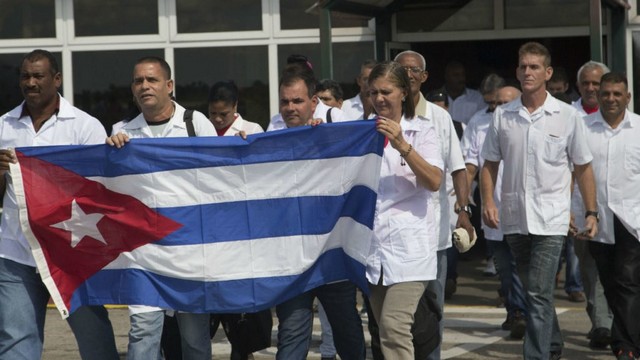
UN Secretary General Antonio Guterres has called for an immediate ceasefire in every war during this crisis, and for the U.S. to lift its deadly sanctions on all our neighbors around the world. That should include Iran; North Korea; Sudan; Syria; Venezuela; Zimbabwe; and not least Cuba, which is playing a courageous and active role in fighting the pandemic, rescuing the passengers of an infected British cruise ship that was refused entry by the U.S. and other countries, and sending medical teams to Italy and other infected countries around the world.

The 21st Century Command Economy

The “command economy” was a derisive term used to criticize the centrally planned economies of Eastern Europe during the Cold War. But economist Eric Schutz used the 21st Century Command Economy as a subtitle for his 2001 book Markets and Power, in which he analyzed the effects of the dominant market power of monopolistic multinational corporations on the U.S. economy.

As Schutz explained, neoliberal (or neoclassical) economic theory ignores a critical factor in the “free” markets a generation of Americans have been taught to revere. This ignored factor is power.  As more and more aspects of American life are entrusted to the mythical “invisible hand” of the market, the most powerful players in every market are free to use their market power to concentrate wealth and even greater market power in their own (not so invisible) hands, driving smaller competitors out of business and exploiting other stakeholders: customers; employees; suppliers; governments; and local communities.

Since 1980, every sector of the U.S. economy has been gradually taken over by fewer and fewer larger and larger corporations, with a predictably debilitating effect on American life: fewer opportunities for small business; diminishing investment in public infrastructure and services; shrinking or stagnant wages; rising rents; privatization of education and healthcare; the destruction of local communities; and the systematic corruption of politics. Critical decisions that affect all our lives are now made primarily at the bidding and in the interests of big banks, big pharma, big tech, big ag, big developers, the military-industrial complex and the wealthiest 1% of Americans.

The infamous revolving door through which senior officials move between the military, lobbying firms, corporate boards, Congress and the executive branch is duplicated in every sector of the economy. Liz Fowler, who wrote the “Affordable Care Act” as a Senate and White House staffer, was a senior executive at Wellpoint Health (now Anthem), the parent company of Blue Cross-Blue Shield, which now rakes in billions in federal subsidies under the law she wrote. She then returned to the “industry” as an executive at Johnson & Johnson – just as James “Mad Dog” Mattis returned to his seat on the board at General Dynamics to reap the rewards of his “public service” as Secretary of Defense.

Whatever mix of capitalism and socialism each American may favor as a model for the U.S. economy, very few Americans would pick this corrupt 21st century command economy as the system they would choose to live under. How many American politicians would win election if they honestly told voters that this is the system they believe in and plan to promote?

We are living in a society in which everybody knows the deal is rotten, as the Leonard Cohen song goes, and yet we remain lost in a hall of mirrors, victims of a “divide and rule” strategy by which the wealthy and powerful control politics and the media along with every other sector of this 21st century command economy. Trump, Biden and Congressional leaders are just their latest figureheads, demonizing and arguing with each other as they and their paymasters laugh all the way to the bank.

There is a savage irony in the way the Democratic Party closed ranks around Biden just as Covid-19 appeared on the scene. A month ago, it seemed that 2020 might be the year Americans would finally blow away the well-funded smoke and mirrors of the for-profit U.S. health insurance industry and achieve universal publicly-funded healthcare. Instead, Democratic leaders appear to be settling for the lesser evil of another humiliating defeat and four more years of Trump over (to their minds) the greater danger of a Sanders presidency and universal healthcare.

But now this exceptionally dysfunctional society has run smack-bang into a real force of nature, a tiny virus that can kill millions of people. Other countries are rising to this exacting test of their healthcare and social systems more successfully than we are. So will we finally wake up from our American dream, open our eyes and start learning from our neighbors in other countries, including ones that have different political, economic and healthcare systems than ours? Our lives may depend on it.

Nicolas J S Davies is the author of Blood On Our Hands: the American Invasion and Destruction of Iraq. He is a freelance journalist and a researcher for CODEPINK.

27 March 2020

Source: countercurrents.org
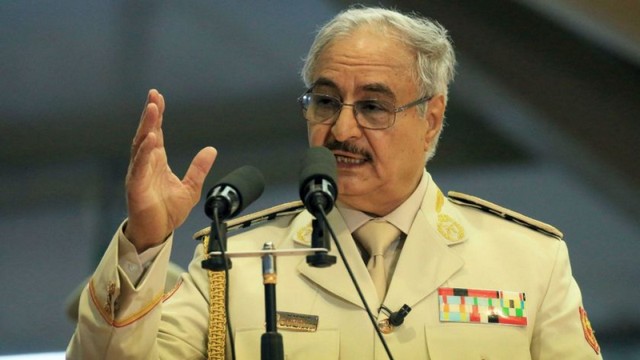
Lack of consequences emboldens Libya’s Haftar

The 18 February 2020 attack on Tripoli’s main seaport is the latest in a series of measures by Libyan warlord, General Khalifa Haftar, to secure a military victory over his rivals, the UN-recognised Government of National Accord (GNA). His self-styled ‘Libyan National Army (LNA)’ also seized the port city of Sirte in January, and halted shipments of Libyan oil in an attempt to weaken the Tripoli-based GNA. The Tripoli seaport attack ended UN-brokered ceasefire negotiations between the two sides. Haftar, who is supported by the UAE, Saudi Arabia, Egypt and France, among others, has been emboldened by the lack of censure for his actions. His decision not to endorse a January 2020 ceasefire agreement mediated by Turkey and Russia was rewarded by the UAE with two fighter jets.

The February port attack followed increased Turkish support for the GNA, enabling it to force back LNA troops to pre-April 2019 battle lines. Thus, apart from Haftar’s capture of the strategic city of Sirte in January 2020, his ten-month siege of the capital, Tripoli, which commenced in April 2019, has resulted in limited gains. This despite the fact that his forces have had an enormous military hardware advantage, having received arms from the UAE and Egypt, with Chadian, Sudanese, and Russian mercenaries being attracted to support his advance. To break the military stalemate, Haftar imposed an oil embargo in an attempt to strangle the GNA, which relies on oil revenues to provide services and compensate militias. Haftar has not attempted to resell the oil, but his control of most of Libya’s oil and water resources – which are located in the country’s east – allows him great leverage.

Between January and February this year, the UAE provided Haftar with over 4 600 tons of military equipment, allowing him to snub UN and Turkish-Russian mediation efforts. Turkey, on the other hand, supports the GNA. Ankara enhanced this support in recent months by deploying Syrian rebels and Turkish Special Forces to Libya after Haftar captured Sirte. Ankara and the GNA also concluded a maritime border agreement in 2019, strengthening Turkish claims over natural gas in the Mediterranean, and undermining the claims of Greece and Cyprus. Ankara thus regards support for the GNA as critical to its national interests, and will likely further augment its support, despite suffering dozens of casualties among its soldiers. It is noteworthy that Syria and the eastern House of Representatives, which Haftar is influential over, concluded an agreement in March jointly to confront Turkey; the two will likely soon exchange diplomatic representatives. The HoR followed the UAE and Bahrain in re-establishing ties with Syria, which were severed following the start of the Syrian uprising.

Meanwhile, the UN continues to be hamstrung by divisions within the Security Council. Haftar’s continued obduracy has been encouraged by support he receives from France, a permanent member of the UNSC, and, more recently, Russia, another permanent member. His march on Tripoli, a week before a UN-sponsored national conference scheduled to be in Libya (which was subsequently cancelled), and his issuance of an arrest warrant for the head of the GNA, Fayez al-Sarraj, elicited little censure from the UNSC, despite the UN’s now-former special envoy to Libya, Ghassan Salame, labelling the move a coup. In addition, Haftar’s shutting down of oil terminals also resulted in no repercussions, despite UNSC Resolution 2510, which affirms the need to resume oil production.

Further, the UN has had an obsessive focus on elections as a means out of the conflict, and has not given much attention to consensus-building and bottom-up negotiations, which were hallmarks of the initial phases of the 2015 Libyan Political Agreement and the subsequent Skhirat agreement. The UN had planned for elections to be held in 2018, but these have continually been postponed. In February, UNSC Resolution 2510 ratified the January 2020 Berlin Roadmap calling for a full ceasefire and an arms embargo on Libya. Implementation of the resolution will be difficult, however, especially since Russia, a key Haftar supporter, abstained from the vote, indicating it is unlikely that it will support the implementation of the resolution.

A 13 January 2020 ceasefire agreement, mediated by Turkey and Russia, failed because Haftar refused to endorse it, while a fifty-five point roadmap endorsed by most roleplayers in Libya, including the UAE, Turkey, and France, in Berlin on 19 January is also proving difficult to implement.  Ceasefire talks between five military officials from each of the two sides in February in Geneva agreed on a tentative ceasefire, but the two rival governments overruled this. Another seemingly-useless initiative is the EU’s February endorsement of a new mission to complement its Operation Sophia, which seeks to enforce the Libyan arms embargo, but which fails to account for the fact that this will not hamper Haftar since most of his weapons come through Egypt. France, which had despatched forces to support Haftar from 2014, and which had vociferously advocated for the new mission, opposes Turkey’s support of the GNA.

The current stalemate suggests that a political solution is the only real way out of the crisis. However, it is doubtful that Haftar will enter into negotiations in good faith; he has continually acted to scupper any talks that might limit his power. On the sidelines of the Berlin conference, he insisted that talks to form a government could only occur after Tripoli was disarmed, supporting an earlier LNA statement that a militarily-imposed solution was the only way to ensure security. His attitude is hardened by the support he continues to receive from regional and global powers, which emboldens him, even though consolidating control over Tripoli and the country’s western regions has proved more difficult when compared to his rapid march through the South in early 2019. Haftar’s recent announcement of a humanitarian ceasefire was a result of pressure from the USA, and is unlikely to lead to real change. Already, the LNA has undertaken attacks in Tripoli, killing two.

22 March 2020

Source: amec.org.za

Palestine remembers Rachel Corrie

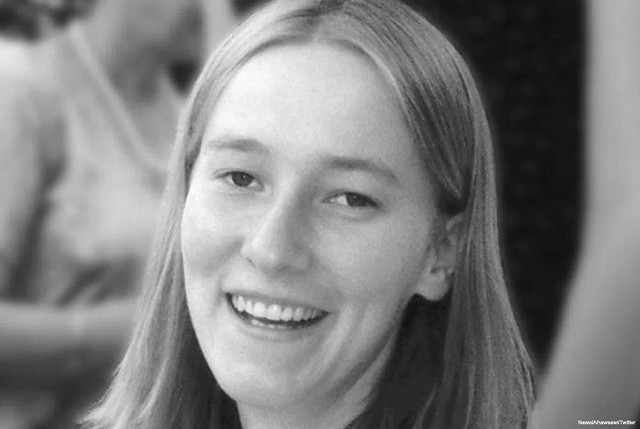
Twenty-three-year-old American peace activist Rachel Corrie was killed by an Israeli bulldozer that was preparing to demolish a Palestinian home in the Gaza Strip in 2003. The Head of the Popular Committee against the Israeli Siege on Gaza said on the occasion of Rachel Corrie’s death anniversary that the 17th anniversary of Rachel Corrie’s death should spur heightened global solidarity with Palestine. He asserted: “The world must listen to Corrie’s voice which still resonates around the world.” The 23-year-old solidarity activist confronted the ugly, cruel Israeli occupation forces in order to protect a Palestinian family from becoming homeless. Corrie’s family now calls for international solidarity movements to intensify their efforts to save the Gaza Strip from the worsening humanitarian and economic crises which overwhelm it: “We hope to see popular, institutional and parliamentarian moves having a tangible impact at the official level,” he added. “Such efforts must lead to real pressure on the Israeli government in order to end its siege imposed on the Gaza Strip. We will never forget Rachel Corrie and her sacrifice to achieve justice and protect the Palestinians.”

“Happy birthday” Rachel Corrie

Palestine remembers Rachel Corrie –
Cartoon [Sabaaneh/MiddleEastMonitor]

“Happy Birthday, Rachel!” This is what she would have heard in her hometown, Olympia, Washington. Her family and friends would have cheerfully flocked around her as she blew out forty candles on April 10, 2019. However, Rachel Corrie deserves a warm international celebration on this day to appreciate her dedication to expressing the value of solidarity.

Rachel Corrie, who was born to a middle-class American family on April 10, 1979, could have had a normal life in which she did not care about what was going on in her world, but she knew she had a responsibility to express and take action, imposed on her by her humanity and values. Rachel expressed her moral responsibilities as a child, as revealed in the moving speech she gave when she was 10, known as the fifth-grade speech. She talked about childhood pains in her world and the need to take action. “I’m here for other children. I’m here because I care. I’m here because children everywhere are suffering,” she said in 1990. This schoolgirl grew up with an alert human conscience, and as a university student, she joined the International Solidarity Movement (ISM). She joined at a time when the Israeli occupation forces were committing constant killings and daily widespread destruction campaigns in the West Bank and Gaza Strip.

On one of her trips, the American woman travelled to the Gaza Strip. She saw the Israeli army’s armoured bulldozers destroying Palestinian homes and razing their agricultural land. On March 16, 2003, Corrie held the loudspeaker and by one of the army’s bulldozer in Al-Salam neighbourhood in Rafah, located near the Egyptian border in the southern part of Gaza. She repeatedly urged them to stop the destruction, which, throughout a few years, led to the destruction of the basic life needs for thousands of Palestinians in Rafah alone. Some Israeli commentators described the destruction of houses and civilian facilities and the bulldozing of trees and farmlands as giving the area a “zero buzz cut” because it removed everything in their path.

Rachel Corrie wore an orange high visibility vest, required to identify her as a volunteer in solidarity work, as she issued multiple appeals. However, the bulldozer continued to approach her without slowing down until it crushed this 24-year-old American civil activist. This tragedy embodied how the successive Israeli governments and its military forces typically behaved, i.e. disregard for international appeals and their continued occupation, oppression, war crimes, and countless violations without any regard for any appeals.

The Israeli occupation army resorted to its habit of evading responsibility for this crime by opening an investigation into what happened and absolved itself from causing the brutal murder of Corrie. It considered it to be an unintended accident. This conclusion was rejected by the most prominent human rights organisations in the world, including Israeli and Palestinian organisations. In 2012, an Israeli court acquitted the occupation army and the bulldozer driver of any responsibility for what happened after Rachel’s parents filed a lawsuit in this regard. This was denounced by the UN Special Rapporteur on Human Rights Richard Falk. It is sickening that the Israeli reports continued to downplay the crime, justify it, and even blame the victim, even though the army bulldozer driver buried Rachel Corrie alive as she screamed into the loudspeaker while wearing her orange vest, visible to everyone.

Time did not stop on March 16, 2003, the day on which the tragic incident occurred in Rafah. Rachel Corrie grew in the human conscience and became a symbol of solidarity in the world after she was buried alive as the price for her solidarity. As for her family, they are no longer just the loving family living in Olympia, as Rachel has become an inspirational international icon. She has also become a Palestinian given her attachment to a fair cause that cannot be extinguished. Her name lives in Palestine in the names of many facilities.

It is true that President Donald Trump will not find time on Rachel’s 40th birthday to commemorate his fellow American who was brutally crushed by the Israeli occupation army, while the congressional sessions will avoid mentioning her name on this occasion. However, through this young brave woman, America presented a loyal face in its international expression of noble human values, as Rachel Corrie’s name inspired a generation of solidarity activists after her who then carried loudspeakers to defend human rights, justice, and the people’s freedoms and to combat injustice, aggression and war crimes.

On April 10, 2019, there will be an international celebration honouring the sacrifices of activists showing solidarity with Palestine around the world, with forty candles for Rachel Corrie.

My name is Rachel Corrie

My Name is Rachel Corrie, being showed at the Young Vic in London, is based on the emails and diary entries of the pro-Palestinian activist, which first premiered at London’s Royal Court in 2005. The play was originally put together by the late Alan Rickman and Katharine Viner, now the editor of the Guardian.

Unsurprisingly the plays reproduction has come under strong criticism from Pro-Israeli groups. Fury at the revival of the play has stirred all kinds of controversy such that supporters of Israel in the UK are piling pressure on the Young Vic for staging the play. The Vic’s artistic director David Lan, who is Jewish, felt compelled to come to the theatre’s defence saying: “Gaza is a wound to the planet from which so many people are suffering.” Aside from the nuisance of having Pro-Israeli activists shoving propaganda leaflets smearing the memory of Corrie towards you at the entrance of the theatre, the hour and half long immersion into Corrie’s mind is a memorable experience.

The play brilliantly darts through the diaries of Corrie from her early teens through to the period of her untimely death. Directed by an award winning director, Josh Roche, and wonderfully performed by British actor Erin Doherty, viewers are exposed to a visceral representation of the brutality of Israeli occupation seen through the eyes of an activist searching for her place in life. It brings to life defining moments in the campaigner’s personal journey as she grapples with her own sense of privilege in contrasted with the indignity and poverty she saw in Gaza.

https://www.middleeastmonitor.com/20171026-my-name-is-rachel-corrie/.

22 March 2020

Source: palestineupdates.com

Technology of Death: The Not-So-Shocking Report on Israeli Weapons Exports

By Dr Ramzy Baroud

The Middle East region, battered by wars and adjoining humanitarian crises that have left millions of people stateless, hungry and diseased, is in urgent need for peace, security and reconstruction. Thanks to the US, Russian, French, Israeli and other weapons manufacturers, however, it is now the dumping ground for military hardware, an ominous sign for the years ahead.

Data released by the Stockholm International Peace Research Institute (SIPRI) on March 9, paints a grim picture of the world, in general, and the Middle East, in particular. According to the report, the demand for weapons in the warring region has increased by a whopping 61% between 2015 and 2019.

The correlation between arms, war, and casualty count needs no elaborate algorithm to be deciphered, as facts on the ground amply demonstrate. Syria remains the epicenter of conflict in the Middle East, with Libya, Yemen, Iraq, Palestine, and South Sudan trailing, but not far behind.

The top five merchants of death, according to SIPRI, are the United States, Russia, France, Germany, and China. Interestingly, while US arms exports have increased exponentially by 76% in the last five years, Russia’s arms exports fell by 18%.

The US market is in constant expansion as it now includes 96 client countries, while Russia has, essentially, lost one of its most significant clients, India.

Ruled by a right-wing Hindu nationalist government, Delhi has found in Tel Aviv a more ideologically like-minded supplier. The special ‘friendship’ between India’s Narendra Modi and Israel’s Benjamin Netanyahu has made India Israel’s largest weapons market.

In 2017, Israel’s arms exports reached a record high of $9 billion dollars, following the signing of a $2 billion deal with India. The contracts awarded to the Israel Aerospace Industries (IAI) were considered the “single largest deal ever signed by the Israeli arms industry.”

With India becoming the largest importer of Israeli arms in the world, Israel is now a secondary party in the protracted conflict between India and Pakistan. The two nuclear-armed countries edged closer to the abyss of a full-blown war in March 2019. Naturally, Israeli weapons, now featured prominently in India’s military arsenal, will play a major role in sustaining any future conflict.

According to the newly-released data, Israel is only second to South Korea in terms of the vast expansion of weapons exports, as Israel’s weapons manufacturing industry has experienced an unprecedented boom in recent years. SIPRI puts that increase at 77%.

Last year, the International Defense Cooperation Directorate of the Israeli Ministry of Defense (SIBAT), which is the cornerstone of Israel’s weapon manufacturing, testing and export, released a comprehensive plan aimed at the expansion of Israel’s global weapons market, with due focus on the US, Finland and India.

What makes Israeli weapons more attractive than others is the fact that they are not accompanied by any political price tag. In other words, Israel is willing to sell weapons to any country, or even non-state actors, openly or secretly, regardless of how these weapons are used and whether their use violates human rights or not.

In May 2019, Amnesty International’s Israeli chapter released an in-depth report that examined Israel’s weapons export markets. Contrary to the claim by Rachel Chen, head of the Israeli Defense Export Controls Agency, that “we will carefully examine the state of human rights in each country before approving export licenses for selling them weapons,” Israel is known for peddling its weapons to the world’s most notorious human rights violators. The list includes Myanmar, Philippines, South Sudan, and Sri Lanka.

A damning proof to the above claim is a statement made by Philippines President, Rodrigo Duterte, who is known for his dismal human rights record, on September 4, 2018, during his highly touted visit to Israel. Duterte told Israeli President, Reuven Rivlin, that the Philippines “would henceforth only buy weapons from Israel due to its lack of restrictions,” ‘Times of Israel’ reported.

The US is “a good friend,” Duterte said, but like Germany and China, US weapons come with certain “limitations”.

Considering that Washington provides Israel with over $3 billion worth of weapons annually that are used freely against occupied Palestinians and other Arab nations with no regard whatsoever for international or humanitarian law, one has to marvel at Duterte’s statement.

It is logical to assume that a country that sells weapons to civil war-torn and extremely impoverished South Sudan, has not an iota of regulations, let alone moral standards.

What is unique about the export of Israel’s weapons and so-called ‘security technology’ to the rest of the world, is that they often appear in regions where people are most oppressed and vulnerable. For example, Israeli companies have for years stood at the forefront of successive US administrations’ war on undocumented immigrants.

Moreover, recent years have witnessed the infusion of brutal Israeli military tactics in many aspects of American society, including the militarization of American police, thousands of whom received training in Israel.

Similarly, in 2018, Israeli war technology was incorporated to the European Union’s security apparatus. One such contract was awarded to the Israeli company Elbit, estimated at $68 million, to provide maritime unmanned aircraft system (UAS) services. This technology, which relies on the Hermes 900 Maritime Patrol system, allows Frontex – the European Border and Coast Guard Agency – to intercept war refugees and migrants in their attempts to cross into safer European territories.

Interestingly, the EU has purchased from Israel the same deadly technology that the Israeli army has used against Palestinians in the besieged Gaza Strip during Israel’s so-called ‘Protective Edge’ war of 2014.

The latter fact represents the backbone of Israel’s marketing strategy. Branding its military products as ‘combat-proven’, Tel Aviv is able to obtain top dollar for its bloody technology, as it is able to demonstrate, using actual footage, how its armed drones, for example, can flatten whole Palestinian neighborhoods in seconds and return safely to their bases inside Israel.

SIPRI and Amnesty International are right in exposing Israel’s thriving weapons exports market, while emphasizing the fact that much of these weapons proliferate freely among human rights violators. But far greater focus should be placed on the fact that Israel is, itself, a notorious human rights violator that should be held accountable for its crimes against Palestinians, who are often used as guinea pigs in the testing stage of Israel’s technology of death.

Ramzy Baroud is a journalist and the Editor of The Palestine Chronicle.

24 March 2020

Source: countercurrents.org
Coronavirus on East Coast of USA

By Sally Dugman

First, this information at the link below in its second half conforms to the “secret” information that my nephew knows. His is from US government sources that indicate that half of Americans will likely get the virus.

Second, his father is writing an exam for tomorrow for some of his approximately 120 students. He is concerned that the remote viewing online might not work and that some of the students may cheat using books and such. So he is doing all that he can to make corrections for both contingencies.

Third, remember the 2008 bailout. Remember AIG throwing a big vacation overseas for executives while not helping mid and low level workers with that money? Well, it is happening again. Redux. .

Darling Donald Trump and miserable Mitch McConnell have the same plan in place with no contingency to bail out workers with corporate given funds when giving the money to corporations, and no tracking measurements for the ways that the money is used. Way to go NOT! … Absolutely no tabulations on the way that the bailout money is spent! And who is on the hook for it? Taxpayers.

Fourth, the man who owns a pizza shop was practically crying last night. He does not live high on the hog, but doesn’t have spare money to tide his family over. Yet nobody at all except a few people come to his eatery any more. … Yes, I ate pizza last night from his place that’s a few miles from my home. Nothing except takeout, of course.

Fifth, my sister daily takes a Facebook exercise class using her husband’s account since she has no Facebook account like me with none. The class comes out of NY and she is in MD. With the shelter in place conditions, it’s a case of “use it or lose it” with your body nonetheless.

Karen C. from elder services in Worcester, MA called me recently. She phoned to inquire about whether I needed food, medicine or some other critical provision such as visits for home care providers and physical therapy. This is because she was calling to all people whom she knows and will make sure that they will get whatever that they need.

She’ll even go out herself to provide whatever may be needed after she dons her mask and gloves. … Yes, we all need to step up in troubled times. Fortunately, some of us like Karen go all out. They are willing even to personally handle emergencies even when it puts themselves at risk.

At https://threadreaderapp.com/thread/1239975682643357696.html:
To read more than the analysis below, please go to the link. The second half of the article is excellent and is applicable to many countries.

Excerpted:

This mitigation strategy is what you’ve seen a lot of people talking about when they say we should “flatten the curve”: try to slow the spread of the disease to the people most likely to die from it, to avoid overwhelming hospitals. And it does flatten the curve — but not nearly enough. The death rate from the disease is cut in half, but it still kills 1.1 million Americans all by itself. The peak need for ventilators falls by two-thirds, but it still exceeds the number of ventilators in the US by 8 times.

Sally Dugman lives in MA, USA.

24 March 2020

Source: countercurrents.org

Europe’s coronavirus death toll passes 10,000

By Robert Stevens

More than 10,000 people have been killed by coronavirus across the European continent. The gruesome milestone has been reached just five weeks after the first death was recorded on the continent, in France, on February 15.

With yesterday’s 1,414 new deaths, the total for the entire continent reached 10,220 deaths from 192,663 cases. Among the European Union’s 27 countries, 9,720 deaths have been recorded from 172,407 cases.

In Italy, 601 new fatalities brought the total to 6,077 deaths. Almost 5,000 new cases of the virus were reported. Many more lives are threatened even before these new cases, with 50, 418 active cases and 3,204 classed as “serious, critical.” All told 63,927 people have been infected in Italy.

In Spain, the death toll reached 2,206, with 434 new deaths reported, up from 391 the previous day. There were 4,321 new cases making for a total of 27,528 active cases. Some 2,355 are classed as serious, critical.

The inability of health and social care services across Europe to cope with the destructive impact of the virus—after decades of being underfunded, privatised and de-staffed—saw soldiers, who were drafted in to provide disinfecting and run residential homes in Spain, find elderly people dead in their beds, abandoned to their fate with the country under a strict lockdown.

In France, there were 186 new deaths, an increase over the previous day’s 112, bringing the total to 860. The deaths included another two medics, one a GP and the other a gynaecologist. There are over 13,000 active cases in the country, 8,675 people in hospital and 2,082 people in critical condition.

A further 34 people perished in the Netherlands, bringing the total to 213, and 24 people died in Germany, bringing fatalities to 118.

In the UK, after it was announced that 54 more people had died, and 335 in total, Conservative Prime Minister Boris Johnson announced a lockdown of the country Monday evening. People can only leave their homes for “very limited purposes” including “shopping for basic necessities, as infrequently as possible” and “one form of exercise a day.” Only two people can be together, unless they live in the same household. Police can enforce the lockdown, “including through fines and dispersing gatherings,” said Johnson.

The Foreign Office advised the up to 1 million Britons on holiday or on business trips abroad to return to the UK immediately. They warned that otherwise there would likely be no more commercial flights available with air routes likely shutting without warning over Tuesday and Wednesday.

Johnson’s government has refused to take a number of critical measures to stop the spread of the virus. Its original plan, before being forced to retreat, was to allow the mass infection of the population supposedly in order to achieve “herd immunity.” The government still advises all who suspect they have the virus not to seek treatment in hospital, but to “self-isolate” at home—without being tested.

More evidence is emerging that those who are contracting the virus and in some cases dying are from many age ranges, including younger, fitter people, from a baby who was born with the virus to a group of three 30-year-old junior doctors in the same UK hospital who were diagnosed Sunday and required ventilators.

In response, the ruling elite is putting into operation draconian attacks on civil liberties that set a dangerous precedent, while providing no real medical assistance.

Yesterday, the Johnson government was able to pass all stages, in the House of Commons, of the Emergency Coronavirus Bill, under which he and his ministers are granted extraordinary authoritarian powers, including banning any assembly of people, at any time and place.

This week, Hungary’s parliament will hear a bill under which far-right prime minister Viktor Orbán is set to receive dictatorial powers enabling him to rule by decree. The powers provide no defined cut-off date and include imprisoning those deemed to be spreading “fake news” for prison terms of up to five years.

No government in Europe or internationally is carrying out the mass testing required to successfully quarantine and then treat those infected, who may not be showing symptoms, but who are still spreading COVID-19. Even front-line medical staff are not being tested. Due to health service cuts, there is hopelessly inadequate provision of basic medical facilities, including ventilators and personal protective equipment (PPE) for staff.

In contrast the banks, corporations and super-rich are being granted bailouts that eclipse those granted to the bankers and financial institutions after the 2008 global financial crash. In recent days, Germany, France, Britain and Spain have announced massive subventions to big business, under conditions in which millions of workers have already been laid off, with only those in essential services now employed in most European countries.

Well over a trillion euros have been made available in a matter of days to prop up the financial aristocracy and corporate billionaires. Chancellor Angela Merkel’s government has made available a package worth around €750 billion to protect Germany’s banks and major corporations. Emmanuel Macron’s French government committed €300 billion and Johnson’s Chancellor Rishi Sunak £350 billion.

Spain’s Socialist Party prime minister Pedro Sánchez has committed $219 billion to the corporations, including €100 billion of guarantees for company loans. A further €17 billion of direct support for enterprises is available and €83 billion is reportedly being reserved for private sector investment.

These represent a gigantic raid on the public purse for the second time in a decade. Germany’s bailout is the equivalent of 20.5 percent of GDP, Spain’s 15.6 percent, the UK’s 15 percent.

These bailouts followed the lead of the European Central Bank, which last week announced a €750 billion new money-printing programme aimed at keeping financial markets afloat. The ECB is committed to buying government debt and private securities with the new funds by the end of this year.

These vast sums are just a down payment, with government officials in treasuries in the main European counties stressing that there will be “unlimited” funds available. This was confirmed yesterday as Johnson’s government agreed to nationalise the losses of every private rail franchise in Britain for the next six months initially. This transfers all revenue and cost risk to the government but leaves private firms able to still reap profits and to be paid a management fee under an “emergency measures agreement.”

Workers throughout Europe must demand a programme directly opposed to that of the corporations and the governments that act on their behalf. They must reject this unprecedented bleeding dry of the public purse for the purpose of funding big business and the bankers. These entities must be taken under public control and run by the working class in the interests of society.

In a statement Monday, “The spread of the pandemic and the lessons of the past week,” the WSWS proposed the measures necessary for workers to take forward the fight against the COVID-19 pandemic: “The working class must demand universal testing and free and equal access to health care; the closure of all nonessential production, with full income to those affected; safe working conditions in industries essential to the functioning of society; and an emergency program to build health care infrastructure and ensure that all medical workers have access to the necessary equipment.”

Originally published by WSWS.org

24 March 2020

Source: countercurrents.org

Coronavirus kills more than 2,600 across Europe in one weekend

By Alex Lantier

The coronavirus pandemic surged across Europe this weekend, with more than 2,600 deaths, the majority of them in Italy, followed by Spain, France, Britain, the Netherlands, Belgium and Germany. The weekend toll by itself nearly equaled the entire three-month death toll in China, where the epidemic began.

On Sunday alone there were 1,287 deaths and 17,303 new cases, with Italy, Spain and France all seeing record numbers of deaths from the epidemic. The total for the continent as a whole reached 168,803 cases and 8,785 deaths.

The toll from the pandemic in Europe has now reached more than double the impact in China, which saw 81,054 cases and 3,261 deaths. Worldwide, there have been 335,377 declared cases of coronavirus and 14,611 deaths.

A third major epicenter is Iran, where there have been at least 21,638 cases including 1,685 deaths, while the number of cases in the United States has skyrocketed to more than 32,000, with 400 deaths. There is also a rapid growth in the number of cases in Africa and Latin America.

Though Italy, Spain and France are under country-wide lockdown, as well as large parts of Germany, the contagion is spreading relentlessly across Europe, after governments refused for weeks to adopt shelter-in-place orders or make any serious effort to actually stop the contagion by combining lockdowns with testing, contact-tracing and quarantining all those either infected or in contact with the infected.

Italy, Europe’s worst-hit country for now, saw 5,560 new cases and 651 deaths on Sunday after 6,557 new cases and a record 793 deaths on Saturday, for 59,138 cases overall and 5,476 deaths. On Saturday, Prime Minister Giuseppe Conte announced that all factories would close indefinitely except for those “strictly necessary … to guarantee us essential goods and services.” Officials in Lombardy, the hardest-hit region, warned that stricter measures, like a ban on anyone leaving their homes, might be taken as hospitals continue to be flooded with critically ill patients gasping for air.

While Russian military aid and a group of Cuban doctors arrived in Italy, the European Union (EU) still refuses to provide aid to the devastated country. A diplomatic incident ensued this weekend over the theft of a shipment of 680,000 Chinese face masks to Italy in the Czech Republic, whose government initially denied that anything had been stolen. The Czech government is now sending masks and respirators to Italy, however.

Italian health officials pointed to the slight fall in the number of infected and of deaths on Sunday, as well as the fact that only 30.4 percent of new cases were in Lombardy, as signs the contagion might be slowing. The incubation period of the virus typically ranges from three to seven days and can go up to 14. As confinement orders to prevent further spread of the disease took effect over a week ago, many of those already infected and incubating the virus at that time could be expected to have already started showing symptoms.

However, officials also warned not to take false hope. “I hope and we all hope that these figures can be borne out in the coming days. But do not let your guard down,” commented Italian civil protection service chief Angelo Borrelli.

In Spain, there were 3,925 new cases and 288 deaths Saturday and 3,107 new cases and 375 deaths Sunday, bringing the total to 28,603 cases and 1,756 deaths. One of those who has fallen ill is the beloved opera singer, Placido Domingo, lately a target of the right-wing #MeToo movement. Moreover, 12 percent of the confirmed cases (3,475) are doctors, nurses or health staff, devastating the health system which is already flooded with patients in key areas such as Madrid.

On Saturday, Spanish Prime Minister Pedro Sanchez warned that “the worst is to come.” As confined Spanish people banged on pots and pans to protest his handling of the pandemic, Sanchez pledged to organize more mass testing for coronavirus. The Sanchez government has prolonged Spain’s state of alarm and lockdown until at least April 11.

In France, where the first doctor died of coronavirus in Compiègne, the total number of cases rose to 16,018 with 674 deaths, including 112 on Sunday alone. Health Minister Olivier Véran also said he believed the true number of cases in France is 30,000 to 90,000. However, he brazenly ignored calls from health professionals to carry out mass testing to identify and isolate all the sick before they can spread the disease to others. Instead, Véran said France would increase testing “once confinement orders are lifted,” that is, at some point in the indefinite future.

In Germany, officials are reportedly considering a nationwide lockdown as the number of sick rose 2,488 on Sunday to 24,852. Amid growing fears of coronavirus infections in rest homes, nine elderly residents of a home have died and thirty people have been infected, including some of the rest home’s staff, in the town of Würzburg, where 166 people have already fallen ill. Among those now self-isolating, moreover, is German Chancellor Angela Merkel, who reportedly came into contact with a doctor who later tested positive for the virus.

In Britain, 48 people died and 665 fell ill on Sunday, bringing the total to 281 deaths and 5,683 cases—including the first teenager to die of coronavirus in Britain, aged 18.

Prime Minister Boris Johnson came under growing criticism for his refusal to act against the pandemic. After his scientific advisor Patrick Vallance said it was “not desirable” to prevent Britons from contracting the disease—claiming this would prevent them from becoming immune—Johnson was forced to deny a Sunday Times report that his far-right adviser Dominic Cummings had argued to “let old people die.”

The pandemic is rapidly bringing to the fore deep class divisions internationally. The financial aristocracy is determined to let the disease run its course, so long as they are able to emerge richer than ever before. While the European Central Bank has printed €750 billion since the pandemic began to bail out stock markets and the super-rich, and national states are offering hundreds of billions of euros in financial guarantees for the corporations, businesses across Europe demand workers stay on the job to keep making profits for them.

Anger is mounting among health workers and industrial workers, however, at the ruling elite’s irresponsible attitude to this deadly pandemic. Amazon has stopped shipping non-essential products in Italy, after strikes last week and threats of strike action by Amazon workers in France.

After a wave of wildcat strikes in Italy forced Conte to adopt the initial confinement order, health professionals are bitterly criticizing decades-long EU austerity policies that have slashed health budgets and devastated hospitals .

In Spain, a hospital supply purchaser spoke to El Espanol to criticize Sanchez’s Spanish Socialist Party-Podemos government’s failure to order face masks and emergency respirators. “He did not buy them on time, it is a scandal,” he said. “In the meantime they were debating about local elections in the Basque Country and Galicia or asking whether the Montero law on sexual freedom was creating conflict in the ruling coalition. What stupidities, with coronavirus looming over it all! What a waste of time!”

In France, a group of 600 doctors has sued Prime Minister Edouard Philippe and former Health Minister Agnès Buzyn before the Republic’s Court of Justice (CJR) over their handling of the pandemic. They are accusing Philippe and Buzyn of having “voluntarily abstained from taking or launching measures” against “a danger for the security of persons.” After Buzyn admitted she had warned Philippe of the danger of a pandemic since January, the group is demanding a criminal investigation of Philippe and the seizure of his computers.

Amid growing class conflict, as workers clash with the state and the banks to try to secure social resources to fight the pandemic, the ruling elite—assisted by the union bureaucracy and its pseudo-left political allies—is moving to suppress opposition. Obsessed with giving handouts to the banks and the super-rich, it is preparing attacks on wages and basic social and democratic rights and accelerating moves towards authoritarian forms of rule.

As Portugal’s social-democratic government voted a state of emergency on March 18, suspending the constitutional right to strike for the first time since the fall of the fascist Salazar dictatorship in 1974, Spain deployed the army at home to enforce the state of alarm. In France, the government adopted a bill for a new state of emergency during the coronavirus crisis that allows businesses to slash a week of vacation and eliminate restrictions on the length of the workweek—even after the coronavirus crisis is over. These measures emerged from talks between business and the unions.

In Germany on Friday, the IG Metall union used the coronavirus crisis as a pretext to abandon talks with employers and accept contracts with no wage increases—claiming this was necessary to protect business activity. Left Party official Dietmar Bartsch hailed Merkel’s policies, tweeting, “The Left party fraction will support all measures that demand solidarity to avoid damage to the nation, people and the economy.”

The defense of workers’ health, livelihoods and democratic rights after years of EU austerity and police-state repression demands a social revolution and a break with this rotten establishment. The struggle to stem the pandemic, obtain decent wages during lock-downs, and obtain free and decent medical coverage for all is an international political struggle. This requires the organization of the working class across Europe and internationally in rank-and-file committees of action, independent of the unions, and a struggle to transfer political power to the working class.

Originally published by WSWS.org

23 March 2020

Source: countercurrents.org
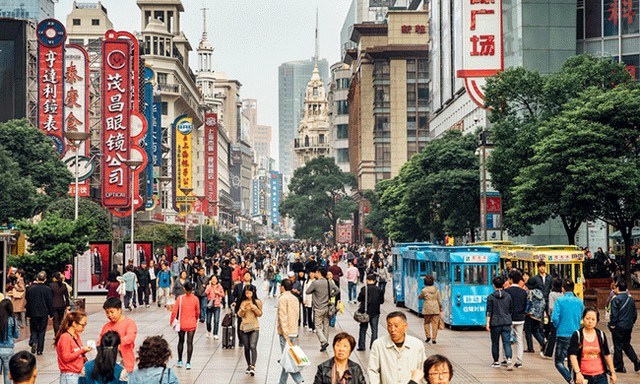
‘This is our version of coronavirus, we are sick’

By Arundhati Roy

Beloved friends, comrades and my fellow writers,

This place where we are gathered today is only a short bus ride away from where four days ago a fascist mob, fired up by speeches made by members of the Ruling Party, backed up and actively assisted by the police, assured of round the clock support by a vast section of the electronic mass media, and comforted by the belief that the courts would do nothing to come in their way – mounted an armed, murderous attack on Muslims in the working class colonies of North East Delhi.

The attack had been in the air for a while, so people were somewhat prepared, and so defended themselves. Markets, shops, homes, mosques and vehicles have been burnt down. The streets are full of stones and debris. The hospitals are full of the wounded and dying. The morgues are full of the dead. Both Muslim and Hindu, including a policeman and a young staffer of the Intelligence Bureau. Yes. People on both sides have shown themselves capable of horrifying brutality as well as unbelievable courage and kindness.

However, there can be no equivalence here. None of this alters the fact that the attack was begun by lumpen mobs chanting “Jai Shri Ram” backed by the apparatus of this now nakedly fascist state. Notwithstanding these slogans, this is not what people like to label a Hindu-Muslim “riot”. It is a manifestation of the ongoing battle between fascists and anti-fascists – in which Muslims are the first among the Fascists’ “enemies”. To call it a riot or a “danga”, or “Left” versus “Right” or even “Right” versus “Wrong” as many are doing, is dangerous and obfuscatory.

We have all seen the videos of the police standing by and sometimes participating in the arson. We have seen them smashing CCTV cameras, just as they did when they vandalised the Jamia Millia Islamia University library on December 15. We have seen them beat wounded Muslim men as they lay piled up against each other and force them to sing the national anthem. We know that one of those young men is dead. All the dead, wounded and devastated, Muslim as well as Hindu are victims of this regime headed by Narendra Modi, our nakedly fascist Prime Minister who himself is no stranger to being at the helm of affairs in a state when 18 years ago a massacre on a much larger scale went on for weeks.

The anatomy of this particular conflagration will be studied for years to come. But the local detail will only be a matter of historical record because the ripples based on hateful rumours fuelled on the social media have begun to eddy outwards and we can already smell more blood on the breeze. Although there have been no more killings in North Delhi, yesterday (February 29) saw mobs of people in Central Delhi chanting the slogan that built up to the attacks: “Desh ke Gaddaron ko, Goli maaron saalon ko.”

Only a few days ago. the Delhi High Court Judge, Justice Muralidharan was furious with the Delhi Police for having taken no action against Kapil Mishra, former BJP MLA candidate who had earlier too used it as an election slogan. On the night of February 26, the judge was given midnight orders to take up his new assignment in the Punjab High Court. Kapil Mishra is back on the streets chanting the same slogan. It can now be used until further notice. Fun and games with judges isn’t new. We know the story about Justice Loya. We may have forgotten the story of Babu Bajrangi, convicted of participating in the killing 96 Muslims in Naroda Patiya, in Gujarat in 2002. Listen to him on YouTube: He’ll tell you how “Narendra bhai” got him out of jail because of “setting” the judges.

We have learned to expect massacres such as this one before elections – they have become a sort of barbaric election campaign to polarise votes and build constituencies. But the Delhi massacre happened just days after an election, after the BJP-RSS suffered a humiliating defeat. It is a punishment for Delhi and an announcement for the coming elections in Bihar.

Everything is on record. Everything is available for everyone to see and hear – the provocative speeches of Kapil Mishra, Parvesh Verma, Union Minister Anurag Thakur, Chief Minister of UP Yogi Adityanath, the Home Minister Amit Shah and even the Prime Minister himself. And yet everything has been turned upside down – it’s being made to appear as though all of India is a victim of the absolutely peaceful, mostly female, mostly – but not only – Muslim protestors who have been out on the streets for almost 75 days, in their tens of thousands, to protest against the Citizenship Amendment Act.

The CAA, which offers a fast-track route to citizenship for non-Muslim minorities, is blatantly unconstitutional and blatantly anti-Muslim. Coupled with the National Population Register and the National Register of Citizens, it is meant to delegitimise, destabilise and criminalise not just Muslims but hundreds of millions of Indians who do not have the requisite documents – including those who are chanting “Goli Maaro Saalon Ko” today.

Once citizenship comes into question, everything comes into question – your children’s rights, your voting rights, your land rights. As Hannah Arendt said, “citizenship gives you the right to have rights.” Anybody who thinks this is not the case, please turn your attention to Assam and see what has happened to twenty lakh people – Hindus, Muslims, Dalits, Adivasis. Now trouble has started between local tribes and the non-tribal population in the state of Meghalaya. There is curfew in Shillong. The state borders are closed to non-locals.

The sole purpose of the NPR-NRC-CAA is to destabilise and divide people not just in India but across the whole subcontinent. If they do indeed exist, these phantom millions of human beings who India’s current Home Minister calls Bangladeshi “termites”, cannot be kept in detention centres and cannot be deported. By using such terminology and by thinking up such a ridiculous, diabolic scheme, this government is actually endangering the tens of millions of Hindus who live in Bangladesh, Pakistan and Afghanistan who they pretend to be concerned about, but who could suffer the backlash of this bigotry emanating from New Delhi.

Look where we have ended up.

‘This is our version of coronavirus, we are sick’, Arundhati Roy on Delhi violence
Muslim as well as Hindu are victims of the regime headed by our nakedly fascist PM Modi, she says
File photo of Arundhati Roy/Collected

Three days after the deadly violence killed at least 42 people and injured hundreds in northeast Delhi over citizenship law, India’s acclaimed author Arundhati Roy said, “This is our version of the coronavirus. We are sick.”

She made the remark while addressing a gathering at Jantar Mantar in Delhi on Sunday, reports Scroll.

Read her full speech below-

Beloved friends, comrades and my fellow writers,

This place where we are gathered today is only a short bus ride away from where four days ago a fascist mob, fired up by speeches made by members of the Ruling Party, backed up and actively assisted by the police, assured of round the clock support by a vast section of the electronic mass media, and comforted by the belief that the courts would do nothing to come in their way – mounted an armed, murderous attack on Muslims in the working class colonies of North East Delhi.

The attack had been in the air for a while, so people were somewhat prepared, and so defended themselves. Markets, shops, homes, mosques and vehicles have been burnt down. The streets are full of stones and debris. The hospitals are full of the wounded and dying. The morgues are full of the dead. Both Muslim and Hindu, including a policeman and a young staffer of the Intelligence Bureau. Yes. People on both sides have shown themselves capable of horrifying brutality as well as unbelievable courage and kindness.

However, there can be no equivalence here. None of this alters the fact that the attack was begun by lumpen mobs chanting “Jai Shri Ram” backed by the apparatus of this now nakedly fascist state. Notwithstanding these slogans, this is not what people like to label a Hindu-Muslim “riot”. It is a manifestation of the ongoing battle between fascists and anti-fascists – in which Muslims are the first among the Fascists’ “enemies”. To call it a riot or a “danga”, or “Left” versus “Right” or even “Right” versus “Wrong” as many are doing, is dangerous and obfuscatory.

We have all seen the videos of the police standing by and sometimes participating in the arson. We have seen them smashing CCTV cameras, just as they did when they vandalised the Jamia Millia Islamia University library on December 15. We have seen them beat wounded Muslim men as they lay piled up against each other and force them to sing the national anthem. We know that one of those young men is dead. All the dead, wounded and devastated, Muslim as well as Hindu are victims of this regime headed by Narendra Modi, our nakedly fascist Prime Minister who himself is no stranger to being at the helm of affairs in a state when 18 years ago a massacre on a much larger scale went on for weeks.

The anatomy of this particular conflagration will be studied for years to come. But the local detail will only be a matter of historical record because the ripples based on hateful rumours fuelled on the social media have begun to eddy outwards and we can already smell more blood on the breeze. Although there have been no more killings in North Delhi, yesterday (February 29) saw mobs of people in Central Delhi chanting the slogan that built up to the attacks: “Desh ke Gaddaron ko, Goli maaron saalon ko.”

Only a few days ago. the Delhi High Court Judge, Justice Muralidharan was furious with the Delhi Police for having taken no action against Kapil Mishra, former BJP MLA candidate who had earlier too used it as an election slogan. On the night of February 26, the judge was given midnight orders to take up his new assignment in the Punjab High Court. Kapil Mishra is back on the streets chanting the same slogan. It can now be used until further notice. Fun and games with judges isn’t new. We know the story about Justice Loya. We may have forgotten the story of Babu Bajrangi, convicted of participating in the killing 96 Muslims in Naroda Patiya, in Gujarat in 2002. Listen to him on YouTube: He’ll tell you how “Narendra bhai” got him out of jail because of “setting” the judges.

We have learned to expect massacres such as this one before elections – they have become a sort of barbaric election campaign to polarise votes and build constituencies. But the Delhi massacre happened just days after an election, after the BJP-RSS suffered a humiliating defeat. It is a punishment for Delhi and an announcement for the coming elections in Bihar.

Everything is on record. Everything is available for everyone to see and hear – the provocative speeches of Kapil Mishra, Parvesh Verma, Union Minister Anurag Thakur, Chief Minister of UP Yogi Adityanath, the Home Minister Amit Shah and even the Prime Minister himself. And yet everything has been turned upside down – it’s being made to appear as though all of India is a victim of the absolutely peaceful, mostly female, mostly – but not only – Muslim protestors who have been out on the streets for almost 75 days, in their tens of thousands, to protest against the Citizenship Amendment Act.

The CAA, which offers a fast-track route to citizenship for non-Muslim minorities, is blatantly unconstitutional and blatantly anti-Muslim. Coupled with the National Population Register and the National Register of Citizens, it is meant to delegitimise, destabilise and criminalise not just Muslims but hundreds of millions of Indians who do not have the requisite documents – including those who are chanting “Goli Maaro Saalon Ko” today.

Once citizenship comes into question, everything comes into question – your children’s rights, your voting rights, your land rights. As Hannah Arendt said, “citizenship gives you the right to have rights.” Anybody who thinks this is not the case, please turn your attention to Assam and see what has happened to twenty lakh people – Hindus, Muslims, Dalits, Adivasis. Now trouble has started between local tribes and the non-tribal population in the state of Meghalaya. There is curfew in Shillong. The state borders are closed to non-locals.

The sole purpose of the NPR-NRC-CAA is to destabilise and divide people not just in India but across the whole subcontinent. If they do indeed exist, these phantom millions of human beings who India’s current Home Minister calls Bangladeshi “termites”, cannot be kept in detention centres and cannot be deported. By using such terminology and by thinking up such a ridiculous, diabolic scheme, this government is actually endangering the tens of millions of Hindus who live in Bangladesh, Pakistan and Afghanistan who they pretend to be concerned about, but who could suffer the backlash of this bigotry emanating from New Delhi.

Look where we have ended up.

In 1947, we won independence from colonial rule that was fought for by almost everybody with the exception of our current rulers. Since then all manner of social movements, anti-caste struggles, anti-capitalist struggles, feminist struggles have marked our journey up to now.

In the 1960s, the call to revolution was a demand for justice, for the redistribution of wealth and the overthrow of the ruling class.

By the 1990s, we were reduced to fighting against the displacement of millions of people from their own lands and villages, people who became the collateral damage for the building of a new India in which 63 of India’s richest people have more wealth than the annual budget outlay for 1,200 million people.

Now we are reduced to pleading for our rights as citizens from people who have had nothing to do with building this country. And as we plead, we watch the state withdraw its protection, we watch the police get communalised, we watch the judiciary gradually abdicate its duty, we watch the media that is meant to afflict the comfortable and comfort the afflicted do the very opposite.

Today is the 210th day since Jammu and Kashmir was unconstitutionally stripped of its special status. Thousands of Kashmiris including three former chief ministers continue to be in jail. Seven million people are living under a virtual information siege, a novel exercise in the mass violation of human rights. On February 26, the streets of Delhi looked like the streets of Srinagar. That was the day that Kashmiri children went to school for the first time in seven months. But what does it mean to go to school, while everything around you is slowly throttled?

A democracy that is not governed by a Constitution and one whose institutions have all been hollowed out can only ever become a majoritarian state. You can agree or disagree with a Constitution as a whole or in part – but to act as though it does not exist as this government is doing is to completely dismantle democracy. Perhaps this is the aim. This is our version of the coronavirus. We are sick.

There’s no help on the horizon. No well-meaning foreign country. No UN.

And no political party that intends to win elections will or can afford to take a moral position. Because there is fire in the ducts. The system is failing.

What we need are people who are prepared to be unpopular. Who are prepared to put themselves in danger. Who are prepared to tell the truth. Brave journalists can do that, and they have. Brave lawyers can do that, and they have. And artists – beautiful, brilliant, brave writers, poets, musicians, painters and filmmakers can do that. That beauty is on our side. All of it.

We have work to do. And a world to win.

Arundhati Roy is an Indian novelist, political activist.

1 March 2020

A lesson coronavirus is about to teach the world

By Jonathan Cook

If a disease can teach wisdom beyond our understanding of how precarious and precious life is, the coronavirus has offered two lessons.

The first is that in a globalised world our lives are so intertwined that the idea of viewing ourselves as islands – whether as individuals, communities, nations, or a uniquely privileged species – should be understood as evidence of false consciousness. In truth, we were always bound together, part of a miraculous web of life on our planet and, beyond it, stardust in an unfathomably large and complex universe.

It is only an arrogance cultivated in us by those narcissists who have risen to power through their own destructive egotism that blinded us to the necessary mix of humility and awe we ought to feel as we watch a drop of rain on a leaf, or a baby struggle to crawl, or the night sky revealed in all its myriad glories away from city lights.

And now, as we start to enter periods of quarantine and self-isolation – as nations, communities and individuals – all that should be so much clearer. It has taken a virus to show us that only together are we at our strongest, most alive and most human.

In being stripped of what we need most by the threat of contagion, we are reminded of how much we have taken community for granted, abused it, hollowed it out. We are afraid because the services we need in times of collective difficulty and trauma have been turned into commodities that require payment, or treated as privileges to which access is now means-tested, rationed or is simply gone. That insecurity is at the root of the current urge to hoard.

When death stalks us it is not bankers we turn to, or corporate executives, or hedge fund managers. Nonetheless, those are the people our societies have best rewarded. They are the people who, if salaries are a measure of value, are the most prized.

But they are not the people we need, as individuals, as societies, as nations. Rather, it will be doctors, nurses, public health workers, care-givers and social workers who will be battling to save lives by risking their own.

During this health crisis we may indeed notice who and what is most important. But will we remember the sacrifice, their value after the virus is no longer headline news? Or will we go back to business as usual – until the next crisis – rewarding the arms manufacturers, the billionaire owners of the media, the fossil fuel company bosses, and the financial-services parasites feeding off other people’s money?

‘Take it on the chin’

The second lesson follows from the first. Despite everything we have been told for four decades or more, western capitalist societies are far from the most efficient ways of organising ourselves. That will be laid bare as the coronavirus crisis deepens.

We are still very much immersed in the ideological universe of Thatcherism and Reaganism, when we were told quite literally: “There is no such thing as society.” How will that political mantra stand the test of the coming weeks and months? How much can we survive as individuals, even in quarantine, rather than as part of communities that care for all of us?

Western leaders who champion neoliberalism, as they are required to do nowadays, have two choices to cope with coronavirus – and both will require a great deal of misdirection if we are not to see through their hypocrisy and deceptions.

Our leaders can let us “take it on the chin”, as the British prime minister Boris Johnson has phrased it. In practice, that will mean allowing what is effectively a cull of many of the poor and elderly – one that will relieve governments of the financial burden of underfunded pension schemes and welfare payments.

Such leaders will claim they are powerless to intervene or to ameliorate the crisis. Confronted with the contradictions inherent in their worldview, they will suddenly become fatalists, abandoning their belief in the efficacy and righteousness of the free market. They will say the virus was too contagious to contain, too robust for health services to cope, too lethal to save lives. They will evade all blame for the decades of health cuts and privatisations that made those services inefficient, inadequate, cumbersome and inflexible.

Or, by contrast, politicians will use their spin doctors and allies in the corporate media to obscure the fact that they are quietly and temporarily becoming socialists to deal with the emergency. They will change the welfare rules so that all those in the gig economy they created – employed on zero-hours contracts – do not spread the virus because they cannot afford to self-quarantine or take days’ off sick.

Or most likely our leaders will pursue both options.

Permanent crisis

If acknowledged at all, the conclusion to be draw from the crisis – that we all matter equally, that we need to look after one another, that we sink or swim together – will be treated as no more than an isolated, fleeting lesson specific to this crisis. Our leaders will refuse to draw more general lessons – ones that might highlight their own culpability – about how sane, humane societies should function all the time.

In fact, there is nothing unique about the coronavirus crisis. It is simply a heightened version of the less visible crisis we are now permanently mired in. As Britain sinks under floods each winter, as Australia burns each summer, as the southern states of the US are wrecked by hurricanes and its great plains become dustbowls, as the climate emergency becomes ever more tangible, we will learn this truth slowly and painfully.

Those deeply invested in the current system – and those so brainwashed they cannot see its flaws – will defend it to the bitter end. They will learn nothing from the virus. They will point to authoritarian states and warn that things could be far worse.

They will point a finger at Iran’s high death toll as confirmation that our profit-driven societies are better, while ignoring the terrible damage we have inflicted on Iran’s health services after years of sabotaging its economy through ferocious sanctions. We left Iran all the more vulnerable to coronavirus  because we wanted to engineer “regime change” – to interfere under the pretence of “humanitarian” concern – as we have sought to do in other countries whose resources we wished to control, from Iraq to Syria and Libya.

Iran will be held responsible for a crisis we willed, that our politicians intended (even if the speed and means came as a surprise), to overthrow its leaders. Iran’s failures will be cited as proof of our superior way of life, as we wail self-righteously about the outrage of a “Russian interference” whose contours we can barely articulate.

Valuing the common good

Those who defend our system, even as its internal logic collapses in the face of coronavirus and a climate emergency, will tell us how lucky we are to live in free societies where some – Amazon executives, home delivery services, pharmacies, toilet-paper manufacturers – can still make a quick buck from our panic and fear. As long as someone is exploiting us, as long as someone is growing fat and rich, we will be told the system works – and works better than anything else imaginable.

But in fact, late-stage capitalist societies like the US and the UK will struggle to claim even the limited successes against coronavirus of authoritarian governments. Is Trump in the US or Johnson in the UK – exemplars of “the market knows best” capitalism – likely to do better than China at containing and dealing with the virus?

This lesson is not about authoritarian versus “free” societies. This is about societies that treasure the common wealth, that value the common good, above private greed and profit, above protecting the privileges of a wealth-elite.

In 2008, after decades of giving the banks what they wanted – free rein to make money by trading in hot air – the western economies all but imploded as an inflated bubble of empty liquidity burst. The banks and financial services were saved only by public bail-outs – tax payers’ money. We were given no choice: the banks, we were told, were “too big to fail”.

We bought the banks with our common wealth. But because private wealth is our era’s guiding star, the public were not allowed to own the banks they bought. And once the banks had been bailed out by us – a perverse socialism for the rich – the banks went right back to making private money, enriching a tiny elite until the next crash.

Nowhere to fly to

The naive may think this was a one-off. But the failings of capitalism are inherent and structural, as the virus is already demonstrating and the climate emergency will drive home with alarming ferocity in the coming years.

The shut-down of borders means the airlines are quickly going bust. They didn’t put money away for a rainy day, of course. They didn’t save, they weren’t prudent. They are in a cut-throat world where they need to compete with rivals, to drive them out of business and make as much money as they can for shareholders.

Now there is nowhere for the airlines to fly to – and they will have no visible means to make money for months on end. Like the banks, they are too big to fail – and like the banks they are demanding public money be spent to tide them over until they can once again rapaciously make profits for their shareholders. There will be many other corporations queuing up behind the airlines.

https://twitter.com/Jonathan_K_Cook/status/1239492023754862596

Sooner or later the public will be strong-armed once again to bail out these profit-driven corporations whose only efficiency is the central part they play in fuelling global warming and eradicating life on the planet. The airlines will be resuscitated until the inevitable next crisis arrives – one in which they are key players.

A boot stamping on a face

Capitalism is an efficient system for a tiny elite to make money at a terrible cost, and an increasingly untenable one, to wider society – and only until that system shows itself to be no longer efficient. Then wider society has to pick up the tab, and assist the wealth-elite so the cycle can be begun all over again. Like a boot stamping on a human face – forever, as George Orwell warned long ago.

But it is not just that capitalism is economically self-destructive; it is morally vacant too. Again, we should study the exemplars of neoliberal orthodoxy: the UK and the US.

In Britain, the National Health Service – once the envy of the world – is in terminal decline after decades of privatising and outsourcing its services. Now the same Conservative party that began the cannibalising of the NHS is pleading with businesses such as car makers to address a severe shortage of ventilators, which will soon be needed to assist coronavirus patients.

Once, in an emergency, western governments would have been able to direct resources, both public and private, to save lives. Factories could have been repurposed for the common good. Today, the government behaves as if all it can do is incentivise business, pinning hopes on the profit motive and selfishness driving these firms to enter the ventilator market, or to provide beds, in ways beneficial to public health.

The flaws in this approach should be glaring if we examine how a car manufacturer might respond to the request to adapt its factories to make ventilators.

If it is not persuaded that it can make easy money or if it thinks there are quicker or bigger profits to be made by continuing to make cars at a time when the public is frightened to use public transport, patients will die. If it holds back, waiting to see if there will be enough demand for ventilators to justify adapting its factories, patients will die. If it delays in the hope that ventilator shortages will drive up subsidies from a government fearful of the public backlash, patients will die. And if it makes ventilators on the cheap, to boost profits, without ensuring medical personnel oversee quality control, patients will die.

Survival rates will depend not on the common good, on our rallying to help those in need, on planning for the best outcome, but on the vagaries of the market. And not only on the market, but on faulty, human perceptions of what constitute market forces.

Survival of the fittest

If this were not bad enough, Trump – in all his inflated vanity – is showing how that profit-motive can be extended from the business world he knows so intimately to the cynical political one he has been gradually mastering. According to reports, behind the scenes he has been chasing after a silver bullet. He is speaking to international pharmaceutical companies to find one close to developing a vaccine so the United States can buy exclusive rights to it.

Reports suggest that he wants to offer the vaccine exclusively to the US public, in what would amount to the ultimate vote-winner in a re-election year. This would be the nadir of the dog-eat-dog philosophy – the survival of the fittest, the market decides worldview – we have been encouraged to worship over the past four decades. It is how people behave when they are denied a wider society to which they are responsible and which is responsible for them.

https://twitter.com/Jonathan_K_Cook/status/1239474578205835264

But even should Trump eventually deign to let other countries enjoy the benefits of his privatised vaccine, this will not be about helping mankind, about the greater good. It will be about Trump the businessman-president turning a tidy profit for the US on the back of other’s desperation and suffering, as well as marketing himself a political hero on the global stage.

Or, more likely, it will be yet another chance for the US to demonstrate its “humanitarian” credentials, rewarding “good” countries by giving them access to the vaccine, while denying “bad” countries like Russia the right to protect their citizens.

Obscenely stunted worldview

It will be a perfect illustration on the global stage – and in bold technicolour – of how the American way of marketing health works. This is what happens when health is treated not as a public good but as a commodity to be bought, as a privilege to incentivise the workforce, as a measure of who is successful and who is unsuccessful.

The US, by far the richest country on the planet, has a dysfunctional health care system not because it cannot afford a good one, but because its political worldview is so obscenely stunted by the worship of wealth that it refuses to acknowledge the communal good, to respect the common wealth of a healthy society.

11 mind-blowing facts about American health care dysfunction

The US health system is by far the most expensive in the world, but also the most inefficient. The vast bulk of “health spending” does not contribute to healing the sick but enriches a health industry of pharmaceutical corporations and health insurance companies.

Analysts describe a third of all US health spending – $765 billion a year – as “wasted”. But “waste” is a euphemism. In fact, it is money stuffed into the pockets of corporations calling themselves the health industry as they defraud the common wealth of US citizens. And the fraudulence is all the greater because despite this enormous expenditure more than one in 10 US citizens has no meaningful health cover.

As never before, coronavirus will bring into focus the depraved inefficiency of this system – the model of profit-driven health care, of market forces that look out for the short-term interests of business, not the long-term interests of us all.

There are alternatives. Right now, Americans are being offered a choice between a democratic socialist, Bernie Sanders, who champions health care as a right because it is a common good, and a Democratic party boss, Joe Biden, who champions the business lobbies he depends on for funding and his political success. One is being marginalised and vilified as a threat to the American way of life by a handful of corporations that own the US media, while the other is being propelled towards the Democratic nomination by those same corporations.

Coronavirus has an important, urgent lesson to teach us. The question is: are we ready yet to listen?

This essay first appeared on Jonathan Cook’s blog: https://www.jonathan-cook.net/blog/

Cook won the Martha Gellhorn Special Prize for Journalism.

19 March 2020

Source: countercurrents.org
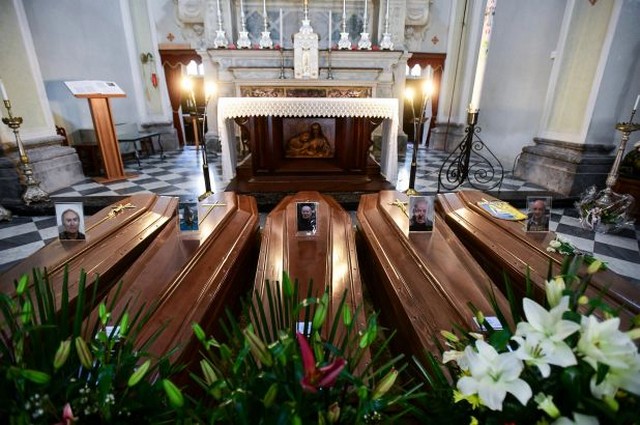
Coronavirus pandemic: China and Cuba send medical teams, equipments and medicine to countries

By Countercurrents Collective

China and Cuba have stepped in with practical measures at international level amidst the near-collapse health care situation in a number of capitalist countries in the face of coronavirus pandemic.

China sending million masks & gloves to France

China is shipping one million surgical masks and gloves to France as the EU member struggles to contain the coronavirus, with Europe becoming the new focal point of the global pandemic.

French Foreign Minister Jean-Yves Le Drian confirmed the shipments on Wednesday in an interview with France’s BFM TV.

The first of two planes has already arrived via Belgium and a second will arrive on Thursday, he said.

China’s gesture comes after France sent 17 tonnes of equipment to Beijing when the Covid-19 virus first broke out in Wuhan last December.

France reported 89 new deaths from Covid-19 on Wednesday, updating the total to 264. The number of confirmed cases has also risen to 9,134 – up from 7,730 on Tuesday – health agency director Jerome Salomon said.

China’s medical team and equipment in Italy

Last week, China shipped a planeload of medical supplies including respirators and masks to Italy, which has suffered more than any other European country so far, and has seen hospitals overloaded with the rapidly increasing numbers of cases.

Along with the 30 tons of equipment, China also sent nine of its medical staff to Italy to help in its battle against the disease.

Italian Red Cross head Francesco Rocca said the country was in “desperate need” of the masks and was grateful for the donation in a moment of “great difficulty.”

“Today, Italy is not alone,” said Italy’s Foreign Minister Luigi Di Maio. “Many people in the world are supporting us.”

It is the third team of experts deployed by the Chinese authorities.

EU is not helping

Earlier reports said:

Italy requested the EU and EU member-countries to send medical equipments to fight coronavirus. But the EU and its member-countries declined to help citing the reason that they do not want to deplete their stocks.

Earlier this week, Italy’s permanent representative to the EU, Maurizio Massari, complained that Italy’s plea for medical help to combat the coronavirus outbreak crippling the country had gone unanswered.

Massari noted that while the EU had ignored Italian requests for aid, China had begun helping bilaterally.

“Italy, the European country struck hardest by the coronavirus, has done everything it can to contain and manage the epidemic,” he said.

The Italian minister said: “We must ensure, under EU co-ordination, the supply of the necessary medical equipment and its redistribution among those countries and regions most in need. Today, this means Italy; tomorrow, the need could be elsewhere.

“Italy has already asked to activate the European Union Mechanism of Civil Protection for the supply of medical equipment for individual protection.

“But, unfortunately, not a single EU country responded to the commission’s call. Only China responded bilaterally. Certainly, this is not a good sign of European solidarity.”

China sends masks to Serbia

Caught off guard by the EU’s ban on medical exports, Serbia found help in China as it struggled to prepare for the Covid-19 outbreak, the Serbian president said, adding that it has become clear that European solidarity is a myth.

Serbia is the latest country to impose severe restrictions on travel and public gatherings in response to the global epidemic.

As President Aleksandar Vucic declared a national emergency on Sunday, he had some scalding remarks for the EU.

The crisis has proven that European solidarity, only exists “on paper,” Vucic said, citing the ban on the export of medical equipment and supplies imposed by EU members to non-EU countries in response to the outbreak.

“Only China can help us in this situation”, the Serbian leader added, saying he recently wrote a letter to China’s President Xi Jinping “asking him for help and calling him a brother.”

Serbia received five million masks from China that it couldn’t get in Europe and an offer to send doctors to help tackle the disease, the president said.

“I say to foreigners: don’t come to Serbia, except for the Chinese who are called upon to come, their doctors, the people who help us,” Vucic said.

According to official sources, the country had to shop for respirators on a “semi gray market.”

Starting Monday, Serbia has shut down all teaching facilities, mobilized the military to guard sensitive sites such as hospitals, and closed the borders to everyone apart from citizens.

Serbs will have to remain in quarantine after coming back or face prison terms of up to three years.

As of Monday, there are 55 confirmed coronavirus cases in Serbia, which has a population of seven million. Two of the patients are in serious condition. The virus has also reached other Balkan nations with the exception of Montenegro.

The health crisis has put EU cohesion to the test.

Spain Iran Iraq

China has already sent medical missions and shipments of supplies to Spain, Iraq and Iran.

Beijing has been praised by the World Health Organisation for its efforts against the coronavirus. Authorities responded to the outbreak by building new hospitals in a matter of days and locking down Hubei province, which has a population of 58 million, to contain the spread of the disease.

To the U.S.

In addition to the government help, Chinese billionaire Jack Ma sent a shipment of surgical masks and Covid-19 test kits to the U.S., which has its own shortage of kits.

Africa

Ma said Monday he would also donate masks and test kits to all countries in Africa.

Despite its efforts to step up and aid other hard-hit countries, China has faced a barrage of negative media coverage in the West, with Trump administration officials repeatedly referring to Covid-19 as the “Chinese virus” and the “Wuhan virus” given the fact that it originated there in December.

Cuba’s medical team to Italy

Socialist country Cuba has already sent medical team to Italy to help the EU-member fight coronavirus.

Cuba’s team to Venezuela

A specialized Cuban technical delegation traveled to Venezuela March 15 to support the country’s Covid-19 containment strategy.

Cuba’s medicine to China to fight coronavirus

Among the thirty medicines the Chinese National Health Commission selected to fight the coronavirus is a Cuban anti-viral drug, Interferon Alpha 2b. This drug has been produced in China since 2003, by the enterprise ChangHeber, a Cuban-Chinese joint venture.

Cuban Interferon Alpha 2b has proven effective for viruses with characteristics similar to those of coronavirus, officially named COVID-19.

Cuban biotech specialist Dr. Luis Herrera Martinez explained, “its use prevents aggravation and complications in patients, reaching that stage that ultimately can result in death.”

Cuba first developed and used interferons to arrest a deadly outbreak of the dengue virus in 1981, and the experience catalyzed the development of the island’s now world-leading biotech industry.

In 1981, the Biological Front, a professional interdisciplinary forum, was set up to develop the industry in Cuba. While most developing countries had little access to the new technologies (recombinant DNA, human gene therapy, biosafety), Cuban biotechnology expanded and took on an increasingly strategic role in both the public health sector and the national economic development plan. It did so despite the U.S. blockade obstructing access to technologies, equipment, materials, finance, and even knowledge exchange. Driven by public health demand, it has been characterized by the fast track from research and innovation to trials and application, as the story of Cuban interferon shows.

Interferons are “signaling” proteins produced and released by cells in response to infections that alert nearby cells to heighten their anti-viral defenses.

Countries ask Cuba to send medicine

The Cuban medication Interferon Alpha 2B has been requested by more than ten countries.

Coronavirus-hit cruise ship docks in Cuba for passengers to evacuate

A British cruise ship that has been stranded for more than a week in the Caribbean after several cases of the new coronavirus were confirmed onboard is set to dock in Cuba on Wednesday to allow weary passengers to disembark and fly home.

Britain’s Foreign Minister Dominic Raab expressed gratitude on Tuesday in parliament to Communist-run Cuba for offering a safe haven to the Braemar, which has more than 1,000 mainly British passengers and crew aboard after several Caribbean ports refused to let it dock.

“Prevention and contention of new coronavirus require the efforts of entire international community,” said Cuba’s foreign minister, Bruno Rodriguez. “Let’s reinforce health care, solidarity and international cooperation.”

Passengers would return to Britain from the capital’s international airport in the evening on four charter flights including a separate one for passengers who had received a positive diagnosis for coronavirus or displayed any flu-like symptoms.

Any not considered well enough to fly would be offered support and medical treatment in Cuba.

The ship was refused docking in Barbados and the Bahamas, which are both part of the British Commonwealth – an irony not lost on some passengers.

“We should all remember what #Cuba has done for us, stepping in when none of the British Commonwealth countries and protectorates in the region offered any help,” tweeted one passenger aboard the Braemar, Steve Dale.

Cuban authorities are screening travelers at airports and have stepped up the production of facemasks while banning large cultural events. Family physicians are paying more home visits to monitor local communities.

Yet the government has not canceled flights from countries hardest hit by the pandemic, restricted internal movement or banned social gatherings, in contrast to other countries in the region, eliciting concern among some Cubans, as has the arrival of the Braemar.

A March 18, 2020 datelined Granma report, headlined “A safe port amidst adversity” said:

The humanitarian and altruistic dimensions of the events could make them stuff of a movie scene. The crew of the MS Braemar, owned by the British Fred Olsen cruise line, spent several days sailing the Caribbean with passengers aboard suffering coronavirus infections.

Despite diplomatic efforts by the UK government, the ship was refused entry to several ports in the region. But there was nothing fictional about the urgent situation of passengers, including the sick whose lives were endangered, with the rest facing possible infection, in the middle of the ocean.

Cuba said yes, and offered a safe port in the midst of adversity, with modesty, not seeking headlines in the media, for absolutely nothing in return. Such a decision perhaps generated incomprehension on the part of some, those who are unaware of the value of a helping hand during a catastrophe.

But, for most Cubans, the opportunity to help fills us with patriotic pride, with the emotion only understandable by women and men of good will in all latitudes. Because in “times of coronavirus,” the words “help, cooperate, work together” should be the norm, across the planet. Because human civilization should understand, once and for all, that only together can we overcome common challenges and tragedies.

Cuba, true to its principles, could not act otherwise, nor is this the first time we have done so. Solidarity is in the genes of the Cuban people. It is part of our unique identity and has written memorable chapters in our history.

Perhaps for these reasons, in the time of Covid-19, the eyes of the world look hopefully to Cuba, and our people, who despite hardships and a fierce blockade, did not hesitate to respond.

Requests for support have arrived from various parts of the world.

Meanwhile, others are sending thousands of military personnel to Europe to conduct the most extensive maneuvers since the Cold War, while leading an insulting campaign against Cuban medical collaboration around the world. Cuba’s response? An army of white coats at the service of the dispossessed: more than 400,000 health professionals who, over 56 years, have carried out missions in 164 nations.

Women and men from this Caribbean island have faced Ebola in Africa, blindness in Latin America and the Caribbean with Operation Miracle, and cholera in Haiti. Twenty-six Cuban brigades from the Henry Reeve International Contingent of Doctors Specialized in Disasters and Major Epidemics – recognized with the Dr. Lee Jong-wook Public Health Award, granted by the Executive Council of the World Health Organization – helped during difficult times in Pakistan, Indonesia, Mexico, Ecuador, Peru, Chile and Venezuela, among others.

In fact, this event is nothing like a film. It is an expression of solidarity from the Cuban people, who understand health as a human right, help any way we can and share what we have, with those who need it most in difficult times.

Martí said: “Cuba does not go around the world begging. She goes as a sister and works with authority as such. By saving herself, she saves.” Then and now, and into the future.

19 March 2020

Source: countercurrents.org