Just International

13 Protesters killed in a day in Iraq while death toll reaches 342

By Countercurrents Collective

At least 13 protesters were killed and 150 were injured Sunday in Baghdad and the southern cities of Basra and Nasiriya during clashes between security forces and the protesters. Sunday was one of the “worst” days since protests began. Many of these deaths were due to the use of live ammunition and tear gas by security forces against demonstrators.

At least 342 people have been killed in protests in Iraq since the protest began in early October.

Several of killed protesters are reported to have died after they were shot in the face with tear gas canisters. Safaa al Saray, a 26-year-old protester, killed in the same way as Safaa was protesting against the lack of jobs, an end to corruption and better public services.

The anti-government protests began in Baghdad’s Tahrir Square and spread to cities across the south of the country.

On Sunday, thousands came out across the country after activists called for a general strike.

Meanwhile, in Baghdad, street battles between security sources and protesters continued as demonstrators gathered in Tahrir Square on Sunday.

According to the Iraqi Human Rights Council, “three demonstrators were killed in violent clashes with security forces in Umm Qasr, south of Basra, and 78 others were injured. Three demonstrators died in Nasiriya and 71 people were injured. In Basra, seven people were killed in what one security official called “one of the worst” days of the protest movement.

In Baghdad’s Tahrir Square, street battles between security sources and protesters continued.

Interior Ministry spokesperson Khaled al-Mahanna said Saturday night that three demonstrators were killed in Baghdad alone and more than 100 people were injured, including 30 members of the security forces in clashes with demonstrators at Ahrar Bridge.

Human rights groups have previously described the situation in Iraq as a “bloodbath” and have called on the government to stop the security forces.

For their part, protesters are demanding the overthrow of the political elites that they consider corrupt and serving foreign powers, while many Iraqis suffer in poverty without work, medical care or education.

Iraqi protesters blocked Sunday the third bridge leading to Baghdad’s Green Zone and roads leading to oilfields and the main port in the country’s south, gaining more ground in the largest and deadliest anti-government demonstrations in decades.

Security forces used tear gas and stun bombs to stop protesters from crossing the Ahrar Bridge in central Baghdad, in part of a weeks-long attempt to disrupt traffic and get to the Green Zone where government ministries and embassies are located.

Additionally, hundreds of students gathered in Baghdad’s Tahrir Square, the symbolic place of the protest movement.

“No politics, no parties, this is a student awakening!” read one banner carried by a young Iraqi.

For the second time since the start of anti-establishment demonstrations, protesters on last Monday blocked the entrance to the Umm Qasr, Iraq’s main Gulf port near Basra, preventing employees and tankers from entering and bringing operations down by 50 percent, two port sources said.

If the blockage continues, operations will come to a complete halt, the sources told Reuters.

“We students are here to help the other protesters, and we won’t retreat a single step,” said another teenager.

In the city of Hillah, south of Baghdad, students and other activists concentrated in front of the provincial headquarters.

“We’ll keep up our protest and general strike with all Iraqis until we force the government to resign,” said Hassaan al-Tufan, a lawyer and activist.

Sit-ins have become the main tactic for the protest rallies.

Iraqi security forces have been heavily criticized for their use of live rounds including machine-gun fire – and firing of heavy-duty tear gas canisters against mostly young and unarmed protesters, leading to “gruesome” deaths and injuries when canisters pierce protesters’ skulls or lungs.

The outgoing chief of NATO’s Iraq mission told AFP on Sunday the violence was “an absolute tragedy.”

“While the events of the last six weeks are an absolute tragedy, NATO continues to urge restraint to the government of Iraq,” said Major General Dany Fortin.

The government has proposed a list of reforms in recent weeks but demonstrators rejected them as insignificant and made too late in a country ranked the 12th most corrupt in the world by Transparency International.

“These steps, these reforms are just an opiate for the masses. Nothing more, nothing less,” one protester said on Sunday, pointing to the Green Zone, adding, “there are so many capable young people in Iraq who are deprived, and unfortunately those are the guys who rule us.”

25 November 2019

Source: countercurrents.org

The MH17 Trials as Political Theatre

By Kees van der Pijl

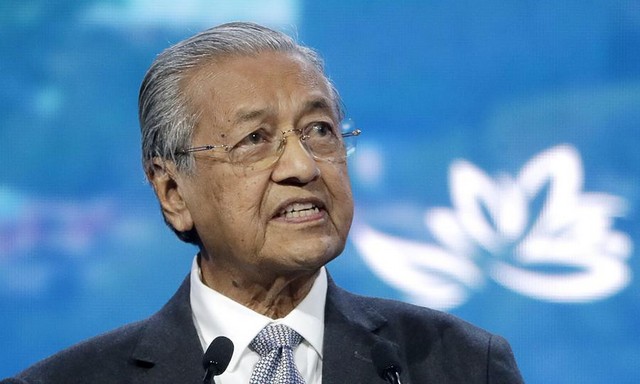
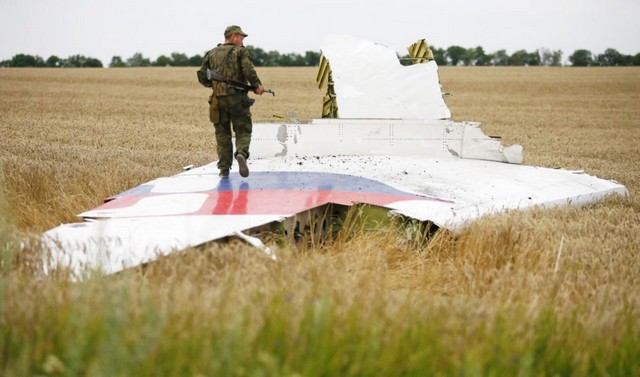
On 9 March, 2020, the trial of those accused of being responsible for the downing of Malaysia Airlines Flight MH17 on 17 July 2014, is planned to begin. The decision to hold a trial of MH17 suspects was taken by the Dutch Public Prosecution Service (Openbaar Ministerie, OM) on 19 June 2019, on the basis of the criminal investigation by the Joint investigation Committee, JIT. The JIT members conducting this investigation are the Netherlands, Australia, Belgium, and Ukraine and Malaysia (since March 2015). Prime Minister Mahathir of Malaysia has criticised the late admission of his country to the criminal prosecution, and also has raised doubts about the pertinence of the indictment for murder of three Russians and one Ukrainian, an indictment made public at the JIT press conference also on 19 June 2019.

Whether the JIT under these circumstances is still able to function, is therefore in serious doubt. The decision by the JIT countries that the prosecution and trial of suspects would be conducted by and in the Netherlands, under Dutch law, dates from 5 July 2017. To facilitate the actual trial next year, a special treaty was concluded by the Netherlands and Ukraine covering a number of practical issues such as extradition, video hearing of defendants, and the like. The trial will be held before the Hague District Court, in a special location to accommodate a large trial, the Justice Complex Schiphol (JCS) near Schiphol Airport. On the special website launched to publicise the event, and via which its proceedings will be live-streamed, the court is already being recommended as having extensive experience with cases involving international elements. ‘It has, for instance, heard cases with regard to offences that nowadays are punishable in the International Crimes Act. Examples of offences under this law are genocide, crimes against humanity, war crimes and torture.’ As the website continues,

The quality of the Dutch justice system ranks above average compared with other countries. This is confirmed by the EU Justice Scoreboard (a comparison of the justice systems of the European Union member states) and the Rule of Law Index (a global comparison of justice systems). These rankings are based on matters such as the average duration of trials, how judges are trained and the extent to which the justice system is free from discrimination, corruption and political influence. In terms of experience with international proceedings, the Netherlands ranks number one in the world.

These self-congratulatory qualifications notwithstanding, we cannot look forward to the trial with confidence, on the contrary. For the sort of justice being dispensed here is a very special, new form of justice, international criminal law. That type of law is not the familiar form of international law, based on treaties, of which states are the legal subjects. It is an individualised form of transnational penal law, national to varying degrees (hence, ‘involving international elements’), and with a record that does not give rise to optimism, certainly not where it concerns he role of the Netherlands.

In one of the most disturbing cases, the International Criminal Tribunal for the Former Yugoslavia (ICTY), which also sat in The Hague, the prosecution was principally directed against Serbians and the chief suspect, Yugoslav president Slobodan Milošević, died in his cell after the main charge against him had been dropped for lack of evidence. On the other hand, NATO bombing of Serbia, without even a UN mandate, was not prosecuted and the secessionists’ actions in the violent dissolution of Yugoslavia profited from a light touch. Since one of the judges assigned to the MH17 trial, Ms. C.I.H. Kerstens-Fockens LLM, was an intern at the ICTY, the Yugoslavia experience deserves to be investigated closely. In the parallel Rwanda tribunal, only Hutus were investigated and indicted for the massacres in 1994, whilst the Tutsi RPF, which triggered the bloodbath by shooting down the plane of the Rwandan president, was not. The International Criminal Court (ICC) only indicted Africans, whilst George W. Bush and Tony Blair, who ordered the invasion of Iraq, were seemingly above the law. In the Lockerbie trial held in the Netherlands (by a Scottish court), a Libyan who had nothing to do with that disaster was found guilty and sentenced. So if in the upcoming MH17 trial, only Russians and pro-Russian Ukrainians are the suspects, this fits the longer trend.

One must fear, then, that the upcoming trial of the MH17 suspects will not depart from the pattern established in the three decades of legal precedent in this area. Indeed, prosecution in international criminal cases has so far turned out to be nothing else but the continuation by different means of so-called ‘humanitarian intervention’; so first comes the intervention itself (sanctions, ‘colour revolutions’, coups d’état, regime change wars), and then the judicial sequel, all part of a single punitive operation. Indeed ‘humanitarian intervention’, harking back to the mediaeval concept of ‘just war’, in all or most cases has been followed by the application of criminal justice to the parties against whom the intervention was launched in the first place. This is the one similarity with the trials of Nazi and Japanese war criminals at the end of World War II, except that the Nuremberg trial of the former laid down the principle that launching a war is the supreme war crime. Humanitarian intervention has functioned as a way round that principle.

Kees van der Pijl is a Dutch political scientist who was professor of international relations at the University of Sussex. He is known for his critical approach to global political economy and has published, amongst others, Flight MH17, Ukraine and the New Cold War.

25 November 2019

The Unlawfulness of the Israeli Settlements Remains as Clear as Ever

By Richard Falk

The American Secretary of State, Mike Pompeo, made headlines around the world when announcing that the U.S. had shifted its positions and no longer viewed Israeli settlements as in violation of international law. In one of the stupider public statements of our time Pompeo explained that “..arguments about who is right and wrong as a matter of international law will not bring peace.” It is stupid, first, because there is no genuine argument about the unlawfulness of the settlements, as until the U.S. spoke out of turn, Israel was totally alone in defending settlement legality. And more definitively, the role of international law is to regulate the proper behavior of sovereign states, not to make peace by negating the relevance of international law, which truly seems a cheer for the law of the jungle. Pompeo removed any doubt about this when he justifyied the American shift by admitting that “[w]e recognized the reality on the ground.’ Or in plainer language, lawless behavior become lawful if sustained long enough by force, a logic that not only defies international law but is contrary to the core legal commitments of the UN Charter.

The Clarity of International Law with respect to Israeli Settlements in Occupied Palestine

On many issues of international law, particularly in the area of peace and security, international law is somewhat ambiguous. Opposed positions for and against legality can be reasonably maintained, and only resolved by either a tribunal with authority to do so or by

practice sustained over time. Most relevantly, the establishment of settlements on Occupied Palestinian Territory is an example of an issue of law upon which it is not possible to make a responsible argument in support of legality. The unlawfulness of the settler encroachment on Occupied Palestine has been pointed out over and over again by informed observers as the biggest single obstacle to peace and the arena of most vivid and unabashed Israeli defiance of relevant international law. The question presented by the Pompeo announcement is whether or not Trump has given Israel a legal leg worth standing on after more than fifty years of universally condemned settlement expansion. Phrased differently, has Washington given Israel its blessings for doing whatever it wants in the future regarding settlements, and for that matter, the West Bank. After all, if the White House endorses Israeli annexation of the Golan Heights, situated in Syrian sovereign territory, the West Bank can now be thought of as small potatoes.

Part of the clarity of international law on the issue of the settlements arises from the unusual

fact that the conclusion of unlawfulness has been formally declared by the most authoritative sources of international guidance when it comes to legal controversy. I give three illustrations of this international consensus: (1) Article 49(6) of the Fourth Geneva Convention governing what is called ‘belligerent occupation’ sets forth the applicable basic norm: “The Occupying Power shall not deport or transfer parts of its own civilian population into the territory it occupies.” All governments have accepted an interpretation of this important provision of international humanitarian law as prohibiting the establishment of Israeli settlements on any part of the Occupied Palestinian Territories. Even the International Committee of the Red Cross, the most cautious and politically aloof of nongovernmental organizations saw fit to weigh in, officially declaring “that international humanitarian law prohibits the establishment of settlements, as these are a form of transfer into occupied territory.” If Israel was complying with international law it should have ceased forthwith settlement activity and dismantled what had been built in the years after the 1967 War. Instead Israel continued building, even at an accelerated pace, advancing the lame rationale that Israelis should be able to live wherever they wish in Palestine. Additionally, Jerusalem and the West Bank where the settlements exist are not viewed by Israel as even ‘occupied’ in a legal sense (the West Band is referred to within Israel as ‘Judea and Samaria’ forming part of ‘promised land’ of the Jewish people, an annexationist sentiment expressed days ago by Netanyahu in his desperate effort to remain Prime Minister).

(2) The Advisory Opinion of the International Court of Justice (ICJ) in the Wall Separation case (2004) contained strong uncontested assertions reaffirming the unlawfulness of the settlements. Most impressive was the highly unusual degree of unity in this judicial body, the highest court on the planet, that rarely achieves a strong consensus, given the diverse jurisprudential, cultural, and political backgrounds of the 15 judges. Yet in Wall Opinion the vote was 14-1, with only the American judge dissenting, and even he made clear that he agreed on most matters of substance addressed in the majority opinion, and dissented only because he felt the Court had no basis for discounting the central Israeli claim that wall was built on occupied Palestinian territory because of security concerns. What the Court declared without even pausing to develop a careful analysis undoubtedly because the point seemed so legally self-evident, was that the wall was constructed so as to put on the Israeli side 80% of the settlement population, noting in passing that the settlements were established in violation of applicable law. Israel refused to comply with this conclusive judgment by the ICJ, emphasizing its supposedly ‘advisory’ character. It is unfortunate that such activity of the ICJ endures under this linguistic cloud, but more adequately considered, it is evident that an Advisory Opinion, especially one so strongly supported, expresses the carefully considered legal assessments of the most distinguished legal minds in the world, sitting on a tribunal with a preeminent standing within the UN System. Such an Advisory Opinion deserves respect, and provides a reliable sense of the relevance of international law to particular policy questions of this sort.

(3) The UN Security Council in December 2016 adopted Resolution 2334 reaching a similar assessment of unlawfulness to that of the ICJ by the vote of 14-0, with only the U.S. abstaining. This abstention was itself a remarkable departure from U.S. practice during the Obama presidency, which invariably relied on the veto to insulate Israel from any action in the Security Council that could be viewed as critical of Israel’s practices. The basic legal conclusion was set forth in unconditional language in the very first operative paragraph of the resolution: “1. Reaffirms that the establishment by Israel of settlements in the Palestinian territory occupied since 1967, including East Jerusalem, has no legal validity and constitutes a flagrant violation under international law and a major obstacle to the achievement of the two-State solution and a just, lasting and comprehensive peace..” The resolution is also notable for stressing exactly the opposite point to that made by Pompeo. The Security Council makes clear that prospects for peace have been seriously diminished in past years by the persistence of Israel’s unlawful settlement activity.

The U.S. Shift on Legality has only Political Weight

No country can by its decree influence the legal status of Israeli settlement activity. What Pompeo declared was a shift in political position by the U.S. Government. It is legally insignificant, but geopolitically significant. The Trump spin room sought to minimize the shift by recalling that Reagan, while president, once indicated off the cuff that he didn’t think the settlements were illegal, but as not so often noted, he went on in the same comment to suggest that settlement expansion was ‘unnecessarily provocative.’ More relevant was the exchange of letters by George W. Bush and Ariel Sharon in 2004 in which it was agreed by the two leaders that any viable peace deal with the Palestinians would allow the settlement blocs along the border to be incorporated into Israel. Again, such a side agreement was without legal legs, representing nothing more than a geopolitical pat on Israel’s back, but it was a rather good indicator of what Israel and U.S. would demand in future peace negotiations, essentially declaring that international law was indeed irrelevant to any realistic diplomatic endeavor. What makes the Pompeo move different is its positioning in relation to other controversial Trump moves and its whitewashing language that gives Israel incentives to move ahead with annexation. I believe this is another instance of American overreaching. Palestinian resistance remains strong as the Great March of Return on the Gaza border illustrates, and global solidarity initiative are gathering strength that Israel seems to acknowledge by defaming its nonviolent opponents as anti-Semites.

This new settlements’ rhetoric continues the pattern established by the Trump presidency– repudiating the international consensus on key issues bearing on the rights and duties of states. The highlights of this pattern in the Palestinian context were the shift of the American Embassy to Jerusalem and the endorsement of Israeli annexation of the Golan Heights, and now the putting to one side as irrelevant the supposed unlawfulness of the settlements. This step has been condemned in diplomatic circles as a ‘final nail’ in the coffin of the two-state solution. This moves the political compass in the direction of one-state outcomes of the long struggle, with the likelihood being Jewish dominance and Palestinian subjugation in a state structure that increasingly looks and behaves as if it were an apartheid regime. Is this, then, the endgame of the Palestinian struggle? I think not. Palestinian resistance and the global solidarity movement will be telling the world a different story.

Richard Anderson Falk is an American professor emeritus of international law at Princeton University. He is also the International Advisory Panel (IAP) for JUST.

25 November 2019

“They’re killing us like dogs” – A Massacre in Bolivia and a Plea for Help

By Medea Benjamin

I am writing from Bolivia just days after witnessing the November 19 military massacre at the Senkata gas plant in the indigenous city of El Alto, and the tear-gassing of a peaceful funeral procession on November 21 to commemorate the dead. These are examples, unfortunately, of the modus operandi of the de facto government that seized control in a coup that forced Evo Morales out of power.

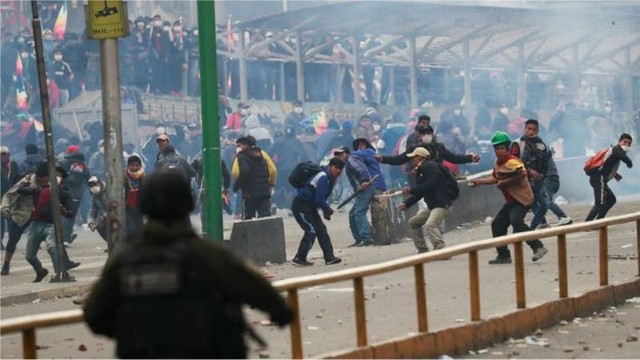
The coup has spawned massive protests, with blockades set up around the country as part of a national strike calling for the resignation of this new government. One well-organized blockade is in El Alto, where residents set up barriers surrounding the Senkata gas plant, stopping tankers from leaving the plant and cutting off La Paz’s main source of gasoline.

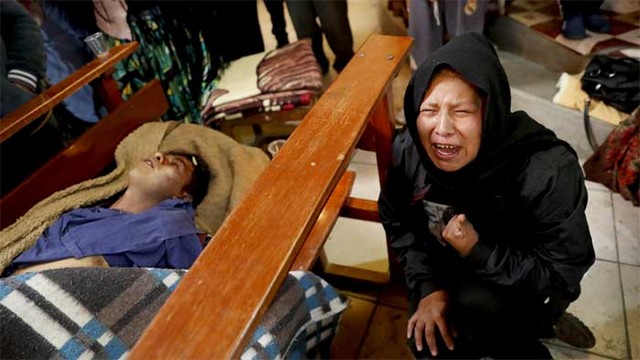
Determined to break the blockade, the government sent in helicopters, tanks and heavily armed soldiers in the evening of November 18. The next day, mayhem broke out when the soldiers began teargassing residents, then shooting into the crowd. I arrived just after the shooting. The furious residents took me to local clinics where the wounded were taken. I saw the doctors and nurses desperately trying to save lives, carrying out emergency surgeries in difficult conditions with a shortage of medical equipment. I saw five dead bodies and dozens of people with bullet wounds. Some had just been walking to work when they were struck by bullets. A grieving mother whose son was shot cried out between sobs: “They’re killing us like dogs.” In the end, there were 8 confirmed dead.

The next day, a local church became an improvised morgue, with the dead bodies–some still dripping blood–lined up in pews and doctors performing autopsies. Hundreds gathered outside to console the families and contribute money for coffins and funerals. They mourned the dead, and cursed the government for the attack and the local press for refusing to tell the truth about what happened.

The local news coverage about Senkata was almost as startling as the lack of medical supplies. The de facto government has threatened journalists with sedition should they spread “disinformation” by covering protests, so many don’t even show up. Those who do often spread disinformation. The main TV station reported three deaths and blamed the violence on the protesters, giving airtime to the new Defense Minister Fernando Lopez who made the absurd claim that soldiers did not fire “a single bullet” and that “terrorist groups” had tried to use dynamite to break into the gasoline plant.

It’s little wonder that many Bolivians have no idea what is happening. I have interviewed and spoken to dozens of people on both sides of the political divide. Many of those who support the de facto government justify the repression as a way to restore stability. They refuse to call President Evo Morales’ ouster a coup and claim there was fraud in the October 20 election that sparked the conflict. These claims of fraud, which were prompted by a report by the Organization of American States, have been debunked by the Center for Economic and Policy Research, a think tank in Washington, D.C.

Morales, the first indigenous president in a country with an indigenous majority, was forced to flee to Mexico after he, his family and party leaders received death threats and attacks–including the burning of his sister’s house. Regardless of the criticisms people may have of Evo Morales, especially his decision to seek a fourth term, it is undeniable that he oversaw a growing economy that decreased poverty and inequality. He also brought relative stability to a country with a history of coups and upheavals. Perhaps most importantly, Morales was a symbol that the country’s indigenous majority could no longer be ignored. The de facto government has defaced indigenous symbols and insisted on the supremacy of Christianity and the Bible over indigenous traditions that the self-declared president, Jeanine Añez, has characterized as “satanic.” This surge in racism has not been lost on the indigenous protesters, who demand respect for their culture and traditions.

Jeanine Añez, who was the third highest ranking member of the Bolivian Senate, swore herself in as president after Morales’ resignation, despite not having a necessary quorum in the legislature to approve her as president. The people in front of her in the line of succession – all of whom belong to Morales’ MAS party – resigned under duress. One of those is Victor Borda, president of the lower house of congress, who stepped down after his home was set on fire and his brother was taken hostage.

Upon taking power, Áñez’s government threatened to arrest MAS legislators, accusing them of “subversion and sedition”, despite the fact that this party holds a majority in both chambers of congress. The de facto government then received international condemnation after issuing a decree granting immunity to the military in its efforts to reestablish order and stability. This decree has been described as a “license to kill” and “carte blanche” to repress, and it has been strongly criticized by the Inter-American Commission on Human Rights.

The result of this decree has been death, repression and massive violations of human rights. In the week and a half since the coup, 32 people have died in protests, with more than 700 wounded. This conflict is spiraling out of control and I fear it will only get worse. Rumors abound on social media of military and police units refusing the de facto government’s orders to repress. It is not hyperbole to suggest that this could result in a civil war. That’s why so many Bolivians are desperately calling for international help. “The military has guns and a license to kill; we have nothing,” cried a mother whose son had just been shot in Senkata. “Please, tell the international community to come here and stop this.”

I have been calling for Michelle Bachelet, the United Nations High Commissioner for Human Rights and former president of Chile, to join me on the ground in Bolivia. Her office is sending a technical mission to Bolivia, but the situation requires a prominent figure. Restorative justice is needed for the victims of violence and dialogue is needed to defuse tensions so Bolivians can restore their democracy. Ms. Bachelet is highly respected in the region; her presence could help save lives and bring peace to Bolivia.

Medea Benjamin is the co-founder of CODEPINK, a women-led peace and human rights grassroots organization. She has been reporting from Bolivia since November 14.

22 November 2019

Source: countercurrents.org

People’s protests pass more than a month in Chile

By Countercurrents Collective

People in thousands joined in protests in Chile on Monday (November 18). It marked the first month of the most serious public protests against neo-liberal policies in recent time in Chile.

The protests show the people’s distrust of the social agenda the government announced, and the parliamentary agreement on a new constitution.

Anti-riot police used tear gas, rubber bullets and water cannons against protesters.

Protests also took place in the cities of Temuco, where thousands of people took to the streets, as well as Concepcion, where people also paid tribute to the anniversary of a young indigenous man who was shot dead by police in circumstances that are still under investigation.

The father of Camilo Catrillanca, a Mapuche man from the southern Araucania region, which has long been in conflict with the state, appealed to people to demonstrate “calmly.”

It began with 30 cents issue

The protest began on October 14 as a call by university students to sneak into the Santiago subway to protest against the increase in the ticket prices. It was a 30-cent increase in the subway fare.

In the capital Santiago, the protest started in the Italia Square, renamed Dignity Square, and in the Avenue Libertador General Bernardo O’Higgins, better known as Alameda.

The police have been heavily criticized for their handling of the demonstrations, with medical experts saying that more than 200 protesters have suffered eye injuries or been blinded by tear gas canisters and rubber bullets.

Kattya Barrera, 19, of Santiago’s low-income La Florida neighborhood said she believed nothing had changed since Catrillanca’s death. “When someone goes out to demonstrate, they take out their eyes,” she said. “Today isn’t just about Catrillanca, it’s for everyone.”

A 1.2 million-march

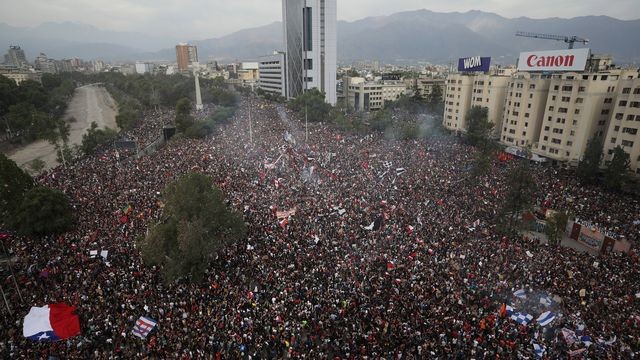
Street demonstrations reached unprecedented levels on October 26, when around 1.2 million people gathered for a march in Santiago, to demand the resignation of President Sebastian Pinera and denounce his right-wing austerity policies.

People in Chile have not demobilized. They continue in the streets demanding real transformations.

This week, the police chief said he would fit firearms officers with surveillance cameras and deploy more human rights experts.

Ana Piquer, the executive director of Amnesty International Chile, said Pinera should respond to the many complaints of police excesses.

“We don’t want to see any more victims of police violence anywhere in Chile, killed or seriously injured simply for raising their voice on social demands,” she said.

In the country mired in social injustice, the discontent quickly shifted against “30 years” of neoliberal policies, which have seriously affected health, education, wages, and pensions.

“It’s not 30 cents, it’s 30 years,” citizens shouted to summarize their requirement of a Constituent Assembly, which can deeply transform the economy inherited from the dictatorship (1973-1990).

The protests turned unparalleled in the last three decades. It has no identified leaders. It turned into a cry for a fairer economic model.

Trauma cases

On Thursday, the health ministry announced an alert across six of Chile’s 16 regions to release extra funding amid a surge of 10,000 trauma cases and an unspecified increase in people seeking treatment for mental health issues.

The ministry did not link the health issues to the protests, but said they were due to “a situation of high health risk to the population”.

Rights not respected

“In the last four weeks, Chile changed; the Chileans changed, the government changed; we all have changed. The social pact under which we had lived broke down,” said President Sebastian Pinera.

Pinera announced a series of social measures in parliament.

He acknowledged for the first time that there have been abuses and excessive use of force by security forces, which he promised to sanction.

The president admitted last Sunday “there was excessive use of force” by state agents and that in some cases “the rights of everyone were not respected.”

The unrest has left at least 23 dead. The number of injured persons was 2,381 injured. Chile’s National Institute of Human Rights provided the data in its latest report.

Carabineros, Chilean militarized police, informed on November 18: The number of arrested protesters is more than 15,000 since October 18. The police claimed that of the arrested protesters, 4,000 were linked to “looting.”

However, other sources claimed that the number of arrested protesters is more than 17,000, and 950 are in pretrial detention.

Octavio Avendaño, a sociologist in the University of Chile, said: “The persistence of people in continuing to express their discontent reflects that each of the attempts to calm or ease the conflict has not been effective.”

“There are two things that are pending: the social agenda and human rights. As long as they are not resolved, the conflict will continue,” the expert told EFE.

Hundreds of homicides

The Inter-American Commission on Human Rights (IACHR), an autonomous body of the Organization of American States (OAS), began a visit to the country on November 18 to investigate hundreds of complaints of abuse, torture, sexual violence and homicides by the security forces.

The IACHR joins other organizations on the ground, such as Human Rights Watch and the UN.

Paulo Abrao, executive secretary of the IACHR, met separately with justice minister Hernan Larrain, the president of the Supreme Court Haroldo Brito, and with representatives of 50 civil organizations.

“The commission focuses mainly on the future conditions of affirmation of the right to justice and reparation of the victims in a way that the operation of the justice system in this context is crucial,” said Abrao.

270 eye injuries: Police had to suspend pellet use

At least 270 protesters have been wounded in the eyes as the Carabineros shot pellets directly in the face in anti-government protests. The eye-injury figure is a world record in terms of similar injuries.

The Director of the Carabineros, Mario Rozas, had to announce the suspension of the use of pellets as an anti-riot tool, except in cases of “legitimate defense, when it represents a death threat.”

The measure follows a study by the University of Chile that states that these pellets are composed of only 20 percent rubber, while the rest, 80 percent, are with other elements including lead.

Rozas said the measure would be maintained while the pellets are subjected to other tests requested from laboratories abroad. “The restriction will be evaluated when we have in our possession the results of the studies,” he added.

However, the Carabineros had rejected the University’s report and urged the ammunition supplier to submit a report on its composition.

On earlier occasions, the Rancagua, Concepción, Antofagasta, Valparaíso and La Serena Courts of Appeals had ordered the police to refrain from using pellets in public demonstrations, and to limit the use of tear gas that affects people’s physical integrity.

Rape, torture, without water and food

Reports said: Girls are imprisoned without water or food. They are kept in isolated cells. Sexual abuse and torture of protesters were reported.

One report said: “Arbitrary detentions, under-16-year minors in cells without water, food, and access to talk to their families. Forced nudity in detentions and more serious forms of sexual violence. Tortures, excessive use of violence, deaths, and disappearances.”

There are reports of serious police human rights violations.

Repression reaches similar to Pinochet’s repression

After completing an “emergency mission” in Chile, European Parliament Members (MEP) Miguel Urban and Idoia Villanueva on Wednesday reported that this South American country suffers repression levels similar to those seen in the last three years of the Augusto Pinochet’s dictatorship (1973-1990).

Besides preparing a mission report, the leftist MEPs wrote an open letter addressing Federica Mogherini, the European Union (EU) High Representative for Foreign Affairs and Security Policy.

They ask that the EU requires President Pinera to halt the repression of citizens and ask for explanations about the actions carried out by the Army and the Police.

Urban and Villanueva recalled that the EU and Chile signed an Economic Partnership Agreement (EPA), which contains a “Cause on Democracy”.

This binding instrument contemplates that the bilateral trade deal can be suspended if Chile does not respect human rights.

“Chile is just another example within a global trend towards the criminalization of social protests and persecution of human rights defenders,” Urban said, adding that such problems “are being silenced.”

The MEP indicated that Europe does not want to recognize the “exhaustion” of neoliberalism, which is an unsustainable model that enhances social inequalities.

“The EU cannot look the other way,” Urban stressed and regretted that some MEPs are just asking for a debate on the Chilean issue, which does not imply a final joint resolution.​​​​​​​

Chile “is just another example within a global trend of criminalization of social protests and the persecution of human rights defenders,” Urban said and added that such problems “are being silenced.” The MEP indicated that Europe does not want to recognize the “exhaustion” of neoliberalism, which is an “unsustainable model that generates inequality.”

“The European Union cannot look the other way,” Urban said and regretted that some groups of parliamentarians, who refuse to condemn the repression in Chile, ask for a debate on the Chilean issue but that does not imply a final joint resolution.

They torture, rape, kill

At the Latin Grammys ceremony held in Las Vegas on Thursday, singer Mon Laferte uncovered her breasts where she wrote: “In Chile, they torture, rape and kill.”

This powerful statement was meant to express solidarity with millions who have taken to the streets daily for four weeks now to demand deep political and economic changes.​​​​​​

Since then social networks have offered the stage for a symbolic battle in which harsh criticism has been raised against her brave gesture.

She has been attacked for her ideas, for her body and even for her music, although she won her second Latin Grammy in the category of Best Alternative Music Album.​​​​​​​

Subtle forms of censorship were not long in coming. Almost immediately, Instagram prevented Mon Laferte’s topless photos from being easily searched and located.​​​​​​

“My free body for a free homeland,” the Chilean singer wrote as a reply in her media account.

“If the images were men’s breasts, they would not be censored.”​​​​​​​

Some social media users also raised their voices frontally in support of the Latin American singer and her message.

“Kendall Jenner and Mon Laferte both with her boobs showing up on a red carpet. One is celebrated. The other is criticized for her nudity,” @fineIovers said and added, “the truth is men don’t care about nudity. They care when woman bodies are not there for their likeness and consume.”

Contrary to what some xenophobic and misogynistic comments​​​​​​​ hinted at, Mon Laferte is not a frivolous artist in search of easy fame.​​​​​​​

In an interview with the BBC, she talked about her childhood in a country she remembers as a place where social injustice prevails.

“I was born during the dictatorship in a poor neighborhood,” she said and recalled that her “house had no floor, no doors or keys.”

Nevertheless, “her mother, father, and sister worked for a long time trying to improve it,” outlet En24 reported, adding that her father was bricklayer and carpenter, which meant that her family didn’t have enough money to get to the end of the month.

“Sometimes not even for reaching the middle of the month,” Mon Laferte ​​​​​​​bounded.

The 36-year-old artist also commented that she began singing at age 14 to get some money to help her family and explained that she considered it “natural” to get involved in protests.

“All Chilean society is furious about inequality,” Mon Laferte said and stressed the importance of taking part in collective actions that are aimed at solving problems “affecting the Chilean people.”​​​​​​​

Progressive social movements and parties, however, have criticized the agreement reached among political elites, which would seem to be looking for opportunities to perpetuate themselves in power.

Question neoliberal policies

While Pinera revoked the increase in subway fare, social unrest increased in magnitude as the Chileans began to question “30 years” of neoliberal policies, which have implied a systematic withdrawal of economic and social rights for millions of people.

Pinera’s impeachment

Eleven opposition lawmakers on Tuesday filed a “constitutional accusation” against Pinera for his responsibility in hundreds of human rights violations recorded since October 14.

“He is responsible for brutal human rights violations… His decisions led to military and police actions and he has to answer for his actions,” said Daniel Nunez, a lawmaker from the Communist Party (PC).

“We’re going to use democracy’s weapons so that Sebastian Pinera assumes the political responsibility he eludes.”

The 110-pages accusation “has long been worked with the parliamentarians’ teams,” said Democratic Revolution (RD) lawmaker Jorge Brito. The lawmaker explained that Pinera “has been hiding behind the police and the military to deny democracy.”

For it to be processed, the constitutional accusation requires a favorable vote of half-plus-one of the representatives in the Chamber of Deputies.

If it passes this test, the accusation will require that two-thirds of the senators approve it. If this also happens, Pinera may be dismissed.

Lawmakers presented the constitutional accusation related to these human rights violations from the Wide Front (FA), the Communist Party, the Socialist Party and the Party for Democracy (PPD).

In the Chilean political history, constitutional accusations were raised against Manuel Montt in 1868 Carlos Ibanez in 1931 and Arturo Alessandri in 1939.

A new constitution

A poll by Pulso Ciudadano this Monday revealed that 81 percent of Chileans would vote for a new Constitution in the referendum announced for April 2020.

The study indicates that only 8.2% of those consulted were opposed to a new Constitution, while 6.3 percent did not know what to answer, which demonstrates the broad support of the country’s citizens for a new Magna Carta.

Equally important is that when asked about the preferred body to draft the new constitutional text, 63.5 percent favored the constitutional convention (constituent assembly), composed only of citizens and without the participation of politicians.

Only 24.4% support the idea that this task should be carried out by a mixed constitutional convention (mostly backed by right-wing parties and the government), which would be made up of citizens and parliamentarians in equal shares.

The poll showed that the plebiscite has aroused great interest amongst the population, since, in a country like Chile, where abstentionism is very high, 78.2 percent said they would definitely vote, and only 6.7 percent said they would not go to the polls.

Regarding the reasons why Chile needs a new Constitution, respondents stated first the need to reduce existing inequalities, followed by a better health system, education, pensions, putting an end to the Constitution imposed during the Pinochet dictatorship, and greater social justice, in that order.

Don’t forget the people, says Communist Party

Guillermo Teillier, president of the Communist Party of Chile, insisted on November 15 that citizens had to play an important role in the process of writing a new Constitution.

Referring to the agreement signed on November 15 by 11 opposition parties and officials, Teillier welcomed a referendum as “an undeniable step forward” to define the mechanism that will allow drafting a new Constitution.

Although the Communist Party did not sign that agreement, the party is “going to participate in the whole process, undoubtedly, in Parliament, the Chamber of Deputies, the Constitution Commission, and then in the whole process that comes forward. The struggle is not over, the struggle continues,” he said in an interview for Radio Nuevo Mundo station.

Teillier stated that the Communist Party maintains a point of difference, because “the two-third quorum agreed so the matters to be discussed were approved and what will be part of the new Constitution, is very high.”

He stressed the importance of not only creating the conditions for the referendum, but also responding to the situation of workers, their low wages and pensions, health problems, the elderly and others.

He also insisted that no leftist party activist could stay away from this process: “We all have to supervise (the process), but above all the social movement, the workers’ organizations, which led and forced the government to completely surrendered their positions.”

Chile’s lawmakers on November 15 agreed to hold a referendum next April on replacing the constitution drafted by Augusto Pinochet’s dictatorship (1973-1990), bowing to demands of millions who want the country’s social and economic model overhauled.

Chileans will be asked whether they approve the idea of a new constitution and whether current lawmakers should serve on the commission that would redraft the document.

The agreement for a new Constitution includes a question on a Constituent Convention, not a Constituent Assembly, a notion fought against by right-wing forces in Chile for the last 30 years.

While the agreement has the backing of parties that support the current administration of Sebastian Pinera, alongside those of the former “Concertacion”, and a sector the Broad Front, it has drawn suspicion from the Communist Party, who along with a sector of the Broad Front, decided not to participate in the negotiations accusing a lack of consultation with social movements.

I am with you, says singer Patti Smith

United States singer and poet Patti Smith said Sunday that “ordinary people” are really the ones challenging the status quo in the world, and sent a message to support protesters who have been demanding social rights for a month in the streets of Chile.

“I am with you,” said the 73-year-old singer, who is considered one of the world’s most influential rock music artists.

Smith, who recently performed at a theater in Santiago as part of an international tour added she was “very touched by people in Chile” and acknowledged the “bad times” happening across the world.

At the beginning of the crisis, the artist wrote a poem on her Instagram account dedicated to Chile, a country she is visiting for the first time.

“My message was just to simply say (to the protesters): I am with you, I am thinking about you,” she said Sunday during a press conference in which she also spoke about the importance of protecting the environment and fighting together against injustice.

“We have to support one another, we have to support our youth and we have to keep our revolutionary hearts beating,” said the singer of the legendary songs “Because the Night” and “People Have the Power”.

The singer added, when she sees “that the people are motivated and standing up for their rights and taking the streets, I think it is very important to show solidarity.”

“The one beauty about terrible times is that it wakes people up and hopefully inspires them to unify,” Smith commented.

22 November 2019

Source: countercurrents.org

Occupied Palestine: From BDS To ODS

Co-Written by Kevin Zeese and Margaret Flowers

We spent the last week in Occupied Palestinian Territory, commonly referred to as Israel, where we traveled around the country to visit communities in Jerusalem, Jaffa, Bethlehem, the West Bank, the Nagab, and more.

We call Israel Occupied Palestine because it is not just the West Bank and Gaza that are occupied, but all of historic Palestine, the entire Palestinian nation. Palestinian people do not have equal rights and their communities are constantly encroached upon by settlers pushing them into small, crowded areas. The mistreatment of Palestinians happens right before the eyes of the Israeli Jews. If they do not see it, it is either because they do not want to see it or because they are encouraged not to see it. Just as Jim Crow racism was evident to all in the southern states of the US, apartheid in Palestine is obvious.

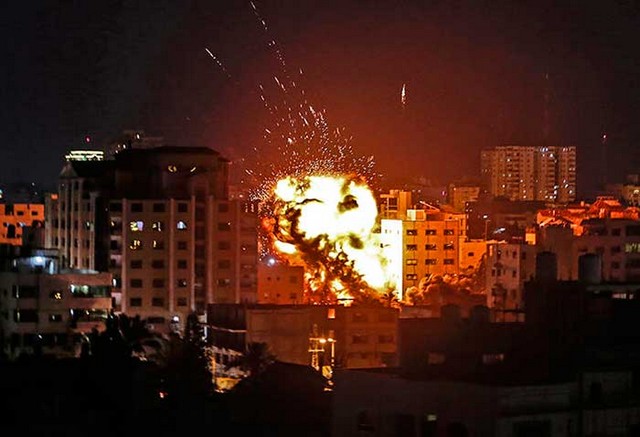
This visit deepened our support for the Boycott, Divestment, and Sanctions (BDS) movement because we saw modern apartheid, Jim Crow-segregation laws, ongoing land theft, and ethnic cleansing. For example, we were in Jerusalem when a squadron of fighter jets flew over our heads to bomb the open-air prison of Gaza killing more than 30 people. The Israeli people, media and politicians applauded that, displaying a sickness that runs deep in this colonized land founded on theft, terrorism, and violence.

To end the colonization, there is great hope of developing a movement for the creation of One Democratic State (ODS). This is being organized by a large group of Palestinians and Jews as the formation of two separate states is impossible. ODS envisions a universally equal and democratic nation where minority communities are protected and every person can vote. ODS is the first step to the decolonization and healing of Palestine.

Correcting The Record

Palestinians are disenfranchised: Occupied Palestine is called a liberal democracy. In reality, while Palestinians are the majority, most of them can’t vote. Out of a total population of twelve million people, five million Jews can vote and five million Palestinians can’t. The remaining two million Palestinians who live in “The 48,” the land between the West Bank and Gaza, can vote but often boycott elections in protest. The dominant parties all support anti-Palestinian policies.

Palestine has hyper-segregation: Palestine can only be described as a modern apartheid state with updated Jim Crow laws. We drove on Jewish-only roads where the color of a person’s license plate determines if they can use the road. There are military checkpoints along these roads. Palestinians are often forced to take long detours to get around the segregated roads and walls. Many Jews never meet a Palestinian because their lives are so segregated.

Under the 1993 Oslo Accords, Occupied Palestine was divided into Areas A, B and C. We visited Bethlehem, classified as Area A, where a sign upon entry warns it is against the law for Israeli-citizens to enter. In Area A, the Palestinian Authority (PA) serves as police and can arrest Israeli-Jews and turn them over to Israeli-police. In Area B, both the PA and Israeli-police have power. And, in Area C, the majority of the country, only the Israeli-police have authority.

Land Theft Against Palestinians Continues: People are often told that no one lived here before 1948 when the occupation of the area by Jewish settlers began. This massive land theft continues today. Although the German Holocaust is used to justify this, the Zionist project began well before then.

This false picture is depicted by the well-known Zionist artist Nahum Gutman. His famous painting of the major Arab city of Jaffa showed only sand dunes and a few buildings where hundreds of houses stood. Today Sir Charles Clore Park covers the remains of this section of the city. Similar tactics have hidden thousands of Palestinian villages that existed before “The Nakba” in 1948.

Forests planted by the Jewish National Fund (JNF), founded in 1901, are still being used to hide the sites of Palestinian villages. We visited the village of Al-Araqib, which has been destroyed 167 times. All that remains is a cemetery built in 1914 and a few residents who hold space under a tree near the cemetery in fear of losing access to it. In Canada, there is a campaign to end the non-profit status of the JNF.

Jaffa was an important Arab port city with a population of 90,000 before 1948 that served as an entry point into Jerusalem and beyond. The first Jewish neighborhoods were built there in the late 19th Century. Tel Aviv, the first Jewish-governed city, began in the early 20th century as a suburb of Jaffa. More than ninety-five percent of the population of Jaffa was expelled by Zionist militias in 1948 and beyond. The remaining residents were confined to an area under guard and forced to operate the port. Between 1947 and 1949, the Nakba terrorized Palestinians and forced 800,000 to flee their homes. The Absentee Property Law was used to seize the homes of those who fled.

Zionist settlers continue encroaching on land in Palestinian neighborhoods. In the historic walled city of Old Jerusalem, they come up from underground tunnels to seize homes in the Palestinian quadrant and put them under armed guards. In Palestinian East Jerusalem, Zionists continue to confiscate houses and land, pushing Palestinians to the other side of the segregation wall where they are crowded into areas without city services. Similar forced urbanization and crowding is occurring throughout Palestine. Gaza is perhaps the most severe example of this. Over the last 50 years, the Israeli government has transferred between 600,000 and 750,000 settlers to the West Bank and East Jerusalem in at least 160 settlements and outposts.

In the West Bank, Jerusalem, and Gaza, this land annexation has made a two-state solution physically impossible. The combination of hundreds of thousands of settlers, Jewish-only roads plus the Expansion (or Annexation) Wall that divides Palestinian communities, and more than 200 checkpoints have severely restricted movement for Palestinians and seized 78% of their country.

Judaism is not Zionism: In the 1880s, Palestinian Jews amounted to three percent of the total population. They were apolitical and did not aspire to build a Jewish state. We met with Rabbi Meir Hirsch in the Mea Sharim neighborhood of Jerusalem. This tightly-knit ultra-Orthodox Jewish neighborhood has signs posted on the walls that say: ‘A Jew Not a Zionist,’ ‘Zionism is Dying’ and ‘Arabs are Good.’

Hirsch’s family came to Palestine 150 years ago from Russia. His people came to better worship God, not to take land from Palestinians. Hirsch told us about Jacob Israël de Haan, a Dutch-Jew who worked to prevent the 1917 Balfour Declaration and almost succeeded. The Balfour Declaration, issued by the British government, announced support for the establishment of a “national home for the Jewish people” in Palestine. De Haan was assassinated in Jerusalem by the Jewish paramilitary organization Haganah for his anti-Zionist political activities. His murder led to the Neturei Karta movement, which resists Zionism to this day.

Hirsch views Zionism as contradictory to the Jewish religion. His community believes the Torah does not allow Jewish sovereignty of any kind over the Holy Land and those who want to live there must have the approval of the native Palestinian people. Hirsch says that ultra-Orthodox Jews “want to see the end of the Zionist tragedy and the restoration of peace to the Middle East.” His views counter those who claim criticism of Israel is anti-Semitic as, he says, “Judaism and Zionism are as foreign to each other as day and night, good and evil.”

One Democratic State

There is a positive path to resolving the conflict between Jews and Palestinians. The path comes from the movement for One Democratic State, which envisions a genuinely just and workable political agreement developed by Palestinians and Jews together.

There has been a marked decline in support for a two-state solution. A poll conducted by the Palestinian Center for Policy and Survey Research from September 11-14, 2019 found only 42% of Palestinians now support the two-state solution. When President Netanyahu entered office a decade ago, that figure was 70%. Similarly, fewer than half of the Jews now support a two-state solution. Further, 63% of Palestinians believe a two-state solution is no longer practical or feasible due to the expansion of the settlements and 83% support the local and international boycott (BDS) movement against Israel.

We met separately with two leaders of this campaign, Awad Abdelfattah, a founder of the Arab Balad Party, and Ilan Pappe, an Israeli historian. Along with many others in the ODS campaign, they seek a multicultural and constitutional democracy in which all people enjoy a common citizenship, a common parliament, and equal civil rights, with constitutional protection granted to national, ethnic and religious views. ODS means equal rights for Palestinians and protection of the rights of Jews.

Their vision includes making the Palestinian ‘right of return’ a reality. Palestinian homes and communities were demolished years ago. According to the Palestinian geographer Salman Abu-Sitta, 85% of Palestinian lands taken in 1948 are still available for resettlement. While more than 530 villages, towns, and urban areas were systematically demolished, their agricultural lands still exist. Other lands lie under public parks and forests. Refugees could actually return, if not to their former homes, at least to the parts of the country where they originated. Palestinian planners could design modern communities for refugees and their descendants in the areas they left with new communities and economic infrastructure that is integrated with other segments of the society. Land redistribution, financial compensation, and equal access to education, training and the economy would enable refugees, like other Palestinians, to achieve economic parity with Jews within a fairly short time.

For Jews, their security will increase by providing constitutional protection of their collective rights. While structures of privilege and domination would be dismantled, the “collective rights” of groups to maintain their community in the framework of a multi-cultural democracy (e.g., communities of ethnic Russians, African asylum-seekers, foreign workers, anti-Zionist ultra-orthodox Jews, and others) give Jews the collective security they need.

ODS views the establishment of a just and working state as requiring: decolonization, restoration, and reconciliation. Decolonization includes ending economic, cultural, political, and legal domination. This means building an egalitarian, inclusive and sustainable society that restores the rights, properties (actual or through compensation), identities and social position of those expelled, excluded and oppressed. This is followed by reconciliation to confront the still-open wounds of the Nakba and the Occupation, and the suffering they have caused.

While the view may sound Utopian to some, in fact, it is the practical path out of the current disaster of Occupied Palestine. Palestine is already one nation. The issue is whether it will be a democratic state with equal rights for all citizens that dismantles the apartheid system or whether it will remain an undemocratic and unequal settler-colonial nation.

We titled this article “BDS to ODS” because while this solution must come from the Palestinian people, along with Jews, people in the United States and throughout the world who support peace and justice have an important role to play through the growing BDS campaign to pressure Israel into accepting ODS. This struggle will be won through solidarity between popular movements inside and outside Occupied Palestine.

We encourage you to visit Occupied Palestine to see and learn for yourself. If you visit Jerusalem, be sure to take the tour offered by Grassroots Jerusalem. They also offer a guide to Palestinian places to stay, shop and eat. Zochrot is an organization that also offers tours and resources about the Nakba. If you are interested in direct service, you can volunteer to assist with the olive harvest or volunteer in places such as the Aida Refugee Camp. They need all sorts of volunteers, especially those who can provide instruction to children in music and arts. Visit Volunteer Palestine to see the many opportunities available.

Kevin Zeese and Margaret Flowers are directors of Popular Resistance

20 November 2019

Source: countercurrents.org
Mahathir’s reform dream fading away in Malaysia

By Nile Bowie

Resounding by-election defeat and rising internal dissent signal ruling Harapan coalition is losing steam

alaysia’s ruling coalition is reeling from a by-election loss that saw voters opt for an opposition candiate associated with ex-premier Najib Razak’s Barisan Nasional (BN) coalition was toppled at May 2018 polls after decades of consecutive rule.

Mired by factional infighting and uncertainty over a leadership succession plan, Prime Minister Mahathir Mohamad’s government is increasingly perceived to be backsliding on promised reforms to advance inclusiveness and democracy.

Critics had even cast the weekend’s poll, staged in the southern state of Johor, as a referendum on the 94-year-old’s premiership.

While political watchers did not expect his governing Pakatan Harapan (PH) to retain the parliamentary seat for Tanjung Piai, the stunning majority obtained by the opposition BN coalition – reportedly the largest seen in any by-election in Malaysia’s history – far exceeded expectations.

Wee Jeck Seng, a former two-term parliamentarian with the Malaysian Chinese Association (MCA), a BN component party, won with 65.6% of the vote. Mahathir had personally campaigned for Harapan’s candidate, Karmaine Sardini, who took just 26.7% of the ballot.

“It is too early to say whether this is a bellwether. But nonetheless, if I were in the ruling coalition, I would be concerned,” said political scientist Chandra Muzaffar, a former deputy president of Parti Keadilan Rakyat (PKR), now the ruling coalition’s largest party. “I would be concerned largely because of the magnitude of the defeat.”

The defeat marked the worst electoral showing in a parliamentary by-election of Mahathir’s decade-spanning political career, including a previous 22-year stint as prime minister leading a BN coalition.

Ethnic Chinese-majority polling districts previously seen as supportive of the ruling coalition abandoned it at a rate more than twice that of ethnic Malay-majority polling districts, post-election data showed.

Strong backing from the nation’s ethnic Chinese community, representing around 23% of the multi-ethnic nation’s population, helped bring Harapan to power at last year’s historic general election.

The young coalition was voted in with the support of about 95% of Chinese voters and only 25% to 30% of the total Malay vote share. Around 62% of Malaysia’s population is ethnic Malay.

Mohamed Farid bin Md Rafik of Mahathir’s Parti Pribumi Bersatu Malaysia (PPBM) won the seat for Tanjung Piai, where Malay and Chinese electorates are almost equally split, with a slim majority of 524 votes in 2018.

Mohamed Farid died of a heart attack in September, triggering the by-election vote. Analysts view the swing in ethnic Chinese support away from Harapan as a sign of frustration with its unfulfilled promises and stances on communal issues, and not necessarily an endorsement of the opposition’s more right-wing political agenda.

“It’s actually a warning to PH that people are tired of the politicking,” said Serina Abdul Rahman, a visiting fellow from Singapore’s ISEAS-Yusof Ishak Institute. “This is a rural community with many fishermen and they have always voted BN. People on the outskirts feel that the PH government doesn’t know, or care to know, what they need.”

The researcher pointed to economic pressures compounding local grievances. “[The] cost of living hasn’t come down, things are harder. [Voters] don’t understand issues like institutional change that PH say they want to do. For them, it’s bread and butter issues, and those haven’t been dealt with,” she told Asia Times.

Nine parliamentary by-elections have been held since May 2018, with two seats changing hands to the opposition since. Voters have supported BN in four out of five contests this year, retaking Tanjung Piai with a record majority.

Chinese voters were upset with “the government’s need to outdo the Malay ultra-nationalists,” said Serina, amid posturing on matters of race and religion by Mahathir’s PPBM and its stance on issues affecting Chinese education, concerns that have put the ruling coalition’s ethnic Chinese-majority Democratic Action Party (DAP) in a bind.

Some feel that Harapan’s second-largest component party has been rendered “unable to stand up for the Chinese cause,” she said.

Opposition politicians accuse the party of masterminding a conspiratorial agenda to undermine special privileges accorded to the country’s Malay Muslim majority with the aim of denying them political power.

Though not backed by evidence, this oft-repeated mantra pedaled by critics from the BN’s United Malays National Organization (UMNO) and Parti Islam SeMalaysia (PAS), the two largest ethnic Malay-based opposition parties, undergirds the already widespread skepticism of Harapan among ethnic Malay voters.

Ahmad Faizal Azumu, chief minister of Perak state and a member of PPBM, even controversially appeared to pander to this narrative while campaigning in Tanjung Piai, telling residents that he is fighting a “lone battle” against coalition partner DAP to defend Islam and Malay land, a remark that suggests deepening intra-coalition cracks.

Harapan now finds itself on the horns of a dilemma, says Oh Ei Sun, a senior fellow at the Singapore Institute of International Affairs (SIIA) think tank. “On the one hand, the Malay voters are blaming PH for not preserving and even enhancing their special rights and privileges as much as UMNO used to do, or not advancing a hardline religious agenda enough,” he said.

“On the other hand, the Chinese voters who voted overwhelmingly for PH in the last general election were sorely disappointed in PH’s inaction on an otherwise progressive social agenda, but rather stern actions to promote a regressive social agenda,” Oh told Asia Times, referring to stances taken by Harapan that critics view as a bid to win back Malay support.

They include a government proposal to teach Malay-Arabic calligraphy, or khat, in constitutionally protected Chinese and Tamil vernacular schools that caused an uproar among the local Chinese community in August, leading Mahathir to label Chinese educationist group Dong Zong “racist” for opposing the inclusion of the script lessons into school syllabi.

While the Cabinet eventually opted to make the calligraphy course an optional elective, the leadership’s slow pace in keeping its promise to recognize the United Examinations Certificate (UEC), a standardized test administered by self-funded Chinese independent high schools, shored up perceptions of it having a pro-Islamic bias in public education.

“I think there was that underlying expectation [among non-Malay voters] that once you get rid of UMNO, you’re going to get rid of all those elements related to the Malay position as it affects the Chinese and others, whether its education or business, or social mobility and so on,” Muzaffar opined. “That was not going to happen.”

Finance Minister Lim Guan Eng’s calls for MCA to relinquish its ownership over a non-profit private university in Kuala Lumpur in order to be eligible to receive public funding was also seen as a misstep. Deputy Education Minister Teo Nie Ching reportedly said the issue was among the reasons why Chinese voters embraced the MCA’s candidate in Tanjung Piai.

At face value, the Chinese vote swing there was validation for Malaysia’s race and religion-based opposition bloc. UMNO president Ahmad Zahid Hamidi said as much, calling the outcome a recognition of Muafakat Nasional (MN) – a political pact formed between UMNO and PAS in September – as the “defender of their (voters’) future.”

Some analysts see it differently. “The Chinese vote swing is by no means an endorsement of MN’s racially supremacist and religiously extremist agendas,” said Oh regarding the pact’s exclusivist positions on Malay rights and Islam. “The Chinese voters want to send a strong protest message to PH, and a by-election is a ‘safe’ occasion for doing so.”

PKR president Anwar Ibrahim, who Mahathir has promised will eventually succeed him, described the by-election result as “a shock” and a message to the coalition’s leadership.

BN’s Wee, meanwhile, celebrated his victory hand-in-hand with scandal-plagued former premier Najib and Zahid, who served as his deputy prior to their election defeat last May.

Both men could potentially spend the rest of their lives in prison if found guilty on various charges relating to money laundering, criminal breach of trust and abuse of power. Najib and Zahid are similarly adamant in denying any wrongdoing. Analysts believe a resurgence of support for the opposition could be their get-out-of-jail-free card.

“They’ve not cowed down” despite various legal cases against them, said Serina said of Najib and his former deputy who, in her words, are “constantly declaring their innocence, perhaps delaying court proceedings in the belief that they might win back power before they can be charged, then everything will be forgotten.”

“They are hoping they can come back to power and avoid jail,” Muzaffar concurred. “It is a shame that voters, both Malays and non-Malays, failed to pronounce judgment on blatant corruption, and from what we know, the kleptocracy, theft and manipulation that had taken place (under BN),” he told Asia Times.

“Not only did they not pronounce judgement, they seemed to give the impression this wasn’t something that they should stand up against,” he said.

19 November 2019

Nile Bowie is a journalist and correspondent with Asia Times, an all-digital outlet dedicated to Asian political, economic and security news. He is based in Singapore and reports on current affairs, trade, diplomacy and international relations in Southeast Asia and Greater China. He is also a JUST member.

How Western Media Bias Allows Israel to Getaway with Murder in Gaza

By Dr Ramzy Baroud

An Israeli attack on Gaza was imminent, and not because of any provocations by Palestinian groups in the besieged, impoverished Gaza Strip. The Israeli military escalation was foreseeable because it factors neatly in Israel’s contentious political scene. The war was not a question of “if”, but “when”.

The answer came on November 12, when the Israeli military launched a major strike against Gaza, killing an Islamic Jihad Commander, Bahaa Abu al-Ata, along with his wife Asma.

More strikes followed, targeting what the Israeli military described as Islamic Jihad installations. However, the identities of the victims, along with damning social media footage, pictures, and eyewitness accounts indicate that civilians and civilian infrastructure were bombed and destroyed as well.

As of November 14, when a truce was announced, 32 Palestinians have been killed and over 80 wounded in the Israeli aggression.

What truly frustrates any meaningful discussion on the horrific situation in Gaza is the feeble response, whether by international organizations that exist with the sole purpose of ensuring world peace or by Western mainstream media, that ceaselessly celebrates its own accuracy and impartiality.

A most disappointing response to the Israeli violence was offered by Nickolay Mladenov, the United Nations Special Coordinator for the Middle East Peace Process.

Mladenov, whose job should have long been deemed pointless considering that no “peace process” actually exists, expressed his “concern” about the “ongoing and serious escalation between Palestinian Islamic Jihad and Israel”.

Not only Mladenov’s statement creates a moral equivalence between an occupying power, which instigated the war in the first place, and a small group of a few hundred armed men, it is also dishonest.

“The indiscriminate launching of rockets and mortars against population centres is absolutely unacceptable and must stop immediately,” Mladenov elaborated, putting great emphasis on the fact that, “there can be no justification for any attacks against civilians”.

Shockingly, Mladenov was referring to Israeli, not Palestinian civilians. At the time that his statement was released to the media, there were already dozens of Palestinian civilians that had been killed and wounded, while Israeli media reports spoke of few Israelis who had been treated for “anxiety”.

The European Union did not fare any better. The EU parroted the same American knee-jerk response by condemning “the barrage of rocket attacks reaching deep into Israel”.

“The firing of rockets on civilian populations is totally unacceptable and must immediately stop,” a statement by the European bloc read.

Is it not possible that Mladenov and top EU foreign policymakers do not truly comprehend the political context of the latest Israeli onslaught – that embattled Israeli Prime Minister Benjamin Netanyahu is using military escalation as a way of fortifying his weakening grip on power.

Considering this, what is one to make of the poor media coverage, the inept analyses and the absence of balanced reports in major Western news media?

In a report published by the BBC on November 13, the British broadcaster referred to “cross-border violence between Israel and militants in Gaza”.

But Gaza is not an independent country and, per international law, it is still under Israeli occupation. Israel declared Gaza a “hostile territory” in September 2007, arbitrarily establishing a “border” between it and the besieged Palestinian territory. For some reason, the BBC finds this designation acceptable.

CNN, on the other hand, reported on November 13 that “Israel’s military campaign against Islamic Jihad” is entering its second day, while emphasizing the UN condemnation of the rocket attacks.

CNN, like most of its American mainstream counterparts, reports on Israeli military campaigns as a part and parcel of some imagined “war on terror”. Therefore, analyzing the language of US mainstream media with the purpose of underlining and emphasizing its failures and biases, is a useless exercise.

Sadly, US bias regarding Palestine has extended to mainstream media in European countries that were, to some degree, fairer, if not somewhat sympathetic, with the Palestinian peoples’ situation.

El Mundo of Spain, for example, spoke of a number of Palestinians – making sure to emphasize that they were “mostly militants”, – who “died” as opposed to “were killed” by the Israeli military.

“The escalation followed the death of Gaza’s armed branch leader,” El Mundo reported, failing once more to pinpoint the culprits in these seemingly mysterious deaths.

La Repubblica, which is perceived in Italy as a “leftist” outlet, sounded more like a rightwing Israeli newspaper, in its description of the events that led to the death and wounding of many Palestinians. The Italian newspaper used a fabricated timeline that only exists in the mind of Israeli military and decision-makers.

“Violence continued. Several rockets were thrown towards Israel by Gaza’s Islamic Jihad (militants), breaking the brief truce, according to (rightwing Israeli newspaper) The Jerusalem Post and to the Israeli army”.

It remains unclear what “truce” La Repubblica was referring to.

France’s Le Monde followed suit, reporting the same deceptive and cliched Israeli lines and emphasizing statements by the Israeli military and government. Interestingly, the death and wounding of many Palestinians in Gaza did not deserve a place on the French newspaper’s homepage. Instead, it chose to highlight a comparatively irrelevant news item where Israel denounced the labeling of illegal settlement products as “discriminatory”.

Maybe, one could have excused these across-the-board journalistic and moral failings if it were not for the fact that the Gaza story has been one of the most covered news topics anywhere in the world for over a decade.

It is obvious that the West’s “newspapers of record” have maintained their blindspot on fairly reporting on Gaza and intentionally kept the truth from their readers for many years so as not to offend the sensibilities of the Israeli government and its powerful allies and lobbies.

While one cannot help but bemoan the death of good journalism in the West, it is also important to acknowledge with much appreciation the courage and sacrifices of Gaza’s young journalists and bloggers who, at times, are targeted and killed by the Israeli army for conveying the truth on the plight of the besieged but tenacious Strip.

Dr. Ramzy Baroud is a journalist, author and editor of The Palestine Chronicle.

17 November 2019

Source: countercurrents.org
Bolivia – A Color Revolution – or a New Surge for Latin American Independence?

By Peter Koenig

Like Túpac Katari, indigenous Aymara leader more than 200 years ago, confronting the Spaniards, Evo Morales was betrayed and ‘dismembered’ by his own people, recruited and paid by the agents of the most destructive, nefarious and murderous dark elite that governs and has governed for over two hundred years our planet, the United States of America. With their worthless fiat-Ponzi-pyramid money, the made-out-of-thin-air US dollar, they create poverty throughout the globe, then buy off the weak and poor to plot against the very leaders that have worked for years to improve their social conditions.

It’s become a classic. It’s being called a Color Revolution, and it’s been taking place on all Continents. The list of victim-countries includes, but is not exhaustive – Colombia, Honduras, Argentina, Paraguay, Ecuador, Chile, Brazil, in some ways also Uruguay (the current left-leaning government is powerless and has to remain so, otherwise it will be “changed”… that’s the name of the game) – and now also Bolivia. – Then there are Georgia, Ukraine, Iraq, South Sudan, Libya, Afghanistan, Indonesia; and the lawless rulers of the universe are attempting to “regime change” North Korea, Syria, Iran, Venezuela, Cuba, Nicaragua – and on a larger scale China and Russia (I just returned from China – where the Government and people are fully aware what Washington’s intentions are behind every move they make).

In Africa, Africom, the US military Africa Command, buys off almost every corrupt African leader put in place by Africa’s former and new European colonialists, so they may continue sucking the riches out of Africa. These African leaders backed by Africom keep the African population in check, so they will not stand up. In case they won’t quite manage, “they” created the fear-squad called, Boko Haram, an off-spring of ISIS / IS – the Islamic State, created by the same creator, the CIA, Pentagon and NATO. The latter represents the European US-puppet allies; they keep raping Africa and reaping the benefits of her plentiful natural resources, and foremost, make sure that Africans stay subdued and quiet. Those who don’t may easily be “disappeared”. It’s Arica. But, have “they” noticed, Africa is moving, is gradually waking up?

And yes, not to forget, the “developed” and industrialized Europe, where sophisticated “regime change” over the years has subdued a largely well-off population, numbed and made apathetic by endless pro-capitalist propaganda and consumerism – Germany, UK, Netherlands, Denmark, Sweden, France, Italy, Spain – look what they have done to Greece! – Greece has become a red-flag warning for every EU nation that may dare to step out of US-dictated lockstep, of what might happen to them.
The list goes on with Eastern European EU countries, mostly former Soviet republics or Soviet satellites. They are EU members thanks to the UK, Washington’s mole in the EU, or as I like to call it – the European non-union – no Constitution, no solidarity, no common vision. They are all fiercely anti-Russia and most are also anti-Europe, but are made to – and love to eat and drink from the bowl of the EU-handouts, compliments of EU taxpayers. That’s about the state of the affairs we are in. There is, of course, much more coercion going on, but you get the picture. US interference is endless, merciless, reckless, without scruples and deadly.

Bolivia is just the latest victim. The process of Color Revolution is always more or less the same – a long preparation period. The coup d’état against Evo has been under preparation for years. It began already before Evo was first elected, when Washington realized that after the Bolivian people’s purging of two of Washington’s imposed “stooges” Presidents, in 2003 and 2005, Bolivia needed a respite. But the empire never gives up. That is a golden rule written in their unofficial Constitution, the PNAC (Plan for a New American Century), the writing of which has begun just after WWII, is regularly adjusted and updated, even name-changed (from Pax Americana to PNAC), but is still very much alive and ticking.
The coup against Evo Morales’ Government is not only because Washington does not tolerate any socialist government, and least in its “backyard”, but also – and maybe foremost – because of Bolivia’s riches in natural resources, gas, oil, a long list of minerals and metals – and lithium, the use of which is expected to triple over the next ten years, as it is used in electric cars and batteries. And as we know from the rapidly growing Green Movement, the future is out of hydrocarbon-driven into electric cars. No matter how the electricity is produced and how much environmental damage is done in producing the new flag, but still individual ‘mobility’. As neoliberal economists would say, “that’s just an externality”.

The first of the two US-imposed Presidents at the turn of the century, was Gonzalo Sánchez de Lozada, also called “Goni”, who privatized Bolivia’s rich hydrocarbon resources to foreign, mostly US, petro-corporations for a pittance. He was “elected” in 2002 against the indigenous, Aymara candidate, Evo Morales. When Goni was disposed of in a bloody people’s coup (about 60 dead) in 2003, he was replaced by his Vice-President, Carlos Mesa, the very key opponent of Evo’s, in the 20 October 2019 elections – who, following the same line of Goni’s privatization policies, was also overthrown by the Bolivian people in 2005. This led to a new election late in 2005 – and that’s when Evo finally won by a landslide and started his Presidency in January 2006.

What he has achieved in his almost 14 years of Presidency is just remarkable – more than significant reductions of poverty, unemployment, analphabetism, increase in health indicators, in national reserves, in minimum wages, pension benefits, affordable housing – in general wellbeing, or as Evo calls it, “living well”.

That’s when Washington decided to step back for a while – and regroup, to hit again in an appropriate moment. This moment was the election three weeks ago. Preparation for the coup intensified a few months before, when Bolivia’s Vice-President, Álvaro Marcelo García Linera, told the media that every day there were reports that US Embassy agents were interfering in the country’s internal and local affairs.

The manipulated election in 2002 is recorded in an outstanding film, “Our Brand is Crisis”, a 2005 American documentary by Rachel Boynton on American political campaign marketing tactics in Bolivia by Greenberg Carville Shrum (GCS) – James Carville was previously President Clinton’s personal assistant – the documentary:https://www.dailymotion.com/video/x6dqysa.

Then, like today, the coup was orchestrated by the CIA via the “legitimate” body of the Organization of American States (OAS). The US Ambassador to the OAS openly boasts paying 60% of OAS’ budget – “so, better don’t mess with us”.

Less than a week before the October 20 election, Carlos Mesa was trailing Evo Morales with 22 against 38 points. Under normal circumstances it’s is virtually impossible that in a few days a candidate picks up that much of a difference. The election result was Mesa 37% and Morales 47% which would give Morales a first-round win, as the winning candidate needs a margin of ten points. However, already before the final tally was in, the OAS, the US and the usual puppets, the European Union, complained about election ‘irregularities’ – when the only irregularities were manufactured in the first place, namely the drastic increase in Mesa’s percentage from 22 to 37 points.

Evo declared himself the winner on 20 October, followed immediately by violent anti-Evo riots throughout the country, but mostly in the oil-rich Santa Cruz area – home of Bolivia’s oligarchs and elite. The protests lasted for about three weeks during which at least three people died, when last Sunday, November 10, Evo was “suggested” by the military brass, supported by the OAS (US) to step down with his entire entourage, or else. He resigned, because he wanted the riots to stop and his countrymen to continue living in peace. But violence hasn’t stopped, to the contrary, the opposition has become fiercer in their racist attacks on indigenous people, targeting them with live ammunition. The dead toll as of today has reached at least 20.

President Morales asked for, and was granted political asylum in Mexico. The Vice-President, Alvaro Linera, and most of Morales’ cabinet members followed him to Mexico. The President of the Senate, Ms. Adriana Salvatierra, also of the MAS party, according to the Constitution, would have been the legitimate interim-President. But she was also forced to resign, and so were Victor Borda, the leader of the Chamber, and Rubén Medinaceli, First Vice President of the Senate. They all had to resign. In total some 20 high-ranking officials of Evo’s Government took refuge in the Mexican Embassy in La Paz, before they flew to Mexico.
Evo has since said he wants to return to Bolivia, to be there for the millions of his supporters. Yes, still a sizable majority of Bolivians support Evo and his Movement towards Socialism (MAS). There is a mass of peaceful unarmed Evo supporting demonstrators, growing every day. They are being brutally beaten by US trained and “bought” police and military forces. Indeed, the commander of Bolivia’s armed forces, Williams Kaliman, served in earlier days as a military attaché at the Bolivian Embassy in Washington. During that time he was secretly ‘recruited’ to be trained by what then was called the School of the Americas, and which is now the Western Hemisphere Institute for Security Cooperation, located at Fort Benning near Columbus, Georgia. Apparently Kaliman was not the only one of high-ranking Bolivian military and police officers having been subjected to this torturer and coup plotter training.

On Tuesday, 12 November, an extraordinary session of both chambers (Deputies and Senate) of the Plurinational Legislative Assembly (Parliament) was convened, to officially accept President Morales’ resignation, but the representatives of the Movement to Socialism (MAS), which are the majority in both chambers, did not attend because they were told by the opposition that their safety and that of their families could not be guaranteed. As a consequence, Parliament had suspended its session due to the lack of quorum.

Nevertheless, Jeanine Añez, an opposition senator, declared herself interim-President, and even though her nomination is illegal and unconstitutional, the Constitutional Court confirmed the legality of the transfer of power. But who could blame the judges of the Constitutional Court? They want to be on the right side of the fence, now that the Americans are soon expected to rule the country. Ms. Añez is from the right-wing Social Democrat Movement (not to confuse with MAS = movement towards socialism), and she is known to be fiercely anti-Morales. If her coronation looks and sounds like the one of Juan Guaidó in Venezuela, it is because her self-nomination is like Juan Guido’s, a US-supported farce. Washington has immediately recognized Ms. Jeanine Añez as (interim) President of Bolivia. She, as well as Carlos Mesa, have been groomed to become the next Bolivian leaders, when new elections are held – probably sometime in January 2020. Especially, Carlos Mesa is well known as a US-supporter from his earlier failed stint at the Bolivian Presidency (2003 – 2005).

Earlier, Jeanine Añez, tweeted,“I dream of a Bolivia free of satanic indigenous rites, the city is not for the Indians who should stay in the highlands or the Chaco”. That says it all, where Bolivia is headed, unless – unless another people’s revolution will stop this nefarious course. Ms. Añez apparently has since removed the tweet.

One of the internal drivers of the ‘golpe’ is Luis Fernando Camacho, a far-right multi-millionaire, from the Santa Cruz region, where the US have supported and encouraged separatism. Camacho, a religious bible fanatic, received support from Colombia, Brazil and the Venezuelan opposition – and, of course, he is the US henchman to lead the ‘coup’ internally.

As Max Blumenthal from “The Grayzone” reports, “When Luis Fernando Camacho stormed into Bolivia’s abandoned presidential palace in the hours after President Evo Morales’s sudden November 10 resignation, he revealed to the world a side of the country that stood at stark odds with the plurinational spirit its deposed socialist and Indigenous leader had put forward. – With a Bible in one hand and a national flag in the other, Camacho bowed his head in prayer above the presidential seal, fulfilling his vow to purge his country’s Native heritage from government and “return God to the burned palace.” Camacho added “Pachamama will never return to the palace,” referring to the Andean Mother Earth spirit. “Bolivia belongs to Christ.”

Still, there is hope. Bolivians are known to be sturdy and staunch defenders of their rights. They have proven that best in the overthrow of two foreign-imposed successive Presidents in 2003 and 2005, “Goni” and Carlos Mesa respectively. They brought their Aymaran Evo Morales to power in 2006, by an internationally observed, fully democratic election.

There are other signs in Latin America that things are no longer the way they used to be for decades. Latin Americans are sick and tired of their status of US backyard citizens. There is movement in Brazil, where Lula was just released from Prison, against the will of Brazil’s fascist also foreign, i.e. US-imposed, Jair Bolsonaro. Granted, Lula’s release from prison is temporary, but with the massive people’s support he musters, it will be difficult for Bolsonaro to put him back in prison – and preserve his Presidency.

Social upheavals in Chile for justice and equality, against a racist Pinochet era Constitution, violently oppressed by President Piñera’s police and military forces, have lasted for weeks and will not stop before a new Constitution is drafted, in which the protesters demands are largely integrated. That too is a sign for an awakening of the people. And the enduring resistance against North America’s aggression by Venezuela, Cuba and Nicaragua, are all positive vibes for Bolivia – not to be trampled over.

Peter Koenig is a Research Associate of the Centre for Research on Globalization.

17 November 2019

Source: countercurrents.org
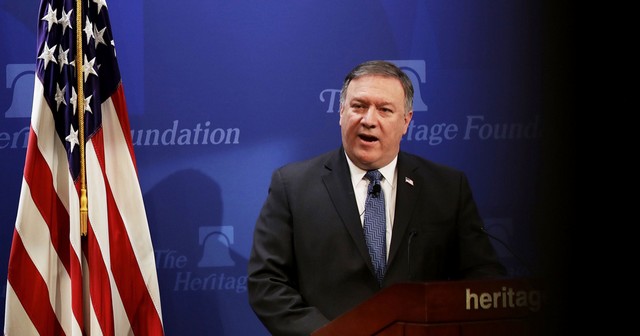
Does The Appeal For Peace And Harmony Apply To Hindutva Brigade As Well For Future?

Co-Written by Sandeep Pandey, Yugal Kishore Shashtri and Lubna Sarwath

With the exception of few, every leader of political or social importance is making an appeal to the common people to maintain peace and communal harmony in the wake of Supreme Court judgement in the Ram Janambhumi-Babri Masjid case as part of which the entire 2.77 acres of disputed land has been given for construction of Ram temple and Government has been directed to provide 5 acres of land elsewhere for construction of mosque. The Prime Minister has said, ‘After the verdict, the way every section of society, of every religion, has welcomed it is a proof of India’s ancient culture and tradition of social harmony.’ He also said, ‘The calm and peace maintained by 130 crore Indians in the run-up to today’s verdict manifests India’s inherent commitment to peaceful coexistence.’ The Rashtriya Swayamsewak Sangh chief has made an appeal, ‘I urge the people of India to maintain law and order.’ Lal Krishna Advani’s reaction is, ‘I stand vindicated, and feel deeply blessed,..’ It will be interesting to see how the Court will now judge him as an accused in the Babri Masjid demolition case.

The SC observes, ‘As regards the inner courtyard, there is evidence on preponderance of probabilities to establish worship by the Hindus prior to the annexation of Oudh by the British in 1857. The Muslims have offered no evidence to indicate that they were in exclusive possession of the inner structure prior to 1857 since the date of construction in the sixteenth century.’ This has been the basis of handing over the disputed site to Hindus. It further observes, ‘The exclusion of the Muslim from worship and possession took place on the intervening night between 22/23 December 1949 when the mosque was desecrated by the installation of Hindu idols.’ And then it goes on to say, ‘The Muslims have been wrongly deprived of a mosque which had been constructed well over 450 years.’

While acknowledging Muslims offering namaz from 1857 to 1949 in the inner structure but saying there is no evidence of this before 1857, although accepting that the mosque existed for at least 450 years, the judgement says, ‘Dividing the land will not subserve the interest of either of the parties or secure a lasting sense of peace and tranquility,’ and offers the land to Hindus. It balances by saying, ‘Justice would not prevail if the Court were to overlook the entitlement of the Muslims who have been deprived of the structure of the mosque through means which should not have been employed in a secular nation committed to the rule of law. The Constitution postulates the equality of all (emphasis in the judgement) faiths. Tolerance and mutual co-existence nourish the secular commitment of our nation and its people.’

The purpose of the judgement and the national appeals, before and after the delivery of judgement – issued by authorities as well as social-political leaderships – are understandable. At best the judgement is a compromise to appease the majority while assuaging the feelings of minority, whether justice has been done is questionable. Similar to the clampdown in Jammu and Kashmir, a tight security control ensured that ‘peace’ would be prevailed.

The first two authors were not allowed to hold a two day communal harmony workshop on 17-18 August, 2019, at Ram Janaki temple at Saryu Kunj in Ayodhya in which Professor Ram Puniyani was to speak and have been issued notices soon after that by the Resident Magistrate of Ayodhya prohibiting them from opening a bank account of their ‘Sarva Dharm Sadbhav Trust.’ The Sarva Dharm Sadbhav Trust has plans to build a multi-faith harmony centre in Ayodhya to convey the message that Ayodhya, sacred to at least five religions – Hinduism, Islam, Buddhism, Jainism and Sikhism – is a place which is symbol of communal harmony. They were detained again on 19th August when they wanted to hold a press conference at the temple. The Government obviously didn’t want any other point of view, than in favour of Ram temple, to be expressed by anybody for the last four months. This is how ‘peace’ and ‘social harmony’ has been enforced upon the country.

If such a tight control had been observed in 1992, when Bhartiya Janata Party’s government was in power in Uttar Pradesh, probably the mosque would not have been demolished. The Chief Minister Kalyan Singh went back on his word given to SC, that he would be faithful to the Constitution, to claim that he was a RSS worker first and CM later, after the mosque was demolished. In 2002, in spite of PM Atal Behari Vajpayee admonishing Narendra Modi, the then CM of Gujarat, to follow ‘Rajdharm,’ and Defence Minister George Fernandes wanting to deploy Army, rioting went on in Gujarat for three days. And we should remember that this violence was triggered by burning of a train in Godhra carrying kar-sewaks who had gone to perform shila-pujan at Ayodhya, 17 years in advance of a judgement in favour of Ram temple. Earlier this year Amit Shah, the Home Minister, and Mohan Bhagwat, both have rejected the SC judgement allowing entry of women of menstruating age to Sabrimala temple in Kerala. The Home Minister is also openly discriminating against Muslims, contrary to the Constitutional principle of equality of all faiths, by excluding them from the possibility of obtaining Indian citizenship as part of the proposed Citizenship Amendment Bill.

It is interesting that the politics of Hindtuva which has built itself up on violence and hatred, starting with the murder of Mahatma Gandhi, and doesn’t care if the copy of Constituion is burnt at Jantar-Mantar and holds an unfavourable SC judgement in contempt, is displaying a new found faith in Constiution, values like equality and fraternity enshrined in it, and respect for a favourable SC judgement. It is obvious that it has worked to build a consensus, taking most Muslim organizations on board and also the SC judges into confidence, to arrive at this judgment. But the larger question is, has this consensus for maintaining peace and harmony been built selectively only for the Ayodhya judgement?

If the BJP/RSS genuinely believe that peace and harmony should prevail from now on, can we expect no more mob-lynching incidents, killing of intellectuals, discrimination against minorities and dalits and in general politics of hate? Are they also going to respect Places of Worship (Special Provisions) Act, 1991 which prohibits conversion of any place of worship? And conversion doesn’t always take place in the manner in which it has been done in Ayodhya. At Mazar mod in Indira Nagar, Lucknow at a corner plot where Muslims used to offer namaz, gradually over years, after a stone was kept under a tree, Hindus have started worshipping a deity and now there is a Provincial Armed Constabulary camp as well at the site. In a TV channel discussion on Indian Ahead on 23 Ocotber, 2019, in anticipation of the Ayodhya judgement, in which the third author was also invited, Vishwa Hindu Parishad spokesperson Vinod Bansal has admitted that they have a list of 30,000 sites in addition to Kashi and Mathura, where Hindu temples were demolished to build some Islamic structures. The working President of VHP Alok Kumar has said that SC judgement on Ayodhya is not the end of the story, it is the beginning, in the context of Kashi and Mathura. Will the BJP/RSS top brass counsel VHP leadership and make it clear to the country that observance of peace and harmony is meant for them as well?

The demolition of Babri Masjid invited the problem of terrorism to India. More such misadventure is going to plunge India into deeper problems.

By Sandeep Pandey, Yugal Kishore Shashtri and Lubna Sarwath – The first and third authors are with Socialist Party (India) and Yugal Kishore Shashtri is Mahant of Ram Janaki temple in Ayodhya.

14 November 2019

Source: countercurrents.org