Just International

Of Palestinian victories and Israel’s harassment pranks

By Ranjan Solomon

Palestinians are compelled to cope with Israel’s bullying tactics day after day. Israel’s arrogant expansion of the occupation comes with an in-your-face approach to the rest of the world. At the UN, Israel unabashedly shows up and pretends it is the victim of Palestinian aggravation. Israel handily overlooks its colossal human rights violations, its settlement enterprises, its brutal killings and maiming of innocent women, children, youth, and elderly. It embezzles land unapologetically, and converts the heritage pieces of land into machines profit under the garb of heritage tourism.On the other hand, every day brings accounts of Palestinian resistance and growing international solidarity. The world remains unacquainted with accounts of courageous resistance and push backs from Palestine only because a pliant corporate media does not report Palestinian successes sufficiently, If we were to adopt the ‘glass is half-full’ narrative, it is possible to see a crisis in the evolution of Israel. It is constantly fending off criticisms and isolation from businesses, cultural icons, academics, and other dimensions of human encounter that can enrich it as a nation. But Israel has mistakenly chosen to make believe that all is well and that its recognition is universal. Sadly, the truth is poles apart.Israel has often to buy people-to-people exchanges at a huge price – a sort of corrupt inducement in order to make it look like a regular country. The burden of up keeping its image as ‘normal’ prompts Israel to indulge in huge investments in projects of normalization such as birthright tours. But even with the highest level of enticements that Israel offers to exchange scholars, academics, musicians, and just ordinary tourists, it is struggling to alter the narrative. Jewish Voice for Peace, a credible and widely supported/respected Jewish Movement of progressive Jews has urged Young Jews to boycott “Birthright Israel” tours arguing that the campaign “is fundamentally unjust that we are given a free trip to Israel while Palestinian refugees are barred from returning to their homes’. In much the same way, the Palestinian Campaign for the Academic and Cultural Boycott of Israel (PACBI) initiated in 2004 to steer the struggle for Palestinian freedom, justice and equality has made significant advances with many countries adopting its aims and purposes and collaborating to urge artists, academics, sports teams and others to shun Israeli relations which allow it to keep-up-appearances of normalcy. The boycott of Israeli academic and cultural institutions is geared to punish Israel for deep and persistent complicity in Israel’s denial of Palestinian rights that are stipulated in international law.The UN, academia, and various influential sources of public opinion are working intensively to change public perception and challenge Israel’s false claims to normalcy. Churches, and theological institutions are also re-interpreting versions of theology that allow Israel to pass off the occupation as a basic human right by falsely presenting Biblical Israel and the Modern State of Israel as one and the same thing. Many of these religious structures are reading the Bible from the eyes of the Palestinians and are emerging as catalysts to co-ordinate new and existing church advocacy for peace, aimed at ending the illegal occupation in accordance with UN resolutions.On the battle a nuclearised, and armed-to the teeth may seem to be marching to victory. On the moral front, Israel looks ailing and decrepit, unable to convince the civilized world that it has a claim to the land it has deceitfully plundered and occupied. Worse, it has, over the years, adopted laws and policies that have made it palpably racist and colonial. Is this tenable and sustainable? Sooner or later, internal dissent will set in with normal Israeli’s being discontented over being the constant antagonist and invader. Already, a small but influential cluster of Israelis reject Zionist-Israel’s ‘political normal’ narrative and are resisting with methods that advance alternative paradigm of Jewish Palestinian Arab relations based on equality and justice in every sphere of life. For them, there are no half-measures of compromises to be had. They are in the camp where they believe which believes that justice must occur even if the heavens fall.

Ranjan Solomon is a widely experienced civil society/human rights/GO leader with varied experiences in organizational transformation and creating social change through advocacy, communications, and issues of education.

14 December 2018

Source: palestineupdates.com

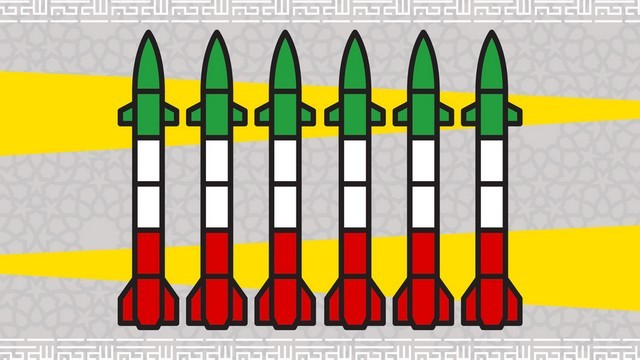
Six factors shaping Iran’s missile decision-making calculus

By Seyed Hossein Mousavian

The UN Security Council convened Dec. 12 to address the implementation of the Joint Comprehensive Plan of Action (JCPOA). US Secretary of State Pompeo said that Iran’s pace of missile activities has not diminished since the JCPOA and that the United States seeks to reimpose ballistic missile restrictions that were outlined in UN Security Council Resolution 1929. European countries, however, distanced themselves from the United States by saying Iran had been in compliance with the Iran nuclear deal, while at the same time saying the missile tests were in noncomformity with UN Security Council Resolution 2231, which endorsed the nuclear deal. Meanwhile, China and Russia said Iran’s missile tests were not a violation of Resolution 2231.

Iranian officials, including Foreign Minister Mohammad Javad Zarif, have rejected that there have been any violations, reiterating that the UN resolution does not ban Tehran’s missile activities.

One reason President Trump cited to justify his decision to withdraw the United States from the nuclear deal was Iran’s missile program. Pompeo also demanded that Iran dismantle its ballistic missile program. Iran has repeatedly rejected calls for dismantling its arsenal, insisting that its defensive capabilities are non-negotiable. Moreover, Iran’s Revolutionary Guards warned that if threatened, Tehran would increase the range of missiles to above 2,000 kilometers (1,240 miles).

The following interconnected factors shape Iran’s missile policies and its defense strategy:

One is the horrific memories of Iraq’s invasion of Iran in 1980; hundreds of thousands of Iranians died in an eight-year war bankrolled by Saudi Arabia and Kuwait and supported by major world powers, including France, the Soviet Union and the United States. The conflict left an indelible mark in the Iranian political psyche that the country must fight for its survival at all costs.

Second, Iraq’s systematic use of Scud missiles to bombard defenseless Iranian cities gave Iran the incentive to begin investing in its ballistic missile program. Over the period of eight years, the Iraqi army launched 533 ballistic missiles on Iranian cities, resulting in 2,300 deaths and injuries to 11,600 Iranians. By the end of war in 1988, Tehran had been attacked 118 times, resulting in 1,600 casualties. In a potential future conflict, Iran can use its inventory to deter and retaliate against an adversary.

Third, the traumatic experience of Saddam Hussein’s systematic use of chemical weapons against Iran, and the international community’s indifference to such violations, has convinced Iran that it cannot rely on international institutions to deter and punish such flagrant violations. A CIA declassified assessment reveals that Iraq began using chemical weapons early in 1983, only to escalate in 1984. Iraq’s 11,000-page report to the UN Security Council listed 150 foreign companies — including from the United States, Germany, and France — that played a role in Saddam Hussein’s weapons of mass destruction program.

Fourth, the current imbalance of conventional forces in the region play a critical role in Iran’s missile policies. While Iran has been under an arms embargo for decades, its regional rivals, especially Saudi Arabia, have de facto carte blanche to purchase any advanced weapon systems. With defense spending of $69.4 billion in 2017, the kingdom became the largest arms importer in the world. Meanwhile, Israel, with military spending of $19.6 billion, is equipped with the most-advanced military hardware. In comparison, Iran’s defense spending stood at $14.5 billion, a fraction of its neighbors’.

While Iran’s missile arsenal is the most diverse of its kind in the region, it has voluntarily limited the range of its missiles to 2,000 kilometers. However, Saudi Arabia’s Chinese made DF-3 and Df-21 missiles are reported to have an increased range of 2,800 kilometers (1,740 miles), with some claiming a range of up to 4,000 kilometers.

Fifth, Iran is surrounded by US military forces in the region and a number of nuclear-weapon states, such as Israel and Pakistan. Israel, which has the most hostile relations with Iran, has an inventory of 200 nuclear warheads that are deliverable by ballistic missiles, including Jericho II, with a range of 3,500 kilometers (2,175 miles), Jericho III (6,500 kilometers, or 4,000 miles) and air- and sea-launched warheads.

Last but certainly not the least, over the past four decades, the United States has used economic, cyber and political warfare to isolate and weaken Tehran, and has repeatedly called for regime change in the country. Moreover, the Trump administration has firm intentions to create a new political alliance with six Gulf Arab states, Egypt and Jordan aimed at confronting Iran.

The Nuclear Threat Initiative chaired by former US Energy Secretary Ernest Moniz found in a study that between 2005 and 2012, when the world powers imposed the most comprehensive sanctions on Iran, the country developed new, liquid-fuel ballistic missiles and tested at least 33 missiles, more than twice the number of missiles tested in the preceding 20 years. From 2012, when Iran-US high-level direct nuclear talks began, until the signing of the deal in July 2015, Iran conducted only one missile test. The study said that in the 2012-2017 period since the negotiations began, Iran decreased the overall number of tests and focused more on solid-fuel short-range missile capabilities rather than intercontinental ballistic missiles. However, the German newspaper Welt am Sonntag reports that Western intelligence services maintain that Tehran, after Trump’s departure from the nuclear deal, this year has doubled the number of last year’s missile tests.

In such a hostile environment, an acceptable framework to alleviate mutual concerns should address the legitimate security concerns of all parties. Such a framework could include a multilateral arrangement for the establishment of a zone free of weapons of mass destruction in the Middle East and a regional conventional arms arrangement beneficial to all parties. Otherwise, under current circumstances, where the countries of the region are aggressively arming themselves, it is simply folly to expect that Iran will dismantle the backbone of its defense doctrine.

Seyed Hossein Mousavian is a Middle East security and nuclear policy specialist at Princeton University and a former spokesman for Iran’s nuclear negotiators.

12 December 2018

Source: www.al-monitor.com

The U.S., not China, is the real threat to international rule of law

By Jeffrey D. Sachs

If, as Mark Twain reputedly said, history often rhymes, our era increasingly recalls the period preceding 1914. And as with Europe’s great powers back then, the United States, led by an administration intent on asserting America’s dominance over China, is pushing the world toward disaster.

The context of the arrest of Huawei CFO Meng Wanzhou – a dangerous move by U.S. President Donald Trump’s administration in its intensifying conflict with China – matters enormously. The United States requested that Canada arrest Ms. Meng in the Vancouver airport en route to Mexico from Hong Kong, and then extradite her to the United States. Such a move is almost a U.S. declaration of war on China’s business community. Nearly unprecedented, it puts American business people travelling abroad at much greater risk of such actions by other countries.

The United States rarely arrests senior business people, U.S. or foreign, for alleged crimes committed by their companies. Corporate managers are usually arrested for their alleged personal crimes (such as embezzlement, bribery or violence) rather than their company’s alleged malfeasance. Yes, corporate managers should be held to account for their company’s malfeasance, up to and including criminal charges, but to start this practice with a leading Chinese business person – rather than the dozens of culpable U.S. CEOs and CFOs – is a stunning provocation to the Chinese government, business community and public.

Ms. Meng is charged with violating U.S. sanctions on Iran. Yet, consider her arrest in the context of the large number of companies, U.S. and non-U.S., that have violated America’s sanctions against Iran and other countries. In 2011, for example, JP Morgan Chase paid $88.3 million in fines in 2011 for violating U.S. sanctions against Cuba, Iran and Sudan. Yet Jamie Dimon wasn’t grabbed off a plane and whisked into custody.

And JP Morgan Chase was hardly alone in violating U.S. sanctions. Since 2010, the following major financial institutions paid fines for such violations: Banco do Brasil, Bank of America, Bank of Guam, Bank of Moscow, Bank of Tokyo-Mitsubishi, Barclays, BNP Paribas, Clearstream Banking, Commerzbank, Compass, Crédit Agricole, Deutsche Bank, HSBC, ING, Intesa Sanpaolo, National Bank of Abu Dhabi, National Bank of Pakistan, PayPal, RBS (ABN Amro), Société Générale, Toronto-Dominion Bank, Trans Pacific National Bank (now known as Beacon Business Bank), Standard Chartered and Wells Fargo.

None of the CEOs or CFOs of these sanction-busting banks were arrested and taken into custody for these violations. In all of these cases, the corporation – rather than an individual manager – was held accountable. Nor were they held accountable for the pervasive lawbreaking in the lead-up to or aftermath of the 2008 financial crisis, for which the banks paid a staggering US$243 billion in fines, according to a recent tally. In light of this record, Ms. Meng’s arrest is a shocking break with practice. Yes, hold CEOs and CFOs accountable – but start at home in order to avoid hypocrisy, self-interest disguised as high principle and the risk of inciting a new global conflict.

Quite transparently, the U.S. action against Ms. Meng really seems to be part of the Trump administration’s broader attempt to undermine China’s economy by imposing tariffs, closing Western markets to Chinese high-technology exports and blocking Chinese purchases of U.S. and European technology companies. One can say, without exaggeration, that this is part of an economic war on China – and a reckless one at that.

Huawei is one of China’s most important technology companies and therefore a prime target in the Trump administration’s effort to slow or stop China’s advance into several high-technology sectors. America’s motivations in this economic war are partly commercial – to protect and favour laggard U.S. companies – and partly geopolitical. They certainly have nothing to do with upholding the international rule of law.

The U.S. appears to be trying to target Huawei especially because of the company’s success in marketing cutting-edge 5G technologies globally. The U.S. claims the company poses a specific security risk through hidden surveillance capabilities in its hardware and software. Yet the U.S. government has provided no evidence for this claim.

A recent diatribe against Huawei in the Financial Times is revealing in this regard. After conceding that “you cannot have concrete proof of interference in ICT, unless you are lucky enough to find the needle in the haystack,” the author simply asserts that “you don’t take the risk of putting your security in the hands of a potential adversary.” In other words: While we can’t really point to misbehavior by Huawei, we should blacklist the company nonetheless.

When global trade rules obstruct Mr. Trump’s gangster tactics, then the rules have to go, according to him. U.S. Secretary of State Mike Pompeo admitted as much last week in Brussels: “Our administration,” he said, is “lawfully exiting or renegotiating outdated or harmful treaties, trade agreements, and other international arrangements that don’t serve our sovereign interests, or the interests of our allies.” Yet before it exits these agreements, the administration is trashing them through reckless and unilateral actions.

The unprecedented arrest of Ms. Meng is even more provocative because it is based on U.S. extra-territorial sanctions – that is, the claim by the U.S. that it can order other countries to stop trading with third parties such as Cuba or Iran. The U.S. would certainly not tolerate China or any other country telling American companies with whom they can or cannot trade.

Sanctions regarding non-national parties (such as U.S. sanctions on a Chinese business) should not be enforced by one country alone, but according to agreements reached within the United Nations Security Council. In that regard, UN Security Council Resolution 2231 calls on all countries to drop sanctions on Iran as part of the 2015 Iran nuclear agreement. Yet the United States. – and only the United States – now rejects the Security Council’s role in such matters. The Trump administration, not Huawei or China, is today’s greatest threat to the international rule of law, and therefore to global peace.

Jeffrey D. Sachs is an American economist and the director of Columbia University’s Center for Sustainable Development.

12 December 2018

Source: theglobeandmail.com

William Blum: Anti-Imperial Advocate Passes Away

By Dr Binoy Kampmark

In the incessant self-praise of the US imperial project, kept safe in a state of permanently enforced amnesia, occasional writings prod and puncture. Mark Twain expressed an ashamed horror at the treatment of the Philippines; Ulysses Grant, despite being a victorious general of the Union forces in the Civil War and US president, could reflect that his country might, someday, face its comeuppance from those whose lands had been pinched.

In the garrison state that emerged during the Cold War, the New Left provided antidotes of varying strength to the illusion of a good, faultless America, even if much of this was confined to university campuses. Mainstream newspaper channels remained sovereign and aloof from such debates, even if the Vietnam War did, eventually, bite.

The late William Blum, former computer programmer in the US State Department and initial enthusiast for US moral crusades, gave us various exemplars of this counter-insurgent scholarship. His compilation of foreign policy ills in Rogue State: A Guide to the World’s Only Superpower, was written with the US as sole surveyor of the land, all powerful and dangerously uncontained. To reach that point, it mobilised such familiar instruments of influence as the National Endowment for Democracy and the School of the Americas, a learning ground for the torturers and assassins who would ply their despoiling trade in Latin America. The imperium developed an unrivalled military, infatuated with armaments, to deal with its enemies. Forget the canard, insists Blum, of humanitarian intervention, as it was espoused to justify NATO’s bombing of Yugoslavia in 1999.

His Killing Hope: US Military and CIA Interventions since World War II, remains his best and potently dispiriting affair, one in which Washington and its Christian warriors sought to battle the “International Communist Conspiracy” with fanatical, God-fearing enthusiasm. In this quest, foreign and mostly democratically elected governments were given the heave-ho with the blessings of US intervention. Food supplies were poisoned; leaders were subjected to successful and failed assassinations (not so many were as lucky as Cuba’s Fidel Castro); the peasantry of countries sprayed with napalm and insecticide; fascist forces and those of reaction pressed into the service of Freedom’s Land.

The squirreling academic, ever mindful of nuts, has been less willing to embrace Blum. This has, to some extent, been aided by such curious instances as the mention, by one Osama bin Laden, of Rogue State in a recording that emerged in 2006. “If I were president I could stop terrorist attacks against the United States in a few days. Permanently.” Sales surged at this endorsement from the dark inspiration behind September 11, 2001. “This is almost,” observed Blum wryly, “as good as being an Oprah book.”

Killing Hope, praised by various high priests in academe on its initial release in 1986, morphed. Various extensions and additions were not approved. Blum, considering the US in its vicious full bloom of the post-Cold War, saw the wickedness of the market in Eastern European countries, the hand of US power in sabotaging negotiations between the Muslims, Croats and Serbs in Bosnia that led to an ongoing murderous conflict, and ongoing mischief in the Middle East (the Syrian Civil War, sponsored jihadists).

Much of this, admittedly, finds an audience, if only for the fact that it excuses, to some extent, local factors and failings. Students of imperial history tend to forget the manipulations of local elites keen to ingratiate themselves and sort out problems with the aid of a foreign brute. It is worth pointing out that, in the vastness of US power, a certain incompetence in exercising it has also prevailed.

But the groves of the academy have tended to sway away from Blum for many of the usual reasons: tenure, security and treading carefully before the imperium’s minders. “It merits mention,” poses Julia Muravska, very keen to mind her P’s and Q’s before the academic establishment as a doctoral candidate, “that after the release of the last majorly revised edition in 1995, successive versions of Killing Hope have largely passed under the radar of mainstream punditry and academia, but remained stalwartly cherished not only in left-leaning circles, but also amongst conspiracy theorists and fringe commentators.”

Such is the damning strategy here: to be credible, you must wallow in mainstream acceptance and gain acknowledgment from the approving centre; to be at the fringe is to not merely to be unaccepted but unacceptable. Amnesia is a funny old thing. While Blum’s scholarship at points had the failings of overstretch, a counteracting zeal, his overall polemics, and advocacy, were part of a tradition that continues to beat in an assortment of publications that challenge the central premises of US power.

Much of Blum’s takes remain dangerously pertinent. “Fake news” has assumed a born-again relevance, when it should simply be termed measured disinformation, one that the CIA and its associates engaged in, and still do, with varying degrees of success. The Russians hardly deserve their supposed monopoly on the subject, though they are handy scapegoats.

Blum did well to note an absolute pearler by way of example: the efforts of the CIA’s Office of Policy Coordination and the US Post Office to solicit a letter writing campaign in 1948 to influence the course of Italy’s 1948 elections. American Italians, or so it was thought, were mobilised to swamp the mother country with warnings of atheistic communism and the threat it posed to Catholic authority. Should Italy turn red, US largesse and aid would stop flowing to a country still suffering from the ills of war. Italians known to have voted communist would not be permitted to enter the US.

Some individuals, guided by samples run in newspapers, offered specimens, but it soon became a campaign featuring “mass-produced, pre-written, postage paid form letters, cablegrams, ‘educational circulars’ and posters, needing only an address and signature.” Italian political parties, generally those of centre, could count on the CIA for a helpful contribution.

Empire remains a terrible encumbrance, draining and ruining both the paternal centre and its patronised subjects. It is a salient reminder as to why Montesquieu insisted on the durability of small republics, warning against aggrandizement. Doing so produces the inevitable, vengeful reaction. As Blum surmised, “The thesis in my books and my writing is that anti-American terrorism arises from the behaviour of US foreign policy. It is what the US government does which angers people all over the world.” To that end, his mission, as described to the Washington Post in an interview in 2006, has been one of, if not ending the American empire, then “at least slowing down” or “injuring the beast.”

Dr. Binoy Kampmark was a Commonwealth Scholar at Selwyn College, Cambridge. He lectures at RMIT University, Melbourne. Email: bkampmark@gmail.com

12 December 2018

Source: countercurrents.org

Yemen Genocide About Oil Control

By F. William Engdahl

The ongoing de facto genocide in the Republic of Yemen in a war whose most intense phase began in 2015, has until very recently been all but ignored in the Western mainstream media. What has also been ignored is the fundamental casus belli for the US-backed Saudi war, ostensibly against the Shi’ite Houthi by the Sunni Wahhabite Saudis. As with virtually every war and destabilization since the British first discovered abundant oil in the Persian Gulf over a century ago, the Yemen war is about oil, more precisely about control of oil, lots of oil.

Yemen is a strategically key geopolitical stretch of land at the critical connecting point of the Red Sea which links to the Mediterranean via the Suez Canal and the Indian Ocean. It’s the site of one of the world’s most strategic shipping choke points, the Bab el Mandab, a narrow passage a mere 18 miles distance from Djibouti in the Horn of Africa, making it one of the US Department of Energy’s Oil Transit Chokepoints. According to the US Department of Energy an estimated 4.7 million barrels of oil passesthrough Bab el Mandab in both directions daily, including oil bound for China.

In March 2015 a new civil war raged in Yemen between the group known popularly as Houthis after Hussein Badreddin al-Houthi, of the Zaidi sect of Islam. The Zaidi area traditionally moderate group who favors equality of women, something anathema to the Saudi Wahhabites. The Zaidi had ruled Yemen for more than 1,000 years until 1962.

The Houthi movement had forced the ouster of Yemeni president Ali Abdullah Saleh in late 2011 on charges of vast corruption. He was succeeded by Abdrabbuh Mansur Hadi, Saleh’s Vice President. At that time both Saleh and Hadi were proxy presidents of Saudi influence.

Things began to change when Hadi refused to step down after his mandate expired. His decision to cut subsidies on fuel prices as well as refusing agreed reforms led to his arrest by the Houthi movement forces in early 2015. He managed later to flee to Saudi Arabia on March 25, 2015 and that same day Saudi Defense Minister Mohammed bin Salman ordered the start of the ongoing bombing war against Yemen and the Houthis.

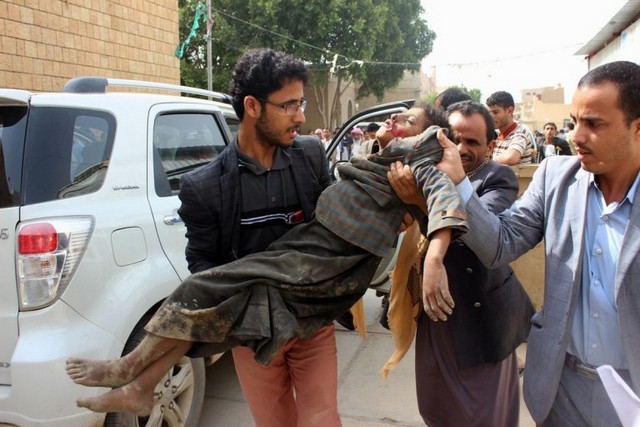
By the end of 2015 Prince bin Salman and his coalition in the strangely-named Operation Decisive Storm (remember Desert Storm) had inflicted atrocities on the civilian population of Yemen. Within six months of relentless Saudi-led bombing, the UN declared Yemen a “Level Three” emergency, the highest level. Bombings destroyed critical civilian infrastructure, health facilities and the Saudis blockaded urgently needed food, water and medical aid to an estimated 20 million Yemenis, in violation of international law. Some 2,500,000 Yemeni civilians have been displaced. Famine and cholera are rampant. In short, it is genocide.

Cheney Oil Wars

The roots of the ongoing Yemen war with the Saudi-led coalition of Gulf states can be traced back to the Bush-Cheney Administration in the aftermath of September 11, 2001 and declaration of the so-called War on Terror.

The 2003 invasion of Iraq was about oil. Several US officials admitted so at the time including Paul Wolfowitz.

”You’ve got to go where the oil is. I don’t think about it [political volatility] very much,” Cheney told a meeting of Texas oilmen in 1998 when he was still CEO of Halliburton, the world’s largest oil services company.

As Vice President under Bush Jr, Cheney by all indications architected the US military campaigns of Defense Secretary Don Rumsfeld to “take out seven countries in five years,” as General Wesley Clark famously reported it several years later. All those seven are strategic to control of the huge Middle East oil flows to China, to the EU and to the world economy.

In 2004 when the Cheney-Bush “War on Terror” went to Yemen to support then-president Saleh, Saudi domination of Yemen was unquestioned. US and British forces backed Saleh against an uprising by the Houthi minority that began after Saleh tried to arrest Hussein Badreddin al-Houthi, the Zaidi religious leader.

By 2015 that US proxy war changed and the Pentagon and Obama Administration quietly backed a full-scale catastrophic Saudi military assault on Yemen.

What is the US or Saudi interest in Yemen? Control of the oil is the short answer, but perhaps not in the usual sense.

In November 2005 the Republic of Yemen expropriated its oil basins — the Marib Al-Jawf Block — from US Hunt Oil Company and ExxonMobil. That was an irritant but not a decisive game-changer. It was in 2014 when the Houthi rebellion against the President, Saudi-backed Hadi, was victorious that the war took a new form. By March 2015 the Houthi-led Supreme Revolutionary Committee declared a general mobilization to overthrow Hadi, after taking over Sana’a and the Yemeni government and proceeding to Aden.

Undiscovered potential

There are two strategic aspects of who is in control of Yemen, especially the areas now in control of the Houthi. One is the mentioned geostrategic control of oil flows passing Bab el Mandab in the Horn of Africa. The second is the control of the largely untapped oil wealth of Yemen itself.

In 2002 a public report by the US Geological Survey (USGS) concluded that, “When undiscovered potential is added to known reserves, the total petroleum endowment for the MadbiAmran / Qishn TPS rises to 9.8 BBOE, which then ranks Yemen 51st for potential of petroleum resources, exclusive of the US.”

Now, 10 billion barrels of crude oil might not seem huge compared with the Saudi claim to hold proven reserves of 266 billion barrels. Here, however, a CIA report from 1988 becomes interesting. The report, South Yemen’s Oil Resources: The Chimera of Wealth, heavily redacted and declassified, has a cryptic note on potential oil reserves in the large disputed border between Yemen and Saudi Arabia. The CIA points to oil and gas reserves along what during the Cold War was the disputed border Neutral Zone between North Yemen and South Yemen.

The Hunt Oil Company of Texas has been sitting in the Alif Field since 1982 and discovered oil there in 1984. The Alif Field lies in the Houthi-controlled north of Yemen near the undefined border between Saudi Arabia and Yemen. The author had the occasion almost two decades ago during an interview with someone associated with the US Government to discuss notions of peak oil and oil geopolitics. At that point the person in discussion volunteered that the undefined desert lands between Saudi Arabia and Yemen, according to non-published US aerial and geophysical surveys, held oil reserve potential that likely exceeded that of Saudi Arabia.

Whether that statement was accurate is not possible to independently confirm. What is clear is that the space surrounded by the Persian Gulf and the Red Sea, including Yemen and Somalia is one of the most tectonically active areas on our planet, a prerequisite for hydrocarbon discovery. Presence of huge oil and gas reserves in Yemen would explain much about why the Pentagon has actively backed the Saudi brutal effort to retake control of Yemen from the Houthi.

It has little to do with any Shi’ite versus Wahhabite Sunni conflict. Rather it has to do with strategic control of world energy. So long as Saana was in control of a Saudi proxy, whether Saleh or then Hadi, it was a secondary priority for Washington. The oil was “safe,” even if the Yemen government had expropriated the US company oil properties. Once a determined independent Houthi Zaidi force was in control of Yemen or a major part, the threat became serious enough to give the eager new Saudi Defense Minister Prince Mohammed bin Salman the green light to begin the war. That Houthi-controlled Yemen would be potential client for Russian or Chinese oil companies to open up serious exploration of the potentials. That combined with the fact that the Houthi also had friendly relations with Iran clearly set off red lights in the Obama Administration.

Salman not surprisingly claimed it was a war of Iran-led “imperialists” against the forces of Saudi-led “freedom-loving” Sunnis.China now has its first overseas military base across from Yemen in Djibouti, next door to the US whose Camp Lemonnier is the largest American permanent military base in Africa. Former colonial occupier France is also there. There is far more at stake in Yemen than we are being told.

*

Note to readers: please click the share buttons above. Forward this article to your email lists. Crosspost on your blog site, internet forums. etc.

F. William Engdahl is strategic risk consultant and lecturer, he holds a degree in politics from Princeton University and is a best-selling author on oil and geopolitics.

20 November 2018

Source: globalresearch.ca

Israel’s new war of attrition on Jerusalem’s Palestinians

By Jonathan Cook

Czech president Milos Zeman offered Benjamin Netanyahu’s ultra-nationalist government a fillip during his visit to Israel last week. He inaugurated a cultural and trade centre, Czech House, just outside Jerusalem’s Old City walls.

At the opening, he expressed hope it would serve as a precursor to his country relocating its embassy from Tel Aviv to Jerusalem. If so, the Czech Republic would become the first European state to follow US President Donald Trump’s lead in moving the US embassy in May.

It is this kind of endorsement that, of late, has emboldened Mr Netanyahu’s government, the Israeli courts, Jerusalem officials and settler organisations to step up their combined assault on Palestinians in the Old City and its surrounding neighbourhoods.

Israel has never hidden its ambition to seize control of East Jerusalem, Palestinian territory it occupied in 1967 and then annexed, as a way of preventing a viable Palestinian state from emerging.

Israel immediately began building an arc of Jewish settlements on Jerusalem’s eastern flank to seal off its Palestinian residents from their political hinterland, the West Bank.

More than a decade ago, it consolidated its domination with a mammoth concrete wall that cut through East Jerusalem. The aim was to seal off densely populated Palestinian neighbourhoods on the far side, ensuring the most prized and vulnerable areas – the Old City and its environs – could be more easily colonised, or “Judaised”, as Israel terms it.

This area, the heart of Jerusalem, is where magnificent holy places such as the Al Aqsa mosque and the Church of the Holy Sepulchre are to be found.

Under cover of the 1967 war, Israel ethnically cleansed many hundreds of Palestinians living near the Western Wall, a retaining wall of the elevated Al Aqsa compound that is venerated in Judaism. Since then, Israeli leaders have grown ever hungrier for control of the compound itself, which they believe is built over two long-lost Jewish temples.

Israel has forced the compound’s Muslim authorities to allow Jews to visit in record numbers, even though most wish to see the mosque replaced with a third Jewish temple. Meanwhile, Israel has severely limited the numbers of Palestinians who can reach the holy site.

Until now, Israel had mostly moved with stealth, making changes gradually so they rarely risked inflaming the Arab world or provoking western reaction. But after Mr Trump’s embassy move, a new Israeli confidence is tangible.

On four fronts, Israel has demonstrated its assertive new mood. First, with the help of ever-more compliant Israeli courts, it has intensified efforts to evict Palestinians from their homes in the Old City and just outside its historic walls.

Last month, the supreme court handed down a ruling that sanctions the eviction of 700 Palestinians from Silwan, a dense neighbourhood on a hillside below Al Aqsa. Ateret Cohanim, a settler organisation backed by government-subsidised armed guards, is now poised to take over the centre of Silwan.

It will mean more Israeli security and police protecting the settler population and more city officials enforcing prejudicial planning rules against Palestinians. The inevitable protests will justify more arrests of Palestinians, including children. This is how bureacratic ethnic cleansing works.

The supreme court also rejected an appeal against a Palestinian family’s eviction from Sheikh Jarrah, another key neighbourhood near the Old City. The decision opens the way to expelling dozens more families.

B’Tselem, an Israeli rights group, characterised these rulings as “sanctioning the broadest move to dispossess Palestinians since 1967”.

At the same time, Israel’s parliament approved a law to accelerate the settler takeover.

Over many years, Israel created a series of national parks around the Old City on the pretext of preserving “green areas”. Some hem in Palestinian neighbourhoods to stop their expansion while others were declared on the land of existing Palestinian homes to justify expelling the occupants.

Now the parliament has reversed course. The new law, drafted by another settler group, Elad, will allow house-building in national parks, but only for Jews.

Elad’s immediate aim is to bolster the settler presence in Silwan, where it has overseen a national park next to Al Aqsa. Archaeology has been co-opted to supposedly prove the area was once ruled by King David while thousands of years of subsequent history, most especially the current Palestinian presence, are erased.

Elad’s activities include excavating under Palestinian homes, weakening their foundations.

A massive new Jewish history-themed visitor centre will dominate Silwan’s entrance. Completing the project is a $55 million cable car, designed to carry thousands of tourists an hour over Silwan and other neighbourhoods, rendering the Palestinian inhabitants invisible as visitors are delivered effortlessly to the Western Wall without ever having to encounter them.

The settlers have their own underhand methods. With the authorities’ connivance, they have forged documents to seize Palestinian homes closest to Al Aqsa. In other cases, the settlers have recruited Arab collaborators to dupe other Palestinians into selling their homes.

Once they gain a foothold, the settlers typically turn the appropriated home into an armed compound. Noise blares out into the early hours, Palestinian neighbours are subjected to regular police raids and excrement is left in their doorways.

After the recent sale to settlers of a home strategically located in the Old City’s Muslim quarter, the Palestinian Authority set up a commission of inquiry to investigate. But the PA is near-powerless to stop this looting after Israel passed a law in 1995 denying it any role in Jerusalem.

The same measure is now being vigorously enforced against the few residents trying to stop the settler banditry.

Adnan Ghaith, Jerusalem’s governor and a Silwan resident, was arrested last week for a second time and banned from entering the West Bank and meeting PA officials. Adnan Husseini, the Palestinian minister for Jerusalem, is under a six-month travel ban by Israel.

Last week dozens of Palestinians were arrested in Jerusalem, accused of working for the PA to stop house sales to the settlers.

It is a quiet campaign of attrition, designed to wear down Jerusalem’s Palestinian residents. The hope is that they will eventually despair and relocate to the city’s distant suburbs outside the wall or into the West Bank.

What Palestinians in Jerusalem urgently need is a reason for hope – and a clear signal that other countries will not join the US in abandoning them.

Jonathan Cook won the Martha Gellhorn Special Prize for Journalism.

3 December 2018

Source: countercurrents.org

The Long, Brutal U.S. War on Children in the Middle East

By Kathy Kelly

On November 28, sixty-three U.S. Senators voted in favor of holding a floor debate on a resolution calling for an end to direct U.S. Armed Forces involvement in the Saudi-UAE coalition-led war on Yemen. Describing the vote as a rebuke to Saudi Arabia and the Trump Administration, AP reported on Senate dissatisfaction over the administration’s response to Saudi Arabia’s brutal killing of Jamal Khashoggi last month. Just before the Senate vote, Secretary of State Mike Pompeo called current objections to U.S. relations with Saudi Arabia “Capitol Hill caterwauling and media pile-on.”

The “caterwaul” on Capitol Hill reflects years of determined effort by grassroots groups to end U.S. involvement in war on Yemen, fed by mounting international outrage at the last three years of war that have caused the deaths of an estimated 85,000 Yemeni children under age five.

When children waste away to literally nothing while fourteen million people endure conflict-driven famine, a hue and cry—yes, a caterwaul —most certainly should be raised, worldwide.

How might we understand what it would mean in the United States for fourteen million people in our country to starve? You would have to combine the populations of New York, Chicago, and Los Angeles, and imagine these cities empty of all but the painfully and slowly dying, to get a glimpse into the suffering in Yemen, where one of every two persons faces starvation.

Antiwar activists have persistently challenged elected representatives to acknowledge and end the horrible consequences of modern warfare in Yemen where entire neighborhoods have been bombed, displacing millions of people; daily aerial attacks have directly targeted Yemen’s infrastructure, preventing delivery of food, safe water, fuel, and funds. The war crushes people through aerial bombing and on-the-ground fighting as well as an insidious economic war.

Yemenis are strangled by import restrictions and blockades, causing non-payment of government salaries, inflation, job losses, and declining or disappearing incomes. Even when food is available, ordinary Yemenis cannot afford it.

Starvation is being used as a weapon of war—by Saudi Arabia, by the United Arab Emirates, and by the superpower patrons including the United States that arm and manipulate both countries.

During the thirteen years of economic sanctions against Iraq— those years between the Gulf War and the devastating U.S.-led “Shock and Awe” war that followed—I joined U.S. and U.K. activists traveling to Iraq in public defiance of the economic sanctions.

We aimed to resist U.S.- and U.K.-driven policies that weakened the Iraqi regime’s opposition more than they weakened Saddam Hussein. Ostensibly democratic leaders were ready to achieve their aims by brutally sacrificing children under age five. The children died first by the hundreds, then by the thousands and eventually by the hundreds of thousands. Sitting in a Baghdad pediatric ward, I heard a delegation member, a young nurse from the U.K., begin to absorb the cruelty inflicted on mothers and children.

“I think I understand,” murmured Martin Thomas, “It’s a death row for infants.” Children gasped their last breaths while their parents suffered a pile-up of anguish, wave after wave. We should remain haunted by those children’s short lives.

Iraq’s children died amid an eerie and menacing silence on the part of mainstream media and most elected U.S. officials. No caterwauling was heard on Capitol Hill.

But, worldwide, people began to know that children were paying the price of abysmally failed policies, and millions of people opposed the 2003 Shock and Awe war.

Still the abusive and greedy policies continue. The U.S. and its allies built up permanent warfare states to secure consistent exploitation of resources outside their own territories.

During and after the Arab Spring, numerous Yemenis resisted dangerously unfair austerity measures that the Gulf Cooperation Council and the U.S. insisted they must accept. Professor Isa Blumi, who notes that generations of Yemeni fighters have refused to acquiesce to foreign invasion and intervention, presents evidence that Saudi Arabia and the UAE now orchestrate war on Yemen to advance their own financial interests.

In the case of Saudi Arabia, Blumi states that although Crown Prince Mohammad bin Salman wants to author an IPO (Initial Public Offering), for the Saudi state oil company, Aramco, no major investors would likely participate. Investment firms know the Saudis pay cash for their imports, including billions of dollars’ worth of weaponry, because they are depleting resources within their own territory. This, in part, explains the desperate efforts to take over Yemen’s offshore oil reserves and other strategic assets.

Recent polls indicate that most Americans don’t favor U.S. war on Yemen. Surely, our security is not enhanced if the U.S. continues to structure its foreign policy on fear, prejudice, greed, and overwhelming military force. The movements that pressured the U.S. Senate to reject current U.S. foreign policy regarding Saudi Arabia and its war on Yemen will continue raising voices. Collectively, we’ll work toward raising the lament, pressuring the media and civil society to insist that slaughtering children will never solve problems.

Kathy Kelly is a peace activist and a co-coordinator of Voices for Creative Nonviolence http://vcnv.org/ .

30 November 2018

Source: countercurrents.org

Hundred Thousand Farmers Lay Siege To Indian Parliament

By Countercurrents.org

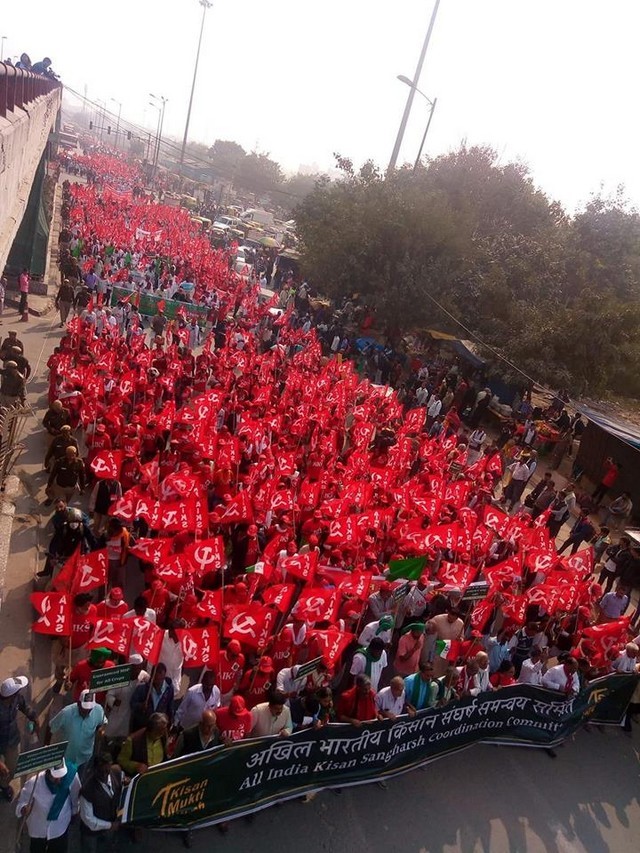
Around 100,000 farmers from across the country converged and marched to the parliament of India in New Delhi demanding a special session to discuss their problems. They were stopped near Parliament Street Police station in the national capital, where their leaders addressed the protesters.

The farmers, who have been camping at the Ramlila ground since Thursday, began their march to Parliament Street around 10.30 am amid heavy policy deployment.

The farmers are demanding a special session of parliament to discuss crop support prices, a nationwide waiver of farm loans amid rising fertilizer costs and other agricultural inputs. The government’s procurement agencies, which are mandated to purchase agricultural produce at guaranteed rates, buy only a small portion of total output, leaving millions of farmers across the country at the mercy of middlemen

About 800 million people of India’s 1.3 billion depend directly or indirectly on farming, with agriculture accounting for about 16 percent of the economy. The country is the world’s top grower of cotton and the second-biggest producer of wheat, rice and sugar.

Farmers from 24 states have also joined the protest to press for their demands, including debt relief and remunerative prices for their produce. Some farmers traveled for more than 2,000 kilometers from different parts of the country to reach New Delhi to participate in the two-day protest.

Congress president Rahul Gandhi addressed the rally and said “If the loans of industrialists can be waived off, then the debt of farmers must be waived off as well. I assure the farmers of India, we are with you. Don’t be scared.”

Participating in the mega farmers’ rally in Delhi, Aam Aadmi Party chief Arvind Kejriwal demanded that the central government should immedietly implement the recommendations of the Swaminathan Commission. He said if the Modi government fails in doing this, farmers will give a befitting reply in the 2019 Lok Sabha election. “Five months are left for the Lok Sabha election. I demand that the central government should implement the recommendations of the Swaminathan Commission.”

The key recommendation of the Swaminathan commission report was that MSP be set at 1.5 times the cost. For instance, if the cost of producing a particular crop is Rs 1,000 per quintal, the MSP should be Rs 1,500 per quintal.

NCP leader Sharad Pawar said “We will bring in a necessary legislation to solve issues of the farmers in distress. We don’t have numbers, but will do whatever we can do to pass the two private member bills in Parliament”

Communist Party of India (Marxist) general secretary Sitaram Yechury referred to Prime Minister Narendra Modi and BJP president Amit Shah as the two eldest Kaurva’s — Duryodhan and Durshaasan — ill-famous for bringing the dynasty down.

The farmers are protesting under the aegis of the All India Kisan Sangharsh Coordination Committee (AIKSCC), which is a coalition group of over 200 farmer organisations from across the country. The coalition is also demanding that parliament pass two bills prepared by the AIKSCC – the freedom from indebtedness bill and a bill to guarantee remunerative MSP.

Between 1995 and 2016, 3,33,398 farmers committed suicide. That is over 15,000 suicides every year, 1,200 suicides each month or 42 suicides per day.

30 November 2018

Source: Countercurrents.org

Neoliberalism’s Dark Path to Fascism

By Chris Hedges

Neoliberalism as economic theory was always an absurdity. It had as much validity as past ruling ideologies such as the divine right of kings and fascism’s belief in the Übermensch. None of its vaunted promises were even remotely possible. Concentrating wealth in the hands of a global oligarchic elite—eight families now hold as much wealth as 50 percent of the world’s population—while demolishing government controls and regulations always creates massive income inequality and monopoly power, fuels political extremism and destroys democracy. You do not need to slog through the 577 pages of Thomas Piketty’s “Capital in the Twenty-First Century” to figure this out. But economic rationality was never the point. The point was the restoration of class power.

As a ruling ideology, neoliberalism was a brilliant success. Starting in the 1970s, its Keynesian mainstream critics were pushed out of academia, state institutions and financial organizations such as the International Monetary Fund (IMF) and the World Bank and shut out of the media. Compliant courtiers and intellectual poseurs such as Milton Friedman were groomed in places such as the University of Chicago and given prominent platforms and lavish corporate funding. They disseminated the official mantra of fringe, discredited economic theories popularized by Friedrich Hayek and the third-rate writer Ayn Rand. Once we knelt before the dictates of the marketplace and lifted government regulations, slashed taxes for the rich, permitted the flow of money across borders, destroyed unions and signed trade deals that sent jobs to sweatshops in China, the world would be a happier, freer and wealthier place. It was a con. But it worked.

“It’s important to recognize the class origins of this project, which occurred in the 1970s when the capitalist class was in a great deal of difficulty, workers were well organized and were beginning to push back,” said David Harvey, the author of “A Brief History of Neoliberalism,” when we spoke in New York. “Like any ruling class, they needed ruling ideas. So, the ruling ideas were that freedom of the market, privatization, entrepreneurialism of the self, individual liberty and all the rest of it should be the ruling ideas of a new social order, and that was the order that got implemented in the 1980s and 1990s.”

“As a political project, it was very savvy,” he said. “It got a great deal of popular consent because it was talking about individual liberty and freedom, freedom of choice. When they talked about freedom, it was freedom of the market. The neoliberal project said to the ’68 generation, ‘OK, you want liberty and freedom? That’s what the student movement was about. We’re going to give it to you, but it’s going to be freedom of the market. The other thing you’re after is social justice—forget it. So, we’ll give you individual liberty, but you forget the social justice. Don’t organize.’ The attempt was to dismantle those institutions, which were those collective institutions of the working class, particularly the unions and bit by bit those political parties that stood for some sort of concern for the well-being of the masses.”
“The great thing about freedom of the market is it appears to be egalitarian, but there is nothing more unequal than the equal treatment of unequals,” Harvey went on. “It promises equality of treatment, but if you’re extremely rich, it means you can get richer. If you’re very poor, you’re more likely to get poorer. What Marx showed brilliantly in volume one of ‘Capital’ is that freedom of the market produces greater and greater levels of social inequality.”

The dissemination of the ideology of neoliberalism was highly organized by a unified capitalist class. The capitalist elites funded organizations such as the Business Roundtable and the Chamber of Commerce and think tanks such as The Heritage Foundation to sell the ideology to the public. They lavished universities with donations, as long as the universities paid fealty to the ruling ideology. They used their influence and wealth, as well as their ownership of media platforms, to transform the press into their mouthpiece. And they silenced any heretics or made it hard for them to find employment. Soaring stock values rather than production became the new measure of the economy. Everything and everyone were financialized and commodified.

“Value is fixed by whatever price is realized in the market,” Harvey said. “So, Hillary Clinton is very valuable because she gave a lecture to Goldman Sachs for $250,000. If I give a lecture to a small group downtown and I get $50 for it, then obviously she is worth much more than me. The valuation of a person, of their content, is valued by how much they can get in the market.”

“That is the philosophy that lies behind neoliberalism,” he continued. “We have to put a price on things. Even though they’re not really things that should be treated as commodities. For instance, health care becomes a commodity. Housing for everybody becomes a commodity. Education becomes a commodity. So, students have to borrow in order to get the education which will get them a job in the future. That’s the scam of the thing. It basically says if you’re an entrepreneur, if you go out there and train yourself, etc., you will get your just rewards. If you don’t get your just rewards, it’s because you didn’t train yourself right. You took the wrong kind of courses. You took courses in philosophy or classics instead of taking it in management skills of how to exploit labor.”

The con of neoliberalism is now widely understood across the political spectrum. It is harder and harder to hide its predatory nature, including its demands for huge public subsidies (Amazon, for example, recently sought and received multibillion-dollar tax breaks from New York and Virginia to set up distribution centers in those states). This has forced the ruling elites to make alliances with right-wing demagogues who use the crude tactics of racism, Islamophobia, homophobia, bigotry and misogyny to channel the public’s growing rage and frustration away from the elites and toward the vulnerable. These demagogues accelerate the pillage by the global elites while at the same time promising to protect working men and women. Donald Trump’s administration, for example, has abolished numerous regulations, from greenhouse gas emissions to net neutrality, and slashed taxes for the wealthiest individuals and corporations, wiping out an estimated $1.5 trillion in government revenue over the next decade, while embracing authoritarian language and forms of control.

Neoliberalism generates little wealth. Rather, it redistributes it upward into the hands of the ruling elites. Harvey calls this “accumulation by dispossession.”

“The main argument of accumulation by dispossession rests on the idea that when people run out of the capacity to make things or provide services, they set up a system that extracts wealth from other people,” Harvey said. “That extraction then becomes the center of their activities. One of the ways in which that extraction can occur is by creating new commodity markets where there were none before. For instance, when I was younger, higher education in Europe was essentially a public good. Increasingly [this and other services] have become a private activity. Health service. Many of these areas which you would consider not to be commodities in the ordinary sense become commodities. Housing for the lower-income population was often seen as a social obligation. Now everything has to go through the market. You impose a market logic on areas that shouldn’t be open to market.”

“When I was a kid, water in Britain was provided as a public good,” Harvey said. “Then, of course, it gets privatized. You start to pay water charges. They’ve privatized transportation [in Britain]. The bus system is chaotic. There’s all these private companies running here, there, everywhere. There’s no system which you really need. The same thing happens on the railways. One of the things right now, in Britain, is interesting—the Labour Party says, ‘We’re going to take all of that back into public ownership because privatization is totally insane and it has insane consequences and it’s not working well at all.’ The majority of the population now agrees with that.”

Under neoliberalism, the process of “accumulation by dispossession” is accompanied by financialization.

“Deregulation allowed the financial system to become one of the main centers of redistributive activity through speculation, predation, fraud, and thievery,” Harvey writes in his book, perhaps the best and most concise account of the history of neoliberalism. “Stock promotions, ponzi schemes, structured asset destruction through inflation, asset stripping through mergers and acquisitions, the promotion of levels of debt incumbency that reduce whole populations even in the advanced capitalist countries to debt peonage. To say nothing of corporate fraud, dispossession of assets, the raiding of pension funds, their decimation by stock, and corporate collapses by credit and stock manipulations, all of these became central features of the capitalist financial system.”

Neoliberalism, wielding tremendous financial power, is able to manufacture economic crises to depress the value of assets and then seize them.

“One of the ways in which you can engineer a crisis is to cut off the flow of credit,” he said. “This was done in Eastern, Southeast Asia in 1997 and 1998. Suddenly, liquidity dried up. Major institutions would not lend money. There had been a big flow of foreign capital into Indonesia. They turned off the tap. Foreign capital flowed out. They turned it off in part because once all the firms went bankrupt, they could be bought up and put back to work again. We saw the same thing during the housing crisis here [in the United States]. The foreclosures of the housing left lots of housing out there, which could be picked up very cheaply. Blackstone comes in, buys up all of the housing, and is now the biggest landlord in all of the United States. It has 200,000 properties or something like that. It’s waiting for the market to turn. When the market turns, which it did do briefly, then you can sell off or rent out and make a killing out of it. Blackstone has made a killing off of the foreclosure crisis where everyone lost. It was a massive transfer of wealth.”

Harvey warns that individual freedom and social justice are not necessarily compatible. Social justice, he writes, requires social solidarity and “a willingness to submerge individual wants, needs, and desires in the cause of some more general struggle for, say, social equality and environmental justice.” Neoliberal rhetoric, with its emphasis on individual freedoms, can effectively “split off libertarianism, identity politics, multiculturalism, and eventually narcissistic consumerism from the social forces ranged in pursuit of social justice through the conquest of state power.”

The economist Karl Polanyi understood that there are two kinds of freedoms. There are the bad freedoms to exploit those around us and extract huge profits without regard to the common good, including what is done to the ecosystem and democratic institutions. These bad freedoms see corporations monopolize technologies and scientific advances to make huge profits, even when, as with the pharmaceutical industry, a monopoly means lives of those who cannot pay exorbitant prices are put in jeopardy. The good freedoms—freedom of conscience, freedom of speech, freedom of meeting, freedom of association, freedom to choose one’s job—are eventually snuffed out by the primacy of the bad freedoms.

“Planning and control are being attacked as a denial for freedom,” Polanyi wrote. “Free enterprise and private ownership are declared to be essentials to freedom. No society built on other foundations is said to deserve to be called free. The freedom that regulation creates is denounced as unfreedom; the justice, liberty and welfare it offers are decried as a camouflage of slavery.”

“The idea of freedom ‘thus degenerates into a mere advocacy of free enterprise,’ which means ‘the fullness of freedom for those whose income, leisure and security need no enhancing, and a mere pittance of liberty for people, who may in vain attempt to make use of their democratic rights to gain shelter from the power of the owners of property,’ ” Harvey writes, quoting Polanyi. “But if, as is always the case, ‘no society is possible in which power and compulsion are absent, nor a world in which force has no function,’ then the only way this liberal utopian vision could be sustained is by force, violence, and authoritarianism. Liberal or neoliberal utopianism is doomed, in Polanyi’s view, to be frustrated by authoritarianism, or even outright fascism. The good freedoms are lost, the bad ones take over.”

Neoliberalism transforms freedom for the many into freedom for the few. Its logical result is neofascism. Neofascism abolishes civil liberties in the name of national security and brands whole groups as traitors and enemies of the people. It is the militarized instrument used by the ruling elites to maintain control, divide and tear apart the society and further accelerate pillage and social inequality. The ruling ideology, no longer credible, is replaced with the jackboot.

Chris Hedges writes a regular column for Truthdig.com.

27 November 2018

Source: https://countercurrents.org/2018/11/27/neoliberalisms-dark-path-to-fascism/

Human Delusion and Our Destruction of the Biosphere: We Aren’t Even Trying!

By Robert J. Burrowes

Have you heard the expression ‘climate change’? That lovely expression that suggests a holiday in a place with a more pleasant climate.

Unfortunately, only the rarest individual has the capacity to see through the elite-promulgated delusion that generated this benign expression and its twin notions that 1.5 degrees celsius (above the preindustrial level) is an acceptable upper limit for an increase in global temperature and that the timeframe for extinction-threatening outcomes of this ‘climate change’ is the ‘end of the century’.

If you believe that this 1.5 degree increase is achievable or even viable for sustaining life on Earth and that the ‘end of the century’ is our timeframe then you are the victim of your own fear, which is suppressing your capacity to seek out, analyze and comprehend the evidence that is readily available and to then behave powerfully in response to it. For an explanation, see ‘Why Violence?’ and ‘Fearless Psychology and Fearful Psychology: Principles and Practice’.

Therefore, your fear, rather than the climate catastrophe and other critical assaults on Earth’s biosphere, is the real problem.

The most casual perusal of the evidence in relation to what is happening to Earth’s biosphere – as distinct from the propaganda that is endlessly promulgated in the global elite’s corporate media – clearly indicates that the cataclysmic assault on our biosphere in a wide range of synergistic ways is now driving the sixth mass extinction event in Earth’s history and that, as a direct result of our relentless and rampaging destruction of habitat, it will take down humanity with it. Well within 10 years. See ‘Human Extinction by 2026? A Last Ditch Strategy to Fight for Human Survival’.

Now if your fear hasn’t already been triggered so that you ceased reading this article, let me offer the barest outline of the nature and extent of the assault on Earth’s biosphere and why the climate catastrophe is only one part of it which nonetheless needs to be seriously, rather than tokenistically, addressed, as is usually suggested whether by most climate lobby groups or, of course, elite-controlled governments and the IPCC.

But before ranging beyond the climate to highlight other threats to the biosphere, did you know that governments and corporations around the world are currently planning or have under construction 1,380 new coal plants? That’s right. 1,380 new coal plants. In 59 countries. See ‘NGOs Release List of World’s Top Coal Plant Developers’ and ‘2018 Coal Plant Developers List’.

For just a taste of the detail on this rapid coal expansion, try the report ‘Tsunami Warning: Can China’s Central Authorities Stop a Massive Surge in New Coal Plants Caused by Provincial Overpermitting?’ and ‘The World Needs to Quit Coal. Why Is It So Hard?’

So if we are deluding ourselves about coal, what about oil? Can we expect a dramatic reduction in oil use to compensate for the substantial increase in coal use? Well, according to the just-released report of the International Energy Agency (IEA), while there is some projected improvement in fuel economy for cars and a projected increase in the number of electric vehicles, cars only account for about one-quarter of the world’s oil consumption and there is no projected reduction in the oil used to fuel freight trucks, ships and airplanes; for heating; and to make plastics and other petrochemicals. ‘As a result, the agency expects global oil demand to keep rising through 2040.’

To summarize: the IEA report notes that global carbon dioxide emissions rose 1.6% in 2017 and are on track to climb again in 2018 and, on the current trajectory, emissions will keep rising until 2040. See ‘World Energy Outlook 2018’ and ‘Clean Energy Is Surging, but Not Fast Enough to Solve Global Warming’.

So, given that we are led to believe that there is supposed to be some sort of international consensus to limit the global temperature increase to 1.5 (which is far too high in any case) above the preindustrial level, why is this happening? Well, in relation to coal: ‘Powerful companies, backed by powerful governments, often in the form of subsidies, are in a rush to grow their markets before it is too late. Banks still profit from it. Big national electricity grids were designed for it.’ See ‘The World Needs to Quit Coal. Why Is It So Hard?’

And just to illustrate what those of us who are genuinely concerned are up against, if you want to read the latest breathtakingly delusional account of the state of the world’s climate which prodigiously underestimates the nature of the climate catastrophe and utterly fails to consider the synergistic impact of other critical environmental destruction, you can do so in the US government’s just-released report ‘Fourth National Climate Assessment Volume II: Impacts, Risks, and Adaptation in the United States’ which is summarized here: ‘Fourth National Climate Assessment Volume II: Impacts, Risks, and Adaptation in the United States; Report-in-Brief’.

This report is presented in one of the global elite’s primary propaganda outlets as follows: ‘A major scientific report issued by 13 federal agencies on [23 November 2018] presents the starkest warnings to date of the consequences of climate change for the United States, predicting that if significant steps are not taken to rein in global warming, the damage will knock as much as 10 percent off the size of the American economy by century’s end.’ See ‘U.S. Climate Report Warns of Damaged Environment and Shrinking Economy’.

At this point I must confess that despite my substantial knowledge of human psychology and widespread human insanity (and the fear that drives it), certainly afflicting the global elite, sometimes even I am impressed with the level of delusion that elites can propagate and have so many believe. See ‘The Global Elite is Insane Revisited’.

Still, as Joseph Goebbels, Nazi Minister of Propaganda and Public Enlightenment under Adolf Hitler once noted: ‘If you tell a lie big enough and keep repeating it, people will eventually come to believe it. The lie can be maintained only for such time as the State can shield the people from the political, economic and/or military consequences of the lie. It thus becomes vitally important for the State to use all of its powers to repress dissent, for the truth is the mortal enemy of the lie, and thus by extension, the truth is the greatest enemy of the State.’ What Goebbels didn’t know is that someone must be terrified – as we terrorize our children – so that they can be so victimized by propaganda as adults.

Anyway, apart from our destruction of Earth’s climate by burning coal and oil, not to mention gas, elites use geoengineering to wage war on Earth’s climate, environment and ultimately us. For the latest update on the geoengineering assault on Earth’s biosphere, listen to Dane Wigington’s latest superb ‘Geoengineering Watch Global Alert News, #172’ and read, watch and listen to the vast documentary record available on the Geoengineering Watch website which remind us how climate engineering is annihilating plants, toxifying soils and water, and destroying the ozone layer among many other outcomes. For a video explaining the role of geoengineering in the latest wildfires in California, see ‘Climate Engineering Total Desperation, Engineering Catastrophic Wildfires To Temporarily Cool Earth’.

All of the above is happening despite the existing temperature increase (about one degree) triggering the now-endless succession of deadly wildfires, droughts, cold snaps, floods, heat waves and catastrophic hurricanes (often in parts of the world where the corporate media can ignore them), as well as the out-of-control methane releases into the atmosphere that are occurring. See ‘7,000 underground gas bubbles poised to “explode” in Arctic’ and ‘Release of Arctic Methane “May Be Apocalyptic,” Study Warns’.

Moreover, these methane releases coupled with other ongoing climate impacts such as sea ice melt and permafrost thawing in the Arctic – summarized in ‘Will humans be extinct by 2026?’ – which has led to the ‘Arctic’s strongest sea ice break[ing] up for first time on record’ and the dramatic weakening of the Gulf Stream – see ‘Anomalously weak Labrador Sea convection and Atlantic overturning during the past 150 years’, ‘Observed fingerprint of a weakening Atlantic Ocean overturning circulation’ and ‘Gulf Stream current at its weakest in 1,600 years, studies show’ – threaten imminent human extinction.

So do you think we are even trying? Or are we tinkering around the edges of this accelerating catastrophe and deluding ourselves that we are doing enough?

But this is far from the end of it. There are other critical threats to Earth’s biosphere that horribly complicate the nature and extent of this catastrophe. What are these threats?

Well, to leave aside a series of threats only marginally less drastic, here are some of the key ones, all of which seriously degrade (or destroy outright) vital components of the interrelated ecosystems (‘the web of life’) that make life on Earth possible.

Rainforests

We are currently destroying the world’s rainforests, mainly by logging them for timber and burning them down to make way for cattle ranches or palm oil plantations. In an extensive academic study, more than 150 joint authors of a report advised that ‘most of the world’s >40,000 tropical tree species now qualify as globally threatened’. See ‘Estimating the global conservation status of more than 15,000 Amazonian tree species’.

Why are more than 40,000 tropical tree species threatened with extinction? Because ‘Upwards of 80,000 acres of rainforest are destroyed across the world each day, taking with them over 130 species of plants, animals and insects.’ See ‘Half of Amazon Tree Species Face Extinction’ and ‘Measuring the Daily Destruction of the World’s Rainforests’. If you missed that, it was 80,000 acres of rainforest destroyed each day.

Oceans

We are destroying the Earth’s oceans by dumping into them everything ranging from excess carbon dioxide and vast amounts of synthetic poisons to plastic and the radioactive contamination from Fukushima. The oceans absorb carbon dioxide as one manifestation of the climate catastrophe and, among other outcomes, this accelerates ocean acidification, adversely impacting coral reefs and the species that depend on these reefs.

In addition, a vast runoff of agricultural poisons, fossil fuels and other wastes is discharged into the ocean, adversely impacting life at all ocean depths – see ‘Staggering level of toxic chemicals found in creatures at the bottom of the sea, scientists say’ – and generating ocean ‘dead zones’: regions that have too little oxygen to support marine organisms. See ‘Our Planet Is Exploding With Marine “Dead Zones”’.

Since the Fukushima nuclear reactor disaster in 2011, and despite the ongoing official coverup, vast quantities of radioactive materials are being ongoingly discharged into the Pacific Ocean, irradiating everything in its path. See ‘Fukushima: A Nuclear War without a War: The Unspoken Crisis of Worldwide Nuclear Radiation’.

Finally, you may not be aware that there are up to 70 ‘still functional’ nuclear weapons as well as nine nuclear reactors lying on the ocean floor as a result of accidents involving nuclear warships and submarines. See ‘Naval Nuclear Accidents: The Secret Story’ and ‘A Nuclear Needle in a Haystack: The Cold War’s Missing Atom Bombs’.

Soil

But not all of our destruction is as visible as our vanishing rainforests and contaminated oceans. Have you considered the Earth’s soil recently? Apart from depleting it, for example, by washing it away (sometimes in dramatic mudslides but usually unobtrusively) because we have logged the rainforest that held it in place, we also dump vast quantities of both inorganic and organic pollutants into it as well. Some of the main toxic substances in waste are inorganic constituents such as heavy metals, including cadmium, chromium, lead, mercury, nickel and zinc. Mining and smelting activities and the spreading of metal-laden sewage sludge are the two main culprits responsible for the pollution of soils with heavy metals. See ‘Soil-net’.

Far more common, however, is our destruction of the soil with organic based pollutants associated with industrial chemicals. Thousands of synthetic chemicals reach the soil by direct or indirect means, often in the form of fertilizers, pesticides, herbicides and other poisons that destroy the soil, by reducing the nutrients and killing the microbes, in which we grow our food (which many people actually eat, at great cost to their health). See, for example, ‘Glyphosate effects on soil rhizosphere-associated bacterial communities’.

Using genetically modified organisms, and the chemical poisons on which they rely, exacerbate this problem terribly. But two other outcomes of the use of such poisons are that the depleted soil can no longer sequester carbon and the poisons also kill many of the beneficial insects, such as bees, that play a part in plant pollination and growth.

And, of course, military contamination and destruction of soil is prodigious ranging from the radioactive contamination of vast areas to the extensive and multifaceted chemical contamination that occurs at military bases.

Partly related to military violence but also a product of using nuclear power, humans generate vast amounts of waste from exploitation of the nuclear fuel cycle. This ranges from the pollution generated by mining uranium to the radioactive waste generated by producing nuclear power or firing a nuclear weapon. But it also includes the nuclear waste generated by accidents such as that at Chernobyl and Fukushima.

Again, for just a taste of the monumental nature of this problem, see ‘Emergency Declared at Nuclear Waste Site in Washington State’, ‘Disposing of Nuclear Waste is a Challenge for Humanity’ and ‘Three Years Since the Kitty Litter Disaster at Waste Isolation Pilot Plant’.

Like destroying the rainforests and oceans, destroying the soil is an ongoing investment in future extinctions. And so is our overconsumption and contamination of the Earth’s finite fresh water supply.

Fresh Water

Whether wetland, river, creek, lake or acquifer, Earth’s fresh water is under siege. Given corporate negligence, this includes all of the chemical poisons and heavy metals used in corporate farming and mining operations, as well as, in many cases around the world where rubbish removal is poorly organized, the sewage and all other forms of ‘domestic’ waste discharged from households. Contamination of the world’s creeks, rivers, lakes and wetlands is now so advanced that many are no longer able to fully support marine life. For one summary of the problem, see ‘Pollution in Our Waterways is Harming People and Animals – How Can You Stop This!’

Beyond this, however, Earth’s groundwater supplies (located in many underground acquifers such as the Ogallala Aquifer in the United States) are also being progressively contaminated by gasoline, oil and chemicals from leaking storage tanks; bacteria, viruses and household chemicals from faulty septic systems; hazardous wastes from abandoned and uncontrolled hazardous waste sites (of which there are over 20,000 in the USA alone); leaks from landfill items such as car battery acid, paint and household cleaners; and the pesticides, herbicides and other poisons used on farms and home gardens. See
‘Groundwater contamination’.

Moreover, while notably absent from the list above, these contaminants also include radioactive waste from nuclear tests – see ‘Groundwater drunk by BILLIONS of people may be contaminated by radioactive material spread across the world by nuclear testing in the 1950s’ – and the chemical contamination caused by hydraulic fracturing (fracking) in search of shale gas, for which about 750 chemicals and components, some extremely toxic and carcinogenic like lead and benzene, have been used. See ‘Fracking chemicals’.

By the way, if you didn’t know it, our purchase and use of all of those hitech products – cars, computers, mobile phones, televisions… – coupled with our consumption of intensively-farmed animal products, all of which are produced using huge quantities of fresh, clean water, is rapidly depleting and degrading the remaining fresh water on Earth, as well as savagely exploiting the people from whose countries we take the strategic minerals and water necessary for such production. See, for example, ‘500 Years is Long Enough! Human Depravity in the Congo’.

War

In addition to the above (and many other biosphere-destroying activities not mentioned), relying on our ignorance and fearful complicity, elites have a budget of hundreds of billions of dollars annually – see the US budget for war in ‘Costs of Post-9/11 U.S. Wars to 2019: $5.9 Trillion’ – to kill huge numbers of our fellow human beings but also to destroy vast areas of Earth’s biosphere through war and other military violence. See, for example, the Toxic Remnants of War Project and the film ‘Scarred Lands & Wounded Lives’.

Unfortunately, too few activists have the awareness and courage to acknowledge the role that war plays in destroying the climate and environment, and include anti-war efforts in their campaigns. Campaigns that will fail dismally, and spectacularly, if the threatened nuclear war should eventuate. See ‘The War to End War 100 Years On: An Evaluation and Reorientation of our Resistance to War’.

Extinction beckons

In summary, our multifaceted, monumental and unrelenting assault on Earth’s biosphere is generating an extinction rate of 200 species (plants, birds, animals, fish, amphibians, insects and reptiles) each day with another 26,000 species already identified as ‘under threat’ – see ‘Red list research finds 26,000 global species under extinction threat’ – with some prominent scholars explaining how even these figures mask a vital component of the rapidly accelerating catastrophe of species extinctions: the demise of local populations of a species. See ‘Biological annihilation via the ongoing sixth mass extinction signaled by vertebrate population losses and declines’.

For further evidence from the vast literature on this subject touching only on impacts in relation to insects and its subsequent impact on birds, see ‘Death and Extinction of the Bees’, ‘Insectageddon: farming is more catastrophic than climate breakdown’ and ‘“Decimated”: Germany’s birds disappear as insect abundance plummets 76%’.

So severe is this assault on the biosphere that recent research warns that the ‘alarming loss of insects will likely take down humanity before global warming hits maximum velocity…. The worldwide loss of insects is simply staggering with some reports of 75% up to 90%, happening much faster than the paleoclimate record rate of the past five major extinction events’. Without insects ‘burrowing, forming new soil, aerating soil, pollinating food crops…’ and providing food for many bird species, the biosphere simply collapses. See ‘Insect Decimation Upstages Global Warming’.

So what can we do?

If you are genuinely powerful, you can stop lobbying governments to tinker with their policies, for example, in the direction of renewable energy (which, alone, cannot solve the multiplicity of ecological crises).

Governments are not the problem. And they simply do as elites direct them in any case. (If you believe that voters decide governments and their policies, and that lobbying them is effective, then your fear is deluding you again.)

The real problem is you and me. We have swallowed one of the ‘big lies’ that Joseph Goebbels talked about: we have believed and acted on the capitalist imperative to endlessly overconsume so that economic growth can rise perpetually in our finite world: a planet that has ecological limits.

But, as I noted above, the big lie only works because our fear makes us believe delusion. Why? Because we were terrorized as children into accepting material goods as substitutes for our capacity to be our unique and powerful Self. See ‘Love Denied: The Psychology of Materialism, Violence and War’.

The monstrous assault on Earth’s biosphere, that goes far beyond the climate catastrophe, is the outcome of each of us consuming more than we need and then fearfully deluding ourselves that it is necessary (or that the harm it caused was too little to matter or justified by some other consideration). Well, you can delude yourself as much as you like but it is still just that: a fearful delusion.

And the point is simply that you can choose differently and powerfully, if you have the courage. For a start, you can forego all air travel. You can travel without owning your own car. You can eat well without consuming meat or fish (and eating biodynamically/organically grown vegetarian/vegan food instead). In essence: If the demand for planet-destroying products is reduced, corporations will not produce them (and destroy the Earth in doing so). This is how the law of supply and demand works under capitalism.

Beyond these simple but vital measures, you can consider many other powerful options, particularly including (accelerated) participation in the fifteen-year strategy outlined in ‘The Flame Tree Project to Save Life on Earth’ which provides a simple plan for people to systematically reduce their consumption, by at least 80%, involving both energy and resources of every kind – water, household energy, transport fuels, metals, meat, paper and plastic – while dramatically expanding their individual and community self-reliance in 16 areas, so that all environmental concerns are effectively addressed.

The Flame Tree Project was inspired by Mohandas K. Gandhi who identified the environmental crisis decades before it became an issue in the West, and who lived his own life in extraordinary simplicity and self-reliance, symbolized by his daily spinning of khadi. ‘Earth provides enough for every person’s need but not for every person’s greed.’ He also invited us to powerfully follow our conscience, reminding us that ‘Hesitating to act because others do not yet see the way only hinders progress.’

But, critically important though he believed personal action to be, Gandhi was also an extraordinary political strategist and he knew that we needed to do more than transform our own personal lives. We need to provide opportunities that compel others to consider doing the same.

So if your passion is campaigning for change, consider doing it strategically as outlined in Nonviolent Campaign Strategy. For example, see the Nonviolent Strategy Wheel and the list of strategic goals necessary to halt the climate catastrophe and end war. Choose one or a few goals appropriate to your circumstances and conduct a strategically-oriented nonviolent campaign, as explained on the same website, to achieve those goals.

Sound strategy is vital given the insanity driving elite behaviour (such as planning/building 1,380 new coal plants). As mentioned above, see ‘The Global Elite is Insane Revisited’.

If your fear makes it difficult to do things such as those suggested above, consider healing as explained in ‘Putting Feelings First’.

If you want your children to be able to respond powerfully in the face of the biosphere’s progressive collapse, consider making ‘My Promise to Children’.

And if you want to join the worldwide movement to end all violence against humans and the biosphere, you can do so by signing the online pledge of ‘The People’s Charter to Create a Nonviolent World’.

The bottom line is this. You can systematically and rapidly reduce your personal consumption and, one way or another, mobilize others or nonviolently compel them to do the same. Or you can let your fear delude you that the ongoing destruction of Earth’s biosphere is somehow unrelated to your personal choices about consumption and the choices of those around you.

Extinction beckons. The choice is yours.

27 November 2018

Robert J. Burrowes has a lifetime commitment to understanding and ending human violence.