Just International

How Europe’s Band-Aid Ensures Greece’s Bondage

By Yanis Varoufakis

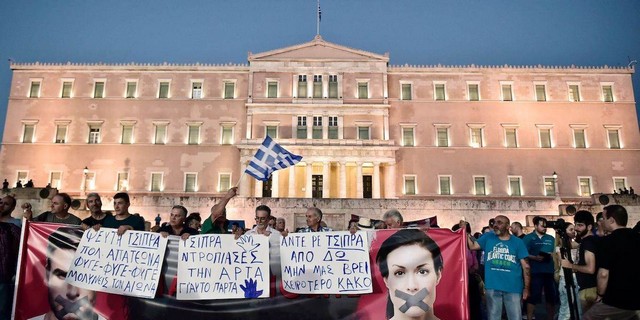
All the happy talk about impending “debt relief” and a “clean exit” from Greece’s third “bailout” obscures an uglier truth: the country’s debt bondage is being extended to 2060. Worse, by ossifying Greece’s insolvency, while pretending to have overcome it, Europe’s establishment is demonstrating its refusal to fix the eurozone’s flaws.

ATHENS – Greece’s never-ending public-debt saga has come to signify the European Union’s inept handling of its inevitable eurozone crisis. Eight years after its bankruptcy, the Greek state’s persistent insolvency remains an embarrassment for Europe’s officialdom. That seems to be why, after having declared the euro crisis over in the rest of Europe, the authorities seem determined to declare final victory on the Greek front, too.

The big moment, it is said, will come in August, when Greece will be pronounced a “normal” European country again. Recently, in preparation for the government’s return to the money markets – from which it has been effectively excluded since 2010 – Greece’s public-debt authority has been testing the waters with a long-term bond issue.

Unfortunately, all the happy talk about impending “debt relief” and a “clean exit” from Greece’s third “bailout” obscures an uglier truth: the country’s debt bondage is being extended to 2060. And, by ossifying Greece’s insolvency, while pretending to have overcome it, Europe’s establishment is demonstrating its dogged refusal to address the eurozone’s underlying fault lines. This augurs ill for all Europeans.

For an EU country to be considered “normal,” it should be subject to the scrutiny facing countries that were never bailed out. That means the standard twice-yearly checks of compliance with the EU’s Stability and Growth Pact, as performed by the European Commission under the so-called European Semester procedure. Nevertheless, for countries like Ireland or Portugal, a tougher “post-program surveillance” procedure was designed following their bailouts: quarterly checks conducted not only by the European Commission but also by the European Central Bank.

It is plain to see why Greece’s road will be much bumpier than Ireland’s or Portugal’s. The ECB had already begun purchasing Irish and Portuguese debt in the secondary markets well before these countries’ bailout exit, as part of its “quantitative easing” program. This enabled the Irish and Portuguese governments to issue large quantities of new debt at low interest rates.

Greece was never included the ECB’s quantitative easing program, for two reasons: its debt burden was too large to service in the long term, even with the help of ECB-sponsored low interest rates, and the ECB was under pressure, mainly from Germany, to wind down the program. Moreover, the post-program surveillance procedure does not give the “troika” of official creditors – the European Commission, the ECB, and the International Monetary Fund – the leverage over Greece that they desire.

In celebrating Greece’s “clean exit,” while retaining its iron grip on the Greek government and withholding debt restructuring, Europe’s establishment is once again displaying its skill at inventing neologisms. Until 75% of Greece’s public debt is repaid – in 2060, at the earliest – the country, we are told, will be subject to “enhanced surveillance” (a term with unfortunate echoes of “enhanced interrogation”).

In practice, this means 42 years of quarterly reviews, during which the European Commission and the ECB “in collaboration with the IMF” may impose new “measures” on Greece (such as austerity, fire sales of public property, and restrictions on organized labor). In short, the next two generations of Greeks will grow up with the troika and its “process” (perhaps under a different name) as a permanent fixture of life.

The celebration of Greece’s return to normality began a few weeks ago with the government’s oversubscribed €3 billion ($3.7 billion) issue of its first seven-year bond in years. What the revelers failed to note, however, was that, to borrow that €3 billion on behalf of its creditors, the Greek state added €816 million in interest payments to its debt repayments for 2025. Germany’s cost for rolling over the same sum, on the same day, was a mere €63 million. Will Greece’s income rise by a similar amount between now and 2025 to make this sustainable?

The official answer is that debt relief will come soon, paving the way for Greece’s smooth return to the money markets. But European officials have ruled out restructuring debt that cannot be repaid. What debt relief really means is that repayment will be shifted from 2022-2035 to 2035-2060, with interest added. In other words, Greece will gain easier medium-term repayments in exchange of 40 years of debt serfdom.

Back in 2015, I was pushing for substantive debt restructuring by means of linking the volume of debt and the rate of repayment to the size of Greece’s nominal GDP and its rate of growth, respectively. Now, it seems that the idea of nominal GDP-indexing will be revived, but only to determine the extent to which medium-term repayment is pushed into the future. Moreover, the easier medium-term payments will be made contingent not only on growth, but also on new “conditionalities” (read: austerity measures) imposed by the (renamed) troika.

According to the authorities’ propaganda, Greece’s creditors are linking debt repayments to growth. In reality, the prospect of recovery will be dealt another blow, because long-term investors will be deterred by the combination of prolonged insolvency and protracted austerity.

What accounts for this implacable determination to leave the Greek wound festering under a flimsily applied Band-Aid? The answer lies in France and Germany, where, a decade after the 2008 financial crash exposed the eurozone’s design flaws, there is still no consensus about how to manage the large-scale insolvencies that are inevitable in a currency union lacking any mechanism to temper financial flows and trade imbalances.

Greece remains the litmus test of the European establishment’s capacity to rationalize the eurozone, and its people have been sacrificed on the altar of an impasse whose repercussions have long since spilled over to the fragmenting political scenery of Central Europe.

Something has to give. Will it be the establishment’s determination to stick to business as usual? Or will it be Europe’s integrity?

Yanis Varoufakis, a former finance minister of Greece, is Professor of Economics at the University of Athens.

26 February 2018
Source: https://www.project-syndicate.org/commentary/greece-debt-relief-enhanced-surveillance-by-yanis-varoufakis-2018-02?utm_source=Project+Syndicate+Newsletter&utm_campaign=c1427ae595-sunday_newsletter_4_3_2018&utm_medium=email&utm_term=0_73bad5b7d8-c1427ae595-104996581

Saudi crown prince sees a new axis of ‘evil’ in the Middle East

By Ishaan Tharoor

Mohammed bin Salman, the youthful and ambitious Saudi crown prince, arrived in London on Wednesday for a three-day visit shrouded in controversy. Critics protested the British government’s close ties to Riyadh, lambasting the kingdom’s human rights record as well its escalation of the war in Yemen, which has led to an unmitigated humanitarian disaster.

Meanwhile, the crown prince’s defenders unleashed a public-relations blitz celebrating the liberalizing reforms being introduced under his watch. Ads in British newspapers and billboards across London hailed how Mohammed was “opening Saudi Arabia to the world.” His supporters blanketed social media with stories of his campaigns to curb corruption and give more freedoms to Saudi women.

Mohammed is indeed shaking things up at home. Recent interviews with prominent Washington Post and New York Times columnists show how eagerly he is styling himself as a millennial reformer steering his nation into 21st-century modernity. But he’s also playing a central role in an international realignment that is perhaps more important.

Before arriving in Britain, Mohammed stopped in Cairo to visit Egyptian President Abdel Fatah al-Sissi, a close Saudi ally. Apart from meeting with Sissi, the crown prince also called on Pope Tawadros II, the head of Egypt’s ancient Coptic Church. It was cast as a sign of Mohammed’s liberal enlightenment: The scion of a regime notorious for embracing and exporting an ultra-conservative brand of Sunni Islam was reaching out to one of the region’s embattled minority faiths.

But the crown prince was also sending a message to his supposed enemies. In remarks reportedly made this week in a meeting with Egyptian newspaper editors, he pointed to a “triangle of evil” in the Middle East made up of Iran — Riyadh’s perennial foe — Islamist extremist groups and Turkey. His rhetoric seemed to echo the notorious “axis of evil” bluster of the George W. Bush administration.

The inclusion of Turkey raised eyebrows and sparked an angry backlash on Turkish social media. There is no love lost between Turkish President Recep Tayyip Erdogan and leaders in the region, especially in the case of Sissi, who brutally suppressed Islamist factions favored by Erdogan after taking power in a 2013 military coup. To this day, Erdogan and his supporters memorialize a crackdown on Muslim Brotherhood activists in Cairo that summer, which saw hundreds, perhaps thousands, of people killed.

After reports about Mohammed’s comments emerged, Saudi officials moved to placate their critics. “It was alleged that the Saudi Crown prince pointed to Turkey via the words ‘some evil powers in the region,’ ” read a statement from the Saudi Embassy in Ankara. “We would like to state that these ‘evil powers’ are the Muslim Brotherhood and radical groups.”

But that hardly obscures the ill will between Riyadh and Ankara. The two countries represent opposing visions for the Middle East: Erdogan was a champion of the 2011 Arab Spring and cheered on the democratic victories of Islamist political parties across the region. Saudi Arabia, meanwhile, reviled parties such as the Muslim Brotherhood and hated the upheavals that plunged much of the old authoritarian order of the Arab world into crisis.

While Erdogan was championing the Turkish model of democracy as a blueprint for the region, deposed Arab autocrats were finding sanctuary in Saudi Arabia. Now, numerous political Islamists from Egypt and other Arab states are in exile in Turkey, and Erdogan cuts an increasingly isolated figure, raging at both the West and his Arab rivals.

In recent months, Turkey has been fighting a media war with both Saudi Arabia and the United Arab Emirates, which also detests Erdogan’s coziness with Islamists and support of its rival, Qatar. In December, Erdogan and the UAE’s foreign minister traded insults over Ottoman history in the Arabian peninsula. This week, the Saudi crown prince reportedly chided Erdogan’s desire for his own “caliphate” across the Middle East.

This week, a major Middle Eastern satellite network based in the UAE — but believed to be majority Saudi-owned — even stopped airing Turkish soap operas, which are tremendously popular across the Middle East and North Africa. The decision is thought to be an extension of the heated political climate.

In that climate, Erdogan has drawn closer to Iran, particularly in the fitful project to broker some sort of truce in Syria. But that hardly justifies being lumped into the “triangle of evil” by the Saudi crown prince. As we’ve noted in Today’s WorldView, Turkey and Iran find themselves on the opposite sides of the Syrian battlefield in many places. And while Turkey is justifiably criticized for allowing myriad Islamist fighters to slip into Syria in the early years of the war, it has also suffered greatly from Islamic State terrorism attacks at home.

Meanwhile, Shiite Iran is ideologically anathema to Sunni jihadist groups. In linking the two, Mohammed took a page directly out of the playbook of Israeli Prime Minister Benjamin Netanyahu, who has insisted repeatedly that the Islamic Republic and Islamic State should be seen in the same light.

That, too, is telling. Mohammed is advancing an agenda that is bringing Riyadh into tighter cooperation not only with a hawkish Trump administration, but with Israel itself. Although the Saudis aren’t publicly admitting it, Israeli officials privately confirm that there is growing strategic cooperation between the two countries, as well as Egypt. Think of it, perhaps, as another triangle in a region where new enmities and rivalries constantly take shape.

Ishaan Tharoor writes about foreign affairs for The Washington Post.

8 March 2018

Source: https://www.washingtonpost.com/news/worldviews/wp/2018/03/08/saudi-crown-prince-sees-a-new-axis-of-evil-in-the-middle-east/?utm_term=.12a43c7fb5f8

Rothschild Passing Dynasty on to 7th Generation, Marking 200 Years of Banker Family Rule

By Rachel Blevins

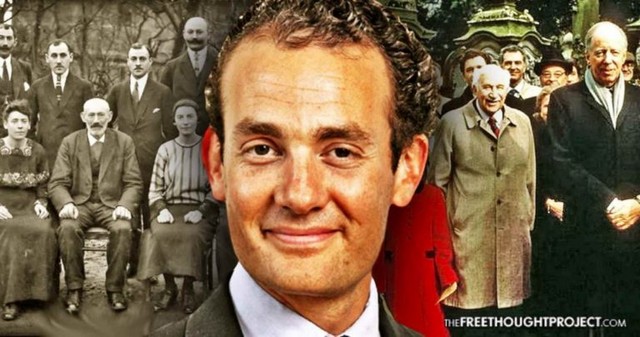
3 Mar 2018 –The Rothschild banking empire will ensure that its control continues to stay within the family for a seventh generation as David de Rothschild, 75, is set to hand the role of chairman over to his son, Alexandre de Rothschild, 37, in June.

The banking dynasty has been passed between generations for the last 200 years. It was started by Mayer Amschel Rothschild as a French railway company, and five of his sons went on to establish banking businesses across Europe. Financial Times reported that the investment bank is currently pushing to “diversify from its core French and British advisory business to help it ride out less buoyant periods in Europe’s mergers and acquisitions market.”

The new chairman joined the bank in 2008, and he has helped to set up and oversee the private equity business. As the group increases its investments in small U.S. operations, the Times noted that the overhaul of the corporate structure that occurred during the elder de Rothschild’s term allowed the family to “tighten control over the group by buying out minority shareholders.”

The Rothschild family has also shown its influence in “U.S. operations” by working closely with political figures such as failed presidential candidate, Hillary Clinton. WikiLeaks revealed that Lynn Forester de Rothschild was working with the Clinton campaign to formulate economic policy as early as January 2015.

“I think this blog overstates what Warren was doing, but we need to craft the economic message for Hillary so that Warren’s common inaccurate conclusions are addressed. Xoxo Lynn,” Lady Rothschild wrote in an email to top Clinton aide, Cheryl Mills.

Emmanuel Macron, the current French president, is also a former employee of Rothschild. He earned the nickname of “Mozart of Finance” at the company after he played a crucial role in advising Nestlé to invest $12 billion in the acquisition of a Pfizer unit in 2012.

The Rothschild family currently has 58 percent of voting rights and owns 49 percent of the company, and the Times noted that while revenue from its global advisory business fell 8 percent, private wealth and asset management and merchant banking divisions grew by more than 30 percent each and overall revenue rose by 6 percent in 2017.

As The Free Thought Project reported in August 2017, Lord Jacob Rothschild, founder and chairman of RIT Capital Partners, sent ominous signals internationally when he began selling U.S. assets because he viewed them as risky and unstable.

“We do not believe this is an appropriate time to add to risk. Share prices have in many cases risen to unprecedented levels at a time when economic growth is by no means assured,” Rothschild wrote in his company’s semi-annual report.

Rothschild also said he believes “The period of monetary accommodation may well be coming to an end,” and that quantitative easing programs employed by central banks, such as the Federal Reserve Bank in the U.S. will eventually “come to an end.”

The Rothschilds consider themselves to be the “custodians of the Economist magazine’s legacy.” The magazine published an article in 1988 that claimed a centralized “world currency” could be expected by the year 2018—a methodical movement that has played out in many ways over the years.

The Financial Times reported that while Rothschild was affected by a financial crisis in 2016, its share increased by more than 15 percent in 2017. It remains to be seen how Alexandre de Rothschild’s leadership will impact the banking empire.

As The Free Thought Project previously reported, the Rothschild family has been moving its chess pieces around the world for centuries.

The head of the Rothschild banking empire, and staunch supporter of Israel, Lord Jacob Rothschild, recently revealed the critical role of his family in the securing the Balfour Declaration, which “helped pave the way for the creation of Israel.”

The Balfour Declaration, written in 1917, was an official document from the British Foreign Minister, Lord Balfour, addressed to Lord Rothschild, a leader of the Zionist movement in Britain at the time – and Lord Jacob Rothschild’s uncle.

During the television interview with Rothschild, he revealed new details about the extremely pivotal role his cousin Dorothea de Rothschild played. Rothschild described Dorothea, who was in her teens at the time, as “devoted to Israel,” and said: ‘What she did was crucially important.’”

Rothschild went on to say that Dorothy acted as a conduit between Zionist leader Chaim Weizmann and the British political establishment. Dorothy “told Weizmann how to integrate, how to insert himself into British establishment life, which he learned very quickly,” according to Rothschild.

Rothschild explained that the manner in which the declaration was procured was extraordinary.

“It was the most incredible piece of opportunism,” he reasoned.

“[Weizmann] gets to Balfour,” Rothschild described, “and unbelievably, he persuades Lord Balfour, and Lloyd George, the prime minister, and most of the ministers, that this idea of a national home for Jews should be allowed to take place. I mean it’s so, so unlikely.”

This extremely revealing interview with Lord Rothschild was conducted by former Israeli ambassador Daniel Taub as part of the Balfour 100 project, commemorating the 100-year anniversary of the Balfour Declaration. The interview took place at Waddesdon Manor in Buckinghamshire, a manor bequeathed to the nation by the Rothschild family in 1957, where the Declaration is stored.

According to Ambassador Taub, the Balfour Declaration “changed the course of history for the Middle East.”

Rothschild said his family at the time was divided on the idea of Israel, noting that some members “didn’t think it was a good thing that this national home be established there.”

Dorothea’s letters are also stored at Waddesdon, and describe her subsequent dealings with a variety of Zionist leaders, as well as her advice on the organization of the Zionist Conference, according to the Times.

Rothschild said that the Declaration went through five separate drafts before finally being formally issued on November 2, 1917.

In her book, Against Our Better Judgment: The Hidden History of How the U.S. Was Used to Create Israel, Alison Weir exposed the fact that numerous drafts of the declaration were presented to Zionists in the United States prior to the document being finalized.

Weir’s book notes that one of the primary inducements offered to British leaders to issue the Balfour Declaration was the Zionist claim that they would bring the U.S. into World War I on Britain’s side if the British would promise to enable the Zionist colonization of Palestine.

Balfour Declaration Text:
Foreign Office
November 2nd, 1917
Dear Lord Rothschild,

I have much pleasure in conveying to you. on behalf of His Majesty’s Government, the following declaration of sympathy with Jewish Zionist     aspirations which has been submitted to, and approved by, the Cabinet.

His Majesty’s Government view with favour the establishment in Palestine of a national home for the Jewish people, and will use their best endeavors to facilitate the achievement of this object, it being clearly understood that nothing shall be done which may prejudice the civil and religious rights of existing non-Jewish communities in Palestine or the rights and political status enjoyed by Jews in any other country.

I should be grateful if you would bring this declaration to the knowledge of the Zionist Federation.
Yours,

Arthur James Balfour

The deeply intertwined relationship between modern Zionism and the Rothschild banking empire cannot be overstated. Without the Rothschild family’s vast influence and direct assistance, Israel very well may have never been created.

Rachel Blevins is an independent journalist from Texas, who aspires to break the false left/right paradigm in media and politics by pursuing truth and questioning existing narratives.

5 March 2018

Source: https://www.transcend.org/tms/2018/03/rothschild-passing-dynasty-on-to-7th-generation-marking-200-years-of-banker-family-rule/

Guns and Liberty

By Chris Hedges

25 Feb 2018 – The proliferation of guns in American society is not only profitable for gun manufacturers, it fools the disempowered into fetishizing weapons as a guarantor of political agency. Guns buttress the myth of a rugged individualism that atomizes Americans, disdains organization and obliterates community, compounding powerlessness. Gun ownership in the United States, largely criminalized for poor people of color, is a potent tool of oppression. It does not protect us from tyranny. It is an instrument of tyranny.

“Second Amendment cultists truly believe that guns are political power,” writes Mark Ames, the author of “Going Postal: Rage, Murder, and Rebellion: From Reagan’s Workplaces to Clinton’s Columbine and Beyond.” “[They believe that] guns in fact are the only source of political power. That’s why, despite loving guns, and despite being so right-wing, they betray such a paranoid fear and hatred of armed agents of the government (minus Border Guards, they all tend to love our Border Guards). If you think guns, rather than concentrated wealth, equals political power, then you’d resent government power far more than you’d resent billionaires’ power or corporations’ hyper-concentrated wealth/power, because government will always have more and bigger guns. In fact you’d see pro-gun, anti-government billionaires like the Kochs as your natural political allies in your gun-centric notion of political struggle against the concentrated gun power of government.”

American violence has always been primarily vigilante violence. It is a product of the colonial militias; the U.S. Army, which carried out campaigns of genocide against Native Americans; slave patrols; hired mercenaries and gunslingers; the Pinkerton and Baldwin-Felts detective agencies; gangs of strikebreakers; the Iron and Coal Police; company militias; the American Legion veterans of World War I who attacked union agitators; the White Citizens’ Council; the White League, the Knights of the White Camellia; and the Ku Klux Klan, which controlled some states. These vigilante groups carried out atrocities, mostly against people of color and radicals, within our borders that later characterized our savage subjugation of the Philippines, interventions in Latin America, the wars in Korea and Vietnam and our current debacles in the Middle East. Gen. Jacob H. Smith summed up American attitudes about wholesale violence in the Philippines when he ordered his troops to turn the island of Samar, defended by Filipino insurgents, into “a howling wilderness.”

Mass culture and most historians do not acknowledge the patterns of violence that have played out over and over since the founding of the nation. This historical amnesia blinds us to the endemic violence that defines our culture and is encoded in our national myth. As historian Richard Slotkin writes in “Regeneration Through Violence: The Mythology of the American Frontier 1600-1860,” the first of his three magisterial works on violence in American society, our Jacksonian form of democracy was defined by “the western man-on-the-make, the speculator, and the wildcat banker; [in a time] when racist irrationalism and a falsely conceived economics prolonged and intensified slavery in the teeth of American democratic idealism; and when men like Davy Crockett became national heroes by defining national aspirations in terms of so many bears destroyed, so much land preempted, so many trees hacked down, so many Indians and Mexicans dead in the dust.”

“The first colonists saw in America an opportunity to regenerate their fortunes, their spirits, and the power of their church and nation,” he writes, “but the means to that regeneration ultimately became the means of violence, and the myth of regeneration through violence became the structuring metaphor of the American experience.”

“A people unaware of its myths is likely to continue living by them, though the world around that people may change and demand changes in their psychology, their ethics and their institutions,” Slotkin writes.

The metaphors we use to describe ourselves to ourselves are rooted in this national myth. We explain our history and our experience and seek our identity in this myth. This myth connects us to the forces that shape and give meaning to our lives. It bridges, as Slotkin writes, “the gap between the world of the mind and the world of affairs, between dream and reality, between impulse or desire and action. It draws on the content of individual and collective memory, structures it, and develops it from imperatives for belief and action.”

The historian Roxanne Dunbar-Ortiz in her book “Loaded: A Disarming History of the Second Amendment” also illustrates how the racist, white settler vision of the world continues to color our perception of reality. She writes:

The populist frontier ideology has served the U.S. ruling class well for its entire history and once again found tremendous resonance in the Vietnam War as another Indian war. A key to John F. Kennedy’s political success was that he revived the “frontier” as a trope of populist imperialism, speaking of the “settling” of the continent and “taming” a different sort of “wilderness.” In Kennedy’s acceptance speech in Los Angeles at the 1960 Democratic Convention, he said: “I stand tonight facing west on what was once the last frontier. From the lands that stretch 3,000 miles behind me, the pioneers of old gave up their safety, their comfort and sometimes their lives to build a new world here in the West. … We stand today on the edge of a new frontier.” The metaphor described Kennedy’s plan for employing political power to make the world the new frontier of the United States. Central to this vision was the Cold War, what Richard Slotkin calls “a heroic engagement in the ‘long twilight struggle’ against communism,” to which the nation was summoned by Kennedy in his inaugural address. Soon after he took office, that struggle took the form of the counterinsurgency program in Vietnam and his creation of the Green Beret Special Forces. “Seven years after Kennedy’s nomination,” Slotkin reminds us, “American troops would be describing Vietnam as ‘Indian Country’ and search-and-destroy missions as a game of ‘Cowboys and Indians’; and Kennedy’s ambassador to Vietnam would justify a massive military escalation by citing the necessity of moving the ‘Indians’ away from the ‘fort’ so that the ‘settlers’ could plant ‘corn.’ ”

The gun culture permits a dispossessed public, sheared of economic and political power, to buy a firearm and revel in feelings of omnipotence. A gun reminds Americans that they are divine agents of purification, anointed by God and Western civilization to remake the world in their own image. Violence in America is not about the defense of liberty or radical change. It is an expression of domination, racism and hate. American vigilantes are the shock troops of capitalism. They butcher the weak on behalf of the strong. “The essential American soul is hard, isolate, stoic, and a killer,” the English novelist and essayist D.H. Lawrence wrote. “It has never yet melted.”

There are some 310 million firearms in the United States, including 114 million handguns, 110 million rifles and 86 million shotguns. The number of military-style assault weapons in private hands—including the AR-15 semi-automatic rifles used in the massacres at Marjory Stoneman Douglas High School in Parkland, Fla., and at the Sandy Hook Elementary School in Newtown, Conn.—is estimated at 1.5 million. The United States has the highest rate of gun ownership in the world, an average of 90 firearms per 100 people.

“Total gun deaths in the United States average around 37,000 a year, with two-thirds of those deaths being suicides, leaving approximately 12,000 homicides, a thousand of those at the hands of the police,” writes Dunbar-Ortiz. “Mass shootings—ones that leave four or more people wounded or dead—now occur in the United States, on average, at the pace of one or more per day. Disturbing as that fact is, mass shootings currently account for only 2 percent of gun killings annually. The number of gun deaths—37,000—is roughly equal to death-by-vehicle incidents in the United States per year.”

If the ruling elites feared an armed uprising, a draconian form of gun control would instantly be law. But the engine of gun ownership is not the fear of government. It is the fear by white people of the black and brown underclass, an underclass many whites are convinced will threaten them as society breaks down. Guns, largely in the hands of whites, have rarely been deployed against the state. In this, the United States is an exception. It has a heavily armed population and yet maintains political stability. The few armed rebellions—the 1786 and 1787 Shays’ Rebellion, the 1921 armed uprising by 10,000 coal miners at Blair Mountain in West Virginia—were swiftly and brutally put down by militias and armed vigilantes hired by capitalists. These uprisings were about specific grievances, not systemic change. Revolution is foreign to our intellectual tradition.

As jobs and manufacturing are shipped overseas, communities crumble, despair grips much of the country and chronic poverty plagues American families, the gun seems to be the last tangible relic of a free and mythic America. It offers the illusion of power, protection and freedom. This is why the powerless will not give it up.

“In the heartland, these are people who feel they’ve been the victims of sustained economic violence at the hands of tyrannical governments of both parties,” writer and editor Daniel Hayes wrote in The New York Times in 2016. “In 2008, Barack Obama’s notorious misstep got one thing right: Rural people will ‘cling’ to guns. Not because they are sad or misguided, but because it is the last right they feel they still have: a liberty at least, in place of opportunity.”

“Outsourcing and guns: These are the twin issues animating Trump voters in rural Kentucky,” he wrote. “The two are linked and feed off each other; the only difference between them is that white rural voters see outsourcing as a losing battle, whereas protecting and expanding Second Amendment rights is the only policy they’ve been able to get politicians to move on. For that reason alone, it is totemic.”

The Second Amendment, as Dunbar-Ortiz makes clear in her book, was never about protecting individual freedom. It was about codifying white vigilante violence into law.

“The elephant in the room in these debates has long been what the armed militias of the Second Amendment were to be used for,” Dunbar-Ortiz writes. “The kind of militias and gun rights of the Second Amendment had long existed in the colonies and were expected to continue fulfilling two primary roles in the United States: destroying Native communities in the armed march to possess the continent, and brutally subjugating the enslaved African population. …”

Attacks on the gun culture and the gun violence that plagues the nation are seen by many gun owners as an attack on their national identity. The more powerful the weapon, the more powerful the gun owner feels. There are those among the marginalized and enraged who are tempted, especially because of easy access to assault-style weapons, to use their guns in mass killings to cleanse the world. The lone killer, almost always a white male, is celebrated by Hollywood and in our national myth and “frontier psychology.” This peculiar American veneration of violence, Slotkin writes, “reaches out of the past to cripple, incapacitate, or strike down the living.”

Chris Hedges spent nearly two decades as a foreign correspondent in Central America, the Middle East, Africa and the Balkans.

5 March 2018

Source: https://www.transcend.org/tms/2018/03/guns-and-liberty/

Meanwhile, Around the World

By Johan Galtung

The world is getting worse.  Violence used to cluster around the global power of USA and the regional power of Israel. Now two more:

  • The unstoppable growing power of China” (NYT editorial 28 Feb 2018)
  • Erdögan’s Neo-Ottomanism at a Dangerous Turning Point” Pier Zaccone (Other-news.info/2018/02, 28 Feb 2018). One global, with “Military buildup on the reefs” in South China Sea (NYT), one regional.

There are similarities.  Xi and Erdögan have a religious base, Buddhism and Islam.  And great successes, Xi in “lifting the bottom up”, Erdögan in ridding his country of secular military dictatorship.

One may speculate that the successes have gone to their heads so they see themselves as indispensable for their countries, and invincible. Being male and strong they have Trump’s approval, a fragile benefit.

Both have taken serious steps to make their reign long lasting–uninterrupted by elections–also known as dictatorships.  And, whereas democracies are different, dictatorships tend to be boringly similar.

One similarity: decline, fall and violent death of the dictator.  There is something suicidal about dictators.  They may be praised for problems they solve but have to know when their time is over.  If not coalitions will arise with one shared goal: to get rid of them. The rumblings of coalitions shaping up may now be heard in both countries.

We take note with sadness, mindful of their achievements.  Gandhi did no such thing nor did Mandela, applying nonviolence to themselves. Xi-Erdögan were not inspired by nonviolence, nor is it a requisite. The self-interest in being remembered for the achievements is enough.

The world needs peaceful co-existence, not more belligerence; and arms races, China with USA, Turkey with Iran. Russia makes arms and the people less vulnerable, but “U.S. chases Russia into a new nuclear arms race” (NYT 6 Feb 2018). Much more dangerous is “The Army of the EU” with no national democratic controls (CounterPunch 16 Feb 2018).

What else?  “The economy, stupid”, Bill Clinton said, and most economic stupidity is found in his country. “‘America First’ policy leaves country isolated while others make deals” (NYT 26 Jan 2018) with 35 bilateral and regional trade pacts (USA only with EU, and “that negotiation has gone dormant”. Hence “Poverty American Style” (Kenneth Shurin, CounterPunch 9 Feb 2018), brilliantly explored by UN Special Rapporteur on extreme poverty and human rights, Australian Professor Philip Alston. The USA does worse than other developed countries on “life expectancy, infant mortality, pregnant mother mortality, obesity, incarceration, homicide, educational attainment, income disparity, childhood poverty, nutrition, homelessness, etc.”

The recent life expectancy decline was “fueled by a 21 percent rise in the death rate from drug overdoses”.

Early February Dow plunged 4.6 percent, erasing January gains.  That will happen again, and we are waiting for bigger crashes. The clever strategy is obvious: make economic distance to the USA.

Look at the Spanish version. The price of housing increased 3,1 percent in 2017, not much. But 3,6 percent January 2018 alone is much, even if we only multiply by 12 for 2018 (Spaniaposten March 2018). People less able to service debts may still buy housing, and banks shall collapse as did Banco Popular in 2017, losing 13,5 billion euro in failed housing investment. Bought by Banco Santander for 1 euro.

German trade expands. From 1986 to 2016 Germany added to the biggest-second biggest trade partners Finland, Poland, Czech Republic, Slovakia, Hungary, most of former Yugoslavia, Romania, Bulgaria (Le Monde Diplomatique Feb 2018). Germany has moved east before.  Trade creates dependence, more lasting than conquest as it craves for more. The US approach, dependence on military support, is at best ambiguous.

All is set to make the USA the biggest loser. But there will be many losers as “an era of easy money draws to end” (NYT 8 Feb 2018).

How about Afghanistan?   “In an unwinnable war, what is the least bad loss?” (Max Fisher, NYT 3-4 Feb 2018). Six points: Nation-building of sorts, Starting over, The Somalia federal model, A peace that satisfies no one, A post-American civil war, Perpetual stalemate.  Not a word about 25,000 independent villages or about the 1893 Durand line cutting the Pashtun = Taliban nation in two; now even with palisades.  And, “least bad” for whom?  For the USA. of course. How about Afghans?

An article as badly informed as Pentagon-State Department?

Billy Graham passed away February 21st at the age of 99, and the article by Cecil Bothwell in CounterPunch 23 Feb 2018 is recommended.  Graham had incredible power over US presidents, making them believe that the way to God’s support of their wars went through him. A country listening to him and his likes is not worth listening to.

We note “In Britain, privatizing gone wrong” (NYT 24 Jan 2018). The giant Carillion went into liquidation after gaping over far too many tasks that cannot be run for profits and serve all citizens. The state is needed, but not the state alone, we hasten to add.  Both-And.

“Challenging the cult of youth” (NYT 12 Feb 2018): interesting for the people advanced in age, so is “Aging Pride”. But exhibiting “Nudes of old people, men and women alike” focuses only on the body, not on mind and spirit. No.  Like Xi and Erdögan, do better next time.

“The secret to a happy marriage is knowing how to fight” (NYT 19 Jan 2018, by Daphne de Marneffe) makes good points. But, is “fight” the word?  How to solve conflict, concile trauma is our answer.  How about “how to have a conversation”, “how to talk”, not how to fight?

Tore Linné-Eriksen revisits (KK 25 Jan 2018) four 1968 aspects: periphery against center (Oslo), lower against higher classes, revolt within the state church, international solidarity. Add informality. First names, no Sie-vous, but du-tu.  Inter-human, not only -district, -class, -state.  An enormous, and irreversible, gain.  Thanks, 1968.

Johan Galtung, a professor of peace studies, dr hc mult, is founder of TRANSCEND International and rector of TRANSCEND Peace University.

5 March 2018

Source: https://www.transcend.org/tms/2018/03/meanwhile-around-the-world-11/

Ahed’s Generation: Why the Youth in Palestine Must Break Free from Dual Oppression

By Ramzy Baroud

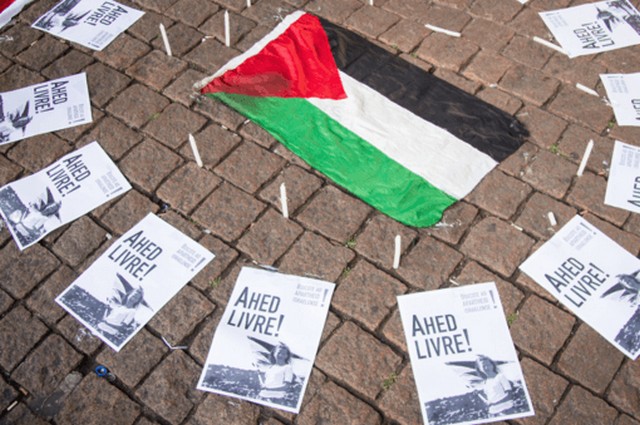
As global voices continue to demand the freedom of 17-year-old teenage Palestinian girl, Ahed Tamimi, Israeli authorities have arrested nine additional members of her family.

Those who were detained on February 26 include Ahed’s 15-year-old cousin, Mohammed Tamimi.

Israeli troops had shot Mohammed in the head last December, shattering his skull. The teenager, who is awaiting reconstruction surgery, is unlikely to receive proper medical care in Israeli prisons.

Ahed’s crime was that she slapped an Israeli soldier in a video that, since then, went viral, shortly after her cousin was shot. He was then placed in a medically-induced coma.

The Israeli soldier who shot Mohammed did not receive even a reprimand for shooting-to-kill an unarmed boy.

The Israeli military provided an outrageous explanation of why the Tamimi family members, all hailing from the small village of Nabi Saleh, were detained in a pre-dawn army raid.

“The detainees are suspected of involvement in terrorist activities, popular terror and violent disturbances against civilians and security forces,” the Israeli military spokesperson said.

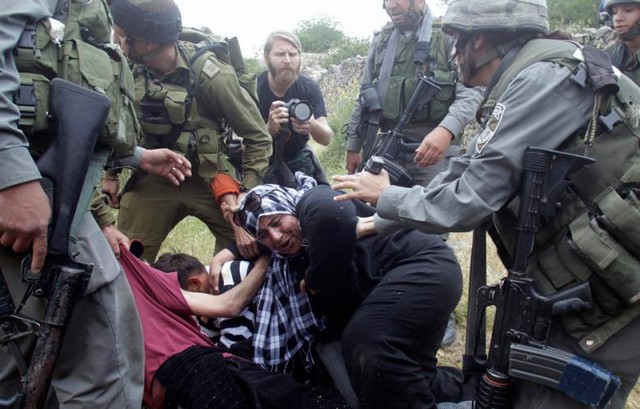
By ‘popular terror’, the statement was referring to the recurring protests led by the 500 residents of Nabi Saleh against the illegal settlements and Apartheid Wall. These protests have been a staple in the everyday life of the village for nearly 12 years.

Anywhere between 600,000 and 750,000 illegal Jewish settlers live in settlements placed strategically throughout the Occupied West Bank and East Jerusalem. They are a glaring violation of international law.

Aside from the massive Israeli army build-up in the Occupied Territories, the armed settlers have been a major source of violence against Palestinians.

Ahed and Mohammed Tamimi, along with hundreds of thousands of Palestinian children and teenagers, were born into this violent reality, and feel trapped.

Their collective imprisonment is not only as a result of the perpetual military occupation of their land by Israel, but also by the fact that their leadership has operated for many years in a self-centered fashion, orbiting far away from Nabi Saleh and its tiny, struggling but brave population.

Nabi Saleh is relatively a short distance away, northwest of Ramallah, the political base of the Palestinian Authority (PA); but in some way, both places are a world apart.

The PA was formed in 1994, as one of the outcomes of the Oslo Accords, which was initially reached and signed in secret by the Palestinian Liberation Organization (PLO) and Israel.

Most Palestinians in the Occupied Territories matured politically or were even born after the advent of the PA. They have no other frame of reference but Israel and the Ramallah-based authority.

The latter has grown comfortable by its wealth and status and, with time, evolved into a culture of its own. It is no longer a democratic institution, and definitely does not represent all Palestinians.

Thus, Palestinian reality is now shaped by three forces: the domineering Israeli occupation, the subservient and self-centered PA and the indignant and leaderless Palestinian youth, which is held captive in dual bondage.

This is why Ahed’s slapping of the Israeli soldier resonated throughout Palestine, and among Palestinians across the world. It was a symbol of defiance that, despite the twofold oppression, Palestine’s youth still have the power to articulate an identity, one that is, perhaps, captive but nonetheless resilient.

Although Mohammed’s skull is crushed, he continued to speak out as soon as left the hospital. The spirit of the Palestinian people is clearly not broken, and Palestine’s youth are the only way out of the double-walled cage.

Alas, the mission of this generation of young Palestinians is even harder than previous generations, especially Palestinian youth that led and sustained a 7-year-long uprising, the Intifada of 1987 – also known as the Intifada of the Stones.

That generation resurrected the Palestinian cause as they daringly organized their communities, mobilizing all efforts to challenge the Israeli occupation. Thousands were killed and wounded at the time, but an empowered Palestinian nation arose in response.

The Palestinian leadership used the Intifada to reinvent itself. It exploited the attention young Palestinians had garnered to negotiate Oslo, which ultimately gave some Palestinians special status and denied the rest any rights or freedoms.

The PA, led by aging President Mahmoud Abbas, understands well that if the youth are to be given the chance to mobilize, another Intifada would dismantle his entire leadership, possibly in a matter of days.

This is why, no matter how serious the disagreements between Abbas and the Israeli government become, they will always stay united against any possibility of a popular Palestinian revolt, led by the youth.

Numerous Palestinians have been arrested, imprisoned or tortured by Palestinian police in the years that followed the formation of the PA. The latter did so in the name of ‘national interest’ while, in reality, it was done in the name of Israeli security.

Indeed, Oslo has allowed both Israel and the PA to maintain ‘security coordination‘ in the West Bank. This has mostly been used to keep the illegal settlements safe and to prevent Palestinian youth from confronting the Israeli army.

Such a practice has meant that the PA became a first line of defense against rebelling Palestinians.

While Palestinian officials continue to pay lip service to Ahed Tamimi and thousands of young Palestinians who continue to endure imprisonment and ill treatment by Israel, in truth, Ahed epitomizes the antithesis of everything that the Palestinian leadership in Ramallah stands for.

She is strong, morally-driven and defiant; the PA is subservient, morally bankrupt and quisling.

Palestinian youth already understand this, and it is mostly up to them to free themselves from the confines of military occupation and corruption.

In his seminal book, ‘The Wretched of the Earth’, anti-colonial author and revolutionary, Frantz Fanon wrote, “Each generation must discover its mission, fulfill it or betray it, in relative opacity.”

Ahed and Mohammed Tamimi’s generation have already discovered their mission, and it will be them who will continue to fight for its fulfillment – their freedom and the freedom of their homeland.

Ramzy Baroud is a journalist, author and editor of Palestine Chronicle.

7 March 2018

Source: https://countercurrents.org/2018/03/07/aheds-generation-why-the-youth-in-palestine-must-break-free-from-dual-oppression/

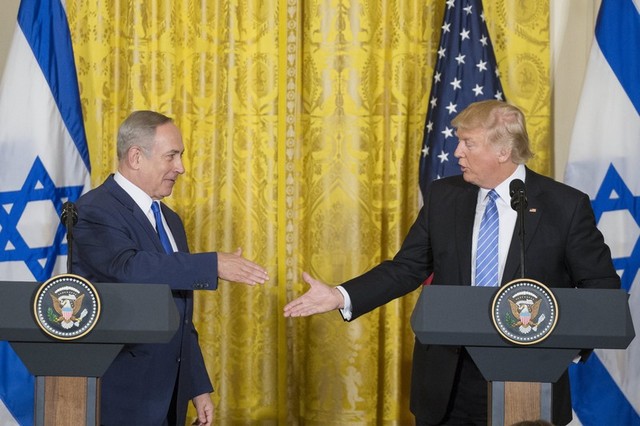
Netanyahu and Liberman are trying to drag the US into war with Iran

By Dr Ludwig Watzal

There are still some reasonable people in the US security establishment who have the guts to speak the truth about the real intentions of the Zionist regime. Perhaps President Obama’s most significant achievements were not to be dragged into a war with Iran by Netanyahu and his then time Defense Minister Ehud Barak. Probably under the enormous influence of the Zionist lobby, President Trump will also reverse this merit of his predecessor. So far, Trump’s “achievements” are the reversals of Obama’s policies.

Netanyahu and Liberman are both warmongers. In April, Liberman will talk in New York City at the annual conference of the right-wing Israeli Newspaper “The Jerusalem Post” on the following subject: “The New War with Iran.” How bold or self-confident must one be to speak on such a subject openly?

Netanyahu is not one iota better than his fascist Defense Minister Liberman when he declared the following in January at the Holocaust memorial in Jerusalem: ” The greatest danger that we face, of hatred for the Jewish people and the Jewish state … comes from Iran. It comes from the ayatollah regime that is fanning [the] flames [of anti-Semitism].” Netanyahu knows that his rhetoric is baloney because over 30000 Jewish Iranians are living free and unmolested in the Islamic Republic of Iran. At the same time, the Zionist regime is deporting asylum-seekers from Africa.

AIPAC just wrapped up its annual conference. For the first time, liberal Jews were allowed to speak at this event. Even AIPAC’s president called for a two-state solution. Perhaps even this lobby has understood the writing on the wall that Netanyahu’s career is coming to an end. He and his wife facing corruption charges.

Not even President Trump should be so stupid to do the fighting for the Zionist regime. So far, the US Empire has failed across the Middle East. To listen to people such as Netanyahu, Liberman, Mohammed bin-Salman from Saudi Arabia, or military strongman Abd al Fattah as-Sisi from Egypt, the US can only lose. Instead of talking to rational actors such as Vladimir Putin, Bashar al-Assad, or the President of the Islamic Republic of Iran, Hassan Rohani, Trump associates with political morons such as Netanyahu and his ilk.

The following speech gives some hope that even in Washington reason will prevail.

https://www.youtube.com/watch?v=NXOSJU80A00

The following discussion is also revealing:

https://www.youtube.com/watch?v=DFmKGkHhjAg

Dr. Ludwig Watzal works as a journalist and editor in Bonn , Germany.

7 March 2018

Source: https://countercurrents.org/2018/03/07/netanyahu-and-liberman-are-trying-to-drag-the-us-into-war-with-iran/

Israeli Army’s Lies Can No Longer Salvage Its Image

By Jonathan Cook

Nazareth: It is has been a very bad week for those claiming Israel has the most moral army in the world. Here’s a small sample of abuses of Palestinians in recent days in which the Israeli army was caught lying.

A child horrifically injured by soldiers was arrested and terrified into signing a false confession that he was hurt in a bicycle accident. A man who, it was claimed, had died of tear-gas inhalation was actually shot at point-blank range, then savagely beaten by a mob of soldiers and left to die. And soldiers threw a tear gas canister at a Palestinian couple, baby in arms, as they fled for safety during a military invasion of their village.

In the early 2000s, at the dawn of the social media revolution, Israelis used to dismiss filmed evidence of brutality by their soldiers as fakery. It was what they called “Pallywood” – a conflation of Palestinian and Hollywood.

In truth, however, it was the Israeli military, not the Palestinians, that needed to manufacture a more convenient version of reality.

Last week, it emerged, Israeli officials had conceded to a military court that the army had beaten and locked up a group of Palestinian reporters as part of an explicit policy of stopping journalists from covering abuses by its soldiers.

Israel’s deceptions have a long history. Back in the 1970s, a young Juliano Meir-Khamis, later to become one of Israel’s most celebrated actors, was assigned the job of carrying a weapons bag on operations in the Jenin refugee camp in the West Bank. When Palestinian women or children were killed, he placed a weapon next to the body.

In one incident, when soldiers playing around with a shoulder-launcher fired a missile at a donkey, and the 12-year-old girl riding it, Meir-Khamis was ordered to put explosives on their remains.

That occurred before the Palestinians’ first mass uprising against the occupation erupted in the late 1980s. Then, the defence minister Yitzhak Rabin – later given a Hollywood-style makeover himself as a peacemaker – urged troops to “break the bones” of Palestinians to stop their liberation struggle.

The desperate, and sometimes self-sabotaging, lengths Israel takes to try to salvage its image were underscored last week when 15-year-old Mohammed Tamimi was grabbed from his bed in a night raid.

Back in December he was shot in the face by soldiers during an invasion of his village of Nabi Saleh. Doctors saved his life, but he was left with a misshapen head and a section of skull missing.

Mohammed’s suffering made headlines because he was a bit-player in a larger drama. Shortly after he was shot, a video recorded his cousin, 16-year-old Ahed Tamimi, slapping a soldier nearby after he entered her home.

Ahed, who is in jail awaiting trial, was already a Palestinian resistance icon. Now she has become a symbol too of Israel’s victimisation of children.

So, Israel began work on recrafting the narrative: of Ahed as a terrorist and provocateur.

It emerged that a government minister, Michael Oren, had even set up a secret committee to try to prove that Ahed and her family were really paid actors, not Palestinians, there to “make Israel look bad”. The Pallywood delusion had gone into overdrive.

Last week events took a new turn as Mohammed and other relatives were seized, even though he is still gravely ill. Dragged off to an interrogation cell, he was denied access to a lawyer or parent.

Shortly afterwards, Israel produced a signed confession stating that Mohammed’s horrific injuries were not Israel’s responsibility but wounds inflicted in a bicycle crash.

Yoav Mordechai, the occupation’s top official, trumpeted proof of a Palestinian “culture of lies and incitement”. Mohammed’s injuries were “fake news”, the Israeli media dutifully reported.

Deprived of a justification for slapping an occupation soldier, Ahed can now be locked away by military judges. Except that witnesses, phone records and hospital documentation, including brain scans, all prove that Mohammed was shot.

This was simply another of Israellywood’s endless productions to automatically confer guilt on Palestinians. The hundreds of children on Israel’s incarceration production line each year have to sign confessions – or plea bargains – to win jail-sentence reductions from courts with near-100% conviction rates.

It is more Franz Kafka than Hollywood.

A second army narrative unravelled last week. CCTV showed Yasin Saradih, 35, being shot at point-blank range during an invasion of Jericho, then savagely beaten by soldiers as he lay wounded, and left to bleed to death.

It was an unexceptional incident. A report by Amnesty International last month noted that many of the dozens of Palestinians killed in 2017 appeared to be victims of extra-judicial executions.

Before footage of Saradih’s killing surfaced, the army issued a series of false statements, including that he died from tear-gas inhalation, received first-aid treatment and was armed with a knife. The video disproves all of that.

Over the past two years, dozens of Palestinians, including women and children, have been shot in similarly suspicious circumstances. Invariably the army concludes that they were killed while attacking soldiers with a knife – Israel even named this period of unrest a “knife intifada”.

Are soldiers today carrying a “knife bag”, just as Meir-Khamis once carried a weapons bag?

A half-century of occupation has not only corrupted generations of teenage Israeli soldiers who have been allowed to lord it over Palestinians. It has also needed an industry of lies and self-deceptions to make sure the consciences of Israelis are never clouded by a moment of doubt – that maybe their army is not so moral after all.

A version of this article first appeared in the National, Abu Dhabi.

Jonathan Cook won the Martha Gellhorn Special Prize for Journalism.

6 March 2018

Source: https://countercurrents.org/2018/03/06/israeli-armys-lies-can-no-longer-salvage-image/

Who Are The ‘Arsonists And Firefighters’ In Syria?

By Nauman Sadiq

Recently, General Joseph Votel, the head of US Central Command, accused Kremlin of playing as both arsonist and firefighter in Syria. This projection is farthest from truth because in fact it’s Washington which kindled the fires of militancy in Syria and now it appears desperate to douse those fires.

First, Washington nurtured militants against the Syrian government for the first three years of the Syrian proxy war from 2011 to 2014, and then it declared a war against one faction of the militants, the Islamic State, when the latter transgressed its mandate in Syria and dared to occupy Mosul and Anbar in Iraq in early 2014 from where the US had withdrawn its troops only a couple of years ago in December 2011.

Moreover, early last year, two very similar military campaigns were simultaneously going on in Syria and Iraq. While the Syrian offensive with Russian air support against the militants holed up in east Aleppo was reviled as an assault against humanity, the military campaigns in Mosul and Raqqa by the US-backed forces were lauded as ‘liberation struggles’ by the mainstream media.

Although the campaigns in Mosul and Raqqa were against the Islamic State, while in east Aleppo, the Syrian government mounted a military offensive against so-called ‘moderate rebels,’ the distinction between Islamic jihadists and moderate militants is more illusory than real.

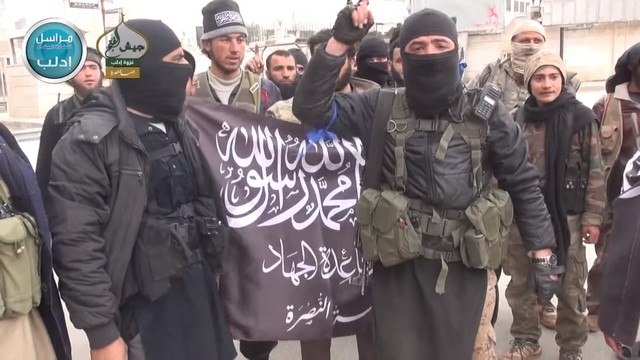
More recently, the Syrian government has launched a military campaign in Eastern Ghouta against the militants of Hayat Tahrir al-Sham (HTS), formerly al-Nusra Front, and Jaysh al-Islam which is being reviled as a ‘massacre’ by the mainstream media; however, both are Salafist militant groups which are generously funded by the Gulf states and have been holding the civilian population of Eastern Ghouta hostage since 2013.

Regarding the nexus between Islamic jihadists and purported ‘moderate rebels’ in Syria, according to a recent AFP report [1] by Maya Gebeily, hundreds of Islamic State’s militants have joined so-called ‘moderate rebels’ in Idlib in their battle against the advancing Syrian government troops backed by Russian airstrikes.

The Islamic State already had a foothold in neighboring Hama province and its infiltration into Idlib seems to be an extension of its outreach. On January 12, the Islamic State officially declared Idlib one of its ‘Islamic emirates.’ It has reportedly captured several villages and claims to have killed two dozen Syrian soldiers and taken 20 hostages.

In all likelihood, some of the Islamic State’s jihadists who have joined the battle in Idlib were part of the same contingent of militants that fled Raqqa in October last year under a deal brokered [2] by the US-backed Syrian Democratic Forces (SDF).

In fact, one of the main objectives of the deal was to let the jihadists fight the Syrian government troops in order to free up the Kurdish-led SDF in a scramble to capture oil and gas fields in Deir al-Zor and the border posts along Syria’s border with Iraq.

Islamic State’s foray into Idlib, which has firmly been under the control of Hayat Tahrir al-Sham (HTS) led by al-Nusra Front since 2015, isn’t the only instance of its kind. Remember when the Syrian government was on the verge of winning a resounding victory against the militants holed up in east Aleppo, Islamic State came to the rescue of so-called ‘moderate rebels’ by opening up a new front in Palmyra in December 2016.

Consequently, the Syrian government had to send reinforcements from Aleppo to Palmyra in order to defend the city. Although the Syrian government troops still managed to evict the militants holed up in the eastern enclave of Aleppo and they also retook Palmyra from Islamic State in March last year, the basic purpose of this tactical move by the Islamic State was to divert the attention and resources of the Syrian government away from Aleppo to Palmyra.

Fact of the matter is that the distinction between Islamic jihadists and purported ‘moderate rebels’ in Syria is more illusory than real. Before it turned rogue and overran Mosul in Iraq in June 2014, Islamic State used to be an integral part of the Syrian opposition and it still enjoys close ideological and operational ties with other militant groups in Syria.

It’s worth noting that although turf wars are common not just between the Islamic State and other militant groups operating in Syria but also among rebel groups themselves, the ultimate objective of the Islamic State and the rest of militant outfits operating in Syria is the same: to overthrow the government of Bashar al-Assad.

Regarding the Syrian opposition, a small fraction of it is comprised of defected Syrian soldiers who go by the name of Free Syria Army, but the vast majority has been comprised of Islamic jihadists and armed tribesmen who have been generously funded, trained, armed and internationally legitimized by their regional and global patrons.

Islamic State is nothing more than one of numerous Syrian militant outfits, others being: al-Nusra Front, Ahrar al-Sham, Jaysh al Islam etc. All the militant groups that are operating in Syria are just as fanatical and brutal as the Islamic State. The only feature that differentiates the Islamic State from the rest is that it is more ideological and independent-minded.

The reason why the US has turned against the Islamic State is that all other Syrian militant outfits only have local ambitions that are limited to fighting the Syrian government, while the Islamic State has established a global network of transnational terrorists that includes hundreds of Western citizens who have become a national security risk to the Western countries.

Regarding the dominant group of Syrian militants in the Idlib and Eastern Ghouta, according to a May 2017 report [3] by CBC Canada, Hayat Tahrir al-Sham (HTS), which was formerly known as al-Nusra Front until July 2016 and then as Jabhat Fateh al-Sham (JFS) until January 2017, has been removed from the terror watch-lists of the US and Canada after it merged with fighters from Zenki Brigade and hardline jihadists from Ahrar al-Sham and rebranded itself as Hayat Tahrir al-Sham (HTS) in January last year.

The US State Department is hesitant to label Hayat Tahrir al-Sham (HTS) a terror group, despite the group’s links to al-Qaeda, as the US government has directly funded and armed the Zenki Brigade, one of the constituents of Hayat Tahrir al-Sham (HTS), with sophisticated weaponry including the US-made antitank missiles.

The purpose behind the rebranding of al-Nusra Front first as Jabhat Fateh al-Sham (JFS) and then as Hayat Tahrir al-Sham (HTS) and purported severing of ties with al-Qaeda has been to legitimize itself and to make it easier for its patrons to send money and arms.

The US blacklisted al-Nusra Front in December 2012 and persuaded its regional allies Saudi Arabia and Turkey to ban it, too. Although al-Nusra Front’s name has been in the list of proscribed organizations of Saudi Arabia and Turkey since 2014, it has kept receiving money and arms from its regional patrons.

Finally, regarding the deep ideological ties between the Islamic State and al-Nusra Front, although the current al-Nusra Front has been led by Abu Mohammad al-Jolani, he was appointed [4] as the emir of al-Nusra Front by Abu Bakr al Baghdadi, the leader of Islamic State, in January 2012. In fact, al-Jolani’s Nusra Front is only a splinter group of the Islamic State, which split from its parent organization in April 2013 over a leadership dispute between the two organizations.

Sources and links:

[1] Four years and one caliphate later, Islamic State claims Idlib comeback:

https://uk.news.yahoo.com/four-years-one-caliphate-later-claims-idlib-comeback-143938964.html

[2] Raqqa’s dirty secret: the deal that let Islamic State jihadists escape Raqqa:

http://www.bbc.co.uk/news/resources/idt-sh/raqqas_dirty_secret

[3] Syria’s al-Qaeda affiliate escapes from terror list:

http://www.cbc.ca/beta/news/canada/terror-list-omission-1.4114621

[4] Al-Julani was appointed as the emir of al-Nusra Front by al-Baghdadi:

http://english.al-akhbar.com/node/16689

Nauman Sadiq is an Islamabad-based attorney, columnist and geopolitical analyst focused on the politics of Af-Pak and Middle East regions, neocolonialism and petro-imperialism.

2 March 2018

Source: https://countercurrents.org/2018/03/02/arsonists-firefighters-syria/

The Shadow of An Israeli/U.S. Attack Grows Larger By the Day

By Edward Curtin

Last week I wrote that “all signs point toward an upcoming large-scale Israeli/U.S. attack on Lebanon and Syria, and all the sycophantic mainstream media are in the kitchen prepping for the feast.  Russia and Iran are the main course, with Lebanon and Syria, who will be devoured first, as the hors d’oeuvres.”  Those signs are growing more numerous by the day.

Israel’s mainstream newspapers, Haaretz, and the more conservative Jerusalem Post, both announce in headline news that Iran has built a new base in Syria with missiles capable of hitting Israel. One look at these newspapers with their talk of Israeli war preparations and the potential in assassinating the Hezbollah leader Hassan Nasrallah makes it very clear that an expanded Middle Eastern war is fast approaching.  Russia, Syria, and Iran are being demonized as mind control propaganda spews forth.  The mainstream corporate media in the United States and other countries are sure to follow.

In Lebanon, the Prime Minister Saad Hariri has returned to Saudi Arabia to meet with his Saudi patrons for the first time since his shocking resignation on November 4, 2017, which he later withdrew.  The timing of his visit suggests another anti-Iranian and anti-Hezbollah announcement will follow.  Will Hariri issue another statement accusing Iran and Hezbollah of destabilizing Lebanon to add to the war rhetoric coming out of Israel at the same time that Lebanon is making a military agreement with Russia?  The moves on the chessboard are happening fast and furious. Divide and conquer is clearly the strategy of Saudi Arabia, Israel, and the United States.

Here in the United States, Veteran Intelligence Professionals for Sanity,  a group of retired intelligence workers, has just issued a public warning, or what they call a memo, to Donald Trump ( Why bother?  Do they actually think he is listening or is in charge?)Growing Risk of U.S.-Iran Hostilities Based on False Pretexts. This group, which shares some suspicions regarding Iran and is therefore not its apologist, nevertheless says the following:

There is considerable anti-Iran rhetoric in U.S. media, which might well facilitate a transition from a cold-war type situation to a hot war involving U.S. forces.  We have  for some time been observing with some concern the growing hostility towards Iran coming out of Washington and from the governments of Israel and Saudi Arabia.  National Security Advisor H.R. McMaster is warning that the ‘time to act is now’ to thwart Iran’s  aggressive regional ambitions while United Nations Ambassador Nikki Haley sees a ‘wake-up’  call in the recent shooting incident involving Syria and Israel.  Particular concern has been expressed by the White House that Iran is exploiting Shi’a minorities in neighboring Sunni dominated states to create unrest and is also expanding its role in neighboring Iraq and Syria.

VIPS also suggests that because Netanyahumay be indicted on corruption charges: “it is conceivable that he might welcome a ‘small war’ to deflect attention from mounting political problems at home.”  One may say the same of Donald Trump, but as history has taught us ‘small wars’ lead to large wars, and as is well known, the ultimate target of these warmongers is Russia, and such a war would be far from small.

One of the signers of the VIPS’ aforementioned article is Philip Giraldi, a former CIA officer who in a separate article, Donald Trump’s foreign policy: Made in Israel?(No need for the question mark), rightly says that Trump is aligned with the most hardline elements in Israel and that “some pretext for war [with Iran] will surely follow with the United States having to bear much of the burden as well as most of the consequences, including what is likely to be a large casualty list as the Iranians will surely fight back.”  Furthermore, Giraldi says that the U.S., with an active presence on the ground in Syria aimed at destabilizing the country and ousting Assad, is supporting alleged Israeli intelligence that allows it to bomb another sovereign country under the claims it is protecting Israel by attacking Iranian, Hezbollah and Russian targets.

While the American public is inundated with news about Jared Kushner and Hope Hicks,propaganda about how the Syrian government is slaughtering civilians in East Ghouta (see Jonathan Cook’s excellent article, The Authoritarians Who Silence Syria Questions),and is further depressed by news of  the tragedy at Marjory Stoneman Douglass High School, shares are rising in the US military-Industrial Complex and the Academy Awards ceremony will soon give a Hollywood deluded society a “needed distraction” from all the news.  Meanwhile, the bloodthirsty warmongers are licking their lips in anticipation.  They are beating the war drums, and not very slowly right now.  The beat has quickened.  You can hear it if you listen.

Perhaps the propaganda film The Post, about the CIA’s favorite newspaper, The Washington Post, will take home the golden fetish at the Oscars while Israel and the U.S. assumes their responsibility to protect the innocent by killing more of them and expanding their deadly arms toward their ultimate targets.

Edward Curtin is a writer whose work has appeared widely.  He teaches sociology at Massachusetts College of Liberal Arts.

2 March 2018

Source: https://countercurrents.org/2018/03/02/shadowof-israeli-u-s-attack-grows-larger-day/