Just International

Famine in Africa- Cry the beloved Continent

A new socio-political order – not aid – will alleviate the continent’s growing poverty and famine writes

By Firoz Osman

The spectre of famine haunts parts of Africa again, with more than 20 million people facing starvation across Somalia, Nigeria and South Sudan.

Only15% of the $4.4 billion that the UN appealed for has been delivered despite horrendous images of emaciated babies and forlorn men and women in flimsy tents made of rags emblazoned on our television screens.

How does such a scale of suffering occur on a continent of 1.2 billion people, so rich in mineral wealth and oil and so huge that it can hold almost every other continent in the world?

While famines frequently occur in different parts of the world, a closer examination of the recurrence of this misery in Africa suggests there is little natural about it.

From the 1950s African national liberation movements broke the yoke of colonialism and were granted independence but it turned out to be fraudulent and the continent continued to be invisibly looted under private auspices.

Former and current imperial and colonial powers such as France, Britain, the US and Israel, use the military-industrial-corporate complex, the IMF, World Bank, and the United Nations to exploit Africa’s resources.

African governments have been forced, through structural adjustments, to divert funds from agriculture, health and education, and into areas that benefits the West.

A major cause of the famines, however, is conflict and war. Strategically located Somalia has been at war since 1995 with numerous foreign interventions and famine has been a parallel occurrence. It now faces its third famine in 25 years, the last one in 2011 that claimed 250,000 lives.

South Sudan with half its population facing starvation is a country floating on oil. Emma Jane Drew, Oxfam’s Humanitarian programme manager, described the famine as “a man-made tragedy”. In 2014 the New York Times put the blame for the conflict on the US.

The third African country in dire need of humanitarian aid named by the UN is Nigeria. Independent journalist Thomas Mountain states that up to a third of Nigerian oil is stolen, secretly loaded onto oil tankers after bribes are paid to corrupt government officials.

Western oil companies loot some $140 billion a year of Nigeria’s black gold while nearly two-third of its people live on less than $2 a day. It boasts of the biggest economy on the continent but still in constant need for IMF bailouts.

Nigeria has the largest, best-equipped army in West Africa, benefitting mostly Western military industries. Instead of being wealthy and the envy of the world, its cities are filled with homeless children begging for bread.

Tom Burgis describes in his book The Looting Machine about a network of anonymous multinationals, corporate investors and bankers, who strike opaque deals with coup leaders and African elites to drain the continent’s resources.

This is illustrated by the colonial pact where 14 West African countries are obliged by France to put 85% of their foreign reserves into France’s national bank under the French minister of Finance control.

It is estimated that France now holds nearly $500 billion of the African countries’ money in its treasury. African leaders who object or resist are killed or become victims of coups. Those who obey are rewarded with security and a lavish lifestyle while their people endure extreme poverty.

Nearly 200 million people in Africa are malnourished. Malaria, dysentery, TB, HIV/AIDS, and pneumonia, ravage the continent. More than 5 million children under the age of five die annually and millions more face death by starvation, conflict and famine.

There is minimal primary health care, schooling, electricity, clean drinking water and sanitation. Many revolutionary leaders who freed their people from colonialism now rule through the same oppressive structures they overthrew.

Robert Lupton in Toxic Charity states that in the last 50 years, the continent has received $1 trillion in benevolent aid. Country by country, Africans are worse off today with more than half living on less than $1 a day. Life expectancy has stagnated, and adult literacy plummeted.

And yet charity has become a mammoth global industry worth $138.8 billion and employs 600,000 people, more than the most valuable industry, US Oil and Gas. In sub-Saharan Africa, it is worth an annual $55.8 billion, making it equal to the yearly output of Africa’s 20 poorest countries.

Dambisa Moyo, an Economist and author of Dead Aid, says that humanitarian aid is “the disease of which it pretends to be the cure”. It is not enough to treat the symptoms but not the cause.

Charity should not become a substitute for real justice merely to patch up the effects of fundamental injustices. An alternative socio-economic-political order must be developed where wealth is deployed to meet human needs.

(Dr Firoz Osman is with the Media Review Network of South Africa)

28 April 2017

Yemen: Effective Humanitarian Aid Depends on a Peace Accord

By Rene Wadlow

The United Nations (UN) together with the governments of Sweden and Switzerland which have often led humanitarian issues in the UN system held a high-level pledging conference in Geneva on April 25, 2017 to again draw attention to the deepening humanitarian crisis in war-torn Yemen, currently the largest food security emergency in the world. Some 60% of the population are in a food-insecure situation.

More than 3.5 million people have been displaced in the cycle of escalating violence. “We are witnessing the starving and the crippling of an entire generation. We must act now, to save lives” said Secretary-General Antonio Guterres who presided over the conference. Realistically, he stressed that funding and humanitarian aid alone will not reverse the fortunes of the millions of people impacted. Diplomatically, he called for a cessation of hostilities and a political settlement with talks facilitated by the Special Envoy of the Secretary General, the Mauritanian diplomat Ismail Ould Chekh Ahmed.

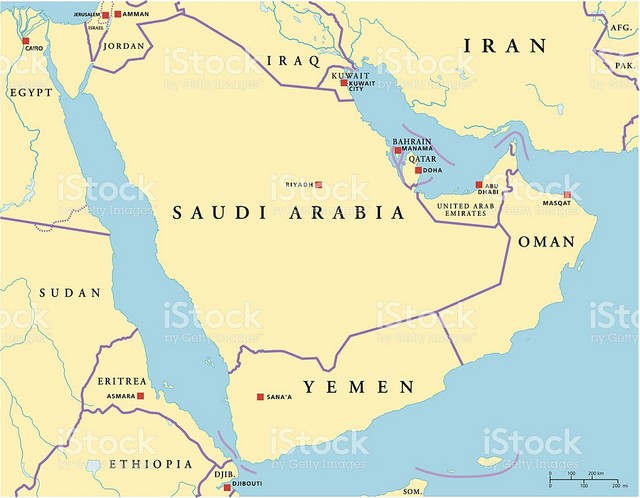
UN officials and most diplomats are reluctant to call the armed conflict by its real name: “a war of aggression”. The aggression of the Saudi Arabia-led coalition (Bahrain, Egypt, Jordan, Kuwait, Morocco, Qatar, Sudan, and the United Arab Emirates) against Yemen began on March 24, 2015.

The Saudi-led coalition is helped with arms and “intelligence” by the USA and the UK which appreciate Saudi money for arms and do not want to antagonize a large segment of the Arab world when the conflicts of Syria-Iraq-Kurds-Turkey is still “on the table.”

However, the aggression of the Saudi coalition is what has turned an internal Yemen struggle for power between the current and the former President of Yemen into a war with regional implications, now drawing Iran into the picture.

Intellectually, the “political solution” is clear. There needs to be an end to the Saudi bombing and a withdrawal of its coalition troops. Then, the different factions in Yemen can try to develop some sort of inclusive government. The Swiss Foreign Minister, a co-host of the conference, hinted to the issue in suggesting very briefly that, if asked, Switzerland could provide expertise on forms of decentralization and con-federal government.

The effort to create a centralized Yemen government has failed. The future lies in a very decentralized government with great autonomy for the regions, taking into consideration the diverse tribal configuration of the country. With intelligence and patience – always in short supply – a single, highly decentralized State might be developed.

The most difficult first-step is ending Saudi-led aggression, after which an effective humanitarian aid and development program can be put into effect.

Prof. René Wadlow is President of the Association of World Citizens.

28 April 2017

Middle Eastern Surgeon Speaks About The ‘Ecology Of War’

By Andre Vltchek

Dr. Gus Abu-Sitta is the head of the Plastic Surgery Department at the AUB Medical Center in Lebanon. He specializes in: reconstructive surgery. What it means in this part of the world is clear: they bring you people from the war zones, torn to pieces, missing faces, burned beyond recognition, and you have to try to give them their life back.

Dr. Abu-Sitta is also a thinker. A Palestinian born in Kuwait, he studied and lived in the UK, and worked in various war zones of the Middle East, as well as in Asia, before accepting his present position at the AUB Medical Center in Beirut, Lebanon.

We were brought together by peculiar circumstances. Several months ago I burned my foot on red-hot sand, in Southeast Asia. It was healing slowly, but it was healing. Until I went to Afghanistan where at one of the checkpoints in Herat I had to take my shoes off, and the wound got badly infected. Passing through London, I visited a hospital there, and was treated by one of Abu-Sitta’sformer professors. When I said that among other places I work in Lebanon,he recommended that I visit one of his “best students who now works in Beirut”.

I did. During that time, a pan-Arab television channel, Al-Mayadeen, was broadcasting in English, with Arabic subtitles, a long two-part interview with me, about my latest political/revolutionary novel “Aurora”and about the state of the global south, and the upsurge of the Western imperialism. To my surprise, Dr. Abu-Sitta and his colleagues were following my work and political discourses. To these hardened surgeons, my foot ‘issue’ was just a tiny insignificant scratch. What mattered was the US attack against Syria, the Palestine, and the provocations against North Korea.

My ‘injury’ healed well, and Dr. Abu-Sitta and I became good friends. Unfortunately I have to leave Beirut for Southeast Asia, before a huge conference, which he and his colleagues are launching on the May 15, 2017, a conference on the “Ecology of War”.

I believe that the topic is thoroughly fascinating and essential for our humanity, even for its survival. It combines philosophy, medicine and science.

What happens to people in war zones? And what is a war zone, really? We arrived at some common conclusions, as both of us were working with the same topic but lookingat it from two different angles: “The misery is war. The destruction of the strong state leads to conflict. A great number of people on our Planet actually live in some conflict or war, without even realizing it: in slums, in refugee camps, in thoroughly collapsed states, or in refugee camps.”

We talked a lot: about fear, which is engulfing countries like the UK, about the new wave of individualism and selfishness, which has its roots in frustration. At one point he said: “In most parts of the world “freedom” is synonymous with the independence struggle for our countries. In such places as the UK, it mainly means more individualism, selfishness and personal liberties.”

We talked about imperialism, medicine and the suffering of the Middle East.

Then we decided to publish this dialogue, shedding some light on the “Ecology of War” – this essential new discipline in both philosophy and medicine.

ECOLOGY OF WAR

(The discussion took place in Beirut, Lebanon, in Cafe Younes, on April 25, 2017)

Broken Social Contract In The Arab World, Even In Europe

G.A-S: In the South, medicine and the provision of health were critical parts of the post-colonial state. And the post-colonial state built medical systems such as we had in Iraq, Egypt and in Syria as part of the social contract. They became an intrinsic part of the creation of those states. And it was a realization that the state has to exercise its power both coercively, (which we know the state is capable of exercising, by putting you in prison, and even exercising violence), but above all non-coercively: it needs to house you, educate you, and give you health, all of those things. And that non-coercive power that the states exercise is a critical part of the legitimizing process of the state. We saw it evolve in 50’s, 60’s and 70’s. So as a digression, if you want to look at how the state was dismantled: the aim of the sanctions against Iraq was not to weaken the Makhabarat or the army, the aim of the sanctions was to rob the Iraqi state of its non-coercive power; its ability to give life, to give education, and that’s why after 12 years, the state has totally collapsed internally – not because its coercive powers have weakened, but because it was robbed of all its non-coercive powers, of all its abilities to guarantee life to its citizens.

AV: So in a way the contract between the state and the people was broken.

G.A-S: Absolutely! And you had that contract existing in the majority of post-colonialist states. With the introduction of the IMF and World Bank-led policies that viewed health andthe provision of health as a business opportunity for the ruling elites and for corporations, and viewed free healthcare as a burden on the state, you began to have an erosion in certain countries like Egypt, like Jordan, of the non-coercive powers of the state, leading to the gradual weakening of its legitimacy. Once again, the aim of the IMF and World Bank was to turn health into a commodity, which could be sold back to people as a service; sold back to those who could afford it.

AV: So, the US model, but in much more brutal form, as the wages in most of those countries were incomparably lower.

G.A-S: Absolutely! And the way you do that in these countries: you create a two-tier system where the government tier is so under-funded, that people choose to go to the private sector. And then in the private sector you basically have the flourishing of all aspects of private healthcare: from health insurance to provision of health care, to pharmaceuticals.

AV: Paradoxically this scenario is also taking place in the UK right now.

G.A-S: We see it in the UK and we’ll see it in many other European countries. But it has already happened in this region, in the Arab world. Here, the provision of health was so critical to creation of the states. It was critical to the legitimacy of the state.

AV: The scenario has been extremely cynical: while the private health system was imposed on the Arab region and on many other parts of the world, in the West itself, except in the United States, medical care remainspublic and basically free. We are talking about state medical care in Europe, Canada, Australia and New Zealand.

G.A-S: Yes. In Europe as part of the welfare state that came out of the Second World War, the provision of healthcare was part of the social contract. As the welfare state with the advent of Thatcherism and Reagan-ism was being dismantled, it became important to undergo a similar process as elsewhere. The difference is that in the UK, and alsoin countries like Germany, it was politically very dangerous. It could lead to election losses. So the second plan was to erode the health system, by a thousand blows kill it gradually. What you ended up in the UK is the piece-by-piece privatization of the health sector. And the people don’t know, they don’t notice that the system is becoming private. Or in Germany where actually the government does not pay for healthcare – the government subsidizes the insurance companies that profit from the private provision of healthcare.

AV: Before we began recording this discussion, we were speaking about the philosophical dilemmas that are now besieging or at least should be besieging the medical profession. Even the social medical care in Europe: isn’t it to some extent a cynical arrangement? European countries are now all part of the imperialist block, together with the United States, and they are all plundering the rest of the world – the Middle East, Africa, parts of Asia – and they are actually subsidizing their social system from that plunder. That’s one thing. But also, the doctors and nurses working for instance in the UK or Germany are often ‘imported’ from much poorer countries, where they have often received free education. Instead of helping their own, needy people, they are actually now serving the ageing and by all international comparisons, unreasonably spoiled and demanding population in Europe, which often uses medical facilities as if they were some ‘social club’.

G.A-S: I think what has happened, particularly in Europe is that there is a gradual erosion of all aspects of the welfare state. Politically it was not yet possible to get rid of free healthcare. The problem that you can certainly see in the United Kingdom is that health is the final consequence of social and economic factors that people live in. So if you have chronic unemployment, second and third generation unemployment problem, these have health consequences. If you have the destruction of both pensions and the cushion of a social umbrella for the unemployed, that has consequences… Poor housing has health consequences. Mass unemployment has health consequences. Politically it was easy to get rid of all other aspects of the welfare state, but they were stuck with a healthcare problem. And so the losing battle that the health systems in the West are fighting is that they are being expected to cater to the poor consequences of the brutal capitalist system as a non-profit endeavor. But we know that once these lifestyle changes are affecting people’s health, it’s too late in terms of cure or prevention. And so what the European health systems do, they try to patch people and to get them out of the system and back on the street. So if you have children with chronic asthma, you treat the asthma but not the dump housing in which these children are living in. If you have violent assaults and trauma related to violence, you treat the trauma, the physical manifestation, and not the breakdown of youth unemployment, or racism that creates this. So in order to sustain this anomaly, as you said, you need an inflated health system, because you make people sick and then you try to fix them, rather than stopping them from being sick. Hence that brain drains that have basically happened, where you have more Ghanaian doctors in New York than you have in Ghana.

AV: And you have an entire army of Philippine nurses in the UK, while there is suddenly a shortage of qualified nurses in Manila.

G.A-S: Absolutely! This is the result of the fact that actually people’s health ‘happens’ outside the health system. Because you cannot get rid of the health system, you end up having a bloated health system, and try to fix the ailments that are coming through the door.

Collapse Of The Health Care In The Middle East

AV: You worked in this entire region. You worked in Iraq, and in Gaza… both you and I worked in Shifa Hospital in Gaza… You worked in Southern Lebanon during the war. How brutal is the healthcare situation in the Middle East? How badly has been, for instance, the Iraqi peoples’ suffering, compared to Western patients? How cruel is the situation in Gaza?

A-S: If you look at places like Iraq: Iraq in the 80’s probably had one of the most advanced health systems in the region. Then you went through the first war against Iraq, followed by 12 years of sanctions in which that health system was totally dismantled; not just in terms of hospitals and medication and the forced exile of doctors and health professionals, but also in terms of other aspects of health, which are the sewage and water and electricity plants, all of those parts of the infrastructure that directly impact on people’s lives.

AV: Then came depleted uranium…

G.A-S: And then you add to the mix that 2003 War and then the complete destruction and dismantling of the state, and the migration of some 50% of Iraq’s doctors.

AV: Where did they migrate?

G.A-S: Everywhere: to the Gulf and to the West; to North America, Europe… So what you have in Iraq is a system that is not only broken, but that has lost the components that are required to rebuild it. You can’t train a new generation of doctors in Iraq, because your trainers have all left the country. You can’t create a health system in Iraq, because you have created a government infrastructure that is intrinsically unstable and based on a multi-polarity of the centers of power which all are fighting for control of the pie of the state… and so Iraqis sub-contract their health at hospital level to India and to Turkey and Lebanon, or Jordan, because they are in this vicious loop.

AV: But this is only for those who can afford it?

G.A-S: Yes for those who can, but even in those times when the government had cash it could not build the system, anymore. So it would sub-contract health provisions outside, because the system was so broken that money couldn’t fix it.

AV: Is it the same in other countries of the region?

G.A-S: The same is happening in Libya and the same is happening in Syria, with regards of the migration of their doctors. Syria will undergo something similar to Iraq at the end of the war, if the Syrian state is destroyed.

AV: But it is still standing.

G.A-S: It still stands and it is still providing healthcare to the overwhelming majority of the population even to those who live in the rebel-controlled areas. They are travelling to Damascus and other cities for their cardiac services or for their oncological services.

AV: So no questions asked; you are sick, you get treated?

G.A-S: Even from the ISIS-controlled areas people can travel and get treated, because this is part of the job of the state.

AV: The same thing is happening with the education there; Syria still provides all basic services in that area.

G.A-S: Absolutely! But in Libya, because the state has totally disappeared or has disintegrated, all this is gone.

AV: Libya is not even one country, anymore…

G.A-S: There is not a unified country and there is definitely no health system. In Gaza and the Palestine, the occupation and the siege, ensure that there is no normal development of the health system and in case of Gaza as the Israelis say “every few years you come and you mown the lawn”; you kill as many people in these brutal and intense wars, so you can ensure that the people for the next few years will be trying to survive the damage that you have caused.

AV: Is there any help from Israeli physicians?

G.A-S: Oh yes! Very few individuals, but there is…

But the Israeli medical establishment is actually an intrinsic part of the Israeli establishment, and the Israeli academic medical establishment is also part of the Israeli establishment. And the Israeli Medical Association refused to condemn the fact that Israeli doctors examine Palestinian political prisoners for what they call “fitness for interrogation”. Which is basically… you get seen by a doctor who decides how much torture you can take before you die.

AV: This actually reminds me of what I was told in 2015 in Pretoria, South Africa, where I was invited to participate as a speaker at the International Conference of the Psychologists for Peace. Several US psychologists reported that during the interrogation and torture of alleged terrorists, there were professional psychologists and even clinical psychiatrists standing by, often assisting the interrogators.

G.A-S: Yes, there are actually 2-3 well-known American psychologists who designed the CIA interrogation system – its process.

AV: What you have described that is happening in Palestine is apparently part of a very pervasive system. I was told in the Indian-controlled Kashmir that Israeli intelligence officers are sharing their methods of interrogation and torture with their Indian counterparts. And of course the US is involved there as well.

CONFLICT MEDICINE

Gus Abu-Sitta: War surgery grew out of the Napoleonic Wars. During these wars, two armies met; they usually met at the frontline. They attacked each other, shot at each other or stabbed each other. Most of injured were combatants, and they got treated in military hospitals. You had an evolution of war surgery. What we have in this region, we believe, is that the intensity and the prolonged nature of these wars or these conflicts are not temporal-like battles, they don’t start and finish. And they are sufficiently prolonged that they change the biological ecology, the ecology in which people live. They create the ecology of war. That ecology maintains itself well beyond of what we know is the shooting, because they alter the living environment of people. The wounds are physical, psychological and social wounds; the environment is altered as to become hostile; both to the able-bodied and more hostile to the wounded. And as in the cases of these multi-drug-resistant organisms, which are now a big issue in the world like the multi-drug-resistant bacteria, 85% of Iraqi war wounded have multi-drug-resistant bacteria, 70% of Syrian war wounded have it… So we say: this ecology, this bio-sphere that the conflicts create is even altered at the basic DNA of the bacteria. We have several theories about it; partly it’s the role of the heavy metals in modern ordnance, which can trigger mutation in these bacteria that makes them resistant to antibiotics. So your bio-sphere, your bubble, your ecological bubble in which you live in, is permanently changed. And it doesn’t disappear the day the bombs disappear. It has to be dismantled, and in order to dismantle it you have to understand the dynamics of the ecology of war. That’s why our program was setup at the university, which had basically been the major tertiary teaching center during the civil war and the 1982 Israeli invasion. And then as the war in Iraq and Syria developed, we started to get patients from these countries and treat them here. We found out that we have to understand the dynamics of conflict medicine and to understand the ecology of war; how the physical, biological, psychological and social manifestations of war wounding happen, and how this ecology of war is created; everything from bacteria to the way water and the water cycle changes, to the toxic reminisce of war, to how people’s body reacts… Many of my Iraqi patients that I see have multiple members of their families injured.

AV: Is the AUB Medical Center now the pioneer in this research: the ecology of war?

G.A.-S: Yes, because of the legacy of the civil war… of regional wars.

AV: Nothing less than a regional perpetual conflict…

G.A-S: Perpetual conflict, yes; first homegrown, and then regional. We are the referral center for the Iraqi Ministry of Health, referral center for the Iraqi Ministry of Interior, so we act as a regional center, and the aim of our program is to dedicate more time and space and energy to the understanding of how this ecology of war comes about.

AV: In my writing and in my films, I often draw the parallel between the war and extreme poverty. I have been working in some of the worst slums on Earth, those in Africa, Central America and Caribbean, South Asia, the Philippines and elsewhere. I concluded that many societies that are in theory living in peace are in reality living in prolonged or even perpetual wars. Extreme misery is a form of war, although there is no ‘declaration of war’, and there is no defined frontline. I covered both countless wars and countless places of extreme misery, and the parallel, especially the physical, psychological and social impact on human beings, appears to be striking. Would you agree, based on your research? Do you see extreme misery as a type of war?

G.A-S: Absolutely. Yes.At the core of it is the ‘dehumanization’ of people. Extreme poverty is a form of violence. The more extreme this poverty becomes, the closer it comes to the physical nature of violence. War is the accelerated degradation of people’s life to reaching that extreme poverty.But that extreme poverty can be reached by a more gradual process. War only gets them there faster.

AV: A perpetual state of extreme poverty is in a way similar to a perpetual state of conflict, of a war.

G.A-S: Definitely. And it is a war mainly against those who are forced to live in these circumstances. It’s the war against the poor and the South. It’s the war against the poor in the inner-cities of the West.

AV: When you are defining the ecology of war, are you also taking what we are now discussing into consideration? Are you researching the impact of extreme poverty on human bodies and human lives? In this region, extreme poverty can often be found in the enormous refugee camps, while in other parts of the world it dwells in countless slums.

G.A-S: This extreme poverty is part of the ecology that we are discussing. One of the constituents of the ecology is when you take a wounded body and you place it in a harsh physical environment and you see how this body is re-wounded and re-wounded again, and this harsh environment becomes a continuation of that battleground, because what you see is a process of re-wounding. Not because you are still in the frontline somewhere in Syria, but because your kids are now living in a tent with 8 other people and they are in danger of becoming the victims of the epidemic of child burns that we now have in the refugee camps, because of poor and unsafe housing.

Let’s look at it from a different angle: what constitutes a war wound, or a conflict-related injury? Your most basic conflict-related injury is a gunshot wound and a blast injury from shrapnel. But what happens when you take that wounded body and throw it into a tent? What are the complications for this wounded body living in a harsh environment; does this constitute a war-related injury? When you impoverish the population to the point that you have children suffering from the kind of injuries that we know are the results of poor and unsafe housing, is that a conflict-related injury? Or you have children now who have work-related injuries, because they have to go and become the main breadwinners for the home, working as car mechanics or porters or whatever. Or do you also consider a fact that if you come from a country where a given disease used to be treatable there, but due to the destruction of a health system, that ailment is not treatable anymore, because the hospitals are gone or because doctors had to leave, does that constitute a conflict-related injury? So, we have to look at the entire ecology: beyond a bullet and shrapnel – thingsthat get headlines in the first 20 seconds.

AV: Your research seems to be relevant to most parts of the world.

G.A-S: Absolutely. Because we know that these humanitarian crises only exist in the imagination of the media and the UN agencies. There are no crises.

AV: It is perpetual state, again.

G.A-S: Exactly, it is perpetual. It does not stop. It is there all the time. Therefore there is no concept of ‘temporality of crises’, one thing we are arguing against. There is no referee who blows the whistle at the end of the crises. When the cameras go off, the media and then the world, decides that the crises are over. But you know that people in Laos, for instance,still have one of the highest amputation rates in the world.

AV: I know. I worked there in the Plain of Jars, which is an enormous minefield even to this day.

G.A-S: Or Vietnam, with the greatest child facial deformities in the world as a result of Agent Orange.

AV: You worked in these countries.

G.A-S: Yes.

AV: Me too; and I used to live in Vietnam. That entire region is still suffering from what used to be known as the “Secret War”. In Laos, the poverty is so rampant that people are forced to sell unexploded US bombs for scrap. They periodically explode. In Cambodia, even between Seam Reap and the Thai border, there are villages where people are still dying or losing limbs.

G.A-S: Now many things depend on how we define them. It is often a game of words.

AV: India is a war zone, from Kashmir to the Northeast, Bihar and slums of Mumbai.

G.A-S: If you take the crudest way of measuring conflict, which is the number of people killed by weapons, Guatemala and Salvador have now more people slaughtered than they had during the war. But because the nature in which violence is exhibited changed, because it doesn’t carry a political tag now, it is not discussed. But actually, it is by the same people against the same people.

AV: I wrote about and filmed in Salvador, Honduras and Nicaragua, on several occasions. The extreme violence thereis a direct result of the conflict implanted, triggered by the West, particularly by the United States. The same could be said about such places like Jamaica, Dominican Republic and Haiti.It has led to almost absolute social collapse.

G.A-S: Yes, in Jamaica, the CIA played a great role in the 70’s.

AV: In that part of the world we are not talking just about poverty…

G.A-S: No, no. We are talking AK-47’s!

AV: Exactly. Once I filmed in San Salvador, in a gangland… A friend, a local liberation theology priest kindly drove me around. We made two loops. The first loop was fine. On the second one they opened fire at our Land Cruiser, with some heavy stuff. The side of our car was full of bullet holes, and they blew two tires. We got away just on our rims. In the villages, marassimply come and plunder and rape. They take what they want. It is a war.

G.A.-S: ICRC, they train surgeons in these countries. So the ICRC introduced war surgery into the medical curriculum of the medical schools in Colombia and Honduras. Because effectively, these countries are in a war, so you have to train surgeons, so they know what to do when they receive 4-5 patients every day, with gunshot wounds.

AV: Let me tell you what I witnessed in Haiti, just to illustrate your point. Years ago I was working in Cité Soleil, Port-au-Prince, Haiti. They say it is the most dangerous ‘neighborhood’ or slum on Earth. The local wisdom goes: “you can enter, but you will never leave alive”. I went there with a truck, with two armed guards, but they were so scared that they just abandoned me there, with my big cameras and everything, standing in the middle of the road. I continued working; I had no choice. At one point I saw a long line in front of some walled compound. I went in. What I was suddenly facing was thoroughly shocking: several local people on some wooden tables, blood everywhere, and numerous US military medics and doctors performing surgeries under the open sky. It was hot, flies and dirt everywhere… A man told me his wife had a huge tumor. Without even checking what it was, the medics put her on a table, gave her “local” and began removing the stuff. After the surgery was over, a husband and wife walked slowly to a bus stop and went home. A couple of kilometers from there I founda well-equipped and clean US medical facility, but only for US troops and staff. I asked the doctors what they were really doing in Haiti and they were quiet open about it; they replied: “we are training for combat scenario… This is as close to a war that we can get.” They were experimenting on human beings, of course; learning how to operate during the combat…

G.A-S: So, the distinction is only in definitions.

AV: As a surgeon who has worked all over the Middle East but also in many other parts of the world, how would you compare the conflict here to the conflicts in Asia, the Great Lakes of Africa and elsewhere?

G.A-S: In the Middle East, you still have people remembering when they had hospitals. Iraqis who come to my clinic remember the 80’s. They know that life was different and could have been different. And they are health-literate. The other issue is that in 2014 alone, some 30,000 Iraqis were injured. The numbers are astounding. We don’t have a grasp of the numbers in Libya, the amount of ethnic cleansing and killing that is happening in Libya. In terms of numbers, they are profound, but in terms of the effect, we are at the beginning of the phase of de-medicalization. So it wasn’t that these medical systems did not develop. They are being de-developed. They are going backwards.

AV: Are you blaming Western imperialism for the situation?

G.A-S: If you look at the sanctions and what they did to their health system, of course! If you look at Libya, of course! The idea that these states disintegrated is a falsehood. We know what the dynamics of the sanctions were in Iraq, and what happened in Iraq after 2003. We know what happened in Libya.

AV: Or in Afghanistan…

G.A-S: The first thing that the Mujahedeen in Afghanistan or the Nicaraguan Contras were told to do was to attack the clinics. The Americans have always understood that you destroy the state by preventing it from providing these non-coercive powers that I spoke about.

AV: Do you see this part of the world as the most effected, most damaged?

G.A-S: At this moment and time certainly. And the statistics show it. I think around 60% of those dying from wars are killed in this region…

AV: And how do you define this region geographically?

G.A-S: From Afghanistan to Mauritania. And that includes the Algerian-Mali border. The Libyan border… The catastrophe of the division of Sudan, what’s happening in South Sudan, what’s happening in Somalia, Libya, Egypt, the Sinai Desert, Syria, Yemen, Afghanistan, even Pakistan including people who are killed there by drones…

AV: But then we also have around 10 million people who have died in the Democratic Republic of Congo, since the 1995 Rwandan invasion…

G.A-S: Now that is a little bit different. That is the ‘more advanced phase’: when you’ve completely taken away the state… In the Arab world Libya is the closest to that scenario. There the oil companies have taken over the country. The mining companies are occupying DRC. And they run the wars directly, rather than through the Western armies. You erode the state, completely, until it disappears and then the corporations, directly, as they did in the colonialist phase during the East Indian Company, and the Dutch companies, become the main players again.

AV: What is the goal of your research, the enormous project called the “Ecology of War”?

G.A-S: One of the things that we insist on is this holistic approach. The compartmentalization is part of the censorship process. “You are a microbiologist then only look what is happening with the bacteria… You are an orthopedic surgeon, so you only have to look at the blast injuries, bombs, landmine injuries…” So that compartmentalization prevents bringing together people who are able to see the whole picture. Therefore we are insisting that this program also has social scientists, political scientists, anthropologists, microbiologists, surgeons… Otherwise we’d just see the small science. We are trying to put the sciences together to see the bigger picture. We try to put the pieces of puzzle together, and to see the bigger picture.

AV: And now you have a big conference. On the 15th of May…

G.A-S: Now we have a big conference; basically the first congress that will look at all these aspects of conflict and health; from the surgical, to the reconstruction of damaged bodies, to the issues of medical resistance of bacteria, infectious diseases, to some absolutely basic issues. Like, before the war there were 30,000 kidney-failure patients in Yemen. Most dialysis patients are 2 weeks away from dying if they don’t get dialysis. So, there is a session looking at how you provide dialysis in the middle of these conflicts? What do you do, because dialysis services are so centralized? The movement of patients is not easy, and the sanctions… One topic will be ‘cancer and war’… So this conference will be as holistic as possible, of the relationship between the conflict and health.

We expect over 300 delegates, and we will have speakers from India, Yemen, Palestine, Syria, from the UK, we have people coming from the humanitarian sector, from ICRC, people who worked in Africa and the Middle East, we have people who worked in previous wars and are now working in current wars, so we have a mix of people from different fields.

AV: What is the ultimate goal of the program?

G.A-S: We have to imagine the health of the region beyond the state. On the conceptual level, we need to try to figure out what is happening? We can already see certain patterns. One of them is the regionalization of healthcare. The fact that Libyans get treated in Tunisia, Iraqis and Syrians get treated in Beirut, Yemenis get treated in Jordan. So you already have the disintegration of these states and the migration of people to the regional centers. The state is no longer a major player, because the state was basically destroyed. We feel that this is a disease of the near future, medium future and long-term future. Therefore we have to understand it, in order to better treat it, we have to put mechanisms in place that this knowledge transfers into the medical education system, which will produce medical professionals who are better equipped to deal with this health system. We have to make sure that people are aware of many nuances of the conflict, beyond the shrapnel and beyond the bullet. The more research we put into this area of the conflict and health, the more transferable technologies we develop –the better healthcare we’d be allowed to deliver in these situations, the better training our students and graduates would receive,and better work they willperform in this region for the next 10 or 15 years.

AV: And hopefully more lives would be saved…

Andre Vltchek is a philosopher, novelist, filmmaker and investigative journalist. He has covered wars and conflicts in dozens of countries. Three of his latest books are revolutionary novel “Aurora” and two bestselling works of political non-fiction: “Exposing Lies Of The Empire” and  “Fighting Against Western Imperialism”.View his other books here. Andre is making films for teleSUR and Al-Mayadeen. Watch Rwanda Gambit, his groundbreaking documentary about Rwanda and DRCongo. After having lived in Latin America, Africa and Oceania, Vltchek presently resides in East Asia and the Middle East, and continues to work around the world. He can be reached through his website and his Twitter.

28 April 2017

The Shame of Killing Innocent People

By Kathy Kelly

On April 26th, 2017, in Yemen’s port city of Hodeidah, the Saudi-led coalition which has been waging war in Yemen for the past two years dropped leaflets informing Hodeidah’s residents of an impending attack.  One leaflet read:

“Our forces of legitimacy are heading to liberate Hodeidah and end the suffering of our gracious Yemeni people. Join your legitimate government in favor of the free and happy Yemen.”

And another: “The control of the Hodeidah port by the terrorist Houthi militia will increase famine and hinder the delivery of international relief aid to our gracious Yemeni people.”

Certainly the leaflets represent one aspect of a confusing and highly complicated set of battles raging in Yemen. Given alarming reports about near famine conditions in Yemen, it seems the only ethical “side” for outsiders to choose would be that of children and families afflicted by hunger and disease.

Yet the U.S. has decidedly taken the side of the Saudi-led coalition. Consider a Reuters report, on April 19, 2017, after U.S. Defense Secretary James Mattis met with senior Saudi officials. According to the report, U.S. officials said “U.S. support for the Saudi-led coalition was discussed including what more assistance the United States could provide, including potential intelligence support…”  The Reuters report notes that Mattis believes “Iran’s destabilizing influence in the Middle East would have to be overcome to end the conflict in Yemen, as the United States weighs increasing support to the Saudi-led coalition fighting there.”

Iran may be providing some weapons to the Houthi rebels, but it’s important to clarify what support the U.S. has given to the Saudi-led coalition.  As of March 21, 2016, Human Rights Watch reported the following weapon sales, in 2015 to the Saudi government:

– July 2015, the US Defense Department approved a number of weapons sales to Saudi Arabia, including a US $5.4 billion deal for 600 Patriot Missiles and a $500 million deal for more than a million rounds of ammunition, hand grenades, and other items, for the Saudi army.

– According to the US Congressional review, between May and September, the US sold $7.8 billion worth of weapons to the Saudis.

– In October, the US government approved the sale to Saudi Arabia of up to four Lockheed Littoral Combat Ships for $11.25 billion.
· In November, the US signed an arms deal with Saudi Arabia worth $1.29 billion for more than 10,000 advanced air-to-surface munitions including laser-guided bombs, “bunker buster” bombs, and MK84 general purpose bombs; the Saudis have used all three in Yemen.

Reporting about the role of the United Kingdom in selling weapons to the Saudis, Peace News notes that “Since the bombing began in March 2015, the UK has licensed over £3.3bn worth of arms to the regime, including:

– £2.2 bn worth of ML10 licences (aircraft, helicopters, drones)

– £1.1 bn worth of ML4 licences (grenades, bombs, missiles, countermeasures)

– £430,000 worth of ML6 licences (armoured vehicles, tanks)

What has the Saudi-led coalition done with all of this weaponry?  A United Nations High Commissioner for Human Rights panel of experts found that:
“At least 3,200 civilians have been killed and 5,700 wounded since coalition military operations began, 60 percent of them in coalition airstrikes.”

A Human Rights Watch report, referring to the UN panel’s findings, notes that the panel documented attacks on camps for internally displaced persons and refugees; civilian gatherings, including weddings; civilian vehicles, including buses; civilian residential areas; medical facilities; schools; mosques; markets, factories and food storage warehouses; and other essential civilian infrastructure, such as the airport in Sana’a, the port in Hodeidah and domestic transit routes.”

Five cranes in Hodeidah which were formerly used to offload goods from ships arriving in the port city were destroyed by Saudi airstrikes.  70% of Yemen’s food comes through the port city.

Saudi coalition airstrikes have hit at least four hospitals supported by Doctors Without Borders.

In light of these findings, the leaflets fluttering down from Saudi jets on the beleaguered city of Hodeidah, encouraging residents to side with the Saudis “in favor of the free and happy Yemen” seem exceptionally bizarre.

UN agencies have clamored for humanitarian relief. Yet the role the UN Security Council has played in calling for negotiations seems entirely lopsided.  On April 14, 2016, UN Security Council Resolution 2216 demanded “that all parties in the embattled country, in particular the Houthis, immediately and unconditionally end violence and refrain from further unilateral actions that threatened the political transition.” At no point is Saudi Arabia mentioned in the Resolution.

Speaking on December 19, 2016, Sheila Carpico, Professor of Political Science at the University of Richmond and a leading Yemen specialist called the UN Security Council sponsored negotiations a cruel joke.

These negotiations are based on UN Security Council resolutions 2201 and 2216. Resolution 2216 of 14 April 2015, reads as if Saudi Arabia is an impartial arbitrator rather than a party to an escalating conflict, and as if the GCC “transition plan” offers a “peaceful, inclusive, orderly and Yemeni-led political transition process that meets the legitimate demands and aspirations of the Yemeni people, including women.”

Although scarcely three weeks into the Saudi-led intervention the UN’s deputy secretary-general for human rights said that the majority of the 600 people already killed were civilian victims of Saudi and Coalition airstrikes, UNSC 2216 called only on “Yemeni parties” to end the use of violence. There was no mention of the Saudi-led intervention. There was similarly no call for a humanitarian pause or corridor.

The UN Security Council resolution seems as bizarre as the leaflets delivered by the Saudi jets.

The U.S. Congress could put an end to U.S. complicity in the crimes against humanity being committed by military forces in Yemen.  Congress could insist that the U.S. stop supplying the Saudi led coalition with weapons, stop helping Saudi jets to refuel, end diplomatic cover for Saudi Arabia, and stop providing the Saudis with intelligence support. And perhaps the U.S. Congress would move in this direction if elected representatives believed that their constituents care deeply about these issues. In today’s political climate, public pressure has become vital.

Historian Howard Zinn famously said, in 1993, “There is no flag large enough to cover the shame of killing innocent people for a purpose which is unattainable. If the purpose is to stop terrorism, even the supporters of the bombing say it won’t work; if the purpose is to gain respect for the United States, the result is the opposite…”  And if the purpose is to raise the profits of major military contractors and weapon peddlers?

Kathy Kelly (Kathy@vcnv.org) co-coordinates Voices for Creative Nonviolence (www.vcnv.org)

28 April 2017

Yassmin Abdel-Magied Censored On Anzac Day – Jingoists Trash Australian Free Speech

By Dr Gideon Polya

On Australia’s Anzac Day,  Muslim, feminist  social advocate and  humanitarian  journalist  Yassmin Abdel-Magied (who works for the ABC, Australia’s equivalent of the UK BBC) posted on her Facebook page: “Lest we forget (Manus, Nauru, Syria, Palestine)”. Savaged by public outcry, Ms Abdel-Magied rapidly deleted the post and apologized. The post was correct and her silencing by rabid jingoists is a stain on Australia and an attack on free speech.

One can succinctly amplify Yassmin Abdel-Magied’s truthful combination of seven (7) words that so offended the rabid jingoists of imperial lackey Australia as follows. Australia’s Anzac Day (“the one day of the year”) commemorates the invasion of Turkey on 25 April 1915 by the Australian  and New Zealand Army Corps (ANZAC) and Anglo-French forces. The invasion was unsuccessful and the Allied forces withdrew in 1916.  Anzac Day commemorates  Australia’s  war dead totalling about 100,000 over the last century in the service of the British Empire or, after Pearl Harbor,  the American Empire. Australia and the Australian War Memorial ignore the 100,000  Indigenous Australians who died defending Australia from genocidal invaders (the British) while massively – and indeed most appropriately – commemorating 100,000 courageous Australians who died overseas in foreign lands in British and/or American wars.

As a UK lackey or US lackeys Australia has invaded 85 out of 203 present-day countries (195 UN-recognized nations and 8 non-UN-recognized self-governing countries) as compared to the British 193, the French 80,  the US 72 (52 after WW2), Germany 39, Japan 30, Russia 25, Canada 25,  Apartheid Israel 12 and China 2. Australia has been involved in all post-1950 US Asian wars, atrocities associated with 40 million Asian deaths from violence or war-imposed deprivation. Australia is an enthusiastic participant in the US War on Muslims (aka the US War on Terror) that has been associated with 32 million Muslims deaths from violence, 5 million, or deprivation, 27 million, in 20 countries invaded by the  US Alliance since the US Government’s 9-11 false flag atrocity that killed 3,000 people, overwhelmingly  Americans. There are presently 65 million refugees in the World  with about half being Muslim refugees from genocidal wars conducted by the US and its allies, notably the UK, Australia, Canada, France  and US-, UK-, Australia- , Canada- and France-backed Apartheid Israel. The refugee breakdown is circa  7 million (Palestine),  5-6 million (Iraq), 11 million (Syria), 2 million (Somalia), 1 million (Libya), 3 million (Afghanistan), 2 million (Pakistan), 0.5 million (Yemen). US lackey Australia is complicit in an ongoing Muslim Holocaust and Muslim Genocide. In addition to various involvements in Libya, Syira, Iraq, Afghanistan, and Pakistan, Australia is  targeting  US drone strikes in starving Somalia and starving Yemen (Gideon Polya, “Paris Atrocity Context: 27 Million Muslim Avoidable  Deaths From Imposed Deprivation In 20 Countries Violated By US Alliance Since 9-11”, Countercurrents, 22 November, 2015: http://www.countercurrents.org/polya221115.htm ;  “Experts: US did 9-11”: https://sites.google.com/site/expertsusdid911/; “Muslim Holocaust Muslim Genocide”: https://sites.google.com/site/muslimholocaustmuslimgenocide/ ; “Stop state terrorism”: https://sites.google.com/site/stopstateterrorism/ ).

Back to Yassmin Abdel-Magied’s “Lest we forget (Manus, Nauru, Syria, Palestine)” –  “Lest we forget” is absolutely correct. Silence is complicity and silencing truth-tellers like Yassmin Abdel-Magied is worse than mere complicity. Australia has a policy of highly abusively and indefinitely  imprisoning  refugees (mostly Muslims) without charge or trial in remote concentration camps on the Island Nation of Nauru and on Manus Island in Papua New Guinea. Australia is presently involved in its Third Syrian War in a century (it previously invaded Syria in WW1 and WW2). In the present US-backed Syrian Civil War 0.5 million Syrians  have  died violently, a similar number have died from war-imposed deprivation and 11 million refugees have been generated . ANZAC forces commenced the Palestinian Genocide and Bedouin Genocide with the WW1 conquest of Palestine that led to a famine that killed 100,000 Palestinians, and with the December 1918 Surafend Massacre of Palestinians, including Bedouin. ANZAC forces helped to brutally suppress pro-democracy Egyptians  in 1919.

Duncan Fine (a lawyer and Director and Special Counsel for The National Justice Project) has come to Yassmin Abdel-Magied’s defence and offered this fine opinion: “Last month Attorney-General George Brandis called for changes to the “offend, insult and humiliate” clause in Section 18C of the Racial Discrimination Act, saying that they stifled freedom of speech and that was “one of the key things the Anzacs fought for”. With perfect timing, yesterday, on Anzac Day, we got to see whether he was right. Because Yassmin Abdel-Magied, the young social advocate, part-time ABC presenter and writer posted on her Facebook page: “Lest we forget (Manus, Nauru, Syria, Palestine)”. She deleted the post within hours and wrote a brief ­apology… To paraphrase George Brandis, the ability to bravely say what you think, no matter how unpopular, is exactly why the Anzacs fought at Gallipoli. Accordingly, we should celebrate Abdel-Magied, not attack her” (Duncan Fine , “We should celebrate Yassmin Abdel-Magied , not attack her”, Sydney Morning Herald , 26 April 2017: http://www.smh.com.au/comment/we-should-celebrate-yassmin-abdelmagied-not-attack-her-20170426-gvsp1k.html ).

I wrote a letter of support for Yassmin Abdel-Magied  to her fellow  ABC journalists (however the Silence has been Deafening):

LETTER:

“Dear ABC journalist,

This is a letter of support for a courageous and humane  ABC journalist, Ms Yassmin Abdel-Magied, who was absolutely correct to say in effect: “Lest we forget all the victims of war” but has been savaged on that account by  the Yellow Press of the Dirty Digger [media mogul Rupert Murdoch] and by a vomit of Coalition politicians.

ANZAC forces commenced the Palestinian Genocide and Bedouin Genocide with the WW1 conquest of Palestine that led to a famine that killed 100,000 Palestinians and with the December 1918 Surafend Massacre of Palestinians, including Bedouin. 25 April is Anzac Day for Australians and New Zealanders, a day on which they quite rightly remember their courageous veterans and courageous military war dead at cenotaph memorial  services and veteran parades  in cities and in country towns. The key phrase associated with Anzac Day is “lest we forget” – lest we forget the courageous and loyal men and women who served or  died in the service of their country in war,  whether or not the war was just or lawful. However “lest we forget” unfortunately does not extend to the victims of rape in war or the millions of “collateral” civilian deaths.  Nor does “lest we forget” extend to the war criminal politicians, lobbyists, media and corporations primarily responsible for these war crimes. 25 April is Anzac Day commemorating the Australian and New Zealand Army Corps (ANZAC) invasion of Turkey at Gallipoli in 1915, the day after the commencement of the Turkish Armenian Genocide (1.5 million Armenians killed) that was precipitated by the prior prolonged Allied naval bombardment. On Anzac Day Australians utterly ignore Australia’s complicity in horrendous UK and US war crimes. Australia has a secret genocide history that is resolutely ignored by White Australians.

For details of 40 deadly atrocities in which Australia has been complicit see  Gideon Polya, “On Anzac Day Australia ignores its complicity in horrendous war crimes & climate crimes”, Countercurrents, 24 April 2017: http://www.countercurrents.org/2017/04/24/on-anzac-day-australia-ignores-its-complicity-in-horrendous-war-crimes-climate-crimes/ .

My detailed and documented analysis was published on Armenian Genocide Remembrance Day (Armenian Genocide Memorial Day) (24 April)  for a world-wide audience and concludes: “On Anzac Day Australians rightly remember the sacrifice of their courageous veterans and  courageous war dead. However,  on such solemn memorial occasions Australians, all members of the US Alliance and indeed all of Humanity must also  publicly remember the horrendous civilian deaths from violence or war-imposed deprivation and other atrocities, notably rape and other violent and traumatic subjugation, associated with war.  Lest we forget. As Albert Einstein famously observed: “I know not with what weapons World War III will be fought, but World War IV will be fought with sticks and stones”. Sustained Mainstream media fake news through lying by omission means that a poorly-informed Humanity is badly running out of time to save the planet. Examine the above catalogue of war criminal,  climate criminal or sociopathic Australian complicities and determine the complicity of your country in egregious inhumanity or egregious threats to Humanity.  Please tell everyone you can.”

Yours sincerely, Dr, Gideon Polya, Melbourne, Victoria, Australia”

Since the terror hysteria occasioned by the US Government’s 9-11 false flag atrocity that killed 3,000 people, mostly Americans, there has been a huge increase in anti-Arab anti-Semitism, Islamophobia, warmongering and jingoism within the US Alliance, including  Australia.  Each year  Australian Mainstream  media, politicians and academic presstitutes join in an outpouring of fervent jingoism on the occasion of Anzac Day.  Alex Bainbridge commented thus in the Green left Weekly on this most recent Anzac Day (2017): “Today — ANZAC Day — is the climax of the orgy of nationalism and militarism we’ve been subjected to in recent times, ostensibly to remember the ordinary people who responded to the lies of the government by fighting and dying in an unjust war. Of course progressive people have sympathy for the soldiers who died as well as the soldiers who didn’t die but nevertheless witnessed or experienced terrible things. But it is also fair to point out the hypocrisy of the official propaganda machine” (Alex Bainbridge, “Justice and hypocrisy on Anzac Day), Green Left Weekly, 25 April 2017: https://www.greenleft.org.au/content/justice-and-hypocrisy-anzac-day ).

Honest and forthright Australian journalist Guy Rundle writing in the independent Australian web magazine Crikey on the centenary of the futile and bloody 1915 ANZAC and Allied invasion of Turkey (2015): “As Anzac Day approaches, the World War I wars have started up again! About ten years ago, WWI ceased to be a futile struggle and became a struggle against German militarism. The reason was obvious: as the Iraq War bogged down, the usual historical argument for war — the failure of “appeasing” Hitler — stopped working. We needed the example of a meaningful quagmire, and so WWI was it, the revision starting almost to the day that the last living witnesses of the conflict died. But Turkey has always been a problem in this — there was nothing to pin on the rather torpid empire, which was attacked purely as a way to cut through to central Europe and open a second front (and then carve up its provinces into colonies). That problem has become especially acute now that we are attempting to turn Gallipoli into something other than meaningless slaughter… Meanwhile, there’s probably at least one truth and reconciliation commission that Australians should be more interested in, and that’s to do with a war closer to home — the frontier massacres of Aborigines, which continued right up to and beyond WWI, and which shaped the attitudes of many of the country kids who became the Diggers. There’s a link there, too. The larrikin image of the Anzacs that we celebrate may have come from an irreverence to authority in the face of British disdain, but much of that disdain came from the fact that some, perhaps many, Australian troops were far more willing to kill Arab civilians than British soldiers were, and Australian troops were notorious for it. Why? Because they’d already become comfortable and relaxed about killing brown people at home, and Arabs were just a different shade” (Guy Rundle, “Rundle: the Right really do not want to open the Anzac can of worms”, Crikey, 16 April 2015: https://www.crikey.com.au/2015/04/16/rundle-the-right-really-do-not-want-to-open-the-anzac-can-of-worms/ )

Guy Rundle is correct about the (ongoing) Australian Aboriginal Genocide.  Australia (like Apartheid Israel that Zionist-subverted, US lackey Australia backs with a fervency second only to that of the Zionist-subverted US), arose through racist European colonization and ongoing genocide of the Indigenous population. Thus the Indigenous Australian population dropped from about 1 million in 1788 to about 0.1 million a century after invasion  due to violence,   dispossession, disease and deprivation. The Aboriginal Genocide continues with about 4,000 Indigenous Australians dying avoidably each year. Indeed about 2 million Aborigines have died untimely deaths from violence, 0.1 million, or deprivation and disease, 1.9 million, since 1788. There were up to 750 unique Aboriginal groups and associated languages and dialects in 1788 but only 150 remain with all but 20 endangered. Aboriginal Ethnocide (Aboriginal Cultural Genocide) continues through deprivation,  removal of bilingual education and continued removal of Indigenous children from their mothers at a record rate. About 0.1 million Indigenous Australian died violently in the “frontier wars”,  with violent extermination of Indigenous Australians (Aboriginal, Aborigines) only ceasing after the Coniston Massacre in 1928 in Central Australia (Gideon Polya, “Australian PM Turnbull backs genocidal Apartheid Israel with falsehood and exceptionalism”, Countercurrents, 24 February 2017: http://www.countercurrents.org/2017/02/24/australia-pm-turnbull-backs-genocidal-apartheid-israel-with-falsehood-and-exceptionalism/ ; “Aboriginal Genocide”: https://sites.google.com/site/aboriginalgenocide/ .)

Crikey published my following comments on Guy Rundle’s truth-telling: “Congratulations to Guy Rundle for his powerful, truth-telling antidote to 100 years of Australian warmongering propaganda and mythologizing. History ignored yields history repeated and Australia is now engaged in its Seventh Iraq War, this year marking not just the centenary of Australia’s disaster at Gallipoli (8,000 Australians killed, about 700 from disease) and the Armenian Genocide (1.5 million Armenians killed) but also the start of Australia’s First Iraq War (see Gideon Polya, “Australia’s First Iraq War” , MWC News, 28 February 2015 : http://mwcnews.net/focus/analysis/50028-australias-seventh-iraq-war.html ). However some corrections and amplifications below: 1. After months of Allied shelling in the Dardanelles, the Turkish Armenian Genocide began on 24 April 2015, the eve of the Anzac landing, with the round-up of Armenian community leaders – indeed 24 April is commemorated as Armenian Genocide Remembrance Day (see Gideon Polya, ‘Australian ANZAC Day, Armenian Genocide Day Of Remembrance And Australia’s Secret Genocide History”, Countercurrents, 24 March, 2013: http://www.countercurrents.org/polya240413.htm ). 2. Australia was complicit in the WW2 Bengali Holocaust (the 1942-1945 Bengal Famine; 6-7 million Indians deliberately starved to death by the British ) by withholding food from starving India from its huge wartime wheat stores (see “Bengali Holocaust (WW2 Bengal Famine” writings of Dr Gideon Polya”: https://sites.google.com/site/drgideonpolya/bengali-holocaust and Gideon Polya (2011), “Australia And Britain Killed 6-7 Million Indians In WW2 Bengal Famine”, Countercurrents, 29 September, 2011: http://www.countercurrents.org/polya290911.htm ). 3. Turkey is but 1 out of 85 countries that Australia has invaded as a UK lackey or a US lackey with variously disastrous short-term and long-term consequences (see Gideon Polya, “As UK Lackeys Or US Lackeys Australians Have Invaded 85 Countries (British 193, French 80, US 70)”, Countercurrents, 9 February, 2015: http://www.countercurrents.org/polya090215.htm and Gideon Polya (2013), “Review: “The Cambridge History Of Australia” Ignores Australian Involvement In 30 Genocides”, Countercurrents, 14 October, 2013: http://www.countercurrents.org/polya141013.htm ).”

Back in 2015, Scott McIntyre, a courageous young sports journalist with Australia’s substantially taxpayer-funded,  multicultural  Special Broadcasting Service (SBS), was sacked after he tweeted a succession of truthful anti-war comments on Anzac Day (25 April and Australia’s more important of 2 major  war dead remembrance days, the other being  the WW1-end Remembrance Day on 11 November, also the date in 1975  on which progressive Australian PM Gough Whitlam was sacked in a US CIA-backed Coup). Only a few decent Australians –  most notably Guy Rundle,  John Pilger (outstanding expatriate Australian journalist), Greg Barnes (a barrister and a spokesman for the Australian Lawyers Alliance.), the NSW Council for Civil Liberties  and myself – came to his defence, and the rest was silence or strong condemnation of McIntyre from politicians , journalists and commentators . Free speech was trashed in jingoistic, pro-war , US lackey, endlessly war mongering and human rights-abusing  Australia (Gideon Polya, “Australia trashes free speech – SBS sacks journalist Scott McIntyre over anti-war tweets.”, Countercurrents, 4 April 2015: http://www.countercurrents.org/polya040515.htm ).

Indeed Guy Rundle commented thus on Anzac Day and Scott McIntyre (2015): “The [1916 Dublin, Ireland] Easter Rising was worth becoming a martyr for, but Anzac Day collapses under the weight of its own meaninglessness. That we were defeated at Gallipoli was unquestionably the best thing, a demonstration to the world that the Europeans could be stopped from turning the whole world into their empire. The meaning of the deaths of Anzacs, as an event, can only come from defeat. It was necessary to a good result that we be thrown back into the sea. The private and particular meanings we make of the invasion is a way of avoiding that melancholy truth.… Scott McIntyre’s tweets were a related example — he was just the first person in the mainstream meeja to crack. The fact that the Minister of Communications [the oh-so-charming, all-smiles, ostensible liberal but US lackey Rightist and lipstick-on-a-pig Malcolm Turmbull – now PM of Australia] felt the need to step in on four tweets shows how brittle the whole thing has become” (Guy Rundle, “Rundle – on Anzac Day in Dublin and a cause worth dying for”, Crikey, 27 April 2015: https://www.crikey.com.au/2015/04/27/rundle-on-anzac-day-in-dublin-and-a-cause-worth-dying-for/ ).

The jingoists, warmongers, and war-glorifiers falsely praise themselves for upholding  national security  – however the opposite is true at a very fundamental level. The jingoists and warmongers endanger Humanity by falsehood and censorship. Fundamentally , rational risk management that is crucial for societal safety, successively involves (a) accurate  reportage, (b)  scientific analysis (this involving the critical testing of potentially falsifiable  hypotheses) and (c) informed systemic change to minimize risk. Unfortunately this is  turned on its  head by jingoist warmongers through (a) lying, censorship and intimidation, (b) anti-science spin-based analysis (this involving the selective use of asserted facts to support a partisan position) and (c) counterproductive, reportage-threatening blame and shame, with the ultimate obscenities being violence and war.

Thus warmongering lunacy must be opposed by decent, sane people everywhere. The Korean War resulted in the deaths of up to 28% of the North Korean population  by US saturation  bombing and turned North Korea into a one-party state and military fortress that has now acquired several nuclear bombs. US lackey Australia has joined threatening Trump jingoism over North Korea which has responded in kind with this appalling, horrifying and chilling threat: “If Australia persists in following the US’ moves to isolate and stifle North Korea … this will be a suicidal act of coming within the range of the nuclear strike of the strategic force of North Korea”. Of course one notes that Australia is complicit in US nuclear terrorism  via electronic tracking facilities such as that at Pine Gap in Central Australia and through hosting  US ship-borne nuclear weapons – Australia thus helps the US  threaten all nations on earth with nuclear annihilation. ANU Professor Leszek Buszynski has commented: “This is a [North Korean] regime that fears the United States may launch a pre-emptive strike. I think in North Korea they take this very seriously indeed, because they’ve seen what the Trump administration has done in Syria … and they would fear that the US would do the same to them” (Andrew Green, “North Korea threatened nuclear strike against Australia if it doesn’t  stop “blindly toeing US line””, ABC News, 23 April, 217: http://www.abc.net.au/news/2017-04-22/north-korea-accuses-australia-of-blindly-following-the-us/8464252 ).

Australia and the World would be better served if Australia sought to encourage a pragmatic, China-mediated and China-guaranteed North Korea –South Korea rapprochement that would obviate North Korea’s present perception that it needs nuclear weapons. And then the World could turn its attention to US-, UK- and Australia-backed nuclear terrorist, genocidally racist, racist Zionist-run, democracy-by –genocide Apartheid Israel that reportedly has 400 nuclear bombs, that (unlike Iran) refuses to sign the Nuclear Non-Proliferation Treaty (NPT), that (unlike North Korea) refuses to ratify the Chemical Weapons Convention (CWC), which has invaded a dozen countries and routinely bombs other countries when it chooses to (Korea and Iran have not invaded any other country for centuries) (see “Nuclear weapons ban , end poverty & reverse climate change”: https://sites.google.com/site/300orgsite/nuclear-weapons-ban ).

Former Australian PM, the late  Malcolm Fraser, warned against US lackey Australian jingoism after WikiLeaks revealed that PM Kevin Rudd had suggested the possibility of a US war with China (the  biggest destination for Australian exports) if it didn’t play ball and that the Australian Ambassador to Washington, Kim Beazley, indicated to the Americans  that Australian troops would be involved in such an eventuality . Malcolm Fraser was horrified and recalled that when the US was threatening war against China in the1950s, the then PM,  conservative Robert Menzies, declared that Australian forces would not be involved in such a war (Malcolm Fraser “Slavish devotion to the US a foreign policy folly for Australia”, The Age On-line, National Times, 14 December 2010: http://www.theage.com.au/opinion/politics/slavish-devotion-to-the-us-a-foreign-policy-folly-for-australia-20101213-18vec.html  ).

All praise to truth-telling Australian journalist Yassmin Abdel-Magied. By deleting her truthful post she has lived to fight another day in serial war criminal, jingoistic, US lackey, politically  correct  racist (PC racist)  Australia. And her truthful post lives on: “Lest we forget (Manus, Nauru, Syria, Palestine)”.  Lest we forget all the victims of war, all the victims of  the ongoing US War on Muslims,  and in particular the people of a famine-wracked swathe of countries from Nigeria to Yemen in which 20 million are presently facing famine and mass starvation. Australia is presently complicit in the US bombing of starving Somalia and starving Yemen, countries with populations (50% children) of 11.2 million and 27.9 million, respectively ( “Famine “largest humanitarian crisis the history of the UN””, Al Jazeera, 11 March 2017: http://www.aljazeera.com/news/2017/03/famine-united-nations-170310234132946.html ).

History ignored yields history repeated.  Holocaust  ignored yields holocaust repeated. Genocide ignored yields genocide repeated. Indeed genocide ignoring and holocaust ignoring are far, far worse than repugnant genocide denial and holocaust denial because at least the latter permit  refutation and public debate ( Gideon Polya, “Body Count. Global avoidable mortality since 1950”, that includes a succinct history  of every country and is now available for free perusal on the web: http://globalbodycount.blogspot.com/  and Gideon Polya, “Jane Austen and the Black Hole of British History. Colonial rapacity, holocaust denial and the crisis in biological sustainability”, G.M. Polya, Melbourne, 2008 edition that is now available for free perusal on the web: http://janeaustenand.blogspot.com/ ).

Peace is the only way but silence kills and silence is complicity. No more war – please tell everyone you can.

28 April 2017

Turkey’s Kurdish Agenda

By Dr Binoy Kampmark

Any doubts that Turkey’s involvement in the conflict against Islamic State is purely symbolic were dispelled by a latest round of air strikes against Kurdish positions in northeast Syria and Iraq’s Sinjar region, killing at least 20 fighters.  (The number from Ankara is a more inflated 70).  Iraqi government officials were flawed by the action, infuriated by its audacity; the US State Department was troubled and confused.

“We are very concerned, deeply concerned,” claimed spokesman Mark Toner, “that Turkey conducted air strikes earlier today in northern Syria as well as northern Iraq without proper coordination with the United States or the broader global coalition to defeat IS.”[1]  Toner also explained that such strikes “were not approved by the coalition and led to the unfortunate loss of life of our partner forces in the fight against” Islamic State.

The Pentagon seemed less troubled, concerned more with logistical error and plain bungling among coalition members.  “We don’t want our partners hitting other partners,” came a statement from a senior US defence official.  “We’ve got to figure out exactly who got hit.  We don’t know yet. We do know where the strikes were, but we don’t know exactly who is dead.”[2]

Turkish President Recep Tayyip Erdoğan is very much on top of the world – his world, at least. On the home front, he continues a savage campaign against alleged coup plotters through mass detentions. He is beaming from the referendum results held this month that granted him new constitutional powers.

Refuting the suggestion that this latest round of belligerence was an act of introspective, isolated adventurism, he explained that, “We shared this with the US and Russia and we are sharing it with Iraq as well.  It is an operation that (Iraqi Kurdistan President Massoud) Barzani has been informed about.”  Such an interpretation stretches the meaning of sharing, to say the least.

A statement from the Turkish military justified the strikes on a long grounded and orthodox basis: that the groups in question had links with the Kurdish Workers’ Party, or PKK, deemed by both Washington and Ankara as a terrorist group. The fighters in question had become targets as a preventative measure against the smuggling of weapons and munitions into Turkey that might end up being used by the PKK against the Turkish state. The agenda for liberation has no borders:

“To destroy these terror hubs which threaten the security, unity and integrity of our country and our nation and as part of our rights based on international law, air strikes have been carried out… and terrorist targets have been struck with success.”

The PKK presence in Sinjar was yet another consequence of violence and its bitter fruit, a response to the murderous efforts of Islamic State militants against the local Yazidi population that saw genocide and enslavement practiced against thousands.  Erdoğan is less sentimental about the reaction to IS exploits, concerned that the PKK presence risks creating a “new Qandil” reminiscent of the organisation’s base bordering Turkey, Iraq and Iran.

The bloody melange looks all the more complicated for having the US-backed Popular Protection Units (YPG), being targeted by a NATO and US ally, a point that underscores Turkey’s ambivalent role in fighting various fundamentalist groups in the conflict.  Turkey is keeping its enemies traditional.

The YPG was in little doubt what the actions had done, expressing its anger in a Twitter post.  “By this attack, Turkey is trying to undermine [the] Raqqa operation, give (IS) time to reorganize and put in danger live of thousands of” displaced persons.

For some months now, Ankara has been insisting that Washington adopt a different approach to their YPG allies, one of studied disentanglement from the Kurdish temptation.  Preference, at least from the Turkish side of things, is given to closer cooperation with Syrian units, notably in efforts to remove Islamic State forces from Raqqa.

An even more stern tone has been directed at Baghdad, accused of dragging its feet on the issue of dealing with the Kurdish problem.  A statement by spokesman Saad al-Hadithi ventured a condemnation, claiming that the raids were “a violation of international law and of Iraqi sovereignty.”  Much of this will fall on deaf ears, given the porous, contingent nature of the current Iraqi and Syrian borders.  Large powers trample and stomp, and the governments in question seem mere caretakers for the next hostile engagement.

The Ministry of Peshmerga Affairs in the Kurdish north had little time to lavish legitimacy on the Turkish assault, but it had a concession to make: “PKK has been problematic for the people of the Kurdistan region and, despite broad calls to withdraw, refuses to leave Sinjar.”[3]

Accordingly, the “PKK must stop destabilising and escalating tensions in the area to allow life to return to the people of the area.”  A frightful mess and one that Erdoğan has every intention of complicating.

Dr. Binoy Kampmark was a Commonwealth Scholar at Selwyn College, Cambridge.  He lectures at RMIT University, Melbourne.  Email: bkampmark@gmail.com

[1] http://www.bbc.com/news/world-middle-east-39708909

[2] http://www.middleeasteye.net/news/turkey-bombs-kurdish-forces-northeast-syria-179841213

[3] https://www.wsj.com/articles/washington-protests-as-turkish-strikes-target-u-s-backed-fighters-1493158100

28 April 2017

Palestinian, Jewish Voices Must Jointly Challenge Israel’s Past

By Dr Ramzy Baroud

Israel has resorted to three main strategies to suppress Palestinian calls for justice and human rights, including the Right of Return for refugees.

One is dedicated to rewriting history; another attempts to distract from present realities altogether and a third aims at reclaiming the Palestinian narrative as essentially an Israeli one.

The rewriting of history happened much earlier than some historians would assume. The Israeli hasbara machine went into motion almost simultaneously with Plan Dalet (Plan D), which saw the military conquest of Palestine and the ethnic cleansing of its inhabitants.

But the actual discourse regarding the ‘Nakba’ – or the ‘Catastrophe’ – that has befallen Palestinian people in 1947-48 was constituted in the 1950s and 60s.

In an article entitled: “Catastrophic Thinking: Did Ben-Gurion Try to Rewrite History?” Shay Hazkani revealed the fascinating process of how Israel’s first Prime Minister, Ben Gurion, worked closely with a group of Israeli Jewish scholars to develop a version of events to describe what had taken place in 1947-48: the founding of Israel and the destruction of Palestine.

Ben-Gurion wanted to propagate a version of history that was consistent with Israel’s political position. He needed ‘evidence’, to support that position.

The ‘evidence’ eventually became ‘history’, and no other narrative was allowed to challenge Israel’s take on the ‘Nakba’.

“Ben-Gurion probably never heard the word ‘Nakba,’ but early on, at the end of the 1950s, Israel’s first Prime Minister grasped the importance of the historical narrative,” Hazkani wrote.

The Israeli leader assigned scholars in the Civil Service to the task of fashioning an alternative history that continues to permeate Israeli thinking to this day.

Distracting from history – or the current reality of the horrific Occupation of Palestine – has been in motion for nearly 70 years.

From the early myths of Palestine being a ‘land with no people for a people with no land’ to today’s claim that Israel is an icon of civilization, technology and democracy surrounded by Arab and Muslim savages, Israel’s official distortions are relentless.

So while Palestinians are gearing up to commemorate the war of June 5, 1967, which led to the, thus-far, 50-year military occupation, Israel is throwing a big party, a major ‘celebration’ of its military occupation of Palestinians.

The absurdity is not escaping all Israelis, of course.

“A state that celebrates 50 years of occupation is a state whose sense of direction has been lost, its ability to distinguish good from evil, impaired,” wrote Israeli commentator Gideon Levy in the ‘Haaretz’.

“What exactly is there to celebrate, Israelis? Fifty years of bloodshed, abuse, disinheritance and sadism? Only societies that have no conscience celebrate such anniversaries.”

Levy argues that Israel has won the war of 1967 but has “lost nearly everything else.”

Since then, Israel’s arrogance, detestation of international law, “ongoing contempt for the world, the bragging and bullying” have all reached unprecedented heights.

Levy’s article is entitled: ‘Our Nakba’.

Levy is not attempting to reclaim the Palestinian narrative, but is succinctly registering that Israel’s military triumphs was anaffliction, especially as it was not followed by any sense of national reflection or attempt at correcting the injustices of the past and the present.

However, the process of claiming the term ‘Nakba’ has been pursued cunningly by Israeli writers for many years.

For those scholars, ‘the Jewish Nakba’ refers to the Arab Jews who arrived in the newly independent Israel, largely based on the urgings of Zionist leaders for Jews worldwide to ‘return’ to the biblical homeland.

A ‘Jerusalem Post’ editorial complained that “Palestinian propaganda juggernaut has persuaded world public opinion that the term ‘refugee’ is synonymous with the term ‘Palestinian.’”

By doing so, Israelis attempting to hijack the Palestinian narrative hope to create an equilibrium in the discourse, one that is, of course, inconsistent with reality.

The editorial puts the number of ‘Jewish refugees’ of the ‘Jewish Nakba’ at 850,000, slightly above the number of Palestinian refugees who were expelled by Zionist militias upon the founding of Israel.

Luckily, such disingenuous claims are increasingly challenged by Jewish voices, as well.

A few – but significant – voices among Israeli and Jewish intellectuals around the world are daring to re-examine Israel’s past.

They are rightly confronting a version of history that has been accepted in Israel and the West as the uncontested truth behind Israel’s birth in 1948, the military occupation of what remained of Palestine in 1967, and other historical junctures.

These intellectuals are leaving a mark on the Palestine-Israel discourse wherever they go. Their voices are particularly significant in challenging official Israeli truisms and historical myths.

Writing in the ‘Forward’, Donna Nevel refuses to accept that the discussion of the conflict in Palestine starts in the war and occupation of 1967.

Nevel is critical of the so-called ‘progressive Zionists’ who insist on positioning the conversation only on the question of occupation, thus limiting any possibility of resolution to the ‘two-state solution.’

Not only is such a ‘solution’ defunct and practically not possible, but the very discussion precludes the ‘Nakba’, or the Catastrophe, of 1948.

The “Nakba doesn’t enter these conversations because it is the legacy and clearest manifestation of Zionism”, Nevel wrote.

“Those who ignore the ‘Nakba’- which Zionist and Israeli institutions have consistently done – are refusing to acknowledge Zionism as illegitimate from the beginning of its implementation.”

This is precisely why the Israeli police have recently blocked the ‘March of Return’, conducted annually by Palestinians in Israel.

For years, Israel has been wary that a growing movement among Palestinians, Israelis and others around the world have been pushing for a paradigm shift in order to understand the roots of the conflict in Palestine.

This new thinking has been a rational outcome of the end of the ‘peace process’ and the demise of the ‘two-state’ solution.

Incapable of sustaining its founding myths, yet unable to offer an alternative, the Israeli government is now using coercive measures to respond to the budding movement: punishing those who insist on commemorating the ‘Nakba’, fining organizations that participate in such events and even perceiving as traitors any Jewish individuals and groups that deviate from its official thinking.

In these cases, coercion hardly works.

“The March (of Return) has rapidly grown in size over the past few years, in defiance of increasingly repressive measures from the Israeli authorities,” wrote Jonathan Cook in ‘Al-Jazeera’.

It seems that 70 years after the founding of Israel, the past is still looming large.

Fortunately, the Palestinian voices that have fought against the official Israeli narrative are now joined by a growing number of Jewish voices.

It is through a new common narrative that a true understanding of the past can be attained, all with the hope that the peaceful vision for the future can replace the current one – one which can only be sustained through military domination, inequality and sheer propaganda.

Dr. Ramzy Baroud has been writing about the Middle East for over 20 years. He is an internationally-syndicated columnist, a media consultant, an author of several books and the founder of PalestineChronicle.com.

28 April 2017

Climate Change As Genocide

By Michael T Klare

Not since World War II have more human beings been at risk from disease and starvation than at this very moment. On March 10th, Stephen O’Brien, under secretary-general of the United Nations for humanitarian affairs, informed the Security Council that 20 million people in three African countries—Nigeria, Somalia, and South Sudan—as well as in Yemen were likely to die if not provided with emergency food and medical aid. “We are at a critical point in history,” he declared. “Already at the beginning of the year we are facing the largest humanitarian crisis since the creation of the U.N.”  Without coordinated international action, he added, “people will simply starve to death [or] suffer and die from disease.”

Major famines have, of course, occurred before, but never in memory on such a scale in four places simultaneously. According to O’Brien, 7.3 million people are at risk in Yemen, 5.1 million in the Lake Chad area of northeastern Nigeria, 5 million in South Sudan, and 2.9 million in Somalia. In each of these countries, some lethal combination of war, persistent drought, and political instability is causing drastic cuts in essential food and water supplies. Of those 20 million people at risk of death, an estimated 1.4 million are young children.

Despite the potential severity of the crisis, U.N. officials remain confident that many of those at risk can be saved if sufficient food and medical assistance is provided in time and the warring parties allow humanitarian aid workers to reach those in the greatest need. “We have strategic, coordinated, and prioritized plans in every country,” O’Brien said. “With sufficient and timely financial support, humanitarians can still help to prevent the worst-case scenario.”

All in all, the cost of such an intervention is not great: an estimated $4.4 billion to implement that U.N. action plan and save most of those 20 million lives.

The international response? Essentially, a giant shrug of indifference.

To have time to deliver sufficient supplies, U.N. officials indicated that the money would need to be in pocket by the end of March. It’s now April and international donors have given only a paltry $423 million—less than a tenth of what’s needed. While, for instance, President Donald Trump sought Congressional approval for a $54 billion increase in U.S. military spending (bringing total defense expenditures in the coming year to $603 billion) and launched $89 million worth of Tomahawk missiles against a single Syrian air base, the U.S. has offered precious littleto allay the coming disaster in three countries in which it has taken military actions in recent years. As if to add insult to injury, on February 15th Trump told Nigerian President Muhammadu Buhari that he was inclined to sell his country 12 Super-Tucano light-strike aircraft, potentially depleting Nigeria of $600 million it desperately needs for famine relief.

Moreover,just as those U.N. officials were pleading fruitlessly for increased humanitarian funding and an end to the fierce and complex set of conflicts in South Sudan andYemen (so that they could facilitate the safe delivery of emergency food supplies to those countries), the Trump administration was announcing plans to reduce American contributions to the United Nations by 40%.  It was also preparing to send additional weaponry to Saudi Arabia, the country most responsible for devastating air strikes on Yemen’s food and water infrastructure. This goes beyond indifference.  This is complicity in mass extermination.

Like many people around the world, President Trump was horrified by images of young children suffocating from the nerve gas used by Syrian government forces in an April 4th raid on the rebel-held village of Khan Sheikhoun. “That attack on children yesterday had a big impact on me—big impact,” he told reporters. “That was a horrible, horrible thing. And I’ve been watching it and seeing it, and it doesn’t get any worse than that.” In reaction to those images, he ordered a barrage of cruise missile strikes on a Syrian air base the following day. But Trump does not seem to have seen—or has ignored—equally heart-rending images of young children dying from the spreading famines in Africa and Yemen. Those children evidently don’t merit White House sympathy.

Who knows why not just Donald Trump but the world is proving so indifferent to the famines of 2017?  It could simply be donor fatigue or a media focused on the daily psychodrama that is now Washington, or growing fears about the unprecedented global refugee crisis and, of course, terrorism.  It’s a question worth a piece in itself, but I want to explore another one entirely.

Here’s the question I think we all should be asking: Is this what a world battered by climate change will be like—one in which tens of millions, even hundreds of millions of people perish from disease, starvation, and heat prostration while the rest of us, living in less exposed areas, essentially do nothing to prevent their annihilation?

Famine, Drought, and Climate Change

First, though, let’s consider whether the famines of 2017 are even a valid indicator of what a climate-changed planet might look like. After all, severe famines accompanied by widespread starvation have occurred throughout human history. In addition, the brutal armed conflicts now underway in Nigeria, Somalia, South Sudan, and Yemen are at least in part responsible for the spreading famines. In all four countries, there are forces—Boko Haram in Nigeria, al-Shabaab in Somalia, assorted militias and the government in South Sudan, and Saudi-backed forces in Yemen—interfering with the delivery of aid supplies. Nevertheless, there can be no doubt that pervasive water scarcity and prolonged drought (expected consequences of global warming) are contributing significantly to the disastrous conditions in most of them. The likelihood that droughts this severe would be occurring simultaneously in the absence of climate change is vanishingly small.

In fact, scientists generally agree that global warming will ensure diminished rainfall and ever more frequent droughts over much of Africa and the Middle East. This, in turn, will heighten conflicts of every sort and endanger basic survival in a myriad of ways. In their most recent 2014 assessment of global trends, the scientists of the prestigious Intergovernmental Panel on Climate Change (IPCC) concluded that “agriculture in Africa will face significant challenges in adapting to climate changes projected to occur by mid-century, as negative effects of high temperatures become increasingly prominent.” Even in 2014, as that report suggested, climate change was already contributing to water scarcity and persistent drought conditions in large parts of Africa and the Middle East. Scientific studies had, for instance, revealed an “overall expansion of desert and contraction of vegetated areas” on that continent.  With arable land in retreat and water supplies falling, crop yields were already in decline in many areas, while malnutrition rates were rising—precisely the conditions witnessed in more extreme forms in the famine-affected areas today.

It’s seldom possible to attribute any specific weather-induced event, including droughts or storms, to global warming with absolute certainty.  Such things happen with or without climate change.  Nonetheless, scientists are becoming even more confident that severe storms and droughts (especially when occurring in tandem or in several parts of the world at once) are best explained as climate-change related. If, for instance, a type of storm that might normally occur only once every hundred years occurs twice in one decade and four times in the next, you can be reasonably confident that you’re in a new climate era.

It will undoubtedly take more time for scientists to determine to what extent the current famines in Africa and Yemen are mainly climate-change-induced and to what extent they are the product of political and military mayhem and disarray. But doesn’t this already offer us a sense of just what kind of world we are now entering?

The Selective Impact of Climate Change

In some popular accounts of the future depredations of climate change, there is a tendency to suggest that its effects will be felt more or less democratically around the globe—that we will all suffer to some degree, if not equally, from the bad things that happen as temperatures rise. And it’s certainly true that everyone on this planet will feel the effects of global warming in some fashion, but don’t for a second imagine that the harshest effects will be distributed anything but deeply inequitably.  It won’t even be a complicated equation.  As with so much else, those at the bottom rungs of society—the poor, the marginalized, and those in countries already at or near the edge— will suffer so much more (and so much earlier) than those at the top and in the most developed, wealthiest countries.

As a start, the geophysical dynamics of climate change dictate that, when it comes to soaring temperatures and reduced rainfall, the most severe effects are likely to be felt first and worst in the tropical and subtropical regions of Africa, the Middle East, South Asia, and Latin America—home to hundreds of millions of people who depend on rain-fed agriculture to sustain themselves and their families. Research conducted by scientists in New Zealand, Switzerland, and Great Britain found that the rise in the number of extremely hot days is already more intense in tropical latitudes and disproportionately affects poor farmers.

Living at subsistence levels, such farmers and their communities are especially vulnerable to drought and desertification.  In a future in which climate-change disasters are commonplace, they will undoubtedly be forced to choose ever more frequently between the unpalatable alternatives of starvation or flight.  In other words, if you thought the global refugee crisis was bad today, just wait a few decades.

Climate change is also intensifying the dangers faced by the poor and marginalized in another way.  As interior croplands turn to dust, ever more farmers are migrating to cities, especially coastal ones.  If you want a historical analogy, think of the great Dust Bowl migration of the “Okies” from the interior of the U.S. to the California coast in the 1930s. In today’s climate-change era, the only available housing such migrants are likely to find will be in vast and expanding shantytowns (or “informal settlements,” as they’re euphemistically called), often located in floodplains and low-lying coastal areas exposed to storm surges and sea-level rise. As global warming advances, the victims of water scarcity and desertification will be afflicted anew.  Those storm surges will destroy the most exposed parts of the coastal mega-cities in which they will be clustered. In other words, for the uprooted and desperate, there will be no escaping climate change.  As the latestIPCC report noted, “Poor people living in urban informal settlements, of which there are [already] about one billion worldwide, are particularly vulnerable to weather and climate effects.”

The scientific literature on climate change indicates that the lives of the poor, the marginalized, and the oppressed will be the first to be turned upside down by the effects of global warming. “The socially and economically disadvantaged and the marginalized are disproportionately affected by the impacts of climate change and extreme events,” the IPCC indicated in 2014. “Vulnerability is often high among indigenous peoples, women, children, the elderly, and disabled people who experience multiple deprivations that inhibit them from managing daily risks and shocks.” It should go without saying that these are also the people least responsible for the greenhouse gas emissions that cause global warming in the first place (something no less true of the countries most of them live in).

Inaction Equals Annihilation

In this context, consider the moral consequences of inaction on climate change. Once it seemed that the process of global warming would occur slowly enough to allow societies to adapt to higher temperatures without excessive disruption, and that the entire human family would somehow make this transition more or less simultaneously. That now looks more and more like a fairy tale. Climate change is occurring far too swiftly for all human societies to adapt to it successfully.  Only the richest are likely to succeed in even the most tenuous way. Unless colossal efforts are undertaken now to halt the emission of greenhouse gases, those living inless affluent societies can expect to suffer from extremes of flooding, drought, starvation, disease, and death in potentially staggering numbers.

And you don’t need a Ph.D. in climatology to arrive at this conclusion either. The overwhelming majority of the world’s scientists agree that any increase in average world temperatures that exceeds 2 degrees Celsius (3.6 degrees Fahrenheit) above the pre-industrial era—some opt for a rise of no more than 1.5 degrees Celsius—will alter the global climate system drastically.  In such a situation, a number of societies will simply disintegrate in the fashion of South Sudan today, producing staggering chaos and misery. So far, the world has heated up by at least one of those two degrees, and unless we stop burning fossil fuels in quantity soon, the 1.5 degree level will probably be reached in the not-too-distant future.

Worse yet, on our present trajectory, it seems highly unlikely that the warming process will stop at 2 or even 3 degrees Celsius, meaning that laterin this century many of the worst-case climate-change scenarios—the inundation of coastal cities, the desertification of vast interior regions, and the collapse of rain-fed agriculture in many areas—will become everyday reality.

In other words, think of the developments in those three African lands and Yemen as previews of what far larger parts of our world could look like in another quarter-century or so: a world in which hundreds of millions of people are at risk of annihilation from disease or starvation, or are on the march or at sea, crossing borders, heading for the shantytowns of major cities, looking for refugee camps or other places where survival appears even minimally possible.  If the world’s response to the current famine catastrophe and the escalating fears of refugees in wealthy countries are any indication, people will die in vast numbers without hope of help.

In other words, failing to halt the advance of climate change—to the extent that halting it, at this point, remains within our power—means complicity with mass human annihilation. We know, or at this point should know, that such scenarios are already on the horizon.  We still retain the power, if not to stop them, then to radically ameliorate what they will look like, so our failure to do all we can means that we become complicitin what—not to mince words— is clearly going to be a process of climate genocide. How can those of us in countries responsible for the majority of greenhouse gas emissions escape such a verdict?

And if such a conclusion is indeed inescapable, then each of us must do whatever we can to reduce our individual, community, and institutional contributions to global warming. Even if we are already doing a lot—as many of us are —more is needed.  Unfortunately, we Americans are living not only in a time of climate crisis, but in the era of President Trump, which means the federal government and its partners in the fossil fuel industry will be wielding their immense powers to obstruct all imaginable progress on limiting global warming. They will be the true perpetrators ofclimate genocide. As a result, the rest of us bear a moral responsibility not just to do what we can at the local level to slow the pace of climate change, but also to engage in political struggle to counteract or neutralize the acts of Trump and company. Only dramatic and concerted action on multiple fronts can prevent the human disasters now unfolding in Nigeria, Somalia, South Sudan, and Yemen from becoming the global norm.

Michael T. Klare is the Five College Professor of Peace and World Security Studies at Hampshire College in Amherst, Massachusetts.

22 April 2017

Artificial Intelligence: Socioeconomic, Political And Ethical Dimensions

By Jon Kofas

Introduction: Humanity’s Future in AI-Biosynthetic World

In a few centuries or perhaps a few decades, Artificial Intelligence (AI) and biosynthetic engineering will be perfected to the degree that androids will closely resemble humans and biosynthetically engineered humans will resemble androids. Despite the nightmares of such a prospect for some scientists, humanist scholars and theologians, AI will be a dream becoming reality for those espousing Max More’s philosophy of “transuhumanism”; a movement whose goal is to enhance the human condition physically and intellectually through the application of scientific and technological means. (Carvalko, Joseph, The Techno-human Shell-A Jump in the Evolutionary Gap. Sunbury Press, 2012)

Whether one agrees with transhumanism or finds it abhorrent because it is merely another means of promoting eugenics, the race to transform science fiction dreams into a profitable reality is picking up speed by corporations and investors. Multinational corporations see the opportunity for billions in profits and that is all the motivation they need to move forward full speed, advertising AI research and development even now to prove that their company is decades ahead of the competition.

Besides corporations, the potential power and wealth in AI has universities, government-funded research institutions and privately-funded labs working to realize the dream without worrying about the potential risks involved for society at large. Like the nuclear bomb developed in the 1940s, the AI genie is out of the bottle and it has been since the 1940s when scientists from different fields contemplated building an artificial brain thus giving birth to the formalize scientific discipline of AI in 1956.

British code breaker Alan Turing is known as the Father of Computer Science, also a pioneer in the domain of artificial intelligence, was only at the theoretical stage in the middle of the 20th century when he was conducting research. Contemporaries of Turing, Ross Quillian and Edward Feigenbaum followed by Marvin Minsky who co-founded MIT’s AI lab were all pioneers along with corporate giant IBM. By 2016 when Minsky died, AI was the hottest field that corporations, governments, and research institutions intensely pursued, some trying to beat the competition marketing robots for various tasks in the next few years. (George Zarkadakis, In our Own Image: Savior or Destroyer? The History and Future of Artificial Intelligence, 2017).

GOOGLE’s Peter Norvik, in charge of research made the argument that there is no turning back on AI which he views as the ultimate tool in solving problems, not considering the new problems it would create. “I don’t care so much whether what we are building is real intelligence. We know how to build real intelligence…—my wife and I did it twice, although she did a lot more of the work. We don’t need to duplicate humans. That’s why I focus on having tools to help us rather than duplicate what we already know how to do. We want humans and machines to partner and do something that they cannot do on their own.” https://www.forbes.com/sites/gilpress/2016/12/21/artificial-intelligence-pioneers-peter-norvig-google/#7dd2f52c38c6

In 2016, there were more than 650 business deals involving $5 billion in startups for AI research. With Google leading in patent applications, Microsoft, Amazon, INTEL, Facebook, and Apple became heavily involved in the domain of AI. The same companies involved in the web and cell phones are now competing for the lucrative AI market of the future with different venture capitalists backing research and development (R & D). With the advent of the web and cell phones, R & D in AI has moved rapidly since Turing’s era into the mainstream of government in a number of countries in the world, but especially US and China which are the main competitors in the field. According to some, AI is the global arms race of the future because of its potential in every sector including defense. https://www.theatlantic.com/technology/archive/2017/02/china-artificial-intelligence/516615/; http://www.nbcnews.com/mach/features/next-global-arms-race-aims-perfect-artificial-intelligence-n685911

Because of immense institutional interest in AI, there has been a great deal written and debated about what it would all mean for society. There are tens of thousands of scholarly books and articles on the subject covering everything from scientific dimensions to social political and philosophical, some enthusiastic, others skeptical, and still others condemning AI as the new danger to humanity, even worse than motion pictures and science fiction novels depict. While most scholars are neither pessimistic nor as glowingly optimistic as Norvik about the miracle of AI awaiting the human race, there are those who cautiously point to both benefits and possible risks and skeptics cautious about the possible unforeseen consequences, some already evident with the cybergeneration of infophiles addicted to cell phones, computers, and video games.

In the early 21st century, the cybergeneration growing up in cyberspace with mechanical toys, videogames, cell phones and computers relate to machines as their reality. Accepting cyberspace as parallel to experiences with people they come into direct contact, the cybergeneration is conditioned to accept alienation from empirical reality as the norm, separating existential reality they may dread from cyber reality in which they live because they enjoy the illusion of greater control from a distance. A cybergeneration individual may have dozens or even hundreds of “cyber-friends” across the country and across the world but few if any friends in school, in the neighborhood, or at work. These cyubergeneration individuals deem detachment normal because the cyber-community has replaced the empirical one where they cannot hide behind numerous masks that cyberspace permits and promotes. The conditioning of the cybergeneration is very different than the socialization of any generation in the past that was socialized in the real community rather than in cyberspace. If this is the condition of the current cybergeneration, what would the future look like with AI robotics? http://cyberikee.tripod.com/thinking_cyber_subjectivity_1.html

By the end of this century, the reality of children growing up with robots, holograms and bioengineered humans will be far different than it is for the generation of the early 21st century in every respect from individual to group identity. The wealthier families will have androids in their homes, most likely helping to raise and educate their children, conditioning them about the existential nature of robots as an integral part of the family like the loveable dog or cat. The less affluent middle class would be able to rent-a-robot for the ephemeral experience of it. The lower classes will feel even more marginalized because AI robotics will be out of reach for them; in fact they will be lesser beings than the robots whose intelligence and functions will be another privilege for the wealthy to enjoy. As we will see below, the sense of identity and community will be largely impacted by AI in ways difficult to conceive today for all classes.

AI, Population Explosion and the Job Market

Robotics and AI goes to the heart of how existing and new industries could widen the class gap between rich and poor, and between richer advanced countries and poorer nations. AI raises many public policy questions especially in the domain of economics and politics. This is largely because resource allocation will mean that the lower classes and less developed countries will be further marginalized in the world economy. Even in the advanced countries robots will be replacing humans in the workplace with grave social consequences in the absence of a strict regulatory regime and a social safety net for the working class.

In 2016, a White House report speculated that AI will result in higher productivity, but it will also leave millions without work while creating far greater wealth inequality than already exists. Just as the Silicon Valley has created a small wealthy class without absorbing the surplus labor force at a time that the rich-poor gap has been widening in the last three decades, similarly AI will exacerbate the trend. Apologists of the market economy reject all pessimistic scenarios, insisting that AI will deliver paradise on earth for all humanity. http://www.dailymail.co.uk/sciencetech/article-4068986/Is-job-risk-White-House-report-warns-AI-soon-leave-millions-Americans-unemployed.html; https://www.theguardian.com/technology/2014/jan/04/robots-future-society-drones

If world population reaches 9 billion by 2050 as it is expected (38% higher than in 2010), and assuming it climbs to 11.2 billion by the end of the century with 9 billion living in Africa and Asia, it is easy to envision the sorts of sociopolitical problems that AI will create in the name of solving others, mainly for the benefit of raising corporate profits. Considering that most people will live in the non-Western World, those in the West will use AI as the pretext to keep wages low and exert their political, economic, military and cultural hegemony. Xenophobic politicians and nativist groups will use AI as a pretext to keep out Africans, Asians, and Latin Americans. Heightened xenophobia with robots to the rescue of the Caucasian minority on the planet will be another dimension of those looking for a pretext to rally rightwing populists behind an authoritarian regime. http://www.visualcapitalist.com/animation-world-population-2100-region/

It is a given that AI will result in many benefits in every field from surgery to the auto industry, and to an estimated 700 fields according to an Oxford University study. Just as the internet has made possible the assistance of a physician in Cleveland providing live instructions and advice to a colleague carrying out surgery in the Philippines, similarly AI will result in such miracles. The issue however is the manner that corporations and government will use AI as leverage for labor policy. When the auto industry introduced robotics in the 1970s (MIT’s “Silver Arm”), auto workers reacted like Luddites in the early 19th century England because they realized that corporations used robotics as leverage to drive down wages and benefits, circumvent labor standards and policies impacting workers and their socioeconomic condition. http://www.oxfordmartin.ox.ac.uk/downloads/academic/The_Future_of_Employment.pdf

In our era, fast food restaurants are among some industries that want to replace minimum wage workers with robots as soon as possible. Multinational corporations have been threatening government not to raise the minimum wage because robots are not far off replacing humans. Just as capitalists in early 19th century England were using the machine as leverage to determine labor policy, so do corporate CEOs in the early 21st century. Just as the British government sided with businesses against the Luddites in the era of the Napoleonic Wars, governments in the 21st century are also on the side of industry against workers.

From the perspective of the capitalist, an android can do a much better job in everything from serving food, to serving on the court bench as a judge without human prejudice which is the flaw that accounts human uniqueness. Although some argue that robots should not be used as health care providers or any area where human judgment of ethical considerations must be taken into account such as the judicial system, others insist that androids will serve humans better than people in every endeavor. As tools for human advancement and comfort, science and technology are a welcome development from a consumerist perspective, something that business and government use as an argument to fund R & D for AI.

AI could unlock immense potential for economic growth and development for the betterment of mankind, at least as far as its advocates are concerned. This assumes that the benefits of AI once fully implemented will be equally shared among all social classes across the entire world. Did all social classes and all nations advance equally because of the Scientific Revolution of the 17th century and the first Industrial Revolution in England in the 18th century? The rich-poor (northern Hemisphere vs. Southern Hemisphere) divide between northwest Europe, North America and Japan that were the core of the world capitalists system became more pronounced by continued scientific, technological, and industrial development. Scientific, technological, and industrial development under the capitalist system was hardly the solution for the lack of social justice, for widespread misery owing to poverty and disease, and lack of health and education among the poor. On the contrary, the advanced capitalist countries used technology as tools of exploitation of the Southern Hemisphere and AI technology will be no different.

Greater egalitarianism and the promise of creating a techno-scientific paradise on earth is the bait that corporations and bourgeois politicians and their apologists have been throwing to the masses for the past three centuries and they continue to do it when it comes to the AI revolution. There are studies warning about the greater gap between rich and poor people and countries that robotics will cause. “Oxford University researchers have estimated that 47 percent of U.S. jobs could be automated within the next two decades. And if even half that number is closer to the mark, workers are in for a rude awakening. In the 1800s, 80 percent of the U.S. labor force worked on farms. Today it’s 2 percent. Obviously mechanization didn’t destroy the economy. “

https://www.wired.com/brandlab/2015/04/rise-machines-future-lots-robots-jobs-humans/

In Robot Nation, Stan Neilson raises the question of how a large percentage of the population will survive when corporations replace humans with robots on such a scale that half of the active work force will not be employable. Is the future of the majority of the people to serve robots serving the rich who own the robots? Will such conditions create the atmosphere for social revolutions because AI will create greater polarization than we have seen in modern history? After all, the contradiction of the AI revolution is the promise to make life better for all when it is entirely possible that it will make it much worse for the majority. While businesses and politicians are constantly trying to convince people that the AI revolution is a panacea, people will see for themselves that the benefits will accrue to the elites. Will there be a rise of a Luddite movement against robots and will the elites use robots to suppress revolutionary uprisings?

Advocates of AI insist that hyperbolic issues depicted in science fiction motion pictures and books have nothing to do with the practical reality of AI. The proponents of this new revolution believe that many new opportunities will be created by the new industry and robots will complement humans rather than humans competing with robots for jobs. The challenge for large corporations is to have the engineers to keep pace with the job demand. American companies have complained that government must do something to meet the demand shortage that forces corporations to recruit from India, China, Iran, Russia and other countries. India and China graduates 10 to 20 times more engineers (depending on the source) than the US where the field is not popular with students. On November 30, 2016, the computer sciences dean Andrew Moore testified before the congressional Subcommittee on Space, Science and Transportation that the US must have one million High School students now geared for engineering to maintain global competitiveness in AI. https://www.cmu.edu/news/stories/archives/2016/november/moore-senate-testimony.html

The engineering glut in Asia, India, China and Japan also points to the race for AI that is seen as another tool giving the competitive advantage to whichever country crosses the finish line first with far reaching implications for the economy. Considering that about half of US engineering graduates  (54% Ph.D. and 42% MS) are foreign nationals, corporations have been asking government in the past ten years to provide more incentives, everything from scholarships to R & D grants to universities graduating engineers. Because of the enormous potential to the economy and defense sector, AI has become an important element in international competition, leaving no room to question the nuances of corporate welfare for the AI industry and about what it would mean to the active workforce of the future.

Transhumanism and Identity

Resting on the works of “transhumanist” intellectuals, the corporate, political and business advocates of AI believe the evolution of culture and identity is inevitable with the advent of robotics. Welcoming tranhumanism, the advocates believe that human beings have always evolved under very different conditions throughout human history, and they will continue to evolve physically and mentally thanks to the advancements in science and technology. While Max More’s definition of transhumanism cited below touches on some risks of AI, it stresses the benefits and it is the kind of justification that AI investors, government and industry is seeking.

1. The intellectual and cultural movement that affirms the possibility and desirability of fundamentally improving the human condition through applied reason, especially by developing and making widely available technologies to eliminate aging and to greatly enhance human intellectual, physical, and psychological capacities.

2. The study of the ramifications, promises, and potential dangers of technologies that will enable us to overcome fundamental human limitations, and the related study of the ethical matters involved in developing and using such technologies. http://whatistranshumanism.org/; Max More and Natasha Vita-More, The Transhumanist Reader, 2013)

Ever since British geneticist J. B. S. Haldane’s essay “Daedalus: Science and the Future” (1923), scientists advocating transhumanism have flirted with the idea of eugenics made possible by advances in science and technology. The idea of humans existing in a mechanical environment and approximating an android could be an anathema to a theologian or a humanist. For transhumanists, this is neither blasphemy nor perversion of the human condition; only its improvement. http://www.nextbigfuture.com/2013/03/data-driven-eugenics-genetic.html

Cyberculture that has created virtual communities raises philosophical questions about identity, relationships, values, the withering of real community culture, and lifestyles that will largely be determined by the AI industry. Robot companions and infophiles are oblivious to the unknown risks that AI could pose on society, arguing that a generation or two ago skeptics of the internet had similar questions. There are those who maintain that cyberculture is egalitarian and within it there is a counterculture movement validating its democratic nature and endless possibilities for individual and cyber-identity.

Others warn that there is also a criminal and “hate group” culture operating in everything from promoting narcotics to human slavery, from neo-Nazi elements to nihilistic cults promoting suicide, all of which could potentially become much worse with AI technology. “Social engineering, which refers to the practice of manipulating people into performing actions or divulging information, is widely seen as the weakest link in the computer security chain. Cybercriminals already exploit the best qualities in humans — trust and willingness to help others — to steal and spy. The ability to create artificial intelligence avatars that can fool people online will only make the problem worse.” https://www.nytimes.com/2016/10/24/technology/artificial-intelligence-evolves-with-its-criminal-potential.html?_r=0

To apologists, cyberculture is not confined to the perimeters of the hegemonic culture of the elites simply because Silicon Valley is an integral part of corporate America. To skeptics, it has yet to be determined what role AI will play in shaping human and group identity if robotics is the domain of the business and political class. After all, large corporations and governments have a dominant role in cyberculture because they control cyberspace. Although we have no way of determining how AI will shape human identity, we do know something about the web’s influence in that regard.

In 2012, the British government commissioned a study directed by Professor Sir John Beddington on the manner the web was redefining human identity. Concluding that traditional identity based on community was becoming less relevant by web users, the study noted that there were both positive and negative influences resulting from the web community and users’ sense of identity. A segment of the population identifying with a particular sporting or cultural event could be mobilized through the web because individuals identified with that specific cause. At the same time, thousands of people could be called into political action as was the case not just with the Arab Spring uprisings, but also Occupy Wall Street and European protests. “The internet can allow many people to realise their identities more fully. Some people who have been shy or lonely or feel less attractive discover they can socialise more successfully and express themselves more freely online”. http://www.bbc.com/news/technology-21084945

According to the British report on web identity, there was a sharp rise of internet users becoming members of social networks in the first two decades of the 21st century, along with the prevalence of social networks that accounted for changing identity of users. This is especially in the advanced capitalist countries, but the trend has spread rapidly to India, China and other parts of the world. Given the prevalence of social networks and the web, what will AI mean to human beings and their sense of identity and community once perfected to be almost indistinguishable from humans? If Fidel Castro and Ernesto “Che” Guevara used RADIO REBELDE effectively to undertake the Cuban Revolution in the 1950s, will future generations use AI robots for social change, for personal satisfaction, for both and much more?

Infophiles are already becoming more like the machines they use, like surreal characters in a Franz Kafka novel or a science fiction motion picture. They crave virtual reality more than empirical reality; their relationship with their cell phones or computers outlasts any other they have with human beings. If we accept the assumption that environment shapes human nature to a large degree as empiricist philosophers ever since John Locke argued, then we must accept that a techno-science environment of AI robots used by bio-engineered humans will result in robo-humans and a world where transhumanism will be the norm.

Eager to have robots behave like the ideal human, scientists are trying to create the machine that can emulate human beings when in fact the infophile has evolved into a quasi-robotic existence. The robot can be programmed to mimic human behavior, but humans are already programmed by institutions to mimic robots. Obedience is what businesses want from employees and consumers, what government expects from its docile citizenry, what religious institutions expect of the faithful. Just as robots are subject to conformity lacking free will, similarly the masses have moved in that direction as well. It often seems as though society has moved closer to the science fiction world of Fritz Lang’s METROPOLIS, but it is all in the name of ‘progress’. Given the mechanical evolution of where capitalism is leading humanity, why should it be surprising that rich people who could afford the robot would have a problem with it as a lover or companion; after all it would be in the name of ‘progress’ and who wants to be left behind?

Future generations growing up in the world of AI will be conditioned into virtual reality as “more real” than the blood running in their veins, rejecting the real community which they cannot switch off and on like cell phones. It could be argued that the generation conditioned in infophilia has an identity not much different than our ancestors in the Age of Faith (500-1500 A.D.) who lived with the dream of achieving eternal life in Paradise. Nevertheless, the infophilia generation would be condemned to increasing alienation from the real community. As long as AI human-like robots and techno devices keep people content, at least for those with the means to afford them, humans will be aiming at techno-perfection.

To be human entails a myriad of contradictions, rational and irrational tendencies; instinctive spontaneous reaction and carefully planned; expressing free will and yearning for spiritual and emotional ventures; striving for self-improvement in every aspect of one’s character, and above all the limitless boundaries of creativity rooted in the totality of life’s empirical experiences. The robot does not have these traits and is defined by programmed behavior, or operating within certain confines even when perfected at some point in the future to account for emotional reactions and creativity. Nor does the robot have the biological sense of empathy for humans even if programmed not to harm them. This makes a robot as much the perfect soldier and police officer as it does the perfect worker to obey. In short, through robotics, corporations are designing the perfect soldier and worker and one that would be a model for humans to emulate.

Erich Fromm’s theory of social necrophilia helps to explain human behavior increasingly emulating technical devices, not merely as a byproduct of science and technology, but of sociopolitical conditioning in a world where human values are measured by inanimate objects. There is a case to be made that identity with the machine and emulating it leads to a necroculture distorting human values where inanimate objects have greater worth than human beings – materialism in a capitalist society over humanism of an anthropocentric society is the norm. (Charles Thorpe, Necroculture, 2016)

While force, social and legal/criminal justice pressures, along with religious institutions kept people docile and compliant in centuries past across the globe, it could be argued that science and technology are substitutes to religion as the new conduits to keep human beings in a state of conformity. Existential alienation that Jean-Paul Sartre addressed in Being and Nothingness is vastly exacerbated by the cyber-world in which we live. We are wired to alienation by the dominant market-oriented culture, whereas the French peasant in the 12th century was presumably content in the illusion of connectedness to the divine and hope for eternal Paradise. Either our cyber-illusions could be as fulfilling as those of our ancestors 1000 years ago, or we are merely more delusional about a false sense of hope in our cyber-controlled lives.

Beyond threatening human identity, artificial intelligence and biogenetic engineering intentionally and inadvertently will reduce even the elites into robots, affording them the illusion that because they have the means to buy the latest science and technology has to offer so they could manipulate their identity that entails control instead of subjugation to the machine. Human beings especially the wealthier ones treasure uniqueness money can buy. But instead of turning inward to develop their creative potential and build positive character traits, they turn outward to science and technology to achieve what they believe will afford them satisfaction. If the ancient Greeks created a pantheon of anthropomorphic deities to reflect the superego as well as the realization of their limitations, why shouldn’t our generation create anthropomorphic robots even if many people feel threatened by them in this embryonic phase of androids walking down the street next to humans and difficult to distinguish? Gods and heroes are a timeless human illusion and the AI industry is willing to oblige for a price.

AI Alienation and Sex-bots

Addictive behavior – drugs, drinking, gambling, etc. may become worse with the AI technology becoming more prevalent because of greater alienation from the real community and retreat into a cyberculture. Although narcotics use in the US has been an integral part of society since the Nixon administration created the war on drugs to punish blacks and the anti-war left, in our cyberspace era there is some correlation between the necroculture of which cyberculture has become an integral part and widespread use of drugs in the secular West. The culture of materialism and hedonism are certainly considerations as is marginalization and alienation of a segment of the cyberspace community. Will AI make people able to cope with alienation without resorting to narcotics and/or prescription pain killers, or will they become even more addicted because of alienation? (Fred Turner, From Counterculture to Cyberculture. 2006)

The population of the US is 4.34% of the world’s, but consumes 80% of the world’s opioids. The US also has the top spot in the use of a number of other narcotics, including cocaine and marijuana with heroin addiction infecting all communities in the nation.  It hardly comes as a surprise to most people in the age of cyberspace that human beings in much of the world are increasingly more alienated despite of the means of communications available. Symptomatic of the Industrial Revolution and rise of urbanization, alienation is hardly the result of computers and cell phones. The sense of community once enjoyed in the village, small town neighborhood, small social environments where people enjoyed personal interactions as in the place of worship have been replaced by cyberspace and they are about to become even more remote with the advent of robotic and artificial intelligence.

Those in the business of developing AI argue that their goal is to build robots more human than humans for everything from doing menial jobs around the house to satisfying the human in the bedroom. This raises many questions about the perimeters of human identity and uniqueness. Is the human mind more like a computer or is that only one of its many aspects? Some believe that sex robots will become widely used in a decade and by the middle of this century women will use mostly robots. Clearly, AI social robots, including sex-bots or companion-partners will be confined to those who can afford them, with much cheaper and crude versions for the broader rental market.  https://www.newscientist.com/article/2096530-why-grannys-only-robot-will-be-a-sex-robot/; http://www.express.co.uk/news/science/613337/Bionic-bonking-with-robots-will-become-more-common-than-normal-sex-claims-doctor

However, there are companies lining up to manufacture and market such robots, some which exist today even if in a crude form for the mass market. “Rent-a-robot” for a few hours, days or weeks when you go on that dreamy vacation to exotic islands and robo-love seems to be the acceptable trend. If need be, your hotel could make a sex robot available for you, or you can pick one up at the airport at the same location of the self-driving car rent-a-center. The sort of uninhibited sex without boundaries that science fiction films like Westworld depicted will become a reality and the lines between human and android could become as blurred as in the film Blade Runner. This eventuality will mean that teenagers could be experimenting with robots and viewing sex with the machine as normal thus encountering difficulty with humans that have emotions, thoughts, and free will that does not respond to commands.

A segment of the male population could be opting for a Stepford Wives type of relationship with a female, and for those who are into alternative sex lifestyles could be enjoying the freedom of relationships with a machine without any pressures or limitations that human impose. Everything from objectification of the sex partner to taboo sexual practices will be made much easier with robots that will change how humans view sex, emotional, and intimate relationships with other people. (Jason Lee, Sex Robots: The Future of Desire, 2017)

Therapists could be using androids to help individuals with psychological problems ranging from fear of intimacy to pedophilia and misogyny. At the same time, there is the potential that robots will be the facilitators for psychopaths to express their distorted desires that include everything from abuse to murder. The Pandora’s Box of sex robots has already been opened by many companies around the world. Nevertheless, it is still in its very early stage when very little is known about what emerges. Researchers are not in the position of determining what will emerge until it actually does by examining a large sample of cases.

At this stage, there is interest on the part of companies making crude versions of sex robots to capture the global market craving inanimate objects that are as close to human as AI permits for the relatively low price of a moderately priced car. It would hardly be surprising if Las Vegas style AI clubs appear throughout the world as part of the adult entertainment industry. Beyond the economics of the adult entertainment robot industry that promises disease-free, problem-free relationships, there is the issue of humans becoming intimate with machines, namely, robo-love/lust that reinforces proclivities toward necroculture. https://www.bustle.com/p/is-this-the-future-of-sex-robots-49207

Civil Rights and Police-State-Militarism with AI Robots

There is nothing inevitable about the polarizing impact of AI as some have argued any more than there was anything inherently polarizing for society with the invention of the steam engine or electricity, except in so far as technology is a part of a class-based economy bound to disadvantage the lower classes in the race for capital accumulation. The issue is how the new science technology will operate under the capitalist system as an instrument of capital accumulation and how politicians, from the populist right wing that may oppose AI to the progressive left that may favor it under a certain regulatory regime intended to benefit the broader population. https://rationalaltruist.com/2014/05/14/machine-intelligence-and-capital-accumulation/

Idealists and propagandists argue that there is no reason for the new science and technology to be the servant of big capital rather than of humanity. Under the existing political economy, there is little doubt that socioeconomic problems, which many scholars fear about the implications of the AI industry, will come true. Even worse, given the current trend increasingly toward an authoritarian system parading under a thin cloak of consumerist democracy, it is highly unlikely that governments will use AI for the progress of all human beings in education, the handicapped who are unable to afford special care, etc.

Government already plays a major role not just in tax breaks and subsidies to AI research and development. In the future, government regulation and the ability of intelligence agencies to use AI for surveillance as they currently use the web and cell phones will be major issues. “Machine ethics” will include the domain of civil rights and surveillance for those coming into contact with AI robots. Some social scientists are concerned that AI robots could be subject to abuse for the more thorough exploitation of citizens and consumers. This is reflected in books and science fiction movies reflecting human concern for machine rather than fellow humans. Liability for malfunctioning robots whether as security guards at the airport, or as lovers in the bedroom will be another major policy and legal issue that is currently unknown. https://www.21centurystate.com/articles/artificial-intelligence-to-play-bigger-role-in-policing/

In many respects, humans are already subordinated to machines in many facets of life. AI will only be an add-on. If the cell phone, computer, smart TV, even the headset are devices that permit government and corporations to monitor people, will civil liberties become non-existent in the future?  How would the AI technology enhance the existing surveillance society already here for Americans whose government and corporations have their citizens under watch? What would AI technology entail for the social contract when robots would have to be an integral part of that contract?

While some believe that robots will need protection under the law as pets or even humans, in the last analysis the robot is no different than the vacuum cleaner intended for a purpose, even if it is highly intelligent one and looks like a human fashion model. Given that the values of society are such that objects are held in higher regard than human beings, it would make sense that robots are accorded special legal treatment that not even minorities enjoys in the hands of the criminal justice system. Some advocates of AI contend that all people, but especially women, ethnic and religious minorities would be better protected by androids in the courts and criminal justice system because robots would not have human prejudices. The flip side of this is that human dignity would suffer across the board for all people subjected to AI robot surveillance and supervision. Humans could wind up becoming servants of robots in the distant future; a scenario some scietists fear. In my view, it will not be because of a robot revolution and takeover but rather the dependence of humans on robots.

The police-state militarism regime is already here concealing itself behind the very thin veil of bourgeois democracy that lacks accountability to anyone other than the capitalist class whose representatives formulate policy. The Pentagon estimates that in another 20 years the US armed forces will be composed of both humans and hi-tech machines that will be more lethal than anything we have seen in the past. Of course, the drone warfare that became popular with the Pentagon and CIA under President Barak Obama set the groundwork for machines fighting humans, destroying many innocent civilians in the process when hitting military targets in Muslim countries. http://www.governing.com/columns/tech-talk/gov-artificial-intelligence-government-technology.html

The US government has contracted for autonomous robot soldiers with the ability to fight in the front lines and make spontaneous strategic decisions under changing battlefield conditions. Considering that drones have been largely responsible for indiscriminate killings of civilians, how would robo-soldier do in the battlefield against the amorphous “human enemy” of soldiers and civilians? Will AI create war crime conditions much worse than we have ever seen, or will it be discriminating killing and destroying?  http://www.dailymail.co.uk/sciencetech/article-4068986/Is-job-risk-White-House-report-warns-AI-soon-leave-millions-Americans-unemployed.html#ixzz4ePxj71FR

The same companies working on “robo-soldiers” are also working on “robo-cop” technology. Police departments already have serious problems with their militarization approach to law enforcement, pursuing minorities with greater vigor in overzealous pursuits. Robo-cops could be an improvement or they could make police departments even more militaristic than they are already. Joergen Pedersen, the CEO of RE2 robotics and the chairman of the National Defense Industrial Association’s robotics division argued that:  “If these robots are used in manners for which they were unintended, we would expect that the officers who are there to keep citizens and themselves safe would use good judgment where the application of lethal force is a last resort.” http://www.defenseone.com/technology/2016/07/military-robotics-makers-see-future-armed-police-robots/129769/

Pedersen’s comment hardly inspires public confidence because it states that human officers will be making the decision on robo-cop conduct thus transferring human prejudices to the machine. Would the criminal justice system be any less racist than it is today in America because of robots if white racists are programming the robots? Considering that the robo-cops presence will make the officer feel invincible over citizens to a much greater degree than the real officers feel today, can the human power-hungry officer be trusted with a robo-cop by his side to keep order in a public demonstration against government policy about any number of issues? It is estimated that within the next two decades US police departments will be using robo-cops throughout major US cities. The combination of robo-cops and robo-soldiers could make society far more authoritarian than we have seen since the era of the Third Reich, prompting mass demonstrations against repression and polarizing society even more than it is in our time.

The universal presence of robot would mean the absence of self-determination and even the absence of humans collectively determining their own destiny.  If the robot will be more useful and smarter than any human with the ability to make countless calculations and decisions based on algorithms, then why not have robots and computers run society as they see fit so that people no longer blame social, business, religious, academic and political leaders? There is a very real danger that governments will program AI to manipulate public opinion even more than it is today where empirical truth is reduced to a relativist alternate reality amid a barrage of propaganda. Besides government manipulating public opinion to convince people that behind the thin veneer of democracy operates capitalist authoritarianism, why would corporations not be using AI to manipulate consumers and increase profits? The AI industry is itself a reflection of where capitalism is headed.

Scientific and Religious Opposition to AI

AI Skeptics claim that robots and computers cannot be programmed to account for relativism in domain of morality, ideology and culture, thus failing to best serve humanity because of the inability to account for nuances in human nature, human experiences and the unique conditions that may deviate from the pre-programmed mold. If indeed one of the great traits in human character is the capacity to doubt, to consider options, to change one’s mind, to dream and aspire, to feel torn because of dilemmas owing to moral and emotional considerations, the question becomes whether AI machines can be programmed accordingly and if so what would this mean for humans.

Two public opinion polls (2007 and 2016) indicate that the majority of Americans have no fear of AI robotics in the manner that motion pictures and science fiction books depict them. Understandably, respondents were more worried about their fellow humans that intentionally cause harm rather than programmed robots. Because living standards have been declining in the age of the internet whose proponents had been promising techno-paradise on earth for all people, many do not see how things could become worse with thinking machines. In a public opinion poll conducted in 2016, 53% of the respondents replied that it is important to proceed with AI research and development, while 15% agree with some scientists warning that AI is potentially dangerous. Another 20% see no need for AI, presumably because human beings are sufficient to carry out tasks of these robots. http://www.cbsnews.com/news/60-minutes-vanity-fair-poll-artificial-intelligence/

A public opinion poll conducted in 2007, asked: “Do you, for some reason, fear the current and/or future increase of artificial intelligence?” RESULTS: 16.7% Yes, I find the idea of intelligent machines frightening (1002 votes); 27.1% No, I don’t find intelligent machines frightening (1632 votes); 56.3% I’m not afraid of intelligent machines, I’m afraid of how humans will use the technology (3366 votes). http://www.thinkartificial.org/web/the-fear-of-intelligent-machines-survey-results/

To some degree, public opinion polls on AI actually reflect the concerns of scientists and scholars, including theologians and religious leaders. Most scientists are well aware of both the potential benefits and possible risks involved in the AI industry as it becomes a major segment of the economy. World renowned physicist Stephen Hawking has argued that AI has the potential of becoming the most worthy contribution to humanity but also the instrument of its destruction. Thousands of scholars have expressed serious reservations about AI but for different reasons, some for political, others for ethical, others for man’s inability to control his own inventions from taking over and turning against humanity. http://www.newsweek.com/ai-asilomar-principles-artificial-intelligence-elon-musk-550525

Some scientists estimate that by the end of this century AI robots will have superhuman intellectual capabilities. One key question is whether AI will make humans more intelligent or intellectually and creatively lazy because the machine will think and work for them. Some scholars believe that computer technology is actually making humans less intelligent, while others insist the computer will never be as smart as their human programmers and it is but a tool for human development. Advocates of AI argue that most likely humans will evolve along with robots, although it may take genetic modification for humans, those whose parents can afford it, to keep up with the robot. http://nautil.us/issue/28/2050/dont-worry-smart-machines-will-take-us-with-them

There is evidence to indicate that the average middle class child in the Western World is more intelligent in 2017 than a child growing up in the 1950s. At the same time, however, the average child of the early 1950s used her/his brain to solve problems, whereas today’s child resorts to the computer for everything from problem-solving and analysis to information and memory. The machine facilitates and speeds up research and communication, but it also makes the user intellectually lazy. Even worse, the computer can make the user cynical often unable to distinguish between what is useful and edifying and that which is useless or potentially destructive.

Although the cell phone and computer make it much easier to communicate and gather information, the web cannot think or make judgment for the individual about what is true and what has scientific, scholarly and ethical validity. This is where the vast “garbage” of the web enters into the picture, overloaded with all sorts of completely useless, untruthful, unscientific, and often harmful material that many people embrace as empirical fact; a reflection of a value judgment on the part of the web user. The ability to determine what is truly for the edification of humankind and what is useless or even harmful remains a human endeavor and one that the computer or AI robot cannot carry out in the absence of a program. https://www.psychologytoday.com/blog/mr-personality/201305/is-technology-making-us-stupid-and-smarter

The debate about AI technology raises old questions about human nature. Viewed from the perspective of a neuroscientist, the debate about the mind goes to the heart of understanding consciousness (aware of one’s existence and surroundings) and whether that particular feature can be replicated in a robot. While some scientists and of course advocates of AI believe it is possible to create robots that are self-aware, others are skeptical. If one takes the view of the brain as another mechanical device and consciousness limited to the definition of memories, thought processes, then it is easier to see how AI proponents would conclude robots will be no different than humans.

If we accept the brain as a machine-like device, then we are not far apart from accepting AI in every aspect of human society, including as intimate partners. Politicians of the future could be consulting robots on how to make a policy decisions. Generals about to launch a military strike, or media editors deciding what news stories the public needs to see/hear and how to deliver such information could be carried out with the assistance of computers and robots. Because all of this in a primitive form takes place right now, we are already in the pre-AI phase of a robo-society where the hegemonic culture is conditioning robo-citizens into conformity.

Many theologians and philosophers believe that AI will simply make humans more like robots depriving them of their soul; a controversial position for those who doubt there is such a thing as a “soul”. One could argue that 17th century rationalist philosophers Rene Descartes, Baruch Spinoza and Gottfried Wilhelm Leibniz had a much more mechanical view of humans than philosophers before the Scientific Revolution when religion dominated everyone’s worldview. If the living body is an “automaton” and God the computer programmer, then why is AI so vastly different with humans playing the role of God as the Grand Programmer?

Critics, especially theologians, argue that humans are more than merely mechanical devices like a robot because they have a conscious, a soul for those who believe in its existence as either separate from or an integral part of the brain. AI technology may pose a very serious threat to religion; more so than Charles Darwin’s work on evolution that remains unacceptable even today for many yielding to religious dogma. Despite religious reservations about the new technology, houses of worship are among the first to use it to reach the faithful through computers, advertise and project their services online. If “tele-worship” is already here and now, how far behind would the houses of worship be when it comes to using AI robots in all sorts of ways, insisting they are instruments of God serving mankind’s path to salvation! Just as opportunism drives corporations to pursue research and development and government to want “robo-soldiers” and “robo-cops”, all other domains in society, including religion will adapt to the new AI technology, setting aside their dogmatic opposition. After all, what could be greater than using a robot as a model of an obedient servant to God in the name of redemption which humans ought to emulate? Isn’t blind robotic obedience what religion always expects of its faithful?

Conclusions

Regardless of what many critics warn about the risks once AI becomes commercially viable, the potential for immense profits and power are the sole motivating factors. Naturally, there will be a high-end market, and medium to low-end for the mass consumer looking to emulate the experience of the elites by renting these machines. Biosynthetic engineering fits into a similar elitist mold, despite the promise of providing miracles in human health and wellness for the sake of a ‘wellness society’.

Of course, the issue of scientific and technological progress goes beyond rich people having a robot as servant or an intimate partner (SEX-BOT), or deciding that their offspring must have blue eyes, blonde hair, and an athletic built. Nor is the issue about how cheaply robots in fast food restaurants can serve French fries to customers; how fast they can go in a self-driving car; or how doctors could be providing the option to those who can afford it of freeing their children from crippling hereditary diseases. AI raises a public policy debate with many dimensions for the entire social structure impacted by new science and technology in a very uneven manner. Because moral reasoning programmed into an AI device will have the inherent limitations of its programmer (s), this raises questions about social justice as a goal for society where the elites will use AI as instruments of exploitation.

AI also raises the issue of human evolution of the elites that will set themselves apart from the rest of humanity existing outside the world of AI; elites that will be able to afford the dream of super-race status; of techno-flawlessness as a way of life emulating their robot partners that would have either replaced or supplemented their human partners. This is not an issue of defining human beings so narrowly that they only fit the mold of pre-civilization hunter-gatherers, or even pre-industrial era peasant existing in self-sufficiency and immersed in religion and superstition.

In a globalized economy and culture where the means of communication are instantly bringing people closer together than at any time in history AI will have profound ramifications working as much in favor as against the elites by groups using AI to change the status quo. Revolutionary movements, resistance, protest and dissidence will change because of AI. The dialectic will continue because AI cuts both ways, no matter what the corporate world and bourgeois politicians wish for their robots as their exclusive servants against society.

Creativity’s boundaries are as endless as the universe. While human creativity has resulted in the edification of mankind, creativity also extends to the domain of weapons of mass destruction for which there can be no possible defense for anyone with a modicum of social conscience; something that nuclear physicist Robert Oppenheimer discovered after realizing the atomic bomb’s destructive potential to humanity. AI can be a useful tool that enhances the human experience but with it will come the destructive aspects used for by governments for wars and police-state methods. Realistically, no matter what ethicists, politicians, theologians and scientists argue, the voice that matters mostly in the AI industry is that of capitalists.

Among others, American billionaire Mark Cuban speculates that the world’s first trillionaires will be those with the ability to master all aspects of artificial intelligence and derivative industries. No doubt, such an appetizing dream has many companies investing in artificial intelligence research and development. The recognition that the new industry of the future will be operating under existing rules of capitalism is a tacit acknowledgement that AI will not solve any of the outstanding social, economic and political problems. http://www.imf.org/external/pubs/ft/fandd/2016/09/berg.htm

Just as advancements in science and technology operating under the capitalist system did not result in social justice, the AI industry is merely a continuation of scientific, technological, industrial development and hardly a panacea for society’s larger economic, social and political problems. Their hypocritical claims to the contrary aside, corporations will use AI to amass profits not to enhance the lives of human beings. This means exploiting everyone as a consumer, from small children to the elderly and the physically and mentally ill. Human beings will gravitate toward AI because they have a predisposition to acquire godlike qualities, a quest to experience even vicariously what it is like to remain forever young, immortal and as close to perfect as possible. AI will afford the opportunity to the wealthier class to enjoy the privilege of the godlike satisfaction.

Jon V. Kofas, Ph.D. – Retired university professor of history – author of ten academic books and two dozens scholarly articles. Specializing in International Political economy, Kofas has taught courses and written on US diplomatic history, and the roles of the World Bank and IMF in the world.

22 April 2017

You Can’t Understand ISIS If You Don’t Know the History of Wahhabism in Saudi Arabia (Part 2)

By Alastair Crooke

Middle East Time Bomb: The Real Aim of ISIS Is to Replace the Saud Family as the New Emirs of Arabia

BEIRUT — ISIS is indeed a veritable time bomb inserted into the heart of the Middle East. But its destructive power is not as commonly understood. It is not with the “March of the Beheaders”; it is not with the killings; the seizure of towns and villages; the harshest of “justice” — terrible though they are — that its true explosive power lies. It is yet more potent than its exponential pull on young Muslims, its huge arsenal of weapons and its hundreds of millions of dollars.

“We should understand that there is really almost nothing that the West can now do about it but sit and watch.”

Its real potential for destruction lies elsewhere — in the implosion of Saudi Arabia as a foundation stone of the modern Middle East. We should understand that there is really almost nothing that the West can now do about it but sit and watch.

The clue to its truly explosive potential, as Saudi scholar Fouad Ibrahim has pointed out (but which has passed, almost wholly overlooked, or its significance has gone unnoticed), is ISIS’ deliberate and intentional use in its doctrine — of the language of Abd-al Wahhab, the 18th century founder, together with Ibn Saud, of Wahhabism and the Saudi project:

Abu Omar al-Baghdadi, the first “prince of the faithful” in the Islamic State of Iraq, in 2006 formulated, for instance, the principles of his prospective state … Among its goals is disseminating monotheism “which is the purpose [for which humans were created] and [for which purpose they must be called] to Islam…” This language replicates exactly Abd-al Wahhab’s formulation. And, not surprisingly, the latter’s writings and Wahhabi commentaries on his works are widely distributed in the areas under ISIS’ control and are made the subject of study sessions. Baghdadi subsequently was to note approvingly, “a generation of young men [have been] trained based on the forgotten doctrine of loyalty and disavowal.”

And what is this “forgotten” tradition of “loyalty and disavowal?” It is Abd al-Wahhab’s doctrine that belief in a sole (for him an anthropomorphic) God — who was alone worthy of worship — was in itself insufficient to render man or woman a Muslim?

He or she could be no true believer, unless additionally, he or she actively denied (and destroyed) any other subject of worship. The list of such potential subjects of idolatrous worship, which al-Wahhab condemned as idolatry, was so extensive that almost all Muslims were at risk of falling under his definition of “unbelievers.” They therefore faced a choice: Either they convert to al-Wahhab’s vision of Islam — or be killed, and their wives, their children and physical property taken as the spoils of jihad. Even to express doubts about this doctrine, al-Wahhab said, should occasion execution.

“Through its intentional adoption of this Wahhabist language, ISIS is knowingly lighting the fuse to a bigger regional explosion — one that has a very real possibility of being ignited, and if it should succeed, will change the Middle East decisively.”

The point Fuad Ibrahim is making, I believe, is not merely to reemphasize the extreme reductionism of al-Wahhab’s vision, but to hint at something entirely different: That through its intentional adoption of this Wahhabist language, ISIS is knowingly lighting the fuse to a bigger regional explosion — one that has a very real possibility of being ignited, and if it should succeed, will change the Middle East decisively.

For it was precisely this idealistic, puritan, proselytizing formulation by al-Wahhab that was “father” to the entire Saudi “project” (one that was violently suppressed by the Ottomans in 1818, but spectacularly resurrected in the 1920s, to become the Saudi Kingdom that we know today). But since its renaissance in the 1920s, the Saudi project has always carried within it, the “gene” of its own self-destruction.

THE SAUDI TAIL HAS WAGGED BRITAIN AND U.S. IN THE MIDDLE EAST

Paradoxically, it was a maverick British official, who helped embed the gene into the new state. The British official attached to Aziz, was one Harry St. John Philby (the father of the MI6 officer who spied for the Soviet KGB, Kim Philby). He was to become King Abd al-Aziz’s close adviser, having resigned as a British official, and was until his death, a key member of the Ruler’s Court. He, like Lawrence of Arabia, was an Arabist. He was also a convert to Wahhabi Islam and known as Sheikh Abdullah.

St. John Philby was a man on the make: he had determined to make his friend, Abd al-Aziz, the ruler of Arabia. Indeed, it is clear that in furthering this ambition he was not acting on official instructions. When, for example, he encouraged King Aziz to expand in northern Nejd, he was ordered to desist. But (as American author, Stephen Schwartz notes), Aziz was well aware that Britain had pledged repeatedly that the defeat of the Ottomans would produce an Arab state, and this no doubt, encouraged Philby and Aziz to aspire to the latter becoming its new ruler.

It is not clear exactly what passed between Philby and the Ruler (the details seem somehow to have been suppressed), but it would appear that Philby’s vision was not confined to state-building in the conventional way, but rather was one of transforming the wider Islamic ummah (or community of believers) into a Wahhabist instrument that would entrench the al-Saud as Arabia’s leaders. And for this to happen, Aziz needed to win British acquiescence (and much later, American endorsement). “This was the gambit that Abd al-Aziz made his own, with advice from Philby,” notes Schwartz.

BRITISH GODFATHER OF SAUDI ARABIA

In a sense, Philby may be said to be “godfather” to this momentous pact by which the Saudi leadership would use its clout to “manage” Sunni Islam on behalf of western objectives (containing socialism, Ba’athism, Nasserism, Soviet influence, Iran, etc.) — and in return, the West would acquiesce to Saudi Arabia’s soft-power Wahhabisation of the Islamic ummah (with its concomitant destruction of Islam’s intellectual traditions and diversity and its sowing of deep divisions within the Muslim world).

“In political and financial terms, the Saud-Philby strategy has been an astonishing success. But it was always rooted in British and American intellectual obtuseness: the refusal to see the dangerous ‘gene’ within the Wahhabist project, its latent potential to mutate, at any time, back into its original a bloody, puritan strain. In any event, this has just happened: ISIS is it.”

As a result — from then until now — British and American policy has been bound to Saudi aims (as tightly as to their own ones), and has been heavily dependent on Saudi Arabia for direction in pursuing its course in the Middle East.

In political and financial terms, the Saud-Philby strategy has been an astonishing success (if taken on its own, cynical, self-serving terms). But it was always rooted in British and American intellectual obtuseness: the refusal to see the dangerous “gene” within the Wahhabist project, its latent potential to mutate, at any time, back into its original a bloody, puritan strain. In any event, this has just happened: ISIS is it.

Winning western endorsement (and continued western endorsement), however, required a change of mode: the “project” had to change from being an armed, proselytizing Islamic vanguard movement into something resembling statecraft. This was never going to be easy because of the inherent contradictions involved (puritan morality versus realpolitik and money) — and as time has progressed, the problems of accommodating the “modernity” that statehood requires, has caused “the gene” to become more active, rather than become more inert.

Even Abd al-Aziz himself faced an allergic reaction: in the form of a serious rebellion from his own Wahhabi militia, the Saudi Ikhwan. When the expansion of control by the Ikhwan reached the border of territories controlled by Britain, Abd al-Aziz tried to restrain his militia (Philby was urging him to seek British patronage), but the Ikwhan, already critical of his use of modern technology (the telephone, telegraph and the machine gun), “were outraged by the abandonment of jihad for reasons of worldly realpolitik … They refused to lay down their weapons; and instead rebelled against their king … After a series of bloody clashes, they were crushed in 1929. Ikhwan members who had remained loyal, were later absorbed into the [Saudi] National Guard.”

King Aziz’s son and heir, Saud, faced a different form of reaction (less bloody, but more effective). Aziz’s son was deposed from the throne by the religious establishment — in favor of his brother Faisal — because of his ostentatious and extravagant conduct. His lavish, ostentatious style, offended the religious establishment who expected the “Imam of Muslims,” to pursue a pious, proselytizing lifestyle.

King Faisal, Saud’s successor, in his turn, was shot by his nephew in 1975, who had appeared at Court ostensibly to make his oath of allegiance, but who instead, pulled out a pistol and shot the king in his head. The nephew had been perturbed by the encroachment of western beliefs and innovation into Wahhabi society, to the detriment of the original ideals of the Wahhabist project.

SEIZING THE GRAND MOSQUE IN 1979

Far more serious, however, was the revived Ikhwan of Juhayman al-Otaybi, which culminated in the seizure of the Grand Mosque by some 400-500 armed men and women in 1979. Juhayman was from the influential Otaybi tribe from the Nejd, which had led and been a principal element in the original Ikhwan of the 1920s.

Juhayman and his followers, many of whom came from the Medina seminary, had the tacit support, amongst other clerics, of Sheikh Abdel-Aziz Bin Baz, the former Mufti of Saudi Arabia. Juhayman stated that Sheikh Bin Baz never objected to his Ikhwan teachings (which were also critical of ulema laxity towards “disbelief”), but that bin Baz had blamed him mostly for harking on that “the ruling al-Saud dynasty had lost its legitimacy because it was corrupt, ostentatious and had destroyed Saudi culture by an aggressive policy of westernisation.”

Significantly, Juhayman’s followers preached their Ikhwani message in a number of mosques in Saudi Arabia initially without being arrested, but when Juhayman and a number of the Ikhwan finally were held for questioning in 1978. Members of the ulema (including bin Baz) cross-examined them for heresy, but then ordered their release because they saw them as being no more than traditionalists harkening back to the Ikhwan— like Juhayman grandfather — and therefore not a threat.

Even when the mosque seizure was defeated and over, a certain level of forbearance by the ulema for the rebels remained. When the government asked for a fatwa allowing for armed force to be used in the mosque, the language of bin Baz and other senior ulema was curiously restrained. The scholars did not declare Juhayman and his followers non-Muslims, despite their violation of the sanctity of the Grand Mosque, but only termed them al-jamaah al-musallahah (the armed group).

The group that Juhayman led was far from marginalized from important sources of power and wealth. In a sense, it swam in friendly, receptive waters. Juhayman’s grandfather had been one of the leaders of the the original Ikhwan, and after the rebellion against Abdel Aziz, many of his grandfather’s comrades in arms were absorbed into the National Guard — indeed Juhayman himself had served within the Guard — thus Juhayman was able to obtain weapons and military expertise from sympathizers in the National Guard, and the necessary arms and food to sustain the siege were pre-positioned, and hidden, within the Grand Mosque. Juhayman was also able to call on wealthy individuals to fund the enterprise.

ISIS VS. WESTERNIZED SAUDIS

The point of rehearsing this history is to underline how uneasy the Saudi leadership must be at the rise of ISIS in Iraq and Syria. Previous Ikhwani manifestations were suppressed — but these all occurred inside the kingdom.

ISIS however, is a neo-Ikhwani rejectionist protest that is taking place outside the kingdom — and which, moreover, follows the Juhayman dissidence in its trenchant criticism of the al-Saud ruling family.

This is the deep schism we see today in Saudi Arabia, between the modernizing current of which King Abdullah is a part, and the “Juhayman” orientation of which bin Laden, and the Saudi supporters of ISIS and the Saudi religious establishment are a part. It is also a schism that exists within the Saudi royal family itself.

According to the Saudi-owned Al-Hayat newspaper, in July 2014 “an opinion poll of Saudis [was] released on social networking sites, claiming that 92 percent of the target group believes that ‘IS conforms to the values of Islam and Islamic law.’” The leading Saudi commentator, Jamal Khashoggi, recently warned of ISIS’ Saudi supporters who “watch from the shadows.”

There are angry youths with a skewed mentality and understanding of life and sharia, and they are canceling a heritage of centuries and the supposed gains of a modernization that hasn’t been completed. They turned into rebels, emirs and a caliph invading a vast area of our land. They are hijacking our children’s minds and canceling borders. They reject all rules and legislations, throwing it [a]way … for their vision of politics, governance, life, society and economy. [For] the citizens of the self-declared “commander of the faithful,” or Caliph, you have no other choice … They don’t care if you stand out among your people and if you are an educated man, or a lecturer, or a tribe leader, or a religious leader, or an active politician or even a judge … You must obey the commander of the faithful and pledge the oath of allegiance to him. When their policies are questioned, Abu Obedia al-Jazrawi yells, saying: “Shut up. Our reference is the book and the Sunnah and that’s it.”

“What did we do wrong?” Khashoggi asks. With 3,000-4,000 Saudi fighters in the Islamic State today, he advises of the need to “look inward to explain ISIS’ rise”. Maybe it is time, he says, to admit “our political mistakes,” to “correct the mistakes of our predecessors.”

MODERNIZING KING THE MOST VULNERABLE

The present Saudi king, Abdullah, paradoxically is all the more vulnerable precisely because he has been a modernizer. The King has curbed the influence of the religious institutions and the religious police — and importantly has permitted the four Sunni schools of jurisprudence to be used, by those who adhere to them (al-Wahhab, by contrast, objected to all other schools of jurisprudence other than his own).

“The key political question is whether the simple fact of ISIS’ successes, and the full manifestation (flowering) of all the original pieties and vanguardism of the archetypal impulse, will stimulate and activate the dissenter ‘gene’ — within the Saudi kingdom. If it does, and Saudi Arabia is engulfed by the ISIS fervor, the Gulf will never be the same again. Saudi Arabia will deconstruct and the Middle East will be unrecognizable.”

It is even possible too for Shiite residents of eastern Saudi Arabia to invoke Ja’afri jurisprudence and to turn to Ja’afari Shiite clerics for rulings. (In clear contrast, al-Wahhab held a particular animosity towards the Shiite and held them to be apostates. As recently as the 1990s, clerics such as bin Baz — the former Mufti — and Abdullah Jibrin reiterated the customary view that the Shiite were infidels).

Some contemporary Saudi ulema would regard such reforms as constituting almost a provocation against Wahhabist doctrines, or at the very least, another example of westernization. ISIS, for example, regards any who seek jurisdiction other than that offered by the Islamic State itself to be guilty of disbelief — since all such “other” jurisdictions embody innovation or “borrowings” from other cultures in its view.

The key political question is whether the simple fact of ISIS’ successes, and the full manifestation (flowering) of all the original pieties and vanguardism of the archetypal impulse, will stimulate and activate the dissenter ‘gene’ — within the Saudi kingdom.

If it does, and Saudi Arabia is engulfed by the ISIS fervor, the Gulf will never be the same again. Saudi Arabia will deconstruct and the Middle East will be unrecognizable.

“They hold up a mirror to Saudi society that seems to reflect back to them an image of ‘purity’ lost”

In short, this is the nature of the time bomb tossed into the Middle East. The ISIS allusions to Abd al-Wahhab and Juhayman (whose dissident writings are circulated within ISIS) present a powerful provocation: they hold up a mirror to Saudi society that seems to reflect back to them an image of “purity” lost and early beliefs and certainties displaced by shows of wealth and indulgence.

This is the ISIS “bomb” hurled into Saudi society. King Abdullah — and his reforms — are popular, and perhaps he can contain a new outbreak of Ikwhani dissidence. But will that option remain a possibility after his death?

And here is the difficulty with evolving U.S. policy, which seems to be one of “leading from behind” again — and looking to Sunni states and communities to coalesce in the fight against ISIS (as in Iraq with the Awakening Councils).

It is a strategy that seems highly implausible. Who would want to insert themselves into this sensitive intra-Saudi rift? And would concerted Sunni attacks on ISIS make King Abdullah’s situation better, or might it inflame and anger domestic Saudi dissidence even further? So whom precisely does ISIS threaten? It could not be clearer. It does not directly threaten the West (though westerners should remain wary, and not tread on this particular scorpion).

The Saudi Ikhwani history is plain: As Ibn Saud and Abd al-Wahhab made it such in the 18th century; and as the Saudi Ikhwan made it such in the 20th century. ISIS’ real target must be the Hijaz — the seizure of Mecca and Medina — and the legitimacy that this will confer on ISIS as the new Emirs of Arabia.

Alastair Crooke, a former top British MI-6 agent in the Middle East, is author of Resistance: The Essence of Islamic Revolution.

17 April 2017