
By Dan Glazebrook
Turkey’s shooting down of a Russian jet today shows the utter desperation currently sweeping through the regime change camp as Russia closes in on the death squads in Syria – and does so with massive international support.
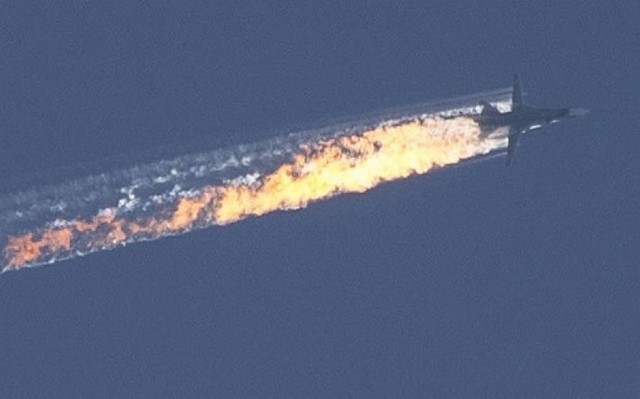
At 9.30am on Tuesday morning, a Russian SU-24 jet was shot down by Turkish fighter planes. Its pilots were then allegedly killed by Syrian Turkmen anti-government militias, with the body of one paraded on camera in a video that was immediately posted on youtube. Turkey claimed the jet had encroached on Turkish airspace, but Russia maintains the plane was shot down well inside Syrian territory, 4km from the Turkish border. Rather than calling Russia to defuse any tension arising from the attack, Turkey then immediately called an emergency NATO meeting to ramp it up – “as if we shot down their plane”, Putin commented, “and not they ours”.
To make sense of this apparently senseless provocation, it is necessary to cut through the multiple layers of obfuscation which surround Western narratives around Syria and ISIS. The reality is that the forces essentially line up today just as they did at the outbreak of this crisis in 2011: with the West, Turkey and the gulf monarchies sponsoring an array of death squads bent on bringing down the Syrian government; and Russia, Iran, Iraq, Syria (obviously) and Hezbollah resisting this project; the rise of ISIS has not fundamentally changed this underlying dynamic. Indeed, the next-to-useless impact of the West’s year-long phony war against ISIS – alongside its relentless funneling of weaponry to militias with an, at best, ambiguous relationship with Al Qaeda and ISIS – has demonstrated that the Syrian state (or “Assad” to use the West’s puerile personalization) remains the ultimate target of the West’s Syria policy. As Obama himself put it, the goal is not to eliminate ISIS, but rather to “contain” them – that is, keep them focused on weakening Syria and Iraq, and not US allies like Jordan, Turkey or the US’s favoured Kurdish factions. In civil wars, there are only ever really two sides: those who want the insurgency to overthrow the government, and those who want the government to defeat the insurgency. In the Syrian civil war, NATO remains on the same side as ISIS. In this sense, Putin is entirely correct when he commented on the Turkish attack it was a “stab in the back, carried out by the accomplices of terrorists” and asked: “do they want to make NATO serve ISIS?”
Russia’s direct entry into the Syrian conflict two months ago, however, has caused utter panic in the ‘regime change’ camp. Belying all their ‘anti-ISIS’ rhetoric, the US and Britain were openly horrified that Russia might actually be putting up an effective fight against the group and restoring governmental authority to the ungoverned spaces in which it thrives. Immediately, the West began warning of ‘blowback’ to Russia, and ramping up advanced arms shipments to the insurgency. Within a month, a Russian passenger plane was blown up, with ISIS claiming responsibility and British Foreign Minister Philip Hammond calling the attack a “warning shot”. It was a “shot” alright, aimed not only at Russia, but also at her allies; the downing of the plane on Egyptian soil was a deliberate act of economic war against the Egyptian tourist industry, a punishment for Egypt’s support for Russia and Syria and its choking off of fighters to Syria since Sisi came to power. Then, two weeks later, came the attack on Paris. White supremacist niceties prevented Hammond calling that a “warning shot”, but that is precisely what it was, this time at those within the regime change/ anti-Russia camp who were showing signs of ‘wobbling’. Hollande had suggested back in January that sanctions on Russia should be lifted asap, and more recently had showed a willingness to cooperate with Russia militarily over Syria: a ‘red line’ for France’s ‘Atlantic partners’. This is what France was being punished for.
Nevertheless, the net continues to close on the West’s death squad project in Syria. From the start the key to ISIS success has been, firstly, the porous Syria-Turkey border, through which Turkey has allowed a free flow of fighters and weapons back and forth for the past four years, and secondly, the massive amounts of finance ISIS receives both from oil sales and from donors in countries prepared to turn a blind eye to terror financing. In recent weeks, all of this has been threatened by the Russian-led alliance (of which France is increasingly willing to be a part).
The past week has seen a large scale Syrian ground offensive, supported with Russian air cover, in precisely the Syrian-Turkish border region which is the death squads’ lifeline: a move which prompted the Turkish foreign ministry to warn of “serious consequences” if the Russian airstrikes continued. Simultaneously, Russia has embarked on a major campaign against ISIS’ reportedly 1000-strong oil tanker fleet which is so crucial to the group’s financial success. As the Institute for the Study of War reported, “Russian military chief of staff Col. Gen. Andrey Kartapolov announced on November 18 “Russian warplanes are now flying on a free hunt” against ISIS-operated oil tanker trucks traveling back and forth from Syria and Iraq, claiming that Russian strikes had destroyed over 500 ISIS-operated oil trucks in the past “several days.”” This massive dent in the group’s oil transporting capacity even shamed the US into belatedly and somewhat half-heartedly launching similar attacks of their own. The smashing of ISIS’ oil industry will not only be a blow to the entire death squad project, but will directly affect Turkey, widely thought to be involved in the transportation of ISIS-produced oil, and even Erdogan’s family itself, as it is the company run by his son Bilal that is believed to be running the illicit trade.
Finally, France yesterday announced a crackdown on ISIS’ financiers, and demanded other countries do the same. French Finance Minister Michel Sapin implied that the report to the G20 on the issue last month was a whitewash, and demanded that the international Financial Action Task Force be much more explicit in its report to the next G20 finance meeting in February about which countries are lax in terms of terror financing. The move is very likely to expose not only Turkey and Saudi Arabia but also, given HSBC’s links to Al Qaeda, the City of London. Indeed, as the Politico website noted, Sapin specifically “said that considering the reputation of the City of London, he would be “vigilant” on the U.K.’s implementation of EU-agreed measures to clamp down on money laundering and exchange financial information on shady transactions or individuals”.The reactions to his demands that implementation of tougher EU regulations be moved forward will also be instructive (in another move exposing the total lack of urgency in the West’s supposed ‘war on ISIS’, they are currently not due to be implemented for another two years).
And on top of all this, the UN Security Council finally passed a resolution authorizing ‘all necessary measures’ to be used against ISIS, Al Qaeda and other terrorist groups in Syria, effectively granting UN approval to Russia’s intervention. As Pepe Escobar has pointed out, French support for the resolution rendered it politically impossible for the US or UK to use their veto – although US ambassador Samantha Power, an extreme Russophobe and ‘regime changer’, registered her disapproval by failing to turn up for the vote and sending a junior official along instead.
In other words, on all sides the net is closing in on the West’s death squad project in Syria. Turkey’s actions today have merely demonstrated, again, the impotent rage of those who have thrown in their chips with a disastrous and bloody attempt to remake the Middle East. Syria is indeed becoming the Stalingrad of the regime changers – the rock on which the imperial folly of the West and it’s regional imitators may finally be broken.
Dan Glazebrook is author of Divide and Ruin: The West’s Imperial Strategy in an Age of Crisis
This article originally appeared on RT.com
26 November, 2015
Countercurrents.org