Just International

Hunger Profiteers, Granny Killers and Skin-Deep Morality

By Colin Todhunter

Today, a fifth (278 million) of the African population are undernourished, and 55 million of that continent’s children under the age of five are stunted due to severe malnutrition.  

In 2021, an Oxfam review of IMF COVID-19 loans showed that 33 African countries were encouraged to pursue austerity policies. Oxfam and Development Finance International also revealed that 43 out of 55 African Union member states face public expenditure cuts totalling $183 billion over the next few years.

As a result, almost three-quarters of Africa’s governments have reduced their agricultural budgets since 2019, and more than 20 million people have been pushed into severe hunger. In addition, the world’s poorest countries were due to pay $43 billion in debt repayments in 2022, which could otherwise cover the costs of their food imports.

Last year, Oxfam International Executive Director Gabriela Bucher stated that there was a terrifying prospect that in excess of a quarter of a billion more people would fall into extreme levels of poverty in 2022 alone. That year, food inflation rose by double digits in most African countries.

By September 2022, some 345 million people across the world were experiencing acute hunger, a number that has more than doubled since 2019. Moreover, one person is dying of hunger every four seconds. From 2019 to 2022, the number of undernourished people grew by 150 million.

Billions of dollars’ worth of arms continue to pour into Ukraine from the NATO countries as US neocons pursue their goal of regime change in Russia and balkanisation of that country.

Yet people in those NATO countries are experiencing increasing levels of hardship. The US has sent almost 80 billion dollars to Ukraine, while 30 million low-income people across the US are on the edge of a ‘hunger cliff’ as a portion of their federal food assistance is taken away. In 2021, it was estimated that one in eight children were going hungry in the US. In England, 100,000 children have been frozen out of free school meals.

Due to the disruptive supply chain effects of the conflict in Ukraine, speculative trading that drives up food prices, the impact of closing down the global economy under the guise of COVID and the inflationary impacts of pumping trillions of dollars into the financial system between September 2019 and March 2020, people are being driven into poverty and denied access to sufficient food.

Matters are not helped by issues that have long plagued the global food system: cutbacks in public subsidies to agriculture, WTO rules that facilitate cheap, subsidised imports which undermine or wipe out indigenous agriculture in poorer countries and loan conditionalities, resulting in countries ‘structurally adjusting’ their agri sectors thereby eradicating food security and self-sufficiency – consider that Africa has been transformed from a net food exporter in the 1960s to a net food importer today.

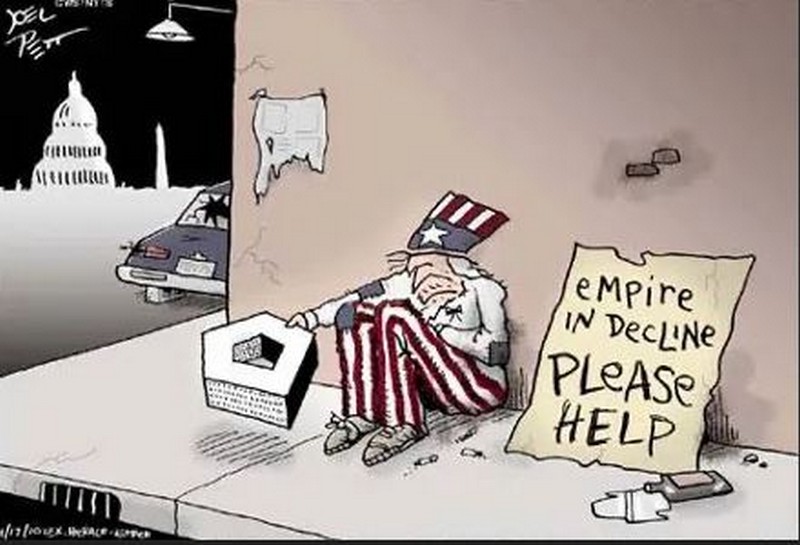
Great game food geopolitics continue and result in elite interests playing with the lives of hundreds of millions who are regarded as collateral damage. Policies, underpinned by neoliberal dogma masquerading as economic science and necessity, which are designed to create dependency and benefit a handful of multi-billionaires and global agribusiness corporations who, ably assisted by the World Bank, IMF and WTO, now preside over an increasingly centralised food regime.

Many of these corporations have engaged in rampant profiteering at a time when people across the world are experiencing rising food inflation. For instance, 20 corporations in the grain, fertiliser, meat and dairy sectors delivered $53.5 billion to shareholders in the fiscal years 2020 and 2021. At the same time, the UN estimates that $51.5 billion would be enough to provide food, shelter and lifesaving support for the world’s 230 million most vulnerable people.

As a paper in the journal Frontiers noted in 2021, these corporations form part of a powerful alliance of multinational corporations, philanthropies and export-oriented countries who are subverting multilateral institutions of food governance. Many who are involved in this alliance are co-opting the narrative of ‘food systems transformation’ as they anticipate new investment opportunities and seek total control of the global food system.

This type of ‘transformation’ is more of the same wrapped in a climate emergency narrative in an attempt to move food and farming further towards an ecomodernist techno-dystopia controlled by big agribusiness and big tech, as described in the article The Netherlands: Template for Ecomodernism’s Brave New World.

A ‘brave new world’ where a concoction of genetically engineered items, synthetic food and ultra-processed products will do more harm than good – but will certainly boost the bottom line of the pharmaceutical corporations.

While securing further dominance over the global food system and undermining food security in the process, global agribusiness frames this as ‘feeding the world’.

The model these corporations promote not only creates food insecurity but also produces death and illness.

Former Professor of Medicine Dr Paul Marik recently stated:

“If you believe the narrative, Type 2 diabetes is a progressive metabolic disease that’ll result in cardiac complications. You’re going to lose your legs. You’re going to have kidney disease, and the only treatment is expensive pharma drugs. That is completely false. It’s a lie.”

It is projected that by the end of this decade half of the world’s population are going to be obese and over 20% to 25% will have Type 2 diabetes.

According to Marik, the bottom line is Type 2 diabetes is a metabolic disease due to bad lifestyle and really bad eating habits:

“We eat all the time. We snack all the time. This is part of the food industry’s goal. Processed food, starch, becomes an addiction. Most of us are glucose addicted and it’s, in fact, more addictive than cocaine. It creates this vicious cycle of insulin resistance.”

He adds that if you’re insulin resistant, this prevents leptin and the other hormones acting on your brain, so you’re continually hungry:

“If you are continually hungry, you eat more, which causes more insulin resistance. It causes this vicious cycle of overeating carbohydrates…”

This is the nature of the modern food system. Cheap processed ingredients, low-nutrient value, highly addictive and maximum profits. A system that is being imposed or has already been imposed on countries whose populations once had healthy, unadulterated diets (see Obesity, malnutrition and the globalisation of bad food – theecologist.org).

Over the past 60 years in Western nations, there have been fundamental changes in the quality of food. In 2007, nutritional therapist David Thomas in ‘A Review of the 6th Edition of McCance and Widdowson’s the Mineral Depletion of Foods Available to Us as a Nation’ noted a precipitous change towards convenience and pre-prepared foods containing saturated fats, highly processed meats and refined carbohydrates, often devoid of vital micronutrients yet packed with a cocktail of chemical additives including colourings, flavourings and preservatives.

Aside from the negative impacts of Green Revolution cropping systems and practices, Thomas proposed that these changes are significant contributors to rising levels of diet-induced ill health. He added that ongoing research clearly demonstrates a significant relationship between deficiencies in micronutrients and physical and mental ill health.

Increasing prevalence of diabetes, childhood leukaemia, childhood obesity, cardiovascular disorders, infertility, osteoporosis and rheumatoid arthritis, mental illnesses and so on have all been shown to have some direct relationship to diet, specifically micronutrient deficiency, and pesticide use.

It is clear that we have a deeply unjust and unsustainable food system that causes environmental devastation, illness and malnutrition, among other things. People often ask: So, what’s the solution? The solutions have been made clear time and again and involve a genuine food transition towards agroecology.

Unlike the co-opted version of ‘food transition’ being promoted, agroecology offers concrete, practical solutions to many of the world’s problems that move beyond (but which are linked to) agriculture. Agroecology challenges the prevailing moribund doctrinaire economics of a neoliberalism that drives a failing system. Well-known academics like Raj Patel and Eric Holtz-Gimenez have written extensively on the potential of agroecology. And its benefits are clear.

In finishing, let us consider the skin-deep morality pedalled throughout the COVID period. During COVID, the official narrative was underpinned by emotive slogans like ‘protect lives’ and ‘keep safe’. Those who refused the COVID jab were labelled ‘granny killers’ and ‘irresponsible’. All presided over by government politicians who too often failed to obey their own COVID rules.

Meanwhile, while having terrorised the public with a health crisis narrative, they continue to collude with powerful agrifood corporations that destroy health courtesy of their practices. They continue to facilitate a system that serves the needs of global agricapital and ruthless investors like BlackRock’s Larry Fink who secure massive profits from a monopolistic food system (Fink also invests in the pharma sector – one of the biggest beneficiaries of a sickening global food regime) that by its very nature creates illness, malnutrition and hunger.

The COVID narrative was imbued with the notion of moral responsibility. The people who sold it to the masses have no morality. Like the UK’s former health minister and COVID rule breaker Matt Hancock (see Matt Hancock’s Car Crash Interview), they are willing to sell their soul (or influence) to the highest bidder – in Hancock’s case, a £10,000 wage demandfor a day’s ‘consultancy’ as a sitting politician or a few hundred thousand to bolster his ego, bank balance and image on a celebrity TV programme.

In a corrupted and corrupting society, the rewards could be even higher for the likes of Hancock when he leaves office (a health minister who helped traumatise the population while doing nothing to hold the health-damaging agribusiness corporations to account). But with a long line of well-rewarded fraudsters to choose from, we already know that.

*

Renowned author Colin Todhunter specialises in development, food and agriculture.

20 April 2023

Source: www.globalresearch.ca

A new paradigm of justice is urgent

Palestine Update 641
Comment

A new paradigm of justice is urgent
In 2014, 60% of Palestinians said the final goal of their national movement should be “to work toward reclaiming all of historic Palestine from the river to the sea”. A poll published in 2021 by the Palestinian Center for Policy and Survey Research revealed that only 39% of Palestinians support the two-state solution. Another report published in 2021 by the RAND Corporation found that Israelis across the political spectrum opposed a two-state solution.

There have been many diplomatic efforts to realize a two-state solution, starting from the 1991 Madrid Conference. There followed the 1993 Oslo Accords and the failed 2000 Camp David Summit followed by the Taba negotiations in early 2001. In 2002, the Arab League proposed the Arab Peace Initiative. The latest initiative, which also failed, was the 2013–14 peace talks. A 2021 survey of experts found that 52 percent believe that the two-state solution is no longer achievable. 77 percent believe that if not achieved, the result would be a “one-state reality akin to apartheid“. According to a 2021 PCPSR poll, support for a two-state solution among Palestinians and Israeli Jews, as of 2021, has declined to 43 percent and 42 percent, respectively. According to Middle East experts David Pollock and Catherine Cleveland, as of 2021, the majority of Palestinians say they want to reclaim all of historic Palestine, including pre-1967 Israel. A one-state solution with equal rights for Arabs and Jews is ranked second.

In this context, China’s emergence as a political influence in Middle East politics must be taken more seriously especially after the West has both failed and betrayed the Palestinians with their one-sided political manipulations. China has declared its intent to  play an “active role” in encouraging peace between Israelis and Palestinians. This was stated by the Chinese Foreign Minister, Qin gang, at the end of a telephone conversation with the counterpart of the Palestinian National Authority (PNA), Riyadh al-Maliki, held a few hours after a telephone conversation with the head of Israeli diplomacy, Eli Cohen, during which he urged Israelis and Palestinians to re-launch peace negotiations. These are declarations with which Beijing demonstrates, for the second time in a few months, its willingness to act as a peace broker in a region, the Middle East, characterized by long-standing tensions and alliances.

China has demonstrated its intent to change the political contours of the Middle East when it brokered a deal between Saudi Arabia and Iran, who, after years of hostilities have decided to put an end to their diplomatic rift. “This historic deal has the potential to transform the Middle East by realigning its major powers, replacing the current Arab-Iranian divide with a complex web of relationships, and interweaving the region with China’s global ambitions. For Beijing, the announcement was a big leap forward in its rivalry with Washington”, highlighted the US magazine “Foreign Affairs”.

The many-sided reports in this issue of Palestine Updates illustrates why even fermenting peace should be viewed as urgent. The West cannot and will not pursue a just solution. Guilt from the holocaust times, and racial prejudices are two factors which will never allow them to be facilitators of justice for the Palestinians. They have not just lost the trust of the Palestinians but also the political capacity to be honest mediators.

On behalf of MLN Palestine Updates

Ranjan Solomon

———————————————————————————-

Israel’s One-State Reality: It’s Time to give up on the Two-State Solution

“The temporary status of “occupation” of the Palestinian territories is now a permanent condition in which one state ruled by one group of people rules over another group of people. The promise of a two-state solution made sense as an alternative future in the years around the 1993 Oslo accords, when there were constituencies for compromise on both the Israeli and the Palestinian sides and when tangible if fleeting progress was made toward building the institutions of a hypothetical Palestinian state. But that period ended long ago. Today, it makes little sense to let fantastical visions for the future obscure deeply embedded existing arrangements.

It is past time to grapple with what a one-state reality means for policy, politics, and analysis. Palestine is not a state in waiting, and Israel is not a democratic state incidentally occupying Palestinian territory. All the territory west of the Jordan River has long constituted a single state under Israeli rule, where the land and the people are subject to radically different legal regimes, and Palestinians are permanently treated as a lower caste. Policymakers and analysts who ignore this one-state reality will be condemned to failure and irrelevance, doing little beyond providing a smokescreen for the entrenchment of the status quo.”
Read more from Foreign Affairs

Could Israel Carry Out Another Nakba?
Peter Beinart
“In mainstream American political discourse, such a prospect seems unthinkable. US government officials don’t acknowledge Palestinian fears of another Nakba. They more often treat Palestinians as a people that would be on route to independence if only they avoided “unhelpful” actions—like demanding international pressure on Israel— that leave them “further away from a two-state solution.” But when Palestinians claim that Israel’s long term goal is not Palestinian statehood but Palestinian expulsion, they aren’t hallucinating. Expulsion is deeply rooted in Zionist history, and the sentiment pervades Israel today, including among politicians and commentators generally viewed as centrists. Israel’s current defense minister, national security advisor, and agriculture minister—members of Benjamin Netanyahu’s center-right Likud party—have all alluded to removing Palestinians from the country. While the pace of Palestinian expulsion has waxed and waned in the 75 years since Israel’s war of independence, there is reason to worry that the radicalism of Israel’s current government, combined with rising violence in the West Bank, could turn the current trickle into a flood. Another Nakba is possible. By pretending it isn’t, American officials conveniently avoid an uncomfortable but vital question: What would they do to try and stop it?”
Read full article in Jewish currents

Over 100 rights groups lobby UN to not adopt IHRA antisemitism definition
Organizations claim formula could be abused to impact freedom of speech, prevent criticism of Israel, and block advocacy for Palestinian rights 
“Over 100 human and civil rights organizations have signed a letter urging the United Nations not to adopt the International Holocaust Remembrance Alliance working definition of antisemitism, warning it could impact freedom of speech and curtail criticism of Israel, Human Rights Watch said Thursday…The letter was first sent to UN Secretary-General António Guterres on April 3 with 60 signatures and since then dozens more have added their names to it, HRW said in a statement, putting the current total at 104.”

“Over 100 human and civil rights organizations have signed a letter urging the United Nations not to adopt the International Holocaust Remembrance Alliance working definition of antisemitism, warning it could impact freedom of speech and curtail criticism of Israel, Human Rights Watch said Thursday…The letter was first sent to UN Secretary-General António Guterres on April 3 with 60 signatures and since then dozens more have added their names to it, HRW said in a statement, putting the current total at 104.”
Source:

The Israeli right’s most dangerous anti-Palestinian smear
The Jewish far right has been calling Palestinians ‘Nazis’ for almost 80 years, casting them as an irredeemable enemy in an eternal war.
“Yom HaShoah, or Holocaust Remembrance Day, is a solemn occasion in Israel and across the Jewish diaspora. Memorial ceremonies are held, often attended by survivors; testimonies about the horrors of the Nazi regime are disseminated across social media and in the press; and, in Israel, two-minute air-raid siren blares, bringing much of the country to a halt. The occasion is also, however, an opportunity for hasbarists to share one of their favorite, and most repugnant, smears: that the Palestinian people are, in fact, Nazis…But the broadest, most dangerous function of the smear is in the latitude it is intended to grant Israel in its abuses, thus contributing to the larger project of obscuring the root causes of violence in Israel-Palestine. Describing one’s victims using the internationally-recognized shorthand for pure evil makes the ugly business of colonization and occupation not just permissible, but a moral imperative. Under this rubric, forced displacement, mass incarceration, extrajudicial killings, and home demolitions are not war crimes or human rights abuses, but rather necessary tools in a desperate, existential struggle against an irredeemable enemy.”
Read more from 972 Mag

Israeli Police Violently Beat Several Holy Fire Worshippers Trying to Defy Capacity Limits
Angry pilgrims and clergy jostled to get through while Israeli police struggled to hold them back, allowing only a trickle of ticketed visitors and local residents inside

“Tens of thousands of Christians took part in the Holy Fire ceremony on Saturday, an annual Orthodox Christian ceremony held in Jerusalem’s Church of the Holy Sepulchre, amid tension between police and Christian worshipers over Israel’s decision to place limits on the number of participants for the third year in a row. Thousands of clergy, police, diplomats and pilgrims huddled inside the church, while thousands more huddles in the surrounding alleys, where police clashed and in some cases violently beat worshipers trying to make their way through their barricades.”
Read more from Haaretz

China offers itself as a peace broker in the Middle East, a new slap in the face for the US
Only on March 10 Beijing achieved an important diplomatic result by negotiating the agreement between Saudi Arabia and Iran

La in China it is willing to play an “active role” in encouraging peace between Israelis and Palestinians. This was stated by the Chinese Foreign Minister, Qin gang, at the end of a telephone conversation with the counterpart of the Palestinian National Authority (PNA), Riyadh al-Maliki, held a few hours after a telephone conversation with the head of Israeli diplomacy, Eli Cohen, during which he urged Israelis and Palestinians to relaunch peace negotiations. These are declarations with which Beijing demonstrates, for the second time in a few months, its willingness to act as a peace broker in a region, the Middle East, characterized by long-standing tensions and alliances. Only on March 10, China achieved an important diplomatic result, brokering the deal between Saudi Arabia and Iran, who, after years of hostilities that have fueled conflicts throughout the region, have decided to put an end to their diplomatic rift. “This historic deal has the potential to transform the Middle East by realigning its major powers, replacing the current Arab-Iranian divide with a complex web of relationships, and interweaving the region with China’s global ambitions. For Beijing, the announcement was a big leap forward in its rivalry with Washington”, highlighted the US magazine “Foreign Affairs”.

Source:

22 April 2023

Source: nakbaliberation.com

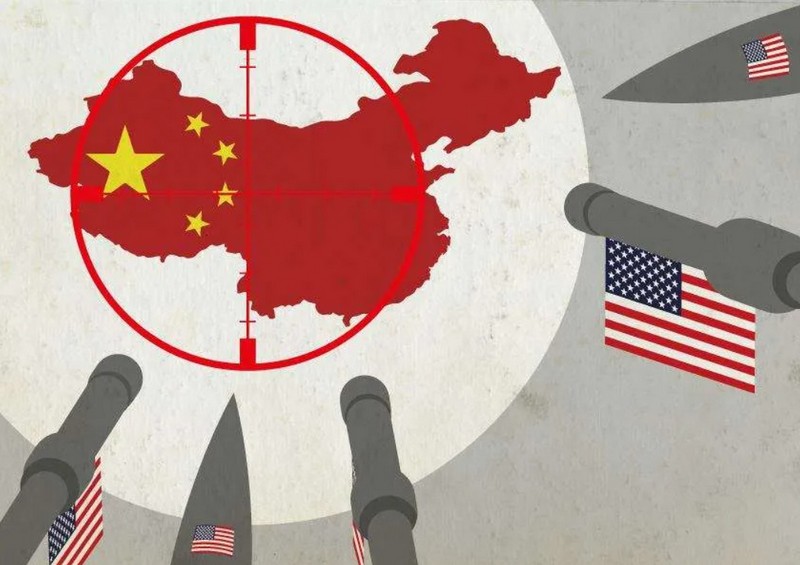
China’s Pivot to World Markets, Washington’s Pivot to World Wars…

By Prof. James Petras

China and the United States are moving in polar opposite directions: Beijing is rapidly becoming the center of overseas investments in high tech industries, including robotics, nuclear energy and advanced machinery with collaboration from centers of technological excellence, like Germany.

In contrast, Washington is pursuing a predatory military pivot to the least productive regions with collaboration from its most barbaric allies, like Saudi Arabia.

China is advancing to global economic superiority by borrowing and innovating the most advance methods of production, while the US degrades and debases its past immense productive achievements to promote wars of destruction.

China’s growing prominence is the result of a cumulative process that advanced in a systematic way, combining step-by-step growth of productivity and innovation with sudden jumps up the ladder of cutting edge technology.

China’s Stages of Growth and Success

China has moved from a country, highly dependent on foreign investment in consumer industries for exports, to an economy, based on joint public-private investments in higher value exports.

China’s early growth was based on cheap labor, low taxes and few regulations on multi-national capital.  Foreign capital and local billionaires stimulated growth, based on high rates of profit.  As the economy grew, China’s economy shifted toward increasing its indigenous technological expertise and demanding greater ‘local content’ for manufactured goods.

By the beginning of the new millennium China was developing high-end industries, based on local patents and engineering skills, channeling a high percentage of investments into civilian infrastructure, transportation and education.

Massive apprenticeship programs created a skilled labor force that raised productive capacity.  Massive enrollment in science, math, computer science and engineering universities provided a large influx of high-end innovators, many of whom had gained expertise in the advanced technology of overseas competitors.

China’s strategy has been based on the practice of borrowing, learning, upgrading and competing with the most advanced economics of Europe and the US.

By the end of the last decade of the 20th century, China was in a position to move overseas. The accumulation process provided China with the financial resources to capture dynamic overseas enterprises.

China was no longer confined to investing in overseas minerals and agriculture in Third World countries.  China is looking to conquer high-end technological sectors in advanced economics.

By the second decade of the 21st century Chinese investors moved into Germany, Europe’s most advanced industrial giant.  During the first 6 months of 2016 Chinese investors acquired 37 German companies, compared with 39 in all of 2015.  China’s total investments in Germany for 2016 may double to over $22 billion dollars.

In 2016, China successfully bought out KOKA, Germany’s most innovative engineering company.  China’s strategy is to gain superiority in the digital future of industry.

China is rapidly moving to automate its industries, with plans to double the robot density of the US by the year 2020.

Chinese and Austrian scientists successfully launched the first quantum-enabled satellite communication system which is reportedly ‘hack proof’, ensuring China’s communications security.

While China’s global investments proceed to dominate world markets, the US, England and Australia have been trying to impose investment barriers. By relying on phony ‘security threats’, Britain’s Prime Minister Theresa May blocked a multi-billion dollar Chinese investment-heavy nuclear plant (Hinckley Point C). The pretext was the spurious claim that China would use its stake to “engage in energy blackmail, threatening to turn off the power in the event of international crises”.

The US Committee on Foreign Investment has blocked several multi-billion dollar Chinese investments in high tech industries.

In August 2016 Australia blocked an $8 billion-dollar purchase of a controlling stake in its biggest electricity distribution network on specious claims of ‘national security’.

The Anglo-American and German empires are on the defensive.  They increasingly cannot compete economically with China, even in defending their own innovative industries.

In large part this is the result of their failed policies.  Western economic elite have increasingly relied on short-term speculation in finance, real estate and insurance, while neglecting their industrial base.

Led by the US, their reliance on military conquests (militaristic empire-building) absorb public resources, while China has directed its domestic resources toward innovative and advanced technology.

To counter China’s economic advance, the Obama regime has implemented a policy of building economic walls at home, trade restrictions abroad and military confrontation in the South China Sea – China’s strategic trade routes.

US officials have ratcheted up their restrictions on Chinese investments in high tech US enterprises including a $3.8 billion investment in Western Digital and Philips attempt to sell its lighting business.  The US blocked ‘Chen China’s planned $44 billion takeover of Swiss chemical group ‘Syngenta’.

US officials are doing everything possible to stop innovative billion dollar deals that include China as a strategic partner.

Accompanying its domestic wall, the US has been mobilizing an overseas blockade of China via its Trans-Pacific-Partnership, which proposes to exclude Beijing from participating in the ‘free trade zone’ with a dozen North America, Latin American and Asian members.  Nevertheless, not a single member-nation of the TPP has cut back its trade with China.  On the contrary, they are increasing ties with China – an eloquent comment on Obama’s skill at ‘pivoting’.

While the ‘domestic economic wall’ has had some negative impacts on particular Chinese investors, Washington has failed to dent China’s exports to US markets.  Washington’s failure to block China’s trade has been even more damaging to Washington’s effort to encircle China in Asia and Latin America, Oceana and Asia.

Australia, New Zealand, Peru, Chile, Taiwan, Cambodia and South Korea depend on Chinese markets far more than on the US to survive and grow.

While Germany, faced with China’s dynamic growth, has chosen to ‘partner’ and share, up-scale productive investments, Washington has opted to form military alliances to confront China.

The US bellicose military alliance with Japan has not intimidated China.  Rather it has downgraded their domestic economies and economic influence in Asia.

Moreover, Washington’s “military pivot” has deepened and expanded China’s strategic links to Russia’s energy sources and military technology.

While the US spends hundreds of billions in military alliances with the backward Baltic client-regimes and the parasitical Middle Eastern states, (Saudi Arabia, Israel), China accumulates strategic expertise from its economic ties with Germany, resources from Russia and market shares among Washington’s ‘partners’ in Asia and Latin America.

There is no question that China, following the technological and productive path of Germany, will win out over the US’s economic isolationist and global militarist strategy.

If the US has failed to learn from the successful economic strategy of China, the same failure can explain the demise of the progressive regimes in Latin America.

China’s Success and the Latin American Retreat

After more than a decade of growth and stability, Latin America’s progressive regimes have retreated and declined.  Why has China continued on the path of stability and growth while their Latin American partners retreated and suffered defeats?

Brazil, Argentina, Venezuela, Uruguay, Paraguay, Bolivia and Ecuador, for over a decade, served as Latin America’s center-left success story.  Their economies grew, social spending increased, poverty and unemployment were reduced and worker incomes expanded.

Subsequently their economies went into crisis, social discontent grew and the center-left regimes fell.

In contrast to China, the Latin American center-left regimes did not diversify their economies:  they remained heavily dependent on the commodity boom for growth and stability.

The Latin American elites borrowed and depended on foreign investment, and financial capital, while China engaged in public investments in industry, infrastructure, technology and education.

Latin American progressives joined with foreign capitalist and local speculators in non-productive real estate speculation and consumption, while China invested in innovative industries at home and abroad.  While China consolidated political rulership, the Latin American progressives “allied” with strategic domestic and overseas multi-national adversaries to ‘share power’, which were, in fact, eagerly prepared to oust their “left” allies.

When the Latin commodity based economy collapsed, so did the political links with their elite partners.  In contrast, China’s industries benefited from the lower global commodity prices, while Latin America’s left suffered.  Faced with widespread corruption, China launched a major campaign purging over 200,000 officials.  In Latin America, the Left ignored corrupt officials, allowing the opposition to exploit the scandals to oust center-left officials.

While Latin America imported machinery and parts from the West; China bought the entire Western companies producing the machines and their technology – and then implemented Chinese technological improvements.

China successfully outgrew the crisis, defeated its adversaries and proceeded to expand local consumption and stabilized rulership.

Latin America’s center-left suffered political defeats in Brazil, Argentina and Paraguay, lost elections in Venezuela and Bolivia and retreated in Uruguay.

Conclusion

China’s political economic model has outperformed the imperialist West and leftist Latin America.   While the US has spent billions in the Middle East for wars on behalf of Israel, China has invested similar amounts in Germany for advanced technology, robotics and digital innovations.

While President Obama and Secretary of State Hillary Clinton’s “pivot to Asia” has been largely a wasteful military strategy to encircle and intimidate China, Beijing’s “pivot to markets” has successfully enhanced its economic competitiveness.  As a result, over the past decade, China’s growth rate is three times that of the US; and in the next decade China will double the US in ‘robotizing’ its productive economy.

The US ‘pivot to Asia’, with its heavy dependence on military threats and intimidation has cost billions of dollars in lost markets and investments.  China’s ‘pivot to advanced technology demonstrates that the future lies in Asia not the West. China’s experience offers lessons for future Latin American leftist governments.

First and foremost, China emphasizes the necessity of balanced economic growth, over and above short-term benefits resulting from commodity booms and consumerist strategies.

Secondly, China demonstrates the importance of professional and worker technical education for technological innovation, over and above  business school and non-productive ‘speculative’ education so heavily emphasized in the US.

Thirdly, China balances its social spending with investment in core productive activity; competitiveness and social services are combined.

China’s enhanced growth and social stability, its commitment to learning and surpassing advanced economies has important limitations, especially in the areas of social equality and popular power.  Here China can learn from the experience of Latin America’s Left.  The social gains under Venezuela’s President Chavez are worthy of study and emulation; the popular movements in Bolivia, Ecuador and Argentina, which ousted neo-liberals from power, could enhance efforts in China to overcome the business- state nexus of pillage and capital flight.

China, despite its socio-political and economic limitations, has successfully resisted US military pressures and even ‘turned the tables’ by advancing on the West.

In the final analysis, China’s model of growth and stability certainly offers an approach that is far superior to the recent debacle of the Latin American Left and the political chaos resulting from Washington’s quest for global military supremacy.

18 April 2023

Source: www.globalresearch.ca

Loneliness and Rachel

By Mazin Qumsiyeh

10 Apr 2023 – On this day, Rachel Corrie’s Birthday, I reflected on her message which mentions loneliness (see message below). In my 65 years on this earth I talked to more than 120,000 people and I continue to find difficulty understanding connectivity and loneliness. The Beatles’ song “look at all the lonely people” plays in my head with every encounter. “We feel alone, and in this we are connected” said Leo Babauta. In other words, everyone at some level is lonely. While many are reluctant to admit it: we are lonely even when we are surrounded by friends, a lover, and family.As a biologist and at an intellectual level, I can understand that.

While we (Homo sapiens) evolved as a social species, our genome and chromosomes produce variations and characters that ensure uniqueness and individuality. This is both a blessing and a curse. Of course there are variations among people in behaviours and even in levels of feeling lonely. How different people react to their circumstances is also shaped by their background and upbringing. Being adored or being popular does not free you from loneliness. Stars and celebrities all feel loneliness and their mind may react to it in different ways generating behaviours ranging from self-destruction to charity.

How many stars went down the path of self destruction (Elvis Pressly, Marilyn Monroe etc.)? On the other end of the spectrum we find people like Danny Thomas (“make room for Daddy”)  who went on to establish St Jude Children Research Hospital (where I worked in cancer research for two years meeting him three times before he died and old and happy man.  My conversations with him as with Edward Said and many other “famous” people taught me that the most important aspect is to remain humble, to remain curious, to remain a student of life. This does not save you from loneliness. It does shed a new light on loneliness.

Recognizing that we humans have a biological need for acceptance and validation, our mind and attitude can deal with this and manage it by inward reflection. The Buddhist philosophy says to mediate and be still. Be like water which seeks the lowest places yet can erode and shape rocks. But even when we feel pain, our Buddhist friends tell us: embrace it and do not fight it. It is part of you. Many religions even encourage followers to endure pain (such as pain of hunger when fasting) by keeping an eye for the goal. But we do not have to believe in heaven and hell (carrots and sticks) to do what all know is right (and not do what is wrong).

Loneliness is not the same as being alone or solitude. Loneliness can be turned around. It has to do with choice. You can take time alone (whether because you choose or because you are forced ) to learn from books, reading poems, reflecting on what you want to do next, and even to forgive yourself (we all have our sins to atone for including the sin of wasting time vegetating and being sorrowful!). Getting out of depressive loneliness like any other negative emotion (fear, hate, guilt) requires practice and mind “management.”

The only minds we can actually (& thankfully) control are our own minds. When I visited Mumbai many years ago I saw thousands of people in abject poverty on the streets. One image still etched in my mind: a family, father, mother, two children sprawled at 11 PM semi naked on card boads on a street with a cell phone that they were watching and laughing (their own TV). The sound of that laughter never leaves me. It is the same laughter I heard from Children at a Palestinian refugee camp who invited me to share a meager meal with them (hummus, zait and zaatar and bread).

It was the jokes and laughter I heard from Palestinian prisoners sharing a cell with them (even though it was for one night, and I feld crushed to leave them). When I am tempted to feel sorry for myself, I need to remember those times and places where hope, kindness, love, and camaraderie was shown. Those memories sustain us when we are alone (by choice or not) and certainly can pull us out of the loneliness (even that which happens when we are surrounded by people).  I end with the words of our friend Rachel Corrie who wrote in January 2003 (two months before she was murdered by the Israeli occupation army):

“We are all born and someday we’ll all die. Most likely to some degree alone. What if our aloneness isn’t a tragedy? What if our aloneness is what allows us to speak the truth without being afraid? What if our aloneness is what allows us to adventure – to experience the world as a dynamic presence – as a changeable, interactive thing? If I lived in Bosnia or Rwanda or who knows where else, needless death wouldn’t be a distant symbol to me, it wouldn’t be a metaphor, it would be a reality. And I have no right to this metaphor. But I use it to console myself. To give a fraction of meaning to something enormous and needless. This realization. This realization that I will live my life in this world where I have privileges. I can’t cool boiling waters in Russia. I can’t be Picasso. I can’t be Jesus. I can’t save the planet single-handedly. I can wash dishes….”

Rachel changed millions of minds and hearts… that is something to celebrate on her birthday (she would have been 44 today) …..

The rose that grew from concrete: Palestinian refugees in Jordan ‘green’ their camps to resist

American held by Israeli occupation

Occupation 101- Voices of the Silenced Majority:

Occupation 101- Voices of the Silenced Majority (2006) Leg Pt-Br

Mazin Qumsiyeh, associate professor of genetics and director of cytogenetic services at Yale University School of Medicine, is founder and president of the Holy Land Conservation Foundation and ex-president of the Middle East Genetics Association.

17 April 2023

Source: www.transcend.org

Finland’s NATO Move Leaves Others to Carry On the “Helsinki Spirit”

By Medea Benjamin and Nicolas J. S. Davies

11 Apr 2023 – On April 4, 2023, Finland officially became the 31st member of the NATO military alliance. The 830-mile border between Finland and Russia is now by far the longest border between any NATO country and Russia, which otherwise borders only Norway, Latvia, Estonia, and short stretches of the Polish and Lithuanian borders where they encircle Kaliningrad.

In the context of the not-so-cold war between the United States, NATO and Russia, any of these borders is a potentially dangerous flashpoint that could trigger a new crisis, or even a world war. But a key difference with the Finnish border is that it comes within about 100 miles of Severomorsk, where Russia’s Northern Fleet and 13 of its 23 nuclear-armed submarines are based. This could well be where World War III will begin, if it has not already started in Ukraine.

In Europe today, only Switzerland, Austria, Ireland and a handful of other small countries remain outside NATO. For 75 years, Finland was a model of successful neutrality, but it is far from demilitarized. Like Switzerland, it has a large military, and young Finns are required to perform at least six months of military training after they turn 18. Its active and reserve military forces make up over 4% of the population – compared with only 0.6% in the U.S. – and 83% of Finns say they would take part in armed resistance if Finland were invaded.

Only 20 to 30% of Finns have historically supported joining NATO, while the majority have consistently and proudly supported its policy of neutrality. In late 2021, a Finnish opinion poll measured popular support for NATO membership at 26%. But after the Russian invasion of Ukraine in February 2022, that jumped to 60% within weeks and, by November 2022, 78% of Finns said they supported joining NATO.

As in the United States and other NATO countries, Finland’s political leaders have been more pro-NATO than the general public. Despite long-standing public support for neutrality, Finland joined NATO’s Partnership for Peace program in 1997. Its government sent 200 troops to Afghanistan as part of the UN-authorized International Security Assistance Force after the 2001 U.S. invasion, and they remained there after NATO took command of this force in 2003. Finnish troops did not leave Afghanistan until all Western forces withdrew in 2021, after a total of 2,500 Finnish troops and 140 civilian officials had been deployed there, and two Finns had been killed.

A December 2022 review of Finland’s role in Afghanistan by the Finnish Institute of International Affairs found that the Finnish troops “repeatedly engaged in combat as part of the military operation that was now led by NATO, and had become a party in the conflict,” and that Finland’s proclaimed objective, which was “to stabilize and support Afghanistan to enhance international peace and security” was outweighed by “its desire to maintain and strengthen its foreign and security policy relations with the U.S. and other international partners, as well as its effort to deepen its collaboration with NATO.”

In other words, like other small NATO-allied countries, Finland was unable, in the midst of an escalating war, to uphold its own priorities and values, and instead allowed its desire “to deepen its collaboration” with the United States and NATO to take precedence over its original aim of trying to help the people of Afghanistan to recover peace and stability. As a result of these confused and conflicting priorities, Finnish forces were drawn into the pattern of reflexive escalation and use of overwhelming destructive force that have characterized U.S. military operations in all its recent wars.

As a small new NATO member, Finland will be just as impotent as it was in Afghanistan to affect the momentum of the NATO war machine’s rising conflict with Russia. Finland will find that its tragic choice to abandon a policy of neutrality that brought it 75 years of peace and look to NATO for protection, will leave it, like Ukraine, dangerously exposed on the front lines of a war directed from Moscow, Washington and Brussels that it can neither win, nor independently resolve, nor prevent from escalating into World War III.

Finland’s success as a neutral and liberal democratic country during and since the Cold War has created a popular culture in which the public are more trusting of their leaders and representatives than people in most Western countries, and less likely to question the wisdom of their decisions. So the near unanimity of the political class to join NATO in the wake of the Russian invasion of Ukraine faced little public opposition. In May 2022, Finland’s parliament approved joining NATO by an overwhelming 188 votes to eight.

But why have Finland’s political leaders been so keen to “strengthen its foreign and security policy relations with the U.S. and other international partners,” as the Finland in Afghanistan report said? As an independent, neutral, but strongly armed military nation, Finland already meets the NATO goal of spending 2% of its GDP on the military. It also has a substantial arms industry, which builds its own modern warships, artillery, assault rifles and other weapons.

NATO membership will integrate Finland’s arms industry into NATO’s lucrative arms market, boosting sales of Finnish weapons, while also providing a context to buy more of the latest U.S. and allied weaponry for its own military and to collaborate on joint weapons projects with firms in larger NATO countries. With NATO military budgets increasing, and likely to keep increasing, Finland’s government clearly faces pressures from the arms industry and other interests. In effect, its own small military-industrial complex doesn’t want to be left out.

Since it began its NATO accession, Finland has already committed $10 billion to buy American F-35 fighters to replace its three squadrons of F-18s. It has also been taking bids for new missile defense systems, and is reportedly trying to choose between the Indian-Israeli Barak 8 surface-to-air missile system and the U.S.-Israeli David’s Sling system, built by Israel’s Raphael and the U.S.’s Raytheon.

Finnish law prohibits the country from possessing nuclear weapons or allowing them in the country, unlike the five NATO countries that store stockpiles of U.S. nuclear weapons on their soil – Germany, Italy, Belgium, Holland and Turkey. But Finland submitted its NATO accession documents without the exceptions that Denmark and Norway have insisted on to allow them to prohibit nuclear weapons. This leaves Finland’s nuclear posture uniquely ambiguous, despite President Sauli Niinistö’s promise that “Finland has no intention of bringing nuclear weapons onto our soil.”

The lack of discussion about the implications of Finland joining an explicitly nuclear military alliance is troubling, and has been attributed to an overly hasty accession process in the context of the war in Ukraine, as well as to Finland’s tradition of unquestioning popular trust in its national government.

Perhaps most regrettable is that Finland’s membership in NATO marks the end of the nation’s admirable tradition as a global peacemaker. Former Finnish President Urho Kekkonen, an architect of the policy of cooperation with the neighboring Soviet Union and a champion of world peace, helped craft the Helsinki Accords, a historic agreement signed in 1975 by the United States, the Soviet Union, Canada and every European nation (except Albania) to improve detente between the Soviet Union and the West.

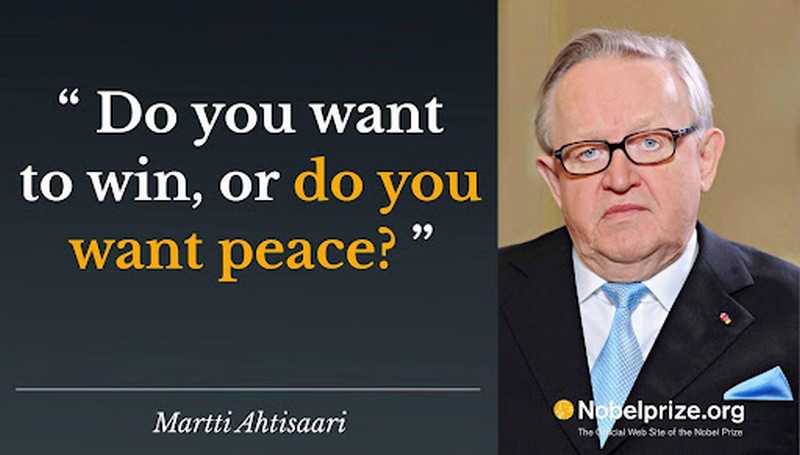
Finnish President Martti Ahtisaari continued the peacemaking tradition and was awarded the Nobel Peace Prize in 2008 for his critical efforts to resolve international conflicts from Namibia to Aceh in Indonesia to Kosovo (which was bombed by NATO).

Speaking at the UN in September 2021, Finnish President Sauli Niinistö seemed anxious to follow this legacy. “A willingness of adversaries and competitors to engage in dialogue, to build trust, and to seek common denominators – that was the essence of the Helsinki Spirit. It is precisely that kind of a spirit that the entire world, and the United Nations, urgently needs,” he said. “I am convinced that the more we speak about the Helsinki Spirit, the closer we get to rekindling it – and to making it come true.”

Of course, it was Russia’s decision to invade Ukraine that drove Finland to abandon the “Helsinki Spirit” in favor of joining NATO. But if Finland had resisted the pressures on it to rush into NATO membership, it could instead now be joining the “Peace Club” being formed by Brazilian President Lula to revive negotiations to end the war in Ukraine. Sadly for Finland and the world, it looks like the Helsinki Spirit will have to move forward–without Helsinki.

Medea Benjamin and Nicolas J. S. Davies are the authors of War in Ukraine: Making Sense of a Senseless Conflict, available from OR Books in November 2022.

17 April 2023

Source: www.transcend.org

All Roads Lead to Beijing

By Pepe Escobar

This is the tale of two pilgrims following the road that really matters in the young 21st century.

15 Apr 2023 – This is the tale of two pilgrims following the road that really matters in the young 21st century; one coming from NATOstan and another one from BRICS.

Let’s start with Le Petit Roi, Emmanuel Macron. Picture him with a plastic grin in his face strolling alongside Xi Jinping in Guangzhou. Following the – long and gentle – sound of classic “High Mountain and Flowing Water”, they enter the Baiyun Hall  to listen to it played by the 1000-year-old Guqin (a beautiful instrument). They taste the fragrance of 1000-year-old tea – and muse on the rise and fall of great powers in the new millennium.

And what does Xi tell Le Petit Roi? He explains that when you hear this eternal music played by this eternal instrument, you expect to be in the company of a bosom friend; you are in synch as much as the high mountain and the flowing water. That’s the deeper meaning of the ancient tale of musicians Yu Boya and Zhong Ziqi, 25 centuries ago in the Kingdom of Chu: bosom friendship. Only bosom friends can understand the music.

And with that, as Chinese scholars explained, Xi brought up the concept of Zhiyin. After Zhong Ziqi died, Yu Boya broke his Guqin: he thought that no one else could understand his music. Their story imprinted the term “Zhiyin”: someone who understands music, with the added meaning of close friends that can completely understand each other.

All bets are off on whether a narcissist puppet like Macron would ever be cultured enough to understand Xi’s subtle, sophisticated message: those that get it are true soul mates. Moreover, Macron was not dispatched to Beijing and Guangzhou by his masters to do soul mating, but to try to bend Xi towards NATO on Russia/Ukraine.

His body language is a dead giveaway – complete with crossing his arms demonstrating boredom. He may at first have been impervious to the notion that true friendship requires mutual understanding and appreciation.

But then something extraordinary happened. Xi’s message may have touched a key spot in the tortured inner depths of the narcissist Petit Roi. What if, in international relations, mutual understanding and appreciation is the key for nations to find common ground and work together towards common goals?

What a revolutionary notion; not exactly the Hegemon-imposed “rules-based international order”.

Are you a true Sovereign?

By inviting Le Petit Roi to China, and personally spending no less than 6 hours with his guest, Xi enacted millenniums-old diplomacy at its best. He reminded his guest of the turbulent history between France and the Anglo-Saxon powers; and he talked about sovereignty.

The key subtle sub-plot: “Europe” better think hard about being subservient to the Hegemon and minimize as best as possible the massive economic turbulence when Confrontation Day with the U.S. arrives. Implied is Beijing’s priority of breaking up growing U.S. attempts to encircle China.

So Xi treated France as a potential true Sovereign even under the EU; or somewhat splitting from EU dogma.

Of course another key message was implied under this Confucian invitation to epistemological growth. For those not willing to be friendly to China because of complex geopolitical layers, it will never be too late for Beijing to show the less “friendly” side of the Chinese state – if the situation arises.

Translation: if the West goes for Total Machiavelli, China will apply Total Sun Tzu. Even if Beijing would rather go for international relations under the aegis of Beauty, Goodness and Truth rather than “you’re with us or against us”, war of terror and sanctions dementia.

So did Petit Roi have a “road to Damascus” moment? The verdict is open. He literally freaked the Hegemon out with his outburst that Europe must resist pressure to become “America’s followers”. That’s pretty much in synch with the 51 points agreed upon by Beijing and Paris, with emphasis on “legitimate security concerns of all parties”.

The Americans got even more spooked when Macron asserted that Europe should become an independent “third superpower”. Le Petit Roi even advanced some baby steps in favor of de-dollarization (certainly under supervision of his financial masters) and not in favor of Forever Wars.

So the Americans, in panic, had to send German 5th column Annalena “360 Degrees” Bearbock in a hurry to Beijing to try to undo Le Petit Roi’s outbursts – and reaffirm the Washington Dictates Brussels official script. No one, anywhere, paid the slightest attention.

That came on top of the most glaring subplot of the whole tale: how European Commission dominatrix Ursula von der Leyen was treated by Beijing as worse than irrelevant. A Chinese scholar scathingly described her as “just the mouthpiece of a canine organization with no teeth. Even her bark sounds like whimpering from a terminally ill dog that is about to be euthanized.”

The “terminally ill dog” had to go through passport control and customs (“Anything to declare”?) No diplomatic status. No official invitation. No sovereignty. And no, you cannot take the special high-speed train alongside Macron to go to Guangzhou. So here’s another message – this one quite graphic: Don’t mess with the 3,000-old Middle Kingdom ethos.

Lula and “Zhiyin”

Top Chinese scholars were absolutely riveted by Xi applying diplomatic stratagems that had been so useful 25 centuries ago, now re-enacted on the road-to-multipolarity global stage.

Some are calling for a new “Strategies for the Warring States” rewritten for the 21st century. The massive round table set up by Chinese protocol with the “jungle” in the middle and Macron and von der Leyen positioned as if for a job interview was a monster hit on Weibo and We Chat. That led to endless discussions on how China is now finally able to “drive a wedge among the barbarians”.

Compared to all this hoopla, the tale of Brazilian President Lula coming to Shanghai and Beijing reads like a graphic illustration of Zhiyin.

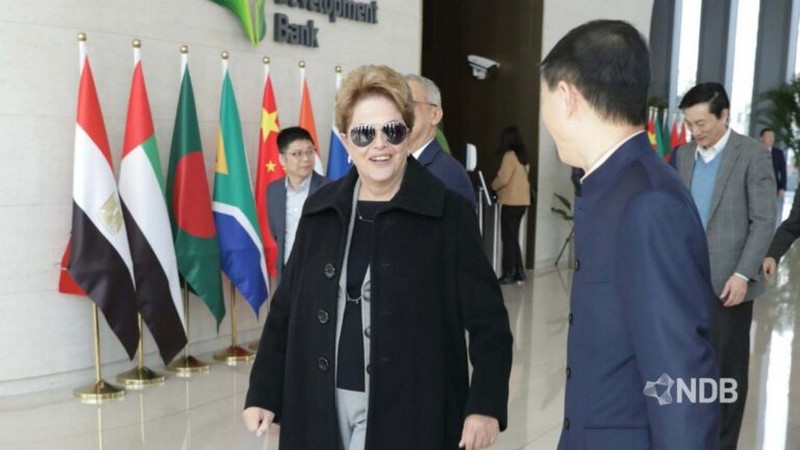
Lula went for the jugular right from the start, during the inauguration of former President Dilma Rousseff  as the new president of the NDB, the BRICS bank.

In simple, direct language that anyone from Sahara to Siberia can understand, Lula said, “Every night I ask myself why should every country need to be tied to the dollar for trade? Why can’t we trade in our own currencies? And why don’t we have the commitment to innovate?”

Directly implied is the fact that the expanding BRICS+ should design and promote its own currency (the long, complex process has already started), on top of allowing trade in national currencies.

Lula’s powerful message was addressed to the whole Global South. A Brazilian example is China’s ICBC setting up a clearing house in Brazil allowing direct yuan-real exchange.

It’s no wonder that the CIA official rag, the Washington Post, foaming at the mouth, immediately issued the Deep State verdict: Lula is not obeying the “rules-based international order” diktat.

That means the Deep State will come after Lula and his government – all over again, and will go no holds barred to destabilize it. Because what Lula said is exactly what Saddam Hussein and Colonel Gadaffi said – and tried to implement – in the past.

So Lula will need all the help he can get. Enter, once again, “Zhiyin”.

This is how Xi officially welcomed Lula in Beijing. Very few people around the world, non-Chinese, understand that when someone of Xi’s stature tells you, right in front of you, that you are “an old friend of China”, this is it.

All doors are open. They trust you, embrace you, protect you, listen to you, help you in times of need and will always do their best to keep the friendship close to their hearts.

And that ends, for now, our tale of “bosom friends” taking the road to Beijing. The BRICS friend certainly understood all there is to know. As for the NATOstan Little King dreaming of becoming a true sovereign leader, the moment of truth is knocking at his door.

Pepe Escobar, born in Brazil, is a correspondent and editor-at-large at Asia Times and columnist for Consortium News and Strategic Culture in Moscow.

17 April 2023

Source: www.transcend.org

BRICS Bank De-dollarizing, New Chief Dilma Rousseff Says

By Ben Norton

The new chief of the BRICS bloc’s New Development Bank, Brazil’s leftist ex-President Dilma Rousseff, revealed they are gradually moving away from the US dollar, promising at least 30% of loans in local currencies of members.

16 Apr 2023 – The new president of the BRICS Bank has revealed that the Global South-led bloc is advancing toward de-dollarization, gradually moving away from use of the US dollar.

The New Development Bank plans to give nearly one-third (30%) of its loans in the local currencies of the financial institution’s members.

Dilma Rousseff, the left-wing former president of Brazil, took over the leadership of the Shanghai, China-based New Development Bank (NDB) this March.

The NDB was created in 2014, by the BRICS bloc of Brazil, Russia, India, China, and South Africa, as a Global South-oriented alternative to the US-dominated World Bank, which is infamous for imposing neoliberal economic reforms on impoverished countries, which hinder their development.

In an interview with China’s major media outlet CGTN on April 14, Rousseff explained, “It is necessary to find ways to avoid foreign exchange risk and other issues, such as being dependent on a single currency, such as the US dollar”.

BRICS Bank is de-dollarizing, promises loans in local currencies to help Global South develop

“The good news is that we are seeing many countries choosing to trade using their own currencies. China and Brazil, for instance, are agreeing to exchange with RMB (renminbi) and the Brazilian real”, she said.

“At the NDB, we have committed to it in our strategy. For the period from 2022 to 2026, the NDB has to lend 30% in local currencies, so 30% of our loan book will be financed in the currencies of our member countries”, Rousseff added.

“That will be extremely important to help our countries avoid exchange rate risks and shortages in finance that hinder long-term investments”, the new NDB president stressed.

Members of the NDB not only include the founders of the BRICS but also Bangladesh, the UAE, and Egypt. Uruguay is likewise in the process of joining, and many other countries have expressed interest.

Argentina, Iran, and Algeria have formally applied to join the extended BRICS+ bloc, and according to the foreign minister of Russia, Sergei Lavrov, other nations that are interested “include Egypt, Turkey, Saudi Arabia, the United Arab Emirates, Indonesia, Argentina, Mexico, and a number of African nations”.

South Africa’s foreign minister, Naledi Pandor, revealed in January that BRICS plans to “develop a fairer system of monetary exchange” in order to weaken the “dominance of the dollar”.

“The systems currently in place tend to privilege very wealthy countries and tend to be really a challenge for countries, such as ourselves, which have to make payments in dollars, which costs much more in terms of our various currencies”, she said.

“So I do think a fairer system has to be developed, and it’s something we’re discussing with the BRICS ministers in the economic sector discussions”, Pandor added.

This April, Brazil’s current president, Lula da Silva, a fellow member of Dilma’s leftist Workers’ Party, took a historic trip to China, where he called to challenge US dollar dominance.

While in Shanghai, Lula was the first head of state to visit the NDB headquarters, where he attended the swearing in ceremony for Dilma.

Lula said the NDB’s goal is “creating a world with less poverty, less inequality, and more sustainability”.

He added that the bank should play a “leading role in achieving a better world, without poverty or hunger”.

Dilma also commented, “As a former president of Brazil, I know the importance of the work of multilateral banks to support developing countries, particularly NDB, in addressing their economic, social, and environmental needs”.

“Becoming the president of the NDB is undoubtedly a great opportunity to do more for the BRICS, the emerging markets, and developing countries”, she said.

In her interview with CGTN, Rousseff explained her goals with the BRICS Bank:

It is very important to me that New Development Bank, the bank of the BRICS, acts as the tool to support the development priorities of the BRICS and other developing countries.

We need to invest in projects that contribute to three fundamental areas:

First, we need to support the countries with regards to climate change and sustainable development goals.

Second, we should promote social inclusion at every opportunity we have.

And I believe we should finance their most critical and strategic infrastructure projects.

That said, we want to promote quality development.

Developing countries still don’t have the necessary infrastructure. They don’t have enough ports, airports, and highways to meet their needs. And many times, the ones they have are not adequate.

They still have to build alternatives and more modern models of transportation, for instance.

I see China, a country that has developed capability for alternative transportation at the scale and quality it needs.

NDB has to support the other countries to also build their quality infrastructure as well, like high-speed trains.

It is very important to invest in technology and innovation, invest in universities for example.

Our countries will not overcome extreme poverty if we don’t invest in education, science, and technology.

When asked what challenges the BRICS and NDB face, Rousseff replied:

The world now is under the threat of high inflation and restrictive monetary policy, particularly in developed countries.

Such monetary policy means a higher interest rate, and therefore a higher probability of reduction in growth and a higher probability of recession.

This presents an important question for the BRICS. We need a mechanism, a so-called anti-crisis mechanism, which must be counter-cyclical and support stabilization.

It is necessary to find ways to avoid foreign exchange risk and other issues, such as being dependent on a single currency, such as the US dollar.

The good news is that we are seeing many countries choosing to trade using their own currencies.

China and Brazil, for instance, are agreeing to exchange with RMB (renminbi) and the Brazilian real.

At the NDB, we have committed to it in our strategy. For the period from 2022 to 2026, the NDB has to lend 30% in local currencies, so 30% of our loan book will be financed in the currencies of our member countries.

That will be extremely important to help our countries avoid exchange rate risks and shortages in finance that hinder long-term investments.

Benjamin Norton is an investigative journalist, analyst, writer and filmmaker.

17 April 2023

Source: www.transcend.org

Why the Media Don’t Want to Know the Truth about the Nord Stream Blasts

By Jonathan Cook

First, journalists lapped up Russian culpability. Now they peddle a preposterous James Bond-style story. Anything to ignore the US role.

11 Apr 2023 – No one but the terminally naïve should be surprised that security services lie – and that they are all but certain to cover their tracks when they carry out operations that either violate domestic or international law or that would be near-universally rejected by their own populations.

Which is reason enough why anyone following the fallout from explosions last September that ripped holes in three of the four Nord Stream pipelines in the Baltic Sea supplying Russian gas to Europe should be wary of accepting anything Western agencies have to say on the matter.

In fact, the only thing that Western publics should trust is the consensus among “investigators” that the three simultaneous blasts deep underwater on the pipelines – a fourth charge apparently failed to detonate – were sabotage, not some freak coincidental accident.

Someone blew up the Nord Stream pipelines, creating an untold environmental catastrophe as the pipes leaked huge quantities of methane, a supremely active global-warming gas. It was an act of unrivaled industrial and environmental terrorism.

If Washington had been able to pin the explosions on Russia, as it initially hoped, it would have done so with full vigor. There is nothing Western states would like more than to intensify world fury against Moscow, especially in the context of NATO’s express efforts to “weaken” Russia through a proxy war waged in Ukraine.

Who Blew Up Nord Stream Pipelines? | A Mystery!

But, after the claim made the rounds of front pages for a week or two, the story of Russia destroying its own pipelines was quietly shelved. That was partly because it seemed too difficult to maintain a narrative in which Moscow chose to destroy a critical part of its own energy infrastructure.

Not only did the explosions cause Russia great financial harm – the country’s gas and oil revenues regularly financed nearly half of its annual budget – but the blasts removed Moscow’s chief influence over Germany, which had been until then heavily dependent on Russian gas. The initial media story required the Western public to believe that President Vladimir Putin willingly shot himself in the foot, losing his only leverage over European resolve to impose economic sanctions on his country.

But even more than the complete lack of a Russian motive, Western states knew they would be unable to build a plausible forensic case against Moscow for the Nord Stream blasts.

Instead, with no chance to milk the explosions for propaganda value, official Western interest in explaining what had happened to the Nord Stream pipelines wilted, despite the enormity of the event. That was reflected for months in an almost complete absence of media coverage.

When the matter was raised, it was to argue that separate investigations by Sweden, Germany and Denmark were all drawing a blank. Sweden even refused to share any of its findings with Germany and Denmark, arguing that to do so would harm its “national security.”

No one, again including the Western media, raised an eyebrow or showed a flicker of interest in what might be really going on behind the scenes. Western states and their compliant corporate media seemed quite ready to settle for the conclusion that this was a mystery cocooned in an enigma.

Isolated and friendless

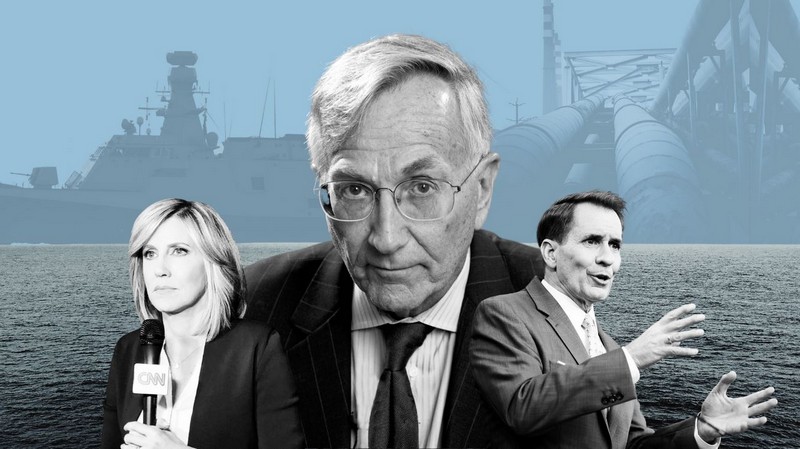
It might have stayed that way forever, except that in February, a journalist – one of the most acclaimed investigative reporters of the past half-century – produced an accountthat finally demystified the explosions. Drawing on at least one anonymous, highly placed informant, Seymour Hersh pointed the finger for the explosions directly at the US administration and President Joe Biden himself.

Hersh’s detailed retelling of the planning and execution of the Nord Stream blasts had the advantage – at least for those interested in getting to the truth of what took place – that his account fitted the known circumstantial evidence.

Key Washington figures, from President Biden to Secretary of State Anthony Blinken and his senior neoconservative official Victoria Nuland – a stalwart of the murky US, anti-Russia meddling in Ukraine over the past decade – had either called for the destruction of the Nord Stream pipelines or celebrated the blasts shortly after they took place.

If anyone had a motive for blowing up the Russian pipelines – and a self-declared one at that – it was the Biden administration. They opposed the Nord Stream 1 and 2 projects from the outset – and for exactly the same reason that Moscow so richly prized them.

In particular, the second pair of pipelines, Nord Stream 2, which was completed in September 2021, would double the amount of cheap Russian gas available to Germany and Western Europe. The only obstacle in its path was the hesitancy of German regulators. They delayed approval in November 2021.

Nord Stream meant major European countries, most especially Germany, would be completely dependent for the bulk of their energy supplies on Russia. That deeply conflicted with US interests. For two decades, Washington had been expanding NATO as an anti-Moscow military alliance embracing ever more of Europe, to the point of butting up aggressively against Russia’s borders.

The Ukrainian government’s covert efforts to become a NATO member – thereby destroying a long-standing mutual and fragile nuclear deterrence between Washington and Moscow – were among the stated reasons why Russia invaded its neighbor in February last year.

Washington wanted Moscow isolated and friendless in Europe. The goal was to turn Russia into Enemy No. 2 – after China – not leave Europeans looking to Moscow for energy salvation.

The Nord Stream explosions achieved precisely that outcome. They severed the main reason European states had for cozying up to Moscow. Instead, the US started shipping its expensive liquified natural gas across the Atlantic to Europe, both forcing Europeans to become more energy dependent on Washington and, at the same time, fleecing them for the privilege.

But even if Hersh’s story fitted the circumstantial evidence, could his account stand up to further scrutiny?

Peculiarly incurious

This is where the real story begins. Because one might have assumed that Western states would be queuing up to investigate the facts Hersh laid bare, if only to see if they stacked up or to find a more plausible alternative account of what happened.

Dennis Kucinich, a former chair of a US Congressional investigative subcommittee on government oversight, has noted that it is simply astonishing no one in Congress has been pushing to use its powers to subpoena senior American officials, such as the secretary of the Navy, to test Hersh’s version of events. As Kucinich observes, such subpoenas could be issued under Congress’s Article One, Section 8, Clause 18, providing “constitutional powers to gather information, including to inquire on the administrative conduct of office.”

Similarly, and even more extraordinarily, when a vote was called by Russia at the United Nations Security Council late last month to set up an independent international commission to investigate the blasts, the proposal was roundly rejected.

If adopted, the UN Secretary-General himself would have appointed expert investigators and aided their work with a large secretariat.

Three Security Council members, Russia, China and Brazil, voted in favor of the commission. The other 12 – the US and its allies or small states it could easily pressure – abstained, the safest way to quietly foil the creation of such an investigative commission.

Excuses for rejecting an independent commission failed to pass the sniff test. The claim was that it would interfere with the existing investigations of Denmark, Sweden and Germany. And yet all three have demonstrated that they are in no hurry to reach a conclusion, arguing that they may need years to carry out their work. As previously noted, they have indicated great reluctance to cooperate. And last week, Sweden once again stated that it may never get to the bottom of the events in the Baltic Sea.

As one European diplomat reportedly observed of meetings between NATO policymakers, the motto is: “Don’t talk about Nord Stream.” The diplomat added: “It’s like a corpse at a family gathering. It’s better not to know.”

It may not be so surprising that Western states are devoted to ignorance about who carried out a major act of international terrorism in blowing up the Nord Stream pipelines, considering that the most likely culprit is the world’s only superpower and the one state that can make their lives a misery.

But what should be more peculiar is that Western media have shown precisely no interestin getting to the truth of the matter either. They have remained completely incurious to an event of enormous international significance and consequence.

It is not only that Hersh’s account has been ignored by the Western press as if it did not even exist. It is that none of the media appear to have made any effort to follow up with their own investigations to test his account for plausibility.

‘Act of war’

Hersh’s investigation is filled with details that could be checked ­– and verified or rebutted – if anyone wished to do so.

He set out a lengthy planning stage that began in the second half of 2021. He names the unit responsible for the attack on the pipeline: the US Navy’s Diving and Salvage Center, based in Panama City, Florida. And he explains why it was chosen for the task over the US Special Operations Command: because any covert operation by the former would not need to be reported to Congress.

In December 2021, according to his highly placed informant, National Security Adviser Jake Sullivan convened a task force of senior administration and Pentagon officials at the request of Biden himself. They agreed that the explosions must not be traceable back to Washington; otherwise, as the source noted: “It’s an act of war.”

The CIA brought in the Norwegians, stalwarts of NATO and strongly hostile to Russia, to carry out the logistics of where and how to attack the pipelines. Oslo had its own additional commercial interests in play, as the blasts would make Germany more dependent on Norwegian gas, as well as American supplies, to make up the shortfall from Nord Stream.

By March last year, shortly after Russia’s invasion of Ukraine, the precise site for the attack had been selected: in the Baltic’s shallow waters off Denmark’s Bornholm Island, where the sea floor was only 260ft below the surface, the four pipelines were close together and there were no strong tidal currents.

A small number of Swedish and Danish officials were given a general briefing about unusual diving activities to avoid the danger that their navies might raise the alarm.

The Norwegians also helped develop a way to disguise the US explosive charges so that, after they were laid, they would not be detected by Russian surveillance in the area.

Next, the US found the ideal cover. For more than two decades, Washington has sponsored an annual NATO naval exercise in the Baltic every June. The US arranged that the 2022 event, Baltops 22, would take place close to Bornholm Island, allowing the divers to plant the charges unnoticed.

The explosives would be detonated through the use of a sonar buoy dropped by plane at the time of President Biden’s choosing. Complex arrangements had to be taken to make sure the explosives would not be accidentally triggered by passing ships, underwater drilling, seismic events or sea creatures.

Three months later, on September 26, the sonar buoy was dropped by a Norwegian plane, and a few hours later three of the four pipelines were put out of commission.

Disinformation campaign

The Western media’s response to Hersh’s account has perhaps been the most revealing aspect of the entire saga.

It is not just that the establishment media have been so uniformly and remarkably reticent to dig deeper into making sense of this momentous crime – beyond making predictable, unevidenced accusations against Russia. It is that they have so obviously sought to dismiss Hersh’s account before making even cursory efforts to confirm or deny its specifics.

The knee-jerk pretext has been that Hersh has only one anonymous source for his claims. Hersh himself has noted that, as with other of his famous investigations, he cannot always refer to additional sources he uses to confirm details because those sources impose a condition of invisibility for agreeing to speak to him.

That should hardly be surprising when informants are drawn from a small, select group of Washington insiders and are at great risk of being identified – at great personal cost to themselves, given the US administration’s proven track record of persecuting whistleblowers.

But the fact that this was indeed just a pretext from the establishment media becomes much clearer when we consider that those same journalists dismissive of Hersh’s account happily gave prominence to an alternative, highly implausible, semi-official version of events.

In what looked suspiciously like a coordinated publication in early March, The New York Times and Germany’s Die Zeit newspapers printed separate accounts promising to solve “one of the central mysteries of the war in Ukraine.” The Times headline asked a question it implied it was about to answer: “Who Blew Up the Nord Stream Pipelines?”

Instead, both papers offered an account of the Nord Stream attack that lacked detail, and any detail that was supplied was completely implausible. This new version of events was vaguely attributed to anonymous American and German intelligence sources – the very actors, in Hersh’s account, responsible both for carrying out and covering up the Nord Stream blasts.

In fact, the story had all the hallmarks of a disinformation campaign to distract from Hersh’s investigation. It threw the establishment media a bone: the chief purpose was to lift any pressure from journalists to pursue Hersh’s leads. Now they could scurry around, looking like they were doing their job as a “free press” by chasing a complete red herring supplied by U.S. intelligence agencies.

Which is why the story was widely reported, notably far more widely than Hersh’s much more credible account.

So what did the New York Times’ account claim? That a mysterious group of six people had hired a 50ft yacht and sailed off to Bornholm Island, where they had carried out a James Bond-style mission to blow up the pipelines. Those involved, it was suggested, were a group of “pro-Ukrainian saboteurs”– with no apparent ties to President Volodymyr Zelenskiy – who were keen to seek revenge on Russia for its invasion. They used fake passports.

The Times further muddied the waters, reporting sources that claimed some 45 “ghost ships” had passed close to the site of the explosion when their transponders were not working.

The crucial point was that the story shifted attention away from the sole plausible possibility, the one underscored by Hersh’s source: that only a state actor could have carried out the attack on the Nord Stream pipelines. The highly sophisticated, extremely difficult operation needed to be concealed from other states, including Russia that were closely surveilling the area.

Now the establishment media was heading off on a completely different tangent. They were looking not at states – and most especially not the one with the biggest motive, the greatest capability and the proven opportunity.

Instead, they had an excuse to play at being reporters, visiting Danish yachting communities to ask if anyone remembered the implicated yacht, the Andromeda, or suspicious characters aboard it, and trying to track down the Polish company that hired the sailing boat. The media had the story they preferred: one that Hollywood would have created, of a crack team of Jason Bournes giving Moscow a good slapping and then disappearing into the night.

Welcome mystery

A month on, the media discussion is still exclusively about the mysterious yacht crew, though – after reaching a series of dead-ends in a story that was only ever meant to have dead-ends – establishment journalists are asking a few tentative questions. Though, let us note, most determinedly not questions about any possible US involvement in the Nord Stream sabotage.

Britain’s Guardian newspaper ran a story last week in which a German “security expert” wondered whether a group of six sailors was really capable of carrying out a highly complex operation to blow up the Nord Stream pipelines. That is something that might have occurred to a less credulous newspaper a month earlier when the Guardian simply regurgitated the Times’ disinformation story.

But despite the security expert’s skepticism, the Guardian is still not eager to get to the bottom of the story. It conveniently concludes that the “investigation” conducted by the Swedish public prosecutor, Mats Ljungqvist, will be unlikely ever to “yield a conclusive answer”.

Or as Ljungqvist observes: “Our hope is to be able to confirm who has committed this crime, but it should be noted that it likely will be difficult given the circumstances.”

Hersh’s account continues to be ignored by the Guardian – beyond a dismissive reference to several “theories” and “speculation” other than the laughable yacht story. The Guardian does not name Hersh in its report or the fact that his highly placed source fingered the US for the Nord Stream sabotage. Instead, it notes simply that one theory – Hersh’s – has been “zeroing on a Nato Baltops 22 wargame two months before” the attack. 

It’s all still a mystery for the Guardian – and a very welcome one by the tenor of its reports.

The Washington Post has been performing a similar service for the Biden administration on the other side of the Atlantic. A month on, it is using the yacht story to widen the enigma rather than narrow it down.

The paper reports that unnamed “law enforcement officials” now believe the Andromeda yacht was not the only vessel involved, adding: “The boat may have been a decoy, put to sea to distract from the true perpetrators, who remain at large, according to officials with knowledge of an investigation led by Germany’s attorney general.”

The Washington Post’s uncritical reporting surely proves a boon to Western “investigators”. It continues to build an ever more elaborate mystery, or “international whodunnit,” as the paper gleefully describes it. Its report argues that unnamed officials “wonder if the explosive traces – collected months after the rented boat was returned to its owners – were meant to falsely lead investigators to the Andromeda as the vessel used in the attack.”

The paper then quotes someone with “knowledge of the investigation”: “The question is whether the story with the sailboat is something to distract or only part of the picture.”

How does the paper respond? By ignoring that very warning and dutifully distracting itself across much of its own report by puzzling whether Poland might have been involved too in the blasts. Remember, a mysterious Polish company hired that red-herring yacht.

Poland, notes the paper, had a motive because it had long warned that the Nord Stream pipelines would make Europe more energy dependent on Russia. Exactly the same motive, we might note – though, of course, the Washington Post refuses to do so – that the Biden administration demonstrably had.

The paper does inadvertently offer one clue as to where the mystery yacht story most likely originated. The Washington Post quotes a German security official saying that Berlin “first became interested in the [Andromeda] vessel after the country’s domestic intelligence agency received a ‘very concrete tip’ from a Western intelligence service that the boat may have been involved in the sabotage”.

The German official “declined to name the country that shared the information” – information that helpfully draws attention away from any US involvement in the pipeline blasts and redirects it to a group of untraceable, rogue Ukraine sympathizers.

The Washington Post concludes that Western leaders “would rather not have to deal with the possibility that Ukraine or allies were involved”. And, it seems the Western media – our supposed watchdogs on power – feel exactly the same way.

‘Parody’ intelligence

In a follow-up story last week, Hersh revealed that Holger Stark, the journalist behind Die Zeit’s piece on the mystery yacht and someone Hersh knew when they worked together in Washington, had imparted to him an interesting additional piece of information divulged by his country’s intelligence services.

Hersh reports: “Officials in Germany, Sweden, and Denmark had decided shortly after the pipeline bombings to send teams to the site to recover the one mine that has not gone off. [Holger] said they were too late; an American ship had sped to the site within a day or two and recovered the mine and other materials.”

Holger, Hersh says, was entirely uninterested in Washington’s haste and determination to have exclusive access to this critical piece of evidence: “He answered, with a wave of his hand, ‘You know what Americans are like. Always wanting to be first.’” Hersh points out: “There was another very obvious explanation.”

Hersh also spoke with an intelligence expert about the plausibility of the mystery yacht story being advanced by the New York Times and Die Zeit. He described it as a “parody” of intelligence that only fooled the media because it was exactly the kind of story they wanted to hear. He noted some of the most glaring flaws in the account:

‘Any serious student of the event would know that you cannot anchor a sailboat in waters that are 260 feet deep’ – the depth at which the four pipelines were destroyed – ‘but the story was not aimed at him but at the press who would not know a parody when presented with one.’

Further:

‘You cannot just walk off the street with a fake passport and lease a boat. You either need to accept a captain who was supplied by the leasing agent or owner of the yacht, or have a captain who comes with a certificate of competency as mandated by maritime law. Anyone who’s ever chartered a yacht would know that.’ Similar proof of expertise and competence for deep sea diving involving the use of a specialized mix of gases would be required by the divers and the doctor.

And:

‘How does a 49-foot sailboat find the pipelines in the Baltic Sea? The pipelines are not that big and they are not on the charts that come with the lease. Maybe the thought was to put the two divers into the water’– not very easy to do so from a small yacht – ‘and let the divers look for it. How long can a diver stay down in their suits? Maybe fifteen minutes. Which means it would take the diver four years to search one square mile.’

The truth is that the Western press has zero interest in determining who blew up the Nord Stream pipelines because, just like Western diplomats and politicians, media corporations don’t want to know the truth if it cannot be weaponized against an official enemy state.

The Western media are not there to help the public monitor the centers of power, keep our governments honest and transparent, or bring to book those who commit state crimes. They are there to keep us ignorant and willing accomplices when such crimes are seen as advancing on the global stage the interests of Western elites – including the very transnational corporations that run our media.

Which is precisely why the Nord Stream blasts took place. The Biden administration knew not only that its allies would be too fearful to expose its unprecedented act of industrial and environmental terrorism but that the media would dutifully line up behind their national governments in turning a blind eye.

The very ease with which Washington has been able to carry out an atrocity – one that has caused a surge in the cost of living for Europeans, leaving them cold and out of pocket during the winter, and added considerably to existing pressures that have been gradually de-industrializing Europe’s economies – will embolden the US to act in equally rogue ways in the future.

In the context of a Ukraine war in which there is the constant threat of a resort to nuclear weapons, where that could ultimately lead should be only too obvious.

Jonathan Cook is an award-winning British journalist based in Nazareth, Israel, since 2001.

17 April 2023

Source: www.transcend.org

The West Is Facing the Nightmare of Peace in the Middle East

By Vanessa Beeley

13 Apr 2023 – President Bashar Al Assad of #Syria during a meeting with US Peace Council delegation in July 2016 (I was present):

“The North Americans are so far up the lie tree, we have to find a way to allow them to come down without humiliating them.”

Macmillan Backed Syria Assassination Plot

Documents show White House and No 10 conspired over oil-fueled invasion plan

Nearly 50 years before the war in Iraq, Britain and America sought a secretive “regime change” in another Arab country they accused of spreading terror and threatening the west’s oil supplies, by planning the invasion of Syria and the assassination of leading figures.

Newly discovered documents show how in 1957 Harold Macmillan and President Dwight Eisenhower approved a CIA-MI6 plan to stage fake border incidents as an excuse for an invasion by Syria’s pro-western neighbours, and then to “eliminate” the most influential triumvirate in Damascus.

The plans, frighteningly frank in their discussion, were discovered in the private papers of Duncan Sandys, Mr. Macmillan’s defence secretary, by Matthew Jones, a reader in international history at Royal Holloway, University of London.

Although historians know that intelligence services had sought to topple the Syrian regime in the autumn of 1957, this is the first time any document has been found showing that the assassination of three leading figures was at the heart of the scheme. In the document drawn up by a top secret and high-level working group that met in Washington in September 1957, Mr Macmillan and President Eisenhower were left in no doubt about the need to assassinate the top men in Damascus.

Part of the “preferred plan” reads: “In order to facilitate the action of liberative forces, reduce the capabilities of the Syrian regime to organise and direct its military actions, to hold losses and destruction to a minimum, and to bring about desired results in the shortest possible time, a special effort should be made to eliminate certain key individuals. Their removal should be accomplished early in the course of the uprising and intervention and in the light of circumstances existing at the time.”

The document, approved by London and Washington, named three men: Abd al-Hamid Sarraj, head of Syrian military intelligence; Afif al-Bizri, chief of the Syrian general staff; and Khalid Bakdash, leader of the Syrian Communist party.

For a prime minister who had largely come to power on the back of Anthony Eden’s disastrous antics in Suez just a year before, Mr Macmillan was remarkably bellicose. He described it in his diary as “a most formidable report”. Secrecy was so great, Mr Macmillan ordered the plan withheld even from British chiefs of staff, because of their tendency “to chatter”.

Concern about the increasingly anti-western and pro-Soviet sympathies of Syria had been growing in Downing Street and the White House since the overthrow of the conservative military regime of Colonel Adib Shishakli by an alliance of Ba’ath party and Communist party politicians and their allies in the Syrian army, in 1954.

Driving the call for action was the CIA’s Middle East chief Kermit Roosevelt, grandson of former president Theodore Roosevelt. He identified Colonel Sarraj, General al-Bizri and Mr Bakdash as the real power behind a figurehead president. The triumvirate had moved even closer to Nikita Khrushchev’s orbit after the previous year’s disastrous attempt by Britain and France, in collusion with Israel, to reverse the nationalisation of the Suez canal.

By 1957, despite America’s opposition to the Suez move, President Eisenhower felt he could no longer ignore the danger of Syria becoming a centre for Moscow to spread communism throughout the Middle East. He and Mr Macmillan feared Syria would destabilise pro-western neighbours by exporting terrorism and encouraging internal dissent. More importantly, Syria also had control of one of the main oil arteries of the Middle East, the pipeline which connected pro-western Iraq’s oilfields to Turkey.

The “preferred plan”adds: “Once a political decision is reached to proceed with internal disturbances in Syria, CIA is prepared, and SIS [MI6] will attempt, to mount minor sabotage and coup de main incidents within Syria, working through contacts with individuals.

“The two services should consult, as appropriate, to avoid any overlapping or interference with each other’s activities… Incidents should not be concentrated in Damascus; the operation should not be overdone; and to the extent possible care should be taken to avoid causing key leaders of the Syrian regime to take additional personal protection measures.”

Sabotage

The report said that once the necessary degree of fear had been created, frontier incidents and border clashes would be staged to provide a pretext for Iraqi and Jordanian military intervention. Syria had to be “made to appear as the sponsor of plots, sabotage and violence directed against neighbouring governments,” the report says. “CIA and SIS should use their capabilities in both the psychological and action fields to augment tension.” That meant operations in Jordan, Iraq, and Lebanon, taking the form of “sabotage, national conspiracies and various strong-arm activities” to be blamed on Damascus.

The plan called for funding of a “Free Syria Committee”, and the arming of “political factions with paramilitary or other actionist capabilities” within Syria. The CIA and MI6 would instigate internal uprisings, for instance by the Druze in the south, help to free political prisoners held in the Mezze prison, and stir up the Muslim Brotherhood in Damascus.

The planners envisaged replacing the Ba’ath/Communist regime with one that was firmly anti-Soviet, but they conceded that this would not be popular and “would probably need to rely first upon repressive measures and arbitrary exercise of power”.

The plan was never used, chiefly because Syria’s Arab neighbours could not be persuaded to take action and an attack from Turkey alone was thought to be unacceptable. The following year, the Ba’athists moved against their Communist former allies and took Syria into a federation with Gen Nasser’s Egypt, which lasted until 1963.

Vanessa Beeley is a member of the TRANSCEND Network for Peace Development Environment.

17 April 2023

Source: www.transcend.org
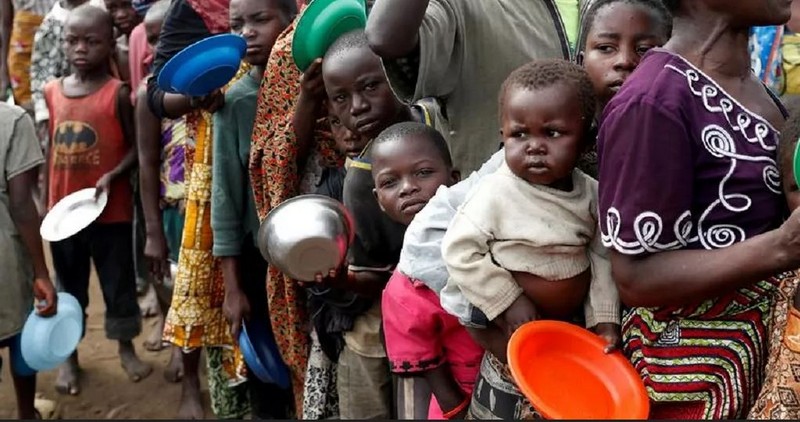
If the U.S. Can’t Boss the World, It Will Spitefully Destroy It

By Jeremy Kuzmarov

13 Apr 2023 – In May 2022, Henry Kissinger gave a remarkable speech at the World Economic Forum meeting in Davos, Switzerland, where he urged the Biden administration to seek a peace agreement in Ukraine that satisfies the Russians because “pursuing the war beyond this point would not be about the freedom of Ukraine but a new war against Russia itself.”

Kissinger in his speech further reflected back on his experience negotiating détente with Beijing in the 1970s, noting that the potentially adversarial aspect of the U.S.-China relationship should be mitigated and common interests should be pursued and upheld. “The U.S.,” he says, “must realize that China’s strategic and technical competence has evolved. Diplomatic negotiations must be sensitive, informed and unilaterally strive for peace.”

Kissinger was a hawk throughout his career, supporting escalation of the Korean and Vietnam Wars and, in 1957, publishing a book sponsored by the Council on Foreign Relations advocating for the utility of what he called “restricted nuclear war.”

Fashioning himself as a modern-day Metternich (Austrian practitioner of realpolitik), Kissinger raised the question in that book of whether the USSR “did not have more to lose from an all-out war than we did.” Be that as it may, he said, “our announced reluctance to engage in all out war gave the Soviet bloc a psychological advantage.”[1]

Kissinger’s change of face has unfortunately come too late to alter U.S. foreign policy.

At 99, he no longer has influence in Washington, which is dominated by neo-conservative and liberal war hawks who have grown ever more aggressive and reckless in provoking conflicts with two nuclear armed powers at the same time.

The country’s growing rapacious intent for war was apparent during the May 15, 2022, segment of NBC’s Meet the Press, which simulated a U.S. war against China over Taiwan.

Like a Cornered Dog with Sharp Teeth

Monthly Review has published an important new book, Washington’s New Cold War: A Socialist Perspective, that helps place Washington’s increasingly dangerous and reckless foreign policies in historical context.

A key theme is that Washington is behaving like a wounded and cornered dog with sharp teeth.

With its economy reeling, the country’s oligarchic elite is increasingly nervous and jealous about a rising China and its alliance with Russia.

Growing Eurasian integration further threatens to undercut American influence and power in a region that imperial planners believe the U.S. needs to control to achieve global domination.

Following the end of the Cold War, defense intellectual Paul Wolfowitz drafted an influential policy blueprint (“Defense Policy Guidance”) that considered expanding U.S. military power into the former Soviet Union’s sphere of influence and saw weakening Russia as key to establishing a unipolar world order led by the U.S.

The integration of Ukraine into the North Atlantic Treaty Organization (NATO) and Western sphere was to be the culmination of this project, which has been thwarted to a large extent by Vladimir Putin and his nationalistic policies.

Regime-Change Russia, Target China

John Ross, a senior fellow at Chongyang Institute for Financial Studies, Renmin University of China, emphasizes in his essay in Washington’s New Cold War that the U.S. lured Russia into a conflict in Ukraine by launching a coup d’état in February 2014 against a democratically elected pro-Russian leader and then building up Ukraine’s military as it attacked the people of eastern Ukraine who were more oriented toward Russia and strove for autonomy.

The Ukrainians have been used as cannon fodder by the U.S., whose overarching aim is to weaken Putin’s regime by a) bogging him down in a quagmire; b) ratcheting up sanctions that ruin Russia’s economy; and c) sustaining an information war directed against him.

Ideally, as the Russian people rise up, the U.S. could help “install a government in Moscow which no longer defends Russia’s national interests [like that led by Mikhail Gorbachev and Boris Yeltsin]—and one which is hostile to China and subordinate to the U.S.”[2]

“If that were achieved,” Ross writes, “not only would China face a greatly increased military threat from the U.S., but its long northern border with Russia would become a strategic threat.”

Following this up, Ross quotes Sergei Glazyev, a Russian commissioner on the executive body of the Eurasian Economic Union, who said: “After failing to weaken China head-on through a trade war, the Americans shifted the main blow to Russia, which they see as a weak link in the global geopolitics and economy. The Anglo-Saxons are trying to implement their eternal Russophobic ideas to destroy our country, and at the same time to weaken China, because the strategic alliance of the Russian Federation and the PRC is too tough for the United States.”

Old Cold War Versus New

Ross interestingly compares the economic and military positions of the U.S. during what he calls the “old Cold War,” lasting roughly from 1946 to 1991, to the “new Cold War” in the present.

In 1950, the U.S. accounted for 27.3% of world Gross Domestic Product (GDP) compared to 9.6% for the Soviet Union. Today, the figure is between 15 and 25%. China’s economic growth has for some time been much faster than that of the U.S. and its economy is already 18% larger than the U.S. and projected to be 35% larger by 2026.

China is now the world’s largest manufacturing power with a share of global manufacturing 70% larger than the U.S. In 2021, China’s trade in goods outpaced the U.S. by 31% and its exports were 91% higher.

The U.S. is now far in the lead in only one area—military spending.

And U.S. leaders appear increasingly willing to unleash the military because they cannot accept a new multipolar world order in which the U.S. is not the pre-eminent economic power.

The sabotage of the Nord Stream II pipeline is an example of the terrorist tactics adopted by the Biden administration to try to sustain U.S. economic pre-eminence. With Russia’s economy cut off from Germany, Ross points out that, by 2026, the U.S. is expected to become Germany’s top liquefied natural gas supplier.

Who Is Leading the United States to War?

Deborah Veneziale’s essay, “Who is leading the United States to war,” includes an interesting discussion of the class interests driving aggressive U.S. policies in the new Cold War.

A Venice-based journalist, Veneziale suggests that the majority of America’s business elite seeks the overthrow of the Chinese communist government and its replacement with a neo-liberal one that would allow for greater U.S. economic penetration of China.

U.S. tech giants such as Google, Amazon, IBM and Facebook are particularly hostile to China where they have virtually no market, but would like to obtain one under a new regime.

Veneziale writes that “Eric Schmidt, the former CEO and Executive Chairman of Google, led the establishment of the U.S. government’s Defense Innovation Unit in 2016 and the National Security Commission on Artificial Intelligence in 2018. His fervent promotion of the ‘China threat’ theory reflects the prevailing opinion of the U.S. tech community, which also shapes public discourse.”

According to Veneziale, many of the Big Tech companies have formed close bonds with the U.S. military, signing thousands of contracts worth tens of billions of dollars in recent decades while also collecting data in the vast U.S. intelligence empire. Consequently, they are keen to embrace gargantuan military and intelligence agency budgets that are justified under the guise of the New Cold War.

The weakening of domestic resistance to U.S. militarism has resulted from the abolition of the draft and distancing of war from the public because of the reliance on private military contractors and sophisticated military technologies like drones. Of the more than 241,000 people killed in Afghanistan between 2001 and 2021, only one percent were U.S. military personnel.

Trump and other Republicans have effectively directed the lower-middle class’s resentment of the deteriorating economic and political situation toward China, whereas Obama, Clinton and Biden and the Democrats have done the same with the upper-middle class and Russia. The political climate in the U.S. increasingly resembles the McCarthyist period of the 1950s consequently, and in certain ways that of Germany in the early 1930s.

Notes on Exterminism

The final essay in Washington’s New Cold War is by Monthly Review editor John Bellamy Foster, who warns of the twin threats of climate catastrophe and nuclear armaggedon that 21st century capitalism has produced.

Foster reminds readers of the prognosis by scientists in the early 1980s that, if nuclear weapons were again unleashed, they could reduce the Earth’s temperature considerably by causing mega-fires in cities that would release soot and smoke into the atmosphere, which would block solar radiation in a process known as nuclear winter.[3]

The fear of this coming to pass had helped to ignite a strong movement to dismantle nuclear weapons in the 1970s and 1980s that is urgently needed today—as the U.S. government embarks on a massive expansion of its nuclear weapons program and tears up nuclear arms control agreements, like the Intermediate Range Nuclear Forces (INF) Treaty that Donald Trump abrogated in 2019.

The Biden administration, like its predecessors, is committed to nuclear dominance over Russia and China and threatens nuclear first-use to decapitate its rivals’ arsenals.

This has prompted Russia and China to push ahead of the U.S. in the development of hypersonic missiles that can maneuver aerodynamically, and anti-satellite counterspace weapons designed to remove the U.S. advantage of high precision nuclear and non-nuclear weapons.

According to Foster, the search for nuclear primacy is leading to an insane arms race that threatens global omnicide—a threat magnified by U.S. interference in Ukraine and Taiwan.

The only solution that he sees is a socialist revolution that would establish a government not beholden to a tiny elite intent on sustaining its enormous wealth and privilege no matter what the human cost.

NOTES:

  1. Henry A. Kissinger, Nuclear Weapons and Foreign Policy, foreword by Gordon Dean, published for the Council on Foreign Relations (New York: Harper Brothers, 1957), 43, 47, 49.
  2. Alexei Navalny has been fingered as Putin’s hoped-for replacement, though he has very limited popular support within Russia and is a crook, so they had to concoct a fake story of him being poisoned and turn him into a martyr by having him sent to jail as a “political prisoner.”
  3. Foster discusses how the power elite in the U.S. saw warnings about a nuclear winter as a direct attack on the nuclear armaments industry and Pentagon, and efforts of the Reagan administration to create a space-based nuclear defense shield known as Star Wars. They responded by engaging in a campaign of denialism similar to the later campaign denying the existence of global warming.

Jeremy Kuzmarov is Managing Editor of CovertAction Magazine and author of four books on U.S. foreign policy, including Obama’s Unending Wars (Clarity Press, 2019) and The Russians Are Coming, Again, with John Marciano (Monthly Review Press, 2018).

17 April 2023

Source: www.transcend.org